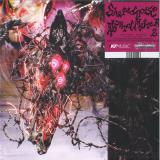
A central figure in the contemporary scene, Setaoc Mass delivers five tracks of intimidatingly dystopian techno for Fuse's next release. Synth-heavy and melodically focused, the UK native brews moody tones over his signature percussion to provide a touch of improvisation for balance. In Static Rush, genres and influences collide under the persistence of concrete club music.
A haunting synth sequence opens FUSE10 with 'The Sky Above', showcasing Setaoc Mass's intentions for the rest of the release. Playing with decay and sifting through shakers, the seasoned producer fills the spectrum with constant tension throughout the entirety of the A1. In 'Shaded', whipping white noise over sixteenth synth notes, the pressure rises and falls with whistling accents on the transitions. Keeping the dancer on their toes with a lively arrangement, Setaoc Mass keeps his hands on all elements to maximise the record's progression. Moving to the B side, Feeling blends harmony and robust tone. Claps thunder through the track's warehouse acoustics, complemented by a sharp lead cutting through a heavy low end. The structure remains elusive and quick like the previous two, and it boasts a full, grinding sound destined for peak-time sets.
The end of Feeling then dips down into a two-track journey of ethereal sound designs and soft melodies. Keeping the rhythm swinging, Flutter By settles the atmosphere with an IDM-inspired iced synth and pads. This change of emotion pushes depth into the record, providing a welcome surprise in Static Rush. Setaoc Mass then signs off with the final contribution to the EP, Overload. Pushing further than ever into melody with hints of Detroit electro and a complete absence of a kick, the producer teases a slithering arrangement that ends his record with a bold conclusion.
Поиск:rhythm central
Все
Deruta Records opens its catalog with “Dela Secu” ,a two- track EP from acclaimed Romanian producer Cezar Lazar. The EP stands out as a musical manifesto, challenging the techno-house scene’s drift into mainstream quicksand.
“Solo 2305” introduces the EP with orchestral strings and a polymetric woodwind theme anchored by a steady groove, crafting a soundscape where tension and release unfold with precision. The woodwinds’ evolving motif lends a lyrical contour that completes the arrangement. “Yaka Yaka” turns toward intricate syncopations, its rhythmic complexity enriched by subtle orchestral inflections. A central polyrhythm drives the track, heightening its tension while adding depth to the groove.
Mastered by Vlad Caia and cut to lacquer by Mike Grinser, the tracks are crafted for the dancefloor, shaped by Cezar’s signature lyrical motifs that define his standing in minimal and experimental techno.
This debut sets the tone for Deruta Records: boundary- blurring and unapologetically underground.
Arriving two years after the first chapter, Absurd Matter 2 isn’t just a sequel, it’s an evolution, redrawing the boundaries established by its acclaimed predecessor. The Berlin-based Italian producer tempers his confrontational sonics with rare moments of introspection, shifting seamlessly between blown-out noise, warped hip-hop, mutant club experimentation, and weightless ambience. Textures disintegrate and reassemble, rhythms flex and crumble, and every detail balances on the edge of fantasy. It’s a poetic, layered response to Nino Pedone’s changing physical reality: the gradual hearing loss and perceptual renegotiation triggered by Ménière’s disease, which struck him in 2022. At first, the experience felt like betrayal, a brutal disconnection from the very sense that had shaped his life. But over time, the disorientation turned into a strange kind of focus. The silence between sounds became as expressive as the sounds themselves.
The first Absurd Matter was a visceral reaction to trauma; the second is more reflective – an ambiguous chronicle of sensory recalibration. Pedone doesn’t represent his altered inner reality through extremes, but through depth, zooming in on illusory distortions, tense rhythmic fluctuations, and fragmented sonics. Dense, immersive, and mystical, the album mirrors Pedone’s evolving relationship with perception itself.
Tinnitus-like feedback wails and noir-ish strings introduce “Repeater”, making it immediately clear that Pedone is painting a more delicately finessed image this time around. Fleshed out by raps from cult MCs billy woods and E L U C I D, the track is marked by subtle, sophisticated contrasts: the blurred, inverted rhythms that couch Armand Hammer’s haunted back-and-forth, and the glitchy interference that offsets the lavish orchestral phrases. Backwoodz associate Fatboi Sharif lends his Lynchian drawl to “Bandage Chipped Wings”, grounding Pedone’s lysergic rhythmic distortions with syrupy, horror-inspired couplets. Pedone also invites discomfort into “Crash Landing”, with droning, metallic tones that contradict South Central rapper ICECOLDBISHOP’s elastic flow. “Bitch, I don't give a fuck about anybody,” he squawks over Pedone’s incongruous rasping textures and time-warped beats, “cash out at any party.” Working alongside London’s Loraine James on production, Pedone reunites with Moor Mother on “I Saw The Light”, blending James’ soft-focus atmospherics with soundsystem-damaging, overdriven bass hits and rusted percussive snips. Moor Mother’s assertive words hover over the wreckage, tightening Pedone’s themes of overstimulation and altered awareness as they stutter and veer off course, vanishing into the backdrop.
Contrasting his more pensive experiments, Pedone’s dancefloor deviations are more concentrated on Absurd Matter 2 than ever before. He torches a stuttering dembow structure on “X”, obfuscating the rhythm’s familiar energy with disturbing audio hallucinations. On “Splintered”, he reunites with Kenyan prodigy Slikback, mangling neon-lit trance arpeggios with dissociated trap rhythms. He sharpens his skills to a fine point on “Oblivion Step”, observing 2- step through a lens of distortion and personal abstraction, shaking blipping synth leads over neck-snapping drums and counteracting the momentum with airless sci-fi soundscapes.
Perhaps the album’s most surprising moment arrives with “Viel”, which features vocals from Los Angeles-based composer Kaitlyn Aurelia Smith. Together, Pedone and Smith chance upon their notion of dub techno, fogging synth stabs and ghostly vocal traces into eerie harmonic distortions. On some level, it’s almost pop music, a far cry from the bleak dissonance of Absurd Matter and a hopeful way to reframe turbulence as transformation. Absurd Matter 2 doesn’t simply document a process; it enacts one. It doesn’t offer clarity; it invites disorientation. It’s not a map of the labyrinth, but a foghorn piercing the darkness.
When it comes to Latin soul, Bobby Matos And The Combo Conquistadores 'Tema De Alma Latina', has to be up there as one of the heaviest tracks ever recorded. This much-loved Latin workout has been rocking dancefloors for years with its infectious, driving energy and pulsating rhythms. Released in 1968, the 'My Latin Soul' album on Philips Records now receives a welcome reissue on Mr Bongo. It’s a sheer delight throughout and a premier example of the Nu Yorican sound that was thriving in New York in the ‘60s.
From a young age, the Bronx, New York-born Latin jazz percussionist Bobby Matos found inspiration through the conga drum masters Mongo Santamaría and Patato Valdez (who he had informal backstage lessons with) and timbales legends Willie Bobo and Tito Puente. Bobby was drawn into New York's club scene and began playing in the vibrant ‘60s beat / bohemian Greenwich Village cafes, followed by stints in a wide range of different venues. These included Bronx dance halls and after-hours clubs in El Barrio, through to the elegance of Carnegie Hall, Central Park concerts, and off-Broadway theatres.
Later relocating to Los Angeles, Bobby played an important role in spreading Latin music far and wide. He became an inspiration to many on the jazz dance and acid jazz scenes in the ‘80s / '90s where his recordings were picked and played, becoming prized collector items amongst DJs. The track 'Tema De Alma Latina' was immortalised as a classic for many, after being featured on the Gilles Peterson’s Street Sounds Jazz Juice 5 compilation in 1987. A captivating listen from start to finish, the album features other treats such as the dynamic album opener ‘Nadie Baila Como Yo’, the blazing flute led 'Mambo Maxims', and the blistering piano shuffler 'Raices'.
A truly iconic Latin classic whether you’re being reunited with it like an old friend or discovering it as a fresh new find.
Formed by George Thompson, Kyle Martin and Jonathan Nash, Kommune were active between 2014-2015. As close friends living near each other, their musical journeys were intertwined; Nash and Martin had recently completed their debut album as Land Of Light, while Thompson (aka Black Merlin), at that time putting the finishing touches to his debut album ‘Hipnotik Tradisi’, was also working with Martin as part of the duo Spectral Empire. Sharing equipment and ideas, Kommune arose organically, serving as a creative outlet for exploring analogue machine music in an improvisational context.
Sessions in their North London studios led to a handful of gigs at venues including Hamburg’s legendary Golden Pudel and London’s LN-CC. This fleeting chapter of musical history may well have gone entirely undocumented had it not been for the fortuitous decision to meet up for a recording session in October 2014. Filling a car with their machines, they drove to a converted barn in the south of England, proceeded to set up, settle in and hit the record button. Over the course of two days, fuelled by the experiences of recent performances, the trio immersed themselves in the machines, crafting subtly evolving, long-form compositions with an enchanting balance and flow.
Across the four long-form compositions that make up ‘Oast’, the trio summons barely controllable scrapes, acid-like bubbles, and bleeps from their machines, leaning on dub mixing techniques to give the tracks a sense of depth, dynamism and organic ambience. Mastery of the TR-808 drum machine is central, with remarkably nuanced drum programming imparting a hypnotic rhythm to the work, allowing other elements to emerge and unfold at a beautifully measured tempo.
Recorded entirely live and improvised without any overdubs, ‘Oast’ offers a profound journey into minimalist electronic music while serving as a tribute to friendship, curiosity, and the spirit of experimentation.
Sleeve art and design by Michael Willis.
Evighet proudly unveils its fifth release, EVIGHET005, featuring the Sky City EP by Dave N.A., the prolific producer from Yerevan known for his refined sound design and emotionally resonant compositions. With a catalog that spans labels such as Typeless Records and Uppers & Downers, his work continues to bridge precision and sensitivity, exploring the borders between rhythmic architecture and ambient introspection. On Sky City EP, Dave N.A. constructs an intricate sonic landscape where lush atmospheres coexist with fractured breaks and IDM-inspired rhythms. Rooted in the traditions of Jungle and Breakbeat yet unbound by genre, each piece reveals a narrative built from texture, movement and space. His music invites reflection while maintaining a dynamic forward energy, evoking the sense of motion through memory and dreamlike transitions. A central moment in the release is “Bloom”, which features a collaboration with Hayk Karoyi on flute. His performance adds an organic depth and melodic fluidity, weaving through electronic layers with warmth and clarity. The result is a delicate interplay between human breath and machine pulse, blurring the boundary between the natural and the synthetic. Sky City EP marks a new chapter for Evighet, reaffirming the label’s dedication to sound as a medium of exploration and storytelling. Through this release, Dave N.A. captures both emotional immediacy and compositional detail, expanding the label’s evolving narrative with a vision that feels deeply personal yet universally resonant.
- A1: Wulomei – Takoradi
- A2: Conjunto Ana N’gola – Puxa Odoette
- A3: Zeal Onyia & His Music – Egbe Ne Lueli
- A4: Los Corraleros De Majagual – Remanga
- A5: Aquí Suena – Abel Llinas
- B1: Peacocks International Highlife Band – Igbala Oso
- B2: Pedro Lima Et L’orchestre Os Leonenses – Philomene
- B3: The Shoe Laces – Isitha Somunthu
- B4: Claudio Y Su Combo – Como Sea
- B5: Pa’ Entro Mi Gente – Ángelo El Auténtico
- C1: Zaire – I’m Tired Of Living In The Shack
- C2: Afous - Anavdhou (Edna Martinez Extended Edit)
- C3: Zaïko Langa Langa – La Tout Neige (Edna Martinez Edit)
- C4: Erick Cosaque Et Les Voltage 8 – Ajaccio (Edna Martinez Remix)
- C5: Picó Sin Fronteras – Abel Llinas
- D1: La Calandria – Como Duele Una Traición
- D2: African System International – Amina
- D3: Carlos Díaz Y Su Orquesta – Tres Meses De Vida
- D4: No Puedes Conmigo – Ángelo El Auténtico
Berlin-based Colombian DJ, producer, and curator Edna Martinez presents a sonic journey into the electrifying world of Picó—the vibrant and dynamic sound system culture that has defined the streets of Cartagena and Barranquilla for decades. More than just a musical movement, Picó is a way of life, a bold expression of identity, community, and resistance. From its roots in the working-class neighbourhoods of Colombia’s Caribbean coast to its deep connections with Africa and the Caribbean, this compilation captures the pulse of a culture where music is played at full volume, rhythms travel across oceans, and dance is both a form of celebration and storytelling. For those unfamiliar, Picós are hand-painted sound systems, often adorned with dazzling colours and striking imagery, each with its own name and sonic identity. These mobile discos became the heart of neighbourhood bailes, where the sounds of champeta, highlife, soukous, mbaqanga, zouk, soca, and cumbia would turn every street corner, market, and terrace into a dancefloor. Initially built by local craftsmen using modified speaker components, Picós became legendary for their powerful bass and exclusivity, with DJs sourcing rare vinyl from African and Caribbean ports and rebranding them with unique piconemas—new names adapted to local slang, making the tracks instantly recognisable within the community.
This compilation brings together a carefully curated selection of these rare and sought-after tracks, tracing the deep-rooted musical exchanges between Colombia, West and Central Africa, and the Caribbean. Featuring artists like Los Corraleros De Majagual, Peacocks International Highlife Band, Pedro Lima, Zaïko Langa Langa, and more, the album also includes edits by Edna Martinez, reimagining these timeless rhythms for contemporary audiences while staying true to their original spirit.
Strut presents ‘Picó! Sound System Culture From The Colombian Carribbean’ across 2LP Vinyl, 1CD & Digital focusing on a celebration of the raw, undiluted energy of Picó culture. Through Edna Martinez’s curation, and extensive liner notes, this compilation offers a powerful and authentic glimpse into one of the most vibrant musical traditions of the Colombian Caribbean
Ed. of 300, each in a unique printed sleeve
747's latest LP, 'Pacific Spirit' arrives in a limited vinyl edition of 300, each housed in a one of one unique cover, created with code by 747 and Emily Nicoll.
His first full-length since 2019, the album pushes his acid-rooted sound into jungle territory. Lush, atmospheric, and rhythmically agile, it builds on the luminous emotion of Aurora Centralis while exploring deeper, more expansive sonic ground.
EP 1[25,17 €]
12" GREEN Color Vinyl / With Black Solid Jacket and Large Sticker
The Unofficial Edits & Overdubs by Joaquin Joe Claussell
Finally comes the first of a two-part forthcoming EP's, Extended Versions taken from the highly successful Joe Claussell Afro Edits & Overdubs Series previously released on LP and CD.
Influence of hallucinations induced by chewing roots from the iboga plant on the works of Joaquin Joe Claussell's Edits & Overdubs IBOGA Compilation. The iboga plant is indigenous to the humid, tropical climates of West Central Africa, including Gabon, Cameroon, Congo, and Angola, which are home to the 2nd largest rainforest in the world. It has been used for centuries in spiritual initiation ceremonies and practices, particularly by the Bwiti tradition and religion in Gabon.
Joaquin Joe Claussell was inspired by these influences and went into the studio to create a compilation of edits and overdubs of African vibrational sounds and rhythms. The result is a collection of nine compositions that showcase the future possibilities of this influential work.
Tested for months on dance floors across the globe every on this complication are sure to continue setting dance floors on fire where ever spun.
Extended Versions Cuts Taken Limited Vinyl EP featuring selected cuts from the compilation. Listen loudly and enjoy the experience!
Thank You for Listening
XTRICTLY ELEKTRO returns with Volume 2, further establishing its vision of innovative and forward-thinking Electro. Featuring six producers with razor-sharp sound design and solid trajectories across the international circuit, this collective work reinforces Cosmic Tribe’s commitment to rhythmic synthesis, harmonic tension, and the structural discipline of the genre — unafraid to step outside orthodoxy.
EC13 opens the release with another chapter of his retro-futurist signature, marked by strong conceptual intent and cinematic pulse.
Spectrums Data Forces, a side project of C-System, brings the most technical edge from southern Spain, blending depth, precision, and modular design.
Atix, hailing from Lyon, contributes decades of refined energy and craftsmanship, always with a club-oriented focus.
On the B-side, Calagad 13 returns with a deep, introspective electro bass cut, reaffirming his role as a central sonic pillar of the series.
Final Dream, one of Phil Klein’s aliases, delivers a powerful piece built on heavy low-end and epic atmospheres, in line with his legacy as a key figure in UK Electro.
Elektrotechnik, a German producer, closes the release with an industrial-leaning, bold, and uncompromising statement.
Six exclusive tracks showcasing the genre’s vitality and the diversity of creative visions driving its continuous evolution.
Limited to 150 copies.
The latest transmission on Samurai tunes into half-time intensity with a psychedelic edge courtesy of leading French practitioner Vardae. Applying techno hypnotism and cinematic atmospheres to his snaking beat constructions, the Lyon-based artist delivers a pitch-perfect exercise in mystical meditation that follows a natural path from the Ancestral Voices LP.
Since first emerging around 2017, Vardae has been determined to establish a sound unbound by genre restrictions. To date he's successfully moved between cult labels such as Non Series and Ooda while pivoting from linear 4/4 to crooked broken beat without disrupting his immersive, finely sculpted production style.
Alongside his releases, Vardae is also responsible for the ouroboros festival that takes place every year in central France. Last summer, after the dancefloor closed on the final night of the the event, fabled Dutch transcendental ambient group Son Of Chi made an acoustic concert around the campfire that cast a spell over everyone present. This experience formed the inspirational basis for Vardae's new EP, drawing on the instinctive power of insistent rhythm and the spiritual intrigue that lies behind subtly dissonant tones - shadows cast by refined, restrained synthesis flickering in the imagined light of the flames.
From the rattle of timbale on 'The Light Motion' to the laser-focused ripples that charge through 'Voices Of Dispossession', Vardae bends and shapes his drum work with exacting intention across this EP. Treading the line between 85 and 170BPM, he approaches fierce peaks in his tracks with an exacting patience, building to the arp-soaked climax of 'Flaming As A Cloud' and its ecstatic, melodic crescendo.
Proudly individual and drawing from the deepest of musical experiences, Vardae's latest statement promises similarly profound moments when these pieces come into contact with the right souls and the right sound in the right setting.
MARTHIAL joins NECHTO with ‘NECH029’, a four-track vinyl release blending tradition and futurism. The record pays homage to a genre central to MARTHIAL’s imagination, drawing on its history to shape a forward-thinking sonic vision. The Milan-born and -based artist describes the EP as “a reflection on change: everything transforms, everything evolves, and we are tasked with finding harmony between what has been and what could be”.
Born Alessandro Vaccari, MARTHIAL is a DJ, producer, and founder of Milan’s independent cultural hub, the Tempio del Futuro Perduto. Through this unique space and his 24/H Records label, MARTHIAL has collaborated with influential artists like Stanislav Tolkachev and Fabrizio Rat. His music evokes ethereal atmospheres and hypnotic rhythms, bridging Detroit-inspired soundscapes with innovative, interstellar journeys.
The EP represents a personal journey for MARTHIAL, who describes the process of revisiting this sonic language as an opportunity to redefine himself and his perspective on the world. By channelling the past as a guide and embracing the future as a responsibility, he crafts a cohesive narrative that combines deep emotional resonance with forward-thinking energy.
‘NECH029’ is a cohesive exploration of these elements, delivering pulsating energy and emotional depth across its four tracks: ‘Don’t Wanna’, ‘Soul Groove’, ‘The Dancer Gift’, and ‘Infinito Imperfetto’.
The album’s title deftly gestures to the sheer vastness of astronomical dimensions, while simultaneously capturing the musical breadth within, where the eight planets are imagined as the eight notes of an octave. The work draws inspiration not only from earlier compositions —most notably Gustav Holst’s The Planets—but also from the rich astronomical and cultural contexts surrounding these celestial bodies. Here, the focus transcends direct citation of melodic motifs, instead embracing an intriguing conceptual approach on a meta level, unfolding in a series of vividly contrasting soundscapes. These contrasts shape a sweeping sonic journey, one that fully embraces the album format with both arms, inviting the listener to venture into realms both strange and wondrous, feeling the immensity of the interstellar space that lies between them. Contrast, after all, is the brushstroke that enriches our world.
Embarking on an auditory voyage, "Astral Guide" establishes the sonic framework that propels us into the boundless expanses of the cosmos. Its ethereal tones evoke the vastness of space, crafting a mood ripe for exploration within the realms of sci-fi. The subsequent tracks unfold like constellations, weaving a rich tapestry of sound that seamlessly marries cinematic soundscapes with pulsating, club-oriented rhythms. This album invites listeners to traverse its immersive landscapes, whether nestled in the comfort of home or dancing under the starlit sky, each note a guide through the transcendent experience of a nocturnal journey.
"Solar Flares" draws its inspiration from the awe-inspiring expanse of solar phenomena, capturing the majestic power of the sun as it reaches into the cosmos. This track resonates with the idea that energy, while vital, can also be a force of destruction when unleashed with overwhelming intensity. The composition beautifully mirrors the sun’s duality, where brilliance and devastation coexist, inviting listeners to reflect on the delicate balance between creation and annihilation. Through its rich textures and dynamic shifts, "Solar Flares" serves as both a homage to the celestial and a poignant reminder of nature's formidable power.
"Mercury – The Winged Messenger" embodies a meticulously crafted soundscape where artistry meets astronomy. The tempo of 173.6 BPM, derived from precise astronomical data, propels the composition into a vibrant realm that resonates with cosmic energy. Synthwave sound design intertwines seamlessly with the fluid rhythms of Drum’n’Bass, imbuing the piece with an uplifting dynamism that evokes the ethereal grace of Mercury itself. In this sonic exploration, listeners are invited to ascend on wings of sound, navigating the celestial tapestry of the universe with each invigorating beat.
"Venus, The Bringer of Peace" strikes a decidedly cozy note, presenting a poignant contrast to the more tempestuous themes often found in cosmic narratives. This composition evokes a nostalgic vision of an optimistic era, one in which humanity transcended borders and embraced the infinite possibilities of space exploration, where no destination felt too distant. The dense, languid atmosphere envelops the listener, creating a tangible sense of serenity that unfolds gradually, allowing for a meditative journey through sound. Each note serves as an invitation to linger in this tranquil embrace, reflecting on the harmonious potential of our collective aspirations and the beauty of connection in a vast universe.
The central theme of „Gaia, The Bringer of Life“ —originally not part of the planetary cycle— is the profound enabler of life on Earth. The arrangement delicately mirrors the slow, tentative unfolding of this potential, marked by an initially sparse orchestration that gradually builds in momentum. This progression crescendos, embodying the explosive dynamism of the Cambrian burst of life, ultimately culminating in a euphoric fanfare—a triumphant, celebratory flourish echoing life’s victorious emergence.
"Blue Moon" unfolds as a contemplative reverie on the tranquil clarity of a night sky, now seldom glimpsed in its natural purity, unclouded by the relentless haze of urban light. The listener is drawn into the vast embrace of the star-strewn firmament, a journey that sways between euphoric awe at nature’s sublime beauty and a profound melancholy for its fragile and imperiled state. Musically, this duality finds expression in the delicate interplay of modal mixtures, while an ever-shifting triplet groove, poised at the intersection of Outrun and melodic house, lends a pulse that is both nostalgic and forward-looking—echoing the beauty and transience of a world on the brink.
Rather than replicating the original composition of „Mars, The Bringer of War“, this interpretation seeks to evoke its profound, foreboding atmosphere. Cyberpunk emerges here as an ideal genre, channeling the dark, relentless march synonymous with Mars, the ancient god of war. The piece reverberates with intensity, as distorted vocalizations rise, embodying the anguish and visceral torment that shadow war’s violent crescendo. This auditory descent into conflict captures the relentless pulse of warfare, where sound itself becomes an embodiment of suffering and fury.
Majestically, "Jupiter, the Bringer of Jollity" emerges on the celestial stage, sweeping away the somber tones with its radiant vigor. Drawing inspiration from the triumphant strains of the original, and borrowing a melodic motif in the refrain, the piece expresses joy and buoyancy through a shift to a major key and the lilting sway of a danceable 12/8 meter. Spirited and exuberant, it leaps boldly from major to minor and back again, playfully shifting time signatures to capture a mood of unbridled festivity and jollity.
Here, a more conciliatory concept is chosen than in the original inspiration. „Saturn“ aligns with the number six, being the sixth planet from the Sun and bearing the iconic hexagonal pattern at its northern pole. What, then, could be more fitting than to render this piece in a 6/8 time signature? The arrangement unfolds with a multifaceted richness, mirroring the countless stones and ice fragments that form the foundations of Saturn’s majestic rings.
„Uranus“ adopts the theme of a light-footed, dancing instrumentation, giving the impression of perpetual motion, never quite settling. This musical choice harmonizes with the planet’s own orbit, as it spins with breathtaking velocity, teetering and swaying, seemingly unable to attain rest or stability.
The chill and vastness of the cosmos find expression in „Neptune, The Mystic“. At its core, an electronic soundscape envelops a classical arrangement, its unreachability intensified by an ethereal, otherworldly choir. Hovering at the outermost boundaries of the solar system, where warmth is but a distant memory, the composition lingers in a slow, contemplative tempo, evoking a realm where space for speculation stretches wide and silence reigns supreme.
Though Pluto may have lost its planetary status, and its companion Charon never achieved one, this shift in classification subtly aligns with the cosmic scale invoked here—one that mirrors the musical tradition of an eight-note sequence. Fittingly, the album closes with „Kuiper Belt“, a composition emblematic of the turbulence and vitality of countless smaller
celestial bodies that, though diminutive, find their rightful place within the vast architecture of the solar system.
They say nature is the greatest composer, shaping the universe with a symphony of chaos and order, beauty and danger. It is this duality that fuels the artistic vision of Edictum—a producer who, armed with a doctorate in chemistry, delves as deeply into the mysteries of molecules as he does into the depths of sound. In the tension between the vastness of the cosmos and the microscopic processes that dictate life’s rhythm, Edictum creates sonic landscapes that dissolve the boundaries between science and art.
His music is a story of contrasts—a sonic tale where the raw forces of nature clash with the intricate structures of human culture. Opposites intertwine to form a harmonious whole: the primal rhythms of the earth meet the celestial melodies of the cosmos, the rigid laws of physics blend with the boundless freedom of art. Edictum explores these polarities with meticulous devotion, each composition an expedition into uncharted soundscapes—a quest to give voice to the unfathomable.
With over 20 years immersed in the realms of electronic music, Edictum has honed a keen sense for rhythm and movement. His driving beats compel both body and mind into a hypnotic flow. Yet beyond the pulse of dance lies a complex framework of conceptual thought. Today, his creative focus revolves around holistic album projects—self-contained worlds with overarching narratives that embrace contrast and complexity. Each track stands alone as a fragment of the whole, but together, they weave a cohesive tapestry, much like the chapters of a novel that guide the listener on an emotional and sonic journey.
Edictum’s distinctive musical signature has earned him international recognition. With over 150 releases, many on prestigious platforms like the iconic *NewRetroWave* label, and collaborations with artists such as Jan Johnston, Azumi Inoue, Powernerd, and Turbo Knight, he has solidified his place in the global electronic music scene. His latest work, *A Cosmic Scale*, marks his seventh vinyl album and is released under his own label, *Echoes of Expanse*. The label’s name is no coincidence—it captures the essence of his art: echoes of infinity, the vibrations of the universe distilled into a singular sonic experience that carries the listener ever further into the boundless expanse of sound and space.
From the needle drop, the listener is swept away by Moving Still. The Jeddah-born, Dublin-based artist graces Bordello A Parigi with Close to the Shams, four works that summarise his broad range and even broader influences. Pulsating percussion push piano plumes and brass blasts in “Zaman.” A SWANA-inspired scent weaves through the track, with snare rolls adding spice and speed to this heady opener. Tempos drop for “Bang of Luban.” Beats are bolstered, acid squirms lending texture, while the central melody bends and turns from traditional refrains to house reimaginings.
Those traditional undercurrents continue into the B-Side. The title piece is big and bold, kicks split into broken beats while nuanced mizmar notes dip and dive with a swallow-like agility. “Sunday Rollover (Suntop Mix)” calls time on the quartet. A relaxed rhythm gives support and space to low-slung lounge lines, a dreamy and enchanting finish to an EP that illustrates the breadth and depth of Moving Still.
Since launching her own club night, “Motivation,” back in 2018, B.AI has played a key role in bringing the underground’s club sounds to her home country, China. While introducing some of the scene's most exciting artists to her local audiences, she emerged as one to look out for as well: first as a DJ and quickly thereafter as a producer. Her original takes – a sensitive, highly personal approach to melody and a knack for playing with expectations – crystallized in a slew of A+ releases and a couple of international tours. This trajectory, shaped by taking matters into her own hands and self-empowerment, now sees a logical next step, with the inception of a label that will also operate under the “Motivation” banner and features her own “Hope” EP as its first release.
Sparkling mallets, with synth-pop quality catchiness, open the title track. Rather than further evolving, their two-bar arrangement gets looped over and again, serving as the foundation for a slick FM bass rhythm and a variety of hooks. Although these incline to the bright, the overall vibe is melancholic. In vintage B.AI style, the aptly titled “Hope” is more ambiguous than its patches suggest. Similarly, the vocal this type of palette would call for ultimately comes in the form of aloof, covert musings. A bit buried in the mix, they are most efficient – just like the tension that keeps brooding underneath the surface.
“Murderbot Diaries 1991” turbocharges four-to-the-floor synthetic drums with an arpeggiated rolling bass. The blue note melody on top feels sequenced via a pocket calculator, and the dissonant, electroclash-reminiscent stabs that follow might sound even more angular. The tune is frantic, sinister – and perhaps above all tongue in cheek. It reaches fever pitch with the arrival of a tubular bell theme between the two breaks.
“Once”’s slomo cutoff modulation on the 16th note mid-bass instantly creates a sultry atmosphere that meshes greatly with the pastel cool of the gently delayed DX7 leads. The energy drifts between effortless control and uncertain outcome. These contrasts are amplified as the drums alternate amidst moderation and beat-repeat rendered havoc.
On “Only We Know,” a progressive sine lead lays out the central motif. Yet as briskly as it appears, it makes way for detuned, gliding square waves taking on the same theme. This outlines the track’s structure: as slightly morphed repetitions keep getting introduced almost haphazardly, a dreamlike, mesmerizing ambience unfolds. Techy drum rhythms and a 101-type bass make sure everything stays fuelled. Within the ingenious tapestry of melodies and new twists, it never loses touch with the dance floor. It illustrates B.AI’s club savvy neatly and is therefore a perfect closer for this EP.
German artist Martin Matiske’s start in music came at the hands of the legendary DJ Hell, who invited him to his first DJ gigs in 1999 at one of his Gigolo label nights in Munich. His own productions, inspired by early electronic pioneers like Kraftwerk and Jean Michel Jarre, soon followed on International Deejay Gigolo Records, as have many more since on Frustrated Funk, Bordello A Parigi, Moustache Records and Central Processing Unit. Matiske has had high-profile support from the likes of Dave Clarke and Helena Hauff, and this new EP for Brooklyn-based label Melodize is another one that will likely find wide acclaim.
The fantastic ‘Moments’ opens up with ice-cold snares and drum sounds that are backlit by celestial pads as retro-future synth work brings colour to this catchy and optimistic proto-electro groove. ‘Moments’ then gets a sublime remix treatment from the prolific and endlessly creative Legowelt, who has explored every different style possible under a myriad of aliases on a range of cult labels like Clone, LIES and Crème Organization. The Dutch maestro’s superb take on ‘Moments’ is an astral electro workout with killer acidic lines, squelchy bass and daubs of psychedelic colour.
On the flip, ‘Dimensional Space Travel’ is another cinematic electro journey that taps into the motorik tick of Kraftwerk with distinctive melodic phrasings, forming a playful call-and-response with the background chords. Closer ‘Analogue Being’ taps into early electro with lovably tinny rhythms and sugary, pixelated analogue chords that bring a sense of nostalgia and ruefulness.
Glasgow based Seated Records return with more 1980s Scottish Post-Punk / New Wave material. In this 8-track mini compilation the label introduces the work of Stirling band 22 Beaches, offering a deep dive into music recorded between 1980-1984 - the majority of which has never seen the light of day!
22 Beaches formed in Stirling in the late 1970s as an evolution of the short lived group ‘Alone at Last’ - drummer Fred Parson’s and guitarist Stephen Hunter being the two who spanned the divide. Out of the six members of 22 Beaches, many were school friends, and the rest naturally fell together. The band toured extensively and played at a truly diverse set of venues across the UK: from a local swimming pool boiler room, to small nightclubs and university parties, to several fundraisers for the miners strike. Maybe most notably of all, drummer Fred Parsons described playing at what he calls “the Grangemouth International”, organised by local promoter Brian Guthrie and which featured an all-star lineup of 22 Beaches, The Exploited and the first incarnation of The Cocteau Twins. A coach was hired to ship the audience to Grangemouth from Stirling, the cost of which was included in the ticket. The gig then paused halfway through for a 'help yourself' buffet. Young promoters take heed. This is how it's done!
Over the course of the 80s the band released music on three different, and now sought after, various artists compilation cassettes. “What Day Is It?” and “Sadie When She Died” were released on a compilation of local Stirling artists 'The A.N.K.L.E File'. The track from which the current record takes its namesake - “Dust” - was initially released on a compilation-tape for the fanzine 'Another Spark'. And ‘‘Zoo” (also featured on this record) was first released on Glasgow label Pleasantly Surprised via compilation, 'An Hour Of Eloquent Sounds', where 22 Beaches rubbed shoulders with early music from Scottish names Primal Scream, Cocteau Twins, The Wake and Sunset Gun. Unfortunately, 22 Beaches never met the same level of commercial success as these others and decided to retire the project in 1984 - leaving their recordings and demos to gather dust (hehe)…until now!
This compilation, “Dust: recordings 1980-1984” follows the band's journey and the changes in their sound over the years. It moves from the raw, punk energy of early DIY recordings through to the A Certain Ratio style Balearica of their later pieces. The record's opener and title track “Dust” is perhaps the most shining example of the latter. Characterised by the plenitude of sonic space in the mix, “Dust” has an almost dub sensibility that is communicated through centrality of Parsons’ drums, McChord’s percussion, and Fildes’ Bass while the harmonising vocals of Sharkey and McGregor chant over the top to give the track its distinctive psychedelic edge. This is an atmosphere only exacerbated by the lofi quality of the recording which sits the vocals in the same aural realm as much 1960s psych-folk. On “Cartoon Boy”, the band strips things down further. A droning bass line persists through the tape fuzz and is accompanied by the sounds of a sole looping guitar chord sequence and McGregor and Sharkey’s vocals - respectively and carefully dancing around one another before harmonising in the most beautiful way. The result is a haunting and abstract Marine Girls style heartbreaker. ‘That Girl’ again delivers a dub adjacent rhythm section similar to that of “Dust”. However, on this instance crisp guitar chords, a distant, phased organ and blue-eyed soul vocal delivery, produce a track that could easily have been a lost Orange Juice recording from their sessions with Dennis Bovel. On “Somebody Got It Wrong” and “One Of Us” the band employ a more macro approach where a jangling guitar with an almost highlife-influenced tone, vocal ad-libs and syncopated percussion give the music a Talking Heads-esque swagger.
Taken together these tracks illustrate a clear trajectory in the band's sound, moving from from the high energy no-wave quality of early recordings towards a more dub influenced, and stripped-back sound - a sonic trajectory followed by so many bands of the time, not least those emerging from the diaspora of Manchester’s Factory Records.
On “Breathing’’ we hear the beginning of this transition, with the strong influence of the oddball NYC disco styles of Was (Not Was) and ZE records. All of this is meshed together with the residual punk rock energy of 1980s UK. This combination is employed to excellent effect with the addition of the distinctly Scottish (and what the band confirmed to me to be spontaneous) vocal delivery of: “Do you love me? Do you want me?” “Aye!” “Do you love me? Do you need me?” “Naw!”.
On the record’s closing tracks, “Zoo” and “Talent Show”, we hear early examples of the band’s work, playing with their rawest all-in-one-take live energy where Hunter’s spiralling guitar riffs and McGregor's distorted vocal exclamations lead the charge. The band recalls that these initial-forays did not always translate so well into multitrack recording and overdubbing: “the deconstruction took away some of the band's natural feel”. On “Talent Show” the record ends with Sharkey delivering an almost unintelligible spoken word section over the top of the track, making for one final, disorientating, almost manic slice of post-punk.
These tracks from 1980-1984 chart the progress of a unique contribution to the world of Scottish Post-Punk and New Wave, encapsulating not only the musical trajectory of 22 Beaches but also echoing the broader sonic landscape of 1980s UK, a testament to the adaptability and creativity of the UK’s underground music of the time.
Shipwrec have delved into the underbelly of electronics for their latest discovery. Fake Youth Cult is the brand new project of Richard van Kruysdijk, an artist who has been integral to the Dutch music scene. Following releases on Delsin, as well as founding his own Music for Speakers label, this latest undertaking explores the darker hues of Kruysdijk's audio creations. Across six tracks, a realm of shadows and steel is constructed. From the murky tones of "Visitor" to the industrial and blackened "Scorched", a towering sound of punishing percussion looms over the listener. Techno is central message. Despite this, the piercing coldness of electro rises in the incising and stark "Messing." The influence of punk comes to the fore in racing rhythms and lean strings that make up "Smear." BPMs drop in the slow burning EBM stained "Management." The machines take control for the finale. A relentless kick is the motor that drives this seven minute juggernaut to the close. Broad and brutish brilliance from a prodigious talent.
An adventurous percussion playground Trio inclassable qui explore les rythmes et les sons, Spëcht a ouvert un terrain de jeu singulier autour des percussions en donnant une nouvelle dimension à des instruments acoustiques.
Darbuka, gongs, kalimbas, riqq, doholla, bendirs,... sont à la base de leur univers percussif et mélodique qui oscille entre sons organiques et textures atmosphériques, paysages sonores aux accents de transe et grooves entraînants.
Après la sortie du premier EP "Dawn" sous le nom de groupe "Hands in Motion” », letrio sort « Triptyques » et propose une expérience évolutive en trois temps progressifs.
“The trio includes three of the top percussionists in Belgium Simon Leleux, Robbe Kieckens, Célestin Massot their music is a rich world of stimulating transglobal rhythms and transfixing sounds” World Music Central It's an exciting time for music lovers and fans of innovative sounds, as the band formerly known as 'Hands in Motion' makes a refreshing re-entry into the music world under a new name: Spëcht. With their latest album, 'Triptyques', Spëcht promises an immersive listening experience that retains the deep-rooted essence of the band while exploring new musical horizons.
After a period of artistic development and introspection, Spëcht has decided that the name change is a natural step in their musical journey. The name 'Spëcht' not only reflects their renewed focus and energy but also their commitment to creating music that is both powerful and sophisticated, just like the bird of the same name.
Triptyques' is an album composed of three parts, each highlighting a unique aspect of the band. This conceptual masterpiece takes the listener on a journey through various musical landscapes, from melodic harmonies and huge percussion elements with complex rhythms to bold experimental sounds. Each 'triptych' stands alone as an individual work of art, yet together they form a cohesive and captivating story.
With 'Triptyques', Spëcht demonstrates a maturity and depth in their musical expression that will surprise and charm both loyal fans and new listeners.
Dive into darkness and discover the pulsating sounds of Amsterdam based Raderkraft: a masterful fusion of minimal synth, darkwave, and post-punk elements. His love for synthesizers combined with the right dose of DIY spirit has resulted in three EPs.
Raderkraft takes you on an introspective journey to the darkest corners of the human mind. “Politiestaat?!” is a raw and unapologetic expression of the times we live in, inviting listeners to reflect on their own input and behaviour regarding pressing issues that dominate our world today.
The icy synthesizers, hypnotic rhythms and piercing vocals weave a story with the central themes of fear, misunderstanding and rejection. Raderkraft brings his signature sound, a unique mix of raw energy and refined minimalism, back to life. This time only up-tempo songs, partly in Dutch and also including a remix of Dyatlov track “Insect Paranoia“ (exclusive 2023 remaster) plus a cover of Belgium 80’s minimal wave act Violence Conjugale. It -finally- marks the vinyl release of crowd favorite “De Witte Streep” (exclusive 2023 remaster).
The lavish lyrics reflect a sense of rejection in an indifferent polarizing society. This mini album will make you think, feel and finally realize that we live in turbulent times.