Libyan Reggae at its peak grooves courtesy of Benghazi-born Ahmed Ben Ali. After working with Ahmed in 2020 on the 12” hit “Subhana” (Habibi012) (2.4M Spotify streams), Habibi Funk is back with a fulllength release focusing on Ahmed’s releases from the mid 2000’s.
The tracks on the LP represent a blisteringly deep collection of heavy reggae rhythms and synthesized grooves from a singular creative force, inspired as much from Jamaican sonics as from Libyan folkloric styles, as Ahmed says, “it’s the Libyan style, not some bullshit.” Out everywhere June 16th.
Buscar:rhythm is rhythm
Who would be better suited for remixing the Skudge classic? It's not a far-fetched idea, as we now see the remix 12" of Convolution featuring Levon Vincent.
Classic late 00s Levon Vincent style of rhythm and pace meets Skudge's hallmark sound.
It's been over a decade since Skudge took charge and urged us to "Give it all up". 'Convolution' forged two distinct genres while avoiding the trap of losing the attitude of both. The track was a strong take on Techno and House simultaneously and brought something new and interesting to the table.
Fast forward a decade since this effort marked the beginning of the Skudge journey, which not only caught the middle ground between Techno and House but also the ears of fellow producer Levon Vincent.
Levon is a prominent name in the oceanic underwater funk, touching strands of Dub, Techno, and House.
Levon delivers two versions, where the Scream Version captures the UK sound of anarchistic basslines similar to 'Basemental' from '95, on the A-side.
Flipping over to the B-side, one can hear the 'Convolution' atmosphere echoing between Levon and Skudge respectively.
Hailing from the south of Italy, Nico Lahs is a man of many tasks. Besides running the great „Cosmic Rhythm“ label, Nico has more than a decade of quality house music releases on labels like Moods & Grooves, Local Talk, Omena, Delusions of Grandeur or Josh Wink’s Ovum under his belt! „Easy loving you“ shows his diverse skills: proper club trax („Keep on groovin’“), freaky yet groovy stuff (well… “Freakin’“), emotional deep house („Come get me“) and raw and deep tunes („Easy loving you“), Nico Lahs can do it all!
Merging a dynamic curio of melodic guitars, disconcerting monologues and a rhythm section both technical and unruly, London’s Legss create a wholly unique and mesmerising sound. New EP Fester is a literary and disarmingly lyrical collection of art-rock songs laden with ideas and sun-licked beneath the bus smog of anxious skies.
Even when leaning into more melodic territory, there’s a pervasive uneasiness that underpins both the vocals and instrumentation. Just as you drift into the relaxing arpeggio flow, vocalist Ned Green’s soft soliloquy accelerates to an exasperated yelp and we’re jolted by discordant noise-rock stabs dragging us into Legss’ deliciously feverish and poetic world.
“The lyrics were written in the summer, when you’re sun-drunk and romantic, and the buses look like they’re kissing as they cross each other, and everyone’s got a cold sore. But beneath all the sunny games there’s a bittersweet desire to be someone or something else.” - Legss
Fresh from supporting the likes of Pom Poko and Hotel Lux, Legss release Fester via The State51 Conspiracy on 16th June. Pressed on 12” black vinyl in a sealed polybag liner.
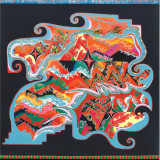
The next chapter of the Natural Information Society is here. Since Time Is Gravity, credited to Natural Information Society Community Ensemble with Ari Brown, presents a newly expanded manifestation of acclaimed composer & multi-instrumentalist Joshua Abrams nearly 15 year, 7 albums &-counting flagship ensemble. Joining the core NIS of Abrams (guimbri & bass), Lisa Alvarado (harmonium) Mikel Patrick Avery (drums) & Jason Stein (bass clarinet) are Hamid Drake (percussion), Josh Berman & Ben Lamar Gay (cornets), Nick Mazzarella & Mai Sugimoto (alto saxophones & flute), Kara Bershad (harp) & Chicago living legend of the tenor saxophone Ari Brown. Recorded live to tape at Electrical Audio & The Graham Foundation, cover painting Vibratory Cartography: Nepantla, by Lisa Alvarado. 2xLP on Eremite USA, 2xLP & CD on Aguirre/Eremite Europe. Out 14-04.
Since first developing Natural Information Society in 2010, Joshua Abrams has been gradually expanding the group’s conceptual underpinnings, its musical references & the sheer number of the group’s members. Its music is, in a sense, an expansive form of minimalism, based in repeated & overlaid rhythmic patterns, ostinatos & modality. Its roots, its scale & its meaning become clearer in time. If time is gravity, it also allows us to carry more. Having begun as fundamentally a rhythm section with Abrams’ guimbri at its core, the version here can stretch to a tentet, including six horns.
Abrams has been expanding his minimalism gradually, but he has long understood a key to minimalism’s potential: the breadth of its roots in the late 1950s & early 1960s, ranging from the dissatisfaction of young European-stream composers with the limitations of serialism to the simultaneous dissatisfaction of jazz musicians with the dense harmonic vocabulary of bop & hard bop. The former began exploring rhythmic complexity & narrow tonal palates in place of harmonic abstraction (Steve Reich’s Drumming, Philip Glass’ Music with Changing Parts; perhaps above all Terry Riley’s In C & his late ‘60s all-night organ & loop concerts); the later reduced dense chord changes to scales (signally with Miles Davis' Kind of Blue, but rapidly expanding with John Coltrane’s vast project). In the 1950s the LP record opened the world with documentation of Asian & African musics, key influences on both minimalists & jazz musicians. If John Coltrane’s soprano saxophone suggested the keening shehnai of Bismillah Khan, the instrument was rapidly taken up by two key minimalists, LaMonte Young & Riley, similarly appreciative of its flexible intonation, the same thing that kept it out of big bands.
If the guimbri, the North African hide-covered lute that Abrams plays with NIS, involves a rich tradition of hypnotic healing music associated with the Gnawa people, Abrams’ music also touches on other musics as well — other depths, memories & healings, different drones, rhythms & modes. As the group expands on Since Time Is Gravity, he has made certain jazz traditions in the same stream more explicit as well. If there is a mystical & elastic quality involved in the experience of time, both in direction & duration, you will catch it here. The parts for the choir of winds expand on the roles of Abrams’ guimbri, Mikel Patrick Avery & Hamid Drake’s percussion & Lisa Alvarado’s harmonium: at times, the winds are almost looping in the tentet version, each hitting a repeating note in turn, at once drone & distinct inflection on temporal sequence. The brilliance of the work resides in Abrams’ compositions, the NIS’ intuitive execution & in Ari Brown’s singular embodiment of the great tenor saxophone tradition, including the oracular genius of Eddie “Lockjaw” Davis, & Yusef Lateef. The three pieces by the expanded NIS featuring Brown —the opening “Moontide Chorus” & “Is” & the ultimate “Gravity”— have an immediate impact, & togther might be considered a kind of concerto for tenor saxophone. Here Brown presses almost indistinguishably from composed melody to improvised speech, getting so close to language that he might have a text. Everything here is a sign. Note the tap of the Rhythm Ace that links “Moontide Chorus” to “Is”, the attentive heart always present, even when signed by a machine. There’s a link here to the methodologies & meanings of dub music & the linear & vertical collage of beats, textures & tongues: treated with reverence, a sample of a beat-box can be as soulful, as hypnotic, as a mbira or a tamboura. If those pieces with Brown are heard as a suspended concerto, the three embrace & enfold the other works, like the sepals of a flower. That placement will also touch on the mysteries of our perception of time.
Particularly in “Is”, but elsewhere as well, a phenomenon of transcendence arises in which time appears to be tripartite, at once moving backwards & forwards & standing still. This is an act of technical brilliance certainly, but also an illumination of music’s ability to represent temporal consciousness through polymetrics. This particular listener has only heard it before in a few places, including the horn shouts & bowed basses of Coltrane’s Africa, in moments of Charles Mingus’ The Black Saint & the Sinner Lady, in certain pieces where tapes were literally running backwards, & earlier still in Dizzy Gillespie’s Cubana Be, Cubana Bop, in which the composer George Russell & conguero Chano Pozo found a music that spoke at once in the voices of Stravinsky’s Rite of Spring & the vestigial rites, rhythms & songs of the Yoruba language & Santeria religion of inland Cuba.
In Joshua Abrams’ compositions & the realization of them by the NIS, in the time of one’s close listening & memory thereof, distinctions between the “natural” & the “social”, the “quotidian” & the “transcendent” are erased, suspended or perhaps irrelevant. Consider two of the ensemble pieces, one named for nature, the other social science. In “Murmuration” the repeated wind figures of flute & alto saxophone combine with the interlocking patterns of harp, guimbri & frame drum (tar) to create a perfect moving stillness, not an imitation but a witness to the miracle of the starlings’ astonishing collective art, a surfeit of beauty that might be the ultimate defense tactic.
“Stigmergy” takes its name & concept from the Occupy movement’s Heather Marsh, who proposes a social system based on a cooperative rather than competitive models, one in which ideas are freely contributed & developed as ideas rather than an individual’s property. In its form, Abrams’ “Stigmergy” is the closes thing to traditional jazz, a series of accompanied solos by each of the wind players. However, the composed accompaniment is a radically collectivist notion: a repeated rhythmic figure, call it ostinato or riff, in which the different winds each play only a note or two of the figure, a concept both more collectivist & individualistic in its conception than any typical unison figure. It suggests another of the underlying recognitions that propel the Natural Information Society, the group as social organism, the teleology of hypnotic anarchy, all parts in place, functioning systematically, evolving & expressing itself, its nature & society, as a transformative organism.
George Lewis has described music as “a space for reflection on the human condition”. This suggests that, rather than a “distraction”, at least some music might serve as a distraction from distraction. It’s a focus, a clarity, a awareness, an external invitation to interiority, as if music itself is a model for form & contemplation, an organism contemplating for us or as us. If that is a possibility, & I am sure I have heard such musics, than this music is among them. How many of our rhythms, melodies & harmonies (cultural, historical, biological, psychic) might such music carry, translate & transform in the particulate ecstasy of our own murmuration? (Stuart Broomer, April 2022)
Superb EP exploring the Mental Acid with another view... A view where the kick dictat is ejected.
Indus Acid, Electro, Breakbeat, melodies, rhythms creation, beat digging... Everything here is fresh and unheard before on wax.
Nazamba & Dubsetters kicked off this new Finnish Dub & Sound label in a superb style recently and what better way to follow that up than with the reggae master, smoking king and weed aficionado Linval Thompson. This might sound like one of his classic lost cuts from the 70s but it is actually an all new tune from the Jamaican reggae icon. Dubsetters provide the gentle, percussive rhythms which are organic and deep, with Linval's smooth mic work up top adding to the global conversation about the decriminalization of cannabis. Flip it over for an even more mellow and dubbed out sound on the b-side.
»Nifbin Circle« is the fourth release by Detlef Funder, aka Konrad Kraft, on the Cologne label aufabwegen. Sounds generated with two apps on the iPad,provided the basic structures and the sound space. The strangely enraptured textures created in this way, with a subtle percussive touch, were partly combined with supporting beats in the course of further processing. Thus, after more than 30 years, tracks with rudimentary melodies and rhythms were created again.
Intrinsic Rhythm is proud to present a new EP by John Heckle entitled "Return To Titan" and the first on the the label from a different artist other than label owner Tr One.
This will be John's first release under his own name for a number of years and also includes a remix by Michigan techno visionary John Beltran.
The EP kicks off with "A" where energetic skillful production combines with Chicago and Detroit influences to concoct a brilliant mix of styles very much focused on the floor.
Next up is 7C where melodic bass and chords merge together to offer a brilliant whimsical approach towards analogue music that only John has mastered over previous releases.
Following this is the brief and one of the most beautiful tracks on the EP entitled "DSI" where building strings engage with soft percussion and kickdrum interplay to pull the listener in to the musicality on show.
On the B side we kick off with the beatless and ambient driven "CII" where 8 minutes of melodic density and synth interplay swirl between crescendo and musical culmination.
Finally John Beltran steps up and delivers a beautifully hypnotic club ready version of "A" where the Michigan artist teases between Detroit techno elegance and organic flair to show why he is one of electronic music's all time great producers.
More than four years after his previous EP and after having released some remixes and collaborations with Agar Agar, Black Devil Disco Club or the Italian design studio Burro Studio, LeonxLeon comes back with a new EP, passing to the electronic shaker the styles of music listened since the last release.
4 tracks all as different as each other with first Itanewa, where the Parisian producer tries for the first time to give voice, without vocoder, well aware that on a track inspired by South African productions of the 80s, an instrumental version only would not be enough to do justice. It is thus in a kind of invented Esperanto that the lyrics, a call to lightness and simplicity according to the artist, are distilled between synthetic bass, keyboards and other percussions.
On Piano Mondo, we leave rather in the direction of South America with pianos of Bossa inspiration on a bass italo-disco, rises and descents as if we were in Val d'Isere and breaks just long enough to catch its breath.
The idea of Solid Dose is completely different since it was a question of taking the post new-beat dance sound of the beginning of the 90s, with a big blow, hence the title, of the synthetic bass sound "Solid Bass" which will be used in a lot of ways at this period and which is coming back in force nowadays, and to mix it with the Nordic touch of dance music for a soaring, evolving track, with arpegios which cross each other and an acid line which finally makes its appearance here.
The last track is a wink to the well-known movie that gave its name to the whole project: it is indeed Luc Besson's Léon that we are talking about, re-cut on the dialogues of Nathalie Portman and Jean Reno, supported by a simple rhythmic, analogical bass and electronic kick at the service of a dark atmosphere, closing the record at the antipodes of the first track, without ever having left the universe of melodies and percussions that already characterized the previous releases of LeonxLeon.
Much anticipated debut album from this Leeds-based electronic duo, following high-profile UK festival slots, and shows alongside luminaries The Brian Jonestown Massacre, Warmduscher, Sea Power, Moonlandingz, The KVB, with multiple plays across BBC6/BBC Introducing and Amazing Radio, jellyskin are finally ready to unleash ‘In Brine’, their first full length release. The result of four years spent writing, recording, and refining the album between Leeds, Liverpool, Bristol, Palamos, and Berlin, ‘In Brine’ showcases the many talents of Will Ainsley and Zia Larty-Healy in a work straddling iridescent electronica, tungsten-tipped techno, art pop, and queasy, brown acid folk. The songs are pieced together with themes of longing, misadventure by the sea, desire and aquatic apparitions that showcase Larty-Healy’s warm but urgent vocal range, as at home around the campfire as it is in the club. The pair’s meticulous arrangement and rearrangement, sculpting, recording, and mixing was a glacially slow process of adaptation, mutation, cooperation, growth, and, yes, natural selection. First single ‘Bringer of Brine’ thumps from the speaker anthemically and forcefully, pitched somewhere beautiful and uncanny; Larty-Healy’s vocals soar and skim off the production like a smooth stone across choppy waves. The radio-ready pop electronica of ‘I Was The First Tetrapod’ bursts into the world with an urgency in line with the lyrics. An aquatic tale of crawling onto land for the first time, desperate to make new life forms, it’s also a positive, joyful rebuke to the despair of the world around us. “Growing my legs...”. The fuzzed-out psychedelic keys and forward-moving, Knife-like structure echo throughout while beautiful lyrics detail visions of where this would all lead life as we know it-“I can run freely, white horse behind me. Flexing my bones and artery twine, find human tone and reach for the vine.” ‘Fox Again’ opens with chopped alarm clocks segueing into a lurching rhythm, before exploding into skittering beats and a soaring chorus. The effect is like waking up drowsily, going over to the window in your room and yanking open the curtains to be blasted by searing sunshine. The pair brought in Berlin based co-producer, mixer and masterer Lewis D-t to help finesse the tracks into fat-free hunks of ecstasy and sonic exploration, their rich depths marking ‘In Brine’ as an album everyone should be talking about this summer and beyond-all nine tracks will have feet moving and hearts swelling in equal measure. As opening track ‘Lift (Come In)’ positively opines “Going up!/Just want to keep going up!”. It’s time to get in on the ground floor
Z Lovecraft AKA Rhythm Section International's Mali Baden-Powell, offers up four originals on the Utopia Club Tracks label that showcase the disco/house end of his varied output. 'Exotic Passage' coasts along serenely with gently slapped bongos and warm electric piano, definitely a weapon to have in one's warm up arsenal. 'Release (The Tension)' ups the heat a little with a busier bassline, filters and disco licks, before B-side opener 'Lust In Denial' comes with more jazz-slanted piano riffs and 'People Get Too Deep' closes proceedings with the most spacious and dubby arrangement of the quartet. Musically refreshing and understated but lively enough to move feet onto dancefloors, this is the business.
- A1: Carlos Picklin - La Charanga Del Espacio
- A2: Tito Chicoma - Cumbia A Go Go
- A3: Choche Merida - El Rock De Los Chinos
- A4: Benny Del Solar, Melochita, Ita Branda - Rumba Espanola
- A5: Lucho Macedo - Rock & Roll Mambo
- A6: Nallye Fernandez - Batijugando
- A7: Nelson Ferreyra - Twist En Guaracha
- B1: Los Kintos - Kintos Boogaloo
- B2: Patty Pastel - Computador Electronico
- B3: Luciano Luciani - A Bailar Bump
- B4: Willy Marambio - Trompeta A Go Go
- B5: Los Vikingos - Go Go En Patines
- B6: Edgar Zamudio - Dia De Pago
- B7: Lucha Macedo - El Maestro Del Rock & Roll
Exotica, ye-yé cumbia, guaracha infused twist, rock’n roll mambo, Spanish rumba, boogaloo beat, tropical garage and other unexpected bastard genres are featured in this festive compilation of bizarre hits taken from the glorious catalog of records released during the 60s and 70s on the Peruvian label Discos MAG. Some clearly unite genres, others are projects with creative names, but all are bold musical initiatives that got and will always get people onto the dance floor. “Sabroso Go Go” brings together fourteen musical mixes created in the recording studios of Manuel Antonio Guerrero (MAG), in which music directors combine rhythm with alchemy in a quest to find the philosopher's stone of the dance. Exotica, ye-yé cumbia, guaracha infused twist, rock’n roll mambo, Spanish rumba, boogaloo beat, tropical garage and other unexpected bastard genres are featured in this festive compilation. Although this compilation begins in 1957, experiments like this (some more memorable than others) were not new in Peru. The songs on this album were however much more successful hybrids. Some clearly unite genres, others are projects with creative names, but all are bold musical initiatives that got and will always get people onto the dance floor. At the end of the fifties, rock music shook the foundations of Peru, and orchestras rushed to cover hit songs and explore the possibilities of mixing them with tropical music. Lucho Macedo's orchestra took up the mantle and reinterpreted a well-known guaracha by Celia Cruz ('Rock and Roll') in mambo style, renaming it 'Rock and roll Mambo'. 'Maestro de Rock and Roll', a hit by the Cuban Conjunto Casino, received similar treatment. Another mix in this vein is the rock tune 'El Rock de los Chinos' by the Mexican Manolo Muñoz (author of 'Speedy González') recorded by the Chilean Choche Mérida for MAG in 1961. The following year, Chubby Checker’s 'The Twist' hit the scene and was immediately fused with guaracha by maestro Nelson Ferreyra. A legendary MAG musician, Carlos Pickling, composed 'La Charanga del Espacio' in 1963. The space sounds are produced by Pickling and his inseparable Hammond. He himself is the one who leads the orchestra that accompanies Benny Del Solar, Lita Branda and Pablo "Melcochita" Villanueva in the tropicalized version of Spanish Rumba, when the beats of the Iberian rumba were still exotic in South America. Around that time, the Chilean Willy Marambio was already living in Lima. In the track included on this album, the go-go style showcases his virtuosity on the trumpet. Another outstanding trumpet player, Roberto "Tito" Chicoma from Chiclayo, played as a session musician with MAG from 1959. A few years later, he became one of the most popular Colombian cumbia players, a talent he demonstrates in the song on this compilation, which blends the fun of go-go with yé-yé beats. 'Batijugando' was a hit from Mexico and was played in all the rhythms played across the Hispanic world since 1967. Inspired by the "Batman" series, it was performed at MAG by the Betico Salas orchestra, with vocals by the Panamanian lady crooner Nallye Fernández. 'Computador Electrónico' is another surprise on this album, performed by Panamanian vocalist Patty Pastel, it is the only known version in Spanish of 'Der Computer Nr. 3', originally sung in German by France Gall. Two other songs feature Edgar Zamudio. The versatility of Zamudio y Los Vikingos (originally a Chilean group) is demonstrated in the guitar-heavy song composed specifically for the late sixties skate fashion ('Go Go en Patines') and in his idiosyncratic protest song ('Día de Pago') performed in beat style. In the mid-seventies, Los Kintos, led by guitarist Francisco Acosta, developed different harmonic ideas in an instrumental track that veers from boogaloo to salsa, the fashionable rhythm of the day. Finally, in 1976, when the bumping hips dance craze swept the continent, Manuel Guerrero was quick to jump onto the bandwagon, composing a Bump song, together with his son Carlos. The Italian musician based in Lima, Luciano Luciani performed the song 'A Bailar Bump' backed by his band of local musicians Los Mulatos.
Audio Soul Project is back with their latest vinyl-only EP, Simurgh. With a title inspired by the mythical Persian bird, these four tracks fuse elements of house, R&B, dub, and drum & bass to create an ecstatic and hypnotic experience.
The EP kicks off with "Deliver Me," a dreamy house track with warm filtered chords and bouncing synth bass. R&B female vocal ad libs pepper the groove and the refrain "Deliver Me" adds a sense of yearning. The percussion, including morphing 4x4 and breakbeat drums, piano and synth stabs, nod to the cerebral Detroit and Chicago house compositions of the mid 90s.
"Azizam Dub" takes a more stripped-down approach with a subsonic bass line bump and Juno 106 stabs. Frantic percussion and deftly cut vocal samples accent the ebbs and flows of the arrangement, making for a dynamic and engaging dance.
The B-side of the record starts with "Internal Vybrations," a bass-heavy drum & bass track that winds and jumps with multiple layers of deep, fluttering bass and ambient pads and strings. Percussion layers like hi-hats, shakers, and maracas lift and relax the rhythm in parallel to the rest of the composition, making for a hypnotic and trance-inducing vibe.
The B2 track on the EP, "Celebration Dub," is a bass-heavy swinging house track with ecstatic diva "Whooo" samples that punctuate the ups and downs of the groove's energy. Classic reggae and dub-influenced vocal samples and heavy tape delay on certain key instruments add to the joyful and uplifting vibe of the track. The keyboard
and string section can transport a dancer to other realms of consciousness if they let themselves go to the groove.
Simurgh is a masterful fusion of various genres that showcases Audio Soul Project's production prowess and ability to create an entrancing sonic journey.
TL;DR: Audio Soul Project's Simurgh EP features 4 tracks of dub-infused house music. Deliver Me has dreamy chords and female R&B adlibs, Azizam Dub is stripped down with subsonic bass and vocal samples, Internal Vybrations is a bass-heavy drum & bass track, and Celebration Dub is a swinging house track with reggae and dub vocal samples.
Death Is Not The End's 333 sub-label drops a much needed reissue of Rupie Dan's My Black Race 12" from 1982. A huge Shaka selection featuring one of the heaviest dubs available from this era of UK roots production. Originally written and produced by Rupie for his Flag Records label, with engineering from Tony Addis (later of Addis Posse and the Warriors Dance label).
"The lyrical idea for My Black Race came about during the 1980/81 social/racial revolution that took place in several cities all over England, including London, Liverpool, Birmingham, Leeds etc. I was living in Bradford, West Yorkshire at the time and was a DJ/Sound System operator on Jah Scorcher International Sound. I also co-hosted a Reggae show on an independent radio station Called Pennine Radio 235. In my regular job I was a youth and community leader with the Bradford education council. I was fully connected and in touch the community.
Seeing how the media used the events of the social uprising as a weapon to further discriminate against the African & Caribbean community committed me to say and do something to elevate the minds of especially young people who were already demoralised by the rhetoric that brought about the so called "riots" of the time. It was during this time that the lyrical foundation of "My Black Race" was laid. The rhythm came later after hearing Barry Brown's "No Wicked Shall Enter the Kingdom of Zion". In the summer of 1982 I entered into the Addis Ababa recording studio on Harrow Road, Paddington and recorded the song having moved to London the previous year. Musicians featured included Victor Cross on bass and Mark Wright on drums (both from the Ariwa band), Rizzo on guitar, Tan Tan and Bami on Horns (all 3 from Aswad band), Bubblers on Piano/Organ (Undivided Roots/Ruff Cutt Band). Lead vocals were provided by myself, with backing vocals Jenifah Gad and Niomi who was working with David Bowie at the time. The engineers were Bubblers and Tony Addis (later of Addis Posse & the Warriors Dance label).
Jah Shaka was in the studio during the entire recording session. I was aquatinted with him as I was previously involved in a 3 way soundclash with Shaka, Quaker City and my sound at the time Jah Scorcher. Some years later I was in Terry's Dub studio in North Acton cutting some dubs when King Jammys and Bunny Lee walked in and heard the song. Bunny was responsible for the production of Barry Brown's "No Wicked Shall Enter the Kingdom of Zion". Thankfully they were both impressed by the track which delighted me as a young up-and-coming artist/producer. The rest is history as we know it. Jah Shaka was mystically constant hence his attachment and love for the song. Jah bless and guide him."
When approached several years back by the highly revered Toy Tonics crew/ record label to participate in a remix for artists Karl Hector & Nicolas Tounga for their song titled Ngunga Yet Fofa; just on the strength of a sincere enthusiasm showed by the request alone, it wasn't long after that Joaquin Joe Claussell accepted the challenge to remix an already original dope composition. Originally released, and still available on their Mushroom House Concept 12" EP 4 Cat number TOYT 068; on it Joaquin produced a unique remixed and married Acoustic art with electronic ecstasy. Fast Forward to today Sacred Rhythm with the blessings of Toy Tonics brings forth a dope 12" the compliments that precious version, but with dope different, more experimental takes all in the rhythm of Afro Electronics.
Housed in Limited Red vinyl more dopeness is about to take its place in the airwaves. Let's take flight...
“Are we having fun yet? Living in the grey zone”? The Toads ask the question and already know the answer. There’s many a wry smile, often packed with gallows humour, shared on the Melbourne groups’ debut album “In the Wilderness” (out June 9th on Anti Fade and Upset The Rhythm). Navigating the dross of modern life, whilst keeping one foot in a dream is the key to their nervy post-punk scuffle. Featuring members of The Shifters, The Living Eyes and Parsnip you’d be forgiven for guessing what The Toads sound like, but their mordant step and minor-key enchantment makes for an intriguing parry.
The Toads hatched after a short period of domestic readjustment mid-2021. Billy Gardner (guitar) found himself in need of a roof after his home was consumed by fire, and was kindly hosted by friend Stella Rennex (bass). Elsie Retter (drums) was a regular visitor to the house and after seeing Miles Jansen (vocals) tear it up with his other band at the local bowls club, they invited him along to sprinkle his deadpan musings across their fledgling sound. Pretty quickly they hit on their direction; a savvy, snappy lo-fi pop as openhearted as it is brooding.
After playing some formative shows, including a debut at Jerkfest in 2022, The Toads set about recording five songs mid-year for a tentative EP. Realising the songs were too long to fit on a 7”, they booked in another recording session the following September to extend the EP to 12”. Two tracks’ chords structures were fleshed out with new melodies and arrangements, and by this point The Toads were surprised to find they had an album’s worth of material. ‘In The Wilderness’ is a beguiling record, full of twists and turns. It’s arch, resilient, thoughtful and straight-at-your-head catchy to boot.
It’s fitting that the title track “In The Wilderness” draws this record to a close, being the peak of their invention so far. Drums pound and tumbling bass-lines sprint among the crisply stabbing guitar phrases and soaring horns outro. It’s a survivalist epic of hard-worn wisdom, ambling and restless. “I open up the door trying to get all of us through” sings Miles, becoming progressively more dizzy and despondent. There is a sense of toughing it out that never falters though and this is the essence of what The Toads do best. They push onwards into the darkness and keep their appetite, pulling us all into the light.
Oorsprong is a tube, a line in a forest, a sound sculpture. Acoustics to be revealed. Activated by entering, it becomes a giant flute producing a tone that is so low, the body crashes into waves of pure pressure instead of sound. Untranslatable energy. CERCHI CERCHI by Lukas De Clerck (FKA: Bloedneus & de Snuitkever) is a quest in a forest to find traces of that untranslatable sound, its impact, its imprint, its memory. A hide and seek in which the body is concealed in the instrument, becoming its second voice, hidden but exposed.
I
whistling, organ pipe, voice
A whistle, a whisper, a play of breath. Echoes of a low pulse, colliding into each other.
Party in the background, a coach blows a whistle, a haunting scream echoes the whistling from inside, kids returning from a party.
II
voice, whistling
To give away your voice, a gesture. The initiative for an introduction.
Birds chirping, an F16 piercing through the sky.
III
kaval
A circular breath gently caresses a line of circles, making its surface ringing.
Birds chirping, voices of kids, kids shouting, the door of Oorsprong closes.
IV
oorsprong, two bass recorders
When tuning becomes rhythm, when rhythm becomes a beat of breath. A beat underneath the beating of tones. Feedback of flutes.
The clanging of 2 bass recorders, the ventilator of Oorsprong is turning on.
The Complex Inbetween is a mesmerising journey inspired by the spirit of krautrock early electronic music and experimental rock. JeGong return with their second full- length album which sees them continue their musical journey inspired by the spirit of krautrock, early electronic music and experimental rock. With The Complex Inbetween Dahm Majuri Cipolla (MONO, Watter) and Reto Ma"der (Sum Of R, Ural Umbo) put a dazzling spin on the timeless music of genre innovators like Can, Faust and Neu!, incorporating noisier and more abrasive elements to create a mental odyssey into the uncanny. Born from the collision of the most unreal moments of Ma"der's free-flowing musical associations with Cipolla's stick-wielding hands, these eight compositions form the duo's own mythical realm after the rhythm has been set. As the cradle of electronic music, krautrock is often viewed by outsiders in terms of the mechanical rather than the human, yet Ma"der and Cipolla manage to uncover a human side that has always been present in the music of their forebears. That driving beat which powers album opener «Come To The Center» was never meant to be called `Motorik', as explains its inventor Klaus Dinger of Neu! in one interview. "It is very much a human beat. I like to call it the endless straight. It's a feeling like a picture." With Cipolla behind the kit the machine becomes human, testifying to the power that rhythm can hold over us as a deeply communal obsession. Like their debut, The Complex Inbetween shows the profound knowledge these two musicians have of their source of inspiration as well as their tremendous skill in applying its principles. With the piece «Night Screaming Moves» JeGong expands their sound with atmospheric drone rock elements. A feedback laden guitar motif surrounds the oscillations of mellotron sounds, behind it pounds a slow motion drum beat that is reminiscent of dragging, shuffling footsteps in the dark of night. Evoking feelings of trench coat wearing film-noir or the cloying darkness of cult 70s horror flicks, «Night Screaming Moves» shows that not only are the duo of Ma"der and Cipolla experienced musicians, but cinephiles and soundtrack lovers with a strong sense for moods and emotions. RIYL Neu!, Cluster, Tangerine Dream, Swans, Mogwai, Sonic Youth, John Zorn Ltd Coloured Vinyl!