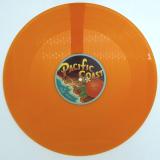
Introducing the 4th instalment of the Pacific Coast House rebirth. We bring back another much sought-after 12” from The Coastal Commission & Jesse Outlaw. “Bring down the Walls” was a nod to Raze’s “Break for Love”, Robert Owens “Bring Down the Walls” and Ritchie Hawtin’s use of the Roland 606 throughout “Sheet One”. Long out of reach and fetching $100+ on Discogs, Atjazz’s freshly remastered editions are finally available .. “Let it Go” was never mastered & only ever cut to dub-plate. It has now been mastered & available in all it’s glory.
Coastal Commission “Bring Down the Walls” “Bring down the Walls” was a nod to Raze’s “Break for Love”, Robert Owens “Bring Down the Walls” and Ritchie Hawtin’s use of the Roland 606 throughout “Sheet One.” We gave the tune a Californian psychedelic twist with conga laden drums, a moody synth, low pulsing 303 patterns + Benjamin Zephaniahs patois call to “Move the Body Rhythmwize!” The first PCH releases had dropped Worldwide to International acclaim from DJ’s far and wide across the Globe with support in London, Paris & New York. However the local scene here in L.A that preached “Love, inclusion & Unity” was anything but that. L.A at that time was very tribal & divided up into 3 camps. If you weren’t affiliated with any of them (aka independent) then you were pretty much locked out of getting any kind of gig support or the Dj’s from those camps actually playing the music. The local feedback from Dj’s was that what we were making wasn’t “house,” but “Techno” which was absurd to me. “Bring Down the Walls” was a mantra to “move the bod”y and in doing so “bring down the walls” of separation not just in L.A but throughout society in general. Thank goodness for support from people like Terry Francis, Eddie Richards, DJ Deep & Philly Stalwart King Britt. After years of copies going for upward of $100+ on Discogs the now freshly remastered copies by At Jazz’s Martin Iveson are finally hitting the platters this Spring.
Jesse Outlaw “Let it Go” I met Jesse at Beatnonstop Records on Melrose Ave with Miguel Placencia in the late 90’s. Miguel (RIP) was a mainstay in the Underground scene and had always been very supportive of my endeavors. He had had success with a huge release on Yellow Orange and was working with Jesse under the moniker “When Worlds Collide.” I signed “Brighter Days” & “Set you Free” from them and released the tracks on my Seductive imprint. They told me that they were making the tracks on a Sony Playstation “Music Now” program and I was like FFS “What.s more Underground than that!?” Later Jesse gave me some of his solo work. The track “Let it Go” was never mastered & only ever cut to Dub-plate and featured on my 1st PCH mix “Pacific Coast House Sounds.” It has now been mastered by Martin Iveson and is available in all it’s glory. The dreamy vocal “You need to let it go” beckons over the top of driving percussive Latin beats and church organ which is a great compliment to the flip side of “Bring down the Walls.” All in all two West Coast stompers now finally available remastered on PCH in Orange vinyl.
Search:rhythm king
A mix of metallic doomgaze, epic gothic soundscapes and post punk attitude. Loud and crushing, yet sharp enough to stick in your head for days. There are two kinds of heavy bands: the ones that make a lot of noise and the ones that drag you somewhere you didn't know you needed to go. Cwfen (pronounced 'Coven') are the latter, and Sorrows is a record that doesn't just crush - it haunts long after the final note. The allure of Cwfen's sound lies in contrasts: the glacial ferocity of Amenra, with the velvet-and-razor vocals of King Woman, and the rotting grandeur of Type O Negative. It's as hypnotic as it is harrowing, but somehow even better than the sum of those parts. Since emerging from Glasgow's underground just 18 months ago, Cwfen's reputation is growing, selling out shows and pulling growing audiences into their doom-laden fever dream. Released in October, the band's debut single 'Reliks' was a hit with fans and critics, landing a spot on Kerrang!'s release of the week playlist. And rightly so. Their sound devours and delights in equal measure. "Cwfen have emerged from the darkest depths of the Caledonian underground with a beguiling blend of doom metal and gothic post-punk for those who like to live deliciously." Kerrang! Sorrows lives in the space around doom where the weight of the riffs is matched by the weight in your chest, where the lyrics and the songwriting are as important as the music itself. Loud and crushing, yet sharp enough to stick in your head for days. It builds, burns, collapses, resurrects. Big on riffs, bigger on feeling. The kind of songs you carry with you. Singer and rhythm guitarist Agnes Alder bears her claws one minute, then whispers the next, as the band follows like a storm front, rising, breaking, drowning you in the weight of it. From the guttural Penance to the lush Whispers, to the feral Wolfsbane and the insurrectionist Rite. It includes a long reworking of Embers and Bodies, the two self-recorded demos that launched them into the scene with a bang and their growing legion of fans already adore. Intricate vocal arrangements, heavy and harsh guitars, a mix of atmosphere and heft, it undoubtedly punches above its weight for a debut. As Agnes says: "When we stopped trying to fit into any one space, what came out was this beautiful mix of dark and light. Something visceral and cathartic." This is a band that sits right in the boundaries between the heavy genres, pulling in everyone from the young goths and to the die-hard metalheads alike and 'Sorrows' truly does deliver in spades. Make no mistake, Cwfen are set to be one of the names to watch in 2025. FFO: Chelsea Wolfe, Zetra, King Woman, Type O Negative, Alcest, Faetooth, Liturgy. Limited vinyl pressing, 500 copies in transparent red vinyl. Full colour Gatefold outer sleeve, with a full colour printed inner sleeve, Full download included as well.
- A1: Think
- A2: Messin' Up
- A3: Dedicated To The One I Love
- A4: Tell The Truth
- A5: It Hurts Inside
- A6: When I Get Like This
- A7: Good Lookin' Woman
- A8: Say It
- B1: Don't Let It Be In Vain
- B2: I'm With You
- B3: Show Me
- B4: I Got To Know
- B5: Much In Need
- B6: Catch That Teardrop
- B7: What's In The Heart
- B8: Get Something Out Of It
The “5” Royales were the most enduring and influential of all the 1950s proto-soul groups. In a very crowded market, their success was remarkable. The Royales were the first African American group to introduce gospel based vocal styles into the rhythm and blues format. This gave an intensity to their recordings and live performances that no other combo could get near, thanks to the passion and power that lead singer Johnny Tanner generated. Furthermore, the group possessed in Lowman Pauling a songwriter of genius and a guitarist, who invented an exciting style of playing that linked stinging solos with rhythmic accompaniment. The Harbingers Of Soul is a mouth-watering overview featuring the best of the King era and the most soulful sides from their stay at Home Of The Blues. 180gsm vinyl. Sleeve notes by John Ridley.
The king of cheeky edits of timeless disco and funk is back with a wicked trip through obscure French grooves, flipped, filtered, and fired up for contemporary dancefloors. These three edits from Monsieur Van Pratt on Illegal Disco 008 don't just nod to the past, they grab it by the collar and drag it under the mirrorball. The opener 'Danse Danse' struts in a sunny groove built for open-air euphoria, 'Pas Chez Toi' slides deeper, a go-go-soaked funk jam with razor-sharp percussion then 'Ombre De Plaisir' detonates with horns blaring, rhythm pumping and pure disco adrenaline. Another gem from Mr Pratt.
- San Francisco
- Take A Look At Yourself
- Send Me Your Pillow
- She Shot Me Down
- I Love Her
- Old Time Shimmy
- What Do You Say
- Let's Make It
- You Know I Love You
- Big Soul
- Good Rocking Mama
- Onions
- No One Told Me
- Boom Boom
- Thelma
- Process
John Lee Hooker is widely recognised as one of the true giants of the blues, along with Muddy Waters, B.B. King, and Howlin' Wolf. Hooker is often called the "King of the Boogie" and his driving, rhythmic approach to guitar playing has become an integral part of the blues' sound and style that perpetuated the UK's rhythm and blues scene of the '60s. Presented here is one of John Lee Hooker' s finest album, The Big Soul of John Lee Hooker, recorded in Chicago in 1962.
In a career that spanned some forty odd years, a pivotal point of success came with his 1989 album The Healer, which featured collaborations with Carlos Sanatana, Bonnie Raitt, Charlie Musselwhite, and Los Lobas. The album expanded his audience beyond the blues idiom, earning him his highest Billboard album chart success (#62) his first Grammy Award; all of this at the grand-old-age of 73. For those not familiar with Hooker's earlier work, the Big Soul of John Lee Hooker is an excellent starting point.
- 01: Architettura Industriale
- 02: Fabbrica - I Versione
- 03: Fabbrica - Ii Versione
- 04: Termomeccanica
- 05: Dinamica
- 06: Raffineria
- 07: Dinamica - Ii Versione
- 08: Meccanizzazione Agraria
- 09: Industria Metallurgica
- 10: Chimica Industriale
First-ever official reissue - 180g black vinyl edition
In the late 1960s, a distinctive musical movement began to flourish in Italy—while also gaining momentum abroad, particularly in France and the United Kingdom. Known as library music (or sonorization), this genre consisted of genuine music libraries created specifically to accompany audiovisual productions such as television programs, commercials, documentaries, and films.
Produced under conditions of complete artistic freedom, these recordings often defy clear categorization, as they are not tied to any single musical genre. This creative independence allowed composers—frequently working in total anonymity—to experiment boldly, crafting avant-garde and forward-thinking sounds that, in many cases, anticipated musical trends that would only become widespread years later.
Oronzo De Filippiis known not only for his contributions to library music, but also for being part of the projectThe Braen's MachinealongsideAlessandro Alessandroni, one of the most significant figures in this field.
Meccanizzazione is a fully instrumental album—as is typical of the genre—literally dominated by the distinctive sound of the harpsichord. The record essentially alternates between two main compositional approaches: on one hand, more accessible and "friendly" tracks with a refined jazz-lounge and bossa nova flavor; on the other, darker and more hypnotic pieces, whose repetitive structures vividly evoke the rhythms and mechanical pulse of the industrial world.
- 1: Running
- 2: Soul Woman
- 3: Golden Sun
- 4: You’ll Never Know
- 5: Flow
- 6: Speak To Me
- 7: Pick Up The Pieces
- 8: When All Is Said And Done
- 9: Seasons
- 10: I Thank You
Clear Vinyl in limitierter Auflage von 1500 Stück. Die renommierte US-niederländische Gospel-Soul-Künstlerin Michelle David & The True-tones läuten mit ihrem neuen Album ,Soul Woman", das am 27. Februar 2026 bei Record Kicks erscheint, ein neues Kapitel ein. Aufbauend auf dem von Kritikern gefeierten Album ,Brothers & Sisters" aus dem Jahr 2024, das die Komplexität der Welt widerspiegelte, wendet sich die neue LP ,Soul Woman" nach innen - eine zutiefst persönliche Auseinandersetzung mit Identität, Heilung und spiritueller Widerstandsfähigkeit. ,Wie kann ich andere bitten, sich Zeit zu nehmen, um über ihr Leben nachzudenken, wenn ich das selbst nicht tue?", fragt Michelle David. Dieser Geist der Selbstreflexion und Erneuerung steht im Mittelpunkt von ,Soul Woman" - einem Album, das Verletzlichkeit zulässt und gleichzeitig Stärke ausstrahlt. Musikalisch verfeinert ,Soul Woman" die charakteristische Mischung der Band aus Gospel, Soul und Vintage-Rhythm & Blues und schöpft dabei aus einer breiteren Palette von Einflüssen. Anklänge an Curtis Mayfield, Bobby Womack und The Four Seasons pulsieren durch die Grooves, während das Gospel-Feuer der Blind Boys of Alabama und die fröhliche Ausstrahlung von Diana Ross & The Supremes dem Album sowohl Schwere als auch Glanz verleihen. Im Mittelpunkt steht Michelle Davids unverwechselbare Stimme - rau, warm und voller Entschlossenheit -, umhüllt von reichhaltigen, analog geprägten Arrangements ihrer langjährigen Mitstreiter Paul Willemsen (Gitarre, Bassgitarre), Onno Smit (Gitarre, Bassgitarre) und Bas Bouma (Schlagzeug). Gemeinsam stehen Michelle David & The True-tones an der Spitze der Retro-Soul-Szene - sie verbinden zeitlose Grooves mit moderner Dringlichkeit, unerschütterlicher Authentizität und herzlicher Leidenschaft. Eine Stimme, geboren in der Kirche, geschliffen auf der Straße. Michelle David wurde in New York geboren und wuchs in der Kirche auf. Mit nur vier Jahren begann sie zu singen und trat mit fünf Jahren ihrer ersten Gruppe, The Mission of Love, bei. Ihre kraftvolle Stimme führte sie um die ganze Welt, wo sie in gefeierten Broadway-Produktionen wie Mama, The Sound of Motown, Glory of Gospel und Mahalia mitwirkte und mit Legenden wie Diana Ross und Michael Bolton Aufnahmen machte - alles bevor sie ihre gefeierte Reise mit The True-tones begann. Gemeinsam haben Michelle David & The True-tones sieben von der Kritik gefeierte Alben veröffentlicht und die Bühnen Europas erobert, von Pinkpop über North Sea Jazz bis hin zum London Jazz Festival. Die Band ist bekannt für ihre mitreißenden Live-Auftritte, hat von Spanien bis Skandinavien Standing Ovations erhalten, ist in großen Fernseh- und Radiosendungen aufgetreten und hat sogar bei den Olympischen Winterspielen 2022 gespielt. Ihre Aufnahmen wurden ebenso gelobt: The Gospel Sessions wurde für einen Edison Award (das niederländische Pendant zum Grammy) nominiert, während Truth & Soul aus dem Jahr 2020 von Craig Charles' BBC Radio 6 Music zum Album des Jahres und von FIP (Radio France) zum Album des Monats gekürt wurde. Ihr jüngstes Album, Brothers & Sisters (2024), markierte ihr Debüt bei Record Kicks und wurde zu einem Durchbruch - gefeiert von Rolling Stone France, KEXP, Jazzthing Magazine (Deutschland), De Volkskrant (Niederlande) und BBC 6 Music. Ein Zeugnis der zeitlosen Kraft des Soul: Mit ,Soul Woman" bieten Michelle David & The True-tones mehr als nur eine neue Platte - es ist ein musikalisches Zeugnis der Widerstandsfähigkeit, eine Feier des spirituellen Wachstums und eine Bekräftigung der Fähigkeit der Soulmusik, zu heilen, zu verbinden und zu inspirieren. Gleichzeitig in klassischen Traditionen verwurzelt und neue Wege beschreitend, ist dies zeitgenössischer Soul vom Feinsten. Für Fans von Durand Jones & The Indications, Thee Sacred Souls, Jalen Ngonda, Sharon Jones & The Dap-Kings, Lee Fields, Mavis Staples.
Don’t believe your ears - Pepper’s Ghost is the latest offering from NYC project Nuke Watch.
Whatever you think it is - it is not. By the same token it really can be whatever you want - electronica, jazz, improv, noise, new age, ambient - it’s none and all of these. Like the primitive visual illusion it’s named for - Pepper’s Ghost is a projection of a thing, it’s not the thing.
The Nuke Watch method - like that of Aaron Anderson and Chris Hontos’ other primary project Beat Detectives - leans almost entirely on live improvisation, with some advanced studio alchemy in post. Where the Beat Detectives palette draws from club music tropes, Nuke Watch blends recognizable tones (hand drums, woodwinds, keys, fretless bass) with sounds of providence unknown, the line between organic and synthesized instrumentation unintelligibly smudged. What is real and what is projection? It’s hard to say. What do our ears tell us? This is where we arrive at Pepper’s Ghost.
Warped as the sounds may be, the playing belies a crew of deeply expressive, learned improvisers who have their craft honed. Their friendship and psychic connection enhances the ritualistic rhythms, mutant modular synthesis, nimble keyboard runs, absurdist sampling and unidentified skronk. They’re wonderfully complemented across several tracks on this set by Cole Pulice’s levitational, sublime saxophone.
As unhinged as this might all appear, once the mind and music meet on the same wavelength this is profoundly moving, energizing and uplifting Alive Music that recalibrates the sense of what music can be.
Nuke Watch is Aaron Anderson and Chris Hontos, with an array of friendly guests. They’ve released records as Nuke Watch on The Trilogy Tapes, Commend and Moon Glyph. As Beat Detectives they’ve released records on Not Not Fun, 100% Silk and their own studio imprint NYPD Records.
Pepper's Ghost was written and produced by Aaron Anderson and Chris Hontos. Additional instrumentation on these recordings by Cole Police, Leonard King, Eric Timothy Carlson, Chris Farstad and William Statler. It was mixed by Chris Hontos and mastered by Jack Callahan. Painting on the cover is “The Unity Of Being” (2020), by Ry Fyan. Design and layout by Aaron Anderson.
RIYL - Musical illusions, puzzles and magic tricks, downtempo, music of the spheres, good journey, Eddie Harris, Ketron, "world building", orange sunshine, suspension of disbelief.
The continued relevance of the work of Akae Beka is forceful on the movingly topical Rastafari statement Imandment To Heart. Taken from 2021’s album Polarities and produced by Zion I Kings with Tippy I at the helm, the track presents a striking contrast: an uplifting major-key Rub A Dub rhythm, powered by renowned Jamaican drummer Kirk Bennett, sets the stage for scathing lyrics linking “chaos theory,” refugee crossings, and prophetic judgment. Vaughn Benjamin calls for a moral law “written upon the inward part” amidst global turmoil. Released on 7” vinyl for the first time by Before Zero Records, the single is backed by a B-side dub sculpted sonically by Laurent “Tippy I” Alfred at his Holy Mountain Studio in St Croix.
Stateside Swing is a UK Garage focused vinyl only dance record label that showcases the genre's production and manufacturing exclusively from the USA.
“Tubby did three original dub albums, ‘Dub From The Roots’. ‘The Roots of Dub’ and the third is ‘Brass Rockers’ with Tommy McCook ‘pon the flying cymbals. Where he mixed it with the horn going in and out in a dub way and one named ‘Shalom Dub’ you can call Tubby’s too because he mixed the versions as they were off forty fives’’
Bunny ‘Striker’ Lee
King Tubby and Producer Bunny ‘Striker’ Lee are intertwined in the birth of Dub Music. After discovering a mistake that made a ‘serious joke’ (more of which later...) they went on to release the first pressings of this new musical genre namely ‘Dub Music’. Tubby’s vast knowledge of electronics and Bunny’s vast catalogue of rhythms would lay the foundations of what today is taken as a standard... the Remix / Version cuts to an existing vocal tune.
Osbourne ‘King Tubby’ Ruddock was born in Kingston, Jamaica on 28th January 1941 and grew up in the High Holborn Street area of downtown Kingston. He studied electronics at Kingston’s National Technical College and also on two correspondence courses from the U.S.A... When he had qualified Tubby began repairing radios and other electrical appliances in a shack in the back yard of his mother’s home. His work in the early days included winding transformers and building amplifiers for Kingston’s Sound Systems. Tubby built his first Sound System in 1957 playing jazz and Rhythm & Blues at local weddings and birthday parties. His reputation as a man who knew and understood both electronics and music grew steadily and as the sixties drew to a close. Tubby
purchased his own basic two track equipment. He installed this alongside his dub cutting machine, a home-made mixing console, and his impressive collection of jazz albums in the back bedroom of his home at 18 Dromilly Avenue which he christened his music room.
Tubby and Striker were at Treasure Isle Studio’s one day while Ruddy from Spanish Town was working with the engineer Byron Smith....
“Tubby and myself was talking when Ruddy was cutting some dub but Smithy (engineer) made a mistake through we were talking and forgot to put in the voice. It was two track recording in those days. Ruddy said ‘No Man! Make it stay! and so they cut the rhythm. When I went over to Ruddy’s that Saturday night a dance was in progress and when they played the vocal to the tune... then he said we’re going to play ‘Part Two’. They never called it ‘Version’..and then he played the rhythm track. The song was a catchy song and everybody started to sing along and the deejay started to toast so everything went down well. On Monday morning I went up and I said ‘Tubbs the mistake we made was a serious joke.It mash up Spanish Town! The people went wild. So you have to start to do that now ‘cause when the man put on the ‘Part Two’ everyone start singing this song. It played about twenty times. I said you try Tubbs!’...Well the next Saturday night now when Tubby strung up down the farm U Roy said he’s going to play ‘Part Two’ but Tubby did it different now. He started with the voice then dropped it out and let the rhythm run and then he brought in the voice in the middle and from there Tubby started to get really popular.’’
Bunny ‘Striker’ Lee
Dynamic Sounds upgraded to sixteen track recording in 1972 and Tubby purchased, again with the help of a deal brokered by Bunny Lee. The old four track equipment and the MCI console from their Studio B. The four tracks now gave him far wider scope to work with and he began to create a new musical form where the bass and drum parts were brought up while the faders allowed Tubby to ease the vocal and rhythm in and out of the mix. It was only a matter of time before Tubby’s dub plate experiments began to make it on to vinyl and the first ever long-playing King Tubby releases would feature a collection of his mixes to a selection of Strikers rhythms. So please sit back and enjoy this historic set of sounds. Lovingly restored and with a few extra gems added to the CD Editions. These releases were the first to carry the name of King Tubby and the first to credit the great musicians that contributed so much to the rhythms that made these albums possible.
Reggae music in many ways reminds us of America’s Motown records. The music comes out of its stable fast and furious we tend to know the songs, the artists, the
studio but who? are the players. The unsung heroes that in many cases, cut most of our favourite tracks One such band this applies to in the Reggae field is the Soul Syndicate Band.
Each Jamaican record producer would have their favourite set of musicians they would use, availability permitting. Although several musicians crossed over into different named bands. For example, a set of players working with Producer Bunny 'Striker' Lee would go under the guise of The Aggrovators. The same group working with Producer Joe Gibbs would work under the name The Professionals. Soul Syndicate were the band of choice for Producer Niney the Observer, who used them for his own recordings and when you put that aside the other artists Niney produced, Dennis Brown, Max Romeo, Michael Rose, I Roy, The Ethiopians, Barry Brown, Gregory Issacs and Freddie McGregor. To name a few and not necessary all, you begin to see the amount of material this set of musicians played on.
Built around the rhythm section of Calton 'Santa' Davis and George 'Fully' Fullwood, drums and bass respectfully. They were usually accompanied by Earl 'Chinna' Smith, Tony Chin on guitars, Keith Sterling, Gladstone 'Gladdy' Anderstone, Bernard 'Touter' Harvey, organ/keyboards and Noel 'Skully' Simms, percussion. Niney's tracks tended to be rhythm heavy and thus Sound System favourites.But when brass was needed/called for ,this was provided by the likes of Tommy McCook, Bobby Ellis, Felix ' Deadley Headley' Bennett. Niney not having a studio of his own at the time used most of Kingston's studios, again availability and money providing. But most of these cuts
selected for this release were cut at Channel 1 and a few exceptions at Randy's Studio 17 and at Joe Gibbs studio at Burns Avenue.
Niney also worked closely with King Tubby on his dub plates, so tracks after the recording sessions were taken to King Tubbys for reconstruction and sometimes
re-voicing over an existing rhythm. These were then used as version sides to the vocal cuts, but most importantly used to nice up the dances, being played out on King Tubbys Hometown Hi-Fi Sound System. We have pulled together a selection of such dub plate specials cut by the Soul Syndicate band for this release. Dub sides that emphasise how well the band worked together, and with Niney at the reigns and the added bonus of some Tubby magic sprinkled on top. Please see our Niney the Observer at King Tubbys 1973-1975 (JRO11) for further examples of this work.
We at Jamaican Recordings hope we are not alone in saluting the musicians, that played such a big part in producing many of our favourite Reggae Sounds. Having released titles by The Revolutionaries (JR003), The Aggrovators (JR005), Sly and Robbie (JR006), we are now pleased to release a selection of rare Dub cuts by another one of Jamaica's finest, the Soul Syndicate band to our catalogue...
Respect Jah Floyd.
KIK is the new project of two core strategists of sonic enigma HHY & The Macumbas: Jonathan Uliel Saldanha & João Pais Filipe. Ditching acoustic instruments in favour of drum synthetics & tightly controlled sound design, the duo's debut album NIGHTSHIFT focuses on off-kilter club tracks that thwart 4-on-the-floor flavours whilst maintaining trance-inducing extended cycles. If the devil is in the details, this is all about the spectromophology of the details.
Beginning with moving morse code blips in an odd time signature We Can't Dance announces the characteristic unlife of the album's pulse. Once the kick enters, syncopations progressively accumulate into a weave of interacting rhythmic lines. Smoke Machine's groove is reminiscent of the riddims Saldanha explores in his HHY & The Kampala Unit, adding scintillating pads and snippets of blitzed out laughter.
The album's third track, Proff, hearkens back to the initial pulse, displaced and pitched down in register. Here's a more meditative temperament on display, where the regular geometries of the club have been moved into higher-order structures. Segments rise & fall into earshot. Deepening the meditative mood, Back Room explores a short melodic leitmotif anchoring the track's wander- lust.
The rhythmic assault continues in Tactical Gear, bringing further experiments into polyrhythmic contours exacerbated by preci- sion movements of echo & delay. Limping can be heard as a what-if sonic fiction taking Autechre-inspired abstractions through Durbanoid Gqom terrains. The album closes with its longest track, Night Shift, that segments into shifting sound worlds.
Drawing from industrial grit, cybernetic percussion and the eerie fluorescence of after-hours energy, NIGHTSHIFT exists in the liminal space between body music and abstraction——a soundtrack for phantom warehouses and malfunctioning machines. This isn’t just music; it’s an immersive sonic environment, a journey into the heart of deconstructed dancefloors.
For fans of Rian Treanor, Proc Fiskal, Jlin and Lorenzo Senni.
Most recently, HHY has been collaborating with Nyege Nyege through projects such as Kampala Unit and Arsenal Mikebe, performing live with the ensemble alongside Valentina Magaletti, and producing records for artists like Fulu Miziki, as well as collaborations with Phelimucasi, Rey Sapiens, Kingdom Choir and others. He also released Camouflage Vector: Edits From Live Actions 2017–2019 on the label, a live album featuring two tracks with Adrian Sherwood.
Previous collaborations include Tunnel Vision with Badawi (released on Tzadik), the HHY & The Macumbas album Beheaded Totem on House of Mythology, and Fujako (Wordsound, with MC Sensational), along with double-bill shows with acts such as Clipping and Death Grips.
- 1: Kingdom Of Thunder
- 2: Space Mates (Abridged)
- 3: Star Bright
- 4: The Nile, Part 1
- 5: Eve
- 6: Tiny Pyramids
- 7: The Lady With The Golden Stockings
- 8: Paradise
- 9: New Horizons
- 10: Portrait Of The Living Sky
- 1: India
- 2: Ancient Aiethopia
- 3: Planet Earth
- 4: April In Paris
- 5: Island In The Sun
- 6: Africa
- 7: Friendly Galaxy
- 1: Interstellar Low Ways
- 2: The Conversion Of J.p. (Abridged)
- 3: Cha-Cha In Outer Space
- 4: Brazilian Sun
- 5: Lights On A Satellite
- 6: Somewhere In Space
- 7: Spontaneous Simplicity
- 8: Overtones Of China
Interdimensional exotica in the form of eccentric space jazz, sonic experimentation, Afro-centric rhythms, and ostinato electronic freakouts! Includes three platters worth of tunes pressed on orange vinyl, all curated by Irwin Chusid - who also co-wrote the liners with Brother Cleve - for all those with cocktail in hand and ready for a slice of Ra’s jetpack jetset recorded legacy!
Grupo um celebrate 50 years with release of lost dictatorship-era album nineteen seventy seven!
First time release - vinyl comes with printed innersleeves
Brazilian avant-jazz vanguardists Grupo Um celebrate their 50th anniversary, sharing a second previously lost 1970s album from the vaults. Nineteen Seventy Seven (titled after the year it was recorded) is another rip-roaring instrumental fusion treasure from the band which spawned from within Hermeto Pascoal’s famed mid-1970s São Paulo collective.
Like their debut album Starting Point, Grupo Um’s Nineteen Seventy Seven was recorded when Brazil's military dictatorship was at its most repressive. “There were no open doors to those who dreamt to be protagonists in creative instrumental music”, remembers drummer Zé Eduardo Nazario, “even popular composers and singers had to submit their songs to censors and many records were banned and confiscated from the stores.”
Just like Hermeto Pascoal's Viajando Com O Som (1977) and Grupo Um's previous album Starting Point (1975), both of which remained unreleased until the 21st century, Zé Eduardo asserts that the 1977 album was flatly 'without any chance to be released at that time."
Recorded at Rogério Duprat’s Vice-Versa Studios in São Paulo, the group were under both time and space restraints, “we chose the small Studio B,” Lelo Nazario recalls, “which had a Tascam (TE AC) 12x8 console and a 4-channel AMPEX AG 440 machine. Therefore, we had to record without overdubs, everything straight to tape.”
Expanding from a trio to a quintet, original Grupo Um members Lelo Nazario (keys), Zé Eduardo Nazario (drums), and Zeca Assumpção (bass) were joined by saxophonist Roberto Sion and percussionist Carlinhos Gonçalves. Carlinhos, Zé and Zeca had already played together in the group Mandala, while brothers Lelo and Zé had just finished a stint backing Hermeto Pascoal during his years in São Paulo.
Lelo was deeply immersed in modular synthesizer experimentation during this period, working extensively with the ARP2600 and EMS Synthi AKS. These electroacoustic explorations formed the sonic foundation for "Mobile/Stabile," one of his first compositions to merge modular synthesis with Brazilian music, a fusion that would ripple throughout the Brazilian jazz scene. The piece premiered at the first São Paulo International Jazz Festival in 1978, performed by Grupo Um with guest trumpeter Márcio Montarroyos. In a shocking moment, festival organizers interrupted the show mid-performance, sparking fierce backlash from both audience members and journalists who denounced the incident as artistic censorship during Brazil's era of political and cultural repression. The version on Nineteen Seventy Seven is the first recording of the composition.
Nineteen Seventy Seven combines Afro-Brazilian rhythm, modular synthesis and a plethora of whistles, percussion and effects pedals. Album opener “Absurdo Mudo” - so titled for the absurd difficulty it poses to the musicians performing it - starts out in a cloud of mysterious dissonance, before the haze breaks for a glorious keyboard and saxophone interplay atop an uptempo samba groove. “Cortejo dos Reis Negros (Version 2)” (Procession of the Black Kings), based on the maracatu rhythm, inverts the traditional jazz song structure by beginning with improvisations, which are followed by the theme and a final coda. “The studio also had two Parasound electronic reverb units,” Lelo notes, “and the timbre is very audible on the soprano sax and percussion.”
Grupo Um’s daring music represents a manifesto of resistance during the dictatorship years, but it’s one which remains just as relevant today. As Lelo puts it: “For me, the aesthetic issue has always been about combining contemporary avant-garde languages with Brazilian music, independent of categories and commercial interests. The result of this fusion takes music to a new level.”
Recording credits (1977)
Recorded at Vice-Versa B Studio, São Paulo, November 9, 1977
Produced by Lelo Nazario and Zé Eduardo Nazario
Engineered by Ricardo “Franja” Carvalheira
Lelo Nazario – Wurlitzer electric piano, acoustic piano, signal generator, percussion
Zé Eduardo Nazario – drums, percussion
Zeca Assumpção – electric bass
Carlinhos Gonçalves – percussion
Roberto Sion – soprano sax, clarinet
Release credits (2025)
Produced by UTOPIA Studio, São Paulo
Project Coordination in Brazil by Irati Antonio (Utopia Studio)
Tape Restoration and Digital Mastering by Lelo Nazario at Utopia Studio, July 2025
Liner Notes by Lelo Nazario and Zé Eduardo Nazario
Photography by Jorge Las Heras, Lelo Nazario, and artists' personal archives
Photo Restoration by Lelo Nazario
Artwork and Design by Alessandro Renaldin
"Ranking Dread In Dub, originally released, on the Silver Camel UK label run by the late Tony Gorman, in 1982 is back in the shops with a completely remastered version that highlights the musical production of this classic album. The rhythm’s are provided by The Roots Radics and Sly & Robbie, with the tracks mixed at King Tubby’s. It also come back with the iconic artwork by Rod Vass."
ATA Records proudly present the latest release from The Flying Hats, Blender 7” Following the buzz surrounding their debut LP and the soft limited pre-release of Blender, anticipation for this single has been huge - and with good reason.
“I've never heard something so perfectly combine funk and reggae and do it in a way that is dancefloor gold”. - Monkeyboxing.
The Flying Hats - the Leeds quartet responsible for one of the standout albums of the year - return in phenomenal form with two previously unreleased cuts of the highest calibre. Both tracks strike hard somewhere between Kingston and New Orleans, as if The Meters were channelling Jackie Mittoo or Sound Dimension were jamming with Jimmy Smith.
Thick, funky-reggae organ leads the charge with killer breakbeats, bass pressure, and rhythm-section fire designed to light up any dancefloor worth its salt. Both sides are built for selectors, collectors and dance DJs alike.
- 1: Any God Of Yours (Instrumental)
- 2: Swell (Instrumental)
- 3: Arise Dear Brother (Instrumental)
- 4: Ammi Ammi (Instrumental)
- 5: Buffed Sky (Instrumental)
- 6: Sex With Nobody (Instrumental)
- 7: Eye’s Drift (Instrumental)
- 8: The Sea Liner Mk 1 (Instrumental)
- 9: Empty Vessels (Instrumental)
- 10: New Builds (Instrumental)
- 11: Dull Boys (Instrumental)
- 12: Thames Water (Instrumental)
XL Recordings is proud to mark the 10th anniversary of Archy Marshall’s (aka King Krule) A New Place 2 Drown with the release of a newly remastered instrumental edition.
Originally released on 10 December 2015, A New Place 2 Drown remains a singular entry in the Archy Marshall catalogue. Known to many for his work as King Krule, Marshall released A New Place 2 Drown under his own name, highlighting a different facet of his creative identity. An atmospheric blend of submerged beats, woozy textures, and diaristic storytelling, the project earned widespread acclaim upon release, including Pitchfork’s Best New Music.
Developed in parallel with a visual world shaped with his brother and longtime collaborator Jack Marshall, the quietly influential project stands as a multidisciplinary love letter to their home of South London, originally released alongside a Will Robson-Scott–directed short film and a book of artworks, photography, and poetry by the Marshall brothers.
The 2025 instrumental edition offers a newly illuminated perspective on the record’s sonic core, drawing fresh attention to the production craft that underpins the project. By stripping the songs back to their foundations, the release highlights the intricate textures, rhythmic detail, and atmospheric depth that have helped A New Place 2 Drown grow into a cult favourite over the past decade.
“A New Place 2 Drown evokes a septic world filled with flickering halogen bulbs, sticky synth keys, and corroded outputs. Marshall has made tremendous strides as a producer, gorgeously reproducing the gloom and loneliness of early '90s hip-hop and finding a way to integrate it into his own style.” - PITCHFORK
Wrapped Up In Time is the fourth vinyl release by Night Foundation; the solo project of Intermedia artist and Noir Age label owner Richard Vergez. An existential suite of sounds comprised of analogue synth and drum machine, guitar, clarinet, tape loops and other assorted space racket.
The LP offers solo, instrumental passages punctuated by duets with Noir Age alumni: Underground vocal legend Little Annie reputable for her past collaborations with Coil, Nurse With Wound, Swans and countless others, lends her lived-in pipes for Blue Garage; along with Belgrade-based sound artist Zhe Pechorin for Night Blooming Jasmine; a tribute to our passed brother David Lynch.
Both rhythmic and expansive, Hinterland searching; Wrapped Up In Time is a processing of grief, memory, and the current state of our revolving loop of life. Recorded in South Florida, 2024-2025.
Mastered by Giuseppe Ielasi of Senufo Editions.
For fans of: Coil, King Tubby, Dead Can Dance, Scorn, Sabres of Paradise, and Vicious Pink
Limited edition of 100 on black vinyl with full color matte jackets
(LP+DL) First issue of this previously unreleased Oriental psych monster from the organ king of Casablanca, combining traditional rhythms with spaced out modern sounds. Third part of Abdou El Omari's Nuits-trilogy. This album contains dazzlinginstrumentals spiced up here and there with some traditional vocals.