Search:rhythm workshop

Styles
All
SPICE - SPICE LP

Spice

SPICE LP

12inchDAISC4153
Dais Records
09.09.2022

As a collective thought, Spice's Self-Titled debut album offers a deliberate isolation of pain as interpreted through different vehicles. Less than 30-minutes in length, the record diverts from a singular mood, tempo, or delivery, instead focusing on orchestrating emotional drain as single impulses_fast, slow, driving, simple, and layered_that coalesce in their machinations. At its core, Spice's SelfTitled album is wired together by brawny and brittle guitars, lock-groove rhythms, and vocals announce each moment and mood. Formed in 2018 and based across California, each members' roots are in the North Bay of San Francisco. Comprised of Ross Farrar (vocals) and Jake Casarotti (drums), both of Ceremony, along with Cody Sullivan (bass), Ian Simpson (guitar), and Victoria Skudlarek (violin), Spice's sound pulls from the sense of melody and drive inherent to Bay Area pedigree, peppered with modernity and awash with an anthemic haze. The hook is in the connection as much as melody, with each song building its inner narrative and exploration of affliction. Traversing guitar-driven indie-pop and call-to-action impulse, Spice balances their urgency by interspersing violin melodies and layers, creating depth without oversaturating the heart of each song. Building complexity with laser focus, Spice shares the authoritative drive of Jawbreaker, J Church, The Horrors, and Fugazi, set in their own world of unrest. The treatment of each song is a statement that informs the whole - anecdotes that can bleed slowly or swirl quickly. In a sense, the Self-Titled album itself is an entire song, with each track becoming the verses, choruses, and interludes that narrate its intent. Ending with the final track they workshopped for the album titled "I Don't Wanna Die in New York," the album ends with a punch before winding back into meditation. Honed over late nights at Panda Studios in Fremont, California with producer Sam Pura (Basement, The Story So Far, Self Defense Family), Spice spent hours tweaking it until it became a little world formed by what they refer to as "the power of groupthink." Sprinkled with field recordings_audio snapshots from the member's every-day-lives_the record offers an intimate twist that builds on its theme of a single thread that connects everything with continuity, making it a single organism with as many depths as questions.

pre-order now09.09.2022

expected to be published on 09.09.2022

22,48

Last In: 2026 years ago
SPICE - SPICE LP

Spice

SPICE LP

12inchDAISC3153
Dais Records
09.09.2022

As a collective thought, Spice's Self-Titled debut album offers a deliberate isolation of pain as interpreted through different vehicles. Less than 30-minutes in length, the record diverts from a singular mood, tempo, or delivery, instead focusing on orchestrating emotional drain as single impulses_fast, slow, driving, simple, and layered_that coalesce in their machinations. At its core, Spice's SelfTitled album is wired together by brawny and brittle guitars, lock-groove rhythms, and vocals announce each moment and mood. Formed in 2018 and based across California, each members' roots are in the North Bay of San Francisco. Comprised of Ross Farrar (vocals) and Jake Casarotti (drums), both of Ceremony, along with Cody Sullivan (bass), Ian Simpson (guitar), and Victoria Skudlarek (violin), Spice's sound pulls from the sense of melody and drive inherent to Bay Area pedigree, peppered with modernity and awash with an anthemic haze. The hook is in the connection as much as melody, with each song building its inner narrative and exploration of affliction. Traversing guitar-driven indie-pop and call-to-action impulse, Spice balances their urgency by interspersing violin melodies and layers, creating depth without oversaturating the heart of each song. Building complexity with laser focus, Spice shares the authoritative drive of Jawbreaker, J Church, The Horrors, and Fugazi, set in their own world of unrest. The treatment of each song is a statement that informs the whole - anecdotes that can bleed slowly or swirl quickly. In a sense, the Self-Titled album itself is an entire song, with each track becoming the verses, choruses, and interludes that narrate its intent. Ending with the final track they workshopped for the album titled "I Don't Wanna Die in New York," the album ends with a punch before winding back into meditation. Honed over late nights at Panda Studios in Fremont, California with producer Sam Pura (Basement, The Story So Far, Self Defense Family), Spice spent hours tweaking it until it became a little world formed by what they refer to as "the power of groupthink." Sprinkled with field recordings_audio snapshots from the member's every-day-lives_the record offers an intimate twist that builds on its theme of a single thread that connects everything with continuity, making it a single organism with as many depths as questions.

pre-order now09.09.2022

expected to be published on 09.09.2022

22,48

Last In: 2026 years ago
Don Cherry - The Summer House Sessions

Note price increase and cat number change from last time around. In 1968, Don Cherry had already established himself as one of the leading voices of the avant-garde. Having pioneered free jazz as a member of Ornette Coleman's classic quartet, and with a high profile collaboration with John Coltrane under his belt, the globetrotting jazz trumpeter settled in Sweden with his partner Moki and her daughter Neneh. There, he assembled a group of Swedish musicians and led a series of weekly workshops at the ABF, or Workers' Educational Association, from February to April of 1968, with lessons on extended forms of improvisation including breathing, drones, Turkish rhythms, overtones, silence, natural voices, and Indian scales. That summer, saxophonist and recording engineer Göran Freese who later recorded Don's classic Organic Music Society and Eternal Now LPs invited Don, members of his two working bands, and a Turkish drummer to his summer house in Kummelnäs, just outside of Stockholm, for a series of rehearsals and jam sessions that put the prior months' workshops into practice. Long relegated to the status of a mysterious footnote in Don's sessionography, tapes from this session, as well as one professionally mixed tape intended for release, were recently found in the vaults of the Swedish Jazz Archive, and the lost Summer House Sessions are finally available over fifty years after they were recorded. On July 20, the musicians gathered at Freese's summer house included Bernt Rosengren (tenor saxophone, flutes, clarinet), Tommy Koverhult (tenor saxophone, flutes), Leif Wennerström (drums), and Torbjörn Hultcrantz (bass) from Don's Swedish group; Jacques Thollot (drums) and Kent Carter (bass) from his newly formed international band New York Total Music Company; Bülent Ates (hand drum, drums), who was visiting from Turkey; and Don (pocket trumpet, flutes, percussion) himself. Lacking a common language, the players used music as their common means of communication. In this way, these frenetic and freewheeling sessions anticipate Don's turn to more explicitly pan-ethnic expression, preceding his epochal Eternal Rhythm dates by four months. The octet, comprising musicians from America, France, Sweden, and Turkey, was a perfect vehicle for Don's budding pursuit of "collage music," a concept inspired in part by the shortwave radio on which Don listened to sounds from around the world. Using the collage metaphor, Don eliminated solos and the introduction of tunes, transforming a wealth of melodies, sounds, and rhythms into poetic suites of different moods and changing forms. The Summer House Sessions ensemble joyously layers manifold cultural idioms, traversing the airy peaks and serene valleys of Cherry's earthly vision. In the Swedish Jazz Archive quite a few other recordings from the same day were to be found. Some of the highlights are heard as bonus material on the CD edition of this album. The octet is augmented by producer and saxophone player Gunnar Lindqvist, who led the Swedish free jazz orchestra G.L. Unit on the album Orangutang, and drummer Sune Spångberg, who recorded with Albert Ayler in 1962. The bonus CD also includes a track without Cherry featuring Jacques Thollot joined by five Swedes including Lindqvist, Tommy Koverhult, Sune Spångberg, and others. With liner notes by Magnus Nygren and album art featuring a cover painting by Moki Cherry: Untitled, ca. 1967-68. Track list: 1. Summer House Sessions 2. Summer House Sessions.

pre-order now02.09.2022

expected to be published on 02.09.2022

30,67

Last In: 2026 years ago
Gav & Jord - Writings Ov Tomato

Jon K & Elle Andrews' MAL imprint returns with its second release - a long rumoured excursion from Equiknoxx skippers Gavin “Gavsborg” Blair and Jordan “Time Cow” Chung operating under the Gav & Jord masthead for the first time. It’s their most probing x tight set of productions thus far - showcasing that naturally wild rhythmic mutability that’s earned them followers in every corner of the experimental paradigm over the last few years.

‘Writings Ov Tomato’ ties off a loop between Equiknoxx and their early supporter Jon K, who was pivotal in bringing their productions to the attention of Sean Canty at DDS, who went on to release their by-now seminal ‘Bird Sound Power’ album a good half-decade ago. This new set of tracks came about after MAL urged to the duo to explore any under-excavated musical territory they’d been thinking about since they began to tour the world, and the result is this incredible, purely instrumental LP that romps between Autechrian mutations, avant R&B swangers, Jersey-style sluggers and proper, wig-flipping club missiles.

Who else would boot off a new LP with a track titled ‘Childish House Mafia’? The fact it sounds like Actress formulating an industrial noise tape using ritual chants just makes it all the more screwy. The title track returns the duo to more familiar ground, with prickly “Bird Sound Power” drums notched up a few BPM and spliced with whirring trap hats and disorienting synths. ‘A Yow Jon K’ is a Kingston-fried take on sun-bleached Miami electro, with a rolling beat filled out by Gav & Jord’s hard boiled soundboard x foley crunches, before ‘Pig Pilot’, the record’s most substantial cut, loops JBC Radiophonic Workshop convulsions around a booming 4/4 that wouldn’t sound completely out of place at Berghain’s Klubnacht. Saturating the hook and allowing ferric hats to fill in the gaps, the pair manage to fabricate a sound closer to 1970s library music than Villalobos, and we’d wager you ain’t ever heard owt like it.

Combine all this with lower-key slithering industrial-ambient moments like the plughole-wonked outro ‘Brent Bird’ (named after Gav’s producer brother), the tuned tinkle of ‘No Sweat in my Sweatpants’ and the airborne elegance of ‘Appinness’, and you’ve got another Equiknoxx joint that draws from the syncretic mosaic of Afro-Latin-Sino-US influences and re-contextualises them into remarkably odd and effective structures that dance in the integers of a myriad styles.

out of Stock

Order now and we will order the item for you at our supplier.

26,51

Last In: 3 years ago
Gledd - The Difference EP

Samosa Records continue their hot streak with ‘The Difference EP’ - a superb four tracker from a producer who is all about the funk, Gledd.

This wonderfully constructed EP kicks off with the first track on the A-side - ‘I Don’t Know’. From the get go, this is a slinky, catchy funky number. The warm, all consuming bass line jogs along, aided by subtle guitar riffs that light up the melody. The chugging train suddenly breaks for an outrageous blues vocal - deep growls and female backing singers take control before the track launches straight into the stratosphere. A guaranteed dance floor bomb.

Next up on the A-side is ‘Amapola Sunrise’, a latin infused 125bpm slice of heaven. Gledd knows these rhythms inside out - and this hypnotic ‘love dance’ of a track proves it. You can only imagine the sunrises and sunsets this will provide the soundtrack to. It’s a deep, glorious journey into hedonism - let the lead guitar and sax take you by the hand to the rug-pull breakdown. Gledd at his incomparible best.

Meanwhile, over on Side B, De Gama is setting out the party stall early with his ‘Re-Groove’ of Muni. When De Gama masters the grooves in the ‘Re’Groove’ workshop, the flames can be seen for miles. African horns, organ stabs and Mali-inspired guitar riffs combine with the superb vocals. It’s a tribal, ethereal and very spiritual funk dream, which is De Gama’s trademark.

Closing off this excellent EP is B.2 - ‘Japan Lips’. In no time, we’re off around the seedy back street bars where gifted but washed up bass players hang out to find work. The bass line is as clean as a whistle as it kicks against the snares and cymbals of the beat, and the melody wraps around you instantly with rhythm guitar, jazz flute and breaks. Another mesmerising piece from a man who knows how to mesmerise. The perfect topper to this thoroughbred release.

‘The Difference EP’ is a welcome Samosa debut for Gledd and is sure to be a hit with lovers of the groove. This has to be in your collection.

out of Stock

Order now and we will order the item for you at our supplier.

11,13

Last In: 7 months ago
Brown Fang - Sherwood Pines LP

To a degree, all musicians are a product of their environment, the places they record and the venues they play. For proof, check out the alumni of the n-wave era CBGBs venue in New York, Cabaret Voltaire’s Western Works studio in Sheffield or more recently London’s Total Refreshment Centre.

We can now add to that list the Constellations Workshop in Colwick, Nottingham, a project that provides employment through making studio furniture, for out-of-work musicians. It was here, after-hours, that the music on Brown Fang’s impressive and ear-catching debut album took shape.

Both members of Brown Fang, bassist John Thompson and guitarist Henry Scott AKA Henry Claude, have a long association with the Constellations Workshop. Though their musical projects are manifold – Thompson having toured with the likes of The Nectarine No9 and The Selecter, with Scott being both a mainstay of Nottingham jazz circuit and recording ambient music as Fang Jr – the work provided by the community-minded project has kept their heads above water and allowed them a space to record in when the shutters go down and the bandsaws get switched off.

Yet the music showcased on Sherwood Pines is more morning-fresh and sun-kissed than industrial and sawdust-sprinkled. Combining the pair’s brilliant musicianship – think languid bass guitars and Pat Martino-esque jazz guitar licks – with saucer-eyed electronics, occasional downtempo drum machine rhythms and plenty of glistening special effects, the set’s eight tracks are as blissful and becalmed as an early morning saunter through Sherwood Forest on a misty autumn morning.

For proof, check epic opener ‘Tracing Paper’, a slow-build ambient soundscape in which bubbly electronic lead lines and colourful chords sashay around Scott’s sparkling, laidback guitars, and the beguiling ‘That’s All You Can Think’, a subtle tribute to Steve Reich masterpiece ‘Electric Counterpoint’ in which slow-burn, stretched out synthesizer sounds wave in and out of a gradually evolving cycle of delay-laden electric guitar motifs.

The band’s love of classic American minimalism – as well as a shared love of the Duratti Column and Robert Fripp – comes to the fore on ‘HDMI I Love You’, which boasts a deliciously dubby bassline, Tangerine Dream style synths and the deepest of ambient chords, while ‘I Nearly Married a Human’ and ‘Fridgewords’ balance bespoke electronics – languid, dewy eyed and comforting – with Scott’s gorgeously laidback, slow-release guitars.

Every great album needs a triumphant conclusion, and Sherwood Pines is no different. You can hear everything that makes Brown Fang great on ‘Goodbye Donkey Jacket’, from the pin sharp, effects laden jazziness of Scott’s guitars and the fluid dexterity of Thompson’s bass, to the pleasingly spacey pulse of the synths and the gentle rhythms of the soft-focus machine drums. It’s a confident, ear-catching conclusion to a debut album that’s been years in the making.

out of Stock

Order now and we will order the item for you at our supplier.

18,45

Last In: 3 years ago
Kapingbdi - Born In The Night LP

Kapingbdi came together in Liberia, West Africa, during the late 1970’s and had their own unique style. This six to seven-piece band played original compositions in a vibrant mix of African Rhythms, Soul, Spiritual Jazz, Funk and Rock. Led by Kojo Samuels on sax, flute and vocals “Born in The Night” presents the essential tracks from their rare studio LPs produced between 1978-1981. The work has been carefully edited and remastered in 2019 for vinyl LP and a 6-Page Digipack CD, which includes two additional recordings. Kapingbdi toured through Europe and the U.S. and were the only Afro funk band to ever come out of Liberia.

Kapingbdi hail from Liberia, West Africa and have their own imitable style. They effortlessly combine traditional African music in a modern mix of Jazz, Funk, Soul and Rock. The band is a fusion of the old and the new.

The word "Kapingbdi" is taken from the Sierra Leone language Mende and means "born in the night". Kojo Samuels was given the name by his Latin teacher whilst attending high school in Freetown, They often meet and debate at night in the city and soon after Kojo is called Kapingbdi. The name serves as a description of his origin. Born In Lagos, Nigeria in 1943. The son of slave children. His mother from Nigeria and father from Sierra Leone who moved the family to Liberia, during the 1950’s.

Kojo has played music for as long as he can remember. He starts with the harmonica and later becomes a drummer and percussionist in his first band at school. During his art studies 1965-1972, he tours Germany and works as an art teacher in the USA. His band Kapingbdi is reorganized five times and consists of up to seven musicians. In a VW-Bulli he drives the group from concert to concert and if the drummer fails, he jumps in himself. Between 1978 and 1981 three Kapingbdi LPs are produced for the independent label Trikont, recorded in Hamburg and Munich. During this creative period, the band plays at festivals in Africa and Europe. In 1984, the band tours the United States and shortly after, they came to an end.

At their best, Kapingbdi would rouse the audience with original compositions like "Human Rights", justice for all, especially for South Africans, and "You Go Go You Go Come". The officials and employees in the government departments have no time for the common man, for any questions such as job search, scholarship or similar, he receives the answer "go, come back tomorrow" and the same thing the following day. Or "Now Is The Time For Cry For Love." Now it is time to scream for love and finally, time for humanity and justice. Despite immense difficulties, the musicians consciously live and work in Africa and are at home in Liberia.

On April 12, 1980, ordinary soldiers and non-commissioned officers organize a coup against the government. This is an attempt to put an end to a policy of exploitation of the Liberian people. Whilst efforts to eradicate poverty, lawlessness and illiteracy are obvious throughout the country, Liberia is still Americanized to a high degree. This is evident, as the radio programs of that time almost exclusively played American disco music. Under these conditions, the people seek a reconnection to their folk music, and Kapingbdi were aware of this. Kojo tried many times to come together with traditional Liberian musicians. This passion takes him north of the country. Meeting and playing with the old hornblowers and playing music on traditional instruments, such as the elephant tusk.

Kapingbdi make high quality tape copies of their own vinyl LPs and patiently try to displace all unauthorized tapes from the domestic "market". Nevertheless, it is hard to make a living through music in Liberia. Kapingbdi, is now celebrated. The radio plays are in abundance, but royalties are not forthcoming. Their musical link is the feeling of Afrobeat and Highlife, which is found in each of the many Kapingbdi pieces. They embody Jazz, which is understood to be the most refined example of black music outside of Africa. In Liberia, Jazz is virtually impossible to hear. Bright shining names such as John Coltrane, Charlie Parker or Miles Davis were widely unknown. Thus, the Black Jazz, including its Back-To-Africa movement of the 60’s and 70‘s, passes by without leaving a trace in Africa itself.

Kojo's claim at the time, was to make African music with the depth, sensitivity and the freedom of the technical level of Jazz. This makes Kapingbdi the torchbeares. The underpaid prophets in small Liberia. It is the passion with which the founder of the band continues to work on their music for years. Tirelessly, stimulating and encouraging his fellow musicians. This is ultimately responsible for the success of Kapingbdi in Liberia itself. The local audience seems to listen to the band in fascinated astonishment. One wonders about the ability to develop as demonstrated by Kapingbdi on the basis of their music. It is African and unusually jazzy, danceable and better than the American disco music heard on the radio.

Rather than chase the money and the job opportunities in Europe, Kapingbdi are firmly rooted in Africa. The musicians live in Monrovia, the capital of Liberia, at the Kabingbdi workshop, located in the Congotown area on the eastern edge of the sprawling city. Kojo works here as a sculptor, painter, batik artist and musician. The sales revenue that his activities generate, gives him the opportunity to support the development of African Jazz music. The highest percentage of funds are from Germany and Kojo’s work ethic is “to work on your own thing“. The stance taken aims to support the welfare of Liberians and Africans. The other musicians of the group live in a second house that is nearby.

For the sake of consistency, Kapingbdi is a full-time band. However, the revenue, from all of the sources, could not keep them afloat. Equally, as important to the group are Kojos's knowledge of traditional African music and his sculpting skills. His knowledge is shared with others at the afternoon workshops. It is here that they discuss new lyrics, engage in political debate and the self-imposed task of improving conditions in Africa. At times the debate became heated, especially during rehearsals. This was regarded as good and integrative, sowing the seeds of innitiative to keep the band together.

From 1980 to 1985 Kojo also opened and ran the club "Panjebota", located on the grounds of the U.S. Consulate in Monrovia. Almost every evening Kapingbdi perform the song "Wrong Curfew Walk", whose lyrics lament the killing of citizens during the curfew imposed by the Liberian government. When the head of state Samuel Doe hears the song, he behaves agressively and forces Kojo to close the "Panjebota". Kojo had already moved on. Soonafter he meets Fela Kuti at the Africa-Festival and plays concerts in Germany with Cecil Taylor's workshop band.

Kapingbdi is for thinking, dreaming, dancing. What they sing about is what they have experienced. Kojo Samuels is 76 years old today and still follows his vocation as a critical musician, artist and activist.

Ekkehart Fleischhammer / Sonorama 2019 (with the help of original press sheets and the memories of Kojo Samuels)

out of Stock

Order now and we will order the item for you at our supplier.

18,91

Last In: 4 years ago
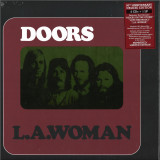
The Doors - L.A. Woman 50th Anniversary Deluxe Edition
 
39

LP + 3xCD + booklet !

The Doors found their mojo (and Mr. Mojo Risin’) in November 1970 as they recorded L.A. Woman over six days at the Workshop, the band’s rehearsal space on Santa Monica Boulevard. A success both critically and commercially, the album was certified double-platinum and contains some of the band’s most enduring music, including the Top 20 hit “Love Her Madly,” “Riders On The Storm,” and the title track.
To commemorate the album’s 50-year anniversary, Rhino keeps on risin’ with a 3-CD/1-LP set that will be available on December 3rd. L.A. WOMAN: 50TH ANNIVERSARY DELUXE EDITION includes the original album newly remastered by The Doors’ longtime engineer and mixer Bruce Botnick, two bonus discs of unreleased studio outtakes, and the stereo mix of the original album on 180-gram virgin vinyl.
For this new collection, the original album has been expanded with more than two hours of unreleased recordings taken from the sessions for L.A. Woman, allowing the listener to experience the progression of each song as it developed in the studio. An early demo for “Hyacinth House” recorded at Robby Krieger’s home studio in 1969 is also included.
The outtakes feature Jim Morrison, John Densmore, Robby Krieger, and Ray Manzarek working in the studio with two additional musicians. The first was rhythm guitarist Marc Benno, who worked with Leon Russell in The Asylum Choir. The other was bassist Jerry Scheff, who was a member of Elvis Presley’s TCB band.

out of Stock

Order now and we will order the item for you at our supplier.

67,19

Last In: 4 years ago
Super Biton De Ségou - Afro-Jazz-Folk Collection Vol. 1 (2x12")

Deviation Records is pleased to present you their latest and exiting collaboration with the Mieruba Label Team.
The Super Biton has existed since the 60s, like Ségou, its orchestra, the Super Biton has always remained behind what was done in Bamako and in the big cities of Africa. The Ségou orchestra developed and incorporated amplified instruments that mingle with brass, in particular electric guitars, symbols of modernity at the time. It opens up to Cuban music, and congas and bongos complement the sound of the orchestra. The group drew a unique sound from it, a perfect balance between tradition and the modern. There are about fifteen artits on stage, singers, guitarists drummer and percussionists. The Super Biton has for years been the best known and most sought-after orchestra of Mali outsid the country's borders, the Super Biton transcends the only Bambara heritage with its repertoire. Ségou is crossroads between Bambara, Fulani, Mandingo and Somono cultures and Biton has drawn on all these traditions to creat a repertoire extremely rich in rhythms and words. Some musicians completed their training in Cuba. They play "bambara jazz", incorporating a lot of
brass instruments such as saxophone, trumpet, clarinet. The compositions are modern and sophisticated.
Mieruba Art Center is a place dedicated to the transmission and safeguarding of Malian musical heritage through musical exchange between the older and newer generation - Artist residences, music lessons, rehearsals, Workshops, Masterclasses - and so on. Just as happy former musicians of Mali, the members of Super Biton give lessons on site. It is also the office of the Mieruba-ML label in the same place where Deviation Records is collaboration for the second time on the album - After the « Lost Maestros Collection » - with the
support of La Manufacture de Vinyles. Phil of Deviation Records tells: "I am very enthusiastic at the idea of offering you these two volumes of the History of the Super Biton of Ségou, Clique of Super Heroes of sound,
a source of inspiration for generations of musicians, DJs and also griots and storytellers of great renown! This double LP compiles the first Chapter of the rich Afro-Jazz-Folk Collection whose tapes have been remastered by Monsieur Jonin and cut at the MB Mastering Studio in Aubervilliers .The gatefold artwork is conceived by
Ewwanuelle Collage and formatted by Bertrand Tondeur, Graphic designer of Les Mouches. All that’sleft to say is that i hope that you enjoy listening to the final result !"

out of Stock

Order now and we will order the item for you at our supplier.

20,13

Last In: 4 years ago
Anthonie Tonnon - Leave Love Out Of This

Tonnon produced the album with longtime collaborator, and The Beths’ guitarist and producer, Jonathan Pearce. Tonnon wrote the bulk of the songs during an extensive period of touring after the release of Successor - a period where Tonnon performed with Nadia Reid in Europe, The Veils in the USA, and The Chills, The Phoenix Foundation and Don McGlashan in New Zealand. The pair workshopped songs between tours, often recording new parts as the live versions developed.

Tonnon and Pearce recorded between 2017 and 2020, and in that time, Tonnon’s practise evolved heavily. He incorporated new technology into his set, including the Wellington-designed Synthstrom Deluge, which allowed him to adapt his set for new performance environments;Art Galleries, Museums, even New Zealand Fashion Week. He took that technology further when he collaborated with the Otago Museum on the immersive show for Planetariums, A Synthesized Universe, which travelled to Arts Festivals around New Zealand in 2019.

Creating a music video for ‘Old Images,’ which explored a lost passenger train network, Tonnon came to the idea for a new experience-based show called Rail Land. It took audiences on railways to reach distant community halls around Aotearoa. The show saw Tonnon combine historical research and spoken word narrative, with the immersive lighting and musical technology he developed for A Synthesized Universe. In March, Rail Land finished a three-night run at Auckland Arts Festival, cementing Tonnon’s move to the concept show.

Over time, Tonnon and Pearce’s production moved further from the traditional rhythm sections that powered songs like Successor’s ‘Water Underground.’ In their place came off kilter electronic rhythms, like the beat in ‘Two Free Hands,’ and textures that blur lines between organic and synthesized sound. Guitars are set against synthesizers, and drums against drum machines in ‘Entertainment’ and ‘Peacetime Orders,’ which Tonnon also used in his soundtrack for RNZ’s 80s spy-themed podcast The Service. In ‘Leave Love Out Of This,’ a ballad starts with a piano and a string quartet, but ends in a wall of electronic sound.

The constant has been Tonnon’s lyrics. Whether singing about evolution and the future of work in ‘Two Free Hands,’ the television industry in ‘Entertainment,’ or environmental disaster and regulatory failure in ‘Mataura Paper Mill,’ Tonnon has followed a distinct approach to subject matter, description and phrasing that have seen him longlisted for the APRA Silver Scroll three times.

Tonnon’s explorations of local government and civic infrastructure in his work - an unusual preoccupation for a songwriter, have taken new meaning in his adopted home of Whanganui, where last year, he was elected by councillors as Whanganui District Council’s representative for public transport.

After Tonnon moved to Whanganui, and Pearce toured almost constantly after the success of The Beths’ first album, the pair conducted their collaboration over distance, but with key sessions at Pearce’s Karangahape Road studio, including drums and bass with long time band members Stuart Harwood and David Flyger, a string quartet led by Charmian Keay and arranged by Matthew Bodman, and additional drums with The Beths’ Tristan Deck.

As Leave Love Out Of This is released, Tonnon and Pearce find themselves in very different places to where they started, working on Auckland’s Karangahape Road, close to the venues like Wine Cellar and Whammy Bar where they regularly performed. Back in New Zealand since Covid, Pearce has had to adjust to being in one of Aotearoa’s best-known bands, while Tonnon, when not working on conceptual shows, wrestles with how to restore civic infrastructure to a post industrial city in the regions.

Created over a life-altering period of, Leave Love Out Of This is the culmination of years of experimentation and development - with new technology, new sounds, and new ways of creating, and performing music.

pre-order now16.07.2021

expected to be published on 16.07.2021

21,56

Last In: 2026 years ago
Various - Jazz in Jamaica - The Coolest Cats From The Alpha Boys School

Talking about the foundation of Jamaican music, the Alpha Boys School in Kingston can be considered as one of the places where it all began! Back in the day, under the direction of Sister Mary Ignatius, the school was the place where young boys from the poor neighborhoods in Kingston could embrace an instrument (mostly brass and drums). Then history tells us that some of these kids became among the most influential musicians in the history of Jamaican Jazz, Ska, and Reggae. Joe Harriott, Dizzy Reece, Tommy McCook, Don Drummond, Cedric Brooks, Rico Rodriguez, Johnny Osbourne, Leroy Smart and Yellowman are just some of the fruits of such a great community art project. Now this compilation contains some rare gems produced between 1959 and 1962 by Jamaican Jazz heavyweights such as Tommy Mc Cook, Don Drummond, Ernest Rangling, Lennie Hiibert, Cecil Lloyd and others. This is highly swinging music inspired by the Black American tradition with a unique and inevitable Caribbean flavour. Don't miss it!!!

pre-order now05.02.2021

expected to be published on 05.02.2021

18,45

Last In: 2026 years ago
Asian Dub Foundation - Access Denied (2x12")

It was a busy 2019 for Asian Dub Foundation with the long-awaited reissue of their Mercury Prize-nominated 1998 classic Rafi’s Revenge. The reissue garnered ecstatic reviews, all of which agreed that the sound and the message that ADF threw down in 1998 is as relevant now as it was then-perhaps even more so. So it’s timely that in 2020 the band are set to release their 9th album “Access Denied” which finds them as uncompromising as ever. The album showcases ADF in full spectrum mode from the tough Jungle Punk sound of “Stealing The Future” and “Mind-lock” through to the orchestral meditation of “Realignment” and the reggae lament of the title track.

With guestspots from Greta Thunberg, incendiary Palestinian shamstep warriors 47 Soul, Chilean revolt’s rap main figure Ana Tijoux and radical UK comedian Stewart Lee, Asian Dub Foundation continue their sonic opposition to the powers that be and “Access Denied” kicks harder and higher than ever.

Asian Dub Foundation are a genre unto themselves. Their unique combination of tough jungle rhythms, dub bass lines and wild guitar overlaid by references to their South Asian roots and militant high-speed rap has established them as one of the best live bands in the world. During their long and productive career Asian Dub Foundation have shared the stage with the likes of Rage Against The Machine, the Beastie Boys and Primal Scream also collaborating on record with the likes of Radiohead, Sinead O’ Connor, Iggy Pop and Chuck D.
The story began in the early 90’s when ADF formed from a music workshop in East London at the institution which is their spiritual home, Community Music. Their unique beginnings in a music workshop in east London marked out both their sound and their wider educational aspirations, as showed by their early involvements with Roma Youth in Budapest, hooking up with the leg-endary Afro Reggae in the favelas of Rio, and setting up their own education organisation ADF Education (ADFED), not to mention their campaigns on behalf of those suffering miscarriages of justice. Building a solid live reputation in the mid-90’s, particularly in France, they eventually es-tablished themselves as an important worldwide force and particularly as an explosive alterna-tive to the backward-looking obsession with Britpop in the UK.
In addition to their blistering live reputation ADF were one of the first bands to experiment with the now more commonplace live film re-score, beginning with their rapturously-received interpre-tation of the French classic La Haine back in in 2001. They’ve continued to perform said project or nearly two decades, taking in David Bowie’s Meltdown at London’s South Bank and a contro-versial show at the Broadwater Farm Estate, scene of the events that led to the London Riots of 2011.They’ve also rescored George Lucas’ debut THX 1138 (with encouragement from Mr. Lu-cas himself) and they’ve recently revived their explosive live interpretation to the continually rele-vant Battle of Algiers at the Museum of Immigration in Paris.

out of Stock

Order now and we will order the item for you at our supplier.

29,20

Last In: 3 years ago
Daisy Moon - Geometry of Curves

Another exceptional talent has been brewing in the Idle Hands homestead of Bristol for some time now. Daisy Moon has forged strong ties within the creatively bustling city, from her current DJ spots at the ever popular Housework nights, alongside Shanti Celeste, Gramrcy and Golesworthy, her continued work with Bristol's Women In Music group via DJ workshops and industry advice sessions and her former residency alongside Idle Hands founder, Chris Farrell, and Danielle, at the much loved BRSTL nights.

In a sideways step away from the dancefloor, Daisy has prepped a diverse and absorbing EP for the label. Celestial tones and shimmering vocals form the building blocks of 'Geometry Of Curves' whilst 'Halycon' moves at a seductively smooth pace as it combines time stretched vox, sparse yet crunchy beats and plummeting soundscapes to great effect. Deft melodies and woody percussion signature the almost kitsch pop sounds of 'Anemone', whilst EP finale, 'Chambers', locks down ethereal sensations floating on a hefty rhythm, signing off a wonderfully impressive debut release from Daisy for Idle Hands.

out of Stock

Order now and we will order the item for you at our supplier.

9,20

Last In: 6 years ago
Shawn Lee & Paul Elliott - Mexican Marimba

While filming "The Library Music Film", Shawn Lee & Paul Elliott travelled the world interviewing legendary composers, musicians and producers. This meant visiting some incredible recording studios, studios almost as famous as the music created in them, places like Telecine Sound Studio in Rome, Angel Studios in London, Studio CBE in Paris and Piero Umiliani's Sound workshop in Rome.

f you have ever met Shawn Lee & Paul Elliott, you will know they can't resist picking up an instrument or two for an impromptu jam, so it was inevitable that the pair would create some music in at a least a couple of these world-renowned studios. This special 7" release is the result of their spontaneous, off the cuff musical moments.

"Mexican Marimba" was kick started in The Sound Workshop Studio in Rome, when Shawn and Paul played the Maestro Piero Umiliani's Mexican Marimba with their fingers - the mallets where not next to the instrument, so they just played anyway!

"French Attack" began life when Paul improvised a piece on Studio CBE's tack piano, while Shawn sat on the floor beating out the rhythm on a bass drum and tom toms - this moment can briefly be seen in "The Library Music Film"

Both recordings were then taken back to London to Shawn Lee's own studio for the finishing touches and the music was included in the film's underscore. Here it is released commercially for the first time!

out of Stock

Order now and we will order the item for you at our supplier.

8,36

Last In: 6 years ago
Duccio - Pocket Love EP

Duccio Lopresto is a classic car lover and modernist in the classical sense from northern Italy. His debut on Greta Cottage Workshop was a blueprint for what House Music can be 35 years after it emerged: Funky without copying the 70s, deep without being boring, uplifting without being cheesy.

His second artist EP is now going to be released on Berlin's „Smile for a while“, coming with heavy synths, bouncing basslines, syncopated drums and hypnotizing rhythm patterns. Clearly an approach from a motor city - not Detroit though but Milan.

out of Stock

Order now and we will order the item for you at our supplier.

9,87

Last In: 6 years ago
Johnny GRIFFITH - The Geneva Connection

An extremely rare album left by Detroit-based jazz keyboard player Johnny Griffith known for the album "Together, Togetherness" on RCA. An album covering "From The Music Connection" with Freddie Redd Quartet and Jackie McLean. The Music From "The Connection" was composed by jazz pianist Freddie Redd for Jack Gelber's 1959 play The Connection. This first recording of the music was released on the Blue Note label in 1960. It features performances by Redd and Jackie McLean Jack Gelber originally planned for the play to feature improvised music performed by jazz musicians who would also play small roles in the production. Freddie Redd, however, persuaded Gelber to include his original score. Redd re-recorded the score later in 1960 as Music from the Connection.

In 1974 The pianist Johnny Griffith, who was a member of the prestigious Motown rhythm section "Funk Brothers", covered the album "The Connection" by Freddie Red as a whole album, playing electric piano here, which really changes the vibe of the music - and the players are supposedly a host of Motown studio musicians - playing jazz here, but with a nice funky soul undercurrent. Originally released on Detroit Geneva Label.

Pianist Johnny Griffith can be heard on classic Motown sides, as well as on recordings from other Detroit-area labels. Like Motown's other pianists, Joe Hunter and Earl Van Dyke, Griffith's had an extensive musical background.

Signed to Motown's Jazz Workshop label, he recorded the albums "Detroit Jazz" and "The Right Side" of Lefty Edwards. When the march of the Motown hits began, Griffith started playing on sessions for their R&B/Pop acts. But rather than signing a work-for-hire contract with Motown like other musicians, Griffith remained a freelancer, doing other dates and sessions in New York and nearby Chicago.The Motown hits that Griffith played on include: Marvin Gaye's "How Sweet It Is (To Be Loved By You)", his celeste trills are heard on "Mercy Mercy Me (The Ecology)", adding Wurlitzer electric piano on both Gaye's "I Heard It Through the Grapevine" and the Temptations' "Ain't Too Proud to Beg", organ on the Supremes' "Stop in the Name of Love and organ and shotgun effects on Junior Walker and the All Stars' "Shotgun.

Griffith's non-Motown hits are with Edwin Starr, Jackie Wilson, The Chi-Lites, and Young-Holt Unlimited's "Soulful Strut" In the '90s, Griffith was still active on the Detroit club scene.

out of Stock

Order now and we will order the item for you at our supplier.

26,35

Last In: 6 years ago
Langham Research Centre - Tape Reworks, Vol. 1

"a kind of Radiophonic Workshop Rebel Alliance…" - The Quietus

Modern music concrete quartet Langham Research Centre follow-up their debut album, Tape Works, Vol. 1 with a short EP of remixes, also on nonclassical. Remixes come from a fan of theirs – experimental veteran Jim O'Rourke – and Berlin-based industrial duo group A.

On Side A, Jim O'Rourke uses 'Quasar Melodics' as his source material, transforming fizzing grains of sound into an oceanic swirl of noise. On the flip, group A find metallic rhythms and eerie melancholy in 'Perpetual Motion'.

On 7" and digital, the EP has gained radio play on BBC's Late Junction.

out of Stock

Order now and we will order the item for you at our supplier.

8,87

Last In: 6 years ago
J.McFarlane’s Reality Guest - Ta-Da

“Ta Da” is the debut full length from J. McFarlane Reality Guest, the collective name for the trio headed by the eponymous McFarlane. As a member of the group Twerps, McFarlane has traversed guitar-centric, melodic pop music for some years while honing a highly unique, personal musical language. Ta Da is the first recorded unveiling of McFarlane’s affecting, oblique songwriting panache. Originally released in her native Australia on Hobbies Galore, Ta Da will be released worldwide by Night School in June 2019.

Wheezing into view with a troubled reed instrument set against a s of whoozy synth lines, Human Tissue Act is a foggy curtain the listener is invited to peel back. The dissonant notes are left to dance entwined, with clarinet heralding a Harry Partch-esque mallet percussion interlude. It’s a mood. With no resolution in sight, an audience dragged closer into uncertainty is suddenly drenched with the light of inter-weaving wah wah synth and saxophone. I Am A Toy introduces us to McFarlane’s vocal, an effortless and matter-of-fact, accented statement that quietly takes the reins. While McFarlane’s previous work in Twerps might reference 80s UK and antipodean guitar pop, Ta Da showcases a different influences immersed in psychedelic music and synths. It’s a brilliant, deft concoction swimming in Young Marble Giants-type minimalism washed with bare pop and harmony similar to Kevin Ayers making sense of a Melbourne suburb full of faces half-recognised in the blanching sun.

What Has He Bought begins with a Casio-keyboard rhythm pattern, palm-muted guitars and immaculately enunciated vocal give way to a burnt melodica part that elevates the spirits. Simple patterns repeated, like a well-tempered pop song that does what it needs to do and no more, build into the sound of summer leaking orange juice. They’re moments of joy, layered on top of each other like a melting cake. Do You Like What I’m Sayin’ recalls Marine Girls covering a classic ‘66 Garage nugget, organ lines fighting funk with guitar chords played just behind the percussion. “In a talking world, meanings are the same. Words want to hold on to the people they contain. Do you like what I’m sayin’?” We’re in a Beckett play perhaps, obtuse absurdities rendered pretty. Alien Ceremony is a heart-melter, given a melancholic timbre by bowed double bass it’s a tragi-comic piece that almost reeks of Robert Wyatt at his mid-whimsical twisting a fugue completely out of shape. Beneath the layers of harmony and twinkling instrumentation you sense there’s a genuine sadness somewhere even if it remains veiled.

Through out Ta Da, McFarlane plays with counterpoint and contrast to sometimes delirious effect. On Your Torturer, a simple, upbeat chord progression is hard panned, underpinning a flute solo which seems out of place, hence making it completely in place on this warmly surreal album. My Enemy is a slowly swinging eulogy to a failed relationship punctuated by analogue synth burbles, with our protagonist simply asking, in the aftermath, “can we be nice?” Here McFarlane’s vocal is straight forward, lyrically conversational but still not completely in focus, a surreal kitchen sink drama filtered through a dream where everything is in the wrong place. It’s a fine precursor to Heartburn, which similarly borrows BBC Radiophonic Workshop-style noise synths and the use of space to carve up the simple “You Will Make My Heart Burn” line. At this point, the listener has been in such close proximity to McFarlane’s show, the reality guest in a performance where they’re the sole audience member, that when Where Are You My Love rises on the horizon as a sleepy, psychedelic send off it’s uplifting. The vocal drifts away into the sunset, simple and direct. It leaves the listener slightly confused, perhaps, but grateful for the gentle surprise.

pre-order now14.06.2019

expected to be published on 14.06.2019

19,96

Last In: 2026 years ago
Benjamin BRUNN/DAVE WHEELS - 2000

Benjamin Brunn/Dave Wheels

2000

2x12inchSUSH44
Sushitech
03.06.2019

Sound design masters Benjamin Brunn and Dave Wheels of the Workshop fame team up with the iconic Berlin based Sushitech for a beautiful double 12" LP release.

"2000" is an electronic masterpiece, lush melodies, dubby rhythms and some mesmerising synth lines that we can all recognise from previous milestone Benjamin Brunn releases such as Song From The Beehive that was already released a decade ago together with Move D.

This 2x12" with 8 full length tracks packed in a gatefold sleeve makes a beautiful pack that is a simply must have for any serious vinyl collector - BIG!

out of Stock

Order now and we will order the item for you at our supplier.

23,49

Last In: 5 years ago
The Slow Engineer - Where Comes The Dark

After a pleasing start to the New Year, 2 same night sell outs on lathe cut 45s and a single afternoon sell out of the recent Gabe Knox LP, Polytechnic Youth continue their relentless release schedule with 2 more awesome full lengths. In their own ways, both totally unique but very much befitting the tried and trusted synth / electronic PY blueprint.

First up is the fabulous 'Where comes the Dark' debut full length from shadowy, underground producer The Slow Engineer. 'An album of sculpted synthsonics and Eldritch electronics originally released on a limited run, blink and you'll miss it cassette which sold out in 24 hrs. Heavy on basslines, with driving rhythms and tweaked synthesisers, it's a record which openly acknowledges it's nod to horror scores and the work of the Radiophonic Workshop whilst pulling off something uniquely and freshly new, with an assembled array of wayward equipment stored at his Analogue Hades base.'

British horror actor Laurence R. Harvey adds suitably menacing narration in places, and across 10 fabulous tracks this is a richly, deliciously diverse electronic record which comes hugely recommended to fans of John Carpenter, not to mention label mates The Heartwood Institute and Dream Division.

A one time pressing of 300, destined to sell out pretty swiftly.....

out of Stock

Order now and we will order the item for you at our supplier.

12,90

Last In: 7 years ago
Black Booby - Bb09

Black Booby

Bb09

12inchBB09
BLACK BOOBY
08.10.2015

Black Booby is back with the Mighty Jordan Fields from Chicago, IL and Richard Rogers, London, UK for BB-09 4 tracks of retro inspired, raw, stripped machine music.Jordan's A1 blaster is pure Gherkinesq analogue, mind melting, building mayhem, designed for dancing Richard Rogers Debut on BB gives A2 a Workshop vs Detroit styled Bass workout with subtle paperclip percussion bringing up the rear. Black Booby tears up the seminal Kenji Tsujisaka produced Shinobi coin op level music to new club dance floor heights on B1, B2. Direct 8 bit coin op pressure with stripped 707, 808 and 909 rhythm sections. Retroactive music for arcade junkies.

out of Stock

Order now and we will order the item for you at our supplier.

8,53

Last In: 8 years ago
Amara Toure - Amara Toure 2x12"

The enigmatic Amara Touré from Guinée Conakry finally getting a well deserved compilation showcasing all of the 10 songs ever released between 1973 and 1980. Cuban influenced music of a different kind featuring amazing spaced-out guitar works!! Analog Africa compiles a complete collection of Amara Touré's Afro-Cuban compositions, originally released between 1973 and 1980."Lamento Cubana and Temedy are the two finest Afro-Cuban compositions ever recorded. As if they were played in a smokey, poorly lit ballroom where dark rum was sipped ever so slowly" - Vikram Sohonie - Ostinato Records
Analog Africa to release a compilation by Amara Toure, the enigmatic Afro-Cuban musician from Guinea-Conakry, showcasing all of the 10 songs he ever released between 1973 and 1980.
"Latin music, is it really foreign to us Africans I don't think so. Listen to the drums, to the rhythm. It all seems very close to us - it feels like it's our own culture," declared enigmatic singer Amara Toure. It is the late 50s, and Senegal is going crazy to the groove of Son Montuno and Patchanga. Brought to West Africa by Cuban sailors in the early 40s, these styles were immediately adopted by a flourishing music scene that did not hesitate to embrace the Caribbean sound, mixed it with their own Folklore, and, in the process, created something new. Through the unique cultural fusion of West African and Caribbean influences, Latin music took on a new and unique sound - the format was reinvented. Producer Ibra Kasseì and his Miami nightclub acted as the spearheads of this movement. They brought a breath of fresh air into Dakar's nightlife, further energising one of West Africa's most exciting cities. The demand for ballroom parties and live acts exploded, attracting numerous musicians from surrounding countries. One of the musicians who answered this call was percussionist and singer Amara Toureì, from Guinea-Conakry. Spotted by Kasseì while performing with Dexter Johnson, Toureì was asked if he would like to be part of a new project. Little did he know that this project would become a phenomenon.Immensely important for the development of Senegalese modern music, Le Star Band de Dakar, led by Mady Konate, became a sort of musical incubator and workshop, where many musicians learned and practiced their trade before moving on to become stars in their own right. Toureì's talent on percussion was undeniable, but it was his powerful and raw voice that captivated the producer. The fascinating way Toure interpreted Cuban music was unparalleled, and it was this feature that encouraged Kasse to recruit the unknown artist.
Although already brimming with incredible talent, Amara Toure's joining of Le Star Band de Dakar in 1958 began the band's meteoric rise to the top. The band quickly became Dakar's number one orchestra, and it cemented the reputation of the Miami nightclub as the hottest spot in the country. The place was packed nightly, and Dakar was boiling.
Amara Toure's Senegalese adventure lasted for ten years when he received an irrefutable offer and in 1968, joined by a few talented Senegalese musicians, headed to Cameroon and immediately formed the Black and White ensemble. Many live gigs later and it was time for the first songs to be recorded. A total of three singles were produced between 1973 and 1976. These singles, representing the first six songs on this compilation, fully epitomise and distill the essence of what Toureì had learned during his career. His Mandingue roots fused with the Senegalese sound that he had mastered - the perfect foundation for the Toureì's Cuban interpretations.
If Toure's intention was to create the most sensual music ever recorded in Africa, he might very well have reached this goal. The musicians on the recording sound like they are playing in a smokey, poorly lit juke joint, where dark rum was sipped ever so slowly, and the pulse of the music took up a life of its own. How many couples have danced, swayed, and melted together to the distinct sound of Amara Toure Nobody can say for sure ...
Amara Toureì's success poured across the borders of Cameroon, and in 1980 he went to Libreville, Gabon, to team up with the powerful Orchestre Massako. Toureì recorded an LP at that time which is hailed by many music aficionados as one of the very best African albums. The songs from that LP are the last four on this compilation. It took only ten songs for Amara Toureì to become a legend. These ten treasures, representing Toure ìs complete discography, have been carefully re-mastered from original session tapes and vinyl records, and will be released by Analog Africa on 22 June 2015. After the release of his LP in 1980, Toureì seems to have disappeared. Apparently he was last seen in Cameroon but it is unknown if he is still alive today. His music though is definitely alive.

out of Stock

Order now and we will order the item for you at our supplier.

27,31

Last In: 3 years ago
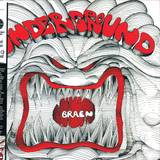
The Braen's Machine - Underground

During the '70s, work days at Umiliani's Sound Workshop Studios were hectic; thousands of sessions were held in order to keep up with a very busy Italian movie industry: Hundreds of soundtracks alongside with music library were recorded and released on vinyl in very limited quantities for TV and film production use only. Those LPs are now proper collectors' items, extremely hard to find.

Filled with hypnotic bass lines, heavy drums and screaming fuzz guitars "Underground", the first LP of the fictitious group known as Braen's Machine, is one of the rarest and the most expensive of them all, always "reaching" sky high prices throughout the second hand vinyl market. A fast-beat jam with hammond scales and a twin lead guitar theme ("Flying") opens the A Side soon followed by "Imphormal", a classicfunk-beat-meetsfender- rhodes-and-psychedelic-guitar number. The music then switch to "thriller territories" with "Murder" which is based on prepared piano swells and a deeply hypnotic walking bass, reminiscent of the best Morricone's soundtracks for Dario Argento's movies. Two highly percussive songs complete the A Side: "Gap" is an improvised song with guitar and keyboards dwelling over an infectious drum rhythm while a marching snare and a vibraslap effect are the special features on "Militar Police".

The mood relaxes slightly on the opening of the B Side with a lazy jazz groove on "New Experience" but the rock influences are soon brought back on the following track "Fall Out". "Obstinacy" is all about keyboards with syncopated rhodes themes and distorted hammond sustained notes whilst the fuzz guitar is back again screaming through the left channel on the last song of the album, "Description". We could happly say that that was the golden age of the Italian music library. But who's behind the name "Braen's Machine" On the original cover the songs are credited to the composers Braen and Gisteri. Braen was a pseudonym often used by Alessandro Alessandroni, an extremely skilled and versatile musician, and one of Umiliani's closestcollaborators. He could write, conduct and arrange, he could sing (ever heard "Mah Na Mah Na"), he could whistle (ever heard Morricone's "For a fistful of dollars") and he could play almost anything: guitar, bass tuba, accordion, sitar and the list grows..... His first album "Alessandro Alessandroni e il suo complesso" (Sermi, 1969), had transformed the Italian library music from orchestral sound beds into the psychedelia we all love; the extremely fuzzy guitars are very "present" on "Underground" too. For a long time Gisteri's real identity was rather mysterious; often wrongly attributed to Umiliani. Gisteri was the pseudonym of Oronzo De Filippi, art name of Rino De Filippi, music supervisor to the Italian public broadcast company (RAI) between the '60s and the '70s. De Filippi composed other notable pieces such as "Riflessi" (Edipan, 1975) and "Nel mondo del lavoro" (Sermi, 1972).

De Filippi passed away few years ago but we were able to contact Alessandroni to talk about this LP. Remembering "Underground" recording session as one of the thousands he took part of, Alessandroni told us that this record was produced very quickly, in two days maximum. This was made possible by a team of wonderfully capable session musicians and the creative genius behind the mixing desk; this incredible combination helped to focus on the mood of each track even more. Unfortunately there are no liner notes but Alessandroni's memories and speculations, based on other music tracked in the same period at Soundworkshop by resident engineer Claudio Batussi, led us to identify this as the most probable lineup: Munari on drums, Majorana on bass, Vannucchi on keyboards and Alessandroni himself on guitar. For this reissue the sound has been restored and the cover art reproduced exactly as it was.

out of Stock

Order now and we will order the item for you at our supplier.

28,53

Last In: 10 years ago
Items per Page:
N/ABPM
Vinyl