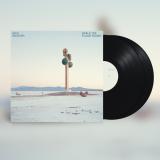
Oscar-nominated composer Max Richter's new album While The Flood Rages, drawn from Richter's latest collaboration with choreographer Wayne McGregor, MaddAddam, inspired by Margaret Atwood's trilogy.
Across 15 tracks split into three acts, Richter blends orchestral writing, electronics, processed field recordings, choir and piano to create an immersive sonic journey.
Themes of ecological collapse, technological acceleration and resilience run throughout, with recurring piano motifs providing moments of reflection amid dense, cinematic soundscapes.
It’s True What They Say is the debut EP from Edinburgh-based, husband-and-wife duo Sarah/Shaun (pronounced simply Sarah Shaun), aka Sarah and Shaun McLachlan (pronounced “McLochlin”).
“Sarah and I both have a love for nostalgia,” explains Shaun. “We watched that amazing old 80’s Sci-Fi, (John) Carpenter movie, Starman, a few months back. Myself and my brother David used to watch it all the time. We must have been, roughly, 5-7 at the time. I remember loving the movie but the end, you know, with the beautiful, atmospheric, synth ending, I love that particular moment the most - best part of the movie, you know, when he goes home… It’s heartbreaking but stunning, all the same. It’s the music that moves you most… It did when I was 5 and it still does to this day. It must have had some form of a (much deeper) impact on me.”
The duo narrates stories across themes of love, hope, family, friends, dreams and sadness - the good that comes with the bad in everyday life, not just on a personal scale but within a community as well.
“Starbed is the first song I have ever written and just came out of the blue really, with Shaun playing a melody and me singing along,” says Sarah. “It’s simple and just about two people in love. Love songs are always the best songs, after all… Music has been a big part of my life from a young age. I was unwillingly dragged to piano and violin lessons, which I’m thankful for now! I’d say the first band I really became obsessed with growing up were the Beatles, and on the back of that a lot of 60s music and fashion. From then on, I had a love for music.”
“Shaun definitely opened my ears to a lot of sounds and got me thinking about soundtracks and all the noises that can be made,” she goes on. “We love just spending time experimenting in the house with instruments, pedals etc and Ali is a real magician to work with, too…”
The recordings took place over the summers of 2022 and 2023, with fellow Delta Mainline member Ali Chisholm (aka Jaguar Eyes) plus long-term friend and collaborator Gavin King. Further collaboration then came via the ‘net from the (international) likes of Chris Dixie Darley (Father John Misty), Darren Coghill (Neon Waltz) and Daniel Land (The Modern Painters), among others (see a full list of credits below).
Both Sarah and Shaun have a love for uber-soundtrack producers such as Hanz Zimmer, Max Richter, Cliff Martinez plus live acts such as Beach House, Spiritualized, M83, Suicide, Moby and OMD (to name a few). Shaun also credits the work of Kyle Dixon & Michael Stein (from Survive) on the Stranger Things score… “Even a moment in a movie, whether it be just 30 seconds during a particular scene, it grips you,” he says. But there’s something much deeper at play as well. “Music is a healer,” he goes on, “and I write from my own perspective but more so for others. Once I've done my bit, it doesn't belong to me any longer. It belongs to whoever wants it or needs it.”
The result is a cinematic, synth-wavey, dream poppy and downright beguilingly beautiful body of work. And they’re just getting started…
REVIEWS/RADIO/FEEDBACK:
“Starbed is folky, flavoured by pedal steel, cello, and brass. Dust Tears, in stark contrast, is a mini synth-pop rave epic. Part Bicep. Part Human League. Keep Your Eyes Closed summons a mood that’s romantic, but also dark and potentially doomed – like David Lynch’s Twin Peaks meets Cliff Martinez’s Drive score. My pick though is It’s True What They Say, whose interwoven jangle and picking recalls New Order’s more introspective moments (Love Vigilantes, Love Less… ). Drums crashing, cathartic. Guitar raising dramatic arcs. Its chorus a rush, like a reprise of Pains Of Being Pure Of Heart’s ‘Higher Than The Stars’.” BAN BAN TON TON
"Dust Tears sees them sharing vocal duties over a synth foundation reminiscent of Moby’s Go - Artist Of The Week” THE SCOTSMAN
"Woozy pop" NEMONE (Mary Anne Hobbs Morning Show, BBC 6Music)
"Nice one, very David Lynch meets Euro dream pop" YOUTH (Killing Joke, Paul McCartney, U2, The Orb, Spiritualized etc)
"Music sounds killer! Real emotion” DAVID HOLMES
"I’m enjoying it” TIM BRINKHURST aka LONDON (IKLAN, Young Fathers, Callum Easter)
“Oh, this is lovely!” SEAN JOHNSTON (A Love From Outer Space)
"It’s totally my cup of tea with milk and biscuit" BRENT RADEMAKER (Beachwood Sparks/GospelBeach)
"Beautiful, ecstatic electronica! Short and to the point" KEVIN BALES (Spiritualized, Julian Cope, Soulsavers, BE)
"Makes me wanna sit in the sun and sip an Arnold Palmer" CHRIS DIXIE DARLEY (Father John Misty)
“Really beautiful - Cocteau Twins / Spiritualized vibes but has its own thing going on, too - worth checking out!” JULIAN CORRIE (Franz Ferdinand, Miaoux Miaoux)
‘Sounded nice on a sunny day, makes me think of Twin Peaks, nice moods’ EAMON HAMILTON (Sea Power)
"Dealing in nostalgia, no bad thing at all, great to play that (Dust Tears) for you” RODDY HART (BBC Radio Scotland)
“I'll give the vocal tracks a spin before the release." VIC GALLOWAY (BBC Radio Scotland)
"Rather good!" IAIN ANDERSON (BBC Radio Scotland)
CREDITS:
Lyrics, Guitars, Keys, Synths, Drums, Drum Programming, Percussion, Mandolin, Glockenspiel: Shaun McLachlan
Lyrics, Vocals, Keys by Sarah McLachlan
Guitars, Synths, String Arrangements, Drum Programming, Engineering: Jaguar Eyes Percussion/Drums/Effects, Fire Extinguisher: Darren Coghill (Neon Waltz)
Guitars by Daniel Land
Slide Guitar by Chris Dixie Darley (Father John Misty)
Brass by Bruce Michie
Keys, pre-production & engineering on “It’s true what they say”: Gavin King
All produced by Jaguar Eyes and Shaun McLachlan and then mixed at Glasgow’s Chem19 Studios by David McCaulay (From Scotland With Love, Rick Redbeard, BBC TV’s Attenborough and The Mammoth Graveyard score).
Artwork: Jamie Walman (Fourteen Admirals)
MORE INFO:
Although Shaun released a pair of solo singles (When We Dance and Give Your Love To Me) during Lockdown, he will be better known to many via his work as the multi-instrumentalist in Edinburgh band Delta Mainline. With two albums released to date, Oh! Enlightened and Bel Avenir, both rapturously received by fans and critics alike, Delta Mainline have developed an international, cult following. Oh Enlightened (2013) achieved widespread critical acclaim on release, earning the band comparisons to Arcade Fire and Echo & The Bunnymen, while 2019’s Bel Avenir pulled in references to The Flaming Lips, Pink Floyd, David Bowie and krautrock. A third DM album is currently being mixed and due for release later this year…
We’re teaming up with ELUCID and Fat Possum for a limited edition of 300 copies of a Rush Hour black ice coloured edition.
E L U C I D, one half of the illustrious duo Armand Hammer, is here with the full-length follow-up to 'I Told Bessie'. Further experiments in the sonic, expanding on the 'live' side of music paired with the embracing of chaos. Something you haven't heard, or not so for a very long time. E L U C I D is here to reveal the bleakness of reality.
''There is never time in the future in which we will work out our salvation. The challenge is in the moment; the time is always now.''
James Baldwin
A raw, crackling urgency runs through rapper-producer ELUCID’s new album REVELATOR like an underground power line. There is no space here for sepia-toned reminiscences or indulgent self-mythologizing. Intellectual rabbit holes have been filled in with concrete and rebar ; there is nowhere to hide and no off ramp from the audio Autobahn that ELUCID has fashioned—a renegade Robert Moses with gold fronts, bulldozing the homes of the powerful and the complicit. REVELATOR brims with the energy of now, with a refusal to look away. Carpe diem in a murder one mask.
Born in Jamaica, Queens, ELUCID has been on the cutting edge of New York’s underground scene since the mid-2000s. From the beginning, he has defied both convention and expectation. He ran with Okayplayer darlings Tanya Morgan, but his own music eschewed their throwback charm for glitchy noise experiments and bass-swamped culture jamming. His 2016 debut studio project Save Yourself (re-released in a deluxe edition last year) announced him in earnest. But in recent years, his Armand Hammer releases with partner-in-crime billy woods have received significant attention and acclaim. Serving as a followup to his last solo album—2022’s comparatively balmy I Told Bessie—ELUCID hoped to “re-distinguish” himself with REVELATOR, setting himself apart amidst the increasing attention around the music he and his friends are making together.
For ELUCID, this meant setting bold new challenges for himself. One of these was diving further into live instrumentation than ever before—”getting my Quincy Jones on,” as he puts it. The testing ground for this approach was Armand Hammer’s most recent project, 2023’s We Buy Diabetic Test Strips’ Möbius strip soundscapes, warmed with instrumental flourishes and skin-shedding beat progressions. With REVELATOR, though, ELUCID strove to create an atmosphere of chaos, embracing experimental electronics and atonal sample bursts. He worked on much of the album with co-producer Jon Nellen, who comes from a background in avant-garde and Indian classical music. “I wanted to get as freaky as I could at this moment. I wanted people to hear things, maybe for the first time, or in a way they haven’t for a long while,” the rapper explains.
ELUCID arrived at the studio with a collection of noise sources: non-referential samples, glitches and noises. Together he, Nellen, and others created forms out of them and, as ELUCID recalls, “just started playing drums with it.” Their fried, distorted sound was directly inspired by Miles Davis at his most uncompromising—specifically, the tone-clustering funk track “Rated X” from his 1974 double LP Get Up With It. At times, the pairing of rap with avant-fusion sounds also brings Emergency! from The Tony Williams Lifetime to mind, perhaps in an alternate timeline where the late drummer was listening to Ice Cube’s AmeriKKKa’s Most Wanted.
“The World is Dog,” REVELATOR’s lead single, functions as the album’s aesthetic thesis statement. Like the Davis track, the textures are punishing, the tonality is in free-fall, and the driving breakbeat of a groove cuts in and out unceremoniously. Avant-jazz bassist Luke Stewart, who appears throughout the record, holds the whole thing together just long enough for ELUCID to tightwalk over the beat. This tension is exactly where REVELATOR sets itself apart; in a time of drumless loops, and safe soul samples, this is a high-wire act with no safety net. Similarly, the song announces the themes of the album within just a few phrases, evoking the way societies accept and adjust to new levels of debasement and brutality while suffocating under the weight of history: “Can’t clock the kill, all a mystery/Forced past will eating everyone eventually/The world is dog.”
Many of the songs on REVELATOR grapple obliquely with dissolution and disenfranchisement in America and across the world—the grim realities of our domestic sociopolitical climate and our involvement in foreign conflicts. “Much of my artistic and political sensibility comes from the Black arts movement here in New York,” ELUCID explains. “Recognizing the interconnected global struggles against oppression, artists and thinkers created works and actions in solidarity with freedom movements in South Africa and Palestine.” ELUCID cites intellectuals like Amiri Baraka, Kwame Nkrumah, Audre Lorde, Sonia Sanchez, and Nikki Giovanni among his heroes. (One track on the album is specifically inspired by Lorde’s work, “SKP,” citing the scholar’s paper “Uses of the Erotic: The Erotic As Power.”) Songs like REVELATOR’s insistent closer “ZIGZAGZIG,” find ELUCID applying up-to-the-minute messaging, making explicit reference to the conflict in Gaza: “Feed a war machine…from river to sea, in lieu of peace.”
Despite ELUCID’s preference for cacophonous system overload here, the rapper also provides moments of respite. Recorded at The Alchemist’s Los Angeles studio, the laid-back, wheezing “INSTANT TRANSFER” is a collaboration with billy woods, which crystallizes their shared sense of creative determination. “With much momentum behind us and even more on the horizon, I knew a purpose, and that every step was ordered to that purpose,” ELUCID said of the experience. Meanwhile, the jittery “HUSHPUPPIES” is a playful anomaly on the track list, providing a snapshot of ELUCID watching his grandparents in the kitchen while preparing for Friday night fish fry dinners.
“Love still rules over on this side,” ELUCID says. ”I’m raising a family. We are making meaning and finding joy in the midst of all the fucked up-ness of everything around us because the alternative is cowardice and slow death. We remain rooted. We celebrate our people and our wins. Struggle is necessary.”
“IKEBANA” is one of ELUCID’s strongest statements of purpose on the record, blending the record’s heaviest themes with its most hopeful sentiments. supported by a shoutalong refrain and an urgent prog-funk groove. Breaking away from images of dissolution and crumbling societal systems that populate REVELATOR, ELUCID notes that the only way to navigate life’s bleakest landscapes is to cling to love and believe in those around you—to look forward toward something better that may or may not be possible. For the rapper, one of the album’s most trenchant lines comes during a centerpiece of a beat drop: “Being alive/I must look up.”
“The lyric ‘being alive I must look up’ is important especially in the context of this album. Much of the album imagery is harsh and reflects the actual doom some of us experience. But still I/we exist,” ELUCID explains.
Every artist is, in one way or another, the product of their time, bound by life’s leaden gravity to operate within the space of that which is already known. But there are some who are able to shake free of these ties, to shape the culture as it unfolds, to make the present their own.
Revelation, as a concept, points to the scales falling from people’s eyes—something that has been hiding in plain sight becoming clear. “The revelator relates to things that have been talked about, things that have been forecasted,” ELUCID adds. “And now they’re really here, and everyone sees it. And there’s no escaping.” REVELATOR plays out with the unmitigated power of those storms, laying waste to any genre conventions in pursuit of a certain physicality. Here, ELUCID develops a wholly distinctive musical language to explore our fractured modernity.
REVELATOR's packaging was designed by longtime Armand Hammer / Backwoodz art director, Alexander Richter.
It’s True What They Say is the debut EP from Edinburgh-based, husband-and-wife duo Sarah/Shaun (pronounced simply Sarah Shaun), aka Sarah and Shaun McLachlan (pronounced “McLochlin”).
“Sarah and I both have a love for nostalgia,” explains Shaun. “We watched that amazing old 80’s Sci-Fi, (John) Carpenter movie, Starman, a few months back. Myself and my brother David used to watch it all the time. We must have been, roughly, 5-7 at the time. I remember loving the movie but the end, you know, with the beautiful, atmospheric, synth ending, I love that particular moment the most - best part of the movie, you know, when he goes home… It’s heartbreaking but stunning, all the same. It’s the music that moves you most… It did when I was 5 and it still does to this day. It must have had some form of a (much deeper) impact on me.”
The duo narrates stories across themes of love, hope, family, friends, dreams and sadness - the good that comes with the bad in everyday life, not just on a personal scale but within a community as well.
“Starbed is the first song I have ever written and just came out of the blue really, with Shaun playing a melody and me singing along,” says Sarah. “It’s simple and just about two people in love. Love songs are always the best songs, after all… Music has been a big part of my life from a young age. I was unwillingly dragged to piano and violin lessons, which I’m thankful for now! I’d say the first band I really became obsessed with growing up were the Beatles, and on the back of that a lot of 60s music and fashion. From then on, I had a love for music.”
“Shaun definitely opened my ears to a lot of sounds and got me thinking about soundtracks and all the noises that can be made,” she goes on. “We love just spending time experimenting in the house with instruments, pedals etc and Ali is a real magician to work with, too…”
The recordings took place over the summers of 2022 and 2023, with fellow Delta Mainline member Ali Chisholm (aka Jaguar Eyes) plus long-term friend and collaborator Gavin King. Further collaboration then came via the ‘net from the (international) likes of Chris Dixie Darley (Father John Misty), Darren Coghill (Neon Waltz) and Daniel Land (The Modern Painters), among others (see a full list of credits below).
Both Sarah and Shaun have a love for uber-soundtrack producers such as Hanz Zimmer, Max Richter, Cliff Martinez plus live acts such as Beach House, Spiritualized, M83, Suicide, Moby and OMD (to name a few). Shaun also credits the work of Kyle Dixon & Michael Stein (from Survive) on the Stranger Things score… “Even a moment in a movie, whether it be just 30 seconds during a particular scene, it grips you,” he says. But there’s something much deeper at play as well. “Music is a healer,” he goes on, “and I write from my own perspective but more so for others. Once I've done my bit, it doesn't belong to me any longer. It belongs to whoever wants it or needs it.”
The result is a cinematic, synth-wavey, dream poppy and downright beguilingly beautiful body of work. And they’re just getting started…
REVIEWS/RADIO/FEEDBACK:
“Starbed is folky, flavoured by pedal steel, cello, and brass. Dust Tears, in stark contrast, is a mini synth-pop rave epic. Part Bicep. Part Human League. Keep Your Eyes Closed summons a mood that’s romantic, but also dark and potentially doomed – like David Lynch’s Twin Peaks meets Cliff Martinez’s Drive score. My pick though is It’s True What They Say, whose interwoven jangle and picking recalls New Order’s more introspective moments (Love Vigilantes, Love Less… ). Drums crashing, cathartic. Guitar raising dramatic arcs. Its chorus a rush, like a reprise of Pains Of Being Pure Of Heart’s ‘Higher Than The Stars’.” BAN BAN TON TON
"Dust Tears sees them sharing vocal duties over a synth foundation reminiscent of Moby’s Go - Artist Of The Week” THE SCOTSMAN
"Woozy pop" NEMONE (Mary Anne Hobbs Morning Show, BBC 6Music)
"Nice one, very David Lynch meets Euro dream pop" YOUTH (Killing Joke, Paul McCartney, U2, The Orb, Spiritualized etc)
"Music sounds killer! Real emotion” DAVID HOLMES
"I’m enjoying it” TIM BRINKHURST aka LONDON (IKLAN, Young Fathers, Callum Easter)
“Oh, this is lovely!” SEAN JOHNSTON (A Love From Outer Space)
"It’s totally my cup of tea with milk and biscuit" BRENT RADEMAKER (Beachwood Sparks/GospelBeach)
"Beautiful, ecstatic electronica! Short and to the point" KEVIN BALES (Spiritualized, Julian Cope, Soulsavers, BE)
"Makes me wanna sit in the sun and sip an Arnold Palmer" CHRIS DIXIE DARLEY (Father John Misty)
“Really beautiful - Cocteau Twins / Spiritualized vibes but has its own thing going on, too - worth checking out!” JULIAN CORRIE (Franz Ferdinand, Miaoux Miaoux)
‘Sounded nice on a sunny day, makes me think of Twin Peaks, nice moods’ EAMON HAMILTON (Sea Power)
"Dealing in nostalgia, no bad thing at all, great to play that (Dust Tears) for you” RODDY HART (BBC Radio Scotland)
“I'll give the vocal tracks a spin before the release." VIC GALLOWAY (BBC Radio Scotland)
"Rather good!" IAIN ANDERSON (BBC Radio Scotland)
CREDITS:
Lyrics, Guitars, Keys, Synths, Drums, Drum Programming, Percussion, Mandolin, Glockenspiel: Shaun McLachlan
Lyrics, Vocals, Keys by Sarah McLachlan
Guitars, Synths, String Arrangements, Drum Programming, Engineering: Jaguar Eyes Percussion/Drums/Effects, Fire Extinguisher: Darren Coghill (Neon Waltz)
Guitars by Daniel Land
Slide Guitar by Chris Dixie Darley (Father John Misty)
Brass by Bruce Michie
Keys, pre-production & engineering on “It’s true what they say”: Gavin King
All produced by Jaguar Eyes and Shaun McLachlan and then mixed at Glasgow’s Chem19 Studios by David McCaulay (From Scotland With Love, Rick Redbeard, BBC TV’s Attenborough and The Mammoth Graveyard score).
Artwork: Jamie Walman (Fourteen Admirals)
MORE INFO:
Although Shaun released a pair of solo singles (When We Dance and Give Your Love To Me) during Lockdown, he will be better known to many via his work as the multi-instrumentalist in Edinburgh band Delta Mainline. With two albums released to date, Oh! Enlightened and Bel Avenir, both rapturously received by fans and critics alike, Delta Mainline have developed an international, cult following. Oh Enlightened (2013) achieved widespread critical acclaim on release, earning the band comparisons to Arcade Fire and Echo & The Bunnymen, while 2019’s Bel Avenir pulled in references to The Flaming Lips, Pink Floyd, David Bowie and krautrock. A third DM album is currently being mixed and due for release later this year…
"I am sitting in a garden, I haven't left the property in weeks, someone is dropping off food once a week. I haven't seen a human being in ages, I feel like a reverse Schroedinger cat - do I exist when nobody sees me? I must be somewhere in France but I don't remember. I have lost my consciousness again. When I wake up I hear a broken record looping somewhere in the mansion. A washed-out opera. Behind the trees I see the dilapidated hermaphrodite sculpture in a field of verdant nettles and fern. I hear gunshots far afield, aeroplanes in the sky, sirens on the main road.
When unconscious I dreamt of sitting on the Concorde observing the scarab blue ocean and iridescent clouds from above, an erstwhile receding memory. Sometimes I hear the organ of the nearby Renaissance Cathedral merging with the Russian Church bells.
I am hallucinating again. Someone's humming in the kitchen? Singing? A Radio? I overhear two young women talking about art galleries in the neighbour's garden. Bees attack, again…..again and again. The hairspray finally intoxicates them. An amphoric japanese voice is whispering in my head saying I will die soon. Someone (something?) bangs on the vases. The fountain's water turns dark red.
Fleur calls and says mum died. The funeral will be televised on tuesday. We opt for the synthetic choir for the service. The call is suddenly interrupted. Mold is slowly taking over the house.
I go back inside."
Une Fille Pétrifiée is the debut album of new Black To Comm related entity Mouchoir Ètanche (after one recent 12" on Richter's own Dekorder label). Combining real and fake acoustic instrumentation, sampling, field recordings and excessive yet inaudible post production this is another sublime and ethereal statement. Influences are ranging from (French) Classical & Opera to the anecdotical compositions of Luc Ferrari, Chinese Opera, Chanson, Sacred Music / Church Music, JG Ballard and Surrealism.
Marc Richter records as Black To Comm for Thrill Jockey, Type and Dekorder and as Jemh Circs for his own Cellule 75 imprint. He also produces soundtracks and acousmatic multichannel installations for institutions such as INA GRM Paris, ZKM Karlsruhe and Kunstverein Hamburg.
Across the past decade, KAS has established herself as a unique voice in experimental electronic music, a composer and synthesist whose work dissolves the boundaries between ambient electronica, contemporary classical, composition, and immersive sound design. Her new album “Ruin: It’s Not Just Music” arrives with a distinctive gravitational pull. The record moves with greater physical force, placing rhythm and impact at the centre of its architecture, revealing a more confrontational and embodied dimension of KAS’s musical language.
The first single “Ruin” arrives May 22nd, with the full album released October 2nd via SOMEONE SPECIAL the new label co-founded by KAS.
Where much of KAS’s earlier work explored harmonic environments, the forthcoming album is built around tension and release. Inspired by the sound of drum and bass, breakbeats fracture through dense fields of synthesis, percussive patterns and her signature melodic fragments – motions that feel closer to the kinetic language of club music than the meditative spaces often associated with her past catalogue. The result is a body of work that feels both recognisably hers and newly charged, music that moves through the body as insistently as it engages the mind.
For listeners who first encountered KAS through the glowing synthesis of “Ears” (2016) or the intricate experimental pop of “The Kid” (2017), this direction may feel initially surprising, yet the shift has been quietly unfolding across the past several years. KAS’s practice has steadily expanded beyond the expectations placed upon experimental electronic artists, moving between orchestral composition, audiovisual installations, film scoring, and large-scale commissions while retaining the unmistakable sonic signature that defines her work.
The 2022 albums “I Could Be Your Dog / I Could Be Your Moon” (2022) and “Let’s Turn It Into Sound” (2022) explored a deeply immersive approach to composition, expanded her reputation and instinct for constructing detailed sonic ecosystems while continuing to blur the lines between experimental electronics and contemporary pop structures. KAS’s most recent output has continued to widen that field including the rhythm oriented electronic album “Gush” (2025) and her return to more orchestral roots with “Thoughts on the Future” (2025). Together these releases underscored the breadth of her practice.
Her prolific collaborators and creative partners have ranged from Patti Smith and Suzanne Ciani to Danny Elfman, Tycho, Glass Beams, RY X, Caribou, Four Tet, Reggie Watts, and Max Richter, while her compositions have appeared in projects with Apple, Chanel, Meow Wolf, the BBC Orchestra, and major film and television productions.
On “Ruin: It’s Not Just Music”, that vocabulary becomes more kinetic than ever before. The record draws energy from jungle, drum and bass, and dance-floor focused electronic music while retaining the intricate synthesis and tonal curiosity that have defined KAS’s work from the beginning. The result is a record that feels equally at home within club culture, contemporary composition, and the experimental spaces that have long championed her artistry.
On May 27th KAS will present a major performance at London’s Barbican Centre alongside the London Contemporary Orchestra, marking the ten-year anniversary of her landmark album Ears. The evening will trace the arc of her creative evolution while also introducing material from the new album.
pas en stock
Dernière livraison il y a 2 jours réapprovisionnement sans garantie
Come Back Down, the new album by Nashville experimental-pop duo Total Wife, was born from the edge of sleep. When composer and producer Luna Kupper would begin to fall asleep during late-night mixing sessions, the songs would follow her into the halfway place between dream and lucidity. Like Dale Cooper in Twin Peaks, she'd wake with a new perspective on the puzzle she was piecing together. "I'm a psychological mixer - I'm trying to think of how someone's experiencing the sound, versus getting stuck in trying to make all these different tones and using all this gear to make something sound a certain way," Kupper says. And like a spiral from waking life into dream, the songs on Come Back Down are endlessly self-referential, building whole universes from a single point. Kupper sold all of her synths to make rent before she started working on the album, and so every inorganic sound is instead built from samples of the band's own work. A guitar on one song may be reprocessed and used as a synth on the next, while everywhere on the album vocal samples are taken from a single unreleased cover of Elliott Smith's 'Between the Bars.' In tribute to this process, the album was almost named The Julia Set after the mathematical equation which feeds into itself again and again, creating beautiful fractal images. The intention was to create something complex but accessible; experimental, yet precise and without abstraction. In her lyrics, too, lyricist and vocalist Ash Richter is as straightforward as she's ever been. She drew on her experience of pandemic isolation to write about connection and disconnection, using her lyrics as a tool for the communication that was missing in everyday life. On the soaring, shoegazey track 'peaches,' a storm that forced the cancellation of a recording session became a metaphor for emotional distance. 'still asleep' chronicles Richter's euphoria after Total Wife's first tour, and watches it begin to curdle into paranoia. "Thank the full moon, my heart is overflowing," she sings, before: "Is there such a thing as too happy?" The experience of isolation was prompting Richter to think back to her childhood, a time marked for her by solitude and natural play - climbing trees, making mud pies, getting lost in the woods. On tracks like 'in my head' and 'second spring,' she uses the imagery of nature to recall that time and forge a connection with her lonely inner child. "I feel connected with transcendentalist writing and magical realism - trying to convey things in a concrete way, but with that element of psychology and mystery," she says. Richter and Kupper, friends from high school, formed Total Wife in 2016, relocating from Boston to Nashville in 2020. Both are visual artists as well as musicians, which they incorporate into their work with Total Wife via layered and purposeful visuals. A DIY streak underpins everything that they do - from handling their own artwork and music videos to recording their own music, releasing tapes through their label Ivy Eat Home, and hosting house shows in the basement they've christened Ryman 2. In Nashville they've settled into a weirdo scene living under the record industry's floorboards, a hive of collaborative and creative energy that has made them excited to call the city home. They also assembled a live band for the first time shortly after moving to Nashville, consisting of Ryan Bigelow, Sean Booz and Billy Campbell - injecting their creative process with a jolt of spontaneity and aliveness that has fed back into Come Back Down.
Come Back Down, the new album by Nashville experimental-pop duo Total Wife, was born from the edge of sleep. When composer and producer Luna Kupper would begin to fall asleep during late-night mixing sessions, the songs would follow her into the halfway place between dream and lucidity. Like Dale Cooper in Twin Peaks, she'd wake with a new perspective on the puzzle she was piecing together. "I'm a psychological mixer - I'm trying to think of how someone's experiencing the sound, versus getting stuck in trying to make all these different tones and using all this gear to make something sound a certain way," Kupper says. And like a spiral from waking life into dream, the songs on Come Back Down are endlessly self-referential, building whole universes from a single point. Kupper sold all of her synths to make rent before she started working on the album, and so every inorganic sound is instead built from samples of the band's own work. A guitar on one song may be reprocessed and used as a synth on the next, while everywhere on the album vocal samples are taken from a single unreleased cover of Elliott Smith's 'Between the Bars.' In tribute to this process, the album was almost named The Julia Set after the mathematical equation which feeds into itself again and again, creating beautiful fractal images. The intention was to create something complex but accessible; experimental, yet precise and without abstraction. In her lyrics, too, lyricist and vocalist Ash Richter is as straightforward as she's ever been. She drew on her experience of pandemic isolation to write about connection and disconnection, using her lyrics as a tool for the communication that was missing in everyday life. On the soaring, shoegazey track 'peaches,' a storm that forced the cancellation of a recording session became a metaphor for emotional distance. 'still asleep' chronicles Richter's euphoria after Total Wife's first tour, and watches it begin to curdle into paranoia. "Thank the full moon, my heart is overflowing," she sings, before: "Is there such a thing as too happy?" The experience of isolation was prompting Richter to think back to her childhood, a time marked for her by solitude and natural play - climbing trees, making mud pies, getting lost in the woods. On tracks like 'in my head' and 'second spring,' she uses the imagery of nature to recall that time and forge a connection with her lonely inner child. "I feel connected with transcendentalist writing and magical realism - trying to convey things in a concrete way, but with that element of psychology and mystery," she says. Richter and Kupper, friends from high school, formed Total Wife in 2016, relocating from Boston to Nashville in 2020. Both are visual artists as well as musicians, which they incorporate into their work with Total Wife via layered and purposeful visuals. A DIY streak underpins everything that they do - from handling their own artwork and music videos to recording their own music, releasing tapes through their label Ivy Eat Home, and hosting house shows in the basement they've christened Ryman 2. In Nashville they've settled into a weirdo scene living under the record industry's floorboards, a hive of collaborative and creative energy that has made them excited to call the city home. They also assembled a live band for the first time shortly after moving to Nashville, consisting of Ryan Bigelow, Sean Booz and Billy Campbell - injecting their creative process with a jolt of spontaneity and aliveness that has fed back into Come Back Down.
This new album compiles several songs made in the years following Black To Comm's classic "Alphabet 1968" album. Originally released on the seminal Type label in 2009 (and to be reissued on Cellule 75 this year) "Alphabet 1968" combined the sound of vintage shellac and vinyl loops with broken electronics and field recordings, the press release mentioning disparate influences "ranging from Moondog to Basic Channel by way of Bernard Herrmann". In a beautiful one-page review in The Wire magazine (later reprinted in his book Ghosts Of My Life) Mark Fisher compared Richter's music to JF Sebastian’s miniature automata in Blade Runner ("with their bizarre mixture of the clockwork and the computerised, the antique and the ultramodern, the playful and the sinister"), ETA Hoffmann's inventor-magicians and Auguste Villiers de l'Isle-Adam's 1886 tale of Thomas Edison's (fictitious) construction of an artificial human.
Now titled "Coh Bâle" (inspired by a strange dream) these recordings were supposed to become a follow-up to said album but for reasons unknown it never materialized and the album seemed forever lost. At the time Richter started to dive deeper into several strains of (so-called) world music aka the folk music of Southeast Asia and Eastern Europe as well as liturgical and medieval music, the Kraut-Electronica of Harmonia and several certain Mediterranean experimentalists from the 1980's who started to merge their mostly electronic and field recording based compositions with traditional musics from all over the world by way of new sampling technology.
Many of the songs for the album were recorded while travelling and at various residencies around Europe: a detuned piano in a Thessaloniki basement (Richter played at a children's birthday party there), vintage synthesizers in the GRM studios in Paris, decaying acoustic instruments found in an old Black Forest mansion, childrens' voices at a workshop in Karlsruhe's ZKM Institute; then mixed on headphones in the ICE trains running between these places and his hometown Hamburg.
"Coh Bâle" is taking inspirations from old Nonesuch Explorer and Ocora LP's, Crammed Records, 80s Mediterranean Ambient (Nuno Canavarro, Roberto Musci) combined with the DIY spirit of Deux Filles and Flaming Tunes and the playfulness of Asa Chang & Junray. The songs are both mysterious and transparent, intricate and frugal, vibrant and patient. One of the album's unexpected climaxes is a gorgeous (artificial) berimbau version of the Welsh traditional "Iechyd o Gylch".
No two songs feature the same instrumentation and many acoustic sources (pianos, flutes, wood percussion, viola, tablas, autoharp) were disassembled and later coalesced into new configurations or used as virtual instruments; later combined with samples, field recordings, electronics and (on a few tracks) autotuned vocals reminding of recent works by the likes of Claire Rousay or More Eaze.
We had to wait for a worldwide pandemic for Richter to dig deep into the vaults and finally bring these recordings to light. This is the 2nd release from his archives after the "Diode, Triode" LP which presented Musique Concrète/Acousmatic recordings made at INA/GRM and ZKM. Another massive Double-CD (MM∞XX Vol. 1 & 2) was released last year featuring collaborations with 33 artists such as Andrew Pekler, Richard Youngs, Eric Chenaux, Maja Ratkje, Radwan Ghazi Moumneh of Jerusalem In my Heart, GRM boss François Bonnet (Kassel Jaeger), Felix Kubin, Timo van Luijk (In Camera, Af Ursin), Luke Fowler and many others, showing Richter's versatility and his willingness to reinvent himself for every new release.
Marc Richter is widely known under his Black To Comm moniker, having released (at least) 12 albums under this alias in the last 20 years. He is currently signed to the Thrill Jockey label. Richter composes soundtracks for film and has worked with visual artists such as Mike Kelley and Ho Tzu Nyen. He also records as Jemh Circs and Mouchoir Étanche for his own Cellule 75 label (named in tribute to the late Luc Ferrari).
pas en stock
Dernière livraison il y a 4 mois réapprovisionnement sans garantie
'Lookaftering' von Vashti Bunyan wird 20 Jahre alt. Aus diesem Anlass und zum 80. Geburtstag der Künstlerin erscheint eine erweiterte Ausgabe. Neben dem Original-Studioalbum auf Disc 1 enthält die Expanded Edition auf Disc 2 Demoversionen, alternative Takes und Live-Aufnahmen aller Original-Tracks des Albums. Außerdem begleitende Kommentare von Vashti Bunyan höchstpersönlich, Produzent Max Richter und Devendra Banhart sowie ein 16-seitiges Textheft mit einer Sammlung von Gemälden von Vashtis Tochter Whyn Lewis - Gemälde, die zufällig die Texte des Albums widerspiegeln.
Die Demos stammen aus den Jahren 2001 bis 2005 und wurden von Vashti zu Hause aufgenommen, wobei sie sich selbst auf akustischer und elektrischer Gitarre begleitete und mit Synthesizern experimentierte. Der Sound ist im Vergleich zum fertigen Album natürlich etwas zurückgenommen, doch die Live-Version von Lately, aufgenommen bei einem frühen 'Comeback'-Konzert in Los Angeles im Jahr 2006, mit der gleichen Instrumentierung wie auf dem Album, ist absolut perfekt.
Es ist eine wunderbare Erfahrung, die Demos und die endgültigen Versionen nebeneinander zu hören, während man die Sleeve Notes liest. Man erfährt und hört, wie sich die Songs und das Album entwickelt haben, und Vashti und Max Richter (der das Album produziert und auch darauf gespielt hat) erklären, wie alle beteiligten Künstler (Devendra Banhart, Johanna Newson, Adem Ilhan, Robert Kirby und Mitglieder der Band Vetiver), die von Vashtis Originalalbum 'Just Another Diamond Day' von 1970 berührt waren, die Gelegenheit ergriffen, dabei zu sein.
pas en stock
Dernière livraison il y a 5 mois réapprovisionnement sans garantie
Bruit's sound is a tectonic collision of raw noise and patient, cinematic structure: layers of metallic percussion, low-end rumbles and fractured melodic fragments that creep, accumulate and then converge. Balancing soaring melancholy and industrial grit with meticulous dynamics, they turn long-form pieces into physical architectures where silence, resonance and sudden force are equally important. In this reissue of their staggering debut EP `Monolith', Bruit give us the opportunity to rediscover their first ever release, the completely self-produced and recorded record that defined their direction and introduced their world-shattering sound. `Monolith' is an epic portrayal at the centre of the human experience, the band's use of melancholia, industrial textures reimagined through patient dynamics, sculpted resonances, and a singular attention to momentum gives listeners access deep and power terrains. `Monolith' is the first expression of Bruit's exploration of material sound and human scale. Building on the dense palette of integrity and compositional mastery, Bruit interrogates what long-form composition can hold: memory, pressure, and a cinematic coalescence. Bruit's sound captures the exorbitant nature of the times, the outrageousness of humanity at a moment in time that is grotesque in scale and overwhelming in scope. Two long tracks for FOR FANS OF Hans Zimmer * Nils Frahm * Godspeed You! Black Emperor * Balmorhea * Max Richter * Olafur Arnalds * A Silver Mount Zion * Boards Of Canada
Bruit's sound is a tectonic collision of raw noise and patient, cinematic structure: layers of metallic percussion, low-end rumbles and fractured melodic fragments that creep, accumulate and then converge. Balancing soaring melancholy and industrial grit with meticulous dynamics, they turn long-form pieces into physical architectures where silence, resonance and sudden force are equally important. In this reissue of their staggering debut EP `Monolith', Bruit give us the opportunity to rediscover their first ever release, the completely self-produced and recorded record that defined their direction and introduced their world-shattering sound. `Monolith' is an epic portrayal at the centre of the human experience, the band's use of melancholia, industrial textures reimagined through patient dynamics, sculpted resonances, and a singular attention to momentum gives listeners access deep and power terrains. `Monolith' is the first expression of Bruit's exploration of material sound and human scale. Building on the dense palette of integrity and compositional mastery, Bruit interrogates what long-form composition can hold: memory, pressure, and a cinematic coalescence. Bruit's sound captures the exorbitant nature of the times, the outrageousness of humanity at a moment in time that is grotesque in scale and overwhelming in scope. Two long tracks for FOR FANS OF Hans Zimmer * Nils Frahm * Godspeed You! Black Emperor * Balmorhea * Max Richter * Olafur Arnalds * A Silver Mount Zion * Boards Of Canada
Come Back Down, das neue Album des experimentellen Pop-Duos Total Wife aus Nashville, entstand am Rande des Schlafes. Wenn die Komponistin und Produzentin Luna Kupper während nächtlicher Mixing-Sessions einzuschlafen begann, folgten ihr die Songs in den Zwischenraum zwischen Traum und Wachsein. Wie Dale Cooper in Twin Peaks wachte sie mit einer neuen Perspektive auf das Puzzle auf, das sie gerade zusammensetzte. ,Ich bin eine psychologische Mixerin - ich versuche mir vorzustellen, wie jemand den Klang erlebt, anstatt mich darauf zu versteifen, all diese verschiedenen Töne zu erzeugen und all diese Geräte zu benutzen, um einen bestimmten Klang zu erzielen", sagt Kupper. Und wie eine Spirale vom Wachleben in den Traum sind die Songs auf Come Back Down endlos selbstreferenziell und bauen aus einem einzigen Punkt ganze Universen auf. Kupper hat alle ihre Synthesizer verkauft, um die Miete zu bezahlen, bevor sie mit der Arbeit an dem Album begann, und so wird jeder anorganische Klang stattdessen aus Samples der eigenen Arbeit der Band aufgebaut. Eine Gitarre in einem Song kann in dem nächsten Song neu verarbeitet und als Synthesizer verwendet werden, während überall auf dem Album Gesangs-Samples aus einem einzigen unveröffentlichten Cover von Elliott Smiths ,Between the Bars" verwendet werden. Als Hommage an diesen Prozess hätte das Album beinahe den Namen ,The Julia Set" bekommen, nach der mathematischen Gleichung, die sich immer wieder selbst speist und wunderschöne fraktale Bilder erzeugt. Die Absicht war, etwas Komplexes, aber Zugängliches zu schaffen; experimentell, aber präzise und ohne Abstraktion. Auch in ihren Texten ist die Texterin und Sängerin Ash Richter so direkt wie eh und je. Sie griff auf ihre Erfahrungen mit der Isolation während der Pandemie zurück, um über Verbindung und Trennung zu schreiben, und nutzte ihre Texte als Mittel für die Kommunikation, die im Alltag fehlte. In dem hochfliegenden, shoegazigen Track ,peaches" wurde ein Sturm, der die Absage einer Aufnahmesession erzwang, zur Metapher für emotionale Distanz. ,still asleep" erzählt von Richters Euphorie nach der ersten Tournee von Total Wife und beobachtet, wie diese sich allmählich in Paranoia verwandelt. ,Danke, Vollmond, mein Herz ist übervoll", singt sie, bevor sie fragt: ,Gibt es so etwas wie zu viel Glück?" Die Erfahrung der Isolation veranlasste Richter, an ihre Kindheit zurückzudenken, eine Zeit, die für sie von Einsamkeit und Spielen in der Natur geprägt war - auf Bäume klettern, Matschkuchen backen, sich im Wald verlaufen. In Tracks wie ,in my head" und ,second spring" nutzt sie Bilder aus der Natur, um sich an diese Zeit zu erinnern und eine Verbindung zu ihrem einsamen inneren Kind herzustellen. ,Ich fühle mich mit transzendentalistischer Literatur und magischem Realismus verbunden - dem Versuch, Dinge auf konkrete Weise zu vermitteln, aber mit einem Element von Psychologie und Mysterium", sagt sie. Richter und Kupper, Freunde aus der Highschool, gründeten Total Wife im Jahr 2016 und zogen 2020 von Boston nach Nashville. Beide sind sowohl bildende Künstler als auch Musiker, was sie durch vielschichtige und zielgerichtete Visuals in ihre Arbeit mit Total Wife einfließen lassen. Eine DIY-Ader prägt alles, was sie tun - von der Gestaltung ihrer eigenen Kunstwerke und Musikvideos über die Aufnahme ihrer eigenen Musik bis hin zur Veröffentlichung von Kassetten über ihr Label Ivy Eat Home und der Ausrichtung von Hauskonzerten in ihrem Keller, den sie Ryman 2 getauft haben. In Nashville haben sie sich in einer schrägen Szene niedergelassen, die unter dem Parkett der Plattenindustrie lebt, einem Bienenstock kollaborativer und kreativer Energie, der sie begeistert hat, die Stadt ihr Zuhause zu nennen. Kurz nach ihrem Umzug nach Nashville haben sie auch zum ersten Mal eine Live-Band zusammengestellt, bestehend aus Ryan Bigelow, Sean Booz und Billy Campbell, die ihrem kreativen Prozess eine Portion Spontaneität und Lebendigkeit verleiht, die sich auch in Come Back Down widerspiegelt.
This new album you hold in your hands, Sleep Circle, is this newly recorded, abridged version of Sleep informed by those concert experiences and focusing on the movements within the composition that are more in the foreground. This way Sleep Circle becomes a hallucinatory 90-minute trip into the hypnagogic state. For Max, the approach offered new insights into his epic composition: “Some of these compositions, such as Dream 11, Moth-like Stars or Non-Eternal, are so rich in their poetic core that I wanted the music to be experienced in a more traditional way. I first wrote a structure for a concert performance. The new version we’ve recorded now is based on these performances, which also means that it has a slightly different architecture. It's like Sleep distilled.”
pas en stock
Dernière livraison il y a 12 mois réapprovisionnement sans garantie
Marconi Union, one of the most influential names in contemporary ambient and electronic music, announce their twelfth studio album, The Fear of Never Landing, set for release 6th June via Just Music. The news is paired with the release of first single Eight Miles High Alone, out 20th March on all major streaming platforms.
Known for their ability to craft cinematic, immersive soundscapes that blur the lines between ambient, electronic, and experimental music, the Manchester-based duo once again push the boundaries of sonic exploration. The Fear of Never Landing takes us on a dynamic journey that’s atmospheric, diaphanous and never short of mesmerising. While the new record is certainly infused with a sense of hope, there’s more than a soupçon of anxiety too, as the title suggests.
A 55-minute odyssey presented as one seamless piece divided into nine movements, they transcribe the nexus of modern living into a mostly wordless odyssey. The album encapsulates Marconi Union’s ability to translate the complexities of the human experience into sound, all while maintaining a stunning sense of cohesion.
While the music feels effortless, the creative process was anything but. During the two years it took to complete the album, members Jamie Crossley and Duncan Meadows faced creative struggles that even led them to briefly question the band’s future. A pivotal moment came when they performed a live soundtrack to the 1975 skateboarding film Downhill Motion, rekindling their connection to atmospheric composition. By testing new material live and returning to their roots, Marconi Union redefined their creative process, leading to some of their most emotionally impactful work to date.
“We’ve always made atmospheric music but we had started to lose that aspect. Other than some rough ideas, we had no sense of what we were doing anymore, a kind of musical wilderness. Eventually a couple of things fell into place, and it was like, ‘Ah, okay.”
With a foundation to build upon, they went back to basics and decided to take their time going forwards. “We tried out a few new tracks live which gave us the opportunity to see what worked and what didn’t. We've never given ourselves that luxury before.”
The first track to be shared, Eight Miles High Alone, is a mesmerizing sequencer-driven track that builds an immersive, atmospheric soundscape. Its hypnotic pulses and intricate layers evoke a sense of solitude and weightlessness, perfectly capturing the album’s blend of tension and introspection. “Eight Miles High Alone was the first piece that we managed to complete and helped to inform our approach to the rest of the album.”
Formed in Manchester in 2003, their debut album, Under Wires and Searchlights (2003), introduced their signature sound, but it was their 2011 release of Weightless that brought international acclaim. Developed in collaboration with a sound therapist, Weightless was scientifically recognised as “the world’s most relaxing song”, praised for its ability to reduce anxiety and heart rates. With over 900 million streams and widespread coverage across media, the track remains a cultural phenomenon.
Over the years, Marconi Union has continued to evolve, producing critically acclaimed albums such as Signals (2021), Ghost Stations (2016), and Tokyo+ (2017). Their work has been hailed for its emotional resonance and sonic depth, with The Quietus noting their ability to find “beauty in the bleakest places” and The Sunday Times describing them as “amongst today’s most talented musicians.”
Beyond their studio albums, Marconi Union has collaborated with visual artists, provided soundtracks for installations, and remixed notable acts like Max Richter and Vök. Their invitation by Brian Eno to perform at Norway’s Punkt Festival further cemented their reputation as innovators in the ambient music sphere.
With The Fear of Never Landing, Marconi Union once again showcases their unmatched ability to create immersive soundscapes that resonate deeply. The album reaffirms their position as masters of atmosphere and emotional storytelling, making it an essential addition to their storied catalog.
Max Richter, der gefeierte Komponist, der dafür bekannt ist, traditionelle Orchestrierung nahtlos mit modernen elektronischen Elementen zu verbinden, bereitet sich darauf vor, sein mit Spannung erwartetes Album
zu veröffentlichen. Dieses Album markiert eine bedeutende Entwicklung in Richters musikalischem Werdegang, da er sich intensiver mit Themen wie Optimismus und der Polarität des Lebens und menschlicher
Emotionen auseinandersetzt, begleitet von einer tieferen Erkundung elektronischer Klänge und Feldaufnahmen.
Mit seiner jahrzehntelangen Karriere und prägenden Projekten wie SLEEP oder Vivaldi Recomposed kann
Max Richters Einfluss auf Musik und Kultur gar nicht hoch genug eingeschätzt werden. Seine unvergleichliche Fähigkeit, tiefgreifende menschliche Erfahrungen in musikalische Kompositionen zu übersetzen, hat
ihm weltweit eine treue Anhängerschaft eingebracht.
Seither begeisterte Max Richter weltweit ein Millionenpublikum und berührte damit nicht nur bewährte
Kenner, sondern auch völlig neue Generationen von Hörern, sei es in Filmen wie Ad Astra, oder Serien, wie
zuletzt in den Netflix-Erfolgsformaten Bridgerton oder The Crown.
pas en stock
Dernière livraison il y a 18 mois réapprovisionnement sans garantie
After 25 years, eight albums, and countless gigs, BLEEDING THROUGH persist as a tried-and-true outlier in heavy music and culture. The Southern California stalwarts wield an enigmatic and unmistakable signature sound born at the cross roads of no-holds-barred hardcore, cutthroat thrash, and cinematic black metal.
Mastering a drastic push-and-pull, they have always occupied their own elevated realm in the extreme space, exhibiting a rare ability to not only incite a moshpit, but also invite complete immersion. It’s why they’ve endured changing tides and trends and stood strong as a force of nature with consistent critical acclaim and packed shows. However, the six-piece - Brandan Schieppati vocals, Derek Youngsma [drums], John Arnold [guitar], Ryan Wombacher [bass], Marta Peterson [keys, vocals] and Brandon Richter [guitar] - assuredly perfect this vision in 2025 on their aptly titled ninth full-length offering, NINE.
RADIAL
Acoustic Rhythm & Texture Sequencer
Available as C60 Limited Edition of 50 mirror dubs- (same on both sides) + Inserts
written and produced by
S.Gordon 2024.
additional percussion by Islay Spalding - TRK 7, recorded at SFS studios 2024
Synths & Radial - SDGordon.
The Radial instrument was designed to explore various material's acoustic characteristics in ways that could only be achieved through mechanical and electronic control.
It creates sporadic dense percussive sequences & sharp reciprocating sweeps or can focus in on tiny acute angles to produce deep shaking drones among a host of other planned and unplanned acoustic sounds.
Radial uses 5 voltage controlled motors and interchangeable textured cylinders captured via contact microphones positioned within the chassis. The cylinders can be synchronised or independent & the blades are interchangeable allowing the flex of certain materials to skew and augment the movements and sounds and sequences.
Playing the Radial instrument is a direct visceral experience. Its sequences sound unlike anything else i have used and the simple design by no means limits the scope of its rhythmical output. After feeling out the controls you arrive somewhere in-between the rubbery juddering fuzz or clockwork blasts of percussion and can step back allowing the physicality of the instrument itself to dictate how things proceed. Minor adjustments can have a butterfly effect on the entire tone inmate rewardingly unpredictable but controllable way.
On certain tracks there’s some synth work in a move away from the potential “instrument study” vibe of the release and Islay Spaldings blistering scrap metal percussion on Track 7 was incredible to watch.. Additional thanks to Stephan P Richter “SPR” for the advice and encouragement through the whole build.
Brian Jackson dives into the world of Alfonso Lovo
Legendary musician Brian Jackson, known for his pioneering work in neo-soul and modern hip hop, has lent his extraordinary talents to retouch two tracks from Alfonso Lovo's remarkable album "Terremoto Richter 6:25 Managua.”
As one-half of the influential duo Gil Scott-Heron and Brian Jackson, Brian began his career at an early age, having recorded nine albums by his 27th birthday. He is widely celebrated as a musical innovator, with New Yorker Magazine recently hailing him as “a musical pioneer” in a 2022 article.
Alfonso Noel Lovo, moved by the devastating earthquake that struck Managua on December 23, 1972, recorded his first album in New Orleans the following year. "Terremoto Richter 6:25 Managua" stands as a testament to resilience and artistic fusion, featuring a stunning blend of psychedelic rock, mazurka, jazz, Louisiana blues, and African folk.
pas en stock
Dernière livraison il y a 16 mois réapprovisionnement sans garantie
Reissue of Annette Peacock and Paul Bley's "Dual Unity" album, originally released in 1972 on Freedom Records. Hailed as a pioneer and artistic genius by many, this album captures Peacock in her element alongside husband, Canadian jazz genius Paul Bley. Dual Unity is a landscape of aural vision captured on tape in 1970, during their first European tour. For 33 minutes and 21 seconds, the listener is absorbed by other spirits. Using Robert Moog's earliest synthesizers, Bley and Peacock apply the strategic use of silence to indicate its reflective nature with captivating results. A statement of immensity through synthetic minimalism and a milestone in the avant-garde, free jazz movement. Guests musicians: Han Bennink (drums) on "M.J." and "Gargantuan Encounter", Mario Pavone (bass) and Laurence Cook (drums) on "Richter Scale" and "Dual Unity".
Third album from Finnish group Mahti, a collaboration between three members of stalwart avant-rock legends Circle and Hannu Saha. Saha plays the Kantele, a traditional Finnish acoustic instrument which can have five, ten, fifteen, or thirty-six strings, and which is plucked like a zither or harp, producing a delicate string sound. Following their two very limited studio albums on UK label Riot Season, Konsertti I is an excellent recording of the group in live performance, capturing their understated and beautiful mix of ambient, electronic, and string music. Saha’s Kantele centers the music, sometimes plucking out melodic arpeggios, at others blending in with the burbling-but-subtle electronic and electric guitar backdrop. Doesn’t really sound like anything else, but recommended to fans of AR & Machines, Ash Ra Temple, Richter Band, Durutti Column, etc. “These ancient musicians played their ‘mahti’…and the sound they produced was called ‘musiikki’.”
Jlin’s detailed and meticulous exploration of rhythm’s inner and outer reaches has made her one of the most distinctive and recognisable voices within both the electronic and classical music worlds. Her compositions are consistently appealing and have an accessibility to them, yet often defy expectations. She exists within her own locus solus - no matter the collaborator, no matter where sounds ultimately lead her. Whatever the situation – from composing the Pulitzer Prize shortlisted ‘Perspective’ for Third Coast Percussion, to ‘Godmother’ her AI-powered collaboration with Holly Herndon, Jlin always expresses her outlook to the fullest. Her new album ‘Akoma’ sets a new benchmark in her personal road map, not only since the album features guest appearances from Björk, Philip Glass and Kronos Quartet but for her continued sonic persistence and resistance. Jlin does what Jlin does and it’s beloved across genres, across scenes and across generations. ‘Akoma’ is a new entry point into her sound and a new approach for both those who have been following diligently and those who are just now entering her world.So how did she get here? Here’s a rundown for those looking for the facts. She was both a math nerd and a steel factory worker. She got inspired by Footwork and started making tracks with mentorship assistance from RP Boo and DJ Rashad, but her music was far from typical for footwork from the get-go. In 2011, she released her first track ‘Erotic Heat’ on the Planet Mu anthology ‘Bangs & Works Vol.2.’ Fashion designer Rick Owens heard it and invited her to soundtrack his Paris Fashion Week show. Already before an EP or an album Jlin was in new cutting-edge territory. And it hasn’t stopped since. Everyday Jlin wakes up early and clocks into her home studio working hard on new music. Her discipline and craft-like approach means that those who would try to copy her sound simply can’t get to the level she is at. Since ‘Erotic Heat’ she has released two bold albums, 2015’s ‘Dark Energy’ and 2017’s ‘Black Origami.’ She has also released her soundtrack to Company Wayne McGregor’s dance piece ‘Autobiography’ (2018) and most recently (2023) the mini-album ‘Perspective.’ She’s remixed µ-Ziq, Factory Floor, Ben Frost, Max Richter, Björk, Martin Gore and others. She’s collaborated with Holly Herndon and the late SOPHIE. She’s worked with visual artists Kevin Beasley and Nick Cave. She composed a string quartet for Kronos Quartet and performed with them live in a tribute to Philip Glass. She also recently completed a tribute to Sun Ra with Kronos. ‘Perspective’, her very well received percussion work for Third Coast Percussion has further opened doors for her in classical music. She’s even thinking of one day writing an opera. She had a residency at MassMoca Museum earlier this year (2023). She’s performed live at Pitchfork Festival, Unsound Festival and too many others to mention. She’s also worked with Indian dancers, Company Wayne McGregor and renowned choreographer/MacArthur Fellow Kyle Abraham. There’s more but you get the picture - she’s working in contexts and in ways that few of her peers are able to. ‘Akoma’ is the next step - all these paths have led to this. We encourage you to tune in.
pas en stock
Dernière livraison il y a 2 ans réapprovisionnement sans garantie
Over the course of five albums, Manchester based trumpeter, composer, arranger and band-leader Matthew Halsall has carved out a niche for himself on the UK music scene as one of it's brightest talents. His languid, soulful music has won friends from Jamie Cullum and Gilles Peterson to Jazz FM and Mojo as well as an ever-growing international following. His new album Into Forever, puts the spotlight on Halsall the composer, arranger and producer. Halsall draws on a diverse range of influences from Alice Coltrane, Dorothy Ashby, Phil Cohran and Leon Thomas to the more contemporary sounds of The Cinematic Orchestra, Max Richter and Nils Frahm to deliver his most complete recording to date. Into Forever features renowned Manchester based soul poet Josephine Oniyama and rising star vocalist Bryony Jarman-Pinto (Werkha) as well as regular collaborators, flautist Lisa Mallett, harpist Rachael Gladwin, koto player Keiko Kitamura, pianist Taz Modi, bassist Gavin Barras and drummer Luke Flowers (The Cinematic Orchestra) and two percussionists Sam Bell and Chris Cruiks. The result is arguably Halsall's finest record, asublime melding of stripped back soulful funk and deep, minimalist, spiritual jazz, that will take you on a journey deep into forever!
pas en stock
Dernière livraison il y a 2 ans réapprovisionnement sans garantie
Le jazz homme is the 2nd album of Black To Comm related entity Mouchoir Ètanche. This time heavily influenced by French Jazz (?) as well as the usual suspects: Nurse With Wound, Luc Ferrari, JG Ballard, Surrealism. The human entity has finally been replaced.
"Program music, instrumental music that carries some extramusical meaning, some “program” of literary idea, legend, scenic description, or personal drama. It is contrasted with so-called absolute, or abstract, music, in which artistic interest is supposedly confined to abstract constructions in sound. It has been stated that the concept of program music does not represent a genre in itself but rather is present in varying degrees in different works of music." (Encyclopædia Britannica)
Prompt 1: Pascal Comelade's toy piano falling down the stairs , Hector Zazou pushing from behind, laughing
Prompt 2: Cool jazz played on antique mellotron, low in fidelity, and sad, Glenn Miller‘s grandma crying silently
Prompt 3: A hippie commune version of jazz as played by a cheap computer fed by Chat GPT with medieval buisine fanfare information and samples, trained on the entire Amon Düül II history, heavily looped yet unsynchronized
Prompt: 4: Same, but flutes and synths and trance and chants
Prompt 5: French female artist philosophizes about Shirley Temple, mysterious atmosphere, insensitive homme laughing nervously, heavily looped, hynotic 18th century orgue de salon underneath
Prompt 6: Cool jazz, Echoplex, strange rhythm, Blue Note daydreaming
Prompt 7: Hammond jazz with fake Cyro Baptista loop, Madagascar indri indri lemurs chanting fake sax solos in Malagasy language, electronic bells
Prompt 8: German jazz and artificial prayers, and Shirley Temple returning, with defect Publison recorded at GRM, destroying the voice recording
Prompt 9: Andrei Tarkovsky's moustache meets Johann Sebastian Bach's wig, a well gently lapping in the background, fifths, car crashing into a poor violent onsen geisha
Marc Richter records as Black To Comm for Thrill Jockey and under the Mouchoir Ètanche and Jemh Circs monikers (and solo) for his own Cellule 75 imprint. He collaborated with visual artists such as Ho Tzu Nyen, Jan van Hasselt and Mike Kelley. He also produces soundtracks and acousmatic multichannel installations for institutions such as INA GRM Paris, ZKM Karlsruhe and Kunstverein Hamburg.
Sylvain Chauveau's debut album "Le livre noir du capitalisme" is a melancholic milestone – and a precursor of what later would become the Modern Classical genre. With his release in 2000, Chauveau created a landmark of contemporary electronic music, parallel to the first releases of Jóhann Jóhannsson and Max Richter.
Inspired by John Cage's reflections on silence and Mark Hollis' solo album of the same name, on "Le livre noir du capitalisme" Chauveau assembles contemplative, repetitive piano and string arrangements with electronic sound layers and discreet field recordings to create an other-worldly but seductive Musique Noir. Midway between ambient, jazz and post-rock, Chauveau lays out a new paradigm of electro-acoustic music that functions as much atmospherically as compositionally, and whose parameters keep the boundaries between academic and non-academic music dissolved to this day.
Originally released on the small French experimental label Noise Museum in 2000, the album got reissued by Type Records in 2008 with the English title “The Black Book of Capitalism”. Being out of print for a while, Sonic Pieces now rereleases the classic with its original French title, plus new remastering by Loop-O and in an ultra-limited, handmade edition with black bookcloth cover on both CD and vinyl.
Mit der Veröffentlichung des Albums 'Kalakuta Show' rächte sich Fela unerschrocken an dem Militärregime, das ihn 1974 angegriffen und brutal behandelt hatte. Die 'Kalakuta Show' war der zweite Angriff dieser Art innerhalb von acht Monaten und ein Versuch der nigerianischen Polizei, die Cause of Justice zu beeinflussen. Nach der ersten Polizeirazzia in Kalakuta im April 1974 wurde Fela vor Gericht angeklagt wegen Besitzes von gefährlichen Drogen und Entführung von "Minderjährigen". Die von der Staatsanwaltschaft vorgelegten Beweise konnten jedoch von der Verteidigung leicht entkräftet werden, die aussagte, dass die in den Räumlichkeiten gefundenen Drogen zur Junction Clinic gehörten, einer staatlich zugelassenen Klinik innerhalb der Republik Kalakuta, die von Felas jüngerem Bruder, Dr. Beko Ransome Kuti, geleitet wurde. Was den Vorwurf der Entführung von Minderjährigen betrifft, so bestritten alle jungen Mädchen, die in Felas Haus verhaftet wurden, minderjährig zu sein und entführt worden zu sein, und sie sagten vor Gericht aus, sie seien aus eigenem Antrieb zu Felas Haus gegangen. Da es keine stichhaltigen Beweise gab, um Fela in diesem vielbeachteten Prozess zu verurteilen, beschloss die Polizei, eine Woche vor der Urteilsverkündung eine zweite Razzia in Felas Haus durchzuführen, in der Hoffnung, dieses Mal Beweise zu finden. Das Ergebnis ist die Schilderung der zermürbenden und brutalen Art und Weise, wie die Polizei ihre Opfer behandelte. Sie führen den Fall auf, und Fela, der mit Kopfwunden und einem gebrochenen Arm vor Gericht erschien, erregte beim Richter mehr Mitleid als das Gegenteil. Eine Menschenmenge von mehr als fünfzigtausend Lagos-Jugendlichen trug Fela vom Gerichtsgebäude im Apapa-Gebiet von Lagos zur Kalakuta Republic - eine Entfernung von etwa sechs Kilometern. Während dieses Jubels kam der Verkehr im zentralen Teil des Festlandes von Lagos für mehrere Stunden zum Stillstand.
pas en stock
Dernière livraison il y a 2 ans réapprovisionnement sans garantie
Javier Jiménez Rolo surprises with Saint Malo, a project that explores the intersections of neoclassicism, folk, ambient and electronic textures.
That Saint-Malo is a town in Brittany is the least of it. Even the fact that it exists is unimportant. Javier has never been there. Similarly, his album takes us to remote or not so remote places without moving from where we are. Javier composed these twelve songs between 2019 and 2021 from his room: "One of the problems with recording at home rather than in a studio is that when you move, your recording space changes too. In the case of this album, I was involved in three moves during its whole process. Trying to see the positive side of this situation, I realised that, as well as a collection of songs, it was a testimonial to the different places where I had lived during those years and their respective views: 'Promenade' is an imagined walk from an interior flat; 'Picture In A Frame' is a sunny afternoon in a park in Ciudad Lineal, Madrid, and 'Bells Of Nowhere' is a stroll through the neighbourhood that was once my grandparents' and is now mine."
It's an eminently evocative album but also powerfully narrative, which moves through different emotional states. Along the way, references as heterogeneous as Javier's own tastes come up. From the inevitable Arvo Pärt, Max Richter and Steve Reich to the more unsuspected Thom Yorke, Burial, Caribou, Vulfpeck or even Dua Lipa. Stéphane Grappelli, Andrew Bird, Nils Frahm, Olafur Arnalds or Rene Aubry are other names Javier mentions when he talks about something similar to influences.
The journey, during which the songs miraculously fit with magical precision to the landscapes we are travelling through, begins with the promising 'Beware Of The Dogs' and 'Maltravieso'. It is followed by the obsessive arpeggios of 'Le Havre' that give way to the luminous 'Fields Of Gold', the emotion of 'Cais do Sodré' and the passionate 'Le pont roulant', reminiscent of a restrained Alexandre Desplat. Along the way, dogs will bark, rain will fall on the 'Promenade' and the sun will come out with the perfectly playful 'Dolce Far Niente' ("a mix between elevator music and a song announcing the arrival of summer" according to Javier) in which echoes of Isao Tomita and Raymond Scott resound.
The result of this captivating, unexpected and suggestive mixture is Saint Malo, Javier Jiménez's first album and the empirical demonstration that he does not have, despite his classical training, any red lines. "I've always flirted with jazz, with swing... Then I moved on to messing around with loops, to doing more ambient and experimental things. I also had my folkie phase with the klezmer group Barrunto Bellota Band..."
In Saint Malo the melodies grow, become small, return and intertwine with loops and improbable aromas, to form an album that describes a journey through emotions. From melancholy to joy and the surprise of first discoveries.
Javier Jiménez Rolo surprises with Saint Malo, a project that explores the intersections of neoclassicism, folk, ambient and electronic textures.
That Saint-Malo is a town in Brittany is the least of it. Even the fact that it exists is unimportant. Javier has never been there. Similarly, his album takes us to remote or not so remote places without moving from where we are. Javier composed these twelve songs between 2019 and 2021 from his room: "One of the problems with recording at home rather than in a studio is that when you move, your recording space changes too. In the case of this album, I was involved in three moves during its whole process. Trying to see the positive side of this situation, I realised that, as well as a collection of songs, it was a testimonial to the different places where I had lived during those years and their respective views: 'Promenade' is an imagined walk from an interior flat; 'Picture In A Frame' is a sunny afternoon in a park in Ciudad Lineal, Madrid, and 'Bells Of Nowhere' is a stroll through the neighbourhood that was once my grandparents' and is now mine."
It's an eminently evocative album but also powerfully narrative, which moves through different emotional states. Along the way, references as heterogeneous as Javier's own tastes come up. From the inevitable Arvo Pärt, Max Richter and Steve Reich to the more unsuspected Thom Yorke, Burial, Caribou, Vulfpeck or even Dua Lipa. Stéphane Grappelli, Andrew Bird, Nils Frahm, Olafur Arnalds or Rene Aubry are other names Javier mentions when he talks about something similar to influences.
The journey, during which the songs miraculously fit with magical precision to the landscapes we are travelling through, begins with the promising 'Beware Of The Dogs' and 'Maltravieso'. It is followed by the obsessive arpeggios of 'Le Havre' that give way to the luminous 'Fields Of Gold', the emotion of 'Cais do Sodré' and the passionate 'Le pont roulant', reminiscent of a restrained Alexandre Desplat. Along the way, dogs will bark, rain will fall on the 'Promenade' and the sun will come out with the perfectly playful 'Dolce Far Niente' ("a mix between elevator music and a song announcing the arrival of summer" according to Javier) in which echoes of Isao Tomita and Raymond Scott resound.
The result of this captivating, unexpected and suggestive mixture is Saint Malo, Javier Jiménez's first album and the empirical demonstration that he does not have, despite his classical training, any red lines. "I've always flirted with jazz, with swing... Then I moved on to messing around with loops, to doing more ambient and experimental things. I also had my folkie phase with the klezmer group Barrunto Bellota Band..."
In Saint Malo the melodies grow, become small, return and intertwine with loops and improbable aromas, to form an album that describes a journey through emotions. From melancholy to joy and the surprise of first discoveries.
pas en stock
Dernière livraison il y a 2 ans réapprovisionnement sans garantie
tom Ravenscroft at 6music amongst others. And now, in true AMO1 creative fashion they are presenting an off-shoot release of that album, one completely reimagined by the man, the myth: Ricardo Villalobos.
Much has been written and talked about when it comes to producer/DJ Ricardo Villalobos over the years.
The mercurial Chilean-German artist has consistently redefined the boundaries of techno and electronica over the past 30-years as a producer, whilst also traversing the world and expanding minds as a DJ who can equally delight as he does challenge.Like a great jazz drummer (he was a percussionist before discovering mixing records), Villalobos has not so much as broken “the rules” of structure as just created his own unique approach. One that is often surprising, ever open-minded, and clearly lead by whatever happens to be inspiring him at any given moment. Watching him work or hearing him play music always feels live and free. He’s an artist. And that is exactly how this (perhaps unlikely) collaborative album has come to light – but then this is Ricardo, so maybe we should all know by now that anything is possible.
Villalobos explains, “In my scientific search for some electroacoustic musical landscapes, the offer of remixing ‘Black Apple Pink Apple’ was just perfect for me… In general, the song writing is so very good and particular, with all the instruments played into a sequencer, so it was very inspiring to strip down these pop songs into my dubby extensions, taking only the drums, bass, and vocals of the song.” Expanding further, “After delivering the first remix, Mo and myself came up with the idea of reimagining the whole album in a new way, mixed simple with other ears and my inspirations, with a new and different point of view of what instruments are important to hold the song to bare itself.”
It says a lot, and somehow captures the essence of Ricardo’s approach to music (and life), that one remix soon evolved into a whole plethora of reimagined works, driven by a creative slipstream and a clear connection to the songs created by A Mountain of One.
Mo Morris provides more insight into his own connection with Villalobos, “I lived in Berlin back in 2002-04 and used to religiously go to dance to Rici at the after (after) hours parties: little, tiny events. And he just used to blow my mind, I hadn’t heard anything like it before (or since). Ultra-modern and forward thinking.”
Mo continues, “A good friend connected to Ibiza happenings introduced me to Ricardo as it transpired that he was a fan of our early material, so I sent him some demo’s when we were in the studio creating ‘Stars Planets Dust Me’ and he loved ‘Black Apple Pink Apple’. The relationship and collaboration grew from there really, and I hope that this release is still at the start of what we can all create together.”
Focussing in on the album at hand – ‘Ricardo Villalobos reimagines: Stars Planets Dust Me’ – we are treated to a concept listen that guides us from dreamy daytime Balearic pop – staying very true to the original songs – all the way through to completely original deep dubby techno excursions. And to Villalobos fans, it will perhaps surprise (and hopefully delight) how light a touch he has provided to the opening tracks, focussing more on enhancing the sonics, and allowing the originals to shine brighter through remastering and mixing down. It’s in these moments that we see Ricardo as a pure music fan, needing not overly change or alter what’s already been created, but simply doing what he can to maximise what’s already there.
What will certainly delight Ricardo fans are the four full ‘klub’ remixes provided of ‘Black Apple Pink Apple’, ‘Make My Love Grow’, ‘Softlanding’ and ‘Dealer’ that each boldly explore the outer regions of the dancefloor in a way that only Villalobos can.
Mo rounds off, “From an electronic and sonics standpoint he’s kind of out there on his own. It’s such a unique sound. Weatherall also had this, and Harvey has that unique flavour, and also people like Nils Frahm and Max Richter have this gift. It’s not an easy thing to produce. Ricardo has his own personal cosmic trademark.”
Indeed he does. Take a trip with him around the stars and planets and see for yourself.
pas en stock
Dernière livraison il y a 2 ans réapprovisionnement sans garantie
Over the course of 20 years, German artist Black To Comm (Marc Richter) has pushed the limits of / and merged the aesthetics of art, conceptual installations, and music, coming in a wave of innovation alongside his peers Pita, Fennesz, and later Sarah Davachi to name a few. Through it all Richter as Black to Comm has challenged assumptions, explored identity, and confronted the concept of authorship itself. At Zeenath Parallel Heavens finds Black to Comm contemplating the hybridity within each and every one of us, be it sexual, racial, cultural, or linguistic. Richter mirrors personal dualities musically with a combination of sounds he created and manipulated samples, blurring their boundaries. "I always try to blur the line between sampling and my own recordings, also between "real" instruments,MIDI, electronics, editing, between authenticity and theatrics/artificiality," says Richter. When recording he became aware of how AI text programs processing resembles his own methods. "I had the realization recently that the way I compose is not too dissimilar to what AI software is doing nowadays - especially when the AI is hallucinating (this is the term used when the AI is overloaded/overcharged/inundated and comes up with made-up results)." Human behavior reflected in a computer facsimile of human intelligence appealed to the ethos of Black to Comm, whose titles and concepts are often oblique and tongue-in-cheek.
Over the course of 20 years, German artist Black To Comm (Marc Richter) has pushed the limits of / and merged the aesthetics of art, conceptual installations, and music, coming in a wave of innovation alongside his peers Pita, Fennesz, and later Sarah Davachi to name a few. Through it all Richter as Black to Comm has challenged assumptions, explored identity, and confronted the concept of authorship itself. At Zeenath Parallel Heavens finds Black to Comm contemplating the hybridity within each and every one of us, be it sexual, racial, cultural, or linguistic. Richter mirrors personal dualities musically with a combination of sounds he created and manipulated samples, blurring their boundaries. "I always try to blur the line between sampling and my own recordings, also between "real" instruments,MIDI, electronics, editing, between authenticity and theatrics/artificiality," says Richter. When recording he became aware of how AI text programs processing resembles his own methods. "I had the realization recently that the way I compose is not too dissimilar to what AI software is doing nowadays - especially when the AI is hallucinating (this is the term used when the AI is overloaded/overcharged/inundated and comes up with made-up results)." Human behavior reflected in a computer facsimile of human intelligence appealed to the ethos of Black to Comm, whose titles and concepts are often oblique and tongue-in-cheek.
After the demise of Denver emo legends, Christie Front Drive, singer/
guitarist Eric Richter moved to Brooklyn and started Antarctica with other
members from the scene - Despite just a few releases to their name they
gathered a large cult following - Originally released as a 2xCD in 1999 on
File 13 Records, 81:03 is an expansive and textured example of
electronic-infused shoegaze music blending the swooning, syncopated
pop of New Order, the dark chill of Pornography-era Cure, the hypnotic
pulse of Underworld, and the guitar harmonies of Ride and For Against
Almost 25 years later, 81:03 still feels fresh; like a modern soundtrack for those
seeking moments of beauty in an increasingly troubled world. Newly remastered
and finally available on vinyl for the first time, Antarctica will appeal to fans of
early Cure, The Church, Washed Out, Tycho, Christie Front Drive, Mineral, The
Gloria Record, etc.
Marc Richter aka Black To Comm released his debut record 20 years ago. In 2023 he is still busy releasing music under various disguises and is currently signed to the Thrill Jockey label. To celebrate this anniversary his own Cellule 75 label is re-releasing some classic out-of-print vinyl albums that originally came out on the defunct Type and De Stijl labels. The LP will feature a full-colour lyric sheet / poster exclusive to this edition.
After releasing the critically acclaimed Alphabet 1968 on the seminal Type label (Grouper, Jóhann Jóhannsson, Yellow Swans), Richter chose De Stijl for this 2012 album, an American label that had just put out future classics by the likes of Circuit Des Yeux, Hype Williams and Wolf Eyes.
EARTH is a 2009 silent film by Ho Tzu Nyen, one of Singapore's foremost visual artists. After hearing Black To Comm's Alphabet 1968 Ho Tzu Nyen invited Richter to accompany the film at Berlin's Asian Film Festival, Unsound in Krakow and several other art biennals and music festivals around the world.
In his own words: "Most of the music was composed under the influence of heavy pain killers while recovering from a broken leg (the recordings literally took place in bed). The music (like the film) is about slowness and decay, states of unconsciousness, sleeping and waking up, dying and being reborn. The film is a post-apocalyptic collage based on paintings by classical European painters (Caravaggio, Delacroix, Rembrandt, Gericault) -- the music translates this concept employing corresponding collage-based sampling techniques using loops made from vintage vinyl and shellac records combined with acoustic and electronic instrumentation and voice."
From the original De Stijl one-sheet:
"Richter’s already formidable expressive power stretches over all of EARTH. Reflecting the countless cyclical forces that make up, oh, more or less everything we know and are, the music on EARTH is bracing, lovely, bustling and still, and at times bittersweet, a commingling of sensations and emotions that can’t be neatly separated from one another. (EARTH is complex, as you know.) Guests on EARTH include David Aird, a.k.a Vindicatrix (on the Mordant Music label), contributing startling vocal work; Renate Nikolaus on an array of instruments and noise devices; Rutger Zuydervelt (singing bowls); and Christopher Kline (singing saw). EARTH is Black to Comm’s seventh album and his debut for De Stijl, following the acclaimed Alphabet 1968 (on Type) and last year’s vinyl-only collaboration with Mike Kelley of Destroy All Monsters (on the En/Of label)."
Alex Neilson in The Wire:
"The most marked aspect of Earth is the voice of David Aird, aka Vindicatrix. Imperious and dolorous, he has the gravity of post-Climate Of Hunter Scott Walker, David Sylvain or Klaus Nomi stripped of the pathetic ritz. This is something that's easy to do badly, but Aird pulls it off with aplomb. On "The Children" he breaks into a morose yodel, rolling the words around his palate and colouring each syllable black before gifting them to the air. The meaning isn't understood verbally as much as viscerally. Beneath Aird's ululations, Richter casts handfuls of angelic debris from keyboards and digital devices, generating a celestial electronic tapestry reminiscent of Japanese musician Nobukazu Takemura. Sounds vie and twist at frequencies you can't so much hear as feel in the bridge of your nose, and the variety and full-bloodedness of the accompaniment is what prevents Aird's vocal from occassionally lapsing into shtick."
Marc Richter aka Black To Comm released his debut record 20 years ago. In 2023 he is still busy releasing music under various disguises and is currently signed to the Thrill Jockey label. To celebrate this anniversary his own Cellule 75 label is re-releasing some classic out-of-print vinyl albums that originally came out on the defunct Type and De Stijl labels. The LP will feature a full-colour printed inner sleeve exclusive to this edition.
In 2009 the Type Recordings label run by John Twells had just released seminal records by Grouper, Jóhann Jóhannsson and Yellow Swans when they signed Richter and put out his breakthrough Alphabet 1968 album. The LP sold out within two weeks, receiving a glowing full-page review in The Wire Magazine by the late Mark Fisher (later reprinted in his book Ghosts Of My Life), was selected for Boomkat's Top 10 releases of the year (alongside debut albums by Leyland Kirby, Demdike Stare and Oneohtrix Point Never) and was greeted with universal praise in the underground blog network as well as established magazines such as The New Yorker and Pitchfork.
The music itself played with the notion of nostalgia without being nostalgic itself. It's the sound of half-remembered dreams, a surreal distorted vision of the past, an aural polaroid of long forgotten musics, a ghostly voice from a non-existent era.
From the original Type one-sheet:
"The mission statement for Alphabet 1968 was to write an album of "songs" for want of a better word. Short tracks which represented genre points, the milestones which stuck in Richter's mind when he thought back to his favorite records. What we arrive at is a breathtaking 10-track album which, over the course of 45 minutes, explores world music, techno, noise, avant-garde, ambient music and even exotica. Each track is linked with a loose thread of radio static or environmental sound, dragging you through the album, as if tuning in to a stray broadcast or a particularly adventurous mix. Richter has pieced the album together from hours of recordings made at his studio with home made gamelan, small instruments and loops gathered from a collection of ancient vinyl and 78 records. The scope of the album is admirable, but ignoring this, it is simply a shockingly arresting collection of experimental oddities, with references ranging from Moondog to Basic Channel by way of Bernard Herrmann. It's not hard to fall in love with Alphabet 1968, far harder would be to place exactly where the record should fit into your collection."
Mark Fisher in The Wire:
"But what if we were to take Richter's provocation seriously - what would a song without a singer be like? What would it be like, that is to say, if objects themselves could sing? It’s a question that connects fairy tales with cybernetics, and listening to Alphabet 1968, I’m reminded of a filmic space in which magic and mechanism meet: JF Sebastian’s apartment in Blade Runner. The tracks on the LP are crafted with the same minute attention to detail that the genetic designer and toymaker brought to his miniature automata, with their bizarre mixture of the clockwork and the computerised, the antique and the ultramodern, the playful and the sinister. Richter’s musical pieces have been built from similarly heterogeneous materials - record crackle, shortwave radio, glockenspiels, all manner of samples, mostly of acoustic instruments. ….. JF Sebastian's apartment was itself an update of older spaces in which science and sorcery co-existed: the workshops of ETA Hoffmann's inventor-magicians, or of Pinocchio's creator, Geppetto. I think, too, of Auguste Villiers de l'Isle-Adam's astonishing 1886 tale The Future Eve in which Edison, using the expertise he has recently acquired from inventing the phonograph, sets himself the task of constructing an artificial woman. But if there are songs here, they are sung by the gramophone and other recording and playback machines. Richter so successfully effaces himself as author that it is as if he has snuck into a room and recorded the objects as they played (to) themselves. Rather than simply automating his music, as in the case of Pierre Bastien and his mechanical machines, Richter makes us feel that he has merely recorded the unlife of objects. ….. Indeed, the impression of things winding down is persistent on Alphabet 1968. Entropy has not been excluded from Richter's enchanted soundworld. It feels as if the magic is always about to wear off, that the enchanted objects will slip back into the inanimate again at any moment."
Circassian-Turkish Producer Sine Buyuka debuts new solo project Sinemis with lush, graceful album ‘Dua’, gently combining the ancestral Sufi music of her homeland with sophisticated techno-inflected ambient. Dua’s life began with a life-threatening illness. “I started feeling unwell last year and no one could figure out the reason,” Sine writes. “It was a scary time, not knowing and trying to manage symptoms while they slowly worsened. In late 2021, while I was visiting my family in Turkey during the Christmas break, I was taken into A&E. After more tests, I had a diagnosis and had surgery in January.” Following this, within the healing process - highly emotional as well as physical - Sine was drawn to the traditional Sufi music of Turkey and the Middle East. Ritualistic music to accompany ancient sema ceremonies, in which whirling dervishes enter a transcendental consciousness through ecstatic movement and repetition. With this influence at heart, Sine began work on ‘Dua’, with a newly-formed artist name to signify new, unfamiliar music from a celebrated electronic producer. For her, the album marks a significant step in her recovery. But it is also a potent marriage of contemporary and ancestral trancestates, interweaving sci-fi synthesis and floor shaking bass tones with mystic imagery, textures and timbres. A meditative, spiritual balm that melds field recordings, found sounds, ambient soundscapes, electronics and acoustic instrumentation to celebrate life and survival in challenging circumstances. The breathy, cinematic tones of album opener ‘Dua’ hover and shiver in preparatory stasis as broken-machine punctuation begins to dot rhythmically through the space. A yearning, repeated vocal sample - a living, beating heart inside the machine - characterises a crucial theme for the album: the marriage of digital instrumentation with the analogue, the human and the organic. Later, ‘Elegy’ reflects its title with heartbreaking chordal shifts and glitching birdsong, conjuring a sound world somewhere between KMRU and Max Richter. Key track ‘Gazel’ moves in glacial slo-mo, like whirling dervishes frozen in time at the peak of their trance. Euphoric ceremony made haunting and poignant without losing a mote of power…Across the album, the timbres of Sufi ritual are often captured by the otherworldly presence of the historic ney flute, said to be as old as the Holy Books. “Sufi music can be created using several different instruments but the ney flute is at the heart of it. The sounds emanating from this fascinating instrument kept capturing my imagination,” Sine tells us. Working both with samples and with Turkish musician Omar Faruk Tekbilek, Sine achieves a rare balance of reverence and recontextualisation for such a time-honoured instrument, here performed by a lifelong student of its intricacies and mysteries. In Sinemis’ hands, the processing and sonic treatment of the ney even sometimes renders it indistinguishable from Dua’s synthesis and sound-design
It's hard not to see the hype around BRUIT= as the next big thing in post-rock. While their 2018 EP Monolith provided a promising indication of their son- ic ambition, it was their debut LP The Machine is Burning and Now Everyone Knows It Could Happen Again which really set off the trig- ger. Receiving rave reviews around the globe and selling out the first vinyl pressing of 3.000 copies within less than a year, BRUIT= have no need to prove themselves beyond what they have already achieved so far. Consisting of three musical meditations, Apologie du Temps Perdu Eng. apology for time wasted sees BRUIT= cut down on their massive sound in favour of a more subtle contem- plation. In contrast with their recent streaming single «Parasite (The Boycott Manifesto)» with its direct message for Spotify CEO Daniel Ek and his listeners, the band have seemingly forgone their activist agenda paring back the grand thematic gestures and poignant spoken-word excerpts. Instead, BRUIT= let the music do the talking, reaching an activism which is more visceral, but all the more personal. "This ambient EP is conceived as a comma between our first album and the next one," explains bass player & violinist Cle'ment Libes about the purpose of this record. "It is an invitation to lose time, a parenthesis in the frantic race of our society." Existing somewhere between the grand genius of soundtrack composers like Hans Zim- mer and Ramin Djawadi, and the experimental prowess of fringe pop artists like Radio- head and Darkside, Apologie du Temps Perdu reveals the hidden power of film scores. We all know that moment in which we cease to be conscious of the musical accompani- ment and we become truly absorbed in the story. The music becomes part of scenery, and in this moment we lose track of time. Talking of his own work Ramin Djawadi (Game of Thrones, Westworld) notes: "If you were to turn the picture off, there is a story there and a connection to the characters and the plots." In the same way, through the sweeping strings of «La Sagesse de Nos Ai"eux», the ethereal tape loops of «Re^veur Lucide» and the undu- lating synths of «Les Temps Perdus», worlds are created to get lost in, and we experience the full power of music with our eyes and ears open. RIYL Hans Zimmer, Nils Frahm, Godspeed You! Black Emperor, Balmorhea, Max Richter, Olafur Arnalds, A Silver Mount Zion, Boards Of Canada