Available on vinyl for the first time in 40 years, Outernational Sounds proudly presents a cornerstone document from the Los Angeles jazz underground, Flight 17 – the first appearance on record of the legendary Pan-Afrikan Peoples Arkestra, led by their founder and mastermind, Horace Tapscott.
"The Arkestra would allow the creativity in the community to come together, would allow people to recognize each other as one people and ask, “Now what can we do to make this community better? What can we do for this community together?”...That’s how the Pan-Afrikan Peoples Arkestra – the Ark – began, with the knowledge that we wanted to preserve the black arts in the community."
Horace Tapscott
Horace Tapscott’s Pan-Afrikan Peoples Arkestra (P.A.P.A.) was one of the most transformative, forward-thinking and straight-up heavy big bands to have played jazz in the 1960s and 1970s. Countless musicians passed through its ranks, and in Tapscott it was led by a musical visionary who should be ranked with the very greatest names in the music. If P.A.P.A. doesn’t have the interstellar rep of that other famous Arkestra, and if the name Tapscott doesn’t ring bells like Monk or Tyner, there’s a reason why: in an industry dominated by record labels, a band that doesn’t record doesn’t count. And the Pan-Afrikan Peoples Arkestra didn’t record for nearly twenty years. But recording success was never their concern – they weren’t about that.
First formed as the Underground Musicians Association in the early 1960s, Tapscott always wanted his group to be a community project. From their base in Watts, UGMA got down at the grassroots. They played for the people, organising fundraisers in parks and coffee houses, hosting teach-ins and workshops for young and old, and mixing it with radical theatre groups, firebrand poets, political radicals, Black separatists, community groups and churches. They lived communally, supporting each other and their people, and built an ark for the Black arts in the heart of the city. The group was renamed the Pan-Afrikan Peoples Arkestra in 1971, and soon after they established a monthly residency at the Immanuel United Church of Christ which ran for over a decade, while still playing all over LA and beyond. But through all this, they never released a note of music.
It was the intervention of Tom Albach, a fan of Tapscott and the group, that finally got them on wax. Determined that their work should be documented, Albach founded Nimbus Records specifically to release the music of Tapscott, the Arkestra, and the individuals that comprised it. The first recording sessions in early 1978 yielded enough material for two albums, and the first release was Flight 17. From the surging avant-gardism of Herbie Baker’s title track to the laid- back summertime groove of Kamonta Lawrence Polk’s ‘Maui’, or Roberto Miranda’s uptempo Latin jam ‘Horacio’, Flight 17 showcased the radical voices of the Arkestra’s members. Led out by Tapscott’s hard-swinging piano, this is the first flight on wax of the West Coasts’ foundational community big band – energised, hip and together. Open up the gates and prepare for departure!
This edition of Flight 17 contains two tracks previously only available on the 1997 CD edition: ‘Coltrane Medley’ and ‘Village Dance’, recorded live at the Immanuel United Church of Christ. It is released as a limited vinyl-only edition on a 180g pressing by Pallas. Fully licensed from Nimbus West founder Tom Albach.
Search:robert m
Carlo Onda vinyl debut represents the Neue Deutsche Welle reinterpretation as it must. Truly vanguard and fresh minimal synth and perfect Germanic vocals that transport us to splendor days of Grauzone, DAF, Joachim Witt or Robert Görl. All tracks have been specially remastered for long cut vinyl by Eric Van Wonterghem at Prodam Berlin.
“Stop here!” exclaimed Robert Oumaou as we passed a mango tree on the side of the road just outside of Point-a-Pitre, the balmy capital of Guadeloupe. He filled a plastic bag with ripe fruit, and we set off on our journey across the small Caribbean island in search of musicians he hadn’t seen in years. On the way, we shared stories in broken French and English, stopping at truck stops to eat delicious fried fish. Robert took me to his hometown, and placed a mango and a flower on the grave of his teacher and mentor, a local poet. The seeds of Vwayajé (Traveller) were sewn on this trip, but shortly after returning home, I heard that Robert was ill, and he sadly passed away in 2018. This compilation was originally intended as a way to share Robert’s brazen work with a wider global audience, but it now also serves to immortalize his indomitable spirit.
Gwakasonné is the ecstatic articulation of Robert Oumaou’s artistic and political vision, a unified expression of his interests in American jazz, pre-colonial rhythms, Guadeloupian independence, and Créole poetics. Over the course of three albums, all released in the 80s, Robert piloted a revolving cast of musicians, a venerable who’s-who of Point-a-Pitre avant-jazz pioneers, to deftly intone his creative communal concepts. The songs on Vwayajé are compiled from these three releases, Gwakasonné, Temwen, and Moun, along with an electronic mantra taken from his 2007 solo album Sang Comment Taire. Viewed from our current artistic and cultural landscape, Robert’s work is exceptionally enduring, grounded in its declarations of freedom and foundational use of the Ka (drum) and voice, and prescient in its borderless explorations of protest folk, electronics, ambient atmosphere, music from the African diaspora, and spiritual jazz. The long-form hive-mind expression of the group has parallels with similar explorations by The Grateful Dead, electric
Miles, Pharaoh Sanders, and even the Boredoms, but these are only oblique references for a truly peerless sound. Like other conceptual children of Gérard Lockel, the group was part of a progressive movement of like-minded musicians, such as Serge Fabriano, Dao, Erick Cosaque, and Gaoulé Mizik, who embraced Lockel’s modernist ideals, fusing Gwo Ka drumming and tuning systems with contemporary jazz and vanguard recording technologies. Robert’s ecstatic phrasings, embrace of electronic instruments, and daring lyrics set the group apart as the beatific expression of a sagacious soul.
After an 18 month hiatus, Secretsundaze relaunch their label with a flurry of activity. The first 12" as part of this new wave of material is a Secretsundaze artist EP, remarkably the first full EP on the label from Giles Smith and James Priestley having previously released a killer split 12' with Palms Trax back in 2017.
During this label downtime the boys have been busy releasing music with amazing labels and kindred spirits in Japan, London and Frankfurt: Mule Musiq, Phonica Records and forthcoming later this year an EP on Live At Robert Johnson, the label of the club very close to their hearts where they have been playing regularly for 10 plus years.
Canadian John Varuhin serves up the second tasteful EP on Clyde Records , a sublime minimal techno affair across 4 standout tracks.
This Vancouver artist is a techno DJ and producer who has also played a purely digital live set in the past. He has a clean, crisp style that comes back from the future and is rich in hi fidelity details that make it truly cinematic.
Opener ‘ Bunker ’ is a spacious track with gooey kick drums rolling deep as slithers of synth and tiny metallic sounds glint and glisten up top. It’s perfectly transcendental, while the excellent ‘ Retribution ’ picks up the pace with a sense of silky techno urgency. The unsettl ing sound of distant automation and darkened synths recall the best of Motor City techno and ensure this one will have the floor locked in.
The expertly designed ‘ Rainy Day ’ is pure minimalism, with icy hi hats and scuttling little details sure to find favour with fans of Robert Hood. Hugely atmospheric and absorbing, it’s the sort of deep and late night track that’s designed for intimate club rooms. Last of all, ‘ Detached Screen ’ is another deep, rolling, perfectly elongated groove design to melt your mind and trap you in the beautiful repetition.
This is a classy and timeless EP of meticulously crafted minimal techno.
The second chapter in the Family Matters serie marks the 10th release on the Belgian record label 9300 Records. Via electro, through house and breakbeat, all the way to New Beat, established members offer you their view on the different aspects in the spectrum of electronical music. It's a nostalgic reference to the past, through the eyes of the present. Alessandro Parisi makes his first contribution to the label with an ominous New Beat influenced track, while Betonkust joins him on the dark B-side with his well known non compromising electro. A-side consists of dance-floor approved electro/house tracks of both Intimacy & Innershades and a sober, yet sophisticated anthem by the hand of Robert D.
After a sabbatical period, Roberto Auser makes a comeback with his analogical machinery with the exquisite mini-album called “Chaos Never Dies”. In this record he explores a broad range of sounds from minimal-electro to acid with a touch of improvisation from his particular perspective based in roughness, rhythm and immediacy. Limited to 300 copies.
Ashley Henry is one of a new generation of musicians who've been raised with a wide range of influences, from such luminaries as Kirkland, Moran, Madlib and Dilla, yet also steeped in the traditional sounds of masters such as Hancock and Monk.
At the time of recording, Henry was only 24, playing with such beauty and sensitivity - that usually comes from a lifetime immersed in jazz - that allowed him to tour the UK appearing at Ronnie Scott's, the Jazz Cafe and the Royal Albert Hall. He was the youngest performer on the bill for the 2015 International Piano Trio festival where he performed alongside the likes of Robert Glasper.
After graduating from Leeds College of Music with the Yamaha Jazz Scholarship Award, Ashley continued his studies, attaining a Master's degree in Jazz Piano & Performance from the Royal Academy of Music.
As well as performing with some of the UK's leading Jazz musicians (including Gary Crosby, Jean Toussaint, Shane Forbes, Jay Phelps, and award-winning saxophonist Krzysztof Urbanski) he's also recorded extensively with Manchester-based hip hop collective The Mouse Outfit.
This, his debut album, shows that his trio is clearly influenced by hip hop but has its roots firmly in jazz. This is the next generation planting their feet firmly in twenty first century.
The Soulpop Continuum – by Arno Raffeiner
Six songs, one sound signature, one vision. Supreme Beats Series by Drei Farben House is an album
that firmly stands in the tradition of the big records of the disco era: a vinyl disc full of kicks and licks,
just as much as two sides in amazing sound quality can hold.
The album is the latest work of Michael Siegle, the Berlin-based producer and owner of Tenderpark
Records. 13 years after Drei Farben House's first full-length on the acclaimed Force Tracks label, it
features contributions by singer and songwriter Mavin and none other than Robert Owens who's voice
shaped house music forever. The trademark sonic elegance of Drei Farben House blends perfectly
with the timbre of the man behind Fingers Inc.'s Mysteries Of Love. Siegle's work as a producer is not
so much about turning this rich heritage upside down, but about refining it and creating a space within
that realm that's very much his own.
The title of the opening song with Owens states it: I’m Remaining Here. And Supreme Beats Series
invites you to come over and stay there, too, in a refuge of class and funkiness. The record offers
dense layers of rhythm, vintage keyboard sounds, chucking guitar, and vocal samples that indulge in a
many-voiced conversation. Not to forget the prominent, singing rather than walking bass lines
performed by the hands of Michael Siegle himself with his bass guitar.
New Release Information
You could think of Supreme Beats Series as a cross-section in time and space. It allows you to take a
closer look at the here and now of a much bigger picture, both aesthetically and socially. Siegle uses
the vocabulary of house music in a way that transcends its conception as merely a genre and speaks
of the historic evolution and the profound roots of this music as a movement. His record takes
inspiration from 60s Motown hits as well as the blue eyed soul of the 80s, you can discover influences
ranging from Philly's pre-disco craze to new jack swing and on to the heyday when house-pop divas
stormed the charts. By drawing these lines, Siegle deliberately opens up the space of a visionary
Soulpop Continuum.
In the 1950s, the American issue of Vogue magazine had their say about Coco Chanel's work and its
ever-lasting impression on fashion and design. They claimed it was all about “infinite variety within
narrow limits,“ and meant that as a compliment, of course. Michael Siegle likes to think about Drei
Farben House in a similar way. And you should, too.
Info about the artwork:
As far as the cover artwork of 'Supreme Beats Series‘ is concerned, the release of Drei Farben
House’s new album shows the second part of an image series which has been started with TDPR
release # 021 and which revolves around architectural photos taken by Achim Valbracht. Tenderpark
art director Till Sperrle and photographer Achim Valbracht like these pictures of various commercial
buildings erected in Berlin in the 1990s to be seen as a critique of investor-driven architecture which
has been dominating Berlin for several decades now.
The fascination of these pictures lies in their ambivalence of staging a normalised and globally
standardised kind of beauty, but at the same time revealing a strong sense of isolation - noticeable not
only but also in the absence of human beings. This new series of images is to some extent a
continuation of art director Till Sperrle's and label manager Michael Siegle’s interest in architectural
photography. However, at the same time the photo series also embodies a new angle on the subject
since all previous picture series on Tenderpark had been an affirmation of socially progressive
architecture which expressed a longing for socio-cultural utopia.
- 1: Shine A Little Light
- 2: Eagle Birds
- 3: Lo/Hi
- 4: Walk Across The Water
- 5: Tell Me Lies
- 6: Every Little Thing
- 7: Get Yourself Together
- 8: Sit Around And Miss You
- 9: Go
- 10: Breaking Down
- 11: Under The Gun
- 12: Fire Walk With Me
The Black Keys’ long-awaited ninth studio album, “Let’s Rock”, their first in five years, is a return to the straightforward rock of the singer/guitarist Dan Auerbach and drummer Patrick Carney’s early days as a band. Auerbach says, “When we’re together we are The Black Keys, that’s where that real magic is, and always has been since we were sixteen.” The album includes the hit single ‘Lo/Hi’. The Black Keys’ touring begins in North America in September, with further international dates to be announced soon.
“Let’s Rock” was written, tracked live, and produced by Auerbach and Carney at Easy Eye Sound studio in Nashville and features backing vocals from Leisa Hans and Ashley Wilcoxson. “The record is like a homage to electric guitar,” says Carney. “We took a simple approach and trimmed all the fat like we used to.”
The “Let’s Rock” Tour will hit cities including Chicago, Nashville, New York, Los Angeles, and Austin. Special guests Modest Mouse will provide support on all dates, and Shannon & The Clams, Jimmy “Duck” Holmes, *repeat repeat, and Jessy Wilson will each open select shows on the tour. The band also headlines 2019’s Life Is Beautiful festival in Las Vegas on September 21.
Rolling Stone named ‘Lo/Hi’ a “Song You Need to Know” and said, ‘the Keys have officially returned, louder than ever’ and the New York Times calls the song ‘the kind of garage-boogie stomp that the band never left behind.’ In the words of the NME, ‘It’s the soundtrack to the type of party that doesn’t exist anymore, but one you still wish you were cool enough to get the invite to.’
Formed in Akron, Ohio in 2001, The Black Keys have released eight studio albums: their debut The Big Come Up (2002), followed by Thickfreakness (2003) and Rubber Factory (2004), along with their releases on Nonesuch Records, Magic Potion (2006), Attack & Release (2008), Brothers (2010), El Camino (2011), and, most recently, Turn Blue (2014). The band has won six Grammy Awards and headlined festivals including Coachella, Lollapalooza, and Governors Ball.
Since their last album together, both Auerbach and Carney have been creative forces behind a number of wide-ranging artists:
Dan Auerbach formed the Easy Eye Sound record label, named after his Nashville studio, in 2017, with the release of his second solo album, Waiting on a Song. Since its launch, Easy Eye Sound has become home to a wide range of artists including Yola, Shannon & The Clams, Dee White, Shannon Shaw, Sonny Smith, Robert Finley, and The Gibson Brothers; it also has released the posthumous album by Leo Bud Welch as well as previously unreleased material by Link Wray.
Patrick Carney has produced and recorded new music with artists such as Calvin Johnson, Michelle Branch, Damns of the West, Tobias Jesso, Jr., Jessy Wilson, Tennis, *repeat repeat, Wild Belle, Sad Planets, Turbo Fruits, and more. He also created the theme music for the Netflix TV show BoJack Horseman with his late uncle, Ralph Carney.
Don't let the date fool you, released back in 1983 this modal to slightly free jazz outfit from California takes you on a journey back to the late 60s and very early 70s, into the spiritual realms of greats like John Coltrane, Pharoah Sanders, John McLaughlin and Miles Davis among others. A soul jazz treasure from the LA scene of the early 80s - a fantastic record that I rank with the best Strata East sides of the time! The group's led by alto saxophonist Dadisi Komolafe, and features vibes by Ricky Kelly, piano by Eric Tillman, bass by Roberto Miranda, and drums by Sunship Theus - all working together in a style that's infused with soulful, post-Coltrane exploratory energy, never going too far outside, and always staying true to the rhythmic pulse at its core. Kelly's vibes are really great - sparkling underneath solos by Komolafe that remind me a lot of Gary Bartz's earliest work.
- A1: Ray Charles - I Got A Woman
- A2: Horace Silver & The Jazz Messengers - The Preacher
- A3: Count Basie & His Orchestra - Jumpin At The Woodside Feat Dave Lambert, Jon Hendricks & Annie Ross
- A4: Miles Davis - Au Bar Du Petit Bac (Bo Ascenseur Pour L\'Echafaud)
- A5: Chet Baker - The More I See You
- A6: Elek Bacsik - Take Five
- A7: Anita O\'Day - Rock\'N Roll Blues
- B1: Charles Mingus - Boogie Stop Shuffle
- B2: Sarah Vaughan - All Of Me
- B3: Cannonball Adderley - A Little Taste
- B4: Dinah Washington - You Let My Love Grow Cold Feat Quincy Jones & His Orchestra
- B5: Sonny Rollins - Mambo Bounce
- B6: Carmen Mcrae & Dave Brubeck - Oh, So Blue (Live At Basin Street East)
- B7: Art Blakey & The Jazz Messengers - Ill Wind
Celebrating the photography of Robert Doisneau, 25 years after his death. Discover the new Esprit Robert Doisneau Collection, associating songs with his famous images of Paris.
Famous all over the world, the photographer’s work accurately represents the soul of Paris. This collection of ten LPs are all pressed on 180g coloured vinyl.
The second one dithers between Kraut Rock and Techno. Spiked with quotes from Psychogeographer Will Self to War photographer Robert Capa the tracks draw a wide array of cultural themes to the listener and onto the dancefloor. Floating highhats meets eerie Sounds . Electric boogie, organic twist. Vital Sales Points: - Symbiosis between Krautrock and techno “Live from Hermit Cave” is the second release of Frankfurt/Main based label KLINIKA provided by THE CHURCH OF I.R.L. It dithers between Kraut Rock and Techno. Spiked with quotes from Psychogeographer Will Self to War photographer Robert Capa the tracks draw a wide array of cultural themes to the listener and onto the dancefloor. Floating highhats meets eerie Sounds . Electric boogie, organic twist.
Phosphene describes vision without stimulus, which is a fitting metaphor for this artist debut on Pomelo. Sparse mathematical patterns form the backbone of its four tracks, creating sensory impact through subtle mutations and tense arrangements. Mimikry and Metro’s stark rhythms and strict tonality take a nod from Robert Hood and Terry Riley, while Math and Ak-ki on the flip-side evoke the more grounded moments of Mika Vainio, with grumbling, bassy grooves and brief flashes of cathartic enlightenment.
L’Illustration Musicale, Sonimage, Técipress-In Editions (Timing), Musax, Freesound,
Montparnasse 2000 in France but also De Wolfe and Chappell in England, every of these
sound illustration labels have in common to bring out as a legendary spectre the name of Jacky
Giordano and his aliases. Widespread practice in the library music world, Joachim Sherylee,
chosen for the In Motion album, is one of his plentiful aliases (with José Pharos, Jacky
Nodaro, Gruppo Sounds, Rubba...) used by the french composer, that we regain as well for
Black Devil with Bernard Fèvre or even for the Shifters with Yan Tregger.
For his enthronement on the mythical English label De Wolfe, it's under the obscure name of
the Rubba collective that Jacky Giordano aka Joachim Sherylee sneaked in the londonian De
Wolfe studios with the companionship of British colleagues such as John Hyde (aka John
Saunders, James Harrington, Astral sounds or even Wozo) and his wife Monice Hyde (aka
Monica Beale), Alan Howe (aka John Collins), Robert Poole and Tim Broughton.
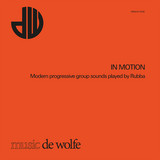
Published in 1980, the In Motion: Modern Progressive Group Sounds Played By Rubba LP
and its minimalistic and utilitarian red record cover which contains 13 tracks, mainly composed
by Joachim "Giordano" Sherylee and was never reissued since then. This record became cult
over time; it will have taken that the Hip-Hop world seizes it in order to dig out from the
disregarded and underestimated musical gems graveyard. First of all with beatmaker Madlib
and Freddie Gibbs in 2011 with the track “Thuggin'”, in which he sampled the track “Way Star”,
also used more recently by Mil and the rapper Westside Gunn on his track “Brains Flew” by
(1964 Version).
Nearly 40 years after, the Farfalla Records label, after publishing Timing Archives, presents
another aspect more progressive and psychedelic of the multi-faceted composer Jacky
Giordano by fully reissuing at last this coveted, mysterious and mesmerizing "Rubba". Very
desired by crate-diggers, In Motion appears in the want-list of plenty enthusiasts in this
enigmatic world of the library music. (Erwann Pacaud)
- A1: Antonio Ruscito - Seclusion One
- A2: Antonio Ruscito - Seclusion Two
- B1: Antonio Ruscito - Seclusion Two (Aleksi Perala Remix)
- B2: Antonio Ruscito - Seclusion Three
- C1: Roberto - Into The Blue
- C2: Roberto - Dx Waves
- D1: Roberto - Chord Recall
- D2: Roberto - Chord Recall (Peverelist Remix)
- E1: Stl - Spy Vs Spy
- E2: Stl - Atomsmasha
- F1: Stl - Summer Breeze & Brotherhood
- F2: Stl - Freebird
“Ta Da” is the debut full length from J. McFarlane Reality Guest, the collective name for the trio headed by the eponymous McFarlane. As a member of the group Twerps, McFarlane has traversed guitar-centric, melodic pop music for some years while honing a highly unique, personal musical language. Ta Da is the first recorded unveiling of McFarlane’s affecting, oblique songwriting panache. Originally released in her native Australia on Hobbies Galore, Ta Da will be released worldwide by Night School in June 2019.
Wheezing into view with a troubled reed instrument set against a s of whoozy synth lines, Human Tissue Act is a foggy curtain the listener is invited to peel back. The dissonant notes are left to dance entwined, with clarinet heralding a Harry Partch-esque mallet percussion interlude. It’s a mood. With no resolution in sight, an audience dragged closer into uncertainty is suddenly drenched with the light of inter-weaving wah wah synth and saxophone. I Am A Toy introduces us to McFarlane’s vocal, an effortless and matter-of-fact, accented statement that quietly takes the reins. While McFarlane’s previous work in Twerps might reference 80s UK and antipodean guitar pop, Ta Da showcases a different influences immersed in psychedelic music and synths. It’s a brilliant, deft concoction swimming in Young Marble Giants-type minimalism washed with bare pop and harmony similar to Kevin Ayers making sense of a Melbourne suburb full of faces half-recognised in the blanching sun.
What Has He Bought begins with a Casio-keyboard rhythm pattern, palm-muted guitars and immaculately enunciated vocal give way to a burnt melodica part that elevates the spirits. Simple patterns repeated, like a well-tempered pop song that does what it needs to do and no more, build into the sound of summer leaking orange juice. They’re moments of joy, layered on top of each other like a melting cake. Do You Like What I’m Sayin’ recalls Marine Girls covering a classic ‘66 Garage nugget, organ lines fighting funk with guitar chords played just behind the percussion. “In a talking world, meanings are the same. Words want to hold on to the people they contain. Do you like what I’m sayin’?” We’re in a Beckett play perhaps, obtuse absurdities rendered pretty. Alien Ceremony is a heart-melter, given a melancholic timbre by bowed double bass it’s a tragi-comic piece that almost reeks of Robert Wyatt at his mid-whimsical twisting a fugue completely out of shape. Beneath the layers of harmony and twinkling instrumentation you sense there’s a genuine sadness somewhere even if it remains veiled.
Through out Ta Da, McFarlane plays with counterpoint and contrast to sometimes delirious effect. On Your Torturer, a simple, upbeat chord progression is hard panned, underpinning a flute solo which seems out of place, hence making it completely in place on this warmly surreal album. My Enemy is a slowly swinging eulogy to a failed relationship punctuated by analogue synth burbles, with our protagonist simply asking, in the aftermath, “can we be nice?” Here McFarlane’s vocal is straight forward, lyrically conversational but still not completely in focus, a surreal kitchen sink drama filtered through a dream where everything is in the wrong place. It’s a fine precursor to Heartburn, which similarly borrows BBC Radiophonic Workshop-style noise synths and the use of space to carve up the simple “You Will Make My Heart Burn” line. At this point, the listener has been in such close proximity to McFarlane’s show, the reality guest in a performance where they’re the sole audience member, that when Where Are You My Love rises on the horizon as a sleepy, psychedelic send off it’s uplifting. The vocal drifts away into the sunset, simple and direct. It leaves the listener slightly confused, perhaps, but grateful for the gentle surprise.
Vor 20 Jahren startete Chloé Thévenin ihre Karriere mit Mixer und
Plattenspieler, bereits 1999 zählte sie zur Speerspitze der Pariser
Techno-Szene. Seitdem kennt man Chloé als technisch versierte und
groovig agierende DJ mit Vorliebe für Deep House und Minimal. In der
französischen Kapitale sind besonders die Batofar-Residency und PulpNächte im Rex in Erinnerung geblieben. Ihre Skills präsentierte sie einem
größeren Publikum auf Mix-CDs wie "I Hate Dancing" (2004) oder "Live
At Robert Johnson" (2008). Hinzu kamen regelmäßig eigene
Produktionen, die sie auf über einem Dutzend 12_ÇÖ_ÇÖes
veröffentlichte. Daneben brachte Chloé mit "The Waiting Room" (2007)
und "One In Other" (2010) auch zwei Großformate heraus. Dass es bis
zur Fertigstellung ihres dritten Langspielers sieben Jahre gedauert hat,
erklärt sich für Chloé durch die Wechselfälle des Lebens. Aufgrund
spannender Kollaborationsarbeiten und verschiedener
Kompositionsaufträge für Filme und Installationen blieb ihr zu wenig Zeit
für die Albumproduktion. Außerdem gründete sie mit Lumière Noire ein
eigenes Label, auf dem "Endless Revisions" als eines der ersten Werke
erscheint. Dieses gleicht einem elektroakustischen Soundabenteuer und
hat mit Tanzmusik nichts am Hut. Zwar mäandern immer mal wieder
satte Beats durch die Tracks, aber eben nur als ein Element unter vielen
anderen. Ein Album für den kontemplativen Hörgenuss
Berlin based trio Keller Crackers collective likes to shape haunting esoteric sounds, in which self-built instruments dance with ritualistic synthesised rhythms, field recordings, psychoacoustic drones and poetical spoken silhouettes.
After a self-released MC and a mesmerising tune called “Anem” out in February 2019 on the custom-made Kashual Plastik 007 double-vinyl compilation, now they give birth to their own debut record “KC”, a four track EP resulting from various improvisational studio sessions, a bag full of spontaneous visionary DIY sound fashion that melts meandering serialism, foggy ‘Chris & Cosey’-ness, exoticism and freely expressed emotions. Some pieces are given time to evolve, being dragged through long arrangements and slow transitions, while others are playful and short. To close up the magic circle, the release includes a tripping Tolouse Low Trax signature remix.
The opening tune “Specialised” swings on a trance-like hypnotic bass line, while a self-made kalimba played through a tape delay and overtones from a DIY circuit bended device inject dynamics and colour to the composition. Out of the sonic depth, the spoken words of Sylvana Wickman emerge enchanting and unreal, naming a series of technical terms, assembling a deep notion on the specialised society we live in.
“Cow Tongue” follows, a fleeting composition of crackling electronic clicks jumping off a micro-modular device. They got overdubbed again by Sylvana’s voice, delightfully reciting phrases from a recipe of regional delicacies.
The A side of KC`s first strike finishes with a spaced-out synth bass and the lo-fi beats of a Yamaha RX15 drum machine. They are the gripping foundation of “Aithouses Anamonis“, which means “Waiting Rooms”. It describes the scene of a man sitting in a waiting room observing the consumerist behaviour by the folks around him.
The B-side opens with a Tolouse Low Trax remix of “Specialised”, elevating the original with the bass line of “Aithouses Anamonis“, while melting the all into a dark nebulous Tolouse Low Trax signature stripped down funk for endless nights in neon lights.
For their final track “Colours”, Keller Crackers invited a steady free member of their live shows to record with them: free jazz musician Robert Würz. He tuned his flute enthralling over a suspenseful bass line formed in a whirlwind of synth-sounds. The whole frenzy gets divine through sliding chords that rise from a self-built guitar.
A musical bouquet for open spirits, that value charming minimal wave zones, undefinable post-industrial psychedelics and hallucinogenic poetry reflections on the current state of our mechanical times.
- A1: Episode One – Fit The Nineteenth
- B1: Episode Two - Fit The Twentieth
- C1: Episode Three - Fit The Twenty-First
- D1: Episode Four – Fit The Twenty Second
‘Just rain! Tell that to the dolphins!’
The brand new first-time vinyl edition of The Hitchhiker’s Guide to
the Galaxy: Quandary Phase comes on heavyweight blue vinyl,
packaged in the lavish style of the preceding Primary Phase,
Secondary Phase and Tertiary Phase LP releases.
Here, for the first time ever on vinyl, are Episodes 19 to 22 of the
BBC radio series. First broadcast in 2005, the Quandary Phase is
based upon the Douglas Adams’s fourth novel So Long, and
Thanks for all the Fish. This is the first ever publication of the
original radio edits of the Quandary Phase, as heard on their
original Radio 4 broadcast.
Hitching a lift back to Earth after it miraculously reappeared, Arthur
Dent returns to his cottage and tries to resume normal life. But an
encounter with a striking woman named Fenchurch leads to a
series of unanswered questions. Why has the planet’s entire
population of dolphins vanished, leaving behind them some very
charming crystal bowls? Who is Wonko the Sane, and what is
God’s Last Message to His Creation? Meanwhile Ford Prefect is
Having revelations of his own, and as for Marvin the Paranoid
Android…well, just don’t ask. Suffice to say, things may never be
the same again.
Starring William Franklyn as The Book, with Simon Jones as
Arthur Dent, Geoffrey McGivern as Ford Prefect, Bill Paterson as
Rob McKenna, Jane Horrocks as Fenchurch, Sandra Dickinson as
Tricia McMillan and Stephen Moore as Marvin the Paranoid
Android, with a guest cast including Arthur Smith, June Whitfield,
Stephen Fry, Jackie Mason, Rula Lenska, Patrick Moore and
Christian Slater, with music by Philip Pope and Paul ‘Wix’
Wickens. Adapted, Directed and Co-Produced by Dirk Maggs
Two 180g heavyweight coloured vinyl discs are presented in
illustrated wallets inside a rigid, bound 20 page book, including a
moving tribute to Douglas Adams written by Stephen Fry and
sleeve notes by Jem Roberts, Adams’s official biographer.
‘Whoooo…I’m flying…’