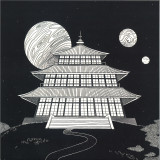
»Follower« is Abrahams’ 6th album for Room 40 and showcases his continuing interest in the ambiguous spaces between music and noise; tonality and atonality; rhythm and texture. All four tracks have piano as a key factor: in one instance, high-pitched and atonal; in another, emotive yet distant as if projected on to a screen. Follower presents the listener with a sound world of colourful juxtapositions, rich orchestration and organically open forms.
On the opening track, bass piano meanders through a wilderness of de-tuned bells and organ swells; a strange sort of festival. Low frequency sighs evenly punctuate, like a pump or a heartbeat. It’s a procession that takes it time as it wanders the terrain, brought to a close with transcendent distortion. On track 2, muscular modal piano surfs among waves of percussion and analogue synthesisers. A buffeting travel.
Buscar:room 10
- A1: Saved
- A2: Cannock Chase
- A3: Fool Me A Goodnight
- A4: It Must Be Love
- A5: Gimme Some More
- A6: Blue Lady
- B1: Love Oh Love Oh Love
- B2: Crying, Laughing, Loving, Lying
- B3: Hotel Room Song
- B4: My Song
- B5: Till Forever
- B6: Come On Michael
Labi Siffre’s third album was the first to be produced by Labi himself, who declares it to be “the one where it all
came together… singing some of my best songs”.
• Issued in 1972, it features the beautiful original version of “It Must Be Love”, a # 14 hit for Labi nine years
before Madness took it to the top. Also featured is “My Song”, as sampled by Kanye West for “I Wonder”, and
the # 11 hit title song, also covered by Rod Stewart and Olivia Newton-John.
• This new edition has been expertly cut by Barry Grint at AIR Mastering from the original stereo tapes using
precision half-speed mastering.
• Half-speed mastering is a vinyl cutting technique that improves groove accuracy and transient information
creating an incredibly detailed stereo image with a natural high frequency response.
• Presented in its original gatefold sleeve, pressed on180 gram heavyweight vinyl, featuring an obi strip and
housed in a poly-lined inner sleeve, with all the lyrics on the 4 page insert.
Summer at Land's End is not an interlude or tangent for The Reds, Pinks & Purples but rather a perfect fourth movement following the albums Anxiety Art, You Might Be Happy Someday, and Uncommon Weather. As with these self-recorded records (the primary work of songwriter Glenn Donaldson), the songs on Summer at Land's End were crafted slowly and then drawn together to make a unified statement. But here, and more than before, Summer at Land's End combines Donaldson's rueful pop sensibility with a parallel musical universe, one composed of pictures, dreams, and feelings without words. Even if the underlying theme of this collection is one of conflict or unhappiness, the vision of the music presents an escape to a new world, always fading in and out of sight. For listeners who may not be familiar with Donaldson's corner of San Francisco--the Richmond district--or the current wave of hazy, melodic DIY pop groups performing in the city, Summer at Land's End pulls in images and scenes that feel like a collision of the mundane and the sublime of this present landscape. With this record, The Reds, Pinks & Purples give less focus to the vanities of a subculture and more to the challenge of connecting with someone, to the ordinary goals of being human and finding harmony with others. This deliberate saturation in drama and ambiance, along with some of Donaldson's best songwriting to date, is what gives Summer at Land's End its special class in the project's discography. Of the album's cinematic mood, Donaldson refers to films like Summer of '42 and the influence of the classic 4AD catalogue of the 1990s. This style informs much of Donaldson's prior and current ventures of course (The Ivytree, Vacant Gardens, and a dozen projects in between) but now The Reds, Pinks & Purples have taken the mantle, embracing this instinct for instrumental or dreamier modes of pop songwriting. It's a pleasure to experience Summer at Land's End, as this record finds a thrilling balance between songs and sounds, instruments and voices, and the ironic twin poles of art and life.
PALE GREEN STARS VINYL
Summer at Land's End is not an interlude or tangent for The Reds, Pinks & Purples but rather a perfect fourth movement following the albums Anxiety Art, You Might Be Happy Someday, and Uncommon Weather. As with these self-recorded records (the primary work of songwriter Glenn Donaldson), the songs on Summer at Land's End were crafted slowly and then drawn together to make a unified statement. But here, and more than before, Summer at Land's End combines Donaldson's rueful pop sensibility with a parallel musical universe, one composed of pictures, dreams, and feelings without words. Even if the underlying theme of this collection is one of conflict or unhappiness, the vision of the music presents an escape to a new world, always fading in and out of sight. For listeners who may not be familiar with Donaldson's corner of San Francisco--the Richmond district--or the current wave of hazy, melodic DIY pop groups performing in the city, Summer at Land's End pulls in images and scenes that feel like a collision of the mundane and the sublime of this present landscape. With this record, The Reds, Pinks & Purples give less focus to the vanities of a subculture and more to the challenge of connecting with someone, to the ordinary goals of being human and finding harmony with others. This deliberate saturation in drama and ambiance, along with some of Donaldson's best songwriting to date, is what gives Summer at Land's End its special class in the project's discography. Of the album's cinematic mood, Donaldson refers to films like Summer of '42 and the influence of the classic 4AD catalogue of the 1990s. This style informs much of Donaldson's prior and current ventures of course (The Ivytree, Vacant Gardens, and a dozen projects in between) but now The Reds, Pinks & Purples have taken the mantle, embracing this instinct for instrumental or dreamier modes of pop songwriting. It's a pleasure to experience Summer at Land's End, as this record finds a thrilling balance between songs and sounds, instruments and voices, and the ironic twin poles of art and life.
Originally released in 2014, “Instruction Booklet N. 1232” marks the first cassette release on Dauw for Tatersall under his The Humble Bee moniker. Taking advantage of the format, each side on “Instruction Booklet N. 1232” is reserved for a single piece nearing the 20-minute mark.
“Exploding View” (aka Side A) swells into existence with a very grand sounding synth-driven melody. Of course the other thing that’s present is the decaying sound of the tape loop that’s working to bring that music to life. At first, the melody grows and grows, fairly undisturbed, but eventually the sound of so-much tape warble threatens the rising nature of the piece until it sounds as though it is one loop away from total decay and simply fluttering out of existence.
But of course that’s the point. There’s a tension between that grand melody that opens these moments and that warble. It’s a lesson in opposites: the mechanics of a tape loop, guaranteed to break down, placed in contrast with those signature Tatersall melodies, which somehow seem eternal. And just as that tension seems too much to bear — the melody dies to be replaced by something altogether new. What comes next is something much quieter, driven by a sub-aquatic bassline, some rhythmic tape hiss and some gentle piano.
It’s a very dramatic and sudden break. The technical elements of that could be attributed to Tattersall’s understanding of how far a melody can be pushed before it succumbs to the abuse of being processed out of existence — perhaps the tape had been looped and processed to its breaking point. Regardless of whether it was a technical or artistic choice, that hard break serves an important narrative function. Frequently in instrumental music, musicians play with opposites (quiet-loud, clean-distorted) to create a narrative to their work since they don’t have words/lyrics as a tool. In the case of The Humble Bee’s use of tape loops, one set of opposites in tension is always driven by the fragility of the melodies and the limitations of a machine guaranteed to inevitably decay the media it is designed to support. And where one thrives, the other takes a backseat. As side A winds down, the melodies are much more sparse — appropriate for en ending, yes; but it also gives more space for those hisses and crackles to claim their moment.
Side B is filled out by “Manual with Foot Pedal” and it begins as gently as its predecessor ended. Slowly eking outing it existence – it’s as if watching Tatersall set the board, showing his players on opposite sides of the table before really setting them in motion to do their thing. By the piece’s midpoint, melody has taken centre stage as a glitchy, piano-led rhythm marches its way forward, clearly carving out its space and claiming its territory. And almost immediately following that: the decay takes over again and those tape loops seem processed to near death — the melody almost barely decipherable as it flutters under the weight of the history of being looped/played ad nauseum. And in the very final moments, the melodies are sparse again, giving the tape hiss room to play its part — it’s as if Tatersall is giving both players enough space to take their final bows.
Tape
Originally released in 2019, Craig Tattersall unspooled a gorgeous tape of disintegrated piano meditations and dusty lower case ephemera.
On the A-side it’s a dreamily searching, silty flux of piano notes peeling in slow motion. Strings drift over, connoting cold breezes and infrasonic, spectral presences, but the effect is far from menacing, it’s more a tranquil shade of sublime, like those hours after midnight when the meridian sounds of road traffic and human life have ebbed off into the distance and you’re left with the sighing creaks of a room.
The sound is remarkably different on the B-side. Here the air gradually thickens with murkier sub-harmonic distortion, bordering on a seething sense of aggression relative to most of Tattersall’s other output, pushing the grim murk to a logical entropy that precipitates elegiac pauses for reflection and warbling closure.
Mr Projectile, one of our favorite IDM producers from back in the day, has given La Luna the chance to share some of his unreleased IDM tracks from the early 2000’s. The album is an eclectic blend of ambient, IDM and experimental electronics.
These sounds are a time machine to simpler, less chaotic times and have become essential listening these days. We envision this album spinning on a sunny Sunday afternoon, filling your room with the delicate and deep textures of electronic music and soothing your uncertainty. Enjoy a nice cup of coffee and explore your thoughts as you speed through time and space. Hopefully serving as a special reminder that we are all in this madness together.
Not only is the music stellar, but we are honoured to have Marcello Raeli, an Italian artist and car designer, accompany the music with his wonderfully mind bending artwork. Marcello is an artist who has designed some of the most insanely beautiful/fast cars on the planet. Here we get to take a deep look into his mind and marvel at the incredible interconnectedness created in this piece and appreciate the sense of depth and space created for this album.
Three generous portions of blissful beats on the Electric Shrine imprint, kicking off with the downbeat (in BPM terms) but lively 'Solar Visions' coming on like a dub mix of a lost Chic classic, 'What You Love' more like prime-era John Carpenter remixed by a mischievous Orb and 'Un Amore Supremo' a slow motion (one of the slowest we've ever encountered) reverb-fest, designed for more eccentric chillout rooms. And that's all before the opera singer pitches in.
Many Worlds Interpretation is a collection of cosmic Americana for electronics, guitar, and percussion culled from Jon Iverson’s extensive home-studio archive. 1984, Los Osos, California. In a small cinderblock cottage, hand-painted with bright psychedelic flora, Jon Iverson created vibrant new worlds. He spent long days and nights immersed in sound, perfecting home recording on his 8-track reel-to-reel, combining his love for kosmische and Berlin School electronics with an infatuation with ethnographic sounds and expansive guitar music. In a duo with fellow sonic traveler Thomas Walters, Iverson released missives from the studio on a self-titled LP released on country legend Guthrie Thomas’ Eagle Records. That release featured
three electro-acoustic compositions (“Naningo”, “River Fen”, and “Fox Tales”) as well as a gathering of guitar duo tapestries. Many Worlds Interpretation re-imagines those interplanetary works alongside several unreleased compositions that also feature synthesizer, guitar, and percussion, creating a re-visioned album which leans into Iverson’s electronic studio wizardry.
All songs have been carefully transferred from analog tape to high resolution digital, retaining their vintage studio warmth, but mixed and mastered for modern ears and audio systems. The album is pressed at 45rpm, further enhancing the audiophile experience.
Artist Statement
I worked in a Harley Davidson parts warehouse in the summer of 1976 in the San Francisco Bay Area. The goal was to save enough money to buy transportation for college and a Teac 4 track 1/4" reel to reel tape machine. By September there was a rusting monkey-vomit green car in the driveway and shiny new Teac with a Sony condenser microphone in the bedroom. At this point I had been playing guitar for a dozen years and like most children of the sixties, dreamed of joining
a band.
Went to college instead to study business.
But all was not lost. 1978-1979 was spent as Weird Al Yankovic's roommate and we recorded and created enough songs to play shows around San Luis Obispo, California, where we were attending college. Many of those recordings have yet to be heard by the public, including the first performances of My Bologna and many other parodies of pop songs of the day. We sent tapes to Dr. Demento, we auditioned for The Gong Show and were barred from playing at the local college after one memorable performance. Wild times.
I, however, was more intent on working on "serious" music, with albums from Vangelis, Tangerine Dream and Jean Michel Jarre providing inspiration. DJing at the local college radio station and then public radio outlet provided exposure to an endless stream of obscure albums (Sky Records from Germany was a particular favourite). Most of them would never make it to the air, but my buddies and I would pass them around like exotic treasure.
Fast forward a couple more years and I had picked up a Mini-Moog and eventually a Prophet V synthesizer as well as starting a collection of instruments from around the world. The Teac and synths formed the basis for a growing DIY studio that had taken over a modest-size garage (pictured on the cover) that had been converted into a two room cottage in Los Osos, California.
The Teac was eventually joined by a rented Otari 1/2" 8-track and then finally a vintage MCI JH-100 2" 16-track. The compositions on this album were recorded on these three machines between 1982 and 1989. At some point an Apple II computer with Alpha Syntauri sound card and keyboard were added and then later the first personal computer sampling hardware/software kit, the Decillionix DX-1. The DX-1 forms the rhythm track for “Fox Tales” and the Alpha Syntauri was programmed to create the pulsing synth for “Naningo”. “River Fen” was tracked with both the Alpha Syntauri and the Prophet V.
I knew this music wasn't commercial, but didn't care. It was inspiring working with the first computer-based synths and semi-pro gear. Home studios were still rare in the early 80s until the Tascam Portastudio blew the DIY door wide-open. But I was more interested in sound quality so stuck with reels of tape instead of lower fidelity cassettes.
During the time these songs were recorded, I was also collaborating with my good friend and mandolinist, Tom Walters. “River Fen”, “Naningo” and “Fox Tales”, were solo recordings that also ended up on the first Iverson & Walters album, First Collection. The other four pieces on this new LP were never fully finished or released until now.
— Jon Iverson, September 2022
Running Back regular Feater aka Daniel Meuzard puts his newly-transplanted studio through its paces for the first time since relocating from Vienna, swapping out the bustle of the city for the fresh mountain breeze of the West Alps. The Positive People EP proves that a change is as good as a rest, as the wide open nature not only had some rejuvenating effects on the creative process - it also gave Feater some room in his head to ponder questions about nature, nurture, and whether our inner morality is externally programmed.
The taut jazz funk of opening track Coding springs into action like the montage music of a lost ‘70s TV show, while the title track Positive People plays on the ambiguity of its title, with cascading synth notes, tastefully dubby 303 stabs, and an afro-cuban drum figure that forms the foundation for a spaced-out dancefloor workout. It's a combo of tracks that should appeal to chat room moderators and serotonin programmers alike.
Expensive Zeit kicks off sounding like grime maverick XTC had been brought up on Murder Capital electro rather than East London garage - before it morphs into a bumpin electrofunk and percussion session, with its sights set firmly on an aquatic worm hole. The EP rounds out with Decline All Cookies, which breaks out of a flanged-out half-time drum 'n' effects intro to reveal a lush chord progression, flipping a soul jazz piano mood into a trippy slice of modern instrumental funk.
Can man be the master of his own destiny? It seems with this change of location and musical direction, Feater might just have figured out the answer.
- A1: Es Ist An Der Zeit
- A2: Hinfort
- A3: Unbemerkt Hinein
- A4: Fur Immer Verbunden
- A5: Schon Wieder Erleuchtet
- A6: Nutzlose Ratschlage
- A7: Lass Mich Schlafen
- A8: Stille Nacht
- A9: Lieber Nicht
- A10: Mach Die Augen Zu
- A11: Verdrehter Kopf
- A12: Berauscht
- A13: Finger Im Wind
- A14: Taumel
- A15: Stets Weiter
- A16: Gluck Im Traum
- A17: Abgetrieben (Reprise)
- B1: Wieder Verdrangt
- B2: Das Geheimnis Des Klosters
- B3: Das Verschwundene Kind
- B4: Unter Der Decke
- B5: Zuruck
- B6: Verstimmt
- B7: In Der Grotte
- B10: Hinten Im Eck
- B11: Zeit Mit Dir
- B12: Uber Den Dachern
- B13: Bitte Bleib
- B14: Draussen Ist's Kalt
- B15: Lauf Der Wasserader
- B16: Kleiner Abschied
- B17: Einen Augenblick Lang
- B8: Labbrige Hostie
- B9: In Begleitung
Johannes Schebler's musical output is all about establishing a dreamlike territory where sonic settlements can spread at ease. While Grykë Pyje (Johannes Schebler's duo with Jani Hirvonen) presents musical landscapes as open and clear spaces, Baldruin's miniature pieces tend to narrow them down, zooming into domestic sceneries that shift like malleable rooms inside a magic building. These are the quarters where the inhabitants of Schebler's musical world are configured.
Rendered in a tender manner, the tunes in Kleine Freuden (in English: small joys) unfold like a collection of fairy tales and bedtime stories. Fables and lullabies performed in whispering tones seem to carry us through a child's dream where images blend into each other. Compact, yet gauzy and free flowing melodies gather up revealing an ensemble of households where fanciful entities play care freely, leading us along their musical maze. The music is placid, childlike and playful. It wanders around in unwavering estrangement, organizing an unprecedented and intimate space as seen from a bird's eye view.
In the landscape of a bedroom where the night lamp is the sun, we take part in a lively journey, as wonder is warrant and keeper of a warm and pristine environment. Perspective shifts as we rise from bed sheet folds that turn into fragile mountain ranges. We crawl behind furniture and take shelter in secret hideouts while dust falls upon us like a blizzard. Transfiguring notions of scale and time, we are left wondering how long have we been here, wondering if music is the only true measurement of time.
2022 Repress
The Artist Concurrently Known As Jackmate has been already been indoctrinated into our cult since he signed onto he Pampa bookings roster awhile back. As SoulPhiction he is also co-founder of Philpot, the Stuttgart-based label, home to the majority of his releases over the past 10+ years. Anyway, we get the privilege of stamping the Turkey logo on SoulPhiction's first proper release of 2013, following his remixes for Murat Tepeli and Detroit Swindle. 'When Radio Was Boss' is a tribute to those magical electromagnetic waves that ruled yesteryear. With that prototypical Pampa percussion-rattling and clanking its way into the room-and a warm, round bassline bounce combined with some symphonic froth in the atmosphere, this track definitely demands airplay. On the dancefloor, at least! (And right in the middle of the track, catch the pleasantly jarring shout-out from WBAU, the call sign of the defunct New York radio station that counted members of Public Enemy and hosts of Yo! MTV Raps amongst its staff.) On the flip, the bpm gets cranked down just a bit for 'Maybachswagger"-If the A-side is a tribute to radio, the B has roller-skating on its mind. Starting out spooky with a sampled voice cooing over a slightly detuned bassline, the surprise comes in the final third, when a kawaii disco vibe drops in, seducing you onto the rink for a few laid-back laps.
Y Bülbül is back on the controls accompanied by Yumurta, a percussionist from Istanbul. Pingipung introduced the London based artist in 2020 with his psychedelic, synth-laden debut “Fever”.
“Not One, Not Two” is based on a one-way transmission of improvised drum recordings from an industrial estate in Maslak, Istanbul to another one in Tottenham, London, where Y Bülbül laid down fragmented layers of bass, synths, guitars and field recordings over Yumurta’s singular drum takes. The result is a free-form deep listening album for fans of dub, ambient and kosmische music, where the groove and harmonies are mystically interwoven, yet somehow manage to stay on the brink of collapse. Although the sessions were non concurrent and scattered over two continents, the collaboration evokes scenes of a telepathic communion where individual perspectives, circumstances and stories are exchanged between the two.
Resembling Moondog, Holy Tongue or Luis Paniagua in the sense that they favor the raw over the polished, holistic presence over conceptual perfection and questions over answers, the duo’s focus on bare sounds and repetition guides the listener throughout the album. The ride cymbal opening the minimalistic “I’m This”, for instance, briskly disarms the listener who might have been looking for more traditional songwriting or production clues. There are plenty of immediately rewarding moments too in “Not One, Not Two,” like the organic acid bassline in “Maurin Quina”, the euphoric drum fills of “Big K” and the intoxicating groove of the hypnotic vibe-setter “Jah Oto”.
Bülbül is Turkish for a singing bird while Yumurta simply means egg. Which one is first? Who is to follow? It’s this enigmatic entanglement between the two artists which creates the lurking tension, emphasized by the Zen Kōan-like title. The beauty in this album is a peculiar one, and it certainly is a rabbit hole too. Dissonance is fluid as everything moves, and whenever two sounds collide, a third one emerges.
Omochi, (honorific “O” before mochi) in daily parlance is a rice cake, a dense glutinous product suited to many recipes, sweet or savoury. Stick one under the grill, watch it burst open, wrap it in crisp seaweed and dip it in soya sauce - a healthy snack, and a staple around Japanese New Year. Like everything, Omochi also has its dark side - each year it kills off a small section of the aged community, the gluey bolus a hard act to swallow - the unwary can quickly choke to death.
This Omochi is in fact Tadaki Matsunaga, of early 2000s Tokyo three piece Femini Flyers. The original Feminis were Tadaki (bass), Sachie (vocals) and Koji (drums) that was it, no guitars, no synths, Tadaki's bass being the rhythm and lead, and boy could he make it sing. Their 7” single Like You See / Masterbed was an early Ethbo release was the most requested track from Japan Blues’ Boiler Room Collections video - now pulled off the internet by The Powers That Be - since it was first aired, way back in 2014. Now the single trades for a collector's premium with those in the know. Since that recording, Omochi has built, and been working in, his home studio. The first release being his Ethbo 7” Devil, in 2019.
The follow-up is a roller-coaster ride, his own take on several genres in his forage bag, marinated to his own recipe. You'll hear his expert bass in amongst the fungii, some slick R'n'B guitar styling, several dollops of glitch-tronics, some falling-down-the-stairs drum'n'bass, a slice of kraut, Omochi's louche voice, and a spot of Sachie, the lead singer of the legendary Feminis.
This modern psychedelic omnibus, flying in the face of logic (an Ethbo template) was pressed by Omochi at Toyo Kasei, the last independent Japanese pressing plant, housed it in a tip on sleeve and shipped it to the UK, grill-ready for release. Itadakimasu!
- Something Like Love (Acoustic)
- World Of Echo (Acoustic)
- She Calls The Tune (Acoustic)
- Lifeline (Acoustic)
Stripped down versions of tracks from Flicker. “On my debut solo album The View From Halfway Down I did all of my promotion via Zoom and pre-recorded interviews and acoustic sessions,” explains Andy of the EP. “I enjoyed making the acoustic versions and decided to do some more for this album.” “‘Something Like Love’ is the most popular song from Flicker and one of the oldest, starting life in the ’90s. It’s probably the only one that dates back to the Ride era. "The riffs for ‘World Of Echo’ were written while I was on tour with Oasis, at the height of my La’s obsession. It went through a few iterations from then onwards, but never had a final melody until last year. ‘She Calls The Tune’ was the first song I wrote after I joined Oasis, ending a period of writers’ block which I had started going through some time in 1999. The very first performance of it was to an audience of Liam Gallagher, Gem Archer and Richard Ashcroft in a Milan hotel room. No pressure! I don’t think I ever saw this as an Oasis song, but I have them to thank for the fact that I was able to write songs again at all.” ‘Lifeline’ was another riff I came up with while on tour with Oasis. I remember being on a UK tour with Shack, and sitting around backstage on acoustics with Mick and John Head jamming around the Simon & Garfunkel version of ‘Scarborough Fair’. The riff for ‘Lifeline’ followed soon after. It was always called ‘Lifeline’ but I never found the right lyric for it until recently. A1 Something Like Love A2 World Of Echo B1 She Calls The Tune B2 Lifeline
Sky Blue Vinyl[35,25 €]
Ltd edition Double Sky Blue Vinyl, Gatefold sleeve w/ spot gloss, liner notes + DL card. Classic Double Black vinyl, Gatefold sleeve w/ spot gloss, liner notes + DL card. Bending scuzzy boundaries, ‘Good Bad Not Evil’ is a coming-of-age garage rock classic record. Full of hedonistic delinquent anthems, the fourth studio album from Atlanta punks Black Lips reaches it’s 15 year anniversary. This deluxe edition includes unearthed photos and new liner notes from Jared Swilley and King Khan. The second disc features B-sides and rarities including ‘Cruising’, ‘I Wanna Dance With You’ and ‘Leroy Faster’. ‘Good Bad Not Evil’ perfectly encapsulates the disillusionment of the mid-00s America, slammed between warehouse parties, DIY generator shows and scattered party pics, which was recorded in a little house in Atlanta that had been converted into a studio called the Living Room. Referencing Shangri-Las in the title, this is where their knack for garage gems met Motown; with bass heavy grooves (later remixed by Diplo), a certified country twang and unabashed bravado. Instant hits like ‘Veni Vidi Vici’, ‘Cold Hands’, ‘Bad Kids’ and ‘O Katrina!’ immediately became Black Lips staples. This was a band caught in the eye of the storm, the touring continued, the parties didn’t stop, this was a band bending the scuzzy boundaries of their chosen genre. The record was hailed by the likes of Pitchfork, who proclaimed, “Black Lips are a go-to band for vintage lo-fi freaks, and their raucous live shows have helped them cross over outside of crusty dive bars. ‘Good Bad Not Evil’, however, is the record where naysayers, disinterested friends and acquaintances, people on the street, and anyone else within earshot has to sit up, shut up, and listen.” …and, shut up and listen they did. “A perfect tapestry of sordid pleasure.” NME // “The same rapturous energy as the Sonics and the 13th Floor Elevators.” The Guardian // Track List: Disc One – Good Bad Not Evil. A1 I Saw A Ghost (Lean) A2 O Katrina! A3 Veni Vidi Vici A4 It Feels Alright A5 Navajo A6 Lock and Key A7 How Do You Tell a Child That Someone Has Died B1 Bad Kids B2 Step Right Up B3 Cold Hands B4 Off The Block B5 Slime and Oxygen B6 Transcendental Light… Disc Two - B-Sides & Rarities. C1 Cruising C2 Make It C3 I Wanna Dance With You D1 Best Napkin I Ever Had D2 My Trouble D3 Leroy Faster D4 Buried Alive
Black Vinyl[31,72 €]
Ltd edition Double Sky Blue Vinyl, Gatefold sleeve w/ spot gloss, liner notes + DL card. Classic Double Black vinyl, Gatefold sleeve w/ spot gloss, liner notes + DL card. Bending scuzzy boundaries, ‘Good Bad Not Evil’ is a coming-of-age garage rock classic record. Full of hedonistic delinquent anthems, the fourth studio album from Atlanta punks Black Lips reaches it’s 15 year anniversary. This deluxe edition includes unearthed photos and new liner notes from Jared Swilley and King Khan. The second disc features B-sides and rarities including ‘Cruising’, ‘I Wanna Dance With You’ and ‘Leroy Faster’. ‘Good Bad Not Evil’ perfectly encapsulates the disillusionment of the mid-00s America, slammed between warehouse parties, DIY generator shows and scattered party pics, which was recorded in a little house in Atlanta that had been converted into a studio called the Living Room. Referencing Shangri-Las in the title, this is where their knack for garage gems met Motown; with bass heavy grooves (later remixed by Diplo), a certified country twang and unabashed bravado. Instant hits like ‘Veni Vidi Vici’, ‘Cold Hands’, ‘Bad Kids’ and ‘O Katrina!’ immediately became Black Lips staples. This was a band caught in the eye of the storm, the touring continued, the parties didn’t stop, this was a band bending the scuzzy boundaries of their chosen genre. The record was hailed by the likes of Pitchfork, who proclaimed, “Black Lips are a go-to band for vintage lo-fi freaks, and their raucous live shows have helped them cross over outside of crusty dive bars. ‘Good Bad Not Evil’, however, is the record where naysayers, disinterested friends and acquaintances, people on the street, and anyone else within earshot has to sit up, shut up, and listen.” …and, shut up and listen they did. “A perfect tapestry of sordid pleasure.” NME // “The same rapturous energy as the Sonics and the 13th Floor Elevators.” The Guardian // Track List: Disc One – Good Bad Not Evil. A1 I Saw A Ghost (Lean) A2 O Katrina! A3 Veni Vidi Vici A4 It Feels Alright A5 Navajo A6 Lock and Key A7 How Do You Tell a Child That Someone Has Died B1 Bad Kids B2 Step Right Up B3 Cold Hands B4 Off The Block B5 Slime and Oxygen B6 Transcendental Light… Disc Two - B-Sides & Rarities. C1 Cruising C2 Make It C3 I Wanna Dance With You D1 Best Napkin I Ever Had D2 My Trouble D3 Leroy Faster D4 Buried Alive
Exclusive to INDIE STORES: Hiss and Shake Records to release ‘Logically Yours’ – a limited edition, 5 x LP boxset of 50 essential recordings from seminal post-punk icon Lora Logic including 2 classic Essential Logic albums, early single releases, EPs, B-sides, rarities, vinyl exclusives + first new Essential Logic studio album in 43 years! Includes the classic Rough Trade Records releases ‘Beat Rhythm News (Waddle Ya Play?) + ‘Pedigree Charm’ + 2 retrospective compilations of early single releases, EPs, B-sides, rarities + vinyl exclusives ‘Aerosol Burns & Other Misdemeanours’ + ‘No More Fiction’ + new studio album ‘Land of Kali’ (first in 43 years) + 20 page booklet with introduction from Celeste Bell + Lora Logic Q+A. Susan Whitby, aka Lora Logic was one of the most distinctive talents from the post-punk era known for her intoxicating, rough-around-the-edges, yet exhilarating sax playing and haywire vocal style. Her offbeat, occasionally arresting lyrics tackled alienation, sexism, poverty and urban isolation, and with a complete disregard for convention, she carved her own path not only in her short-lived music career but also personal life. She was still in her teens when she answered an ad in Melody Maker “Looking for young punks,” and in 1976, with her friend Marion Elliot (aka Poly Styrene), she formed the punk band X-Ray Spex and acquired the pseudonym, Lora Logic. The duo soon achieved notoriety with the irresistible feminist protest single, ‘Oh Bondage Up Yours’ (1977) – Logic arguably stealing the show with her thrilling punk sax. “X-Ray Spex was my first band, I happened to be accepted, It happened to work, I happened to get famous overnight. I’d been playing sax in a cupboard in my room; I thought I better do something.” However, just prior to recording 'Germ Free Adolescents' (1978), X-Ray Spex's debut album, she found herself unexpectedly ousted from the band. With abundant enthusiasm and encouragement from Geoff Travis, founding director of Rough Trade Records, she went on to form Essential Logic, creating some of the most liberating and exciting music of the early post-punk era, not only as Essential Logic, but also as a solo artist. Hiss and Shake Records are pleased to present a limited edition boxset of 50 essential recordings from the irresistibly engaging Lora Logic archive, allowing for a new generation to become aware of her incredible creative output. Across 5 LPs, ‘Logically Yours’ includes in their entirety, the classic Rough Trade Records releases ‘Beat Rhythm News (Waddle Ya Play?) (1979) – Essential Logic’s sole studio album, and Lora’s solo album, ‘Pedigree Charm’ (1982) – her last studio album before turning her back on the music business, sad and disillusioned and fighting drug addiction, which saw her turn to a Hare Krishna lifestyle, alongside Poly Styrene, embracing a fresh new chapter. This totally absorbing and definitive collection also includes two retrospective compilations; ‘Essential Logic – ‘Aerosol Burns & Other Misdemeanours’, which comprises early single releases, B-sides and oddities including the gloriously chaotic ‘Aerosol Burns’, the essential punk/disco ‘Music Is A Better Noise’, and ‘Fanfare In the Garden’, showcasing Lora at her most pop. In addition, ‘Essential Logic – ‘No More Fiction’; contains 10 vinyl exclusives, including ‘Do You Believe in Christmas?’, recorded with the Krishna Kids Choir in 1985, alongside tracks recorded circa 1997, with Martin Muscatt, Dave Farren (Bad Manners) and Gary Valentine (Blondie), forming the basis of what would have been Essential Logic’s third studio album, ‘No More Fiction’. Having recently returned to the studio refreshed and rejuvenated, ‘Logically Yours’ also includes ‘The Land of Kali’ (co-produced by Youth), the first new Essential Logic studio album in 43 years, and features the forthcoming new single ‘Prayer for Peace’, a re-imagining of the X-Ray Spex track from the tragically overlooked album, ‘Conscious Consumer’ (1995) on which Lora also played sax. “Poly Styrene and I were living in a Krishna community in Worcestershire in the early 80s. We came together for the first time musically after X-Ray Spex to record the original version of this song. In 2019, I decided to record my own take as a tribute to the special times we shared. I hope Poly likes this new version too.” Further tracks penned for release from the album include the dystopian, lockdown-inspired ‘Alien Boys’ and ‘Sky Rocket’, written with daughter Malini, about the fairground of life. Despite her short-lived career in the music business, Lora still managed to perform and appear on releases with many artists including US experimental rock band Red Crayola between 1978 and 1981, and also appeared on recordings by The Stranglers, The Raincoats, Kollaa Kestää, Dennis Bovell, Swell Maps and later, Boy George. Undoubtedly an iconic figure of the UK post-punk scene, Lora Logic’s boldness, adventurousness and sense of fun can be seen as an influence on numerous female artists today including Karen O from Yeah Yeah Yeahs, Peaches and St. Vincent among others. Tracklisting: Essential Logic ‘Beat Rhythm News (Waddle Ya Play?)’ (1979). A1 ‘Quality Crayon Wax OK’ A2 ‘The Order Form’ A3 ‘Shabby Abbott’ A4 ‘World Friction’ B1 ‘Wake Up’ B2 ‘Albert’ B3 ‘Alkaline Loaf in the Area’ B4 ‘Collecting Dust’ B5 ‘Pop Corn Boy (Waddle Ya Do?)’…… Lora Logic – ‘Pedigree Charm’ (1982). A1 ‘Brute Fury’ A2 ‘Horrible Party’ A3 ‘Stop Halt’ A4 ‘Wonderful Offer’ A5 ‘Martian Man’ B1 ‘Hiss and Shake’ B2 ‘Pedigree Charm’B3 ‘Rat Allé’ B4 ‘Crystal Gazing’…..Essential Logic – ‘Aerosol Burns & Other Misdemeanours’. A1 ‘Aerosol Burns’ (1978) – Debut single A2 ‘World Friction’ (1978) – ‘Aerosol Burns’ B-side A3 ‘Eugene’ (1981) – Single A4 ‘Tame the Neighbours’ (1981) – ‘Eugene’ B-side A5 ‘Music Is A Better Noise’ (1981) – Single A6 ‘Moontown’ (1981) – ‘Music Is A Better Noise’ B-side B1 ‘Fanfare In the Garden’ (1981) – Single B2 ‘Stereo’ (1982) – ‘Wonderful Offer’ single B-side B3 ‘Rather Than Repeat’ (1981) – ‘Wonderful Offer’ single B-side B4 ‘The Captain’ (1979) – ‘Fanfare In The Garden’ B-side B5 ‘Soul’ (1983) – Previously unreleased on vinyl B6 ‘Stay High’ – Previously unreleased on vinyl….. Essential Logic – ‘No More Fiction’. A1 ‘Essential Logic’ (1991) – Vinyl exclusive A2 ‘On The Internet’ (1998) – Vinyl exclusive A3 ‘Under The Great City’ (1997) – Vinyl exclusive A4 ‘No More Fiction’ (1998) – Vinyl exclusive A5 ‘Love Eternal’ (1997) – Vinyl exclusive B1 ‘Barbie Be Happy’ (1998) – Vinyl exclusive B2 ‘Not Me’ (1998) – Vinyl exclusive B3 ‘The Beautiful and the Damned’ (1997) – Vinyl exclusive B4 ‘Marika’ (1997) – Vinyl exclusive B5 ‘Do You Believe in Christmas?’ (1985) with the Krishna Kids Choir – Vinyl exclusive……Essential Logic – ‘Land of Kali’ (2022). A1 ‘Prayer For Peace’ A2 ‘Alien Boys’ A3 ‘Mother Earth’ A4 ‘Never Know’ A5 ‘Charming Every Cupid’ B1 ‘Sky Rocket’ B2 ‘Serious’ B3 ‘Fallible Soldiers’ B4 ‘Land of Kali’ B5 ‘Beyond’
Genre : Indie / Pop-folk The New Yorker Adam Green’s 11th and latest solo album, That Fucking Feeling, continues his musical explorations with longtime collaborators Loren Humphrey, James Richardson (MGMT), and Jesse Kotansky. The album places large-scale 'Wall of Sound' style productions alongside home-recordings done during COVID quarantine. Adam Green was touring in Europe in 2022 spring, and will tour in USA in November. When talking about the title track, Adam says: “I wanted to release something home-recorded. Back in the Moldy Peaches days I used to record everything on my parent’s kitchen table, but it’s been 20 years since I put out something like that. I wrote a few songs in quarantine singing into my laptop, and I like how direct it feels. Not every song has to be big, this is just a little song that felt like a sweet moment captured. I think of myself as a singing man, maybe that’s how I’m most comfortable in life” Tracklist : 1. Black Out / 2. That Fucking Feeling / 3. Red Copper Room / 4.Bitter Hearts / 5. All Hell Breaks Loose / 6. What's her face / 7. Dreidels of Fire / 8. Black Out (accoustic) / 9. What's her Face (accoustic) / 10. Little Failure
Brimming with breezy melodies, breakneck percussion, & electronic flourishes. Back in print 10th Anniversary, on Orange Vinyl. 181.8 k Spotify Listeners, 1.12 Million Streams. Recommended If You Like: Do Make Say Think, Explosions in the Sky, Ratatat, The Album Leaf, Mogwai, Positive/uplifting instrumental loopage ‘n riffage. Transitions is the 2012 album by post-rock duo El Ten Eleven. Bobbing and weaving from one time signature and tempo to another, the duo of Kristian Dunn and Tim Fogarty jolt the listener into new sonic territories with the delicacy of a tilt-o-whirl. Includes a cover of Duran Duran's "Tiger Tiger". Back in print on Orange Vinyl. A refreshing trifecta of compositional prowess, intricate riffage, and experimental pop melodies. --Premier Guitar // “El Ten Eleven is proof that live looping and programming can rock; and that instrumental tracks can captivate and hold a room’s attention as well as any vocal-led group.” --Tape Op! // Track Listing: Transitions / Thanks Bill / Yellow Bridges / No One Died This Time! / Birth / Tiger Tiger / Lullaby
We Out Here is the highly anticipated debut EP from Dublin’s Plus One on First Second Label. The prolific musical polymath lays down 4 sub-wrenching club tracks indebted to hardcore futurism with a canny pop sensibility.
Plus One is an alias of cultishly adored producer Matt Finnegan, a veteran beatsmith behind multiple productions for Irish rapper Kojaque, amongst other impressive credits on an expansive CV. He concurrently eyed up the dancefloor, stocking an impressive hard drive of unreleased club tracks that were subsequently rinsed heavily by the likes of Ben UFO, re:ni and EMA to name but a few.
This is his solo debut proper, and comes impressively fully formed from the off. We Out Here starts the engines with a deliciously sub-y stepper of epic big room potential, with a fittingly large bassline to boot. Hood Up Head Down is suspended in an aqueous ambient-drowned RnB bath before unfurling into lush 2-step in romantic fashion. Kiki bobs assuredly along a breaks-y techno pulse amongst a twinkling twilight melody and an emotive reese-bass stunner of a line. Me concludes the EP on a necessary 160 tip, flexing a modern jungle rinse out with sharp amens and soaring melodic subs to round off this statement of intent. - Nevan Jio
Do you like the Elton Chron? Its the best green I’ve ever smoked man! Put it on the turntable, sink into the couch, and let the warm fuzzies begin. Jad & The’s ‘Elton Chron’ brings the warm, happy, feel good trip into the living room/club/bar mitzvah. A green dream within the smoke gleam its stoner paradise baby and its available soon.
- B1: Eat My Butterfly - Dann Ton Zié (El Búho Remix)
- B3: The Garifuna Collective - Ideruni (Help)
- A1: La Chica - 3 (El Búho Remix)
- A2: Zoufris Maracas - Bleu De Lune (El Búho Remix)
- A3: Baiuca & Carlangas - Fisterra (El Búho Remix)
- A4: Biomigrant - La Muerte (El Búho Remix)
- B2: Minük - Pura Flor (El Búho Remix)
- B4: Maarja Nuut &Amp; Ruum - Kuud Kuulama (El Búho Remix)
The second volume of El Búho's "Tributaries" remix compilation series brings together 14 more remixes from UK born producer and remix extraordinaire Robin Perkins aka El Búho. Building on 2018's first volume, the evolution of the producer's sound and influences becomes clear. The album is threaded together by reinterpretations of traditional music in a new electronic-organic context. Be it Galician, Estonian, Colombian, Irish, Garifuna, Reunionnaise or Frenchfolkmusic, El Búho makes his own unique tribute to the originals, bringing them into his owlish universe.
The album mixes club-ready bangers with beautiful and moving interpretations, easily making sense both in your living room or behind the decks. We are treated to a wide delta of influences, styles and sounds, moving between the slow, psychedelic electronic cumbia take on Chadian group Pulo NDJ's Dabadji Am Alcorama across the Atlantic to the upbeat, dancefloor fire remix of Garifuna Collective Ideruni, from an anthemic version of No Más Velorio by Colombia's Plu Con Pla to a refreshing, driving remix of up and coming Reunionnaise producer Eat My Butterfly.
Tributaries offers both a nod to the past, paying tribute to traditions andfolkmusic around the world, and a vision of the future, carving out new channels and directions, transporting the flows of the past into the future.
d 04: Biomigrant - La Muerte (El Búho Remix) feat. Toño García & Fredys Arrieta
[e] 05: Eat My Butterfly - Dann Ton Zié (El Búho Remix) [feat. Sibu Manaï]
[g] 07: The Garifuna Collective - Ideruni (Help) [El Búho Remix]
Special 10th Anniversary Edition In Brown Card Artboard Sleeve With Additional Lyric Print Insert
Slowdive singer and songwriter’s third solo album, which was originally released in November 2012. It is a stunning record and one which, upon its release, underlined the claims that Neil was one of the finest and most underrated British songwriters of recent times. It’s also a very special release in the Sonic Cathedral catalogue; the shoegaze label licensed the record from Jack Johnson’s Brushfire imprint for the UK and Europe and it was the start of a relationship that also gave us the Black Hearted Brother album in 2013 and, ultimately, brought about the reformation of Slowdive in 2014. But Palindrome Hunches is a very different beast. Both stately and understated, this moody and mesmerising collection of peculiarly British folk songs was made with the Band of Hope, a Wallingford, Oxfordshire based collective consisting of Ben Smith (violin), Drew Milloy (double bass), Paul Whitty (piano) and Tom Crook (guitar). Together with producer Nick Holton, banjo player Kevin Wells and backing singer Aimee Craddock, they recorded the album to tape over a few weekends in the music room of their local junior school. “At first we were going to record in a studio, but everything seemed too clean,” said Neil at the time. “We just went through the songs and recorded them live without very much rehearsal. We wanted to be spontaneous and simple and to keep the little mistakes that sneaked in.” This goes a long way to explaining the album’s humanity and intimacy, and also why it has had a quiet life of its own over the past decade, gradually growing in stature alongside Neil’s more high-profile activities with Slowdive; copies of the 2012 original and even the 2017 repress currently fetch up to triple figures on Discogs. The stunning opener ‘Digging Shelters’ was used to devastating effect in the posthumously released James Gandolfini movie Enough Said – a fitting home for a song that rubs shoulders here with ruminations about love and loss such as ‘Tied To You’ and ‘Spin The Bottle’ and, on ‘Wittgenstein’s Arm’, an Austrian pianist who had his right arm amputated in World War I and lost three of his brothers to suicide. The wordplay of the title track is almost light-hearted in comparison; “I wanted to write a song that was the same forwards and backwards, but it didn’t quite work out,” explained Neil, adding that he also chose ‘Palindrome Hunches’ for the album’s title because “I like the idea of things being reversible”. A couple years later, by reforming his old band, he proved that. And now, ten years on, it’s the perfect time to rewind to this understated, underrated classic. Side A 1 Digging Shelters 2 Bad Drugs and Minor Chords 3 Wittgenstein’s Arm 4 Spin The Bottle 5 Tied to You Side B 1 Love Is a Beast 2 Palindrome Hunches 3 Full Moon Rising 4 Sandy 5 Hey Daydreamer 6 Loose Change. Praise for Palindrome Hunches on its original release: ““Nope, it ain’t shoegaze as it's been codified and re-codified. But why be disappointed in someone following his muse to a logical conclusion when that path was always the one he walked on?” – Pitchfork An exquisite set of dark folk music” – The Times “Draws from the same understated, reflective well as John Martyn” – MOJO “‘Tied To You’ doesn’t merely evoke Nick Drake but withstands the comparison – evidence of the songs’ quality” – Financial Times “Halstead’s songs breathe the sort of honesty and goodness that’s harder and harder to find in the iTunes age” – The Independent “Given the chance, they could be songs that continue to enchant for many years to come” – The Line Of Best Fit
Green Vinyl
Föllakzoid are nearly unparalleled in the hypnotic lysergic drenched neo-psychedelic experience. On their debut it is mostly a rather bulky one, determined by the downright dirty, distorted electric guitar, which is also usually accompanied by a spacey, howling and herbaceous howling one. In addition, there is fat bass and powerful drums. During the prolific post-napster musical era dominated by myspace, the Chilean musical field opened up so that many bands could broaden their creative spectrum by taking global and timeless references as an aesthetic holy grail. This experimentation had the internet and specialized forums as a search engine, which not only provided the world parameters in trends, but also allowed to find true hidden gems, bands that were adored by a few connoisseurs of the real quality left behind by the record labels. In this context, a group of university students who have known each other from school began to rehearse in the Caracol Vip underground (Santiago, Chile), in a room owned by a local heavy-metal legend, Juanzer. Equipped with tube amplifiers, Marshall and other custom made, the members of that time: Gonzalo Laguna on vocals, Juan Pablo Rodriguez on bass, Domingo García-Huidobro on guitar, Diego Lorca on drums and Francisco Zenteno on second guitar, they began to play endless jams without a strict sense of songs or directed compositional notion. The rule was to follow the noise in a journey through valleys and peaks that allowed the spontaneous appearance of textures, lyrics, phrases and some invented chords that did not resemble anything that had been heard at that time. The rehearsals were transformed into true live performances without an audience, which were only seen by a few curious, among alcohol, smoke and deafening noise, which could only end when the owner of the room (Juanzer) entered to turn off the equipment. Over time he himself stayed as an auditor, witnessing how the musicians stripped themselves in their rehearsals. Considered at that time as play or fun, the idea of forming a band with a name came with the real live performances to which they were invited, without yet having songs made, at the end of 2006. The myth of their first live performance alludes to a numerical superstition, on July 7, 2007, in a small bar in Providencia (Santiago), which also provided the band with an upward recognition for the psychedelic-punk music they were doing, with a voracious vocalist who destroyed everything on stage and a band that stood firm on the endless songs they built. The name that was invented for that occasion was the result of a nonsense about the German word feuerzeug brought to the group by their close friend Alfredo Thiermann (who would later make the cover of the first album and become keyboardist), which the members of that time took and Spanishized at will. This neologism represents the second founding myth of the band since the interest in bands like Can, Neu! and AMON DUUL II and the characteristic motorik rhythm would soon arrive, in the form of kosmische musik. By 2008 the band had already added several live performances and some songs appeared, among which were Directo al Sol and Loop (nod to the English band), which allowed a greater deployment of ambient-noise resources, almost close to the 'concrete' music. The deconstructed rock of Spacemen 3 was also present in the form of repeated sequences on the bass and drums, as the layers of shrill guitars formed the foam of the tide bursting in the darkness of space. With the ideas and general feeling of the sound that they already had, the band made the decision to record their first album with the sound engineer and Juan Pablo's brother, Ignacio 'Nes' Rodríguez, who later together with JP would form the BYM label to make the first CDs of the forthcoming debut of Föllakzoid and other bands that Nes was recording. Sheltered that winter in the studio that Nes had built in an old house in Recoleta, the band recorded the bulk of the songs on the album with a new jam that emerged in that room composed of 1 note and moments of rising intensity: Sky Input I and II appeared to complete a set of songs that came from rock but were slowly passing to a level of trance and cacophony typical of orchestrated and atonal music. With three takes per song but only one take of the jam, the album was finished with a few extra takes and overdubs, some made in the house of Nes himself, who contributed a guitar to Loop, although it does not appear in the credits, and additional takes of "Pelao" Zenteno with delay and reverse for almost all songs. The names of the songs came from the lyrics that Laguna had worked from the live versions to the studio finals, except for Loop, Sky Input and El Humo. The cover of the album, which as mentioned was made by Thiermann, represents well the spirit of those days, when creative magma looked for an outlet through the instruments without any restriction or explicit direction from any of the members of the group. The image of the tree towards the sky speaks of the roots that rise towards the immensity, the nature projected towards the stratosphere. Ideas that the neo-psychedelia of those years seemed to capture well, echoing in the Chilean bands that at that time were gathering around the BYM label. Both the creative fluency and the lack of a musical director ensured that Föllakzoid was an original band that did not impose themselves a way of doing things or sounding, collective music took shape in the most wonderful way, without characters, without a record name, without faces. Just an instant in space. 2022 GALAXY GREEN coloured vinyl
Bill Nace"s Through a Room represents a seismic progression from Both, his startling 2020 debut solo LP for Drag City. Nace"s career has been defined by a relentless probing of ways to frame the complex menu of human emotions, and that the guitar has been his primary tool for exploring this terrain is of little consequence. On this new release, he also employs tapes, hurdy gurdy, doughnut pipe, quelle est belle, as well as his latest instrument of choice, taishogoto. This is also, ultimately, insignificant. What matters is the discerning spirit which animates his work. The tracks are carefully built from loops and phrases that talk to each other, subsume one another, overlapping and crashing and diving and expanding and emerging into unimagined vistas. On the whole, the record offers a fascinating and engrossing chronicle - a sequence of interrelated stories told by a temporally dislodged narrator. You think you"re here, then you"re there, and then you go through trapdoors and along tunnels, into cellars and secret rooms, and you find that actually you"re back where you started. But it"s not hard to follow. Trust me. Nothing this enticing can be hard to follow. The record was recorded and edited in Philadelphia during the uncertain summer of 2021 with engineer and co-producer Cooper Crain. Where Both was a chiseling down of spontaneous live performance, Through a Room, while obviously the work of the same artist, treats its sounds as building blocks, combining them to mesmerizing effect. What"s striking is the poise, the degree of authorial intensity. The false dichotomy of composition and improvisation is thoroughly and rightfully abolished. Bill"s interests range from post-punk to post-industrial to hip-hop to free jazz to avant-garde composition, and every area between such unhelpful labels. From the inscrutable, evocative track titles to the enticingly baffling cover art by his longtime compatriot Daniel Higgs, Nace is guided by an ineffable, internal muse, a persistently personal stormcloud of ideas that, ultimately, comprise that thing we call art. Here"s the real deal. - Matt Krefting, Holyoke, 2022
- A1: Kush Clouds 03 03
- A2: Görlitzer Park 02 56
- A3: Palmistry 02 49
- A4: Fra – Chi 02 22
- A5: 44.20 Fm 03 19
- A6: Sekundenschlaf 02 51
- B1: Gästeliste (Skit) 00 25
- B2: A Dream In A Dream In A Dream 02 11
- B3: Room #421 01 55
- B4: Long Havel Beach 02 44
- B5: Good Bye 02 08
- B6: K-Hole (Skit) 00 21
- B7: You Got Me 02 28
- B8: Rip Txl 03 30
“A Dream In A Dream” is the debut LP by DJ Piper, also known as Felix Wagner of techno superstar duo FJAAK.
One might be surprised about this all hip-hop instrumental album looking at Felix’ all dance music focussed musical resumé. Nevertheless, he has been crafting rap beats ever since he started producing as a teen, but had his childhood friends freestyle over the tracks solely. It took until 2020 when he teamed up with Lukas and
Jonathan Nixdorff of Kommerz Records to release his first solo track “Iluminay”, which was part of “Kommerz Season 1: Anti-Virus” compilation and shared by B-Real of Cypress Hill right away.
Now, 2022, marks the right moment to share his debut album, a waltzing ode to hip-hop’s golden era. The Berlin- Spandau original merges the legacies of both Pete Rock and Dr. Dre, while funky breakbeats meet laid back SoCal “Chronic” vibes. 12 instrumental tracks and 2 skits strong, his album tells the story of a young man, who lives up to his wildest teenage dreams. Most of the track ideas came up while being on tour with FJAAK. Between international transit areas, making inspirational new friends and bizarre encounters all over the world, beat making became DJ Piper’s safe space to process all the positive madness around him. As a result, “A Dream In A Dream” breathes that raw, untamable creative energy around Felix’ extraordinary day-to-day life, while being heavily influenced by the sound of his childhood, 90s and 2000s rap.
To visualize “A Dream In A Dream” DJ Piper and Kommerz Records joined forces with Raman Djafari, a childhood friend of the artist, who illustrated music videos for Dua Lipa and Elton John (no joke!) and worked for New Release Information Adult Swim. Raman’s supernaturalistic aesthetics bring life to DJ Piper’s somewhat psychedelic, somewhat nostalgic fantasy, locating the album in an otherworldly version of Spandau, hometown to both of the artists.
As one half of FJAAK Felix became an icon of Berlin techno conquering major festival stages and mainstream audiences while heavily representing underground D.I.Y. mentality up to this very day. As an initiator of Spandau20 label and collective, Felix pushes his creative family and day 1’s regardless of commercial potentials.
The same ethos and love for culture fuels the DJ Piper project. No matter if it’s FJAAK or DJ Piper, techno or hiphop… Integrity is key!
Super deep n’ rolling ambient junglist mutations from hyped cloakroom attendent Florian T M Zeisig and mysterious XPQ? operator PVAS, uniting under the NUG moniker for a highly atmospheric session beamed directly from that short-lived, elusive sweetspot in the mid 90’s when Omni Trio and DJ Crystl collided with Mo Wax’s Some Scientific Abstract Type Shit! and Gescom’s Disengage, all red lights dappling thru a dense fog of smoke.
Rinsed out under the timeless influence of “bong & sterni” - who sound like a legendary Berlin ambient duo, but are just weed and beer - Zeisig and PVAS collide in midair for a stereo-swirled recollection taking us back to 1995 - that Autechre radio show on Kiss FM, peak Mo Wax, Kodwo Eshun’s ‘club trax’ column, just before everything went fully tasteful. Throwing links to more contemporary refractions found on various J. Albert workouts as much as Skee Mask’s most vapourised breaks, the NUG sound keeps toes and heads off the ‘floor with a rugged but lush suite of rave suspension systems making critical use of negative space and recoiling dub dynamics.
One for the early hours of the club, ‘Not Many People Here yet’ gives acres of room to bounce off the walls, while the ruder ‘Filthy Club’ sounds like the backroom heard from ceramic tiled bogs, and you’re already healthily zonked for the zombie float of ‘Is Under The Blanket.’ The radiant pads and swingeing breaks of ‘Morpheus’ dial up Skee Mask’s most pendulous rave visions, and ‘Napping Under God’ rolls out on 9 minutes of webbed breakbeat for the locked-in steppers, with Florian’s ambient texturing fully coming into effect on the blurry-eyed flex of ‘Lite.’
- 1: Step On My Travelator
- 2: Party Sized Away Day (Feat Maria Uzor)
- 3: Bethlehem Or Bust (Feat. Cat Rin)
- 4: Blow Your Speakers (Feat. Soft Focus)
- 5: Crashing Cars In Ibiza (Feat Maria Uzor)
- 6: Bad Club Bad Drugs Bad People
- 7: Elevate (Feat. Charlotte Kemp Muhl)
- 8: The Three Rooms Of Nightclub Marilyn (Feat Lieselot Elz
- 9: I Used To Be A Dj In A Club (But Now I'm Just A Dj In M
- 10: My Hats On Fire (Feat. Hannah Hu And Richard Hawley)
- 11: Eulogy To A Quiet Life (Feat. Maxine Peake)
Blue Vinyl[19,29 €]
ACID KLAUS, the new collaborative solo project from songwriter-producer and Northern England cult leg-end, Adrian Flanagan (The Moonlandingz, International Teachers of Pop, Eccentronic Research Council & lots more) announces his debut concept album co-produced with his music partner in the ERC, Dean Honer titled Step On My Travelator: The Imagined Career Trajectory of Superstar DJ & Dance-Pop Producer, Melvin Harris which will be released on Yard Act"s ZEN F.C. label. The album features contributions from Adrian"s long-time collaborators and friends including actress, Maxine Peake, US musician and video director, Charlotte Kemp Muhl (Ghost of a Sabertooth Tiger), Maria Uzor from Sink Ya Teeth and the Bradford-born pop-noir singer (currently singing in The Specials), Hannah Hu who is joined on lap steel guitar on a track by Richard Hawley. The album is completed by a whole host of fresh and exciting artists (as well as the aforementioned Lieselot Elzinga) - there"s the enigmatic Queen Bee of the Calder Valley, solo artist, Bianca Eddleston who goes under the name Soft Focus and finally from South Wales (and the current talk of the South London scene), the incredible welsh language singer-songwriter, Cat Rin.
- 1: Linda Lindas - Claudia Kishi
- 2: Fake Fruit - No Mutuals
- 3: Naked Roommate - Wandering Thumb
- 4: Cindy - No Flags
- 5: Swab - Nothing To Lose
- 6: Selofan - Black Box
- 7: Sweeping Promises - Falling Forward
- 8: Wet Specimen - Abraxas
- 9: The Glass Beads - Music Box
- 10: Body Double - Critter
- 11: Landehekt - Lola
- 12: Provoke - Prison Strike
- 13: Persona - Old Man, Young Woman
- 14: Luukurkkuun - Luukurkkuun
- 15: Squid Ink - Sundown
- 16: Optic Nerve - Landscape Shift
Red Vinyl[26,01 €]
"Who invented the Typical Girl?" The Slits gleefully proclaimed as they attacked sexual stereotypes way back in 1979. There are no typical girls. Just remarkable women making remarkable music, as this compilation highlights. 16 of the greatest current female fronted independent punk, darkwave and independent bands, from around the world, celebrated on vinyl.
Inspired by the pioneering women of the 1st wave punk era and beyond, Emotional Response continues to bring you the sixth volume of their acclaimed TYPICAL GIRLS series. Featuring the finest in current punk, indie, darkwave female fronted music for all corners of the globe.
- 1: Linda Lindas - Claudia Kishi
- 2: Fake Fruit - No Mutuals
- 3: Naked Roommate - Wandering Thumb
- 4: Cindy - No Flags
- 5: Swab - Nothing To Lose
- 6: Selofan - Black Box
- 7: Sweeping Promises - Falling Forward
- 8: Wet Specimen - Abraxas
- 9: The Glass Beads - Music Box
- 10: Body Double - Critter
- 11: Landehekt - Lola
- 12: Provoke - Prison Strike
- 13: Persona - Old Man, Young Woman
- 14: Luukurkkuun - Luukurkkuun
- 15: Squid Ink - Sundown
- 16: Optic Nerve - Landscape Shift
Black Vinyl[26,01 €]
"Who invented the Typical Girl?" The Slits gleefully proclaimed as they attacked sexual stereotypes way back in 1979. There are no typical girls. Just remarkable women making remarkable music, as this compilation highlights. 16 of the greatest current female fronted independent punk, darkwave and independent bands, from around the world, celebrated on vinyl.
Inspired by the pioneering women of the 1st wave punk era and beyond, Emotional Response continues to bring you the sixth volume of their acclaimed TYPICAL GIRLS series. Featuring the finest in current punk, indie, darkwave female fronted music for all corners of the globe.
‘Happiness, Guaranteed’ is about the cyclical nature of our modern dissatisfaction. It’s a brief dive into the frustrations our desires bring in our attempts to reach a level of contentment. Each song explores the pursuit of happiness within our relationships, our work, and our wealth all whilst finding ways to be content with what you have whilst balancing a desire to grow. Having come off the back of touring our first record Shadowboxer we were keen to get back in the room together and start writing new material. Traditionally we had taken the approach of writing sketches alone and sharing them with each other in the studio. We wanted to shake this process up and decided to rent a house, set up our instruments, and play freely together with no expectations, we did this over a couple of months. A lot of the music we made during those sessions felt like new territory for us and a move in the right direction. One of the first songs we landed on was MORE, which is based around a character disillusioned by their desire for consuming possessions. It’s a tongue-in-cheek exploration into how we’re sold happiness with what we can buy, something which we all really resonated with at the time -filling our apartments with furniture, buying gear, and settling back down into a post-tour life. Don’t Wait was another important piece of the puzzle. It’s a song that reckons with a break up and greeting the great unknown. It was a more joyous moment in the record, touching on the freedoms of growing up and having a better understanding of who you are and what you want in a relationship. The Trouble with Us was a similar exploration but focused more on the pain and frustration of a relationship ending. Throughout the record there’s this desire to arrive, to reach what we’ve been promised in life, a sense of completion and happiness.
In the spring of 2008, almost exactly two years after the last time they began recording, the band returned to Bogren's studio in Orebro to show there was still room for improvement with Twilight of the Thunder God.
Re-mastered from the original master tapes.
180 gr vinyl pressed by Optimal in Germany using the Metal Mothers from Pallas.
Facsimile reissue using the original photo by Jean-Pierre Leloir.
Double insert using an original color photo by JP Leloir.
Each record has been visually checked to prevent defects.
In its October ‘58 issue, the title carried by Jazz Hot magazine was: »Revelation at the Chat Qui Pêche. The spirit of jazz (which some thought was dying) is sparkling with life in the Donald Byrd Quintet.« And indeed, on its first appearance at the Cannes Festival in July (the Jazz Festival, not the other one), the Donald Byrd Quintet brought the house down. Its members were hardly the Who’s Who of jazz, however. People vaguely knew that the leader had replaced Kenny Dorham in the Jazz Messengers, that Doug Watkins had played bass with them, and that pianist Walter Davis Jr. had been with Charlie Parker before he was 19. As for Art Taylor, if he’d already enjoyed a career longer than that of his colleagues, it hadn’t yet brought him recognition beyond a small circle of cognoscenti. Only Bobby Jaspar – who’d shone at the Club St. Germain – was famous with the Parisian audience. At the beginning of 1956, he’d decided to try his luck in the United States; J.J. Johnson had hired him, and then Miles Davis (for a brief spell) before Donald Byrd brought him into his own group. After appearing in Cannes (in the sun) and Knokke-le-Zoute (a much smaller audience) for almost three months, the Donald Byrd Quintet settled down for the autumn in one of the capital’s top jazz spots, the Chat Qui Pêche on the Rue de la Huchette. »In that tiny room,« wrote Frank Ténot, »where the owner used to bump into the soloists by accident when she was serving her customers, the music they played was hot, and always surprising.« To crown a tour that had been extremely satisfying for everyone, a concert at the Olympia theatre was organised (there were gigs there called “Jazz Wednesdays”). Byrd and Co. took things very seriously, even though they preserved the relaxed approach that their (relatively) long association now permitted: "La Marseillaise", and "And The Angels Sing" are both present in the introduction to Parisian Thoroughfare played by the two horns. The latter then went on to imitate other horns, those of the cars on 52nd Street ... However, when it came to "Stardust", it was with all the seriousness in the world, almost in meditation in fact, that Donald Byrd improvised over the backing provided by just Walter Davis Jr. and Doug Watkins. Bobby Jaspar, of course, was marvellous. If he showed a marked obedience to Sonny Rollins, he still preserved, intact, the virtues of sobriety that prevented him falling into the trap of serving up torrents of notes in pieces taken at a rapid tempo ("At This Time", for example). During the exchanges on "Formidable", you’d be forgiven for saying that he gets the better of Donald Byrd. As for the complicity that reigned between the members of the rhythm section, it gave the formation a homogenous character that was very rare in a quintet. One can’t thank François Postif enough for taking the risk to release this concert at the time. Now, almost half a century later, one
Kris Kristofferson has always identified himself first and foremost as a
writer, and true writers know that what works best is giving a piece of
themselves to the listener
With the release of This Old Road, Kristofferson lays a chunk of his own soul on
every track. This beautifully sparse recording puts an emphasis on his fine lyrics
and distinctive voice by featuring Kristofferson, his guitar, and harmonica. The
album is so intimate it makes the listener feel as if they are sitting in
Kristofferson's living room while he picks and sings just for them. Pressed on
Classic Blue Color vinyl.
Wretch shows mysterious black metal band Anti-God Hand at the height
of its powers
Anti- God Hand are reportedly based in Vancouver and connected to brutal
electronica /// progressive Industrial /// ritualistic ecstatic ambient musician City,
though we can neither confirm nor deny such circumstances. We can tell you that
Wretch is positively cosmic and toys readily with established black metal tropes,
pushing so-called genre conventions in directions atmospheric, experimental and
electronic. Recorded in Vancouver, Andrew Weathers (claire rousay, Threshing
Spirit, Hayden Pedigo, More Eaze) mastered and Sebastian Ruslan provided
album art.
RIYL: Krallice, Deafheaven, Spectral Wound, Wolves In The Throne Room, Liturgy
File under: Metal, Black Metal
MCVCVP turns sound into a stream - In four tracks, they give us a place
to float, a deep pool of water
We listen to what is underneath. Continuity is the world we navigate, an eternal
vibration with all its nuances. Inside the water, there's no difference between
playing and finding the truth "non contextual and fluid " that carries us through
time. In MCVCVP, Carbon and Palestine open a window for us to stare into the
vortex where sound lives: pianos in abandoned rooms, a mysterious voice with a
dress, dusty tables and painted clouds, low light, blue walls, mirrors, echoes
without a ghost. A fine line between mysteries that remain close, the wish to be
dissolved in playful darkness. Each sound is alive and has a story that continues.
Staring are the open eyes of all the people who were. Not a scary one, just the
story of being. Pressed on Clear Blue with Black and White Smoke Color vinyl.
After a long period of time separated from their bandmates due to COVID,
The Homeless Gospel Choir and Teenage Halloween went into their
respective studios and recorded two new songs each
Derek Zanetti of The Homeless Gospel Choir had this to say about the process:
"After spending months apart from each other and feeling the bitter bite of
quarantine, we wanted to write songs for each other to help us get through the
lonely times. "Pittsburgh Shoes and "Harrisburg Shoes" are love songs written to
encourage and uplift one another and remind ourselves about the goodness that
is to come.
It was amazing for us to all be in a room together playing music and capturing the
magical moments of being a band. All of the elements and musicality that is so
important, small nuances, and inside jokes are all laid out in a way that you can
hear everything." Pressed on Opaque Yellow Color vinyl.
ROOMER is the name of the latest Berlin music sensation. Call it slowcore, shoegaze, dream pop, noise- or indie rock. Whatever way you like! The band's influences are definitely an eclectic lot. Just like with all good bands. But their sound is now! ROOMER are consisting of well-known Berlin scene musicians* who only now start to appear as ROOMER: Ronja Schößler, Ludwig Wandinger, Luca Pusch and Arne Braun. The birth of the band, however, goes back to a session at Kunsthalle Below about a year ago "We recorded a few songs on our own with some equipment that was lying around there and then recorded a few overdubs at home in Berlin," says Ronja Schößler laconically about the founding myth of ROOMER. On this EP they sound like a band that has been playing together for many years and knows exactly where they want to go with their music. ROOMER proves once again that a circle of friends making music is b asically unbeatable as a band formation.
Moogroove is a self unit of Japanese house music producer “Kenji Eto”.
This release is originally released in 1994 on Mo Rhythm Records.
It was a top secret 90’s Japanese house record until Danilo Plessow aka Motor City Drum Ensemble selected “Dark Room” from this EP for his Fabric compilation.
First straight reissue with great artwork from Lily Fei.
All tracks are first class underground deep house.
Enjoy.
Saft's X series signs up accomplished French house artist Pablo Valentino for a new EP that features Patchworks and includes a remix from Seb Wildblood. Valentino hails from East France but his work has made a global impact. He runs FACES Records and is A&R for the cult MCDE Recordings. Next to that he DJs around Europe and has produced both solo and as part of collectives such as Creative Swing Alliance and Hipster Wonkaz for labels like MCDE, Eureka and Room With A View.
Atmospheric opener "Look Deeper" is a rough and steamy deep house cut for cosy basements. The drums are raw and alive, the lead synth is haunting, and the keys bring a jazz feel while vocal coos add some serious soul. French jazz, soul and deep house artist Patchworks guests on "X Rousse", a freewheeling jam with loose-limbed drums and funky chords. It channels the spirit of Moodymann and is sure to bring heat to any party. The final original is "Bagaco"; a bubbly and percussive number underpinned by warm bass stabs. The dynamic groove never rests and raw claps amp up the energy throughout.
Seb Wildblood is a driving force in the South London scene thanks to running Church, All My Thoughts and Coastal Haze. From house to downtempo, leftfield to techno, he has a broad stylistic range that always looks forwards. His remix is a celebratory broken beat workout. It's all about big stabs, soulful smeared chords and cutting loose on the dance floor without a care in the world. Once again, The Saft X
DJ Different dons his Terraform alias as he begins his journey in ‘Entering The Void’ on CYBERDOME; exploring phat electro bass-lines and party-starting ghettotech energy with its crosshairs fixated firmly on the club environment.
Born and raised in the culturally rich city of Malmo, the Swedish producer has previously released on London based label Deeply Cultured, Distant Hawaii, Mood Of Era, 1Ø PILLS MATE and Traxx Underground, spanning atmospheric techno, ethereal breakbeat and chunky electro.
‘Ultrasonic’ is an ear-wriggling cut of stripped-back psychedelia. As David Holmes would say, all the best electronic music tracks are made up of only a few components. Here, typical electro synth stabs, robotic vocal sampling and sparse precision allows the track room to breathe, whilst maintaining a deep and funk-driven groove.
‘Ghettotech’ sounds how you would expect it to; pounding kicks, frantic atmospherics and lairy screw-face hype combine on a certified fire-starter, before ‘Exiting The Void’ introduces itself on a footwork vibe that evolves into a sequence of interstellar-dungeon dub-electro.
‘The Rise of the Slavs’ takes its inspiration from the diverse group of tribes who lived in Central and Eastern Europe in the 6th to 10th centuries, establishing the foundations for the Slavic nations; it’s marching rhythm beaming historical context into 21st Century dance music.
Black Vinyl[29,79 €]
Crystal Clear/Blue/Black Marbled Vinyl[32,14 €]
Black Heavy Vinyl[88,24 €]
Das legendäre ukrainische Black-Metal-Projekt Drudkh läutet mit seinem brandneuen Werk "All Belong to the Night" die kalte Dunkelheit und den verführerischen Verfall des Herbstes ein. Obwohl das Album nur vier Songs umfasst, wütet es über 45 Minuten lang und liefert einen epischen Strudel aus grandiosen Melodien, verheerender Aggression und den kalten, atmosphärischen Passagen, die Drudkhs unverwechselbaren Sound ausmachen. Für Fans von SAOR, MGLA, FUATH, WOLVES IN THE THRONE ROOM, PANOPTICON. Artwork von Edward Novikov.
Cassette[15,92 €]
Crystal Clear/Blue/Black Marbled Vinyl[32,14 €]
Black Heavy Vinyl[88,24 €]
Das legendäre ukrainische Black-Metal-Projekt Drudkh läutet mit seinem brandneuen Werk "All Belong to the Night" die kalte Dunkelheit und den verführerischen Verfall des Herbstes ein. Obwohl das Album nur vier Songs umfasst, wütet es über 45 Minuten lang und liefert einen epischen Strudel aus grandiosen Melodien, verheerender Aggression und den kalten, atmosphärischen Passagen, die Drudkhs unverwechselbaren Sound ausmachen. Für Fans von SAOR, MGLA, FUATH, WOLVES IN THE THRONE ROOM, PANOPTICON. Artwork von Edward Novikov.
Es ist gar nicht so selten, dass ein Künstler seine eigenen persönlichen Erfahrungen und sein Wachstum durch die von ihm veröffentlichten Platten ausdrücken kann, aber nur wenige Elektronikkünstler haben das so gefühlvoll getan wie Gold Panda.
Der Albumtitel The Work ist sowohl eine wörtliche Aussage über die Platte, für die er sechs Jahre gebraucht hat, als auch, wenn man tiefer gräbt, eine Offenbarung darüber, dass er (der Titel) genauso viel darüber aussagt, wie er jetzt geschafft hat an diesem Ort anzukommen. Das Ergebnis ist ein reichhaltiges Album, das eine sichere Ruhe und das kreative Wunder eines sich weiterentwickelnden Künstlers ausstrahlt.
- A1: Only The Strong Survive
- A2: Soul Days Feat. Sam Moore
- A3: Nightshift
- A4: Do I Love You (Indeed I Do)
- A5: The Sun Ain’t Gonna Shine Anymore
- B1: Turn Back The Hands Of Time
- B2: When She Was My Girl
- B3: Hey, Western Union Man
- B4: I Wish It Would Rain
- B5: Don’t Play That Song
- C1: Any Other Way
- C2: I Forgot To Be Your Lover Feat. Sam Moore
- C3: C7 Rooms Of Gloom
- C4: What Becomes Of The Brokenhearted
- C5: Someday We’ll Be Together
Orange Vinyl[31,89 €]
CLEAR PINK VINYL
Barely disco and hardly jazz, Rupa Biswas' music the halfway point between Bollywood and Balearic. Tracked in 1982 at Calgary's Living Room Studios with a crack team of Indian and Canadian studio rats alike, both "Moja Bhari Moja" and "East West Shuffle" are the perfect fusion sarod and synthesizer. Remastered from original analogue source material and with permission and blessing of the producers and performers.
Sunshine Only Sometimes: Archives Vol. 2, 1972–1975 continues Anthology Recordings’ excavation, and exploration, of southern singer, songwriter, and psychedelic serviceman Robert Lester Folsom’s bountiful archives. Recorded across Georgia in various bedrooms, a barn, and a motel room with a reel-to-reel and a revolving cast of whip smart studio musicians in the first half of a dazed and confused decade, Sunshine Only Sometimes furthers Folsom’s place in the canon of long lost but eventually found independently spirited, high-flying American folk rock. When Anthology’s reissue of Music and Dreams, the sole contemporaneous album released in 1976 by Folsom, surfaced in 2010, little else was known of Folsom’s nearly five-decade deep archive of unreleased demos and fully formed studio recordings.
"Most of this record was created in the shadow of COVID and deep in the maw of Melbourne’s 2020 long winter lockdown. It is a meditation on the nature of connection.
Restricted to a 5km zone, one of the only people I saw outside my family during this time was my old friend and teacher, Ania Walwicz. We met in the overlap between our zones on the waterfront near Docklands to walk and talk on bright, cool winter afternoons. Those conversations became large in my thoughts when Ania suddenly passed away in September. Her voice was in my head as I worked on this music, trawling through threads of ideas, recordings made on my phone, and thoughts jotted down in notebooks.
Ania’s practice as a writer relied on ‘automatic’ processes. Her work was informed by everything she had read (a lot) but it was created in the manner of dreams. In a state where the subconscious might bubble up and the words arrange themselves into meaning bearing forms that resonate more than represent. I thought a lot about that as I made this music. I recorded everyday using the trumpet, my old Revox reel-to-reel, a couple of synths, a harmonium I lent from a friend, and whatever else was around. I worked mostly on just diving a little deeper each time I sat down to it.
Through the simple process of exhalation, I explored my relationship with the trumpet, which has been through so many twists and turns. I let the tones produced by my breath unfurl on long tape loops and degrade beyond recognition through pedal and plugin chains, until the only imprint of the initial gesture remained.
My process also involved long bike rides during which I’d listen to the work of previous days on ear buds, gliding through familiar streets made slightly strange by the absence of people and movement. Often my rides took me along Footscray Rd next to the port, and as I washed down towards Docklands past the old boat moorings I stopped pedalling to coast. The sounds from my darkened studio mingled with the low rush of air past my helmet, the click and whirr of my bike gears, a squalling bird, a whooshing car. And I remembered my last conversation with Ania. Sitting in the late afternoon sun, squinting against the light that raked across the water, she was telling me about all the different words for they have for blue in Polish and Russian, and how words don’t just change our perception of things, but also actually change the thing being perceived.
As I rode home that afternoon, I felt like anything was possible. "
Peter Knight
Beatservice Records are thrilled to present the hotly-anticipated third album from Oslo-based production maestro, Third Attempt. 'The Novel Sound' follows on from the widely acclaimed 'Beats From The Quarantine' album released in April 2021, and further compliments the young artist's deserved reputation as one of the dance underground's most exciting talents to emerge in recent years.
Third Attempt (aka Torje Fagertun Spilde) has been dazzling us with his far-reaching music since arriving in the Beatservice fold with 'Shoreline' back in 2018, and since then his ever-evolving repertoire has continued to serve up immaculate sonic surprises. The fast-rising 23-year old artist has wasted no time making his indelible mark, displaying a frenetic work rate alongside an impeccable ear for constructing compelling leftfield grooves.
'The Novel Sound' opens with the rolling deviance of 'Freak Out', where a dusty string sample makes way for vocal samples, scratches, and searing sirens permeating a bass-heavy groove, setting the tone magnificently for the music that's primed to unfold. Next, we arrive in the mid-tempo chug of 'Age Of Steam'. Evolving over a crisp, club-ready rhythm, heavy funk guitars, dancing keys and distant vocal stabs cascade over driving bass before soaring strings herald the arrival of a slick breakdown section. The icing on the cake arrives as bubbling acid joins sensational horn motifs, breaking down once again for a starry-eyed beatless passage that leaves us yearning for a reprise.
'My Girl' features amorous vocal samples hovering over an irresistible disco beat, with alluring rhythm guitars and dreamy e-piano chords setting the scene for rousing horns to blast off into blissful summer skies. Before we've found time to catch our breath, 'Nu Funk' arrives with snappy hip hop samples scratched over tight beats and a delectable bass guitar hook. The groove pauses for dubbed-out space delays to echo into the night before a singing lead guitar joins the rhythm elements to burst back into life, with flute motifs, elegant strings, and otherworldly sweeps elegantly meandering across the panorama.
Set over a groove that arrives like a cool summer breeze, 'Sunbeam Symphony' drifts over soul-soothing chords, weighted bass and slick, rolling beats. Hypnotic keys guide us into position as the drums build energy and the bass notes power us forward. Third Attempt's dextrous keyboard solo dazzles momentarily before subsiding for a dub-infused break, with spaced-out vocal chops and rising sweeps building tension before the groove resumes and the virtuoso solo once again majestically soars. Maintaining the sun-kissed meditations, 'Definite' effortlessly floats through waves of thick bass, funk guitar chops and elegantly fused samples, with seductive chords, hypnotic horns and laser-tight drums combining to create a near overpowering dream state.
The heavy trip-hop rhythms of 'Nightfall' enrapture the listener as rich chords discreetly beckon, with cascading congas, mysterious melodies and exotic refrains building before the glorious lead vocal appears like a hyper-luminous flash of light. The chords disappear into the nothingness, before the carefully selected sample of 'Working Man' drifts in to fill the empty space. Smokey drums soon arrive, joined by weighted bass, foggy chords and an enigmatic whistle lead, fusing to conjure a half-lit world lifted from the pages of an evocative film noir novel.
The enlivening tablas, glitchy effects and saucer-eyed sweeps of 'Greed' hide subliminal messages casting a knowing eye over the consumer-driven society and self-help culture that pervade our society, before we arrive at the album's charmed finale. 'Last Winter Of My Childhood' yet again manages to transport the listener into a gently hallucinatory realm, with drowsy bass notes, tripped out pads and emotive strings building to a profound and rush-inducing crescendo.
'The Novel Sound' once again sees Third Attempt dextrously merging expansive musical aesthetics that fuse trip-hop, funk, soul and disco to deliver a sound that – although endowed with vintage sensibilities – feels proudly up to date. Continuing his breathtaking development in dazzling style, the album feels destined to echo over blissed-out sunsets, back-room excursions and twilight skies for many years to come.
Clear Vinyl
New Nordic jazz duo Svaneborg Kardyb sign to Gondwana Records and announce NPR Tiny Desk session and captivating third album Over Tage
Svaneborg Kardyb are Nikolaj Svaneborg - Wurlitzer, Juno, piano and Jonas Kardyb - drums, percussion a multi award winning duo from Denmark, where they won two "grammys" at the Danish Music Awards Jazz 2019: New artist of the year and Composer of the year. ?Drawing on Danish folk music and Scandinavian jazz influences, including Nils Frahm, Esbjörn Svennson and Jan Johansson's landmark recording Jazz På Svenska, their music is an exquisite and joyful melding of beautiful melodies, delicate minimalism, catchy grooves, subtle electronica vibes, Nordic atmospheres and organic interplay, all underwritten by the sheer joy of playing together. "We started in the earliest of mornings over the blackest of coffee, sometimes even without talking, just music.
Immediately we felt a connection between our personal style of playing and the compositions emerged like out of nowhere. The vibe from these early sessions is still the backbone of our little band".
Svaneborg Kardyb hail from Aalborg, in Jutland, in the north of Denmark where they first met in 2013 and discussed the possibility of creating a duo over late night talks. Six years went by as they both explored other projects before they eventually realised the idea of making music together. Like their new label mates, Vega Trails, Svaneborg Kardyb are a duo, a format that gives them a lot of space to occupy - or leave blank. "We enjoy the simplicity and focus it gives to the interplay. We come from very different musical backgrounds; Nikolaj from Scandinavian jazz, and Jonas from Roots, blues and folk, so the music is a sum of our personal contributions and doesn't thrive to be anything else than that. It's quite unique for us to have this shared musical tongue and friendship".
Their music is intentionally simple at first glance, but evolves and unfolds through listening over time, with plenty of room for exploration, reflection and improvisation. Their aim is to create music that is as honest and intimate as possible "with melodies and rhythms so strong that we are left as only the messengers". And their fast-developing music chemistry allowed them to give little thought to what their musical influences were. Giving their music a captivating charm. "We explored whatever sounds and musical structures our duality gave birth to and through long jam-sessions we found small seeds of ideas that turned into tunes. Danish traditional songs, community singing and hymns are a big inspiration too. Both the tonal language, the lyrical melodies and the way generations can gather around the music, is something that is close to our hearts".
Over Tage (over roofs) is their third album, following Knob (2019) and Haven (2020) and marks their debut for Gondwana Records a label noted for working with artists such as Mammal Hands, Portico Quartet and GoGo Penguin whose music, like that of Svaneborg Kardyb delights in exploring the fertile spaces between genres. For the duo it is their most serious and thoughtful record to date. "It may be our strongest and most honest record so far. Doubts and uncertainty were kind of the foundation for the sounds of the album but there is also hope and lots of uplifting moments and we're very pleased with how it came out." And it is that mixture of elevation and thoughtfulness, honesty and intimacy that makes the music of Svaneborg Kardyb so special and Over Tage such a joy to listen to. The world awaits.
Mondays at The Enfield Tennis Academy, x2 LPs of long-form, lyrical, groove-based free improv by acclaimed guitarist & composer Jeff Parker's ETA IVtet. Recorded live at ETA (referencing David Foster Wallace), a bar in LA’s Highland Park neighborhood with just enough space in the back for Parker, drummer Jay Bellerose, bassist Anna Butterss, & alto saxophonist Josh Johnson to convene in extraordinarily depth-full & exploratory music making. Gleaned for the stoniest side-length cuts from 10+ hours of vivid two-track recordings made between 2019 & 2021 by Bryce Gonzales, Mondays at The Enfield Tennis Academy is a darkly glowing séance of an album, brimming over with the hypnotic, the melodic, & patience & grace in its own beautiful strangeness. Room-tone, electric fields, environment, ceiling echo, live recording, Mondays, Los Angeles. Jeff Parker's first double album & first live album, Mondays at The Enfield Tennis Academy belongs in the lineage of such canonical live double albums recorded on the West Coast as Lee Morgan’s Live at the Lighthouse, Miles Davis' In Person Friday & Saturday Night at the Blackhawk, San Francisco & Black Beauty, & John Coltrane's Live in Seattle.
While the IVtet sometimes plays standards &, including on this recording, original compositions, it is as previously stated largely a free improv group —just not in the genre meaning of the term. The music is more free composition than free improvisation, more blending than discordant. It’s tensile, yet spacious & relaxed. Clearly all four musicians have spent significant time in the planetary system known as jazz, but relationships to other musics, across many scenes & eras —dub & Dilla, primary source psychedelia, ambient & drone— suffuse the proceedings. Listening to playbacks Parker remarked, humorously & not, “we sound like the Byrds” (to certain ears, the Clarence White-era Byrds, who really stretched it).
A fundamental of all great ensembles, whether basketball teams or bands, is the ability of each member to move fluidly & fluently in & out of lead & supportive roles. Building on the communicative pathways they’ve established in Parker’s -The New Breed- project, Parker & Johnson maintain a constant dialogue of lead & support. Their sampled & looped phrases move continuously thru the music, layered & alive, adding depth & texture & pattern, evoking birds in formation, sea creatures drifting below the photic zone. Or, the two musicians simulate those processes by entwining their terse, clear-lined playing in real-time. The stop/start flow of Bellerose, too, simulates the sampler, recalling drum parts in Parker’s beat-driven projects. Mostly Bellerose's animated phraseologies deliver the inimitable instantaneous feel of live creative drumming. The range of tonal colors he conjures from his extremely vintage battery of drums & shakers —as distinctive a sonic signature as we have in contemporary acoustic drumming— bring almost folkloric qualities to the aesthetic currency of the IVtet's language. A wonderful revelation in this band is the playing of Anna Butterss. The strength, judiciousness & humility with which she navigates the bass position both ground & lift upward the egalitarian group sound. As the IVtet's grooves flow & clip, loop & repeat, the ensemble elements reconfigure, a terrarium of musical cultivation growing under controlled variables, a tight experiment of harmony & intuition, deep focus & freedom.
For all its varied sonic personality, Mondays at The Enfield Tennis Academy scans immediately & unmistakably as music coming from Jeff Parker‘s unique sound world. Generous in spirit, trenchant & disciplined in execution, Parker’s music has an earned respect for itself & for its place in history that transmutes through the musical event into the listener. Many moods & shapes of heart & mind will find utility & hope in a music that combines the autonomy & the community we collectively long to see take hold in our world, in substance & in staying power.
On the personal tip, this was always my favorite gig to hit, a lifeline of the eremite records Santa Barbara years. Mondays southbound on the 101, driving away from tasks & screens & illness, an hour later ordering a double tequila neat at the bar with the band three feet away, knowing i was in good hands, knowing it would be back around on another Monday. To encounter life at scales beyond the human body is the collective dance of music & the beholding of its beauty, together. – Michael Ehlers & Zac Brenner
On August 26th Gwilym Gold releases his third album, Blue Garden, on SA Recordings. Alongside the record we are pitching the beautiful Blue Garden. Gwilym began playing improvised music as a pianist and may be fondly remembered as the singer and keyboardist in psychedelic pop trio Golden Silvers but has since worked widely as a soloist. 2012 saw the release of his high-concept solo piece Tender Metal which was composed and released using Bronze; a new music technology which Gold created with producer Lexxx alongside Mick Grierson. Using Bronze, a song is enabled to rebuild itself on each playback from the musical seeds and ground sown by the writer. Music composed with Bronze is not restricted to just one playback possibility, it is a dynamic, ever-transforming representation of itself where the artist builds a new model as part of each song’s writing process. Gwilym has since collaborated with artists such as Arca, Jai Paul, Philippe Parreno and Nicolas Becker, introducing them to this new technology. One of the hopes for Bronze is that it brings some of the characteristics of performance back into previously inert musical documents, and alongside his work with Bronze, Gwilym has maintained a wide performance practice. Performing recently alongside musicians such as Dave Okumu, Tom Skinner and Lucinda Chua and collaborating with artists Eddie Peake and Holly Blakey. His two recent collections of songs, A Paradise and Sky Blue Room, stem from this, the second being recorded almost entirely live in three days alongside Okumu and drummer Dan See. Blue Garden is Gwilym’s first collection written and recorded entirely in solitude and he hoped to unburden the process of anything beyond the most primary elements. Setting up a sort of hybrid harp in a small isolated room, the aim was to let the songs flow out unadorned and record them as they were. The only addition to the album is the accompanying sound of rivers and birdsong by sound recordist and founding member of Cabaret Voltaire, Chris Watson. Gwilym started to play the new album alongside Watson’s recording ‘The Drinking Boy’ which led him to reach out to Watson. Gwilym explains “I played it to a friend once I had recorded it with Chris’ field recordings, they said it almost sounded like the quarantine birds, there was a feeling of it being a little sanctuary”. The songs on Blue Garden were written during a bittersweet time, where Gold was experiencing moments of love, loss and rebirth. The album is a loose and abstract exploration of love in all its forms, how familial, platonic and romantic love are all intertwined.
- A1: Shadowland
- A2: Nina Simone
- A3: F***Ing Idiots
- A4: Sitting Still
- A5: Olive Hollow
- A6: Sheep Of The Long White Cloud
- B1: The Ballad Of Clayton Looby
- B2: No More Travelling
- B3: Will It Yet Be Thus
- B4: Invisible Things
- B5: Back Room
- B6: Tudor Blues
Fronted by brothers Peter O'Doherty and Reg Mombassa, Dog Trumpet have been playing, writing and recording their
music since the early 90s. Reg and Pete were founding members of iconic Australian band Mental As Anything, who hit
the charts around the world with “Live It Up”. The band made a mark with their left field mix of music, art, video and
humour and leading eventually to ARIA awards and induction into the Hall of Fame in 2009.
• Recorded and produced by Peter at home in his 'South Road' studio, the brothers have created an inventive and original
body of work distinguished by an eccentric and offbeat harmonic warmth and melodic drive propelled by Reg's distinctive
slide guitar and Peter's elegant acoustic guitar and mandolin. Their poetic, yet at times absurdist lyrics are set against a
sonic backdrop that could loosely be described as a meld of rock and roll, psychedelic folk, country and semi-abstract
blues.
• “Shadowland” is the duo’s brand new album, recorded earlier this year, with the guys playing all the instruments
themselves. Amidst a group of songs with all sorts of subject matter (including the sheep of New Zealand, and Nina Simone)
is the very direct “F***ing Idiots”, about the human race and its continuing desire to wage wars.
• The inner sleeve features all the lyrics and wonderful paintings by both Reg and Peter.
Hot on the heels of the sold-out limited ep Was It Ever Real?, The Soft Pink Truth releases a super catchy, sexy contemporary disco banger Is It Going To Get Any Deeper Than This?, Throughout the ten songs of the album, the provocation to go "deeper" prompts promiscuous moves across the genres of disco, minimalism, ambient, and jazz, sliding onto and off of the dancefloor, sweeping higher and lower on the scale of frequencies, engaging both philosophical texts re-set as pop lyrics and wordless glossolalia. Throughout, Is It Going To Get Any Deeper Than This? aims for a kind of psychedelic poolside take on disco, using the steady 120 bpm rhythmic chassis of the music as a launchpad for reverie rather than big room EDM bluster. Sidestepping retro kitsch but paying homage to highly personal interpretations of disco such as Arthur Russell, Don Ray, Dr. Buzzard"s Original Savannah Band, and Mandré, or the jazz-funk of Creed Taylor and CTI Records. Its emphasis on slowly morphing deep house grooves will also appeal to fans of DJ Sprinkles, Moodymann, and Theo Parrish. At once catchy and spacey, poppy and perverse, Is It Going To Get Any Deeper Than This? shows a restless musician trying to square the circle of dance music and meditation, repetition, and change.
From the moment that German producer, Fejká, burst onto the scene at the age of 17, he has captivated listeners with an unrivaled ability to sit comfortably at the intersection of expression and introspection. Where night and day, dreaming and dancing, the fast and the slow, might naturally diverge, he is able to balance them delicately, creating sounds which are, in the same moment, wonderfully ethereal, but also thrillingly dynamic.
His new single Hiræth, meaning ‘long gone’, offers a soundscape full of warmth and calm, enhanced by the unique soothing quality of Kim van Loo’s distinctive vocals – a sound which Fejká accidentally discovered during their time as roommates in lockdown. The track describes a certain sense of nostalgia for a place that might never be reached, or a place that might never be returned to, with an overarching feeling of longing throughout. Working from his studio in
Stuttgart, Fejká processed synths, pads and piano with a tape machine to heighten the nostalgic ambience and, through grainy imperfections, establish a more intimate relationship with the listener. The track is restrained and subtle, yet it cycles through the ups
and downs of an ever-changing landscape keeping listeners on their toes, “Like the feeling of being taken on a journey for the last time“, says Fejká Delving into a vast range of emotions and musical approaches, Fejká’s most recent album,
Reunion, cemented the young producer’s position in the downtempo electronic scene. The album’s single, Svanur, has been streamed over 15 million times with Fejká having recently performed sold-out shows at EartH London, Cross Club Prag, Kater Blau, and Klein Istanbul.
Freedom is both an integral and multi-layered topic for improvised music, describing its mechanics, aesthetics, and values and often an underlying political dimension as well. In the case of free jazz specifically, the word carries additional weight given the music's deep connection to the black liberation movement of the 1960's and 70's.
The passionate and unclassifiable work of Calgary-based improviser Jairus Sharif embraces each of these definitions of freedom and others, albeit strictly on its own personal and idiosyncratic terms. Since early 2020, the 34 year-old autodidact has been generating a steady stream of homespun solo recordings that forge unprecedented connections between hip-hop abstraction, cosmic skronk, outsider jazz, and staunch post-punk DIY ethos.
Leading up to the pandemic, Sharif's immersion in spiritual and exploratory jazz had culminated in him deciding to purchase an alto saxophone. Unbeknownst to him this instrument would be a catalyst for him to discover his own ardently individualistic artistic voice.
Prior to that point, he had always been somewhat of a solitary musical traveler. In 2002, he acquired his first instrument—a pair of Technics 1200s — but struggled to find local collaborators that had equal investment in hip hop culture. Ultimately, Sharif picked up the guitar, turning to the resilient local punk community, that had also nurtured both of his mothers some time earlier.
As Black Lives Matter gained momentum in the wake of George Floyd's murder, Sharif was suddenly flooded with an acute awareness of his own identity. It compelled him to zealously plunge headlong into open-ended spontaneous solo creation. Water & Tools, his strange and stirring debut for Toronto's Telephone Explosion Records (home to full-lengths from the likes of Brodie West's Eucalyptus, Mas Aya, and Joseph Shabason), offers a glimpse into this ongoing hermetic journey.
As Sharif dedicated himself to uncovering his own deeper musical truths, he assembled a home studio in his basement, cobbling together a drum kit from bits his bandmate had left at his house pre-pandemic, chaining effects together and outfitting the entire space with microphones. Somewhere between the chaos of child's treehouse and the tidy import of a shrine, this space (pictured on the album's back cover) consecrated his own imagination. He laid it out to maximize access to any and every tool in his arsenal, providing him a freedom to explore that he had never permitted himself to consummate before.
Within this cozy private universe, his recent purchase—the saxophone—assumed new meaning. It furnished a tangible connection to the black radicalism that mobilized free jazz, but also something far more personal. From a technical standpoint, the instrument was completely unfamiliar to him, yet rather than this being a hindrance to Sharif, his inexperience opened fruitful path forward, unencumbered by preconceptions. Resolving to shirk formal training, convention, and build his own understanding of it from scratch, allowed him to access his most raw, fundamental creative impulses. The Saxophone's inseverable bond with breath compounded this effect, echoing revelatory discoveries he had been making about breathing through yoga, research, and psychotherapy. Of course, the parallels with BLM's harrowing rallying cry—“I can't breathe”—were not lost on him either.
Water & Tools is a dense, contradictory statement with a blustery surface that shelters a soulful heart. It's generous music, exuding profound vulnerability—grappling with the loss of one his mothers, Lisa—all the while brimming with electric wide-eyed wonder. Almost every one of the nine pieces seems to carry some semblance of a groove, while remaining completely untethered from pulse. For Sharif, this collection is an expression of newfound lucidity, however for the listener his sonic concoctions act as powerful psychotropics. At points, there's a timelessness that's conveyed through the music's processional, ritualistic tenor, and yet there's an endless amount of wild, futuristic detail waiting to unspool at any given moment. Similarly, while this recording emerges from Sharif's private pilgrimage and personal emancipation, he also leaves room for collaboration. Woven throughout Sharif's one-man-ensemble textures, one finds Maxmilian Turnbull (of Badge Epoque, U.S. Girls, and Cosmic Range infamy) providing sundry keyboards and treatments, as well as his mixing skills.
Whether conjuring effusive psychedelia or plumbing introspective depths, the music that Jairus Sharif produces is singular, visceral, and wondrously unpredictable. Water & Tools sketches a raw, firsthand account of his nascent explorations within his own unbridled imagination.
For Fans Of Garage Punk, Power Pop, Cheap Trick, Dollyrots, Suzi Moon, Pretenders, Blondie, The Muffs, 5.6.7.8’s. One part pop, one part poison, all “poolside glitter punk,” Hayley and the Crushers offer up a tsunami of bad girl power. Anointed “the naked embodiment of power pop punk” by New Wave icon Josie Cotton (who signed the band to her Kitten Robot Records in 2021), Modern Adult Kicks is their most ambitious and self-possessed album to date. Produced by legendary LA punk producer and ex-Screamer Paul Roessler (TSOL, Josie Cotton, Richie Ramone), the album conjures up the electricity of first-car freedom, the woes of suburban isolation and the lurid pleasures of Y2K chat rooms all wrapped in the warm glow of a late-night infomercial. While the content is no doubt “adult,” there’s no shortage of kicks to be had. The California-to-Detroit transplants have injected even the most bummer of subjects (addiction, heartbreak) with a potent venom of caffeine and heart. Sure, BUST Magazine once likened the band to a bag of Sour Patch Kids, but this new album reveals fresh depths of flavor. Crafted in a post-Covid world, Modern Adult Kicks is exactly what it advertises to be: a more put-together, wiser “big sister” to the band’s sunny 2020 release, Vintage Millennial. Like finally being old enough to party with the babysitter, Kicks is a shining example of how growing up can actually rule. In the Crushers’ world, growing jaded isn’t an option and there’s never a good reason to stop dancing. Tracks 1 Taboo 2 Cul de Sac 3 She Drives 4 Broken Window 5 I Fall 6 Click and 7 Act Now 8 Lost Cause 9 California 10 Sober 11 No Substitutes 12 Overexposed
Baltimore’s Julien Chang writes music that tunnels
toward a series of deeper truths, investigating
everyday existentialism, love and life, art and the artist.
Arriving in 2019 with his critically acclaimed album
‘Jules’, Chang set a precedent with his breezy, dreamy
debut and is now exacting his focus on 2022 with new
music.
Chang’s second album, ‘The Sale’, testifies to his
talents as he wrestles with enviable grace across his
new 12-track opus the idea of estrangement and the
problematics of artistic creation. Chang leans sonically
into indie-pop, with guitar-driven instrumentation
burbling across punchy drums and his layered,
ethereal vocals, yet the album is still replete with
touchstones of the psychedelic popcraft that
enamoured listeners on his debut.
Recorded partially in his hometown of Baltimore and
partially in his dorm room at Princeton, ‘The Sale’ is a
homegrown effort with Chang playing all instruments,
bar the odd exception of a few notable cameos from
Baltimore locals, classmates and old friends. Following
his debut ‘Jules’ - which saw Chang earn praise from
the likes of Pitchfork, Fader, The Guardian, NME, Loud
& Quiet, DIY and Billboard, alongside support from
BBC Radio 1 and 6 Music via Annie Mac, Jack
Saunders and Jamz Supernova - his new album
explores the discrepancy between two worlds, a
struggle to get comfortable in either one of them, and
ultimately an artistic fascination with this very struggle.
A statement of intent from an artist who promises to be
an important rising voice of our times, Chang’s new
album is released on CD and crystal clear vinyl.
Alex Chilton’s Feudalist Tarts (1985) found the Big Star/The Box Tops front man re-making himself as a southern fried hipster offering up original tunes like “Stuff” and sly soulful covers “B-A-B’Y” and “Thank You John” while adding a horn section to his road tested rhythm section. Side Two features a number of rare Chilton tracks including “Rubber Room” and “Wild Kingdom.” Chilton had hit rock bottom in his home town of Memphis after 15 years of substance abuse and hard partying. He chose New Orleans as the city where he would re-make himself. One of the benefits was exposure to all the music he would hear down there. He immediately immersed himself in the city’s laid back, stretched out grooves. The covers he chose for this record were songs he heard being played by older musicians around New Orleans. Expanded version includes a side of rare tracks. Out of print on vinyl since 1986. Includes seven original Chilton compositions. Original album release coincided with his most prolific touring schedule since his days in The Box Tops.
London 4 piece Crows’ second album, ‘Beware Believers’ conjures a dark and visceral post-punk that’s been hardened by years of notoriously rowdy live shows, Crows have amassed a legion of die-hard fans since they formed back in 2015 and cultivated a singular, much-adored presence in the British alternative music scene. Equal parts ferocious and hedonistic, the incoming ‘Beware Believers’ LP arrived off the back of their critically acclaimed 2019 debut ‘Silver Tongues’, international touring and festival appearances, and shared stages with the likes of IDLES, Wolf Alice, Girl Band, Metz, Slaves and Protomartyr. Following the release of their long-awaited debut album on the IDLES-run Balley Records back in 2019, Crows immediately set to work on its follow-up and by January 2020 they were already back in the studio tracking what would become the ‘Beware Believers’ LP and then Covid hit. “Once we knew Covid was here to stay, we took the first break we’ve taken since we released our first single ‘Pray’ in 2015. Being locked down for three months unable to finish the last bits of the record was very frustrating but it did mean we could come back to the album with fresh ears and make sure it sounded like it should: a true representation of Crows.” Loud, cathartic and abrasive a quintessential Crows record it certainly is. “Beware Believers has felt like a marathon, a real endurance test that’s been a long, winding road filled with highs and lows and plenty of twists and turns”, frontman James Cox says: “The majority of the themes on the album came from what was going on in the world around Summer 2019 when we started writing the album. Covid wasn't in our lives and the biggest impact was Brexit and the madness our government were putting us through. I was reading a lot of J.G. Ballard and Kurt Vonnegut, mad dystopian novels, whilst all this craziness was going on around us and it was a weird headspace to get into.” Tracklist: 1) Closer Still 2) Garden of England 3) Only Time 4) Slowly Separate 5) Moderation 6) Healing 7) Room 156 8) Meanwhile 9) Wild Eyed And Loathsome 10) The Servant 11) Sad Lad
After a 2 year hiatus, Madam X's KAIZEN imprint comes back full force, with an upgraded aesthetic and brand new wave of leftfield, off-kilter club music. KZN009 sees one of Manchester's most exciting up & coming producers, Cartridge, mark his debut with a fierce 2 tracker, loaded with soundsystem pressure and gully 130 artillery in the Banada EP. Melodic Grime, moody Dubstep, and sub-heavy textures sprinkle this wobby release, designed for dark rooms, splintered basements and heavy soundsystems. With an impressive back catalogue on Deep Dark & Dangerous, Albion Collective & one half of Regents alongside Manchester kingpin Strategy (Broke'n'£nglish), Cartridge is no stranger to the UK's burgeoning bass music scene.
On the A side, we have Banada, a melodic eastern-flavoured instrumental, with elements of Grime and Dubstep carrying the tune to its arpeggiated crescendo.
A singing voice and raspy melody build the tension before a heavily distorted switch up catches you off guard, leading you further down a Dubstep rabbit hole, and into a world of shady and sinister drops, sitting perfectly alongside the label's strictly hoods-up, heads-down tip.
Teaming up with KAIZEN heavyweight and local scene hero Biome on the B-Side, Ricky Rosé has proved a firm favourite for those peak-time, no-holds-barred, bass-in-your-face, power hour moments. Relentless in its metallic bassline and thumping 808 drums, this explosive club tool comes with a solid side-serving of gunfingers and screwfaces.
ARCHITECTS have delivered their 10th studio album; an arena-ready
opus entitled, the classic symptoms of a broken spirit , the follow up to
their 2021 breakout album For Those That Wish To Exist, which hit #1 on
the UK sales chart.Finding yourself with a UK Number One album and
selling out arenas is enough for some to repeat a winning formula
Architects however, are forever moving forward. "It was definitely validating and
felt really cool for like a day," recalls drummer, producer and songwriter Dan
Searle of hitting the top spot with For Those That Wish To Exist."For a lot of the
bucket list things you reach in any career, there's a momentary gratification then
you're like, 'What next?' You just move on. By the time the album came out, my
head was already in the mindset of 'broken spirit'. That was where I was at."
Searle notes how it was their albums Lost Forever/ Lost Together, All Our Gods
Have Abandoned Us, and Holy Hell that really "cemented what the band was
about" and "took them to a new level" as a rock powerhouse and leaders of the
UK's metalcore scene – making it all the more "daunting" to reinvent themselves
on the records that would follow. "I wanted to make this album with a different
aesthetic. We were enjoying working with the synths and doing stuff that we
hadn't done before."
As a band who never stop writing, the kernels of the songs that make up the
classic symptoms of a broken spirit were already in progress before the ink had
time to dry on the artwork of their last record. Architects were on a creative roll,
and the record was born of that creative freedom. Produced by Dan Searle and
guitarist Josh Middleton, with additional production from frontman Sam Carter at
Decon's Middle Farm Studios and their own Brighton Electric Studios before being
mixed by Zakk Cervini, the band were buoyed by finally being back in a room
together after their last album was made mostly remotely due to COVID
restrictions. The result was something altogether more "free, play - ful and
spontaneous," Searle explains.
Carter agrees: "This one feels more live, more exciting and more fun – it has that
energy. We wanted it to be a lot more industrial and electronic. That was the main
mission. They can sit side-by-side: Mr. Electronic and Mr. Organic."
Jet Set is a collection of 15 carefully crafted guitar-driven songs that
prove to be the most diverse and inventive of Los Straitjackets' oeuvre
The album was recorded at The Pow Wow Fun Room studios in Los Angeles with
producer and friend Janne Haavisto (of Laika and the Cosmonauts) and includes
a few guest appearances by The Basic Cable Horns (from the Conan show) and
Finnish actress and musician Irina Bjorklund. Jet Set delivers the high-energy rock
and roll instrumental music fans have come to expect from Los Straitjackets.
This 10th anniversary edition of Los Straitjackets' long-out-of-print 2012 classic is
pressed on sky blue vinyl
- A1: Bas Mooy & Jeroen Liebregts - Shelf Life
- A2: Mascon - Nenner
- B1: Exium - Dark Voids
- B2: Quelza - Argumentum Ad Ignorantiam
- C1: Nørbak - Hereditário
- C2: Rebecca Delle Piane - Throw A Fit
- C3: Dimi Angélis - Poisoned Cocktail
- D1: Izan Hesse - Blue Room
- D2: Antony Doria - Uprite
- E1: Alexander Johansson & Mattias Fridell - Folkskygg
- E2: Vinicius Honorio - Fearless
- F1: Johannes Volk - Nightmare Orchestra
- F2: Jaraossa - Drive
- G1: Roll Dann - Suffrage Of Souls
- G2: Surit & Katran - Reconnect
- G3: Kaiser - Esco
- H1: Operator - Metal Moon
- H2: Takaaki Itoh - Implement
- I1: Uvb - Hdmt
- I2: Asec - Guilt Can't Shape The Future
- J1: Rommek - Caustic Waves
- J2: Piska Power - Unbenanntererer
- K1: Ritzi Lee - Ants On Steroidz
- K2: Lewis Fautzi - 141021
- L2: Jokasti & Nek - Gains
- M1: Kike Pravda - Rotational
- M2: Olympic Pool Maintenance League - When Sadness Still Comes
- N1: Shxcxchcxsh - Röd Sol
- N2: Vertical Spectrum - Męczybuła
- N3: Gotshell - Lost In The Subway
- K3: Casual Treatment - It Doesn't Matter (Just Listen)
- L1: Bazalt - Ogas
Keiji Haino/Jim O'rourke/Oren Ambarchi
Caught in the dilemma of being made to choose” This makes the...
- 1: A Contradiction Has Started To Devour The Numerical Sequence We May Be Made Aware That Normal??? Exists Finally
- 2: Thinking Too Deeply I Skipped Over ¯¯ Three By Three
- 5: “Caught In The Dilemma Of Being Made To Choose” This Makes The Modesty Which Should Never Been Closed Off Itself Continue To Ask Itself: “Ready Or Not?” Part 1
- 6: “Caught In The Dilemma Of Being Made To Choose” This Makes The Modesty Which Should Never Been Closed Off Itself Continue To Ask Itself: “Ready Or Not?” Part 2
- 7: Overtightened The Screw Of The Password To Mystery Drowns In An Infinite Number
The renowned trio of Keiji Haino, Jim O’Rourke and Oren Ambarchi return to Black Truffle with their 11th release, “Caught in the dilemma of being made to choose” This makes the modesty which should never been closed off itself Continue to ask itself: “Ready or not?” Demonstrating once again their commitment to continual experimentation in instrumentation and approach, the record begins with a long-distance collaboration made in response to a commission from New York’s Issue Project Room in 2021 during widespread lockdowns and travel limitations. A unique piece in the trio’s extensive body of work, this side-long epic finds Haino performing on metal percussion, O’Rourke on electronics and Ambarchi on gongs and bells. Initially dominated by rapid patterns on resonant, high-pitched tuned percussion, the piece sets Haino’s dynamic and dramatic performance against a calm backdrop of cycling electronics, thrumming gong strikes and hanging bell tones. The performance develops a heightened, intensely concentrated atmosphere reminiscent of Haino’s classic Tenshi No Ginjinka or his Nijiumu project; when Haino moves to clashing hand cymbals in its second half, the piece’s ritualistic energy suggests aspects of the music of Tibetan Buddhism.
The remainder of the double LP documents the trio live at Tokyo’s SuperDeluxe (the location of all but their very first recording) in a wide-ranging set recorded in December 2017. The concert opens, in another first for the trio, with Haino on drums, O’Rourke on Hammond organ and Ambarchi on his signature Leslie cabinet guitar tones. Haino’s explosively untutored approach to the drumkit will be familiar to some listeners from the radical duo iteration of Fushitsusha heard on Origin’s Hesitation. Setting flurries of rapid activity against moments of silence, his drumming here at times suggests Milford Graves in its tumbling toms and thudding kick-drum propulsion. Accompanied by O’Rourke’s organ and Ambarchi’s guitar, which in their shared use of long tones and shifting modulation speeds almost blend into a single voice, the opening sections of this performance are some of the most magical music the trio has committed to tape thus far.
After an interlude of spoken vocals in both Japanese and English, Haino makes a dramatic entrance on guitar. Against O’Rourke and Ambarchi’s increasingly intense electronic backdrop, Haino unleashes a stunning passage of slowly moving chromatic melodies and sudden shrieking explosions bathed in distortion and reverb. By the time we reach the third side, the guitar/bass/drums power trio is established and lurches into a passage of massive, lumbering rock that threatens to fall apart at every beat, O’Rourke’s strummed chordal work on six string bass creating a harmonic density equivalent to a second guitar. An abrupt edit throws the listener in media res into a frantic locked groove grounded by fuzzed out bass patterns and caveman drums. As Haino moves through a variety of approaches, from massive edifices of stuttering fuzz to ominous swarms of feedback, the trio eventually stumble into a kind of Harmolodic military tattoo, Haino’s guitar weaving and slashing across the rhythm section’s irregular accents. Moving through an epic opening duet for O’Rourke on Hammond and Haino’s wailing guitar, the fourth side eventually ramps up into a frenetic finale of mad bass riffing, crackling snare hits and guitar squall.“Caught in the dilemma of being made to choose” This makes the modesty which should never been closed off itself Continue to ask itself: “Ready or not?” is a testament to the continuing power and invention of this trio, who continue to seek out new terrain after over a decade working together. 2LP set presented in a lavish gatefold sleeve on heavy stock along with inner sleeves containing live pics by Tsuyoshi Kamaike. Photography by Jim O’Rourke, design by Lasse Marhaug and translation by Alan Cummings.
Gather your loved ones, Together is here. Duster's fourth album is a 13-song exploration of comfortable, interplanetary goth. A sonic vaseline of submerged guitars, solder-burned synths, and over-driven rhythm tracks. "I know people say, `Oh Duster music so sad, we've even said it ourselves before," Clay Parton said. "But it's a lot more like absurdism than nihilism."
Before the very popular thrashy death metal band Legion Of The Damned was formed, with albums out on Massacre and Napalm Records, vocalist Maurice Swinkels and drummer Erik Fleuren played in the more brutal extreme blackened death metal band Occult.
Hailing from Geldrop, Noord-Brabant, The Netherlands, the already very extreme barking voice of Swinkels was supported by female vocalist Rachel with an even more brutal grunt. After two studio albums on the Dutch label Foundation 2000 they were on the search for an international record deal and they recorded two demos to achieve that goal.
The first four songs on this album come from a rehearsal room session in 1997, and the last five songs were recorded in the small Harrow Studios in 1998. It resulted in a deal with the German Massacre Records label, and Occult’s third studioalbum, ‘Of Flesh And Blood’, saw the light in 1999.
Now you can finally hear, for the first time, most of these songs in their original, raw and rough demoversions.
For fans of Desaster, Absu, Deicide, Usurper, Vader, Sinister, Skeletonwitch, Goatwhore, Destroyer 666.
Before the very popular thrashy death metal band Legion Of The Damned was formed, with albums out on Massacre and Napalm Records, vocalist Maurice Swinkels and drummer Erik Fleuren played in the more brutal extreme blackened death metal band Occult.
Hailing from Geldrop, Noord-Brabant, The Netherlands, the already very extreme barking voice of Swinkels was supported by female vocalist Rachel with an even more brutal grunt. After two studio albums on the Dutch label Foundation 2000 they were on the search for an international record deal and they recorded two demos to achieve that goal.
The first four songs on this album come from a rehearsal room session in 1997, and the last five songs were recorded in the small Harrow Studios in 1998. It resulted in a deal with the German Massacre Records label, and Occult’s third studioalbum, ‘Of Flesh And Blood’, saw the light in 1999.
Now you can finally hear, for the first time, most of these songs in their original, raw and rough demoversions.
For fans of Desaster, Absu, Deicide, Usurper, Vader, Sinister, Skeletonwitch, Goatwhore, Destroyer 666.
- A1: De'sean Jones & Ideeyah - Pressure
- A2: Donald Lee Roland Ii - Simba's Theme
- A3: Jason Hogans - Surrounded By Trees
- B1: John C & Meftah - Full
- B2: Meftah - When The Sun Falls
- B3: De'sean Jones - Psalm 23
- C1: Ian Fink - Moonlight (Duality/Detroit Live Version)
- C2: Kesswa - Chasing Delerium Feat. Nova Zai
- D1: Specter - The Upper Room
- D2: Raj Mahal - Hudsons
- E1: Raybone Jones - Green Funk
- E2: Whodat & Sophiyah.e - Don’t Know
- F1: Howard Thomas - Experiment 10
- F2: Mbthelight - Again (T’s Edit)
- F3: Sterling Toles - Janis
Growing up in Chicago, later Detroit-based music producer, Theo Parrish is internationally well known for his own inimitable downtempo house music style. The approach Parrish took to compiling DJ-Kicks was very ambitious, inviting his Detroit peers to produce a collection of brand new material, and in turn creating the first ever all exclusive entry to the esteemed series.
"Detroit creates. But rarely imitates. Why? We hear and see many from other places do that with what we originate. No need to follow. Get it straight. In the Great Lakes there are always more under the surface than those that appear to penetrate the top layer of attention and recognition. What about them that defy tradition? Those that side step the inaccurate definitions often given from outside positions? This is that evidence. Enjoy."
First official compilation by Theo Parrish
All exclusive unreleased material
Includes new music from Theo Parrish
Triple LP sampler containing 15 full length tracks
+ 10 Tracks for download
Preceded by the successive releases of lead singles "Sandcastles" and "My Mind", here comes the versatile debut full-length offering from Tel-Aviv-based producer Kadosh on Stil vor Talent, "Unanimously". Bridging the club universe with that of deeper, further immersive off-floor narratives, Kadosh entices us down a compelling path of rhythmic enlightenment and all-embracing togetherness. Casting mutable strains of EBM, house, pop and exotica entangled in one dizzying polyphony throughout the album, the Israeli vibist has us surfing our way across his musical headspace effortlessly.
From the stealth, neo-noir-like opening sequence of "Interstellar" feat. Marc Piñol to the epic Luso-Italo vibrations of "Sandcastles" feat. vocal hoodooist Abra~o, via the exquisite Afro-informed piano house and all-round atmospheric luxuriance of "My Mind" feat. Floyd Lavine and Erika Krall's supremely smooth yet characterful timbre, Kadosh swings the pendulum with constant surprise and bravura. Aside from his compositions' obvious hooking nature, there's also great lots of textural back funk to dive in at every corner. Hauntingly transporting, "From Jaffa to Frederichshain" feat. Upon You's Marco Resmann works a more jagged programming, flush with big-room reverbs and muted drums, while the slo-evolving "Pronto" feat. Emanuel Satie morphs from a low-key DJ tool into a full-fledged, melancholy-charged peak-time burner.
Bearing both Kadosh and David Mayer's signature, "1999" lets the 80s-inherited arsenal of iridescent Casio synths and lashing percussions talk in unhindered fashion, whereas "Volantage" feat. Murat Uncuoglu goes all in on the trampling kicks, sooty claps and prismatic keyboard stabs. Sensual to the fullest, "Moran" in collaboration with Rodriguez Jr. is certainly one of the album's highlights with its impeccably laid-down melange of bassy thunder and shapely Latin rhythmic backbone ushering us down an irresistibly poignant and hypnotic tunnel of sound. A joint effort with Locked Groove, "Far Too Close" is a further loopy discoid affair reminiscent of the French filtered-house scene's heyday, while the album's closer "Think it Over" feat. Stereo MC's is that perfect pop-indebted electro chugger that'll rev up any tired engine with reinvigorated, ecstasy-inducing horsepower.
The Locked Room imagines a protagonist who experiences the outside world as an endless escape room, a place where, in the early hours, every passing tail-light, train in the distance, hunched bike rider or crying bird might be a possible riddle, leading to a passage or the discovery of a key.
Once opened, however, a room locked from the other side could just be the same room as the one you're in - only slightly different. And maybe the person wanting to break free is not you at all, but the sum or remnant of all of your online actions and conversations, a locked-in avatar whose consciousness wants to experience the real world, and real emotion with it.
"This album is about a struggle with the experience of reality, and about the places and zones where you cross over into a different territory. I tried to address these fixations on steel mandolin and gut-string violone."
Clues and conclusions, finding your way like a kid in the dark, virtual illusions and contemporary gaming culture all have their place on The Locked Room, an album of minimal, kosmische mandolin and violone music that documents the elegant collapse of our 21st-Century grip on reality.
All music written and performed by Ameel Brecht on steel mandolin, violone and electric piano.
»Februarys« is a collection of recordings taken over the past few years from these sessions. First started in a hotel room in Iceland and finished in Deupree’s studio in 2021. It is a diary of sorts, collecting these times into a small box of sounds. Taylor Deupree and Marcus Fischer have been collaborating on music for over 10 years. Ever since, and at every opportunity they are together, they record. Whether it’s in one of their respective studios, on stage somewhere or in a hotel room on tour, the tape machines are running. For some reason, this often seems to happen in the month of February.
- A1: Nothing, Save The Power They’re Given
- A2: Dear G-D
- A3: The Hardest Part Is Forgetting Those You Swore You Would Never Forget
- A4: This Loneliness Won’t Be The Death Of Me
- B1: The Sea Always Seems To Put Me At Ease
- B2: Salute E Vita
- B3: It’s Really Not As Complicated As You’re Making It Out To Be
- C1: Humble Servant, Am I
- C2: This Room Is Alive
- C3: We Will Never Be The Same
- C4: If They’re Not Counted, Count Me Out
- D1: The People Who Share My Name (Bonus Track)
- D2: Dear G-D (Acoustic)
- D3: The Hardest Part Is Forgetting Those You Swore You Would Never Forget (Acoustic)
10 years after Being As An Ocean crashed into the scene with “Dear G-D…”, the legendary debut album of the Californian band is now available on vinyl including 1 brand new previously unreleased song and 2 acoustic bonus tracks! As a special for the fans the album will also be released as a strictly limited double vinyl in bone white color.
The Older I Get, the Funnier I Was, which follows Thomas’ brilliant 2020 HBO special The Golden One and his Can't Believe You're Happy Here EP released earlier this year, surveys a range of emotion and offers a broad sonic palette, moving between pop punk, electro, and the obvious influence of the singer-songwriters he grew up listening to in early childhood. It conjures the ennui of Bright Eyes alongside the barefaced storytelling of John Prine, the overstuffed lists of Fred Thomas with the lackadaisical humor of Colleen Green, among many others.
Thomas attributes the dexterity of the record to Duterte, who recorded and engineered most of it in addition to serving up plenty of encouragement when Thomas got down on the process. “As a comic, I used to test out new songs during sets to see if the funny bits were hitting, but since I wrote this in isolation I ended up writing lyrics and worrying less about making jokes,” Thomas says. That said, the album’s plenty funny. Stand-out and lead single “Rigamarole” opens with a Thomas-voiced infomercial that recalls his oft-cited lookalike Jim Carrey as the Grinch, before launching into a buoyant pop song about being depressed.
Whitmer Thomas will admit that when he traveled home to small town Gulf Shores, Alabama to record his HBO stand-up special, The Golden One, he expected to be greeted as a returning hero, a conquering king, or at minimum, a guy with a moderately successful career as an entertainer in Los Angeles. “I expected a big welcome home, open arms, but when I went back I realized: nobody fucking knows me. Nobody remembers me,” Thomas says. “In the years I’d been performing that show, I’d been romanticizing my childhood in this mythologized place, but the visit made me see that I’m not really from there anymore.”
The sense of alienation compounded when Thomas recognized how few people in town remembered his mom, to whom The Golden One is dedicated and largely about. Thomas grew up watching her perform with her twin sister at the legendary Flora-Bama Lounge, where he set the special, and still counts her as one of his musical influences. His new album, The Older I Get, the Funnier I Was, isn’t overtly about his mom, her presence is deeply felt throughout. While in Gulf Shores, Thomas discovered dozens of her old recordings, all of which had been wrecked by Katrina, but upon returning to LA, Thomas paid “a fancy place in Hollywood” to fix the tapes and hired Melina Duterte (Jay Som, Bachelor, Routine) to mix them. The two struck up a collaborative friendship, and Thomas had the sound of his mom’s voice back. “I was listening to songs she recorded when she was about my age, just these heartfelt, sweet Americana songs,” he says. “I decided then that I wanted to lose the Ian Curtis voice I always sing with; I wanted to do what came naturally, because my mom always sounded like herself, even when she was singing some cheesy reggae song about, like, Jamaica.”
Thus he went into The Older I Get, the Funnier I Was knowing it was time to retire his darkwave persona, and leaning into his natural, chirpier voice, which he says sounds “like a 12-year-old’s.” It makes sense: much of the album chronicles what Thomas calls “being a kid and feeling like you have no control and overcompensating by being annoying.” “So much of the album is about witnessing drug and alcohol addiction as a kid and seeing what it does to people, but also realizing that there's nothing you can do about it,” Thomas says. It’s familiar territory (see: “Partied to Death”) but the methodology is different this time around; true to its title, The Older I Get, the Funnier I Was isn’t always looking for laughs. Thomas might’ve left his hometown behind, but his kid self is still tagging along, a Peter Pan shadow he can’t untether himself from. The first line he sings on The Older I Get, the Funnier I Was is: “There should be a room at every party where you can just sit and watch a movie.” Find a 12-year-old who wouldn’t say the same.
The sun, kissing the forehead through half-closed blinds; the night, coming uninvited through a windowpane like a damp, sticky shroud. Light and darkness, solid foundations and elusive glimpses of parallel realities. Armies of digital insects - taken aback by warmth of one brave heart, 90s chillout rooms updated for todays vast and desolated space full of fragile souls desperate in their look for any kind of communion; “artificial intelligence” after three decades of wandering, trying to finally find a helping hand, solace and peace. Shimmer and shine. Welcome to “Pristine”, a new recording from the mind of Jacek Sienkiewicz.
For the past years Jacek has been escaping his image of relentless producer and performer of driving, multi-layered club music. His most recent works include deep ambient records, abstract electro-acoustic experiments, and super smart, stripped-down yet incredibly complex contemporary electronica. The last few records, mostly on his own label Recognition include albums with Max Loderbauer and Atom™, reinterpretations of works by Bogdan Mazurek of the legendary Polish Radio Experimental Studio, scores for radio plays and last year’s massively overlooked “Krasz”, music for theatrical performance of Ballard’s/Cronenberg’s “Crash”.
“Pristine”, a labour of love, is at times abstract and atonal, at times breathtakingly beautiful and tender.
8 tracks written and performed in Jacek’s unmistakable, singular style, and covering many grounds - abstract, electronic forms, neo-classical wonders, super tight compositions and freeform, jazz-like improvisations and stripped-down rhythms. Different moods, machine-translated and reverseengineered in a variety of recording locations, make up this exceptional record.
Shimmer and shine, immerse and enjoy.
Co-Financed By The Minister Of Culture And National Heritage of Poland.
The project has been implemented in co-production with Recognition Records and the National Centre for Culture of Poland
- A1: I Will Be True...' (From Lips Of Lying Dying Wonder Body #1) / Reign Rebuilder (Head)
- A2: Vienna Arcweld / Fucked Gamelan / Rigid Tracking
- B1: Steal Compass / Drive North / Disappear
- B2: Wild Dogs Of The Thunderbolt / 'They Cannot Lock Me Up... I Am Eternally Free...' (From Lips Of Lying Dying Wonder Body #2)
- B3: Omaha
- C1: There Is No Dance In Frequency And Balance
- C2: Côte D’abrahams Roomtone/’What’s Going On?...’ (From Lips Of Lying Dying Wonder Body #3)
- C3: Love Song For 15 Ontario (W/ Singing Police Car)
- C4: Injur: Gutted Two-Track
- C5: When I First Get To Phoenix
- C6: Shit-Heap-Gloria Of The New Town Planning
- D1: Jesus / Pop
- D2: Esquimalt Harbour
- D3: Two Tears In A Bucket
- D4: Fading Lights Are Fading / Reign Rebuilder (Tail Out)
Die lang erwartete erste Wiederveröffentlichung eines Klassikers, dessen (einzige) Originalpressung innerhalb weniger Wochen nach der Veröffentlichung am 15. Oktober 2001 ausverkauft und seitdem nicht mehr erhältlich war.
Vielleicht das dynamischste und abenteuerlichste Album, das die Montrealer Szene der frühen Nullerjahre um Godspeed you black emperor! hervorgebracht hat.
Aufgenommen über einen Zeitraum von fünf Tagen, handelt es sich bei dem beeindruckenden Debütalbum des 13-köpfigen Kollektivs aus Montreal, dem auch Mitglieder von Godspeed you black emperor!, A Silver Mt Zion und Fly Pan Am angehören, laut TimeOut um 'eines der grüblerischsten, dramatischsten, emotionalsten und eindringlichsten Alben, die jemals an deiner Seele gekratzt haben.' Auch Pitchfork zeigte sich beeindruckt und attestierte: 'ein wunderbar einfallsreiches und kraftvolles Album.'
Remastered bei Dubplates & Mastering.
“Haunting vocals backed up by an intimate guitar” -
Rolling Stone
“With its icy charms unfolding at a devastating
pace, this marks the emergence of a bold new
talent” - Clash Magazine
‘they only talk about the weather’ is an album of
acute emotional exploration. It’s Arny’s coming-ofage journey, from writing in school, staring out of
dorm room windows, being on the road, to today.
With poetic proficiency and a knack for composing
melodies that bury themselves deep into the
subconscious, Arny writes of loneliness and
existentialism with stark relatability. There’s a quiet
confidence that comes from these tracks; crystal
clear in their conception, completely honest, and
masterfully arranged.
She walks us through her relationships growing up
and her realisations about other people as well as
herself. We listen as she unpacks herself to a
backdrop of vividly painted natural landscapes.
Pink vinyl LP.
CABAL is one of the most brutal and promising heavy acts hailing from Copenhagen, Denmark. The band aims to create a visceral and doom-laden atmosphere throughout both their music and visual expression. The production is crystal clear, whilst the songwriting draws inspiration from everything from black-and death metal to djent and hardcore.
The young band has since the release of their debut album “Mark of Rot” in 2018 managed to make a name for themselves in both Denmark and the rest of the world by playing renowned festivals like Copenhell, Roskilde Festival, Euroblast Festival and Complexity Fest as well as touring in Europe, Japan and North America.
CABAL released the sophomore album “Drag Me Down” in April 2020-a dark descent into a personal hell brought to life by crushing instrumentals, an oppressive atmosphere and dark personal lyrics delivered with relentless intensity, while still leaving room for experimentation and expansion of CABAL’s signature sound. Add to this guest appearances from metal titans Trivium’s Matt Heafy, rising metalcore stars Polaris’ Jamie Hails and Denmark’s Blackgaze darlings MØL’s Kim Song Sternkopf and there is no doubt that CABAL is a band with friends in every corner of the metal scene.
CABAL is now ready to unleash their third and most ambitious album to date “Magno Interitus”, in collaboration with the metal label mastodons Nuclear Blast. This album sees CABAL expanding on the foundation they’ve built with previous releases, but also sees the band experiment more than ever before.
“Micro tonal poetry” - Mats Gustafsson
'Its an honor for the AFJ-Series to introduce the self-titled debut album by Danish Oslo resident Signe Emmeluth. Recorded at Flerbruket, in the forest an hour outside of Oslo - Emmeluth alone in a room with her alto and tenor saxophones.
A fantastic session of sax solo ecstasies recorded by Magnus Hemnes Nergård. Much like Joe McPhee’s Tenor and Peter Brötzmann’s 14 Love Songs, this album share the same beautiful intimacy. It is close, sparse, poetic and raw at the same time. Minimalist and soulful free music.
Signe Emmeluth is a Danish saxophonist and composer educated by the Jazz Department in Trondheim and is currently based in Oslo. Emmeluth has recently become a rising star on the international scene for improvised music. She has her own quartet Emmeluth’s Amoeba and has worked with Trondheim Jazzorkester, John Edwards, Tony Buck, Paal Nilssen-Love, Mats Gustafsson and Mette Rasmussen to name a few.'
All music by Signe Emmeluth, except 'I’ll Be Seeing You' by Sammy Fain
Signe Emmeluth: alto saxophone, tenor saxophone, recorder and electronics
Recorded at Flerbruket, Hemnes (December 2020/January 2021)
Sound Engineer: Magnus Skavhaug Nergaard
Mix/Master: Lasse Marhaug
Artwork: Kim Hiorthøy
Tak til Karl, Magnus, Lasse og Joakim for hjælp og gode vibber
- A1: Rock This Mother
- A2: Talk To Me Girl
- A3: You Can Find Me
- A4: Check This Out
- A5: Jesus Going To Clean House
- A6: Hope You Understood
- A7: Is It What You Want
- A8: Love Is Everlasting
- A9: This Is Hip-Hop Art
- A10: Opposite Of Love
- A11: Do You Know What I Mean
- B1: Saving All My Love For You
- B2: Look Out Here I Come
- B3: Girl You Always Talking
- B4: Have A Great Day
- B5: Take My Hand
- B6: I Need Your Love
- B7: Your Town
- B8: Talk Around Town
- B9: Booty Head/Take A Little Walk
- B10: I Love My Mama
- B11: I Never Found Anyone Like You
Vinyl LP[23,49 €]
As the sun sets on a quaint East Nashville house, a young man bares a piece of his soul. Facing the camera, sporting a silky suit jacket/shirt/slacks/fingerless gloves ensemble that announces "singer" before he's even opened his mouth, Lee Tracy Johnson settles onto his stage, the front yard. He sways to the dirge-like drum machine pulse of a synth-soaked slow jam, extends his arms as if gaining his balance, and croons in affecting, fragile earnest, "I need your love… oh baby…"
Dogs in the yard next door begin barking. A mysterious cardboard robot figure, beamed in from galaxies unknown and affixed to a tree, is less vocal. Lee doesn't acknowledge either's presence. He's busy feeling it, arms and hands gesticulating. His voice rises in falsetto over the now-quiet dogs, over the ambient noise from the street that seeps into the handheld camcorder's microphone, over the recording of his own voice played back from a boombox off-camera. After six minutes the single, continuous shot ends. In this intimate creative universe there are no re-takes. There are many more music videos to shoot, and as Lee later puts it, "The first time you do it is actually the best. Because you can never get that again. You expressing yourself from within."
"I Need Your Love" dates from a lost heyday. From some time in the '80s or early '90s, when Lee Tracy (as he was known in performance) and his music partner/producer/manager Isaac Manning committed hours upon hours of their sonic and visual ideas to tape. Embracing drum machines and synthesizers – electronics that made their personal futurism palpable – they recorded exclusively at home, live in a room into a simple cassette deck. Soul, funk, electro and new wave informed their songs, yet Lee and Isaac eschewed the confinement of conventional categories and genres, preferring to let experimentation guide them.
"Anytime somebody put out a new record they had the same instruments or the same sound," explains Isaac. "So I basically wanted to find something that's really gonna stand out away from all of the rest of 'em." Their ethos meant that every idea they came up with was at least worth trying: echoed out half-rapped exhortations over frantic techno-style beats, gospel synth soul, modal electro-funk, oddball pop reinterpretations, emo AOR balladry, nods to Prince and the Fat Boys, or arrangements that might collapse mid-song into a mess of arcade game-ish blips before rallying to reach the finish line. All of it conjoined by consistent tape hiss, and most vitally, Lee's chameleonic voice, which managed to wildly shape shift and still evoke something sincere – whether toggling between falsetto and tenor exalting Jesus's return, or punctuating a melismatic romantic adlib with a succinct, "We all know how it feels to be alone."
"People think we went to a studio," says Isaac derisively. "We never went to no studio. We didn't have the money to go to no studio! We did this stuff at home. I shot videos in my front yard with whatever we could to get things together." Sometimes Isaac would just put on an instrumental record, be it "Planet Rock" or "Don't Cry For Me Argentina" (from Evita), press "record," and let Lee improvise over it, yielding peculiar love songs, would-be patriotic anthems, or Elvis Presley or Marilyn Monroe tributes. Technical limitations and a lack of professional polish never dissuaded them. They believed they were onto something.
"That struggle," Isaac says, "made that sound sound good to me."
In the parlance of modern music criticism Lee and Isaac's dizzying DIY efforts would inevitably be described as "outsider." But "outsider" carries the burden of untold additional layers of meaning if you're Black and from the South, creating on a budget, and trying to get someone, anyone within the country music capital of the world to take your vision seriously. "What category should we put it in?" Isaac asks rhetorically. "I don't know. All I know is feeling. I ain't gonna name it nothing. It's music. If it grabs your soul and touch your heart that's what it basically is supposed to do."
=
Born in 1963, the baby boy of nine siblings, Lee Tracy spent his earliest years living amidst the shotgun houses on Nashville's south side. "We was poor, man!" he says, recalling the outhouse his family used for a bathroom and the blocks of ice they kept in the kitchen to chill perishables. "But I actually don't think I really realized I was in poverty until I got grown and started thinking about it." Lee's mom worked at the Holiday Inn; his dad did whatever he had to do, from selling fruit from a horse drawn cart to bootlegging. "We didn't have much," Lee continues, "but my mother and my father got us the things we needed, the clothes on our back." By the end of the decade with the city's urban renewal programs razing entire neighborhoods to accommodate construction of the Interstate, the family moved to Edgehill Projects. Lee remembers music and art as a constant source of inspiration for he and his brothers and sisters – especially after seeing the Jackson 5 perform on Ed Sullivan. "As a small child I just knew that was what I wanted to do."
His older brother Don began musically mentoring him, introducing Lee to a variety of instruments and sounds. "He would never play one particular type of music, like R&B," says Lee. "I was surrounded by jazz, hard rock and roll, easy listening, gospel, reggae, country music; I mean I was a sponge absorbing all of that." Lee taught himself to play drums by beating on cardboard boxes, gaining a rep around the way for his timekeeping, and his singing voice. Emulating his favorites, Earth Wind & Fire and Cameo, he formed groups with other kids with era-evocative band names like Concept and TNT Connection, and emerged as the leader of disciplined rehearsals. "I made them practice," says Lee. "We practiced and practiced and practiced. Because I wanted that perfection." By high school the most accomplished of these bands would take top prize in a prominent local talent show. It was a big moment for Lee, and he felt ready to take things to the next level. But his band-mates had other ideas.
"I don't know what happened," he says, still miffed at the memory. "It must have blew they mind after we won and people started showing notice, because it's like everybody quit! I was like, where the hell did everybody go?" Lee had always made a point of interrogating prospective musicians about their intentions before joining his groups: were they really serious or just looking for a way to pick up girls? Now he understood even more the importance of finding a collaborator just as committed to the music as he was.
=
Isaac Manning had spent much of his life immersed in music and the arts – singing in the church choir with his family on Nashville's north side, writing, painting, dancing, and working various gigs within the entertainment industry. After serving in the armed forces, in the early '70s he ran The Teenage Place, a music and performance venue that catered to the local youth. But he was forced out of town when word of one of his recreational routines created a stir beyond the safe haven of his bohemian circles.
"I was growing marijuana," Isaac explains. "It wasn't no business, I was smoking it myself… I would put marijuana in scrambled eggs, cornbread and stuff." His weed use originated as a form of self-medication to combat severe tooth pain. But when he began sharing it with some of the other young people he hung out with, some of who just so happened to be the kids of Nashville politicians, the cops came calling. "When I got busted," he remembers, "they were talking about how they were gonna get rid of me because they didn't want me saying nothing about they children because of the politics and stuff. So I got my family, took two raggedy cars, and left Nashville and went to Vegas."
Out in the desert, Isaac happened to meet Chubby Checker of "The Twist" fame while the singer was gigging at The Flamingo. Impressed by Isaac's zeal, Checker invited him to go on the road with him as his tour manager/roadie/valet. The experience gave Isaac a window into a part of the entertainment world he'd never encountered – a glimpse of what a true pop act's audience looked like. "Chubby Checker, none of his shows were played for Black folks," he remembers. "All his gigs were done at high-class white people areas." Returning home after a few years with Chubby, Isaac was properly motivated to make it in Music City. He began writing songs and scouting around Nashville for local talent anywhere he could find it with an expressed goal: "Find someone who can deliver your songs the way you want 'em delivered and make people feel what you want them to feel."
One day while walking through Edgehill Projects Isaac heard someone playing the drums in a way that made him stop and take notice. "The music was so tight, just the drums made me feel like, oh I'm-a find this person," he recalls. "So I circled through the projects until I found who it was.
"That's how I met him – Lee Tracy. When I found him and he started singing and stuff, I said, ohhh, this is somebody different."
=
Theirs was a true complementary partnership: young Lee possessed the raw talent, the older Isaac the belief. "He's really the only one besides my brother and my family that really seen the potential in me," says Lee. "He made me see that I could do it."
Isaac long being a night owl, his house also made for a fertile collaborative environment – a space where there always seemed to be a new piece of his visual art on display: paintings, illustrations, and dolls and figures (including an enigmatic cardboard robot). Lee and Issac would hang out together and talk, listen to music, conjure ideas, and smoke the herb Isaac had resumed growing in his yard. "It got to where I could trust him, he could trust me," Isaac says of their bond. They also worked together for hours on drawings, spreading larges rolls of paper on the walls and sketching faces with abstract patterns and imagery: alien-like beings, tri-horned horse heads, inverted Janus-like characters where one visage blurred into the other.
Soon it became apparent that they didn't need other collaborators; self-sufficiency was the natural way forward. At Isaac's behest Lee, already fed up with dealing with band musicians, began playing around with a poly-sonic Yamaha keyboard at the local music store. "It had everything on it – trumpet, bass, drums, organ," remembers Lee. "And that's when I started recording my own stuff."
The technology afforded Lee the flexibility and independence he craved, setting him on a path other bedroom musicians and producers around the world were simultaneously following through the '80s into the early '90s. Saving up money from day jobs, he eventually supplemented the Yamaha Isaac had gotten him with Roland and Casio drum machines and a Moog. Lee was living in an apartment in Hillside at that point caring for his dad, who'd been partially paralyzed since early in life. In the evenings up in his second floor room, the music put him in a zone where he could tune out everything and lose himself in his ideas.
"Oh I loved it," he recalls. "I would really experiment with the instruments and use a lot of different sound effects. I was looking for something nobody else had. I wanted something totally different. And once I found the sound I was looking for, I would just smoke me a good joint and just let it go, hit the record button." More potent a creative stimulant than even Isaac's weed was the holistic flow and spontaneity of recording. Between sessions at Isaac's place and Lee's apartment, their volume of output quickly ballooned.
"We was always recording," says Lee. "That's why we have so much music. Even when I went to Isaac's and we start creating, I get home, my mind is racing, I gotta start creating, creating, creating. I remember there were times when I took a 90-minute tape from front to back and just filled it up."
"We never practiced," says Isaac. "See, that was just so odd about the whole thing. I could relate to him, and tell him about the songs I had ideas for and everything and stuff. And then he would bring it back or whatever, and we'd get together and put it down." Once the taskmaster hell bent on rehearsing, Lee had flipped a full 180. Perfection was no longer an aspiration, but the enemy of inspiration.
"I seen where practicing and practicing got me," says Lee. "A lot of musicians you get to playing and they gotta stop, they have to analyze the music. But while you analyzing you losing a lot of the greatness of what you creating. Stop analyzing what you play, just play! And it'll all take shape."
=
"I hope you understood the beginning of the record because this was invented from a dream I had today… (You tell me, I'll tell you, we'll figure it out together)" – Lee Tracy and Isaac Manning, "Hope You Understand"
Lee lets loose a maniacal cackle when he acknowledges that the material that he and Isaac recorded was by anyone's estimation pretty out there. It's the same laugh that commences "Hope You Understand" – a chaotic transmission that encapsulates the duality at the heart of their music: a stated desire to reach people and a compulsion to go as leftfield as they saw fit.
"We just did it," says Lee. "We cut the music on and cut loose. I don't sit around and write. I do it by listening, get a feeling, play the music, and the lyrics and stuff just come out of me."
The approach proved adaptable to interpreting other artists' material. While recording a cover of Whitney Houston's pop ballad "Saving All My Love For You," Lee played Whitney's version in his headphones as he laid down his own vocals – partially following the lyrics, partially using them as a departure point. The end result is barely recognizable compared with the original, Lee and Isaac having switched up the time signature and reinvented the melody along the way towards morphing a slick mainstream radio standard into something that sounds solely their own.
"I really used that song to get me started," says Lee. "Then I said, well I need something else, something is missing. Something just came over me. That's when I came up with 'Is It What You Want.'"
The song would become the centerpiece of Lee and Isaac's repertoire. Pushed along by a percolating metronomic Rhythm King style beat somewhere between a military march and a samba, "Is It What You Want" finds Lee pleading the sincerity of his commitment to a potential love interest embellished by vocal tics and hiccups subtlely reminiscent of his childhood hero MJ. Absent chord changes, only synth riffs gliding in and out like apparitions, the song achieves a lingering lo-fi power that leaves you feeling like it's still playing, somewhere, even after the fade out.
"I don't know, it's like a real spiritual song," Lee reflects. "But it's not just spiritual. To me the more I listen to it it's like about everything that you do in your everyday life, period. Is it what you want? Do you want a car or you don't want a car? Do you want Jesus or do you want the Devil? It's basically asking you the question. Can't nobody answer the question but you yourself."
In 1989 Lee won a lawsuit stemming from injuries sustained from a fight he'd gotten into. He took part of the settlement money and with Isaac pressed up "Saving All My Love For You" b/w "Is It What You Want" as a 45 single. Isaac christened the label One Chance Records. "Because that's all we wanted," he says with a laugh, "one chance."
Isaac sent the record out to radio stations and major labels, hoping for it to make enough noise to get picked up nationally. But the response he and Lee were hoping for never materialized. According to Isaac the closest the single got to getting played on the radio is when a disk jock from a local station made a highly unusual announcement on air: "The dude said on the radio, 107.5 – 'We are not gonna play 'Is It What You Want.' We cracked up! Wow, that's deep.
"It was a whole racist thing that was going on," he reflects. "So we just looked over and kept on going. That was it. That was about the way it goes… If you were Black and you were living in Nashville and stuff, that's the way you got treated." Isaac already knew as much from all the times he'd brought he and Lee's tapes (even their cache of country music tunes) over to Music Row to try to drum up interest to no avail.
"Isaac, he really worked his ass off," says Lee. "He probably been to every record place down on Music Row." Nashville's famed recording and music business corridor wasn't but a few blocks from where Lee grew up. Close enough, he remembers, for him to ride his bike along its back alleys and stumble upon the occasional random treasure, like a discarded box of harmonicas. Getting in through the front door, however, still felt a world away.
"I just don't think at the time our music fell into a category for them," he concedes. "It was before its time."
=
Lee stopped making music some time in the latter part of the '90s, around the time his mom passed away and life became increasingly tough to manage. "When my mother died I had a nervous breakdown," he says, "So I shut down for a long time. I was in such a sadness frame of mind. That's why nobody seen me. I had just disappeared off the map." He fell out of touch with Isaac, and in an indication of just how bad things had gotten for him, lost track of all the recordings they'd made together. Music became a distant memory.
Fortunately, Isaac kept the faith. In a self-published collection of his poetry – paeans to some of his favorite entertainment and public figures entitled Friends and Dick Clark – he'd written that he believed "music has a life of its own." But his prescience and presence of mind were truly manifested in the fact that he kept an archive of he and Lee's work. As perfectly imperfect as "Is It What You Want" now sounds in a post-Personal Space world, Lee and Isaac's lone official release was in fact just a taste. The bulk of the Is It What You Want album is culled from the pair's essentially unheard home recordings – complete songs, half-realized experiments, Isaac's blue monologues and pronouncements et al – compiled, mixed and programmed in the loose and impulsive creative spirit of their regular get-togethers from decades ago. The rest of us, it seems, may have finally caught up to them.
On the prospect of at long last reaching a wider audience, Isaac says simply, "I been trying for a long time, it feels good." Ever the survivor, he adds, "The only way I know how to make it to the top is to keep climbing. If one leg break on the ladder, hey, you gotta fix it and keep on going… That's where I be at. I'll kill death to make it out there."
For Lee it all feels akin to a personal resurrection: "It's like I was in a tomb and the tomb was opened and I'm back… Man, it feels so great. I feel like I'm gonna jump out of my skin." Success at this stage of his life, he realizes, probably means something different than what it did back when he was singing and dancing in Isaac's front yard. "What I really mean by 'making it,'" he explains isn't just the music being heard but, "the story being told."
Occasionally Lee will pull up "Is It What You Want" on YouTube on his phone, put on his headphones, and listen. He remembers the first time he heard his recorded voice. How surreal it was, how he thought to himself, "Is that really me?" What would he say to that younger version of himself now?
"I would probably tell myself, hang in there, don't give up. Keep striving for the goal. And everything will work out."
Despite what's printed on the record label, sometimes you do get more than one chance.
A deluxe, remastered, 20 year anniversary edition of the Heads’ third album proper, the under-rated gem in their canon that is “Under Sided”.
Originally released in 2002 on the Sweet Nothing label (SNLP/CD 11), Under Sided was recorded in 2001 at WhiteHouse Studios in Weston Super Mare, with Martin Nichols engineering. The band had previously recorded tracks for Mans Ruin 10” at these studios (also famous for Ripcord, Heresy, Slowdive, Hardskin, Decadence Within, Icehouse.. amongst many others!).
For the reissue, the original recordings were remastered for vinyl and CD by long time Heads Masterer (!) Shawn Joseph. The resultant 8 tracks, spread over 4 sides of vinyl are some of the best music the Heads have recorded, after a bit of a hiatus following their 2000 US tour / Peel session (included in the boxset / on the 2CD version here), the band regrouped and worked out the tracks for the album, relentless rehearsing for the recording. Very few shows happened in that 2001-2002 timeframe.. band members were busy, earning a living, getting on with life, but they still had some riffs/songs there.
Upon release in 2002 the album got great reviews in the press, from Kerrang and MOJO to the Sunday Times, all helping the Bristol fourpiece confirm their cult status, which has continued to current times..
The remastered album is being reissued as a 4LP + 2CD boxset. The extra 2LP features their Peel session from 2000, as well as a couple of compilation tracks (For Mad Men Only / Born To Go), and some unreleased demo versions, as well as 2 exclusive to this set CDS that feature nearly 150 minutes of Live recordings (mastered, but RAW!) from their gigs on the Thekla in Bristol and rehearsal room tapes in 2001 and 2002.
The boxset will also have a special slip-mat, stickers, and a 24 page booklet of photos /writings, including recollections by each band member, and others including Stewart Lee.
Under Sided is a pounding sike-nightmare that shows the Heads at the peak of their powers, there’s a flow throughout the album of melding psychedelic noise rock to unrelentin rhythms and creating a bad trip for all listening.. open battering-ram “Dissonaut” is a staple in their live shows to this day… even the gentle sooth of “Energy” is enveloped by a white noise fury.. the intensity of some of the tracks: the terror inducing “Bedminster” or “False Heavy” (a tour worn riffmonger from 2000) or the Magnet-esque “Heavy Sea”, showed the band as ferocious as any of the insurgent “stoner” genre of that time.
They were never going to make their living out of touring, record sales… as Hugo mentions in his notes for the booklet, “.. we had less boundaries and felt we could experiment more and not worry about commerciality…” but they were able to make this album.
A deluxe, remastered, 20 year anniversary edition of the Heads’ third album proper, the under-rated gem in their canon that is “Under Sided”.
Originally released in 2002 on the Sweet Nothing label (SNLP/CD 11), Under Sided was recorded in 2001 at WhiteHouse Studios in Weston Super Mare, with Martin Nichols engineering. The band had previously recorded tracks for Mans Ruin 10” at these studios (also famous for Ripcord, Heresy, Slowdive, Hardskin, Decadence Within, Icehouse.. amongst many others!).
For the reissue, the original recordings were remastered for vinyl and CD by long time Heads Masterer (!) Shawn Joseph. The resultant 8 tracks, spread over 4 sides of vinyl are some of the best music the Heads have recorded, after a bit of a hiatus following their 2000 US tour / Peel session (included in the boxset / on the 2CD version here), the band regrouped and worked out the tracks for the album, relentless rehearsing for the recording. Very few shows happened in that 2001-2002 timeframe.. band members were busy, earning a living, getting on with life, but they still had some riffs/songs there.
Upon release in 2002 the album got great reviews in the press, from Kerrang and MOJO to the Sunday Times, all helping the Bristol fourpiece confirm their cult status, which has continued to current times..
The remastered album is being reissued as a 4LP + 2CD boxset. The extra 2LP features their Peel session from 2000, as well as a couple of compilation tracks (For Mad Men Only / Born To Go), and some unreleased demo versions, as well as 2 exclusive to this set CDS that feature nearly 150 minutes of Live recordings (mastered, but RAW!) from their gigs on the Thekla in Bristol and rehearsal room tapes in 2001 and 2002.
The boxset will also have a special slip-mat, stickers, and a 24 page booklet of photos /writings, including recollections by each band member, and others including Stewart Lee.
Under Sided is a pounding sike-nightmare that shows the Heads at the peak of their powers, there’s a flow throughout the album of melding psychedelic noise rock to unrelentin rhythms and creating a bad trip for all listening.. open battering-ram “Dissonaut” is a staple in their live shows to this day… even the gentle sooth of “Energy” is enveloped by a white noise fury.. the intensity of some of the tracks: the terror inducing “Bedminster” or “False Heavy” (a tour worn riffmonger from 2000) or the Magnet-esque “Heavy Sea”, showed the band as ferocious as any of the insurgent “stoner” genre of that time.
They were never going to make their living out of touring, record sales… as Hugo mentions in his notes for the booklet, “.. we had less boundaries and felt we could experiment more and not worry about commerciality…” but they were able to make this album.
A deluxe, remastered, 20 year anniversary edition of the Heads’ third album proper, the under-rated gem in their canon that is “Under Sided”.
Originally released in 2002 on the Sweet Nothing label (SNLP/CD 11), Under Sided was recorded in 2001 at WhiteHouse Studios in Weston Super Mare, with Martin Nichols engineering. The band had previously recorded tracks for Mans Ruin 10” at these studios (also famous for Ripcord, Heresy, Slowdive, Hardskin, Decadence Within, Icehouse.. amongst many others!).
For the reissue, the original recordings were remastered for vinyl and CD by long time Heads Masterer (!) Shawn Joseph. The resultant 8 tracks, spread over 4 sides of vinyl are some of the best music the Heads have recorded, after a bit of a hiatus following their 2000 US tour / Peel session (included in the boxset / on the 2CD version here), the band regrouped and worked out the tracks for the album, relentless rehearsing for the recording. Very few shows happened in that 2001-2002 timeframe.. band members were busy, earning a living, getting on with life, but they still had some riffs/songs there.
Upon release in 2002 the album got great reviews in the press, from Kerrang and MOJO to the Sunday Times, all helping the Bristol fourpiece confirm their cult status, which has continued to current times..
The remastered album is being reissued as a 4LP + 2CD boxset. The extra 2LP features their Peel session from 2000, as well as a couple of compilation tracks (For Mad Men Only / Born To Go), and some unreleased demo versions, as well as 2 exclusive to this set CDS that feature nearly 150 minutes of Live recordings (mastered, but RAW!) from their gigs on the Thekla in Bristol and rehearsal room tapes in 2001 and 2002.
The boxset will also have a special slip-mat, stickers, and a 24 page booklet of photos /writings, including recollections by each band member, and others including Stewart Lee.
Under Sided is a pounding sike-nightmare that shows the Heads at the peak of their powers, there’s a flow throughout the album of melding psychedelic noise rock to unrelentin rhythms and creating a bad trip for all listening.. open battering-ram “Dissonaut” is a staple in their live shows to this day… even the gentle sooth of “Energy” is enveloped by a white noise fury.. the intensity of some of the tracks: the terror inducing “Bedminster” or “False Heavy” (a tour worn riffmonger from 2000) or the Magnet-esque “Heavy Sea”, showed the band as ferocious as any of the insurgent “stoner” genre of that time.
They were never going to make their living out of touring, record sales… as Hugo mentions in his notes for the booklet, “.. we had less boundaries and felt we could experiment more and not worry about commerciality…” but they were able to make this album.
Limited Edition of 1500 copies. Includes a show flyer for the performance. Pressed on green colored vinyl. In the spring and summer of 1999, Satan's Pilgrims were awaiting the release of their self-titled fifth album. During that time, an in-store performance was recorded live at Jackpot Records on June 13, 1999 onto a mono cassette recorder. Since they were promoting a new album which was yet to be released, none of those songs had been performed in front of a live audience before. Both Jackpot Records and Satan's Pilgrims agreed that this lo-fi boombox recording should be released as is and sonically unaltered, since it really captures what it was like to be standing a few feet in front of the band vibrating the entire block. What could be more "Record Store Day" than an album recorded IN a record store? Mastered by Black Belt Mastering (The Germs, Green Day, Pearl Jam). Tracks: 1. Badge of Honor (cut) 2. Theme from the Arturan 3. Fra Diavolo 4. Tears and Gears 5. Casbah 6. All Day Party (All Night Party) 7. Mutha Fuzz 8. Frankenstomp 9. Super Stock 10. Black Marquis 11. Chi Chi 12. Jungle Room
- 1: They Quiet The Room
- 2: Building A Swing
- 3: Whatever Fits Together
- 4: Whistle Of The Dead
- 5: Lullaby In February
- 6: Pass Through Me
- 7: Could It Be The Way I Look At Everything?
- 8: Outside, Playing
- 9: It's Like A Secret
- 10: Sticker
- 11: Window Somewhere
- 12: (Secret Instrumental)
- 13: Quiet The Room
- 14: You Are My House
Black Vinyl[21,81 €]
Der Grundstein für "Quiet The Room" wurde vor zwei Jahren gelegt, als Helen Ballentine einen Song gleichen Namens komponierte und aufnahm. Im Gegensatz zu den meisten anderen Songs von SKULLCRUSHER wurde dieser auf dem Klavier geschrieben, dem erklärten Instrument ihrer Kindheit. Während Ballentine im Sommer 2021 den Rest des Albums schrieb, flogen ihr Visionen aus ihrer Jugend zu, wie die Fledermäuse vom Dachboden, während sie in der schwülen, stickigen Hitze durch ihre Wohnung in Los Angeles lief. Das Bild eines Hauses entstand in Ballentines Kopf, als sie die innere Welt ihrer Songs mit den äußeren Räumen, die sie jetzt umgab, zusammenfügte. Sie dachte dabei viel an ihre Kindheit in Mount Vernon, NY, die sie als größte Inspiration für die Platte bezeichnet. "It's like layers of tracing paper, like someone is trying to make a drawing and you're seeing the entire process", sagt Ballentine über die Entstehung des Albums. Bei der Durchsicht älterer Heimvideos fielen ihr die scheinbar harmlosen Aufnahmen auf, die durch das Fenster gemacht wurden und sie am Klavier oder beim Spaziergang im Garten zeigten. Versteckte Bedeutungen, die über die Ränder der Bilder hinausgingen, eine sich abzeichnende Dunkelheit, die außerhalb des Blickfelds schwebte (ihre Eltern stritten sich, waren auf dem Weg zur Scheidung usw.). Das Haus schaffte es nicht länger, sie alle unter einem Dach zu beherbergen. Ballentine versucht nicht auf "Quiet The Room" die oft zitierte Unschuld der Kindheit einzufangen, sondern will diese in ihrer intensiven Komplexität darstellen. Das Ergebnis ist ein atemberaubendes wie leise bewegendes Werk geworden, das die Reisen widerspiegelt, die wir durch unsere körperlichen und geistigen Sphären unternehmen, um uns der Welt zu präsentieren.
South-east Turkey born DJ, sound artist and producer Banu uses music as a political tool. For her, the strong message carried through sound is a vehicle to express emotions as well as a means of fighting against oppression. Using participation, social design, ecology, feminist and queer theory to create multimedia installations with sound as a main element, Banu‘s practice is closer to contemporary art and activist spaces than the club realm.
Banu‘s debut album TransSoundScapes is an exercise in female solidarity between her as a migrant woman and her sisters from the trans community, where an artist from one marginalised group is showing support towards her trans sisters, using her platform to help them amplify their voices and building a bridge towards a mutual understanding of femininity.
Conceptually, TransSoundScapes comes in continuation of Banu‘s previous research-based work, using music as a positive tool for change while working with various marginalised communities. The album originated from the very real experience of being confronted with verbal harassment in Berlin on a daily basis, particularly aimed at her transfeminine friends and companions. As a queer woman of Turkish and Kurdish origin, Banu did not only observe the verbal aggression directed at her friends, but also understood most of the insults shouted in languages such as Arabic. Seeing how she got signifi cantly more verbal violence directed at them when in company of trans people made a lasting impression on her, so she wanted to try and use her relative privilege to amplify transfeminine voices through her music.
Coming from a very conservative family, making music has been her lifelong dream. It was the moment she had the opportunity to work with the iconic Arp 2600 synthesiser (a younger sibling to Eliane Radigue‘s infamous 2500 machine) that all her disparate interests came into place to create an empowering soundscape with the aid of analogue drum machines. TransSoundScapes has a very full, porous sound, where every element that comes into play sounds soft yet clear. Across the 7 tracks, Banu conjures pounding subterraneous bassy techno („Surgery“), slithering tentacular EBM („First Time“) and pulsating cavernous soundscapes („Harem“), where oversized dancefl oor elements are woven with poetic spoken word passages, resulting in sensusous yet political anthems. Banu artfully merges loosely related genres such as techno, electro, dub and sound poems into a sound that is at once deeply personal and extremely compelling.
All of the tracks are collaborative efforts, Banu seeing the process as an exchange of care and shared experiences, while integrating research into her writing process. The lyrics in „Transition (part 1+2)‘‘ are an adaptation of Sara Ahmed’s “Living a Feminist Life”, while „Surgery“ was born out of series of interviews with trans people, channeling the metallic sounds of a surgery room to refer to society‘s perception of transness as a medical condition. Tracks like „First Time feat. Patricia“, „Harem feat. Prince Emrah“ or „We feat. Aérea Negrot“ document her encounters with various trans women, centering their life experiences while also developing a deep dialogue through the process of making music together.
The darkest and perhaps the most emblematic track is ‚‘Bianka (In Memory Of)‘‘, dedicated to the late Bianka Shigurova, a 22-year old Georgian actress found dead in her apartment. It was her Tbilisi photographer friend George Nebriedze who told her Bianka‘s tragic story, whose death is suspected to be an assasination due to transphobia. Banu chose one of Nebriedze‘s analogue photos of Bianka as the album‘s cover art.
- A1: Stars
- A2: Day Is Young
- A3: Clear Spot
- A4: Monkey
- A5: Mrs Moon
- A6: Blue Like You
- A7: Snow
- A8: Home In My Shoes
- A9: Vivement Dimanche!
- A10: Andi
- A11: Eyes Closed
- A12: Hpassage
- A13: Bright Above Me
- A14: Right Place
- A15: Westend
- A16: Ipassage
- B1: Für Frans
- B2: Two Nights
- B3: Happy Glow
- B4: The Stomach Room
- B5: Moments In Love
- B6: Tall Like A Tree
- B7: Out Of Cigarettes
- B8: Sad Fast Car
- C1: Blue
- C2: Densette
- D1: Pink
- D2: Orange
- B9: Some Of Today
- B10: Gut Nacht
Stephan Mathieu's FrequencyLib was originally released in 2001 on Mille Plateaux's Ritornell sublabel. A quintessential document of the late 1990s/early 2000s Pismo PowerBook era of digitally manipulated audio, FrequencyLib is an adept meditation on the entropic possibilities inherent in popular music. Included with this reissue is the complementary Sad Mac Studies EP - first issued in a run of 100 on Robert Meijer's boutique En/Of label. Exploring similar themes/processes as FrequencyLib, Sad Mac Studies reimagines and deconstructs the sonic world of Sesame Street.
In a time where electronic music gets harder and faster each day, Berlin-based duo Brigade‘s debut album „Hard Times, Soft Music“ reclaims easy listening as a badge of honour. Being released on 14.10.2022, the record is a meticulously calibrated work of room temperature, a home cooked meal between friends or a warm sonic blanket that tugs you in after a rainy day. Pushing their club roots to the side, Brigade‘s debut album con- dently sits between ambient, house and hip hop. „We took the pandemic as a cue to take a break from dance floor productions and play around with different genres and production styles.“ The rst single „International CommunicationTM“ showcases that breadth and introduces an album pretty much anyone in the post-Shrek cultural landscape could agree on. Basically, if you appreciate a good hug, chances are you‘ll enjoy this LP. Also, there's a pretty cute dog on the cover.
On 14 October 2022, wildly creative free-form songwriter Rachael Dadd is to release her brand new studio album 'Kaleidoscope' via Memphis Industries and follows 2019's 'Flux', which was released to much acclaim and which she was touring when the pandemic struck. Like so many people disconnected from their communities and struggling through the lockdowns, Rachael Dadd turned inwards, seeking escape through music and connection through song writing, and her hope is that when people listen to 'Kaleidoscope' "they will feel held and find space to breathe, grieve and celebrate." "This album is a lot more honest and personal than 'Flux'" she shares, "but I feel the songs are universal as they are largely rooted in truth and love. If I had to pick a favourite album it would be this one because of the magical rekindling of human connection when me and my band got back in a room together again. All that magic went into these songs." Co-produced "intuitively, boldly, and playfully" by Rachael and Rob Pemberton (The Staves, Emily Barker, Maja Lena), 'Kaleidoscope' includes musical collaborators such as Maja Lena (Low Chimes), long-time collaborator Emma Gatrill (Willy Mason), Alex Heane (bass), Charlotte West (synths), Alex Garden (strings) and 'Flux' producer Marcus Hamblett (Villagers, James Holden, The Staves), giving the record "just the right colour combination, just the right pattern of shapes, plenty of space where needed and finally landing in a sound world that feels fresh and open and true" reflects Rachael.
Wildly creative free-form songwriter Rachael Dadd is set to release
her brand new studio album, ‘Kaleidoscope’, via Memphis Industries.
The album follows 2019’s ‘Flux’, which was released to much
acclaim, and was the album she was touring when the pandemic
struck. Like so many people disconnected from their communities and
struggling through the lockdowns, Rachael Dadd turned inwards,
seeking escape through music and connection through songwriting,
and her hope is that when people listen to ‘Kaleidoscope’, “they will
feel held and find space to breathe, grieve and celebrate.”
“This album is a lot more honest and personal than ‘Flux’” she shares,
“but I feel the songs are universal as they are largely rooted in truth
and love. If I had to pick a favourite album it would be this one
because of the magical rekindling of human connection when me and
my band got back in a room together again. All that magic went into
these songs.”
Co-produced “intuitively, boldly, and playfully” by Rachael and Rob
Pemberton (The Staves, Emily Barker, Maja Lena), ‘Kaleidoscope’
includes musical collaborators such as Maja Lena (Low Chimes),
longtime collaborator Emma Gatrill (Willy Mason), Alex Heane (bass),
Charlotte West (synths), Alex Garden (strings) and ‘Flux’ producer
Marcus Hamblett (Villagers, James Holden, The Staves), giving the
record “just the right colour combination, just the right pattern of
shapes, plenty of space where needed and finally landing in a sound
world that feels fresh and open and true,” reflects Rachael.
Japanese aesthetics absorbed from her time spent living there are
subconsciously woven into Rachael’s songs. “I first stepped foot in
Tokyo in 2008, sparked by the adventure of such a rich and different
culture and later on I lived on a small island and experienced an
appealing and balanced way of life: the aesthetics, the art and the
traditions,” she recalls. “There was a lot of caring for each other, a lot
of gentleness, and a lot of simple living in harmony with nature. Japan
left its cultural mark on me and is now part of my inner world and I’m
sure this comes out with the words and music I write.”
“But overall,” Rachael explains, “this is an album of homecoming and
reconnecting to my own truth, to my community here, to the earthy
land that I love and to the sky that I know.”
Welcome to Retropolis! Known for the inimitable Can’t Stop with Coloray, an unhealthy obsession with vintage music machines, a baroque style in the use of synthesizer melodies and a forewarn-looking approach to the past, Chris Barratt’s music as Eagles & Butterflies can be as fun-loving as melancholically beautiful. For his long overdue debut on Running Back, the english man dishes out a bit of both in a healthy bowl of broth.
Retropolis is not only the direction giving title, but bold and bonny at the same time. That its working title was Italo should tell you all you need to know. Suitable for big rooms, major moments, minor miracles and sophisticated car chase scenes alike. Faster takes off in another direction. Imagine two people falling in love during a bumper car ride – heartfelt vocals included.
On the flip side E&B follows a similar state of equilibrium. Like the highs and lows and ups and downs in a John Hughes movie, it also showcases the characteristics of two synthesizer classics: the exuberant piano version of Juno Ninja (please look at the digital release for a version devoid of it) offsets the poignant and plangent vibe of CS-80. In summary: made with lots of synthesizers and for fans of keyboard music. And always keep in mind: the future sounds and looks better than you think!
The most beautiful themes of the famous science fiction universe Star Wars created by the American director George Lucas are now gathered in this exclusive vinyl record! First conceived as a cinematic trilogy in 1977, the franchise now counts films, series, novels and other goodies taking place «a long time ago in a galaxy far far away» in which a conflict between Jedi knights and Sith warriors remains.
The award-winning Star Wars soundtrack composed by John Williams and inspired by Wagner’s operas has influenced the greatest film musics. They are performed by The City of Prague Philharmonic Orchestra.
Erlend Apneseth is one of Norway's foremost Hardanger fiddle players and folk musicians. After being widely recognized with the award-winning and critically acclaimed Erlend Apneseth Trio, he now returns with an acoustic soloalbum. This is the first time since his debut album "Blikkspor" (2013) that he has put the soloistic performance in focus, and this time the unique acoustics in Emmanuel Vigeland's Mausoleum sets the scene for his improvisations and compositions. "The Hardanger fiddle is traditionally a soloistic instrument. For me, one of the most fascinating things about the instrument is its ability to fill a whole room with sound all by itself. Even though I've been working in an electro-acoustic universe the last years, I've never left the acoustic approach to the Hardanger fiddle, and I now felt the time had come to do something all alone again." Even though Apneseth is rooted in traditional music, he has immersed himself in improvisation and alternative sonic-and pizzicato-technics on the Hardanger fiddle, which makes him stand out with his very own musical expression. After incessantly exploring his instrument for many years, this album can be seen as a personal catalogue of the Hardanger fiddle's sonic possibilities. Erlend Apneseth has released eight albums, received numerous awards, among them "Grappas Debutantpris" and "Gammleng-prisen", and no less than five nominations for the Norwegian Grammy's. In 2019 he received the Norwegian Grammy's award in the Open Cathegory for his album "Salika, Molika", with Erlend Apneseth Trio and Frode Haltli. The album also received the NOPA-award and was nominated for the Nordic Music Prize. Apneseth has written commissioned works for Kongsberg Jazzfestival, Fordefestivalen and Ultima, and toured extensively in Europe the past years. Since 2021 he has collaborated with the composer Orjan Matre on new works for Hardanger Fiddle and The Norwegian Chamber Orchestra.
Active since 2013, Paisley Fields is a singer, songwriter, and bandleader
splitting time between Brooklyn, New York and Nashville, Tennessee.A
touring member of the newly reformed Lavender Country, Paisley also
played keyboard on their album "Blackberry Rose"
On his new album, "Limp Wrist", he draws inspiration from queer icon Andy
Warhol and the myriad drag artists with whom he's collaborated. His years of
experience in Manhattan piano bars did not diminish his love for country music,
and he released two albums that pay homage to the music of his youth.
"Limp Wrist" is an exploration of where rural queerness intersects religion.
Paisley's family were devout Catholics, and he served as the official church
pianist in his parish throughout his teens, playing every Sunday.
The songs on the album are deeply personal, and often touch on what it was like
to grow up closeted and queer in rural Iowa in the early 2000s. "Black Hawk
County Line" tells the story of Paisley being outed by a former friend his senior
year in high school, "Dial Up Lover" is about logging on to gay AOL chat rooms to
find other queers in the area, and "Plastic Rosary" recounts the experience of
being told he'll never get into heaven while praying the rosary.
The most personal and biographical moment comes during "Iowa", which
recounts the tragic murder of Matthew Shepard, and the visceral fear he had to
wrestle with since he was already aware of how different he was.
The album ends on an uplifting note, sharing a message of friendship and hope
with "Tomorrow Finds a Way".
The stories are his, but the feelings they convey - love, loneliness, lust, fear - are
still universal.
Pressed on Red color vinyl.
In August she is releasing her solo debut "Changes Like the Weather in the
Mountain", consisting of her songs wrapped in electric guitar, wurlitzer, fiddles
and some high- pitched choir voices. Selma's music reveals an admiration for
Norwegian and English folk music, as well as containing an airy energy from
somewhere unknown – moving from an open space like big mountain into the
hidden rooms in one's heart.Selma is already known in the folk-scene in Norway
as a member of bands such as Norwegian Grammy nominated Masava and
Norwegian Grammy winner Morgonrode. She has toured and worked with artists
like Frokedal & Familien, Kristian Kristensen, Siv Jakobsen and the Switch. Her
musical work has been acknowledged by many, lastly featured as the theme song
in the Viaplay series Furia.
Growing up in the suburban university town of As, Selma French was exposed to
folk music from an early age, playing violin and Hardanger fiddle all her life, as
well as making songs on guitar. The list of musical inspirations is long, from
Linda Perhacs, Nick Drake, Fairport Convention and Judee Sill, to Frokedal,
Susanne Sundfor, Sandy Denn and The Roches.
Artists:
Selma French: vocals, acoustic guitar
Anja Lauvdal: synths, wurlitzer
Christian Winther: el-guitar
Andreas Winther: drums
"The anger and depression got to me, and I couldn't hold it in anymore
So, I got into a room with my demons and we just hit record," shares indie singersongwriter Leslie Mendelson. The resulting album, playfully titled, ' If You Can't
Say Anything Nice' ,' is viscerally themed, imaginatively arranged, cinematically
dynamic and textured, oozing raw elegance. " I deal with depression and anxiety,
and I've never really sang about it before. It also felt like what was going on with
society was also affecting me, in terms of gun violence, the opioid crisis, and the
all hatred in the news and media. It felt like it was time to speak out," Leslie
explains. Leslie has released two prior albums, including her Grammy Awardnominated debut, 'Swan Feathers,' one EP, and three singles. Her first album
exhibited a production sheen she opted to strip away on her sophomore album, '
Love & Murder.' Her latest, ' If You Can't Say Anything Nice ' ,' is a gutsy album that
splits the difference between her previous albums in terms of production, but
also features some garage- rock bluster. " The best time to make a rock n' roll
record is when you're broke and pissed off, " she says, with a good-natured laugh.
For the album, Leslie worked with longtime co-writer and guitarist Steve McEwan
who co-produced the album alongside bassist and engineer Lorenzo Wolff.
Canary Yellow vinyl[29,71 €]
Freedy Johnston is one of those rare singer-songwriters who counts
critics among his biggest fans — and whose heroes consider him a peer.
Not bad for a self-proclaimed "geek in glasses who never left his room."
Johnston's 9th album, 'Back on the Road to You' is a record steeped in
wit, humor, pathos, love, and friendship drenched with memorable,
infectious melodies
Johnston recorded the album in Los Angeles with producer Eric Corne after
setting up house in nearby Joshua Tree. The new surroundings seem to have
imbued the album's mood and instrumentation with echoes of The Byrds,
Jackson Browne, Joni Mitchell, and Neil Young. Joining Johnston in the studio
were Aimee Mann, Susanna Hoffs of The Bangles, and longtime collaborator,
Susan Cowsill, along with an all-star roots music band, including Doug Pettibone
(Lucinda Williams), Dusty Wakeman (Jim Lauderdale), Dave Raven (Shelby Lynn)
and Sasha Smith (Priscilla Ahn).In 1994 Rolling Stone named Johnston the
'Songwriter of the Year', describing him as "A master storyteller, (who) sketches
out full- blown tragedies in a few taut poetic lines." Adding, "He joins that elite
cadre of songwriters—Bob Dylan, Neil Young, Elvis Costello—whose brilliant pop
compositions turn magical with the addition of a defiantly idiosyncratic singing
voice."
'Back on the Road to You' is a return to grace for this gifted songwriter. It
embodies the sound of an American original reminding us that he is still
considered one of the best songwriters of his generation.
Black Vinyl[26,01 €]
Freedy Johnston is one of those rare singer-songwriters who counts
critics among his biggest fans — and whose heroes consider him a peer.
Not bad for a self-proclaimed "geek in glasses who never left his room."
Johnston's 9th album, 'Back on the Road to You' is a record steeped in
wit, humor, pathos, love, and friendship drenched with memorable,
infectious melodies
Johnston recorded the album in Los Angeles with producer Eric Corne after
setting up house in nearby Joshua Tree. The new surroundings seem to have
imbued the album's mood and instrumentation with echoes of The Byrds,
Jackson Browne, Joni Mitchell, and Neil Young. Joining Johnston in the studio
were Aimee Mann, Susanna Hoffs of The Bangles, and longtime collaborator,
Susan Cowsill, along with an all-star roots music band, including Doug Pettibone
(Lucinda Williams), Dusty Wakeman (Jim Lauderdale), Dave Raven (Shelby Lynn)
and Sasha Smith (Priscilla Ahn).In 1994 Rolling Stone named Johnston the
'Songwriter of the Year', describing him as "A master storyteller, (who) sketches
out full- blown tragedies in a few taut poetic lines." Adding, "He joins that elite
cadre of songwriters—Bob Dylan, Neil Young, Elvis Costello—whose brilliant pop
compositions turn magical with the addition of a defiantly idiosyncratic singing
voice."
'Back on the Road to You' is a return to grace for this gifted songwriter. It
embodies the sound of an American original reminding us that he is still
considered one of the best songwriters of his generation.
- 1: We Will Meet In A Hurricane
- 2: Walk Through Fire (Feat. Amiee Interrupter Of The Interrupters)
- 3: Longer Days In Shorter Years
- 4: Birds Of A Feather (Feat. Ashleigh Ball)
- 5: Beyond Four Walls
- 6: Man From Cascades
- 7: Something Lost + Something Found
- 8: Shine On (Feat. Marcia From The Skints)
- 9: A Torn Jacket With Silver Lining
- 10: Margie, Do Your Best
- 11: Hard Road
- 12: Into The Black…
As this album represents a spiritual return to a foundational past, sonically this record is likewise about going back to our fundamentals and our roots; when Eon and I were two kids with guitars in a bedroom figuring out some songs. Our last album, Mass, featured so many parts. We recorded it in New Orleans at Preservation Hall with a thirteen-piece horn section, percussionists, strings, etc. For the most part, it’s tough to find any guitar on the record. So we decided to simplify and reconnect with what inspired us. We kept the ingredients limited, the palate simple. We went back to our beginnings and rediscovered the joy of just playing on an acoustic, and a bass through a small amp, with a vocal. We spent our days like we used to when we were younger. We hung out and talked about music. If it was sunny we went to the beach. We played some tennis. Then in the afternoon we might play through some ideas. If it sounded good in the front room of the house, we took it to the studio.
Cassette[7,77 €]
In his brand-new album ' Yearbook', RJ combines the feeling of loss and
hope, to explore the depths that can be reached within song writing
The album fuses classic song writing with an alternative indie pop sensibility,
sweeping from the sun-kissed bliss of the hopeful Feel Alive, through the dark yet
enticing Cutting Room Floor, to the intimately beautiful Forest Fires which
intertwines voice, guitar, and string quartet. He has created a world around the
songs. An App, accessed through QR codes installed into the album artwork,
created alongside a friend, invites fans into the songs; through childhood
pictures, voice note demos and discussions around the lyrics and their
themes.UK tour announced including Royal Albert Hall. Print Press support from,
The Times, CLASH, The Guardian and Wonderland along with Playlist support for
singles preceding the album release including: Wonderland Magazine
'Wonderlist', Square One Magazine € Release Radar', Spindle Magazine 'Spindle
Selects'. Single ' Feel Aline' was featured on Record of the Day in July. " Genuinely
for the first time, I've written songs on Yearbook where I've gone 'Oh my God,
that's mine! I've surprised myself and I really do love it.' he admits. Now it's
everyone else's turn to be surprised by RJ Thompson's ever- expanding world.
'Yearbook' released as a Jewel Case CD.
Vinyl LP[21,64 €]
In his brand-new album ' Yearbook', RJ combines the feeling of loss and
hope, to explore the depths that can be reached within song writing
The album fuses classic song writing with an alternative indie pop sensibility,
sweeping from the sun-kissed bliss of the hopeful Feel Alive, through the dark yet
enticing Cutting Room Floor, to the intimately beautiful Forest Fires which
intertwines voice, guitar, and string quartet. He has created a world around the
songs. An App, accessed through QR codes installed into the album artwork,
created alongside a friend, invites fans into the songs; through childhood
pictures, voice note demos and discussions around the lyrics and their
themes.UK tour announced including Royal Albert Hall. Print Press support from,
The Times, CLASH, The Guardian and Wonderland along with Playlist support for
singles preceding the album release including: Wonderland Magazine
'Wonderlist', Square One Magazine € Release Radar', Spindle Magazine 'Spindle
Selects'. Single ' Feel Aline' was featured on Record of the Day in July. " Genuinely
for the first time, I've written songs on Yearbook where I've gone 'Oh my God,
that's mine! I've surprised myself and I really do love it.' he admits. Now it's
everyone else's turn to be surprised by RJ Thompson's ever- expanding world.
'Yearbook' released as a Jewel Case CD.
B. Bravo (aka Adam Mori) returns to Bastard Jazz with the long-awaited follow-up to his 2017 debut LP, "Paradise," with a fresh full-length offering: "Vizionz." Replete with his signature future funk vibes, infectiously soulful grooves, and talkbox excursions, "Vizionz" sees the multifaceted artist take the classic West Coast into outer space. If B. Bravo's last album sought to get lost in paradise - enjoying the moment here and now - "Vizionz" looks forward, feet placed firmly in an established LA vibe, while the matured eyes of a veteran producer gaze keenly to the future.
"Vizionz" arrives following a slew of diverse singles, which highlight B. Bravo's stunning versatility as a songwriter, producer, and collaborator. Last year's "Lifted (What U Waiting 4)" came first, at the end of May, 2020, pairing g-funk talk-box verses and synth lines with rich vocal harmonies and a dance-floor-ready beat. Frequent collaborator Reva DeVito (Miami Horror, Kaytranada) makes a standout vocal appearance on "Fly Bye," the second single. Here, Adam surrounds Reva's vocals with ambient pads, a Dilla-inspired beat, and an irresistible bassline, while Reva's dreamily sings about getting away from it all. The final single, "Believe," sees Chuck Inglish (of the famed duo The Cool Kids) rhyme in his distinctive baritone over a bass-heavy instrumental meant to rattle some car stereos.
The singles offer a view into the rest of the album: Solo B. Bravo joints include "Moon Bounce," a talk-box boogie jam begging for late-night drives with the top down; the largely-instrumental synth improvisation, "Midnight Rider;" the upbeat "Penelope," which showcases Adam's vocal and harmonic prowess; a bumping g-funk interlude, with "Flip Out;" as well as the laid back album opener, "Da Essence."
Further vocal assists come by way of Sally Green on the flirty "10/10," and Rojai on the slow jam ""No Regrets" . Both singers have worked on B. Bravo projects in the past, with Rojai additionally joining forces with Adam to form the duo Kool Customer, whose self-titled debut album was released on Bastard Jazz in 2018. Two more hip-hop-leaning tracks are aided by Def Sound ("Back Times Two") and Nico Fasho ("Ms. Stardust"); leaning heavy into outerspace G-Funk Hip-Hop vibes.
Taken as a whole, "Vizionz" is a much needed boost of serotonin: Uncompromisingly positive, sometimes nostalgic, sometimes aspirational, but always funky. The range of styles is a testament to Adam's indelible production chops, songwriting skill, and ability to collaborate. While it has been a long 5 years since "Paradise," "Vizionz" proves more than worth the wait.
Born and raised in California, with roots in Japan, B. Bravo's signature style of Cosmic Funk and late night synth grooves have made him a favorite among DJ's, dancers, and music lovers worldwide. A tasteful producer, sought after remixer, party rocking DJ, master of the talkbox, band leader, and alumnus of the Red Bull Music Academy, Mr. Bravo is an accomplished performer both at home and abroad.
Heavily inspired by the synthesizer-enhanced R&B grooves of the late '70s and early '80s, B. Bravo debuted in 2009 with the seven-track "Analog Starship" EP. A deeper impression was made the following year with a shorter extended play, "Computa Love," the title track of which was supported by BBC DJ Benji B months prior to release. Additional strides were made with a batch of singles and EPs that followed throughout the next few years, as Bravo toured and performed at numerous festivals around the world.
His relationship with the Brooklyn tastemaker label, Bastard Jazz Recordings, began in 2016 with the 7" single "I'm For Real / Stay The Night' (which notably featured a Mr. Carmack remix of the latter). Bravo's debut solo LP quickly followed with 2017's critically acclaimed "Paradise" - which shone a light on vocalists and frequent collaborators Reva DeVito, Trailer Limon, Kissey, and Lauren Faith - with a remix album appearing six months later.
Additional solo releases have found a home on Gilles Peterson's Brownswood Recordings and Frite Nite, while production credits have appeared on releases from the legendary Blue Note Records, HW&W, All City, Friends of Friends, and Tokyo Dawn. B. Bravo has worked on projects with the likes of Salva, Mr. Carmack, Teeko, DJ Lean Rock, Reva DeVito, Lauren Faith, and Kate Stewart.
Having toured throughout the US, Latin America, Europe and Asia, he's shared the stage with performers like Erykah Badu, Flying Lotus, DāM-FunK, Hudson Mohawke, at a world-spanning range of festivals such as Detroit Electronic Music Fest, HARD LA, Northern Nights, Laneway Singapore, Sonar in Barcelona, Snowglobe, SXSW, Basscoast, Do-Over, Low End Theory, Boiler Room, and Soulection.
B. Bravo's "Vizionz" LP is out on Brooklyn's Bastard Jazz Recordings Spring, 2022.
2022 Repress
LP+MP3 - Carefully ReEdited, 100% Original
Lady of Mine is the 1989 debut LP by self-made Italian-American Joe Tossini. An astoundingly honest, passionate record of cosmopolitan lounge music, he willed this charming suburban oddity into existence without any formal musical training.
Special remarks : LP with digital download card
Lady of Mine is the 1989 debut LP by self-made Italian-American Joe Tossini. An astoundingly honest, passionate record of cosmopolitan lounge music, he willed this charming suburban oddity into existence without any formal musical training.
Sicilian by birth, Tossini drifted around the world between Italy, Germany and Canada, before finally settling in New Jersey. After the passing of his mother and the breakdown of a second marriage, an anxious and depressed Tossini took to songwriting as a form of therapy, crafting disarmingly candid lyrics from his extraordinary life and loves. Whatever industry savvy or musical virtuosity he lacked was made up for by unflinching resourcefulness and infectious charisma. Befriending bandleader Peppino Lattanzi at local club The Rickshaw Inn, he was encouraged to animate his singular songs with an ambitious cast of 9 players and 5 backing vocalists, sincerely credited as his Friends.
The Atlantic City basement sessions are a low budget, high romance testament to Tossini's character and the power of positive thinking. From the defiant, Casiotone samba of If I Should Fall In Love, to Wild Dream's dizzying escapism and the native tongue croons of Sulla Luna and Sincerita, Lady Of Mine hums with the inimitable magic of a true original. Piercing the heart with an effectively sparse combination of humming keys, CompuRhythm drums, horn flourishes and backing divas, ample room was left for Tossini to frankly deliver his much-needed life lessons.
Underperforming commercially at the hands of short lived label IEA Records, Lady Of Mine has since earned a place in the outsider music canon. Recently peaking interest as a cornerstone of the Sky Girl compilation, the private press trades for inordinate sums, typically with no financial benefit to its creator. Lady Of Mine is now finally reissued on the artist's own terms via Joe Tossini Music, in partnership with Efficient Space, restored from original master tapes with unseen photos, extensive liner notes and Tossini's trademark wisdom.
Devoutly independent, Tossini has previously self-released the 2015 instrumental album When You Love Someone as well as two books - a new fiction novel The Devil In White and his autobiography The Account of My Life.
Repressed !
Raised on Colombia’s Caribbean coast and united by it’s capital, Bogota, Ghetto Kumbé combine the rich musical heritage of their home, to invoke the spirit of digital rumba in audiences all over the world. The secret behind their irresistible electronic sound lies in their powerful percussion base; Caribbean house beats and traditional afro-Colombian rhythms inherited from West Africa. The album’s co-producer, The Busy Twist, adds all the legacy of the UK’s Bass scene to the Afrofuturistic sounds of the 3 Colombians.
Inspired by the different revolutionary movements emerging all over the world, their self-titled debut is visceral, committed, and rebellious, denouncing through frantic rhythms the inequalities and abuses imposed by corrupt governments, while simultaneously enticing listeners to join in the fight. Dance mingles with awareness to create a global community, where family, friends, and strangers come together through our shared love of music and activate change amongst themselves.
Using musical motifs from Africa and Colombia’s Caribbean coast such as the gaita, call-and-response vocals, and an array of hand drums and rhythms, coupled with the elegant electronic production of Techno and House, Ghetto Kumbé creates an Afro-futurist soundscape with lyrics to motivate, elevate, and inspire. This has not gone unnoticed and they’ve played Barranquilla’s world-famous Carnival, Boiler Room, and have even opened for Radiohead.
"Nothing's Going Wrong" is Martha's sophomore album on Blind Faith Records, backed by the mighty Italian Royal Family and produced and mixed by Luca Sapio at Blind Faith Recordings studio. The super solid back beat and the lush horn arrangements evokes the golden era of the Italian movie soundtracks (inspired by Piero Piccioni, Ennio Morricone and Luis Bacalov). Lyrically the album is very much inspired by the socially and politically conscious records made by the likes of Marvin Gaye, Gil Scott Heron and Curtis Mayfield in the mid 70s. A hidden gem proudly shines through in the song ‘ I’ve Still Have A Lot To Learn’; Italian maestro Antonello Vannucchi (leader of the Marc 4 band and keys player behind thousands of iconic Italian soundtracks), has laid down a stellar Hammond B3 take on the melancholic ballad, sadly it was his very last recording session before passing away. Every once in a while an album comes along, and this is one of them, that is beyond what is currently fashionable at any given time, which evokes the best sounds of the soul golden era, combined with Italian soundtracks of the 60s; infuse them together and you get a funk/soul masterpiece, showcasing one of soul music’s most precious gems- Miss Martha High.
Arriving on There Is Love On You, following killer releases from Posthuman, Denham Audio and Saturday Night Rush, comes a sci-fi soaked five-tracker spanning headsy techno, proggytrance and chugging ethereal noise from 'Us' founder Desire, who heads the project that aims to 'shine the light on queer people' through releases and mixes.
'Express Self Love' sounds much like the expression of ecstasy. Spacey atmospheric and ear-wriggle acid lines meet in a dimly lit room with dark techno, electro and trance for a proper headsdown affair. 'Dernier Souffle' is a cut of contemporary progressiveness being championed by labels such as Kalahari Oyster Cult and Butter Side Up - minimal, malfunctioning and dubbed-out goodness.
'Keep Moving' maintains a meaty bassline that threatens to overflow at almost every turn - moments of celestial high-ends emotional transfixation sparkle amongst the tough-as-nails techno - before 'Incisiveness' follows up with what might be the fun-loving twin of its predecessor; a cut of peak moment, intellectual techno-trance.
The tempo comes down on 'Voyage Infini'; a chugging cut of transcendental synthwave best played as the sun is just coming up.
Drawing the night in around his private, unnerving vigil, Ellis Swan returns to Quindi Records with an album of cracked beauty and haunted balladry. The Chicago-based singer-songwriter debuted on the label last year with a collaborative project called Dead Bandit, a vividly produced instrumental set in thrall to the badlands and a laconic, languid Americana.
Under his own name, Swan records intimate, poetic songs in a stark fashion, so fragile they might disintegrate in between your fingers were you to pick them up. He draws the microphone close to pick up every whisper and drags the music through layer upon layer of tape fuzz, leaving room for atmospheric impressions which loom out of the walls like the ghosts of past misdeeds. These pieces play on the natural distortion and delirium which occurs at the farthest end of the night - the hour before dawn might hope to break the veil of darkness.
Swan's is a hauntological sound, but like the late Israeli rockabilly icon Charlie Megira his process strikes a spooked tone past revivalism and out of time or place. The only anchor which places Swan anywhere is the subtle presence of Katherine Swan providing lyrics to '3am' and lyrics and backing vocals to 'It Could Be Worse'.
The impression cast is of one man and his guitar, but there are other textures tucked into the music - the muffled murmur of a drum machine or a low frequency organ hum, some desolate piano, other treated percussive impulses which might well have been the work of incidental sprites while the four-track was rolling.
There are fuller cuts like 'Evening Sun' and the title track '3am' which play with structural dynamics and creep out of the shadows a touch, while passages of plaintive, instrumental unease such as the hypnotic, mantra-like 'Chinatown' protract the space between songs. 'Swing' lolls between moments of bottomless silence and a discernible, rickety funk, and 'Puppeteers Tears' teases out a buried drama. But primarily, it's the light touch of 'Horses Bones' and tin can tenderness of 'She's My Sweet Summer Storm' which spell out the spellbinding character of 3am; a singular creation fusing the best qualities of folk, blues and Americana with a fearlessly experimental sound palette.
- 1: Signal
- 2: 49
- 3: Inside
- 4: Intercept
- 5: The Box
- 6: Nephyr
- 7: Beacon
- 8: Hypersona
- 9: Juliet
- 10: Dream Window
- 11: Forever
- 12: Track
- 13: Hollow
- 14: Find Me
- 15: Home
- 16: Tunnel
- 17: Geiga
- 18: Ghostfields
- 19: Fiona's Room
- 20: Siren
- 21: Darkroom Distortion
- 22: Equassa
- 23: Freefall Peak
- 24: Arc
- 27: Cocoon
- 28: Susurrus
- 29: Lithea
- 30: Deluge
- 31: Radio
- 32: Reunion
- 33: 1983
- 34: One
- 35: World After April
- 36: Seance
- 37: Dreamscape
- 38: Dayasan
- 39: Broken Toy
- 40: Leviatha
- 41: Levitate
- 42: Saphron
- 43: Saphron
- 44: Another World
- 45: Movarian Fields
- 46: Two Doors
- 47: Vision
- 48: Point Of No Return
- 49: Sine Orphan
- 50: Fressa Fa (Slow Version)
- 25: Lightout
- 26: Clear
Black Vinyl[170,80 €]
UK producer Dennis Huddleston goes by the artist name of 36. He is a much-loved producer with a fine back catalogue which is investigated here with The Box, a new collection of his earliest and perhaps most admired works. They were all written between 2005 and 2012 and are drawn from albums such as 2009's Hypersona, 2010's Hollow and 2012's Lithea. The bumper six vinyl collection also features a bonus album, Orphans, of all new and previously unreleased tracks. There is a real depth of range and emotion to these tracks so it is no wonder the artist says they are some of the most personally cherished works he has written.
Galaxy Heart is Moss' fourth record for Constellation and the companion album to 2021's Phosphenes. Galaxy Heart features guest appearances by Jim White (Xylouris White, Springtime, Dirty Three) and Thierry Amar (Godspeed You! Black Emperor).Jessica Moss is a violinist and composer based in Montréal. She uses amplified and processed violin and voice to create intricate works of expressive electronic, drone, experimental and post-classical Minimalism; her distinctive melodic sensibility often channels Klezmer, Balkan and Middle Eastern tropes, combined with an ear for the textural grit and timbral noise of post-punk, industrial and ambient metal. Moss played in cult agit-prop post-punk band Thee Silver Mt. Zion (2000-2015), has contributed to countless albums by the likes of Carla Bozulich, Vic Chesnutt and Matana Roberts, and most recently has guested on albums by Sarah Davachi and Big|Brave. She has released three solo albums on Constellation since 2017.
In the autumn of 2003, Flunk - then consisting of producer/vocalist Ulf Nygaard, singer Anja Øyen Vister, guitarist Jo Bakke and drummer Erik Ruud - booked in at the Hotel de Roubaix in Paris. The framework for their second album "Morning Star" was recorded during a busy week in the Paris hotel room, before being worked out and finished in their Oslo studio early 2004.
The album was licensed to Kriztal Recordings in the USA the following year, and their version of the album included five tracks not on the original Beatservice Records versions, and omitting the Kinks cover "All Day and All Of The Night".
On this expanded edition of the album, all of the US bonus tracks are included to the original Beatservice Records tracklisting, making it a 14 track album.
Two cover song are included: The Kinks' "All Day and All Of The Night", performed as a duet by Anja and Ulf. The cover is the most up-tempo track on the album, capturing the energy of the original Kinks' classic in Flunk's slightly odd way. There is also an acoustic live-in-studio version of New Order's "True Faith". But most of all "Morning Star" includes very strong original material. Both the title track "Morning Star", and the singles "On My Balcony" and "Blind My Mind" showcases the songwriting talents of Flunk.
The track "Play" didn't make it on the original release of the album. But the band did a total makeover of it for the US release, and the track ended up as the feature song in an episode of the show "The O.C.", and on the fourth "The O.C." compilation album.
Other tracks included from the US version of "Morning Star" are the beautiful "Probably" (originally recorded for the debut album "For Sleepyheads Only"), the New Order classic, "True Faith" (a different version than the b-side to "On My Balcony"), the poppy "Skysong" and the lush "All My Dreams On Hold".
"Folk electronica" has been used by a.o. american press to describe Flunk, and on the "Morning Star" album, they have evolved this further. The album is pure indie pop, less electronica - all tracks built around Jo's trademark guitar sound and the voice of Anja Øyen Vister.
"Morning Star" is an instantly tuneful pop injection, now further expanded and with a new superb sounding 2022 24-bit re-master.
DNO hits double figures as Denver’s Trisicloplox & Sectra return with more industrial-strength electro-sludge.
Sectra sets the tone with ‘Mail Theft’, a hulking mass of sand-blasting static, insectoid jitter and low-end boom. It’s an intimidating, uneasy listen, like tuning through the haunting emptiness of post-apocalyptic broadcast frequencies, only to be interrupted by sudden bursts of unseen filth and gore.
Trisicloplox follows with a brace of tracks. ‘Bruised’ does exactly what it says on the tin, gargantuan kicks pummelling layer upon layer of dense sound into an impenetrable wall of noise. Ritualistic rhythms and gluttonous amounts of overdrive swarm over distant wails, sending everything into a spiral into despair.On ‘Megastructure’, doom metal meets hip-hop, as rough-hewn drums crunch above a bassline that takes its cues from the Super Hans School of Electronic Music: “The longer the note, the more dread.”
And finishing up the vinyl offerings is ‘Dead On Arrival’. Coming courtesy of Sectra, the most traditionally ‘club-focused’ effort of the lot sees a serrated breakbeat and venomous acid lick sparring over dissonant pads.
As always, digital listeners are offered a little bonus, this time the only full collab: ‘The Dead InTheir Shrouds’. Shunted along by a systematic kick, the track’s jackhammer subs become all-consuming, seemingly sucking all the air from the room and hurling it back out of the bassbins in a violent frenzy.
A bold release that’s not for the faint of heart, the ‘Dead Structure’ EP further cements Trisicloplox & Sectra as truly original talents and DNO as an outlet that can never be pigeonholed.
Rhythms of postmodern realism at the very bottom of the DNO.
Alice is one of the most distinctive of all Waits" creations, occupying its own corner in the odd-angeld room that is Tom Waits" body of work. While there are familiar parts-the redoubtable ragged voice, jazz ballads and poignant musings on death and longing-the whole is strange and exotic. A devastatingly beautiful atmosphere made of sorrow and reverie, insanity and resignation, rises like a mist in Alice. It"s a lyrical melancholia, a feeling that creeps in on the arms of Stroh violins and unabashed poetry. These are songs to fall into, and sometimes, to keep falling. There are fragile, haunted musings, and laments, mad ruminations, and tales of unrequited love and anthems from beyond the grave.
Gustav Ejstes has always been on his way to someplace else. The Swedish musician has been making records as Dungen for two decades now, and while he’s lauded as one of the sharpest and most adventurous musicians in psychedelic music since 2004’s breakthrough Ta det lungt, for Ejstes psych has always been only a starting point. Or maybe it’s something more like an ethos—psych with its promise of exploration, the way it prioritizes seeking out new sounds, of leaving the old self behind, of setting into the ether to see what else might be out there. En Är För Mycket och Tusen Aldrig Nog (One is Too Much and a Thousand is Never Enough) is the first Dungen record since 2016’s Häxan and the first proper Dungen studio album since Allas Sak was released in 2015. If we’re thinking of psych-rock as a genre, with its readymade tropes—fuzz guitars, shimmering harmonies, pastoral textures—it’s possibly the least psychedelic record Ejstes has ever made. But if psych is really about transcending what’s come before in favor of new ways of seeing and hearing, then the opposite is true. And that means En Är För Mycket och Tusen Aldrig Nog goes further out than any Dungen record before it. There are classic psych rave-ups, of course, and the kind of brilliant vocal harmonies Ejstes has long made his trademark. There are soft, shuffling grooves that transform into wide-eyed cosmic revelations. There are intimate songs guided by Ejstes and his piano, which he plays so gently it sounds like he’s trying not to wake someone in the next room.
LANGUISH is a band that has relied on speed to deliver their message in the most caustic and devastating way possible, but conversely they’ve taken their time to reach the point they’re now at; they stand on the precipice of releasing their third studio album, Feeding The Flames of Annihilation. World events forced a creative go-slow which granted them time to ‘hyperfocus’ on crafting a sonically pernicious 11-track ode to human beings accelerating their own demise. Despite the album being swathed in nihilism, the occasional glimmer of optimism pushes through in the form of class solidarity and hopeful resistance. But for the majority of the 25 minute runtime, malevolence and misanthropy reigns - articulated more clearly than ever before by vocalist, Sean Mears. Although grindcore continues to make up a good deal of the LANGUISH calling card, a considered leaning towards death metal allows room to enunciate their distaste with more clarity - both literally and metaphorically. The world-weariness felt by its authors is coloured with rage, disappointment and a cycle of hitting rock bottom over and over. Inspired by the socialist anthems of Woody Guthrie, LANGUISH takes swipes at landlords, megacorps, and billionaires - with few escaping their scathing sulfur.
The Orielles have created their first genuinely
contemporary record - an experimental double
album self-produced in collaboration with producer
Joel Anthony Patchett (King Krule, Tim Burgess).
In doing so, The Orielles have utilised holistic jazz
practices, oblique 21st Century electronica,
experimental 1960s tape loop methods,
otherworldly Auto-Tuned vocal sounds, the downer
dub of Burial, Sonic Youth’s focus on improvisation
and feedback, and Brian Eno’s legendary Oblique
Strategy cards.
The Viennese singer songwriter Sofie Royer, FKA
Sofie, returns with her second album, ‘Harlequin’, for
Stones Throw, the follow up to her well-received debut
album, ‘Cult Survivor’, in 2020.
‘Harlequin’ journeys between Sofie’s adolescence and
adulthood, blending her nostalgia for early aughts
reality television and American mall punk subculture
with her passion for medieval performance, European
cabaret, and Vienna’s ballet and opera history.
For her new record, Sofie adopts the visual aesthetic
and gestures of the court jester, clown and cabaret
artist, from the album artwork through to her live
performances.
She previously released her compilation, ‘Sofie’s SOS
Tape’, in 2016, featuring artists including Mndsgn and
Charlotte dos Santos. Sofie was also an original
member of Boiler Room and an NTS Resident DJ.
Sofie featured on Toro Y Moi’s new album, ‘MAHAL’
(Dead Oceans) and is supporting Toro Y Moi on his UK
and EU headline tour in October along with her own
‘Cabaret’-style headline shows in key UK and EU
markets later in 2022.
For fans of Cate Le Bon, Charlotte Gainsbourg, Jenny
Hval, Julia Jacklin, Dora Jar, Midnight Sister, Caroline
Polachek, Drugdealer, Clairo.
LP includes lyric and photo insert
Nathan Fake's fourth album, Providence, crafted in the wake of a crippling two year spell of writer's block. Is his most personal and profoundly emotional work to date.
.
Providence sees the British producer collaborate with vocalists for the first time, joining forces with Prurient (aka Vatican Shadow / founder of Hospital Productions) and Raphaelle Standell-Preston from Braids. Both arose from chance meetings in Geneva and Osaka as their tour schedules crossed. Prurient contributed the heavily distorted vocal to 'DEGREELESSNESS' - I was a huge fan of Dominic's (Prurient) music before we met and I love the way he situates his vocals in his productions. I really like how you can't make out what he's saying at all...' - whilst Raphaelle, who lends her voice to 'RVK', was introduced to Nathan by their mutual friend Jon Hopkins. I deliberately kept the first half of the track instrumental and I love the way her vocal lands,' he says. It's quite unexpected when she starts singing.'
It's the quickest album I've written and because of that it's got a close thread running throughout,' says Nathan of his creative process. It also has a distinct sonic signature as a result of the producer refreshing his set-up. I was feeling nostalgic and bought a cheap Korg Prophecy on a whim and it ended up being the backbone of the album,' he explains. I remember reading an article in Sound On Sound back in 1995-96 and I didn't really know much about music production then, but I remember thinking that it must be AMAZING. As it turns out, it's actually quite crap really... It's very hard to program, looks unimpressive, doesn't sound great (laughs), but I recorded it through loads of different pre-amps and tape and mixers and roughed it up. I'm always intrigued by low-end gear, I like the challenge and the limitations it poses.'
Norfolk born and bred, Nathan's first encounters with electronic music came via the radio (hearing the likes of Aphex Twin and Orbital) and reading about the equipment that they used in magazines. This was the stimulus for him to buy some gear and begin his own sonic experiments and, linking with James Holden in 2003, Nathan's early output came via his fledgling Border Community label. His debut album Drowning In A Sea Of Love' (2006) was a triumphant record, drawing a rapturous reception from the likes of Pitchfork, The Guardian and Mixmag (who hailed it among the best of the year). Recording two further albums for Border Community, Hard Islands' (2009) and Steam Days' (2012), Nathan found himself in frantic touring mode for two years and, in this nomadic state, found it impossible to write any new music. On his return, events in his personal life intertwined with, and exacerbated, this creative block. I didn't write any music at all for about two years,' Nathan explains. Overall there was roughly a three year break from writing.'
Emerging from this extended period of inactivity with renewed vigour and lust for life, Providence was recorded during the first six months of 2016 in Nathan's home studio / living room. The meaning behind the title is two-pronged: on the one hand it's a nod to the aforementioned Korg Prophecy synth that features so heavily on the record. But on a deeper level it means guidance or divine guidance' - not necessarily in a religious sense but more to be guided by a higher power - or more specifically to Nathan, music as therapy and a path out of a dark period in his life.
Auf „Tread“ steigert Ross From Friends die komplexen und gefühlsbetonten Qualitäten seines Produktionsstils, die Mixmag bereits dazu veranlassten, seine „eigenwillige Fingerfertigkeit“ zu loben, die „nicht nur dein Herz schmerzen lässt, sondern auch direkt aus deiner Brust tanzt“. „Tread“ ist eine Platte, die gleichzeitig glatt und melodisch, aber auch hervorragend tanzbar, nostalgisch und doch brillant modern ist, mit Anspielungen auf Sounds und Stile, die nicht so sehr reflektiert, sondern durch Weatheralls Linse gebrochen und neu kontextualisiert werden. Genauso einzigartig wie die Musik auf „Tread“ ist die Art und Weise, wie sie entstanden ist. Frustriert von den Arbeitsabläufen im kreativen Prozess, die bei der Aufnahme von Hardware und Instrumenten über einen Computer entstehen - die ständige Notwendigkeit, die Aufnahme zu starten und zu stoppen, alles zu speichern und zu katalogisieren - beschloss Weatherall, seine eigene Software zu schreiben und zu entwickeln. Das daraus resultierende Plugin mit dem Namen „Thresho“, das über Abletons Max For Live-Plattform erhältlich ist, startet die Aufnahme, sobald das Audiomaterial einen benutzerdefinierten Schwellenwert erreicht, und stoppt sie, sobald dieser Schwellenwert unterschritten wird, wobei die resultierenden Clips automatisch mit Zeitstempeln gespeichert und indiziert werden.
- A1: Wide Open Space Motion (2:19)
- A2: Incessant Efforts (2:28)
- A3: Pink Sails (2:09)
- A4: Relaxed Mood (4:18)
- A5: Transiency (1:14)
- A6: Driving Sequences (3:26)
- A7: Action And Suspense (2:06)
- B1: Southern Mentality (2:43)
- B2: Hovering (2:13)
- B3: Bows (4:30)
- B4: Outset (1:39)
- B5: Constellation (1:38)
- B6: Changing Directions (2:39)
- B7: Neutral Position (1:49)
- B8: Departure For Universe (2:10)Or Universe (2:10)
They say: "Contemporary synthesizer sounds illustrating wide open space activities, environment and research."
We say: Panoramic proto-techno underwater-electro library dynamite.
One of the hardest pulls on the seminal Coloursound, Open Space Motion (Underscores) isn't just regarded as one of the best releases from library-funk overlord Klaus Weiss. It's one of the very best library records ever.
As cult as it gets when it comes to library music, the Klaus Weiss sound was built on top of sometimes funky, sometimes frenetic, but always hard-hitting drums. AND YET! Open Space Motion departs from his drum-heavy approach by being completely...BEATLESS! That's right, the virtuoso beat smith, Mr "drumcrazy of Deutschland", a man known for snapping necks at will, crafted one of the most horizontally sumptuous, elegantly sweeping electronic masterpieces, sans-drums, a good decade before chill-out rooms became a thing. It features organic instruments married to pulsing synth bass atop brilliantly subdued yet irresistibly funky percussion. Possessing a very special vibe, that's at once futuristic yet cinematic, it overflows with atmosphere.
The highlights - unsurprisingly - are many. The very first track - the unstoppable "Wide Open Space Motion" - is a sinister, string-fried electro bomb that rides an unrelenting bass loop. "Incessant Efforts" is more reflective, with pastoral yet probing flutes atop strutting synth chords and head-nod percussion that really swings. The heavenly, uber-kosmiche "Pink Sails" hovers over swirling neon-synthy-strings and yet more unobtrusive percussion. The beautiful "Transiency" is a dramatic piano-led underscore, its creeping unease created by patient strings, unhurried percussion and some wonderfully strident keys. "Driving Sequences" is perhaps the key tune here, and if the Detroit crew weren't listening to this staggering piece then, well, imagine if they *were*.
The bubbling rhythms of "Southern Mentality", at first ominous, give way to a more optimistic vibe as the movement progresses. The lush, gorgeous "Bows" is deep-sea slow-motion magic whilst the bright-eyed "Outset" feels as fresh as the dawn, and no less beautiful. How these tracks haven't been gobbled up by sample-driven producers is beyond us. Equally calming is the sweeping majesty of "Constellation", again conjuring images of being at one with and fully beguiled by the wonders of nature, of space, of underwater worlds. "Changing Directions" is another fidgety, propulsive non-Detroit beatless bomb.
As with all our library music re-issues, the audio for Open Space Motion comes from the original analogue tapes and has been remastered for vinyl by Be With regular Simon Francis. Richard Robinson has brought the original Coloursound sleeve back to life in all its metallic silver glory.
Eric Clapton, one of music’s most influential and successful recording artists, joined Reprise Records in 1983, launching a prolific period that spans 30 years and encompasses some of his most celebrated work. This limited edition, 12-LP boxed set revisits Clapton’s first six albums for Reprise along with an LP exclusive to this collection that features rarities from the era, including a previously unreleased remix of “Pilgrim” by co-writer and long-time Clapton producer Simon Climie.
The Complete Reprise Studio Albums – Volume I contains newly remastered versions of six studio albums pressed on 180-gram vinyl: Money and Cigarettes (1983) as a single LP, and Behind the Sun (1985), August (1986), Journeyman (1989), From the Cradle (1994), and Pilgrim (1998) as double-LPs. Behind The Sun and August were originally released as single LPs; both are now 3-sided double albums to avoid long LP sides and to maximize the audio quality.
The final LP in the collection, Rarities (1983-1998) brings together eight rare recordings from this era, including live versions of “White Room” and “Crossroads” that were both featured on the B-side on the 1987 single “Behind The Mask.” Another B-side, “Theme From A Movie That Never Happened” (Orchestral), appeared in 1998 on the Grammy winning single, “My Father’s Eyes.”, and a cover of Albert King’s “Born Under A Bad Sign” (an outtake from Grammy winning album From The Cradle).
All the music included in this collection was mastered by Bob Ludwig at Gateway Mastering and the lacquers for the LPs were cut by Chris Bellman at Bernie Grundman Mastering.
Volume I spans 15 years and touches on some of Clapton’s biggest studio albums. It begins with Money and Cigarettes, the guitarist’s eighth solo studio album, which he co-produced with Atlantic Records’ legend Tom Dowd. Released in 1983, it reached the Top 20 in the U.S. and the U.K. and introduced the hit single “I’ve Got A Rock ’n’ Roll Heart.”
Clapton worked with Phil Collins to produce his next album, Behind the Sun, which peaked at #8 in the U.K. The album would earn platinum-certification in the U.S. thanks to hits like “Forever Man” and “She’s Waiting.” Collins returned to co-produce the next album, August, as well. Certified gold in the U.S., it featured a trio of Top 10 singles – “Miss You,” “Tearing Us Apart,” (a duet with Tina Turner) and the #1 smash, “It’s In The Way That You Use It.” Clapton co-wrote the latter with Robbie Robertson and co-produced the track with Dowd. The song was also featured in The Color of Money, the 1986 blockbuster film starring Paul Newman and Tom Cruise.
Journeyman, Clapton’s 1989 follow-up, reached #2 in the U.K. where it was certified platinum. An international sensation, the record was certified platinum in Canada and gold in Argentina, Australia, France, Japan, Netherlands, New Zealand, Spain, Sweden, and Switzerland. The album was certified double platinum in the U.S., scoring #1 hits on the Mainstream Rock charts with “Pretending” and the Grammy winning single “Bad Love.” The album had two more Top 10 hits in America with “Before You Accuse Me” (#9) and “No Alibis” (#4).
Following the runaway success of his 1992 live album Unplugged, Clapton returned in 1994 with From The Cradle. A blues covers album, it featured his versions of songs recorded by some of the bluesmen who influenced him, including Robert Johnson, Howlin’ Wolf, Muddy Waters, Freddie King and more. The album was certified triple-platinum in the U.S., where it topped the Billboard 200. It also reached #1 in the U.K., making it his only #1 album in the U.K. to date. In addition, From The Cradle won the Grammy Award for Best Traditional Blues Album.
The final release on VOLUME I is Pilgrim, Clapton’s 1998 Grammy Award winning 13th solo studio album. It reached the Top 10 in more than 20 countries, including the U.S. (#4) and the U.K. (#3). A passion project for Clapton, the album was certified platinum in America thanks to hit singles like, “My Father’s Eyes,” “Circus,” “Born In Time” (penned by Bob Dylan) and the title track.
Money and Cigarettes (1983)
• Everybody Oughta Make A Change
• The Shape You’re In
• Ain’t Going Down
• I’ve Got A Rock ’n’ Roll Heart
• Man Overboard
• Pretty Girl
• Man In Love
• Crosscut Saw
• Slow Down Linda
• Crazy Country Hop
Behind the Sun (1985)
• She’s Waiting
• See What Love Can Do
• Same Old Blues
• Knock On Wood
• Something’s Happening
• Forever Man
• It All Depends
• Tangled In Love
• Never Make You Cry
• Just Like A Prisoner
• Behind The Sun
August (1986)
• It’s In The Way That You Use It
• Run
• Tearing Us Apart
• Bad Influence
• Walk Away
• Hung Up On Your Love
• Take A Chance
• Hold On
• Miss You
• Holy Mother
• Behind the Mask
Journeyman (1989)
• Pretending
• Anything For Your Love
• Bad Love
• Running On Faith
• Hard Times
• Hound Dog
• No Alibis
• Run So Far
• Old Love
• Breaking Point
• Lead Me On
• Before You Accuse Me
From the Cradle (1994)
• Blues Before Sunrise
• Third Degree
• Reconsider Baby
• Hoochie Coochie Man
• Five Long Years
• I’m Tore Down
• How Long Blues
• Goin’ Away Baby
• Blues Leave Me Alone
• Sinner’s Prayer
• Motherless Child
• It Hurts Me Too
• Someday After A While
• Standin’ Round Crying
• Driftin’
• Groaning The Blues
Pilgrim (1998)
• My Father’s Eyes
• River Of Tears
• Pilgrim
• Broken Hearted
• One Chance
• Circus
• Goin’ Down Slow
• Fall Like Rain
• Born In Time
• Sick And Tired
• Needs His Woman
• She’s Gone
• You Were There
• Inside Of Me
Rarities Vol. 1 (2022)
• Stone Free
• Crossroads – Live
• White Room – Live
• Theme From A Movie That Never Happened (Orchestral)
• Pilgrim – Remix *
• 32-20 Blues – Live
• County Jail Blues – Live
• Born Under A Bad Sign*
* previously unreleased
To coincide with the Brian Jonestown Massacre’s start of their 2022 European tour is the release of two new tracks by the band. Recorded in Berlin & remotely between 2020 & 2021, the opening track “Fudge” is from the forthcoming album “The Future is Your Past” the second track “The Future is Your Past” is exclusive to this release (Yes I know it’s not a typo the B side is the name of the forthcoming album but the track is not on the album). With Anton Newcombe (Vocals/ Guitars) Hakon Adalsteinsson (guitar), Hallberg Daði Hallbergsson (bass), & Uri Rennert (drums) playing on this offering . The release comes in a heavy weight PVC bag with the artwork being a J card so you can see the vinyl 10” - Tracklisting SIDE A – Fudge SIDE B – The Future is Your Past European Dates – 2022 - 25/09 FRANCE Nancy – L’Autre Canal , 26/09 FRANCE Grenoble – La Belle Electrique , 27/09 FRANCE Toulouse – Le Bikini , 28/09 SPAIN Barcelona – Apolo , 29/09 SPAIN Madrid – La Paqui , 30/09 SPAIN Bilbao – Kafe Antzokia , 01/10 FRANCE Bordeaux – Le Vigean , 02/10 FRANCE La Rochelle – La Sirene , 04/10 FRANCE Paris – La Trianon , 06/10 THE NETHERLANDS Nijmegen – Doornroosje , 07/10 GERMANY Cologne – Luxor , 08/10 SWITZERLAND Zurich – Mascotte , 09/10 GERMANY Munich – Strom , 10/10 CZECH REPUBLIC Prague – Lucerna Music Bar ,11/10 GERMANY Dresden – Beatpol , 12/10 THE NETHERLANDS Amsterdam – Paradiso , 14/10 BELGIUM Antwerp-Desertfest 2023- 28/01 U.K Falmouth – Princess Pavilions , 29/01 U.K Bristol – SWX ,31/01 U.K Brighton – Concorde 2 , 01/02 U.K Brighton – Concorde 2 , 03/02 U.K Birmingham – Academy 2 , 04/02 U.K Manchester – Ritz 05/02 U.K Glasgow – Barrowlands, 06/02 U.K Edinburgh – La Belle Angele , 07/02 U.K Newcastle – Riverside , 09/02 IRELAND Dublin – Academy , 10/02 U.K Belfast – Limelight 2 , 11/02 U.K Liverpool – Camp & Furnace , 12/02 U.K Nottingham – Rescue Rooms ,14/02 U.K Leeds – Stylus , 15/02 U.K London – Forum , 18/02 GERMANY Hamburg – Knust , 19/02 DENMARK Copenhagen – Amager Bio , 20/02 SWEDEN Gothenburg – Pustervik , 21/02/23 SWEDEN Stockholm -Slaktkyrkan , 22/02 NORWAY Oslo – Rockefeller , 23/02 SWEDEN Malmo – Moriska Paviljonen , 25/02 GERMANY Berlin – Festsaal Kreuzberg
Stripped back electro, tooled to make your body move in dark rooms. Rubbery synth lines duck and weave with metallic percussion, as the machines spin stories of deep space and distant aquatic worlds.
Four tracks made with the knowledge and instincts of a turntable veteran combining an 'always in the record bag' usefulness with a solid individual identity.
An additional remix by Human Rebellion mutates the already fierce sea snakes into a radioactive monster from the deep.
WWe are thrilled to welcome Thailand’s Pakarapol Anantakritayathorn aka DOTT for our 12th release on BLKMARKET MUSIC.
DOTT is an integral player in Bangkok’s expanding underground house and techno scene and is one of the three founders of "More Rice", an Asia-based, vinyl only label together with Sarayu and Mikhail, in which the direction is more towards obscurity. Their main vision is to support Asia's upcoming talents by creating great connections between them and other international artists around the world. This vision has led him to open up his brand new record shop More Rice Records in Bangkok.
DOTT’s Bang Waek Baseline EP brings 4 dance floor baseline grooves with an intoxicating analogue sound palette. We will let the music do the talking and let you take a trip into DOTT’s mind with this wicked release.
hey you. yes you. is the fourth studio album by Australian musician Ben Lee, released in 2002. The single, "Something Borrowed, Something Blue", was voted #22 in the Australian Triple J Hottest 100, 2002.
Lee who spends time between Australia and the U.S., collaborated with Josh Radnor (Radnor and Lee), Ben Folds and Ben Kweller (The Bens) and wrote the musical B is For Beer with US author Tom Robbins – soon to become a movie that Ben and actor wife Ione Skye will co-direct. He even collaborated with Lena Dunham on a live tongue-in-cheek tribute to Oasis with the live event “Champagne Superanalysis: Celebrating the Gallagher Brothers through songs and readings” that contained a Brad Pitt cameo.
After the release of "Acoustic Adventures - Volume One", most of the second chapter consists of faster tracks like 'Black Sheep', the all-time live classic 'FullMoon' and 'Flag In The Ground'. But SONATA ARCTICA wouldn't be SONATA ARCTICA if they played it safe: 'San Sebastian' or the closing track 'Victoria's Secret' manage to spread a completely new, refreshing feeling to the listener; a feeling that is best experienced in front of a stage, of course!
To complete this particular saga and finally celebrate the kick-off of their next, repeatedly postponed 'Acoustic Adventures' tour to uplift the Corona-shaken Finnish and European mainland minds. But first: come into the living room, sit back and follow SONATA ARCTICA on their stripped-down but no less exciting journey into the world of acoustic music...!
Saxophone player Jakob "Dino" Dinesen and bass player Anders "AC" Christensen have been household names on the Danish jazz scene since the nineties, where they played together in the now legendary Once Around the Park. Here they are joining up with drummer Laust Sonne. Sonne is one of the most versatile musicians in Denmark and he has been the drummer in the popular Danish rock band, D-A-D, for over 20 years. He has also played drums in the avant jazz rock outfit, Bugpowder, and has made a career for himself with his own rock band, Dear. He has also recorded two solo albums and in 2007 he received the prestigious Danish music award, Ken Gudman Prisen. Anders "AC" Christensen has been a member of Paul Motian's ensemble and has played in Polish jazz legend Tomasz Sta?ko's band. In Denmark, he has played with the Hess brothers in Spacelab, for over 25 years. In 2009 he made his only solo album so far, 'Dear Someone', featuring Aaron Parks and Paul Motian. "AC" is highly in demand among Danish jazz musicians and he has even played in a lot of rock bands, like Sort Sol and The Raveonettes. Jakob Dinesen has made a long string of albums in his own name and has received several prizes. He has played with loads of internationally acclaimed jazz musicians, such as Paul Motian, Kurt Rosenwinkel, Eddie Gomez, Ben Street, Tony Allen, Nasheet Waits and Steve Swallow. He has also been a member of the acclaimed Danish jazz groups Hugo Rasmussen Allstarz and Beautiful Day and has played with Danish musicians as distinct as Thomas Blachman, Thomas Helmig and Lars H.U.G.. The three musicians have known each other for many years. In their younger days, they often ended up together, playing late night jams and gigs at parties. The corona outbreak in the first half of 2020 finally brought the three musicians together again, as most of their other plans were cancelled because of the virus. As a blessing in disguise, they began to play together again, in the rehearsal room. They found, and created, a space for their thoughts and ideas. A space for listening and playing.
'Hypnotise' is the spellbinding new single from sampler slayers, The Allergies. Who, once again, build funky new worlds out of dope beats and loops from their wild and wonderful record collections.
Here, the Bristol-based duo break new ground, sampling the incredible Deli Sosimi and heading out on the housier side of things, working a deadly dancefloor 4/4 around their signature soulful stylings.
Pulsing kicks and playful percussion keep the pace, as euphoric Afrobeat horns and insistent vocal lines build the energy in the room.
It's a captivating cut, made for discerning DJs and discos. But, as soon as you let the infectious double bass-led groove hit you, you'll mesmerised by the music.
'Vamonos' on the flip laces old school boogaloo and salsa samples with sizzling hi-hats, claps, and club-ready breaks. It's an anthem for beach bodies, holiday heroes, and sun-seekers, hell bent on escaping the rat race.
Modern Rituals have announced their return with the release of upcoming new album, Cracking Of The Bulk. For a band who’ve tended to flesh out songs in the practice room and track live, the writing and recording of Modern Rituals’ third album was a disparate and protracted process. In cramped apartments and a secluded annex, sharing files over the internet and working on parts in solitude, the band introduced subtler tones from their last record, This Is The History. Yet still, this new direction is matched by an explosive frustration that gives it a unique balance of darker and lighter shades. Tour Dates:20th November - The Victoria Dalston, London 21st November - The Prince Albert, Brighton 22nd - The Crofters Rights, Bristol 23rd - Voodoo Daddys Showroom, Norwich 24th - Gorilla Studios, Hull 25th - Hyde Park Book Club, Leeds 26th - The Jericho Tavern, Oxford 27th - JT Soar, Nottingham
1. Mixx3ed 2. The Flow 3. Nails of Love 4. Wastrel 5. Western Cut 6. Scummeth 7. Incipit 8. Sonder 9. Dog Jerky Haiku 10. Perpetual Dawn
DJ Scriby - Izingoma zeGqomu / DJ MARIIO - ZULU MAN / DJ Skothan – Nevegation. Highlighting the continuing evolution of Durban's globally influential gqom sound, this special trilogy of releases showcases three separate artists from South Africa's fertile musical landscape. The set captures a fresh wave of gqom innovation from veteran producer DJ Skothan/DJ Scoturn, DJ Scriby, and 20-year-old DJ MaRiiO. DJ Skothan/DJ Scoturn has been a key figure in Durban's underground scene for many years, producing alongside Phelimuncasi, Bhejani, Tweeyking, Lafaristo, MaRiiO and DJ MP3. His gqom and house tracks have quietly provided a rumbling engine for the city's scene, and "Nevegation" is his debut full-length, providing a complex diagram of his dancefloor versatility. This isn't the gqom you might expect to hear: immediately on opener 'The Gringo' familiar sounds - shovel kicks, chopped vocals, sampled gasps, horror movie strings - are shuffled into atypical patterns, creating jerky soundscapes rather than the expected four-on-the-floor bump. 'Salut to DJ Lag' pays respect to Durban's Beyoncé-approved pioneer, but twists the template into a propulsive new form, adding rolling and evolving percussion that teases fractal shapes each bar. But the album's most unexpected and forward-thinking moment arrives with the aptly titled 'The King of Gqom', a track that simmers the genre's percussive sounds into limber sci-fi club futurism, tweaking the bass sounds into patterns that nod to dubstep, Jersey club and ballroom. 25-year-old DJ Scriby has been working behind the scenes since 2013, assisting the first wave of gqom innovators promote their sound both inside Durban and beyond. In 2017 he joined London's Trax Couture to release "The Clermont EP", and here he introduces his long-awaited follow-up "Izingoma zeGqomu". Scriby's approach to gqom is well-studied and self-aware, which gives him the ability to stretch the sound's scope across the diaspora: just peep the Atlanta trap synths on the dynamic 'Friday 13th', or the absorption of tight grime snares on opening track 'Goi'. Scriby's engineering skill pushes his productions to the next level, lending slithering downtempo tracks like 'Ouuu1' and 'Igqom Libuye' a widescreen, big-room punch without losing the genre's undulating funk. And the producer even eyes the EDM mainstage with 'Qumqum!!', balancing saccharine synths with jerky kicks, claps and rolling toms. The youngest artist featured in the collection, DJ MaRiiO started producing when he was just 12 years old, watching YouTube production videos. "No one told me how to use FL Studio," he admits, "and no one helped me doing different genres." This might be why his music sounds so completely unique; the basic structure of gqom is still present, but MaRiiO augments these elements with youthful energy and carefree use of unusual sounds and production methods. "Zulu Man" opener 'GQom NyeGe' manages to mash together trance synths, DMZ bass and a driving woodblock rhythm that reminds you of its Durban roots, while the bizarre 'Ngom ya Phesh', featuring MaRiiO's regular collaborator Hot Chicks on vocals, pushes the gqom template into the red, with overdriven kicks and disorienting environmental sounds. All three records provide a 360 degree view of Durban's contemporary underground, nodding to the past, present and future of gqom. It's a genre that's constantly in flux as it moves from South Africa's bedrooms and basements to main stages and movie screens across the globe.
San Francisco band touches upon black metal, blues, ambient and more. Of all things, it’s laughter that pervades Mamaleek’s Diner Coffee, the San Francisco metal deconstructionists’ sonically crushing ode to the humor found within catastrophe, American diners, and “the little things.” Featuring a mix of live performances, samples, and field recordings, Diner Coffee laughs through its harsh songs in an attempt to reflect the camaraderie found at the heart of global calamities and changing personal situations. It’s an homage to the quotidian set to the backdrop of the mythologized, sanctuary-like properties of a diner, reveling in irony-less nostalgia. Mamaleek embodies this ethos on and off the record. Originally two anonymous brothers, the past few years have seen Mamaleek adding members and venturing into live performance. Diner Coffee, following in the footsteps of 2020’s Come & See, features new, unfamiliar, unknown voices—including expanded experiments with horns, woodwinds, and strings and a Bay Area-local blues harmonica player who improvised recorded selections during practices. The resulting tracks touch on signifiers from black metal, blues, ambient, and more. Diner Coffee simultaneously represents the band’s artistic progression and the state of the world. Taking a surprisingly optimistic perspective, Mamaleek once again puts forward a project of left-field, wholly unique compositions, eluding easy categorization and furthering their abstraction of genre. “The group cloaks its music in the kind of warm, hypnotic distortion that defines shoegaze, and underneath that haze is a style that’s conceptually abrasive yet altogether beautiful.” Forbes //
Tracklist 1 Libations to Sacred Clowns 2 Boiler Room 3 Badtimers 4 Save Your Poor Wicked Soul 5 Grief and a Headhunter's Rage 6 Wharf Rats in the Moonlight 7 Diner Coffee
Ford and Evans have shared the stage in Europe, North America and even
Japan and already released one album The Sun Room together in 2019
(earMUSIC)
With Common Ground they continue their creative relationship as Bill Evans
explains. “Every now and then, like-minded musicians are able to get together in
the studio or on the same stage and create interesting music together. It’s the
blending of each other’s influences and styles, and the will to create something
new and fresh that can turn this ‘creative meeting’ into something special. I
believe myself and Robben share that same ideology. Robben and I both love all
kinds of music whether it’s classic blues, soul, rock and roll, you name it. This
openness to combine different kinds of music and create something musical and
special is what brought me and Robben together in the first place. Robben
composed some of the most inspiring music I’ve played in a long time. Our
writing styles blend seamlessly.”
The title track features the vocals of popular German singer Max Mutzke.
Canada's Preoccupations return to the post-punk, post-pandemic world
with Arrangements - Their 4th studio album finds them restoring their
roots with the singular, guitar driven, dissonant yet anthemic washes of
intricate noise that has brought them international acclaim since their
basement beginnings
For lovers of all things Bowie, Branca, Spacemen 3 and MBV, progressive punk,
jangle rock and mangled goth. Arrangements sees Preoccupations finally and
confidently inhabiting the dystopia that they have been carefully creating from
their musical genesis. They are in a room with taped up windows, except for a
tiny pinprick of light beaming from the otherworld onto the far wall, upside down
and blurred, it's recognizable enough to fill you with warm familiarity and
nostalgia of unknown origins.
Genteel, springlike sounds emanate once more from Paris. Those who live there or have visited will know a joy in this that non-residents or travelers can only imagine, but one senses that there’s a texture to it all that bakes into the human experience when winter finally lifts and trees blossom, warm breezes blow. After being stuck at home for two years, once the weather picks up and the world hopes to shift back in gear without millions of deaths, one’s imagination begins to run. Parisian duo Zusammen Clark have codified this sound of openness and warmth using known goalposts of sound – the subtle drag of these sturdy, easygoing songs, a direct path from Jean-Charles Delarue’s previous outing in Bruit Direct outfit City Band; the descent of chord structures, a deep voice going high and staying louche. Maybe a bit of Felt’s cherry red pastoral, shades of that time in speculative fiction where Pavement signed to Postcard (remember? it was the same year that Dandelion and Les Temps Heureux got out of bed and toured coffeehouses together), the Go-Betweens just before the wheels fell off, or NYC underdogs Plates of Cake. Horns swoop in at the right moments and don’t linger. Hooks lock in and down, lead guitar casually doubles itself. Hair gets done, stubble let fashionably go. Along with bandmate and cousin Jerome Lemee, Delarue constructs a frame, pencils in the outline and begins decorating these songs with all the right touches and a confidence that knows where to place them, not just the value of the objects. This is a world of sound where everything has a story and a place, every room can provide a closet mix. It’s a world that opens into a larger world, a human world, maybe a world these two knew from childhood, maybe one they’ve built for themselves. Earlier is too well-assembled to not have a foundation in profoundly comfortable moments in life, and the knowledge of how to get there, even if one knows they can never stay. It’s a catalogue of delight, impossible to oversell. – Doug Mosurock TRACKLIST: A1 - Magyar A2 - Animals & Evidence A3 - Rest Position A4 - Swim In A Blue B1 - Parallel Lines B2 - Ho Chi Minh B3 - The Postcard B4 - Own Company
For the next instalment in our split series, we handed the reins over to two producers whose work has kept us continually inspired over the last few years. At the helm of the A-side, Berlin big-room havoc-wreaker AMOTIK puts on the burners right away with two riotous jams that scream nothing but sonic aggression. On the flip, the mysterious, genre-unbound Janice sweeps us into his psychedelic, non-formulaic techno mindset. True to AMOTIK's minutely balanced, well-integrated blends of punishing kick drums and sunken harmonics, metronomic destroyer "Narangi" swings the pendulum sharp and clean, from deep down a thick sludge of reverb-soaked, FX-topped percussive armada to bleeps n' bloops barrage fire, whereas quake-inducing tides of 909 thunder hail down upon the dance floor with unrelenting frenzy. The dusty bone-bruiser "Hara" picks up the torch and it's in no calmer mood. A slowed-down, breaks-loaded churner, this one relies on a fine engineering of lo-freq moves and pure hardware-processed filth to establish a murky motel, cinematic narrative of sorts. Up with the fracturing wares, here's Janice rocking the flip upside down with the aptly-titled "Mass Formation Hypnosis". Doing what's written on the tin, the faceless producer rushes us headfirst into the boiler for a thorough, unfaltering brainwash. Smelling of leather, grease and coal, this one's bristling with a delectably rugged palette of unambiguous electronics: an ultimate shelling of chest-rattling drum work, in-your-face bass uppercuts, trumpeting stabs and menacingly altered vox. The final salvo, "Names and Excuses", tops it all off on an ominously droney tip, flinging us right away into the frothing mouth of a deadly machine giant, hurtling and tumbling down mazy bowels of washed-out ambient techno via rhyzomatic gutters of brooding abstract motifs and no-frills heavyweight pound. Hectic. ''XVII'' comes adorned with a duly outstanding frame to shine, and will be pressed on 180g audiophile quality vinyl. Once again a way for RYC to openly declare its aspirations and goals, in letting people know that quality, passion and love for the music is all that matters.
LP black vinyl repress with download card included. CD is available and in stock now (FIRECD289). Ahead of its time, ‘And Don’t The Kids Just Love It’ was Television Personalities’ influential debut album released in 1981 and features ‘I Know Where Syd Barrett Lives’. The legendary lo-fi release sees them produce British inspired 60s pop and post-punk that captured the period and ‘sounds remarkably prescient’ (Pitchfork’s Best 100 albums of the 1980s). With the formidable Daniel Treacy at its core, Television Personalities remain one of new wave’s longest serving and seminal artists with a career spanning over three decades. The indie visionaries directly influenced virtually every major pop uprising of the period including artists as diverse as The Jesus and Mary Chain, Pavement and Creation’s Alan McGee. “They provided the inspiration and motivation for me to start the label.” Alan McGee, Creation Records. “A remarkably influential album that holds up extremely well.” Allmusic. Track Listing 1 This Angry Silence 2 The Glittering Prizes 3 World Of Pauline Lewis 4 A Family Affair 5 Silly Girl 6 Diary Of A Young Man 7 Geoffrey Ingram 8 I Know Where Syd Barrett Lives 9 Jackanory Stories 10 Parties In Chelsea 11 La Grande Illusion 12 A Picture Of Dorian Gray 13 The Crying Room 14 Look Back In Anger
SECOND TITLE IN THE LOCKDOWN TRILOGY 'CLAUSTROPHOBIC
UNIVERSE' NOW AVAILABLE ON VINYL.In 2020, Polish Prog multiinstrumentalist Mariusz Duda (Riverside, Lunatic Soul) decided to
conduct an experiment
He set out to create a third music world, independent of his band 'Riverside' &
solo project, Lunatic Soul. A world which would differ stylistically from the
previous two & underline the first steps he took in music.
30 years ago, a certain shy boy fascinated by the works of Jean Michel Jarre,
Vangelis & Tangerine Dream, locked himself up in his room & started to think up
his original music stories. He recorded them on cassette tapes, created covers
for them & arranged them on the shelf next to those of his masters. 30 years
later, when the world was taken over by a pandemic & an international lockdown,
Mariusz was beamed back to his childhood bedroom, where he was reading &
drawing comic books, playing games, listening to lots of music from cassette
tapes... & recording his own electronic sounds. "Why not do it again?" he thought
to himself, feeling inspired. "Why not create a new project where I will play only
the keyboards? And why not sing it just like I used to when I was a kid? Simply
'Mariusz Duda'".
And that's exactly what he did. Between 2020 & 2021, he recorded & released
online three electronic albums that make up the "Lockdown Trilogy".
'Claustrophobic Universe' is not an album inspired by books about astronomy &
astrophysics. It's an album about a journey into our mind. The universe here is a
metaphor for our escape from reality, escape to the place where we soothe our
response to stimuli.
MARIUSZ DUDA'S SECOND IN THE TRILOGY IS OUT VIA KSCOPE
- A1: Rock This Mother
- A2: Talk To Me Girl
- A3: You Can Find Me
- A4: Check This Out
- A5: Jesus Going To Clean House
- A6: Hope You Understood
- A7: Is It What You Want
- A8: Love Is Everlasting
- A9: This Is Hip-Hop Art
- A10: Opposite Of Love
- A11: Do You Know What I Mean
- B1: Saving All My Love For You
- B2: Look Out Here I Come
- B3: Girl You Always Talking
- B4: Have A Great Day
- B5: Take My Hand
- B6: I Need Your Love
- B7: Your Town
- B8: Talk Around Town
- B9: Booty Head/Take A Little Walk
- B10: I Love My Mama
- B11: I Never Found Anyone Like You
Cassette[11,72 €]
As the sun sets on a quaint East Nashville house, a young man bares a piece of his soul. Facing the camera, sporting a silky suit jacket/shirt/slacks/fingerless gloves ensemble that announces "singer" before he's even opened his mouth, Lee Tracy Johnson settles onto his stage, the front yard. He sways to the dirge-like drum machine pulse of a synth-soaked slow jam, extends his arms as if gaining his balance, and croons in affecting, fragile earnest, "I need your love… oh baby…"
Dogs in the yard next door begin barking. A mysterious cardboard robot figure, beamed in from galaxies unknown and affixed to a tree, is less vocal. Lee doesn't acknowledge either's presence. He's busy feeling it, arms and hands gesticulating. His voice rises in falsetto over the now-quiet dogs, over the ambient noise from the street that seeps into the handheld camcorder's microphone, over the recording of his own voice played back from a boombox off-camera. After six minutes the single, continuous shot ends. In this intimate creative universe there are no re-takes. There are many more music videos to shoot, and as Lee later puts it, "The first time you do it is actually the best. Because you can never get that again. You expressing yourself from within."
"I Need Your Love" dates from a lost heyday. From some time in the '80s or early '90s, when Lee Tracy (as he was known in performance) and his music partner/producer/manager Isaac Manning committed hours upon hours of their sonic and visual ideas to tape. Embracing drum machines and synthesizers – electronics that made their personal futurism palpable – they recorded exclusively at home, live in a room into a simple cassette deck. Soul, funk, electro and new wave informed their songs, yet Lee and Isaac eschewed the confinement of conventional categories and genres, preferring to let experimentation guide them.
"Anytime somebody put out a new record they had the same instruments or the same sound," explains Isaac. "So I basically wanted to find something that's really gonna stand out away from all of the rest of 'em." Their ethos meant that every idea they came up with was at least worth trying: echoed out half-rapped exhortations over frantic techno-style beats, gospel synth soul, modal electro-funk, oddball pop reinterpretations, emo AOR balladry, nods to Prince and the Fat Boys, or arrangements that might collapse mid-song into a mess of arcade game-ish blips before rallying to reach the finish line. All of it conjoined by consistent tape hiss, and most vitally, Lee's chameleonic voice, which managed to wildly shape shift and still evoke something sincere – whether toggling between falsetto and tenor exalting Jesus's return, or punctuating a melismatic romantic adlib with a succinct, "We all know how it feels to be alone."
"People think we went to a studio," says Isaac derisively. "We never went to no studio. We didn't have the money to go to no studio! We did this stuff at home. I shot videos in my front yard with whatever we could to get things together." Sometimes Isaac would just put on an instrumental record, be it "Planet Rock" or "Don't Cry For Me Argentina" (from Evita), press "record," and let Lee improvise over it, yielding peculiar love songs, would-be patriotic anthems, or Elvis Presley or Marilyn Monroe tributes. Technical limitations and a lack of professional polish never dissuaded them. They believed they were onto something.
"That struggle," Isaac says, "made that sound sound good to me."
In the parlance of modern music criticism Lee and Isaac's dizzying DIY efforts would inevitably be described as "outsider." But "outsider" carries the burden of untold additional layers of meaning if you're Black and from the South, creating on a budget, and trying to get someone, anyone within the country music capital of the world to take your vision seriously. "What category should we put it in?" Isaac asks rhetorically. "I don't know. All I know is feeling. I ain't gonna name it nothing. It's music. If it grabs your soul and touch your heart that's what it basically is supposed to do."
=
Born in 1963, the baby boy of nine siblings, Lee Tracy spent his earliest years living amidst the shotgun houses on Nashville's south side. "We was poor, man!" he says, recalling the outhouse his family used for a bathroom and the blocks of ice they kept in the kitchen to chill perishables. "But I actually don't think I really realized I was in poverty until I got grown and started thinking about it." Lee's mom worked at the Holiday Inn; his dad did whatever he had to do, from selling fruit from a horse drawn cart to bootlegging. "We didn't have much," Lee continues, "but my mother and my father got us the things we needed, the clothes on our back." By the end of the decade with the city's urban renewal programs razing entire neighborhoods to accommodate construction of the Interstate, the family moved to Edgehill Projects. Lee remembers music and art as a constant source of inspiration for he and his brothers and sisters – especially after seeing the Jackson 5 perform on Ed Sullivan. "As a small child I just knew that was what I wanted to do."
His older brother Don began musically mentoring him, introducing Lee to a variety of instruments and sounds. "He would never play one particular type of music, like R&B," says Lee. "I was surrounded by jazz, hard rock and roll, easy listening, gospel, reggae, country music; I mean I was a sponge absorbing all of that." Lee taught himself to play drums by beating on cardboard boxes, gaining a rep around the way for his timekeeping, and his singing voice. Emulating his favorites, Earth Wind & Fire and Cameo, he formed groups with other kids with era-evocative band names like Concept and TNT Connection, and emerged as the leader of disciplined rehearsals. "I made them practice," says Lee. "We practiced and practiced and practiced. Because I wanted that perfection." By high school the most accomplished of these bands would take top prize in a prominent local talent show. It was a big moment for Lee, and he felt ready to take things to the next level. But his band-mates had other ideas.
"I don't know what happened," he says, still miffed at the memory. "It must have blew they mind after we won and people started showing notice, because it's like everybody quit! I was like, where the hell did everybody go?" Lee had always made a point of interrogating prospective musicians about their intentions before joining his groups: were they really serious or just looking for a way to pick up girls? Now he understood even more the importance of finding a collaborator just as committed to the music as he was.
=
Isaac Manning had spent much of his life immersed in music and the arts – singing in the church choir with his family on Nashville's north side, writing, painting, dancing, and working various gigs within the entertainment industry. After serving in the armed forces, in the early '70s he ran The Teenage Place, a music and performance venue that catered to the local youth. But he was forced out of town when word of one of his recreational routines created a stir beyond the safe haven of his bohemian circles.
"I was growing marijuana," Isaac explains. "It wasn't no business, I was smoking it myself… I would put marijuana in scrambled eggs, cornbread and stuff." His weed use originated as a form of self-medication to combat severe tooth pain. But when he began sharing it with some of the other young people he hung out with, some of who just so happened to be the kids of Nashville politicians, the cops came calling. "When I got busted," he remembers, "they were talking about how they were gonna get rid of me because they didn't want me saying nothing about they children because of the politics and stuff. So I got my family, took two raggedy cars, and left Nashville and went to Vegas."
Out in the desert, Isaac happened to meet Chubby Checker of "The Twist" fame while the singer was gigging at The Flamingo. Impressed by Isaac's zeal, Checker invited him to go on the road with him as his tour manager/roadie/valet. The experience gave Isaac a window into a part of the entertainment world he'd never encountered – a glimpse of what a true pop act's audience looked like. "Chubby Checker, none of his shows were played for Black folks," he remembers. "All his gigs were done at high-class white people areas." Returning home after a few years with Chubby, Isaac was properly motivated to make it in Music City. He began writing songs and scouting around Nashville for local talent anywhere he could find it with an expressed goal: "Find someone who can deliver your songs the way you want 'em delivered and make people feel what you want them to feel."
One day while walking through Edgehill Projects Isaac heard someone playing the drums in a way that made him stop and take notice. "The music was so tight, just the drums made me feel like, oh I'm-a find this person," he recalls. "So I circled through the projects until I found who it was.
"That's how I met him – Lee Tracy. When I found him and he started singing and stuff, I said, ohhh, this is somebody different."
=
Theirs was a true complementary partnership: young Lee possessed the raw talent, the older Isaac the belief. "He's really the only one besides my brother and my family that really seen the potential in me," says Lee. "He made me see that I could do it."
Isaac long being a night owl, his house also made for a fertile collaborative environment – a space where there always seemed to be a new piece of his visual art on display: paintings, illustrations, and dolls and figures (including an enigmatic cardboard robot). Lee and Issac would hang out together and talk, listen to music, conjure ideas, and smoke the herb Isaac had resumed growing in his yard. "It got to where I could trust him, he could trust me," Isaac says of their bond. They also worked together for hours on drawings, spreading larges rolls of paper on the walls and sketching faces with abstract patterns and imagery: alien-like beings, tri-horned horse heads, inverted Janus-like characters where one visage blurred into the other.
Soon it became apparent that they didn't need other collaborators; self-sufficiency was the natural way forward. At Isaac's behest Lee, already fed up with dealing with band musicians, began playing around with a poly-sonic Yamaha keyboard at the local music store. "It had everything on it – trumpet, bass, drums, organ," remembers Lee. "And that's when I started recording my own stuff."
The technology afforded Lee the flexibility and independence he craved, setting him on a path other bedroom musicians and producers around the world were simultaneously following through the '80s into the early '90s. Saving up money from day jobs, he eventually supplemented the Yamaha Isaac had gotten him with Roland and Casio drum machines and a Moog. Lee was living in an apartment in Hillside at that point caring for his dad, who'd been partially paralyzed since early in life. In the evenings up in his second floor room, the music put him in a zone where he could tune out everything and lose himself in his ideas.
"Oh I loved it," he recalls. "I would really experiment with the instruments and use a lot of different sound effects. I was looking for something nobody else had. I wanted something totally different. And once I found the sound I was looking for, I would just smoke me a good joint and just let it go, hit the record button." More potent a creative stimulant than even Isaac's weed was the holistic flow and spontaneity of recording. Between sessions at Isaac's place and Lee's apartment, their volume of output quickly ballooned.
"We was always recording," says Lee. "That's why we have so much music. Even when I went to Isaac's and we start creating, I get home, my mind is racing, I gotta start creating, creating, creating. I remember there were times when I took a 90-minute tape from front to back and just filled it up."
"We never practiced," says Isaac. "See, that was just so odd about the whole thing. I could relate to him, and tell him about the songs I had ideas for and everything and stuff. And then he would bring it back or whatever, and we'd get together and put it down." Once the taskmaster hell bent on rehearsing, Lee had flipped a full 180. Perfection was no longer an aspiration, but the enemy of inspiration.
"I seen where practicing and practicing got me," says Lee. "A lot of musicians you get to playing and they gotta stop, they have to analyze the music. But while you analyzing you losing a lot of the greatness of what you creating. Stop analyzing what you play, just play! And it'll all take shape."
=
"I hope you understood the beginning of the record because this was invented from a dream I had today… (You tell me, I'll tell you, we'll figure it out together)" – Lee Tracy and Isaac Manning, "Hope You Understand"
Lee lets loose a maniacal cackle when he acknowledges that the material that he and Isaac recorded was by anyone's estimation pretty out there. It's the same laugh that commences "Hope You Understand" – a chaotic transmission that encapsulates the duality at the heart of their music: a stated desire to reach people and a compulsion to go as leftfield as they saw fit.
"We just did it," says Lee. "We cut the music on and cut loose. I don't sit around and write. I do it by listening, get a feeling, play the music, and the lyrics and stuff just come out of me."
The approach proved adaptable to interpreting other artists' material. While recording a cover of Whitney Houston's pop ballad "Saving All My Love For You," Lee played Whitney's version in his headphones as he laid down his own vocals – partially following the lyrics, partially using them as a departure point. The end result is barely recognizable compared with the original, Lee and Isaac having switched up the time signature and reinvented the melody along the way towards morphing a slick mainstream radio standard into something that sounds solely their own.
"I really used that song to get me started," says Lee. "Then I said, well I need something else, something is missing. Something just came over me. That's when I came up with 'Is It What You Want.'"
The song would become the centerpiece of Lee and Isaac's repertoire. Pushed along by a percolating metronomic Rhythm King style beat somewhere between a military march and a samba, "Is It What You Want" finds Lee pleading the sincerity of his commitment to a potential love interest embellished by vocal tics and hiccups subtlely reminiscent of his childhood hero MJ. Absent chord changes, only synth riffs gliding in and out like apparitions, the song achieves a lingering lo-fi power that leaves you feeling like it's still playing, somewhere, even after the fade out.
"I don't know, it's like a real spiritual song," Lee reflects. "But it's not just spiritual. To me the more I listen to it it's like about everything that you do in your everyday life, period. Is it what you want? Do you want a car or you don't want a car? Do you want Jesus or do you want the Devil? It's basically asking you the question. Can't nobody answer the question but you yourself."
In 1989 Lee won a lawsuit stemming from injuries sustained from a fight he'd gotten into. He took part of the settlement money and with Isaac pressed up "Saving All My Love For You" b/w "Is It What You Want" as a 45 single. Isaac christened the label One Chance Records. "Because that's all we wanted," he says with a laugh, "one chance."
Isaac sent the record out to radio stations and major labels, hoping for it to make enough noise to get picked up nationally. But the response he and Lee were hoping for never materialized. According to Isaac the closest the single got to getting played on the radio is when a disk jock from a local station made a highly unusual announcement on air: "The dude said on the radio, 107.5 – 'We are not gonna play 'Is It What You Want.' We cracked up! Wow, that's deep.
"It was a whole racist thing that was going on," he reflects. "So we just looked over and kept on going. That was it. That was about the way it goes… If you were Black and you were living in Nashville and stuff, that's the way you got treated." Isaac already knew as much from all the times he'd brought he and Lee's tapes (even their cache of country music tunes) over to Music Row to try to drum up interest to no avail.
"Isaac, he really worked his ass off," says Lee. "He probably been to every record place down on Music Row." Nashville's famed recording and music business corridor wasn't but a few blocks from where Lee grew up. Close enough, he remembers, for him to ride his bike along its back alleys and stumble upon the occasional random treasure, like a discarded box of harmonicas. Getting in through the front door, however, still felt a world away.
"I just don't think at the time our music fell into a category for them," he concedes. "It was before its time."
=
Lee stopped making music some time in the latter part of the '90s, around the time his mom passed away and life became increasingly tough to manage. "When my mother died I had a nervous breakdown," he says, "So I shut down for a long time. I was in such a sadness frame of mind. That's why nobody seen me. I had just disappeared off the map." He fell out of touch with Isaac, and in an indication of just how bad things had gotten for him, lost track of all the recordings they'd made together. Music became a distant memory.
Fortunately, Isaac kept the faith. In a self-published collection of his poetry – paeans to some of his favorite entertainment and public figures entitled Friends and Dick Clark – he'd written that he believed "music has a life of its own." But his prescience and presence of mind were truly manifested in the fact that he kept an archive of he and Lee's work. As perfectly imperfect as "Is It What You Want" now sounds in a post-Personal Space world, Lee and Isaac's lone official release was in fact just a taste. The bulk of the Is It What You Want album is culled from the pair's essentially unheard home recordings – complete songs, half-realized experiments, Isaac's blue monologues and pronouncements et al – compiled, mixed and programmed in the loose and impulsive creative spirit of their regular get-togethers from decades ago. The rest of us, it seems, may have finally caught up to them.
On the prospect of at long last reaching a wider audience, Isaac says simply, "I been trying for a long time, it feels good." Ever the survivor, he adds, "The only way I know how to make it to the top is to keep climbing. If one leg break on the ladder, hey, you gotta fix it and keep on going… That's where I be at. I'll kill death to make it out there."
For Lee it all feels akin to a personal resurrection: "It's like I was in a tomb and the tomb was opened and I'm back… Man, it feels so great. I feel like I'm gonna jump out of my skin." Success at this stage of his life, he realizes, probably means something different than what it did back when he was singing and dancing in Isaac's front yard. "What I really mean by 'making it,'" he explains isn't just the music being heard but, "the story being told."
Occasionally Lee will pull up "Is It What You Want" on YouTube on his phone, put on his headphones, and listen. He remembers the first time he heard his recorded voice. How surreal it was, how he thought to himself, "Is that really me?" What would he say to that younger version of himself now?
"I would probably tell myself, hang in there, don't give up. Keep striving for the goal. And everything will work out."
Despite what's printed on the record label, sometimes you do get more than one chance.
Temples is a tempting invitation into another world, full of light and movement. From the second the synth comes in this track has got us deep in its pocket. Shotter manages something that is hard to achieve - he has us floating completely, yet steadily carried by tip-toeing metallic rhythm elements and the relentless swells of bright synths. The game changer in the second half is a new, gritty bass quality, which couldn't roll in any more fiercely. At its fullest the track has us in an uncompromising trance, a relentless movement that we don't ever want to escape from. Breaking back down to pleasantly gentle hi-hat reverb-tails and inducing synth patterns Temples lets us down easy, with the unspoken promise to return.
Ueno claims the room to itself completely and immediately. The rise and fall of melodic synth lines lead us through a labyrinth at first, leaving plenty of space for imagination. Before we notice playful call-and-response rhythms are teasing our ears, until the track surrenders itself to an ever-growing wave of synth patterns and their behind-the-beat-delay. It climaxes into a haunting silence with tenuous high-pitched sounds and a clear outer space feel. Finally, all elements lock into a comforting groove, driving us forward, not too fast, not too slow - exactly right.
The track starts off with a blissfully nostalgic vintage-feel - slightly muffled, like the humbling quality you get from an old Technics playing your favourite LP. But don't be fooled, Cube March is bold. And unexpected. Stomping rhythms take over quickly and full-blown gritty synth-stabs cut the air effortlessly, like blades. An unapologetic and careless pumping bass line makes us want to move with every cell in our body. Shotter demonstrates his fearlessness in experimenting with heavy contrasts and elements from different genres here. A break with tastefully placed repetitive rhythm elements is complemented by the constant ebb and flow of melody lines. Both in volume and presence they fluctuate, one handing over the spotlight to the other seamlessly, keeping us hooked until the very end.
This remix lures you away from reality in a matter of seconds, with Definition's signature heavy hitting bass dominating. He expertly weaves shimmery fills into buoyant synth lines and brings us a skilful mix of dark minimal techno, breaks and infectious monster synth lines. Every so often, he adds a new layer, increasing the depth of the track, before letting it all crumble in a breakdown where time stops and tension grows, as we impatiently await the next rise to carry us away. The lengthy build-ups give this remix the energy to fill any room, easily. It is subtle, yet propulsive, too - a lane that Definition seems to manage regularly.
(Remastered)
1st Time EVER on LP for the 40th Anniversary Remasters
‘Theatre of Pain” is certified 4x platinum in the US and their first top 10 album – making it all the way to #6. Includes the timeless classic, with the record-setting video “Home Sweet Home” and first top 40 hit “Smokin’ In The Boys Room” (#16)
Purple Vinyl
Concentric Records present this special edition EP by the Berlin-based duo YHDESSA - composed of Dutch-Italian composer and poly- instrumentalist Grand River and Sardinian electronic music experimentalist Enrica Falqui.
Entitled Along The Simple Line, the 5-track EP is a unique sonic journey that merges in pure form the distinct worlds of the two composers, exposing a warm and delicate essence. Perfectly punctuated, and in a pace of its own, the album gently and precisely unfolds through touching musical spaces, dramatic textures, entrancing rhythms and unexpected vocal lines, revealing a wonderful depth. The result is so perfectly uniting as if woven by the same two hands.
Yhdessa is a collaborative project made up of Grand River and Enrica Falqui which was conceptualised in 2017 while the duo shared a music studio and were living as a couple in Berlin. Their first piece, released in 2018 on the label One Instrument Records, was named after the Vermona E-Piano and is composed entirely using the analogue synthesizer that was built in 1978. Following this came their lingering soundscape Waldorf Micro Q featured on the record “One Instrument Volume 01” as well as an impelling remix of Dunes by Jiska Huizing and Rudi Valdersnes.
Aimée Portioli is a Berlin-based Dutch-Italian composer and sound designer who records and performs as Grand River. The name Grand River evokes nature, scale, and movement, all key forces in Portioli’s work. Her first release as Grand River was the resolute 2017 Crescente EP, which includes Flies, a composition named by XLR8R as one of the best tracks of that year. She followed this with her melodious debut album Pineapple (Spazio Disponibile, 2018), which garnered praise from The Quietus, amongst others. The moving and dynamic subsequent album, Blink A Few Times To Clear Your Eyes (Editions Mego, 2020) was lauded by Resident Advisor and The Verge, and was elected among the best albums of 2020 by Inverted Audio. Separately, Grand River’s work has appeared on compilations by Ghostly International, Tresor, Longform Editions and has composed an official remix for Tangerine Dream.
Enrica Falqui is a Sardinian music producer and DJ currently based in Berlin. With artistic versatility as one of her defining traits: she comfortably traverses between the dimensions of electronic music. For over a decade she has dedicated herself to the study of sound and the relentless excavation of lesser-known music, which has earned her bookings all over the world and commissions for her productions from some of the most respected labels including Marignal Returns which released Plexus, a mini-album of cool, divergent compositions. Enrica is also part of the coveted duo, ERIS, whose debut and sophomore EPs, Moments and Champions League, found their home on the illustrious Cabaret Recordings. The releases entwine the forceful with the ethereal and create an original, future-facing and club-orientated sound. Moloko, a drum-focussed track laced with weaving synths, was considered by Resident Advisor as one of the best tracks of 2019.
Aimée and Enrica’s musical union through Yhdessa, is one of colour and warmth. It expresses an experimental electro-ambient side of the two composers, to form a style that is meditative, other-worldly and at times introspective. Although, the two are now, no longer romantically engaged, they maintain a passionate friendship to match this profound musical partnership.
Black White Splatter Vinyl
When two musicians intensively work together for a period of time, at some point the whole becomes greater than the sum of its parts. If Paul Boex and Dave Miller hadn't already reached that status under their Abstract Division moniker, they certainly have now, with the release of Midnight Ensemble, their first full length album.
Those who have followed the duo since their early days of playing dj-sets together, know that it's hard to define their style anywhere beyond techno or even electronic music, as it is ever evolving and always dependent on the time of the day or night. When listening to this album, the resemblance between their unpredictable selection behind the decks and the eclectic range of subgenres on this album is more obvious than ever before. Midnight Ensemble could be interpreted as an ode to nightlife; a reminiscence of all that happens between dusk and dawn, captured and compressed into about one hour of music. An hour in which they so delicately time their changing of styles and tempos, always reading the room and always being one step ahead of the crowd.
This album is a reflection of that skill, starting its journey with soothing, moodsetting ambient, followed by timeless pieces of Detroit and dubtechno. A daring electro cut providing a refreshing break from the four to the floor tradition, only to be followed by the stripped down sound the duo is so comfortable with.
The final minutes consist of experimental breaks, one last banger to pull out the last bits of energy that is left and a beautiful outro, which concludes the allnighter vibe. There are no open endings, it doesn't make you want to stay in the dark forever. Rather it makes you want to close your eyes one last time before walking outside to see the sun come up again before going home, overwhelmed and satisfied.
Divino Niño are no strangers to bold reinvention. When Camilo Medina and Javier Forero_friends whose bond dates back to their childhoods in Bogotá, Colombia_moved to Chicago and recruited guitarist Guillermo Rodriguez to form a band, they were psych-pop outsiders playing live shows with a drum machine. With the addition of drummer Pierce Codina, their 2019 breakthrough and debut LP for Winspear, Foam, solidified their place as local indie rock mainstays. Soon after, multi-instrumentalist Justin Vittori joined to round out their lineup. Once again, with their masterful, unpredictable, and eminently danceable new album, the band has done something radical: They totally upended the way they write songs, eschewing practice room jams for unrelentingly collaborative beats, implied grooves for immersive dance floor heaters, and mellow vibes for frenetic doses of reggaeton, electropop, and trap on their most adventurous and ambitious work to date. Welcome to the Last Spa on Earth. Written and recorded over the past two years, Last Spa on Earth deals in release and catharsis: confronting your darkest moments and coming out better for it. The album artwork, done by Medina, a longstanding visual artist, depicts a dreamy, yet graffiti-tagged spa, void of physical bodies so listeners can envision themselves in this unique environment. It represents the yin and yang approach Divino Niño took while creating the album: the serenity of the spa and the chaos of the party. Ultimately, the band's desire is to provide healing in the same way one feels after sweating, shivering, stretching, and resting at the spa against the backdrop of the world's darkness. Last Spa on Earth is the cathartic product of Divino Niño letting go of their musical preconceptions, past traumas, and future anxieties to embrace change, chaos, and each other's contributions both to these songs and to each other.
Tape
"Samples, movies and beats. That's the essence of Dead End's brand new LP titled Kino Vol.1. The Portuguese producer takes the chair and delivers a masterful performance that combines music and cinema. Kino Vol.1 is a multidisciplinary album built around samples picked from some of his most loved blockbusters and inspired by iconic movie clips. For the occasion, Saturate's Instagram profile has turned into a video gallery, featuring footage from cult movies and series such as The Office, Sicario, A Fistful Of Dollars, perfectly synched with Dead End's productions.
The album experience itself resembles that of a mini-series like Netflix's Love Death Robot or Oat Studios, where every episode is a story on its own, written and shot in a different way. The fourteen tracks, or episodes as I like to call them, range from heavy club to hip hop and halftime. Some are more colorful and atmospheric like the ending tripled composed by 'Cocoon,' 'Voyage' (feat Dj Ride) and 'Flowers Bloom'. These cuts seem to come off reflective and introspective movies. Others are way heavier, as they were made straight for fighting and chase scenes. In this group, you can count 'Melee Attack,' 'Though Break,' 'Stealth', 'Thin Ice'. My favorite instead are those which set up an ambiguous and sinister mood. 'Bullit Drift,' 'The Fog,' 'Shindeiru,' 'The Road,' all these episodes could fit very well in both mental thrillers (a la Nolan) and unconventional psycho/horror movies. They build a palpable tension that successfully keeps me on my toes as I expect a jump scare or a sudden plot twist to come in at every second given.
In conclusion, Dead Ends' Kino Vol.1 has the virtue of creating a listening experience that, thanks to its references to the world of cinema, becomes interactive and involves the listener in first person. It's impossible not to try to figure out from which films the samples are taken or to try to imagine which scene would be perfect for a specific track."
The Brussels based power trio Don Kapot has gained a lot of attention on the national and international music scene in recent years. Their raw and energetic in your face mix of punk, free jazz, afrobeat and other global sounds took them to stages all over Europe.
Their first two records were based on the unique combined sound of Viktor Perdieus' baritone saxophone, the raw and pumping electric bass of Giotis Damianidis and the powerful and creative drumming of Jakob Warmenbol. Recently, the band has been experimenting with incorporating other sounds and instruments into their repertoire. In anticipation of their new full album, they invited a number of musical friends to their rehearsal room at various times at the end of 2021 and recorded an improvised repertoire with them on the spot. One of those musicians is the multi-talented all-round musician and singer Fulco Ottervanger (known from FULCO, De Beren Gieren, BeraadGeslagen). The recording they made turned out to be so successful that they couldn't just let it pass.
In two twenty-minute suites, Don Kapot & Fulco Ottervanger take the listener on a haunting musical trip, in which numerous influences and genres are reviewed: Classical Indian music, blues, krautrock, free jazz, synth-pop, post-punk, ambient, ... you name it. The musical brilliance of these four extraordinary musicians reaches unprecedented heights.
The record, simply titled 'un peu live', will be officially released on the Belgian jazz not jazz label WERF records on September 23.
Cassette[9,20 €]
Dan Álvarez de Toledo and Jordan Dunn-Pilz have a special bond. Growing up in Newburyport, Massachusetts, the two were fast and unshakable friends through sleepovers, school choir practices, and discovering formative bands, to the point that now, as roommates in Brooklyn, they finish each other’s sentences. This shared history and obvious love for each other are tangible in their songwriting project TOLEDO, named after the Spanish town and Álvarez’s familial namesake. Their music, which is full of seamless harmonies throughout, skirts the softer edges of indie rock and the darker fringes of pop with each song imbuing a heaping dose of vulnerability and emotional openness. On How It Ends, their debut album which is out September 23 via Grand Jury Music, the two dive into each other’s family histories and traumas as they navigate their own lives as twenty-something musicians. These tracks are striking for their blunt honesty but also for the way Álvarez and Dunn-Pilz’s real-life chemistry translates on record: the 12 songs are as tender as a warm hug and as clarifying as a needed reality check. This LP is the product of deep self-reflection and the necessary hard work that comes with any relationship.
Vinyl[21,39 €]
Dan Álvarez de Toledo and Jordan Dunn-Pilz have a special bond. Growing up in Newburyport, Massachusetts, the two were fast and unshakable friends through sleepovers, school choir practices, and discovering formative bands, to the point that now, as roommates in Brooklyn, they finish each other’s sentences. This shared history and obvious love for each other are tangible in their songwriting project TOLEDO, named after the Spanish town and Álvarez’s familial namesake. Their music, which is full of seamless harmonies throughout, skirts the softer edges of indie rock and the darker fringes of pop with each song imbuing a heaping dose of vulnerability and emotional openness. On How It Ends, their debut album which is out September 23 via Grand Jury Music, the two dive into each other’s family histories and traumas as they navigate their own lives as twenty-something musicians. These tracks are striking for their blunt honesty but also for the way Álvarez and Dunn-Pilz’s real-life chemistry translates on record: the 12 songs are as tender as a warm hug and as clarifying as a needed reality check. This LP is the product of deep self-reflection and the necessary hard work that comes with any relationship.
Metal Jukebox is a cover album by German power metal band Helloween, released on 9th November 1999. The songs covered vary from bands like Scorpions to ABBA and The Beatles.
This red and orange splatter vinyl is to celebrate the first time ever for this record to be on vinyl. LIMITED TO 2000 COPIES IN THE UK.
- 01: Mania D. - Zukunft (Sender Freies Berlin)
- 02: Mania D. - Radiator (Zossener Strasse Cute Version)
- 03: Malaria_ - I Will Be Your Only One (,,Malaria_ Ep)
- 04: Matador - Nite Time (,,A Touch Bcl_ Album Version)
- 05: Mania D. - Herzschlag (7Inch Single, Monogam)
- 06: Matador - Paradise (Demo Version)
- 07: Malaria_ - White Sky White Sea (Edit, ,,Weisses Wasser_ Ep)
- 08: Mania D. - Zukunft (Live In Dusseldorf)
- 09: Mania D. - Komm Darling Lass Uns Tanzen Gehen (Live In Dusseldorf)
- 10: Malaria_ - Madels Sind Toll (Live Berlin)
- 11: Malaria_ - You You (Live In Washington D.c., 9_30 Club, 1983)
- 12: Matador - Schreiender Tag (M_Sessions - Remaster)
- 13: Matador - Mother (Demo Version)
M_Sessions - Rare Originals is offering a selection of Mania D., Malaria and Matador’s music for the 40th anniversary. Bringing the past into the now and into the future. The original core team of Beate Bartel, Bettina Köster, Manon P. Duursma and Gudrun Gut selected "Rare Originals" from the repertoire of the 3 bands where they saw special relevance and beauty. There are live tracks, living room recordings and demo versions from times long gone.
The project M_Sessions focuses on the All Female bands Mania D., Malaria! and Matador in the West Berlin music and art scene of the late 1970s and 1980s. The three bands around their members Beate Bartel, Bettina Köster and Gudrun Gut played concerts in different formations from 1979 on, released records and toured around the world. The self-determined appearance of the musicians was new, raised some eyebrows and was reflected both in the music and the lyrics, but also in their unique style and the genre-crossing approach of "more art in the music, more music in the art". To this day, the bands are considered visionary, they shaped a new image of women in pop culture and are pioneers and role models for the still important and necessary emancipatory movement in the music industry. Far beyond the borders of Berlin.
The Crystal Furs are a queer indie pop/rock band from Portland, OR. They write melodic, textured songs about anxiety, architecture, lesbians, and queer feels - loud music for quiet hearts. In Coastal Light is the band’s fifth album, following on from 2020 LP Beautiful and True, and hears them honing their blend of grungey riffs and 60s-girl-group vocals. As featured on: KEXP, WFMU, BBC Radio, Freeform Portland, KBOO Portland, Portland Radio Project, Chasing Infinity on WRUW, Get In Her Ears, Grrls Like Us “Had Portland’s (via Forth Worth) The Crystal Furs been around in the late 80s – early 90s there is a possibility they would have been signed to Sarah Records, home of OG jangle pop bands like The Field Mice and The Sea Urchins. Then again with their sunny, bright melodies, they might have found themselves riding the charts alongside The Bangles.” 50Thirdand3rd “It’s something of a well-worn expression, that adult life is about ‘finding oneself’, but it certainly seems for the Buchanans, and their band, that all of the changes in their life have enabled them to do just that. And what they’ve found are winning alt. indie-pop purveyors in the mould of Helen Love. Beautiful And True is an album whose title could not be clearer: it is what it says it is.” Get In Her Ears “Think of those jangly C86 tunes mixing genteel harmonies, spiraling keyboards, melodic guitar/ bass sounds and wistful vocals and you begin to get the drift here.” Into Creative “From the opening tones of the Farfisa organ on ‘Comeback Girls’ the lo-fi indie pop shines through, with jangly guitars, unassuming instrumental breaks and a naturalistic production that puts the Furs right there in the room with you.” Cambridge Music Review“Retro without being jaded, cute without being cliched what The Crystal Furs do so well – and demonstrate deeply on both tracks in this release – is as we’ve said pair light, sparkling and downright danceable melodies with dark-hearted lyrics emerging from shadowy inner worlds and harder lived experiences.” Popoptica 1. Winter Stars 2. Charlatan 3. Miss Hughes 4. California Misses You 5. Stay With Me 6. Mr Moses 7. Rose-Colored Glasses 8. We Never Sang 9. Please Fade Away10. Girl in the Background
- A1: Round 1. Como Si Estuviera En El Espacio (Like If I Was Out Of Space)
- A2: Round 2. Aro Es Azul (Aro Means Blue)
- A3: Round 3. Me Gusta Meshell (I Like Meshell)
- B1: Round 4. Ya Vienen Les Misak (The Misaks Are Coming)
- B2: Round 5. Esto No Es Un Party (This Is Not A Party)
- B3: Round 6. Sale El Sol, Tranqui! (The Sun Is Coming Out, Chill)
This album records a mystic standoff between Shahzad Ismaily on drums and Niño Lento es Fuego on electric guitar, featuring hypnotic synth storms and spiritual beats brewed into a heavy healing trance. “It was like having that conversation that we never really had,” says Niño Lento es Fuego (a.k.a guitarist Camilo Rodriguez), “‘cause he’s shy, and me too.” Niño Lento and Shahzad Ismaily – multi-instrumentalist, producer and studio owner – have been circling each other for years. They are both legendary players and leaders in their own right who have built many musical worlds in Brooklyn. Ismaily records and performs with artists such as Laurie Anderson, Lou Reed, Tom Waits, Laura Veirs, Sam Amidon, Ceramic Dog, Secret Chiefs 3, John Zorn, Will Oldham and Nels Cline. Rodriguez is a NY-based guitarist and percussionist who co-founded Combo Chimbita, M.A.K.U Soundsystem, Bulla en el Barrio, and Carolina Oliveros y la Nación along with fellow Colombians in New York. He also performs with La Cumbiamba eNeYé, where he first met Ismaily. On September 22, 2022, Figure & Ground releases Ahora Contra el Resto de los Tiempos, Vol. 1, an exploratory and improvisational project comprising six original tracks composed in real time by Shahzad Ali Ismaily (drums) and Niño Lento es Fuego (electric guitar). Produced, recorded and mixed by Lily Wen, the duo recorded guitar and drums live in the room at Figure 8 Recording.
Black Vinyl[21,39 €]
Ghent based psych jazz collective Compro Oro, are set to release new album 'Buy The Dip' on the 2nd September via the groove-obsessed Sdban Ultra label. Having received critical acclaim for their 2020 album 'Simurg' - a collaboration with Murat Ertel, co-founder and frontman of Istanbul's cult psychedelic folk band BaBa ZuLa and his singer partner Esma Ertel - the band's fifth album is less ethno- and more techno-logy, both on a musical and conceptual level.
With tastemaker fans including BBC 6 Music's Gilles Peterson and Stuart Maconie alongside Jazz FM's Jez Nelson, the band's spontaneous quest for psychedelic sounds and jazz grooves has not stopped expanding since their formation in 2014.
After imaginative musical trips to Havana, Mogadishu and Istanbul for previous releases, Compro Oro went looking for sounds and inspirations from other corners of the globe for 'Buy The Dip'. Synthesizers and electronic effects spice up Compro Oro's distinctive musical marriage of vibraphones, electric guitars, jazzfunk rhythms, exotic percussions and dubby bass patterns. Band leader and composer Wim Segers created these new compositions often on piano or vibes in a more analogue way, leaving enough room for his band mates to colour each track when fine tuning the song.
Segers was inspired by the world of crypto markets and the specific concept of 'buying the dip': bitcoin diggers who play the markets at specific 'low' moments to gain higher profits when prices go up again. Are we all reduced to consuming creatures, seeking for nothing more than the thrill of pointless spending and endless profits? It's a fairly philosophical question - especially for an instrumental album - but it's key for the punchy and eclectic sounds on 'Ben Hur' and 'Bitcoins'.
Apart from those synths and fx, a fair bunch of neo-noir western vibes sprout up on this album as well - think detuned piano's, flamenco-like guitars, rattling snare drums, and imminent whistles. Add to that some laid back sunny pop sounds ('Kayak'), off-hook and swaying Turkish psychedelica ('Karsilama') and even some haunted, kraut-ish vocal parts ('Dungeon'), it's evident Compro Oro has a musical voice without any equal in Belgium and beyond.
Compro Oro released their first album 'Transatlantic' in 2015, an ode to jazz vibraphonist Cal Tjader, an icon of the 1950's Latin jazz movement. The release received critical acclaim back home, lauded in the press as a drunken mix of Buena Vista Social Club and guitarist Marc Ribot's, Cubanos Postizos. Subsequent live shows have been called a celebration for the hips, the ear and the soul.
2017 saw the release of 'Bombarda', a bold EP that sailed South and East of Cuba, incorporating different ethnic rhythms and melodies in elaborate jams. No palm trees and cocktails in Havana this time, but instead dingy basements and LSD in West African cities. The critically acclaimed 'Suburban Exotica' followed in 2019 with 'Simurg', released in 2020, earning the band global success.