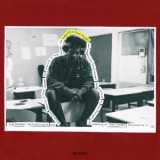
Delasi, the Koforidua-based producer, singer and rapper has released his new single ‘Amplifier’ featuring Nii Noi Nortey.
Prophetic, spiritual and frenetic, ‘Amplifier’ is Delasi’s testimony in musical form. A manifestation of Delasi emerging triumphant after many years in limbo as he searched for a long-awaited breakthrough in the music industry.
Produced by Delasi himself alongside Morgan Greenstreet, ‘Amplifier’ is underpinned by the texture of coastal rhythms indigenous to Accra and tightly ornamented with bustling drum breaks, electronic synth lines and jazz sensibilities.
Veteran Ghanaian multi-instrumentalist and sound designer Nii Noi Nortey appears on the track to deliver an explosive and rhythmically intense saxophone performance throughout as it tastefully builds to an emphatic crescendo.
Self-described as a prayer, the track’s maximalist and percussive instrumentation is cleverly juxtaposed with minimal lyrics where Delasi’s faint vocal repeats a series of repeated phrases like evoking the mood and semblance of a meditative chant and religious experience. Harkening to the work of afrofuturistic jazz musicians like Sun Ra and Pharaoh Sanders.
Speaking on the track’s meaning, Delasi said: “‘Amplifier’ is my prayer and like with other songs of mine it can scare me because I write things and then it’ll manifest in exact detail. The song is basically outlining how hard I’ve worked and how I need an amplifier to have my desires fulfilled. It's like a mantra and that’s why it's not so lyrical”.
‘Amplifier’ marks Delasi’s first release as a lead artist since his 2015 self-released project ‘#thoughtjourney’ which garnered support and praise from Rolling Stone, BBC6 Music, Worldwide FM, KCRW, Afropop Worldwide, Deutschlandfunk Kultur, NRK and legendary French DJ/Producer Laurent Garnier. Additionally parlaying into touring and festival gigs across Nairobi, Berlin, Morocco, Denmark and Sweden.
Delasi is an artist that has been quietly prolific for over a decade. Honing his musicianship exploring sonic possibilities with Ableton and Teenage Engineering. Eventually entrenching himself in the Ghanaian rap scene via collaborations with Hammer of The Last Two, Reggie Rockstone and Yaw P with whom he would release a joint project ‘Imperfections: The Break Up Vol 1’ in 2013.
He was musically raised on a diet heavily influenced by his father who exposed him to the sounds of Marvin Gaye, Bob Marley & The Wailers, Bobby McFerrin, Jim Reeves and Billy Ocean alongside the soundtracks for movies like Doctor Zhivago, The Sound of Music and La Bamba. Delasi’s own tastes would be heavily informed by linchpins of US Hip-Hop like Wu-Tang Clan, Nas, Onyx and M.O.P in addition to alternative R&B artists Frank Ocean and James Blake.
After many years of operating as a proudly independent and self-contained artist, Delasi has now partnered with Gilles Peterson’s Brownswood Recordings. One of the world’s leading indie labels, famed for their instrumental role in breaking the likes of KOKOROKO, Yussef Dayes, Swindle, Joe-Armon Jones, Shabaka And The Ancestors, Zara McFarlane and Ghostpoet.
With Delasi now being granted resources to give his music the grand and worthy footing, he is now on the cusp of the artistic breakthrough that was long out of reach. Speaking further on how the deal with Brownswood inspired the new single, Delasi said:
“The music I’ve created this go round is so strong that I can’t handle it all by myself. Though I had a lot of fun doing it all by myself with ‘#thoughtjourney’, this time around I needed it to be with a home who could properly amplify it.”
Cerca:sai
- A1: Please Come Out
- A2: Wicked
- B1: Working With
- IB2: N My Head
- C1: Got Your Money
- C2: Didn't You Know
- D1: Two-Door
- E1: Memory Lane
- E2: Good Girls And Boys
- F1: All I Want From You
- F2: Don't Sell Rock
- G1: What Yours
- G2: Tweets
- H1: You Check
- H2: Hero Forever
- I1: Don't Pick Up
- I2: You Don't Know Me Anymore
- J1: Tenderly With You
- J2: Now Let's Wait
Sasu Ripatti's complete "Dancefloor Classics" series. Music for imaginary dancefloors, released on Ripatti's own label Rajaton.
”Look up, into the light” she said, while the camera shutter clicked. ”Like this? Does it look holy?” His neck felt stiff. Her reply: ”Yes, just like that. What do you mean holy? Like religious? ”No, more like trying to look very far, somewhere beyond what we can see.” ”Okay, stand still, I’m going to come close to you now. The light hits your face great.” click, click, click.
He noticed her fingernails. They were not polished. Natural. Even somewhat rugged, as if something wore out the fingers slightly. What had these hands held besides the camera? What made the edges of her fingernails drift off?
He thought it’s weird to look straight into the camera. The photographer had closed her left eye, the one not looking into the lens. Then it opened, she looked up, perusing the surroundings, then she closed her eye again, then looked up, closed, looking up, very quickly. It all seemed very professional. Maybe she calculated the light, making sure it’s close to perfect. ”What will these photos look like?” – the thought popped into his head briefly. It was liberating to think it wouldn’t matter.
”What’s that song playing?” he asked. ”Wait a sec, Ol’ Dirty Bastard?” she replied. ”Oh yeah, right. But the sample?” ”Hey, could you look up again, like that. No, lower.”
New directions: ”Look out from the window, turn left.” ”My left or yours?” ”Yours, I always try to think from the direction of my model.” How professional! This is a good shoot, so natural. Should I worry about how the photos look like? No, I don’t want to. His thoughts bounced around. What would the story be like? It’s a big newspaper, everyone will read it. Maybe someone drinks coffee and eats a stroopwafel while they do it. Will they place the waffle on top of the mug for a brief while, so that it gets hot and the syrup melts a little? Then it feels wet, and you can bend the cookie.
She broke his train of thought off midway through: ”Now turn right, but look left, and slightly up, but don’t turn your face right.” ”Umm, like this? Sounds like a set of pilates instructions.” she laughed ”You do pilates?” ”Yeah, it’s hard sometimes. Have you tried?” ”No”, she said. ”I’m not good for sports that are done in groups.” ”Yeah, but in pilates you can just be inside your mind, drowning in your private thoughts.”
”What are you thinking in pilates?” she asked, taking more photos. ”Well, mostly just which way is right. And which left.” click, click.
Q&A with Sasu Ripatti:
1) Tell us something about the EP series ”Dancefloor Classics”, what’s the idea and what can we expect?
I’ve been slowly writing these sort of dance music pieces and finally curated them together for a conceptual release. I like to create music for a dancefloor that exists only in my imagination and doesn’t try to suck up to the standardized reality.
2) Your vinyl format is 10” which is quite special (as opposed to LP / 12”). Why did you choose it?
It’s my favourite format, absolutely. The size is perfect, and you can make it sound really good @ 45 rpm. And you still can make great artwork.
3) You seem interested in sampling/repurposing, what does it mean to you as an artist to approach something already existing from a new angle? How does the source material inform you about the approach to take?
I guess i could flip it around and just say I’ve outgrown synths or electronic sounds to a great extend, and having gotten rid off all my synths already good while ago I’ve used samples as my main source material a lot. It’s obvious on this series that i’ve sampled existing music, but I also sample instruments and things in the studio and resample my own library that I have built over the years, it’s quite large. To me the end result matters, not so much how I get there. Once I have something on my keyboard and play around, it’s all an instrument, though with sampling other music it becomes a really interesting and complex one as you’re possibly playing rhythm, but also harmonic content and maybe hooks or whatever, all at once.
I never sample premeditadedly, like listening to records and looking for that mindblowing 3 sec part. I just throw the cards in the air and see what lands where, just full intuition and hopefully zero mind involved, playing tons of stuff, trying things, just recording hours of stuff. Then comes the interesting part to listen to hours of mostly crazy stuff and finding that mindblowing 3 sec part.
4) What is your relationship with the dancefloor (conceptually and/or in experiences / as a performer)?
Very complicated. I have never really felt comfortable on a dancefloor but have always wanted to. There’s something in club music, in theory, that really speaks to me. It has never really materialized for me – speaking mainly from a performer’s point of view who goes to check on a dancefloor for a moment after a concert. I never have DJ’d or felt much interest towards it. But again, I love the idea and concept of DJing. As well as producing music for imaginary DJs. Lately, as in the past 10+ years, I haven’t even performed in any sort of club spaces. So my relationship to the dancefloor is quite removed and reduced, but there’s quite a bit of passion and interest left.
All tracks composed and produced by Sasu Ripatti.
Artwork & photography by Marc Hohmann.
Mastering by Stephan Mathieu for Schwebung Mastering.
Vinyl cut by SST Brueggemann.
Publishing by WARP Music Ltd.
BONE WHITE VINYL[10,88 €]
Never said it'd be like this, right? Skullcrusher's 21st century rendering of The Hated's 1985 early emo blueprint "Words Come Back" reinvents the song as subtle, ambient folk music. The flip features two versions of the original, including Dan Littleton's home demo, cut in a maddening double groove, and housed in an elegant black and silver sleeve, with embossed braille lettering for the visually impaired. "This is my way of making a punk song," Skullcrusher's Helen Ballentine said, "ignoring structure and letting everything just pour out_though quite a bit quieter."
Black Vinyl[10,29 €]
Never said it'd be like this, right? Skullcrusher's 21st century rendering of The Hated's 1985 early emo blueprint "Words Come Back" reinvents the song as subtle, ambient folk music. The flip features two versions of the original, including Dan Littleton's home demo, cut in a maddening double groove, and housed in an elegant black and silver sleeve, with embossed braille lettering for the visually impaired. "This is my way of making a punk song," Skullcrusher's Helen Ballentine said, "ignoring structure and letting everything just pour out_though quite a bit quieter."
Yuki Saito's 10th album "LOVE"('91) is now available for the first time on vinyl with obi.
It's a hidden masterpiece of 90s city pop and light mellow.
Emotionally fragile songs of poems she wrote herself.
Arrangements by Mioko Yamaguchi, Mayumi, Tetsuya Kakihara, and Kenjiro Sakitani. They are well known by city pop fans.
Andy Sharrocks started writing songs in 1976. He found a vehicle for these songs with punk band Accident On The East Lancs. This started out as a covers band, but Andy soon became frustrated when the other members wanted to stay that way. The band disintegrated but Andy retained the name, forming a new cutting edge four piece playing his songs. He financed their first single in 1979 on his own label Roach Records. This was a double A side as one of the sides was a ditty called We Want It Legalised. The other side was a Bo Diddley kind of groove called Tell Me What Ya Mean, which Record Collector magazine recently said sounded like a song The Strokes should cover. This line up fell apart when immediate success failed to arrive, but Andy formed another band out of the ashes of local band Wilful Damage, and the guitarist out of the original covers band. They recorded and released on Roach Records another double A sided single in 1981 as well as an album released on cassette tape on Cargo Records. The singles now exchange hands on the collectors market for over seventy pounds, the album has been rereleased on vinyl twice, once on a German label, and once on UK’s OZIT/MORPHEUS Records which came with a bonus live album The singles have been released on many punk compilations and We Want It Legalised is about to be released on a new Manchester punk compilation on Cherry Red Records. They played many free festivals including Deeply Vale three times, and did many great supports including The Fall, Tractor, Here And Now and Crass. Andy left the band in 1982 for personal reasons, and had a one single deal with I Believe In Love on the Vibes and Vibes record label in 1985. Refusing to compromise and do covers, Andy found it impossible to make a living doing his own material which was now primarily Americana, after discovering alt.country through Steve Earle and Lyle Lovett in 1985. He went on the road as a tour manager, which is where he met Hilly Briggs, who went on to produce Andy’s first solo album in 2004 called Walking In Familiar Footsteps, which featured ex Rolling Stones Guitarist Mick Taylor, Bluesband and Manfreds frontman Paul Jones and Bobby Vee’s sons Jeff and Tommy on drums and bass respectively. Andy was now living in London and was gigging regularly on his own or with a revolving circle of musicians going under the collective title of Andy Sharrocks & The Smokin’ Jackets. He played over five hundred gigs all over London and the UK. He also did many supports for Mick Taylor, Buddy Whittington, Steve Gibbons, The Strawbs, Curved Air, and supported John Mayall on a UK nationwide tour, and played the Jazz Café in Camden twice with John. He also played The Hells Angels Bulldog Bash three times, The Skegness Rock n Blues Festival, The Herelbeke Blues festival in Belgium and The Colne Blues Festival. In 2009 he released another album called Dirt with The Smokin’ Jackets, which came out to great critical acclaim. Andy is now releasing a triple album of truly magnificent UK Americana, called Country Rock n Roll n Durty Blues. Press Quotes : "Country Rock ‘n’ Roll ‘n’ Durty Blues is a sprawling album of original rock and blues which takes you from Muddy Waters to modern Americana" – Nigel Carr, Louder Than War // "Good honest earthy rock ‘n’ roll done the old fashioned way with passion and aplomb" – Mark Radcliffe, BBC // "Country Rock ‘n’ Roll effortlessly lives up to its title … and more" – Pete Feenstra, Get Ready To Rock // "As a listener it really is bloody good fun - Briticana, Americana with a very English voice
Black Vinyl[30,88 €]
Rogamar by Cesária Evora, released 19 January 2024, includes the following tracks: "Avenida Marginal", "Tiche", "Rogamar", "Modje Trofel" and more.
This version of Rogamar comes as a 2xLP. This release comes with (a) Insert(s).
The vinyl is pressed as a turquoise disc. Another vinyl is pressed as a turquoise disc.
- Pray Them Bars Away
- Leather And Lace
- Forget Marie
- Cold Hard Times
- The Night Before
- Hey Cowboy
- No Train To Stockholm
- For A Day Like Today
- Easy And Me
- What's More I Don't Need Her
- Vem Kan Segla (I Can Sail Without The Wind)
- Me And The Wine And The City Lights (Session Outtake)
- Irst Street Blues (Session Outtake)
- Pray Them Bars Away (Alternate Version)
- Easy And Me (Alternate Version)
- For A Day Like Today (Take 1)
- First Street Blues (Take 1)
- Leather And Lace (Alternate Vocal Mix)
- The Night Before (Mono Single Mix)
- What's More I Don't Need Her (Instrumental)
- Pray Them Bars Away (Take 7 Instrumental)
- Easy And Me (Take 5 Instrumental)
- Cold Hard Times (Take 4 Instrumental)
- No Train To Stockholm (Instrumental)
- Me And The Wine And The City Lights (Instrumental)
- Hey Cowboy (Instrumental)
- Newly Expanded Deluxe Double LP Edition! - Double LP expanded edition includes outtakes, demos and instrumentals, including 10 previously unreleased recordings - 26 total tracks - Album remastered from pristine LHI master tapes by GRAMMYr-nominated mastering engineer John Baldwin - Liner notes by GRAMMYr-nominated reissue producer Hunter Lea including interviews with Torbjo?rn Axelman, Suzi Jane Hokom, Nina Lizell, Don Randi, Hal Blaine and Shel Talmy - Rare film production photos from the Torbjo?rn Axelman archive - Double LP housed in a gatefold jacket // Description: By the end of the 1960s Lee Hazlewood's LHI Records had burned piles of cash, gone through a half dozen distributors and failed to achieve the kind of chart success "Boots" had promised. Fortunately for Lee there was a land where he was still on the top of the charts, a place where women flowed like Bra?nnvin...Sweden was calling. Released as the last LHI LP, Cowboy in Sweden was a soundtrack to the 1970 cult classic film of the same name starring Lee Hazlewood. The film was a surreal psychedelic account of Lee's journey to his new homeland, while the soundtrack was a perfect compilation of Hazlewood's orchestral melancholy country pop songs. Recorded over a prolific globe trotting three year period, Lee's peak on LHI records was ironically the label's swan song.
Keiji Haino/Jim O'rourke/Oren Ambarchi
With pats on the head, just one too few is evil one too many...
- My “Watashi Dake?” Is Definitely Not Included In This Unequal Treaty, Is It?
- Right Brain, Left Brain; Right, Left; Right Wing, Left Wing. Just How Many Combinations Can Be Made From These?
- “Critical Consciousness?” That’s Been Abandoned In Corner Of A Shower Room In A 53-Storey Apartment Building Inhabited By Extra-Terrestrial Lifeforms…
- I Thought I Had Pulverized It Summarily But There Are Just Too Many Who Lack Reality Or Who Are Cowards So I Cannot Change A Thing
- E1: Still Divided Into Pieces? Let’s Reconnect Them Recognise That You Are A Point And The Longest Line Let It Become Light
- I Can No Longer Sense That Sacred Feeling Of Expression Just The Loitering Of Vulgar Vibrations That Can Only Be Described As A Half-Hearted Class Reunion Will You Consent To This?
- There Are Always Things I Wish To Say But I Can Only Convey Them In This Language August 6 August 9
The heavyweight trio of Keiji Haino, Jim O’Rourke and Oren Ambarchi return with their 12th and most epic release to date, the triple LP With pats on the head, just one too few is evil one too many is good that's all it is. Documenting the entirety of their final performance at the dearly departed Roppongi home of Tokyo underground institution SuperDeluxe in November 2018, the music spread across these six sides splits the difference between the guitar-bass-drums power trio moves and experiments with novel instrumentation that have defined the trio’s decade of working together. Containing some of the most delicate music the three have committed to wax since the gorgeous 12-string acoustic guitar and dulcimer tones of Only wanting to melt beautifully away is it a lack of contentment that stirs affection for those things said to be as of yet unseen (BT011), this wide-ranging release also offers up some of their most blistering free rock performances yet.
The side-long opening piece finds Haino on a single snare drum in duet with O’Rourke on unamplified electric guitar, playing in the lovely post-Bailey vein heard on his classic 90s recordings with Henry Kaiser and Mats Gustafsson. Spiky dissonance and ringing harmonics interweave with flowing melodic fragments as Haino single-mindedly explores the resonance of the snare like an untutored Han Bennink. On ‘Right brain, left brain; right, left; right wing, left wing. Just how many combinations can be made from these?’, O’Rourke moves to synth and electronics, joined by Ambarchi on drums, who at first focuses on sizzle cymbals before hypnotic cycles of gentle tom rhythms combine with electronic burbles and flutters to suggest a dream collaboration between Masahiko Togashi and Jean Schwarz. Ambarchi’s percussion is then joined by Haino on wandering, overblown flute, before the man in black switches back to the snare for a bizarre, stuttering drum duet.
For the first trio performance, Haino makes another new addition to his seemingly infinite catalogue of instruments, this time a homemade contraption he refers to as ‘Strings of Dubious Reputation’. Joined by O’Rourke on increasingly spaced-out electric guitar and Ambarchi on skittering percussion, Haino’s wonky, slack strings adds a definite ‘musique brut’ edge to this side-long performance, certainly one of the most enchantingly odd in the trio’s discography. When the group reconvene for the second set, spread out across the final three sides, they seem ready to breathe fire from the first instant. O’Rourke slashes distorted chords on the six-string bass, Ambarchi breaks into his signature irregular caveman thump, and Haino squeals and squawks on heavily delayed oboe before unleashing an overpowering electrical storm when he first picks up the guitar. For over half an hour, the trio pound out one of their most relentless performances, a constantly rearranging kaleidoscope of tortured fuzz guitar, insanely busy bass riffing and propulsive, tumbling drums. A hushed atmosphere initially reigns on the final long piece, given the mournful title ‘There are always things I wish to say but I can only convey them in this language August 6 August 9’. Haino’s clean guitar strumming calls up the shimmering tones of his PSF classic Affection, gradually building to a surging wall of sound, bass and drums lumbering through a roar of jet-engine guitar. Arriving in a deluxe trifold package with photos by Lasse Marhaug alongside inner sleeves with extensive live images, this epic release is perhaps the most remarkable document yet of this unique trio’s stamina and continuing inventiveness.
Soliton maximizes the compact format by further illuminating lesser-traveled paths. Contemplation and exploration weave harmoniously through five mysterious tracks. Influenced by a wide range of styles and sounds, such as Japanese ambient, the muted dissonance of Pharoah Sanders, and the chilly dub of the Scape catalog, Soliton evokes visions of lonely night drives punctuated by bright moments of bliss. The Calque EP from January 2023 saw them pursuing the minimal electronic side of their work even further. The opening track, "Kottbusser Tor,” showcases a conspicuous absence of the processed guitars that characterize most of their work, and instead explores sequenced filters, tape delays and analog synth patterns for eight minutes. On "Ammosel", they dive directly into dubby soundscapes, with crackling electronics and deep basslines, while "Kiyosumi" and "Fade Into Air" pay a visit to more familiar ambient territory. A darker undercurrent pervades on this EP, but one that goes particularly well with the coldest of seasons and its frosty air. The duo, consisting of Jason Kolb (Michigan, US) and Jonas Munk (Denmark) started working together in 2006, sending each other tracks across the Atlantic, eventually resulting in a full-length release on Felte in 2012. What started out as a side project to their respective main projects (Auburn Lull and Manual) have slowly become the main activity for both artists, now with a total of four full-lengths under their belt. Their music has also evolved and matured over the years, reaching a level of perfection that’s only granted producers who've been in the game for decades. Billow Observatory have by now established themselves as purveyors of highly refined ambient music and the Soliton EP sees them elegantly blend new and old, electronic and organic, into a gently drifting, enveloping whole. “.. mind drenching sunrises, glittering constellations, and sailing clouds, richly furnishing the familiar sense of hovering over vast natural orders that you're also inside. – Pitchfork // “So the world it inhabits is essentially that one between states, simulating a quietly vibrant ecology of sub-aquatic bass rumbles, washed out expanses of mid-range swirl and keening top end whose elusive colours seem to fade and coruscate in the low light. Lovely
- A1: Roberto Pregadio – First Time Three 3 11
- A2: Soul's Soul*– Angelus 4 07
- A3: Orchestra Mustang*– Undertown 3 04
- A4: Genius – Bermilyia Avenue 4 04
- A5: Gianni Marchetti – Disposta A Tutto 2 41
- B1: I Raffazzonati* – Maria Schneider 4 13
- B2: Brooklyn Bridge Group – Take Me To New York 3 17
- B3: Hugh Bullen – Sunshine Train 3 49
- B4: Carlo Cordara E I Waterloo*– Un Uomo Che Lavora 3 22
- B5: Las Chakachas*– Super Cat 2 39
- C1: Le Streghe – Kapua Pele Ea 3 44
- C2: Ninety (2) – African Flute 3 57
- C3: Lara Saint Paul – The Voodoo Lady 5 15
- C4: Ivano Fossati / Oscar Prudente*– Tema Del Lupo
- D1: Sandro Brugnolini / Luigi Malatesta*– Afro Free 3 31
- D2: Doriano Saracino – Josie's Theme 3 16
- D3: Enzo Scoppa – Guida Sicura 2 48
- D4: Gino Marinacci – Meeting 3 24
- D5: Shirley Bunnie Foy – The Gypsy - Gershwin Medley - Summertime
An autumnal treasure, East Village’s Drop Out has spent the past thirty years finding new ears to bewitch and new hearts to melt. The only album from this British four-piece, recorded and released in the early nineties, it’s long been considered one of the hidden jewels of its time, and is talked of with hushed reverence by people who know. Bob Stanley of Saint Etienne once called it “an elegy for a particular brand of eighties guitar music, sweet minor chords and Dylanesque lyrics”, which captures what makes it so special; in summarising its era, though, it also effortlessly transcends it.
Like all great guitar gangs, East Village fell together as a four-piece; having relocated from High Wycombe to London in mid ‘80s, brothers Martin and Paul Kelly on bass and guitar, set on forming a group together, were joined by John Wood (guitar) and Spencer Smith (drums). Wood and the Kellys shared writing and vocal duties; it was an ideal combination, and one of the many charms of East Village is their various song writing voices, a tip of the hat, seemingly, to the 60s folk-rock groups who influenced them.
Originally influenced by garage-rock and freakbeat, the band eventually came through via the same scene as groups like Felt, The Go-Betweens, The Weather Prophets, and Primal Scream. They’d formed as Episode Four, releasing an EP, Strike Up Matches, in 1986, which has gone on to become one of most sought after releases of the C86 era. Their first two singles as East Village, ‘Cubans In The Bluefields’ (1987) and ‘Back Between Places’ (1988), were released on Jeff Barrett’s Sub Aqua label.
When it came time to record Drop Out, East Village found a supporter in Bob Stanley, who bankrolled the album sessions until Barrett re-signed the band to his new imprint Heavenly Recordings in 1990. The album that took shape is dusky, heartfelt, lamplit, full of chiming minor chords, close harmonies, rattling organs, all buoyed by a rhythm section that moves as one, steady and elegant. There’s melancholy here, certainly, on songs like ‘What Kind Of Friend Is This’, but also pleasure and freedom, on ‘When I Wake Tomorrow’ and ‘Silver Train’. The group were obsessed with Dylan’s Eat The Document at the time, and the album’s rich with references to the film; Drop Out’s character is also somehow close to the thin wild mercury sound of Blonde On Blonde, and the lambent light of the Byrds’ Notorious Byrd Brothers.
In one of life’s gentler surprises, ‘Silver Train’ became an unexpected radio hit in Australia when released there as a single in 1993. The story of East Village seems marked by such unexpected turns and surprising events. None was more surprising for their fans at the time, though, than their onstage split in 1991, leaving an unreleased album in the can. Encouraged by Jeff Barrett the band revisited the tapes two years on and while mixing the album for its posthumous release in 1993 invited Debsey Wykes (Dolly Mixture, Coming Up Roses, Saint Etienne, Birdie) to sing the quietly devastating album closer, “Everybody Knows”, a perfect, sad-eyed sign-off.
Listening now to Drop Out, its timelessness is clear. It could have been recorded by young folk-pop hopefuls in the late sixties, taking their shot at the big time; but it could just as easily have been recorded yesterday, by a group that’s both reverent to music’s past, but forward looking in spirit and temperament. It’s that kind of album. Drop Out’s pop poetry is fully formed, with a singular charm that takes in wistfulness, romance, and good times, and a clutch of deeply moving songs that are overflowing with melody and gracefulness. It’s pretty much everything you’d want from a guitar pop record.
It's also an album that’s slowly accrued its own legend. From its stunning cover art, photographed by Juergen Teller originally for a Katherine Hammett campaign, to the ten perfectly formed songs within, Drop Out’s significance in the scheme of things is such that, a decade ago, it was given a rare 10/10 rating in Uncut magazine, who called the album “the lost classic of its era”. Drop Out comes round every decade or so, each edition introducing new fans to its understated beauty, and this latest reissue is its most elegant and deluxe yet.
The 30th anniversary edition of Drop Out lands in two formats: an LP with tip-on style jacket and four-page insert, designed to partner with the 2019 vinyl reissue of their singles and rarities compilation, Hot Rod Hotel; and a double CD, featuring an extra disc compiling the group’s early singles and alternative versions. This CD edition previously has only been available in Japan, though it now features a new, superior mix of their second single, ‘Back Between Places’. Both feature new, typically eloquent liner notes from writer Jon Savage.
The members of East Village have all gone on to do inspired things: Martin Kelly joined Jeff Barrett at Heavenly and has managed label mainstays Saint Etienne since 1993; Paul Kelly formed Birdie with Debsey Wykes, and is now a renowned film director and graphic designer; both Paul and Spencer Smith played in Saint Etienne’s live band; John Wood moved to China to teach, and released a lovely, understated folk album, Quiet Storm, in Japan in 2006. But with the hazy perfection of Drop Out, they’ve all already etched their names in the firmament.
2011 als Gyze gegründet, veröffentlicht die japanische Samurai Metal Band RYUJIN am 12. Januar 2024 über Napalm Records ihr erstes selbst
betiteltes Album Ryujin unter neuem Bandnamen. Nach dem sie bereits vier erfolgreiche Alben veröffentlicht haben und weltweit auf großen
Festivals aufgetreten sind, haben RYUJIN ihren ganz eigenen Sound entwickelt, der Melodic Death Metal mit Power Metal und traditioneller
japanischer Musik verbindet. Benannt nach dem japanischen Drachengott des Meeres, lässt das Trio um den Leadgitarristen Ryoji Shinomoto
japanische Instrumente wie Shamisen, Drachenflöten, Erhu und Taiko auf rohes Guitar Shredding und reißende Vocals treffen, womit sie dem
Drachengott eine würdige musikalische Huldigung bieten. Auch auf dem neuen Album treffen High Speed Riffs und atemberaubende Gitarrenlinien
auf traditionelle japanische Elemente und erzeugen einen Sound, der stark an alten orchestralen Gagaku bis hin zu modernen Anime-Themen
erinnert. Ryujin wurde von Matthew Kiichi Heafy (Trivium) produziert und von Mark Lewis gemischt und gemastert und enthält Gastbeiträge von
Heafy (Gesang und Mitwirkung auf verschiedenen Tracks) und Mukai Wataru vom Kansai Philharmonic Orchestra (Cello). Die Texte von RYUJIN sind
durch die Sprache des Ainu-Volkes von Hokkaido (Heimatregion der Band) geprägt, thematisieren die Kraft des Meeres und sind unter anderem von b
Repress of Kal Marks' breakout 2022 LP, "My Name Is Hell," pressed on a limited edition "baby blanket blue" colored vinyl.
Pitchfork said "Where previous records feel bound by chains in a scrapyard, this album is feral and prowling, coursing with adrenaline."
black LP[36,09 €]
Eraldo Bernocchi and Hoshiko Yamane have come together again to create their second album - inspired by the Japanese concept of ""Sabi"". The record is a unique blend of electronic and acoustic music - with Bernocchi’s pulsating textures and Yamane's haunting treated violin melodies weaving together to create a captivating and emotional sonic landscape. ""Sabi"" is a Japanese aesthetic that celebrates the beauty of impermanence and decay. It is often associated with the simplicity, austerity, and solitude found in nature, and is said to evoke a sense of melancholy, nostalgia, and reverence for the passage of time.
Bernocchi and Yamane's ""Sabi"" explores these themes through a collection of minimalist compositions that combine electronic and acoustic instruments immersing the listener in a deeply cinematic experience. The album takes the listener on a journey through a series of atmospheric tracks, sometimes melancholic pieces that evokes the sense of solitude and simplicity often associated with the concept, other times more energetic and uplifting, optimistic ones that celebrates the beauty of transience. The artwork again was created by the renowned designer Petulia Mattioli.
orange LP[36,09 €]
Eraldo Bernocchi and Hoshiko Yamane have come together again to create their second album - inspired by the Japanese concept of ""Sabi"". The record is a unique blend of electronic and acoustic music - with Bernocchi’s pulsating textures and Yamane's haunting treated violin melodies weaving together to create a captivating and emotional sonic landscape. ""Sabi"" is a Japanese aesthetic that celebrates the beauty of impermanence and decay. It is often associated with the simplicity, austerity, and solitude found in nature, and is said to evoke a sense of melancholy, nostalgia, and reverence for the passage of time.
Bernocchi and Yamane's ""Sabi"" explores these themes through a collection of minimalist compositions that combine electronic and acoustic instruments immersing the listener in a deeply cinematic experience. The album takes the listener on a journey through a series of atmospheric tracks, sometimes melancholic pieces that evokes the sense of solitude and simplicity often associated with the concept, other times more energetic and uplifting, optimistic ones that celebrates the beauty of transience. The artwork again was created by the renowned designer Petulia Mattioli.


