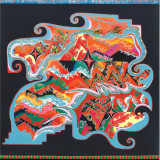
The next chapter of the Natural Information Society is here. Since Time Is Gravity, credited to Natural Information Society Community Ensemble with Ari Brown, presents a newly expanded manifestation of acclaimed composer & multi-instrumentalist Joshua Abrams nearly 15 year, 7 albums &-counting flagship ensemble. Joining the core NIS of Abrams (guimbri & bass), Lisa Alvarado (harmonium) Mikel Patrick Avery (drums) & Jason Stein (bass clarinet) are Hamid Drake (percussion), Josh Berman & Ben Lamar Gay (cornets), Nick Mazzarella & Mai Sugimoto (alto saxophones & flute), Kara Bershad (harp) & Chicago living legend of the tenor saxophone Ari Brown. Recorded live to tape at Electrical Audio & The Graham Foundation, cover painting Vibratory Cartography: Nepantla, by Lisa Alvarado. 2xLP on Eremite USA, 2xLP & CD on Aguirre/Eremite Europe. Out 14-04.
Since first developing Natural Information Society in 2010, Joshua Abrams has been gradually expanding the group’s conceptual underpinnings, its musical references & the sheer number of the group’s members. Its music is, in a sense, an expansive form of minimalism, based in repeated & overlaid rhythmic patterns, ostinatos & modality. Its roots, its scale & its meaning become clearer in time. If time is gravity, it also allows us to carry more. Having begun as fundamentally a rhythm section with Abrams’ guimbri at its core, the version here can stretch to a tentet, including six horns.
Abrams has been expanding his minimalism gradually, but he has long understood a key to minimalism’s potential: the breadth of its roots in the late 1950s & early 1960s, ranging from the dissatisfaction of young European-stream composers with the limitations of serialism to the simultaneous dissatisfaction of jazz musicians with the dense harmonic vocabulary of bop & hard bop. The former began exploring rhythmic complexity & narrow tonal palates in place of harmonic abstraction (Steve Reich’s Drumming, Philip Glass’ Music with Changing Parts; perhaps above all Terry Riley’s In C & his late ‘60s all-night organ & loop concerts); the later reduced dense chord changes to scales (signally with Miles Davis' Kind of Blue, but rapidly expanding with John Coltrane’s vast project). In the 1950s the LP record opened the world with documentation of Asian & African musics, key influences on both minimalists & jazz musicians. If John Coltrane’s soprano saxophone suggested the keening shehnai of Bismillah Khan, the instrument was rapidly taken up by two key minimalists, LaMonte Young & Riley, similarly appreciative of its flexible intonation, the same thing that kept it out of big bands.
If the guimbri, the North African hide-covered lute that Abrams plays with NIS, involves a rich tradition of hypnotic healing music associated with the Gnawa people, Abrams’ music also touches on other musics as well — other depths, memories & healings, different drones, rhythms & modes. As the group expands on Since Time Is Gravity, he has made certain jazz traditions in the same stream more explicit as well. If there is a mystical & elastic quality involved in the experience of time, both in direction & duration, you will catch it here. The parts for the choir of winds expand on the roles of Abrams’ guimbri, Mikel Patrick Avery & Hamid Drake’s percussion & Lisa Alvarado’s harmonium: at times, the winds are almost looping in the tentet version, each hitting a repeating note in turn, at once drone & distinct inflection on temporal sequence. The brilliance of the work resides in Abrams’ compositions, the NIS’ intuitive execution & in Ari Brown’s singular embodiment of the great tenor saxophone tradition, including the oracular genius of Eddie “Lockjaw” Davis, & Yusef Lateef. The three pieces by the expanded NIS featuring Brown —the opening “Moontide Chorus” & “Is” & the ultimate “Gravity”— have an immediate impact, & togther might be considered a kind of concerto for tenor saxophone. Here Brown presses almost indistinguishably from composed melody to improvised speech, getting so close to language that he might have a text. Everything here is a sign. Note the tap of the Rhythm Ace that links “Moontide Chorus” to “Is”, the attentive heart always present, even when signed by a machine. There’s a link here to the methodologies & meanings of dub music & the linear & vertical collage of beats, textures & tongues: treated with reverence, a sample of a beat-box can be as soulful, as hypnotic, as a mbira or a tamboura. If those pieces with Brown are heard as a suspended concerto, the three embrace & enfold the other works, like the sepals of a flower. That placement will also touch on the mysteries of our perception of time.
Particularly in “Is”, but elsewhere as well, a phenomenon of transcendence arises in which time appears to be tripartite, at once moving backwards & forwards & standing still. This is an act of technical brilliance certainly, but also an illumination of music’s ability to represent temporal consciousness through polymetrics. This particular listener has only heard it before in a few places, including the horn shouts & bowed basses of Coltrane’s Africa, in moments of Charles Mingus’ The Black Saint & the Sinner Lady, in certain pieces where tapes were literally running backwards, & earlier still in Dizzy Gillespie’s Cubana Be, Cubana Bop, in which the composer George Russell & conguero Chano Pozo found a music that spoke at once in the voices of Stravinsky’s Rite of Spring & the vestigial rites, rhythms & songs of the Yoruba language & Santeria religion of inland Cuba.
In Joshua Abrams’ compositions & the realization of them by the NIS, in the time of one’s close listening & memory thereof, distinctions between the “natural” & the “social”, the “quotidian” & the “transcendent” are erased, suspended or perhaps irrelevant. Consider two of the ensemble pieces, one named for nature, the other social science. In “Murmuration” the repeated wind figures of flute & alto saxophone combine with the interlocking patterns of harp, guimbri & frame drum (tar) to create a perfect moving stillness, not an imitation but a witness to the miracle of the starlings’ astonishing collective art, a surfeit of beauty that might be the ultimate defense tactic.
“Stigmergy” takes its name & concept from the Occupy movement’s Heather Marsh, who proposes a social system based on a cooperative rather than competitive models, one in which ideas are freely contributed & developed as ideas rather than an individual’s property. In its form, Abrams’ “Stigmergy” is the closes thing to traditional jazz, a series of accompanied solos by each of the wind players. However, the composed accompaniment is a radically collectivist notion: a repeated rhythmic figure, call it ostinato or riff, in which the different winds each play only a note or two of the figure, a concept both more collectivist & individualistic in its conception than any typical unison figure. It suggests another of the underlying recognitions that propel the Natural Information Society, the group as social organism, the teleology of hypnotic anarchy, all parts in place, functioning systematically, evolving & expressing itself, its nature & society, as a transformative organism.
George Lewis has described music as “a space for reflection on the human condition”. This suggests that, rather than a “distraction”, at least some music might serve as a distraction from distraction. It’s a focus, a clarity, a awareness, an external invitation to interiority, as if music itself is a model for form & contemplation, an organism contemplating for us or as us. If that is a possibility, & I am sure I have heard such musics, than this music is among them. How many of our rhythms, melodies & harmonies (cultural, historical, biological, psychic) might such music carry, translate & transform in the particulate ecstasy of our own murmuration? (Stuart Broomer, April 2022)
Поиск:sai
Все
Kusōzu : Nine Death Stages is the second album by the Tokyo trio Archeus, which consists of Keiko Higuchi (voice, percussion, trombone, shamisen), Shizuo Uchida (bass strings), and TOMO (hurdy gurdy, voice). It follows their debut, self-titled and self-released CD and cassette from 2021 and is further proof – if any were needed – that these musicians, who’ve known each other for some time, but only started playing together relatively recently, share a telepathic communication, improvising together, fully in the moment, and as one. Where their debut album featured four extended improvisations, Kusōzu is an object lesson in economy and clarity – nine tracks, thirty-three minutes, everything that needs be said and nothing more.
All three musicians are incredibly active in the Japanese underground. Higuchi currently plays with Sachiko in Albedo Fantastica, adding Uchida for Albedo Gravitas; Uchida and Higuchi team up with Masami Kawaguchi (guitar) in vDBG. She’s also recorded with improvisers such as Naoto Yamagishi, Yasumune Morishige, and Shin-Ichiro Kanda. Uchida is also a member of MAI MAO, Kito-Mizukumi Rouber, Hasegawa-Shizuo, UH, and TERROR SHIT, and he’s recently recorded with improvising guitarist Takashi Masubuchi; TOMO has previously been a member of Tetragrammaton and Pouring High Water, and has recently performed live with Mick of Kousokuya, Mitsuru Tabata, Keiji Haino, and Daisuke Takaoka.
While Higuchi and Uchida have been making music together for some time now, they appear careful not to impose their previously articulated lexicon to bear on Archeus. There are trace elements of their playerly voices still present – the stretchy, plastic scrabbling on bass strings from Uchida; Higuchi’s murmurations of tone, and sudden plunges back down to earth, vertiginous and woozy – but there are other things going on here, particularly with TOMO joining in the action. His hurdy gurdy is a wild card in a group of wild cards, here cranking out burred, purring drones, there fidgeting through floods of notes, cranked up really high, ducking and weaving between Higuchi and Uchida as the three pursue the eternal now that is core to the best improvised music.
Archeus seem to work alchemically, transmuting their base matter into gold. Named after the Buddhist art practice of kusōzu, the graphic painting of nine stages of a decaying corpse in the open air, “to demonstrate the effects of impermanence,” as scholar Gail Chin once wrote.
Kusōzu : Nine Death Stages is Archeus at their most rigorously attentive to each other’s playing, and by the end, the music is itself thinking and feeling.
Vienna impact on RFR! PELETRONIC blesses us with his own unique blueprint of abstract house.
„Riddim & Bassline“ are the main ingredients for the opener of his
„Honey Badger EP“. A rumbling, buzzing and funk loaden predator digs his way into our ear canal.
„Sry I’m dazed AF“ - words we‘d sometimes like to address our supervisor with, especially after a serious weekend night out. A grating, distorted Miami Bass variant on a Deep House bouquet that lives up to his title.
„True Brew“ also starts wonderfully imperfect. Blustering beats and scruffy hi hats are being perfectly paired with a piano harmony. Bring us another two or twenty of this special drink!
Last but not least we got a remix by none other than DMX Krew, who provides a bubbly finish to „Riddim & Bassline“. There is not much left to say, cos if you got Ed DMX on your record, really everything has been said.
What would have happened if Michael Dudikoff had gone missing in action, say – in Poland in 1987 – during the harshest freezing spell of the century? Would he have coped under these conditions like John Rambo has in the town of Hope? We shall never find out, but the soundtrack is already there. Latarnik and Cancer G (members of EABS and Błoto) would call this film Zima Stulecia: Minus 30°C.
When Twin Peaks debuted on Polish National Television with its oneiric music by Angelo Badalamenti, Poland could feel as eerie as the series. Seemingly nothing quite matched, but on the other hand, no one was surprised. Growing up in the 1990s inevitably brings back memories of stalls selling a variety of products. You could buy there cleaning products from Germany, some underwear, Haribo jellies and Jacobs coffee, and have access to the "latest" cultural releases, which would be arriving late in Poland. This is where one could obtain pirated copies of cassette tapes and VHS, the labels of which had typewritten film titles that transported kids' fantasies to another world. With such content distribution, many of these kids got their first glimpse of Predator, Terminator, Robocop, as well as Van Damme's stunts in Bloodsport and a plethora of other B action movies, which to this day - like American Ninja - are rerun on TV over and over again. The afterimages of these soundtracks nestled in the heads of Marcin Rak and Marek Pędziwiatr for years and found expression on their debut album.
The music of Zima Stulecia is difficult to label in terms of genre. It oscillates towards melancholic electronic music. For some it will be techno, others will hear elements of house, all accompanied by improvised synth and percussion music.
Zima Stulecia is a duo that was not supposed to have any chance of success. Many years ago, back in 2006, when they were still budding musicians they met for the first time at a jazz workshop. When they found out where they both came from and that they were separated by almost 800 kilometers, despite having great chemistry in playing, they
jokingly said goodbye with the sentence: "it was fun playing together!". They figured they would never meet again. At the time, none of them imagined that in a few years' time in Wrocław they will form one of the most interesting contemporary jazz bands in Poland: EABS and Błoto. On top of that, they were both born in January 1987. The last of the historic "winters of the century" (eng. for "zima stulecia") occurred at that time in Poland, which ultimately determined their name as a band. Minus 30°C album is a recording of the non-verbal workings of these soulmates, and a fruit of a musical collaboration that has lasted for 16 years.
Das selbstbetitelte Debüt von ENVY OF NONE, der bunten Zusammenrottung von Gitarrist/Keyboarder Alf Annibalini, Rush-Gitarrist Alex Lifeson, Bassist Andy Curran (Coney Hatch) und Singer/Songwriterin Maiah Wynne war eine der spannendsten Grenzgänger-Platten des Jahres 2022 und hat sich bis heute nicht abgenutzt. Die Band schreibt schlicht verdammt gute, emotional greifbare und musikalisch fesselnde Lieder in einem Spannungsfeld aus State-of-the-Art-Elektronik und Rock/Pop-Tradition.
Die nun nachgeschobene EP "That Was Then, This Is Now" dient ihrem Titel entsprechend als Standortbestimmung und enthält zwei Tracks aus den Debüt-Sessions, zwei Remixe und das erste nach "Envy of None" komponierte ´That Was Then´. Stilistisch war das Quartett von Beginn an so vielseitig, dass man nun nicht von einer zusätzlichen Erweiterung ihres Repertoires sprechen kann - doch das famose Songwriting bleibt erhalten, und für Rush-Fans noch besser: Lifesons Spiel schimmert noch einen Tick präsenter durch.
´Lethe River´ ist dem Album-Opener ´Never Said I Love You´ relativ ähnlich, aber insgesamt doch ruhiger. Darauf folgt mit ´You´ll Be Sorry´ sachte brodelnder und zischender Industrial light, der ebenfalls auf "Envy of None" hätte stehen können - was ja auch plausibel erscheint, weil beide Stücke im gleichen Rutsch entstanden sind.
Weekend Recovery are back with a brand-new album ‘Esoteric’. Mixing equal measures of in-yer-face vox, overdriven guitars and straight-talking lyrics, it’s this mix that’s seeing the Sheffield indie-pop trio into editorial playlists on Apple, Deezer and YouTube alongside shows at Kendal Calling, Bingley Weekender and sell out dates including Corporation Sheffield. The first cuts from the record ‘Chemtrails’ and ‘No Guts All The Glory’ hit the airwaves with a bang, amassing plays on BBC Radio 1 Introducing (Gemma Bradley, Nels Hylton), BBC 6 Music (Steve Lamacq, Chris Hawkins, Fresh on the Net), Radio X (John Kennedy), Kerrang! Radio (Johnny Doom), Amazing Radio (Charlie Ashcroft, Shell Zenner, Frankie Francis), Absolute Radio (Frank Skinner), Planet Rock (Wyatt Wendels), BBC Sheffield (Christian Carlisle, Ellie Colton), BBC York (Jericho Keys), RTE 2 Ireland and as far as KEXP, Seattle and national USA station Sirius XM (Rodney Bingenheimer). The latest single ‘No Saint’ features Joel Arthur from local bandmates Hydeout and represents the harder edge in their third studio album.
Wenn die Dämmerung auf das Land der tausend Seen fällt, werden die Schleier zwischen unserer Realität und der Anderswelt dünner im Zwielicht der Wälder und Sümpfe. In solchen Momente gelangen Geschichten wie "das Märchen, das es nie gab" in die Texte und Musik von TENHI. Auf ihrem sechsten Album "Valkama", was unter anderem so viel wie "Hafen" oder "Zuflucht" bedeutet, erzählen die Finnen von einer die ursprünglich als Märchen gedachten Reise aus einem brennenden, vom Krieg zerrissenen Dorf über dunkle Gewässer zu einer Insel der Toten. Auf dieser Insel, die in der finnischen Folklore Verisurma ("der Ort für diejenigen, die den Blut-Tod erlitten haben") genannt wird, wohnen diejenigen, die im Krieg starben oder mit einer Klinge getötet wurden. An den Ufern vergießen sie für immer ihr Blut. Doch in den zehn Jahren, in denen TENHI an dem Album arbeiteten, sickerte zunehmend die blutige Realität mit ihren aktuellen Schrecken und Kriegen in die Märchenwelt ein. Jahr für Jahr spürten die Musiker, wie ihre Geschichte immer wirklicher erschien. Schließlich war ein Pegelstand erreicht, an dem die Band beschloss, ihren Kurs zu ändern. Obwohl noch immer Anklänge an das ursprüngliche Werk hörbar und im Artwork auch sichtbar sind, fühlt sich das finale Album ruhiger, harmonischer und sogar heller an als die erste Fassung. Die Band hätte kaum einen passenderen Namen als TENHI wählen können. Das alte finnische Wort bezeichnet einen "Ältesten" oder "Schamanen". Während die Schamanen des finnischen Nordens unter anderem als Vermittler zwischen ihrer Gemeinschaft und der Geisterwelt dienten, sind TENHI musikalische Grenzgänger zwischen dunklem Folk und Folkrock, die sogar bis in die elektrifizierte Welt des Metal hinein wirken. Dies legt zwar einen Vergleich mit WARDRUNA und HEILUNG nahe, doch nur im spirituellen Sinne und nicht in Hinblick auf den Stil. TENHI wurden im Jahr 1996 von Gitarrist und Sänger Tyko Saarikko ins Leben gerufen. Ein paar Jahre später stieß Ilmari Issakainen zur Band. Gemeinsam bilden die beiden Musiker den kreativen Kern der Gruppe. Nach der Selbstveröffentlichung ihres Demos "Kertomuksia" (1997) und der MCD "Hallavedet" (1998) trafen die Finnen 1999 mit dem Debütalbum "Kauan" auf Anhieb einen Nerv. Ins neue Jahrtausend starteten TENHI dann mit einer weiteren MCD namens "Airut:ciwi" (2000). Es folgte eine Reihe von Alben, die von "Väre" (2002) über "Maaäet" (2006) und "Airut:aamujen" (2006) bis zu "Saivo" (2011) reichte. Mit jedem neuen Album vergrößerten die Finnen ihre treue Fangemeinde, die aus diversen musikalischen Richtungen kommt. TENHI verbanden von Anfang an akustische Instrumente und traditionelle Töne mit Strukturen aus der zeitgenössischen Rockmusik. Während das Vorgängeralbum "Saivo" zuletzt verstärkt in Richtung Ambient und Panorama-Soundtrack tendierte, kehrt "Valkama" zu Songstrukturen zurück - wenn auch oft mäandernd und im epischen Format. "Valkama" kommt mit den typisch finnischen Gefühlen der Sehnsucht und anhaltender Melancholie daher. Doch trotz der hörbaren Dunkelheit bieten TENHI ein musikalisches Antidot für die Schrecken der modernen Welt an. Im Zwielicht der Welt des Nordens ist "Valkama" der Silberstreif am Horizont, der innere Geborgenheit und Frieden verspricht.
Gatefold 2LP (clear vinyl) with etching on side D, insert, padded inner sleeves and protection sleeve (300 copies)
Wenn die Dämmerung auf das Land der tausend Seen fällt, werden die Schleier zwischen unserer Realität und der Anderswelt dünner im Zwielicht der Wälder und Sümpfe. In solchen Momente gelangen Geschichten wie "das Märchen, das es nie gab" in die Texte und Musik von TENHI. Auf ihrem sechsten Album "Valkama", was unter anderem so viel wie "Hafen" oder "Zuflucht" bedeutet, erzählen die Finnen von einer die ursprünglich als Märchen gedachten Reise aus einem brennenden, vom Krieg zerrissenen Dorf über dunkle Gewässer zu einer Insel der Toten. Auf dieser Insel, die in der finnischen Folklore Verisurma ("der Ort für diejenigen, die den Blut-Tod erlitten haben") genannt wird, wohnen diejenigen, die im Krieg starben oder mit einer Klinge getötet wurden. An den Ufern vergießen sie für immer ihr Blut. Doch in den zehn Jahren, in denen TENHI an dem Album arbeiteten, sickerte zunehmend die blutige Realität mit ihren aktuellen Schrecken und Kriegen in die Märchenwelt ein. Jahr für Jahr spürten die Musiker, wie ihre Geschichte immer wirklicher erschien. Schließlich war ein Pegelstand erreicht, an dem die Band beschloss, ihren Kurs zu ändern. Obwohl noch immer Anklänge an das ursprüngliche Werk hörbar und im Artwork auch sichtbar sind, fühlt sich das finale Album ruhiger, harmonischer und sogar heller an als die erste Fassung. Die Band hätte kaum einen passenderen Namen als TENHI wählen können. Das alte finnische Wort bezeichnet einen "Ältesten" oder "Schamanen". Während die Schamanen des finnischen Nordens unter anderem als Vermittler zwischen ihrer Gemeinschaft und der Geisterwelt dienten, sind TENHI musikalische Grenzgänger zwischen dunklem Folk und Folkrock, die sogar bis in die elektrifizierte Welt des Metal hinein wirken. Dies legt zwar einen Vergleich mit WARDRUNA und HEILUNG nahe, doch nur im spirituellen Sinne und nicht in Hinblick auf den Stil. TENHI wurden im Jahr 1996 von Gitarrist und Sänger Tyko Saarikko ins Leben gerufen. Ein paar Jahre später stieß Ilmari Issakainen zur Band. Gemeinsam bilden die beiden Musiker den kreativen Kern der Gruppe. Nach der Selbstveröffentlichung ihres Demos "Kertomuksia" (1997) und der MCD "Hallavedet" (1998) trafen die Finnen 1999 mit dem Debütalbum "Kauan" auf Anhieb einen Nerv. Ins neue Jahrtausend starteten TENHI dann mit einer weiteren MCD namens "Airut:ciwi" (2000). Es folgte eine Reihe von Alben, die von "Väre" (2002) über "Maaäet" (2006) und "Airut:aamujen" (2006) bis zu "Saivo" (2011) reichte. Mit jedem neuen Album vergrößerten die Finnen ihre treue Fangemeinde, die aus diversen musikalischen Richtungen kommt. TENHI verbanden von Anfang an akustische Instrumente und traditionelle Töne mit Strukturen aus der zeitgenössischen Rockmusik. Während das Vorgängeralbum "Saivo" zuletzt verstärkt in Richtung Ambient und Panorama-Soundtrack tendierte, kehrt "Valkama" zu Songstrukturen zurück - wenn auch oft mäandernd und im epischen Format. "Valkama" kommt mit den typisch finnischen Gefühlen der Sehnsucht und anhaltender Melancholie daher. Doch trotz der hörbaren Dunkelheit bieten TENHI ein musikalisches Antidot für die Schrecken der modernen Welt an. Im Zwielicht der Welt des Nordens ist "Valkama" der Silberstreif am Horizont, der innere Geborgenheit und Frieden verspricht.
Gatefold 2LP (clear vinyl) with etching on side D, insert, padded inner sleeves and protection sleeve (300 copies)
ITWVA002 it is the second various-artist vinyl record released on the newborn Italian Weapons Records.
The second release dives through different genres without forgetting the main core of the label which is Italian House Music.
This collection was entirely produced by young and talented Italian artists. Italian Weapons are always looking for sounds from the Italian house scene, allowing their artists to travel back to these golden age sounds.
ITWVA002 Includes 4 tracks carefully selected by the Italian Weapons label. Owned by Niccolo Turini and Gunther Mian. These tracks were mastered by Michele Mucci of Nachtkerzestudio Berlin. And designed by Matteo Mangano. The second various artist ranges through all the nuances of Italian house music including Balearic sounds produced by artists located throughout the country and beyond.
The second round of artists includes Derek & DJLo, Heat Alliance, Niccolo Turini aka; Funksonik, TMM aka; The Mechanical Man, and Sandro Sainati aka; Tai gong.
“Come, Sweet Death” alternates between brutality and winding single string melodies that brings you back to the golden age of Swedish Death Metal! They say that the more things change the more they stay the same. If there’s one thing that has remained stable despite living in 2023 is that we love Swedish Death Metal. The style has become a favorite of ours over the past 35 years. Something about the guitar tone just makes you want to devour any release that can be described as “Inspired by early Entombed and Dismember”. The good thing is that there’s an incredible wealth of bands that draw from that well. The bad thing is that said wealth leads to a lot of bands becoming indistinguishable due to how same they are. Thankfully, Imperishable’s “Come, Sweet Death” manages to stand out from the pack, in no small part due to breaking away from the genre’s usual trappings. And in a way this is no surprise since the band members were or are involved in Vampire, Portrait, Nominon and Dr. Living Dead! As you might have already gathered, the band draws a lot from the Stockholm scene, more specifically Dismember, that is undeniable. What’s really interesting though is that they draw from their later, and more melodic influenced era as much as from the early days. Imperishable, like their peers effortlessly blends the aggressive buzzsaw riffing with leads brimming with melody, which most modern bands in the style avoid in favor of pure aggression. Said blend can be seen throughout their debut album, though it can be felt more on the longer tracks, like “Teeth of the Hydra” and “Fangs”, where the band has more room to develop their ideas and mix grinding Death Metal with NWOBHM-inspired leads and riffs. In short: Imperishable has great songs, great melodies, well-arranged structures and still is brutal, just like the great old bands were. And the production is spot on for this release. It is good to hear a band experiment beyond the confines of the original old school Swedish Death Metal sound. “Come, Sweet Death” is an extremely promising release, and a small breath of fresh air in an otherwise stale scene. Imperishable’s love for the more melodic aspects of the style make them worth keeping an eye on now and in future.
Jan Kincl, a Croatian artist with music released on BBE, Far Out, and Sonar Kollektiv, is launching his own label Cycle Records with an EP titled "For A Minute". Written and produced at Jan's Cycle Studio in Zagreb, the EP features two original tracks riding a thin line between techno and house, and a remix from Gene Hunt, one of the pioneering artists responsible for shaping the early sound of Chicago - "I loved the way the original had such an old school feel to it, jazzy vibes with a 70's touch. When I was asked to do a remix I was like yesssir! It reminds me of something that Moodymann would make. It contained a '94 vibe, Detroit and Chicago combo. Not to mention it was a totally different vibe for me, and I'm honored to be a part of something new and different." - said Gene about this collaboration.
- 1: Saints In Torment
- 2: Contamination
- 3: Progressive Destructor
- 4: Skulls Adorn The Traitor’s Gate
- 5: Behold The Beyond
- 6: Retaliation
- 7: Savage Intent
- 8: Chimes Of Flagellation
- 9: Beheading Of The Godhead
- 10: The Poison Chalice
- 1: Werewolf Corpse
- 2: Pray And Suffer
- 3: Diabolist
- 4: Bleed For Me
- 5: Legion Of The Damned
- 6: Intro/Slaughtering The Pigs
- 7: Doom Priest
- 8: Place Of Sin
- 9: Undead Stillborn
- 10: Intermezzo
- 11: Taste Of The Whip
- 12: Slaves Of The Southern Cross
- 13: The Window's Breed
- 14: Legion Of The Damned
- 15: Dark Coronation/Outro
Blackened thrash veterans LEGION OF THE DAMNED slay on new studio album The Poison Chalice The LEGION slays again! Dutch thrash veterans LEGION OF THE DAMNED have once again entered into an alliance with the devouring depths of black and death metal and unleash another angry beast, The Poison Chalice, on May 26, 2023 via Napalm Records. The shredding monster delivers the most delicious pitch-black brew and tortures dark souls into demonic underworlds. Founded in 1990 as Occult, the thrash machine around founding members Maurice Swinkels and Erik Fleuren was reborn as LEGION OF THE DAMNED in 2005. On The Poison Chalice, the band unites with Fabian Verweij as second guitarist besides Twan van Geel and hails together with bassist Harold Gielen performing as a five piece for the first time ever on a studio album. Conquering the European charts for decades, the LEGION crowned itself at #17 in the Official German Album Charts with predecessor Slaves Of The Shadow Realms (2019). For almost 35 years, they have formed their aggressive signature sound from the most horrific ingredients of thrash and death metal, combined with brutal blackened influences, resulting in one of the most defined and unique sounds in the scene. The Poison Chalice comes to life by spreading its eerily beautiful wings within the first few seconds, then dives headfirst into a hellishly furious storm before the second song ""Contamination"" absolutely kills. In classic LEGION OF THE DAMNED manner, there is no escape as the track relentlessly drives into the abyss. The album spreads brutal and ice cold thrash soundscapes through relentless attacking drums and incredible guitar harmonies from both lead guitarists, underlined by angry bass lines. Infectious thrash treasures such as “Progressive Destructor”, and the almost seven-minute berserk “Behold The Beyond” break necks with hammering guitar riffs and bloody double bass infernos. “Beheading of The Godhead” delivers what the song title promises, before the past 48 minutes of hate closes with a final deep gulp from “The Poison Chalice” - leaving no one behind. Together with producer Erwin Hermsen, the band has closed the gates of the underworld in Toneshed Studio and demonstrates that they remain the unchallenged masters of brute and unrelenting death-thrash metal in 2023
Donovan Woods’ album is a study in contrasts, as one would expect from its name: Both Ways. That push-and-pull, especially in relationships, has long been Woods’ stock in trade. As the lead track of Both Ways, “Good Lover” unfolds with acoustic instruments and Woods’ quietly compelling delivery -- not what a listener might expect from the title alone. That masterful perspective has led to nominations for the Polaris Prize and the Juno Awards. In addition, his single “What Kind of Love Is That?” climbed to No. 1 on the CBC Top 20 Chart, while his catalog has accrued over 45 million streams. Woods is also a notable songwriter in Nashville with credits by Billy Currington, Charles Kelley, Tim McGraw and Charlie Worsham. NPR Music stated, "There are very few writers who can make you laugh and break your heart in the same song.” No Depression noted that Woods’ style is “as fresh and captivating as any out there.” Asked if he writes differently for himself than he does for other artists, Woods replies, “I used to think that there was a difference. I know now there's no difference. You just try to write the best thing. Everything I wrote where I said, ‘This is mine and I’m going to put it out’ – every song like that gets recorded by somebody else. I know now that I just try and write a song that I would want to do.”
- A1: Moon Rise Over The Ocean
- A2: Setting Sail On A Distant Horizon
- A3: Lost At Sea (Feat Lana Del Rey)
- A4: The Texture Of Dreams
- A5: The Poetry Of Wind & Waves
- A6: A Beautiful Delirium
- A7: Deep Ocean Swells
- A8: My Deep Blue Dream
- B1: Reflections Of Light On Water
- B2: In The Dying Light Of Day: Requiem For Mother Earth
- B3: A Delicate Mist Surrounds Me
- B4: The Mermaids' Lullaby
- B5: Song Of The Eternal Sea
- B6: Hollywood Bowl (Feat Lana Del Rey)
Rob Grant präsentiert sein atemberaubendes Debütalbum ”Lost At Sea”.
Grant hatte nie den Plan, Musiker zu werden. Er hat keinerlei musikalische Ausbildung genossen. Noten lesen kann er nicht. Aber wenn er sich an ein Klavier setzt, geschieht etwas Magisches. Die Noten strömen aus ihm heraus und es entsteht eine Komposition nach der anderen.
Als Vater der internationalen Ikone Lana Del Rey hat er eine ganze Reihe von Talenten eingeladen, an der Entstehung des Albums mitzuwirken.
Seine Tochter Lana Del Rey ist als Autorin und Produzentin tätig, während Jack Antonoff, Luke Howard, Laura Sisk und Zach Dawes an der Produktion beteiligt sind.
Sein Album inklusive der Tracks ”Hollywood Bowl” und ”Lost At Sea”, mit Vocals seiner Tochter Lana Del Rey, erscheint am 09. Juni und ist vorbestellbar auf CD und Vinyl.
Die Fortsetzung. Ein starkes Debüt verlangt nach einem starken Nachfolger. Das Pop/Rock-Sextett BOYS FROM HEAVEN ist jetzt mit seinem zweiten Album "The Descendant" fertig. Die Gruppe bleibt zwar dem AOR-Universum der 80er Jahre treu, hat sich aber von einem atmosphärischeren Sound inspirieren lassen, bei dem sich verträumte Flächen, druckvolle Synthesizer und Drumcomputer mit dem organischen und authentischen Sound der Band vermischen. Alle musikalischen Elemente wurden in dieser unglaublich detaillierten Produktion, die von Erik Martensson (Eclipse, Ammunition, etc.) gemischt und gemastert wurde, akribisch ausgearbeitet.Auf "The Descendant" präsentieren Boys From Heaven das klangliche Äquivalent zu einer Reise zurück in die Zukunft, direkt in die Spielhalle, weiter ins Autokino und zurück nach Hause, um ein gebrochenes Herz zu heilen.
- A1: Rock Around The Clock
- A2: Shake, Rattle And Roll
- A3: See You Later, Alligator
- A4: Dim, Dim The Light (I Want Some Atmosphere)
- A5: Happy Baby
- A6: Razzle Dazzle
- A7: The Saints Rock‘n‘roll
- A8: Burn That Candle
- A9: Mambo Rock
- B1: Don‘t Knock The Rock
- B2: Rockin‘ Through The Rye
- B3: Rock-A-Beatin‘ Boogie
- B4: Thirteen Women (And Oly One Man In Town)
- B5: Birth Of The Boogie
- B6: Hide And Seek
- B7: R-O-C-K
- B8: Two Hound Dogs
- B9: The Paper Boy (On Main Street, Usa)
Mit Hits wie “Rock Around The Clock” , “See You Later Alligator”, “Shake Rattle And Roll” hat sich Bill Haley in die Geschichtsbücher des Rock’n’Roll geschrieben.
Für alle Vinylliebhaber gibt es ab sofort eine Zusammenstellung mit allen Hits der Rock’n’Roll Legende.
With hits like „Rock Around The Clock“, „See You Later Alligator“, „Shake Rattle And Roll“, Bill Haley made his mark in the annals of rock‘n‘roll. „See You Later Alligator“, „Shake Rattle And Roll“, Bill Haley has made his mark in the records of rock‘n‘roll.
For all vinyl lovers, a compilation with all the hits by the rock‘n‘roll legend is now available.
- A1: Cattaneo - Il Raggio (Feat Hamid Shahsavan)
- A2: Giovanni Battagliola – Askja
- A3: Alessandro ‘Petrol’ Pedretti – Paline
- A4: Kick - New Try
- A5: Luca Formentini – Fili
- B1: Eke - Draft Junk (Live Cut)
- B2: Maniscalco - Canicola
- B3: Materie – Landscapes
- B4: Chris Benoit – Brokenspiel
- B5: Corrado Saija & Giorgio Presti - Hypster Calling
A sonic love letter to Italy’s 2023 Capital of Culture, Brescia-Bergamo. Harnessing a creativity and energy without genre, boundaries or filters, Rebirth blends together independent musical paths, which were valid but otherwise fragmented, into a collective and identity project called 'Brixia Sonora' - a tribute to the Brescian music scene in its many facets and declinations.
An image of a city and its atmosphere. A photograph that may be imperfect, potentially blurry, yet alive and authentic. Pulsating. Incorporating multiple inspirations and influences: noise, minimalism, breaking the mold; weaves and beats, polyrhythm and polymetry, glitch music and organic music; and yet electronic fractals, jazz effusions, house beats, Balearic sunsets, post-metropolitan downtempo, other forms of rock. A cocktail of hybridizations that, under the direction of Rebirth, finds a balance on the edge of the unexpected, despite its diversity, infinite facets, and multiple identities.
Exploring the musical landscapes of the protagonists: Giovanni Battagliola, Paolo Cattaneo, Chris Benoit, Eke, Luca Formentini, Kick, Alessandro Pedretti, Corrado Saija e Giorgio Presti, Maniscalco, Materie, Matteo Gamba, Mattia Fontana. Solo projects, bands, collectives, DJs, and producers - a crossroads of generations and multitudes within which everyone has carved out their own space. 'Brixia Sonora' symbolizes a period of dialogue and exchange - from exchanging ideas to sharing passions, syncopated beats and new impulses, leading to the evolution of what is yet to come.
Red Vinyl[31,30 €]
Einer der legendärsten und erfolgreichsten Acts der britischen Musikgeschichte präsentiert endlich alle seine Hits auf einer umfangreichen, brandneuen Compilation auf CD und Vinyl. Natürlich inkl. 'I'm Too Sexy', 'Deeply Dippy', 'Don't Talk Just Kiss' und viele mehr.
FRED-FAKTEN:
Die Musik der Band ist durch Dancefloor-Rhythmen und anzügliche Texte gekennzeichnet. Gleich die erste Single 'I’m Too Sexy' ging 1991 durch die Decke und verkaufte sich weltweit etwa drei Millionen Mal. In Großbritannien kletterte der Song bis auf # 2 der Charts, in den USA bis auf # 1. Damit schrieben Right Said Fred Musikgeschichte, denn seit den Beatles war es keiner britischen Band gelungen, drei Wochen in Folge den ersten Platz der US-amerikanischen Billboard-Charts mit einer Debütsingle zu belegen. Außerdem belegte ihr Debütalbum # 1 der britischen Charts. Sie haben zwei Ivor Novello Awards und vier BMI Awards (Broadcast Music Industry) gewonnen. Ganz nebenbei hatten sie u.a. Co-Writing-Credits auf den folgenden Tracks:
- Drake: 'Way Too Sexy' - 300.000.000 Streams
- Taylor Swift: 'Look What You Made Me Do' - 700.000.000 Streams
- Beyoncé: 'Alien Superstar' - 100.000.000 Streams
Following the devastating loss of close friend and founding member Ole Sletner in 2019, Norway's finest return with restorative riffs for heavy hearts! Norway's heavy and hard-hitting power trio Saint Karloff return this June with their new album Paleolithic War Crimes on Majestic Mountain Records
Sound Like: Black Sabbath, Fu Manchu, Kyuss
Die Benjamins ist ein intergenerationelles Projekt mit Wahnsinnsmelodien. Max Gruber aka Drangsal, Charlotte Brandi, Julian Knoth (Die Nerven) und Thomas Götz (Beatsteaks) haben gemeinsam mit der legendären Hans-A-Plast-Sängerin Annette Benjamin eine erste EP aufgenommen, sie erscheint am 2. Juni 2023. "Ich habe hier so eine Supergroup für dich zusammengestellt", sagte Drangsal eines Tages am Telefon zu Annette Benjamin, nachdem sie jahrzehntelang - nach Hans-A-Plast - ein bürgerliches Leben geführt hatte. Als erstes fragte Drangsal Julian Knoth von der Gruppe Die Nerven. "Ich wusste, dass Julian Hans-A-Plast-Fan ist", sagt Gruber. Knoth wiederum trifft kurz darauf auf einem Konzert den Beatsteaks-Schlagzeuger Thomas Götz. Schließlich kam die Songwriterin, Pianistin und Sängerin Charlotte Brandi dazu, die Gruber bei einem Tristan-Brusch-Konzert getroffen hatte. 2022 nahmen DIE BENJAMINS die fünf Songs der Benjamins-EP in drei Tagen in Thomas Götz' Studio auf. Produziert hat Max Rieger von Die Nerven, das "Mastermind des deutschen Indie-Rock" ("Der Spiegel") hat unter anderem mit Casper und Stella Sommer gearbeitet. Wie gesagt: Supergroup.(Torsten Gross) Die Benjamins is an intergenerational project with insane melodies. Max Gruber aka Drangsal, Charlotte Brandi, Julian Knoth (Die Nerven) and Thomas Götz (Beatsteaks) have recorded a first EP together with the legendary Hans-A-Plast singer Annette Benjamin, it will be released on June 2, 2023. "I've put together such a supergroup for you here," Drangsal said one day on the phone to Annette Benjamin, after she had led a bourgeois life - after Hans-A-Plast - for decades. The first person Drangsal asked was Julian Knoth of the group Die Nerven. "I knew Julian was a Hans-A-Plast fan," Gruber says. Knoth, in turn, meets Beatsteaks drummer Thomas Götz at a concert shortly thereafter. Eventually, they were joined by songwriter, pianist and singer Charlotte Brandi, whom Gruber had met at a Tristan Brusch concert. In 2022 DIE BENJAMINS recorded the five songs of the Benjamins EP in three days in Thomas Götz's studio. Max Rieger from Die Nerven produced, the "mastermind of German indie rock" ("Der Spiegel") has worked with Casper and Stella Sommer, among others. As I said: Supergroup.(Torsten Gross)



