Jonah Matranga has been making music for over 30 years. A prolific artist, he has become an enduring institution in the scene with a devoted fan base, rich lineage, and varied music career. Jonah has often straddled the line between the underground and mainstream. He’s worked with indie labels like Jade Tree and majors such as Atlantic, having fronted the bands FAR, NEW END ORIGINAL, and GRATITUDE. His music has influenced bands from Deftones to Blink-182, and he was there for emo and post-hardcore giants in their earliest beginnings–taking bands such as Thursday and Dashboard Confessional on tour. Simply put, the scene cannot be separated from Jonah’s art. Jonah has always written from the heart and performed in an intimate way that few others have accomplished. From basements to massive festivals, he brings the same energy to them all: raw honesty and an ability to make every show unique and personal. This is most apparent in Jonah’s solo and collaborative project ONELINEDRAWING. Jonah’s solo performance has always been about connecting with fans in an intimate setting, where they often perform with only a guitar and R2D2 sidekick. Sketchbook is the latest release from ONELINEDRAWING, featuring a collection of songs from Jonah’s early solo years, 1999 - 2001, completely remastered for vinyl. The album features originals and renditions of the likes of 7 Seconds and Jawbox, as well as the Sensefield split honoring the late Jon Bunch (Sense Field / Further Seems Forever). The LP also includes liner notes and zine by Norman Brannon (Texas is the Reason / New End Original). Sketchbook exists as both a time capsule and thank you letter to fans and music itself–a combination of the period in which Jonah first embarked on his solo journey and a celebration of the vitality that music and community not only affords him but all of us. Available in the EU/UK from Thirty Something Records and in the US from Iodine Recordings. Genre: Alternative / Emo
Search:sam project
Coloured Vinyl[27,94 €]
As an organism, Blood circa Loving You Backwards, was a six piece. Tim O'Brien is the lyric writer, but the song writing and arrangement is a painstakingly collaborative process in which the band aims for democracy over swiftness.
The record also features the band's first major work with the producer Daniel Enrique Howard, whom the band recorded with at his studio in Brooklyn. Howard helped guide Blood into this new sonic territory. It is not a bedroom project, but instead fully realized, somehow sounding both intimate like Liz Harris' Grouper feels intimate and totally vast in the way that a Talk Talk record feels vast. It's in the same universe as Ought in its earlier iterations.
“A corollary is a statement that follows naturally from another statement”
Presenting Corollary1, the first release in a new remix series flipping cuts from O.M.Theorem’s Lemma projects.
For this one we invited good friends DJ Sotofett and Ossia. Regular conspirators in bacalao and dosa dinners, monthly hangouts at Globus-Tresor and sound system parties in Milano & Bristol. Through appreciation of similar frequencies and shared experiences, friendships grow. It felt natural to invite the two to do remixes for us. One evening we bumped into them on the dancefloor during a live concert by Senegalese percussion outfit Ndagga Rhythm. This was a sign. BAM! The EP came alive.
On the A-side, we hear two fresh takes on Lemma1-B2. DJ Sotofett with his dub heavy output on Honest Jon's and Sex Tags Amfibia invites Ghanese Afro-Dub drummer Ekowmania for vocals and usual collaborator LNS for keyboard work on his sub-deep club-stepping colourful remix. We bet the infectious vocals will linger in your mind for a long time. Play it LOUD for full sub bass effect! The second interpretation of the same track is from O.M.Theorem. A techy dubstep banger, this one!
On the B side, Bristol and Peng! Sound's Ossia picked his favorite Lemma1-B1 and drove the mixing desk in true Dub-style fashion with a classic riddim that meets an avant garde melody going in and out of the mix. This is a remix that deserves attention, with every listen revealing new layers and details. Even the premasters sounded phat as a greasy hamburger on the German capital’s legendary Super Power Soundsystem! The second interpretation is from O.M.Theorem, rebuilding percussion and bass from Lemma1-A1. Liberating himself from all restrictions the result is a footwork-reminiscent 160 cut, ready for the dance floor.
repress !
Following acclaimed singles from Powell, Blood Music, Shit & Shine and Prostitutes, the next release from Diagonal is a landmark. It marks both the London label's first full-length album release, and the return of abrasive and furiously funky hip-hop deconstructionists Death Comet Crew, one of the most quietly influential underground acts to emerge from the creative melting pot of 1980s New York.
Ghost Among The Crew documents the group's return to studio operations for the first time since the 80s, as well as their first ever full-length studio album. It's a remarkable trip: a consolidation of their early feral disassemblies of hip-hop and electro, but also broader in scope, chewing up and spitting out fragments of soul, jazz fusion, punk and industrial music.
Death Comet Crew were founded in New York City in 1983 by Stuart Argabright, a founder member of post-punk/industrial mavericks Ike Yard and the mind behind Dominatrix and later Black Rain. Their sound, then as now, was a singular proposition: urban in mood, exploratory, often compellingly danceable, yet confrontational. It emerged from the interweaving talents of the group's varied members: guitarist Michael Diekmann (of Ike Yard), bassist Shinichi Shimokawa (later of Black Rain) and Nick Taylor aka DJ High Priest, frequently joined by the late, great hip hop artist and graffiti writer Rammellzee. Having recorded two studio EPs - 1985's At The Marble Bar (featuring Rammellzee) and its follow-up Mystic Eyes - the group disbanded barely a year after forming. They left behind a reputation for their incendiary live performances, several recordings from which were gathered on crucial 2004 compilation This Is Riphop.
The musical climate that first birthed Death Comet Crew was one of fertile cross-pollination of styles. In the late 1970s and early 1980s, the seeds of modern day urban musics - hip hop, punk and post-punk, no wave - were taking root in the streets of recession-struck New York City. Argabright recalls dancing at the downtown Mudd Club around 1980 to a bold mixture of styles, with DJs cutting from synth-pop and post-punk to funk, soul and early hip-hop: Bowie and James Brown next to Run DMC, Ultravox and Gary Numan. Indeed, the names of his New York contemporaries operating around the same time - the likes of Liquid Liquid, Run DMC, Afrika Bambaataa, Arthur Russell, ESG, Swans, Sonic Youth, Bill Laswell and more - have since been inscribed in modern music history.
With previous projects Dominatrix and Ike Yard having recently become inactive, in 1984 Argabright formed Death Comet Crew as a means of exploring new sonic avenues. He'd been experimenting with tape, recording and procesing the sounds of his surrounding environment and dialogue from films and TV. Joined by Shimokawa, Diekmann and Taylor, and using drum machines, turntables, spidery guitar and bass, the group assembled a scrambled collage of rhythms and sampled voices. Their live performances were, in Argabright's words, "aurally violent, sharp-edged, downright lacerating", hacking gleefully away at hip hop and electro's rhythmic frameworks. Rammellzee joined the group to vocal 1985 debut EP At The Marble Bar; his MC turn on highlight 'Exterior Street' is all the more remarkable for having been entirely freestyled in the studio. When Death Comet Crew reformed in 2003 for a string of live shows, he continued as an active member of the group, touring and working with them during the recording of Ghost Among The Crew, until he sadly passed away in 2010.
After reforming, Death Comet Crew began writing and recording new material. Now, following on from their just-released Galacticoast 12" through Citinite, Ghost Among The Crew - its title a homage to Rammellzee - hones the group's abrasive early experimentations while tripping into bold and astrally minded new territory. Alongside the core quartet of Argabright, Diekmann, Shimokawa and Taylor are new voices, including Rapscallion (a friend of Rammellzee's), Jessica 6/Hercules & Love Affair singer Nomi Ruiz, and Carolyn 'Honeychild' Coleman. Its eight tracks are steeped in the impulsive spirit of electric Miles and the deep space romances of Sun Ra, and possessed of an enigmatic yet undeniable pop edge. But equally they're pricked with urban paranoia and dread, traits that have long been hallmarks of Argabright's musical projects.
'Me Czar Of The Magyars' opens the album in a twist of tension like the turning of a ratchet. Its taut electroid shudder is paired with machine gunned cymbal hits and a voice telling of "wormwood and opium dens" - the sound of being teleported from everyday city streets into the astral plane, where every sensory input is heightened and the promise of danger or pleasure lurks unseen around every corner. Later, Coleman's lyrics pay tribute to Rammellzee on the sci-fi funk of 'Deep Space Woman'. 'Let The Clubs Ring' melts lounge bar organs and frazzled guitar into freakishly unstable shapes, while 'Drag Racing' matches its title, rocketing along frantically atop clattering drums. 'Moons On Titan's Seas' is halfway interlude pause for rest, like an exotic cocktail in a bar orbiting some as-yet-undiscovered new world. These varied strands are somehow all summarised in album closer 'Ignition Spark', which sets Ruiz's vocals alongside Taylor's and Argabright's. The zone the trio inhabit in this final track exists in perpetual push-pull between contemplation, memory, intrigue and violence, a decisive opening of a new chapter in Death Comet Crew's history.
As with all Diagonal releases, the initial vinyl pressing will be packaged in unique, specially designed artwork.

"ECHOES PART 1 and 2 scheduled for release on 17th of May is the first of three singles set to introduce the next album project of Ulrich Troyer - TRANSIT TRIBE - to be released later this year.
Featuring the jazz vibes of Flip Philipp of the Vienna Symphony Orchestra, "ECHOES" has all the resonance of pure gamelan in dub, stately, processional and instrumentally rhythmic with its sparser second part isolating contrasting pulses as the complexity unfolds and dazzles.
Twenty years in the making, now the fully developed vision of multi-instrumentalist Vienna-based Ulrich Troyer can be heard coming to its final fruition. The interface of electronics and the unique warmth of human interplay is apparent on this track as well as all the other sounds to be heard on the album where a remarkable array of new and old friends contribute to the proceedings. Thematically the album, as may be gathered from its title, is a clear appeal for humanity to be shown as the people of the world struggle to cope with increasing problems, whether caused by movement or lack of movement."
Steve Barker (DJ, Radio Presenter - On the Wire, BBC 1984 – 2023,
now Slack City Radio & reggae/dub columnist and contributor to The Wire)
Credits:
Flip Philipp: vibraphone, c-marimba
Ulrich Troyer: analog synthesizers, drum-machine, sampler, field recordings, dub effects
Written & arranged by Ulrich Troyer
Recorded by Ulrich Troyer at 4Bit Studio & 4Bit Bungalow except Vibraphone, C-Marimba recorded by Ulrich Troyer at Konzerthaus, Vienna
Mixed by Ulrich Troyer at 4Bit Bungalow, Vienna
Produced by Osman Murat Ertel & Ulrich Troyer
Mastering & Lacquer Cut by Kassian Troyer at Dubplates & Mastering, Berlin
Cover Drawing by Ulrich Troyer
Kindly supported by the City of Vienna (MA7 - Kultur), Federal Ministry Republic of Austria (Arts, Culture, Civil Service & Sport), SKE-FONDS (AT) & Amt für Kultur, Bozen (IT)
Special Thanks: Steve Barker, Osman Murat Ertel, Eva Kelety & Flip Philipp
- 01: Soulstance - Lead The Way
- 02: Jukka Eskola - 1974
- 03: Luis Ferri - My Love Samba
- 04: Dalindèo - Solifer-Lento
- 05: S-Tone Inc. - Some Kind Of Blues (Jazz Mood Instrumental)
- 06: The Invisible Session - Heroes Of The Conquest
- 07: Paolo Fedreghini And Marco Bianchi - Stars
- 08: Quartetto Moderno - Mr. Bond
- 09: Quintetto Lo Greco - Yes And No
Repress!
Extending the heritage left from the first chapter of the homonymous collection, Schema Records presents "Freedom Jazz Dance Book II". The concept comes from an idea of Luciano Cantone aiming at offering "New Standards" that can be understood and responsively absorbed by young generations. The title deriving from a composition from Eddie Harris describes precisely the project's essence: the intuition of something overcoming hurdles laid by rigid market rules. From this, the artistic meaning of "Freedom", solid funded in "Jazz", from which spawns subsequently the natural impulse to movement, manifesting in "Dance" in fact. With "swing" setting the right pathway without hesitations, the objective of the project remains capturing younger people inside the magic of Jazz. The only possible way it's organic: by leaving the music to free up the spirit within themselves.
The title of the Lau Nau's 10th album, Aphrilis, derives from the Latin word aperire, meaning "to open." A fitting verb for the month of the year it is closely associated with — April. And while the images of plants and blossoms coming back to colorful life after a long, cold winter feels appropriate when listening to the rich and lustrous bloom of music on Aphrilis, another definition of open feels even more apt. For under the abundance lies the memory of times of austerity, the friction of hard choices, the acceptance that nothing is fixed and the future is unknown. This literal and metaphorical exploration of complexity and contradiction makes Aphrilis a multi-dimensional antidote for our troubled times, one that emphasizes the quiet and communal over noise and spectacle. Laura Naukkarinen, the Finnish artist behind this project, has long kept her mind and spirit open to whatever sounds and creative ideas felt appropriate for the moment. For the past six years that has meant primarily working with modular synthesis — learning how to build modules and releasing acclaimed work centered on its sounds like 5x4 (2023) or Puutarhassa (2022). Running parallel to this work, however, has been a continued exploration of acoustic instruments and group performances with her trio Lau Nau ja Seitsemäs Taivas. Aphrilis arrives then like fresh growth in a creative season cycle. A companion to her brilliant 2017 release Poseidon, the album, says Naukkarinen, "felt like a needed moment to embrace songs with lyrics again." And through the creation of this work, she remained open not only to her own creative muse, but also the input of her chosen collaborators. Each player on Aphrilis — Matti Bye on celesta and synths, Pekko Käppi on jouhikko, Hermanni Yli-Tepsa on violin and contrabass, Topias Tiheäsalo on electric guitar, Samuli Kosminen (Múm) on various instruments — was given free reign to arrange their own parts to accompany Naukkarinen's compositions. Kosminen’s lush fingerprint can also be heard in the mixing and production of the album, as with Poseidon six years ago. The moniker of this project may be taken from Naukkarinen’s own name, but Lau Nau feels more like a band than ever before. The delicacy and softness of the music is reflected in Naukkarinen’s lyrics. Each song is rife with imagery and creatures from the natural world. The spiders in the forest. The animals that keep a young woman company in her refuge in the woods. Wet grass. The feeling of the music is almost tactile, as if listening to the album will leave a bit of dew or sap on your fingers. The theme of this material, says Naukkarinen, runs even deeper. “The songs tell about cracks and changes of direction in different histories: personal, societal, planetary,” she says. “About moments when a yes can become a no and vice versa. The album wants to propose that at the moment of a crisis there is a possibility to influence the histories by our choices.” That may feel like a lot for such a fragile sounding collection of songs to bear. But Aphrilis is an album of surprising strength and resilience
Introducing the next release in Names You Can Trust's long-running collaboration with the prolific and symbiotic musical universe of Bogotá, Colombia. Mau Gatiyo y Los Años Maravillosos formed in 2021, arising from the very same fertile ground of the Teusaquillo neighborhood that has spawned many records and musical mischievousness. At the heart of this experimental movement is what can only be described asTropicanibalismo, where a deep hunger for the roots of Colombian tropical music are only satiated by dissecting it, consuming it and ultimately creating something new again as some kind of untraditional, unholy, and yet referential form of musical sustenance.
Within this concept, there's a clear lineage of inspired and visionary artists that have been featured throughout NYCT's record catalog for the last 15 years that includes luminaries Frente Cumbiero, Meridian Brothers, and Romperayo. Each of these artists' tentacles have touched several parallel projects from their talented neighbors and friends, and whether through production, playing, engineering, or mixing, these collaborations have heavily contributed to a very fruitful and colorful scene that could only exist within Colombia's capital, while also gaining notoriety in the nooks and crannies of northern latitudes like New York, Chicago, and Los Angeles.
Mau Gatiyo, a talented accordian player and vocalist, together with his group (translated as The Wonder Years), is precisely one of these projects, a collective that has found their calling in the echoes of thevallenatosandcumbiasthat once populated the nation's airwaves throughout the 20th century. It's a traditional format that has always lent itself to storytelling, whether it be anecdotes about daily life, or using one's voice to raise uncomfortable questions in protest against the system. This is where Mau Gatiyo's poetic, almostnew wavetimbre finds a lane of its own, straddling a 2020s societal landscape under the guise of ostensibly old-time accordion music.
The debut 7-inch from the group, an excerpt from their recently released album Baño Unisex, was recorded at Mambo Negro studios by Ivan Medellin (La Sonora Mazurén) and mixed by Eblis Alvarez of Meridian Brothers, both familiar names and contributors to the NYCT catalog. Alvarez himself, who has emerged in recent years as an international beacon of this new tropical avant-garde, is no stranger to flipping traditional styles on their head, or at least respectfully off-kilter. Mau Gatiyo y sus Años Maravillosos proves to be another great vessel for this veryBogotano expression, draping the classical playing of its group members in a modern day cosmopolitan expression of righteousness, both outwardly in their dashing, performative fashion sense, and lyrically with their cheeky "420, Reloj"ganja-tune promotion – or even their outward dissenter objections to paramilitary and firearm power in "Poder Militar."
Ultimately, these songs lie at the crossroads where two cultural eras connect and become something unique, a protestation one with performance, dance, and artistic expression. This cathartic ritual of protest has a storied history in music, and these two new entries into the NYCT catalog will hopefully find their place amongst a modern day canon, or at the very least, have your feet moving and your head nodding in just approval.
Runar Magnusson is an Icelandic/Danish sound artist and musician, currently based in Austria. With a masters degree in Electronic Music Composition from The Royal Academy of Music, Aarhus, Denmark, he is inspired by the sounds of nature, noise, and meditation. Magnusson specialises in atmospheric disturbances through minimalist compositions. A sly humour cuts through the dark hues of his works.
Magnusson writes: "The two works which make up "Inside Out of Chaos" are somewhat related. They were made at the same time and share the same source materials somewhat – a pool of sounds I had been experimenting with for a couple of years. Two separate projects created the opportunities for me to realise them in these finished forms.
At the beginning of 2020 I was invited to participate in an acousmatic concert series at the Traktorfabrikken in Vienna. Curated by Austrian composer Christian Tschinkel and performed on his Akusmonautikum sound system this particular event, titled Kill & Kaoss, was the last in the series. I named my piece after the event and dedicated it to Tschinkel´s Akusmonautikum system. Without my knowing, I had witnessed this system in action half a year earlier at a concert at the Hermann Nitsch Museum in Mistelbach, with Hermann Nitch playing the organ and Tschinkel operating the sound system – a profoundly enjoyable performance. I was very happy when I connected the dots soon after the invitation to participate. I intended my work for Kill & Kaoss to be a way to greet the new lunar year of the rat – a year which held many surprises… The event took place on 22nd of February 2020 at Traktorfabrikken, Vienna.
"Inside Out (for Trattner)" was composed for Austrian artist Josef Trattner. It was the soundtrack for a film that was a part of his exhibition "Inside Out" at the Kiesler Foundation in Vienna, 2020. I assisted with the installation of the exhibition, itself a filmed action that evolved into the movie of which this is the score. The installation was a very hard physical process that left me bloody and blistered. It was also a fascinating, trance-inducing experience. Mining with ones bare hands, digging out this huge structure and creating a womblike cave, a tunnel system, a playground, a hideaway while experiencing ever-increasing pain in the fingers and hands. The exhibition ran from 27 February 2020 until 23 December 2020.
I consider this release as the final part of a trilogy I refer to as "the three sisters of sorrow". These three releases are an insight into my state of mind at the time – a mental collapse, somewhat triggered by a move to a new country, the death of my friend Jóhann Jóhannsson and the loss of my father a year later. Between 2018 and 2021 I had the trilogy almost ready but had not been able to finish them. I sought professional help to lift me up from the deep and was diagnosed with ADHD, which explained many things in my life. Only after the darkness had lifted could I see that these three releases were connected. They depicted both the mental state I had been in – an incapacitating downward spiral, a crushing chaos – and also my search for the light, a way out of the maze and my path up to the surface."
Runar Magnusson, Vienna, 13 November 2023
Ngwaka Son Systéme’s debut album Iboto Ngenge means “power struggle” or “seizing the opportunity” but while words can only be roughly translated, the music reaches listeners unambiguously: A potent mixture of techno, rumba, soukous, zagué and dancehall with the unique “Kinoise” brand fresh out of Kinshasa, the Congolese megacity that never stops innovating in the music landscape worldwide. Ngwaka Son Systéme is led by musicians Love Lokombe and Bom’s Bomolo, having previously founded the band KOKOKO!. This new project continues the contemporary Congolese tradition of reinventing electronic music by shaping and crafting music instruments made of household objects. As a means to continue strengthening the links between Africa and Latin America, Eck Echo has tasked Colombian dub engineer Diego Gomez with the analog mixing of the stems, originally recorded by Levy David at Timbela Ba Studio in Kinshasa. With the aim to bring the lexicon of shared Colombian and Congolese music into the next chapter, we proudly present to the world the magnificent music of Ngwaka Son Systéme. The inadvertently techno-oriented Lakala, a trance-inducing experience where listeners can quickly relish to the lyrics even without speaking Lingala, for the shapes of the words are already inviting listeners to dance, sing and smile, all the while virtuoso percussionist Steroy operates the DIY-drum kit at high-tempo. The call-and-response effect, where each musician lends their voice to the choir, is particularly felt in Bo Lobi Pe, where the vocals guide us ever so playfully to the tune of an acoustic guitar that invites us to take off our shoes, kick back and relax. Zanga Mbongo (translated as “there is no money”) is lyrically a proud anthem to celebrating life in spite of economic scarcity, and musically it is a triumphant renewal to the legendary soukous genre of the 1970s, championed by worldwide renowned stars such as Pepe Kallé and Sam Mangwana.
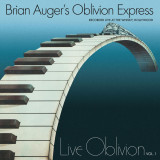
Live albums are often a ‘hit or miss’ affair but ‘Live Oblivion’ 1 & 2 buck that trend, Recorded across 2 nights in 1974 at the Hollywood venue The Whisky A Go Go. The group were finishing off a huge US tour that had roared down the east coast then across the Midwest and by the time they hit LA, as Brian recalls “we were all absolutely performing at our height. So I decided that I really needed to record the band live at that point”. Utilising the Wally Heider Mobile Truck, the scene was set for one of the greatest jazz-fusion live recordings to be made. The show opens with a hyper fast version of Beginning Again due to drummer Steve Ferrone being almost an hour late and running high on adrenaline, Brian remembers thinking “I don’t even know if I can play it that fast!” Fortunately, he and the Oblivion Express including stellar vocalist Alex Ligertwood rise to the challenge and the result is akin to some frenetic jazzy drum & bass but also pushes the group onto another level altogether for the rest of the show. Across both volumes there are no fillers and the highlights are many - Bumpin’ On Sunset, Freedom Jazz Dance, and Inner City Blues are all stunning, but especially the epic version of Maiden Voyage which Mos Def sampled on his 1997 'If You Can Huh! You Can Hear', and both DJ Mitsu in 2004 and 2017 Crimeapple both dipped into Live Oblivion to sample that fire for their own projects.
- A1: Goldne Abendsonne, Wie Bist Du So Schön
- A2: Aprilnacht
- A3: Urin Deiner Blüten 1
- A4: Mutter Maria Zwischen Den Himmeln
- A5: Requiem Für Eine Ringelnatter
- A6: Urin Deiner Blüten 2
- B1: Apfelbaum, Kuh Und Backofen
- B2: Nie Kann Ohne Wonne, Deinen Glanz Ich Sehn
- B3: Requiem Für Ein Schwalbennest
- B4: Morgensonne
- B5: Afra Altar Maidbronx
Originally released on tape by SicSic in 2014, Aprilnacht commemorates a decade of music from Brannten Schnüre and marked the spring in a tetralogy of albums about the four seasons when it came out. Back then the Würzburg-based project consisted solely of Christian Schoppik, who later welcomed Katie Rich to take over the vocals. He used to perform as Agnes Beil, but dropped the name when, while making this album realized his music was becoming "much gentler and more fragile". Aprilnacht already captured the particular musical ideas that Schoppik would thoroughly keep exploring, delving deeper and deeper into the use and manipulation of samplers from sources so diverging as to wander between the five continents to post-war German family television and cult cinema. Heir of the ritualistic intensity of Coil, of the intricate sampler assemblies of Ghédalia Tazartès', and of the dusty, dismal old ballads from around the world, Brannten Schnüre manages to make these paths cross in a territory that is as inherent as it is uncanny; sieged by the past and intimate as a hearth. An organic approach to folk, ambient, and sound collage, where ethereal yet thoroughly textured pieces coalesce in enthralling, delicate, and innermost musical rituals.
The album cover paintings reveal the temper: dreary old towns where shadows come to dim the slow passage of crepuscular colors, a soft area of reanimation where wind and light come close and foresee the night of spring. Aprilnacht was inspired by the stories of German philosopher and writer Friedrich Alfred Schmid Noerr, whose work exhaustively examines the conflict between paganism and Christianity, safeguarding myth in a way that Schoppik describes as boldly modern, humorous and unpredictable in its variations of the Germanic folklore motifs. "I wanted to do the same with the music," he states, and the music here could as well be suitable for a night when household deities welcome wandering will-o'-the-wisps, water nymphs, and gyrovagues to discuss Perchta's leadership of The Wild Hunt, but this album is not a folk tale, it's not an elegy to worlds already gone, hidden in years; it's an intersection of routes that open mysteriously before our ears like a congregation of vapors. Aprilnacht is a gathering of voices; "There are too many children, and none of them keeps quiet," reads the last verse of «Requiem für eine Ringelnatter.»
Sensuality drips over the music to celebrate both the voluptuousness and tragic quality of nature; "It's raining on me, urine from your flowers," Schoppik sings in «Urin deiner Blüten» and later on, faced with a snake's erotic features, as if he wanted to be embraced by it: "Your quick, sharp tongue and your warm venom; that's what the pond is missing." Orality is where this profusion of contents thrives. When the voices get closer and condense, the words reveal the saliva employed to pronounce them; we feel the mouth and the tongue, but when breath envelops them in sorrow and softens their edges, they sound distant, diffused in the atmosphere, letting go of the body that held them. These two vocal facets oscillate permanently and interact naturally with the fertile assembly of samplers and instruments that develop throughout the album, which condense and disperse impersonating each other, interweaving to search for a specific syntax. Tangled whisperings of enigmatic phrases, timid voices that stick out to check the scene but hide away quickly, shivering trance chants and monastic ambiances, distant screams and clamors in between chaos and warfare swirl until bursting into subtle songs where even Mother Mary comes forth softly. Soothed by foggy atmospheres and crackling punctuations, these voices shape a vulnerable crowd, an occasion of fragility. Along this swarm of songs thrown into thin air, accordions sound like heavy-breathing lungs; clarinets sigh like curtains shaking; violin solos wander around like bees; Gjallarhorns cries distend like fleeing cattle; glockenspiels evoke remote music boxes and inherited toys; backward emanations emerge like slender waves retreating. On the banks of stretching loops and ember textures is where the songs slowly nest, collecting the words to find their tone.
A poem by Jorge Teillier says, "To talk with the dead you have to choose words that they recognize as easily as their hands recognized the fur of their dogs in the dark. To talk with the dead you have to know how to wait: they are fearful like the first steps of a child. But if we are patient one day they will answer us with a flame that suddenly revives in the fireplace." This may be Brannten Schnüre's main purpose: To find the voice to speak to those of whom we were a vision. Not in mourning, but acknowledging the obscure and volatile nature of spring's regenerative force, searching for the treasure of balance, as evidenced in the lyrics of «Requiem für ein Schwalbennest,» "Its nest was destroyed so many times before it was finished, and despite that, the shallow builds as if it is infatuated." The same idea is here in the words of Schmid Noerr, who made poetry an act of resistance to the horror of Nazism; "Since having seen the ability of a brilliant spirit to die, with a calm mouth that everyone saw, health is true again and we affirm it, even if rivers of blood flow." And as we call for the dusk's kindness, waiting to return home and eat with our kin by the stove, our ears become used to the games of the night. We feel like we're rowing on wetlands, while the "moon musick" keeps us vigilant against the slightest movement of water or sweet moan because eeriness here is imperative for survival. Do not succumb to the insipid howl of death, for nothing may last but mutability. You see, the rock has moved a little during the night; the rest is just wind fleeing from the void.
Mexican sensation Pahua comes to Razor-N-Tape via a huge remix project featuring some of the hottest producer names in current outer-national dance music. This special 7 inch version features two newcomers to the RNT remix roster.
On the A side, global groove merchant Poirer delivers a stripped down and hypnotic mix in his signature style Pahua’s uptempo anthem ‘Espantapájaros”.
On the B side, Detroit Latin production legend John Beltran adorns the melancholic ‘Flor de Jazmin’ with a samba-inflected rhythmic foundation and a lush horn arrangement that transports you straight to Cafe del Mar, Ibiza.
This package honors the essence of the original music, while flipping it in quintessential RNT club-ready fashion.
Portland based act Dancing Plague has been a steady presence in the dark/cold electronic music scene for quite a few years now.
Since 2016 Conor Knowles’ solo project has been putting out one constant flow of independent releases on multiple formats such as vinyl LPs, EPs, tapes and CDs, creating one sonic palette rich with Ebm, goth, industrial and synth influences.
On their 5th studio album, Dancing Plague continues to flesh out and perfect their unique brand of crushing darkwave.
Elogium explores themes of loss, regret, rebirth and growth coupled with throbbing basslines, rave synths, and pounding drums. Knowles balances aggressive waves of electronics with enough pop sensibilities and catchy hooks to be inviting to those new to the genre.
His skills can be clearly appreciated on tracks like the first single Fading Forms which explores the somber feeling of the years passing you by. Knowles’ emotive baritone crooning paints a melancholic picture of the slow fading of time as you feel like you’re fading with it. The words fall like snow onto cold fields of pulsing 80s synths and pounding drum machine rhythms that bring forth nostalgic familiarity but feel fresh at the same time.
Fans of classic icons such as Depeche Mode, Ministry, Nine Inch Nails as well as contemporary torchbearers Cold Cave and Kontravoid do not sleep on this.
Plenty of disturbing beauty to be found in the depths of the underground
As mood changers go, this track is up there with the best. Last year whilst DJing with miche at Shapes festival in the snow-capped mountains of Switzerland, a breathtaking yet ominous Alpine sky suddenly became a picture postcard moment. The clouds parted and a double rainbow formed, as miche dropped Studio Rio's bossa nova remake of Bill Withers’ all-time classic 'Lovely Day'. From there, the dancefloor shifted gears and morphed into full-swing feel-good vibes, in a beautiful, spontaneous moment nobody could have planned for.
Mr Bongo now proudly presents a reissue of this brilliant, bossa-channelling Bill Withers reinterpretation from Studio Rio’s 2014 release ‘The Brazil Connection’. Masterminded by the German Grammy award-winning Berman Brothers, the project was born out of their deep love of Brazilian music. “Our goal was to bring the Brazilian joie de vivre to iconic performances by well-known artists. What would these classic songs sound like had they been recorded in the studios of Rio de Janeiro in the first place, with the best Brazilian musicians and arrangers?” the brothers reflect.
Capturing the life force of Brazil, the beating heart that is its music, they set out to find the musicians who would fit best with their concept. Landing in Rio in 2013 a series of coincidences led to them being introduced to their idols Marcos Valle and Roberto Menescal, who both agreed to come on board. The Berman Brothers also wanted to find some of the musicians who recorded with one of Brazil’s most influential composers Tom Jobim. “Fifty years after Jobim made the music that really defines bossa nova, we found that many of his sidemen were still active, including Paulo Braga of Jobim’s famed rhythm section. It was magic; everything just fell into place.”
There's no question that the original of ‘Lovely Day’ is up there as one of the most feel-good, spirit-lifting anthems of all time. Here the brothers, with the help of a whole host of Brazil’s finest musicians, rework Bill’s soul-fuelled groove into a bossa nova slice of sunshine. With the blessing of Bill and Sony, they were given access to the original multitracks so they could incorporate Bill’s vocals perfectly into the new arrangement.
Joy-injected horns and bouncing double bass blend with the smile-inducing samba flavour of Pretinho da Serrinha’s cavaquinho playing. Tying it all together Torcuato Marinao who worked with the likes of Gal Costa, Gilberto Gil and Caetano Veloso, completes the line-up as arranger of the songs.
The perfect end-of-the-night track, mood lifter or soul warmer, remakes don’t get much better than this.
2024 Repress
Mannequin Records is proud to present a full length by the Philly minimal-synth princess Void Vision.
Void Vision is a Philadelphia-based electronic project helmed by Shari Vari. It began around 2009 at a time when a wave of synth-revivalists were materializing, but the quality of the songwriting and intense vocals set the band apart from the pack. In a rare instance, Void Vision has managed to combine vintage dance elements with melodic structures, haunting melancholy, and lyrics that have a palpable soul. The songs themselves are dynamic, referencing a cross-section of the last 30 years of electronic music, while simultaneously retaining a uniqueness all their own.
The infamous Wierd Records weekly club night in New York, which showcased a variety of talented electronic and coldwave artists, served as an incubator for Void Vision in it's early stages. After a standout debut performance at the club, they immediately caught the attention of Blind Prophet Records, who consequently released their first 7" single, 'In 20 Years', which received excellent reviews.
Vari has continued performing and recording steadily over the last few years, releasing songs on compilations for various labels, including Rough Trade, and in 2012 the song 'Everything is Fine' was selected for Artforum magazine's 'Best of 2012' issue. In 2013, Void Vision toured the West Coast and later that year released a split 12" with Portland-based band, Vice Device. The first official full-length album, entitled 'Sub Rosa' is set to debut on Berlin-based Mannequin Records, followed by a European tour in 2015.
Shari Vari formed Void Vision in 2009 originally as a duo, during the explosion of the new minimal synth and cold wave scene in United States. Sharing the same scene of the Wierd Records associates like Led Er Est, Martial Canterel, Xeno & Oaklander, Automelodi, in 2010 VV released 'In Twenty Years' on Blind Prophet (Sean Ragon's Cult Of Youth record label), receiving also the attention of the Rough Trade dudes, who asked to put out a track for one of their synth wave compilations.
After other split vinyls, tapes and compilations, Mannequin approached Shari with the intention to continue what Wierd Records started, giving a proper shape to her beautiful and youthful dark electronic sound. The result is 10 hypnotic cold analog tracks dominated by the warm and fragile Shari's voice, some more 'pop orientated' some others belonging to the original 'cold wave' atmosphere.
"Sub Rosa" is an edition of 400 copies on 160 gram black vinyl and 100 copies on 160 gram white vinyl.
Ice Cream Vinyl
Since the release of their debut studio album Do Hollywood (on 4AD) in 2016, The Lemon Twigs_the New York City rock band fronted by brothers Brian (27) and Michael D'Addario (25)_have waved the same revivalist torch as Alex Chilton and his Big Star crew, working to prove that archaic music from the `60s and `70s can still be relevant in digital world. Alongside peers like Foxygen and Drugdealer, The Lemon Twigs have explicitly documented a synchronistic blend of contemporary narrative motifs, old-school recording techniques, and flawless, consistent attitudes collaged from various crucial stages of rock 'n' roll. After a whirlwind 2023, the D'Addarios are continuing the momentum of their own evolving vision and voice, distilling a history lesson of baroque and power pop into A Dream Is All We Know (out May 3 on Captured Tracks). Garnering the top-to-bottom critical acclaim the brothers have long deserved, their 2023 LP Everything Harmony was spearheaded by an impressive string of singles, including "Corner Of My Eye" and "Any Time of Day." It was the kind of record that put all of Brian and Michael's talents on display, be it the former's multi-instrumentalist gifts or the latter's boyish, explosive pop-rock charisma and eye for engineering and vocal layering. But A Dream Is All We Know is not the acoustic, nylon string-based project that Everything Harmony was. Instead, it's a return to the form the Lemon Twigs first introduced on Do Hollywood_an electric guitar-centric, anthemic assemblage of, really, everything the band does great. These two companion records are an immediate example of a band capitalizing on their fire-in-the-belly appetite to make tunes that boast ubiquitous chemistry. A Dream Is All We Know is grandiose yet grounded; meticulous, yet wild and glowing. Made with analog precision, the album was finished in the immediate months after the band completed Everything Harmony during a vibrant, prolific period split between three studios on separate coasts. A Dream Is All We Know is a profoundly dense and charged album, rife with string arrangements and a sonic thesis statement that has quaked through phases of glam, conceptualism, baroque, and Mustang-loud, stone-cold rock `n' roll for more than half-a-century. A Dream Is All We Know sounds like it's lived a thousand lives already.
Introducing 'Planet SP1200' by KLIM. KLIM, the producer and beatmaker based in Kyiv, draws inspiration from classic hip-hop, chill music, and boombap to craft music that combines fresh soulful vibes with a hard-knocking style. With over 4 million streams across various platforms, including lo-fi beat staples such as 'Night Café' and 'Butterfly,' KLIM returns with fifteen tracks created using the EMU SP-1200 and Akai S900 samplers, infusing a '90s vibe throughout the project.
Influenced by artists like Pete Rock, Lord Finesse, Jay Dee, George Fields, and Mr. Brown, KLIM's music is a reflection of the magic found in everyday moments that surround him. It's a product of the emotions that stir within him, where the world serves as his artistic canvas, and each sound and melody is a heartfelt attempt to capture his experiences and thoughts. In his words, "My music is a bridge between my soul and the world, and I hope it can touch the hearts of others, just as it touches mine". Join KLIM on this musical journey, where the past and present harmonize in a symphony of emotions and experiences.
"A spiraling and winding descent into arcane black metal pandemonium! Sounding both modern and timeless at the same time, they unleash some serious throwback Celtic Frost/Darkthrone/early Mayhem vibes while projecting its hideous aura straight into the future with a shape-shifting approach to songwriting that can’t be called anything different but “prog”, while also throwing in the mix some unexpected ambient passages and improvisational liturgic abstractions ( that yield a result of constant motion and disorienting unpredictability, as if we were facing a European version of Negative Plane or a more experimental reinterpretation of the arcane mysticism of Mortuary Drape.
All in all if you are looking for black metal with a touch of timelessness and with classic heavy metal influences mixed with a keen sense of experimentalism then KVELGEYST definitely represents one of the strongest expressions of this school of thought in black metal that’s been seen in a long time." ~ CVLT NATION