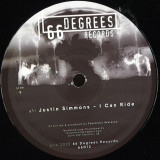
After 20 years of a restful sleep, the legendary Icelandic house label has been resurrected. Three deep cuts exhibiting what is in store for the year 2022.
It begins with "Can Ride", a neo-disco anthem from former resident Justin Simmons. Nifty groove with an acid-bassline - topped with all the razzle and dazzle that is needed to get the dancefloor moving.
The flipside starts with a proper minimal percussion-driven groove from Kate & Joan, a side-project of Dole & Kom from the renowned label BCC music. The Detroit-influenced dub house anthem will, without a doubt, be a useful tool for any DJs to get the crowd going.
The second cut on the B-side is from a Reykjavik-based beatmakers Oh Mama. Its wild style sample-based approach caught the label's attention and the result is a worthy debut vinyl release. Hypnotic, sexy and groovy - with a big and dirty bassline.
DJ Feedback
Raresh:
"Super thanks for this! Will play again the Kate & Joan track, so nice to hear it remastered! Much love from Bucharest."
Roger Gerressen:
"Great quality as always :) thanks for sharing."
Andrei Tripmastaz:
"The tribe is my fave"
Rick Hopkins:
"Once again thank you for the promo. Love it. All 3 cuts essential for any discerning lover of sounds from the deep!"
Andy Green:
"Thanks for sharing - this is a sweet versatile VA EP. The Kate & Joan track chugs sweetly along underneath the skippy percussion. Good tool to bridge house and techno vibes. I'm especially fond of the Laugardalur track Oh Mama with its wobbly, slightly sinister bassline that still works at both ends of the pitch fader."
Ben Btndk:
"Oh yes!! That B1 has been on my wish-list for ages!!"
Dotan Bibi:
"Really good house vibes over here! My favorite is the A2 thanks a lot for sending."
Buscar:sam project
Romperayo is back, with a brand new tropical 9 track album full of tropical riddims and humid Caribbean jams.
After two long sold out albums, Romperayo (Discrepant, 2015) and Que Jué? (Souk, 2019), Pedro Ojeda’s unique update on classic Colombian music returns for a full long player of future tropical instrumental tunes, heavy on the drum grooves mixed with slow, languid experimental interludes.
This is 21st century Colombian popular music taken to the next level by one of the most singular figures currently active on the Colombian scene. Romperayo’s, aka Pedro Ojeda (Los Pirañas, Chupame el Dedo) solo project uses his irreverent drumming techniques and filters them through a lens of new school psychedelia, historical sampling and acid synth solos.
With his sound obsessions clearly present over all of his work (and this record), Pedro effortless mixes the old school with the new with an avant-garde collage approach to composition, never forgetting his academic studies on Latin American drumming styles. The result expands the frontiers of Colombian tropical music and provides a new, multicultural dialogue whilst using many of the rhythms and melodies of the Colombian historical repertoire to a new generation. The Colombian Caribbean coast sonido never sounded so fresh!
Recorded under a loft bed in the guest bedroom of his Nashville home, Michael Ruth aka Rich Ruth’s “I Survived, It’s Over” starts in a humble space. And while many contemporary music projects are produced in such an environment, “I Survived, It’s Over” sets itself apart in its transformative properties as well as its transparency. What we have here is honest sound exploration, session musician-level instrumentation, and a true love for nature run through the fingers of a dude who can channel some acute and undeniable magic. This music goes deep. "I conceived much of this record amidst the quiet and tumult of 2020 in my neighborhood that had recently been ravaged by a tornado," Ruth recalls, "I spent most of my days working on these pieces between bicycle rides - watching the beautiful Tennessee ecosystem flourish in Shelby Park, listening to Keith Jarrett’s The Koln Concert and John Coltrane’s Ascension." Underneath the swell of the strings and the shredding of the guitars, this record has hard working, rustbelt, drum-heavy roots all over it (which makes sense as Ruth hails from outside of Toledo, the album was mixed by John McEntire from Chicago band Tortoise). Many of the flutes, saxophones, pedal steel, and other instruments were recorded remotely because we live in the future, but this only adds to the collage of sampled and sample-able material that Rich Ruth has to offer. The organic relationships between the artist and other musicians on the album is evident even in the compilation style sampling that needs to occur in putting such a project together. "Working on this music is a daily meditation," says Ruth. "I constantly experiment with sound until it reflects the way I am feeling and attempt to sculpt something meaningful from it. Through years of being a touring musician, it is a constant inspiration and privilege to collaborate with the individuals that graced this record with their voices." And those relationships pay off, because “I Survived, It’s Over” is a sonic meal. It’s rich (no pun intended) with massive instrumentation that’s usually reserved for more symphonic delights. But at the same time it’s simple and leaves space to breathe–space you didn’t know you needed. In his own words; "I Survived, It’s Over is a meditation on healing, confronting trauma, surrendering, and finding peace. I wanted to encapsulate the tranquility and disarray found within this process." Ruth’s heart and the peace that his presence produces is all over this album. And despite his midwestern humility and willingness to brush off any praise, he’s put together something really special that carries its own weight. It's the kind of record that only comes around every once in a while and it's worthy of all the head-bobs, acclaim, and celebratory potlucks that Mike and the gang have coming their way. “I Survived, It’s Over” is a record you should buy for your friend, your foe, and yourself. It’ll sit perfectly on your shelf between Alice Coltrane and Hiroshi Yoshimura.
Sampler 3 Blue Vinyl[28,53 €]
Sampler 2 Red Vinyl[29,83 €]
Sampler 4 - Purple[28,53 €]
Sampler 1 - Yellow[14,08 €]
Repressed on black vinyl
In anticipation of Kerri Chandler’s forthcoming album Spaces and Places, his first in 14 years, that sees the New Jersey legend celebrating club and soundsystem culture by recording, writing and performing a track in twenty-two of the worlds most distinguished nightclubs, Kaoz Theory drop the first in a series of vinyl album samplers.
Sampler 1 Sees two UK institutions from the North and South spotlighted. First up, Kerri finds himself in London’s cavernous Printworks, recording ‘Never Thought’ - a classic Kerri, piano fuelled groover, tough, melodic and perfectly accompanied by Sunchilde’s vocals.
On the flip, ‘You Get Lost In It’, recorded at Manchester mecca, The Warehouse Project, channels the electric vibe created by those hallowed surrounds. A deep, heads down heater with sultry vocals from Lady Linn.
A selector, producer and label head at the top of his game, Enzo Siragusa continues to prove exactly why he’s held in such high regard as a staple of the underground music scene. While developments have seen the FUSE boss adjust his approach, recent months have combined a wealth of studio time with the unveiling of new projects – most recently announcing the launch of his new genre-bending all-night-long event series, E:Dimension. Yet, there’s something about a release from Siragusa on home turf that stands out amongst the pack, with productions like ‘Sagamore’, ‘Desire’, ‘Flexin’ and the ‘Kilimanjaro’ cuts instantly recognisable after just a few seconds, and the same looks set to happen as he makes his highly-anticipated return with his first solo material on the label for over two years. Unveiling one of his most heavily requested tracks to date alongside further peak-time business on the flip, April finally welcomes the arrival of the two-track ‘Nothing Matters’.
A track that’s been making waves for months, ‘ICV (Double Flake Mix)’ brings the sub-shaking, cavernous reese bassline now captured by many across the globe as Siragusa launches into his signature blend of heads-down, hands-up sonics, while the vinyl-only dub delves into afterparty territories to offer up an exclusive version for wax owners. On the flip, title cut ‘Nothing Matters’ graces the B-Side and keeps things moving as meandering melodies ride rumbling low-ends, swinging drums and chunky grooves to shape up proceedings in emphatic fashion. It’s safe to say Siragusa’s back, and he’s back like he never left.1
Todh Teri is back to make us groove with the tenth and final volume of the Deep In India series. A total double whammy of a record – this one happens to be a limited edition double vinyl that includes the best of the Todh Teri’s tracks from the previous volumes. As this alluring series comes to an end, get ready to shake a leg to some dark & dubby tunes one last time.
It all begins with Sampadan 34, a tune that makes you want to close your eyes and get lost in a musical trance with its intricate elements of this melody. This is followed by Sampadan 35, an iconic tune that takes you down memory lane, bringing back sweet memories of the yesteryears.
Using a historic sample from the 90s Indian cinescape, Todh Teri has added his touch to create Sampadan 36 - a track that you’re sure to get hooked onto. For the grand finale, wehave Sampadan 37, which brings in some old-school percussive beats into play that will
make your soul come alive.
For listeners who missed out, this final EP of the series also includes a second vinyl which has the best-selected tracks from Vol.1 - Vol.4. Deep In India has been Todh Teri’s heartfelt tribute to the golden age of Indian cinema that has given listeners a fresh perspective on its conventional music. Overall, this record has something for each listener with a magnificently illustrated album cover by Costanza Chandra in association with Masala Movement.
TODH TERI
I would like to thank everyone involved in this project from the bottom of my heart for their
constant support and encouragement. With this release we come to an end to this series
How can music be violent when it's not loud? When is malice beautiful? Amidst the gloom, listening to Chalk is a restorative experience. Neophobia is a meditative saga which, despite the name, radically embraces the aesthetics and methods of post-modernity. In between identical gamelan pieces, Chalk weaves an abrasive collage of sounds and musics that touch on peace punk, musique concrete, & American primitive. Neophobia explores the schizophrenia and horror of living in the contemporary era, an odyssey with an indeterminate point of departure or return. Chalk is an amorphous musical project orchestrated by Barry Elkanick (Institute, Blue Dolphin) While this is Barry's 'solo project' he regularly invites friends, other musicians and artists to accompany him. Under 'Chalk' Barry has self-released 8 cassettes since 2015. While wildly ranging in recording techniques & approach, the cassettes have informed and culminated in the final sound present on "Neophobia" which is his first LP for Post Present Medium. Barry wrote and recorded "Neophobia" independently out of his home in Houston, TX on computers and tape machines. LP limited to 300 copies, includes poster.
LIMITED release (no repress) 300 units hand numbered, stamped copies with insert.
After the first Jam experiment back in 2019 here we have the second chapter of the Bosconi Gang Band session pressed on this limited white label hand stamped & numbered waxx.
This jam was recorded in front of an actual crowd in an event held at Manifattura tabacchi Florence on the 21st February 2020 just a couple weeks before the pandemic started and the first lockdown happened in Italy.
The concept is the same as the previous one with Fabio Della Torre on the mixer conducting the gang mysitc gulf this time with: from left to right Ennio Colaci from Minimono, Dukwa, Rufus, Andrea Giachetti & Antonio Pecori from "The Clover" and Dj Rou.
As it happened with the previous release, the actual jam follows the order of the live execution which naturally developed in a crescendo of speed and intensity.
The result is a collection of 5 of the best takes slightly mixed and revisited afterwards but very much faithful to those performed live.
This is another adventurous release that goes well off grid, plays with strange temps, original textures and moods.
Bosconi Gang Band aims to be an itinerant live improvisational project open to all artists who have released on Bosconi Records that sets the goal of always being unpredictable and special, naturally affected by the artists who perform always creating something unplanned new, and unexpected.
"A very exciting blueprint for the continued evolution of modern dance music!!"
Legendary American musician Brian Jackson announces his first solo album in over 20 years,
‘This Is Brian Jackson’, produced by Phenomenal Handclap Band founder Daniel Collás and
released on BBE Music.
Brian Jackson earned mythic status among music fans thanks to his pioneering work with Gil
Scott-Heron in the 70’s, where his flute and electric piano performances on ‘Pieces of a Man’
and ‘Winter In America’ virtually defined the sound of an era. From the 80s onwards he went
on to record with Kool & The Gang, Will Downing (whose debut album he produced), Roy
Ayers and Gwen Guthrie among many others, and while many veteran musicians tend to
stick with the sounds they know best at some point in their careers, Jackson remains an
unusually adventurous, vital and broad-minded artist to this day.
When the Phenomenal Handclap Band’s Daniel Collás first met Brian Jackson at a
performance in New York, right off the bat he said “I think I could produce you”. “I wasn’t
sure why he thought that,” says Jackson “but I considered it a challenge to find out. Turns
out that he was right.”
Early on in their friendship, Brian mentioned that he’d embarked on a solo project right
around the time he recorded ‘Bridges’ with Gil Scott-Heron in 1976. There were even some
unfinished demos, but the album had never materialised. Daniel leapt on the idea, asking
“what would a Brian Jackson album sound like if the 21st century Brian were to complete
that 1976 album today?” Completed in a series of twice weekly sessions over 11 months in
Daniel’s Williamsburg studio, ‘This Is Brian Jackson’ provides the answer.
“We sketched out musical ideas, drank way too much coffee, consumed way too many
tacos and sampled perhaps a few too many exotic whiskeys while talking about things that
were important to both of us personally. The lyrics for the songs are a result of those
conversations” says Jackson.
Contributors to the album range from Jackson’s guitarist, bassist and longtime friend Binky
Brice (Billy Ocean, Evelyn Champagne King, Roy Ayers), Collás’s occasional writing partner
Morgan Phalen, Latin Grammy-winning flautist Domenica Fossati, drummers Moussa Fadera
and Caito Sanchez, and Phenomenal Handclap Bandmates Juliet Swango and Monika
Heidemann.
And the music? Vintage, soul-stirring Brian Jackson, with the great man’s warm vocals,
distinctive flute and lyrical keys taking centre stage. The songwriting feels timeless, the
arrangement effortless, the production human and analogue. From golden-era soul-funk
opener ‘All Talk’, through soaring Afrobeat-inspired dreamscape ‘Mami Wata’ to compact
groover ‘Little Orphan Boy’ which closes the album, ‘This Is Brian Jackson’ is simply some of
the veteran artist’s best work yet, subtly and lovingly framed by Daniel Collás.
In the spring of 2020, Ben Cook _ a.k.a. Young Governor, Young Guv, or just Guv _ was holed up in the New Mexico high desert, his U.S. tour having been abruptly covid-cancelled during a southwest swing. He and his bandmates were living moment to moment in something called an Earthship, a solar-rigged adobe structure sustainably constructed with, among other things, recycled bottles and tires. And out there in the serene vastness, as a short ride-it-out stint turned into a nine-month sojourn, Ben was writing music, slowly, little by little, mostly at night while the others slept. By the New Year, almost in spite of himself, he had created a new album, two new albums actually, and through the ordeal he was forever changed. In a place he never expected to be, under circumstances no one could have predicted, and in the face of physical isolation, emotional desolation, and existential dread, Ben created GUV III & IV, a collection of songs dedicated and testifying to the eternal healing power of love _ how to find it in the world, in others, and most importantly, in himself. Written in the New Mexico wilderness and produced in Los Angeles, the double album will finally be available in it's entirety this summer via Run For Cover. Young Guv's talent as a songwriter has been with us for a long time. From forming iconic hardcore act No Warning in 1998 to joining Toronto legends Fucked Up, Ben Cook started writing songs as Guv in 2008 between a slew of other projects that were ambitiously working to define the genres they operated in. When he first started working with Run For Cover in 2019, the plan was to release a single record - but with too many songs to turn away, the project expanded into his first double album, GUV I & II. GUV III & IV finds the same ambition and expertise in hit-making, but this time the individual records hone into specific parts of Guv's sonic palette. GUV III is full of iconic hooks, power-pop guitar riffs and dancable-rock songs, while GUV IV takes notes from psych rock, electro pop and Laurel Canyon jangle to make something that as a whole, can only be defined as definitively GUV
EAT is the brand new album from your favourite rapper trumpeter, Pan Amsterdam. Made with fans of both food and hip hop in mind, the LP opens up a new pocket in the Pan Am dimension: the rapper-producer album. The whole thing’s a collaboration with underground legend and Def Pressé family Damu The Fudgemunk.
EAT lands in the wake of the success of Pan Am’s second album, HA Chu. Food, of course, was a vital component in the culture of that work, with GUTS-produced single Carrot Cake receiving plaudits from the likes of BBC 6 Music, and interludes taking place over Chinese food. HA Chu was named his ‘hostile industry diss record’ by Bandcamp and ‘a jazz musician’s vision of what hip-hop can be’ by The Times.
Whereas HA Chu was conceptualised while Pan Am’s real life alter ego Leron Thomas was on tour as Iggy Pop’s bandleader (Iggy had loved Pan Am’s debut LP, The Pocket Watch, leading to him asking him to write and produce his 2019 album Free), and saw guests such as Sleaford Mods’ Jason Williamson and Doves’ Jimmy Goodwin in his El Diablo guise, EAT’s genesis was slightly different.
About to fly on tour in Europe last year, Pan Am was in need of a DJ. Up steps Damu The Fudgemunk, fresh from creating his KPM library-sampling opus Conversation Peace (on Def Pressé Editions). Tour life led to a mutual musical respect, Damu creating soundscapes in his head as he got to know Pan Am’s intricacies whilst performing together.
‘We had some good hangs and talks,’ recalls Pan Am. ‘In those hangs and talks, it seems Damu was taking musical notes because the music he would give me was fitting like a glove. It reminded me that artists be observant and it pays off in the end. Damn fun making this project.’
Perceiving the world in terms of taste, EAT is musically wistfully joyous and lyrically playful, a full menu with Pan Am your maître d' and Damu the chef du cuisine. Damu’s beats are deep, warm, melodic and progressive, a perfect playground for the duality of Pan Am’s beat poetry and Leron’s caressing trumpet, which as always is a persona in itself.
EAT is the brand new album from your favourite rapper trumpeter, Pan Amsterdam. Made with fans of both food and hip hop in mind, the LP opens up a new pocket in the Pan Am dimension: the rapper-producer album. The whole thing’s a collaboration with underground legend and Def Pressé family Damu The Fudgemunk.
EAT lands in the wake of the success of Pan Am’s second album, HA Chu. Food, of course, was a vital component in the culture of that work, with GUTS-produced single Carrot Cake receiving plaudits from the likes of BBC 6 Music, and interludes taking place over Chinese food. HA Chu was named his ‘hostile industry diss record’ by Bandcamp and ‘a jazz musician’s vision of what hip-hop can be’ by The Times.
Whereas HA Chu was conceptualised while Pan Am’s real life alter ego Leron Thomas was on tour as Iggy Pop’s bandleader (Iggy had loved Pan Am’s debut LP, The Pocket Watch, leading to him asking him to write and produce his 2019 album Free), and saw guests such as Sleaford Mods’ Jason Williamson and Doves’ Jimmy Goodwin in his El Diablo guise, EAT’s genesis was slightly different.
About to fly on tour in Europe last year, Pan Am was in need of a DJ. Up steps Damu The Fudgemunk, fresh from creating his KPM library-sampling opus Conversation Peace (on Def Pressé Editions). Tour life led to a mutual musical respect, Damu creating soundscapes in his head as he got to know Pan Am’s intricacies whilst performing together.
‘We had some good hangs and talks,’ recalls Pan Am. ‘In those hangs and talks, it seems Damu was taking musical notes because the music he would give me was fitting like a glove. It reminded me that artists be observant and it pays off in the end. Damn fun making this project.’
Perceiving the world in terms of taste, EAT is musically wistfully joyous and lyrically playful, a full menu with Pan Am your maître d' and Damu the chef du cuisine. Damu’s beats are deep, warm, melodic and progressive, a perfect playground for the duality of Pan Am’s beat poetry and Leron’s caressing trumpet, which as always is a persona in itself.
Lolina project emerged at a time when CDJs became standard in clubs and artists from many disciplines began exploring their possibilities. In Lolina’s records and performances, they are used as a live sampling tool allowing her to move between composition and improvisation. On “Fast Fashion”, discarded vocal takes and phone recordings made while watching videos online or walking down the street are re-sampled across long-form collages. “Mark Ronson’s TED Talk Intro (Using Computer Remix)”, restyles a lecture about sampling and constructed of samples into a track that can’t be contained by any of its elements. Relaxed beats break down into stuttering, jokes turn into abstract situations, and meaning is altered through repetition. With transitions between different parts defining the listening experience, “Fast Fashion” reveals a process by which one thing can be changed into another. “Fast Fashion” is Lolina’s fifth album and first working with Deathbomb Arc. Digital to be released on Oct 27th with vinyl to follow in early 2022 ~ both on pre-sale now. Lolina previously released music as Inga Copeland and was a member of the band Hype Williams between 2009 — 2013.
Imperfect Stranger is the pseudonym of Glasgow based soundtrack composer and producer Kenny Inglis. “Everything Wrong is Right” is his debut solo album for Castles in Space.
Born in 1975, Kenny didn't listen to much music, unless it was the opening credits to a TV show or a film score that had caught his ear. "I loved the pre-title music on a lot of those 80's U.S. TV shows. From the family orientated stuff like The A-Team, to darker dramas such as The Equalizer. My mother would let me stay up to watch the opening sequence of the latter then send me to bed because the story would be too heavy for a kid. That left me with this hanging sense of ambiguity as to what would happen in that hour after the titles came up.”
Exposure to a work colleague’s tiny project studio in a kitchen cupboard was a lightbulb moment for him and the experience of utilising music technology as a way of writing and producing entire tracks stirred a wave of determination to chase a career in music using the opportunities that technology could offer. Kenny figured the best way to move forward was to start a small project studio and learn his craft as a recording engineer. "It was a bit of a shock to the system. I literally had no idea how to work any of the equipment. Kenny focused on learning as much about the craft as he could whilst winging his way through recording and mixing everyone from the likes of singer/songwriters to bands, to voiceovers artists and anything in between. "Eventually, I stopped writing the music I thought people would want to hear, and started writing the music I wanted to make. I didn't come from a music loving background, but I was always obsessed by the way music and film would interact - how music brings this atmosphere and tone to even the most mundane visual stuff. I wanted to capture that. I wanted to grab some of that ambiguity I felt from the TV shows of my childhood and make it into a project of some sort". That project was Spylab. A dark, downtempo project with a cinematic edge. The initial demo consisted of three tracks, with the melancholic 'This Utopia' leading the playlist.
"At the time you did demos on normal cassette tapes. I remember having this endless battle with the bias control to try and get the best sound I could on these little tapes. Ten went in the post one Monday morning, and the following Monday there were three offers from three different labels. Studio K7 were interested in a singles deal, as was Flying Rhino in London. But then there was an offer from a Chicago based label by the name of Guidance Recordings. They wanted an album, and were offering a $15,000 advance. It wasn't a difficult decision to make"
Writing and recording Spylab 'This Utopia' began in 1999. The album took a whole year to produce. The album was to catch the attention of Mary Anne Hobbs at Radio One. At the time Mary Anne was presenting The Breezeblock - a late Sunday night show with an eclectic playlist of alternative electronic music. Picking out the album's title track 'This Utopia', Mary Anne would go on to play it no less than 8 weeks in a row. A request for Spylab to DJ on the show was to follow. "I had never DJ'd before. I think I had a week to figure out how to do that and put a playlist together. I'm not entirely sure how I pulled that off.” In March 2001 the Spylab album was finally released to a hoard of excellent reviews. A North American live tour would follow. From the launch party in Los Angeles, to a sell out show at SXSW in Austin. "I then started a new project under the name Cinephile. It had some of the core elements of the Spylab sound but it was deeper, more cinematic.” Kenny received news that a track from the previous project Spylab had been requested by HBO for the first episode of a new TV drama called Six Feet Under. This was to become a major turning point in Kenny's career. The Spylab track 'Celluloid Hypnotic' dropped during a poignant party scene of the first Six Feet Under episode. Within a couple of days Kenny was getting requests for music from other music supervisors. "It was a chain reaction. The Six Feet Under sync was like the tip of an iceberg. One day I called CBS in America and they put me on to the CSI music supervisor and I managed to get on a call with him. I sent the Cinephile stuff out and within a few months I got this fax through from CBS - a quote request for one of the tracks for a potential use on CSI. It changed my life."
The tone and style of Kenny's music sat perfectly with the CSI score requirements. So much so he found himself part of a pool of incidental writers who worked on all three aspects of the franchise - CSI, CSI: NY, and CSI: Miami. This would continue until 2013, when the last of the series would come to an end.
"I was juggling a bunch of stuff for those ten years. Writing material for CSI, whilst releasing new Cinephile stuff and playing live. As Cinephile continued to gather pace, one of the tracks from Kenny's efforts on CSI was chosen for the Hollywood trailer for the Samuel L. Jackson film 'Lakeview Terrace'. Further trailers would follow, from Gangster Squad to Dead Man Down, Spike Lee's Undisputed Truth, to Fifty Shades Freed.
At the same time, Kenny picked up his first factual commissions in the UK, and this too would be the beginning of a regular run of fully scoring factuals and documentaries. By 2021, six of these had won BAFTAs. He also would find himself soundtracking adverts for the likes of Nike, Audi, and American AirlinesIn early 2020, Kenny made a return to focusing on his own music under the pseudonym Imperfect Stranger. A tweet from Colin Morrison from Castles In Space regarding a charity compilation album 'The Isolation Tapes' caught his eye. Kenny had made a start on his debut album as Imperfect Stranger and submitted the track 'Hymn To The Sun' (which would become the lead track on the album). Further discussions ensued, and the album found a home on CiS. "I had been doing TV and film stuff for almost ten years. It paid the bills and was as close to a 'real job' as I'd had, but I yearned to get back to writing for myself, so doing an album for Castles in Space was a joy.
“The music I write is like a diary. There's an authentic narrative to everything i do. I don't write tracks for the sake of writing. I write tracks to diarise and process the stuff that I've lived through, and the experiences that have come along with the passing years. That's what makes me tick. It's a very public and vulnerable way of expressing myself. If people want to know the real me, all they have to do is listen."
100 copies only
Apron Records has been instrumental in shaping the current landscape of contemporary electronic music coming out of the U.K. since 2014. After almost a decade of pushing their unique vision has made the Apron Records imprint one of the most in-demand labels in most independent record stores. Now more than 45 releases deep in their journey, Apron Records have teamed up with Patta Soundsystem to work on their first various artists release and to celebrate this monumental milestone, both camps have collaborated to create a clothing capsule to accompany this release. After working with the artist formerly known as Funkineven on ‘The Wave’ late last year, it was only right to showcase the diverse talents behind this movement.
Sharing a drawing board with Patta for the first time with Apron Records, together they have created a Trucker Cap and a Graphic T-Shirt that echo the racing theme of the whole project. Better Together is the slogan that runs throughout the entire collaboration, stressing how unity makes us stronger as individuals. Artwork for the record has been provided by Amsterdam based artist Jim Klok. His unique Acetone printing technique has now been immortalised on this LP, juxtaposing vintage cars with checkered racing flags to create a dynamic cover that would be right at home in a picture frame as well as a record bin.
System Olympia’s ‘Passi Mai’ is a beautiful 80’s inspired driving riddim layered with her own vocals that wouldn’t be out of place in an arcade or a sticky nightclub floor. Followed up by ‘Leven’ by Brassfoot, we get a wobbler from the NTS regular. Layed with Jamaican vocal samples and audacious arpeggiated bleeps, Leven is a soulful approach to techno tropes that have been bouncing around Brassfoot’s head. Shamos’ 737363 is a cryptic masterpiece. With dreamy pads as a backdrop for shuffling drum beats, euphoric sweeps and dynamically designed synthesis, this closes off the themes explored in the first half of the record.
Side B kicks off with J M S Khosah’s contribution to the record titled ‘Lessons’ which is a dancefloor filler, adorned with glamorous percussion, vocal samples and syncopated stabs ontop of a driving 4x4 kick pattern. Kicking things into 6th gear is a club-ready production from London's most soulful selector Shy One. Groovy basslines and a 2-step riddim make ‘Candy Floss’ an ode to the grimey and the glittery sides of London nightlife. This project champions one of the people that have been pivotal in the success of the label, Steven Julien whose track E46 is an emotional journey through his synth-laden East London studio. Bookending the project are two compositions from Compton’s-own AshTreJinkins. Showcasing his abilities to approach the project from both an ambient and a pure beat-making perspective in order to hold the whole project together.
Joe Rainey is a Pow Wow singer. On his debut album Niineta he demonstrates his command of the Pow Wow style, descending from Indigenous singing that's been heard across the waters of what is now called Minnesota for centuries. Depending on the song, his voice can celebrate or console, welcome or intimidate, wake you up or lull your babies to sleep. Each note conveys a clear message, no matter the inflection: We're still here. We were here before you were, and we never left. On Niineta, Rainey finds himself in between cultures, collaborating with producer Andrew Broder, who brought his turntablist sensibility to the project. The two of them met backstage at Justin Vernon's hometown Eaux Claires music festival before crossing paths more through the 37d03d collective, and both contributed to the last Bon Iver album before partnering up. "At first I didn't know what I could add," Broder says. "I came to understand everything is rooted in the drum-even the songs on our record that have no drum." Each song started with Broder's beats, the two of them experimenting with various sounds and tempos before orchestrating and recontextualizing the ancient sounds in strange, new in-between places, also pulling from Rainey's vast sample folder of pow wow recordings, layering in slices of his life. Niineta is a short version of the Ojibwe term meaning, "just me," and Rainey is using the term only in the sense that he's taking sole responsibility for the music. He is protective of Pow Wow culture-once outlawed by the US government and maintained in secret-while trying to figure out where he fits and how he can be creative with it. "These are my creations, but they're pow wow songs, and our language is sacred," he says. Rainey suggests conceptualizing the album as him working the door at a Pow Wow after party. "If I'm answering that door, I want to say, hey, yeah, come on in. But there's fucking tons of us in here. It ain't just me."
WRWTFWW Records and MEG Museum (Geneva) are honored to present the first new solo album by renowned Japanese percussionist Midori Takada (Through The Looking Glass) in 23 years, Cutting Branches From A Temporary Shelter, available on vinyl LP, housed in a 350gsm sleeve, with OBI, and liner notes, as well as on digipack CD.
Recorded in a live setting and played with instruments conserved in the collections of the MEG Museum, Cutting Branches For A Temporary Shelter is Midori Takada’s very own rendition of "Nhemamusasa", a traditional work emblematic of the musical repertoire for mbira of the Shona of Zimbabwe, well known worldwide, thanks notably to its version by Paul F. Berliner included on the famed 1973 album The Soul of Mbira.
The choice of this title by Midori Takada evokes the links between traditional African and contemporary music which are the foundation of this work, and it also translates the resolutely multicultural vision of the artist.
Midori Takada explains: "African music is remarkable for its polyrhythms. Not only are there simultaneously several rhythmic motifs, sometimes as many as ten, but furthermore it may be that the part played by each musician has its own starting point and its own pace, all combining to form a cycle. All the cycles progress at the same time according to a single metrical structure which functions as a reference point, but which is not played by any one person from beginning to end. The structure emerges out of the multi-level parts, all different. With the Shona, the musical system is based on the polymelody: one performs simultaneously several melodic lines which are superimposed, each having its own rhythmic organization. It is truly captivating. In Western classical music, one four-beat rhythm induces some precise temporal framework and regular reference points, which come on the strong beats 1 and 3. But in the logic of the Shona musical system, and in other African music, the melody can begin in the very middle of the cycle and be continued up to some other place in an autonomous manner, as if it had its own personality. It’s very rich."
The album comes with in-depth liner notes that include an interview by Midori Takada, a point of view by Zimbabwean scholar, musician and activist Forward Mazuruse, and background information on the project by Isabel Garcia Gomez and Madeleine Leclair from MEG Museum.
The sleeve features an artwork by celebrated Zimbabwean painter Portia Zvavahera.
Part of the budget for the album was donated to Forward Mazuruse’s Music For Development Foundation whose aim is to identify, nurture, and record young but underprivileged musicians in Zimbabwe.
The album is released in conjunction with Midori Takada and Shomyo of Koya-san's You Who Are Leaving To Nirvana, also available on LP and CD on WRWTFWW Records.
Felicia Atkinson’s music always puts the listener somewhere in particular. There are two categories of place that are important to »Image Langage«: the house and the landscape. Inside and outside, different ways of orienting a body towards the world. They are in dialogue, insofar as in the places Atkinson made this record—Leman Lake, during a residency at La Becque in Switzerland, and at her home on the wild coast of Normandy—the landscape is what is waiting for you when you leave the house, and vice-versa. Each threatens—or is it offers, kindly, even promises? —to dissolve the other. Recognizing the normalization of home studios these days, she revisited twentieth-century women artists who variously chose, and were chosen by, their homes as a place to work: the desert retreats of Agnes Martin and Georgia O’Keefe, the life and death of Sylvia Plath. Building a record is like building a house: a structure in which one can encounter oneself, each room a song with its own function in the project of everyday life.
At times listening to »Image Langage« is immediate, something like visiting a house by the sea, sharing the same ground, being invited to witness Atkinson’s acts of seeing, hearing, and reading in a sonic double of the places they occurred. In an aching moment of clarity in »The Lake is Speaking,« a pair of voices emerge out of the primordial murk of piano and organ, accompanying the listener to the edge of a reflective pool that makes a mirror of the cosmos. "I open my feet to fresh dirt, and the wet grass. I hold your hand. You hold his hand. In the distance without any distance. The comets, the stars." At other times, listening to »Image Langage« is more like being in a theatre, the composition a tangle of flickering forms and media that illuminate as best they can the darkness from which we experience it. On »Pieces of Sylvia,« a noirish orchestra drones and clatters beneath and around a montage of vocal images, stretching the listener across time, space, subjectivities. Atkinson says that "Image Langage" is like the fake title of a fake Godard film. There is indeed something cinematic about Atkinson’s work—not cinematic in the sense that it sounds like the score for someone else’s film, but cinematic in the sense that it produces its own images and langage and narratives, a kind of deliberate, dimensional world-building in sound.
»Image Langage« is built from instruments recorded as if field recordings, sound-images of instruments conjured from a keyboard, instruments Atkinson treats like characters, what she calls “a fantasy of an orchestra that doesn’t exist.” And then, speaking of Godard, there are the monologues, operating as both experimental-cinematic device and a literary style of narration. Voice can be a writerly anchor or a wisp of a textural presence. Atkinson’s capacious and slippery speech plunges into and out of the compositional depths, shifting shapes, channelling the voices of any number of beings, subjectivities, or elements of her surroundings—not unlike her midi keyboard, able to speak as a vast array of instruments.
»Image Langage« is an environmental record, in the vastest sense of the world. It is about getting lost in places imagined and real; it registers, too, the dizzying feeling of moving between such sites. It puts forth a concept of self that is hopelessly entangled with the rest of the world, born of both the ache of distance and the warmth of proximity.
For Félicia Atkinson, human voices inhabit an ecology alongside and within many other things that don’t speak, in the conventional sense: landscapes, images, books, memories, ideas. The French electro-acoustic composer and visual artist makes music that animates these other possible voices in conversation with her own, collaging field recording, MIDI instrumentation, and snippets of essayistic langage in both French and English. Her own voice, always shifting to make space, might whisper from the corner or assume another character’s tone. Atkinson uses composing as a way to process imaginative and creative life, frequently engaging with the work of visual artists, filmmakers, and novelists. Her layered compositions tell stories that alternately stretch and fold time and place, stories in which she is the narrator but not the protagonist.
It's hard to believe it's taken this long for a proper retrospective of legendary Los Angeles collective CVE. "We Represent Billions" is a crucial portrait of one of the West Coast's most low-key influential crews - a hydra-like collective of rappers, producers, designers and engineers who were key members of the Good Life Cafe's open mic scene, going on to inspire artists like Jurassic 5, Kendrick Lamar amongst many other. Initially called Chillin Villain Posse before morphing into Chillin Villain Empire in the late 1980s, they eventually centered around the core trio of Riddlore, NgaFsh and Tray-Loc. The crew were years ahead of their time, self-producing music without samples and pioneering a stream of consciousness lyrics that still sound fresh and innovative. CVE were self-sufficient and motivated from the beginning, named "Chillin Villains" because that's how they were perceived by white America. This social motivation was channeled into their groundbreaking performances at Good Life Cafe, the South Central session that evolved into Project Blowed and later on came to influence LA club night 'Low End Theory'. It was chronicled by Ava Duvernay, herself an MC in short-lived duo Figures of Speech, in her "This is the Life" documentary, where she interviewed CVE alongside Jurassic 5, Freestyle Fellowship, Abstract Rude and Busdriver. On "We Represent Billions", we're treated to a snapshot of the CVE sound from 1993-2003, their most prolific era. The retrospective collects music from the handful of albums the crew released on their own Afterlife Recordz label (mostly as limited edition CD-R's) plus many previously unreleased tracks and highlights their untethered eccentric creativity and sheer breadth of influence. Whether twisting twitchy West Coast electro on 'All Over Da Globe' or free associating over horror synths and foley sounds on 'Made in Chillz Ville' there's a sense that their music was just too future for its time. Assembled from heaving industrial samples and graced by back-and-forth tongue twisting flows, 'Thugs and Clips' is as eerie and hard-hitting as anything 2Pac's "The Don Killuminati: The 7 Day Theory" full-length. Fuzzed-out and unsettling, 'Calistylics' welds an ambient synth loop and bone-rattling percussion to Tricky-esque percussion, while the flickering closer 'Unicycle' is a cross between Dr. Dre's icy G-gunk pressure and Three 6 Mafia's pitch black lo-fi funk. In many ways, 2022 is the perfect time to rediscover this music: an urgent, creative fusion of spine-tingling pre-grime electronic minimalism and mind bending wordplay that still sounds completely idiosyncratic and utterly alien. Tracks: 1 All Over Da Globe 2 Thugs and Clips 3 C.V. Vault 4 Made in Chillz Ville 5 Bring It On 6 Calistylics 7 No Feelins 8 Let's Get It On 9 Today Was A Fucked Up Day 10 Untitled (Freestyle) 11 Unicycle