Their full-length debut, Exit Simulation, captures this sense of deep-rooted divination, cycling between simmering ballads, ghosted R&B, downtempo gospel, and looped vocal improvisations – often within the same track. The title is taken from a science fiction novel she read during the purgatory of the pandemic, alluding to a dimensional ideation of departure – “the permission to imagine leaving.”
Recorded in her current home of Charleston, she characterizes the album’s mood in terms both reflective and raw: an exploration of things suppressed, foundations beginning to crack, “talking myself off a ledge.”
The music of Niecy Blues transposes reverie and reckoning into emotive devotionals of keys, guitar, bass, synth, and bewitched voice, steeped in sacred atmospheres gleaned from a youth spent in a religious Oklahoma household: “My first experience with ambient music was church – slow songs of worship, with delay on the guitar... even if you don’t believe, you feel something.”
Buscar:same
French production duo and live act Atomic moog debuts on the Delsin Cameron series with their Programm EP. Operating in a deep techno niche since 2015 they've put out an excellent run of mesmerizing, introvert dancefloor techno for labels like Lowless, Subosc and Norwegian techno platform Monument. Here on Delsin they crafted the next chapter of their vibrant modular quest, sub heavy and sparkling at the same time, sparsely arranged subtle techno jams.
Sourced from the Original Master Tapes and Presented in Audiophile Sound for the First Time: Mobile Fidelity’s Numbered-Edition 180g SuperVinyl LP Plays with Riveting Detail
Three decades before he released The Philosophy of Modern Song — an insightful book devoted to 66 tunes that both impacted his career and the music world at large — Bob Dylan issued Good As I Been to You. The under-heralded 1992 album, Dylan’s first solo acoustic album in nearly 30 years and first all-covers effort in nearly 20 years, can be seen as a prophetic prelude to what has become the Nobel Laureate’s celebrated late-career arc. It’s also an absorbing continuation of the custom Dylan has embraced since he first picked up a guitar.
Sourced from the original master tapes, pressed at RTI, and housed in a Stoughton jacket, Mobile Fidelity's numbered-edition 180g SuperVinyl LP of Good As I Been to You reveals the immediacy, detail, and stripped-down nature of recording sessions that took place in Dylan’s garage studio in California. Simple, raw, and unplugged, the record presents Dylan in peak form — and showcases a diversity of vocal phrasing, soulful chording, harmonica accents, and close-up ambience that on this reissue emerge like never before. As the first-ever audiophile edition of this almost-lost classic, this LP also benefits from SuperVinyl’s extraordinary properties: a nearly inaudible noise floor, superb groove definition, and dead-quiet surfaces among them.
Recorded and mixed by Micajah Ryan, and supervised by Debbie Gold, Good As I Been to You took shape at Dylan’s home shortly after the singer-songwriter completed sessions in Chicago with a full band. Unaccompanied, he again gravitated to existing works — in this case, traditional folk music — and, with Gold serving as a trusted advisor, performed the songs in multiple keys and tempos until he arrived at what he desired. That careful, determined albeit loose, organic approach emanates from this reissue, on which each note, movement, and space come across more directly, fully, and immediately than on the original formats. It helps draw a through-line to Another Side of Bob Dylan (1964) as well as the similarly themed follow-up, World Gone Wrong (1993) and immersive old-world storytelling of Tempest (2012) and Rough and Rowdy Ways (2020).
Well before Dylan made those renowned 21st century LPs, however, he needed to find a way out of a funk that — save for his 1989 collaboration with Daniel Lanois, Oh Mercy — followed him for years. As author Clinton Heylin reported Dylan admitting in 1997: “My influences have not changed — and any time they have done, the music goes off to a wrong place. That’s why I recorded two LPs of old songs, so I could personally get back to the music that’s true for me.”
Truth: Few, if any, concepts better encapsulate Good As I Been to You. It resonates with the same originality, honesty, resolve, and age- and time-defying relevance as the seminal Anthology of American Folk Music that fired Dylan’s imagination as a kid in small-town Minnesota and, later, per Greil Marcus’ That Old Weird America book, informed Dylan and the Band’s Basement Tapes sessions. This record also contains the type of music Dylan was playing during his acoustic sets at his period Never Ending Tour shows; within a year of the record’s release, Dylan would play half the album’s songs live.
As for those songs: Rife with strange mystery, common circumstance, and epic adventure, the stories appeal to our base instincts. Their themes — jealousy, temptation, sacrifice, love, revenge, identity, opportunity — operate on a fundamentally human level immune to trends, generations, or eras. They’re ancient and modern, serious and comical, open and disguised, simple and multi-layered. They talk of vengeance and justice (“Frankie & Albert”; “Jim Jones”), romance and tenderness (“Tomorrow Night,” “Froggie Went a Courtin’”), the troubled and trouble-free (“Hard Times,” “Sittin’ on Top of the World”). They lend voice to lovers scorned and freed (“Blackjack Davey”), the used and users (“Diamond Joe”), the powerful and powerless (“Arthur McBride,” “Canadee-I-O”), the followed and followers (“Little Maggie”). And akin to much of Dylan’s finest output, things are not always what they appear to be.
Spanning country, folk, sea shanty, bluegrass, and blues motifs, Good As I Been to You re-confirms Dylan’s position as an elite interpreter and sculptor — not of just structure but emotion. Dylan delivers the tunes as if he’s known them forever. He plays with a subtle sense of mischievousness and retains a largely upbeat demeanour; his eyes seemingly twinkle as he sings and picks. His guitar serves as the guidepost for shuffles, boogies, ballads, and mess-arounds while his innate feel for each specific arrangement and melody helps inform pacing, tone, attack.
Like a great author, he understands the importance of adhering to concision, luring an audience, holding their attention, and maximizing the impact of details, actions, and unexpected turns. Though already coarse and ragged, his voice feels ideal for the subject matter and his phrasing — from the clever ways he stretches syllables to underline meanings on the surprise twists of “Canadee-I-O” to the sheer delight he gets from singing “rowdy-dow-dow” on the protest song “Arthur McBride” — outstanding.
Decision Paralysis is the first collaboration by Eva Sajanova and Dominik Suchy.
Their music is very minimalist, repetitive, still, the compositions // songs surprisingly evolve over time. The cold synths are beautifully augmented with raw or effected layers of Sajanova's vocal. Of striking prominence is the decision to forgo the use of any beats or percussive elements. The whole album revolves just around vocals, synths, and layers, and the richness they possess enough in themselves.
This goes in line with Suchy's previous work, one of his trademarks being working mostly with melody and harmony, defying a lot of what is going on in contemporary experimental music. In a way, it is a strive to return to classical or pop ????? in her deepest sense; experimental more in the use of sounds, approaches and forms, rather than defying the musical.
The lyrics are exclusively in Slovak, open to interpretation and perhaps leaving the listener unburdened by meaning, enabling them to focus on Sajanova's voice, phrasing, and vocal techniques. They span from child-like repetitive dadaist poems, to heavy existentialist statements on life's inherent beauty yet meaninglessness.
All of it is further supported by the album cover by the Slovak illustrator Martu, blurring the lines between the naive, the beautiful, the natural, synthetic, dark, and glowing. All at the same time.
High Vis were formed in 2016 from the ashes of some of the UK's best hardcore bands. Gild-toothed frontman Graham Sayle's anguished lyrics about life in working class Britain were familiar to fans of Tremors' full-throttle thrash, but alongside his former bandmate Edward `Ski' Harper and veterans of Dirty Money, DiE and The Smear, High Vis sought to transform that energy and intensity into something entirely new.Like scene-mates Chubby and the Gang did by pulling in unlikely source material from classic doo-wop or Micromoon have by combining everything from psychedelia and metal into their high potency mix, High Vis' 2019 debut album, No Sense No Feeling showed the band were never going to be constrained by any sense of genre rules or regulations. Its claustrophobic rattle bore traces of Joy Division, Bauhaus, Crisis, The Cure and Gang Of Four lurking in the shadows. 2020's synth-driven EP, Society Exists, was further evidence of the band's restless creative MO.High Vis' second album Blending sees them open their viewfinder wider than ever before. Alongside longstanding favourites such as Fugazi and Echo and The Bunnymen; Ride and even Flock Of Seagulls were shared reference points as the band worked on the album together.From the anthemic sweep of opener "Talk For Hours", through the title track's psychedelic swirl and "Fever Dream"'s baggy groove, it sees High Vis' sound blossoming into something with an unlimited richness. The hazy drift of "Shame" or the melodic jangle of "Trauma Bonds" may take them until uncharted waters, but they still have all the power and bite that made No Sense No Feeling so remarkable.Lyrically, the album represents another leap forward too. Talking frankly about poverty, class politics, and the challenges of everyday life, Sayle's lyrics have always addressed the downtrodden and discarded communities across Britain slipping below the waterline. This time around, Sayle's lost not of that social consciousness, but he's looked at himself and his own emotional landscape, and in the process created something that feels more universal, that reaches a hand-out to people and ultimately gives a message of hope."To me, the lyrics are less selfish," reflects Sayle. "In the past, I couldn't see past whatever was going on with me. It's about accepting things and being open to conversations and learning to talk to people rather than just thinking that we're all doomed."The song "Talk for Hours" is a prime example of that. Born out of an afternoon meeting up with an old group of mates "repeating the same thing and not actually learning anything about each other" it offers to actually break the cycle and to listen and speak frankly about shared feelings and experiences. "Trauma Bonds", meanwhile, traces the broken lines of those living in lost communities, but ultimately realises that despite our shared scars, there's still hope to move on to a better future."The message of the album is you're not who you're told you are," Sayle summarises. "You're not your class background. Whatever it is, you're not that. Don't resign yourself to thinking you can't be this and you can't be that."It's a vitally important message right now, and one that could be the motto for not only Blending, but for High Vis themselves.
- A1: Leroy Burgess - Nothing Stays The Same (Two Soul Fusion Remix)
- B1: Tony Touch - Apaga La Laz (Pablo Fierro Afro Latino Remix)
- B2: Leroy Burgess - Nothing Stays The Same (Two Soul Fusion Dub)
- C1: Two Soul Fusion - Lovin' (Two Soul Fusion Dub)
- D1: Louie Vega & Johnny Dangerous - You Are A Star
- E1: Bebe Winans - Let's Go Champ (Two Soul Fusion Piano Dub)
- F1: Elements Of Life - Let Us Shine Ft. Josh Milan (Louie Vega Mix)
- F2: Louie Vega - Where I Wanna Be (Demo)
- G1: Louie Vega - Swayin' Demo Ft. Axel Tosca
- H1: Two Soul Fusion - Brazillian Soul Fusion
- I1: Professor Ft. Ndu Shezi & Thebe Vs Luis Radio, Pietro Nicosia - Unobenga Vs Sermon Of The Drums (Ken Terry Rework)
- J1: Elements Of Life - Dusk On The Beach (Demo)
V[57,77 €]
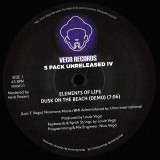
Fall is here after all the summer maddness with festivals, mediterranean tours and Ibiza residencies, it full on vinyl releases for Vega Records. Introducing the 5 Pack Unreleased IV edition, Vega Records takes another step into the world of unreleased music from the Vega Family. Gems from Leroy Burgess, Two Soul fusion, Tony Touch, Professor Featuring Ndu Shezi & Thebe, Johnny Dangerous, and gospel royalty Bebe Winans to Elements Of Life Demos and songs in the making all come together on this special 5 piece vinyl set. With 12 tracks in the sequence there are a select number of talented producers on the project which include Two Soul Fusion AKA Louie Vega & Josh Milan, Pablo Fierro, Johnny Dangerous, Luis Radio, Pietro Nicosia and musicians Axel Tosca and Luisito Quintero. They all contribute to these unique pieces of music mastered by the one and only who we call “The Quincy Jones Of Mastering” Mr. Herb Powers of PM Mastering and the vinyl manufactured by Optimal, Germany. With a limited number of copies made make sure you get your hands on them, they will be rare and very fast!!! Vega Records “always bringing you top quality music” !! Distributed by Above Board, UK.
Kanaan from Oslo, Norway is back with their 2nd album in 2020. Following the impromptu Odense Sessions with Causa Sui guitarist Jonas Munk released in February, Double Sun is a different beast all together: Treading the same path as their 2018 debut Windborne, Double Sun is a studio effort in the best sense of the word. Perfectly balanced on the edge of dynamic improv, throbbing beats sizzled in scorching fuzz and topped off with deeply layered soundscapes. This album sees Kanaan reach a new plateau. Kanaan presents a unique perspective to psychedelic rock, painting with a wide palette that includes jazz and post-rock. Double Sun devotes as much energy to sonic colour as it does to groove and energy. The spirit of experimentation is everywhere: From the savory, pastoral sounds of opening track Worlds Together, to the soaring exploratory paths of the two-part title track. In the creative process, Kanaan dived deep into the possibilities of the studio, adding intricate layers and twists and turns to these tunes: acoustic guitars, percussions & synthesizers embrace and enhance the Norwegian modern day version of a power-trio.
Ross Mc Millan Aka Carlos Nilmmns Started His Career Over 10 Years Ago With Skylax Records. From His 1st Ep "Red" It Is a Statement. a Subtle Mix of House, Techno All Embellished With Striking Cinematographic Landscapes. There Followed a Multitude of Releases on Skylax (Blue Ep) but Also Ornaments, 4lux or Even Circus Company. He Has Just Recently Released 2 Fabulous Remixes for the Soul of the Makossa Man Project (Warehouse Classic 5 & 6). and It Is Logically in View of the Incredible Level He Has Reached in the Development of His Remixes That We Offered Him to Make a New Ep. There Is in This New 12 Inch His Very Personal Touch to the Deep and Sensual but Also Latin House Influences That Surely Would Not Have Denied the Maw but Also the Great David Mancuso (The Loft) Who if He Were Still Alive, We Think Would Have Loved This Ep (Rip). Indeed, Ross Also Manages to Integrate Into His Songs Cinematic Landscapes Worthy of Lalo Schifrin of the 1970s While Maintaining a Club Aspect. Latin Tapes Is One of the Most Beautiful House Bangers We've Heard in a Long Time, a Real Ode to Party and Life. No Love Lost Is Eyeing Moodymann, Mcde and the Brilliant and Forgotten Trus'me. Hootenanny Looks Nothing More or Less Than Isaac Hayes From His Blaxploitation Period. Everything Else Is on the Same Level: City of Love, Sunset Over Antoni De Portmany (Balearic Nights) & Life in the Loire. the Real Question Would Be to Know How He Manages to Obtain This Sound So Classy, the Impression That He Is Accompanied Throughout the Ep by the Philadelphia International Rhythm Section (Gamble & Huff) an Orchestra of Seasoned Musicians. Probably One of the Finest House Records (Or Even Just Music) to Be Released This Year by a Talent as Singular as It Is Elusive. This 12 Inch Is a Masterpiece of Elegance and Refinement....
Temple, Bassey, MacLaine and now, Hurt; in a world of Shirleys, the name Sophia Ruby Katz has chosen for her music is perhaps prophetic as it captures her stunningly emotive vocal approach. And whilst Shirley Hurt might be the perfect nom de plume for the creative Toronto-based artist, it’s her self-titled debut album which positions her as protagonist of her own universe.
Traversing sonic landscapes, Shirley Hurt’s vocals ebb and flow like lyrical Ley lines tracking the contours of her own well-travelled map. By the age of 18, Hurt had travelled extensively, having lived in upwards of 20 different apartments and houses, as a result never really feeling “at home” anywhere. At this age was when Hurt found herself in New York, dipping her toes into various scenes and musical realms. The first and only place she ever felt at home, and a partial home-base for her, she travelled between Toronto and New York until the age of 26.When the project she was working on in New York reached a dead-end she returned West, moving in with musicians Harrison Forman (Hieronymus Harry, Zones) and Patrick Lefler (Roy, Possum). Being surrounded by their improvising at all hours, a new approach emerged. “Harrison is a virtuosic guitar player, and I hadn't picked up a guitar in any serious way since I was 16,” she says, “by osmosis I started playing again for fun.” Without agenda, the process grew organically from there.
Hurt and Forman decided to travel across the US and Canada in a trailer for half a year, with the entire album written in the final months of their trip. Hurt had been writing loose ideas here and there but felt blocked creatively. When the pair reached Berkley, they wound up house-sitting for a tuned-in friend who recommended she pray, in a very direct way, to remove the block. “I took her advice and to my surprise it worked. The album was conceptualized and finished within a couple of months.” Shapeshifting in tone and phrasing, Hurt’s music alchemizes the furthest corners of experimental indie folk, pop, and country into a singular sound with elegant unpredictability.
Whilst Shirley Hurt’s lyrical and structural ideas may have emerged on the road, the album was self-produced and recorded at Joseph Shabason (The War on Drugs)’s Aytche studio in Toronto’s West End. It was engineered by Nathan Vanderwielen and Chris Shannon (Bart), and Hurt enlisted collaborators Jason Bhattacharya, Nick Dourado, Patrick Lefler, and Harrison Forman to hone her vision. “I wasn’t sure what was going to happen with the songs until we returned to Toronto,” she recalls. “Joseph and I had been talking about working together after sending across some demos and Jason happened to recommend his studio at the exact same time, so everything came together naturally at that point.”
Whilst her most recent adventures may have seen Shirley Hurt bound for Texas as an official SXSW artist (hand-picked by Gorilla Vs Bear to perform at their own showcase), she currently resides in her native Canada, more specifically rural Ontario, close to friends and family, and is already working on her second album. The ties to lineage are interwoven in the fabric of the music. Hurt’s mother, artist Leala Hewak, instilled a lust for life and innate value of creativity in her from a young age as she explored the role of gallery owner, vintage jewellery show host, mid-century modern furniture expert, real estate agent, painter. Hurt’s father, a civil litigation lawyer and new-wave obsessed music lover with an extensive vinyl collection, introduced Hurt to a wide-range of artists at a young age such as Nina Hagen, Laurie Anderson, Tom Tom Club, and endless others.
In her video for ‘Problem Child’ Hurt’s grandmother walks her through a generationally revered pie-making process. One would be tempted to hear this, and other songs, as autobiographical. Yet, Hurt’s lyrics are rarely pulled from her relationships or personal history––at least not consciously. Rather, they arise from somewhere less tangible or defined. “Lyrics tend to come to me when I am doing non-musical things - washing dishes, brushing my dogs, walking to the grocery store. I have a lot of voice memos on my phone and half-filled notebooks and when I hear something, I have to stop what I'm doing to get the idea down. Usually it’s bits and pieces. It's rare a full song comes to me in one go, but it's great when they do, and those are often my favourites.”
Carving out a space of her own in an all-encompassing universe, Shirley Hurt is the introduction to a long artistic story, and if the journey so far is anything to go by, it will be stippled with evermore unpredictable chapters.
Altered Circuits' next release comes by way of Bologna-to-Berlin transplant Jacopo Latini. On the Motherboard EP he combines stubby drums and sultry, efficient basslines with richly hued synth work. Once the cuts get going, a tapestry of melody reveals itself: gated leads are accompanied by burbling arpeggios, momentous chord progressions and bright pads that crawl in and out. The patches often incline to the bright and dreamy but are deployed with restraint; in the same vein, concealed and aloof vocal samples get sprinkled in. These techniques - staples for the artist - add an inscrutable quality to his work's mood. It is dance music that feels direct on the surface yet hides more ambiguous emotions underneath. Being a DJ was Latini's first approach to the electronic genres, and it arguably still is his main inspiration - it even occurs he writes tracks with a specific venue in mind. Since starting over a decade ago, and having meanwhile swapped the local Italian stages for the international ones, he has amassed a ton of analogue gear to help him do so. On this occasion, he plugged in his Roland D-50, Moog Sub 37 and microKorg XL, among other favorites, to take on progressive, trance and tech house. "Motherboard", "High Voltage", "It Comes In The Morning", and "Dual Effect" make for a diverse selection but have indeed the same objective: the club floor.
2023 Repress
It's the quiet ones we should watch, they always say. Which is particularly astute advice right now, when loud, constant self-declaration and saturated 'brand' visibility have become the norm. But above the babble and brightness, some voices will always speak quiet volumes - with calm eloquence and the kind of certitude that comes from valuing the playing out, not just the prize.
Sweden's José González is just such a voice. He first charmed his way into the UK's earshot via the murmurous and elegant, classically finger-picked folk pop of his 2005 album, Veneer, which has since sold over a staggering 430, 000 copies in UK alone. Two years later came In Our Nature, a further exploration of José's influences (Argentinian Folklore, the '60s US folk tradition and the British pastoral folk-pop style of the same era), on which he resisted the temptation to beef up his alluringly introvert aesthetic. The albums made the UK Top 10 and Top 20 respectively.
Conceived as the natural third part in an acoustic trilogy, Vestiges & Claws is a(nother) hushed and delicate solo set that forefronts the artist and guitarist's compellingly intimate vocal style and intricate playing technique, but it's often strikingly rhythmic in nature and cohere's perfectly, with hand claps and taps on the body of his instrument underlining the songs' mantric rise-and-fall pattern, while elsewhere, over-dubbed guitar parts and multi-tracked vocal harmonies entwine to sweetly immersive effect.
The title refers to both cultural practices and biological features that survive despite having lost their original function, and to currently useful tools, ie the 'claws' of modern life.
Vestiges & Claws was recorded almost entirely by José and self-produced, mostly in his Gothenburg home, using computer plug-ins to achieve a warm, analogue sound. He prefers working alone, mainly for artistic reasons. 'There were a couple of things that enabled me to complete this record: one was curiosity, to be able to play percussion and do a lot of harmonies and also to produce and mix the album; the other was aesthetics. I love to listen to Arthur Russell and Shuggie Otis, to music that has been done mostly by one person in their solitary state.'
As José sees it, the record is his personal, 'zoomed-out eye on humanity on a small, pale blue dot in a cold, sparse and unfriendly space. The amazing fact that we are all here, an attempt at encouraging us to understand ourselves and to make the best of the one life we know we have - after birth and before death.
This project should have been born in 2005. Indeed, hardock striker had just released his single control (with lyrics borrowed from Ian Curtis) and he recorded at the same time a cover of his favorite group Joy Division by imagining this track interpreted by new order and mixed by shep pettibone. Caught in a whirlwind of releases and dedicated exclusively to all artists signed at the time, this project was left aside. More than 15 years later, delighted to see a whole generation of producers greatly inspired by new wave and italo disco, he finally decides to release it realizing that the production hasn't aged a bit. As a bonus, it comes up with 2 monstruous remixes by the brilliant Spanish producer who is exploding everything at the moment, the future great Parissior.
- A1: Smart Ass Black Boy (Redux)
- A2: Final Destination (Redux)
- A3: Creepin' (Ft. Jahlil Nzinga) (Redux)
- A4: Bkny (Ft. Old Money) (Redux)
- A5: I Shine (Redux)
- A6: Never Let You Go (Ft. Shan) (Redux)
- B1: Hood Party (Ft. Kool A.d. And Despot) (Redux)
- B2: Frenzy (Ft. Gldneye) (Redux)
- B3: Father's Day (Redux)
- B4: Sleepover (Ft. Shawn Neon) (Redux)
- B5: The More Things Change (The More They Stay The Same) (Redux)
- B6: Bkny
"Smart Ass Black Boy: Redux" ist die zum 10-jährigen Jubiläum neu abgemischte und neu gemasterte Ausgabe des zweiten Studioalbums des Houstoner Rappers Fat Tony und des ersten Albums für Young One Records (einem frühen Partisan-Imprint).
"Smart Ass Black Boy" war eine der am meisten gefeierten Hip-Hop-Platten des Jahres 2013 und wurde schließlich zu einer der beliebtesten Houstoner Rap-Platten der 2010er Jahre. Das Album landete auf den Jahresendlisten von Complex und VICE, während Noisey und Pitchfork die Videos zu "BKNY" bzw. "Hood Party" uraufführten. Es wurde in der First Listen-Serie von NPR vorgestellt, wo es als "refreshing" und "promising" beschrieben wurde, während Pitchfork sagte das Album "absolutely knocks". Robert Christgau gab der Platte eine A-Bewertung ("homespun and imaginative"), und Rolling Stone nannte sie einen "thoroughly enjoyable batch of smart-ass raps". Fat Tony hat seitdem Platten mit Don Giovanni und Carpark veröffentlicht, zuletzt in diesem Jahr "I Will Make a Baby in this Damn Economy".
Das Album enthält einen noch nie zuvor veröffentlichten "BKNY (Remix)" mit neuen Versen von Mr. Muthafuckin' eXquire, Melo-X und GLDNEYE.
[l] B6. BKNY [Remix] (feat. Mr. Muthafuckin' eXquire, Melo-X, and GLDNEYE) (Redux)
Die bekannteste ungarische Metalband der Welt kommt mit neuem, unberechenbarem Material zurück. "Vivid Black" bezeichnet nicht nur das bereits vierzehnte Studioalbum mit neuem Material von EKTOMORF, sondern ihr brutalstes und düsterstes jeher! Die Band beweist auch nach fast 30 Jahren Bestehen, dass sie intensiver, erbarmungsloser und ehrlicher klingen können als je zuvor.
Die Corona Pandemie hat ihre Spuren in der Welt hinterlassen. So auch bei Sänger Zoli Farkas. Aufgrund von Isolation hatte er mit Depressionen zu kämpfen, welche er auf dem neuen EKTOMORF Album verarbeitet. Geschrieben in nur drei Wochen (!) ballert sich dieser Hassbatzen direkt in die Gehörgänge und spendet auf eine obskure Weise jedem Trost, der während der Lockdowns ähnliche emotionale Schwierigkeiten hatte. Gleichzeitig ist "Vivid Black" eine persönliche Abrechnung mit alles und jedem die Hass schüren und Menschen zwingen etwas zu sein, was sie nicht sind und sein wollen.
Eben ein neues, ehrliches und wahnsinnig brutales Album von EKTOMORF. Seit bereit für die Zerstörung von "Vivid Black" - der Name ist Programm.
Percolating in the same watery diner coffee that spawned American Football and Hum, C-Clamp shrugged on and off the '90s slowcore and emo scenes in a hurry. Compiled here are the band's two albums for the venerable Ohio Gold label - Longer Waves and Meander + Return, plus a third LP of singles and compilation tracks, and a meticulously annotated book stuffed with lyrics, photos, flyers, and ephemera from their all-too-brief existence. This one's colder than a Chicago winter - better plug in that space heater.
Black Truffle is pleased to announce the first LP documenting master khene player Sombat Simla, the label’s first collaboration with Japanese sound artist, field recordist, and researcher Yasuhiro Morinaga. Simla is known in Thailand as one of the greatest living players of the khene, the ancient bamboo mouth organ particularly associated with Laos but found throughout East and Southeast Asia. His virtuosic and endlessly inventive renditions of traditional and popular songs have earned him the title ‘the god of khene’, and he is known for his innovative techniques and ability to mimic other instruments and non-musical sound, including, as a writer for the Bangkok Post describes, ‘the sound of a train journey, complete with traffic crossings and the call of barbecue chicken vendors’. Aided by a group of Thai friends, in 2018 Morinaga travelled to the Maha Sarakham province in the Isan region, arranging to meet Simla in a remote spot surrounded by rice fields. Then and there, Morinaga recorded the solo performances heard on the LP’s first side. At Morinaga’s request, Simla began with a rendition of the train song ‘Lot Fay Tay Lang’. Beginning with long tones that seem to mimic a train horn, the performance soon moves into a rapid chugging rhythm, interrupted at points by vocal exclamations and the remarkable timbre Simla produces by singing through the khene. To listeners unfamiliar with Thai music, the pentatonic scales and rhythmic chug of many of the pieces can have surprising echoes of the rawest American blues. The range of Simla’s performance is astonishing, moving from compulsive rhythmic workouts on single chords and rapid-fire runs of single notes to gentle sing-song melodies, and using a fascinating array of techniques, including a rapid tremolo that sometimes sounds almost electronic. Later the same day, Morinaga followed Simla to a cattle shed where he met percussionist Mali Moodsansee to play some molam (folk songs found in Isan and neighbouring Laos), with Pattardon Ekchatree joining in on cymbal. At times, these molam songs have a wistful, romantic character quite different from the solo pieces. Backed up by the propulsive hand drums, Simla again dazzles with his melodic fluidity, rhythmic drive, and wild displays of unorthodox technique. As Morinaga writes, ‘It felt like they had been playing together so long that their breathing was perfectly in sync, and it was like listening to the precision of James Brown’s funk’. Accompanied by extensive liner notes by Morinaga detailing the day of recording, this is a stunning document of a master musician, seamlessly integrating tradition and innovation.
Started around a decade ago, "Overcloseness" has been a long time coming. It is Colorist's debut album on paper, but already has a magnum opus feel to it. The beginnings of Colorist lay in the Cologne music community. Being small, it was always influenced by the art and the film scene. (In fact, the label Magazine originates from the same crossing point.) The large cast of guest appearances underlines how much Antonio de Luca and Caroline Kox are in the center of that Cologne community. On "Overcloseness" intimate pieces for one or two instruments alternate with dense choir anthems ("Embody") and tracks built from ultra intense fabrics that conjure up the mediative hardness of Tool ("Blood Markers"). Driven by the otherworldly voice of Koxi and a larger than life bass line by Antonio, the album culminates in the unforgettable "Touch Me". Oscillating between a bad migraine and cathartic hypnosis, Colorist have created a genre defying universe of an album.
„This will not revive your soul, B.“
NOTON IS PLEASED TO RELEASE RAY COLLECTOR - A LIMITED EDITION VINYL FEATURING RECORDINGS SOURCED FROM TAPES PRODUCED BY CARSTEN NICOLAI' FOR HIS 2023 SOLO EXHIBITION STRAHLEN/RAGGI AT FONDAZIONE MODENA ARTI VISIVE.
IN FEBRUARY 2022, CARSTEN NICOLAI DISPATCHED TEN PARCELS FROM BERLIN TO VARIOUS DESTINATIONS. EACH PACKAGE CONTAINED A BLANK MAGNETIC TAPE CASSETTE, AN ILFORD DELTA 3200 ISO 1000 BLACK-AND-WHITE FILM, AND A KODAK ISO 800 COLOR NEGATIVE FILM. ALL PARCELS WERE ADDRESSED TO THE SAME RECIPIENT, MR. NEMO, THE UNFORGETTABLE CAPTAIN OF THE SUBMARINE NAUTILUS IN TWENTY THOUSAND LEAGUES UNDER THE SEA. THE IDEA WAS FOR THE RECIPIENTS TO RETURN THE PARCELS TO THE SENDER. EACH PACKAGE HELD MAGNETIC TAPES AND PHOTOSENSITIVE FILMS THAT WOULD BE EXPOSED TO ELECTROMAGNETIC WAVES AND RADIATION DURING THEIR JOURNEY. UPON THEIR RETURN TO THE SENDER, THE LATENT IMPRESSIONS WERE DEVELOPED, DIGITIZED, AND THUS MADE BOTH VISIBLE AND AUDIBLE.