Zero Years Kid is the alter ego of Joachim Badenhorst, one of the most fascinating and adventurous Belgian jazz musicians from the last 2 decades. He plays with the international band Carate Urio Orchestra but also as musician with Naima Joris or Chantal Acda.
Zero Years Kid started of as a solo project, but has grown into a full and organic live band.
Badenhorst sees Zero Years Kid as a kindergarten to explore other ideas and interests besides of jazz. Together with Jan de Vroede, Lennart Heyndels and Erik Heestermans he brings a colorful amalgam of hip-hop, pop, dance and r&b with playful and poetic lyrics in his native language: Dutch. Next to his clarinet and sax he adds samples and electronica which results in a surprising fantasy world where it is wonderful to wander.
In 2019 debut album Ongerijmde Rijmen was released. Successor Geen Grenzen is ready and will be released on November 10th of this year on Klein. Geen Grenzen is an ode to breaking boundaries, to color outside the lines and to don’t get hung up on expectations.
The title track is a rework of No Limits by 2Unlimited. The song got translated, slowed-down and distorted to the universe of Zero Years Kid. The album is a poetic and humorous trip with a melancholic twist, and themes like the covid pandemic, intense arguments that are forgiven, writers-block, desire and love.
Search:same
Five groups, one mythical studio - documenting the emergence of a generation!
The initial postulate was simple: five groups, one emblematic studio and 24 hours for each to imagine and record two unreleased tracks with one objective - the will to document a French jazz scene in the midst of renewal.
In these last few years, several innovative currents have shaken up the world of jazz and attracted new fans. They have bubbled up from Los Angeles, impregnated with hip-hop culture (Kamasi Washington, Terrace Martin, Thundercat), or from London, tinged with African rhythms (Nubya Garcia, Kokoroko, Ezra Collective). Meanwhile, in France, a new scene is emerging, carrying with it more of a dancefloor-oriented sound influenced by electronic music - an obvious kinship with the French Touch explosion of the late 90s.
Historically, every movement has been assimilated to a certain neighbourhood, to specific clubs where late at night, young guns stayed up to imagine the jazz of tomorrow - the Cotton Club for the jazz of the 20s, Minton’s Playhouse in Harlem for Be-Bop, the Black Hawk in San Francisco for West Coast jazz, Birdland in New York for Hard-Bop or a lot more recently, the Total Refreshment Centre which has been the playing field for the new London scene.
In Paris too, this new sound is associated with actual venues, places which have allowed these groups to form, create a repertoire and forge an aesthetic - Le Baiser Salé for Monsieur Mâlâ, La Gare/Le Gore for Photon, La Pêche in Montreuil for Ishkero, La Petite Halle for Underground Canopy and also le Duc des Lombards and le 38 Riv’ for Alex Monfort; it’s in a live context that this music will always continue to evolve.
Keeping this “live” spirit, with all its spontaneity, was actually the guiding line for the elaboration of this Studio Pigalle compilation. Each take was recorded in the most organic way possible, bringing all the musicians together in the same room to limit post-production alterations before the final cut was assembled, in just one day, by studio in-house sound engineer, Felix Rémy.
A feeling of urgency permeates a record guided by an artistic production taking care to crystalise the essence of this artistically free-range generation whose childhoods were rocked just as much by Bill Evans and Roy Hargrove as by J Dilla and Jeff Mills. One of the two tracks recorded is geared towards the dancefloor, and the other, more cosmic/ambient gives freer rein to individual interpretation.
There were therefore many possible ways of interpreting these guidelines for the five formations which number among the most distinctive on the current French musical landscape, and the occasion, for some, to rummage through their archives! With Transe (Mbappé) and Da Verdere (Vella), Monsieur
Mâlâ present us with two unreleased tracks issued from the very first rehearsals of the quintet reworked especially for this compilation. “Seen the aesthetic range of this group, it all worked out very naturally in the studio”, recounts keyboardist Nicholas Vella “Recording like they did in the sixties with all the channels live and working with small imperfections was a very interesting task, even when it came to the mix, we had to make do with the takes we had... “
“Our group is very recent, and with this session, in just two tracks, we had the opportunity to present the entirety of our musical universe,” says Photons pianist Gauthier Toux. “All too often, we assimilate this fusion between jazz and dance music to computers and post-production modifications. For “Dessine”, we kept the first take, and we must have recorded just three or four for the other track with more of a techno bent. In one day, we understood that we could play our entire repertoire live, from A to Z”.
“When the Komos label offered me this project, it immediately spoke to me”, remembers Alex Monfort “Straight away, I thought of “Since I Met You”, a track with a nine/four time signature which really is reminiscent of a new- soul groove, but with this extra cosmic vibe! I wrote the words to the chorus and Nina Tonji placed her voice on the track, adding her own verses. For “Tonight”, the up-tempo track, I wanted to head off in more of a hybrid direction inspired by Kaytranada or the Black Radio series by Robert Glasper. A cross-over between jazz and hip-hop which really does represent my world, and I also tried to place vocals centre stage (Emcee Agora)”.
“We truly resonated with the way Antoine Rajon imagined this compilation and the recording session”, confide Warren Dongué and Jérémy Tallon from Underground Canopy. “When arriving in this studio we felt as if we had gone backtothe70s! Inkeepingwiththespiritofthisera,heknewhowtoletus keep our spontaneity, without recording in too many takes, and that’s how we like to work”.
“We managed to adhere to the themes of the compilation without changing our instrumentation, we wanted to remain faithful to the sound of Ishkero on these new compositions and take them somewhere else” – says drummer TaoEhrlich -“Withoutaddinganyelectronics.Thesessionwassupervisedin a truly subtle and benevolent manner. From a human perspective, it was also a wonderful experience”.
Whether turned towards hip-hop, ethnic or electronic music, the artists featured on this Studio Pigalle compilation represent the eclecticism of a new generation in the process of writing the first chapters of its history. Open to experimentation, these artists continue to hold high an immutable love for improvisation and creation in the moment... another definition of the word Jazz!
A tech company's "senior spirit guide" finally comes to the defense of the "financially unsuccessful" Vincent van Gogh; wonders of the natural world are reimagined as "muster points for brainstorming innovators"; the "artificial char lines" on fast-food burgers are cited as if signs of the apocalypse. For the better part of three decades, Aesop Rock has used the syntax of the moment to pinpoint the fault lines in that moment's supposedly solid foundation. With his tenth album, Integrated Tech Solutions, Aes wields insidious corporatespeak as a tool to pry that parasitic worldview away from the parts of life that truly matter.
A concept album about an organization offering "lifestyle- and industry-specific applications designed to curate a desired multi-experience," Integrated Tech Solutions picks apart the charlatan language that hears app inventors put themselves on continuums starting with cavemen and continuing through da Vinci. On "Mindful Solutionism," the wheel evolves seamlessly into modern agriculture—and then into atomic bombs, Agent Orange, cigarettes, and surveillance cameras. In a rare moment of transparency, the engineers Aes give voice to sum up this spiral in just a few words: "We cannot be trusted with the stuff that we come up with."
Appropriately, the album sounds like the past and future at once. Largely self-produced, Integrated Tech Solutions catches Aes at his leanest and most innovative, leveraging "Solutionism"'s careening bounce against the wistful "By the River" or the slow creep of "Salt and Pepper Squid." The effect is a record that sounds itself like an organism growing, mutating, hurtling toward profitability-and then destruction. As fans have come to expect, Aes is cuttingly funny and slyly profound at once, whether recounting a childhood restaurant run-in with Mr. T ("100 Feet Tall") or quipping, on "Pigeonome- try," that "white dove is a pigeon-you motherfuckers is bigots." At the same time, Integrated Tech Solutions is working on another parallel project: tracing the sprawl of modernity and cutting directly to its core. "I've been doing laps of the lost worlds," he raps on "All City Nerve Map," sounding at once wearied and reinvigorated. "I can draw a map to the raw nerve."
[f] Kyanite Toothpick [feat. Hanni El Khatib]
[k] Bermuda [feat. Lealani Teano]
[n] Forward Compatibility Engine [feat. Rob Sonic]
[r] Black Snow [feat. Nikki Jean]
- 1: Anne
- 2: Give Me Back To The Sky
- 3: Have You Been Eating That Sandwich Again
- 4: The Way We Were With People
- 5: Cop Graveyard
- 6: Dan Collins Vs. The Maryland Judicial System
- 7: Dead Bird Skeleton
- 8: Grim Reaper
- 9: The Same Things Happening To Me All The Time, Even In My Dreams
- 10 0: Swallow
- 11: Dead Cat
- 12: Spooky Ghost
- 13: No, The Moon
- 14: I Am My Own Hell
- 15: Afterlife Dating
- 16: If I Cleaned Everything
- 17: Untitled-Oct19
- 18: Yr Glow (Acoustic Demo)
teen suicide's first & only proper album, `i will be my own hell because there is a devil inside my body', has been a sought after release for many collectors after it's ultra-limited vinyl release in 2012. Now, Run For Cover Records will be reissuing my own hell, with remastered audio, expanded artwork and 8 never-before-issued bonus tracks. Across the album's 10 songs, the band displays a knack for different sounds and styles. Intimate, keyboard driven tracks like `cop graveyard' and `grim reaper' sit beside more energetic full-band outings like `dead bird skeleton and `give me back to the sky', the latter even adding an evocative viola, piano and choral arrangement to it's chaotic center. It's to the band's credit that their more outré moments feel necessary, not distracting. What becomes clear upon listening to `my own hell' is that beneath the dreamy haze & noisy apathy of teen suicide's recordings exist ernest, extremely well-written pop songs that reflect and express the uncertainty and desperation of reality
Long before Lordi and Nightwish put Finnish metal on the map globally, Waltari were there churning out a curiously engaging concoction of various genres molten into metal. Waltari signed with Roadrunner Records in the early nineties and released Torcha, the first fruit of the co-operation in 1992. Torcha was very well received by the international music press, even though Waltari's iconoclastic habit of breaking all boundaries also annoyed people. Besides heavy metal, speed and thrash, Torcha has acid house, funk and punk, often all in the same song. Previously Torcha has not been widely available on vinyl. There was a very limited poor quality Korean edition in the early nineties, which stuffed the hour-long album on a single LP. The Svart edition has been prepared together with Kärtsy Hatakka, and it spreads the original album on three LP sides and has two bonus tracks on side D.
In ¿Quién?, Sylvia Meyer combines music, image, sound and poetry. Her lyrics, so subtle, acquire a singular dimension. They grow and become an essential lyricism that vindicates art and music. Almost 30 years after her last album release, Sylvia Meyer released ¿Quién?, an album where everything happens between his piano and his voice. Its exquisiteness, sensitivity, luminosity, and refinement coexist with arranging complexity and virtuosic, achieving a unique texture and a voice that penetrates souls to nest there, and grow beauty. The musical atmospheres and the universes of beauty to which the songs that make up this album transport us rescue that sound so complete and, at the same time, so inevitably montevidean, which travels absolutely free. Meyer is one of the most important Uruguayan artists of the last four decades. Composer and owner of a unique and special voice. Everything that sighs fills it with beauty and mystery. His music manages to transcend the borders of cinema, theater, concerts and art. "Because a the music, the only thing that interests is music" repeats Sylvia Meyer
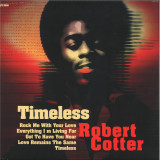
Worthy re-issue of Robert Cotter's second late 70's soul album! Comprising five songs, with four of them being quite lengthy and well-structured for the dance floor, was entirely recorded in the United States by top-notch American musicians. "Timeless", a fresh and lively expression of late 70s soul music, was recorded at the Sundragon Studio in New York. This studio was home to legendary bands such as Talking Heads and Ramones, as well as a few 'disco studio groups' like Andrea True Connection, Tony Valor Sound Orchestra, and Camouflage, who recorded songs that later became considerable hits. For this reason, it's believed that the positive outcome of the album can be partially attributed to Ned Liben, an eclectic New York musician and co-founder of the studio in the Flatiron district of Manhattan, served as an exhaustive interlocutor for any artistic and technical needs. He was also the arranger of "Rock Me With Your Love", the most significant song on the album. Ned's successful mission was to capture the maximum timbral fidelity of Robert Cotter's voice using appropriate recording techniques, assisted by Michael George Ewing, a talented engineer who had previously worked on similar projects with well-known artists like Carol Williams, Maryann Farra & Satin Soul, Touch and Tony Valor. In fact, the piece features original and melodious lines, coupled with an excellent steady rhythm, spanning approximately 8 minutes and 30 seconds - in short, "a delightful sound for every beat." This ensured that the performance of the young singer-songwriter from New Jersey was faithfully reproduced without neglecting the overall musical landscape. The other four songs, arranged by Ben Lazzaroni with the same musicians as the first piece, are no exception. Best Record also delivered on the promise to Robert's older brother, Karl Potter, a powerful percussionist transplanted to Rome, for whom the roman label produced "Sweet & Salty Cha-Cha-Cha" (12", 1986). Robert Cotter, an artist about whom almost nothing has been written, is poised to gain recognition once word spreads about his album, which has been entirely remastered by Dom Scuteri and features a more congenial tracklist. This album is destined to be truly 'timeless', ready to captivate audiences around the world. Even the new cover artwork, created by Nerina Fernandez, pays homage to an artist who, despite expressing himself with elegance and simplicity, radiates energy and exudes love. "Timeless" is an inevitable revelation for anyone who missed it at the time, and for the next 40-plus years, it will remain an absolute must-listen for Robert Cotter's many fans, leaving them all in awe. In addition to the reissue on the classic glossy black vinyl, a strictly limited edition on red vinyl will be released exclusively by Clone Distribution.
Worthy re-issue of Robert Cotter's second late 70's soul album! Comprising five songs, with four of them being quite lengthy and well-structured for the dance floor, was entirely recorded in the United States by top-notch American musicians. "Timeless", a fresh and lively expression of late 70s soul music, was recorded at the Sundragon Studio in New York. This studio was home to legendary bands such as Talking Heads and Ramones, as well as a few 'disco studio groups' like Andrea True Connection, Tony Valor Sound Orchestra, and Camouflage, who recorded songs that later became considerable hits. For this reason, it's believed that the positive outcome of the album can be partially attributed to Ned Liben, an eclectic New York musician and co-founder of the studio in the Flatiron district of Manhattan, served as an exhaustive interlocutor for any artistic and technical needs. He was also the arranger of "Rock Me With Your Love", the most significant song on the album. Ned's successful mission was to capture the maximum timbral fidelity of Robert Cotter's voice using appropriate recording techniques, assisted by Michael George Ewing, a talented engineer who had previously worked on similar projects with well-known artists like Carol Williams, Maryann Farra & Satin Soul, Touch and Tony Valor. In fact, the piece features original and melodious lines, coupled with an excellent steady rhythm, spanning approximately 8 minutes and 30 seconds - in short, "a delightful sound for every beat." This ensured that the performance of the young singer-songwriter from New Jersey was faithfully reproduced without neglecting the overall musical landscape. The other four songs, arranged by Ben Lazzaroni with the same musicians as the first piece, are no exception. Best Record also delivered on the promise to Robert's older brother, Karl Potter, a powerful percussionist transplanted to Rome, for whom the roman label produced "Sweet & Salty Cha-Cha-Cha" (12", 1986). Robert Cotter, an artist about whom almost nothing has been written, is poised to gain recognition once word spreads about his album, which has been entirely remastered by Dom Scuteri and features a more congenial tracklist. This album is destined to be truly 'timeless', ready to captivate audiences around the world. Even the new cover artwork, created by Nerina Fernandez, pays homage to an artist who, despite expressing himself with elegance and simplicity, radiates energy and exudes love. "Timeless" is an inevitable revelation for anyone who missed it at the time, and for the next 40-plus years, it will remain an absolute must-listen for Robert Cotter's many fans, leaving them all in awe.
The sound that swallows jazz rock, mode jazz, and free jazz is serious and profound.
A magnificent concept album that will remain in the history of Japanese jazz with the theme of global anti-war and peace
Hiromasa Suzuki, a rare pianist/composer/arranger who showed his skills in the groups of Terumasa Hino and Akira Ishikawa. Collaborating with Big Soul Media, led by Jiro Inagaki, one of the best jazz rock groups of our time, this work is unusual for a Japanese jazz work, and the concept is based on the theme of “global anti-war and peace.”
The sound that swallows jazz rock, mode jazz, and free jazz is serious and solid, but at the same time, it is full of overwhelming dynamism.
Suzuki’s ability to manage a big band and create a masterpiece sound is also splendid, and Big Soul Media, which listened to Suzuki’s intentions and responded to his request, is also splendid.
Both Suzuki and Inagaki’s activities in the jazz-rock era are at their peak, and this work is also important in that it captures the overlap.
text by Yusuke Ogawa (universounds/Deep Jazz Reality)
Composition/Arrangement/Conductor: Hiromasa Suzuki
Performed by Jiro Inagaki and Big Soul Media
Jiro Inagaki (S.Sax, T.Sax)
Shigeo Suzuki (A.Sax)
Tadayuki Harada (B.Sax)
Takehisa Suzuki (Trumpet)
Tetsuo Fushimi (Trumpet)
Takeshi Nomura (Trumpet)
Shigemichi Domoto (Trombone)
Tadataka Nakazawa (Trombone)
Kazuo Usui (Trombone)
Tsunehide Matsuki (Guitar)
Masaru Imada (Piano, Organ)
Hiromasa Suzuki (Piano, Organ)
Yasuo Arakawa (Bass) / Gen Ishimatsu (Drums)
After holding down a residency at Berlin’s Club der Visionaere for over a decade with their Perfumed Freedom events, dynamic duo Foehn & Jerome look to launch an exciting new record label under the same name. The Berlin based Austrian’s have teamed up for the inaugural release, wandering between tripped out minimalistic vibes with tinges of house textures spread across the record. This is “The Frisbee Of No Return”.
Join Foehn & Jerome as they evolve the Perfumed Freedom journey with their unrivalled chemistry, giving themselves and dedicated artists a platform to express themselves in the years to come.
Drivetrain
Music Got Me - The quintessential blend of retro sophistication with ultramodern late night chic. A rolling bass transports a melodious string accompaniment through an arresting vocal hook.
Afterhours Mix - Following the same path with a slightly different spin, incorporating an electronic touch on the retro syncopation.
Melodymann
Keep It Movin - Intelligently enriched with uplifting vocal drops complementing spicy horn fills, funk bass and electrifying beat oscillation.
Up & Down - Maintaining the energy but substituting the horn fills with jazzy keyboard riffs while the vocal slices continue to drop over bouncing subfrequencies.
“I hope you die by my side, the two of us at the exact same time, I hope we die not long from now, the two of us at the exact same time”
By the time Molly Nilsson released History, she had already established a fledgling cult status built on homemade YouTube videos and home-burnt Cdrs. Writing from a distance, it’s clear that History is the first classic album in her canon and arguably a classic of the 21st Century underground music panorama.While the methodology on History hadn’t changed from Nilsson’s previous 3 albums – it was recorded solo at The Lighthouse, Nilsson’s home studio based on a Berlin crossroads – on this record the songwriting reached a new peak and the emotional scythe cut deeper. Here, Nilsson managed to combine a cosmic, outward looking perspective with an intimate knowledge of the human condition and its place in these turbulent times. In truth, no other songwriter has excavated the modern psyche so clearly and perfectly.
The tracklist to Nilsson’s fourth album reads as an early greatest hits for Molly Nilsson followers and also serves as the perfect entry point to a whole world the artist has been building for the last 10 years. In Real Life crystalises the millenial obsession with relationships built online, with a generation paying for the baby boomer’s excesses with their anxiety towards the harshness of every day life. It’s a call to arms for a generation who fell in love on Skype. On I Hope You Die, one of Molly Nilsson’s most iconic songs, the songwriter flips the song title into a tale of doomed romance, a relationship based on discommunications and the thrill of the other. It’s also one of the most heartfelt songs full of pathos written by anyone, an ode to obsession. Doomed romance, life lived on the flipside of day and the role of the outsider in society are themes that crop up through-out History. On
Bottles Of Tomorrow, the narrator is sweeping up, in love with the night and examining the remains a society leaves behind.
On City Of Atlantis, Nilsson veers from the plaintive balladry she had begun to make her name with, embracing trance-like synth and dance music details to create an unlikely anthem using the mythological city as a means to comment on the patriarchal rendering of history by power. With by now trademark panache, she turns complicated subject matter into a glorious song that transforms into an ecstatic pop moment.
Hotel Home, another Nilsson classic, paints loneliness not as a debilitating anxiety, but as a powerful to that propels the artist forward through her travels. It’s a song that hints at an endearing self-awareness also; the writer is never at home, living life on the road, content that “the world will find me when the time is ripe.”
There’s never been a greater time.
repress!
Back by popular demand, the same unique spirits that brought forth the sound of Detroit streets and turned it into the futuristic soundscape known as "Techno-Bass", The Original members have collaborated to re-issue their catalog 25+ years later. Starting with their 1st double pack LP, "Bass Magnetic" (considered to be a mesh of influences between Miami bass and Detroit techno), AUX88 established themselves in an effort to stay true to their roots in the streets and the clubs creating their own genre into a global dance culture. After the release and production of their own documentary ("AUX88-Portrait of an Electronic Band"), the group celebrates its now classic recordings. Harkening back to its first days on cassette tape to revive a future generation of vinyl aficionados.
Repress!
Matthew Herbert’s Accidental Jnr imprint are back with their second release of the year, this time inviting rising London based star Third Son into the fold. The Polymath label boss has been causing quite a stir in the house music scene with releases for 17 Steps, Skint and Sincopat as well as clocking up remix credits for among others Marc Romboy and Maya Jane Coles (under her Nocturnal Sunshine alias).
‘Bag O’ Bones’ opens up proceedings with its clattering toybox percussion, throbbing kick drums and dissonant lead stabs. The track has a brittle, dry quality to it, but Third Son’s ear for the dance floor is clear as the arrangement smoothly rolls along at firm a pace. More of the same is served up in ‘Chime Salad’, with layers upon layers of wonky, shifting percussion, building up into a tower of sound that feels as though it should come crumbling down, but somehow always stands firm.
The B1 ‘Phase Of Going Through Life’ brings the energy back down to earth with its slightly sparser arrangement and clips of bird songs, while still maintaining the off kilter pace of the previous pieces. The record then closes with the feel-good club work out, ‘The Brain Named Itself’, where we find Third Son administering a last-minute, sharp injection of groove. The dissonant synths that opened the record are replaced by brilliant, euphoric chord sweeps and pounding drums that are sure to move any dancefloor.
2023 Repress
Reiko Kudo first debuted on the Tokyo underground music scene in 1980 with NOISE, a duo which apart from herself under her then maiden name Reiko Omura on voice, guitar and trumpet featured Tori Kudo on organ. Their only album TENNO (1980 on Engel) is probably one of the most outstanding and uncompromising records of all time.
Like other pioneering female producers from Japan such as NON (of NON BAND), PHEW and HACO, who had all begun their startling careers in the early days of the japanese Punk era, Reiko Kudo can surely be regarded as one of the most unique, uncategorisable and daring voices in the entire field of electronic and experimental music ever.
RICE FIELD SLOWLY RIPING IN THE NIGHT was REIKO KUDO's second album under her own name. It features TORI KUDO (MAHER SHALAL HASH BAZ) and SAYA and TAKASHI UENO (TENNISCOATS) on various instruments. The recordings took place in 2000 at Reiko' s and Tori's house in the rural surroundings of Shikoku island.
All recorded music on this album sounds like it originates in a parallel dimension where time and key signatures simply don't exist, Some might describe this as outsider music, but this doesn't really begin to do justice to the quality of the tracks, there is nothing accidental or forced here, this is simply music created in a very different way. Yet again REIKO KUDO had conceived of something utterly beautiful.
"After producing the album "Souvenir de mauve" with Maher Shalal Hash Baz which we released on our label Majikick, the idea came to us, to release Reiko Kudo's work. For Reiko's work, we brought our recording equipment from Tokyo to Shikoku and recorded the entire album at her house.
The piano was positioned in a room with a high ceiling. We would set up our small recording equipment in the room and started to record. The basic tracks were recorded without any rehearsal and just a few overdubs were added on top of it. To have a distant sound on the recording, Tori played trumpet in the next room. The choir was standing outside the house, singing "Enya-totto, enya-totto" through the open window. It was early spring, I remember that it was still a bit cold and the members of the choir were freezing outside.
Reiko plays only at certain times of the day, so that we were able to complete only two or three recordings a day. Therefore we had plenty of free time. We went to a hot spring, to a cafe, or we tried pottery on a spinning wheel at Tori's workshop. It was a very rewarding time.
When this album was finished, we brought it to her to listen to. She said happily "I think this is the best work I have ever done." We felt that all our efforts were richly rewarded. Secretly, we thought the same, so we are delighted that this album will be re-issued." - Saya and Ueno (Tenniscoats), Tokyo 2018
Originally released on Majikick Records, Japan, 2000 Restauration and mastering by Detlef Funder at Paraschall Mastering, Düsseldorf. Vinylcut at Calyx, Berlin Translation by Miki Yui and Claus Laufenburg. Many thanks to Reiko Kudo, Tori Kudo, Saya and Takashi Ueno, Satoru Higashiseto.
Dreyblatt"s minimalist conception - a rhythmic drone played on a double-bass strung with piano wire, playing in concert with other stringed instruments performing in 20 unequal microtones per octave and changing key but keeping the same fundamental pitch - dates back to the 1970s, while he studied under La Monte Young and Pauline Oliveros. Resolve acts in intermittent dialogue with the first Orchestra of Excited Strings release, 1982"s Nodal Excitation.
Since then, Dreyblatt has formed new orchestras across various countries and decades, with each phase of his music requiring several overlapping periods of gestation and arrangement.
The current Orchestra is formed by Konrad Sprenger, Joachim Schütz and Oren Ambarchi. On Resolve, each of the members" playing brings new angles to the compositions. Konrad Sprenger"s involves solenoids, sine waves and a computer-controlled multi-channel electric guitar (as well as a relentless style behind the drum kit and oversight of the album production), while Joachim Schütz"s individual conception of electronics and electric guitar and Oren Ambarchi"s undeniable innovations with signal path work together with Dreyblatt"s bass (still strung with piano wire) as magnetic component parts of Resolve.
These contributions lead to Resolve"s dialogue with the early Orchestra of Excited Strings canon - for instance, the track previewed here, "Flight Path" takes off at a pace not often found in the minimalist genre - a rolling lope! Yet the sense of play is palpable: the ensemble scale their microtonal keys with punkish brio, a stance sharing much with the original Orchestra"s downtown pulse, even as as the new Orchestra burn their own path through Dreyblatt"s music.
Approaching his 70th birthday, with over 40 years of work as a solo artist, collaborator, composer, educator and bandleader, Arnold Dreyblatt views Resolve as an important expression within the long story of The Orchestra of Excited Strings. The album title"s tendency to mean different things is an indicator of the dynamic qualities of his music in all its different phases - an evolution that continues to produce new dimensions in acoustic sound with every new release.
Following the release of the shoegaze masterpiece Delaware in 1992, and the intricate experimentations on National Coma in 1993, Drop Nineteens disbanded. They had a great run. Shared stages with Radiohead, Hole, Blur, PJ Harvey. Went from being teenaged kids in Boston to mid twenty somethings with an MTV video under their belt. So when Drop Nineteens ceased to be, Greg Ackell felt content, music was a closed chapter. That was until 2021. For the first time in nearly 30 years, Ackell felt compelled to pick up a guitar. He immediately called up Steve Zimmeran, the band's bassist and fellow guitarist, and the two got writing. It felt effortless for Ackell, like he never stopped writing music. "We were off to the races," he says. "But also the question came up: what does a Drop Nineteens song sound like today? Enter Hard Light, the band's stunning third record. It's the band's proverbial follow up to Delaware, a modern Drop Nineteens record that is completely singular in its sound and vision. The first task making Hard Light, was of course, getting the rest of the band back together. Drop Nineteens is an inherently collaborative project. Ackell's primarily the lyrics writer, and he collaborates with Zimmerman, Paula Kelley, Motohiro Yasue, and Peter Koeplin to create the sonic world. The record came together over the course of a year, recording at a patchwork of studios all around the country. Making music together felt natural, fluid, exciting. The guitar reverb is expansive as ever. Ackell and Kelley's vocals are crystalline. "Scapa Flow," is triumphant. An excellent example of what a modern day Drop Nineteens song sounds like. The guitars glide like clouds on a blue sky day, drums shuffle in the background, searching. Ackell and Kelley's vocals are cool toned and dreamy, bound up in a haze of reverb. It's unquestionably lovely. You could say the same for the whole of the record. Hard Light is so lovely. A portrait of a band 30 years later, as talented and as dedicated to their craft as ever.
Es ist ein Jahrzehnt her, dass wir das letzte Mal von Marnie Stern gehört haben, aber wenn ihre Gitarre auf „The Comeback Kid“, dem Nachfolger von „The Chronicles of Marnia“ (2013), wie ein Sternenstaubregen hereinbricht, ist es, als wäre keine Zeit vergangen. Aber dies ist kein Nostalgietrip. „The Comeback Kid“ ist ein Statement der Absicht. "I can't keep on moving backwards", wiederholt Stern im hymnischen Eröffnungstrack "Plain Speak", während ihre Finger wütend auf das Griffbrett klopfen und der Song wie eine Rakete mit Warp-Geschwindigkeit vorwärts schießt. Stern verlässt auf „The Comeback Kid“ immer wieder ihre gewohnte Umgebung, ohne sich auf die Klopftechnik zu verlassen, die ihr eintausend Eddie Van Halen-Vergleiche einbrachte. "Til It's Over" ist ein so geradliniger "Alternative Rock"-Song, wie Stern ihn je gemacht hat, und es gibt eine Coverversion von Ennio Morricones "Il Girotondo Della Note". „Es war so toll, wieder ich selbst sein zu können, und wenn ich dachte: "Oh, ist das zu schräg? Dann erinnerte ich mich daran, dass ich tun darf, was ich will! Das ist meins. Das bin ich", sagt Stern über das Schreiben von Songs für „The Comeback Kid“. "Ich versuche, mich gegen diesen Schwachsinn zu wehren, der besagt, dass man, wenn man älter wird, seinen Sinn für guten Geschmack verliert. Ich möchte den Leuten Mut machen, nicht so homogen zu sein und ein bisschen gegen den Strom zu schwimmen. Die Freude an der eigenen Individualität ist die Botschaft von „The Comeback Kid“, ebenso wie die Erkenntnis, dass Musik zu machen, die wirklich widerspiegelt, wer man in all seiner Helligkeit und Schrägheit ist, möglicherweise der Schlüssel zum Glück ist. Bei dieser Platte geht es darum, sich selbst zu versichern, dass es beim Glück nicht darum geht, was für Dinge man hat oder wie viele Dinge man hat oder was man nicht hat - es geht um all die guten Dinge, die man tut", sagt Stern.