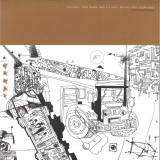
This the debut is being repressed for the first time in a few years. Red Fang is the formation of long time friends and collaborators Bryan Giles (Last of the Juanitas, Party Time), Aaron Beam (Dark Forces, Lachrymator), David Sullivan (Party Time, facedowninshit, Shiny Beast) and John Sherman (Party Time, Bad Wizard, Trumans Water, All Night). Unleashed on New Year's Eve of 2006 in Portland, Oregon, Red Fang stormed out of the gates, introducing a sweaty, seething basement to a new kind of unforgettable fist-pumping, beer-chugging rock music. Since that night, the band has continued with the same intensity, energy, and intimacy to quickly become a touring juggernaut, playing shows all over the US with bands like The Melvins, Big Business, and The Sword, to name just a few. Residing somewhere between Black Flag and Black Sabbath, Red Fang recall a time when rock was more urgent and horrifying. Synthesizing a variety of heavy music influences into their own distinct musical identity, the band easily shifts from barn-burning punk to mid-tempo, hyper-distorted bass destruction all while maintaining a cohesive sound. Red Fang create gigantic rock songs that are easy to listen to (not easy listening, mind you) and qualify the simultaneous usage of both the thinking and the banging head, which are usually mutually exclusive. Their instrumentation is fluid and effortless, and the vocals are delivered melodically and forcefully, with enough rasp and effect saturation to fit nicely within the music. Paired with elemental imagery, the lyrics are immense and satisfying without any pretense.
Поиск:sat
Все
Sie können auf eine treue, langjährig erspielte Gefolgschaft zählen und sind aus dem Metalcore-Bereich längst nicht mehr wegzudenken: Die seit 2003 aktiven Abräumer aus dem australischen Byron Bay veröffentlichen mit "Reverence" ihr sechstes Studioalbum und damit den Nachfolger zum umjubelten Langspieler "Ire" von 2015. Der setzte die Messlatte für kommende Aufnahmen ziemlich hoch, doch die fünf Brachialrocker aus Down Under meisterten die Hürde mit links. Ganz nach dem Motto: Wer Wind sät, wird Sturm ernten. In den Worten von Frontmann Winston McCall stellt sich das so dar: "'Reverence' ist das ehrlichste und persönlichste Album, das wir je erschaffen haben. Es wurde durch Schmerz, Opfer und Überzeugung geboren, mit dem ultimativen Ziel vor Augen, nicht nur das auszudehnen, wofür Parkway Drive musikalisch stehen, sondern auch, wer wir als Menschen sind." Kurz: Auf den zehn Stücken herrscht Nackenhaare-Aufstellgarantie! Genrekonventionen spielen dabei eine untergeordnete Rolle.
- 1: Should Have Seen It Coming
- 2: Mid-Century Modern
- 3: Lonesome Ocean
- 4: Good Days And Bad Days
- 5: Freedom Doesn’t Come For Free
- 6: Reflections On The Mirth Of Creativity
- 7: The Million Things That Never Happened
- 8: The Buck Doesn’t Stop Here No More
- 9: I Believe In You
- 10: Pass It On
- 11: I Will Be Your Shield
- 12: Ten Mysterious Photos That Can’t Be Explained
Billy Bragg has been a fearless recording artist, tireless live performer and peerless political campaigner for over 30 years. Among the former Saturday boy’s albums are his punk-charged debut Life’s a Riot With Spy Vs Spy, the more love-infused Workers Playtime, pop classic Don’t Try This At Home, the Queen’s Golden Jubilee-timed treatise on national identity England, Half-English, and his stripped-down tenth, Tooth & Nail, his most successful since the early 90s. The intervening three decades have been marked by a number one hit single, having a street named after him, being the subject of a South Bank Show, appearing onstage at Wembley Stadium, curating Left Field at Glastonbury, sharing spotted dick with a Cabinet minister in the House of Commons cafeteria, being mentioned in Bob Dylan’s memoir and meeting the Queen. At their best, Billy’s songs present ‘the perfect Venn diagram between the political and the personal’ (the Guardian). Billy Bragg added best-selling author/musicologist to his CV with the success of his acclaimed 2017 book ‘Roots, Radicals & Rockers – How Skiffle Changed The World’. Billy Bragg will release a new single ‘I Will Be Your Shield’ on 14th July 2021. Taken from his forthcoming 10th studio album ‘The Million Things That Never Happened’, ‘I Will Be Your Shield’ is a beautiful love song and is the beating heart of his new record.
- A1: Lanquidity
- A2: Where Pathways Meet
- A3: That's How I Feel
- A4: Twin Stars Of Thence
- A5: There Are Other Worlds (They Have Not Told You Of) (They Have Not Told You Of)
- B1: Lanquidity (Cd2 1978 Philly Jazz Alternate Version)
- B2: Where Pathways Meet
- B3: That's How I Feel
- B4: Twin Stars Of Thence
- B5: There Are Other Worlds (They Have Not Told You Of) (They Have Not Told You Of)
Strut present the definitive official edition of Sun Ra's classic 'Lanquidity' album ,originally released on Philly Jazz in 1978. Recorded overnight at Bob Bank's Blank Tapes on 17th July 1978 after the Arkestrahad appeared on Saturday Night Live, the album is unique in the Ra catalogue. The new 1LP edition of 'Lanquidity' features the widely distributed version of the album originally released on Philly Jazz and reflects the album's original packaging with a metallic foil / magenta sleeve.
The Artists Formerly Known As The Connection Machine (Utrecht, Netherlands) go raw and mean on this one! If the underground The Hague-style from the 90s is your thing, this 12" is your cup of tea. 4 hectic 808/303 trax, all mixed in a dirty way, with loadsa fx on the 303.
The Connection Machine/Cray Emoticon is the multi-talented duo of Natasja Hagemeier and Jeroen Brandjes, who debuted on U-TRAX in 1993 with their instant classic and much sought after 'The Dreamtec Album' (catalogue no: 3 UTR UMM 1). They went on to create another epic release called 'The Black Hole EP' on U-TRAX (catalogue no: 5 UTR UMM 2), but not after they presented 'Bitflower', a true work of art on Planet E from Detroit. Later they released the CD album 'Painless' on Down Low Music and in more recent years two 12"s (shared with The Lost Trax) and an album on Tabernacle Records from the UK.
The title track is originally meant as a replacement for the original game music of level 9 of the 2nd episode (E2L9) of the computer game Doom. The artists thought the original score wasn't doing right to the intensity of the game and made their own apocalyptic soundtrack. 'Gnawing The Heart' already proved its usefulness on many a dancefloor, whilst 'Choice Chip' will satisfy the ultimate speed freaks amongst you. If you're not into drugs or mushrooms, 'I Wish My Zapper Was A Gun' can deliver you the same effects: it's a psychedelic space-acid trip, built around a sample of the sitcom 'Neighbours'.
You can't get wrong with this vintage and merciless dance floor material from the mid-nineties.
Original release date: October 1995.
Two years after the critically acclaimed Pity Party, Liz Lawrence graced us with a return on top form. Crafted in her home studio during the cursed year of 2020, the Avalanche is full of impeccable guitar driven bangers and infectious melodies.
Witnessing Liz playing a stripped back version of album highlight “Drive” a few months back has left the tune on constant rotation in my head. Yes, it is this good.
The Avalanche is still available on a limited green vinyl, packed in a beautifully designed die-cut sleeve.
Comet Records is so thrilled to present Psyco on Da Bus 20th Anniversary, for the occasion it will be reissued as a Double Vinyl LP and newly remastered.
Recorded in just few weeks in the US during Tony Allen's Black Voices album tour in Spring 2000, on Doctor L’s G3 in different places as hotels rooms, local studios (Nyc, Toronto) and the tour bus.
Doctor L and the members of Tony Allen & Afrobeat 2000 band get the idea of making a collective album alltogether, co-writing both songs and music a
nd creating a new spectrum that reflects their different musical backgrounds. Doctor L, Tony Allen, Jean-Phi Dary, Cesar Anot, Jeff Kellner are the “psyco bus” members.
Completed later in Paris with guests artists like Smadj, Dom Farkas and Eric Guathier, Psyco On Da Bus project fill the gap between the 70's and the new millenium, blending afrobeat rhythms, gospel & soul vocals, jazz & funk licks with wicked electronics and astonishing production.
From the futuristic funk of “Afropusherman” to the eastern sounds of “Many Questions” or the killer floor filler “Push your mind Breakbeat” , from the underrated spiritual suite “Time To Take A Rest”, hybrid fusion of free jazz, poetry, rare groove and nu-beats, to the outstanding “Never Satisfied”.
Last but not least the artwork was created and produced by the talented french graphist designer, filmmaker Edouard Salier. Tony told about his collaboration with Doctor L on this project in 2001: “Younger people are coming into Afrobeat right now. And I personally don't want to be past, I want to be future. Young people like hip-hop, and techno, which is what I must think about. It's the direction I want to take. It's an experiment I've wanted to try. That's why I wanted Doctor L to produce the album.”
- A1: Fumiko Yotsuya Let's Dance The Tango
- A2: Kiyoshi Utsumi & Asami Kuji A Wandering Journey
- A3: Kusunoki Shigeo White Camellia Song
- A4: Michiyakko Oh, That's It
- A5: Nakano Rhythm Boys Kazuhisa Yamadera
- A6: Noriko Awaya Blues For Farewell
- A7: Kouta Katsutaro Kanaka's Daughter
- A8: Sato Chiyako Tokyo March
- B1: Wantanabe Hamako I'll Forget It
- B2: Dick Mine Yukari's Song
- B3: Fujiyama Ichiro Recollection
- B4: Kouta Katsutaro & Shigeo Kusunoki Tairiku Bushi
- B5: Issei Mishima Over The Kuroshio
- B6: Fumiko Yotsuya The Izu Dancer (Dancer's Song)
- B7: Hanko Kagurazaka & Toshiro Oumi Hatsukoi Nikki
- B8: Akasaka Koume Is It Really Goodbye?
A further volume of ryūkōka recordings, covering the end of the 1920s though to the late 1930s, supplementing the recent Longing for the Shadow collection...
Emerging during the early stages of the recording industry in Japan, the ryūkōka style adopted western classical, blues & jazz elements into traditional and classical Japanese music.
Is It Really Goodbye? further collects pre-war ryūkōka records which capture the hauntingly unique sound of a cultural merging that was starting to reflect itself via popular song, ahead of the widespread influence of western pop music during post-war US occupation.
- A1: Kumi Nakamura - Kimagure
- A2: Miyuki Maki - Indo No Michibata
- A3: Haruyoshi Yamashina - Osake To Joke
- A4: Sumiko Yamagata - Natsu No Hikari Ni
- A5: Hatsumi Shibata - Party Is Over
- B1: Makoto Iwabuchi - Moonlight Flight
- B2: Hiroshi Sato - Saigo No Tejina
- B3: Arakawa Band - Paradise's Dream
- B4: New Generation Company - I Wander All Alone (Part Iii)
- C1: Kiyohiko Ozaki - Ojosan Oteyawarakani
- C2: Kengo Kurozumi - Juggler
- C3: Ken Nishizaki - Koi No Paradigm
- C4: Jadoes - Simply Another Love
- D1: Midori Hara - Aamar Jabar
- D2: Hitomi 'Penny' Tohyama - Tuxedo Connection
- D3: Mizuki Koyama - Oh! Daddy
- D4: Haruo Chikada & Vibra-Tones - Sofa Bed Blues
- D5: Mitsuko Horie - Chigasaki Memory
A stylish selection of city pop, funk and modern soul from Japanese label Nippon Columbia, selected by DJ Notoya and featuring cult classics and rarities by Hiroshi Sato, Hatsumi Shibata, Hitomi 'Penny' Tohyama & many more.
Annotated by Notoya with journalist Nick Luscombe and artwork by Optigram.
Newly remastered audio.
The selection on ‘Tokyo Glow’ starts with 'Kimugare' a relaxed mid-tempo track by Kumi Nakamura, actually a famous actress who only recorded one album in 1980 for Columbia.
The set continues and flows effortlessly with the sunshine grooves of Miyuki Maki, Hatsumi Shibata and cult keyboard player Hiroshi Sato before the pace starts going faster and funkier with New Generation Company, Kengo Kurozumi - with his superb boogie, 'Juggler'
- and one of the queens of the genre, Hitomi 'Penny' Tohyama with 'Tuxedo Connection'.
Another fine example on the set is the mid-tempo groove of "I Wander All Alone Part III" by New Generation Company, an aggregate group of some of the best Japanese session musicians led by arranger Katz Hoshi and including Hiroyuki Namba (key), Kazuo Shiina (gtr) and Yutaka Uehara (ds) who all played with Tatsuro Yamashita among many others.
There are many other excellent examples in 'Tokyo Glow', showcasing the diversity and specificity of Japanese City Pop during the late 70s and 80s.
Nippon Columbia opened their much-guarded vaults to curator DJ Natoya. Tracks were remastered in Tokyo and the result, ‘Tokyo Glow’, is a unique insight into a most creative period in Japanese music.
- A1: ) Fiend Discovered And Titles
- A2: ) Peter And Rosalind In Attic
- A3: ) Rosalind's Madness
- A4: ) Angel's Claw
- A5: ) Claw In Classroom
- A6: ) Judge By Fireside
- A7: ) Peter Fights Devil, Severs Hand
- A8: ) Judge Drives Off
- A9: ) Mark Alone
- A10: ) Death Of Marc
- A11: ) Angel Naked
- A12: ) Angel's First Curse
- A13: ) Angel's Second Curse
- B1: Return From The Graveyard
- B2: Return From The Graveyard
- B3: Kathy Crowned
- B4: Children Into Church
- B5: Kathy's Ceremony
- B6: Kathy's Rape And Death
- B7: Peter's Ride
- B8: Ralph Chops Tree
- B9: Ralph Saves Margaret
- B10: Margaret Escapes
- B11: Ralph's Wound
- B12: Ralph Bewitched
- B13: Finale And Credits - Total Running Time: 48:B8
Blood On Satan’s Claw – AKA Satan’s Skin in the USA, is a cult British horror movie from 1971. It’s a film from the golden age of British horror, and one that ticks most of the horror connoisseur’s boxes - it stars the Devil, Olde England, it has nudity, strange ritualism, a fair smattering of blood and of course, sublime music. Produced by cult masters Tigon, this film was the perfect companion piece to their earlier Witchfinder General (1968). Set in rural 17th century England, it tells the fine story of a small village that quickly falls under the devil’s spell. It’s brilliantly told and quite beautifully shot with a very fine cast of superb character actors.
Over many years the film has slowly gained a cultish reputation, and there are rumours that good old Tim Burton is a very big fan and used the movie as an influence for his “Sleepy Hollow” production.
The score was never released. Written by Marc Wilkinson, former director of music for the National Theatre, this cult soundtrack takes its lead from “The Devil’s Interval”, but more about that in the next paragraph. Musical appearances from the Ondes Martenot (the earliest electronic instrument) and Cimbalom add to the overall spookiness of this recording. And in 38 years the music has lost none of its depth or addictive, evil hooks. The first pressing sold out many years ago and commands high prices. A repress has been requested for many years.
Here’s Marc Wilkinson’s thoughts…
“The descending chromatic scale which features throughout the music omits the perfect fifth (the only true consonant in the chromatic scale) and therefore highlights the diminished fifth, which ever since the middle ages in Europe has been known as the Devil's Interval!!”
BRIEF ARTIST INFO: Marc Wilkinson was musical director of the National Theatre throughout the 1960s. He scored a number of films in the late 1960s and 1970s including “If” for Lindsay Anderson. Wilkinson currently lives in France.
- A1: (I Can't Get No) Satisfaction (I Can't Get No)
- A2: Respect
- A3: (You Make Me Feel Like) A Natural Woman (You Make Me Feel Like)
- A4: I Say A Little Prayer
- A5: Eleanor Rigby
- A6: (Sweet Sweet Baby) Since You've Been Gone (Sweet Sweet Baby)
- B1: A Brand New Me
- B2: Dr Feelgood
- B3: You Send Me
- B4: Spirit In The Dark
A live experience on its own! A never before released live recording from the Lady Soul ! On July 21 1970 Aretha Franklin made her appearance at the great Antibes Jazz Festival in the south of France. At the head of a twelve piece backing band, "Lady Soul" gave a great performance based on a fine set-list full of hits such as "You Send Me", "Dr. Feelgood", Spirit in the Dark and a couple of tributes to "British Pop", via two heartfelt renditions of the Stones's "Satisfaction" and the Beatles's "Eleanor Rigby".
Aretha Franklin (Piano, Vocals)
Donald Towns, John Wilson, Charles Horse & Clay Robinson (Trumpet)
Chancey Outcalt & René Pitts (Trombone)
Louis Barnett, Miller Brisker, Donald Walden & Charlie Gabriel (Saxophone)
Truman Thomas (Organ)
Ted Sheely (Piano)
Leslie Harvey (Guitar)
Melvin Jackson (Bass)
Hindel Butts (Drums)
Evelyn Green, Almeta Latimer & Wyline Ivy (Backing Vocals)
ARIA & BET nominated rapper and artist Tkay Maidza has announced the highly anticipated follow-up to 2020's Last Year Was Weird, Vol. 2 (The Needle Drop's #1 EP of the Year). Last Year Was Weird, Vol. 3 is the final act of Tkay's EP trilogy. Featuring eight new songs produced by long-time collaborator Dan Farber. To coincide, Tkay has dropped the new single 'Cashmere' and its dreamy, pollen-filled video directed by Jasper Soloff (Tinashe, DJ Khaled) today. 'Cashmere' and its smooth R&B is a satisfying counterbalance to its bombastic predecessors 'Kim' and 'Syrup'.
Für Jay-Z ist es »The Blueprint«, für Kanye West »College«. Die Boygroup Brockhampton nennt es »Saturation« und Goldroger tituliert: »Diskman Antishock«. Der Abschluss seiner großen Trilogie erscheint am
10. Dezember 2021. Getragen ist das Release von dem unbedingten Willen, das Projekt gebührend zu Ende
zu bringen. »Ich wollte einen Hafen erschaffen, an dem Hörer:innen ankommen und immer wieder Neues
entdecken können«, sagt der Kölner. So ist »Diskman Antishock« auch eine musikalische und persönliche
Basis für alles, was kommt. Die »Diskman Antishock«-Trilogie erschafft eine märchenhafte Hyperrealität, die gerade durch ihre Vielschichtigkeit so zugänglich wird. Zudem ist »Diskman Antishock III«, zum
Großteil produziert von Dienst&Schulter, sicher das bisher musikalisch facettenreichste Projekt von Goldroger. »Diskman Antishock III« ist nicht nur der Abschluss eines Albums, sondern auch ein Abschluss mit
den Geistern der Vergangenheit.
Das Album erscheint auf einer schwarzen 180g Vinyl im Gatefold mit Wendecover und einer Chibi Figur
zum selber basteln
Narrow Head’s debut full-length record Satisfac- tion is available once again on vinyl for the first time since its initial release in 2016. Reissued by Run For Cover, this version of the album includes updated album art and a limited color vinyl release. While the band offered a handful of one-off sin- gles and demos prior to Satisfaction’s release, this record offers a perfect introduction to the Houston band’s world.
- A1: Main Title
- A2: Victim
- A3: The Mysterious Creature
- A4: The True Identity Of The Enormous Creature
- A5: Hayashida Research Institute
- A6: Maki And Naoko
- A7: The Soviet Nuclear Submarine’s Crisis
- A8: The Terror In The Ocean’s Depths
- A9: The Ban Is Lifted On The News
- A10: Report 1
- A11: Naoko’s Shorrow
- A12: The Search For The Enemy Begins
- A13: Godzilla Emerges At The Ihama Nuclear Power Plant
- A14: The Destruction Of The Nuclear Power Plant
- A15: Report 2
- A16: The Mt. Mihara Crater
- A17: Us-Soviet Special Envoys Arrive
- A18: To The Prime Minister’s Relief
- A19: Soviet Nuclear Satellite
- A20: Emergency Evacuation Ordered
- A21: The Self-Defense Forces Go To Mt. Mihara
- A22: Coast Lookout Preparations
- B23: Godzilla Appears
- B24: Balashevo
- B25: Godzilla Devastates Yurakucho
- B26: The Guidance Strategy Begins
- B27: Deserted Streets
- B28: The Life Of The Town
- B29: Godzilla And The Magnetic Substance
- B30: The Super-X Mobilizes
- B31: Nuclear Missile Launch
- B32: The Missile Draws Near
- B33: The Giant Beast Collapses
- B34: Super High-Rise Rescue
- B35: The Two Who Were Left Behind
- B36: The Desire To Live
- B37: Nuclear Resolution
- B38: The Red Sky
- B39: Thunder
- B40: The Awakening Of The Giant Beast 1
- B41: The Awakening Of The Giant Beast 2
- B42: The Awakening Of The Giant Beast 3
- B43: The Awakening Of The Giant Beast 4
- B44: Godzilla Vs. The Super-X
- B45: The Terror Of Godzilla
- B46: The Crimson City
- B47: Godzilla Heads To Oshima
- B48: Godzilla Arrives At Oshima
- B49: Godzilla Falls Into Mt. Mihara
- B50: “Godzilla” Ending
He's back! After nine years away from the big screen, the Big G reappeared for his 30th anniversary in THE RETURN OF GODZILLA. Produced by Godzilla's creator Tomoyuki Tanaka and directed by Koji Hashimoto, the picture returns the uber-kaiju to the ultimate antagonist he was always intended to be. Watch as he devastates Tokyo after being resurrected by an underwater volcano and thrill to the dramatic and explosive musical score by Reijiro Koroku!
Having previously worked with Studio Ghibli's Hayao Miyazaki and Isao Takahata, Koroku was the perfect choice to score the Big G's triumphant return, creating no less than three themes for everybody's favourite kaiju. Listen to the rumbling low-frequencies and powerful brass attacks as he ravages a power plant and fights the Japanese Self Defence Forces (JSDF) and swoon to the love theme for Maki and Naoko. Koroku also wrote exciting pieces for the JSDF and the Super-X, a particular machine designed to fight Godzilla. Still, it's his respect and reverence for the Big G that makes THE RETURN OF GODZILLA such a success. The score ends with vocalists The Star Sisters lamenting Godzilla's disappearance, cementing the place he has in our hearts. "Take care now, Godzilla, my old friend."
La Maison's story is essentially an oral one, like for many bands in those years. Casual encounters, records found and exchanged, demos recorded at home, live club shows in a country that in those years was changing socially and culturally at the speed of light, and was molding itself at the rate of a fluid modernity. The tracks of this album, Collected Tape Experiments 1980-1984 tell the story of a world where synthesizers and drum machines coexist and replace traditional rock instruments. Where homemade overdubs broaden the spectrum of sonic possibilities and the "cut and paste" of tapes is done, literally, by hand. A world in which the first infatuations for wave and industrial are contaminated with no prejudice by the rhythms and sounds of funk and disco. A milestone for those who want to understand the vibrant landscape of Italian music of the eighties, many times too hectic and elusive to be captured in real time. Twenty one tracks on CD and twelve on vinyl, most of them never published before, see the light of day more than thirty years after their creation. - Livia Satriano
Interiors, the title of this new release from Ultramarine, may have a topical resonance for many listeners who have found themselves in involuntary confinement during the past year, but the five tracks on this EP were actually recorded in 2011, and they represent a significant opening out of the duo's evolving musical perspective.
Ian Cooper and Paul Hammond, who had become friends while growing up together in the Essex countryside, formed Ultramarine in 1989. Throughout the 90s their distinctive music, an enticing blending of acoustic with electronic instruments, secured a loyal following and won critical acclaim. Then, throughout the whole of the next decade, Ultramarine lay dormant. Interiors documents their reawakening, with Cooper and Hammond exploring approaches to music-making made possible by recently developed software, designed specifically with live performance in mind.
Four of the five tracks to be heard here were issued digitally last year. But as Paul Hammond has pointed out, "with Ultramarine the whole point is to create an artefact, so the form and the look of the finished product is central." That's an outlook shared passionately by Simon Lewin's label Blackford Hill, and the music now available on this vinyl record is appropriately enhanced with cover art by printmaker Katherine Jones. Her imagery matches the music neatly in its nuanced interplay of solidity and shadow, line and colour, geometric form and organic growth.
Ultramarine returned refreshed in October 2011, bursting back into public awareness with "Find A Way," issued as a 7" single on their own label, Real Soon. Clive Bell, writing in The Wire, extolled its engaging mix of electronic beats with cool vocals and tropical percussion. More generally Bell embraced Ultramarine's thoughtful hybrid electronica as "music you could enjoy at home without feeling your intelligence was being scorned, or that if you were not physically in a club, you were wasting your time."
On Interiors, the roots of that slinky single are laid bare on the purely instrumental track "Find A Way Back." Its two distinct parts stretch out the beats and flaunt those tropical flourishes, shuffling and flexing, vibrant and heady, languid and sultry. This is techno filtered through the fabric of magic realism, an exotically spiced concoction, chilled and ready to be savoured at home.
With the diagrammatic clarity of its punchy thrust and spooling loops "Even When" distils the essence of Cooper and Hammond's way of working with their musical material: layering and shaping, nurturing textures, plaiting rhythms and juggling accents. The cumulative impact is almost sculptural in its physical immediacy and looming presence. In contrast, on "By Return" the duo skew the outcome, projecting a selection of limber figures into dub's auditory hall of mirrors. They are clearly revelling in the reverb, relishing the recoil and decay.
Interiors ultimately opens out onto "Decoy Point (Version)." With its ozone saturated ambience, this closing track evokes marshland and mudflat soundscapes, seabird mews, maritime signals and tidal wash. Cooper and Hammond feel deep attachment to the Essex landscape and, in particular, to the local history and physical features of the Blackwater estuary. Blackford Hill provides an accommodating home for Ultramarine's ongoing project Blackwaterside, which has featured to date a 7" vinyl record plus 28-page booklet, and a photo film with soundtrack. Now, delving into the Ultramarine archive, this welcome incarnation of Interiors offers a fascinating glimpse of the duo finding their bearings, at a vital stage along the way.