Following on from the success of ‘For the Rest of My Days’ (Obese records, Fat
Beats NYC, 2011) , ‘Outer Circle Movements’ (Obese Records , Soulspazm , 2013)
and more recently Pegz & Silent Titan - ‘Equilibrium’ ( HydroFunk records), The Silent
Titan returns in 2019 with his forthcoming solo EP, ‘Quiet Elevation’.
Titan, who has been making a name for himself as a producer in Australia for the past
15 years, is eager to see how worldwide Hip Hop fans will take to his sound.
“I always want to make records that can’t be pin-pointed or linked directly to one corner
of the globe”, he says. His production style sees him carrying on the legacy of iconic
sample-based producers such as Pete Rock and Madlib, building on the tradition that
the greats have established before him.
He comments, “As a producer who has great honor and devotion for Hip Hop culture,
I'm here to express to the world through my music what these pioneers have taught me
through their production, build on that style and bring something new and fresh to the
table.”
‘Quiet Elevation’ includes collaborations with MED, Blu, Kota the Friend, Raff Alpha
and Ozay Moore, alongside the Australian-based talents of Minx, Luke Dubber
(Hermitude) and world class saxophonist E.Baker.
The drums hit hard, the sample chops are tight and the synths are heavy.
‘Quiet Elevation’ is less reserved than his previous releases and sees The Silent Titan
really coming out of his shell and exploring new sonic landscapes and arriving at a
point where hip hop heads from around the globe will be forced to stop and take
notice.
Cerca:saxo beat
Previously unreleased live recording of the great tenor saxophonist Dexter Gordon, alongside a star-studded line-up - bassist Niels-Henning Ørsted Pedersen, pianist Tete Montoliu and drummer Alex Riel performing at the classic Copenhagen venue Jazzhus Montmartre, which has now closed. Four tracks from this recording are now available on vinyl for the first time.
Dexter Gordon (1923 - 1990) was an American jazz tenor saxophonist and an Academy
Award-nominated actor (Round Midnight, Warner Bros, 1986). He is regarded as one
of the first and most important musicians to adapt the bebop musical language of
people like Charlie Parker, Dizzy Gillespie, and Bud Powell to the tenor saxophone. His
studio and live performance career were both extensive and multifaceted, spanning
over 50 years in recorded jazz history.
“Gordon was in great form, and his supple, mercurial style, with a tendency to phrase
just behind the beat, would have been pretty demanding, but Riel, Montoliu and
Ørsted Pedersen rise splendidly to the occasion. You can tell that Gordon feels at home
from the number of outrageous quotations he inserts into his solos, but the warm, dry
breadth of his tone, clarity of improvised line and sheer command of the instrument
are uplifting.” - The Observer
The shadow that Gary Bartz casts over the last six decades of progressive Black music, and his continued dedication to same, makes him a logical and very welcome contributor to the Jazz Is Dead label. An alto saxophonist steeped in the history and tradition of his instrument who is also restlessly experimental and not prone to purism of any kind, he enjoys both the respect and admiration of his peers and the hero worship of several generations after him - including Adrian Younge and Ali Shaheed Muhammad, which inevitably led to Gary Bartz JID 006. A look at his body of work reveals dalliances with bebop, hard bop, free jazz, spiritual jazz, soul jazz, jazz-funk, fusion and acid jazz, all while resolutely remaining unmistakably Gary Bartz. There's early work with Eric Dolphy and McCoy Tyner in Charles Mingus' Jazz Workshop, work with Max Roach and Abbey Lincoln, a stint in Art Blakey's Jazz Messengers, and also one with Miles. There's his groundbreaking and highly influential Ntu Troop albums of the early '70s and his jazz-funk work including two classic albums with the Mizell Brothers, one of which supplied A Tribe Called Quest with a sample that was smooth like butter. And while on the subject of samples, the Bartz catalog has provided hip-hop and other genres with a rich source of them, and artists who have gone to his well when producing beats also include Black Sheep, Jurassic 5, Casual, RPM, Warren G, Photek, Statik Selektah, Chi-Ali, 3rd Bass, Showbiz, ZTrip, Young Disciples, and many others.
- 01: Mosaïque Bleu (Leonhard Kuhn / Patricia Römer) Feat. Nesrine, Vocals / Nils Landgren, Trombone
- 02: Ai 101 (Leonhard Kuhn) Feat. Jelena Kuljić, Vocals / David Helbock’s Random/Control (David Helbock, Piano, Keys, Synthesizer & Fx / Andreas Broger, Tenor & Soprano Saxophone, Flute / Johannes Bär, Tuba, Trumpet, Beatbox & Didgeridoo) / Wolfgang Haffner, Drums
- 03: Make Craft Perform (Leonhard Kuhn) Feat. Viktoria Tolstoy, Vocals / Nils Landgren, Trombone
- 04: Green Sun (Theresa Zaremba) Feat. David Helbock, Piano, Keys, Synthesizer, Fx & Toys / Jakob Manz, Alto Saxophone
- 05: Der Literat (Leonhard Kuhn) Feat. Jelena Kuljić, Vocals / Jakob Manz, Recorder
- 06: Hurricane Ride (Andreas Unterreiner / Antonia Dering) Feat. Viktoria Tolstoy, Vocals / Kalle Kalima, Guitar / Wolfgang Haffner, Drums
- 07: What It Is (Leonhard Kuhn)
- 08: Decadence (Andreas Unterreiner / Antonia Dering)
- 09: Shuffling Steps (Leonhard Kuhn)
- 10: Green Sun Return (Theresa Zaremba) Feat. David Helbock, Piano, Keys, Synthesizer, Fx & Toys / Jakob Manz, Alto Saxophone
“Jazzrausch Bigband is making jazz sexy again” -
Bayerischer Rundfunk
The ensemble’s ingenious mix of techno and big
band jazz has proved to be just as accessible to
people listening to the band from the comfort of
their seats in a concert hall as it has to those
sweating it out on the dancefloor.
Since 2015 Jazzrausch Bigband have been in
residence at Harry Klein in Munich, a club
renowned for its house and techno acts as well as
for its stunning live visuals; this cooperation
between a techno club and a big band is a truly
unique one.
DownBeat magazine singled out not just the
band’s “high-voltage performances” and “party
atmosphere” but also the amount of
experimentation going on.
LP pressed on 180g vinyl.
British Heavy Metal legends Saxon will deliver a full-roar-fun-down set of covers on March 19th 2021 (Silver Lining Music), with their latest album Inspirations, which drops a brand new 11 track release featuring some of the superb classic rock songs that influenced Biff Byford & the band.
From the crunching take on The Rolling Stones’ ‘Paint It Black’ and the super-charged melodic romp of The Beatles’ ‘Paperback Writer’ to their freeway mad take on Jimi Hendrix’s ‘Stone Free’, Saxon show their love and appreciation with a series of faithful, raw and ready tributes. Recorded at Brockfield Hall near York, UK, with a firm eye on the old school way using Marshall cabs, Marshall amps and real drums, Saxon approach the likes of Motörhead’s ‘Bomber’ (with added whistle!), AC/DC’s ‘Problem Child’, Black Sabbath’s ‘Evil Woman’ and a raucous Deep Purple’s ‘Speed King’ with refreshingly warm, unfiltered, “vintage” sounding renditions.
Byford takes on some new vocal challenges, which he duly smashes on the likes of Thin Lizzy’s ‘The Rocker’. Saxon do a supreme job of entertaining both themselves and their audience throughout Inspirations. For even more proof of the validity behind that statement, wrap your ears around their sparkling take on Toto’s ‘Hold The Line’ and consider Saxon’s Inspirations a mission accomplished.
“Nothing ever really disappears,” Cassandra Jenkins says. “It just changes shape.” Over the past few years, she’s seen relationships altered, travelled three continents, wandered through museums and parks, and recorded free-associative guided tours of her New York haunts. Her observations capture the humanity and nature around her, as well as thought patterns, memories, and attempts to be present while dealing with pain and loss. With a singular voice, Jenkins siphons these ideas into the ambient folk of her new album.
An Overview on Phenomenal Nature honors flux, detail, and moments of intimacy. Jenkins arrived at engineer Josh Kaufman’s studio with ideas rather than full songs — nevertheless, they finished the album in a week. Jenkins’ voice floats amid sensuous chamber pop arrangements and raw-edged drums, ferrying us through impressionistic portraits of friends and strangers. Her lyrics unfold magical worlds, introducing you to a cast of characters like a local fisherman, a psychic at a birthday party, and driving instructor of a spiritual bent.
Jenkins’ last record, 2017’s Play Till You Win, confirmed the veteran artist’s talent. Evident of Jenkins’ experience growing up in a family band in New York City, the album showcased her meticulous songwriting and musicianship, earning her comparisons to George Harrison and Emmylou Harris. Jenkins has since played in the bands of Eleanor Friedberger, Craig Finn, and Lola Kirke, and rehearsed to tour with Purple Mountains last August before the tour’s cancellation. Her new record departs from her previous work in its openness and flexibility, following her peripatetic lifestyle. “The goal is to be more fluid, to be more like the clouds shifting constantly,” she says. The approach allowed Jenkins to express herself like she never has.
On album opener “Michaelangelo,” before the heavy drum beat and fuzz guitars enter, Jenkins sings quietly “I’m a three-legged dog, working with what I’ve got / and part of me will always be looking for what I lost // there’s a fly around my head, waiting for the day I drop dead.” Phenomenal Nature thrives in this dichotomy between ornate sonics and verbal frankness, a calming guided tour to the edge. Later, on “Crosshairs,” amid lush strings, she sings conversationally: “Empty space is my escape / it runs through me like a river / while time spits in my face.”
“Hard Drive,” the third track and album centerpiece, opens with a voice memo Jenkins recorded at The Met Breuer: a guard muses about Mrinalini Mukherjee’s hybrid textile and sculpture works, which were then on display in a retrospective titled Phenomenal Nature. “When we lose our connection to nature, we lose our spirit, our humanity,” she explains. Stuart Bogie's saxophone & Josh Kaufman's glittering guitar make way for Jenkins' spoken word which constellates scenes from her life, gradually building and blossoming as she recreates a meditation guided by a friend who incants, “One, two, three.”
Sounds of footsteps and bird calls run through the album’s glittering conclusion, “The Ramble.” Meditative and bright, it recalls how Jenkins felt while writing and recording her new material: “Everything else is falling apart, so let’s just enjoy this time,” she said. If Phenomenal Nature has a unifying theme, it’s the power of presence, the joy of walking in a world in constant flux and opening oneself to change.
Alto saxophonist, composer and producer Logan Richardson’s career has been marked by his deep engagement with the Black American improvised music tradition as much as by his fearlessly open-minded embrace of the contemporary sounds of the global diaspora and his keen gaze towards the future.
‘AfroFuturism’ (his fifth solo album) synthesises all those elements together into a stunningly audacious statement that is epic in its scope while providing a deep, intimately personal view into its creator’s inner life.
The core of the album is a series of towering alt-rock/trap/wonky beat soundscapes created Logan’s extensive range of keyboards, synthesizers and programming along with the latest iteration of his Blues People band - Igor Osypov
on guitar and Peter Schlamb on vibes and keys, with Dominique Sanders on bass and sharing production duties, and the thunderously virtuosic drumming of Ryan J. Lee and Corey Fonville rounding out the rhythm team.
Logan intersperses these with an array of diverse sonic interludes, scraps of found audio, unexpected, limpid pools of introspective strings performed by Ezgi Karakus and quiet glades of hushed balladry from long-time collaborator, vocalist Laura Taglialatela. Over all, his unmistakable keening voice on alto sax provides the constant narrative thread. “I was trying to get back deeper to the core of my artistic voice: using fresh production processes to mix in my interconnected influences and all the sounds I hear, while trying to find a sense of roots.”
As one of today’s most singular voices in contemporary music, with AfroFuturism Richardson delivers not only a hugely impressive statement, but one with a direct and urgent message for the future that is rooted in his own and the larger contemporary Black American state of affairs, while reminding us of his musical unpredictability. One can only imagine what he’ll do next.
Despite having been one of the most devastating years in the history of electronic music culture, 2020 has also brought about some creative momentum for music producers worldwide. In the case of Space Echo, it presented an opportunity to complete their third EP for Luv Shack Records.
The energy fuelled “Cha-Cha” is a title track that boasts with all the elements we’ve come to expect from a Space Echo joint; uplifting live drums blended with a classic 4-to-the-floor beat, a funky syncopated bassline, motivational vocal chops and lots of grainy delay. This time however, the main theme is played by a live saxophone that seamlessly fits the formula by switching between rhythmic and melodic phrases throughout the track.
The B-Side takes us to the laid back funk that is “Another Dream”. This sombre slice of sunrise music is jam packed with lush rhodes, live bass and sax and quirky mellotron melodies to boot.
Polish sound wizard Das Komplex gives “Another Dream” the remix treatment, churning out an uptempo disco rendition that is meant to be played on balearic beaches and sweaty afterhours alike.
Ralph Heidel is one of the young musicians that represent the spirit of Berlin’s new musical ecleticism better than others. He is part of the avantgarde circles that mix modern jazz and contemporary classical music with elements of new electronica and experimental ambient music. This is the vibe of Germany's next generation.
Heidel creates a sonic universe that is unique. He takes the listener into a deep, atmospheric travel that stimulates emotions and feelings on a different level. Heidel brings together two worlds: what he learned at Musikhochschule München, Germany’s leading academy for classical music where he studied saxophon and composition and the moods happening in Germany's new electronic circles.
On „Relief“ Heidel created six songs. Except one, all of them are instrumental music. Partly composed and often improvised these sounds take the listener into Heidel's specific sonic universe. Raw beat structures, emotive horn lines, strong harmonical tensions and dramatic build ups. Heidel’s signature sound.
In fact Heidel is a multiple influenced artist with a strong personality that absorbs whats around him, connects it with his own wide artistic knowledge and fullfills it into magical musical moments.
Relief is the next step in what could become a longtime artistic career.
After a (very composed) debut album for string quartet and rhythm section for Kryptox (Moments of Resonance 2019), it was important for Heidel, to process current feelings of daily life.
Not just his cultural learnings, but also emotions connected to the hard COVID times and a lot of personal experiences.
Relief are six abstract, distorted patterns. Long deep transitions that lead into euphoric parts of sonic greatness. Heidel's sense for sound design and the soft tone of his saxophone phrases, add a personal note that is somehow alone in the current music scenario. Sampling his saxophone (reeds, keys etc.) to create very organic beats is one of the many techniques to create that special „Heidel“ sound. Also his calm and wide harmonies over disquiet, rough drums are part of his unique ambivalent, disrupted moods.
Most of this EP has been played by Heidel alone. For a few parts he was joined by musicians from the local scene. In fact besides his albums on Kryptox Ralph Heidel is very connected in Berlin’s current cultural playground: He creates music for underground performance art happenings in Neukölln as well as for new German theater (Volksbühne, Berliner Ensemble). Also German rapper Tarek from K.I.Z heard about Heidels string debut album, so they collaborated for an album, where Heidel reworked his record for stringquartet, piano, drums and bass.
An exploratory record that dances across time and genre, guided by fidgety miniatures and jazz inflected collage. Throughout, the band pool together their instrumental chops, moving from fluid and serpentine R&B to meditative, minimalistic piano, evoking a contrast of virtuosity and self-surrender.
While constructed from the inspiration of soul, funk and film music, BÉE mediate those influences having first digested them through the productions of Madlib & the RZA.
A sticker on the sleeve tells us Self Help “combines jazz-funk and mysticism,” a signpost to where its musical and spiritual concerns align. The jazz-funk component translates to arresting hooks in sideways song forms: echoes of Gainsbourg spooled through Azymuth-style Brazilian jazz and punctuated by the whip and snap of Steely Dan. “The Sound Where My Head Was,” the instrumental centrepiece, exemplifies present-wave jazz but also ancient sounds, giving off the mothballed air of a Hiroshi Yoshimura record in a library-music archive.
Self Help’s mysticism emerges in broad and specific ways, denoting not only a search beyond cliché and intellect but also an inquiry into the beat, the spirit, the one will. This isn’t new territory for them: Turnbull—the artist formerly known as Slim Twig, who writes and performs with U.S. Girls and various other Toronto concerns—named the group’s Nature, Man & Woman EP after the Alan Watts book. Building these songs from his drafts over three weekends at Toronto’s Palace Sound studio, the ensemble was free to tap out of the city and into some other place, taking up residence in a collective mind maze. The album produces, in equal measure, familiar surprises and the surprisingly familiar. Intoxicated jazz riffs swerve left at phantom intersections. Rhythms cut loose and tie you in knots. But wired in to each song is a sense of gentle accumulation, making every featherlight flourish weigh a ton. U.S. Girls’ Meg Remy brings serenity to “Sing a Silent Gospel,” and wears its antic melodies lightly. The soul shimmer of “Unity (It’s Up to You)” lets the players pool their R&B chops into something fluid and serpentine while, on guest vocals, the musical performance artist James Baley issues urgent declaratives: “Water must pool, as a rule, before tasted/Or else the water is wasted.” The words throughout the record complement the ensemble music while riffing on the precarious nature of unity itself. Then, closer “Extinct Commune” finds Turnbull deserted at the piano, playing phrases of meditative minimalism taking after the composer Joanna Brouk.
For all the record’s reach, it is these contrasting quiet moments that bring Self Help’s communal spirit into focus. A note on personnel: Badge Époque Ensemble now has a seventh member in Karen Ng, the saxophonist and sometime collaborator of Do Make Say Think, Feist, and others. In BÉE, Ng joins Chris Bezant and Giosuè Rosati, her bandmates in the Andy Shauf live band, as well as U.S. Girls co-conspirators Turnbull and Ed Squires, and other Torontonian cross-pollinators listed below. Guest vocalists across Self Help include Meg Remy, who sings with Dorothea Paas on the opener, James Baley, and Toronto singer-songwriter Jennifer Castle on the remarkable “Just Space for Light.” Words by: Jazz Monroe
LINER NOTES BY JOHN-PAUL SHIVER:
Reinier Thijs a.k.a. Thijsenterprise's new project Lahringen begins where most of his previous creations have left off. Through reedy skronking sax, no easy listening aesthetics here, we get that passport to the '80s. The intersection between Lou Reed's old New York attitude and the encroaching rhythmic assault about to hit. Post-punk, featuring steady bass lines—peak demon Jaco to cool as fuck Slits era—in transit.
The first track in, bumping new-wave-jazz bravado, immediately covers those grounds the Dutch native likes to dig in on. He pays tribute to Gato Barbieri with "El Arriero", continuing in that off-kilter mash-up of sound textures. This time its beats and machismo.
But "Sketchy", an original arrangement, taps Reinier's dedication to skateboarding. Named for when skate rats land a trick sloppy, non-smooth, or ugly he does in fact match the sound of the bass with the feeling of ‘meh.’ “The drums and percussion in the track carry a driving pulse, and the saxophone plays a light melody, ping-ponging between the groove of the rhythm section, making the track very repetitive, catchy," stated Reinier.
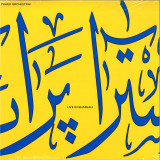
3 x LP - Live in Sharjah Box Set + Booklet. designed by Lorenzo Mason Studio.
If you’ve ever travelled to Egypt and wandered through its crowded streets, you probably ended up buying a cassette or a CDR of popular synth based music heard in most cabs, cabarets, or alleys around town: the almighty Shaabi.Raed Yassin and Paed Conca based their project PRAED on research between Shaabi and Mouled (traditional trance music from Egypt) and the hypnotic structures of both these genres. Repetitive beats, loud Mizmar and loads of energy, with a strong influence from psychedelic rock, free jazz and electronica.
During the years in which the duo produced 4 albums and performed on an endless number of stages around the globe, PRAED started working on anambitious expansive project: an orchestra that could transpose this study of rural and popular culture into an immense, iconic work. In autumn 2018, supported by the Sharjah Art Foundation, PRAED Orchestra! premiered “Live in Sharjah”, interpreting new material merged with some of the band’s iconic pieces. The composition process started with the choice of musicians: the line-up consisted of some of the most innovative artists coming from a wide spectrum of musical practices. Each musician was chosen for a defined role, and the common denominator was their capacity to interpret written material, and their ability to improvise effortlessly. Each role was clearly set to work in unison with the rest of the group, while simultaneously sustaining a centrality in the choir. Solo parts masterfully drawn over the structure as a fil rouge connecting every piece of the entire concert; massive and powerful orchestral sections leading to a breathtaking trance-like state of mind; all of this material ultimately coalescing into an Egyptian Operette that narrates the sorrow, love, and deeply rooted culture of this urban music called Shaabi.
Paed Conca: Clarinet, Electric Bass, Electronics
Raed Yassin: Synthesizers, Vocals, Electronics
Alan Bishop: Alto Saxophone, Vocals
Nadah El Shazly: Vocals, keyboard, Electronics
Christine Kazarian: Electric Harp
Hans Koch: Bass Clarinet, Soprano Sax
Martin Kuchen: Tenor Saxophone, Baritone Sax
Maurice Louca: Keyboard, Organ
Radwan Ghazi Moumneh: Buzuk, Vocals, Modular Synthesizer
Sam Shalabi: Electric Guitar, Oud
Ute Wassermann: Vocals, Mouth Harp, Whistles
Khaled Yassine: Drums, Percussion, Darbuka
Michael Zerang: Drums, Percussion
Recorded live at Calligraphy Square on November 3rd, 2018 in Sharjah, UAE by: Sudish Suman & Shuaib Ahmad Poonthala
Edited by: Rabih Beaini at Morphine Studio, Berlin, Germany
Mixed by: Radwan Ghazi Moumneh at Hotel2Tango Studio, Montreal, Canada. Mastered by: Harris Newman at Grey Market Studio, Montreal, Canada.
Artwork by Lorenzo Mason Studio.
Project manager : Simsara Music
“Easy rider, come and take me higher”. When the world seemingly crumbles around, music can provide an escape few other mediums can. For their debut self-titled LP, Velour effortlessly levitate you above the madness below, each track taking a new turn, cruising over hazy flecked skylines, bustling walkways and bleary eyed bedlam. A trajectory that takes in all of jazz’s vibrancies, blending elements of neo soul, broken beat and hip hop coupled with a much-needed sense of hope across nine deep, soul-searching tracks released via WOLF Music Recordings.
A style and sound taking influence from genres and moods, environments and experiences, Essen-based Velour stretch their legs for this, their first full length album. From the off, they nestle you under their wing with the rustling sax washes of opener ‘CLP’ before diving into an epic slo-mo burner, swooping down into the chaos as singer, Eva Czaya, wistfully narrates the scenes beneath.
Unafraid to shift pace within songs, the likes of ‘Pose’, sauntering from soulful summer groove into woozy late night affair, and ‘Tom's Garage’, that progresses from roadside recounting to grungy basement blowout, finished with a sample of jazz-tinged dusty beats, show that accomplished and adept heads rest on the shoulders of these relative newcomers.
WOLF Music mainstay Mr Fries continues to head up production for Velour, his trademark touch capturing the intimacy of Velour’s sound presenting it in a way that’s considered yet raw - nothing feeling rushed, nor cluttered. A separation and space that gives each element the room it deserves to breathe, with short interludes and skits providing the perfect bridge between tracks, guiding you through smokey jazz bars and twilight whisperings.
Moving through the album, Czaya at points wanders in a serene spoken dialogue, at others letting her voice loose, but always with an ethereal demeanour that comes off with natural ease. One of many highlights, ‘Anthony Davis’ shows off this celestial prowess whilst perfectly embodying Velour’s dream-like escapism. A pent up release of creativity, as moody bass tones mix with deft keys, rolling snares sit behind swirling saxophones.
The journey ends with ‘Luminate’, a transcendent closer laced with space-echoed vocals that reverberate around over-driven Rhodes and feverish drums. Cymbals crash, as modulated synths rise, building and building before easing you off into the night and on your way to a parallel universe.
As a body of work, ‘Velour’ is a shining example of the freedom, energy and enthusiasm of the new school of jazz that’s been captivating minds the world over. An instant on repeat staple - let go, feel the flow, it’s what we need in a time like this.
“Semilla” ist das Kollabo-Debütalbum von Multiinstrumentalist Pachakuti und Produzent young.vishnu. Pachakuti ist ein klassisch ausgebildeter Saxophonist und Pianist mit Hang zu Jazz und lateinamerikanischer Musik. young.vishnu ist Beatmaker, Arrangeur, Sampleologist und Gründer des Nima Composition Archive. Beide lernten sich vor 5 Jahren in Hildesheim kenn und freundeten sich auf einem gemeinsammen Raod-Trip ins Baskenland an. Pachakuti und young.vishnu gründeten eine neunköpfige Band namens Soularkestra die der Ausgangspunkt für ihr neues Projekt war. Auf “Semilla” vereint das Duo Hip-Hop, Jazz, Latin, Funk und Soul mit starken Botschaften zu Politik, Identität, Globalisierung und Neokolonialismus.
When Yiğit Bülbül knocked on our door and put his debut album on the table, Fever took our hearts in a storm. The Turkish born, London based musician and producer knows how to craft his own contemporary avant-garde pop projections with a rich musical heritage shining through from the 1980s and 90s. His style erupts into silly, absurd moments of synth blurps, percussive extravaganza and psyched horns, It’s always colourful and trippy, but in a light way. It’s exactly what we want to release in a year of distress. The album is framed by two contemplative tracks, which are reminiscent of Holger Czukay’s oeuvre. The saxophone in the opening track "The Heath" undulates like an introvert leading voice in a meditation. The long and meticulously crafted ambient outro "Txalaparta" features a spoken word sample by the Basque folk musician Txomin Artola from 1978. The four tracks at the heart of the album are beat driven, percussion-heavy, loaded with synths and random horn samples. "Alo?" sounds like Snakefinger tries to get on a Skype call with Serge Gainsbourg. "Cacti All Over My Head" could well be a Ween instrumental with long arching synth lines over a slowed down bossa nova beat. Fever is a frivolous album which bursts with exalted charm and guest musicians. This is not another greetings-from-the-lockdown album, but with the obvious reference in the title it’s almost a tongue-in-cheek name about creative obsessions of our times. It's the debut album by the multi-instrumentalist Y Bülbül who has learned his trade working with various interesting artists and bands in London in the past 10 years. He is also a passionate crate digger and DJ. His own radio show is unerringly titled "Bülbül's Gemüsement Park", which airs on Netil Radio, a community broadcasting station in Hackney. Bonus fact, Bülbül is the Turkish name for a brown-eared passerine bird, one that's into singing.
- A1: Rush Hour/Elegua (Feat. Kevin Haynes Grupo Elegua)
- A2: Frontline (Feat. Kevin Haynes Grupo Elegua)
- A3: Rye Lane Shuffle
- A4: Drum Dance
- A5: Axis Blue
- B1: City Nocturne (Feat. Zara Mcfarlane)
- B2: Waiting On The Night Bus (Feat. Terri Walker & Louis Vi)
- B3: Marooned In S.e.6 (Feat. Kevin Haynes Grupo Elegua)
- B4: Ancestors (Feat. Kevin Haynes Grupo Elegua)
Moses Boyd is at the forefront of the New British jazz scene having worked and recorded with like of Giles Peterson, Four Tet, Sons Of Kemet, Zara McFarlane and more. With 2 MOBO Awards to his name and Multiple Releases via his Label Exodus Records. Moses has established himself as one of the leaders in bringing the worlds of Jazz and Electronic music together.
This latest release is taken from the same sessions that brought us Rye Lane Shuffle. Displaced Diaspora is a collection of music from Moses Boyd recorded in 2015 that features some of the now leaders of the New British Jazz Scene Such as Theon Cross, Nubya Garcia and Nathaniel Cross. As well as the Iconic British Soul Vocalist Terri Walker, Saxophonist and Bata Player Kevin Haynes and his group, Grupo Eleggua and Rapper Louis VI. The music is a mix of Jazz, Yoruba chants with Hip Hop and electronica influenced beats.
Hailing from Brussels, Bandler Ching is a creation of musical ideas from composer and saxophonist Ambroos De Schepper. Flawlessly blending contemporary jazz, electronics, hip-hop, noise and global beats, the sound is based around the freedom of expression and improvisation and performed with dazzling conviction.
After setting the souls on fire with the exciting “Madera Negra EP” from Nina Simmons, Salgari Records is back on vinyl with Chalanga to dive yourself in the sea of emotions of “Paradisea EP”.
Afro Cosmic House surrounded by hypnotic beats and shamanic saxophones, organic grooves and ancestral flutes.
This is the 1973 solo album by Ghanaian percussionist Anthony Kwaku Bah, who was given the nickname „Reebop“ by American
jazz legend Dizzie Gillespie. He passed away early at the age of 39 in Stockholm in 1983, but before made himself a name for his
works with UK 70s rock heroes TRAFFIC and German Krautrockers CAN, amongst others. If you might expect here the prototypical
Afro Beat and Afro Rock you mostly know from British bands, you will be surprised that this is only one part of the deal. Yes, there
are African elements to be found, buried somewhere in this boiling cauldron where polyrhythmic grooves are the base for jazz
improvisations by the brass section, that range from naughty swing and bebop, to freaked out free jazz and enchanting soul jazz
the way it was popular in the late 60s. The arrangements are utterly lush with so much going on here in every aspect that you
would get lost if there was no trace of melody to be discovered, but there they are and they tell you fantastic stories of exotic
places that only exist in your wildest dreams. Kwaku Bah’s rhythm patterns grab you by the horns and pull you into a world of
their own. Hypnotical, irresistible, hot and vivid. The tunes combine jazz, soul, funk and each one is constructed like a self –
contained story. One could imagine these tunes being used as library music for 70s movies from action to romance. All pieces
though are characterized by the constantly pulsating rhythm. To avoid drifting into the field of insubstantial disco dance music,
the performances witnessed here were executed with the highest possible emotional intensity and dedication. Lay back, close
your eyes and float away on a raft of sound upon the wild river of grooves and melodies. Some haunting Exotica jazz passages
with a typical „jungle“ feel get thrown in for the good measure. There are even vocals in an African language hard to identify,
which create and even more mysterious atmosphere. This is just an introduction part of another powerful speed funk groover but
the vocals stay and make this a clear standout track. Saxophone and guitars seem to have a duel here. You will not sit still while
having this tune „Iphonohimine“ coming down on you like a thunderstorm. Blues, Afro Beat, Psychedelic Rock, Funk, it can all be
found in here and the band goes wild into an everlasting improvisation that deprives you of your breath. Can this record get even better? Do not ask, just enjoy what comes next. If you think that some melodies by the giant brass section sound a bit too catchy
just reach out beyond these harmony lines and find yourself in a thicket of grooves, pulsations, bits and pieces of melody with a
dense, sultry atmosphere. Some smaller parts might make you think of cruise ship big bands and white suits, but everybody will
soon drop these and dance in their underwear for the hot blooded power funk base of the tune called „Africa“, which will take
over one’s soul and set it on fire. So clean, so nice and so filthy and dangerous at the same time, this album is a masterpiece of it’s
style. The exciting and very sensual funk rock of „Lovin‘ you baby“ with crazy fuzz guitars and a dark and haunting approach is
another reason to kneel down when you put this record onto your turntable. Great clean lead guitars give it a latin garage rock
edge Carlos Santana would commit serious crimes for. If you love bands like OSIBISA, Eric Burden & WAR, GINGER BAKER
AIRFORCE, SANTANA, Miles Davis, all around 1969 to 1973, this is what you always wanted to listen to. Grab your copy now.
THE KILIMANJARO DARKJAZZ ENSEMBLE are a project which has always been tied to films. Films are luxurious because they dispose of all these boring, unimportant, and trivial parts of our lives. This allows them to fully control our sensations, to put us in a very specific mood. Joy and sadness are occasionally OK, endless joy or endless sadness are clinical. But there is one sensation which can be persistent and unconditionally bearable at the same time. In the absence of a better alternative, let's call it "the mood". The mood is what TKDE are aiming at. The mood.
The mood is infinite and illimitable, but not uniform and unique. On "From The Stairwell", TKDE deliver eight new incarnations of the mood. Stairwells have always been intriguing. They appear to unavoidably lead you to your destination, but they only disclose the path bit by bit. What lies far ahead of you and far beyond you is hidden in the shadows. The stairwell could just as well be infinite. You climb up this murky stairwell, passing by many doors. Every door contains a variation of the mood, a short film, a song. You open the first one, "All Is One". The evaporating mist discloses a large and empty room with a barstool in the middle. On the barstool, a chanteuse from the roaring twenties. Her voice starts to trigger vibrations of the ground, the walls start spiralling around her, but she remains untouched in the eye of the storm. Second room, "Giallo". Sly guy, telling smile, nice suit. Walking down the streets in the dusk. The ambience starts to get out of phase, the guy stumbles in horror while blending with the surrounding to a brown soup. Fourth room. "Cocaine". Naked people with pig heads crawl on the floor, on the walls, on the ceiling. They try to hopelessly suck up the white dust which covers every single piece of this room and is constantly spit out by tubes coming out of the walls. Dissonant sounds accompany the work of this desperate hive. As the people manage to counteract the tubes, fragile melodies start to overpower the dissonances. Sixth room, "Cotard Delusion". Baby morphing into a black fluid morphing into an old man which turns his eyes inwards and finds his inside to be completely empty. The journey up the stairwell, down the stairwell, continues. The pictures fill your head and make you forget where you wanted to go in the first place.
"From The Stairwell" is a surprise and a logical step at the same time. It is a surprise because the songs are far less beat-driven in comparison to TKDE's earlier works, and even contain a few hopeful tints here and there. It is a logical step because in the end each song turns to have a very diverse dramaturgic flow. This could raise the conjecture that TKDE, initially started out to make music for existing and non-existing films, wanted to incorporate the audiovisual impression completely into songs, making the films superfluous. At times, "From The Stairwell" makes you think of 60's soundtracks, but the organic feeling of those is always interwoven with mechanical elements. Altogether, every single of the numerous details present in TKDE's new songs feels to be at the right place and you can either just dive into the mood or pick one of the many aspects and enjoy it on its own - be it Gideon Kiers' beats & fx, Jason Köhnen's bass & piano, Hilary Jeffery's trombone, Charlotte Cegarra's voice & piano, Eelco Bosman's guitar, Nina Hitz' cello, Sarah Anderson's violin, or - appearing as guest musicians - Eiríkur Óli Ólafsson's trumpet and Coen Kaldeway's saxophone & bass clarinet.