17 Steps present ‘New Atlantis’, a 5 track EP from versatile DJ, producer and dance music historian Chrissy.
The EP takes its name from an unexpected source – a 17th century utopian novel of the same name by Sir Francis Bacon, depicting a future society in which science has become the ruling principle. It’s an inspiring idea for Chrissy – an antidote to the assault on truth and intellectualism led by climate change deniers, anti-vaxxers, flat earthers, creationists, unfit-for-office demagogues and the slow suffocation of fact-based journalism.
‘New Atlantis’ explores the utopian worldview implicit in early rave music, drawing on classic Chicago house, UK hardcore and Drexciyan electro. The result is a collection of jacking breaks and bass infused dance music washed with a bittersweet euphoria – celebrating and lamenting an era’s forgotten optimism.
Search:science fact
The music of Chel White is celebrated in Automaton, a collection of mostly unreleased recordings from 1985 to 1991, by this innovative animator, film maker and visual artist.
Having studied music theory in grade school, White taught himself drumming and played in a new wave band until, in 1981, together with Dan Gediman, they formed the minimal wave duo Process Blue (Alternative Funk, 1985 / Dark Entries, 2018). Here their experimentation went way beyond playing drums.
His interest in industrial music, fostered in the late '70s and early '80s while working in factories as a way to put himself through college, informed his use of electronic instruments, tape manipulation, noise and unconventional percussion.
By 1985, as a now solo artist buoyed by newly affordable audio sampling technology, White tapped into his earlier teenage fascination with the art and films of both the Surrealist and Dada movements - in particular their disparate and fragmented imagery and sound - as a means to create striking new sonic palettes.
Science & Industry - a track largely influenced by Balinese monkey chanting and the consumer excess of American in the 1980's - is a clear example of "music collage". Photocopy Cha Cha, made for the short animation film Choreography for Copy Machine (Berlin International Film Festival, 1992 / Sundance Film Festival, 2001) moved his music into the realm of early multi-media.
Experimenting further, tracks like Liquid Shadows and Pensive provide minimalist moments, before the drone-like Dream #630 and Forest Song point to a future that included music video works (David Lynch/Thom Yorke).
Airplay:
Ben Ufo - Hessle Audio Show, Object Blue - Rinse Fm Show, Leon Vynehall - Ra Mix, Shanti Celeste - Nts Show, Courtesy - Nts Show.
Dj Support:
Airhead, Anina, Bake, Ben Ufo, Bleaker. Bruce, Chekov, Ciel, Courtesy, Facta, Forest Drive West, Gigsta, Haai, Hodge, Laksa, Leon Vynehall, Minor Science, Objekt, Peach, Pearson Sound, Peder Mannerfelt, Re:ni, Resom, Ribeka, Simo Cell, Solid Blake And Will Lister
It's A Funny Old World, And Yet Again, The Black Dog Have Provided The Soundtrack. Our Fast-approaching Dystopia Has Been Envisioned And Documented By The Band For Decades. Now, The Black Dog's Two New Albums, Post -truth And Black Daisy Wheel, Translate Their Growing Horror Into Some Of Their Most Accessible And Impactful Music, Translating Our Manufactured Reality Into High Energy Dancefloor Constructions On Post -truth, And Reflective Ambient Excursions On Black Daisy Wheel.
Long Familiar With The Tropes And Pitfalls Of Esoteric Undergrounds, In Both The Pre- And Post Internet Eras, The Black Dog Have Ventured Deep Into Contemporary Conspiratorial Cultures With A Trenchantly Critical Eye. In The 80s, Conspiracy Theories Were A Tonic For A Sceptical Mind, A Stimulant To Agile Thinking. Today, They Have Become The Stock In Trade Of Mainstream Political Influence. The Scene Has Morphed Into A Rabbit Hole Where Nothing Is 'really' Real, Everything Is A Hoax, And Everyone Is Out To Get You. The Mindset Is Beyond Paranoid, The Discourse So Far Post-fact That Only Opinion And Assumed Identity Matter. Arguing Against Proven Science Is A Part Of The Entry Criteria, And Wilful Pedantry Its Standard Currency. The Impact On Mental Health Is Corrosive: Fear, Uncertainty And Doubt Multiply And Replicate Until The Most Ridiculous Theories Are Invented To Explain The Most Basic Things: Tarmac, Banana Skins, Duvets. Auto-suggestion Is Rife, Where Willing Victims Drink Bleach (mms) At The Behest Of Youtube Videos, Flat-earthers Are Taken Seriously, And The Manufactured Fearful Believe They Are Being Gang-stalked For Finding Monsters On Pixelated Screens. The Distinction Between The Real World And The World Of An Auto-hoaxer Is So Blurred That Reality Melts Away; You're Only Ever One Personal Detail Away From Being Doxxed, At Which Point Reality Bites Back, Hard.
You Couldn't Make It Up, Even Though That Is Exactly What The Conspiratorial Fringe (now One Sharp Corner From The Mainstream) Always Do. The Fact That There Are Real People Involved In This Scene Creates A Real Sense Of Pathos And Anger Which Is Deeply Embedded In The Music On These Two Albums. As Soon As You Start Engaging With People In The So-called 'truth Movement', One Minute It's Painful, But The Next Can Be Genuinely Funny; These Are People Who Are Both On Edge And Upon The Edge Of A Larger Social And Political Reality That, For Worse And For (even) Worse, Defines Our Times. Hence These Two Very Different Albums. Black Daisy Wheel Is Reflective, Often Intense, Frequently Compassionate; While Post -truth Was Written While The Black Dog Was Fully Engaged With People Whose Paranoia Was In Full Swing.
Welcome To Our Disinformation.
Limited To 500 Copies - 180g
It's A Funny Old World, And Yet Again, The Black Dog Have Provided The Soundtrack. Our Fast-approaching Dystopia Has Been Envisioned And Documented By The Band For Decades. Now, The Black Dog's Two New Albums, Post -truth And Black Daisy Wheel, Translate Their Growing Horror Into Some Of Their Most Accessible And Impactful Music, Translating Our Manufactured Reality Into High Energy Dancefloor Constructions On Post -truth, And Reflective Ambient Excursions On Black Daisy Wheel. Long Familiar With The Tropes And Pitfalls Of Esoteric Undergrounds, In Both The Pre- And Post Internet Eras, The Black Dog Have Ventured Deep Into Contemporary Conspiratorial Cultures With A Trenchantly Critical Eye. In The 80s, Conspiracy Theories Were A Tonic For A Sceptical Mind, A Stimulant To Agile Thinking. Today, They Have Become The Stock In Trade Of Mainstream Political Influence. The Scene Has Morphed Into A Rabbit Hole Where Nothing Is 'really' Real, Everything Is A Hoax, And Everyone Is Out To Get You. The Mindset Is Beyond Paranoid, The Discourse So Far Post-fact That Only Opinion And Assumed Identity Matter. Arguing Against Proven Science Is A Part Of The Entry Criteria, And Wilful Pedantry Its Standard Currency. The Impact On Mental Health Is Corrosive: Fear, Uncertainty And Doubt Multiply And Replicate Until The Most Ridiculous Theories Are Invented To Explain The Most Basic Things: Tarmac, Banana Skins, Duvets. Auto-suggestion Is Rife, Where Willing Victims Drink Bleach (mms) At The Behest Of Youtube Videos, Flat-earthers Are Taken Seriously, And The Manufactured Fearful Believe They Are Being Gang-stalked For Finding Monsters On Pixelated Screens. The Distinction Between The Real World And The World Of An Auto-hoaxer Is So Blurred That Reality Melts Away; You're Only Ever One Personal Detail Away From Being Doxxed, At Which Point Reality Bites Back, Hard. You Couldn't Make It Up, Even Though That Is Exactly What The Conspiratorial Fringe (now One Sharp Corner From The Mainstream) Always Do. The Fact That There Are Real People Involved In This Scene Creates A Real Sense Of Pathos And Anger Which Is Deeply Embedded In The Music On These Two Albums. As Soon As You Start Engaging With People In The So-called 'truth Movement', One Minute It's Painful, But The Next Can Be Genuinely Funny; These Are People Who Are Both On Edge And Upon The Edge Of A Larger Social And Political Reality That, For Worse And For (even) Worse, Defines Our Times. Hence These Two Very Different Albums. Black Daisy Wheel Is Reflective, Often Intense, Frequently Compassionate; While Post -truth Was Written While The Black Dog Was Fully Engaged With People Whose Paranoia Was In Full Swing. Welcome To Our Disinformation.
Limited To 500 Copies - 180g
There are some records that manage to sound both of a time and utterly timeless and Bon Voyage Organisation's Jungle Quelle Jungle (a nod to Supertramp's Crisis What Crisis) is one of those albums. Its silken-smooth production, irresistible grooves, funk-tinged guitars, lush soundscapes and general glowing presence could easily lead one to believe that have dug up a lost disco gem from the 1970s. However, behind the disco-pop gleam lies eerie dystopian sci-fi ruminations of a futuristic bent and tones that can often feel as French as they do Asian or African.
This sort of cross-continental exploration is an expansion on BVO's previous two EPs, the man behind the Organisation, Adrien Durand, says. 'I tried to continue the musical expedition between dystopian Science-Fiction Haunted Africa - plus Haitian Vaudou on 'Soleil Dieu' - and futuristic Asia. Addressing, in a double entendre manner, some of the political issues that I am sensitive to.' In fact the jungle in question in the album's title is a metaphorical one and one that creates a vast series of environments for Durand to explore such subjects as world trade, utopian ideals and themes of idols, as well as of time and communication. However, one will need to speak French to decipher such explorations, as well as shake off the natural impulse to move with every glorious beat on its 13 tracks, of which are moved along by Maud Nadal and Agathe Bonitzer's golden vocals.
Durand is a full-time producer based in Paris, working with the likes of Amadou & Mariam, so it makes sense that this record would absolutely sparkle in this department. Durand feeds off the variety of musicians coming and going during recording sessions as well as the rotating members and numbers of people involved with the band but fundamentally he writes all songs on piano first before bringing them to record live. 'We recorded a rhythm section of five - drums, percussion, guitar and myself on bass/synth bass and keyboards - at La Frette which is a studio located in a mansion outside of Paris and fitted with a beautiful 1973 NEVE desk. We only used analogue gear, by taste really, and found it a pretty reliable way of doing things. This simply consists of putting good players together in a room and waiting for the right take to happen.' Two four-day sessions and a 'cooling off' period (to let the recordings settle) soon followed before Durand picked the material back up to give it a final polish.
The resulting album is one loaded with intricacies and idiosyncrasies, something that Durand puts down to his own unique approach. 'I don't consider myself much of a songwriter but I love arranging rhythm sections and I'm pretty proud of the ones on this record.' This applies when it comes to working with such musicians as Inor Sotolongo Zapata, who with Durand used traditional Cuban percussive instruments and explored Haitian rhythms. When Durand expands on some of the ideas and influences that were funnelled into the record, you begin to get a sense of the vastness of the sounds that fill his world, from Trevor Horn's production work on ABC's Lexicon of Love, to the literary work of JG Ballard to the visual flair of the original Blade Runner and even the Tuareg sounds of Tinariwen, due to the fact that his studio neighbours their manager's and he would hear their rhythms bleeding through the walls. You therefore end up with an album that offers tracks such as 'GOMA' that fuses Chinese and African rhythms as well as 'SI D'Adventure' a piece of pop music that is dazzlingly hook-laden.
As a result of this cooking pot of sounds, influences, thoughts and creations, Durand has more of a gumbo approach to making this music than a set-out scientific formula. 'There is no definite recipe for me to like the production of a record,' he says. 'Of course it really sticks out that my work is really influenced by the 1978-1983 period, the golden age and last stand of analogue studios and session musicians.' Whilst Durand adores the traditional and conventional music, he really views this as something bigger and wider. 'I have a taste for the otherworldly vibe from records coming from less sought-after musical scenes, particularly Poland, Haiti, Ethiopia, Somalia, Congo and early Cantonese pop. Languages and the rapport of the people involved in the making of those records really inspires me. I particularly hate the use of the word 'World Music' as a potpourri for everything that doesn't sound quite western enough.'
Montreal electronic duo Essaie Pas are back with their fifth album (their second on DFA Records).
Essaie pas always seek out fresh challenges. After all, there's a whole universe of sounds, sights, and new ideas to explore. Emerging from Montreal's sprawling electronic scene, the duo - Marie Davidson and Pierre Guerineau- feel completely free to express themselves, to sketch out hitherto unmapped musical regions.
Forthcoming album New Path takes this one step further. The duo's fifth album to date - and second on powerhouse label DFA Records -is loosely based on Philip K. Dick's A Scanner Darkly', a classic of dystopian science fiction.
I read the book a long time ago, maybe 15 years ago, and it had a strong impression on me,' explains Pierre. In our previous work we always looked to music as inspiration in our lives, but this time we felt the desire to try something different, that's not based on ourselves but on someone else's universe. It was going to be more conceptual, more political.'
New Path touches on personal ground, on addiction, loss, and the lingering strength of identity within late capitalism's mass media paranoia. It pins down the central character's destructive addiction, using this as a metaphor to explore the dichotomous rupture between our inner lives and our social environment, one that is often fed and soothed by drug abuse, social media, or any kind of dependence.
I think it touches us on many levels,' Pierre continues. We can talk about drug addiction issues, we can talk about the mass surveillance world we live in, but there's also the experience of loss, of grief. I was surprised by how the book felt so modern and accurate to the time we live in right now. Dick's visions of surveillance are the reality of social control today.'
It's a record that continually ties itself in knots, a puzzle that is outwardly beguiling while the solutions remain inherently allusive. As Pierre points out, it's even present in the title. I like the fact that it sounds optimistic, but in the book it's actually an illusion,' he explains.
But it's a challenge met with humour, picking up on the wry elements of Philip K. Dick's own writing - witness the subtle wit of songs such as 'Complet Brouillé', 'Les Agents Des Stups' or as in 'Futur Parlé's tripped-out lyrics, offsetting intense themes with something a little more playful.
The conceptual nature of New Path belies the subtle personal shifts within the band. A husband and wife duo, Essaie pas thrive on freedom, on parting to focus on outside projects in Montreal and Berlin before returning renewed, flushed with fresh inspiration.
Both personally and for Essaie pas it's good that both of us have separate projects,' he explains. Marie has been constantly touring solo for the last year. On my side I've been producing other people's music (Bernardino Femminielli, Pelada or Sleazy to name a few). Collaborating in the studio with talented people with unique aesthetics and different creative processes is really refreshing as an artist.'
The complexity of the project mirrors the complexities within Essaie pas' career to date - forever unpredictable, their wiry, individual sound offers a tangled vision of tomorrow's aesthetics. I think this was the main challenge,' muses Pierre. To adapt what we've been doing live, which before was always changing, and corner it, make it cohesive'.
Ultimately, what the duo want is a challenge, to be forced to raise their expectations again and again, to look continually to the future. This is cold music for cold times, yet beneath this lies a continual search for the humane.
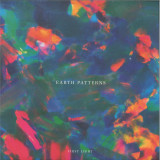
Earth Patterns is a new journey into sound by London based Australian born musician Ben Davidson, best known for his disco tinged house singles as Ben Sun, that were championed by the likes of Gerd Janson and Larry Heard.
The Earth Patterns concept presents a more expanded instrumental sound with live rhythm sequencing and synth work, sitting alongside Vangelis Katsoulis, Lars Bartkuhn and Soichi Terada on Alex Bradley's Utopia Records.
Davidson joins the dots between Detroit by way of Tokyo techno on 'Sunflower' to Dream II Science deepness on 'Horus Rising' and some worldly organic rhythms for a modernist and dare we say it Utopian sound on 'After The Rain'.
The analogue sound from his London studio comes through on the gentle and harmonic B-side opener 'Transit Pan', perhaps the start of a journey beyond the dance floor for the producer.
Artwork and liner notes by Davidson himself, all pressed by bespoke pressing plant The Vinyl Factory on heavyweight vinyl.
THE ASSISTENZ is the culmination of a four year creative hot streak as vivid as any part of CRISTAN VOGEL's long career. The trio of dance oor-oriented records formed by 2012's The Inertials, 2014's Polyphonic Beings and now THE ASSISTENZ are sensual pleasures rst and foremost: a lifetime of study of frequencies and rhythms on the frontline of the world's clubs has been put into the creation of sounds that interface with the nervous system and emotional re- sponses with extraordinary immediacy. But there's much more too: together with the more ab- stracted album Eselsbru¨cke, these form an enticing sonic narrative, encoded themes running through them, each part revealing more about the whole. THE ASSISTENZ, then, is many things: a personal document, a tribute to Copenhagen where it was recorded and after whose famous cemetery it is named - but also the nal piece in this bigger puzzle, which unlocks untold secrets from the previous three records.
There's a deeper history, of course. CRISTIAN's productions going back to the start of the 1990s have woven their way into the fabric of underground culture. His own recent remasters of his early albums, and the Sub Rosa Classics 1993-1998 collections have shown just how potent his early work remains. But his new work exists in a very different world to those past works, and is far removed from the recent electronic generations who he has in uenced too. In fact, as you listen to THE ASSISTENZ, you realise that there's no point making comparisons with other elec- tronic producers at all. While you will certainly hear some of the most fundamental and enduring vectors of underground music - dub, electro, acid, funk - owing through the tracks, even those things are rebuilt from the molecular level, created completely afresh with new, precise, but some- what skewed vision.
CRISTIAN's understanding of music now is spectral. That is to say, with every step through his exploration of sound over the years, he has made more and more detailed analyses of the specif- ic frequencies that make up speci c sounds and produce speci c effects on the human mind and body. And as a result, his own sound synthesis - increasingly done via the Kyma programming platform - is more and more able to reach beyond the 'synthetic' and impact in uncanny and wonderful ways. The most obvious sense of this is the way his sounds touch on the human voice: not just in the chattering, shimmering, singing tones of THE ASSISTENZ's ghostly centrepiece 'Barefoot Agnete', in the alien radio signals of 'The Merman's Dream' or even in the subliminal 'aaah's hiding in the background of the noisy 'Vessels', but in the way any sound, anywhere in any track can sound peculiarly vocal, heard from the right angle.
And it's not just the boundary between human and non-human, or that between acoustic and synthetic, that get blurred to the point of non-existence. CRISTAN's creative methodology now is all about leaving you so uncertain about where anything came from, or what scale the sounds are operating on, that you have no choice but to let go of preconceptions and standardised criti- cal faculties and go with it. Sometimes that can take you to places where darkness and physical- ity close in on you as on 'Vessels' or 'Telemorphosis', or into haunted spaces on the edge of the void like those of 'Snowcrunch' and 'Barefoot Agnete', but even in those, there is euphoria. And in the voluptuousness of 'Hold' or the body-rocking funk of 'Cubic Haze', all the abstraction is grounded in the sheer pleasure of your own bodily responses to the sound.
So many of the science ction dreams of the 1990s are now (virtual) reality. We live in a time when social networks consciously manipulate our emotions, where data is money, where ma- chines learn, where images can't be trusted, and where the synthetic can feel more real than real. Over some 25 years, CRISTIAN's experiments have traced much of this weirdness and evolved with it, and his understanding of synthesis and algorithmic processes to create structure makes him one of the most important composers working today. But THE ASSISTENZ doesn't just ex- periment with the interfaces between mind, body and machine: it expresses those relationships in ways that are beautiful, troubling, moving and scary, and which even make you want to dance. Together with the preceding three albums it enacts a glorious, endlessly-explorable mapping of just what electronic music can do.
- A1: Abayomy - Obatala (Pd)
- A2: Zebrabeat_Zebrabeat Afro - Amazônia Orquestra (Zebrabeat)
- A3: Burro Morto - Lúcifer Colômbia (Daniel Jesi/Burro Morto)
- A4: Ive Seixas - Cervejas Populares (Ive Seixas)
- B1: Iconili - O Rei De Tupanga (Iconili)
- B2: Zulumbi - Zulumbi (Rodrigo Brandão / Lúcio Maia / Pg / Dengue)
- B3: Passo Torto - Faria Lima Pra Cá (Kiko Dinucci / Rodrigo Campos)
- B4: André Sampaio E Os Afromandinga - Ecos De Niafunke (André Sampaio)
- B5: Fabrício - Feito Tamborim, Pará Céu (Fabrício.)
Over the past few decades, there has been a seismic shift in Brazil's musical landscape. A plethora of varying musical undergrounds has developed across the nation. While Rio and São Paulo have been overwhelmed with networks of talented musicians for a long time, creative life is now bursting all over the country. Amplificador exists to document and propagate the wonderfully diverse music currently blossoming from Brazil's vivacious and geographically varied musical undergrounds. Presenting an up-to date insight into Brazilian music, this compilation draws together some of the components of 'Novíssima Música Brasileira' (brand new Brazilian music), ranging from afro-grooves to rock, to modern samba and MPB. The music reaches back across Brazil's incredibly rich musical and cultural traditions, while also taking in influence from other movements around the globe.
Having begun life in 2012 as a Brazilian music blog run by Marcelo Monteiro, Eduardo Rodrigues, Mateus Campos, and Ricardo Calazans, the aim of Amplificador is to document and propel to wider audiences, Brazilian music of the '00s and '10s generation. This is a task made more significant by obvious changes in the way music is consumed. 'People are no longer obliged to listen to what the radio and TV are presenting. There is a whole new generation that wants to listen to new bands and new sounds and we try to connect those bands with other bands, producers, fans and even the mainstream.' These changes in technology and the way music is discovered and shared have developed parallel to the proliferation of these emerging scenes. The ostensible decentralization of the music industry means the promoting and filtering work of journalists and blogs, like Amplificador, have become increasingly important, as people try to keep up with the tsunami of new music and media flooding the country on a daily basis.
Marcelo uses the example of the Mangue Beat movement to explain a trend in contemporary Brazilian music that looks both inwards, to Brazil's own musical traditions and outwards, to movements around the world to create a novel, localised identity: 'The 90's Pernambuco art-social movement was inspired by Coco, Maracatu and Forró all mixed with modern riffs and grooves. The mythical
revolutionary Chico Science, his Nação Zumbi, Mundo Livre, Siba, and many others do this blend perfectly. There are also the references to the older generations and masters - Gil, Caetano, Luiz Gonzaga, João Gilberto, Tim Maia, Jorge Benjor - as a constant inspiration for all bands.' This is very much the case for the Brazilian artists of today.
Music is unquestionably informed by place. Brazil has always been famed for its regional differences in this sense. Indeed there are still pronounced variations between the scenes of Rio, Sao Paulo, Natal, Goiânia, Belo Horizonte and Belém for example, there are also great divergences within cities and while technology has brought changes to the way musical influences are shared, there are cultural differences, rooted in folkloric traditions, that aren't going away. Expressing his appreciation for this fact, while highlighting the potential of Brazil's spread of musical flavours, Marcelo explains that 'what we have now is new ingredients to make an even better mixture.'
This compilation heavily features music from a scene in Brazil's current musical make-up, which draws inspiration from African music, particularly Afro-beat music. Abayomy Afrobeat Orchestra from Rio formed because of their shared love of the music of Fela Kuti, uniting initially in 2009 for a jam session in his honour. But what sets Abayomy apart from other groups of a similar nature, is the fact that their sound also brings with it the songs and rhythms of candomblé. In this sense, Abayomy was the first band of its kind. The thirteen members of the orchestra have a palpable current of Rio's musical heritage - its rhythms and culture - running through them. So while their sound is distinctly African, it is also inherently Brazilian. Similarly, Zebrabeat Afro-Amazônia Orquestra draw upon traditional guitarradas and carimbos from the state of Pará and fuse these with the poly-rhythms of Afrobeat to create another regional hybrid, which stays true to both its Amazonian and African roots, yet which results in a very fresh, Brazilian sound. From Belo Horizonte (capital of Minas Gerais), Iconilli are another key band on Brazil's Afro-groove scene. With influences as varied as funk, jazz and psychedelic rock, congado, mining harmonies, maracatu, coco, ijexá, carimbó, Iconilli somehow manage to balance all of these sounds in such a way that makes it impossible to pin them down. From the Northeastern city of Joao Pessao, Parayba, Burro Morto's pshychadelic afro sound leans more towards rock and funk influences, with hint of regional Brazilian rhythms such as frevo and forro. They add another flavour to the Brazilian afro-groove scene: just one of the many exciting facets of Novíssima Música Brasileira.
While African-inspired music features heavily on the compilation, it is just one of the many styles within. Ive Seixas has a fresh approach to MPB, based on traditional rhythms and instrumentation, punctuated by a pop sensibility, coupled with a powerful female vocal. As an artist she is a product of a 'Do It Yourself' outlook to creativity, taken from her love of rock growing up. In 2013 she embarked on a project of street performance: wandering, like a lonely troubadour with just her guitar. Ive and her project began to gain notoriety and shortly after, her first EP was recorded, featuring some important names of South Rio's underground scene. 'Cervejas Populares' taken from the EP, is a beautiful, sombre piece of modern Brazilian pop, with a traditional samba rhythm. Another artist of the new MPB scene is Fabricio, from the city of Vitoria, who's 'Feito Tamborim' melds rock and funk and is also clearly reminiscent of the old Brazilian masters. It's an appreciation for the national musical heritage, alongside a keen ear for melody and an acceptance of foreign influences that results in these promising new sounds of Brazilian MPB.
Sao Paulo's super group of the underground 'Passo Torto' have been at the helm of an emerging scene in the city: an innovative approach to samba which draws in and experiments with afro grooves, jazz melodies and rock structures. Their sound is naturally very Brazilian, but the nylon twang of Faira Lima Pra Ca, interspersed with ominous strings and light rolling percussion, seems reminiscent of Captain Beefheart or Tom Waits, as the band lament their frustrations with their native city through their music.
The Future of Novíssima Música Brasileira looks very bright. The main challenge (and purpose of this album) is to get the music beyond Brazil's underground and into view of international audiences. In the last 10 years this goal has become somewhat more attainable, as the Brazilian government has begun to see the internationalisation of the nation's culture as a strategic objective, with public projects gaining increased investment and backing. The continuing project of Amplificador is to reinforce this international bridge by writing, filtering and promoting the scene as a whole. There is a wealth of great music currently blooming in Brazil and using new media tools, Marcelo and the team, alongside many others, will passionately continue to get the voices of Brazil's underground heard.
Up and away / To your journey to the sun / Drink your rocket juice / Fly away (Hey, Shooter).
High up in the skies, amongst the clouds, Rocket Juice & The Moon was born. Literally. It happened back in 2008, when Damon Albarn, Flea and Tony Allen convened on the same Lagos flight, to play and exchange musical ideas in that city as part of the Africa Express collective. Relishing a shared enthusiasm for one another's work, and bonding immediately, there and then the triumvirate laid down the blueprint for Rocket Juice.
Still, more than a year passed before conditions were set for three weeks together at Albarn's West London studio, recording and refining two-dozen startlingly out and deeply funky instrumental grooves. The next stage was to invite onboard some extremely talented friends, with further sessions in Dallas, New York, Chicago and Paris... Erykah Badu, no less, queen of contemporary soul. Three companions from Africa Express: Malian singer Fatoumata Diawara, whose debut album has topped World Music charts since its release last Autumn; her multi-talented compatriot Cheick Tidiane Seck, whose prodigious keyboardism has lit up releases by artists ranging from Youssou N'Dour to Hank Jones; the young, Ghanaian rapper M.anifest, quizzically existential, switching seamlessly between Twi and English. And the Hypnotic Brass Ensemble, long-time stalwarts in the Honest Jon's set-up — since one of the team discovered them busking near the shop in Portobello Road, on his lunchbreak — with a second album for the label due in May... Finally, the tracks were dispatched for mixing to Berlin, to be meticulously honed, polished and envenomed by Mark Ernestus, one half of the legendary Basic Channel and Rhythm & Sound partnerships.
The result is Rocket Juice & The Moon — out March 26, 2012, on Honest Jon's Records — a triumphant exploration and proliferation of kinetic Afro-funk rhythms: organic, exuberant, communal music-making, evidenced by the project's live debut on stage as part of the Honest Jon's Chop Up in late 2011, which hit London, Marseille, Dublin, and Cork to such great acclaim (witness the flurry of smart-phone film-clips uploaded in the days thereafter).
From the inaugural bars — that absurdly funky slice of instructional timekeeping, 1-2-3-4-5-6 — the liquid pulse of Fela Kuti's classic recordings drives the action through a suite of 18 shape-shifting compositions. The greatest drummer in the world has never sounded so good as he does here. His intricate cross-patterns jostle and lock with Flea's nimble, rumbling bass riffs. Joined by Seck on There and Extinguished — 'when you dispose of something burning, be sure it's out' — Albarn's keyboards spray synth fusillades up top, over, and under... splicing into the mess of wires running between the freaked Afro-disco of William Onyeabor and the space-jazz-moog of Sun Ra. The HBE brings extra intensity and drama to Leave-Taking — likewise Flea's trumpet to Rotary Connection — teasing out the haunting melody coiled in the mix.
Where the best of vintage Afrobeat sides sustained their concentrated energies over the course of sprawling, marathon jams, RJ & TM manages something altogether different: the group bottles the idiom into capsules of funk... and real songs. Beautifully buoyed by Erykah Badu's unmistakable vocals, Hey, Shooter brilliantly traverses metaphysical spaceways sans any semblance of noodling. Lolo and Follow-Fashion — featuring the open-hearted sensuality of Diawara's singing, M.anifest's quick, brawny science, and more brass blasts — play like its musical cousins or codas. Indeed, the album's shrewd sequencing creates the composite effect of tracks working both individually or within the context of an extended song-cycle.
The lovely ballad, Poison, is bittersweet and ruminative: 'If you're looking for love, beware the signs / They will paralyze you one by one / Poison, it will only break your heart.' Down-tempo and dubby, Check Out and Worries amplify the range of styles and moods. And by the time of Fatherless — a chugging Afro blues that evokes John Lee Hooker lost in Lagos, one gets the sneaking suspicion there's very little outside the reach of this collective's inventive musical grasp.
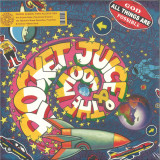
There is, in fact, a palpable openness pervading Rocket Juice & The Moon — the sense of a limber willingness to follow creative impulse — right down to how the group acquired its name. When Ogunajo Ademola — the Lagotian commissioned to do the album's cover artwork — dubbed his submission 'Rocket Juice & The Moon', it quickly morphed into the formal name of the project, like trying to hold onto mercury.
Surely, the stars above also approved.