Lontra is the new project from Brazilian born, Colombian based producer, and musician, Guille Katorzi. The inspiration and influences for this particular project were drawn from diverse sources, including disco, house, Nigerian boogie & afrobeat.
The instrumentals were and produced in Bogotá with Guille laying down the guitar & bass parts which the songs were built upon. After sending the demos to vocalist Sir Jean (Voilaaa/Sir Jean & NMB Afrobeat Experience), with an invitation to collaborate, he was thrilled to receive a warm response to the songs from Sir Jean and so travelled to France in 2023 to record vocals in the singers' home town of Lyon. Returning to Bogotá, a selection of top brass musicians contributed their blazing horns to the project.
Opening up the EP, "Money, Money" serves up a lively disco beat with percussive Afrobeat highlights, funky guitar licks & Afrobeat inspired horn parts, backed by an irresistibly groovy bassline, setting the scene for Sir Jean's lyrical warning "money cannot buy your soul".
Dropping some of the Afrobeat accents and staying closer to the centre line, "Life Is Movement" is a dancefloor focused track where Katorzi's guitar hook pairs with a restless bassline over which Sir Jean's vocal delivery shines. The flipside begins with a sensuous overture on "Mysterious". A loose Afro-beat & guitar syncopation provides an inviting space for the horn section's refrains and solos. The arrangement allows plenty of room for the listener to become intoxicated by the groove, before Sir Jean opens his heart with the emotive ode to someone we learn of only as..."Mysterious".
Closing out proceedings is a more driving club track. The Lyon & The Hunter... where Sir Jean sings a warning wrapped in metaphors while Lontra throws down a club focused punch that deftly dances between funk, house and afro flavours while the scorching horns set the lot aflame.
The culmination of different inspirations and intonations imbues the project with a vivacity and richness in colour that reflects the multi-cultural assembly of players. Canopy is delighted to welcome the talent of Lontra to the family and are happy to say that this is the first in a number of exciting projects that this artist is serving up
Поиск:section 63
Все
- 1
- A1: Psicolimite
- A2: Sexy
- A3: Psicolimite (Perverse Flute)
- A4: Revelations Blues
- A5: Psicolimite (Perverse Synth)
- B1: Strip
- B2: Psicolimite (Perverse Sex)
- B3: Sexy (Ballad)
- B4: Revelations Rhythm
- B5: Psicolimite (Perverse Flute #2)
- C1: Sexy (Gotico)
- C2: Psicolimite (Perverse Sex #2)
- C3: Rivelazioni Di Uno Psichiatra
- D1: Sexy (Romantico)
- D2: Psicolimite (Perverse Sex #3)
- D3: Carica
- D4: Psicolimite (Perverse Flute #3)
- D5: Peanuts
- D6: Psicolimite (End Titles)
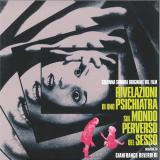
Four Flies is thrilled to present the very first release of Gianfranco Reverberi's hidden masterpiece: a mind-blowing soundtrack, possibly his wildest and most daring. This Italian score is sort of a Holy Grail for fans of the spaghetti sound, especially thanks to the legendary track "Psicolimite".
In 1973, a mysterious 45 rpm single surfaced under the name 'Sharon Chatam e la sua Orchestra.' The single seemed to be a harmless cover of the theme from Last Tango in Paris, complete with a typical image from the film. But behind the innocent facade, a secret was hidden: the B-side track, "Psicolimite," was actually the main theme from Rivelazioni. When someone in the United States figured this out and realized the 'Sharon Chatam' moniker was a pseudonym for Reverberi and his team, the price of the record skyrocketed, making it a coveted collectible.
This makes the discovery of the full soundtrack even more exciting, considering that the music Reverberi composed for the infamous film by Renato Polselli - one of the most outrageous and uncompromising Italian genre cinema directors - was thought to be lost forever, perhaps vanished into the depths of some film processing lab. But thanks to the sleuths at Four Flies, this enigmatic masterpiece has been resurrected and presented in all its glory. It's available now as a luxurious gatefold double LP with original artwork by the brilliant Eric Adrian Lee.
While the film, despite some critics praising it as "psychotronic," is a bizarre mishmash of rambling pseudo-psychoanalytic theories and sexual deviance voyeurism, the music stands out as a foremost, vital element, able to exist on its own.
Reverberi's reputation as a serious, refined producer (for artists like Lucio Dalla, Gino Paoli, Luigi Tenco, and many more), however, led him to keep his distance from exploitation films like Rivelazioni. To maintain his image, he had his friend and former schoolmate Umberto Cannone take credit for the score – a tactic he also used for Polselli's next film, Mania (1974).
But this anonymity might have unexpectedly increased his creative freedom, for the score he put together and recorded is experimental, at times raw, and driven by a relentless rhythm section where bass and drums lay down the groove. The use of electronic instruments is impressive for the time, with drum machines and spacey synths creating a dark and dreamlike atmosphere. Psychedelic flutes, piano phrases, crazed percussion, filters, compressors, and jazzy improvisations on sax and vibraphone complete the mix.
The full soundtrack was recovered following the discovery of the original 1-inch, 16-track tapes, which were transferred, mixed, and mastered for optimal listening on both vinyl and digitally, with the digital version featuring 8 bonus tracks.
Available from November 22!
Uhlmann Johnson Wilkes is the debut album from Gregory Uhlmann (SML, Anna Butterss, Duffy x Uhlmann, Perfume Genius), Josh Johnson (SML, Jeff Parker ETA IVtet & New Breed, Meshell Ndegeocello, Anna Butterss, Leon Bridges), and Sam Wilkes (Sam Gendel, Louis Cole, Chaka Khan). The three improviser/arranger/producers' impressive individual credits encompass such a wide stylistic pendulum swing that a collection of group music from the trio could mine any number of musical territories with masterful results. I n these 11 instrumental songs, the trio explores a spacious lyrical curiosity that could b e described as a jazz-informed take o n progressive electro-acoustic chamber music.
Conceived during two live shows at ETA and a session at Uhlmann's house in Los Angeles, the album maintains a focus on beauty, melody, and rhythm as the pieces unfold, with the trio pushing their instruments and highly-dialed effects to sculpt otherworldly sounds with the collective sensibility o f a rhythm section. The ethos of these instant compositions is arrangement-minded improvisation that showcases the mournful beauty of Uhlmann's fingerpicked electric guitar, the hybrid rhythm-lead of Wilkes' bass chording, and the textural harmonic worldbuilding of Johnson's effect-laden alto saxophone.
Sneaker Social Club welcome a veritable supergroup of bass heavyweights in the form of Legion. Made up of Trends, Boylan, P Jam and D.O.K., this four strong collective first came to light with the We Are Many 12" on Artikal Music in 2021, and now they regroup for another four-strong payload of soundsystem pressure that embraces the darkness in devastating fashion.
The Sister Abigail EP leads with 'Rastaman', an ice-cold half-step drop that summons the spirit of early dubstep in its raw minimalism, eerie atmospherics and snarling low-end wobble. Without an ounce of fat, it's a lean workout of drums and bass that finds catharsis in simplicity without compromising on high definition detail. 'Souls' locks into a jerky groove to set the dance off at acute angles, nudging the textures up a notch without disturbing the spartan mood of the release. 'Sister Abigail' pushes the underlying malevolence of the Legion sound to the forefront with dissonant sheet-metal tones while packing the rhythm section into a tight, vicious formation of gnashing, chrome-plated teeth. 'Play That Vibe' seals the deal on the EP with a hard-thumping, propulsive groove that calls to mind the techy development of dubstep in the 2010s — a taut, tracky throwdown to keep the intensity on a rolling boil.
Drawing on the grounding principles of OG dubstep with a sharp line in crisp, modernist production and a ruthless economy of arrangement on display, Legion prove many cooks can still result in a potent, brutally focused broth.
- A1: Our Boys Are Doing It 19:33
- B1: Dennis Groove 10:03
- B2: Orlando 9:52
By the mid-1970s, trumpeter Dennis Mpale was a consummate musician with an auspicious resume that located him at all the key turning points in the evolution of modern South African jazz. In his mid-20s, he led the trumpet section of Chris McGregor’s Castle Lager Big Band and participated in the ensemble’s landmark 1963 album Jazz/The African Sound. 1968 saw him recording I Remember Nick with The Soul Giants, which joined a wave of notable late-1960s releases, including The Mankunku Quartet’s Yakhal' Inkomo and The Chris Schilder Quintet’s Spring, that ignited the ambitions of South African jazz artists and producers in the 1970s. In 1975, Mpale co-founded the “rock jazz” ensemble Roots, inaugurating the era of jazz fusion in South Africa and opening the door for Pacific Express and Spirits Rejoice.
By 1977, Mpale had earned the right to an album of his own and, having participated in the 1975 recording of Abdullah Ibrahim’s African Herbs, turned to producer Rashid Vally of the As-Shams/The Sun label for his solo debut. Vally financed the project and seized an opportunity to license it to the local subsidiary of a major international label. As such, Our Boys Are Doing It was issued in South Africa on the Mercury label in 1977. Featuring saxophone heavyweight Kippie Moketsi, the album was a response to the global direction taken by trumpeter Hugh Masekela on The Boy's Doin' It in 1975. In contrast, seeped in the bump jive style of popular urban township music, Our Boys Are Doing It was a manifesto for an authentic, exuberant, homegrown variety of South African jazz.
- A1: Pattugliamento Aereo
- A2: Tunnel Sotterranei
- A3: Collina Silenziosa
- A4: Militari In Allarme
- A5: Plotone Di Esecuzione
- A6: Filo Spinato
- A7: Imboscata
- A8: Lettere Dal Fronte
- B1: Sognando La Pace
- B2: Pattugliamento Aereo #2
- B3: Dietro Le Linee Nemiche
- B4: Spettri
- B5: Fiori Tra Le Macerie
- B6: Disertori
- B7: Evasione
- B8: Evasione #2
- B9: Evasione #3
- B10: I Sopravvissuti
Four Flies Records is proud to present Paesaggio Bellico, a collection of unreleased music from legendary composer and multi-instrumentalist Alessandro Alessandroni.
Available digitally starting on the centenary of the maestro's birth on 18th March 2025 and on vinyl on 21st March, Paesaggio Bellico is a true gem hidden within the vast treasure trove of Italian film scores and library music.The album brings together themes and atmospheric pieces inspired by the world of war, viewed not just from a military standpoint, but also through a deeply human and existential lens.
The LP version features 18 tracks, while the digital release expands to 29, including alternate takes and thematic variations. These compositions were meticulously unearthed from scores written and recorded by the maestro between 1969 and 1978 for television documentaries and war films.
Alessandroni's war-inspired music masterfully balances action, suspense, and introspection. Expansive, panoramic themes give way to anxious, tormented moments. Horrifying visions are countered by calmer atmospheres, and glimmers of hope soften the intensity of pain.
Each track embodies the unique sound that has made Alessandroni an irreplaceable figure for soundtrack and library music enthusiasts. His signature whistle – so unmistakable for generations of fans of the genre – soars above delicate 12-string acoustic guitar arpeggios. More dramatic pieces feature his iconic Fender Stratocaster, equipped with a fuzz distortion pedal. And, of course, Alessandroni's vocal group, the Cantori Moderni, a constant presence in his arrangements, contribute, this time lending their voices to the more unsettling aspects of military psychology. An elegant string section adds depth and emotional impact to the more orchestral tracks, completing the picture of this monumental work.
The result is a sonic journey that delves into the darkest, most martial sides of war, but also explores its intimate and deeply painful dimensions, creating a powerful dialogue between the atrocities of conflict and the human emotions it evokes.
The release is enriched by original artwork from Eric Adrien Lee, who reimagined the 1970s graphic design of Italian war-themed library albums. The vinyl LP is housed in a tip-on hard cover (the kind used for higher-end productions during the golden age of Italian soundtracks), with an inner sleeve featuring a color-inverted variation on the cover art, which makes the physical record even more unique.
Private Joy?! With a namesake derived from the mighty Prince’s catalogue, and its lustful connotations, Private Joy is the producer of soul band Lovescene and a supreme vocalist of the Manchester scene. With collaborations working with the likes of Ruf Dug, Finn, and Lenzman, a solo EP was inevitable and a statement this is.
Pops Roberts’ first solo EP debuts on Rhythm Section INTL bringing together influences from Streetsoul, 80s ‘babymaker’ RnB records and a slice of 00s soulful house in there for good measure. In just over 18 minutes, Private Joy welcomes you into her world of sensuality and soulful warmth. Musical hugs galore, the production balances synths, harps, saxophones, tight beats and meaningful lyrical content; eschewing millennial whoops for Sade indebted dulcet tones.
Each track draws from personal experience; be it heartbreak or reconnection, an emotional diary
conveying the trials and tribulations of love, loss and ultimately, desire.
“Desire has been the drive and beginning of so many decisions, highs and lows in life...” - Private Joy
180g, magenta coloured vinyl. This album features Herbie Hancock's more contemporary beginning sounds. His groundbreaking career commenced with Donald Byrd's group, followed by a transformative period with the Miles Davis Quintet in 1963. Renowned for reshaping jazz rhythm sections, Hancock's post-bop contributions were pivotal.
Producer / composer / multi-instrumentalist Angel Marcloid records music under the moniker Fire-Toolz. Though Marcloid’s output emerges in a litany of aliases and projects — from the jazz fusion / new age of Nonlocal Forecast to the vaporous nostalgia of MindSpring Memories — the Fire-Toolz catalog remains the central focus of the prolific artist’s musical universe and a home for Marcloid’s most ambitious work.
"I am upset because I see something that is not there.", the fifth Fire-Toolz album to join the Hausu Mountain catalog since 2017, follows 2021’s sprawling double-album Eternal Home and 2022’s self-released EP I will not use the body’s eyes today. I am upset… offers listeners a prismatic cross-section of juxtaposed genres and compositional contortions to explore, maintaining Fire-Toolz’s signature density and complexity while tightening the scope of Marcloid’s experimentation into the project’s most focused song cycle to date.
Perhaps more than any previous Fire-Toolz album, I am upset... presents some form of pop music, carried in Marcloid’s passages of clean vocals, in the bright synth tones that animate its tracks, in the yearning saxophone lines that pour into view and whisk the narrative onto a new path. The format of a one-person “band” carries a different weight in a landscape of solo artists crafting modernist productions that don’t allude in the slightest to various twentieth-century rock-related traditions. Fire-Toolz exists on both sides of this divide. The music of Fire-Toolz draws energy on a moment-to-moment basis from the constant fluctuation between seemingly disparate styles, yet Marcloid repeatedly pulls off the impossible feat of making chaotic deviations and improbable jump-cuts between ideas sound holistic, as if such compositional gambits were already logical to begin with. Bursts of harsh textural noise cut into drifts of new age synth bliss, while screamo verses bookend passages of hyper-technical jazz fusion.
Istanbul born performing artist, producer, composer and instrument builder Berke Can Ozcan, in collaboration with critically acclaimed Norwegian trumpet mastermind Arve Henriksen and Brooklyn-based baritone saxophonist Jonah Parzen-Johnson, takes you on a captivating journey through the depths of nature on the Lycian Way, immersing the listener in a mesmerizing soundscape that echoes the wonder and mystery of the trail leading to the ancient Lycia As Ozcan ventures deeper into uncharted territory, he stumbles upon a sight that would spark an artistic flame - the Twin Rocks. This collaboration weaves together a tapestry of sonic explorations that capture the essence of Ozcan's journey. The ambient-jazz album's delicate balance between organic sounds and electronic manipulation creates a dreamlike atmosphere that transports the listener to the rugged terrain of the Lycian Way. Mastered by three time Grammy winner Dave Darlington, each track on this ethereal album mirrors a different aspect of the journey to the Twin Rocks, meticulously composed by Ozcan, Parzen-Johnson and Henriksen with each section of the trail in mind. The album is infused with melodic bird songs and sound walk memories that add depth and texture to the ethereal soundscape. Ozcan's array of self- crafted instruments made out of bamboos, soda bottle caps, straws, house keys, terracotta flower pots alongside with his long time companions like his steel drums, chimes, gongs, and vibraphone, serve as the medium through which he expressed the reflections of his encounters in his own world of rhythm and melody
The music explores textures, colors and abstract lands. The play is wild and free.
Dunietz's new compositions go beyond the conventional song structures, and the improvisation is inspired by the roots of Jazz, while allowing itself to be stimulated by other sources such as voices of birds and trees. The album has several free improvisation pieces, bringing forth a fresh side of this very swingy rhythm section.
As a spectral musician and artist, Dunietz tends to focus on the phenomenon and acoustics of sound rather than its potential semantic qualities. Playing trio music from this perspective, created a very crisp and deep sound, beautifully captured in the recording.
If you dig deep enough into the underground you will find the most precious jewels and it ain't that much of an effort these days to turn on the computer and trip through the colorful World Wide Web. But beware for not all the glitter is gold. I stepped by some dark and dusty back street club in Atlanta / Georgia, USA and some enchanting music tempted me to enter. A powerful raspy voice screaming out the pain of the world no matter if it were big or small affairs. "California dreaming on such a winter's day", wow, when the MAMAS AND PAPAS sang this in a sweet folk manner it was a light and joyful anthem for all hippies and hipsters back in 1966, like a call to love. Lee Moses' version is more of a desperate cry for sunshine and freedom. And it goes on this way. His voice has this special phrase showing determination, pain but also sheer joy of life. His 1971 album is a steady groover with a steaming hot band performing , which includes a brass section of divine greatness. These devoted players build up a massive wall of groove and melody on which Lee Moses can unleash his voice like a volcanic eruption. The groove itself stays quite relaxed but definitely hypnotizing throughout the whole album and clears up your mind for the message of love Lee Moses raves about. The high skills of Lee's backing band gets showcased in a steaming instrumental version of THE FOUR TOPS' "Reach out (I'll be there)", which appeared on an early 7" first and got added here as a bonus track. They don't stop for THE BEATLES' "Day tripper" either and next to "California dreamin'" you can find another heart warming version of "Hey Joe" on the regular album. Not as extraordinary outraging as Hendrix' turn on this classic Lee and his mates make it a slightly more epic effort. All in all this is a soul album with very few covers and even more classic anthems of this genre that should actually be worshipped by lovers of the late 1960s Motown sound. Especially the bonus tracks will drive you wild. Go for it, brothers and sisters.
New studio album from Zion Train, featuring the world renowned Zion Train brass section, along with three passionate, politically aware songs from singer Cara Jane Murphy, and featuring Paolo Baldini playing guitar and bass on several tracks - alongside veteran musicians Trinny Fingers, Blacka Wilson, Dreada One and (from Crete) Professor Skank. For this album Zion Train return to their roots, with copious amounts of analogue Dub mixing performed by producer Neil Perch on his vintage TAC Scorpion desk. Artwork is by the acclaimed anarchist artist Marko Gin from Croatia.One of the most unique and enjoyable live dub acts on the planet, their use of dynamic onstage dub mixing whilst performing alongside acoustic instruments and exceptional vocalists, make Zion Train one of a kind.
After a creative break of more than 10 years the Contemporary Noise Ensemble returns with the brand new album called »An Excellent Spiritual Serviceman«. With the band’s line-up reduced and the sound of the brass section replaced with programmable synthesizers comes an entirely new sound of the band’s music. Leaning towards composition instead of improvisation the music is now less jazzy sounding - with electric bass being used instead of double bass and drums actually being the only strictly acoustical instrument. But then again you can hear a lot of other prerecorded instruments like marimba, vibraphone, Rhodes and upright pianos surrounded by arpeggiated synths and other programmable electronic instruments.
The album takes you to a journey through jazz, space rock, funk and electronic music with a destination in a form of a rock song which is as well the title song of the album. The Contemporary Noise Ensemble still impresses with maturity and class.
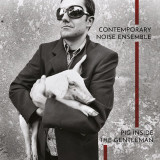
After a creative break of more than 10 years finally the comeback: In line with the long-awaited new album called "An Excellent Spiritual Serviceman" a limited colored vinyl reissue of the classic Contemporary Noise Ensemble debut record "Pig Inside The Genleman" from 2006.
"Jazz music without jazz, film music without movie but something splendid instead! Despite the band's name suggesting noisy music for the chosen ones, Contemporary Noise Ensemble appears to be a revelation for everyone. Beautiful, hard, romantic piano tunes in the dialogue with brass section. Simple and extraordinary emotional compositions leading to the climax which makes the flesh creeps while listening. Hair bristle on the heads of those who remember the musical past of the The Contemporary Noise Ensemble members..."
"The Contemporary Noise Ensemble impresses with maturity and class. There's elegance as well as punk energy. The compositions are unbelievably spacious but on the other hand all fulfilled with instruments - from the superb rhythm combo to the greatly equipped brass section. The roots of the most of The Contemporary Noise Ensemble musicians reach harder music, sometimes even heavy metal what bears excellent interest. The compositions are vigorous and expressive. The name of the band must be remembered because it undoubtedly is Polish export commodity."
"There’s no doubt that the Contemporary Noise Ensemble is one of the most fascinating musical projects from Poland which catches the attention of both pure jazz fans and people who are interested in experimental instrumental music in general. For fans of Cinematic Orchestra & jazz influenced film sounds."
Danish singer-songwriter Soren Munk releases his debut solo album Purr Show on 15 April 2022 via Navarino Records.Soren also travels the world as a cameraman for Channel 4 News, and the album was written and recorded in between trips to cover some of the major global events of recent times, from the war in Mali to the Taliban resurgence in Afghanistan
Soren also co- wrote the much- loved theme tune to the hit animated TV series Charlie and Lola – which is currently trending on TikTok with millions of views.Despite the nature of his news work, the songwriting on Purr Show has a more private focus, dealing in intimate but ambiguous moments of love and loss.
Melodic and intense, the album has elements of Dream Pop, Slowcore and classic songwriting, while the blend of electric guitars, analogue synths and vocals draws on the work of artists that combine restraint and power, such as Neil Young, Low, Big Star and Elliot Smith. Soren worked with Andy Ramsay from Stereolab to record the album, and Jimmie Robertson (Depeche Mode, Arctic Monkeys) during the mixing Soren explains, “I wanted to create slow pop songs. Romantic and melodic but with an edge of strangeness that makes them harder to pin down. That's the music I respond to – things that are assertive but fragile at the same time. Where every element counts.”Soren drew together a strong lineup of musicians and collaborators, including guitarists Garo Nahoulakian (Emiliana Torrini, Gaz Coombes, Piney Gir) and Nick 'Growler' Fowler (Gaz Coombes, Luke Haines); a Danish rhythm section of drummer Nikolaj Bjerre (Lamb) and bassist Andreas Jensen (Dub Pistols); and
pianist Tom Dyson (co-writer of the Charlie and Lola theme). Soren's vocals are often combined on the songs with the soft alto of backing singer Emma Faulkner, creating a sense of something confidential, like snatches of pillow talk.
Previously unissued 1999 live set from Alex Chilton (The Box Tops/Big Star) and Hi Rhythm Section Hi Rhythm Section has performed on seminal recordings from Ann Peebles, Ike & Tina Turner, O. V. Wright, Otis Clay, and Al Green Packaging contains liner notes from Memphis Mayhem author and Producer David Less “I never saw him have so much fun on stage. Without rehearsal, Alex called songs and the band locked in. The horn section consists of top Memphis session guys who huddled together when each song was called creating parts on the fly. The pure joy of playing this music so freely with such legendary musicians comes across in every groove of the record.” —David Less, from his liner notes Memphis is a city with music in its blood. When Fred Ford, co-founder of the Beale Street Music Festival, was diagnosed with cancer, David Less organized Fredstock, a fund raiser to help with his medical bills. Less contacted Memphis legend Alex Chilton (The Box Tops, Big Star), who was living in New Orleans, to ask him to participate. Alex said he didn’t have any musicians to play with in Memphis, so Less suggested the Hi Rhythm Section (the band behind classics from artists including Ann Peebles, Ike & Tina Turner, O. V. Wright, Otis Clay, and Al Green). Alex replied, “That will work.” This previously unissued live set contains versions of soul classics from The Supremes and Otis Clay, rock numbers from Chuck Berry and Little Richard, and even a cover of the KC & The Sunshine Band title track. Available on CD, Digital, and LP
The strange and majestic musical beast that is Africadelic was Dibango’s follow-up to Soul Makossa, but it was initially released on Louis Delacour’s library music label, Mondiaphone, before “Soul Makossa” became an international phenomenon. As a
Mondiaphone release, it was aimed at television and film producers seeking atmospheric background music, so the original titles are simply “Theme No 1,” “Theme No 2,” etc, with corresponding rhythmic notations such as “3/4 Africain,” “Afro Beat 12/8” and “Medium Soul Beat,” though once “Soul Makossa” hit the stratosphere, subsequent reissues bore actual song titles. In any case, the album is simply wonderful, a driving mix of Afro soul, funk and jazz, with an undercurrent of Latin percussion throughout, given further shades by rock guitar and soul organ, as heard on “African Battle” and the title track; opener “Soul Fiesta” builds
dramatic percussive tension before Dibango drops a killer vibraphone riff, while “African Carnival” makes the most of the full horn section, Dibango’s sax soloing giving room for complex polyrhythmic percussion breaks. “Oriental Sunset” has beautiful vibraphone from
Dibango too, as well as a thrilling flute melody, “Monkey Beat” and “Wa Wa” are funky soul struts and “Percussion Storm” has the band marching off into the African sunset as Dibango unleashes another killer vibraphone melody. Listening back to the album now, it is hard to believe that the whole shebang was written in a couple of days and committed to tape within the space of a week, but that is all more testimony to the greatness of Manu Dibango, one of African music’s true pioneers. Play loud and often for best effect!
Credited as one of the best late '60s German psych-rock albums, Bokaj Retsiem's ('meister Jakob' in reverse) Psychedelic Underground is an eccentric, soulful, acidn and fuzzy rockin' essay that clearly prefigures a part of the krautrock movement. Featuring Rainer Deigner, former guitar for the '60s beat German group Former Bonds, as the only credited musician and composer on this album (although other musicians assisted him on bass, keyboards, and that B3 Hammond and Leslie sound), this is basically Rainer's freaked-out tribute to his favorite children's song, 'Meister Jakob,' consisting in trippy instrumental sections, furiously savage E-guitar crescendos, amazing psych-rock improvisation, with just a hint of '60s US psych-garage. A real enthusiastic psych-kraut trip for fans of Vanilla Fudge, Hendrix,and Iron Butterfly.
Jupiter, the gas giant in our Solar System, with thunderstorms a thousand times more powerful than on Earth, rainfalls of diamonds in the atmosphere, temperatures below -100°C, plenty of hydrogen, 79 moons and a South pole that looks like an abstract painting, has just the kind of environment this music seems to emanate from.
Jupiter and Beyond, the second collaborative effort of composer/performer Rafael Toral and percussionist João Pais Filipe as a duo (after Saturn in 2016), is definitely not quite a record of Earth music. On the contrary, Jupiter and Beyond, is indeed gas music, unfolding over two long movements without solid body or any tangible outline, between ambient and noise. A music of sheer volume and beauty, icy, massive, in which the elements of Toral's signature, in particular his use of jazz-inspired electronics and feedback, dissolve to become a labile, nebulous, expansive material, occasionally struck by abyssal depressions and masterful densities, magnified by the return, after 17 years of silence, of the electric guitar in Rafael Toral's instrumentarium.
Towards the end of Beyond, the second piece on the record, lurking behind the volutes of feedback, a bell and a bass drum, one can detect from the distance... a barking dog, as a surreptitious and prosaic reminder of where we are here and now, a calling back to Earth. Between sadness and joy, anger and peace, movement and stillness, Jupiter and Beyond is indeed a mirror held out to us, music reflecting our times and that emotionally speaks first of all about us.
"While João Pais Filipe was drummer in the Space Quartet, we played a live duo set. During soundcheck we were jamming for a while on bowed gongs and feedback and lost track of time, it just flowed so well. I joked "we could make a whole record with this!". But later we took the idea seriously and set to record an improvised session at his cymbalsmith workshop (he made the gong on the cover and it was used in the recording). When we listened to the first take the mass of sound was amazing. At some point it reminded me of the complex clusters of sound in Ligeti's music as it appears on Kubrick's 2001 scene "Jupiter and Beyond the Infinite". In the end the title felt like an apt choice for Saturn's successor. Back at my studio I felt the need for some more layers of density in some sections. I thought of using trombones, but ended up picking up the electric guitar, which I hadn't used since 2003.” Rafael Toral
Ground is an Osaka native, but his soul is truly that of a nomad, traversing the planet, befriending kindred spirits found in humans, animals and plants. He is exceptionally receptive to the beauty in everything that surrounds him—the incidental music of a city street, the orchestral chaos of a scrambling radio, the syncopated grace of migrating birds, the simplicity of an isolated hand clap—and as his roadmap continuously unfolds, he accumulates a vast catalogue of visceral tools to musically recount his experiences. 'Sunizm' is a cross section of the artist’s process—an array of complex microcosms overlapping to comprise a thematic whole—gathering field recordings, found instruments, jagged electronics, synthesized chanting, and weaving all into a dense narrative that appears obsessively constructed yet divinely improvised. 'Follow Me', the second of two singles surrounding the album, is complimented with a pseudo drum’n’bass treatment by enigmatic Greek artist Jay Glass Dubs, as well as a massively triumphant b-side entitled 'Ozone House', which is exclusive to this single release. Attention all humans, animals and plants, Ground and the ESP Institute present, 'Sunizm'.
Big Colors will be released on April 19 via a partnership between Adams' PAX-AM label and Blue Note Records. Ryan Adams, who has been hailed as "one of the most elegant singer-songwriters of his generation' by The New York Times, co-produced the album with Beatriz Artola. John Mayer, Bob Mould, Benmont Tench, Don Was and The Section Quartet are featured on Big Colors, which was recorded at Electric Lady, Capitol Studios and Adams' own PAX-AM.
Big Colors follows Adams' 2017 album, Prisoner, which debuted at No. 3 on in the UK album chart, his highest ever charting position in the UK. Professing his love for Manchester online around the album announce, Adams pays homage to the city that he claims shaped his life by naming a song after it. 'It is at the heart of all the things I love about music, from The Smiths, Joy Division, Oasis, New Order and The Stone Roses.'
More
Big Colors follows Adams' 2017 album, Prisoner, which debuted at No. 3 on in the UK album chart, his highest ever charting position in the UK.
Professing his love for Manchester online around the album announce, Adams pays homage to the city that he claims shaped his life by naming a song after it.
'It is at the heart of all the things I love about music, from The Smiths, Joy Division, Oasis, New Order and The Stone Roses.'
Ground is an Osaka native, but his soul is truly that of a nomad, traversing the planet, befriending kindred spirits found in humans, animals and plants. He is exceptionally receptive to the beauty in everything that surrounds him—the incidental music of a city street, the orchestral chaos of a scrambling radio, the syncopated grace of migrating birds, the simplicity of an isolated hand clap—and as his roadmap continuously unfolds, he accumulates a vast catalogue of visceral tools to musically recount his experiences. Sunizm is a cross section of the artist's process—an array of complex microcosms overlapping to comprise a thematic whole—gathering field recordings, found instruments, jagged electronics, synthesized chanting, and weaving all into a dense narrative that appears obsessively constructed yet divinely improvised. Logos is the first of two singles surrounding the album and is complimented with a monster remix by Bartellow (a fellow ESP artist, collaborator and good friend of Ground) as well as a secret weapon b-side entitled Discopazzle, which is exclusive to this single release. Attention all humans, animals and plants, Ground and the ESP Institute present, Sunizm.
- 1