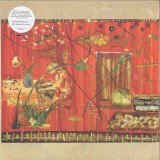
Black Vinyl Edition
The Log and the Leeway follows a 6 year journey of personal exploration and drastic change for Bram Bosteels and his singular Kaboom Karavan universe. What entails is a sound-curiosity of rare format, following a metamorphosis that goes beyond the musical.
Early in the process, Bram was struck by the word/concept of a Leeway : the gradual departure from an intented course due to external influences. Following a boyish fascination for explorers travel journals, logbooks and the far fetched corners of the world, he could not have forseen how fitting of a title he had chosen. Drastically all of a sudden one day, completely unexpectedly, Bram experienced his own father dying in front of him from a rare disease. Shocked and confused by this intense encounter, his perspectives and musical course departed from its original path. But at the same time it was an enlightenment and a necessary influence for him to realise the initial idea and finish this album, started over half a decade before.
The ones familiar with Kaboom Karavan already know that nothing really sounds quite like it. Bram’s musical (and non-musical) universe is of the rare breed that seems to be entirely his own. Self-contained, but never opaque. Quite the opposite actually. Bram never pushes us away, instead, by listening to his music we are given view to a synesthetic wunderkammer of images, places, objects and possibilities. Distant but magnetic, alien but intimately familiar, Kaboom is folk music from another dimension. Listening to The Log and the Leeway is like waking up next to a bonfire in the middle of a swamp wearing somebody else’s clothes: You may not know how you got here, but whatever is happening seems to very directly involve YOU. What will happen?
Note from Erik K Skodvin (Miasmah): All the sounds, fabrics, instrumentation and stories that binds The Log and the Leeway together go far beyond what can be touched up in this simple writeup. As someone who have followed this journey since the beginning, and seen it shift from lighthearted fun to the most crepuscular personal experience, heard the stories behind (almost) every field recording and gone through boundless amounts of clips, visual details, notes, and inspirations – I can only say that it is with great pleasure and certain nostalgia I can present this record in full through Miasmah and close this quite extraordinary chapter. Bram is without doubt the most fascinating person I know. Like I told him in April 2020 during a trying time: “If everything fails, we´ll open a Kaboom Karavan museum” - an idea that might not be as far-fetched as it sounds.
Featuring: Cover painting by John Lurie. 16 page booklet of Musical illustration / collagés by Walter Dhoogh & Erik K Skodvin that more or less connects (or confuses) the dots between the music and stories behind. Mastered by Lupo at Loop-O
Поиск:see know
Все
Craigie Knowes continue their long-running War Child fundraiser series with a new 2x12" release featuring tracks from Eluize, DJ Python, Stellar OM Source, Innnershades, No Moon, The Burrell Connection and more. From ambient and downbeat through to techno and electro, the release spans the sounds that Craigie Knowes have embraced over the last 5 years. The fourth installment of the project also sees a completely new sleeve and center label design by Kyle Morrison. All profits donated to War Child UK, a charity helping children in areas of conflict around the world.
- A1: I Don't Want To See The Sights
- A2: Ignition
- A3: Page One
- A4: Tremelo Song
- A5: The End Of Everything
- B1: Subtitle
- B2: Can't Even Be Bothered
- B3: Weirdo
- B4: Chewing Gum Weekend
- B5: (No One) Not Even The Rain (No One)
- C1: Imperial 109 (Live At Chicago Metro 1991)
- C2: The Only One I Know (Live At Chicago Metro 1991)
- C3: Then (Live At Chicago Metro 1991)
- C4: Happen To Die (Live At Chicago Metro 1991)
- C5: White Shirt (Live At Chicago Metro 1991)
- D1: Indian Rope (Live At Chicago Metro 1991)
- D2: Opportunity (Live At Chicago Metro 1991)
- D3: Sproston Green (Live At Chicago Metro 1991)
Beggars Arkive is excited to announce the reissue of Between 10th and 11th, the second album by The Charlatans, originally released in 1992.
Available on double clear vinyl and double CD, the reissue contains the original album plus remastered tracks from the oft-bootlegged live show from Chicago in 1991, known as Isolation 21.2.91, a holy grail amongst fans.
Between 10th and 11th was originally released in 1992 and feature the UK Top 20 hit (and biggest US single) “Weirdo”, as well as singles “Tremolo Song” and “I Don’t Want To See The Sights”
“A certifiable classic” - PopMatters
Following a high-pressure drop on Sneaker Social Club in 2019, bass-toting instigator Low End Activist steps up with his most expansive release yet.
His sound is a perfect amalgam of elements from the hardcore continuum – at times a dark and malevolent brainstorm of grubby drums dragged through crusty samplers, future-weary textural scrapes, moody splashes of pads and of course bucketloads of crushing subs, lows and low mids all designed to rock you from the waist down. You'll hear spectres of culture past lurking in the shadows – a trip hop skit from a gaunt figure here, a riotous brawl of grime MCs there – and feel the decades of soundsystem absorption seeping off the platters. It's like the LEA reached capacity and these productions were what happened when the sponge got squeezed.
One voice cuts a more prominent figure up front though – the peerless Flowdan, lending some powerful bars to Game Theory. What needs to be said about the Pay As You Go / Roll Deep mastermind you don't already know? His flow is mightier than any sword you care to step with.
Speaking of platters, this particular release marks the first vinyl pressing for Seagrave since the BOA 12" Warp Purpose Vol. 1 back in 2015 (slated for a repress – don't sleep!). It's an occasion worth toasting, building on a powerful and varied catalogue of sub-heavy sonics operating well outside the mainstream in service to naught but the sound, all packaged in a full-colour sleeve. As an expansive double pack of seven sure shots, it's also a fitting document of a subversive operative bringing some devastating angles to the hardcore tradition.
- Oli Warwick.
We are extremely happy to introduce you to Møzaika's first full-length record titled "Silver Tide". Its healing music has been a constant companion to us over the past two years. 2020 finally seems to be the right time to share it with the world. It is a wonderful album to be listened to as a whole - a continuous piece of music with many exciting turns showing the artist's close connection to nature as well as a deep knowledge of his musical ancestry.
Re-Release
Black Truffle is honoured to present the premier recordings of two recent works by legendary American experimental composer Alvin Lucier. A friend and contemporary of pioneers like Robert Ashley, David Behrman, Gordon Mumma, and Christian Wolff, Lucier has been crafting elegant explorations of the behavior of sound in physical space since the 1960s. Lucier is perhaps best known for I Am Sitting in a Room (1970), in which he repeatedly re-recorded his own speaking voice being played back into a room until the room's resonant frequencies entirely obscure the spoken text. Beginning in the early 1970s, he has written a remarkable catalogue of instrumental works that focus on phenomena produced by the interference between closely tuned pitches, such as audible beating, often using pure electronic tones produced by oscillators in combination with single instruments.
Demonstrating the restless creative drive of an artist now in his 80s, the two recent works presented here both feature the electric guitar, an instrument Lucier has just recently begun to explore. In Criss-Cross, Lucier's first composition for electric guitars, two guitarists using e-bows sweep slowly up and down a single semitone, beginning at opposite ends of the pitch range. The piece is a model of simplicity, exemplifying Lucier's desire not to 'compose' in the conventional sense, but rather to eliminate everything that 'distracts from the acoustical unfolding of the idea'. In this immaculately controlled performance of Criss-Cross by Oren Ambarchi and Stephen O'Malley, (for whom the piece was written in 2013), a seemingly simple idea creates a rich array of sonic effects - not simply beating patterns, which gradually slow down as the two tones reach unison and accelerate as they move further apart, but also the remarkable phenomenon of sound waves spinning in elliptical patterns through space between the two guitar amps.
In the comparatively lush Hanover, Lucier draws inspiration from the beautiful photograph that provides the LP with its cover, an image of the Dartmouth Jazz Band taken in 1918 featuring Lucier's father on violin. Using the instrumentation present in the photograph, Lucier creates an unearthly sound world of sliding tones from violin, alto and tenor saxophones, piano, vibraphone (bowed) and three electric guitars (which take the place of the banjos present in the photograph). Waves of slow glissandi create thick, complex beating patterns, gently punctuated by repeated single notes from the piano. The result is a piece that, like much of Lucier's instrumental music, is simultaneously both unperturbably calm and constantly in motion.
Stunning LP design by Stephen O'Malley including an inner sleeve with a portrait of Alvin Lucier by Kris Serafin.
Criss-Cross' recorded at Studios Ina GRM, Paris by Francois Bonnet and mixed by Alvin Lucier. Hanover' recorded in Zurich and mixed by Alvin Lucier.
Mastered and cut by Rashad Becker at D&M Belin.
Criss-Cross' recorded at Studios Ina GRM, Paris by Francois Bonnet and mixed by Alvin Lucier. Hanover' recorded in Zurich and mixed by Alvin Lucier.
Mastered and cut by Rashad Becker at D&M Berlin.
Reemerging from the threshold of the cosmic vortex, Black Lodge returns with another sonic artifact that is charged with vigorous chaotic energy, known as EXPERIMENT_ZERO. Accounts of the radiant object's origin are as mysterious as the raw energy that utters from its core. Following a close study, the guardians of the portal suspect that "Experiment Zero" was a primordial experiment rooted in the slam jack pits and DIY warehouse rituals of ages passed. A sonic dialog constructed of various languages, spanning from roots-house jak to bare-knuckled electro are revealed across the artifact - a revolutionary tale that surpasses the constructs of ephemerality, with a refusal to be ignored. Across the release the listener is confronted with fearless acid lines that are underscored by a tone of revolution, and sets the stage for a human voice that switches between modes of a sharp and mutated presence. The power of such sonic objects are both celebrated and rejected by various tribal societies. It is all dependent on the belief structures and traditional histories of its members. Those that belong to the cult of Ron Hardy, Mad Mike Banks, Traxx, and JTC will welcomingly be drenched in its riotous energies. It is for the dedicated, not the light-hearted. After further research it has been discovered that, Experiment Zero is the product of Dona, aka Dj Plant Texture and Mike Tansella Jr. of Son of Traders, both products of the ancient mercantile city of Bari in Southern Italy. Previous works from these artists have been featured on Creme Organization, Gravitational Waves, Unknown to Unknown, and Illian Tapes. All sonic experimentation was recorded in one take to capture the raw energy of instantaneous collaborative sound craft operating in flux. Black Lodge's 4th release is sure to find a space in the music collections of those seeking to travel within the uncanny portals that unforgivingly defy the status quo. Mastered by: Alex J Michalski Label design: Kosmik Pressing: Deepgrooves (NL)
The late engineer and producer Paul C’s fingerprints are all over this single from Ultramagnetic MC’s, perhaps the defining release of their career. While earlier records gave notice of their strange and unique talents, they were loveably messy affairs. This, however, is the real deal, as polished as their early sound would ever be.
‘Give the Drummer Some’ grabs a fistful of different elements – from James Brown, Dee Felice Trio and James Brown – but bends them to its own purpose. This is a song with a momentum of its own and endlessly quotable lyrics. One of which, of course, was sampled by The Prodigy – huge hip-hop fans – for ‘Smack My Bitch Up’ in 1997. The now hugely rare 7” of ‘Give the Drummer Some’ edits this out to make it more radio-friendly, but this reissue reverses that cut, giving you the original lyrics. If anyone knows why Kool Keith also changes the word ‘rappers’ to ‘monkeys’ for that edit, answers on a postcard…
The brilliant B-side harks back to the time when every group had a song dedicated to their DJ. ‘Moe Luv’s Theme’ sees Kool Keith at his most straightforward, singing the praises of the turntable skills of Moe Luv. It would be throwaway were it not for the effortless repurposing of Jackie Robinson’s oft-sampled ‘Pussyfooter’. That – and the presence of one of the world’s great MC’s at the height of his powers – elevates it far above a footnote.
House Of EFUNK Records returns with a vinyl only offering of floor focused club jams from Tom Flynn, the UK based producer who’s seen outings on Planet E, Vega Records & Dirtybird to name a few.
Highlighted by “Fifty Ways”, a polyrhythmic feast for the ears featuring Grammy nominated NYC legend Luisito Quintero on percussion... The original rides a pulsating afro-feel, while the deep mix envelops us in tense foggy atmospheres fit for those late night / early mornings. Detroit heavyweight, Shigeto supplies a remix that pumps the tempo and injects that Motor City jazz he’s so known for.
Rounding it out... "Catching Stars" brings us down gently, capturing the coastal breeze & warmth of a late summer day... Touché concludes the story, riding a bubbling bassline & playful melodies, it’s a track perfectly fit for the sunrise.
Outta Sight’s collectable ‘Real Side’ series continues with two stunning sides from Ted Jarrett’s Nashville based ‘ref-o-ree’ label. Jarrett was a hugely successful songwriter and producer for a number of Tennessee labels before he formed Poncello and Spar ahead of the harder Soul sounding ‘ref-o-ree’ that was home to our star turn Wendell Watts. Little is known about Wendell Watts other than he recorded and released two 45s for the ‘ref-o-ree’ label in 1969. According to some sources he hailed from Detroit but these recordings are certainly Nashville based and were produced by label owner Ted Jarrett and arranged by his long-time collaborator Bob (Robert) Holmes. The 45s are highly collectable with “Kiss A Good Thing Goodbye” rarely seen for sale and available as a reissue for the very first time. Incredibly, both of our featured spins were originally released as B-sides. “You Girl” on the back of Watts’ soul-cover of the Peppermint Rainbow hit “Will You Be Staying After Sunday”, whilst “Kiss A Good Thing Goodbye” played second fiddle to the novelty Bob Holmes song “The Love Bug”. The latter was reissued in 1972 coupled with “Grooviest Thing Side Of Heaven” on the tiny Jiminie logo. Watts also released a chidren’s Christmas album in 1972, for which he wrote most of the songs, before bowing out of the music industry.
‘Reality Tunnels’ is a concept that was originally introduced by Robert Anton Wilson in his 1983 book ‘Prometheus Rising’. In essence, the concept of a reality tunnel relates to an idea on how we create our own perspective – the subjective filter that we each apply to the world around us; the things we perceive and what our consciousness deems worthy of attention, IE what we see and hear is entirely relative to what we do not.
At points angular and uncompromising with levels in the red, frequencies pushed out and EQ curves stretched into strange new shapes, Pinch mixes both low and hi fi on this boldly distinct sonic statement. It sees him flexing years of production skills – but unconventionally so – knowing well that safe predictability and rounded polish don’t get the most interesting results.
Dark trip hop Bristolia segues into blistering jungle on album opener ‘Entangled Particles’, before planet-hopping onto the spiky insidious grimestep of ‘All Man Got’, featuring the rugged rasp of OG warhorse Trim.
Beginning a triptych of future techno, ‘Accelerated Culture’ offers the album’s most relatively straightforward moment, albeit one of scorching, anthemic dancefloor heat. Delving deeper into the vortex is the synapse sparking wobbler ‘Returnity’, before ‘Finding Space’ reaches to the cosmos’ far-flung, glowing outlands.
Back to an urban reality is ‘Party’, where a subtly menacing sense of dread is ignited by Killa P’s incremental flow, which ramps-up and pairs-back the intensity in unexpected ways. Still moving freely between different realities, ‘Back To Beyond’ is beautiful gloaming ambience, executed with equal fine-tuned grace as the genre’s masters.
Jamaican vocalist Inezi lends sweet tones to the slow burning, roots-meets-modern-bass spiritual ‘Change Is A Must’, and on ‘Non-Terrestrial Forms’ an atmospheric, misty steppers intro segues stealthily into fiercely dystopian, amen-fuelled jungle tekno; marking one of several surprise attacks on the album, where a subtle-slight-of hand shoots the intensity level dynamically up.Closing as it begins, the album is bookended by a piece that recalls the dark, intricate soundscapes of Massive Attack’s ‘Mezzanine’ and Tricky’s ‘Maxinquaye’ – found here in ‘The Last One’s scorched, smoky rocker.
Hit the vinyl double pack for an exclusive and quite unique sounding 120bpm glitchy techno roller featuring man like Trim once again and live cello recordings.
‘Reality Tunnels’ is a concept that was originally introduced by Robert Anton Wilson in his 1983 book ‘Prometheus Rising’. In essence, the concept of a reality tunnel relates to an idea on how we create our own perspective – the subjective filter that we each apply to the world around us; the things we perceive and what our consciousness deems worthy of attention, IE what we see and hear is entirely relative to what we do not.
At points angular and uncompromising with levels in the red, frequencies pushed out and EQ curves stretched into strange new shapes, Pinch mixes both low and hi fi on this boldly distinct sonic statement. It sees him flexing years of production skills – but unconventionally so – knowing well that safe predictability and rounded polish don’t get the most interesting results.
Dark trip hop Bristolia segues into blistering jungle on album opener ‘Entangled Particles’, before planet-hopping onto the spiky insidious grimestep of ‘All Man Got’, featuring the rugged rasp of OG warhorse Trim.
Beginning a triptych of future techno, ‘Accelerated Culture’ offers the album’s most relatively straightforward moment, albeit one of scorching, anthemic dancefloor heat. Delving deeper into the vortex is the synapse sparking wobbler ‘Returnity’, before ‘Finding Space’ reaches to the cosmos’ far-flung, glowing outlands.
Back to an urban reality is ‘Party’, where a subtly menacing sense of dread is ignited by Killa P’s incremental flow, which ramps-up and pairs-back the intensity in unexpected ways. Still moving freely between different realities, ‘Back To Beyond’ is beautiful gloaming ambience, executed with equal fine-tuned grace as the genre’s masters.
Jamaican vocalist Inezi lends sweet tones to the slow burning, roots-meets-modern-bass spiritual ‘Change Is A Must’, and on ‘Non-Terrestrial Forms’ an atmospheric, misty steppers intro segues stealthily into fiercely dystopian, amen-fuelled jungle tekno; marking one of several surprise attacks on the album, where a subtle-slight-of hand shoots the intensity level dynamically up.Closing as it begins, the album is bookended by a piece that recalls the dark, intricate soundscapes of Massive Attack’s ‘Mezzanine’ and Tricky’s ‘Maxinquaye’ – found here in ‘The Last One’s scorched, smoky rocker.
Hit the vinyl double pack for an exclusive and quite unique sounding 120bpm glitchy techno roller featuring man like Trim once again and live cello recordings.
Presenting Shirley Scott’s deeply personal album, ‘One for Me’ - a defiant tribute to the music she always desired to create but was shrouded by the demands of her vibrant career. Thoughtful curation of the band, tracks, and completely self-funded, this project set off on an innovative trajectory supported by Harold Vick on tenor saxophone and Billy Higgins on drums. Originally released on the revolutionary artist-owned label, Strata-East Records, in January 1975, this unique project will be available to enjoy again on Arc Records from 15th May 2020.
The impetus for this record was a real desire for Shirley to express herself more freely and create something for herself, taking back the power she’d seemingly relinquished throughout her career. Maxine Gordon, Scott’s close friend, and executive producer on the original record, expresses thatthey often had intimate discussions about how Scott was being told what to play, what to wear, how to look and how to speak in public for many years. Having had enough of these restrictions, she created this record to please no one but herself.
As Scott expresses on the back of the original LP sleeve:
“All of the music recorded in this album is both personal and very purposeful to me, because it is the first step toward honesty about what and how I want to play. I’ve done a lot of other albums, a lot of different ways for a lot ofdifferent people and now, with the help of the Creator, in whom all things are possible, I have done one for me too.”
Having self-raised funds to make the record, with complete control over the masters, and with her dream band together, Scott recorded at Blue Rock Studio in November 1974. Harold Vick, often referred to as one of the “unsung tenor saxophonists” of his time, was cherry picked to bring Scott’s vision to life. Throughout his career, he released records on Blue Note, RCA as well as performing and recording with a string of legendary artists such as Ray Charles, and Aretha Franklin. Completing the dream trio was highly sought out drummer Billy Higgins, who is the most recorded drummer in the history of Blue Note Records, having played on 45 Blue Note albums. The key to their success was that Higgins tuned his drums to fit with the organ’s bass sound which, of course, Scott played with her feet.
Scott was also known as “Little Miss Half-Steps,” a name given to her by tenor saxophonist George Coleman, (who wrote a composition by that name in her honor) - she regularly played with both George & Harold. Coleman is known to have admired Scott’s half-steps (when you play two adjacent keys on the organ or piano) and their close bond and mutual respect is solidified on this record through a track titled ‘Big George’ - specifically written for Coleman.
“Queen of the Organ”, Shirley Scott was born in Philadelphia in 1934 and lived there most of her life until her early death in March 2002 at the age of 67. Having mastered the piano at an early age, Scott switched from piano to organ at the tender age of 21. Scott had a legendary recording career as a leaderwith 45 albums mainly released on Impulse and Prestige and is often remembered for her work with Eddie “Lockjaw” Davis and Stanley Turrentine.Boasting a thriving career as a musician and composer, Scott progressed to a professor at Cheyney University in her later years. She was a treasured mother and grandmother, and a cherished friend of music scholar, Maxine Gordon, who’s honour it is to collaborate with Arc Records on shining a new bright light on this monumental body of work.
Fantastic first album of Tunisian producer Azu Tiwaline, melting psychedelic dub, industrial and hypnotic techno deeply rooted in her berber culture, supported by Lena Willikens, Nicola Cruz, Toma Kami and Violet, to name a few!
Azu Tiwaline is a new name for a new spirit: one of a producer inspired by the need to explore her origins, rooted in the Tunisian Sahara. The Call to a different sound, organic and raw, vibrating in the great spaces of the African desert where trance music resonates... Ecstatic ritual.
Her first album, Draw Me A Silence, conceived as a diptych, reveals the multiple facets of her identity. Uniting the bonds that connect Berber music, dub culture and techno hypnosis, Azu Tiwaline invites us to refocus on our senses and our Nature. She knows how to use contrasts between light and the invisible, exploring the complexity of our emotions and the mystery that emanates from them, in a polyrhythmic chiaroscuro that runs through each one of her tracks, and of which we discover, as we go along, all the outlines.
Draw Me A Silence Part. I (to be released in February 2020), delivers the most hypnotic variant of her music, centered on dark percussive rhythms and a skillful use of repetition; each of the 5 tracks ineluctably carrying the listener into a trance. Two major tunes particularly illustrate the artist's imagination: "Itrik" and "Berbeka", perfectly synthesizing the heritage of Berber trance music and her techniques derived from minimalist and repetitive electronic music.
The continuation, Draw Me A Silence Part. II (to be released in April 2020), gives prominence to a deep heritage drawn from the dub culture and its numerous bass music filiations. This second part thus gives a new breath in the use of sound space, exploited in a much broader way, leaving all their space to complex syncopated percussive lines, supported by massive basslines dedicated to the best sound-systems. Omok, the first of the five tracks of this Part II is the perfect demonstration of this, playing here the essential role of a bridge to the darker waters of this album's end.
Each of these two parts exist as an Entity, and it is only when they are united that they will reveal their full meaning. Thus, in May, Draw Me A Silence will find its final form in a double-vinyl unifying them. Listening to this album in its entirety offers us a wide panorama of the sound landscapes visited by Azu Tiwaline, who seems to breathe primitive sounds of a faraway desert into a music with modern tones - and vice versa. A resolutely hybrid sound and a singular experience, playing with contrasts and nuances to catch the listener in vast and so far unexplored territories.
“Soul is My Salvation is a collection of dance friendly gospel songs. The mission is to simply uplift your spirit through music and word. Dance floor’s around the world mirror the reactions of Churches from the 70’s and 80’s when experiencing these recordings.” - Tone B. Nimble.
Released as a series of eight limited vinyl-only 45, when assembled together the covers reveal a beautiful design courtesy of designer Charlotte McCrae. A true collectors item.
Chapter 5 includes an essential cut from Fay Hill’s tough to find ‘This Is A Blessing’ LP, officially licensed from the WFL record label’s family trust. Backed with Peaches Mann (RIP)’s under the radar ‘Get In Rhythm With God’s Love’. Groovy.
Played by: Tone B. Nimble, Greg Belson, Skymark, Darryn Jones
2020 sees the release of Smoove & Turrell's 6th studio album Stratos Bleu – a slightly different direction for the boys as they take influences from their infamous DJ sets where they fuse northern soul with funk and electronica.
The production is a marriage of everything that they grew up on fused with elements of modern music, taking influences from Chicago House to Massive Attack, Inner City to Kruder & Dorfmeister but with the distinctive drum heavy dancefloor production Smoove is famous for.
For lyricist Turrell the album is a throwback to the rose-tinted halcyon days of his youth, from stealing his Dad's aftershave to hearing house music for the first time. The challenge for both was about finding the right balance between the Smoove & Turrell sound that has brought them such a fanatical following and the raw dance music they grew up on, while always striving to be original.
Do It - the first single from the album is recognizably a Smoove & Turrell dancefloor destroyer and leads into the glorious analogue bubbler It Ain't Working – slated as their second single.
The tougher electronic sound will be a surprise to some but those denizens of the night who have seen these guys work a crowd from the DJ booth will know what to expect – extraordinary lyricism and tight beats.
The ecstatic breakbeat fueled This Time keeps the album peaking but of course there is always shade with the blinding light on a Smoove & Turrell album and downbeat tracks like Never Wanted You More and Talk About Nothing bring you back to a balearic heyday for vocal electronic dance music
The third release from Night Dreamer’s essential “Direct-to-Disc” sessions sees an incredible meeting between legendary US saxophonist Gary Bartz and leading UK spiritual jazz ensemble, Maisha, featuring two Bartz classics and three brand new joint songs written by both Bartz & Maisha in close collaboration. Having cut his teeth playing with the likes of Charles Mingus, Max Roach, Art Blakey and finally in 1970, Miles Davis at the peak of his electric period, Gary Bartz became a leading figure of the early-to-mid 70s spiritual jazz movement, releasing a string of ground-breaking albums on legendary NYC jazz label Prestige Records with his NTU Troop, featuring classics such as “Celestial Blues”, “Uhuru Dance” and “I’ve Known Rivers”, before collaborating on Blue Note Records with the Mizell Brothers on the anthemic jazz funk of “Music Is My Sanctuary”. An oeuvre much loved by soul jazzers and hip hop fans alike. Led by drummer Jake Long, Maisha have been central to the UK’s jazz explosion, and have fast become the UK’s most exciting and in-demand young spiritual jazz ensemble, from steller shows at Jazz re:freshed, Total Refreshment Centre & Church of Sound and supporting the Sun Ra Arkestra, to releasing their critically acclaimed debut LP, “There Is A Place” on Gilles Peterson’s Brownswood Recordings in 2018. Theirs is an organic & explosive sound that blends influences from afrobeat and broken beat to Persian music, with a deep love and understanding of jazz, particularly the heritage of spiritual jazz led by titans such as Pharoah Sanders, Alice Coltrane and of course, Gary Bartz. Which makes this collaboration even more special. Bartz was first invited to share a stage with Maisha by Gilles Peterson to headline the inaugural We Out Here festival. Their chemistry was rich and instantaneous, certainly a two-way street, with the young musicians reinvigorating the legend’s performance and wowing the intergenerational festival audience. A European tour followed, including a London Jazz Festival highlight at the Royal Festival Hall, celebrating the 50th anniversary of his album “Another Earth”, originally featuring fellow legends, Pharoah Sanders, Charles Tolliver, Stanley Cowell, and John Coltrane’s own bassist, Reggie Workman. Now the relationship has evolved into a special straight-to-disc recording for Night Dreamer Records, that captures the vitality of their collaboration. Whilst Bartz and Maisha reinvent classic Bartz compositions “Uhuru Sasa” and “Dr Follows Dance”, extending the pieces into long piece improvised grooves, their recording session gave birth to three brand new joint compositions, written the very same day. These include the propulsive “Leta’s Dance” that magically combines the Bartz’ soulful musical lyricism with Maisha’s African-jazz influences, and the organic jazz funk of “Harlem to Haarlem”, featuring a hot solo from guest trumpeter Axel Kaner-Lidstrom of Cykada & Levitation Orchestra fame. Like previous Night Dreamer efforts from afrobeat star Seun Kuti & Egypt 80, and the beautiful
collaboration between Brazilian stars Seu Jorge & Rogê, the album was recorded in Haarlem’s Artone Studio, a stones throw from Amsterdam, in just one-take, straight-to-disc, avoiding postproduction embellishments and retaining the purity of the performance lost in modern recording techniques. This record really is an event, in and of itself, a meeting of talents, minds, generations and zeitgeist moments, captured in a unique and pure manner. The music does not disappoint, as Maisha have been inspired to reach new heights whilst we find Bartz truly reinvigorated, and both artists in tune to the spirit of the other.
2x12"
It’s taken Yotam Avni a little while to get to his debut album; almost a decade, really, since his debut 12”, “That’s What The World Needs”, on California’s Seasons Limited imprint. During that time, the Tel-Aviv based producer has refined his productions, tightening the groove and paring everything back to bare essentials; the power in an Avni cut is its combination of piston-pulse propulsion and a deep, but gently applied, musicality. This combination gives his techno productions added heft on the dance floor, but also a lyrical sensibility that places him squarely in a tradition of techno legends who somehow manage to make the four-to-the-floor a space of poetic intensity, of rigorous joy.
Avni’s been on Kompakt’s radar for a while, first appearing on the label last year, with his Speicher contribution, “Mañana Mañana”. (“Track For Agoria”, from that EP, also appeared on Total 19.) The connection immediately made sense – dance music that managed to feel both lush and streamlined across the same great gasp of late-night energy. But with Yotam Avni Was Here, he’s taken a huge leap. After a brief intro, Avni sets his stall with “Beyond The Dance”, which features slow-moving vocal melisma over sculptural, melting tonalities, a tintinnabulating, harpsichord-like two-note phrase pacing out the track. Then “It Was What It Was” comes into view, its strip-light textures suddenly placed into sharp relief by a muted trumpet figure that hangs in the air, melancholy and pensive.
It’s no surprise, at this point, to discover that Avni’s inspirations for Was Here took in the histories of both techno and jazz. “I wanted to try something more around Detroit Techno meets ECM,” he reflects, when explaining the motivating forces behind the album. “Carl Craig’s Just Another Day EP and Kenny Larkin’s Keys, Strings, Tambourines came out during my high school years and had huge impact on me.” Avni’s also appeared on Transmat compilations, and remixed artists like the Midwest’s Titonton Duvanté, and Orlando Voorn – the latter particularly important for the way he connected the Detroit and Amsterdam techno scenes – his career path is marked by ongoing connections, direct and indirect, to Detroit’s storied history.
“I always wanted to go back to those hi-tek soul roots on a full album,” he continues, and he’s definitely exploring that terrain here, with the sky-strafing brass on “Free Darius Now”, morse-code keys on “Vortex” and glitchy, microhouse tickles of “Know Hope” all contributing to an oblique narrative that seems to arc across Was Here – one fleshed out by guest musicians, who include dop and Gerog Levin on vocals, and trumpets by Greg Paulus (of Beirut and No Regular Play). The cover art makes the jazz connection explicit, riffing on the text-based, minimal design of The Modern Jazz Quartet’s 1955 album for Prestige, Concorde. But the way Avni has gathered around him both inspiring musicians and intriguing reference points makes me think of his broader career as well, the collectivism behind his AVADON nights in Tel-Aviv, his many and wide-ranging releases on labels like Innervisions, Hotflush and Stroboscopic Artefacts, and the openness of his productions, which seem to be all about the multiple, the possibilities of cross-pollination, of fusing this with that, of adding and subtracting, all under the pulsating thumbprint of techno.
Good things, after all, are worth waiting for.
Ground Tactics returns to Midgar Sands for his second release on the IDM/Leftfield focused side catalogue of Midgar Records. Over the past five years, Midgar has developed its sound through inventive records by the likes of Wata Igarashi, Forest Drive West, Susumu Yokota, and Retina.it, among others. Having developed from a music producer into a sound alchemist and tuning fork practitioner, Ground Tactics (aka Colin Tobelem) is moving beyond sound, Ground Tactic’s treatments inspire the addition of symbolic values in life – devoted to the purpose of seeking deeper meaning and knowledge of one’s self, to serve in the process of humanity’s transcendence. In a world uniting for self-reflection as a necessary step to spark our precious virtues into Light, Reality Implant symbolizes the start of a techno-prophecy: introducing the coming of a new era in which multiple realities and timelines merge together.
- A1: Calling The Shots
- A2: Zulu Walk (Feat Afrika Bambaataa & Charlie Funk & King Kamonzi)
- A3: The Sun Shines Tonight (Feat Su Kramer)
- A4: Struggle And Triumph
- A5: Transcendental Express
- A6: French Vanilla Skies
- B1: Physique (Feat Caroline Lacaze)
- B2: Battle (Feat Afrika Bambaataa, Charlie Funk & King Kamonzi)
- B3: Peace Street
- B4: A Brighter Darkness
- B5: Paranormals Theme
- B6: The Next Message
The classic album of Germany's funk champions reissued on surf blue colour vinyl.
Original press release note from 2011:
After almost twenty 45's under various pseudonyms, their thrilling and hugely successful debut album with London-based singer Gizelle Smith and a tour with concerts throughout Europe, Germany's most prolific deep funk formation is ready to step further into the spotlight with their second longplayer.
The aptly titled THE FUTURE IS HERE sees the group explore new territories with features by hiphop legends Afrika Bambaataa and Charlie Funk, French singer Caroline Lacaze and German rare groove queen Su Kramer, while manifesting their unique raw funk sound and refining their unmistakable instrumental style that has long gained international reputation.
Producer legend Kenny Dope (Masters at Work, Bucketheads) picked up the Mighty Mocambos's re-interpretation of the Furious Five classic "The Message" (released under a pseudonym on an obscure phantasy label without proper distribution), remixed it and re-released it on his own imprint Kay Dee Records. This album includes the original version of the "Next Message" – a message that apparently got heard and answered.
Afrika Bambaataa (the Godfather of Hip-Hop) and Charlie Funk (aka Afrika Islam, Grammy- and Oscar-decorated producer of Ice-T and original member of the Zulu Nation) loved the Mocambo vibe and joined the group on stage and in the studio to record "Zulu Walk" and "Battle", two stunning tracks of organic Funk that take Hip-Hop "back to the roots where we started out" (as featured MC King Kamonzi rightfully says) and along the way, leads funk into the future.
Keeping up with the universal spirit and ignoring boundaries of language in favour of the global groove, the Mocambos recorded "Physique", a rousing dancefloor smash sung in French by Caroline Lacaze. "The Sun Shines Tonight" is a cheerful party-in-the-studio session with original German funk and disco queen Su Kramer (who played with Donna Summer in the original cast of "Hair" during the late 1960s) that documents the pure joy of playing and spontaneity of a Mocambo live situation.
The 12 titles on this album showcase the group's collective determination, unified versatility and creative wit. From the drum-heavy, afro-tinged "Calling The Shots", the anthemic "Struggle & Triumph", the romantic melancholy of "French Vanilla Skies", the somber and frantic "Transcendental Express", to songs with an almost cinematic quality like the moody "A Brighter Darkness" and the horroresque "Paranormals Theme", the album offers a broad spectrum of colours, all held together by the unity of a band that has been playing together for years - recorded live in a few takes with simple analog equipment to capture the energy, chemistry and blind faith between dedicated musicians.
The result, mixed and mastered by chief engineer Def Stef with a decidedly modern punch, is a far cry from nowadays vintage soul band replicas. It is a universal and timeless statement: with the knowledge of the past and present, right now, we look into the future - THE FUTURE IS HERE.


