The Soulpop Continuum – by Arno Raffeiner
Six songs, one sound signature, one vision. Supreme Beats Series by Drei Farben House is an album
that firmly stands in the tradition of the big records of the disco era: a vinyl disc full of kicks and licks,
just as much as two sides in amazing sound quality can hold.
The album is the latest work of Michael Siegle, the Berlin-based producer and owner of Tenderpark
Records. 13 years after Drei Farben House's first full-length on the acclaimed Force Tracks label, it
features contributions by singer and songwriter Mavin and none other than Robert Owens who's voice
shaped house music forever. The trademark sonic elegance of Drei Farben House blends perfectly
with the timbre of the man behind Fingers Inc.'s Mysteries Of Love. Siegle's work as a producer is not
so much about turning this rich heritage upside down, but about refining it and creating a space within
that realm that's very much his own.
The title of the opening song with Owens states it: I’m Remaining Here. And Supreme Beats Series
invites you to come over and stay there, too, in a refuge of class and funkiness. The record offers
dense layers of rhythm, vintage keyboard sounds, chucking guitar, and vocal samples that indulge in a
many-voiced conversation. Not to forget the prominent, singing rather than walking bass lines
performed by the hands of Michael Siegle himself with his bass guitar.
New Release Information
You could think of Supreme Beats Series as a cross-section in time and space. It allows you to take a
closer look at the here and now of a much bigger picture, both aesthetically and socially. Siegle uses
the vocabulary of house music in a way that transcends its conception as merely a genre and speaks
of the historic evolution and the profound roots of this music as a movement. His record takes
inspiration from 60s Motown hits as well as the blue eyed soul of the 80s, you can discover influences
ranging from Philly's pre-disco craze to new jack swing and on to the heyday when house-pop divas
stormed the charts. By drawing these lines, Siegle deliberately opens up the space of a visionary
Soulpop Continuum.
In the 1950s, the American issue of Vogue magazine had their say about Coco Chanel's work and its
ever-lasting impression on fashion and design. They claimed it was all about “infinite variety within
narrow limits,“ and meant that as a compliment, of course. Michael Siegle likes to think about Drei
Farben House in a similar way. And you should, too.
Info about the artwork:
As far as the cover artwork of 'Supreme Beats Series‘ is concerned, the release of Drei Farben
House’s new album shows the second part of an image series which has been started with TDPR
release # 021 and which revolves around architectural photos taken by Achim Valbracht. Tenderpark
art director Till Sperrle and photographer Achim Valbracht like these pictures of various commercial
buildings erected in Berlin in the 1990s to be seen as a critique of investor-driven architecture which
has been dominating Berlin for several decades now.
The fascination of these pictures lies in their ambivalence of staging a normalised and globally
standardised kind of beauty, but at the same time revealing a strong sense of isolation - noticeable not
only but also in the absence of human beings. This new series of images is to some extent a
continuation of art director Till Sperrle's and label manager Michael Siegle’s interest in architectural
photography. However, at the same time the photo series also embodies a new angle on the subject
since all previous picture series on Tenderpark had been an affirmation of socially progressive
architecture which expressed a longing for socio-cultural utopia.
Suche:see know
Like a homage to smoke-filled vaults, aging billiard rooms and crumby packets of pork scratchings in the Working Men's Clubs of days gone by, Todmorden-by-way of-Europe trio Syd, Jake and Giulia are about to fling open the doors of their own millennial social hub with the fresh post-punk of infectious debut single, 'Bad Blood' / 'Suburban Heights.'
'We grew up in northern towns trying to get in to pubs in social clubs because that's all we had. The name is an ode to that,' explains Working Men's Club's 17-year-old singer and guitarist, Sydney Minsky-Sargeant. 'Our surroundings and their differences has influenced us a lot on these tracks.'
Joined by guitarist-vocalist Giulia Bonometti, 23 and drummer Jake Bogacki, 18, the trio have always had a clear sense of their whereabouts; quite simply, they wouldn't even exist without multi-nationalism. Meeting at college in Manchester, Syd and Jake are from Todmorden and Hebden Bridge, but their families hail from Poland whilst Giulia moved to the UK from Lake Garda, Italy. 'The songs are based on the culture of walking round Manchester every day then going back to the countryside each night and how the contrast of going back into the hills made us sane,' Syd tells.
Working Men's Club are wise beyond their years as they seemingly offer words of wisdom, to be repeated like some kind of break-up mantra, until everything's ok; 'Be happy when the sun shines / Be happy when the sun rains / You know you should do the same.'
If 'Bad Blood' is the day, 'Suburban Heights' is the night. Recorded with Alex Greave at The Nave in Leeds, steady riffs from Syd's fingers tap-dance on the strings alongside Jake's skill in working a jagged snare. Meanwhile Giulia's heavenly disco 'ooohs' recall Donna Summer feeling the love whilst cutting right to the contentious subject of gentrification. 'Suburban Heights refers to how apparent it is that cities are expanding to hold more people and buildings are rising, they're morphing into these dystopian party towns,' tells Syd.
Already with shows supporting The Wedding Present and Brian Jonestown Massacre behind them, Syd says it's only the beginning; 'Those shows were great experiences and ones we'll have for life. We love making music and we're so grateful for what we've achieved so far; hopefully there'll be plenty more to come.'
Kate Tempest returns with her third studio album, The Book of Traps and Lessons.
The highly anticipated album was crafted with Rick Rubin and Dan Carey over the course of the past five years. It follows Tempest’s previous releases, 2014’s Everybody Down and 2017’s Let Them Eat Chaos, both of which were shortlisted for Mercury Prize in 2014 and 2017, respectively. Last year, Kate Tempest was nominated at The BRIT Awards for Best Female Solo Performer.
A handful of words often tell you everything you need to know. When asked, who is Kate Tempest? She gives a brief, albeit telling answer. “Kate Tempest is the words,” she responds. You haven’t ever seen, heard, or experienced anyone quite like her. Tempest uncovers the missing link between the Golden Ages of literature and hip-hop. The London-born BRIT Award-nominated spoken word artist, rapper, poet, novelist, and playwright rhymes with a century-turning fury. Since her emergence in 2011, she has redefined what it means to be a wordsmith in the Modern Age. To date, she has published three poetry collections, staged three plays, and released two studio albums. Along the way, she entranced audiences on The Tonight Show Starring Jimmy Fallon, NPR’s “Tiny Desk,” and more. Not to mention, she garnered widespread critical acclaim from The New York Times, The New Yorker, Forbes, and more, to name a few. In the midst of this whirlwind journey, she performed a passage of her popular 75-minute narrative poem, Brand New Ancients, on Charlie Rose. Legendary producer and American Recordings Founder Rick Rubin caught the show, tracked down her phone number, and made a call. This set a series of events in motion that led to her 2019 debut album for American Recordings, The Book of Traps and Lessons, set for release on June 14th.
Aggelos Baltas is a veteran of the global electronic music scene, responsible for a handful of celebrated EBM 12”s as Dream Weapons, and a particularly heady and open-ended brand of krautrock as Fantastikoi Hxoi. His newest project, Anatolian Weapons, was conceived as a way to bring together these two seemingly mismatched concepts, with the polyrhythmic percussion and wailing tones of Greek folk music serving as their unlikely bonding agent. His output garners praise particularly around the Golden Pudel scene, such as Vladimir Ivkovic, and Phuong Dan. Lena Willikens, from the same circle, included Baltas’ track “Disillusioned” on her Dekmantel Selectors compilation in 2018.
But where much of what Baltas has released as Anatolian Weapons is instantly recognizable as dance music, To The Mother Of Gods—Baltas’ debut album for Beats In Space—is something else entirely. Created in tandem with Greek folk musician Seirios Savvaidis, it is a work of simultaneous collaboration and subtraction whose meticulous construction becomes more apparent with every listen. An album-length exploration of what happens when the principles of dance music are applied to pre-digital musical modalities. It is a record of psychedelic folk music that has more in common with Kikagaku Moyo, Minami Deutsch, and the Habibi Funk label than it does with anything else Baltas has produced under any alias. It’s difficult to imagine this music in any kind of club setting.
And yet, it’s very much the work of a DJ. Baltas initially heard Savvaidis’ music through a friend, and was absolutely amazed. “It was his very esoteric, pagan [music and] beautiful lyrics that grabbed me,” he writes. Seirios is a composer and performer of traditional Greek folk music with a growing discography of regional psych-rock gems. Baltas reached out to collaborate and the seeds of To The Mother Of Gods were sown.
Savvidis contributed stems of ten songs, which Baltas deconstructs and rearranges with appreciation of the ancestry of their lineage and of the deceptively ancient eerie, droning qualities inherent in the style. Occasionally augmenting Savvaidis’ recordings with his own, Baltas treats these elements as if raw materials for an architectural process.
To The Mother Of Gods showcases Baltas’ arrangement skills. He treats Savvaidis’ songs as landscapes, filling them with slanted, droning light and setting the singer’s vocals in dead center. His years behind the decks have given him an intuitive understanding of dynamics—drums crest and recede like tides, snippets of bassline repeat and swirl. He knows how to entrance, and when to push the music from the head to the body. Opener “Taratchi Katarratchi” (“Stormy Cataract”) is sung as a spell to ward off the fear of death, but Baltas’ orchestration demonstrates that dancing is an equally effective way of dispelling the darkness. The beat he assembles from Savvaidis’ playing recalls the late-night ecstasies of Primal Scream circa Screamadelica.
To The Mother Of Gods is a reminder that folk music and dance music are both powered by their audience as much as the musicians themselves. Savvaidis’ lyrics echo pagan Greek themes, touching on what Baltas calls “the magic of nature.” At times, as on “Kalesma” (“Invitation”), this can feel incantatory. Savvaidis chisels his vocal melodies into hard, clipped syllables, their cadence recalling Gregorian chant, and yet Baltas cloaks these details in washes of distortion. “Ston Stavraito” (“In Stavraithos”) is delivered with a lamentive tenderness that Baltas swells into a prideful stomp, immersing Savvaidis in marching drums and distant vocals that form a resilient protest-song. To The Mother Of Gods is a testament to the ongoing and innate truth that music can take us beyond ourselves. That repetition and drone can shepherd us to a liminal space beyond thought and rationality, where the wall between perception and reality does not exist. Call it spirit, if you want, and watch as it courses its way through modern-day dance music, mid-century psych, and the ancient sounds of the anatol.
Anatolian Weapons’ To The Mother Of Gods will be available from Beats In Space on June 14, 2019 in limited vinyl and unlimited digital forms.
Artist Highlights
• Aggelos Baltas is an Athenian music producer creating and Djing under the monikers of Anatolian Weapons, Fantastikoi Hxoi, and Dream Weapons.
• The Anatolian Weapons moniker is an outlet for Baltas to explore global music—from African to Anatolian and Middle Eastern, while also incorporating sounds from his home country of Greece.
This Ltd edition vinyl release see’s a 50 track digital album whittled down to an 8 track sampler encompassing what label bosses Vinyl Junkie and Rachael E.C have determined to be the tracks that represent them best. The selection is predominantly on the junglist tip with a sprinkling of Drum & Bass here and there, which is basically what their label Ghetto Dub is all about.
The proceedings are kicked off by Birmingham born but Bristol based jungle overlord, the man they call Aries, who comes in with a real deep and bass heavy roller called Pre-Rolled, guaranteed to get everyone on their feet and feelin’ the vibes. This is followed by a rising star of the UK jungle scene; Java, who brings in the amens with a ragga style vocal lick for his track Screwface, which has been slaying dancefloors on dub for the last couple of months. Another artist that is really making a BIG name for himself lately is Veak. He comes in HARD with his first offering Lawd A Mercy which is a definite pull up track with a filthy bassline that will nail your head to the dancefloor. X-E-Dos concludes the first vinyl with Feel For Me which is a hard hitting but atmospheric drum fuelled workout, keeping the vibes rolling and maintaining the energy levels perfectly.
Enter the second vinyl and Veak is back, this time teaming up with another UK jungle don; Kumarachi. The combination of these two production masterminds has manifested something quite special in this awesome track Chrome Siren. Punchy in your face amens laced with more killer bass riffs and a mesmerising female vocal make this a definite for the front of your box. Sypmtom steps up next and adds that dark techy vibe like only he knows how; Come Mash Up maintains the jungle vibe but goes on a journey into the realms of drum & bass. Galvatrons track, Buss Up Shot is pure jungle, no doubt about that. Chopped up amens and a deep rumbling bassline are complemented with a beautifully melodic piano section. Last but by no means least, the man like SR takes the limelight with another wicked amen workout. Special Ops VIP gives a nod to the mid 90’s for sure… Wicked oldskool vibes and a sure fire hit with all the junglists that remember those times.
A fruitful collaboration between lyricist Andrew Birtles, composer David Watts, producer Dave Foister, and the beautiful voice of Kym Amps of which only two tracks were released on a 7". Now, almost 40 years after the original release date, the full album finally sees the light of day through Monte Cristo.
Kym Amps' powerful and moving vocal performance is supported by minimal electronic new-wavish arrangements that were produced with, at the time, cutting edge equipment.
- A1: Turning Invisible In An Imaginary Rose Garden One Evening
- A2: Amhrán An Dreoilín
- A3: Jonny Tries To Catch A Pomegranate
- A4: The Road To Your Door
- A5: Requiem For Joe Dillon / Light A Penny Candle
- B1: Somebody Else\'S Blues
- B2: God Bless Little Peter
- B3: That Go To Sleep Rag
- B4: Mad Sweeney’s Day Off
- B5: Again, But With Feeling This Time
- B6: Start Again (Carry On)
"I love it. SO beautiful"
Josh Rosenthal [Tompkins Square]
Songs For A One-String Guitar is the debut instrumental acoustic guitar LP from Jonny Dillon. Better known for his analogue electronic music productions and all-hardware live sets under the ‘Automatic Tasty’ moniker [Lunar Disko, CPU, Wrong Island], Jonny’s records (bearing heavy acid and electro influences), along with live appearances at venues like Berlin’s Panorama Bar and Kiev’s Closer belie the fact that he has been quietly exploring the musical landscape of the guitar for nearly twenty years.
Recorded as a series of sketches over the last 10 years, Songs For A One-String Guitar represents a snapshot taken over a long exposure; one individual’s private response to a variety of currents and inspirations both musical and emotional. While informed in large measure by the world of Irish traditional music and song (of Sweeney’s Men, Planxty and Seán Garvey) along with that of primitivism and the American Spiritual (of John Fahey, Hank Williams and Mississippi John Hurt) these songs are equally a personal attempt to give expression to an inner landscape, from the experience of sorrow and loss to the promise of redemption and renewal.
The LP opens with ‘Turning Invisible In An Imaginary Rose Garden One-Evening’ a contemplative piece played in free-time; “I’ve been playing this piece for years, and it’s gone by so many different names in that time. It’s a sort of shoe-staring daydream, to my mind at least. I want people to disappear when they hear it, and think it suits the LP to open up slowly and reflectively”. While a contemplative strain underpins some of these songs, others are informed more directly by the experience of grief; “I wrote ‘A Requiem For Joe Dillon’ at the death of my uncle. He used play lots of wonderful songs of his own at family gatherings when I was a child, and while a very gifted and sensitive soul, was also troubled by his own demons. The last time I saw him alive was at my family home with my father; I was going out to see some friends and Joe called me back, gave me a hug and made the sign of the cross with his thumb on my forehead, to bless me. It still chokes me up when I think about it. A song of his ‘Light A Penny Candle’ I included to finish the piece in his honour.” A sense of longing and hope is present in other pieces; “Songs like ‘Again But With Feeling This Time’ and ‘Start Again (Carry On)’ come from a sort of hopeful yearning feeling which is always within me; a melancholic sort of joy in search of redemption. For me, music has the strange capacity to express contrary positions simultaneously; to console, redeem and offer transcendence while also expressing suffering and pain. I don’t know what any of this means, but feel as though I’m trying to find my way home by writing the same song over and over again.”
Songs For A One-String Guitar may seem to represent a departure for those who know Dillon for his electronic productions alone, though the reality is that these songs merely represent a new opening onto an old landscape; they are an invitation to more fully share in one individual’s yearning to find meaning through creative expression. “These songs are very personal to me, so there’s a certain nervousness in my seeing them released. I hope that they prove of some use, and that they do some small good to those who hear them.”
All aboard the Beyond Paradise escape capsule, as they throw down with a four-track trip of cosmic chuggers from The Local Beatnik.
‘Mountain Walk’ opens up proceedings, a weighty chugfest that stomps through the undergrowth. Tripped out vocals, throbbing bass synths and mystic wobbles, all venturing out of the interstellar jungle. Turning the corner, psychedelic new wave guitars, entrancing drum loops and lustful French phrases meld together for ‘Eskase’, causing kaleidoscopic swirls as far as the eye can see.
Flip it to take a trip to the Far East for ‘Travel’, getting lost along the way and wandering into a parallel universe where sci-fi, synth wielding robots dominant the dancefloors, drum machines are fed acid and disorientated travellers are captured for their musical knowledge. Out of their grasp and heading to relative safety, you stumble across a delectable ‘Eastern Dish’. One fork full, then two, spiced just right and you’re hallucinating to the space-age synths and percussive treats that follow. Sitars flow with steelpans offering a suitably immersive closer for this standout E.P. from The Local Beatnik.
Stellar new EP on the way from Dutch producer Qindek. The rising star has been on the up as of late having released on labels on such Wolfskin Records and Invite's Choice Records. This time he's releasing on vinyl only label Dreiklang who have had some scintillating cuts from Edit-Select (who appears as one of the remixers on this EP) and Claudio PRC.
Qindek has really been honing his skills and is known as much for his flowing DJ sets as he is for his masterful live sets. This level of technique is truly standing to the artist as we can see from his comfortability with hardware shine through on this project.
'Come Closer' will be the fifth release from the label: it features the original mix Come Closer and three remixes from VOLTMAR, Edit-Select, and KUF, which show the different facades of the track. The original cut is a primal, tribal number merged with club elements. It enters with a bongo-like drum that is followed by a hi-hat for some pace. A surreptitious synth floats in and levitates back and forth, which is coupled with fluctuating keys and toms. It's a mesmerizing number with an understated tempo, bringing the forest to the club.
Cologne based artist VOLTMAR takes the first remix. Known as a DJ for many years now, he has performed in clubs across Europe. He tends to enjoy a deeper sound and this is prevalent in his take on the cut. The percussions are deeper and more hollowed, which creates a different kind of sway. It feels more tribal, with more jungle elements to it. It has less synth and more of a heavy bassline, designed to connect people on a primal level.
Next to feature is none other than Edit-Select. The British native is well established in the club scene and does not disappoint with this remix. A more complex sound, he takes the track and elongates it. It's a consistent sound with underground elements and a slight bit of tempo. It has this divine gothic synth that oscillates with a certain lilt to it. The beat is enchanting as the cut slowly diminishes.
The last stand is by Swedish artist Kuf. Known for his energetic sound, this cut does not disappoint. It's a high-velocity all-out assault club banger. It has rolling beats, speedy hi-hats and a tempo that is driven forward by hand claps. It has a skeleton aspect to it, whereas instead of using builds, they add and subtract elements inject an ever-changing pace.
U Know Me Records proudly presents a special album showcasing Polish drumming scene - each track was produced by a different drummer - these are their portraits.
official video promo: https://youtu.be/qxuTYjMRUMM
In the 21st century drummers imperceptibly switched from the background to the front line, despite popular music not exactly pandering to them. In the early days of rock culture this joke made the rounds "What's the last thing a drummer says in a band?" "Perhaps we could play one of my songs…?"
In popular music the drummer became the first to compete with machines. They were the first band members that consequently began disappearing, however, as contemporary electronic music took hold, they were also the first to return. First they were incorporated into compositions but gradually - took centre stage. Thanks partly to the ubiquitous culture of Hip Hop recognising the drummer's role as key in any recording, alongside the eclecticism of new music, which demanded fluid transitions between musical forms, a drummer's adaptive skills – as a trained multi instrumentalist – became truly impressive. This new generation of drummers seen on Polish stages today are exceptional even against the backdrop of today's unusually creative and well-educated music scene which rejects narrow minded or genre-centric views.
This album exhibits portraits from the cream of today's Polish drummers. Kovalevo Tone Bank by Michał Bryndal tags the 1980's, the era which began stealing drummers' bread. Incidentally, the heavy groove laid down by the artist references a hit by Wham!, the same hit in which the group decided to cut the drummer's part because he was late and replace him with a LinnDrumm machine. Hubert Zemler in The Life and Death of Ben Bekele and Łukasz Moskal in Father Sparrow show they've found themselves perfectly in close cooperation with electronic instruments.
Multifaceted improvisors - Qba Janicki (Kabina projekcyjna) and Jan Młynarski (Roj) - transform their drums kits into multifunctional devices capable of delivering wildly diverse palettes of sound. Rafał Dutkiewicz (Displaced) showcases drums as the lead instrument on a club track. Marcin Rak (Alpaka) does the same, but with the conventions of Funk and Hip Hop, whereas Krzysztof Dziedzic (Vagabonde) gravitates towards the edges of jazz. Each of them here is a leader and… plays one of their songs.
Bartek Chaciński
(translation: Sean Palmer)
- A1: I Really Do
- A2: Za Za Za Zilda
- A3: Love’s Desire
- A4: New Land
- A5: Now I’m Sad
- A6: Give Me Love
- B1: Quabala
- B2: Oh Mariya
- B3: Your Life Will Burn
- B4: I Was Fooling
- B5: Before My Eyes Go Blind
- B6: Rolling Thunder
British blues-rock quartet Zior had their roots in the bourgeoning R&B scene that arose during the
late 1960s in the southeast coastal city of Southend; they built a strong reputation in live
performance, opting for ‘happenings’ in the style of Hawkwind and Pink Floyd that went beyond
mere musical events. By the time they recorded their self-titled debut album, issued on Larry Page’s
short-lived Nepentha label in 1971, they were clearly influenced by the emergent hard rock/
heavy metal scene of the West Midlands, drawing from Black Sabbath’s discordant riffs and occult
influences, along with shrill vocal attacks in Led Zeppelin mode; there were shades of Steppenwolf
and the odd Doors-sounding keyboard riff as well (and the Black Sabbath link was heightened
by an album design from Keith McMillan, who was responsible for Black Sabbath’s debut cover
too). The resultant Zior is a varied ride through different kinds of rock terrain, from blues rock to
hard rock and on to whimsical psychedelia and prog-rock, making it hard to classify. Though this
debut LP should have heralded a bright beginning, misfortune seemed to dog the band from the
start; other recordings were released under the name Monument, the band members listed under
aliases, and a second album, Every Inch A Man, was issued in Germany after Zior’s breakup in
1973, without the band’s knowledge or permission.
Eno Williams, frontwoman of Ibibio Sound Machine, uses both English and the Nigerian language from which her band's name is derived for the dazzling new album Doko Mien. Long lauded for jubilant, explosive live shows, Ibibio Sound Machine fully capture that energy on Doko Mien, the followup to their Merge debut Uyai.
In a glowing piece in the New York Times, those songs were praised for following 'in the tradition of much African music, [making] themselves the conscience of a community.' By pulsing the mystic shapes of Williams' lines through further inventive, glittering collages of genre, Ibibio Sound Machine crack apart the horizon separating cultures, between nature and technology, between joy and pain, between tradition and future. That propensity for duality and paradox seems common in people whose lives span continents.
Williams was born in the UK, but grew up in Nigeria, always steeped in her family heritage. She obsessed over West African electronic music, highlife, and the like, but was equally empowered by Western genres such as post-punk, disco, and funk. The London octet have enveloped themselves in that maximalist quilt proudly since their 2013 formation. Though it can often bring with it news of stress and uncertainty, the modern world further brings all these disparate traditions into connection.
'Everyone has everything now,' says multi-instrumentalist Max Grunhard. 'Everyone has immediate access to every genre, picking things up from everywhere—like magpies.' And while they haven't suddenly left their African roots behind, Doko Mien does find increased representation of English lyrics in the ratio. By sharing more directly with more universal lyrics, the record feels more anthemic, reaching for grander heights.
'We wanted to give people a reason to sing along, to find their soundtrack every day,' Williams says. 'We wanted everyone to feel as if they're part of the music as well.'
Late album highlight 'Guess We Found a Way' addresses the change with a coy smile. 'Guess we found a way to speak to you/ Guess we found a way to say what's true/ To say what's real,' Williams coos over glistening chains of reverberant synth and diamond dust percussion, before returning to Ibibio in the chorus. Perhaps the best example of the group's ability to convey meaning across language and tradition, to blend past and future into a singular present comes on 'She Work Very Hard'. The traditional Ibibio folk tale bobs over the waves of tuned percussion, chunky synth, and pinprick highlife-esque guitar, while Jose Joyette's drums and Derrick McIntyre's bass funk groove bring everyone to the dance floor. 'These stories won't be forgotten. Feel the music: it speaks to everybody,' Williams says. 'We can travel back in time together, while convening on a futuristic, present tense. We hope that we can give people that reason to wake up, that one song to sing and dance and be happy.'
Doko Mien: Tell me everything. On their new album, Ibibio Sound Machine provide the perfect companion, ready to digest as much as possible and then further unfurl beauty and hope. They remember and honor the past and charge forward toward the future, all while intensely expanding the present.
Following on from big recent releases from Neue Grafik & Oliver Night, CoOp Presents Sivey, with an all-new double-header of heat, 'Nobody Else' and 'Somebody Samebody'.
For those that don't know, Manchester-based Sivey became a player in the future beats scene a couple years back, releasing music with the LA-based collective Soulection, as a solo artist and via collaborations with Evil Needle, which came to fruition after a series of online beat battles, as well as releases and remixes with labels like Astral Black and Ninja Tune.
His last wave of output was greeted with enthusiasm by fans of soulful beats championed by artist collectives such as HW&W and Darker Than Wax, and saw Sivey subsequently spinning at events across the UK, and perform shows as far afield as Los Angeles and Tokyo.
Rooted in hip hop production, Sivey's largely instrumental tracks have brought together elements of millennial R&B, neo-soul, UK garage, jazz and 80s funk. In the few years since his previous releases, Sivey has continued to experiment with new ways of exploiting his diverse influences in his productions. As his listening habits became increasingly orientated around jazz and obscure 70s fusion records, his own productions began to reflect the shift.
The recent resurgence of the broken beat movement was something that also inspired him, admiring the balance between musicality and danceability of the genre. He made his first experiments with bruk in 2017 and found that it mixed perfectly with what he'd already been creating. Eager to share the results with the world, it made perfect sense for his first offerings of this ilk to find a home here with us at CoOp Presents.
These two tracks exemplify the ever-evolving progression of Sivey's sonics; the familiar deep keys and synth sounds of his previous productions are there, but nestled alongside more uptempo grooves, and the lush rhythmic complexity of bruk. Tied in with his love for jazz fusion, 'Somebody Samebody' sees Sivey reinterpret a late 70's track by Japanese guitarist, Kazumi Watanabe; this one also enlisting the help of Trian Kayhatu on keys. As well as the original tracks, prolific Selectors Assemble crew member Danvers adds in his own tasty heads-down version of 'Nobody Else', and label co-founder IG Culture (who recently received a Worldwide Award for 'lifetime achievement'!) provides a dope bruk-funk flip of 'Somebody Samebody' to close out the set.
Repress available in early May.
Faitiche releases a new collaboration between the Japanese sound artist ASUNA and Jan Jelinek: the album Signals Bulletin brings together joint improvisations and compositions made over a period of three years in Berlin, Kyoto and Kanazawa. ASUNA’s meandering organ drones merge with Jelinek’s pulsating synthesizer and field recording loops to create dense superclusters that span broad harmonic arcs.
"Watching the Japanese sound artist ASUNA playing the organ, some people might be surprised. ASUNA is no virtuoso flying over the keyboard in a rage. Instead, with the calm gestures of an office worker, he cuts strips of adhesive tape to the correct length before sticking them onto the keys of his instrument. In this way, large clusters of keys are held down, creating a dense and sustained range of frequencies, while the sound artist continually prepares further sets of keys or removes tape again. I have rarely seen a more convincing performance concept, with such a power to fascinate.
I first met ASUNA when we both gave a concert at the 21st Century Museum of Contemporary Art in Kanazawa, his home city. He performed the organ drones as described above and I immediately knew I wanted to collaborate with him. Six years and five meetings later, we completed Signals Bulletin. The album includes both joint improvisations and compositions, recorded in Berlin, Kanazawa and Kyoto.
Whether using prepared organ, Casio keyboards or mechanical plastic toys, ASUNA creates rich textures of sound that barely change over long stretches of time. It is a music without breaks. For a while, I was unsure how my loops made using modular synthesizers and live sampling fitted here – until I realized the role I had to take in this duet: I would provide the rhythmically pulsating foundation over which his dense continuums could unfold.
The result is harmonically drifting superclusters that put us into a meditation-like state. It can perhaps be compared to Automatic Writing – a mode of creative expression floating somewhere between concentration and distraction. Both the structure of our pieces and our approach to our instruments allow a similar “absence”: we let the machines play and repeat themselves – while we, in a mild form of trance, adopt the role of observers, intervening only occasionally.
It is no coincidence that ASUNA owns a collection of Doodle Art – drawings jotted down during conversations or while talking on the phone. It is said that works made like this point to the unconscious and reveal pet motifs – because a doodler always inadvertently returns to his or her favourite themes. The artwork for Signals Bulletin features pictures from the collection, in this case sheets of paper from the pads provided in stationery shops to test out pens. The special quality of such doodles is that the jumble of drawings is the work of a collective whose individual members do not know each other. Layer by layer is added, by someone different each time – until it becomes a dense cluster of lines and symbols ..."
Jan Jelinek, Berlin 2018
Written by Chris Franck and Davide Giovaninni, Oba Lata draws on traditional Yoruban chant blending it with a live afro-beat groove. Edgy, rhythmical analogue synths, vocals, guitars and percussion tied together by the clave and driving afro bassline make this a credible dance floor contender. The vocals honour "Obatala", one of the main Orishas in Yoruban culture. He is seen as the creator of earth and a lover of peace and harmony.
NameBrandSound are IG Culture and Alex Phountzi. The duo were part of the original West London broken beat scene and are known for their involvement with New Sector Movements and Bugz in the Attic. This remix draws on some of the modern African rhythms like Gqom (Durban - South Africa) and Coupé-Décalé (Ivory Coast via Paris) and combines them with their own "bruk" sound. Stripped back vocals and instrumentation make this a remix focused heavily on groove.
This instrumental track 'Dakar' is the result of a recent trip to Senegal during the period of Ramadan. It features an 8 piece woodwind/horn section recorded in Belo Horizonte (Brazil) which has been beautifully arranged by Rafael Martini. A mid tempo groove leaning heavily towards North Africa combining acoustic and electronic elements to create a deep modal feel and mood.
Infuse welcomes Pierre Codarin with an excellent three track release, ‘Pork Chop Express’, featuring a great KOKO remix to boot!
Pierre has been bubbling on the underground surface for few years now, releasing material on respected labels such as Adult Only, LAATE, Tervisio and his self-titled label was launched at the beginning of 2016 and has seen heady plays from the industries peers with each release granting praise from the media, DJ’s and collectors. Pierre brings a very raw and rich sound in both his productions and Performance with a very in-depth knowledge of record selection leaning towards a nostalgic U.S. and U.K. influence.
The title track ‘Pork Chop Express’ is a driving, rib-rattling, pad-infused, triumph of a track causing quite a stir on the floor. On the flip and ‘Lo Pan’ jacks the tempo and gets rough as Pierre drops a smorgasbord of key fills and stabs to keep this beast a grooving! Finally, following on from their brilliant ‘Generation K’ EP on Infuse early this year, KOKO deliver a blistering dance-floor led remix of ‘Pork Chop Express’, perfectly rounding off this great package.
180g
In order to celebrate 5 thrilling and inspiring years, we gathered well-known artists, Goldmin regulars and emerging talents. It was really important for us to express the elusive nature of the Goldmin sound, in the form of a compilation tracklisting. Over the past 5 years, we had the chance to meet most of these guys in person, follow their very own creative path, share ideas, thoughts and there’s no doubt that they all had their part to play in crafting our sound. This intimate and stimulating kind of collaboration had to be expressed and there couldn’t be a better way to capture what we’ve been busily working for, than a serie of Various Artists 12″. What it comes down to is a quintessential, hard-to-follow Goldmin selection devoid of any specific standard or norm. And this whole compilation seems to reflect that non-septate artistic direction, this little something, which has grown throughout our whole catalogue, since the label’s birth.That’s why, picking these select few tracks, that could illustrate Goldmin Music’s essential freedom was probably our toughest work yet. It was also important to pick only the most original and iconic tracks from each artist. In the end each track had to be their most Goldmin one and they all have been tried in all types of situations, in club at 1 and 5 AM, on the highway at night or even staring at the ceiling during a sleepless insomnia session. They all fullfilled their duty.
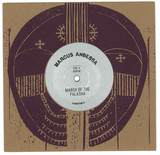
ZamZam 70 is our first team-up with the man of mystery known as Marcus Anbessa. An enigmatic figure whose identity must remain secret for the time being, his infrequent releases on labels such as Lion Charge, Tribe 12, and The Most High (as “Unknown Artist”) are eagerly awaited by those who know, charting an uncompromising vision down a path untrod by the weakheart or the follow-fashion. We love music that builds its own sound world with only passing reference to familiar genres or signposts, music that believes in itself utterly - for this reason we feel genuinely blessed to present these two sides.
“March of The Falasha” is pure roots music that, firmly planted in the soil of dub and sound system, reaches back even further into the mists of time through technological means. Downbeat steppers is the idiom, pure heartbeat is the pulse. Like an old soul young in years but full of wisdom, a distorted flute melody wanders ahead through the undergrowth of bass, light filtering through the ancient canopy above in the form of swung percussion and flickering echoes overlapping and intertwining like vines and creepers weaving on temple walls. Ancient-to-the-future.
“Creator” strikes a different yet equally dread chord, 140-ish post-apocalyptic Rasta business focused squarely on bass and space, hard, insistent drums and infinite echo trails flinging from the snares and percussion, creating hypnotic tracers like sparks swirling heavenward from a well-tended fire in blackest night.
Imagine African Headcharge on Jah Tubbys, or a rootsman groundation resuscitating ancient machines in the crumbling ruins of a near-future world and you begin to see what Marcus Anbessa brings. This music reminds us that nature herself will some day claim Babylon and grind it to dust, regardless of our efforts to save it or hasten its fall.
DJ, producer, singer-songwriter, one-half of world-touring soul duo Myron & E (Stones Throw), founder of boogie outfit The Pendletons (Bastard Jazz), part of electro-funk duo Lucid Paradise, and an endless string of collabos. Over 2 decades in the game means multi-faceted artist Eric Boss knows his way around music. Having been there, done that, gotten the t-shirt and watched the fat lady sing, it's finally time for E to take center stage and deliver his finest effort yet with solo record "A Modern Love", an effervescent collection of raw funk, sweet soul, west coast vibes and classic hip hop, produced by Björn Wagner and Steffen Wagner (The Mighty Mocambos / Bacao Rhythm & Steel Band).
"A Modern Love" has all the ingredients of a future classic. High-profile guests Check: with Gift Of Gab (Blackalicious) rapping on "I Wanna Ride", a track with more bounce than a lowrider chevy on Santa Monica boulevard, and soul siren Gizelle Smith featuring on "Spiders", a spooky number that will get you jumping out of your seat like you've been attacked by giant 8-legged arachnids. Need some dancefloor action "Get Next To You" gets down to serious bizniz with crisp drums and a catchy hook guaranteed to get the party started. Something for lovers We've got it covered with "Is It Love", where Eric waxes lyrical about his sweetheart over a honey-drenched soul beat.
From reggae-flavored vibes being served in inspirational number "Your Life Is Up to You" to the slow-burning grooves of "Merry Jane" which features singer Ishtar, the 10 tunes on "A Modern Love" all attest to Eric Boss' talent and versatility. Judging by how quickly the limited edition 45 of album opener "Closer To The Spirit" sold out when it was released, it seems safe to say Eric Boss is a king Midas with the golden touch when it comes to providing fresh grooves for contemporary ears, and "A Modern Love" is set to prove so once again.
Sometimes, - despite today's high-octane, fast-track and hyper-hysteric music business - you come across things that seem so pure, perfect and poetic that it almost hurts. "Socialo Blanco" is one of these objects.
It appears understated at a first listen, startling at the second and totally enamouring by the third run. To lay it all out on the table: it sounds like a Music from Memory re-issue, looks like a Growing Bins Records discovery and feels like a flea-market-hippie-uncle-record-collection find.
Based on the language (coincidences and misbehaviour included) and direction of the classic EMS Synthi AKS and recorded by hand and directly to tape (no midi, no sync, no computer), it is at once out of time and out of touch with current sound aesthetics, but that only makes it even more contemporary (vintage) - like a great piece of furniture.
Unsurprising, if you know that Feater is helmed by Daniel Meuzard. Hailing from Vienna and having made a name for himself as a trustworthy and skilled studio equipment dealer and working closely with producer and studio engineer Sam Irl, the man has a knack for turning yesterday into today.
Already is his project's second album, "Socialo Blanco" is the result of all of this and some magical and effortless sessions. The voice of Vilja Larjosto from Finland and Ghana's Eric Owusu (Pat Thomas, Ebo Taylor) on percussion, spontaneously invited to the recording sessions by fellow Viennese Giuseppe Leonardi, are the icing on the cake. All of that and especially the non-conformist pop song "Time Million" symbolizes the heart and soul of an album that deserves to be billed as such. And that is no mean feat.