"It's time. Africa, it's time. It's time that Africa changes. It's time our leaders change. Everything that happens in Africa is extraordinary. We have everything: water, earth, sun, fields of oil, gas. We have all this in Africa, but Africa is still poor. It's time we change our way of thinking. It's time for Africans to take their destiny into their own hands. If not, others will take it." This is the message instrumental guitarist Tidiane Thiam hopes to convey with his new solo album, Africa Yontii, a Pulaar title that translates to "Africa Time." To a casual listener, Thiam's bold statement starkly contrasts with his melodic playing. But a closer listen to Thiam's expressive playing reveals a thoughtful voice that stands out from the crop of contemporary guitarists. "What I should be singing (with words) I'm instead saying with my guitar," he says. Hailing from the sleepy fishing Senegalese fishing town of Podor, home of the great Baaba Maal, Thiam taught himself guitar by playing along to late-night radio broadcasts of Manding music. He soon developed his style, often reworking Pulaar folk themes into his compositions. On Africa Yontii, Thiam's third album for Sahel Sounds, he teamed up with hip-hop beat maker Ndiaye Moctar from studio M.N. Records to provide accompaniment, integrating unexpected elements such as field recordings and electronic sounds. In the liner notes for Africa Yontii, Thiam voices his concerns about the lack of opportunities for Africa's youth and the lonely road that can come with leaving behind loved ones in the hope of a better life. He also sprinkles in a philosophical query about the eroding state of the world alongside two more hopeful, traditional offerings in the form of wedding and river songs. Despite the sometimes heavy subject matter, Thiam's love for his homeland and heritage shines through. Tidiane Thiam's Africa Yontii reclaims the maligned "world music" genre within a sonic space that has long been dominated by others telling the story. As the title suggests - It's time!
Suche:sene
Church Andrews and Matt Davies weave intricate patterns from Fibonacci sequences on new mini-album, Yucca.
Producer and composer Church Andrews (aka Kirk Barley) and drummer Matt Davies return to explore the outer limits of rhythm on a six-track suite that is at once angular and fluid, natural and systematic. Drawn to the restrictions of working solely with one synth and live drums, the pair found creativity in limitation, developing a compositional dialogue between the sonic timbres of Kirk’s productions and Matt’s percussive practice.
Evoking the primitive yet complex form of the plant from which it takes its name, Yucca features tracks that are built around rhythmic ratios of the Fibonacci sequence. Mirroring spiral patterns exhibited in nature, each track evolves like a cellular structure of its own, from the livewire syntax of ‘Chirp’ and the deconstructed ebb and flow of ‘Ferns’, to the mini-album’s title track, where crisp grooves flit between modulated electronics like fireflies.
“I’ve always been inspired by music that is complex without sounding complex,” Matt explains. He maintains a sense of bounce amid the intricate phrasing and cites drummers Roy Haynes and his grandson Marcus Gilmore as inspirations, alongside sabar drummers from Senegal and Mridangam drumming of South India.
With a shared background in hip-hop and the swung beats of J Dilla and Flying Lotus, Kirk Barley and Matt Davies were also inspired by the minimalism of Terry Riley and the sparse palette of dub techno.
Written and recorded in Lewisham in the spring and summer of 2023, Yucca follows the release of Axis in 2022, with the duo having also performed at festivals such as Rewire and Waking Life, and recorded live sessions for FACT magazine and Worldwide FM.
The third release on Yorkshire-based Odda Recordings, following Kirk Barley’s Marionette and Flaer’s Preludes, Yucca confirms the label’s reputation for championing music on the unstable ground between the organic and the synthetic.
“A corollary is a statement that follows naturally from another statement”
Presenting Corollary1, the first release in a new remix series flipping cuts from O.M.Theorem’s Lemma projects.
For this one we invited good friends DJ Sotofett and Ossia. Regular conspirators in bacalao and dosa dinners, monthly hangouts at Globus-Tresor and sound system parties in Milano & Bristol. Through appreciation of similar frequencies and shared experiences, friendships grow. It felt natural to invite the two to do remixes for us. One evening we bumped into them on the dancefloor during a live concert by Senegalese percussion outfit Ndagga Rhythm. This was a sign. BAM! The EP came alive.
On the A-side, we hear two fresh takes on Lemma1-B2. DJ Sotofett with his dub heavy output on Honest Jon's and Sex Tags Amfibia invites Ghanese Afro-Dub drummer Ekowmania for vocals and usual collaborator LNS for keyboard work on his sub-deep club-stepping colourful remix. We bet the infectious vocals will linger in your mind for a long time. Play it LOUD for full sub bass effect! The second interpretation of the same track is from O.M.Theorem. A techy dubstep banger, this one!
On the B side, Bristol and Peng! Sound's Ossia picked his favorite Lemma1-B1 and drove the mixing desk in true Dub-style fashion with a classic riddim that meets an avant garde melody going in and out of the mix. This is a remix that deserves attention, with every listen revealing new layers and details. Even the premasters sounded phat as a greasy hamburger on the German capital’s legendary Super Power Soundsystem! The second interpretation is from O.M.Theorem, rebuilding percussion and bass from Lemma1-A1. Liberating himself from all restrictions the result is a footwork-reminiscent 160 cut, ready for the dance floor.
In 1984, Jasper Van’t Hof, a prominent European jazz pianist, propelled to fame with the energetic ‘Pili Pili’ a 15-minute trance collaboration with Guinea's Isaac Tagul Group. Inspired by a fiery red pepperoni, the track sold over 100,000 copies, leading the group to adopt the name Pili Pili, becoming a hit in the club and disco scene.
Pili Pili's musical roots trace back to Van’t Hof's 1982-83 tour in Central Africa, where he discovered a love for African music. The band embraced authenticity by collaborating with diverse African musicians from Mali, Congo, Senegal, and Guinea. In 2000, Van’t Hof initiat-ed a project with the young Zulu choir Phikelela Sakhu-la from Durban, South Africa.
Pili Pili's style, described as experimental fusion, blends intricate African rhythms with jazz, fusion, funk, and dance. Van’t Hof emphasized the importance of groove over complex solos, stating that intellectual approaches are lost in their music.
The band's performances, marked by their energetic fusion of jazz and African rhythms, gained acclaim across Europe. Regular tours and festival appearances, such as the Jazz Festival of Montreux, solidified Pili Pili's reputation as an excellent live band. Reviews praised the band's dynamic and explosive music, turn-ing every performance into a rhythmic and fiery expe-rience.
Senegalese singer Youssou N'Dour, once described by Rolling Stone as ""perhaps the most famous singer alive in Senegal and much of Africa"" and ranked 69th on the magazine's list of the greatest singers of all time. It is easy to say that Youssou N'Dour is an icon. ""The Guide (Wommat)"" is his most successful work commercially. The duet with Neneh Cherry, ""7 Seconds"", is still one of the most successful and important protest songs of the 20th century. The Guide (Wommat) is for the first time available as a 2LP-set. The album is available as a limited edition of 1500 individually numbered copies on yellow, red & orange marbled vinyl and includes an insert.
The Guide (wommat) by Youssou N Dour, released 19 April 2024, includes the following tracks: "Without A Smile (Same) ", "7 Seconds (Duet with Neneh Cherry)", "Generations (Diamono)" and more.
This version of The Guide (wommat) comes as a 2xLP. This release comes with (a) Insert(s).
The vinyl is pressed as a yellow disc. Another vinyl is pressed as a marble, red & orange disc.
"L'idée nous est venu lors d'une conversation un peu arrosée dans un pub du sud de Londres avec Philippe du label Tapeworm" dixit François Kirmann Gamaury alias Franz Kirmann alias Dj Salinger – producteur français établi à Londres depuis plus d'une vingtaine d'années.
"Voyage voyage voyage" est une mixtape. Mais pas dans le sens traditionnelle du terme. Kirmann l'appelle une mixtape subjective, où les morceaux ne sont pas joués tels quels mais présentés tels qu'ils sont ressentis par l'artiste.
Un peu comme le DJ Vladimir Ivkovic qui ralentit certain morceaux sur ses platines pour en révéler un autre aspect, Kirmann zoom dans l'étoffe même des enregistrements, étire les notes et les sons à l'infini, pour en mettre à jour un sens caché, altérer notre perception de ces chansons qui peuvent parfois sembler un peu désuètes. Ici elles sont transformées en nappes fantomatiques et envoutantes qui évoquent un souvenir d'une période de sa vie, une trace sonore d'une époque un peu naive, qui revient aujourd'hui sous forme d'echo, une musique nostalgique trempée dans la reverb et la distortion.
Kirmann a grandit au Sénégal pendant les années 80 et il se souvient des étés de son enfance passé chez ses grand parents, les chansons à la radio, dans le bus du centre aéré, dans un Prisunic en Dordogne, où une fête de camping en Alsace: Catherine Lara, Elsa, Veronique Jeannot et bien sûr Desireless et son fameux tube "Voyage voyage".
Les chansons sélectionnées pour la cassette ont toutes en commun une incitation au départ, une recherche de l'ailleurs, un amour perdu, un souvenir, les thèmes de predilection d'une certaine pop française que l'on nommait variété.
Ces idées d'évasion sont accentuées ici par le traitement sonore qui leur est appliqué. Les chansons sont paralysés dans le temps, figées dans le son, comme si l'on avait souligné certain passages dans un roman pour les détacher du texte intégral.
Distortion, écho, réverbération et autres effets sont appliqués et donnent à la musique et au son une qualité rêveuse et distante. Certains passages reconnaissables se dévoilent et sortent de la brume sonore, ils se révèlent plus net, d'autres sont noyés dans un brouillard imprécis, une musique proche de l'ambient qui enveloppe l'auditeur.
Kirmann: "Chaque track est basé sur une chanson de variété française des années 80, je voulais re-créer une impression de distance, quelque chose de lointain. Les morceaux deviennent des sortes de tapisseries sonores mais dont l'essence de la chanson originelle est toujours présente. Il y'a un roman de Patrick Modiano où les personnages lancent des avis de recherche pour la France à partir d'une station de radio d'un pays lointain. Le son est brouillé, les voix étouffées. J'avais un peu cette idée en tête de faire quelque chose de similaire, comme si les chansons étaient entendus sur un vieux poste de radio mais émises d'une station lointaine et d'un autre temps."
Le résultat est un voyage nostalgique, une musique ambient et nébuleuse façonnée à partir de tubes synthétiques 80's. Imaginez Fennesz ou My Bloody Valentine jouant des reprises de Laurent Voulzy et vous y êtes presque…
Loveless non, Desireless oui!
DJ Salinger. Voyage Voyage Voyage – Disponible en cassette uniquement. 100 exemplaires sur le label Tapeworm.
—
Franz Kirmann is a French music producer living in London. He has made albums for various labels including Denovali, Bytes, Mercury KX. He also writes music for film and TV and is a lecturer in music production at Point Blank Music school.
Senegalese singer Faada Freddy releases a new album entitled "Golden Cages" after a seven-year hiatus. With an organic approach, he uses mainly his voice, hand-clapping and body percussion. The album features original tracks that reflect his critical yet benevolent thinking, tackling themes such as the standardization of thought, lack of reflection and dehumanization in today's society. Faada Freddy defends the idea of freedom, combining conscience and emotion, reflection and wonder. The album also celebrates the singer's African roots and expresses his attachment to his country and continent. "Golden Cages" is an ode to freedom and harmony, a vibrant love song for overcoming divisions.
The Tables Will Turn EP marks the comeback of Senegalese singer Faada Freddy after a long recording silence since the release in 2016 of a first album The Gospel Journey, punctuated by some 300 concerts worldwide.
Tables Will Turn confirms an uncompromising musical approach where the only resources are human "My music is 100% organic and 0% technological" summarizes Faada to evoke a device, already proven on Gospel Journey that solicits the mouth and body to imitate the sound of instruments.
Always traveling, El Gato Negro, the moniker of "nomadic" singer/songwriter and multi-instrumentalist, stopped this time in Dakar, Senegal to record his new album “Tigre qui pleure” (“Crying Tiger”). In a combination of West African and Cuban musicians, under El Gato's Colombian flute, Jazz blends with Hip-Hop, traditional with digital, French with Wolof and Spanish. In this third album, produced by GUTS, El Gato Negro invited his musical family (Florian Pellissier, Kumar, Orchestra Baobab, Cucurucho Valdés, Pat Kalla, Cyril Atef, iZem, Djeuhdjoah & Lieutenant Nicholson...) and dropped his festive mask to let Axel, the melancholic, express himself.
"Cross My Heart" is a tribute to the harmonica player and singer James Cotton, one of Boney Fields" heroes and companions on the road, is certainly the most representative track of this thrilling groove mood that authentic blues musicians know how to infuse. Boney Fields possesses that almost funk tone matured enough to tickle our ears and make us tap our feet. By revitalizing, for example, "The Thrill Is Gone" in the spirit of its original author (Roy Hawkins), Boney Fields perpetuates the tradition of spirited orchestras of yesteryears without compromising the modernity of its irresistible tempo. Much more personal than all his previous albums, "Just Give Me Some Mo" is also the expression of introspection, that of a man who remembers without drowning in dark nostalgia. He thinks of the courage of his mother bravely facing obstacles in an unequal America. "Back in the Day" is not a sad song. It makes one stronger and nurtures faith in the future. This melody is certainly the most touching of the six compositions written by Boney Fields. From "Control of you" to "Something" holding me" or "I know yes I Know" he invites us into his intimate biography, the story of a large family shaken by inevitable upheavals that must be faced, the destiny of a combative musician who resists adversity. Boney Fields chose to let his soul speak. This effort of truth had to be supported by the artistic direction of a master. By enlisting Sebastian Danchin for the production of this album, Boney Fields turns to a historian of African-American culture whose keen ear has already won over Little Milton, Mighty Mo Rodgers, Toni Green, and Jean-Jacques Milteau, among others... Their exchanges uncovered a perfect understanding of "Chicago Blues" the brassy vigor of which they experienced firsthand 40 years ago. Surrounding oneself with the right people is quite a challenge. Fortunately, Boney Fields knows how to spot true talents. He was convinced that the Senegalese guitarist Hervé Samb would also be a good musical director. Hadn"t he been the first to highlight the expressive power of this luminous composer and arranger? The enduring vitality of the blues, when narrated with precision and insight, always manages to find its legitimacy. The months of reflection, of questioning, will not have been in vain. They have given substance and depth to this thrilling record which, we wager, will be a milestone. Boney Fields has waited long enough. Does he want more? We will give him more! "Just Give Me Some Mo" will now be a shared leitmotif, that of an insatiable conductor and that of enlightened admirers.
Wewantsounds is delighted to reissue Brion Gysin"s cult avant funk album produced by Ramuntcho Matta in the early 80"s. The hugely influential Gysin who, with his friend William Burroughs, was revered by the likes of David Bowie, Brian Jones, Laurie Anderson, Genesis P-Orridge, is accompanied here by Matta - on his return from a two-year spell in New York - and French post punk stalwarts Yann Le Ker (from the group Modern Guy) and Frederic Cousseau (from Suicide Romeo) plus special guests including Don Cherry, Elli Medeiros, Lizzy Mercier Descloux, Caroline Loeb and Senegalese drummer Prosper Niang (Xalam). This is the first time the album is reissued on vinyl, newly remastered from the original tapes, augmented with bonus tracks and a 2 page colour insert featuring new liner notes by Gysin scholar Jason Weiss.
Der senegalesische Sänger Faada Freddy veröffentlicht nach siebenjähriger Pause sein neues Album. Mit einem sehr organischen Ansatz nutzt er hauptsächlich seine Stimme / Acapella, Handclaps und Bodypercussion. Das Album spiegelt sein kritisches, aber wohlwollendes Denken wieder und thematisiert die Standardisierung des Denkens, mangelnde Reflexion und Entmenschlichung in der heutigen Gesellschaft.
Faada Freddy verteidigt die Idee der Freiheit, indem sie Gewissen und Emotion, Reflexion und Staunen verbindet. Das Album zelebriert außerdem die afrikanischen Wurzeln des Sängers und bringt seine Verbundenheit zu seinem Land und Kontinent zum Ausdruck.
A Flor de Piel, the new album from singer-songwriter and composer Maria Monica Gutierrez (aka Montañera), is a meditative journey of self-discovery across oceans, time, and the traditional confines of genre. Originally from Bogota, Colombia, Gutierrez began the album as a way to explore her identity after a difficult move to London left her feeling untethered in a strange new place. The result is an examination of the immigrant's experience through a rich sonic lens of ambient pop textures, inspired by sources as disparate as Colombian traditional music, traditional Senegalese music, and whalesong from the depths of the Atlantic. The album begins with the title track "A Flor de Piel," Gutierrez's indelible vocals floating above a vast expanse before being joined by deep, silky bass and the plucks of a koto-like stringed instrument. "The song was inspired by traditional Japanese music," Gutierrez explains, "It's about making my heart a little lighter; I know that inside of me I can be as light as mist in heat, I can be fragile as the song of a sparrow." That sentiment perfectly encapsulates much of what makes A Flor de Piel so special. The album comes with a message of healing for all people, without forgetting the centuries of struggle and hurt that form the bedrock of modern society. The track "Santa Mar," for instance, is inspired by the musical traditions of afro-pacific women in Colombia, and the crucial role that they play as peacebuilders in the region. Backed by a hypnotic beat, the song features contributions from marimba player Cankita, alongside Las Cantadoras de Yerba Buena, an all-female vocal group that utilizes traditional Afro-Colombian music to preserve their history and promote peace. Standout track "Como Una Rama" is a futuristic take on bullerengue, a traditional style of music and dance originally developed by Maroon communities on Colombia's Caribbean coast. Deeply affecting, the song combines Gutierrez's indomitable voice with electronics that recall Steve Reich's rhythmic minimalism. "Cruzar," the final track on the album, feels almost like a lullaby, with a meditative harmonic style and trance-like vocal melody. "The lyrics," Gutierrez explains, "are a personal reminder of what is important to me: healing, letting go, breathing, evaporating, forgetting, changing, crystallizing." Across the 40-odd minutes of A Flor de Piel, Gutierrez triumphs at recontextualizing traditional sounds and sentiments into a modern form using synth-based and electronic textures. It's a fitting representation for the personal struggles that the artist endured during her move to London. Rather than dwelling solely on the past Guitierrez uses A Flor de Piel to summon the strength of past generations, and forge a new path forward. As she describes it, "The album has accompanied me through inner journeys of finding myself in a new territory _ of redefining myself, of remembering who I am _ in a strange place." As we drift towards an increasingly frightening and uncertain future, perhaps Montañera's A Flor de Piel is exactly what we need: something to give us strength, to bring us peace, and to accompany our journey into a strange new place.
Assiko Golden Band de Grand Yoff is the sprawling drum collective tearing up Dakar's nightlife scene. Senegalese poet Djiby Ly (Wau Wau Collectif) is backed by fourteen different percussive instruments plus horns, winds, balafon, and the occasional accordion, combining Count Ossie's spiritually elevated polyrhythms with Fela Kuti's orchestra and Tony Allen's groove. Based in the impoverished neighborhood of Grand Yoff and operating as a mutual aid group for the larger community, the band builds its songs on ancient rhythms passed on from Senegal, Cameroon and the infamous Gorée Island. In both Wolof and French, Djiby preaches a message of uplift and cooperation rooted in the Sufi teachings of the Mouride Brotherhood, as well as Christianity and animist religions. "Senegal, my life my joy" is the call and response chanted over cascading, infinitely layered drum patterns on opener "La Musique Du Coeur." "We build our own country" the band proclaims in Wolof on "Xarritt." For twenty years and across three generations of band members, Assiko have played raucous all-night jams at weddings, secret parties, and political rallies. Grainy cellphone footage of their live shows have spread online. But this is their first album, the result of a collaboration with Swedish musician and archivist Karl-Jonas Winqvist (Sing A Song Fighter), who met the band in Dakar in 2018 and facilitated recording sessions and overdubs via Whatsapp (no small feat with so many musicians). This is vital, exciting and innovative music, alive with energy and purpose, a band rooted in a very specific community but speaking to the world.
Ndox Electrique results from the collaboration between François R. Cambuzat, Gianna Greco (also known for their work with Ifriqiyya Electrique), and the n'doëp community in Senegal. The project originated from the duo's quest to trace the origins of North African rituals, which led them to the Lebu community in Cap-Vert, an isolated region at Africa's westernmost point.
The album seamlessly blends the duo's electronically-infused avant-rock with the intense, ritualistic vocal chants and rhythmic percussion of the n'doëp community. It serves as a captivating bridge between these two musical worlds, capturing the essence of this cross-cultural collaboration.
The text also highlights the challenges of merging Western rock and experimental influences with the sensibilities of their Senegalese collaborators, ultimately resulting in a unique and powerful musical experience. "Ndox Electrique" transcends cultural boundaries, immersing listeners in the enchanting sounds and mystical narratives of Western Africa.
Artist and multi-instrumentalist Flaer looks to the landscape to explore pastoral melancholy on debut release, Preludes.
Ensconced in his family home in rural Leicestershire in the early months of 2020, painter and musician Realf Heygate (b. 1994) picked up his childhood cello for the first time in several years and began to play. Setting himself parameters to only record onto 4-track tape with acoustic instruments – cello, piano and acoustic guitar – he assembled a suite of instrumental compositions that form the basis of Preludes, his debut album as Flaer and the inaugural release on Odda Recordings.
Channelling the tension and unease between the pastoral idyll of the English countryside and the darkness which lurks beneath the surface, the mini-album draws inspiration from the analogue aesthetic of 1970s folk horror films, weaving field recordings of birdsong, church bells and the natural environment into chimerical melodies that reflect on Heygate’s childhood experiences of rural England.
“It was really important not to isolate the sound from its environment,” he explains, describing the compositional and recording process as “site-specific”. Developed over a series of intuitive musical enquiries, the mini-album’s uncanny quality emerges from combining raw demo takes with overdubs of almost orchestral grandeur.
Heygate points to the final track as indicative of the work as a whole: “‘Follow’ really is the mantra for the release and embodies the practical approach I was taking to music making: not to force the music but see where it takes you.”
As a painter, Heygate’s practice takes artefacts through sequences of reproduction that embrace the fluctuating materiality of the copy. Since obtaining a degree in Fine Art from Central Saint Martins in 2017, he has exhibited solo at Peter von Kant and Springseason galleries in London, and has participated in group shows at Saatchi Gallery, Cob Gallery and Senesi Contemporanea.
Describing his artistic practice as one of self-erasure, music instead provides Heygate with a more personal and autobiographical outlet. Where the two worlds combine is on Preludes’ striking artwork, which features paintings of 13th century stone carvings from the font of the church in the town where he grew up.
Speaking to a time where people were connected to the land in a more profound way, each symbol is assigned to a track on the album, which Heygate likens to giving them a title.
“To add that one juxtaposition might open a whole new interpretation or language that might be hard to find otherwise,” he explains.“Over time it might reveal itself to you, which is why I'm excited about it being released. To throw them out there and see what comes of it.”
Musical innovators, Red Snapper, have announced that they will release a new album on Lo Recordings on the 20th of October 2023.
‘Live at The Moth Club’, the follow up to 2022’s acclaimed ‘Everybody Is Somebody’ long player, features nine tracks from a vast and impressive back catalogue on Warp Records and Lo Recordings and captures perfectly the energy of their celebrated sold out London show from May 2022 in Hackney.
With an incredible and genre bursting career that spans nearly thirty years, the new album demonstrates the band’s ability to constantly rework classic and new tracks, keeping them impassioned, experimental and relevant. The collection includes a version of ‘Suckerpunch’ which originally appeared on their 1998 album ‘Making Bones’ and will now be released as a single on the 15th of September 2023.
Notorious for casting convention aside, and remaining one of the UK’s most forward thinking and rule breaking live bands, Red Snapper embrace a unique blend of live, euphoric Afro-Jazz, Future Funk, Dub, Dark Hip-Hop and fragile soundscapes.
Formed in 1994, the original line up of Rich Thair (drums), Ali Friend (double bass) and David Ayers (guitar) released three EPs on Rich Thair and Dean Thatcher’s label Flaw Recordings. The first EP ‘Snapper’ featured Beth Orton on vocals.
Over the initial years the band released the sonically pioneering albums; ‘Reeled and Skinned’, ‘Prince Blimey’, ‘Making Bones’ and ‘Our Aim Is To Satisfy Red Snapper’ (Warp records), touring globally and supporting the likes of Massive Attack, Bjork, The Prodigy, De La Soul and The Fugees. They also acquired a reputation for innovative and expansive remixing – reworking tunes by Trouble Funk, David Holmes, Sabres of Paradise, Garbage, Lamb, S-Express and Edwyn Collins amongst others.
Since then the band have released the eponymous ‘Red Snapper’ and ‘A Pale Blue Dot’ on Lo Recordings followed by ‘Key’ on V2 Records which featured the track ‘Spikey’ which was on the soundtrack for El Camino, the Netflix Breaking Bad film directed by Vince Gilligan in 2019.
In 2013 Red Snapper composed a new soundtrack to the 1970’s Senegalese, psychedelic road movie Touki Bouki which had been restored by Martin Scorsese. The band toured Europe performing the soundtrack live to the film, culminating in the celebrated sell-out show at The Queen Elizabeth Hall on London’s Southbank. In 2014 the album ‘Hyena’ was released on Lo Recordings featuring all the music from their original film score.
Last summer the idea came up that the material of the Chillum Trio live act, which had been matured for years by then, would deserve a release on its own. The concept was to try to reproduce the experience of the live performances as close as possible, so a semi-mixed album was created, on which the seven tracks work separately, but the effect is best when listening to the record in its entirety. The musical world of Random Rituals is crazy dense and colorful, similar to Chillum Trio's previous releases, an exotic mix of contemporary electronics, world music and club sounds;s still, it has a unified character, which is due to the fact that it has grown from a live set that has been constantly developing over the years. Genre-wise, it is characterized by low-tempo, organic desert house, tropical acid drops, deep dub, hypnotic tribal beats and psychedelic episodes. Just like genres, eras and cultures are mixed as well: from the jazz-funk of the 70s, via tribal trance of the 90s to modern deep house, from Peru to Pakistan, from Sudan to Senegal: a real musical journey through space and time.
Géza Szekeres, the heart and soul of Chillum Trio, summed up the essence of the record as follows:
"Random Rituals shows me the paradox that recharges can be planned and ad-hoc at the same time. Rituals are characterized by a predictable scenario, but the effect can also be unexpected, so that events spin without a score. You don't walk into the ritual, but it comes to you, creating the same state that then fills you up."
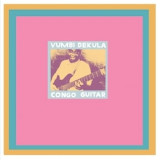
Hive Mind and Sing A Song Fighter are delighted to present to you their first collaborative release, the amazing solo guitar album from legendary Congolese guitarist Kahanga Dekula aka ”Vumbi”.
Swedish producer Karl-Jonas Winqvist (founder of Sing-A-Song Fighter and member of Senegalese/Swedish act Wau Wau Collectif) has been a longtime fan of Vumbi Dekula’s artistry which led to him releasing The Dekula Band's debut album ”Opika” in 2019 with the Dekula Band.
While watching the band perform was always a blast, says Karl Jonas, his desire to hear Vumbi play on his own, without the thunderous drums, wailing saxophones and chanting vocals grew in his mind, “Because, in a way, Vumbi’s guitar playing is like an orchestra on its own. And the idea of just concentrating on all the amazing riffs and beautiful, uplifting melodies was just so appealing”. Karl-Jonas proposed the idea of producing a solo album to Vumbi, and within a week the production process began
Recorded in two days during lockdown at the Helter Skelter Studios in Stockholm, Karl and Vumbi allowed the music to guide them. Vumbi was inspired to play 2nd guitar adding some harmonies and melodies here and there, and on the final track (”UN Forces Get Out of the DR of Congo”) he introduced a banjo into the world of ”Congo guitar”. Karl Jonas started up his old rhythm box machine to some of the songs to see how Vumbi and his playing would react to it. Elsewhere, wordless backing vocals from Karl-Jonas and Emma Nordenstam were added to Maamajacy, bass melodica by Karl-Jonas appears on Weekend, and a little piano tinkering from Emma adds some sparkle to Zuku. But clearly, Vumbi's virtuoso playing remains the star of Congo Guitar.'
Don Cherry's downtown Paris funk masterwork produced in 1985 by Ramuntcho Matta and originally released by Barclay in France only, finally gets a worldwide release on Wewantsounds. Featuring French post-punk muse Elli Medeiros, avant garde poet Brion Gysin and cult Senegalese drummer Abdoulaye Prosper Niang (Xalam), this is a unique soundbite of Paris in the early 80s at its coolest when funk, jazz and new wave were mingling with sounds from Africa, Jamaica and Latin America. Newly Remastered, the album is augmented by a second LP worth of bonus tracks and a deluxe gatefold sleeve with a new essay by French journalist Jacques Denis (Liberation).