Yet another solid gold modern reimagining of the mighty Loleatta Holloway, this time her infamous 1977 smash 'Hit & Run' goes under the knife and is tweaked to devastating effect by 2 of Chicago's finest modern day editors - Jamie 326 & Cratebug. Anyone with even a passing interest in Disco or House will be more than familiar with these 2 guys names. Having edited and remixed numerous cuts in their own original ways, they take this all-time Salsoul classic and strip it right back to the essence, to the very basics, and in the process create a total dancefloor weapon. This edit originally came out a few years ago (2013) on a compilation that showcased the new wave of contemporary talent emanating from the Windy City and naturally it was one of the cuts that stood out, finding favour with a wide variety of DJ's across the board from Motor City Drum Ensemble, Todd Terry, Jeremy Underground Paris, Theo Parrish and more. Drawing comparisons with Paperclip People's anthemic 'Throw' from 1994 in the way it snatches a killer loop from 'Hit & Run's' bassline, 'Hit It & Quit It' is a monster, a record you'll literally play over and over and over again, a relentless Disco juggernaut that oozes power. It made perfect sense for this legit single-sided reissue 12" to come out on Salsoul Records, the home of Loleatta Holloway's finest material and all of her classics. This limited reissue has been made in conjunction with Jamie 3:26 & Cratebug and Salsoul Records, 100% sanctioned and lovingly re-presented for your dancing pleasure. This one is HOT. Sleep at your peril!
B. Chamber (Stratum A), by B. Close, is the first full length solo release by Los Angeles-based multi-disciplinary artist Brian Close. The first of two volumes assembled from some thirteen hours of music produced by Close while residing in Connecticut from 2021-2025, B. Chamber (Stratum A) offers a vivid, fractal afterimage of a prolific, specific time and space in the artist’s oeuvre.
After leaving New York City early in the pandemic to a farmhouse in the countryside with dedicated spaces for multiple sound stations, Close developed an intensive daily practice of melding with the machines. The vast, pastoral backdrop of rural CT provided inspiration and contrast for his ongoing investigations into dynamic, poly-rhythmic electronic music. The sounds on B. Chamber (Stratum A) range from the machine-modeling of acoustic instruments and natural environments to the utterly unhuman, spinning on the axis between crystalline, pointillist precision and shifty blown-cone distortion. Close’s atypical interpretations of rhythm, noise and other undefined musics land in a hybrid zone of their own.
Throughout B. Chamber (Stratum A), Close’s productions are in perpetual motion. Foxtrot’s shifting hi-hats and disembodied voices rise like cicadas propelled by glitching machines and tangled rhythms, Many Drive draws momentum from dubby stabs and twinkling atmospherics. Character Community’s nimble, drifting snares and erratic static are uplifted by swelling synths, and Mpan’s modular mining forgoes drums but is no less propulsive for it. Acre Voices’ seasick pads and deft drum patterns tap an energizing nerve, and closer 5D Bow’s ambush of pummeling machine gun fire spirals into the tryptamine palace and emerges completely rinsed and refreshed.
Equally powerful in the club as in the outdoors, in the headphones eyes closed or on the move, B. Chamber (Stratum A) grants an immersive temporary trip on B. Close’s unique wavelength, with Stratum B to complete the picture in the summer of 2026.
Brian Close (b. 1979, NYC) uses the cold logic of mathematics to trigger states of total sensory displacement. Close co-founded multiple AV studios to explore the "hypnotic"—a ritualistic practice of motional-graphism and improvisational sound. His work is a study in synesthesia and the architecture of trance, using geometric precision to dissolve the sense of time. It is a digital-visceral experience built on heavy logic, designed for large-scale immersion and timelessness.
Close is one half of Georgia who have released records on Palto Flats, Firecracker Recordings, Meakusma, Youth, OOH-Sounds and EM Records, and have a long-running residency on NTS.
B. Chamber was written, produced and mixed by Brian Close.
Mastered by Rashad Becker.
Artwork by Brian Close.
Deluxe Box Set featuring 69 tracks over TWELVE 12" LP's! We're at it once again, going all out with 12 mind melting color pressings and deluxe packaging with extra goodies: RAINBOW FOIL NUMBERED BOX Hand numbered box, Rainbow Splatter Vinyl is Limited to 1000 copies DELUXE COLOR PRESSINGS Hypnotic Rainbow Splatter vinyl pressings with unique op art label for each 12" PHOTO SLEEVES Each 12" in a custom photo inner-sleeve, with 35mm photos by Bob Greco (@picturemanbob) DELUXE 24" x 24" POSTER With polaroid film photos from the festival by Bob Greco BONUS BOOTLEG STICKER Sourced from poster created by Ernie Houk (@leftiesmudges), originally made for Field of Visions 'Mirage City' MIXED & MASTERED Mixed from multi-track stems and mastered for vinyl by Craig Lawrence
Formed in Southend in the late 90’s, Beatglider’s tale is a familiar one taking in early acclaim only for momentum and promise to be dashed by major label statis and indifference.
After the release of the debut long-player, ‘40 Days Of Summer’, in 1999 the band signed to Sony subsidiary Lakota and decamped to LA to record its follow-up, ‘Dreaming Of Roads’, an album that was never to see the light of day.
And now, over 20 years later, ‘Dreaming Of Roads’ eventually gets a deserved release on 28th February via the Arlen label. A beautiful 11-track understated delight which musically falls somewhere between the likes of Elliott Smith, Grandaddy, Yo La Tengo and Sparklehorse, the album has not only stood the test of time, but arguably sounds as fresh as ever in 2026.
The tracklisting of the album - recorded in Los Angeles at the famed Sound City studios - is as follows:
Pioen is the second album by Elisabeth Klinck & Nils Vermeulen, released on blickwinkel. It was recorded in a small chapel of a monastery in the city center of Ghent. A chapel by nature is a place of contemplation and meditation, which automatically had influence on the music. Movements slow down, attention is sharpened and the overwhelming silence of the space becomes part of the music. Sound and silence are meticulously woven into each other. Even when the music grows at times dense and heavy, there is an ever-present sense of closeness and intimacy. This is reinforced by the use of the voice, which naturally appears throughout the album, not as a separate layer but as an extension of the instruments.
The pieces – this time more curated than on their previous album Pair, Paire – arose from hours-long improvisations where sound became space and space became sound. Bringing together violin, double bass and voice, Pioen unfolds as a serene and honest journey, inviting the listener into a state of contemplation.
Elisabeth Klinck is a contemporary violinist, composer and performer based in Brussels, known or her timeless, deep-listening sound worlds. Her album Picture a Frame (2023) and Chronotopia - selected by The Quietus as one of the best albums of 2025 - were released on the Swiss label Hallow Ground. A big part of her work revolves around tactility, fragility, and a very physical approaches to sound.
Nils Vermeulen is a Belgian double bass player active in all varieties of adventurous music. He has played with Paul Lytton, Martin Küchen, Seppe Gebruers, William Parker, John Dikeman, Luis Vicente, among others. He works across many scenes, from free improv to jazz to contemporary classical music, and in many distinct constellations, such as his own groups Kabas and Jukwaa, a Norwegian free jazz trio with Tollef Østvang and Heidi Kvelvane, a string duo with Elisabeth Klinck, and as the double bassplayer of Nemo ensemble. In 2023, he released his debut solo album on Aspen Edities.
Written during a period of geographic and artistic transition, Country Music traces Severin Black’s movement from London to Berlin, unfolding through cycles of isolation and adaptation. Composed on the city’s periphery, the album’s material was continually dismantled and reassembled, reflecting a process of both artistic and personal reconstruction. The album marks a shift in production methodology, moving away from the immediacy of summed live takes toward a more deliberate, stratified multitrack approach. Sparse yet hypnotic, the record distills layers of sound formed by constant relocation, recurrent solitude, and a recalibration of instinct. In many ways, it echoes the experience of exile, not in a political sense but in the quieter, more insidious form of displacement that alters one’s perception of time and self. The music drifts between structure and dissolution, a reflection of existing at the threshold of different spaces—both physically and sonically.
The shedding of the previously used Nape moniker signaled a decisive sonic transformation, informed by extended time spent in the Pyrenees and a renewed engagement with folkloric material. Severin began playing the clarinet while making this record, and though its presence is minimal, it reveals itself as an interest in acoustic simulation, particularly the digital approximations of classical instruments that emerged within 1990s synthesizer technology. This interrogation of authenticity and mediation parallels the album’s thematic engagement with memory, where recollection functions not as a retrieval of fixed experience but as an iterative process of distortion and reconstruction. The relocation to Berlin reignited an affinity for grime music, evident in the syncopated brass of Pilgrim Wine and the fractured vocal layers of March, while memories of childhood in rural Wales permeate the record’s atmospheric spaces. The album includes contributions from longtime collaborator Vanessa Bedoret and Berlin-based artist Pavel Milyakov (Buttechno).
Country Music situates itself within an unresolved dialogue—between past and speculative futures, between folk lineage and digital fragmentation, between place and its embodied and sonic traces. What emerges is not a fixed statement but a process, an ongoing negotiation between what is left behind and what is brought forward. Words by Chantal Michelle
Mastered by Owen Pratt / Design by Severin Black / Center label image by Nicky Kidd / Back cover text by Alya Kanıbelli
out of Stock
Last delivered 7 months ago available to reorder, subject to availability
A chance meeting in Mexico City set Points of Inaccessibility into motion. When Ibero-American composer Rafael Anton Irisarri crossed paths with Dutch media artist Jaco Schilp at MUTEK in 2024, a conversation about how technology shapes perception revealed an unexpected common ground. Schilp invited Irisarri to a spring 2025 residency at Uncloud, the Utrecht-based collective he co-founded, where Irisarri's sound began to take form amid an environment shaped by Schilp’s visual research.
The Uncloud studio was located inside the former Pieter Baan Centre, a forensic psychiatric prison where suspects of violent crimes were once confined. Its long history of silence and containment shaped the atmosphere in which the project developed. Within this setting, Irisarri coaxed long bowed-guitar tones through a network of pedals and looping systems. The raw gestures thickened into a vaporous and architectural field of sound. Schilp processed the material through a custom point-cloud software patch that produced images in continuous flux. The visuals flickered, dissolved and reformed like memories that resist coherence, functioning as a digital Rorschach that reflected the observer’s own perception.
Amid these spectral echoes, the project evolved into an examination of how the past persists within present signals. Memory endures as residue and interference, continually shaping perception even when its source has faded.
Schilp’s visual process required a continuous stream of sound in real time. Irisarri improvised throughout the residency, generating material that allowed the visuals to develop in parallel. Once back in his New York studio, he began shaping the recordings by carving pathways through the improvisations and mapping selected passages into MIDI. This process allowed him to build outward from the bowed-guitar material with minimal overdubs, adding Prophet 5 textures, Moog bass and strings that expanded the harmonic field while keeping the original performances at the center. To refine the structure, Abul Mogard provided editorial input, working with Irisarri’s stems to guide transitions and strengthen the overall pacing. The material, originally created under conditions of immediacy and constraint, evolved into a fully realized work through careful revision, patience and sustained reworking.
The title engages the geographic concept of the Poles of Inaccessibility, locations defined solely by their distance from all surrounding points. Irisarri adapts this idea to the conditions of digital life, where new forms of inaccessibility arise through the informational enclosures that structure perception. What appears to be a fully connected network often produces a deeper kind of separation, one shaped by the filtering logic of the systems that mediate experience. In this sense, the digital sphere mirrors its geographic counterpart. We inhabit spaces saturated with signals, yet the possibility of genuine contact becomes increasingly remote.
At its core, Points of Inaccessibility considers what can be understood as the new rituals of capitalist realism. Irisarri uses the term digital shamanism to describe the forms of simulated connection that organize contemporary life. These systems promise comfort through algorithms, influencers and AI interlocutors, yet they often reproduce the same conditions that generate loneliness in the first place. What appears as connection becomes the echo of connection, a sequence of gestures that imitate solidarity while withholding it. Like the geographic poles, these rituals are defined by distance. They pull us into environments where everything is illuminated, yet meaningful proximity becomes increasingly rare. In this sense, the work approaches a hauntology of the present, a reflection on futures that have stalled and intimacies that have been thinned by the algorithmic infrastructures that surround us.
This thematic tension unfolds across the album’s four movements. Faded Ghosts of Clouds introduces the work with textures that rise and dissipate in slow cycles, creating an atmosphere that resists clear definition. Breaking the Unison occupies a pivotal position in the sequence and focuses on the moment when the individual and the system fall out of alignment. Its shifting patterns trace the scattering of signals that once suggested connection, revealing the instability at the heart of contemporary perception. Signals from a Distant Afterglow forms the center of the album and features vocals by Karen Vogt, whose presence enters the sound field like a fragile transmission shaped by distance and delay. The closing piece, Memory Strands, follows motifs that appear, recede and briefly intersect before returning to quiet. Across these movements, the album outlines a landscape in which emergence and disappearance continually inform one another.
Listening to Points of Inaccessibility is an encounter with a sound field that is constantly in flux. Elements surface briefly, shift position and recede, creating a sense of motion that resists stable interpretation. The music moves between closeness and vastness, carrying traces of memory while withholding a clear point of resolution.
The album’s visual identity completes the project’s conceptual arc. In Mexico City, where Irisarri and Schilp first met, Daniel Castrejón transformed stills from Schilp’s point-cloud visuals into the cover image. The final artwork captures a single suspended frame of the digital material, a moment extracted from a field that is normally in constant motion. Its surface recalls the texture and abstraction found in the work of Catalan artist Antoni Tàpies, where material presence and erasure coexist within the same plane.
What emerges is a work that examines the tension between technological systems and human presence. Points of Inaccessibility asks whether connection is still possible within environments shaped by mediation and delay, or whether we have become isolated points within the very networks that promise proximity. What possibilities for relation persist within environments organized by algorithms and interruption? And how are we meant to understand presence when so much of it is constructed at a distance?
Points of Inaccessibility will be released on BioVinyl on February 6, 2026, with audiovisual performances planned throughout 2026.
Mastered by Stephan Mathieu
Artwork by Jaco Schilp
Design and layout by Daniel Castrejón
Artist photo by Iulia Alexandra Magheru.
out of Stock
Last delivered 7 months ago available to reorder, subject to availability
Mess Esque are a duo featuring music and instruments by Mick Turner
and words and voice by Helen Franzmann. Their self-titled album is a
beguiling travelogue of restless, somnambulant wanderings.
Perhaps best known as one of the Dirty Three, Mick’s been playing
guitar and making music with many collaborators for forty years. He’s
loved his paintings too but revered especially for his solo music - since
1997, Drag City have released four of his albums, plus an EP and an
album of the Tren Brothers (Mick with percussionist and fellow Dirty
Three-ite, Jim White) and two EPs featuring Mick as the Marquis de Tren
with Bonnie ‘Prince’ Billy.
Mick’s last record was 2013’s ‘Don’t Tell the Driver’, a work that found
him departing from his traditional hermetic instrumental template by
employing a rhythm section and brass charts and even collaborating with
a vocalist. After all the purely instrumental music he’s made with Dirty
Three and solo, a singer is now part of the sound he’s hearing in his
head these days; while demoing new material, he realized that he was
again writing music that needed lyrics - and for that matter, someone
other than himself to sing them. But who? In 2019, he was introduced to
Helen through a mutual friend who’d produced her last album. Under the
name Mckisko, Helen has released three albums over the past 12 years,
working and touring with a range of Australian musicians along the way.
Her music has been described as numinous and transformative. Her
most recent album, ‘Southerly’, saw her moving into a more expansive
sound which led to an openness and excitement around further
collaboration.
Helen’s words are carefully observed, her phrasing responding intuitively
to Mick’s looping guitar figures with vocal repetitions of her own. Starting
with a feeling or a voicing, there are often no words - both players are
searching on their own paths. Then suddenly they have arrived and are
passing the emerging meaning back and forth, the rising intensity
forming a kind of undertow that pulls the listener deeper into their world.
Often, Helen would record her vocals in the middle of the night, seeking
that 2am flow, a moment of greatest isolation through which to trace her
melodie with fragility and strength. This crystallizes Mess Esque’s
intention: riding the sleepy drift through the blurred edges of the day…
time-traveling to that moment beyond stasis where sense and no sense
coincide and share space and time and energy. Viewing from afar the
immense peace of this planet when its ghost world of spirits below - the
madness of crowds, people sliding past each other faraway in the night -
are quieted at last.
From the heart of Tamanrasset in South Algeria, Imarhan transcend Tuareg tradition, weaving hypnotic synths into desert blues. The result is a timeless work—deeply respectful of their roots, yet alive with a stirring sense of modernity.
ESSAM is the band’s fourth album, recorded with the same core lineup, but marks a significant shift in their sound and approach. Musically, it marks a departure from the rocky, bluesy, psychedelic Tuareg guitar-driven sound influenced by Tinariwen’s heritage — moving toward something more open, modern, and exploratory.
For the first time, their long-time sound engineer Maxime Kosinetz stepped in as producer. He travelled to Tamanrasset with Emile Papandreou (of the French duo UTO), a multi-instrumentalist who introduced electronic elements by sampling live instruments and reprocessing them in real time with a modular synthesizer — subtly reshaping the band's sonic identity.
The album was recorded mostly live, in one big room at Aboogi Studio — the band’s own rehearsal and recording space in Tamanrasset. The studio, a converted concert hall, has become a kind of cultural hub for the local youth. Friends dropped by during the sessions to contribute handclaps, vocals, and just be part of the energy. It’s a space where people gather, hang out, play dominoes, smoke chicha — a rare communal spot in a city that doesn’t offer many for young people, somewhat like a youth and community center.
This context — the creative shift, the live recording process, the atmosphere around Aboogi — might be interesting threads to explore in the conversation.
Vintage recording equipment has long been a bit of a fetish, but to sound pioneers Voka Gentle, even the most magical machines are a means to an end. The band, made up of twins Ellie and Imogen Mason, along with Imogen’s husband, William J Stokes, are a family band in the truest sense. Whilst they started as a folk trio, their new album Domestic Bliss is an album of throat-grabbing, avant-garde indie rock songs studded with eccentric choices: a synth with its keys jammed, playing a tune of its own making; field recordings – Morris dancers, motorbikes – captured on binaural headphones.
Domestic Bliss is concerned with power: the abuse of it, being on the cusp of it, and what it really means. The album is
teaming with imaginary people in picaresque scenes that reveal the band’s rich cultural storehouse. The songs draw on history, literature, everyday life and pop culture references (specifically Jude Law’s 1995 Vogue cover), with tracks like Cheddar Man reflecting on climate change and prehistory and Creon I tracing the unease of authority through the lens of Greek mythology.
Recorded in the orchestral studios of City University, the album folds intimacy into scale, from phone-recorded vocals and samples of breath to heavy, tribal electronics in grand acoustic spaces. The result is by far their most refined record yet, where the band treat the recording studio like an instrument.
Islaja presents her new album ”Angel Tape”, her debut release on the new Helsinki-based label Other Power. Drawing inspiration from childhood epiphanies while listening to an alleged recording of angels singing, Islaja has crafted an album that stands out as a major work in her expansive and celebrated catalogue, which includes previous releases on labels such as Ecstatic Peace!, Fonal and Svart.
Islaja, aka Finnish artist Merja Kokkonen, describes her new album as a “counterwork” to her most recent albums, where the mode of composing was more song-based. This time around, she goes more in the direction of vast fields of sound where the human voice is a key ingredient of music that breaks free of strict stylistic guidelines and traditional song forms. Rough around the edges, atonal and otherworldly, "Angel Tape” is the result of a lifetime of inspiration from something beyond the immediate realm of our experience, an attempt to catch the elusive essence of musical otherness.
”As a child, I listened to the ’angel tape’ my mother played, and I never thought that the human voices I heard on it were angels singing. Instead, all the aural debris lying just beneath the surface caught my attention as I thought it was mysterious and something from a different world than ours, and so that was probably what was referred to as the ’angels’ so miraculously caught on tape”, Kokkonen explains. ”I think this was one thing that led me on this lifelong quest to find new sounds and forms in music.”
The tape she is referring to, a mid-80s church recording, was passed around in religious circles. Each time the tape was copied, it became slightly more distorted. It was believed that this recording of religious music had accidentally captured for the first time the voices of actual angels singing. The tape was rumoured to have originated in Kansas City and to have made its way to Finland.
Whereas Islaja has often thought of albums as being collections of recent songs presented together, ”Angel Tape” has a strong sense of conceptual coherence. The music comes from a place. That doesn’t mean that one must take a single path from one place to the next, as close listenings of the album reveal layers upon layers of not only sound but also of mood and meaning. From the human voice in its barest form, to the rising dense walls of sound moving and reshaping, ”Angel Tape” is a captivating album that unveils new contours with each repeated listening.
*13 ripping songs totalling 33 minutes from the original 20-song 65 minute master reel tapes, recorded in early February 1978 for producers Flo & Eddie, the night before DMZ (the raw-assed pre-Lyres outfit that never made it!) spent 3 days trapped by a blizzard recording their Sire album. **4 page insert with info, pics and Rick Coraccio's ultra-detailed journal on how it all went down! ***LP includes DOWNLOAD CODE Kapital Ink zine: "In the annals of R&R history, as far as local American rock'n'roll scenes go, Boston is hardly ever looked upon in the same shining light as, say, NY, Detroit, San Francisco or even Austin or Seattle. Unlike those other towns, there's never even been a definitive book about the scene. Maybe it's because Boston is a perennial hard-luck place (just witness the Red Sox) with a serious New York inferiority complex hanging over its head. Boston is ignored by the industry at large, despite the fact that the city has spawned countless heavyweights in both a commercial (Aerosmith, Boston, the Cars) and aesthetic (Modern Lovers, Real Kids, Mission Of Burma) (Crypt editor note: and DMZ!! and LYRES!!) sense. Boston was the first US city to directly reflect the influence of the Velvet Underground, as epitomized by the Modern Lovers, who've proven to be almost as influential in their own right. Fast forward to the days of hardcore, and Boston was one of the pre-eminent strongholds of shave-head mania, shoring up its rep as an angry, intolerant New England outpost. Naturally the town has produced more than its share of local legends: Willie Alexander (who actually was in the Velvet Underground, albeit when the band was on its Lou Reed-less last legs); Jonathan Richman (geekus supremus no small thing considering the subsequent indie hordes, to whom he's a savior); and most of all, the great Real Kids, (Crypt editor note: and DMZ!! and LYRES!!) who could've been the equivalent of the MC5, Stooges or Flamin' Groovies in the annals of American rock if it hadn't been for a series of bad breaks but let's not get into that because it'll only reinforce Boston's eternal self-pitying plight. The fact is, the scene in Boston was more or less built by a string of bands who are so organically-interconnected that it seems like an act of God."
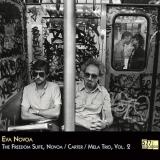
"Brooklyn-based pianist Eva Novoa returns with The Freedom Suite: Novoa / Carter / Mela Trio, Vol. 2 — the second radiant release from her compelling trio with saxophone icon Daniel Carter and celebrated drummer Francisco Mela. This marks Novoa’s sixth album with 577 Records. The trio first came together live in 2021, followed by a series of performances, including appearances in Cambridge (Boston) and later at the Brooklyn edition of the NY Forward Festival.
"The Freedom Suite is an homage to jazz titan Duke Ellington — particularly his masterful big band suites and legendary orchestra featuring Johnny Hodges and other luminaries who helped define an era of jazz greatness. In contrast, Novoa presents her Suite in a more intimate format: the piano trio. The album comprises twelve pieces — mostly brief — with a few extended tracks such as Free to Be Free and Cyborgs.
"For this recording, Novoa also steps in as a vocalist on several tracks, including Mainstream Media, Big Grande, Global, Free to Be Free, Dream, and Cyborgs. These pieces often feature a vocal dialogue between Novoa and Mela, whose expressive, word-infused style draws from rich Cuban traditions.
'Words are powerful,' says Novoa. 'They define who we are, where we come from, and who we hope to become. Without words, there is no conversation — and without conversation, there is no real sense of time, space, or connection.'
The Freedom Suite emerged from deep philosophical and creative conversations — spoken, written, and improvised — between Novoa, Carter, and Mela. In the studio, Novoa introduced printed texts that served as thematic foundations for spontaneous, in-the-moment musical interpretation. The result is an urgent and organic interplay, where instruments speak to one another in a language as fluid as it is fearless.
"Standout track Cyborgs begins with Novoa’s percussive piano, exemplifying the trio’s dynamic, conversational energy. Creative Destruction features Novoa on electric harpsichord in a wild, electric exchange. While Free to Be Free stands out as the album’s leading single, it also captures the essence and message of the entire Suite.
"Recorded in 2021 at New York City’s legendary Sear Sound Studio, the album captures a creative explosion of sound and spirit. Novoa dazzles on piano, Fender Rhodes, electric harpsichord, Chinese gongs — even whistle — showcasing her expansive sonic palette. Together, the trio embodies the power of free improvisation and emotional storytelling.
"Originally from Barcelona, Spain, Eva Novoa has been cultivating her distinctive voice since childhood. Now a staple of the New York creative music scene, she has performed across the globe and collaborated with some of the most adventurous voices in jazz and beyond."
NPVR is the avant garde duo made up of the late Peter Rehberg and Nik Void. Editions Mego is proud to present their second and final release. No this is not some kind of Beatles synthetic AI that raises the dead reconstructed recordings but rather a new album made by the humans and their machines.
The initial meeting of Rehberg and Void was in London in 2016 and despite or due to their mutual awkwardness found solace and compatibility in the fact that they both had a similar electronic modular set up, along with matching cases to transport all. The idea to collaborate was an obvious and organic process as a means to connect their individual gear together and observe the outcome. The fruits of these initial experiments, recorded in London, resulted in the playful experimentation of their acclaimed 2017 release 33 33 (eMego 251).
Now in 2024 Editions Mego presents the logically titled follow up, 33 34. These sessions were recorded six months after the initial recordings at Peter’s home in Vienna. This was planned out as a mirror city release to the original London recordings. With Peter having access to his full studio set up this time around we encounter a rich audio landscape which organically folds together a variety of musical genres blurring any distinction between these forms so the resulting music hovers as a new cloud of sound. Any musical form, be it industrial, electro-acoustic, ambient, drone and techno all coexist and melt into the other as the ensuing result unveils a hypnotic swarm of divergent sounds (music). When active there were no lines or contexts with NPVR, either between sound or genre within these recordings or live where NPVR were at home playing at a techno club one night and an avant garde venue the next.
The initial session of these recordings was edited by Rehberg and sent to Void to further develop. Over time the final versions were agreed on and then shelved as other outside projects took over. The awkwardness had been surmounted and the two had become close friends. NPVR performed at a range of venues such as Tresor, Sutton House, Corsica, Blitz, Paris GRM #Focus2, LEV Festival and Rigas Skanumezs Festival. Following Rehberg’s untimely passing Void had difficulty listening back to the sessions but eventually thought it fit to complete and release this album, of which even the artwork (like 33 33, an image from Zurich photographer, Georg Gatsas) had been decided upon prior to Rehberg parting ways.
There is an unmistakable joy to these recordings. One encounters an enthralling exploration of their chosen machines which conveys the excitement of what can be randomly conjured when people speak through such devices. There is no grand statement or argument here, just the sheer thrill of creation and the recorded results of random encounters. The art of collaboration was always a mainstay of Rehberg’s practice from the advent of the MEGO adventure. Rehberg & Bauer was an initial collaboration with former business partner Ramon Bauer. Even at this stage one can hear a relaxed sense of delight in the sheer discovery of sound.
A mix made for the Wire magazine following the release of 33 33 hints at the freedom that comes with endless urge for exploration and discovery. Abstract tracks from Z'EV. Jérôme Noetinger and Jung An Tagen are included alongside British stalwarts The Fall and New Order. There were no lines between pop / academic / underground or mainstream in Rehberg’s world. All of it sat at the same table. It is just matter in the atmosphere, like the diverse exploration found in these recordings that comprise 33 34.
Towards the end of his life Rehberg was obsessing over the immense output of the German ambient musician Pete Namlook. An artist renowned for not only his sprawling catalogue of ambient masterpieces but one who often said his main inspiration was nature. This is apt with regards to the work of NPVR which also aligns with such thought as the intertwining of the two individual artists and their machines results in a natural symbiotic flow, as it happens, just like in the world around us.
out of Stock
Last delivered 9 months ago available to reorder, subject to availability
Montreal indie rock trio Plants and Animals announce "The Jungle", their fifth studio album set to be released October 23rd via Secret City Records. Their shortest album yet and certainly their boldest, "The Jungle" is eight acts in a world full of noise. The album is auto-produced and was recorded at Mixart, their studio in Montreal. The band explains : "We started working on this a couple of years ago. Warren was afraid for a friend's health. He thought he was self-medicating too much and not taking care of himself. He couldn't let go of this image of an overworked dude swallowing too many sleeping pills and falling asleep with the stove on. So it began as the place next door, sometime before Greta Thunberg turned the expression into a rallying cry, where Earth is the house and the people are sleeping. It's terrifying, and on the whole we're not unlike this friend, are we?" "The Jungle" starts with electronic drums that sound like insects at night. A whole universe comes alive in the dark. It's beautiful, complex and unsettling. Systematic and chaotic. All instinct, no plan. Voices taunt,"yeah yeah yeah." This tangled time in which we find ourselves is reflected back in shadows. Every song is such a landscape. The first one grinds to a halt and you become a kid looking out a car window at the moon, wondering how it's still on your tail as you speed past a steady blur of trees. You watch a house go up in a yellow strobe that echoes the disco weirdness of Giorgio Moroder, Donna Summer and David Bowie. You get pummelled by a rhythm then set free by a sudden change of scenery_the wind stops, clarity returns. You're under a streetlight in Queens, soft-focus, slow motion, falling in love. You speak French now too, in case you didn't already. Bienvenue. These are personal experiences made in a volatile world, and they reflect that world right back at us, even by accident. There's one song Nic sings to his teenage son who was dealing with climate change anxiety and drifting into uncharted independence. The band carries it out slowly together into a sweet blue horizon. Warren wrote the words to another shortly after losing his father. It's about the things we inherit not necessarily being the things we want. In a broader sense, that's where a lot of people find themselves right now.
The Germany-based band Rikas' new album, "Soundtrack For A Movie That Has Not Been Written Yet," promises to be their most cohesive and contemplative project to date
Comprising 11 brisk yet beautiful tracks, the album showcases the band's tight tempos and mellow delivery. "We started this record just to have fun. It's not been that easy, because so much change has happened," guitarist and keyboardist Sascha Scherer reflects. "We've had to learn to adapt... This record is more inward-looking. We were reflecting. " Scherer further explains, "I think a lot of bands have trouble staying still. When you stop touring and moving to a new city each day, you feel lost. I feel like our new album is capturing that feeling of go, go, go." This feeling of inertia contains layers: there's a sense of restlessness, but also brotherhood and camaraderie-- feelings Rikas aim to depict in each of the album's videos. "For our sophomore album, we wanted to create a very homogeneous one," Scherer continues. "Which was not easy to achieve because we have made the experience that throughout all of our records every song differs from each other. We have four songwriters who happen to be also multi-instrumentalists in our band, and that's why we don't have to put much effort into diverse record making. Instead, we had to put pressure on ourselves to make something consistent. But we also didn't want to make every song sound the same. So the concept of the album lays in its topics."The songs for "Soundtrack For A Movie That Has Not Been Written Yet" were written over the past year, adapting and shaping old snippets and ideas, as well as creating songs completely from scratch. "For some reason, when we started writing and listening back to the songs, they all shared a similar feeling of cruising, traveling, being in motion," Scherer says. "This wasn't intentional at first, but felt more and more suiting as we proceeded with the writing. We found we'd enjoy the songs most while driving in our van, looking out the window, seeing the landscapes passing by. This has something very meditating to itself already, amplified even more by a suiting soundtrack. This is the soundtrack we tried to write. The album in its entirety is supposed to feel warm, hugging, like 'being bedded in cotton.'" For the visual content of the album, the band decided to travel to San Remo, northern Italy, to capture some of the late November sun. "In a way, you could say we tried to film the first part of the movie whose soundtrack we had just written," Scherer concludes. "Soundtrack For A Movie That Has Not Been Written Yet" is a testament to Rikas' ability to adapt and reflect on their journey, offering listeners a meditative and immersive experience that captures the essence of being in motion.
Hercules & Love Affair music has always been about folding past, present and future together – and never more so than in the latest phase, encapsulated by the track that launches things, “Someone Else is Calling.”
If the song-first, ultra-gothic mind-movie of the last H&LA album In Amber was partly motivated by Andy Butler falling out of love with dance culture, this new body of work – an EP titled Someone Else Is Calling – is an unabashed resurgence of the love affair. A co-production with London underground veteran and inspiration to Butler, Quinn Whalley of Paranoid London and Decius, the lead single is a surging, tactile acid track woven around the vocal of Icelandic icon Hips & Lips aka Elín Ey – who hits that new wave disco sweet spot between Grace Jones and Yazoo era Alison Moyet.
Elín’s lyrics work perfectly with the bodily momentum of the sounds, circling around themes of self-possession and the urge to move on to the next experience, the next sensation: hunger for reality. And this taps into Andy’s feelings on escaping New York and moving to Belgium, discovering that dance culture was anything but the hollowed-out, identikit-festival-lineup conveyor belt he’d feared, and still had plenty of outposts where it was still – as he’d first experience it as a teen – about the hot, sweaty reality of diverse people seeking communion, communication and heightened ways of being in the here and now.
The video, filmed by Tatsumi Milori couldn’t be a better expression of exactly this. A love letter to the strange and glorious party scene of Mexico City, it captures people who are both tapping into the eternal verities of those magical dancefloor communions, and thrilling – against all the odds of oppressive forces – at the sense of possibility in the flow of gender and sexuality in the present moment. It’s powered by innocence and experience as intertwined forces, and it amplifies the heartbeat of the song a thousandfold. There will be more, much more, to follow from the partnership of Andy, Elín and Quinn. It digs deeper still into the decades of dance and other underground cultures that feed into this modern moment – but this shining beacon should give you a pretty good hint.
Someone Else Is Calling will arrive on one of Los Angeles’s most exciting new independent labels and creative hubs, StrataSonic, on December 14. The lead single of the same name, along with the music video directed by Tatsumi Milori, is out now. This marks the first collaboration between Hercules & Love Affair and Stratasonic.
out of Stock
Last delivered 8 months ago available to reorder, subject to availability
Follow up to last years 12" on Voyage Direct from this active Amsterdam DJ/Producer. TIP!
.
" Back in December 2014, Elias Mazian debuted on Voyage Direct with a 12' that perfectly encapsulated his open-minded but interconnected approach to electronic music. He'd already showcased this ability to blend sounds and styles by becoming one of the most talked-about DJs on the Amsterdam scene. With Future Times' (and its superb flipside, They Don't Know'), Mazian gave notice of his undeniable production credentials.
Fast forward to the summer of 2017, and Mazian is ready to drop an EP that not only confirms his status as a rising star of Dutch dance music, but also showcases a newfound ability to combine a finely-tuned sense of what works on the dancefloor with the kind of compositional skills that can take a lifetime to perfect.
The Duplicate EP is an altogether more mature proposition than his debut 12', but retains many of the sounds and influences that marked out his first appearance on Voyage Direct - not least his love of spacey electronics, mood-enhancing chord progressions and sparkling synthesizer motifs.
This can be heard in particular on the title track, an ear-catching club jam that wraps chiming melodies, Mazian's own rapped vocal refrains and electro-era synths around a gently jacking, Chicago style house groove. It's deep, poignant and attractive, with subtle nods to the dreamy Windy City deep house of Larry Heard, the retro-futurist boogie business of Moon B and Dam Funk, and the kaleidoscopic electronic funk of Parliament.
Further proof of Mazian's increased musical maturity can be heard in the breathtaking Dream Mix' of Duplicate'. Featuring a yearning, almost melancholic vocal from the producer himself, the remix offers an analogue style deep house interpretation bristling with cascading melody lines, classic Chicago house bass and bubbly, deep space electronics.
The EP closes with superb bonus cut Ride That Shit Baby', an expansive chunk of mind-altering analogue deep house full of restless ride cymbals, crunchy drum machine hits, starburst electronics, delay-laden organ lines and swirling chord progressions. It's as intricately programmed and produced as anything Mazian has released to date, and twice as emotion-rich. In some ways, it's the perfect end to an EP in which Mazian brilliantly showcases the depth and breadth of his emerging talent."
Alvorada is Montanha’s first long play: an ambient-leaning work, nocturnal in mood yet touched by electricity, tracing a journey from waking activity into dream logic. Recorded mostly in the late hours of the evening with windows open to the city, letting its air and sounds influence the music, it sometimes reached the early moments of sunrise. The title, meaning “dawn,” reflects both the liminal hours of its making and the band’s own renewal. These tracks are closer to drawings than songs: narratives written between instruments, moments of tension and release, fragments of memory and dream. The tracklist follows this nocturnal voyage with the patience of Eno, the disquiet of Uematsu, and the madness of Miles Davis’ Decoy, oscillating between streets and sleep, routine and reverie.
Montanha was formed in 2010 by André Azevedo, Nuno Oliveira, João Sarnadas, and Tito Silva, bonding over architecture school all-nighters on videogame soundtracks (Age of Empires, Super Mario). They began as a psychedelic rock combo and in 2013 released their self-titled EP which introduced a raw, improvised energy. But the album that was meant to follow was abandoned as the band entered hiatus. The four members turned their creative drive towards co-founding Favela Discos, where experimentation with media and form reshaped their ideas of music, and developed their taste, their way of playing, and a more personal sound that was more open and disconnected from a defined genre.
By 2017, Montanha had returned to the studio with new experience, no longer a rock band in the traditional sense but a project devoted to improvisation and electronic soundscapes. An ever gentrifying city forced them to abandon acoustic drums, and they embraced electronic beats instead, and became mobile; one guitar dissolved into full synths, leaving the other to converse with bass. Improvisation remained their compass. In improvisation there are no mistakes, only missed opportunities. Montanha found their opportunity in the routine of the studio to break routines of pop and experimental. The result is a body of nearly fifty hours of recordings, sculpted into an album.
Alvorada is not only Montanha’s first LP but also the dawn of their new phase. Improvised yet carefully sculpted, the record expands the territory of the song into nonlinear narratives, letting the language of night, dream, and city seep into its form.
Eisenmund, the debut by Berlin-based Schimmel über Berlin is a thing of pounding, brittle beauty that seeks to continue on from where angst-ridden, early-eighties Berlin left off. Angular, monophonic synths, guitars that slice through with wiry yet melodic urgency, basslines that pulse with a taut, driven precision and drums that meld everything together. Liv Billerbeck’s vocals come from the middle distance, drifting between detached and desperate, as if transmitted through a wintery cityscape.
Title track Eisenmund jangles with reedy synths floating over a carpet of bass and mournful vocals dripping with a sense of loss. This mood spills over into the other tracks, like post-punk jewel Schreck with its iridescently lovely guitars.
Eisenmund is sharp, atmospheric, and quietly thrilling - proof that the shadows of the eighties can still dance under today's flickering lights. The album, immaculately produced by T-Rex, captures that classic post-punk mood of urban decay, late-night introspection and stubborn sense of motion, which for someone like me, who was there back in the day, seems utterly familiar without ever sinking into mere nostalgia.
Fiona Sangster (Xmal Deutschland)
Die Band Schimmel über Berlin ist eines der vielen Klanggesichter der Liv Billerbeck, ein Gesicht, das man niemals sieht, das im Verborgenen sich umblickt und agiert und das trotzdem aber in einer seltenen Klarheit erscheint. Man sieht es beim Hören, schemenhaft. Ihr Schaffen ist befallen vom West-Berlin der 1980er Jahre (Xmal Deutschland, Malaria etc.).
Eine Rolle, gerade in der musikalischen Brillanz und Produktionsraffinesse, spielt britischer Post-Punk, der sich sehr klar auch im treibenden Spiel von T-Rex (Bass + Produktion), Việt Phương Vũ (Gitarre) und Christian Ramisch (Schlagzeug – mit Phương übrigens bei der ebenfalls sehr guten Band NOJ) zeigt: The Sound, Killing Joke et. al.!
Es handelt sich bei dieser Musik um einen Sound mit retroesquem Anstrich, der spürbar eine vergangene Luft atmet, einer Nostalgie an eine ferne Zeit anheimfällt, die das Quartett ob ihres Alters nicht erlebt haben kann, und die vielmehr eine Sehnsucht bedeutet, in der Unerfüllbarkeit eine Melancholie mitbringt, eine Art treibende Traurigkeit spürbar macht. Das allein ist groß! Was weitergehend daran aber so interessant, besonders und wahnsinnig schön ist: Das klingt in Billerbecks Schaffen – und insbesondere hier, beim Schimmel über Berlin – nicht wie eine Kopie, ein Abklatsch, eine Reminiszenz oder das, was in der so called NNDW bald flächendeckend geschieht: das Anzapfen einer überholten Coolness. Denn etwas ist ganz gegenwärtig daran, in der Eigenständigkeit, macht einem eindringlich das Hier und Jetzt spürbar, auf unterschiedlichen Ebenen: Traurigkeit, ja, aber auch Bock, bis in die Morgenstunden auszugehen, schnellen Schrittes über rutschiges Kopfsteinpflaster zu traben. Musik dann wieder zum Verkrümeln in zugigen Altbauten, von Schreien über einen nebelbedeckten See im Umland Berlins.
Und eben kein Eskapismus, auch wenn die Musik zur Flucht taugte. Merkwürdig ist, dass in dieser Retroschleife dann etwas Märchenhaftes mitschwingt. Vielleicht liegt es auch in der authentischen 1980er-Jahre Produktion, in der immer wieder so ein Klimpern, ein Schellen durchkommt. Es mag aber auch an den Texten liegen, die etwas von Minnesang haben und in ihrer Klarheit, die aus der Kühle und den Kargheiten (der Vergangenheit, der Gegenwart, der Zukunft) entsteht, doch Wärme transportieren.
Wir hören darin heute, trotz all dem Bewusstsein für die Vergangenheit, den Sound einer seltenen Dichterin der Gegenwart. Das ist von einer Intensität, die einen bald absorbiert. Eisenmund etwa, das Titelstück, ist so ein Song, bei dem man sich hinsetzen oder gleich hinlegen muss. Da sind Dinge, die man nicht ändern kann. Wie geht das? Also: nach vorne, heftig, und dann aber so weich und traurig. Hätten Schimmel über Berlin die 1980er-Jahre dieser Stadt beschallt, sie wären hiermit, das mögen sie selbst vielleicht gar nicht hören, die Helden dieser Zeit gewesen. Eisenmund ist das tollste Album, das mir seit Jahren begegnet ist – und die bisherige Klimax dessen, was aus der Allee der Kosmonauten hervorgeht.
Und wenn man das alles so hört, aufmerksam hört, wird einem, obwohl das alles so ein einziger, riesiger Hit ist, völlig klar: Hier geht es nicht darum, irgendwo damit zu landen, irgendwo mitzumischen, erfolgreich zu sein oder in aller Munde. Hier geht es darum, einfach nur genau das zu machen, was es ist! Alles andere ist egal.
Straight out of the local mud of the city of Antwerp comes dancing this next Souvenirs from Imaginary Cities slab of free-flowing bits of electronic wonder : Schönen Abend by Simon B. Just in time to ease you out of this endless winter and right into springtime. Like the previous hit by Purple Uncle, this flower takes some time to bloom and fill up your head and body with it's ear wormy fragrance.
It's hazy and cinematic, makes you think of Italian electronic pioneers and their library magic, Patrick Cowley's School Daze and Haruomi Hosono in some kind of gothic manner. It's quite stripped and lush at the same time, rhythms like minimal mechanics make you fly above the river and land just outside reality. It's a nice place where soft jazz tingles right around the dark corner, and that particular mix of exotica and melancholia — the trademark of this port city's best electronic auteurs is definitely in the air. The river still shines, but she’s deeply poisoned. The old town has lost every bit of fresh air but keeps on digging for old gold. This bitter pill is served with delicacy and lightness, the wound is dressed up seductively — feet in the mud, head in the air. Stuff is sensuous, with quiet places reminding of the good side of those times when the big wheel stopped turning ever so madly. A strange quietness whistles through the leaves. Some things take time to unfold. In or out of C.
Four years in the making, this is the solo debut LP of Simon B, a longtime contributor to Antwerp's improvised music scene (Groovecats Deluxe, Wij Blij Trio ). Primarily a double bass player, he also has a deep-felt passion for offbeat electronica and the rainbowy side of American minimalism, which takes front here. The smoky voice on the last track belongs to Nina-Joy Thielemans, Nina-Joy is part of Particals, a trio working with live electronics and field recordings, releasing an lp on Ultra Eczema later this year. Furthermore, you can hear the tenor and soprano saxophone of Adia Van Heerentals on 4 tracks, deepening out Simon's naturally flowing compositions and playing around with his melodies. You may know her from Bodem and her strong presence in the Belgian jazz scene lately.
Simon's electroacoustic experiments — using a clarinet and some outboard effects — were important tools in finding the very specific colour of this record. There's this airy character, like wind blowing through old layers of bricks and over the river, anchored with a deep sense of bass, gathering ages of dust and memories in these eight elegantly wobbling tracks, forming a perfect whole that’s really coming together in one deep listening from A to Z.
The centrepiece is perhaps Come to Me, instrumental and reprise with vocals, but no fillers on this one. Every part of the mystery is needed to come to its end and back again. It's a record that works in the morning, to open up a day and in the quiet corners of the night, with it's sleazy quirkiness, smiling towards you from the right corner of the eye. A perfect compagnon for your long-form wandering habits, light reflections on a wet surface obsessions, coffee slurping in the morning and the forgotten art of beachcombing. Quite essential these days, witnessing a world going apeshit.
out of Stock
Last delivered 10 months ago available to reorder, subject to availability
The story begins with Kevin Morby absentmindedly flipping through a box of old family photos in the basement of his childhood home in Kansas City. Just hours before, at a family dinner, his father had collapsed in front of him and had to be rushed to the hospital. That night Morby still felt the shock and fear lodged in his bones. So he gazed at the images until one of the pictures jumped out at him: his father as a young man, proud and strong and filled with confidence, posing on a lawn with his shirt off. This was in January of 2020. As the months went on and the world dramatically changed around him, Morby felt an eerie similarity between his feelings of that night and the atmosphere of those spring days. Fear, anxiety, hope and resilience all churning together. The themes began twisting in his mind. History, trauma and the grand fight against time. Having the courage to dream, even while knowing the tragedy that often awaits those who dare to dream. While his father regained his strength, Morby meditated on these ideas. And then, he headed to Memphis. He moved into the Peabody Hotel and spent his days paying tribute and genuflecting to the dreamers he admired. In the evening, he would return to his room and document his ideas on a makeshift recording set-up, with just his guitar and a microphone. The songs, elegiac in nature, befitting all he had seen, poured out of him.Produced by Sam Cohen (who also worked on Morby’s Singing Saw and Oh My God), This Is A Photograph features musical contributions from longtime staples of Morby’s live band, as well as old friends and new collaborators alike. If Oh My God saw Morby getting celestial and in constant motion and Sundowner was a study in localized intent, This Is A Photograph finds Morby making an Americana paean, a visceral life and death, blood on the canvas outpouring. As Morby reminds us early on, time is undefeated. So what do we do while we’re still here? This is a photograph of that sense of yearning
Sanguis is the alias of Berlin-based producer Ludwig Wandinger, a fixture in the city's experimental scene.
On his debut album Wounding dark ambient textures and solo piano improvisations let the listener's attention slip in and out of focus creating a liminal state of dreaming, feeling and drifting through inner worlds and thoughts.
Wandinger tries to capture fleeting moments - all tracks are unedited first takes, some recorded only with his phone in various places, from a friend's flat in Neukölln to his family home in rural Bavaria. Background noises become a part of the music and create a tangible sense of place, urging the listener to keep an ear out for one's own surroundings.
Though firmly rooted in the ambient genre, the album is not just about finding comfort. It's an acknowledgement of the ambiguity of our world where menace and beauty coexist, a dichotomy most apparent in nature itself - a constant source of inspiration for Wandinger.
Wounding is about walking alone on damp foliage at night and being handed a blanket by a loved one at the earliest daylight.
This is a reissue of the original 1963 album El Decano De Los Cantores 4. Chuíto el de Bayamón (Jesús Sánchez Erazo) was a legendary Puerto Rican troubadour and one of the earliest jíbaro singers to appear on the radio, also known as "el decano de los cantores" (the dean of the singers). Known for his witty décimas and lively improvisation, he helped popularize traditional Puerto Rican music. His work influenced generations, including salsa greats like Héctor Lavoe. In the 1940s, he became the lead-singer for cuatro player and composer Ladislao "Ladí" Martínez's Conjunto Típico Ladí, created in New York City. With Ladí, he recorded "Un jíbaro en Nueva York," a controversia with Ernestina Reyes "La Calandria." It was actually Ladí who baptized him as "Chuíto el de Bayamón". From 1949 to 1977 Chuíto collaborated with Abelardo Díaz Alfaro, the famous Puerto Rican author, in the radio program "La vida de Teyo Gracia y su mundo" aired in WIPR. In addition, Chuíto participated in the films "La trulla" (1951), "Preciosa" (1965), and "El otro camino" (1959). Throughout his career Chuíto recorded more than 40 LPs and performed in New York, Boston, Chicago, New Jersey, Hawai'i, Spain, Cuba and other Latin American cities. His repertoire is characterized by its witticism and sense of humor, and sophisticated musical arrangements. Along with Flor Morales Ramos "Ramito", Odilio González and Daniel Santos, he had a huge influence in the singing style of Puerto Rican salsa star Héctor Lavoe. In 1975 and 1976 he was recognized with the "Agüeybaná Gold Album" award. This is the forth edition of Ansonias Chuito reissue series.
In the magical kingdom of Fiore, Lucy Heartfilia, a celestial spirit mage, joins the legendary guild Fairy Tail, renowned for its eccentric members and explosive adventures. Alongside Natsu Dragneel, a fire-powered Dragon Slayer, and his friends Happy the flying cat, Erza, and Gray, the adventure is only just beginning!
This double vinyl will feature a selection of the best opening and ending themes from the series, transporting you back to the enchanting world of Fairy Tail as if by magic.
In March 2024, Jim White released his first-ever solo album, All Hits: Memories. Coming forty years into his career, it felt like some kind of breakthrough happening. His second solo album confirms it: Jim"s deep percussive intuition is fueling a new musical vehicle in his life. Inner Day finds him dancing ever more deftly with himself on an expressionistic set of drum kit and keyboard duets. Developing meditations on his personal arcana into expressive keyboard feels, he crafts parts as he would on the kit, further interacting with them on drums as well. Jim takes another big step on Inner Day, singing on two standout tracks, "Inner Day" and "I Don"t Do / Grand Central," his words and voice in the mix for the first time. A drummer of exquisite powers, great and small - his Dirty Three compatriot Warren Ellis contends his playing long ago "split the atom" - Jim"s capable of driving a band one minute, then slipping past accompaniment and into the cracks of the subliminal in the next breath. He"s got qualities - deep pockets, a lovely sense of the moment - that serve him and those he drums with well. His collaborators include Bill Callahan, Cat Power, Marisa Anderson, Daniel Blumberg, T. Griffin, Phosphorescent, Jess Ribeiro, Ed Kuepper and Mess Esque, alongside communal experiences in Xylouris White, The Double, Beings, The Hard Quartet and Dirty Three. And all that"s just in the past five years!
Emily A. Sprague's Cloud Time traces an audio-spiritual journey through time and place, recorded across a long-awaited debut tour of Japan in the fall of 2024. Compiled from environmental improvisations captured in and for the moment, material at once welcoming, responsive, and inimitable, the album distills a voyage guided by psychic wayfaring, unbound presence, and activating performance for a reciprocal exchange with space, listener, and each fully engaged instant. The Japanese tour documented on Cloud Time held an almost mythic significance for Sprague, taking on properties of her own sonic white whale. After many near-departures and dropped plans to play in the country, "the empty spaces of cancelled trips and forgotten music turned into strange little misty spirits that I felt followed by," she says. "When I began preparing for the tour, I couldn't shake a sense that the invitation to Japan was more about opening myself up to this new place instead of bringing something into it tightly under my control. Improvisation has always been such a pillar in my music practice, and I really wanted to meet the country, spaces and people through that process." To amplify these intuitive whispers on-stage, Sprague reimagined her time-tested live rig, designed to be as free from error as possible, as a looser, more flexible set up that would allow her to interface with what was essentially a blank sonic canvas every night. Each performance became a collaboration between environment and instinct, Sprague processing the events, energies, and emotions informing the evening through her new sound ecosystem, and projecting an entirely present and unique version of herself to each open-eared and hearted crowd. "It was very much more than just an act of playing for me, but a total experience of time and place," she says. The seven long-form pieces that plot the course of Cloud Time, excerpted from over eight hours of recordings archived on the artist's on-stage recorder and generously shared on the album with no additional mixing and only minimal editing, invite listeners to become still in these deep-rooted moments of presence as the album moves from city to city, venue to venue. Cloud Time chronicles material recorded at each tour stop, Sprague selecting and sequencing the album around mood-based storytelling more so than linear chronology. "I tried to make the whole album flow in the way that any one of the complete live performances did," she explains, "while also keeping the spirit of the whole thing as a journey." The result is equal parts travelog, love letter, and impressionistic collage channeled from the potent ferment of a now encased in the glowing amber of memory. Intrinsically inspired by kankyo ongaku, an environmental music philosophy, known both in and widely outside of Japan that tunes into the similarly expansive ethos as Pauline Oliveros' deep listening practice and posits the listener as composer, Cloud Time is ambient music that seems to be listening right back, grounded in heartfelt synthesized frequencies that abundantly hold and heal. Pieces like "Nagoya," "Tokyo 1," and the ten minute "Matsumoto" in particular hum with the atomic resonance of gently tended landscapes, offering space for tuning way in and dropping far out from perspectives that stifle and bind. Cloud Time is an invitation to embrace each moment as both fleeting and eternal, floating by with nothing to grasp onto and absolutely everything to gain. The exercise in acceptance and letting go that Sprague practiced throughout the tour deeply impacted her understanding of self as both a guest and venerable performer. "The process of loving wherever I am, being present and focusing on a clear channel of communication for mind and emotion, rooted so deeply in respect for the space, those within it, and myself, ended up being profoundly healing," she says. "My vision and hope is that this album can be released as a gift back to anyone who either was or wasn't there. A cloud time of life passing by."
Young Gun Silver Fox are the captains of AM Waves, setting sail towards an isle where melodies soak the shoreline and grooves sway like palm trees. Their route traces a natural progression fromWest End Coast, an album that cast Andy Platts (Young Gun) and Shawn Lee (Silver Fox) as musical virtuosos of SoCal-infused pop. AM Waves does more than duplicate the perfection of West End Coast. It improves it.
Recorded at The Shop in London and Roffey Hall in the English countryside, AM Waves burnishes the blend between the duo's modern aesthetic and their sumptuously crafted homage to '70s-styled pop, rock, and soul. "This music hits a certain spot for me personally that nothing else quite does," says Shawn, who produced the album amidst his projects for Saint Etienne, Shawn Lee's Ping Pong Orchestra, and several other acts. "It's real high-caliber music. It's easy and breezy to listen to but it's really hard to make. Every aspect is A game."
The A game behind AM Waves fuels 43 minutes of Young Gun Silver Fox in peak form. "AM Waves is much more instinctive," says Andy, whose penchant for writing irresistible hooks and melodies also shapes his role as lead singer and lyricist/composer for the band Mamas Gun. "It's more vivid. You can see the clarity to the colors of AM Waves whereas West End Coast is slightly more impressionist, as it were."
Originally issued as a single in September 2017, "Midnight in Richmond" is the anchor of AM Waves. "I hit one chord, which I'd never played before, and the song sort of wrote itself," notes Shawn. "It was intuitive. In many ways, the primary function of what I'm doing is trying to find that chord that opens a door and takes you someplace else. Those chords have magic." Andy embellishes the song's appeal by nimbly juxtaposing wistful emotions with a sun-kissed melody, his voice evoking richly drawn memories. The qualities that make "Midnight in Richmond" an instant classic abound throughout the album.
"Lenny" and "Take It or Leave It" spotlight Andy's versatility as a songwriter. The former was inspired by a dream he had where Lenny Kravitz owned a bar. "It was surreal," he says. "He was polishing the glasses and just serving me hit after hit." Like swimming through moonshine, Andy languorously savors every syllable in the song. "Take It or Leave It" is pure pop bliss. "That was one of those songs that fell out in half an hour," he says. "I had everything and it was done." Shawn adds, "It's such a perfect song in itself. When I listen to it, it's like you've created a record that already existed."
Young Gun Silver Fox introduce a five-piece horn section on "Underdog" that literally trumpets the song's protagonist. Shawn affectionately dubbed them the "Seaweed Horns" in honor of the Seawind Horns, an LA-based unit that recorded with powerhouses like Michael Jackson,Rufus & Chaka Khan,and Earth, Wind & Fire during the late-'70s. Andy explains, "The horns grab another hue of the west coast sound, which is the starting point, but it's also maybe the point where we're injecting a little bit more of ourselves and some outside colors into the familiar west coast palette."
A bounty of treasures course through AM Waves' ebb and flow. "Mojo Rising," which the duo penned with Rob Johnson, is a veritable retreat to paradise. "Sky-bound, heaven sent / Way above the clouds watching shootingstars descend," Andy sings, mirroring the music's celestial undertones. Sensuality contours the notes on "Just a Man," a song that basks in the allure of a woman who leaves "footprints on the water" while "Love Guarantee" is festooned with the Seaweed Horns. "I wanted to bring more of that R&B slickness into the mix," Shawn notes about the latter track. "We hadn't done a tune with that sort of groove." Similar to his work on "Underdog," Nichol Thomson's intricate horn arrangement on "LoveGuarantee"exemplifies another distinction between AM Waves and its predecessor.
"Caroline" occupies a special place on AM Waves, beyond spawning the album title. It tells the story of Radio Caroline, a pirate radio station that broadcast from an offshore vessel during the '60s and '70s. "They played the music that kids wanted to hear, whether it was the old stuff or cutting edge stuff," says Andy. "'Caroline' is about Radio Caroline's eventual capture." Complementing Andy Platts' deft wordplay, which draws parallels between radio airwaves and the station's literal home on the ocean, Shawn Lee layers nearly a dozen different parts on "Caroline," showcasing the vastness of his musicality. "I loved that track as soon as I heard it," Andy continues. "It's a beautiful fusion of me and Shawn."
The Seaweed Horns joinYoung Gun Silver Foxas they detour to the dance floor on "Kingston Boogie." Shawn explains the track's genesis, "I was thinking, what have we not done yet We definitely should get an AOR disco thing happening. I quite like disco. The beat is so metronomic that it allows you to be really sophisticated on top. 'Kingston Boogie' just laid itself out. I call it 'midnight disco.'" With a nod to "Lenny," Andy Platts sets "Kingston Boogie" back at Lenny's Bar, this time revealing a detail or two about its mysterious proprietor as he pours sweet wine and moonshine.
In a sense, AM Waves ends with the beginning. Even before there was Young Gun Silver Fox, there was "Lolita," the first song Andy Platts and Shawn Lee wrote together and a crowd-pleasing staple of the duo's live sets. The tale of a femme fatale who harbors a secret was recorded for West End Coast but instead furnished the B-side to "Long Way Back" as well as a bonus track on the North American edition of the album. Despite the song's checkered trajectory, its infectious chorus sparked the brighter, more buoyant orientation of AM Waves.
Like the moon pulling the tide, Young Gun Silver Fox are a magnet for good songs. "We're both so obsessed and constantly interested in music-making," says Andy. "We're both thinking about it all the time. When you know you have an accomplice with you that's the same as you, it's very liberating. Suddenly, worlds of color start to appear." Indeed, AM Waves is elemental in its power to induce pleasure. Dive right in.
STANDFIRST Titanic, the project spearheaded by Mabe Fratti and Hector Tosta (aka I. la Católica), return with a sumptuous and life-affirming new album.
In her sensational 1929 biography Tiger Woman, dancer and socialite Betty May claimed her ‘coster’s eye’ meant she liked to wear as many colours as possible. “Colours to me are like children to a loving mother. Each is my favourite, yet I can never bring myself to deny the others by preferring one.” May’s bold and inclusive strategy is one that manages to transfer itself, almost a century later, to Hagen, the new record by Titanic.
Many will know Titanic as the Mexico City-based brainchild of cellist and singer Mabe Fratti and multiinstrumentalist Hector Tosta who is now operating under the pseudonym, I. la Católica, (taken, rather unusually, from the name of the street the pair live on). With Hagen, and their previous release, Vidrio, (2023), the pair are creating a distinctive signature sound in modern alternative pop music. Nobody else sounds quite like them. Both records have an open hearted nature and simple, winning melodies that play off against a taste for drama, spectacular orchestration and a feeling of otherworldly mystery. Hagen is the more ambitious, sometimes more mystical effort. From the opening handclaps of ‘Lágrima del Sol’, (a wonderfully uptempo playground chant translating as a tear from the sun but, surely, not referencing the brand of pineapple wine?), the record dances its way through various mid-to-late-eighties inspirations, lush and widescreen passages of melancholy and vertiginous contrasts.
Mystery is often found in the simple but slightly odd song titles. English translations of various track titles give, ‘you swallowed the gum’, ‘leak’, ‘a tear from the sun’, ‘raising the trophy’ ‘digging dimensions’, ‘the owner’, ‘the decapitated hen’ and ‘the trap is exposed’. All denote striking images, metaphysical hints and emotional cues or simple, even childlike actions. Though Fratti and Tosta don’t reveal its provenance, the album’s title could even be a crafty play on words: the listener would be forgiven in thinking the moments of brash contrast and eyebrow raising theatricalism in the music constitute a musical nod to German punk chanteuse, Nina Hagen.
On Hagen, singer and cellist Mabe Fratti once again displays her brilliant knack of speaking to us directly. There is never the suspicion of her playing to the gallery, and the directness of many of the lyrics don’t allow it. Parallel to this, Fratti has an almost magical ability to give Hector Tosta’s melodies, and her and Tosta’s lyrics ones imbued with an insight and meaning that feels otherworldly. Tosta admitted it was “pretty wild to hear Mabe take the interpretations to a different place” and the listener can pick up on the delight Fratti takes in (literally) adding a voice to the many narratives.
Two examples can be shown here: ‘Gotera’ (Leak) uses harsh slashes of cello and tough, gunfire-like guitars and drums and multiple vocal lines that could be acting as a Greek chorus. They play off brilliantly against Fratti’s soft, slightly baleful vocal take that delivers lyrics such as: ‘nobody knows where the leak is / but I know where it is / they fight in front of the door and / nobody can go in’. With ‘La Gallina Degollada’ the somewhat blithe melody melody line, sung with what could be sarcastic brio by Fratti, plays against an itchting rhythm and rasping guitar part. The punch comes when you see that the song is about a chicken that has been decapitated and read lyrics such as: ‘I already saw it, it moved, the decapitated chicken’ / ‘could it be that I'm broken’ and ‘Two people hurt each other by thinking that they no longer agree’/ ‘Hours pass and the chicken represents what scares me’.
There may be death and fights to deal with, but there is also a quality of chirpy self-reliance about Hagen that is a key part of its nature. Like Betty May and her colourful outfits, Hagen’s sound often revels in its own sense of richness. Throughout, the record delivers vaulting string sections or glutinous guitar squeals that could, like the powerful, driving ‘Escarbo Dimensiones’ (Digging Dimensions) have come directly from a glossy 1980s TV series. Fratti sees this “glam sound” developed by Tosta on the aforementioned track and ‘Te Tragaste el Chicle’ (You Swallowed The Gum), as moments that were truly “revealing” for the album as a whole during its making.
What else? The thud and thump of ‘La Trampa Sale’ (The Trap is Exposed), and its sudden change of tempo and mood betrays a monstrously ambitious piece of music, the players almost greedily creating the sounds. Other moments are heart wrenching: ‘Libra’ ends on a poppy chord switch that cleverly ramps up the emotion inherent in the music’s notation. You could almost imagine a teenager in a bedroom forty years ago, rewinding the track over and over on a small, cheap cassette player, unable to get enough of that sugarsweet switch. Elsewhere, Oneohtrix Point Never adds stardust and an unearthly sense of space on the changeable, slightly moody meditation, ‘Pájaro de Fuego’ (Firebird). The record ends with ‘Alzando el Trofeo’ (Lifting the Trophy), a track that could soundtrack a state wedding, what with its beautiful cascading piano parts, a sugary vocal and short triumphal guitar riffs that add a rich patina to the overall sound. Fratti: “When I doubled those vocals on ‘Alzando el Trofeo’ I felt there was an epiphany happening, right at that moment.”
Making a good record is a team game. Tosta and Fratti recall seeing Randall from Circular Ruin Studios in NYC “tweak the drums in ‘Libra’ to make that amazing effect of the gated reverb”, or the shaping of ‘Gotera’, “when (recording engineer) Nate Salon added some synths to the track.” Drummer Eli Keszler, “an amazing and versatile player” had the songs down pat in a couple of days” and, according to Tosta, Oneohtrix Point Never “just came to one of the sessions and we hung out, and after all the recordings he and Nate were together in some studio and out of nowhere they sent us some beautiful tracks for ‘Pájaro de Fuego’! Fratti concurs. “He decided that he wanted to record because he was listening to the record (Nate works closely with him) and he really liked it! It was a total honour, indeed!”
Bedazzled by the playing, the skyscraping ambition in the arrangements and the giddy moments of contrast thrown up by Hagen, we could allow ourselves a brief moment of flippancy and state that Titanic’s new record is Yacht Rock meets Aeschylus, full-on. It’s also worth speculating that, in this hyper-sensitive, intemperate age, Titanic’s music has the power, however fleetingly, to heal hurts. Hagen is a brilliant showcase for a fresh and enriching form of pop music: displaying a magpie eye for what glints and plundering what has gone before.
Like Vidrio, Hagen was partially and additionally recorded at Fratti and Tosta’s house, aka Tinho Studios in Mexico City, as well as Golden Girl Studios & Circular Ruin Studios in New York City. Mixing was done by Santiago Parra in Pedro y el Lobo Studios, Mexico City and mastered by Rafael Anton Irisarri at Black Knoll Studios, New York City. The recording engineer was Nate Salon.
Hagen featured Mabe Fratti on cello, vocals & backing vocals, I. la Católica on guitar, keyboards, prepared piano, bass & backing vocals, drums by Eli Keszler and synths in ‘Pájaro de Fuego’ from Daniel Lopatin and Nate Salon.
All compositions on Hagen are written by I. la Católica, except ‘Escarbo Dimensiones’ & ‘Pájaro de Fuego’, which were composed by I. la Católica and Mabe Fratti. The record was produced by I. la Católica and co-produced by Nate Salon & Mabe Fratti. And all lyrics are by I. la Católica except ‘Escarbo Dimensiones’, ‘Gotera’, ‘Gallina degollada’ & ‘Pájaro de Fuego’, which were written by I. la Católica & Mabe Fratti.
out of Stock
Last delivered 12 months ago available to reorder, subject to availability
STANDFIRST Titanic, the project spearheaded by Mabe Fratti and Hector Tosta (aka I. la Católica), return with a sumptuous and life-affirming new album.
In her sensational 1929 biography Tiger Woman, dancer and socialite Betty May claimed her ‘coster’s eye’ meant she liked to wear as many colours as possible. “Colours to me are like children to a loving mother. Each is my favourite, yet I can never bring myself to deny the others by preferring one.” May’s bold and inclusive strategy is one that manages to transfer itself, almost a century later, to Hagen, the new record by Titanic.
Many will know Titanic as the Mexico City-based brainchild of cellist and singer Mabe Fratti and multiinstrumentalist Hector Tosta who is now operating under the pseudonym, I. la Católica, (taken, rather unusually, from the name of the street the pair live on). With Hagen, and their previous release, Vidrio, (2023), the pair are creating a distinctive signature sound in modern alternative pop music. Nobody else sounds quite like them. Both records have an open hearted nature and simple, winning melodies that play off against a taste for drama, spectacular orchestration and a feeling of otherworldly mystery. Hagen is the more ambitious, sometimes more mystical effort. From the opening handclaps of ‘Lágrima del Sol’, (a wonderfully uptempo playground chant translating as a tear from the sun but, surely, not referencing the brand of pineapple wine?), the record dances its way through various mid-to-late-eighties inspirations, lush and widescreen passages of melancholy and vertiginous contrasts.
Mystery is often found in the simple but slightly odd song titles. English translations of various track titles give, ‘you swallowed the gum’, ‘leak’, ‘a tear from the sun’, ‘raising the trophy’ ‘digging dimensions’, ‘the owner’, ‘the decapitated hen’ and ‘the trap is exposed’. All denote striking images, metaphysical hints and emotional cues or simple, even childlike actions. Though Fratti and Tosta don’t reveal its provenance, the album’s title could even be a crafty play on words: the listener would be forgiven in thinking the moments of brash contrast and eyebrow raising theatricalism in the music constitute a musical nod to German punk chanteuse, Nina Hagen.
On Hagen, singer and cellist Mabe Fratti once again displays her brilliant knack of speaking to us directly. There is never the suspicion of her playing to the gallery, and the directness of many of the lyrics don’t allow it. Parallel to this, Fratti has an almost magical ability to give Hector Tosta’s melodies, and her and Tosta’s lyrics ones imbued with an insight and meaning that feels otherworldly. Tosta admitted it was “pretty wild to hear Mabe take the interpretations to a different place” and the listener can pick up on the delight Fratti takes in (literally) adding a voice to the many narratives.
Two examples can be shown here: ‘Gotera’ (Leak) uses harsh slashes of cello and tough, gunfire-like guitars and drums and multiple vocal lines that could be acting as a Greek chorus. They play off brilliantly against Fratti’s soft, slightly baleful vocal take that delivers lyrics such as: ‘nobody knows where the leak is / but I know where it is / they fight in front of the door and / nobody can go in’. With ‘La Gallina Degollada’ the somewhat blithe melody melody line, sung with what could be sarcastic brio by Fratti, plays against an itchting rhythm and rasping guitar part. The punch comes when you see that the song is about a chicken that has been decapitated and read lyrics such as: ‘I already saw it, it moved, the decapitated chicken’ / ‘could it be that I'm broken’ and ‘Two people hurt each other by thinking that they no longer agree’/ ‘Hours pass and the chicken represents what scares me’.
There may be death and fights to deal with, but there is also a quality of chirpy self-reliance about Hagen that is a key part of its nature. Like Betty May and her colourful outfits, Hagen’s sound often revels in its own sense of richness. Throughout, the record delivers vaulting string sections or glutinous guitar squeals that could, like the powerful, driving ‘Escarbo Dimensiones’ (Digging Dimensions) have come directly from a glossy 1980s TV series. Fratti sees this “glam sound” developed by Tosta on the aforementioned track and ‘Te Tragaste el Chicle’ (You Swallowed The Gum), as moments that were truly “revealing” for the album as a whole during its making.
What else? The thud and thump of ‘La Trampa Sale’ (The Trap is Exposed), and its sudden change of tempo and mood betrays a monstrously ambitious piece of music, the players almost greedily creating the sounds. Other moments are heart wrenching: ‘Libra’ ends on a poppy chord switch that cleverly ramps up the emotion inherent in the music’s notation. You could almost imagine a teenager in a bedroom forty years ago, rewinding the track over and over on a small, cheap cassette player, unable to get enough of that sugarsweet switch. Elsewhere, Oneohtrix Point Never adds stardust and an unearthly sense of space on the changeable, slightly moody meditation, ‘Pájaro de Fuego’ (Firebird). The record ends with ‘Alzando el Trofeo’ (Lifting the Trophy), a track that could soundtrack a state wedding, what with its beautiful cascading piano parts, a sugary vocal and short triumphal guitar riffs that add a rich patina to the overall sound. Fratti: “When I doubled those vocals on ‘Alzando el Trofeo’ I felt there was an epiphany happening, right at that moment.”
Making a good record is a team game. Tosta and Fratti recall seeing Randall from Circular Ruin Studios in NYC “tweak the drums in ‘Libra’ to make that amazing effect of the gated reverb”, or the shaping of ‘Gotera’, “when (recording engineer) Nate Salon added some synths to the track.” Drummer Eli Keszler, “an amazing and versatile player” had the songs down pat in a couple of days” and, according to Tosta, Oneohtrix Point Never “just came to one of the sessions and we hung out, and after all the recordings he and Nate were together in some studio and out of nowhere they sent us some beautiful tracks for ‘Pájaro de Fuego’! Fratti concurs. “He decided that he wanted to record because he was listening to the record (Nate works closely with him) and he really liked it! It was a total honour, indeed!”
Bedazzled by the playing, the skyscraping ambition in the arrangements and the giddy moments of contrast thrown up by Hagen, we could allow ourselves a brief moment of flippancy and state that Titanic’s new record is Yacht Rock meets Aeschylus, full-on. It’s also worth speculating that, in this hyper-sensitive, intemperate age, Titanic’s music has the power, however fleetingly, to heal hurts. Hagen is a brilliant showcase for a fresh and enriching form of pop music: displaying a magpie eye for what glints and plundering what has gone before.
Like Vidrio, Hagen was partially and additionally recorded at Fratti and Tosta’s house, aka Tinho Studios in Mexico City, as well as Golden Girl Studios & Circular Ruin Studios in New York City. Mixing was done by Santiago Parra in Pedro y el Lobo Studios, Mexico City and mastered by Rafael Anton Irisarri at Black Knoll Studios, New York City. The recording engineer was Nate Salon.
Hagen featured Mabe Fratti on cello, vocals & backing vocals, I. la Católica on guitar, keyboards, prepared piano, bass & backing vocals, drums by Eli Keszler and synths in ‘Pájaro de Fuego’ from Daniel Lopatin and Nate Salon.
All compositions on Hagen are written by I. la Católica, except ‘Escarbo Dimensiones’ & ‘Pájaro de Fuego’, which were composed by I. la Católica and Mabe Fratti. The record was produced by I. la Católica and co-produced by Nate Salon & Mabe Fratti. And all lyrics are by I. la Católica except ‘Escarbo Dimensiones’, ‘Gotera’, ‘Gallina degollada’ & ‘Pájaro de Fuego’, which were written by I. la Católica & Mabe Fratti.
out of Stock
Last delivered 12 months ago available to reorder, subject to availability
Emily A. Sprague's Cloud Time traces an audio-spiritual journey through time and place, recorded across a long-awaited debut tour of Japan in the fall of 2024. Compiled from environmental improvisations captured in and for the moment, material at once welcoming, responsive, and inimitable, the album distills a voyage guided by psychic wayfaring, unbound presence, and activating performance for a reciprocal exchange with space, listener, and each fully engaged instant. The Japanese tour documented on Cloud Time held an almost mythic significance for Sprague, taking on properties of her own sonic white whale. After many near-departures and dropped plans to play in the country, "the empty spaces of cancelled trips and forgotten music turned into strange little misty spirits that I felt followed by," she says. "When I began preparing for the tour, I couldn't shake a sense that the invitation to Japan was more about opening myself up to this new place instead of bringing something into it tightly under my control. Improvisation has always been such a pillar in my music practice, and I really wanted to meet the country, spaces and people through that process." To amplify these intuitive whispers on-stage, Sprague reimagined her time-tested live rig, designed to be as free from error as possible, as a looser, more flexible set up that would allow her to interface with what was essentially a blank sonic canvas every night. Each performance became a collaboration between environment and instinct, Sprague processing the events, energies, and emotions informing the evening through her new sound ecosystem, and projecting an entirely present and unique version of herself to each open-eared and hearted crowd. "It was very much more than just an act of playing for me, but a total experience of time and place," she says. The seven long-form pieces that plot the course of Cloud Time, excerpted from over eight hours of recordings archived on the artist's on-stage recorder and generously shared on the album with no additional mixing and only minimal editing, invite listeners to become still in these deep-rooted moments of presence as the album moves from city to city, venue to venue. Cloud Time chronicles material recorded at each tour stop, Sprague selecting and sequencing the album around mood-based storytelling more so than linear chronology. "I tried to make the whole album flow in the way that any one of the complete live performances did," she explains, "while also keeping the spirit of the whole thing as a journey." The result is equal parts travelog, love letter, and impressionistic collage channeled from the potent ferment of a now encased in the glowing amber of memory. Intrinsically inspired by kankyo ongaku, an environmental music philosophy, known both in and widely outside of Japan that tunes into the similarly expansive ethos as Pauline Oliveros' deep listening practice and posits the listener as composer, Cloud Time is ambient music that seems to be listening right back, grounded in heartfelt synthesized frequencies that abundantly hold and heal. Pieces like "Nagoya," "Tokyo 1," and the ten minute "Matsumoto" in particular hum with the atomic resonance of gently tended landscapes, offering space for tuning way in and dropping far out from perspectives that stifle and bind. Cloud Time is an invitation to embrace each moment as both fleeting and eternal, floating by with nothing to grasp onto and absolutely everything to gain. The exercise in acceptance and letting go that Sprague practiced throughout the tour deeply impacted her understanding of self as both a guest and venerable performer. "The process of loving wherever I am, being present and focusing on a clear channel of communication for mind and emotion, rooted so deeply in respect for the space, those within it, and myself, ended up being profoundly healing," she says. "My vision and hope is that this album can be released as a gift back to anyone who either was or wasn't there. A cloud time of life passing by." Emily A. Sprague's Cloud Time will be released Friday, October 10th in vinyl, Japanese import CD (via Plancha), and digital editions.
Ostinato as resistance: Rafael Anton Irisarri’s landmark work reimagined. Marking the tenth anniversary of the American composer’s critically acclaimed album 'A Fragile Geography', this new edition arrives renewed, both sonically and visually.
First released in 2015 (Room40) during a period of personal upheaval and creative reinvention, it endures as a testament to resilience, transformation, and the connection we hold with the places that shape us.
Written in the aftermath of a devastating theft, A Fragile Geography was born out of loss. Just days before a cross-country move to New York, Irisarri’s entire Seattle-based studio was wiped out. Instruments. Recordings. Archives. Gone without a trace. He arrived on the East Coast to an empty room and the daunting task of starting over.
“This album wasn’t just a record; it was a lifeline,” Irisarri reflects. “It became a way to process the emotional chaos that followed: uprooting, instability, and ultimately, the slow, intuitive rebuilding of a life.”
Composed and recorded in the rural woods of the Hudson Valley, the album took shape in seclusion, surrounded by nature, and through a process guided by improvisation. Embracing limitations, Irisarri wove textural layers of field recordings with half-remembered melodies from his Seattle years, piecing them together like fragments of memory. Tracks like “Displacement,” “Hiatus,” and “Persistence” juxtaposed haunting stillness with restless momentum, mapping an inner terrain of grief, catharsis, and rebirth.
Among its defining sounds is “Empire Systems,” a monumental centerpiece built around a simple four-chord progression, organ textures, and guitar drones. Gradually, the track expands into layers of immersive loops and thick, enveloping distortion that wash over the listener like a rolling wave. Often cited as the album’s most majestic passage, it captures Irisarri at his most sonically ambitious. With a harmonically saturated structure crafted from restraint and repetition, it remains one of his most recognizable compositions: an exercise in the art of maximal minimalism.
From the outset, “Reprisal” received praise from BBC’s Mary Anne Hobbs, who championed the track on her radio show. Her support played a key role in introducing Irisarri’s work to wider audiences and solidifying his place within the lineage of electronic, drone, and experimental sound artists. A slow-burning elegy, the piece emerges from a haze of distortion and sub-bass, with dense, unrelenting drones carrying a sense of mounting tension. Just as it seems to collapse under its own weight, flickers of guitar emerge like distant light through fog. It’s a meditation on dissonance, resolve, and the elusive possibility of release.
The closing track, “Secretly Wishing for Rain,” is steeped in saudade: a longing for Seattle’s dour grey skies, lush green landscapes, and desaturated sunsets. Through it, Irisarri mourns a vanished chapter of life bound to the city, a time documented in scattered mementos and cherished collections, now permanently gone. A reflection on what could never be recovered: an era lost to time. Julia Kent’s looped cello motifs added a melancholic warmth to the track, marking the first collaboration between the two artists and sparking a musical dialogue that would keep growing in the years that followed.
More than a career highlight, A Fragile Geography has laid the foundation for Black Knoll studio, which Irisarri rebuilt from the ground up. The studio has since grown into a creative hub for countless projects, with Irisarri engineering records for iconic music figures like Terry Riley, Ryuichi Sakamoto, William Basinski, MONO, Devendra Banhart, Grouper, Emeralds, Steve Hauschildt, Julianna Barwick, and many others. Carried by its lasting influence, the album has quietly captured the ear of a younger generation, its sound and emotional arc finding new listeners in unexpected corners.
The album’s new visual language was reimagined in collaboration with Mexico City–based designer Daniel Castrejón. Irisarri captured ghostly images at Gaztelugatxeko Doniene, a historic coastal site in Bermeo, Euskal Herria. Castrejón then treated the photographs with distressed textures and spectral overlays. The final artwork channels the rugged, elemental forces that shaped both the music and Irisarri’s aesthetic, renewing his ties to ancestral ground inspired by the Basque homeland of his bloodline.
Mastered by Stephan Mathieu with exceptional attention to detail, this anniversary edition uncovers every nuance in the sound design, enhancing clarity and presence. With each listen, new elements emerge, inviting discovery and reconnection.
“I don’t experience this album as a document of grief anymore,” says Irisarri. “I hear adaptation and I'm reminded that when everything falls apart, something meaningful, maybe even beautiful, can emerge.”
out of Stock
Last delivered 9 months ago available to reorder, subject to availability
Ostinato as resistance: Rafael Anton Irisarri’s landmark work reimagined. Marking the tenth anniversary of the American composer’s critically acclaimed album 'A Fragile Geography', this new edition arrives renewed, both sonically and visually.
First released in 2015 (Room40) during a period of personal upheaval and creative reinvention, it endures as a testament to resilience, transformation, and the connection we hold with the places that shape us.
Written in the aftermath of a devastating theft, A Fragile Geography was born out of loss. Just days before a cross-country move to New York, Irisarri’s entire Seattle-based studio was wiped out. Instruments. Recordings. Archives. Gone without a trace. He arrived on the East Coast to an empty room and the daunting task of starting over.
“This album wasn’t just a record; it was a lifeline,” Irisarri reflects. “It became a way to process the emotional chaos that followed: uprooting, instability, and ultimately, the slow, intuitive rebuilding of a life.”
Composed and recorded in the rural woods of the Hudson Valley, the album took shape in seclusion, surrounded by nature, and through a process guided by improvisation. Embracing limitations, Irisarri wove textural layers of field recordings with half-remembered melodies from his Seattle years, piecing them together like fragments of memory. Tracks like “Displacement,” “Hiatus,” and “Persistence” juxtaposed haunting stillness with restless momentum, mapping an inner terrain of grief, catharsis, and rebirth.
Among its defining sounds is “Empire Systems,” a monumental centerpiece built around a simple four-chord progression, organ textures, and guitar drones. Gradually, the track expands into layers of immersive loops and thick, enveloping distortion that wash over the listener like a rolling wave. Often cited as the album’s most majestic passage, it captures Irisarri at his most sonically ambitious. With a harmonically saturated structure crafted from restraint and repetition, it remains one of his most recognizable compositions: an exercise in the art of maximal minimalism.
From the outset, “Reprisal” received praise from BBC’s Mary Anne Hobbs, who championed the track on her radio show. Her support played a key role in introducing Irisarri’s work to wider audiences and solidifying his place within the lineage of electronic, drone, and experimental sound artists. A slow-burning elegy, the piece emerges from a haze of distortion and sub-bass, with dense, unrelenting drones carrying a sense of mounting tension. Just as it seems to collapse under its own weight, flickers of guitar emerge like distant light through fog. It’s a meditation on dissonance, resolve, and the elusive possibility of release.
The closing track, “Secretly Wishing for Rain,” is steeped in saudade: a longing for Seattle’s dour grey skies, lush green landscapes, and desaturated sunsets. Through it, Irisarri mourns a vanished chapter of life bound to the city, a time documented in scattered mementos and cherished collections, now permanently gone. A reflection on what could never be recovered: an era lost to time. Julia Kent’s looped cello motifs added a melancholic warmth to the track, marking the first collaboration between the two artists and sparking a musical dialogue that would keep growing in the years that followed.
More than a career highlight, A Fragile Geography has laid the foundation for Black Knoll studio, which Irisarri rebuilt from the ground up. The studio has since grown into a creative hub for countless projects, with Irisarri engineering records for iconic music figures like Terry Riley, Ryuichi Sakamoto, William Basinski, MONO, Devendra Banhart, Grouper, Emeralds, Steve Hauschildt, Julianna Barwick, and many others. Carried by its lasting influence, the album has quietly captured the ear of a younger generation, its sound and emotional arc finding new listeners in unexpected corners.
The album’s new visual language was reimagined in collaboration with Mexico City–based designer Daniel Castrejón. Irisarri captured ghostly images at Gaztelugatxeko Doniene, a historic coastal site in Bermeo, Euskal Herria. Castrejón then treated the photographs with distressed textures and spectral overlays. The final artwork channels the rugged, elemental forces that shaped both the music and Irisarri’s aesthetic, renewing his ties to ancestral ground inspired by the Basque homeland of his bloodline.
Mastered by Stephan Mathieu with exceptional attention to detail, this anniversary edition uncovers every nuance in the sound design, enhancing clarity and presence. With each listen, new elements emerge, inviting discovery and reconnection.
“I don’t experience this album as a document of grief anymore,” says Irisarri. “I hear adaptation and I'm reminded that when everything falls apart, something meaningful, maybe even beautiful, can emerge.”
out of Stock
Last delivered 12 months ago available to reorder, subject to availability
The successor to 2022"s Bajascillators glides easily into frame, but once there, Inland See is deceptively immediate. It"s so dialed in, you hardly even feel how present the music (and you the listener) is. Time wharping"s always been a resident magic for Bitchin Bajas, as is flow, which is translucent like water here. That"s the Inland See vibe, unique unto itself. In turn, each of the four songs here are entirely within themselves, all together forming an essential whole. The coincision"ll cause yer breath to shorten, like an exciting and non-fatal kind of exercise! New freedoms, yet more molecular structure in each one. With every successive Bitchin Bajas release, we see that the real key for them is a sense of discovery, that tingle that comes when you feel something breakíing through. The sky opening up. The stuff that fills this Inland See holds you up powerfully, as if you"re floating, saltwater or helium-wise - effervescent, effortless, elemental.
The successor to 2022"s Bajascillators glides easily into frame, but once there, Inland See is deceptively immediate. It"s so dialed in, you hardly even feel how present the music (and you the listener) is. Time wharping"s always been a resident magic for Bitchin Bajas, as is flow, which is translucent like water here. That"s the Inland See vibe, unique unto itself. In turn, each of the four songs here are entirely within themselves, all together forming an essential whole. The coincision"ll cause yer breath to shorten, like an exciting and non-fatal kind of exercise! New freedoms, yet more molecular structure in each one. With every successive Bitchin Bajas release, we see that the real key for them is a sense of discovery, that tingle that comes when you feel something breakíing through. The sky opening up. The stuff that fills this Inland See holds you up powerfully, as if you"re floating, saltwater or helium-wise - effervescent, effortless, elemental.
Ten City is universally known as one of the foundational House Music artists who helped to preach the gospel of House from Chicago out to the world during the genre’s formative years in the late 80’s. Remarkably Ten City is still recording and performing, with the voice and face of Ten City Byron Stingily delivering classic songs like “That’s The Way Love Is,” “Devotion” and “Right Back To You” to adoring fans from multiple generations around the world.
Throughout his career, Byron has always had a keen sense of where House Music is going both on a musical and cultural level, and the role Ten City could play to stay at the forefront. He saw that now in the year 2025 the time was right to collaborate with a new generation producer who could “walk the walk” in terms of knowing how to utilize to the fullest the multiple emerging production techniques making House Music dancefloors jump. At the same time, whomever he worked with to create a new Ten City album had to be so well versed and respectful of the group’s legacy that they would not stray too far from what the original songs and albums were all about.
He found his man in another Chicago native DJ Emmaculate, who is well known among house music fans as one of the most talented writer / producer / DJs in the genre.
For the new album on Nervous Records, appropriately entitled “The Next Generation,” Byron and Emmaculate have expanded the Ten City sound both musically and in terms of vocal contributors. While “Voice Of House Music” Byron Stingily still delivers slam-dunk hits with his inimitable style, the album also includes supreme vocal contributions from Mon’Aerie, Uneq’ka, DRAMA D. Lylez, and a rap delivery from OVEOUS.
This Double Pack vinyl consisting of 8 songs with a custom jacket is a priceless and must-have addition to anyone and everyone who is a fan of the house music genre.
out of Stock
Last delivered 10 months ago available to reorder, subject to availability
"Astral Americana hymns hovering somewhere between the dirt and the stars" Pitchfork
"Mood music for moments of solitude, best experienced without distraction" The Times
"Overwhelmingly effective and ravishingly beautiful" The Wire
American Dust is an ode to the beauty of the American Southwest, where vast desert landscapes hold stories both stark and tender. Eve Adams’ characteristic folk noir weaves a vivid tapestry of love, sacrifice and quiet revelation, conjuring images of dust storms, stray dogs and far off trains.
The high desert of California is a vast and confounding place. Equally inspiring as it is punishing, it’s a landscape that carries magic in its deep dark nights, holding stories both tender and stark in the coarse layer of dust that settles upon everything. It’s long been a source of inspiration for musicians, writers, and painters, each of them adding to the same current, carried forward over time, through hope and hardship and the passing years.
Somewhere out there in that broad and boundless landscape, Eve Adams has been living her own desert life, quietly writing the follow-up to 2021’s Metal Bird LP. Where that album sang of liminal space, the dream-like turbulence of Hollywood’s golden age, American Dust is far more rooted in traditional storytelling; a eulogy for the American Dream channeled through that sweeping part of the country that holds such power and mystery. Slipping into different and varied costumes throughout its ten songs, it finds Eve not just observing the people around her but stepping into their shoes and peeling back the layers of their quiet lives.
Adams writes from within. A few years ago she moved out there, to “the middle of nowhere”, finding a slowness that didn’t exist in the city, and she knows only too well about the mystical nature of the land and those who live within it. Weaving together themes of grit and romance, American Dust holds its focus on the bittersweet poetry of lives lived in solitude, most notably the women who sustain life at the center of it all. “There’s something very radical about domestic life,” Adams says of this thread. “So many women live their entire lives behind closed doors, completely in the shadows. Within those lives is such sacrifice, devotion, and love. I wanted to honor that: the poetry in the mundane, the longing in the repetition. The way love survives boredom and dust and time.”
Eve is joined on American Dust by Canadian musician Bryce Cloghesy, aka Military Genius of Crack Cloud, who plays throughout and also helped produce the album. Musically bold and vivid, it’s an ambitious and detailed stride forward from what’s come before, the scope of the LP’s narrative reflected in the radiant sweep of the playing. On top of gentle piano and guitar, gorgeous strings drift through the album, lending the songs a woozy sense of romanticism; a collaboration with Gamaliel Traynor (Cello) and Caroline’s Oliver Hamilton (Violin).
For all the drama that’s coiled around these songs, it’s the recurring notion of love and hope fighting against everything that holds true throughout American Dust. Musically it’s lush and vibrant, intimate and cinematic side by side, and always bursting with warmth. But it’s what it holds in its weary bones that elevates it to something truly special, something more than just a collection of songs penned in the heart of the desert. The characters it speaks of, and from, feel shadowed but wholly real, like they’re bursting to share their stories that have remained hidden for years and years and they allow Eve Adams to grow as a songwriter right in front of our eyes.
“The same swirling dust that clung to the covered wagons of my ancestors as they crossed the Great American Desert is the same dust my great-great-grandmother swept off her porch during the Dust Bowl of 1936 in Oklahoma, is the same dust that blows in through the cracks in my windows here in the desert, carrying stories from a time long gone,” Eve says, reflecting on the personal narrative that runs through her new album.
“It’s not just dust—it’s American Dust, the kind that settles into the bones of a family and never leaves. I think about that dust as a symbol of the passage of time. I hope this album will be part of that same current, carrying forward for the next generations of my family to find. I’ve been lucky enough to have journals and poetry from my ancestors that documents their lives during times of pure hope and pure hardship. I’d like to think of this album as a contribution to that family history.”
Manchester’s sferic label return with a debut from ungoogleable Greco-Canadian anomaly Anastasia Patellis, aka Any, featuring additional instrumentation and co-production from Klein/Lolina cohort LA Timpa. It's a set of "squat pop" experiments that thread nocturnal soundscaping and pop hooks through hallucinated outlines written on harp and broken synth.
Greco-Canadian artist Any was bedding down in a Cretan squat when the album's title, μέγα ελεός in Greek, boomed from loudspeakers next to a bonfire, courtesy of a midnight Orthodox church sermon. Moving to the sunny, ancient island had provided her with an escape from big city burnout, but she ended staying far longer than expected - years rather than months. It’s this prolonged sense of suspension that provides the album with its wandering spirit, using harp as an emotional core.
Listening to Breton music made on the Celtic harp from artists like Kristen Noguès and Alan Stivell, Any sketched out song outlines that were then tweaked by Lagos-born, Toronto-raised journeyman LA Timpa, who flew out to Crete last summer to put his idiosyncratic stamp on the record. Like the dusty songs on Astrid Sonne's 'Great Doubt, ‘MEGA MERCY' sounds as if its drum line was duped on dictaphone from an old beat tape, then spliced with field recordings and vocals.
Half sung, half spoken, she murmurs around the beat, not exactly over it, adding circuitous, boss-tuned harp twangs when necessary. It's music that's spartan rather than lo-fi; a sort of bare-bones reaction to electroacoustic experimentation and outsider folk. It makes perfect sense that an artist as thematically on-point as LA Timpa is involved - Any's instrumental vamps are roughly pasted around pinprick boom-bap snaps and crunchy foley denouements, eventually cooled into contemplative Nala Sinephro-esque meditations.
Sections bring to mind Tirzah's most psychedelic early excursions, with dry asides set against a slurping, off-axis beatbox loop and distant, barely-audible synths. The record is tied up on 'WEATHER LIKE TIDE', an instrumental callback to the opener, book-ending the album with a melancholy, humid kinda ambient folk, purposefully melting the timeline.
out of Stock
Last delivered 14 months ago available to reorder, subject to availability