La Matta Records proudly presents the official reissue of the first 7-inch by Rita and the Danger, an Italian Disco-Funk masterpiece originally released in 1980 on the Flop Record label. This rare and sought-after track ( “Io e lui al lago Nassua” ) recorded in Bari, finally comes out after more than 40 years, carefully restored directly from its original tape on a 16-track Ampex MM 1100 machine, was a pioneer of the 1980s Italo-disco genre. It features melodic overtones that flow into synthesized sequences of early electronic pop. In 1980, the B-side track “Io e Lui al Lago Nassua”, arranged by Cavaros (Rosa Cavalieri), reached the top of the national charts, invading dancefloors and radio stations all over Italy. It also helped Rita and The Danger connect with an audience that extended well beyond their native Puglia region. The group’s youthful charm resonates loud and clear 40 years after its first release, and this sound, which was born in the analog age and is still relevant in the digital age, is now being brought back to life with a new and extended version of the original 7-inch 45 rpm single.
Suche:sequence
Contradictory accounts of Miles Davis’ creation of the soundtrack to Louis Malle’s film noir Ascenseur pour l'Échafaud have all become part of its legend. Rarely has a soundtrack been so decisive. Nearly seventy years on, beyond the myth, this taut, feverish recording, imbued with extreme dramatic tension, remains one of the Miles’ finest records. The basic outline remains: Jean-Paul Rappeneau suggested to Malle asking Miles Davis to create the film's soundtrack who agreed to record the music after attending a private screening. Davis was performing at the Club Saint-Germain in Paris in November 1957 and on December 4, he brought his four sidemen to the recording studio without having had them prepare anything. Davis only gave the musicians a few rudimentary harmonic sequences he had assembled in his hotel room, and, once the plot was explained, the band improvised without any precomposed theme, while edited loops of the musically relevant film sequences were projected in the background. Bassist Pierre Michelot recalled in 1988 that “Miles just asked us to play two chords, D minor and C7, 4 bars of each, ad lib.” Typically, Miles planned very little but know exactly what he wanted. François Leterrier, the film’s Second Assistant Director picks up the story: “The session started at around ten o’clock and went on until dawn. The screen in the auditorium was showing the scenes for which Miles had devised some harmonies, and they were edited into a loop. And that’s what makes this music unique: it was entirely improvised in conditions that went back to the days of silent films, while watching frames shot in black and white by cinematographer Henri Decaë: tracking shots of Jeanne Moreau wandering down the Champs-Elysées at night, passing in front of lit window displays or going into bars, while looking for her lover/murderer alias Maurice Ronet … All of us there in the dark auditorium were aware that something extraordinary was taking place, something that had definitely never happened before. … In the small hours we all met up again at the Pied de Cochon in Les Halles, and Louis was looking at Miles with the disbelieving eyes of a child … as if he couldn’t believe the gift he’d just received. Even in his wildest dreams he had probably never imagined what his film would be like once it had been as if illuminated by the trumpet of Miles, incisive or wrapped softly in cotton.” The music was released on 10” by Fontana and received the Grand Prix from France’s Académie Charles Cros. It was released in the USA on Columbia as the A-side of the 12” LP Jazz Track, which received a 1960 Grammy nomination for Best Jazz Performance, Solo or Small Group. This beautiful re-issue of the original recording is pressed on 180g vinyl at GZ, and packaged in a deluxe gatefold tip-on jacket with Boris Vian’s original liner notes and Jean-Pierre Leloir’s iconic studio photo of Miles and Jeanne Moreau, and an essay on the circumstances that led to this out-of-the ordinary music by Franck Bergerot.
The concept of naught (Ø) has challenged Salvatore Mercatante throughout his musical career, specifically, trying to understand how the idea of ‘nothing’ fits into the realm of sound, and at the same time, exist in a world of influence at every turn. In the absence of everything, are we able to create something truly free?
As a lifelong New York-based musician, Mercatante’s influences and productions run a wide spectrum. Just as happy producing 80s-inspired horror soundtracks as he is refining acute drum patterns over and over again, Salvatore is the first to ask himself, where next? When a musician’s output can be influenced today by so much, and there is no self-defined or perceived artistic goal in mind, how do you start from a place of nothingness, again and again?
This approach has born many minimal and experimental albums of note in the past, but with Ø, Salvatore ended up with an almost controlled maximalist approach. Beginning with open spaces and allowing sonic textures to live and evolve past where you may expect, Ø allows the space between notes to become equally as important as the notes themselves. Walls of noise, soaring soundtracks, dense techno, glittering IDM, and minimal glitch, sit side-by-side to present an all-encompassing palette of sonic possibility.
Often, even without any intent, what can be born from nothing will somehow transpire back into something more recognizable. It’s human nature after all. A subtle fingerprint, as a sequence, melody, pattern, or drum kick. Whether Salvatore intended for this record to represent his defining sound or not, only time will tell.
Mastered by Giuseppe Tillieci @Enisslab, Rome, Italy.
Artwork by Brandon Locher
Written and produced by Salvatore Mercatante
Soliton maximizes the compact format by further illuminating lesser-traveled paths. Contemplation and exploration weave harmoniously through five mysterious tracks. Influenced by a wide range of styles and sounds, such as Japanese ambient, the muted dissonance of Pharoah Sanders, and the chilly dub of the Scape catalog, Soliton evokes visions of lonely night drives punctuated by bright moments of bliss. The Calque EP from January 2023 saw them pursuing the minimal electronic side of their work even further. The opening track, "Kottbusser Tor,” showcases a conspicuous absence of the processed guitars that characterize most of their work, and instead explores sequenced filters, tape delays and analog synth patterns for eight minutes. On "Ammosel", they dive directly into dubby soundscapes, with crackling electronics and deep basslines, while "Kiyosumi" and "Fade Into Air" pay a visit to more familiar ambient territory. A darker undercurrent pervades on this EP, but one that goes particularly well with the coldest of seasons and its frosty air. The duo, consisting of Jason Kolb (Michigan, US) and Jonas Munk (Denmark) started working together in 2006, sending each other tracks across the Atlantic, eventually resulting in a full-length release on Felte in 2012. What started out as a side project to their respective main projects (Auburn Lull and Manual) have slowly become the main activity for both artists, now with a total of four full-lengths under their belt. Their music has also evolved and matured over the years, reaching a level of perfection that’s only granted producers who've been in the game for decades. Billow Observatory have by now established themselves as purveyors of highly refined ambient music and the Soliton EP sees them elegantly blend new and old, electronic and organic, into a gently drifting, enveloping whole. “.. mind drenching sunrises, glittering constellations, and sailing clouds, richly furnishing the familiar sense of hovering over vast natural orders that you're also inside. – Pitchfork // “So the world it inhabits is essentially that one between states, simulating a quietly vibrant ecology of sub-aquatic bass rumbles, washed out expanses of mid-range swirl and keening top end whose elusive colours seem to fade and coruscate in the low light. Lovely
London producer Scott Ferguson is the man behind the Robot84 alias. He has a love for 80s gear that very much defines the sounds he makes, from proto-house to darker disco. His self-titled label is back with more of that good stuff here as he faces off with The Raff for 'Get It Right Next Time'.
This one has a creeping groove and warm chord sequences that tease and please beneath sweeping Balearic synths and celebratory melodic sequences that build to a crescendo.
The drums get the hips swinging and the sprinkling of cosmic magic finishes it off in style making it a perfect cut for open-air dancing by the beach.
Stolen Body is delighted to be working with Bristol progressive psych and jazz legends The Brackish for their fifth album ‘Donor Zone’. Attempting to capture our live sound and intensity, Donor Zone was recorded live at gig volume without the tyranny of headphones. The album kicks off with an ADHD epic ' Willox for a new Age' , apocalyptic coda morphing into the fuzz bass drone of 'Donor Zone'. Forboding chord sequences set up ' J und J' before a gargantuan riff drops, motorik middle section developing into a highly satisfying ripping fuzz guitar finish. Last tune BUABB has the faved Tortoise/ beefheart stylings around a Kraut- inspired improv section. The single 'J und J' draws the listener in to a false sense of uneasy security with it's pensive and motorik sections before it's gargantuan riff payoff. The track shifts dynamically back to it's uneasy base, developing into an extremely satisfying and belligerent ripping fuzz guitar ending.
Four dazzling, extended engagements with mbalax master-drumming.
The contribution from Holy Tongue is chase-the-devil steppers — thumping, clangorous, reverberating — super-charged with energy and atmosphere. From the off drummer Valentina Magaletti detonates a hard rain of small bombs, rounds of fire, ticking fuses. Musical co-ordinates are somewhere between classic On-U Sound crew like African Head Charge, The Mothmen, and Creation Rebel, and the experimental funk of the Pop Group and 23 Skidoo, at their funkiest. Thrillingly, the two dubs are increasingly deranged.
Adjusting the same wavelengths as her superb Workaround LP, Beatrice Dillon plays spaced-out, abstract synth-work against the bodily physicality of the ancient, shifting mbalax rhythms. The music is poised, mindful, tentative; but also limber, fleet, and magical.
Phantasmagorical and efflorescent, Lamin Fofana’s one-two is simply stunning. Both excursions are wide-open, beautiful, epic, and propulsive — the first mix is banging and headlong, the second more syncopated and serpentine — teeming with freshly sublime, funkdafied updates on Jon Hassell’s Fourth World possible musics.
The two parts of LABOUR’s Etu Keur Gui engage the same sequence of drum patterns (called bakks) from different perspectives. The duo performed portions of this piece at the opening ceremony of the Dakar Biennial in 2022, at the Grand National Theater, with thirty sabar players from the family of Doudou Ndiaye Rose. This Wolof phrase for the inner-court of a home — a meeting-place — doubles here as a metaphor for inner space on a metaphysical level; and Pan Sonic, Muslimgauze, Zoviet France, early Shackleton… all ghost across the threshold.
Trailblazing instrumental synth pop experiments created to soundtrack Japan’s booming 1980s cartoon and comic industries. The brightly futuristic instrumentals on this collection reflect the mindset of composers and musicians who believed in a technological future where everything was possible.
In the late 1980s Japan experienced a brief but heady period where societal changes combined with new-found wealth to open up a world of possibilities. A huge influx of cash - artificially created by slashed interest rates after an agreement with the US to weaken the dollar relative to the yen - resulted in the inflation of real estate and stock market at a rapid pace. While the economic bubble it created was unprecedented and impossible to sustain, for a while money was in plentiful supply.
The musical genre City Pop reflected the aspirations of the country’s booming leisure class. Video games flourished with Nintendo's 1983 launch of their Family Computer (or FamiCom). Studio Ghibli was founded 1985 to later became one of the most famous and respected animation studios in the world, and Anime and Manga were established as major forms of entertainment for all generations of the Japanese public.
Music was no mere footnote to the anime and manga boom: the two forms of media often went hand in hand, and not simply through the presence of background melodies. With generous budgets available, even two-dimensional static manga comics could be released with an accompanying soundtrack of original music known as an ‘Image Album’.
Composer and arranger Kazuhiko Izu was one such beneficiary of this open budget approach. Written to accompany artist Katsuhiro Otomo’s manga comic Domu, the composer and arranger took advantage of the world-leading (and wallet-busting) Japanese synthesiser technology available at King Records’ fully equipped studio. Featured on this compilation, A3: Act 2 Scene 26 reflected the story’s sci fi themes with a blazingly futuristic yet warmly funky slice of synth pop that presents a joyful celebration of synthesisers and their seemingly endless possibilities.
Kan Ogasawara was another composer who made early mastery of the litany of synthesisers, drum machines and sequencers that had become available. Two tracks written to accompany the 1985 period manga Yume No Ishibumi are featured here; Honowo’s experimental electronic textures add spice to a jaunty electro pop melody that recalls the Rah band’s 1983 hit Messages From Stars; the jazz-tinged Utage rounds out Ogasawara’s shimmering synth textures with beautifully crafted backing from legendary musicians Yuji Toriyama (guitar), Pecker (percussion) and Jun Fukamachi (piano).
Before becoming one of the pioneers of Japanese Kankyo Ongaku (Ambient Music), Takashi Kokubo worked on the proto techno track Kiki (Jungle At Night). It was put together for the 1984 anime film Shonen Keniya (Kenya Boy) using some of the most expensive music technologies available at the time. This Africa-Inspired dance track offers a contemporary parallel to the early techno music that young Detroit based producers were then creating using cheap Japanese Roland drum machines and synthesisers.
This is the first compilation of Japanese anime and manga soundtracks curated by Kay Suzuki and Rintaro Sekizuka from Vinyl Delivery Service (a Tokyo based online record shop which also operates in East London's renowned wine and hifi shop Idle Moments). With a cover by artist Kazuki Takakura and two pages of liner notes, this vinyl only compilation of music never before released outside of Japan, captures a vital aural snapshot of an era whose forward-thinking sounds went hand in hand with cutting edge technology.
- A1: A Love Before Time (Mandarin)
- A2: Crouching Tiger, Hidden Dragon
- A3: The Eternal Vow
- A4: A Wedding Interrupted
- A5: Night Fight
- A6: Silk Road
- A7: To The South
- A8: Through The Bamboo Forest
- B1: The Encounter
- B2: Desert Capriccio
- B3: In The Old Temple
- B4: Yearning Of The Sword
- B5: Sorrow
- B6: Farewell
- B7: A Love Before Time (English)
Crouching Tiger, Hidden Dragon is a 2000 wuxia film directed by Ang Lee. Taking place in 18th-century Qing dynasty China, the story revolves around a warrior who gives his sword, Green Destiny, to his lover to deliver to safe keeping, but it is stolen, and the chase is on to retrieve it. The film was praised for its story, direction, and cinematography, and for its martial arts sequences. It won the Academy Award and Golden Globe Award for Best Foreign Language Film. The score was composed by Tan Dun, containing many solo passages for cello by Yo-Yo Ma. The track “A Love Before Time” features Coco Lee. This album is released as a limited edition of 750 copies on translucent red vinyl.
Kallaikoi is the term used to refer to all the Celtic clans settled in ancient Gallaecia (northwest of the Iberian Peninsula). They were skilled in metallurgy and the production of tools and weapons, and worshiped a variety of deities, some of them related to nature
and war. Although they disappeared as an ethnic group in antiquity due to Romanization and subsequent consequences, their cultural legacy and Celtic influence in Galicia persist until today. Somehow, that ancestral legacy lingers between the grooves of this
release you have in your hands.
The double EP opens with The Transhumans: Techno, syncopated bass drums and industrial nuances appear in 'Ánima'. Ian Axide proposes robust and percussive Techno in 'Antro', while Obseth lets arpeggios fly in 'Pink Pills'. These tracks are indebted to that
Techno reminiscent of the late 90s golden years monolithic sound.
Side B opens with the local heroine and co-founder of Archaic, Proyecto Inopia, who opts for resounding rhythms and synth sequences sharp like shark teeth, seemingly paying homage to earlier decades in 'Hécate'. Mist Gasp also follows a metallic monotrax line in 'Standarte'. And the first 12” closes with Brai’s '75', where he unleashes Techno meets New and Synth Wave with a nod to the 80s.
The second EP lowers the intensity and tempo, opening with the calm and nostalgic Electro from Synth Alien in 'Pakhum'. Local artist Lefrenk raises the tempo and intensity in arpeggios in a propulsive Electro-Techno wave in 'Fenix'. And also from A Coruña, Roi controls the beats in an electro base that advances later towards obsessive and lacerating synths in 'Melusa'.
The last side of the double album is opened by David Karro with 'Ionosphere', a track with unsettling synths that doesn't need beats to shape its hypnotic and nebulous character. 27 003 delves into the sounds of classic Electro drum machines in 'Sweet', also with clear IDM and dreamy evocations. Corrosivo continues in that vein, with marked Sheffieldier echoes in 'Fast Food'. The EP is closed by Death Whistle with one of his usual opuses where darkness, beauty and epic coexist.
Introducing "Cybernetics" - The second EP by Philip Biedermann on his own label "The Machine Dream". This release features four meticulously crafted tracks that embrace the dancefloor experience.
The EP kicks off with the title track, "Cybernetics," a mesmerizing fusion of a captivating 303 bassline and evocative machine-like sounds.
"Neural Sequence" starts as a techno-infused piece and seamlessly evolves into a melodic wonderland, leaving dancers in awe.
"Digital Emotions" offers a fast-paced and trippy sonic journey, with a groovy yet gnarly bassline and joyful sequences jumping throughout the track.
Closing the EP is "Subsonic Sequences," a genre-bending Breaks track with a melodic touch, perfect for both the late-dancefloor and home listening.
- A1: Leroy Burgess - Nothing Stays The Same (Two Soul Fusion Remix)
- B1: Tony Touch - Apaga La Laz (Pablo Fierro Afro Latino Remix)
- B2: Leroy Burgess - Nothing Stays The Same (Two Soul Fusion Dub)
- C1: Two Soul Fusion - Lovin' (Two Soul Fusion Dub)
- D1: Louie Vega & Johnny Dangerous - You Are A Star
- E1: Bebe Winans - Let's Go Champ (Two Soul Fusion Piano Dub)
- F1: Elements Of Life - Let Us Shine Ft. Josh Milan (Louie Vega Mix)
- F2: Louie Vega - Where I Wanna Be (Demo)
- G1: Louie Vega - Swayin' Demo Ft. Axel Tosca
- H1: Two Soul Fusion - Brazillian Soul Fusion
- I1: Professor Ft. Ndu Shezi & Thebe Vs Luis Radio, Pietro Nicosia - Unobenga Vs Sermon Of The Drums (Ken Terry Rework)
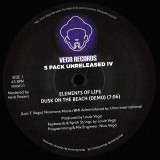
- J1: Elements Of Life - Dusk On The Beach (Demo)
V[57,77 €]
Fall is here after all the summer maddness with festivals, mediterranean tours and Ibiza residencies, it full on vinyl releases for Vega Records. Introducing the 5 Pack Unreleased IV edition, Vega Records takes another step into the world of unreleased music from the Vega Family. Gems from Leroy Burgess, Two Soul fusion, Tony Touch, Professor Featuring Ndu Shezi & Thebe, Johnny Dangerous, and gospel royalty Bebe Winans to Elements Of Life Demos and songs in the making all come together on this special 5 piece vinyl set. With 12 tracks in the sequence there are a select number of talented producers on the project which include Two Soul Fusion AKA Louie Vega & Josh Milan, Pablo Fierro, Johnny Dangerous, Luis Radio, Pietro Nicosia and musicians Axel Tosca and Luisito Quintero. They all contribute to these unique pieces of music mastered by the one and only who we call “The Quincy Jones Of Mastering” Mr. Herb Powers of PM Mastering and the vinyl manufactured by Optimal, Germany. With a limited number of copies made make sure you get your hands on them, they will be rare and very fast!!! Vega Records “always bringing you top quality music” !! Distributed by Above Board, UK.
This vinyl contains analog live one-takes by DJ Lily, recorded during April to June 2023 in Gothenburg. A1, A2 & B1 rely on playfulness, whereas B2 & B3 are blistering. Sequences were made with a Syntrx, the bass module of a Pulsar23 and a modern FM synth.
Mastered by Paul Mac at Hardgroove Mastering.
Doctor Who – Time And The Rani was the opening serial of season 24, first broadcast on September 7th, 1987. It marked the debut of Sylvester McCoy and featured CGI in a very basic form as the technology was still in development. It also debuted a new computer animated opening title sequence with a new synthesiser version of the theme created by Keff McCulloch.
The composer was invited to create incidental music for the series and became a regular member of the team also writing music for Delta & The Bannerman, Paradise Towers, Remembrance Of The Daleks, Silver Nemesis, Battlefield, Dimensions In Time and Shada.
Keff, Dominic Glynn and Mark Ayres were the composers for the last three years of Doctor Who on its original run that ended in 1989, the latter compiling and producing this release.
IT Recordings finally comes back with a new release, offering a sequel to its sound-vision.
This Various Artists project is a culmination of the refinement of IT Recordings sound-vision, guaranteeing a spacey atmosphere filled by groovy low riffs.
Eric Fetcher’s composition is the starting point of this 4-tracks story, made of a distinct atmosphere associated to some dynamically sequenced kicks.
Then follows Alexis Vogel’s Divergence made of a bright melodic synth, groovy low end and varied rhythmic patterns maintaining an intense energy throughout the track.
The 3rd composition is a fast paced rolling cut designed by Corium, that marks the highest point of this 4-tracks story.
Finally Matthieu Benjamin’s Early Mornings is the perfect conclusion to this EP, maintaining the groove of the previous tracks. A refreshing breeze after the storm, makes this project a consistent and diversified tool for the dancefloor.
There has been a huge outpouring of loving tributes to Bernie Marsden since he passed away peacefully, surrounded by his family on 24th August 2023 at the age of 72 Although Bernie had always worked hard and kept busy, most recently releasing 3 chart busting solo albums since 2021 in KINGS, CHESS and TRIOS as part of his Inspirations series, only a few knew that he had just completed a brand new album. Earlier in August, Bernie had approved the artwork, sequence and audio masters for WORKING MAN. An album of Bernie Marsden original songs. The album contains 12 brand new Bernie Marsden penned tracks. Produced by Bernie Marsden and Mixed by Dave Eringa (Manic Street Preachers, The Who). The limited first pressing of the LP & CD will come with a bonus disc of 10 more new recordings
Lucy Railton trusts in the nuance of her own creative instincts on an intensely modern, quietly radical new album, her second for Modern Love.
Following her 2018 solo debut »Paradise 94’« and countless collaborations in the time since, Railton’s diverse musical circles here bleed into each other, creating an insoluble testament to a lifelong pursuit of sound. The multi-instrumentalist further articulates her own tonal register, embracing her solo strengths and trusting the process to reveal vulnerable and compelling emotional facets through a fluid mix of composition, and pure expression.
On the simplest level, »Corner Dancer« is a record that revels in the momentum of creation. Through a range of approaches, Railton gradually loosens her grip and allows her identities to expose themselves; cut to the bone, sinew and spirit of music making. Reaching outside tried and tested zones, she lands at a charged space characterised by unmetered pacing and an embrace of imperfection, using cello, viella (a medieval cello), Buchla, 808, a fan, synths, horse hair whips, a hand held harp and her own voice, across 8 tracks that arc from an opening sequence of ruptured asymmetries, to something bordering the sublime on »Blush Study’« the album’s masterful closing flourish.
In between, Railton invokes psychoacoustic, heady spins and repetitions, while also allowing space for live performance, a mode to which she feels most attuned, and here captured best on »Held in Paradise« (her violin debut) and »Rib Cage«.
Collapsing boundaries, Railton harnesses a lifetime of formal training in order to patiently trace more ambiguous, intimate and sometimes deviant shapes, operating to a fuzzed logic that loops back to themes with an ingenious underlying dramaturgy of energies, dismantling the form from the inside out, in a way that bends through feeling, rather than design.
"North London’s midnight man tumbles out his treehouse to deliver twelve potions of minor healing in “Iron Day”, his questing, soul-salvaging songbook. Brimming with majesty and maraud in equal parts, Genghis Cohn synthesises trad. English folk and woe with surrealist dream sequences on this debut long-player. A romance of two hedgehogs, devotional bone temples, broken shadows and sausage kings, GC conjures Brent Hayward strolling through the silver birch and presents to us, in a warmly recognisable form, a grand slab of folk music that challenges its ancient rewards.
Previous acquaintance with GC's lean, amorphous strain of experimental home recordings may encounter a menacing apprehension whilst trying to settle in the splendour of "Iron Day", unnerved by it's posture and the anticipation of songs dissolving or amalgamating in rust and gob at any moment. Still minimalist and direct, but delivered by an altogether different jester, songwriting that has featured in many previous works is smithed into fine, well-wrought suites that build and blend through paced, tempered sequencing and playful, intricate storytelling.
Amidst cavernous inner-dialogue and brilliant, contorted pastoral sequences, GC’s guitar (reported to be over 100 years old!?) laps and thrashes alongside accompaniments of Lauren Collier’s aching violin, a lethargic harmonica and emphatic hand-percussion that drifts in and then out. A dynamic, earthy collection that places future barn-stormers like “Underneath The Oak” and the gentle blaze of “Onion” in cadence with the doom-stricken, ghostly slides as on “Misunderstood” and “Secrets”, all recorded in dazzling clarity that captures the cascading instrumentation as clearly as the settled, tormented humour of GC’s blues. Indispensable candlemeat and essential, joyous listening for fans of; Davy Graham, The Godz, Leonara Carrington, Smelly Feet, Martin Carthy..."
A limited edition of 300 copies of this 1985 masterpiece, remastered and presented in a renewed artwork. Berlin School synth sequences, American minimalism vibes, new age and oriental influences, guitar-synthesizers, genius arrangements... A masterpiece exploring the emerging MIDI technology of the time. A transportive selection of calming ambient soundscapes punctuated by glassy synth work and meditative drum patterns.
Acclaimed by many, Steve Roach himself said: »I heard Traces on vinyl back in the early 80s. It is still one of my top 10 albums. There is just an elegant, efficient, and emotional quality about it that just holds up like it was created today. A truly timeless piece of beauty.«
Recalling the »Traces« times, Wøllo explained: »I quit all the bands I played in. I wanted to work on my own using the modern electronic studio as an instrument, like a painter with his oil canvasses. I wanted to make a music that had expansive synthesizer textures and sequencer patterns, layered together with expressive melodic electric guitars. Working with depth, time and space. In those years in the early eighties the studio technology was new and revolutionary, and I wanted to explore all the new possibilities. To be able to control the infinite variations of electronic sound, using an endless palette for creative expression«.
Finally, a YouTube comment about the record that we enjoyed: »This sounds like vaporwave before vaporwave had anything to be nostalgic over«.