BARRERA follows up the NUEVO SONIDO BALEAR path started by ORDEN MUNDIAL, POU and PENA MÁXIMA with a debut release filled to the rim with lust, sex, power and distortion. Their songs are slow and acidic, with a tortured tone that would make GLOOM or BRAINBOMBS cry. The seven songs on “Visiones Nocturnas” are themed around the death of romantic love and are not afraid to look at the darkest side of life with a nihilistic conviction. Musically the record follows the path laid by STICKMEN WITH RAYGUNS or FLIPPER but are firmly rooted in Spanish Punk with DESECHABLES as a clear point of reference, both aesthetically and sonically. Although BARRERA occupy their own space with a sound that is clearly their own nightmare. Recorded and mixed by Chano Morales at Impala Uno Studio, Mallorca. Mastered by Shigenori Kobayashi at Noise Room, Tokyo. Artwork by Barrera.
Buscar:seven sonic
First ever box set from one of the most thrilling bands of the Twentieth
Century.
Deluxe 7” singles box set featuring the phenomenal original run of singles
with two bonus singles exclusive to this set. Seven 7” singles housed inside
a lift-off lid box with a booklet featuring an essay by Clinton Heylin,
reminisces from Thurston Moore, Henry Rollins, Mark Lanegan X and Dan
Stuart, rare photographs and flyers, new exclusive issue of the ‘Fire of Love’
fanzine, Ruby Records postcard and a ‘Gun’ button badge.
If ever there was a band seemingly determined to come from nowhere and
go straight back there, it was The Gun Club. Jeffrey Lee Pierce’s search and
destroy combo was spawned by the LA punk scene in 1979. Two years later
their first LP, the incendiary ‘Fire Of Love’, was spewed out by Slash
Records, a matter of months after the punk zine Pierce wrote for, and the
label named itself after, breathed its last. ‘Fire Of Love’ was one of the 80’s
genuinely shape-shifting US debuts, igniting post-punk depth and minting
genres including blues, psychobilly and Americana.
Jeffrey Lee Pierce was an extraordinary character. Learning to play guitar at
the age of 10, he quickly immersed himself firstly in reggae and later the
Delta Blues, particularly works by Tommy Johnson and Robert Johnson. By
1976, he had become obsessed with Blondie, going on to become President
of the West Coast Blondie Fan Club. It was Jeffrey Lee Pierce who
suggested to the band they cover ‘Hanging On The Telephone’. The Blondie
connection would later resurface in 1982 when Chris Stein signed and
produced The Gun Club for his Animal Records label. In 1996 after releasing
seven studio albums, 37-year-old Jeffrey Lee Pierce sadly passed away
following a stroke. What he left behind is a legacy of work that has had a
prolific effect on some of the most distinguished rock acts of the past 20+
years, these include Nick Cave & The Bad Seeds, Sonic Youth, The White
Stripes, Mark Lanegan, Primal Scream and The Black Keys.
“Jeffrey was a human tornado. Yet during the most turbulent points in his life,
he was able to tap what seemed to be a limitless supply of astonishingly
beautiful music. Even now, songs like ‘Flowing’ and ‘Desire’ catch me up.
The immense power that passed through Jeffrey, like an electrical current,
informed his amazing body of work. That level of unrelenting heat and
incandescence is simply not survivable. I wouldn’t wish it on anyone.” -
Henry Rollins (April 2021)
Six 7” singles reprinted with original artwork. Additional ‘Miami Demos’ 7”
exclusive to this box set. All singles remastered especially for these vinyl
editions.
For fans of Tall Heights, Sufjan Stevens, & Indie Folk! Steadily building their artistic style and audience for the past seven years, New Jersey based alternative folk band Cold Weather Company carries a diverse sound, rich with harmonies and instrumental builds. The band combines the various writing approaches and influences of its three members, Brian Curry, Jeff Petescia, and Steve Shimchick, to create unique arrangements with intricate layering. Over the past few years, the band has earned over eight million cross-platform digital streams and supported acts such as Tall Heights, Jamestown Revival, and Juke Ross. On their fourth full-length album, Coalescence, Cold Weather Company continues to expand their acoustic-forward, alternative folk sound into new territory. With delicate additions of synths and electronic instruments, as well as a broadened palette of horns, percussion, strings, and harmonies, "Coalescence" explores each song down to its smallest sonic niche. Conceptually, the album revolves around growth by highlighting our capacity to better ourselves and our connections through introspection and reflection. Often occurring cyclically, especially in nature, the idea of growth also inspired the release process for the album which will be split into three parts, each representing a different conceptual facet. "With their spot on songwriting and boisterous melodies, Cold Weather Company is set to follow in the alt-folk leaning sounds of Avett Brothers, Ben Howard George Ezra
"In Vivo" is the result of the photographic work of Klavdij Sluban at the Fleury-Mérogis Young Offender Institution (France) from 1995 to 2016 Beds in addition to his work from Izalco prison, located in El Salvador, from 2008 [visiting rooms] connected to the music of Gareth Davis.
Gareth Davis is an artist, composer and musician living in Amsterdam. He plays clarinet(s), the result of a somewhat impulsive purchase whilst window shopping in Covent Garden, London, around ten years before the turn of the century. The serendipitous location of a rather wonderful (and equally important, rather cheap) second hand record shop less than 10m from the bus stop required for seven years of schooling, combined with delivering newspapers on a daily basis, lead to a somewhat eclectic, dusty and generally unclassified taste in music.
The result. Activity covering sonic art and contemporary classical music through rock, improvisation and noise with collaborations that have included the premiering of new written pieces by composers such as Bernhard Lang, Peter Ablinger, Toshio Hosokawa and Jonathan Harvey, soloist with orchestras including the SWR Symphonieorchester, Warsaw Philharmonic and Orquesta de la Comunidad de Madrid, performances with groups and performers ranging from the Neue Vocalsolisten and Arditti Quartet through to improvisers Elliott Sharp and Frances Marie Uitti, electronic artists Robin Rimbaud and Merzbow and multimedia work with artists including Christian Marclay and Peter Greenaway.
"In Vivo" is his second solo release after to have recorded a bunch of collaborative albums with artists such as Scanner, Machinefabriek, Steven R. Smith, Kleefstra Brothers, Frances-Marie Uitti, Merzbow, Adain Baker, Duane Pitre and more...
Klavdij Sluban, winner of the European Publishers Award for Photography 2009, of the Leica Prize (2004) and of the Niépce Prize (2000), main French prize in photography, is a French photographer of Slovenian origin born in Paris in 1963.
He develops a rigorous and coherent body of work, nourished by literature, never inspired by immediate and sensational current affairs, making him one of the most interesting photographers of his generation. The Balkans, the Black Sea, the Baltic Sea, the Caribbean, Central America, Russia, China and the Antarctic (first artistic mission in the Kerguelen islands) can be read as many successive steps of an in-depth study of a patient proximity to the encountered real.
His images have been shown in such leading institutions as the Metropolitan Museum of Photography of Tokyo, the Maison Européenne de la Photographie in Paris, the Rencontres d’Arles, the Museum of Photography in Helsinki, the Fine Arts Museum in Canton, the Musée Beaubourg, the Museum of Texas Tech University. His many books include East to East (published simultaneously by Actes Sud, Dewi Lewis, Petliti, Braus, Apeiron & Lunwerg with a text by Erri de Luca), Entre Parenthèses, (Photo Poche, Actes Sud), Transverses, (Maison Européenne de la Photographie) and Balkans -Transit, with a text by François Maspero (Seuil). Since 1995, Sluban has been photographing teenagers in jails. In each prison he organizes workshops with the young offenders to share his passion. First originated in France, in the prison of Fleury-Mérogis with support of Henri Cartier-Bresson during 7 years, as well as Marc Riboud and William Klein punctually. This commitment was pursued in the disciplinary camps of Eastern Europe –Serbia, Slovenia, Ukraine, Georgia, Moldavia, Latvia – and in the disciplinary centres of Moscow and St Petersburg as well as in Ireland. From 2007 to 2012, Sluban has been working in Central America with imprisoned youngsters belonging to maras (gangs) in Guatemala and Salvador. In 2015, he started photographing imprisoned teenagers in Brazil. In 2013, the musée Niépce showed a retrospective of K.Sluban’s work, After Darkness, 1995-2012. In 2015/16, he was awarded the Villa Kujoyama Residence in Kyoto, Japan. K.Sluban is member of national and international jurys, such as prix Niépce, prix de la Jeune Photographie de Niort, prix Leica, All About Photo…
. A true child of the seventies, Sojo wished to record and mix his new material straight to tape, using vintage analog equipment with according methods of work. This was made possible at Studio Kerwax, located in the heart of Brittany. A tight quintet gathered with sound engineer Christophe Chavanon to produce the warm timeless sounds of Silvatica, marking the welcome return of drummer Earl Harvin (Tindersticks, The The, Psychedelic Furs). New recruit Erik 'Raggy' Sevret (from French dub masters Zenzile) works his sax magic, breathing further life into Sweet Gum Tree's lush sonic forest.
The seven-headed Aussie rock beast King Gizzard & The Lizard
Wizard return with a new vinyl edition of ‘Fishing For Fishies’,
perhaps their most perfectly-realised album to date.
The Eco Edition has been pressed on Eco-Mix vinyl and is housed
in a brown paper bag after previous pressings quickly sold out.
Released on the band’s own Flightless Records, here is a world
where the organic meets the automated; where the rustic meets
the robotic. Where the past and future collide in the beautiful
present.
‘Fishing For Fishies’ is a blues-infused blast of sonic boogie that
struts and shimmies through several moods and terrains. From the
soft shuffle Outback country of the opening title track through the
sunny easy listening of ‘The Bird Song’ (think a lysergically-soaked
Laurel Canyon circa 1973) and on through the party funk of
‘Plastic Boogie’ (which somehow summons the spirit of Stevie
Wonder’s ‘Innervisions’) the road-trucking, Doors-like highway
rock of ‘The Cruel Millennial’ and ‘Real’s Not Real’ - what
Carpenters might have sounded like had they existed entirely on
vegemite and weed - it’s a dizzying, dazzling display which
addresses a number of pertinent environmental issues along the
way.
“We tried to make a blues record,” says frontman Stu Mackenzie.
“A blues-boogie-shuffle-kinda-thing, but the songs kept fighting it -
or maybe it was us fighting them. Ultimately though we let the
songs guide us this time; we let them have their own personalities
and forge their own path. Paths of light, paths of darkness. This is
a collection of songs that went on wild journeys of transformation.”
Quiet though it was on the record front, 2018 was hardly a year of
rest for King Gizzard & The Lizard Wizard. In almost perpetual
motion, the band continued their unstoppable rise as their
juggernaut of a live show grew and grew and grew, with a mindblowing headline slot at Green Man Festival, a massive sold-out
US tour in the summer which saw them play their biggest venues
to date, a brain-frying sold out Brixton Academy show, two gigs in
Russia and Istanbul where they played in front of over 15,000
people and putting on the fourth edition of their annual Gizzfest in
Melbourne amongst the highlights.
Editions Mego is proud to welcome Powell to its roster with a bizarre and strangely emotive new LP of synthetic computer works entitled Piano Music 1-7.
Via his own Diagonal Records imprint, his work on XL Recordings and, most recently, the opening of audio/film platform A Folder afolder.studio, Powell has firm footing in the contemporary electronic landscape. During a wry and obstinate musical life he has twisted myriad synthetic forms into shapes that explore and expand upon the districts of post-punk, techno, noise + computer music, and in the the last year alone he has released four albums of hi-def abstractions, each inspired by a formalisation of music proposed by Iannis Xenakis.
As an extension of this intense period of work/research/play with stochastic functions using probabilities to compose music, various processes emerged that Powell then began to apply to more traditional musical events. Where ordinarily in his work the probabilities and relationships are used to define parameters such as wave-shape, folding, FM, filter modes etc., he now began to use them to create musical formations and visual scores that could be played back using any software/MIDI instrument one of these can be seen on the rear cover of the LP release. While mapping out this cartography of relations, he used a basic Grand Steinway sampler as a placeholder instrument; the longer the process went on, though, the more he began to embrace the acoustic properties of the synthetic piano and make it the bedrock for this new constellation of work.
Piano Music 1-7, subtitled 'Music for Synthetic Piano and Assorted Electronics', consists of seven different synthetic islands strung together into a single composition. All were composed using the aforementioned processes that allowed Powell to play a piano, even if he never learned to do so with his hands. After all, 'In writing electronic music,' Robin Mackay once wrote, 'you also have to direct the invention of new tools.'
At times the piano skips gleefully over shadowing synthesis, whilst at others the synthetic sheets swarm and envelope the keys. The interplay between the two create a fantastical alternate reality, a cosmic machine in which time is eroded, shrunk and expanded, like a wax upon which operations and relations are inscribed or engraved. Many of the pieces express a playfulness or optimism verging on vitalism, as bundles of piano notes dance and interpolate with a never-repeating range of electronic gestures. The feel is of a brightly coloured flower-bed in various stage of bloom. This interplay of the artifical acoustic and the electronic builds on the pioneering processes developed by David Behrman in works such as Leapday Night, and Piano Music 1-7 could also be posited as a modern take on Conlon Nancarrow's investigations for player piano. Similarly, the razor-sharp sonic properties and unfolding of non-human events recall the computer works of Xenakis and the surgical precision of Mego mainstay Florian Hecker.
Recorded in late 2020, these new Powell works propose not just a bold and bright vision of electronic music but serve also as a map with which, for 35 minutes at least, we can navigate our way out of the current milieu. As the artist himself remarks in the sleeve-notes, '. . . What emerged from this fog or soup for me were ideas and processes that felt affirmative and life giving — sensations I had always hoped to convey in my music. Perhaps the optimism or positivity I felt at these musical events unfolding, these clusters and knots tumbling in different directions across time, can also be felt by you.'
The long awaited follow up to Osaka's Hibushibire 'Freak Out Orgasm!' debut album from 2017 is almost upon us ...
Who are Hibushibire ?
821 (Hani) on bass
Ryu Matsumoto on drums
Changchang on guitar and vocals
It would be fair to say Hibushibire’s 2017 debut album ‘Freak Out Orgasm!’ went down well with fans of psych-rock (call it what you will). So far it’s had three vinyl pressings, two cassette pressings and a CD run back in Japan. It garnered quite a few influential underground (if not mainstream) reviews and seemed to sell through on word of mouth alone - which in these times seems to be the way things are going: thriving social media groups sharing their love of recent purchases and fellow vinyl lovers going out and scooping them up without the need to buy a magazine or read an online review to make their mind up. My favourite review of ‘Freak Out Orgasm!’ came from UK based music blog Dayz Of Purple And Orange as I think he nailed it perfectly...
“Fuck me! I think I've died and gone to psychedelic heaven! If anyone had asked me what I would really want from a freak out, heavy-as-fuck psych band I would have to say I would want the sheer guitar pyrotechnics of Acid Mothers Temple, the hard-as-nails scuzziness of The Heads, the lead heaviness of a fucked-up Blue Cheer and the instrumental dexterity of Hendrix on speed. Guess what, that band exists and they are called HIBUSHIBIRE!"
That, to me, said it all. Nail hit hard.
But let's get onto 'Turn On, Tune In, Freak Out!'
Once again the album is produced by Makoto Kawabata (Acid Mothers Temple, Mainliner) and for me it's the next logical step in the bands sonic development. As with its predecessor, side one consists of three tracks, "Ecstasy Highwaystar / Blow! Blow! Blow! / Overdose, Pussycat! More! More!", (they do like an exclamation mark). Some of these titles will be familiar if you've followed the band's live shows in recent times, and it's pretty much a guitar to the front, full gonzo-style hard-rocking psychedelic freak out from the first blast of Changchang's guitar panning from left to right before the main riff kicks it all off.
Again, as with their debut, side two comprises of just one epic length track. 'Rollercoaster Of The Universe' clocks in at seventeen minutes and is, in my humble opinion, the sound of the band moving onto the next level during its journey. It's a shudderingly beautiful piece, with many hypnotic twists and turns. I can't wait to hear how they play this live.
The band did initially attempt to produce this album by themselves, but got 'brain fever' in the studio and called their old friend Makoto to come down and help them finish it off. As he had no preparation in advance, he knew nothing about how the recording was going in the studio, and moreover there was little time left for adjustments to be made. But his technique of mixing was, as always, both mighty and almost destructive.
With endless Afro-latin percussion & drums patterns woven throughout ten tracks of tropical dance floor heaters, Italian multi-instrumentalist and master percussionist, Worldwide FM presenter and director of the Yoruba Soul Orchestra, Gabriele Poso is to release his seventh LP, Tamburo Infinito, via New York record label Wonderwheel Recordings. Recorded in Lecce in the south of Italy and almost entirely on his own (unlike previous productions), the undisputed star of the show is once again the drum and the percussion, the Tamburo Infinito.
Although born in Italy, Gabriele has always looked across the Atlantic for inspirations and rhythms, and this album is no different. This time his sonic adventures took him to the French West Indies and the French Caribbean island like Guadeloupe Martinique, "I'm in love with everything about the sound of their drums, it's very unique warm and deep sound."
The album kicks off with the hot & sticky Ritmo, setting the tone for the record with a kaleidoscope of tropical rhythms and influences. First single La Bola is jammed full of exultant horns and syncopated drum beats carried on the back of a driving, funky bassline. By the time the horns drop in on the aptly named Party People the carnival is in full swing over jubilant percussion and spaced out synths.
Gabriele Poso's musical passion has taken him around the world, initially to Rome, then to Puerto Rico, Cuba, and most recently, Berlin. Between 1998 and 2001, Gabriele delved deep into the study of Afro-Cuban percussion, first at the "Timba" School Of Music in Rome, under the guidance of the most important representative of Afro-Cuban culture in Italy, Roberto "Mamey" Evangelista. Later in 2001, he moved to San Juan, Puerto Rico to attend the "Universidad Interamericana De Puerto Rico" to continue his studies, finally culminating in a masterclass at "Escuela Nacional De Arte" in Havana, Cuba.
2008 saw the release of Poso's debut solo album, From The Genuine World, released on Yoruba Records, Osunlade's label, which sparked a career performing around Europe and the rest of the world. His second solo album, Roots of Soul arrived in 2012 on the German label INFRACom!, his third solo album entitled Invocation in 2014, on the German label Agogo Records with other full length efforts released on renowned British labels, Barely Breaking Even (Awakening - 2018) and Soundway Records (Batik - 2019), culminating in an impressively deep and diverse catalogue of solo work.
- 1: Too Many Creeps
- 2: Snakes Crawl
- 3: You Taste Like The Tropics
- 4: Punch Drunk
- 5: Cold Turkey
- 6: Things That Go Boom In The Night
- 7: Das Ah Riot
- 8: Cowboys In Africa
- 9: Rituals
- 10: You Can’t Be Funky
- 11: Moonlite
- 12: Dum Dum
- 13: Stand Up And Fight
- 14: Page 18
- 15: Color Green
- 16: Mr. Lovesong
- 17: World
- 18: Motörhead
- 19: Pretty Thing
- 20: You Don’t Know Me
- 21: Heart Attack
- 22: Ocean
- 23: Nails
- 24: True Blue
- 25: Red Heavy
- 26: Out Again
- 27: There Is A Hum
- 28: Seven Years
- 29: Sucker Is Born
- 30: Run Run Run
- 31: Cutting Floo
Flashes of light rarely burn for long. Bush Tetras exploded into
New York in 1979 and flamed out just a few years later. Yet
somehow this lightning-quick band have risen from their own
ashes again and again for four decades. The spark that ignited
Bush Tetras tapped into a deep grid of power, fuelled by
guitarist Pat Place, singer Cynthia Sley and drummer Dee Pop.
That chemistry is palpable on ‘Rhythm and Paranoia: The Best
of Bush Tetras’, which features 30 tracks across 2CDs in a 4-
panel digipack / 29 songs across 3LPs pressed onto 180gram
vinyl in a rigid lift-off box with lift ribbon, remastered by Carl
Saff, plus a 40-page (2CD) / 46-page (3LP) book with neverbefore-seen photos, an original essay on the band by Marc
Masters and micro essays by Sonic Youth’s Thurston Moore,
R&B legend Nona Hendryx, The Clash’s Topper Headon and
more.
From the band’s earliest recordings to their current, vital-asever incarnation, ‘Rhythm and Paranoia’ - for the first time ever
- showcases their unique, influential and body-shaking meld of
rock, punk, funk, reggae and more in one cohesive, immersive
and meticulously constructed box set.
“Coupled with ‘Too Many Creeps’’ dancey arrangement, Sley’s
monotonous tone signaled that within the Tetras’ newly staked
safe space, misogyny wasn’t a threat: it was just a boring,
predictable damper on the party. Like the rest of their peers, this
band was over it.” - Pitchfork (The History of Feminist Punk in
33 Songs)
“The Bush Tetras are a national treasure” - VICE
“Renowned at the dawn of the eighties for pairing the disjoined
guitar skronk of the inaccessible No Wave scene with
irrepressible, funk-infused rhythms, the Bush Tetras were
remarkably influential without ever really receiving their due” -
The New Yorker
“Bush Tetras bridge the gap between the Ramones and Sonic
Youth.” - NY Post
[e] 5 Cold Turkey [Live in London]
[p] 16 Mr. Lovesong [Alternate Version]
[xd] 30 Run Run Run [Live in San Francisco]
Germany-based metal band OBSCURA launch trilogy concept on stunning new album “A Valediction”. The group’s first (sixth overall) album for Nuclear Blast pivots on many fronts. Advanced, elegant, and yet refreshing, “A Valediction” sums up past endeavors effortlessly as it gazes with purpose and conviction into the future. OBSCURA are fan-renowned and critically acclaimed for challenging and then expanding upon norms. From “Cosmogenesis” (2009) through “Diluvium” (2018), the band flourished and made significant progress in a musical genre unprepared for a creative shot of German invention. “A Valediction” spearheads OBSCURA into a new era of extreme metal.
Guitarist/vocalist Steffen Kummerer founded OBSCURA in 2002. Early on, he set out to improve, redefine, and push forward. Under his self-label creation, the Bavarian released debut album “Retribution” (2006), followed by heavy touring throughout Europe. Word quickly spread that a brand-new band from the south of Germany was on the rise. Buzz lead to a deal with U.S.-based Relapse Records. The first record out was “Cosmogenesis”. In Europe, Metal Hammer Germany awarded the album 6/7 while in the U.S., “Cosmogenesis” hit the Billboard charts at #71. The cross-continental praise and fevered momentum landed OBSCURA on high-profile tours in Europe, North America, and Japan.
When follow-up “Omnivium” arrived in 2011, they upped their chart success (Billboard #11; Media Control #14), received more accolades from publications like Terrorizer, Rock Hard, and Decibel, had another massive round-world tour cycle, while enhancing and making progress on their clever brutality. OBSCURA further developed their sound on “Akróasis” (2016). Moored by jaw-dropping tracks like ‘Sermon of the Seven Suns,’ ‘Ode to the Sun,’ and the title track, “Akróasis” elevated OBSCURA to the highest levels of international renown, having climbed up the Billboard charts (#5) as well as earning top marks in Rock Hard (8.5/10), Metal Hammer Germany (6/7), and Revolver (4/5). The Germans toured the world yet again, playing over 100 shows in support of “Akróasis”.
OBSCURA’s most significant accomplishment was, however, just around the corner. The final part of a tetralogy, “Diluvium” (2018), fiercely pursued OBSCURA’s multi-album transformation into musical innovators and metal powerhouses. Music videos for the title track, ‘Emergent Evolution’ and ‘Mortification of the Vulgar Sun,’ in concert with a substantial interest in virtuosic, forward-thinking metal, posited OBSCURA in the good graces (yet again) of the worldwide press in addition to rocketing up, for the very first time, the official album charts in Germany (#58) and Switzerland (#93). The Germans also topped out at #3 on the Billboard Heatseekers chart with “Diluvium”.
OBSCURA‘s stats have been impressive: Twenty years active; six highly prized albums; over 600 shows on four continents. Worldwide fan and press engagement—the videos for ‘The Anticosmic Overload,’ ‘Akróasis,’ and ‘Diluvium’ have over 4.5 million views—is only getting stronger the longer OBSCURA continue to offer up and interact with (via play-throughs and member/gear spotlights) their very captive audience. This is only the tip of Kummerer’s custom ESP guitar, however. A Valediction finds OBSCURA turning the page to a new chapter in the band’s evolution. A year in the works, the songwriting sessions followed a new approach, where the framework was relaxed, allowing new inspirations, imagining, and opportunities to arise. Songs like the opening epic ‘Forsaken,’ the '80s-tinted ‘When Stars Collide’ (featuring Soilwork/The Night Flight Orchestra frontman Björn Strid), the brutal groove of ‘Devoured Usurper,’ the ethereal artistry of ‘Heritage,’ and the fleet-fingered title track benefitted compositionally (refined structures) and aesthetically (more dynamism) from OBSCURA’s restyled songwriting stratagem.
OBSCURA wrote, recorded, and finalized “A Valediction” during the pandemic. The stipulations of working during this time allowed OBSCURA to work cross-country, tracking each respective part—drums, guitar, and bass—in national studios across The Netherlands, Austria, and Germany. Once the pieces were completed, the recordings were shipped off to award-winning producer Fredrik Nordström and Studio Fredman (In Flames, Architects) in Gothenburg, Sweden, where Kummerer and Münzner completed vocals and acoustic guitars using custom-built ENGL amps. Nordström was also tapped to mix and master. The final result is a deeper, heavier, yet more rounded production.
Lyrically, “A Valediction” is layered in structure and meaning. The word ‘valediction,’ by definition, deals with goodbyes and farewells. In a way, this is auf wiedersehen to the four-part album series while also addressing complex topics of Kummerer’s personal life. Instead of obscuring issues of loss, death, and abandonment in metaphor and allusion, the German laid bare his torment across songs like ‘Forsaken,’ ‘Solaris,’ ‘In Unity,’ ‘The Neuromancer,’ and ‘In Adversity.’ But for every line of desperation, he also offers positivity. Indeed, new beginnings—physical, emotional, or environmental—can provide light in the darkness. Lauded artist Eliran Kantor (Testament, Helloween) was brought on board to visualize the leitmotif. The bronze-themed colourway Kantor used exemplifies OBSCURA’s resistance to individual and sonic corrosion.
In 2021, OBSCURA will lighthouse their musical prowess, thematic complexity, and lyrical ambition on “A Valediction”. The group continue to be a beacon for change. No doubt OBSCURA’s new stats will amaze, but what they’re focused on is the release of “A Valediction” and then taking it on the road. Several high-caliber tours of Europe, North America, and Asia are planned through to 2023, with routes are in the works for the band to visit Australia, South America, and beyond. Truly, there is no band quite like OBSCURA. “A Valediction” proves that persistence, perseverance, and enterprising minds can achieve anything. Welcome to the next level!
- Living Proof
- Harmonia’s Dream
- Change
- I Don’t Wanna Wait
- Victim
- I Don’t Live Here Anymore
- Old Skin
- Wasted
- Rings Around My Father’s Eyes
- Occasional Rain
The War On Drugs first studio album in four years, ‘I Don’t Live Here Anymore’. Over the last 15 years, The War on Drugs have steadily emerged as one of this century’s great rock and roll synthesists, removing the gaps between the underground and the mainstream, between the obtuse and the anthemic, making records that wrestle a fractured past into a unified and engrossing present. The War On Drugs have never done that as well as they do with their fifth studio album, ‘I Don’t Live Here Anymore’, an uncommon rock album about one of our most common but daunting processes—resilience in the face of despair.
Just a month after The War On Drugs’ ‘A Deeper Understanding’ received the 2018 Grammy for Best Rock Album, the core of Granduciel, bassist Dave Hartley, and multi-instrumentalist Anthony LaMarca retreated to upstate New York to jam and cut new demos, working outside of the predetermined roles each member plays in the live setting. These sessions proved highly productive, turning out early versions of some of the most immediate songs on ‘I Don’t Live Here Anymore’. It was the start of a dozen-plus session odyssey that spanned three years and seven studios, including some of rock’s greatest sonic workshops like Electric Lady in New York and Los Angeles’ Sound City. Band leader Adam Granduciel and trusted co-producer/engineer Shawn Everett spent untold hours peeling back every piece of these songs and rebuilding them.
One of the most memorable sessions occurred in May 2019 at Electro-Vox, in which the band’s entire line-up — rounded out by keyboardist Robbie Bennett, drummer Charlie Hall, and saxophonist Jon Natchez — convened to record the affecting album opener “Living Proof.” Typically, Granduciel assembles The War On Drugs records from reams of overdubs, like a kind of rock ‘n’ roll jigsaw puzzle. But for “Living Proof,” the track came together in real time, as the musicians drew on their chemistry as a live unit to summon some extemporaneous magic. The immediacy of the performance was appropriate for one of the most personal songs Granduciel has ever written.
The War On Drugs’ particular combination of intricacy and imagination animates the 10 songs of ‘I Don’t Live Here Anymore’, buttressing the feelings of Granduciel’s personal odyssey. It’s an expression of rock ’n’ roll’s power to translate our own experience into songs we can share and words that direct our gaze toward the possibility of what is to come.
Wasted Cathedral is the solo project of Saskatoon-based musician Christopher Laramee (Shooting Guns, The Switching Yard, and The Radiation Flowers). This new album is the latest in an impressive line of releases that have explored a variety of sounds, from ambient drone and electronic disco to experimental chaos and downtempo electronica. I'm Gonna Love You 'Til The End Of Time is made up of seven songs and is undoubtedly influenced by the starkness of the Canadian Prairie and long Saskatchewanian nights. It serves well as a soundtrack to the setting of any number of listening experiences, particularly when experienced with headphones. No matter the direction Laramee has chosen to guide Wasted Cathedral, the result has always been intriguing and captivating. I'm Gonna Love You 'Til The End Of Time is certainly no exception.
Laramee describes Wasted Cathedral as incidental music, improvised soundscapes created in passing moments, like musical snapshots. This makes perfect sense, considering the likes of Sarah Davachi, Peter Kember, Terry Riley, and Augustus Pablo inform Laramee's approach to composition, as well as tone-setting and mood. According to Laramee, this collection of songs is a continuation of his previous work, albeit in a more stripped down fashion.
Wasted Cathedral is recommended for listeners of Flying Saucer Attack, DJ Shadow, Spectrum/Sonic Boom, Spiritualized, and Portishead.
No less than 12 months later arrives ‘Deep Blue View’ – not so much of a follow-up, as a mini-flipside moving the Jazz from AM to PM, between city and sea.
“I originally had AM Jazz down as walking around some New York backstreet at 4am, smoking in a fedora, looking for crimes to solve but it now ends as night begins,” reveals Al, of his latest tale’s gradual evolution. “Deep Blue View is the night-time album now… like losing yourself deeper in the fog, or disappearing in the sea… would someone, or some 'thing' come to save you or would they , or it , come along for the ride?”
Usually by now, Daveyhulme’s own could-be John Barry would have left distractions of success for suburban side-projects and writing with his fellow Mancunian musicians, but AM Jazz left unfinished business - and, with 50 or so session recordings leaving a litter of sonic debris strewn about the cutting room floor, one major clean-up. Deep Blue View is 6 brand new tracks crafted from its reconstructed and revived remnants, unfurling like Sinatra’s Wee Small Hours to reinforce the strangely beautiful atmosphere of Al’s now revered repertoire. “I had the urge to create something new and started playing around with different EPs and pseudonyms but when I sequenced these tracks, I was really happy how smoothly they flowed; it just needed an opener. I quickly wrote ‘Deep Blue View’ and it fell into place. It’s great, so I carried on, knowing it was time to save the best stuff for myself,” Al grins.
Just as AM Jazz was created in the spirit of his earlier working style on debut album Tower of Love, Deep Blue View fuses Al’s love of finding the ‘right’ in the odd, weird, back-to-front and everything in between, with the hi-fi meets lo-fi sounds of his crate-digging curiosity and empathy for TV themes and movie soundtracks. Guided by melody, his home-based sorcery of working with analog, tape and field recordings opposed to the lure of studio mechanics allowed his inner subconscious to tap at the door and reveal itself in new musical forms. “In the studio it’s tempting to turn everything up loud but I’ve got bad tinnitus and don’t want to write anything else in a Beatles style. I have done all that now… at home I have a computer, a microphone and just go crazy and lose myself staring at the screen. Then suddenly loads of music is written.”
Setting his inner autopilot to flight mode, ‘Peppergone’ adds to the tracks’ nocturnal narrative and appears reborn after a last-minute culling from AM Jazz’s initial tracklist. Like a beautifully romantic ode to Beethoven’s Moonlight Sonata, it is a fitting tribute to dearly departed best friend 'Batfinks', written in the middle of a tough night. “I have no idea why or how the song came about because I was so upset to do anything, let alone record any music. But there you go. Somehow I did and it’s a really special thing. I know he would have dug me using his chords; growing up we’d both try to create the perfect chord sequence. This is his idea of that. I hope he doesn’t think it’s shit,” Al jests.
Also revived from AM Jazz’s archive is the simmering groove of ‘Night Talk Late Street’ and instrumental ‘Star Six Seven’, whilst ‘Have Another Cigar’ weaves its own semi-autobiographical fairy-tale with lyrics written and sung by long-time pal and former housemate Aidan Smith. Transformed from backing track into a cool morsel of story pop, it recalls the drunken joy of when the pair would make recordings together between singing the Everly Brothers at full volume. “I’m sure it’s about not wanting the musical party to stop and having to get on with real life,” Al says.
‘String Beat’ meanwhile, soars like a beautiful Bond theme with the shimmer of Lee Hazlewood holidaying in Palm Springs, alongside perhaps, the waltzing string-like synthonies of some long-lost rhythm and blues orchestra of Davyhulme (whose real-life origins reside with the Berlin Symphony Orchestra), introduced to him by Super Furry Animals’ Cian Ciaran. “I’ve never created anything this moody before and have always threatened to do something John Barry-esque with some slightly dark and spooky musical changes.”
A work that literally immerses the listener into an acoustical substance. The sound becomes almost like matter, like jelly. Soon, you're swimming in sound, getting lost inside it.
With the Sonic Waters project initiated in 1978, my aim was to situate field of electronic music within a liberating and futuristic experience, outside the concert halls and in sync with the development of new instruments - in particular the Synclavier digital synthesizer, the first model of which I acquired in 1977. As concert space, the Pacific Ocean seemed to me to be the ideal experimental medium for both acoustic and cultural reasons. I then developed the aesthetic and technical elements that would contribute to the conception of Underwater Music. Numerous performances would follow spanning four decades, in natural sites or in large public pools such as those of Sydney, Paris or Venice during the 2006 Biennale.
Michel Redolfi (1951), French composer and sound artist, is the founder of Underwater Music. The natural elements captured and highlighted by experimental technology are a constant in Redolfi's catalogue: many compositions explore the earth environments such as in 'Pacific Tubular Waves', 'Jungles', 'Desert Tracks' (re-released on Sub Rosa records) and especially with 'Sonic Waters', a work that literally immerses the listener into an acoustical substance. During the mid-seventies Redolfi carried out his electro-acoustic research in the United States, with major electronic music centers including the California Institute of the Arts and chiefly the University of California in San Diego. As invited resident of their studios, Michel Redolfi launched the underwater music concerts, with the series 'Sonic Waters' performed in the Pacific Ocean. Michel Redolfi's underwater creations have since been regularly programmed by major international festivals, with multi-media installations held in ecological marine reserves or in historical city pools. Among them, the Sydney Festival, Paris 'Nuit Blanche', Ars Electronica in Linz, the 2006 Venice Biennale (nominated Golden Lion) and lately the 2018 Ars Musica festival in Brussels. This record presents different variations of Sonic Waters from 1980 to 1987, alternating studio mixes with their re-recordings in the depths of the Pacific. Michel Redolfi CD's and LP's are currently published by Sub Rosa, INA-GRM and Radio France.
Today, beloved DJ, producer and songwriter Lauren Flax announces her forthcoming EP, Out Of Reality out August 6 via 2MR. Much of Out Of Reality’s cohesion comes from Flax’s expansive production, using simple elements to craft intricate backdrops for the questions posed by her songs. On the EP’s titular track, Alejandra Deheza (School of Seven Bells)’s crystalline vocals are woven against a delicate tapestry of arpeggiated keys, sparse percussion and haunting cello. Watch “Out of Reality” here.
Detachment isn’t always detrimental; sometimes you have to step outside to get a better view. Lauren Flax knows this - as a DJ, producer and songwriter, her discography is notoriously genre-defiant, consisting of an impressive array of solo tracks, collaborations, and remixes. The most recent of these – her mesmerizing take on Pale Blue’s “Breathe” - saw her experimenting with a new style of writing. “I wanted to explore that sound more,” Flax explains, “more of a synth exploration, textures with less beats.” The pared-down songwriting approach lent itself to thematic considerations as well: she’d been thinking about the repetitive nature of the life cycle - the Indian concept of Samsara - and felt a general disappointment at humanity’s lack of progress. On her new EP Out Of Reality, she washes that disappointment in lush sonic hues, stepping outside the quotidien for a new perspective.
Though its themes span beyond the scope of our current socio-political moment, Out Of Reality feels, right now, like an especially tantalizing proposition. Pandemic-driven escapism has bred a new crop of otherworldly music designed to transport the listener somewhere better. But Flax isn’t interested in escapism for its own sake - there’s still work to be done here on Earth, after all. Instead, through a combination of live instrumentation and ethereal synths, Out Of Reality grants us a respite from the real so we can return to it with a clear head.
Synth legend Suzanne Ciani, Demdike Stare’s Sean Canty & Finders Keepers’ Andy Votel come together on this killer hour-long 2014 synapse popper of a collaboration pooling the occasional group’s esoteric collage-based approach into a remarkably foreboding session pregnant with a dread that’s never quite resolved. Think Vladimir Ussachevsky, Todd Dockstader, Spectre and Company Flow melted thru the Deutsch-Italo industrial DIY tape era and funneled thru an almost impenetrable fog of Ann Arbor basement noizze.
Hustling some of Neotantrik’s most amorphous gestures, ’241014’ is a four-segment movement of reduced Buchla treatments, destroyed vinyl loops and scraping foley suspense; like a cosmic dream diary layered into a collage of drones and clatters. Little in Ciani’s extensive catalogue has hinted at what’s on display here; the joyful lullaby-pop of “Seven Waves” or metallic alien soundscraping of “Flowers of Evil” are only hinted at. She instead paints new sonic vistas, allowing space for her collaborators to make themselves known; Votel’s chiming toy autoharp and Bubul Tarang (a Punjab string instrument) add a distinctive flavor, while Canty’s grimy drones and noise-soaked textures drizzle pitch-black molasses into the cracks and crevices. Together, the effect is a bit like hearing Philip Jeck improvising over Popol Vuh’s peerless Moog-led debut “Affenstunde” or Demdike Stare knocking out impromptu reworks of Tangerine Dream’s abstrakt early run.
Perhaps unusually, the trio have still never set foot in a studio together, exclusively maintaining their practice in-the-moment and on stage when schedules intersect. So it’s all the more remarkable that their improvisations naturally find a democracy of role and such a heightened level of intuition, beautifully converging their thoughts to mutual, open-ended conclusions that leaves billowing room for interpretation. In a most classic sense, it’s like the sensation of sleep paralysis or dream/nightmare ambiguity, with a level of suggestiveness that’s disorienting from end to end.
For the first time the recordings are now available in high fidelity (there was a tape version a couple of years back) - now remastered by Rashad Becker to better represent the otherworldly scope of their actions on stage, from the NWW-like queues and drone of ‘Scanned Accents’ and keening silhouette of ‘Second Action,’ to new sections of subaquatic Porter Ricks-like murk in ‘Anti-Contraction’ and the levitating webs of synth and tactile, sampled textures in ‘Last Canción.’ Tape music and synth music have long shared a passionate embrace, and here turntablism coolly slides in on the action. Canty and Votel’s background in beat tape assembly and crate digging pays off: they’re keenly experimental creators but bring an unfussy sense of rhythm and performance that’s miles beyond any facile repetition of a nostalgia for vintage glory. Combined with Ciani’s delicate Buchla work - it’s a unique proposition.
- A1: Africa Is My Root - Osayomore Joseph And The Creative Seven
- A2: Ta Gha Hunsimwen - Akaba Man The Nigie Rokets
- A3: Popular Side - Akaba Man And The African Pride
- B1: Iranm Iran - Victor Uwaifo And His Titibitis
- B2: Sakpaide No 2 - Victor Uwaifo And His Titibitis
- B3: Ta Ghi Rare - Akaba Man The Nigie Rokets
- C1: My Name Is Money - Osayomore Joseph
- C2: Ogbov Omwan - Akaba Man The Nigie Rokets
- C3: Aibalegbe - Victor Uwaifo And His Titibitis
- D1: Who Know Man - Osayomore Joseph And The Ulele Power Sound
- D2: Obviemama - Victor Uwaifo And His Titibitis
- D3: Ororo No De Fade - Osayomore Joseph And The Ulele Power Sound
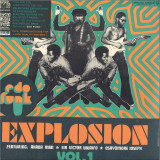
Analog Africa Presents Edo Funk Explosion Vol. 1, available on
2xLP/Gatefold LP with 20-page booklet / CD with 36-page booklet. It was
in Benin City, in the heart of Nigeria, that a new hybrid of intoxicating
highlife music known as Edo Funk was born.
It first emerged in the late 1970s when a group of musicians began to experiment with different ways of integrating elements from their native Edo culture
and fusing them with new sound effects coming from West Africa s night-clubs.
Unlike the rather polished 1980 s Nigerian disco productions coming out of the
international metropolis of Lagos Edo Funk was raw and reduced to its bare
minimum.
Someone was needed to channel this energy into a distinctive sound and Sir
Victor Uwaifo appeared like a mad professor with his Joromi studio. Uwaifo
took the skeletal structure of Edo music and relentless began fusing them with
synthesizers, electric guitars and 80 s effect racks which resulted in some of the
most outstanding Edo recordings ever made. An explosive spiced up brew with
an odd psychedelic note known as Edo Funk.
That’s the sound you’ll be discovering in the first volume of the Edo Funk Explosion series which focusses on the genre’s greatest originators; Osayomore
Joseph, Akaba Man, and Sir Victor Uwaifo: Osayomore Joseph was one of the
first musicians to bring the sound of the flute into the horn-dominated world
of highlife, and his skills as a performer made him a fixture on the Lagos scene.
When he returned to settle in Benin City in the mid 1970s - at the invitation of
the royal family - he devoted himself to the modernisation and electrification
of Edo music, using funk and Afro-beat as the building blocks for songs that
weren’t afraid to call out government corruption or confront the dark legacy of
Nigeria’s colonial past.
Akaba Man was the philosopher king of Edo funk. Less overtly political than Osayomore Joseph and less psychedelic than Victor Uwaifo, he found the perfect
medium for his message in the trance-like grooves of Edo funk. With pulsating
rhythms awash in cosmic synth-fields and lyrics that express a deep personal
vision, he found great success at the dawn of the 1980s as one of Benin City’s
most persuasive ambassadors of funky highlife.
Victor Uwaifo was already a star in Nigeria when he built the legendary Joromi
studios in his hometown of Benin City in 1978. Using his unique guitar style as
the mediating force between West-African highlife and the traditional rhythms
and melodies of Edo music, he had scored several hits in the early seventies,
but once he had his own sixteen-track facility he was able to pursue his obsession with the synesthetic possibilities of pure sound, adding squelchy synths,
swirling organs and studio effects to hypnotic basslines and raw grooves. Between his own records and his production for other musicians, he quickly established himself as the godfather of Edo funk.
What unites these diverse musicians is their ability to strip funk down to its
primal essence and use it as the foundation for their own excursions inward to
the heart of Edo culture and outward to the furthest limits of sonic alchemy.
The twelve tracks on Edo Funk Explosion Volume 1 pulse with raw inspiration,
mixing highlife horns, driving rhythms, day-glo keyboards and tripped-out guitars into a funk experience unlike any other.
Push For Night is the New York City based duo of Oliver Chapoy and James Elliott. Trafficking in dark, liminal electronics, the duo's sound is an ever shifting morass of psychoacoustic textures and spectral utterances. Evoking eerie, unnatural, and hidden spaces, this is music that exists in the threshold – locked in a constant push and pull of thwarted expectations and sublime release, hovering in a trance state of the always in-between. These seven tracks reference dark ambient, post-industrial, electroacoustic, 90s IDM, even fourth world explorations, but the music never truly slides into any definable style. The uncertain and illusory rule this sonic soil. Recorded by PFN in NYC and CDMX, 2017-2020 using various synthesizers, drum machines, heavily processed field recordings and guitars.
*2022 2LP Version *
Seven years after the classic ‘Theater of a Confused Mind’ (as Population One), Detroit techno phenomenon Terrence Dixon is back on Rush Hour with a new album, this time under his own name.
It would be a massive understatement to say we’re proud of this one. After all our whole operation was named after one of Dixon’s early tracks (‘Rush Hour’ originally appeared on a double EP called ‘Hippnotic Culture’ on fellow Detroit legend Claude Young’s Utensil Records in 1995) and ‘Reporting from Detroit’ again finds the maestro in outstanding form.
‘Reporting from Detroit’ is another prime example of the distinctly unique sound language Dixon has developed over the last three decades - defiant, forward-thinking afrofuturist techno that could only have been made in the Motor City.
But this is not just mere Detroit techno - it’s a sound language that’s unique to Dixon. An instantly recognizable high-octane sonic language fueled by frantic funk that’s constantly pushing the boundaries of machine music without ever losing the connection to the magic of the Detroit streets at night.