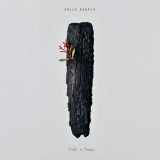
Caroline Says' haunting new album, The Lucky One, is a poignant exploration of how the ghosts of past relationships linger, sometimes holding more sway over our hearts and minds than our current connections. We revisit these ghosts through evocative landscapes of our memories - hometown bars, road trips, and late-night swims. Through a series of fractured and persistent memories these songs capture the bittersweet realization that the past, though imperfect, can sometimes be a more comforting and meaningful companion than the present. Opening track, "The Lucky One," confronts death's role in shaping our memories head-on, as it ponders the way death freezes a person in time, forcing us to confront the complexities of grief and its lasting impact on our relationship with the one we lost. Other tracks delve into the complexities of relationships that naturally grow apart as life takes us in different directions. For example, "Faded and Golden" reflects on the bittersweet nature of reunions with old friends, where the idealized memories of youth can clash with the realities of the present. Then, "Actors" takes this a step further, acknowledging the influence of perception and desire in friendships, and the idea that in many ways "all friendships are imaginary friendships," as it confronts the disappointment of inauthentic connections, and the facades we sometimes put on in relationships. "Roses" began when Caroline was looking through her grandma's collection of commemorative Kentucky Derby glasses, each one etched with the name of a winner. The song delves into the story of "Sunday Silence," the horse that won the year Caroline was born. Researching the horse's journey from near-Triple Crown glory to retirement in Japan sparked a metaphor - a pressured being (the horse) desperately trying to please but ultimately disappointing. The owners eventually selling the horse becomes a relatable symbol of unmet expectations, and the sting of falling short despite our best efforts. Album closer, "Something Good," revisits Caroline's Alabama childhood. Lost on a recent trip to Birmingham, unable to find the familiar path to a riverside hangout, the experience becomes a powerful metaphor; we can't always retrace the paths in our memories, but those memories, however unreliable, continue to shape us. In the end, The Lucky One celebrates this enduring power, acknowledging how past relationships and experiences, even those lost to the haze of time, continue to inform the stories we tell ourselves, and the way we navigate the present.
Buscar:short stories
- Live At Harvard Square Theater
- Cambridge, Ma, November 20, 1975
- Recording Supervised By Don Devito; Mixed By Sean Brennan
- 1: Introduction – Bob Neuwirth
- 2: Edith And The Kingpin
- 3: Don’t Interrupt The Sorrow
- Live At Music Hall
- Boston, Ma, November 21, 1975
- Recording Supervised By Don Devito; Mixed By Patrick Milligan
- 4: Introduction – Bob Neuwirth
- 5: Harry’s House
- Live In Bangor
- Bangor, Me, November 27, 1975
- Recorded By L.a. Johnson & Petur Hliddal
- 6: A Case Of You
- Live At Montreal Forum
- Montreal, Qc, Canada, December 4, 1975
- Recording Supervised By Don Devito; Mixed By Sean Brennan
- 1: Intro To Coyote
- 2: Coyote
- 1976: Tour Of The United States
- Recorded By Stanley Johnston From Pa Mixes By Brian Jonathan
- (Courtesy Of The Estate Of Stanley Tajima Johnston)
- Live At Music Hall
- Boston, Ma, February 19, 1976
- 3: Free Man In Paris
- 4: Shades Of Scarlett Conquering
- Live At Nassau Coliseum
- Uniondale, Ny, February 20, 1976
- 5: For Free
- Side Three
- Live At Music Hall
- Boston, Ma, February 19, 1976
- 1: Shadows And Light
- 2: In France They Kiss On Main Street
- 3: Intro To Furry Sings The Blues
- 4: Furry Sings The Blues
- Hejira Demos
- A&M Studios, Hollywood, Ca, March 1976
- Recorded By Henry Lewy; Mixed By Patrick Milligan
- 5: Traveling (Hejira)
- 1: Black Crow
- 2: Amelia
- Rolling Thunder Revue
- Tarrant County Convention Center, Fort Worth, Tx, May 16, 1976
- Recording Supervised By Don Devito; Engineered By
- Don Meehan; Mixed By Patrick Milligan
- 3: Intro To Song For Sharon
- 4: Song For Sharon
- Hejira Sessions
- A&M Studios, Hollywood, Ca, Summer 1976
- Recorded & Mixed By Henry Lewy
- 1: Refuge Of The Roads (Early Mix With Horns)
- 2: Don Juan’s Reckless Daughter (Early Rough Mix)
- Don Juan’s Reckless Daughter Sessions
- A&M Studios, Hollywood, Ca
- Recorded & Mixed By Henry Lewy
- 3: Otis And Marlena (Early Rough Mix)
- Mingus Sessions
- Electric Lady Studios, New York, Ny
- Recorded & Mixed By Henry Lewy & Jerry Solomon
- 4: Sweet Sucker Dance (Vocals & Drums Version – Take 5)
- Live At Bread & Roses Festival
- Greek Theatre, Berkeley, Ca, September 2 & 3, 1978
- Recorded & Mixed By Henry Lewy
- 1: Introduction
- 2: The Dry Cleaner From Des Moines
- 3: Intro To Goodbye Pork Pie Hat
- 4: Goodbye Pork Pie Hat
- 5: Intro To The Wolf That Lives In Lindsey
- 6: The Wolf That Lives In Lindsey
- Mingus Early Alternate Version
- Electric Lady Studios, New York, Ny And A&M Studios
- Hollywood, Ca, 1978 & 1979
- Recorded & Mixed By Henry Lewy & Jerry Solomon
- 15: God Must Be A Boogie Man
- 1: Sue And The Holy River
- 1979: Tour Rehearsals
- Sir Rehearsal Studios, Los Angeles, Ca
- Recorded By Joel Bernstein
- 2: Jericho
- 3: Help Me
- 1979: Tour Of The United States
- Live At Forest Hills Tennis Stadium
- Queens, Ny, August 25, 1979
- Recorded By Joel Bernstein From Pa Mix By Ed Wynne
- 4: Big Yellow Taxi
- 5: Just Like This Train
- 6: Raised On Robbery
- 1: The Last Time I Saw Richard
- Live At Greek Theatre
- Los Angeles, Ca, September 13, 1979
- Recorded By Andy Johns & Henry Lewy; Mixed By Patrick Milligan
- 2: Intro To A Chair In The Sky
- 3: A Chair In The Sky
Features Unreleased Studio Sessions, Alternate Versions, Live Recordings, Rarities, And 36-Page Book With New Photos & An Extensive Conversation Between Joni & Cameron Crowe
Sourced From Original Stereo Reels, Nagra Film Recordings, Multi-track Tapes, Radio Airchecks & Cassette Tapes
Throughout the latter half of the seventies, Joni continued to creatively break ground with her fearless and fluid exploration of jazz. Rather than tread the same path, she challenged and reinvented her style with a folk fusion like no other. Ascending to an unrivaled sonic peak, this innovative sound took shape across the gold-certified HEJIRA 1976, the gold-certified double-LP DON JUAN’S RECKLESS DAUGHTER [1977], her collaboration with Charles Mingus entitled MINGUS [1979], and live album SHADOWS AND LIGHT [1980]. Channeling the thrill and excitement of these records, she delves even further into this season on JONI MITCHELL ARCHIVES, VOL. 4: THE ASYLUM YEARS (1976-1980), due October 4th.
Available as a 6CD, 4LP (featuring Joni's personal favorites from the 6CD set), and digitally, this comprehensive and essential set spans one of the most prolific periods of her storied career. It boasts powerful live tracks from her time in Bob Dylan’s Rolling Thunder Revue during 1975 and 1976 Tour of the United States. It pulls back the curtain on the music by showcasing early recordings and alternate takes from the respective sessions for HEJIRA, DON JUAN’S RECKLESS DAUGHTER, and MINGUS. It covers the Bread & Roses Festival as well as the Anti-Nuclear Rally. Finally, VOL. 4 chronicles her 1979 tour, even showcasing two tracks from that year’s Tour Rehearsals. Not to mention, it showcases her versatility and adaptability, housing collaborations with everyone from Herbie Hancock and Jaco Pastorious to Wayne Shorter and Pat Metheny.
Vol. 4 culls the previously-unissued material from original stereo reels, cassette tapes, CD-Rs, and even a radio broadcast. Newly mixed tracks came from multi-track tapes, while a handful of hi-res digital tracks have been sourced from the Bob Dylan Archives.
Each version includes a book with never-before-seen photos and liner notes comprising a deep dive discussion between Mitchell and longtime friend Cameron Crowe. As part of their candid conversation, she shares intimate anecdotes, memories, and stories from that five-year creative run.
After dipping into the archive to deliver a series of essential reissues, Bureau B continue to encourage the chaotic brilliance of Faust with an LP of brand new music curated by originator Zappi Diermaier and a band of musical friends, including fellow founder Gunther Wüsthoff. Over the years Faust has become many things, each as separate as the fingers, but as together as the hand which makes up their eponymous fist. From 1971 to 1974 the Hamburg band blazed a bold sonic trail, helping to create the distinct and delirious strand of German music we"ve come to know as Krautrock. Uncompromising, innovative and experimental, their releases in that period, and the stories accompanying their creation, are nothing short of legendary, and the fact that after a hiatus, the band returned and remained active in a variety of separate and simultaneous incarnations is entirely fitting for these musical revolutionaries. On Blickwinkel, Diermaier"s incarnation embrace synchronicity and chance in order to capture the moment in a six track snapshot of industrial churn, unsettling ambience and psychedelic motorik.
- A1: The Feathered Girl
- A2: Nineveh
- B1: Hashem
- B2: The Isle Of Apples
" The myths of our Western tradition have often captivated me, whether they be Greek, Roman, or Judeo-Christian. Myths are a transcendent collective narrative; a buried memory, not intellectual but spiritual, alive to all the senses of another world. These stories often describe forbidding passages guarded by terrifying monster-like creatures, which, if conquered, give access to other planes. 'Door 1 - Door 2' are two of these planes, opening to prophecy and kingship." (Christopher Chaplin)
Following the release of his powerful and dark album trilogy "Je suis le Ténébreux", "Paradise Lost" and "M", British avant-garde composer Christopher James Chaplin has unveiled his latest project in 2021: "Patriarchs", released to critical acclaim. This project is a musical exploration of the Antediluvian patriarchs, from Adam to Noah, and is another captivating and daring work of art that straddles experimental electronic music and the avant-garde. Chaplin has also been wowing audiences with his live performances, releasing the concert album "Patriarchs Live" to shorten the wait for his new studio album "Door 1 Door 2", which will be released on September 20, 2024.
It is another powerful work of art, located between electronic music and avant-garde. Once again, Christopher Chaplin breaks genre boundaries and manages to condense experimental and colorful electronics in chamber music in a unique way, transporting the listener into mental and spatiotemporal intermediate states. A completely unique musical microcosm that can also be experienced in his impressive solo live performances.
Originally from Ireland, but now settled in the peaceful countryside of rural France, Kaz Hawkins is the epitome of musical mastery and versatility. With a soul as rich as the music that inspired her growing up in Belfast, Northern Ireland, and a voice that crosses genres with ease, Kaz stands out as a singer, songwriter and performer extraordinaire. Her musical odyssey began decades ago, shaped by a deep love of blues, soul, jazz and folk, which have become her artistic pillars.
Renowned for her spellbinding performances and heartfelt compositions, Kaz has charmed audiences the world over, weaving stories of resilience, love and the human experience through her melodies. A seasoned musician, Kaz's magnetic stage presence has graced countless venues, captivating audiences and leaving them eager for more. Her melodies transcend borders, resonating with diverse audiences and earning her a loyal fan base across continents. Beyond his musical talent, Kaz embodies authenticity, courageously sharing his past marked by domestic violence, depression, drugs and self-harm, inspiring others to find hope through his music and their own uniqueness.
In 2024 and 2025, Kaz is ready to captivate her audience once again with the release of two live albums, "Live in Brezoi (I)" and "Live in Brezoi (II)". These albums capture the raw energy and emotion of her performances, showcasing her unrivalled talent and the undeniable bond she shares with her audience. Another album, different from the blues, is also in the pipeline and is being
produced in Berlin for release in 2025. In addition, Kaz is embarking on exciting collaborations with other artists, infusing her soul essence into collaborative projects. The first is with French soul artist Thomas Kahn in a duet entitled "A Place Like Home", released on January 10, 2024. Other collaborations will be announced shortly.
As she moves forward, Kaz aims to amplify her presence on social networks, creating deeper bonds with her fans and forging a community united by the magic of her music. In a world where melodies paint emotions and lyrics engrave memories, Kaz Hawkins stands as a testament to the power of music, inviting you to embark on an unforgettable sonic journey.
Black Vinyl[23,49 €]
After dipping into the archive to deliver a series of essential reissues, Bureau B continue to encourage the chaotic brilliance of Faust with an LP of brand new music curated by originator Zappi Diermaier and a band of musical friends, including fellow founder Gunther Wüsthoff. Over the years Faust has become many things, each as separate as the fingers, but as together as the hand which makes up their eponymous fist. From 1971 to 1974 the Hamburg band blazed a bold sonic trail, helping to create the distinct and delirious strand of German music we"ve come to know as Krautrock. Uncompromising, innovative and experimental, their releases in that period, and the stories accompanying their creation, are nothing short of legendary, and the fact that after a hiatus, the band returned and remained active in a variety of separate and simultaneous incarnations is entirely fitting for these musical revolutionaries. On Blickwinkel, Diermaier"s incarnation embrace synchronicity and chance in order to capture the moment in a six track snapshot of industrial churn, unsettling ambience and psychedelic motorik.
- 1: Betty Baker
- 2: Blackberry Blossoms
- 3: Pompey Ran Away
- 4: Cluck Old Hen
- 5: Chimes
- 6: Lost Girl
- 7: Can't Jump Josie
- 8: Red Bird
- 1: Rockingham
- 2: Prettiest Little Girl In The County
- 3: Drunken Hiccups
- 4: Hog Went Through The Fence, Yoke And All
- 5: Polly Put The Kettle On
- 6: Shortening Bread
- 7: Billy In The Lowground
Past collaborators of Decosimo include indie/folk artists Jake Xerxes Fussell, Wye Oak, and Hiss Golden Messenger. Past collaborators of Schrey include experimental/sound artists Alvin Lucier, Gordon Mumma and Yasunao Tone. In April 2021, Joseph Decosimo, Luke Richardson, and Cleek Schrey three of the most compelling interpreters in the American traditional music scene gathered at a cabin in Tennessee to explore their collective repertoire of Old-time fiddle and banjo tunes, gleaned from visits with older players, field recordings, and vintage 78s. Working with fiddle, hardanger d’amore (a fiddle with sympathetic strings), banjos, and a 19th-century pump organ, the trio captured both the sonic details of their instruments and a generous musical interplay rooted in a dozen years of collaboration. Their debut album, Beehive Cathedral, presents resonant, thoughtful, and expansive explorations of Appalachian and American music. The results showcase deep Details study and enveloping, exhilarating performances. A rich vein of stories and relationships to people and places underpin Beehive Cathedral. Much of the album draws on Decosimo’s experiences learning the music of Tennessee’s Cumberland Plateau, where he grew up and worked as a folklorist. A key source of inspiration was fiddler Clyde Davenport (1921-2020), “Clyde was a social and musical trickster who knew hundreds of old tunes and had an uncanny ability to recall each piece in exquisite detail,” says Decosimo. “During my visits, he’d play breathtaking local pieces from his father Will, who was born in 1868. His father had learned some of them from a neighbor who was born in 1829.” "This record expresses some of what we hear in Southern traditional music: the ring of the strings, the buzz of the tunings, the hum of the organ,” explains Schrey. Spending time listening to old recordings and imagining how those sounds were made has made the trio keenly interested in the relationship between physical motion and sound in their source material. The result is a dense layering of sounds and interaction. Of this sonic interplay, Irish fiddle luminary Martin Hayes observes, “The sound of a beehive conveys the idea of a unified harmonious soundscape which is how this recording sounds. Beehive Cathedral is a sonic delight, a beautiful blend of Old-time soundscapes and more. This is a hypnotic recording that is grounded, subtle and refined
"What Occurs", is Islands' 10th album. It was recorded, mixed and mastered entirely on Vancouver Island, the birthplace of Islands' songwriter Nick Thorburn and his first record made on the island. The album functions like a collection of short stories, each song telling a different tale: A man steals a billionaire's painting, ("David Geffen's Jackson Pollock"), a woman is terrified of intimacy but great at dancing ("Arachnophobia"), and a lovelorn loser does everything wrong ("Drown A Fish").
"The seven songs of Tombeaux comprise the Brooklyn-based composer and multi-instrumentalist’s third full-length recording, and her first written and arranged for a large ensemble. Frustrated by the limitations of self-production and solitary home recording, Sridharan set out to create something sonically broader, featuring sitar, vibraphone, woodwinds, horns, strings, and piano. Tombeaux is richly textured and deeply felt, weaving medieval and classical influences into a distinct art pop tapestry that will be much loved by fans of Laurie Anderson, Bel Canto, Anna von Hausswolf, and Julia Holter, who produced the record.
The record’s subject is as expansive as the ensemble; each song is a discrete tale of a death, imagined by Sridharan and told in the first person. From reimagining the work of 16th-century Indian poet Mirabai to exploring Ursula K. Le Guin’s Earthsea afterworld, The Dry Land, to writing about her own grandmother’s death, Sridharan teases out the varied nature of death, applying a broad range of historical and cultural lenses to this great inevitability.
Sridharan was raised by an Indian father who exposed her to Indian classical music and a mother whose passion for history, archeology, and medieval music informed and inspired her from an early age. Her upbringing in the woods of Michigan and high school years on the shores Lake Michigan perhaps further inspired her tendency toward reverie, imagined narratives, and the drama that unfolds between this shore and the next.
Though not intended as an exhaustive survey of ideas of death across cultures, Tombeaux’s scope is impressive, shot through with the feel of a book of short stories, or a performance of tales. It is enchanting and elegantly executed, sensitively shepherded by Holter’s production."
With his new instrumental album Ventas Rumba, the French composer (and singer) returns to his signature instrument, the piano, blending it with warm synth tones. This album represents a "return to his roots ", allowing Ezéchiel Pailhès to reinvent himself in a seamless way while still exploring ballads and ritornellos, halfway between light-heartedness and melancholy. Ezéchiel Pailhès has been meaning to write a solo piano album for as long as he can remember. Hardly surprising, of course, for this academically-trained pianist, brought up on classical music and then studied jazz. Yet, since his 2001 debut with the electro-pop duo Nôze, and his subsequent four albums, the artist had constantly postponed this project that was so close to his heart. Then in 2022, just as he was getting ready to start producing an album of new songs, this long-standing aim finally materialized.
The melodies he wrote seemed to stand on their own naturally, spurring him on to compose this series of fourteen tracks, recorded in sessions split between France and Latvia.
A new piano: the Una Corda
Ezéchiel wanted this project dedicated to the piano to begin a new narrative, to explore new instrumental terrain and new tones, something far removed from the familiar piano he has been playing all his life. He opted for the Una Corda piano, designed by David Klavins, a groundbreaking instrument builder renowned for his distinctive pianos with vertical shapes and frames.
The Una Corda, created in 2014, is an upright piano with a single string per note (unlike three strings on traditional pianos). Enticed by the "crystalline and unique" tones of this instrument, which is hard to find in France, Ezéchiel travelled to Kuldiga, Latvia (where David Klavins set up his workshops and studios), to record the first part of the album. Although the title of the album may initially conjure up images of a distant, sensual dance, the reality is quite different. Ventas Rumba indeed refers to the waterfall and rapids (in Latvian: rumba) of the river Ventas, which runs near this small village in the western part of the country. Ezéchiel chose to blur the lines, as the sound and musicality of the title likely evoke both his short stay in the Baltic country, and also a form of distant exotic imagery perfectly in tune with his own mischievous wit. Tracks as short stories
Back in France, Ezéchiel enhanced the first tracks recorded in Kuldiga with subtle synth tone layers, and added other tracks composed and recorded at his Montreuil studio. The album reflects a deliberate and sensitive orchestration of piano, synth keyboards and digital effects, as he puts it: "playing to erase the differences between the tones of the various instruments", as if each instrument's texture echoed the others. According to Ezéchiel, you can listen to Ventas Rumba as you would leaf through "a collection of short stories", through compositions that rarely exceed three minutes and evoke figures of movement, lightness, curves or modulation, such as "La ligne", "La valse des singes" or "Fly Finger". Others more seriously relate to a kind of spirituality, which quietly infuses such different tracks as "Ferveur", "Éclair" and "Louanges". Ezéchiel adds: “I’m by no means religious, but I like what God has managed to get musicians to achieve (laughs)". "Louanges", for instance, despite its electronic edge, "refers to Olivier Messiaen, a very devout composer who I greatly admire". Other tracks are directly inspired by the classical music he listens to on a daily basis. For example, Chopin's “8th Nocturne” formed the backdrop of “Pianovado”. Likewise, the harmonic structure of Beethoven's “Waldstein Sonata No. 21” inspired “Opus 53”. Aside from these multiple references and inspirations, which quickly recede behind a style that is uniquely his, Ezéchiel Pailhès keeps exploring ideas already found on his first solo albums, this time in an instrumental format, undoubtedly purer, fostering an imaginary world that evokes the shapes and themes of ballads, ritornellos, light-heartedness, passing time, reverie or a universal subdued melancholy.
The opening line of Emily Dickinson’s short poem ‘‘Hope’ is the thing with feathers’ inspired the central image of Emily Barker’s new single ‘Feathered Thing’, written while she navigated cumulative grief.
When Barker was first introduced to producer Luke Potashnick (Gabrielle Aplin, Jack Savoretti, Katie Melua) in May 2022, she brought with her a full album’s worth of songs. But after visiting Potashnick’s storied studio, The Wool Hall and hearing his ambitious production ideas, she was inspired to write one more song.
“I also needed to process some heavy news” she comments. Barker and her husband Lukas Drinkwater had been trying to start a family. Following a couple of failed IVF cycles (and other “starts that we’d lost”), they investigated adoption and had decided to relocate to Australia to be closer to Barker’s family.
“It felt like we couldn’t work out what we wanted, but we finally reached a point where we both felt at peace with not having kids,” Barker recalls. “It had been an incredibly intense time, coinciding with a house move and the pandemic.”
And then Barker found she was pregnant. “We’d done all these things to try to make it happen, and then it happened naturally (and against all biological odds). Having previously navigated losses throughout our pregnancy journey, we now had to get our heads around what having this new person in our lives might look like - emotionally and practically.”
Soon after work began on the album, Barker had a miscarriage.
“Songwriting has always been a way of processing throughout my life.” Barker reveals how the new song came quickly as she sat at her piano at home. She shared an early version with Potashnick and remembers him politely asking, “Do you mind telling me what this is about?”
“I think I’d left it too abstract, initially,” she reflects. “It was difficult to open up about the miscarriage, but Luke was very supportive and encouraged me to dig a little deeper without necessarily being specific. I revisited the lyrics, and the result is much stronger.”
“I went to the burnt-out woods/ A tourist with some damaged goods/ Remembered how the trees withstood fires before…”
“The opening line is a metaphor for knowing that I’ll get through this,” Barker clarifies. “It’s about recovery and hope, allowing yourself both the space to grieve and permission to move on”. But Barker’s optimism is never misplaced – she knows the imprint of imagined futures and lost children are carried in hearts and minds forever:
“It’s so hard to let go, wanted to know wanted to know you …”
“I think that it's important to share and normalise these stories, which are all too common, yet not openly spoken about. People hide their pain and don’t want to burden friends and family. I think behind all this anguish, there’s a deep, often untold story.”
Now that Barker is settled back in Western Australia, she’s embracing being an auntie. “I’ve got three younger siblings over here who I’m close to, and they all have kids,” she enthuses. “I look after my brother's kids, aged two and five, one morning a week.”
Recorded - along with the entirety of the new album - at The Wool Hall, ‘Feathered Thing’ begins gently, with oscillating piano and distant drums, until the arrangement gradually transforms into an instrumental dervish of vibrant strings, bass drones and cymbal crashes. Throughout, Barker’s vocals float tantalisingly like a slipstreaming feather.
Watch the video, filmed at The Wool Hall here. The Wool Hall is a studio in Beckington, Somerset, set up by Tears for Fears in the 1980s and used by artists including The Smiths, Pretenders, Joni Mitchell and many more.
Emily Barker is an award-winning singer-songwriter, best known as the writer and performer of the theme to the hugely successful BBC crime drama ‘Wallander’ starring Kenneth Branagh.
Her last album, 2020's ‘A Dark Murmuration of Words’, was produced by Greg Freeman and recorded at StudiOwz, a converted chapel in the Welsh countryside. Lyrically probing, by turns both dark and optimistic, Barker searches for meaning through the deafening clamour of fake news and algorithmically filtered conversation, delivering a timely exploration of the grand themes of our age. It garnered widespread acclaim, with Uncut calling it “…a kind of Australian equivalent of PJ Harvey’s Let England Shake”.
Barker has released music and toured as a solo artist as well as with various bands and collaborations, most notably her long association with Frank Turner, and has written for TV and film, including composing the soundtrack for Jake Gavin’s lauded debut feature ‘Hector’ starring Peter Mullan and Keith Allen.
‘Fragile as Humans’ is scheduled for release on May 3rd 2024 through Everyone Sang/Kartel Music Group. The album will also feature earlier singles: the vast, cinematic ‘Wild to be Sharing This Moment’ and the meditative, crestfallen ‘Loneliness’.
- 01: What Seed Quests For A Coralline Mud Slump
- 02: Where The Body&Apos;S Distant Arrivals
- 03: Bake Airwaves Into Symbols?
- 04: Like Aurochs Who Fraternized With Syntax Of The Riverbed
- 05: We Stop Short, Frothy, Outdoing The Grass
- 06: Rake A Song-Gush From The Outcrop
- 07: Or The Noun Of Naïve Particles
- 08: Leeching Off The Glow-Work Of Organ Rooms
- 09: We Go Candied In The Marrow
- 10: Grow Dream-Bark, A Tree
Music is a form of world building. I love to develop sonic characters and set them into fictional ecosystems with unique textures, acoustics and atmospheres. Each song forms a different landscape, through which a vocal character guides us and tries to tell us its stories." — Ludwig Berger
Ludwig Berger's 'fictional' debut album "Garden Ediacara" unfolds as a musical eco-fiction, guiding listeners through a speculative ecosystem with synthesized vocals. Infused with storytelling techniques from sci-fi and fantasy, the album intertwines melodic songwriting with electroacoustic sound design. Inspired by hydrofeminism and eco-fiction novels, such as "A Door Into Ocean" by Joan Slonczewski, the album delves into the geological period of Ediacara around 600 million years ago — an era so remote it resonates as a glimpse into a possible future. The Ediacaran period was characterised by a peaceful and thriving ecosystem inhabited by soft-bodied creatures without eyes and bones, which were completely wiped out through the appearance of a new species. "Garden of Ediacara" alludes to this period, celebrating both the pleasures of biodiversity as well as mourning its inevitable loss. The narrative unfolds as an exploration of growth and interconnection in the shadow of a coming extinction. The track titles, written by Daisy Lafarge, reveal themselves as a cohesive poem and contribute to the album's narrative.
Informed by his practice of field recording that focusses on intimate encounters with plants, animals and geological phenomena, as well as his studies in electroacoustic composition, Berger expands his palette for his debut in 'fictional' music. The album prominently features a post-human, non-binary death metal voice synthesizer, physical modeling instruments, and microscopic field recordings of plants, insects, as well as aquatic and geological life. With impressionistic strokes, Ludwig Berger crafts vibrant worlds using glassy timbres and more-than-human voices, guiding listeners through emotionally ambiguous terrain, seamlessly oscillating between moments of intimacy and irritation, melancholy and playfulness.
Ludwig Berger is a landscape sound artist, educator and musician. In his compositions, installations and performances, he enables intimate and playful sonic encounters with plants, animals, buildings and geological entities. He is founder and curator of the label Vertical Music, which releases field recordings and experimental music. Berger holds degrees in electroacoustic composition, as well as musicology, art history and literature. As a sound researcher and teacher at the Institute for Landscape Architecture at ETH Zurich from 2015-2022, he studied the sonic dimension of Japanese gardens, alpine glaciers and urban landscapes, which among other things led to the release of the acclaimed album trilogy 'Melting Landscapes', 'Dammed Landscapes' and 'Buried Landscapes'.
People Museum's full length album Relic was written and demoed shortly after hurricane Ida displaced our community for many weeks in the late summer of 2021. The first three days of work brought 3 of the album's core songs, including the title track of the record - Relic. Each song on the record contains layers of storytelling that speak to our city while also speaking to personal stories of love, loss, the unknown, catharsis, persistence. Living in New Orleans, we often take for granted the unique magic that is our community, something that the uncertainty of a natural disaster placed in the forefront of our minds. Relic is an attempt to bottle our collective histories, our memories and experiences, our love for our city. A way to hold tightly to the gift we have while we have it. The album uses New Orleans as a character - a lover who nourishes us and breaks our heart. A friend - ever contradictory but always worth fighting for, and someone who will inevitably leave an imprint on your heart.
Redrum Recordz and Fremdtunes present:
Maj Rachel - 'My Shadow Was a Nun'
With her debut "My Shadow Was a Nun", Maj Rachel creates anamalgam of soul, musique concrete, sound design experimentsand classical. She employs objects as percussion, fieldrecordings, piano, guitar, synths, violin and effects incompositions that are rich in color and contrast. Her music isabstract, paradoxical, full of emotion. At times, her voicesubmerges into a tumultuous sea of reverb and distortion, onlyto emerge in soft, bittersweet melodies. She sounds dark andeerie. She sounds romantic and whimsical. In short, it's apowerful debut album that engages the mind, heart, and gut.
This is what Maj herself says about "My Shadow Was a Nun":
"So sensitive yet so immune. Light beams shine through millionsof holes. The sun makes the black thick wall seem light grey.The light pulls apart to colors. Love feels painful yet beautiful.You are around even though you're not. A brain doesn't like tothink it's alone. Arranged sound into personal stories, all self-recorded. Because sound creates deep emotion."
When accidents happen, they are normally over in seconds, sometimes minutes; this one has been going on for 20 years. It is two decades since the members of Emile Parisien’s quartet played a jam session together. At the end, they looked at each other in disbelief. They had not just been hit by a collective musical thunderbolt, they also knew they had just brought...well...something...into being. The common ground between them was jazz, but each had all kinds of seeds to sow in it, from classical music and contemporary sounds to rock, electronica and chanson. Saxofonist Emile Parisien, Pianist Julien Touéry, Bassist Ivan Gélugne and drummer Julien Loutelier rip up labels, break down barriers, upset codes, and yet they know exactly where they are headed. There is a shared obsession with narrative. “The central axis of the quartet has always been storytelling,” Parisien emphasizes.
“Let Them Cook” is like a breath of fresh air, and with a band sound now firmly and unmistakably of 2024 rather than 2004. There was a particular turning point: at a concert in Sweden near the end of their “Double Screening” album tour, they had taken a chance and tried out a move from an entirely acoustic sound to incorporate some electronics.It worked, so they stayed with it: they found that these electronic punctuations never polluted the band’s DNA, but rather stimulated it. The electronic apparatus was clearly additive to the stories of these compositions, the way it all fitted together was astounding.
Which brings us back to the ever-present question: how do you get away from the classic jazz quartet of sax, piano, bass and drums? “We’re always trying to find the answer! There’s no point in redoing what the John Coltrane and Wayne Shorter groups did, because in many ways you’ll never reach their level.” “There’s a certain road in life most people walk on,” Wayne Shorter once said, “because it’s familiar, and they can jostle to get in front. I prefer to take a different road that’s less crowded, with many forks, where you get a wider view of life. I call it ‘the road less travelled’. That’s where I want to be.” In the year which marks its 20th anniversary, Emile Parisien’s quartet has never been more in tune with the thinking of one of its main influences.
slide 7 to 10 of 8
Les Égarés
Les Égarés
Miami-based producer and co-owner of the label Zosimos, Feph has been making moves amongst the techno community with her deeply psychedelic modular based techno for the last couple years. Invited to Palinoia based on the few releases I had heard from her, I pestered Feph to send me demo after demo, working our way up to the four tracks that comprise the tenth release on my label, "Kinetics EP". All four tracks are mind-bending short stories - dark and brooding, yet playfully buoyant, tunneling through your brain and taking you on a vivid journey.
I am thrilled to share with you the upcoming release of Live Life and Tell Stories, the new album by Figub Brazlevic & John Robinson set to release in the spring of 2023. This album is a celebration of John Robinson's love for storytelling, which has been evident since he was a young child, and his passion for hearing epic storytelling from many of his favorite emcees of the golden era of hip hop.
The connection between Figub Brazlevic and John Robinson is far from a fly-by-night or simply another international internet collaboration. The two met in 2009 during Robinson’s first time touring in Germany, and shortly after, Figub remixed J.R.’s group Scienz Of Life’s Leviathan album for the love and respect of the music. The remixes, which have yet to be released, impressed J.R. and his SOL crew, and he knew he would work together in the future with Figub. That time has come, and the message is clear: Live Life and Tell Stories is a seamless blend of Robinson’s thought-provoking narratives and Brazlevic’s abstract jazzy boombap soundscapes.
This album promises to take listeners on a sonic journey of dope grooves and ill storytelling, where Robinson's unique storytelling abilities are masterfully interwoven with Brazlevic's jazzy, boombap beats. From start to finish, Live Life and Tell Stories is sure to captivate audiences and keep them grooving to its infectious beats.
In an era where the music industry is dominated by short-lived trends, it is refreshing to see two seasoned artists come together to create music that is both timeless and meaningful. This album is a perfect example of what can happen when artists come together to create something truly unique, and I can't wait for its release in the spring of 2023.
So mark your calendars, because Live Life and Tell Stories is set to release in the spring of 2023. This is an album you won't want to miss, so be sure to push play and let Figub Brazlevic & John Robinson take you on a sonic journey of dope grooves and ill storytelling. Let's go!
- A1: Jeito Bom De Sofrer
- A2: Papo Furado (Jive Talking)
- A3: Xibaba (She-Ba-Ba)
- A4: Andei
- A5: Back Streets Of Havana
- B1: Flora's Song
- B2: San Francisco River
- B3: Vera Cruz
- C1: Celebration Suite
- C2: Casa Forte
- C3: From The Lonely Afternoon
- C4: Black Narcissus
- D1: When Angels Cry
- D2: O Sonho (Moon Dreams)
- D3: Summer Night
- E1: A Secret From The Sea
- E2: O Cantador / I Just Want To Be Here
- E3: Light As A Feather
- E4: O Canto Da Sereia
- F1: Open Your Eyes You Can Fly
- F2: Hot Sand
- F3: Parana
- F4: Jump
- G1: Fingers (El Rada)
- H1: Samba De Flora
- H2: Amajour
- H3: The Road Is Hard (But We're Going To Make It)
- I1: Above The Rainbow
- I2: Love Lock
- I3: What Can I Say
- I4: Musikana
- J1: The Happy People
- J2: Peasant Dance
- J3: Dom-Um (A Good Friend)
- J4: Outernational Meltdown - Hungry On Arrival
- G2: Toque De Cuíca
- G3: Romance Of Death
Airto Moreira and Flora Purim, the legendary King and Queen of Brazilian Jazz, have captivated audiences for over six decades with their vibrant albums and exhilarating live performances. With a dedicated global fan base including the UK's jazz funk and jazz dance scene to Japan's concert halls, the power couple continues to make waves in the industry – Flora's 'If You Will' (2022) album was even nominated for a Grammy! The duo met and came together musically in Sambalanço and the Sambrasa Trio. The mixture of Airto's rural Brazilian background and percussion talents and Flora's classical training and involvement in the underground Bossa Nova movement, created a unique blend of sounds that resonates across generations. They have not only collaborated with music legends like Miles Davis and Chick Corea but have also produced ground-breaking music alongside the likes of Hermeto Pascoal. Despite facing numerous challenges, including Flora's arrest and incarceration in 1974, the duo's close connection with friends-musicians like Thelonius Monk and Cannonball Adderley, their persistence and absolute passion for music have propelled them to the pinnacle of success. They worked with renowned musicians like Wayne Shorter, Jaco Pastorius, Herbie Hancock, Joe Henderson, McCoy Tyner, George Duke and producers such as Orin Keepnews and Creed Taylor. Having been a part of numerous prestigious ensembles, including Dizzy Gillespie's United Nations ensemble, Airto and Flora's journey is a testament to their innovation and devotion to their craft. This collection offers a glimpse of that incredible journey, showcasing their extraordinary talent and unique sound and it’s also the first comp scanning their 60 year careers Compiled by Straight No Chaser editor/publisher Paul Bradshaw & Totally Wired Radio presenter Roberta Cutolo. Àṣẹ.
Sourced from the Original Master Tapes and Presented in Audiophile Sound for the First Time: Mobile Fidelity’s Numbered-Edition 180g SuperVinyl LP Plays with Riveting Detail
Three decades before he released The Philosophy of Modern Song — an insightful book devoted to 66 tunes that both impacted his career and the music world at large — Bob Dylan issued Good As I Been to You. The under-heralded 1992 album, Dylan’s first solo acoustic album in nearly 30 years and first all-covers effort in nearly 20 years, can be seen as a prophetic prelude to what has become the Nobel Laureate’s celebrated late-career arc. It’s also an absorbing continuation of the custom Dylan has embraced since he first picked up a guitar.
Sourced from the original master tapes, pressed at RTI, and housed in a Stoughton jacket, Mobile Fidelity's numbered-edition 180g SuperVinyl LP of Good As I Been to You reveals the immediacy, detail, and stripped-down nature of recording sessions that took place in Dylan’s garage studio in California. Simple, raw, and unplugged, the record presents Dylan in peak form — and showcases a diversity of vocal phrasing, soulful chording, harmonica accents, and close-up ambience that on this reissue emerge like never before. As the first-ever audiophile edition of this almost-lost classic, this LP also benefits from SuperVinyl’s extraordinary properties: a nearly inaudible noise floor, superb groove definition, and dead-quiet surfaces among them.
Recorded and mixed by Micajah Ryan, and supervised by Debbie Gold, Good As I Been to You took shape at Dylan’s home shortly after the singer-songwriter completed sessions in Chicago with a full band. Unaccompanied, he again gravitated to existing works — in this case, traditional folk music — and, with Gold serving as a trusted advisor, performed the songs in multiple keys and tempos until he arrived at what he desired. That careful, determined albeit loose, organic approach emanates from this reissue, on which each note, movement, and space come across more directly, fully, and immediately than on the original formats. It helps draw a through-line to Another Side of Bob Dylan (1964) as well as the similarly themed follow-up, World Gone Wrong (1993) and immersive old-world storytelling of Tempest (2012) and Rough and Rowdy Ways (2020).
Well before Dylan made those renowned 21st century LPs, however, he needed to find a way out of a funk that — save for his 1989 collaboration with Daniel Lanois, Oh Mercy — followed him for years. As author Clinton Heylin reported Dylan admitting in 1997: “My influences have not changed — and any time they have done, the music goes off to a wrong place. That’s why I recorded two LPs of old songs, so I could personally get back to the music that’s true for me.”
Truth: Few, if any, concepts better encapsulate Good As I Been to You. It resonates with the same originality, honesty, resolve, and age- and time-defying relevance as the seminal Anthology of American Folk Music that fired Dylan’s imagination as a kid in small-town Minnesota and, later, per Greil Marcus’ That Old Weird America book, informed Dylan and the Band’s Basement Tapes sessions. This record also contains the type of music Dylan was playing during his acoustic sets at his period Never Ending Tour shows; within a year of the record’s release, Dylan would play half the album’s songs live.
As for those songs: Rife with strange mystery, common circumstance, and epic adventure, the stories appeal to our base instincts. Their themes — jealousy, temptation, sacrifice, love, revenge, identity, opportunity — operate on a fundamentally human level immune to trends, generations, or eras. They’re ancient and modern, serious and comical, open and disguised, simple and multi-layered. They talk of vengeance and justice (“Frankie & Albert”; “Jim Jones”), romance and tenderness (“Tomorrow Night,” “Froggie Went a Courtin’”), the troubled and trouble-free (“Hard Times,” “Sittin’ on Top of the World”). They lend voice to lovers scorned and freed (“Blackjack Davey”), the used and users (“Diamond Joe”), the powerful and powerless (“Arthur McBride,” “Canadee-I-O”), the followed and followers (“Little Maggie”). And akin to much of Dylan’s finest output, things are not always what they appear to be.
Spanning country, folk, sea shanty, bluegrass, and blues motifs, Good As I Been to You re-confirms Dylan’s position as an elite interpreter and sculptor — not of just structure but emotion. Dylan delivers the tunes as if he’s known them forever. He plays with a subtle sense of mischievousness and retains a largely upbeat demeanour; his eyes seemingly twinkle as he sings and picks. His guitar serves as the guidepost for shuffles, boogies, ballads, and mess-arounds while his innate feel for each specific arrangement and melody helps inform pacing, tone, attack.
Like a great author, he understands the importance of adhering to concision, luring an audience, holding their attention, and maximizing the impact of details, actions, and unexpected turns. Though already coarse and ragged, his voice feels ideal for the subject matter and his phrasing — from the clever ways he stretches syllables to underline meanings on the surprise twists of “Canadee-I-O” to the sheer delight he gets from singing “rowdy-dow-dow” on the protest song “Arthur McBride” — outstanding.
CUT THE ENGINES is the third album by All Structures Align, following the critically acclaimed Details And Drawings and Distance And Departure (both released on Wrong Speed Records in 2022). All Structures Align began as a studio project reuniting brothers Tim and Adam Ineson of 90s underground rock heroes Nub. Their debut album Details And Drawings took everyone by surprise.
Rather than sounding like a tentative bedroom project, it arrived fully formed and with its own identity. It was an album of unhurried patience, of mounting tension (and eventual release) and it possessed a depth that rewarded repeated listens as irresistible hooks revealed themselves almost casually to the listener.
It also felt slightly out of time: no rush to the chorus, no gimmicks, no desire to pack out every second of space with sound. Lots of people agreed and the limited vinyl pressing sold out almost instantly. The follow-up came within the same year with the brothers recruiting drummer extraordinaire Neil Turpin (Objections, Bilge Pump, Polaris) to bring swing and pulse to their songs.
Distance And Departure was the result and widened their audience and acclaim further. So much so that the brothers decided to venture out and play live. To do so they brought in Oli Heffernan (Ivan The Tolerable, King Champion Sounds) on bass and Andrew Pollard (Polaris) on guitar and additional vocals.
If you’ve been lucky enough to see All Structures Align live over the last year, you’ll know this expanded band bring the songs to life beyond simple recitation. Those dynamic shifts in the music are now larger than life and fully multi-dimensional. Cut The Engines is the first All Structures Align release to capture the five-piece live band in the studio. Eight songs as spacious and measured as their previous work but with an increased directness and drama that seems to come from the interplay between people in a room.
Whilst never getting down to Ramones levels of brevity, the songs are compact and sharper than before, as though the addition of extra personnel has allowed their musical language to become more concise and effective. The songs still feel like rich novels condensed into short stories, but the band format has brought a confidence and ease to the telling that increases their impact. The resulting record is their most accessible yet, a slow-core indie-rock masterpiece that will intrigue and delight existing fans and newcomers alike for decades to come.