The term Miao is a very ancient Chinese misleading pseudo-ethnic categorisation, what we call the Hmong in western languages, a term recognised by colonial French Indochina. Miao became a generic term which does not reveal the diversity of 38 subgroups or 9 million people, mostly in Southern China Guizhou Province.
China having moved towards the market economy, a large number of minority regions have marketed a commodity available only to them: their ethnicity itself. Ethnic tourism has developed in a big way in China since the 1990s for Chinese and foreign tourists, and is often promoted as the way to create income in those areas for development. I usually stay away from ethnotouristic shows and try to get music which is not a commodity! I was based in Dali, Yunnan, China between 2006 and 2013.
quête:sichuan
- 1
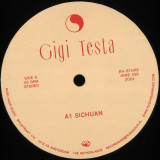
This is an artist who comes straight from Normandy who signs the 6th EP of the Norman label. Already seen on the various artists EP (NRMND003), Sichuan delivers us here a record with his own sound, his own style.
On An-Ting’s extensive travels around the UK, Mongolia, Sichuan, Hong Kong and Taiwan, she took field recordings of birdsong and mixed them with dark experimental electronic music with droning soundscapes and hard beats, creating an album that sonically encapsulates the very essence of nature itself, drifting from peaceful ambience to haunting melancholy through to dark and foreboding.
“There is a light and darkness in nature that civilisation has made us numb to and that we want to explore” Using a binaural recorder to capture the surrounding sounds of birds, An-Ting has created a completely different expression that opens the seemingly simple, yet complex, languages of the birds, furthering the other-worldly, unique feel of Lost Communications ०妏ԏ宙. From An-Ting: “We live with other creatures on earth and are surrounded by all different sounds. Through Lost Communications, I blend the birdsongs with my artistic expression to introduce people to these complex languages and nonhuman voices. I hope this will make us more aware of different life forms on this planet and inspire greater kindness to the earth.” Composed, performed, and mastered by An-Ting Co-produced by AnTing and Ian Gallagher
From the depth of transient memories comes ‘Some Leaves Must Fall 聽其自然’, Temple Rat’s latest EP and the inaugural release for Martin Gilleshøj’s ‘Buttheads’ label.
Across 6 tracks Temple Rat distills fragments of spatial memory, merging conceptual ambience with the mystic, spatial, and driven edges of deep trance and hypnotic techno. A pensive and functional synthesis, one played out like an ode to the sustained.
Through 2024 while moving between Berlin and Sichuan, Temple Rat conceptualized and finished ‘Some Leaves Must Fall 聽其自然’. At its core, the work is an exploration of how the personal memory of cities and their particular acoustic environments can be transmuted in musical form. For these places, altered by the passing of time and the shifting of contexts, mirror the fluid and generative nature of sound itself.
Creatively this approach was borne out in a kind of archaeology of sound: by sampling and capturing auditory fragments Mei was able to preserve otherwise fleeting moments of experience. Sonics which not only embodied the emotions of the present but served too as a mechanism of recall, pulling memory back into focus even against the erasures of time.
In its method this project seeks to transform the sonic textures of urban and natural environments into high-energy dance tracks, exploring the tension between the certainty of space and the uncertainty of time. A tension operating not only within the structural logic of the sound itself, but so too as an affective experience, extending into the listener’s body and perceptual field.
For we are not the first to note that in a world of pervasive temptation and fragmented information, sustained listening has become rarified. Through this project, Temple Rat hopes to counter this tendency; to encourage a deeper mode of listening that restores attention, re-establishing our essential connection with the present.
All music is written, recorded, arranged, and produced by Temple Rat aka Yuxin Mei
Mastered by Giuseppe Tillieci at Enisslab
Distributed by One Eye Witness
This extraordinary NYC trio combines free jazz and post-punk with pointed commentary about issues of race, gender, the pandemic, and political autonomy. Rose Tang, a Mongol from Sichuan, sings/recites and plays guitar, piano, and percussion. Tenor saxophonist Ayumi Ishito, from Japan, plays in a plethora of bands along the jazz/rock spectrum. Drummer, composer, and educator Wen-Ting Wu, from Taiwan, combines jazz drive and classical rigor.
This extraordinary NYC trio combines free jazz and post-punk with pointed commentary about issues of race, gender, the pandemic, and political autonomy.
Rose Tang, a Mongol from Sichuan, sings/recites and plays guitar, piano, and percussion. Tenor saxophonist Ayumi Ishito, from Japan, plays in a plethora of bands along the jazz/rock spectrum. Drummer, composer, and educator Wen-Ting Wu, from Taiwan, combines jazz drive and classical rigor.
The group came together to play one song at an event. ESP-Disk’, already familiar with the separate work on the NYC scene of all three members, immediately invited them to make an album. After intensive rehearsals, the members recorded the album in a one-day session, then reunited during the pandemic to add words about its effect to an existing instrumental on “8 Steps/7 O’Clock.” This album is simultaneously part of ESP-Disk's Drive To Revive Weird Rock and an extension of the label's famed free-jazz legacy.
- 1