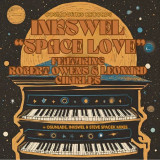
Australian producer Inkswel is back on the Cosmocities label in France with more of his superbly soulful sounds, this time with none other than Chicago legend Robert Owens. The lush 'Space Love' is a playful deep house jam with the sort of cosmic synths that recall early Fingers Inc and Owens's smoky tones only heighten that feeling. Steve Spacek provides a mix that rides on broken beats with elastic bass but just as much cosmic energy and a Fluterumental gets all loose-limbed and seductive. On the flip side are two Yoruba Soul mixes that bring extra rich soul vibes and shimmering pad work. A classy and timeless EP for sure.
Поиск:side b
Все
"After years of audio exploration and creativity together, Bizarre Trax co-founders B.Love and oliver.r unveil their much-anticipated LOVE.R alias with a dynamite, four-track EP on the ever-vibrant Dias de Campo imprint. This powerhouse pairing has been on the label's radar for a while, and their Dos Cremaet Por Favor EP proves exactly why.
Brimming with intricate textures, playful grooves, and the duo's unmistakable flair for left-field dancefloor energy, each track delivers a heady mix of quirky rhythms and off-kilter beats that define each of their signature sounds. The A-side marks the grand entrance of LOVE.R with two innovative collaborations, while the flip lets each artist shine with a solo cut of their own.
And if that's not enough, you can catch these prolific tastemakers lighting up the decks at this year's festival. See you front left."
The writer Max Sebald often pondered over the nature of human memory, specifically, how our thoughts and desires - and their results - overlap and mutate over time. In A Place in the Country, he writes of the significance of what see as “similarities, overlaps and coincidences”. Are they the “delusions” of the self and senses, or manifestations of “an order underlying the chaos of human relationships, ... which lies beyond our comprehension”?
Song of the Night Mists, the new album by post-classical composer Stefan Wesołowski, often feels it draws on Sebald’s premise.
On a simpler plane, the one where the market dictates the neatly ordered information we consume, Song of the Night Mists can be described thus: recorded in the main by Stefan Wesołowski in Gdańsk, both in his studio and in Saint Nicholas' Basilica, the album incorporates acoustic instruments - piano, violin, double bass - and classic synthesizers such as the Roland Jupiter-8, the Soviet Polivoks. A Roland Space Echo RE-150 tape delay was also pressed into service as an instrument. We also hear the basillica’s organ and field recordings from the Tatra Mountains. Other musicians were Maja Miro, who played the flute parts on ‘Glacial Troughs’ and brother Piotr Wesołowski, who played the organ on ‘Wilhelm Tombeau’. Sound engineer was Marcin Nenko, who was also on hand to record the basilica organ parts. The album was mixed in New York by Al Carlson (Oneohtrix Point Never, Jessica Pratt, Zola Jesus, Lady Gaga, and Liturgy) and Rafael Anton Irisarri handled the mastering.
Ostensibly, Song of the Night Mists is the last in a trilogy, following on from albums Liebestod (2013) and Rite of the End (2017). All three deal with existential matters such as love, death, decay and “an ultimate end”; apocalyptic and Promethean in spirit, and betraying very human conceits. The Sebaldian nature of the new record starts to make itself felt when Wesołowski talks of how he used sampling. One element is unexpected, that of sampling himself: “I go back to dozens of my own unused sketches and recordings, treating them as raw material to cut, slow down, reverse, and transform in every possible way.” Memory as sound, to be reemployed by the listener through their own imaginings.
Another set of samples made by Wesołowski plays another role. These are field recordings, originally created for an audio illustration of the formation of the Tatra Mountains, and used in a film by sound designer Michał Fojcik. Wesołowski: “You can hear cracking ice, streams, footsteps in the snow and the wind, and a real avalanche, recorded from the inside.” The “Tatra connection” on the album is also found in samples referencing composer Karol Szymanowski. The album’s title alludes to a poem about the mountains by Polish poet, Kazimierz Przerwa-Tetmajer.
Wesołowski’s Tatra recordings are “about a world without humans - about the fact that the world existed, was beautiful, and had meaning long before people arrived, and for the vast majority of its history, it was a place without us.” Wesołowski, using one iteration of the natural world, plays out in sound Sebald’s idea of another order, underlying the chaos of human relationships lying beyond human comprehension.
These feelings play themselves out on the five album tracks. Sonorous and rich, they illustrate tectonic shifts we have no control over. Wesołowski hints that the overall sound is a “meditation on the metaphysics of the non-human set against the spirituality that human presence has brought into it.” In that light, the opening number, ‘Core’, with its slow build, and crackling and straining sound effects, create an effect of the earth groaning into life in a creation myth. Once the piano part raps out a simple melody and modulated tonguing trumpet samples add to the overall atmosphere, the listener can certainly find a cue in the “spiritual”, or “human” side of the story. Human versus nature: from the strains and harmonic muscle stretches of the second number, ‘Glacial Troughs’, through to the powerful and filmic ‘Stalagmite’ and heart-on-sleeve romance expressed in closer, ‘Wilhelm Tombeau’, we listeners are cast as Friedrich’s wanderer, looking out over a landscape that will appear only if we engage with it.
Formations of melody appear incrementally, almost appearing by chance - like hidden footings in the rock shelves to give us something to grasp onto. Rhythms are used sparsely: the prolonged percussive taps on ‘Glacial Troughs’ are an anomaly and maybe there to give pace to the album to come; essentially to keep the listener strapped in. Elsewhere, percussion is used as an aid to mood, the two thudding, timpani-style passages on ‘Peak’ there to offset the short, beautiful, kosmische passage that splits them.
Elements of the borderline religious spirit that drove German electronic music in the late 1960s and 1970s also find a place on Song of the Night Mists. The swells and recessions of the organ find their emotional climax on ‘Wilhelm Tombeau’, a track which summons up echoes of the “mountain magic” vistas created by Popol Vuh or Tangerine Dream, especially with the slightly atonal wobble of the Mellotron that counters it.
This is a dramatic album, but it does feel a strangely short, or curtailed listen on ending, evoking the feeling one gets when waking from a dream, and, for all its incipient grandeur, a track like ‘Stalagmite’, for instance, ends on a minor note. Wesołowski admits that Song of the Night Mists is born of the all too human process of temptation, doubt and recalibration - Sebaldian overlaps and coincidences forming something that must live another life, away from its creator. In Wesołowski’s words, the album is “a newborn foal must stand up and walk right after birth.” Now it is yours to ponder.
Several years ago, the Disco Records DJ Crew members got their hands on a couple of original 70s obscurities, while these standout records shone brightly in their own right, the team finally decided to put them out as those obscure old records fetch eye-wateringly high prices on the second-hand market. Due to popular request & lovingly mastered to the highest possible standards, they are now available to play and share in very special moments at parties around the world. This will surely be one of the most keenly anticipated disco release of the year. For our first release, we are extremely proud to bring you at last, three very hard to find disco anthems on sides A & B in their glorious full extended versions
- A1: Try Unity - How We Rock It
- A2: Al Storm & Euphony - Ruffin Hardcore
- B1: Billy Bunter & Sanxion - Undertaker
- B2: Secret Squirrel - Twelve Guage
- C1: Pete Cannon - It's Coming This Way
- C2: Z-Neo - Rough N Ready
- D1: Jack Smooth - Break It Down
- D2: Liquid Crystal - Cosmic Funk
- E1: Tim Reaper - Oblivion
- E2: Radicall - Twilight
- F1: Stu Chapman - Rush
- F2: Blackmass Plastics - Bussit
12 brand new, exclusively signed '92-93 oldskool hardcore style tracks to Rave Radio Records. It's authentic, and the genuine article when it comes to the true ruff style of the early 90's hardcore rave production. If you like mixing on the edgier side of hardcore, this is a release you'll want in your collection!\uc0\u8232 \u8232 Ruff Hardcore music from: Try Unity, Al Storm & Euphony, Billy Daniel Bunter & Sanxion, Secret Squirrel, Pete Cannon, Z-Neo, Jack Smooth, Liquid Crystal, Tim Reaper, Radicall, Stu Chapman & Blackmass Plastics and the sleeve artwork is by Aroe.
BLIS701 by Chain Selector is a carefully honed two-track release from BLACKINSTOCK Records, a division of MixCult Records, showcasing Chain Selector’s mastery in blending emotional depth with atmospheric finesse. Designed for those who appreciate subtlety and sonic craft, this release moves between introspective melodies and immersive dub textures with remarkable control.
On Side A, School Days is a tender and timeless composition—melodic, cinematic, and evocative. It gently stirs memory and emotion, creating a world where every sound breathes with intent. On the flip, Autumn Guide opens a more shadowed dimension. Built on layered tension and low-end pulses, it introduces a restrained, dub-heavy soundscape ideal for setting the tone of a deeper set.
With BLIS701, Chain Selector delivers a refined double-sided vinyl, one to reflect, one to explore. Both tracks stand as elegant tools for shaping atmosphere with poise and intention.
Limited 7" Edition
Embark on a one-of-a-kind sonic journey through four electronic worlds.
Each side of the vinyl delivers its own distinctive vibe—hypnotic beats, immersive textures, soaring soundscapes, and driving percussive energy. every track transports you to a new dimension, all tied together by one unmistakable sonic identity.
Ira James' Vessel Recordings keeps it real with another deep house record from an array of the genre's finest. The Sometimes Dream Sampler is a class affair with an A-side taken up by a superb coming together of Jason Hodges, Eddie Leader and Hector Moralez for the weight, tasty dub version of 'No Oatmilk,' then Wally Callerio brings some fresh rhythms with his synth-infused 'Cause You Know'. Jordan Strong's 'Turn The Tide' lands with a nice bit of hip-swinging funk over rolling bass and Christopher Mohn's 'Move Your Body' rocks back and forth on its heels to hypnotic effect. All in all, a nice fresh take on classic deep house.
Back on wax after 13 years, Chris Rea – “Josephine” (MB Edits Repress) is pure Balearic gold — with Chris Coco’s legendary sunset touch and a deep B-side groove from Dalminjo, this is the one DJs have been hunting for.
Jolene Cuts returns with a 5-track vinyl-only masterpiece that channels the golden era of 1998 French House while pushing it into the future. No edits—just 100% original productions from Danny & Mike, two true craftsmen of filtered house grooves. “Jackpot” kicks things off with a euphoric, sample-driven floor-burner, dripping in funk and irresistible filter sweeps that recall the raw magic of classic Roule and Crydamoure records. “Voiture” follows with a sleek, late-night ride through hypnotic basslines and shimmering disco loops, perfect for peak-time club moments. On the flip, “So Cruel” brings soulful vocal chops and deep, rolling grooves in a way that nods to the emotional side of the French Touch era. “Love U” injects pure joy into the mix—swinging drums, warm filters, and a seductive disco flair designed to light up any dancefloor. Closing it all, “Disco Road” is a driving, high-energy weapon blending pulsating bass and filtered hooks that feel like 3 a.m. in Paris circa ’98. This is a love letter to French House—strictly vinyl, strictly limited, five unmissable club bombs. Perfect for DJs who crave that raw filtered energy, vinyl purists, and anyone who knows the true essence of French Touch: groove, soul, and pure dancefloor ecstasy. Once it’s gone, it’s gone.
Rocksteady Disco comes through with more tasteful and timeless edits on this fourth volume of its series which focuses on sounds from Detroit. Gino steps up on the A-side with the leggy grooves and funky bassline soft 'Funk Beyond' then 'Sunshine Ramp' pairs a classic vocal sample with a bubbly, percolating groove full of fun. On the flip, things get more textured and expressive with the busy jazz horns of DJ Righteous's '6 Minutes Of NRG' then 'Never Forget' brings heavyweight drum-first funk with warm organ chords and a busy mix of bass and melodies under the soaring vocals. Scorching stuff.
- A1: Nevertheless
- A2: Will Tomorrow Be The Same
- A3: Violet Dew
- A4: Another Time Another Place
- A5: Please
- A6: Time For Love
- A7: Days Left Behind
- B1: Both Sides, Now
- B2: Earth
- B3: Put Your Face On
- B4: Restitution
- B5: Charity
Eclection’s lack of commercial success remains a mystery to this day. This selection of BBC Top Gear recordings demonstrates their song-writing strength and musical prowess. Only three tracks appeared on the band’s sole studio LP: the remaining nine songs suggest what a second LP might have sounded like. Highly recommended to fans of Fairport Convention, with whom Eclection share some musical DNA.
Comes with full recording credits and extensive sleeve notes.
Recording Quality Very Good/Excellent throughout.
- A1: I'm Dirty
- A2: G Strings
- B1: Side Winder
- B2: Phoenix Theme (G's Out Dub)
- C1: Daily Prayer
- C2: Magic Potion
- D1: My Fathers Farda (Mr G's Soundboyz Dub)
- D2: Gladesmen
- E1: Danger Glyph Theme
- E2: Eye Poke
- F1: Day After B
- F2: Emotionz (Unreleased)
- G1: Hear Me Out
- G2: Pepsi
- H1: Jet Black
- H2: Shelter (Unreleased Version)
- I1: Lights
- I2: Live And Let Me Live
- J1: Song For My Cantor
- J2: Potion (Unreleased)
- K1: Moments
- K2: Mmmm
- L1: Going Home
2026 Repress
Mr. G, aka Colin McBean, presents a remastered, 23-track compilation entitled 'OG Retrospective'
'The day I found my original studio masters and got my rights back was the starting point, and then I realised it's 25 years on and it's time to recode, remaster and reevaluate because I've never looked back properly. I've always been like a bat out of hell, never quite thinking I'm good enough or great at what I do, but it's important to celebrate, because there's nota lot of people still here, still doing it after this length of time'.
With new masters provided by Simon at the renowned London mastering house The Exchange London, a direct link to the original mastering done by the late-Nilz (Nilesh Patel) from The Exchange, Mr. G's 'OG Retrospective' marks a reflective period in McBean's life.
'All I've ever done is write and move forward, but more and more, I get the new generation sending me videos of my old tracks and sometimes I don't even recognise them, so finally I thought, 'ok, you're comfortable in your own skin, let's really see how you sounded at the beginning, how you've changed, how have the techniques changed'?
It was quite raw going back over these; some of the memories are riddled with pain and angst - friends dying, where I was in my life at the time, having a heart attack and so on. Having a sound, too, can be a cross to bear. You're only ever competing with yourself, your only game is being better than your last game, so if you dwell on the past too much you can't move forward. Getting to the point where I can look back and feel happy, feels good.
Invariably, what will come from this is 'more', because, with my own label I have endless possibilities and will continue telling my story.'
HUB CITY DISCO CLUB pairs up EBERHARD & MI FAVO for a limited run that showcases each artist's take on old classics. On Side A EBERHARD reworks GOODY GOODY's "IT LOOKS LIKE LOVE" now titled "LOVE AT THE DISCO". On the flip MI FAVO reassembles KWICK's "NIGHT LIFE" now titled "THE RIGHT TIME".
- A1: Suite Judy Blue Eyes 00:28
- A2: On The Way Home 03:52
- A3: Teach Your Children 03:04
- A4: Triad 06:50
- A5: The Lee Shore 04:35
- A6: Chicago 03:22
- A7: Right Between The Eyes 03:33
- B1: Cowgirl In The Sand 04:01
- B2: Don't Let It Bring You Down 03:30
- B3 49: Bye Byes - America's Children 06:33
- B4: Love The One You're With 03:22
- B5: Pre-Road Downs 03:03
- B6: Long Time Gone 05:59
- C1: Southern Man 13:36
- C2: Ohio 03:33
- C3: Black Queen (Bonus Track) 06:41
- D1: Carry On 13:28
- D2: Find The Cost Of Freedom 03:12
- D3: Medley - The Loner - Cinnamon Girl - Down By The River (Bonus Track) 09:36
4 Way Street is the second and live album by David Crosby, Stephen Stills, Graham Nash, and Neil Young. It was released in 1971 with the live recordings taken from the band's shows during their 1970 tour around the USA. The album reached No. 1 on the Billboard 200 and was awarded a gold record. This is the first 2LP reissue since 1986 and it contains two bonus tracks on sides C and D: the at-the-time unreleased "Black Queen" from Stephen Stills and a medley made up of “The Loner - Cinnamon Girl - Down By The River” performed by Neil Young.
- A1: Cloud Nine
- A2: I Heard It Through The Grapevine
- B1: Run Away Child, Running Wild
- C1: Love Is A Hurtin’ Thing
- C2: Hey Girl
- C3: Why Did She Have To Leave Me (Why Did She Have To Go)
- C4: I Need Your Lovin’
- D1: Don’t Let Him Take Your Love From Me
- D2: I Gotta Find A Way (To Get You Back)
- D3: Gonna Keep On Tryin’ Till I Win Your Love
The Temptations Get High on Psychedelic Soul: Cloud Nine Soars with Ambitious Arrangements and Production, Features Standout Vocal Performances and Instrumentation by the Funk Brothers
The Temptations’ Cloud Nine announced that Motown — and “The Sound of Young America” — would never be the same. Influenced by the emergence of cutting-edge rock and pop currents, as well as increasing sociopolitical turmoil, the album broke down barriers between rock, psychedelia, and soul while heralding the arrival of visionary arrangements and production techniques. Bookended by traditional R&B numbers, the 1969 record sent the Temptations in bold new directions and signaled the advent of psychedelic soul.
Sourced from the original master tapes, strictly limited to 3,000 numbered copies, pressed at Fidelity Record Pressing, and housed in a Stoughton gatefold jacket, Mobile Fidelity’s 180g 45PM 2LP set presents Cloud Nine in audiophile sound for the first time on a domestic pressing. This collectible reissue bestows Norman Whitfield’s extraordinary production with the grand-scale dynamics, natural tonality, expansive openness, and low-end weight it deserves. The timbre of each of the five members’ voices is readily identifiable — even within the group harmonies — bestowing a realism never experienced outside the recording studio.
Making its debut on 45RPM, the album further benefits from the wide groove space by playing with greater separation and more realistic presence than prior editions. Everything from the brassiness of the horns to the dry snap of the snare comes across with reference-grade clarity and positioning. And since Motown’s renowned Funk Brothers backing band plays on many of the cuts, you’ll want to savor every note. The imaging, soundstaging, and organic bloom-and-decay of the notes make that possible.
Amid Cloud Nine, the instrumentation and architecture stand out as much as any element. Never before had a Motown album contained such ambitious patterns and complex passages. Seemingly conscientious of the departure from their past methods, the Temptations and Whitfield bunched together the tracks that mark a deep dive into psychedelic territory and counterbalance them with seven sterling soul cuts that dovetail with Motown tradition drenched with heartfelt vocals, swelling strings, and finger-snapping beats.
On the original 33RPM release, traditional Motown soul — laden with heartfelt vocals, swelling strings, and finger-snapping beats — occupies Side Two. These songs reveal an ensemble still very much on top of delivering pristine pop-soul material graced with romantic sweetness, persuasive insistent, and soaring highs. Re-energized after the departure of lead singer David Ruffin, who was fired for a variety of reasons in June 1968, the Temptations seamlessly meld with his replacement, Dennis Edwards, on one melodic gem after another.
The collective tackles five songs co-written by the legendary Motown team of Barrett Strong and Whitfield. Not the least of which are the smooth, shuffling “Why Did She Have to Leave Me (Why Did She Have to Go)” and deceptively simple, horn-spiked “Gonna Keep on Tryin’ till I Win Your Love.” On these tracks, as well as on a lush rendition of the ballad “Love Is a Hurtin’ Thing” and pleading, tender send-up of the Gerry Goffin-Carole King classic “Hey Girl,” Edwards and Paul Williams take turns on the lead with the estimable Eddie Kendricks, Melvin Franklin, and Otis Williams providing backing support.
All five vocalists trade-off leads on the simmering title track, a groundbreaking composition shot through with wah-wah-pedal effects, liquid funk, deep bass lines, Cuban percussion, saturated reverb, and gang choruses. Whitfield mines each member’s natural vocal range with spectacular results, keeps time with cymbals, and channels both the heated temperatures and escapist desires of a society embroiled in war, conflict, and experimental drugs.
Amazingly, the Temptations top themselves on the similarly revealing “Run Away Child, Running Wild.” Nearly 10 minutes in length, the song explodes R&B parameters and harbors a cinematic scope. Urgent pianos, distorted guitars, stripped-down percussion, steamy Hammond organs, minimal bass motifs, five distinct voices narrating the tale of a boy who fled home and now finds himself amid the scary, unforgiving external world: They combine to give the urgent tune a walls-closing-in atmosphere where fear and desperation reign. Bolstered by an extended instrumental section that precedes a climactic return of the singers’ voices, “Run Away Child, Running Wild” equaled the success of the record’s title track, with both reaching No. 6 on the pop charts.
Repress.
Minimoonstar' on the first record, gets a special underwater treatment by ex-Londoner Shackleton (Skull Disco). On the A-side, we find a special 12"edit of the original, to make it fit on wax. The full-lenght version will be supplied with the CD (PERL69CD), expected sometime later this year. This time the remix gets delivered by Amsterdam based San Proper, who is known for his superb releases on Rush Hour.
Our 3rd release from Ground16 erupts with deep, earthy aroma, unfurling into a bright, spore-kissed flourish and landing as a rustic, forest-born main that revels in the wild, untamed depth of fungi. PS: As a side, a deliciously nutty remix from Pistaccio caps the whole mycelial journey.