Formed by Alison Statton of much-loved Welsh avant-garde/indie pioneers the Young Marble Giants alongside guitarists Simon Booth and Spike, Weekend have been more than a cult band during their short career. La Varieté was their 1982 debut album a delicate collection of songs set against a jazz backdrop, switching across several musical settings including samba, cabaret, Afrobeat and truly original contemporary exotic pop. The album was originally released in 1982 on the Rough Trade label and still deserve the status of a masterpiece. It was revered by critics on release as a bold new departure from the prevailing post-punk ethos and served as a major influence on future indie stars as Saint Etienne and Belle And Sebastian.
Buscar:sim 2
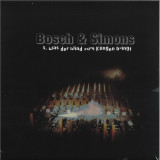
From 1985, the beginning of their collaboration in Amsterdam, Peter Bosch and Simone Simons have been involved in performances, concerts and theatre productions. Since 1990, however, they have focused in particular on the development of autonomous music machines.
All these machines are dynamic: Sound and movement are constantly evolving. »Krachtgever« is their best-known piece for its Golden Nica, received at Prix Ars Electronica, Linz, 1998. The other projects on the LP are »Cantan un Huevo«, commissioned by the Ives Ensemble in 2000 and awarded in 2002 at the 29th edition of the International Competition of Electroacoustic Music and Sonic Art, Bourges, France, and one of their first installations, »Was der Wind zum Klingen bringt«, from 1989/90, shown in the Stedelijk Museum, Amsterdam, 1990, as part of the exhibition »Energieën«, and in 1991 at the Multimediale 2, Z.K.M., Karlsruhe. The LP demonstrates that sound produced by the Bosch & Simons music machines can also be listened to as autonomous »music«.
Tel Aviv-based producer Roy Rosenfeld is excited to announce the release of his latest EP, Simi.
Showcasing Rosenfeld’s unique blend of melodic house music, the three-track EP is sure to captivate listeners with its intricate rhythms and ethereal sound.
On Simi, Roy Rosenfeld seamlessly blends melodic and atmospheric sounds to create a transcendent listening experience. From the groovy and energetic title track opener ‘Simi’ to the hypnotic and calmer ‘Sansi’ and closing with the darker, heavenly ‘Moonshine’, this EP showcases Rosenfeld’s exceptional range, and ability to craft music that goes beyond the dancefloor.
The sounds across these four tracks were made by SIM and NAP from 2021 to 2023 with lots of love and bass... the sessions started from the first time they met at NAP's studio, point always to kick it, jam and see what happens. After a couple months of that of course a sound develops, a process shines and a friendship grows. After a year or so trust built and a language made present. Transcending the spoken word and feeling unique to both...things start to really go off and the jams turn to songs. Two years pass and it’s time to celebrate with the marker and archive of all those deep sessions, now in edited form to be shared with all. And yeah, you can have all in common with someone when it comes to digging wubs, riddims and drum machines but add vulnerable earnest meetings with meals in between and good conversation about things other than music (or maybe how other things relate to it) and then you get something really special, something like SINNAZ. SIM and NAP journeying into collaboration with a debut EP of rhythmic noise, driving bog beats, swampy dembows, radioactive Dancehall and unhinged experimentalia.
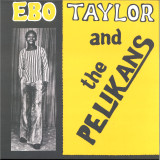
A Ghanaian funk LP from the afrofunk master. one of Ebo Taylor's rarest and most sought-after!
Ebo Taylor and The Pelikans is being reissued on vinyl by Comet Records, pressed on high quality vinyl, with label designs and artwork as per the original release.
Originally released by Ghanian Abookyi label in 1976, Ebo Taylor and The Pelikans is one of Taylor’s most elusive releases, and marked the first time he sang on the seminal Ghana Funk anthem “Come Along”.
The album saw the legendary musician, producer, composer and arranger joining forces with 12-piece Cape Coast Ghanian band ‘The Pelikans’ led by Bessa Simmona with rhythm guitarist Fifi Orleans Lindsay.
Put simply, there has never been a musician and artist quite like Ebo Taylor. As an artist, arranger, musician and producer he’s a combination of James Brown, Nile Rodgers and Quincy Jones: He not only created some of the greatest funk songs ever recorded but as much if not more than that, his genius as an arranger gave the signature sound to high life and afrobeat that was made famous by his one-time London roommate (from when they were both music students, in The early 1960s) Fela. And his funky guitar brought a percussive sound to the rhythm section that didn't exist before.
Pale Blue unveil the penultimate single from their forthcoming album on Crosstown Rebels with ‘Together Alone’, accompanied by a driving and hypnotic remix from Kölsch. Artists with renowned solo careers alongside their ever-evolving journey as the critically acclaimed duo Pale Blue, Mike Simonetti and Elizabeth Wight continue to showcase why their collaborative material is much-loved from all corners of the electronic realm and beyond. Arriving on the heels of the release of the playful and charming ‘No Words’, the pair return to Damian Lazarus’ Crosstown Rebels with the third and penultimate single ahead of their forthcoming album release as they switch up the mood and veer into wistful territories across the absorbing ‘Together Alone’ - backed by a remix from Kompakt mainstay and electronic heavyweight, Kölsch.
A carefully created journey across almost eight minutes, ‘Together Alone’ is an exemplary showcase of balance and restrain as delicate melodies and hazy tones float amongst subtle nimble percussion arrangements, blooming synths and Wight’s captivating vocals for a deep dive into dreamy spheres. Bringing his own take to the record, Danish electronic pioneer Kölsch heads to Crosstown Rebels with his excellent crafted ‘I Have You’ remix, as he builds on the original with a powerful and emphatic introduction of anthemic leads, crisp kicks and a warping bassline rooted at the track’s core to transport the production firmly into the heart of the dancefloor.
Omni AM presents the long-awaited reissue of “Can We Get / Keep Doing That.” This timeless record sent dance music in a new direction. Euphoria Record’s vaults are open and finally, for the first time since 1997, this seminal tech-house classic is available to everyone for the very first time in over 25 years. This 1997 indie record was Euphoria Records second release – and their first international record. Whether you agree with it or not, many people consider this one of the pioneering records of American Tech-House. Both sides and several mysterious alternate versions have graced the decks of DJs like Evil Eddie Richards, Terry Francis, Derrick Carter, Tyler Stadius, and Magda. The list goes on.
We were lucky. Curve Pusher lovingly remastered the original four tracks from the 1997 studio masters. Then, he went a step further, and remastered some previously unreleased versions – including a live version in Chicago that encapsulates what Omni AM was back then: ambient house. There’s a bit of Chicago, a bit of London, a bit of New York, and a bit of Tokyo in every second of these classic, genre-defining tracks.
A1.
“Can We Get” happily sits with the finest works of Ron Trent, Chez Damier, and Mood II Swing – and goes further, as Omni AM has never feared genre definitions. It opens with classic deep house chords, floating synth pads, and sparse vocals. The bassline is deep and warm. Marky Star and Adam Collins expertly work the percussive effects but always keep the theme simple and clear. Everyone knows this is a classic house track because it hypnotizes you.
A2.
“Keep Doing That” continues the theme with another classic late-night killer. However, this one is totally different – almost industrial, yet clearly housey and ambient. It drives deep into a tough groove that just builds and builds. The dub-influenced bass line gives way to a more angular synth riff that both offsets and adds to the track's forward thinking sound design. It’s dark and dirty, yet terribly sexxxy at the same time. It was and always will be mesmerizing. Once again, musical magic by Marky Star and Adam Collins.
B-Sides
The flip side features two remixes of “Keep Doing That” by UK tech-house legend Mark Ambrose. His bubbly, psychedelic take on the track pumps up the percussive Chi-town groove while going in a distinctly London afterhours direction. Trippy, for sure. Fun for all, for sure. These remixes are guaranteed to make your afterhours weird.
the remix release of japanese jazz fusion masterpiece of eiki nonaka which was released in the last summer.
uk balearic master “faze action” chosen one of the best track “flanged vortex” from the album(this track is licensed for great compilation “heisei no to” on music from memory). the result is timeless summer feel balearic slow house.
our new favorite artist in milano “simone du kunovich” chosen very emotional tune which is remind us pat metheny. his remix is stripped down no beats emotional house music. it will be your all time favorite closing track!
Brazilian experimental multi-instrumentalist Carla Boregas follows plates for Bokeh Versions and Hive Mind with a ghostly set of deep listening electronics that plays like a symphony for an imagined woodwind orchestra.
Carla Boregas is best known from her tenure in São Paulo's genre-bending experimental post-punk scene, playing in long-running outfit Rakta as well as other related offshoots. Her solo material has been knottier to unpick, here developing ideas from a collection of unfinished fragments and notebook scribbles exploring the possibility of finding a wind instrument that could be played collectively by several musicians. Coinciding with the pandemic, however, she soon realised the inherent risks involved with sharing breath and so the concept took a different direction, with added resonance.
Boregas developed a synthetic alternative, layering vocals and environmental recordings to suggest wind instrumentation without attempting to mimic it. The sounds here are airy, but rarely diegetic - on the title track, Boregas uses analog arpeggios and plucked, sustained tones to approximate the kosmische world of Ash Ra Tempel or more recently Emeralds, as if trapped in a wind tunnel, moved forward by an unseen force.
There's a whisper of the ancient past that harmonises with Wojciech Rusin's speculative medieval gasps, and Bloedneus & de Snuitkever's severely underheard ‘Milli Mille’, an examination of the ancient Greek aulos. On ’Grafia Do Invisível' the sound is completely different again, but the concept remains, using precise analog drones and minuscule timbral shifts to imitate the character of a wind instrument and simultaneously harmonise with the deep listening meditations of Éliane Radigue and Kali Malone.
A voice enters the frame on 'Sopro’, chopped into deviated gulps and syllables, creating a language that's unfamiliar and percussive. The use of breath is subtle, and vocalisations criss-cross between synths and faint whistles, forming an expression that's different from its predecessors but intrinsically interlinked. This is where ‘Pena Ao Mar’ excels, by viewing breath and its application in electronic music from multiple angles simultaneously. Fans of Lucy Duncombe, Lucrecia Dalt, or Sarah Davachi - don't miss this one.
Repress!
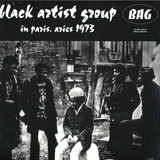
Outstanding free jazz session recorded in 1973 in Paris by Chicago outfit BAG.
It was Lester Bowie, trumpeter with the Art Ensemble of Chicago, who suggested that the Black Artists' Group (BAG) should head for Paris. In 1972 several members of BAG took his advice and flew to France for an extended stay. The following year a concert featuring saxophonist Oliver Lake, trumpeters Baikida Carroll and Floyd LeFlore, drummer Charles Bobo Shaw and trombonist Joseph Bowie (Lester's younger brother) was recorded and subsequently issued as In Paris, Aries 1973, a strictly limited edition LP on the group's own label.
Since the formation of Black Artists' Group in 1968, the home of this multidisciplinary arts collective had been St Louis, Missouri, the city where the Bowie brothers had grown up. It was there that Lester Bowie had started to investigate the expanding horizons of jazz before moving, in 1966, to Chicago where he joined the recently established Association for the Advancement of Creative Musicians (AACM). His close friend Oliver Lake visited Bowie, attended AACM concerts and meetings and was inspired not only by their artistic vision and integrity but also by their efficient organisation. In Chicago musicians were making things happen for themselves, taking control of their own destinies and giving shape to their lives as creative artists.
In June 1969, the Art Ensemble of Chicago had taken their music to France. During the preceding decade Paris had established a reputation for audiences that were unusually well-informed and open-minded, receptive to the uncompromising music of black American innovators such as Cecil Taylor, Ornette Coleman, Albert Ayler and Sun Ra. The city that had nurtured not only Cubism and Surrealism, but also Jean-Luc Godard and contemporary cinema's Nouvelle Vague was well prepared for the sonic collage forms and stylistic dislocations of the Art Ensemble. During that same month violinist Leroy Jenkins, trumpeter Leo Smith and saxophonist Anthony Braxton also arrived in Paris, three further emissaries from the AACM.
The adventure of collective improvisation resonated with the Parisian zeitgeist. Enthusiastic audiences attended their concerts and coverage in the media. In Paris, Aries 1973 offers an isolated and fascinating glimpse into that phase of the group's existence. The album is dedicated to the memory of Kada Kayan, a bassist who had hoped to make the trip from St Louis to France but, tragically, had grown ill and died. His absence adds special poignancy to the sound of the bass when it appears on this recording, played by Baikida Carroll. Listeners keen to hear Kayan himself in the company of Lake, Bowie, Shaw, LeFlore and Carroll should seek out Red, Black and Green by the 10-piece Solidarity Unit, Inc. That album, recorded on 18th September 1970 and dedicated to Jimi Hendrix, who died on that day, features an earlier version of Shaw's composition 'Something to Play On.'
In Paris, Aries 1973 reveals BAG's musical affinities with the Art Ensemble of Chicago. Both groups preserved an independently minded approach to the notion of free jazz and a carefully filtered awareness of pan-African musical practices, while their creative interest in space, mobile structure, chance occurrences and simultaneity also suggests parallels with the concerns of leading experimental composers working at that time. These performances in Paris of Shaw's 'Something to Play On' and Lake's 'Re-Cre-A-Tion,' plus two collective compositions/improvisations, display the dedication to structural fluency and sensitivity to coloration that accompanied BAG's unorthodox group dynamics and their unconventional instrumental combinations. In this case the musicians embrace congas, log drums, marimbas, woodblocks, cowbells and gongs. This is not a showcase for solos, but a shape-shifting and multi-centred statement of togetherness, quest and discovery. Removed from BAG's original multidisciplinary context the music still exudes an exhilarating spirit of collaborative exploration and shared excitement.
New Born is a group of four Italian immigrants who all lived in the area around Ulm/Bavaria.
Primarily they sang more Italian songs and were more on the traditional side of Italian music.
This record is a perfect example of what can happen when the drummer says “Let´s jam” to the musicians. The outstanding track “Galaxy” came out, the vibe of it is like an early piano house track and a hybrid of cosmic and disco.
The original copy of the record is nowadays a highly requested collector´s item, that skyrocketed in terms of prices. Originally released as a 45 single in 1981 the record was pressed in a very small run. Try to find a unicorn it’s easier.
We decided not to do only a simple reissue of it, we asked the creme de la creme of cosmic disco to make us a new born version of the track “Galaxy”. Camp Cosmic aficionados “Albion” & “Spacelexx” are responsible for two mesmerizing versions of this song. On top, we pressed the whole record as a 12″ from the original master tapes.
‘’Ace Todmorden label makes a significant discovery on its own doorstep: a superb cache of ‘loner folk’ songs recorded in the early-70s by Hebden Bridge’s answer to Nick Drake’’ UNCUT PLAYLIST
"This is music that can confidently hold its own with pioneers such as Davey Graham, Michael Chapman, Bert Jansch and Jackson C Frank, as influenced by jazz, blues and steel guitar as any of the old songbook classics from ancient Albion.” Benjamin Myers
"Defiantly Northern and out of this world" Folk Radio
Anti-counter culture loner folk from a teenage attic in the heart of rural Northern hippiedom.
Today the valley town of Hebden Bridge in West Yorkshire is world-renowned as something of a bohemian backwater. It wasn’t like this back in the late 1960s and the early 1970s, when a disparate selection of radicals, drop-outs, heads, musicians, artists and writers started to be attracted to the Calder Valley. Local lad and future poet laureate Ted Hughes called the area “the fouled nest of industrialisation”.
Over time, those seeds of radicalism and collectivism ensured Hebden Bridge evolved into a place where people could be themselves and all shades of individual oddness not only tolerated but actively encouraged. But back at the turn of the dreary 1970s it remained a monochrome world defined by its unforgiving surrounding landscapes, where the old gritstone over-dwellings were stained with soot and rain lashed down for weeks.
It was here that Trevor Beales, who was born in 1953, grew up, and from where he drew musical and lyrical inspiration.
Perhaps it was this dual nationality heritage, unusual in the valley’s largely white working class population at the time, that gave the teenager Trevor Beale’s music an outsider’s perspective. The discovery of Bob Dylan, Django Reinhardt, The Byrds and James Taylor at a young age, lead to him picking up a guitar at the age of ten, and he was soon writing his own originals and performing them at local (though often remote) folk clubs and pubs.
Recorded in the attic of the family home at Ivy Bank in Charlestown on the verdant wooded slopes at the edge of Hebden Bridge between 1971 and 1974, these early recordings are collected here for the first time and mark Trevor Beales long-overdue solo debut.
In these songs is a suffer-no-fools sense of realism that is defiantly Northern, yet also expresses a worldliness that belies Beales’ young years, whilst also showcasing an inherent storyteller’s ear for narrative. Here is a postcard from the past at that crucial musical period of transition, when the idealistic exponents of the 1960s emerged into an austere new decade that was to be shaped by strikes, rising unemployment and economic upheaval.
Two aspects of this music make it remarkable: Beales’ natural ability showcases a sophisticated guitar-picking style that was leagues ahead of many of his (older, more recognised) contemporaries. This is music that can confidently hold its own with pioneers such as Davey Graham, Michael Chapman, Dave Evans, Bert Jansch and Jackson C Frank, as influenced by jazz, blues and steel guitar as any of the old songbook classics from ancient Albion.
Secondly, his lyrics are a far cry from either the naïve bedroom scribblings of a teenager who has barely left his upland home, nor do they fall foul of the type of lazy cliches and sub-Tolkien imagery that was still in abundance in the early 1970s. Most remarkably the earliest songs here were laid down less than a year after he left school (an unearthed report written by his headteacher on July 3rd 1970 noted he had “a considerable ability and interest in music”, though his education ended abruptly when he simply walked out of a science lesson one sunny day while at sixth form, never to return).
Trevor’s music is grounded in reality – his reality. ‘Then I’ll Take You Home’, for example, considers the Guru Marajai, who encouraged his acolytes to give over their worldly possessions, yet who drove a Rolls Royce and lived like a playboy. Unsurprisingly, this latest in a long line of spiritual charlatans found several followers in Hebden Bridge, and Beales casts a disdainful eye over the growing popularity for such false prophets.
With its ancient narratives and propensity for myth-making, folk has certainly produced it’s fair share of cult figures who have enjoyed rediscovery or career resurgence and with this debut compilation of home recordings, rescued from cassette tapes, Trevor Beales might just be the latest addition. Certainly he was the real deal.
Crucially, Beales' music is never jaded or cynical, but instead possesses a poet’s ear, a strong sense of self and some sound critical faculties. And much of it recorded at an age when he could neither vote nor order a pint of heavy.
Trevor Beales died suddenly and unexpectedly on March 29th 1987, aged 33. He left behind Christine and their young child Lydia.
Pink Blue Marbled Vinyl
Angelo is an EP, named after a car, featuring nine songs Brijean have crafted and carried with them through a period of profound change, loss, and relocation. It finds percussionist and singer Brijean Murphy and multi-instrumentalist/producer Doug Stuart processing the impossible the only way they know how: through rhythm and movement. The months surrounding the acclaimed release of Feelings, their full-length Ghostly International debut in 2021 which celebrated tender self-reflection and new possibilities, rang bittersweet with the absence of touring and the sudden passing of Murphy's father and both of Stuart's parents. In a haze of heartache, the duo left the Bay Area to be near family, resetting in four cities in under two years. Their to-go rig became their traveling studio and these tracks, along with Angelo, became their few constants. Whereas Feelings formed over collaborative jams with friends, Angelo's sessions presented Murphy and Stuart a chance to record at their most intimate, "to get us out of our grief and into our bodies," says Murphy. They explored new moods and styles, reaching for effervescent dance tempos and technicolor backdrops, vibrant hues in contrast to their more somber human experiences. Angelo beams with positivity and creative renewal _ a resourceful, collective answer to "what happens now?". Angelo the car is a 1981 Toyota Celica they got off Craigslist during their first stint in Los Angeles, where Murphy and Stuart have since settled. "Such a bro-y, `80s dude car, it's been super fun to drive around in a new town," Murphy says. "He's older than us, he's a classic, he's got a story." It is a spiritual vehicle with a cinematic appeal, first dropping them off in an alleyway for the scene-setting intro, "Which Way To The Club." The question is quickly resolved by "Take A Trip" as a cruising bassline mingles with crowd sounds, hand-claps, cuíca hiccups, whip-cracks, even a horse neigh. Brijean have found some club on this cross-dimensional trip - the kind of imagined space or chamber within one's self capable of "shifting a fraction of who you are," says Murphy. They wrote the track with the simple intention to be "as free as we could be," adds Stuart, likening the flip on the B section to a realm unlocked: "What if the world changed completely? You open the door to a new room." Next is "Shy Guy," a motivational anthem for the wallflowers among us. Murphy sets up the daydream: "We are in junior high, we're on the dance floor, what's going down, who is dancing, who is not, how are we gonna make them dance?" The narrator, the MC, hypes up the room as conga-driven rhythms bounce between languid synth and guitar lines. "Show me how to move...I feel something...I know you feel it too," Murphy sings sweetly, calling back to the opening lines of Feelings, and this time the audience chants it back. It is easy to picture Brijean performing this one - something they only got to do a handful of times until more recently, opening shows for Khruangbin and Washed Out, an experience they found informative. Murphy explains, "It was inspiring to be out there and let loose more. To see how people can expand their expression on stage gave me more liberty with how I viewed my musicianship. My role for so long was to be a backup percussionist, so why would I ever leave the drums, you know? But then after playing all these runs, you see these artists and realize you can, you have permission." "Angelo" and "Ooo La La" deliver the danciest stretch in Brijean's catalog to date. The title track adopts a deep house pulse replete with strings, hi-hats, and kicks. The latter opts for a funkier groove that foregoes verses in favor of warbled hums and extended breakdowns. What follows is perhaps the duo's dreamiest run, a comedown initiated with the honey-hued interlude "Colors" drifting into "Where Do We Go?", a tropicália reverie where Murphy contemplates the passage of time and space. It all culminates in "Caldwell's Way," a fond farewell to their Bay Area community - "a part of my life that I knew couldn't come back," says Murphy. Above shimmering organ sounds, lush strings, and the birdcall of their former neighborhood, she wistfully articulates the uncertainty of moving on by remembering the characters dear to them. There's the wisdom of their neighbor, Santos, who refused payment when helping them move out: "I'd rather have 100 friends than 100 dollars." And the song's namesake, Benjamin Caldwell Brown, a friend and club night cohort for many years. "I'm only miles away, maybe I'm just feeling lonely," the line resigns to warm nostalgia, and "Nostalgia" runs the closing credits to this healing and transportive collection.
"Lovoscope" is the second album of the Parisian band Polycool. After the obsession with lemons of their first LP "Lemon Lord", the band changes course to talk about love, quite simply.
Each song on the album tells the story of love from a different angle. Lovoscope is the only way to access all the faces of love: happy, toxic or even virtual. The album is a bubble of 11 tracks in which we go through rhythmic ballads (Spiral, Leaves, <3), tracks with electronic sounds (Computer Love, Start), sharp melodies and refrains (Unlike You, Please Babe), and even unidentified sound objects (Odijk).
We find the Anglo-Saxon influences of LA Priest, Unknown Mortal Orchestra, Connan Mockasin, but also Metronomy or Sam Evian, all in a French musical sauce. This album was recorded in the summer of 2021 in an attic studio, surrounded by fields, in a free DIY tradition.
"Plastic Music For Deep Thinkers" is a peculiar fusion of electronic music inspired by a cross-section of Warp Records releases, enriched with intelligently used elements of jazz, hip-hop and experiment. This multicolor creates an original mixture with a very emotional expression. Post-hip-hop, irregular beats intertwine with the club pulse and jazz harmonies, and the omnipresent sounds of synthesizers meet organic samples.
"Conceptually, this album is the result of an insight into the current state of the apogee of "plasticity" and confusion of the world, and at the same time its downfall in shape we know it. The title, full of contradictions, speaks of an artificial and exaggerated reality, but also of necessary, deeper reflection on it. Plastic, integrated circuits and synthetic sounds tell the story of human transformation in modern realities."
As the author himself admits with a grain of salt: "This record sounds familiar, but it is similar to nothing - like the reality I observe."
Szymon Burnos is a pianist/keyboardist, composer, producer and improviser. With his eclectic sensitivity he combines various, often extreme, musical worlds and his inclinations and inspirations reach many languages - from electronic music, through jazz, hip-hop, ambient, to avant-garde. He's known mainly for his activities on the Tri-City improvised music scene and from groups such as Algorhythm, delay_ok, Nene Heroine, Tomasz Chyła Quintet or Mu and the Alpaka Records label.
- A1: Mister Sandman
- A2: Teensville
- A3: Steel Guitar Rag
- A4: Whispering
- A5: Yankee Doodle Dixie
- A6: You’re Just In Love
- A7: Swedish Rhapsody
- A8: Theme From “A Summer Place”
- B1: Oh Lonesome Me
- B2: Trambone
- B3: Corrine, Corrina
- B4: Heartaches
- B5: Boo Boo Stick Beat
- B6: One Mint Julep
- B7: Sleep Walk
- B8: Indian Love Call
Known as ‘Mr. Guitar’, Chet was one of the greatest and most influential musicians in Country
Music. He was an RCA Nashville Producer from the late '50s through to the mid-70's,
masterminding sessions for Dolly Parton, Charley Pride, Waylon Jennings and Jim Reeves. Chet
moved to Nashville and became a session man, playing on records by the Everly Brothers, Elvis
Presley and others, while also performing as a solo artist on the Grand Ole Opry. An in-demand
figure at this point, Chet commenced his own recording career with an instrumental version of
Indian Love Call. Followed by Yankee Doodle Dixie, a showcase arrangement on which Chet
played the Bass strings and Treble strings simultaneously! An architect of the Nashville Sound, he
recorded an instrumental version of the Chordettes' hit Mr. Sandman, which provided him with his
first Country Music chart entry. His records began to cross over into Pop and he enjoyed Hot 100
success with the percussive Boo Boo Stick Beat, Teensville, One Mint Julep, Sleep Walk and Oh
Lonesome Me
Out of the many artists, both new and established, that Futurepast has welcomed to its family, Spanish producer and DJ Eduardo De La Calle is one that we can definitively call a legend. His vast discography includes many of dance music's most appreciated labels, so we're humbled to present a full EP from him.
His EP "Kardama" emerged as the winter of 2022 bled into 2023, a period where he'd actually been producing more downtempo works, so "Kardama" is his most recent take on techno; a genre he is certainly well-versed in with over 25 years experience.
As a reflective work, De La Calle processes emotions and thoughts with analog methods, reverse delays and pedals on "Kardama". The emotions that he holds close to himself show up in the detail that sits deeper within each track.
"I simply make music with the intention of feeling better" says De La Calle, "it is a therapy for my mind and for my spiritual state. Through a creative process, I feel calm and useful for the world and for myself."
Marcos Díaz has been part of Buenos Aires underground for many years, being in projects like Bosques and making solo music under the pseudonym Entidad Animada (animated entity). Under this project, Marcos has explored sounds that involve a mix of feedback/distortion through synthesizers, guitars and drum machines that hint at the influence of Stereolab, Spacemen 3, and mid-nineties shoegaze. However, there are also ambient soundscapes with a slight rubbed of the ritualistic psychedelia of the Popol Vuh. The display of colours in his music comes together in the midst of a playful, relaxed and optimistic environment that is simultaneously melancholic. Because of the nature of those pieces, but also because in Entidad Animada there is also space for collage sounds that blend randomly with textures of a primitive analog sound, which inevitably causes a paradox between what is alive and what is inert. And it is because Entidad Animada is precisely that, a spectrum or a vision, a ghost. And these sounds are proof of his existence.
Pruebas de existencia (proofs of existence) is a collection of recordings that Marcos has made in recent years and that we have selected for this album, his first work on Umor Rex. A couple of these pieces were only released digitally, while the others have been on ltd cassette editions through Fuego Amigo Discos in Argentina. Pruebas de existencia is an Umor Rex compilation and remastered edition.
Guitar, sampler, synthesizer, organ, bass, drums & electronic beats, vocals, recording and mixing by Entidad Animada in Buenos Aires. Mastered by Rafael Anton Irisarri at Black Knoll Studio, NY. Cover photography Natch Tablescape (1979) by Langdon Clay. Layout by Daniel Castrejón, Mexico City.
Deluxe Eco Vinyl LP with 16 page lyric booklet! London slowcore band deathcrash have announced their new album Less, due March 31st via untitled (recs). Recorded at the UK's most remote studio in the Outer Hebrides, Less follows their critically acclaimed 2022 album, Return with a statement in reduction that turns out to be as powerful and potent as it is tender and introspective. "The mission statement was to be super minimal," says deathcrash singer Tiernan Banks. "Just simple and beautiful guitar parts and to be really bare. To be...less." Swiftly following Return, the band initially had no plans to make a full length. "The last thing we felt like doing was making another album," says bassist Patrick Fitzgerald. "It was like, 'let's do this little EP that's aesthetically quite different and pared down'." Less was always planned to be a statement in reduction but it soon became apparent that the songs the band were writing were significant, personal and, despite the intentions to strip things back, bigger. "As time went on, we started putting much more emotional weight into it and it became more important to us," says Banks. The result is a record that is as powerful and potent as it is tender and introspective, with arrangements that manage to feel refined yet detailed and with a deep emotional resonance at the core of the record. Banks' voice shifts from hushed whispers to guttural screams, one minute tapping into the kind of fragile beauty that artists like Elliott Smith managed so well, on tracks such as 'Duffy's' before unleashing a doom metal growl in thundering unison with the band on 'Empty Heavy'. The record has confirmed early press support from a number of UK publications, including a 4-page print feature in Loud & Quiet, a feature in Line of Best Fit, and early indications of support from Stereogum and a number of other U.S. publications too. A radio campaign will also be run for the second single 'Duffy's' and we expect support from BBC 6 Music, Apple Music and other tastemaker stations