A1 East Vision by Milanese’s finest Uabos uncovers an extraordinary musical experience with a lot of twists and twirls that are skilfully crafted. Constructed of mouth-watering synth textures and dusty melodic samples that hover over the rolling bass engine, Uabos surely delivers a dancefloor killer.
Herzel’s Transformation as the A2 track adds deep blue melodic depth on top of icy rhythmic pattern. It tickles the senses as sharp leads and powerful kicking stabs appear above the grinding bass line, providing mesmeric effect.
Flute Power’s Discothalia heats up the B side. Lush breaks and ripples meet a cloud-bursting bass line, intertwining with the ethereal vocal traces that unveil throughout the composition and into infinity.
Metropolitan Soul Museum in the closing B2 track Former Glory introduces a delicately structured musical narrative that has blocks of steady rhythmic percussion accompanied with unforeseeable melodic samples and tender vocal cut-ups.
Поиск:skilf
Все
Revered Danish producer and live performer KÖLSCH follows his 2013 hit album "1977" (KOMPAKT 276 CD 107) with the new full-length "1983", again chaining up heroic techno tracks for a grandiose sonic journey to the vibrant heart of today's dance floor. PRIORITY RELEASE
Coupling contemporary production pizzaz with nostalgia-tinged soundscapes and sweeping melodies, this opus acts as both a skilfully composed portfolio of personal memories and a sublime collection of crowd-charming cuts - a modern classic in the making, coming from a master of his craft.
1983 features collaborations with Gregor Schwellenbach, Waa Industry and WhoMadeWho's Tomas Høffding.
Hot on the heels of SPEICHER 84 (KOMPAKT EXTRA 84), featuring club crackers DERDIEDAS and TWO BIRDS, the latest full-length offering from KÖLSCH is very much a travel album: "When I was a kid in 1983, we used to drive through Europe every summer on the way to the south of France", he explains. "A lot of my early music memories stem from these long travels, as we would listen to all my father's favorite records on the cassette deck. After getting a walkman, I would make up my own soundtrack for travelling, with early electro and hip hop creeping into my life. My father of course did not like it, and it never grace the official cassette deck of the car, obviously"
These trips became a primary source of inspiration to a hungry young mind forced to sit on the backseat of a car for several days: "they were also journeys through the seasons. In Denmark, it would be spring time, so I could nearly see us driving through spring into the summer. The scenery would change, and so would the mood in the car." Informed by the symbolic quality of these slightly gauzy childhood memories, KÖLSCH's unique melange of emotional and functional elements works exceptionally well for the full-length format - a seamless transition of musing introspection and explosve expression, where catharsis never seems far away in dance-ready techno vignettes like MOONFACE, UNTERWEGS or PACER.
From beatless opener and title track 1983 to the filigreed piano banger DIE ANDEREN or the bleep-infused synth-fest E45, each cut operates as its own little time capsule, storing bits and pieces of recollection and then magically transforming them into epic, beat-driven soundscapes. Confronted with other producers' input (and other memories), these traits find themselves extended in the most interesting ways - TALBOT, THE ROAD and CASSIOPEIA (also featured on KOMPAKT EXTRA 79) make excellent use of GREGOR SCHWELLENBACH's emotive orchestral flourishes, while BLOODLINE's lyrics come to life thanks to the distinct timbre of TOMAS HØFFDING of WHOMADEWHO fame. A new powerful take on an earlier collaboration, PAPAGENO 30 YEARS LATER not only rejoins WAA INDUSTRY on vocal duty, but also ends the album on a wonderfully elegiac, yet hopeful note - basically turning water into wine, as we've come to expect from KÖLSCH.
UILTY RAZORS, BONA FIDE PUNKS.
Writings on the topic that go off in all directions, mind-numbing lectures given by academics, and testimonies, most of them heavily doctored, from those who “lived through that era”: so many people today fantasize about the early days of punk in our country… This blessed moment when no one had yet thought of flaunting a ridiculous green mohawk, taking Sid Vicious as a hero, or – even worse – making the so-called alternative scene both festive and boorish. There was no such thing in 1976 or 1977, when it wasn’t easy to get hold of the first 45s by the Pistols or the Clash. Few people were aware of what was happening on the fringes of the fringes at the time. Malcolm McLaren was virtually unknown, and having short hair made you seem strange. Who knew then that rock music, which had taken a very bad turn since the early 1970s, would once again become an essential element of liberation? That, thanks to short and fast songs, it would once again rediscover that primitive, social side that was so hated by older generations? Who knew that, besides a few loners who read the music press (it was even better if they read it in English) and frequented the right record stores? Many of these formed bands, because it was impossible to do otherwise. We quickly went from listening to the Velvet Underground to trying to play the Stooges’ intros. It’s a somewhat collective story, even though there weren’t many people to start it.
The Guilty Razors were among those who took part in this initial upheaval in Paris. They were far from being the worst. They had something special and even released a single that was well above the national average. They also had enough songs to fill an album, the one you’re holding. In everyone’s opinion, they were definitely not among the punk impostors that followed in their wake. They were, at least, genuine and credible.
Guilty Razors, Parisian punk band (1975-1978). To understand something about their somewhat linear but very energetic sound, we might need to talk about the context in which it was born and, more broadly, recall the boredom (a theme that would become capital in punk songs) coupled with the desire to blow everything off, which were the basis for the formation of bands playing a rejuvenated rock music ; about the passion for a few records by the Kinks or the early Who, by the Stooges, by the Velvet mostly, which set you apart from the crowd.
And of course, we should remember this new wave, which was promoted by a few articles in the specialized press and some cutting-edge record stores, coming from New York or London, whose small but powerful influence could be felt in Paris and in a handful of isolated places in the provinces, lulled to sleep by so many appalling things, from Tangerine Dream to President Giscard d’Estaing...
In 1975-76, French music was, as almost always, in a sorry state ; it was still dominated by Johnny Hallyday and Sylvie Vartan. Local rock music was also rather bleak, apart from Bijou and Little Bob who tried to revive this small scene with poorly sound-engineered gigs played to almost no one.
In the working class suburbs at the time, it was mainly hard rock music played to 11 that helped people forget about their gruelling shifts at the factory. Here and there, on the outskirts of major cities, you still could find a few rockers with sideburns wearing black armbands since the death of Gene Vincent, but it wasn’t a proper mass movement, just a source of real danger to anyone they came across who wasn't like them. In August 1976, a festival unlike any other took place in Mont-de-Marsan – the First European Punk Festival as the poster said – with almost as many people on stage as in the audience. Yet, on that day, a quasi historical event happened, when, under the blazing afternoon sun, a band of unknowns called The Damned made an unprecedented noise in the arena, reminiscent of the chaotic Stooges in their early adolescence. They were the first genuine punk band to perform in our country: from then on, anything was possible, almost anything seemed permissible.
It makes sense that the four+1 members of Guilty Razors, who initially amplified acoustic guitars with crappy tape recorder microphones, would adopt punk music (pronounced paink in French) naturally and instinctively, since it combines liberating noise with speed of execution and – crucially – a very healthy sense of rebellion (the protesters of May 1968 proclaimed, and it was even a slogan, that they weren’t against old people, but against what had made them grow old. In the mid-1970s, it seemed normal and obvious that old people should now ALSO be targeted!!!).
At the time, the desire to fight back, and break down authority and apathy, was either red or black, often taking the form of leafleting, tumultuous general assemblies in the schoolyard, and massive or shabby demonstrations, most of the time overflowing with an exciting vitality that sometimes turned into fights with the riot police. Indeed, soon after the end of the Vietnam War and following Pinochet’s coup in Chile, all over France, Trotskyist and anarcho-libertarian fervour was firmly entrenched among parts of the educated youth population, who were equally rebellious and troublemakers whenever they had the chance. It should also be noted that when the single "Anarchy in the UK" was first heard, even though not many of us had access to it, both the title and its explosive sound immediately resonated with some of those troublemakers crying out for ANARCHY!!! Meanwhile, the left-wing majority still equated punks with reckless young neo-Nazis. Of course, the widely circulated photos in the mainstream press of Siouxsie Sioux with her swastikas didn’t necessarily help to win over the theorists of the Great Revolution. It took Joe Strummer to introduce The Clash as an anti-racist, anti-fascist and anti-ignorance band for the rejection of old-school revolutionaries to fade a little.
The Lycée Jean-Baptiste Say at Porte d’Auteuil, despite being located in the very posh and very exclusive 16th arrondissement of Paris, didn’t escape these "committed" upheavals, which doubled as the perfect outlet for the less timid members of this generation.
“Back then, politics were fun,” says Tristam Nada, who studied there and went on to become Guilty Razors’ frontman. “Jean-Baptiste was the leftist high-school in the neighbourhood. When the far right guys from the GUD came down there, the Communist League guys from elsewhere helped us fight them off.”
Anything that could challenge authority was fair game and of course, strikes for just about any reason would lead to increasingly frequent truancy (with a definitive farewell to education that would soon follow). Tristam Nada spent his 10th and 11th unfinished grades with José Perez, who had come from Spain, where his father, a janitor, had been sentenced to death by Franco. “José steered my tastes towards solid acts such as The Who. Like most teenagers, I had previously absorbed just about everything that came my way, from Yes to Led Zeppelin to Genesis. I was exploring… And then one day, he told me that he and his brother Carlos wanted to start a rock band.” The Perez brothers already played guitar. “Of course, they were Spanish!”, jokes their singer. “Then, somewhat reluctantly, José took up the bass and we were soon joined by Jano – who called himself Jano Homicid – who took up the rhythm guitar.” Several drummers would later join this core of not easily intimidated young guys who didn’t let adversity get the better of them.
The first rehearsals of the newly named Guilty Razors took place in the bedroom of a Perez aunt. There, the three rookies tried to cover a few standards, songs that often were an integral part of their lives. During a first, short gig, in front of a bewildered audience of tough old-school rockers, they launched into a clunky version of the Velvet Underground's “Heroin”. Challenge or recklessness? A bit of both, probably… And then, step by step, their limited repertoire expanded as they decided to write their own songs, sung in a not always very accurate or academic English, but who cared about proper grammar or the right vocabulary, since what truly mattered was to make the words sound as good as possible while playing very, very fast music? And spitting out those words in a language that left no doubt as to what it conveyed mattered as well.
Trying their hand a the kind of rock music disliked by most of the neighbourhood, making noise, being fiercely provocative: they still belonged to a tiny clique who, at this very moment, had chosen to impose this difference. And there were very few places in France or elsewhere, where one could witness the first stirrings of something that wasn’t a trend yet, let alone a movement.
In the provinces, in late 1976 or early 1977, there couldn’t be more than thirty record stores that were a bit more discerning than average, where you could hear this new kind of short-haired rock music called “punk”. The old clientele, who previously had no problem coming in to buy the latest McCartney or Aerosmith LP, now felt a little less comfortable there…
In Paris, these enlightened places were quite rare and often located nex to what would become the Forum des Halles, a big shopping mall. Between three aging sex workers, a couple of second-hand clothes shops, sellers of hippie paraphernalia and small fashion designers, the good word was loudly spread in two pioneering places – propagators of what was still only a new underground movement. Historically, the first one was the Open Market, a kind of poorly, but tastefully stocked cave. Speakers blasted out the sound of sixties garage bands from the Nuggets compilation (a crucial reference for José Perez) or the badly dressed English kids of Eddie and the Hot Rods. This black-painted den was opened a few years earlier by Marc Zermati, a character who wasn’t always in a sunny disposition, but always quite radical in his (good) choices and his opinions. He founded the independent label Skydog and was one of the promoters of the Mont-de-Marsan punk festivals. Not far from there was Harry Cover, another store more in tune with the new New York scene, which was amply covered in the house fanzine, Rock News (even though it was in it that the photos of the Sex Pistols were first published in France).
It was a favorite hang-out of the Perez brothers and Tristam Nada, as the latter explained. “It’s at Harry Cover’s that we first heard the Pistols and Clash’s 45s, and after that, we decided to start writing our first songs. If they could do it, so could we!”
The sonic shocks that were “Anarchy in the UK”, “White Riot” or the Buzzcocks’s EP, “Spiral Scratch” – which Guilty Razors' sound is reminiscent of – were soon to be amplified by an unparalleled visual shock. In April 1977, right after the release of their first LP, The Clash performed at the Palais des Glaces in Paris, during a punk night organised by Marc Zermati. For many who were there, it was the gig of a lifetime…
Of course, Guilty Razors and Tristam were in the audience: “That concert was fabulous… We Parisian punks were almost all dressed in black and white, with white shirts, skinny leather ties, bikers jackets or light jackets, etc. The Clash, on the other hand, wore colourful clothes. Well, the next day, at the Gibus, you’d spot everyone who had been at this concert, but they weren’t wearing anything black, they were all wearing colours.”
It makes sense to mention the Gibus club, as Guilty Razors often played there (sometimes in front of a hostile audience). It was also the only place in Paris that regularly scheduled new Parisian or Anglo-Saxon acts, such as Generation X, Siouxsie and the Banshees, the Slits, and Johnny Thunders who would become a kind of messed-up mascot for the venue. A little later, in 1978, the Rose Bonbon – formerly the Nashville – also attracted nightly owls in search of electric thrills… In 1977, the iconic but not necessarily excellent Asphalt Jungle often played at the Gibus, sometimes sharing the bill with Metal Urbain, the only band whose aura would later transcend the French borders (“I saw them as the French Sex Pistols,” said Geoff Travis, head of their British label Rough Trade). Already established in this small scene, Metal Urbain helped the young and restless Guilty Razors who had just arrived. Guitarist for Metal Urbain Hermann Schwartz remembers it: “They were younger than us, we were a bit like their mentors even if it’s too strong a word… At least they were credible. We thought they were good, and they had good songs which reminded of the Buzzcocks that I liked a lot. But at some point, they started hanging out with the Hells Angels. That’s when we stopped following them.”
The break-up was mutual, since, Guilty Razors, for their part, were shocked when they saw a fringe element of the audience at Metal Urbain concerts who repeatedly shouted “Sieg Heil” and gave Nazi salutes. These provocations, even still minor (the bulk of the skinhead crowd would later make their presence felt during concerts), weren’t really to the liking of the Perez brothers, whose anti-fascist convictions were firmly rooted. Some things are non-negotiable.
A few months earlier (in July 1978), Guilty Razors had nevertheless opened very successfully for Metal Urbain at the Bus Palladium, a more traditonally old-school rock night-club. But, as was sometimes the case back then, the night turned into a mass brawl when suburban rockers came to “beat up punks”.
Back then, Parisian nights weren’t always sweet and serene.
So, after opening as best as they could for The Jam (their sound having been ruined by the PA system), our local heroes were – once again – met outside by a horde of greasers out to get them. “Thankfully,” says Tristam, “we were with our roadies, motorless bikers who acted as a protective barrier. We were chased in the neighbouring streets and the whole thing ended in front of a bar, with the owner coming out with a rifle…”
Although Tristam and the Perez brothers narrowly escaped various, potentially bloody, incidents, they weren’t completely innocent of wrongdoing either. They still find amusing their mugging of two strangers in the street for example (“We were broke and we simply wanted to buy tickets for the Heartbreakers concert that night,” says Tristam). It so happened that their victims were two key figures in the rock business at the time: radio presenter Alain Manneval and music publisher Philippe Constantin. They filed a complaint and sought monetary compensation, but somehow the band’s manager, the skilful but very controversial Alexis, managed to get the complaint withdrawn and Guilty Razors ended up signing with Constantin with a substantial advance.
They also signed with Polydor and the label released in 1978 their only three-track 45, featuring “I Don't Wanna be A Rich”, “Hurts and Noises” and “Provocate” (songs that exuded perpetual rebellion and an unquenchable desire for “class” confrontation). It was a very good record, but due to a lack of promotion (radio stations didn’t play French artists singing in English), it didn’t sell very well. Only 800 copies were allegedly sold and the rest of the stock was pulped… Initially, the three tracks were to be included on a LP that never came to be, since they were dropped by Polydor (“Let’s say we sometimes caused a ruckus in their offices!” laughs Tristam.) In order to perfect the long-awaited LP, the band recorded demos of other tracks. There was a cover of Pink Floyd's “Lucifer Sam” from the Syd Barrett era – proof of an enduring love for the sixties’ greats –, “Wake Up” a hangover tale and “Bad Heart” about the Baader-Meinhof gang, whose actions had a profound impact on the era and on a generation seeking extreme dissent... On the album you’re now discovering, you can also hear five previously unreleased tracks recorded a bit later during an extended and freezing stay in Madrid, in a makeshift studio with the invaluable help of a drummer also acting as sound engineer. He was both an enthusiastic old hippie and a proper whizz at sound engineering. Here too, certain influences from the fifties and sixties (Link Wray, the Troggs) are more than obvious in the band’s music.
Shortly after a final stormy and rather barbaric (on the audience’s side) “Punk night” at the Olympia in June 1978, Tristam left the band ; his bandmates continued without him for a short while.
But like most pioneering punk bands of the era, Guilty Razors eventually split up for good after three years (besides once in Spain, they’d only played in Paris). The reason for ceasing business activities were more or less the same for everyone: there were no venues outside one’s small circuit to play this kind of rock music, which was still frightening, unknown, or of little interest to most people. The chances of recording an LP were virtually null, since major labels were only signing unoriginal but reassuring sub-Téléphone clones, and the smaller ones were only interested in progressive rock or French chanson for youth clubs. And what about self-production? No one in our small safety-pinned world had thought about it yet. There wasn’t enough money to embark on that sort of venture anyway.
So yes, the early days of punk in France were truly No Future!
The Venetian Orchestra strikes again, this time with "Señora" on the A side, an extended new take on Victor “Il Pirulli’s” rendition of “Señora”, kept in secret for years, but a track that few lucky ones might have already heard on certain DJ Harvey sets over the last recent years. Skilfully encapsulating the Balearic juices of the original while still giving it a playful full bodied new sound, sitting somewhere in between the categories of a remix and cover version with a newly made instrumentation, pure drama!
B side shifts the listener into a slower gear with a Gypsy Kings downtempo classic “Caminando”, stretching it out into dreamy mediterranean bliss, a chuggy dub atmospheric re-work of a Flamenco love anthem. Limited quantities, buy on sight.
- 1: The Plough
- 2: Lefty’s Motel Room
- 3: Song For A
- 4: Sweet William
- 5: Mountains
- 6: The Flood
- 7: Author Song
- 8: The Waltz Of Winter Hey
- 9: That’s What Falling In Love Will Do
- 10: See Things Through
- 11: Estuaries
‘A Tremendous debut. Skilfully blending folk, country and other styles, Woof’s eponymous debut album features thoughtful songwriting, adroit musicianship and her remarkable, crystalline vocals’ - 4/5 RECORD COLLECTOR
‘Enchanting. Whether playing almost solo or with a full band arrangement, Wooff is never less than mesmerising’ - 4/5 SHINDIG!
‘Her spectral voice and acoustic guitar lead abstract stories of loss, yearning and self-exploration, nimbly embellished with pedal steel, organ and strings. ‘The Waltz Of Winter Hey’ and ‘Lefty’s Motel Room’, with its allusive nod to Townes Van Zandt, are outstanding’ - 8/10 UNCUT
‘Launching herself fully onto the scene, she beguiles with tales of love, loss, hope and womanhood, wrapped up in a beautifully strange gothic romanticism’ - FOR FOLK’S SAKE
‘The beauty in the record is not merely based on Toria’s melancholic melodicism and rich delivery. It can be enjoyed in the juxtaposition between the singer’s darker, more eerily gothic instincts and the soothing, reassuring presence of instruments like pedal steel and cellos.’ - KLOF
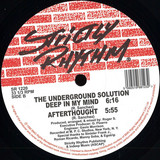
Absolutely ESSENTIAL record right here - The Underground Solution aka The 'S' Man aka the legendary Roger Sanchez is a name that you should all be familiar with by now, and his 1990 ANTHEM 'Luv Dancin' is an NYC deep house benchmark. That's right, this originally came out in 1990. That's a heck of a long time ago. Thing is, this record, when played at the right time will still cause maximum damage in the club. Riffing on disco classic 'Is it all over my face' and with elements of 'The bottle' interspersed with a deep, rolling garage bassline and dreamy keys and pads Sanchez crafted a solid gold cut, a timeless piece of dance music that still inspires today and is often imitated yet obviously never bettered! The flipside cuts 'Deep in my mind' and 'Afterthought' are also sublime exercises in the deepness, The 'S' Man's trademark eerie pads, bleeps and dope drum programming evident throughout, making these tracks huge hits from NYC to Sheffield and beyond! This whole EP is flawless and if you dig the deeper side of this stuff then you're in for a treat - Now's your chance to bag a bonafide, hands down classic record!
'Luv Dancin' has been skilfully remastered from all original master sources and fully licensed and reissued officially for 2017.
Shadow Pressings celebrates one year and its 5th release with another killer selection of deep, chunky house from the very same (unknown) producer as the label’s debut release.
My Soul sets the tone with a stripped back late night groove, working up THOSE Freddie Hubbard strings and a hooky sax riff. The sound palette is familiar but put together in a skilful and original way ensuring this banger will stand out in the crowd.
Tears follows with a similarly punchy, paired back groove which leaves space for the chiming melodies and spoken word samples to shine. Flipping over we have Lost In The Dance and What Galaxy Is This? which continue the theme of choice vox samples, shuffling drums and rolling basslines.
M-Scape is a solo project by Japanese DJ/producer/remixer Makoto Nakatani.
Urban Reconstruction is a release that blends House, Techno and Broken-Beat in a very skilful way.
The title track is, dare we say, a Los Hermanos sounding track that holds both the energy and harmonies Gerald Mitchell would produce.
'I Do' is house on a broken beat tip while 'Freedom' got more of the M-Scape sound fusing House, Jazz and Techno.
Ending the EP is 'Let The Drums Play' which is not far from what electronic-Jazz pioneer Mark de Clive-Lowe does and a great way to end an EP that makes a stellar debut on Local Talk.
Even now, as he reaches his eighth decade, with a lifetime of accolades and a
seminal body of music behind him, Robin Trower is still chasing the biggest
high he knows
It always starts the same way, with a road-scuffed Fender Stratocaster and a revvedup Marshall amplifier, those skilful fingers exploring the fretboard until a riff sticks and
a new song ignites. And from the cultural flashpoint of Sixties London with Procol
Harum, through 1974's stadium- filling Bridge Of Sighs, right up to this year's
acclaimed Come And Find Me, it's these addictive moments of creation that have kept
the guitarist vital, relevant and contemporary while his peers trade on past glories.
"Some people say I'm driven, but I think it's just the love of doing it," reflects Trower of
a multi- million- selling solo catalogue fast approaching thirty releases (and that's
before you compute his collaborations with everyone from Jack Bruce to Bryan Ferry).
"I play guitar every day and just through messing around, ideas happen. I can never
feel the songs coming. But all of a sudden, you get a sliver of an idea and you think,
'Oh, what's this...?'"
DJ Support: Manfredas, Dave Harvey, Felix Dickinson, Kiara Scuro and more
Playful, creative and intelligent, Niklas Wandt weaves a masterfully programmed tapestry of percussive dancefloor delights for Viscera Transmissions 003 with Mehr Phett.
Joyous and bright, Mehr Phett evokes a coconut flavoured sunrise on a distant desert island.
Skilfully intertwining modern drum programming with retroistic instrumentation, Feuerwerk der Rhythmen is a guided tour through the eras of house music and beyond.
Subcutaneous Dance is a whirlpool of interwoven synthesiser melodies. Submarine LFOs guaranteed to get underneath the dermal layer.
Music reorganisation adept Eden Burns flips Mehr Phett on its head, wonky space-toms complete the package.
ANAN is a project born from the musical inspiration of DJs Roberto Agosta and Massimo Napoli (Galathea). The name ANAN comes simply from the repetition of the initials of their surnames.
Their new single ‘Naif’ blends African musical roots with a European groove and celebrates the cultural fusion of modern times and explores sounds that transcend borders. Imagine listening to Fatoumata Diawara or Ali Farka Touré meeting St. Germain or Bonobo
This track opens with a pulsating rhythm, featuring traditional instruments, percussion, and the vocal performance of Kadi Koulibaly from Burkina Faso.
Koulibaly manages to convey a sense of joy and vitality, evoking soundscapes rich with texture and dynamic motion. The melody is skilfully combined with electronic and jazz elements, creating an aural experience that invites you to dance. In short ‘Naif’ is a celebration of cultural fusion, an invitation to indulge in rhythm and explore sounds that transcend boundaries.
Bonding over their disillusionment with exhausting world tours and the relentlessness of the music industry, David Bardon, Oscar Robertson and Olivier Huband formed Sunglasses For Jaws in 2017.
Over the course of their albums, they have collaborated with Clementine Brown (Penguin Café Orchestra), Miles Kane (Last Shadow Puppets) & Rosetta Carr (Alabaster Deplume). Hailing from London, this band takes you on a unique musical journey, skilfully blending the lounge, experimental and groovy influences of the 70s with a contemporary twist that leaves plenty to the imagination.
(repress on black vinyl, originally released in 2019) Supported by many deejays worldwide, most notably Solomun. Moodfamily's favourite four-piece returns home after many journeys. Impatient as we are, we had to hear their stories. Skilfully combining influences, sounds and experiences from east and west, they translated their stories into a new EP oozing with drama, melancholy and determination. The EP describes itself as the soundtrack for an adventure to mysterious outskirts around the globe, starting with 'Whale Parade'.
This prelude takes you to a hidden land after wandering through forests for many months. Guitar, piano and percussion gently move in and carry you away. By the second track, 'All Day I Zama', a slow beat dictated by a banket of percussion evolves to a vigorous and groovy track with moaning vocals as the main theme. In title track 'Gold Town' you will settle yourself in a covered wagon, heading for dodgy settlements on a misty mountain range, accompanied by a grieving trumpet. As the wagon slows to a crawl, 'Ghajar' emerges; a downtempo emotion-filled song, where the piano and a scorching synth interchange melodies and tales.
Black Truffle is back with a delicious new EP, "Gourmet Edits", which takes you on a four-course adventure through the vintage disco territory, blending Jazz-Funk and Latin elements.
Black Truffle's distinctive style is characterised by skilful reinterpretations of hidden treasures from the 70's with a passionate focus on preserving the essence of the original material...
'Disco Meringue' is a crispy piano-driven appetiser with Latin flavour. Its syncopated piano riffs imbue it with a jazzy vibe that makes it a great tool to seamlessly transition between disco, Latin, and modern deep house in your set.
'Drum Tartar' is a percussive tour de force that oscillates between groovy Jazz-Funk and spicy Bossa-Nova, culminating in a thundering drum break that continues for an impressive third of the track.
'Consomme' is the EP's bread and butter for the dance floor layering pulsing percussion, wailing organ riffs, crunchy guitars, curious vocoders and many sax and organ solos that keep on taking it higher and higher resulting in a sizzling high-energy banger.
For dessert, we have 'Souffle', a fluffy big-band Jazz number with a funky Disco beat that gradually develops into an ecstatic culmination with a choir.
- Unperson
- Apparition 3
- Bruise
- Blackmail
- The Itself Of Itself
- Study For Tape Hiss And Other Audio Artefacts 11.58
- Apparition 5
Steven Wilson is no stranger to composing music that appears to counter everything else before it in his catalogue. Bass Communion, his long running solo electronic project, is no exception to this perverse streak that apparently likes to turn all expectations upside down. The Itself of Itself, Bass Communion's first album for 12 years, skilfully pays testament to this. Long established as a purveyor of mostly atmospheric or ambient textures, the seven cuts that represent The Itself of Itself take detours from this approach in order draw as much from musique concrete, noise music, abstract electronics and uneasy listening. Whilst still rippled with the same shades of light and dark that can be found throughout all of Bass Communion's work, The Itself of Itself reveals a fascination with analogue sounds and, more importantly perhaps, 'unwanted' analogue artefacts like tape hiss, wow and flutter, static noise, and sonic break-up, taking the music into a space at once different yet familiar. 'Apparition 3' presents a stark nod to Wilson's established command of shifting textures steeped in penumbral gauze, while 'Bruise' is akin to a space probe adrift and headed towards a white dwarf as all communication is reduced to a disturbing and indecipherable crackle. Between the other five cuts we witness fragmented, garbled and buried voices, vast vacillating banks of grainy hum, what sounds like the dying gasps of an oboe, spooky swirls from an indiscernible source, swathes of tape hiss, moody drones, and spiralling slivers of noise. Meanwhile on the title track, a mellotron flute rusts and collapses in on itself in a way that renders it the very antithesis of the one deployed on 'Strawberry Fields Forever'. Everything adds up to a dynamic listening experience where unease, dread and comparatively claustrophobic torrents of sound make (un)natural bedfellows to moments of enchantment and serenity. Above all, The Itself of Itself sees Steven Wilson cutting his teeth on an album that's at once cinematic and moody whilst proving him to be a master in electronic music craftsmanship. It's an album that might surprise some of those who have thus far been paying attention to his work as Bass Communion, but setting out to please everyone was never part of his raison d'etre. The Itself of Itself catches Bass Communion spreading its weatherbeaten wings to embrace new strategies and a strong desire to journey elsewhere. Arriving in a wonderful Carl Glover designed deluxe cover also comprising a 24pp. booklet of his photographs and an obi strip, this version of The Itself of Itself arrives in December on Lumberton Trading Company as a 2LP pressed in an initial run of 1000 copies.
Indulge in the smooth vibes of Luke Beats' latest album, 'Cream', dropping now on Little Beat More.
Inspired by the Italian saying 'ci sta una crema' ('as good as cream'), which indicates the utmost satisfaction, this work is the perfect dessert for your musical gluttony, kneaded by the skilful hands of Luke Beats for all hip hop lovers. In a world where the saying 'Cash rules everything around me' (once again: C.R.E.A.M!) still resonates loudly from the days when Method Man and the Wu-Tang rapped it, the love and passion for music can continue to shine.
With nods to sounds that have defined this genre in its origins, especially in the melodic and synthesiser parts, 'Cream' blends tradition and novelty, love for the classic and curiosity for the contemporary, creating a dreamy, mellow atmosphere that takes listeners on a creamy journey.
The 18-track album features the collaboration of drummer Federico Romeo on '404 Fun 4 Days' and guitarist Danny Bronzini on 'JamDilla', while Luke Beats himself played bass parts on 'P.T.H', 'JamDilla', 'Cookin' and 'The D'.
Once again, Matteo Baracco's artwork adorns the EP, with a closed but squashed tube of tempera, which perfectly complements the nostalgic yet fresh sounds within, telling of an approach to production and beatmaking still anchored in the “old school” sound craft principles in which getting one's hands dirty is the prerogative needed to shape a sound that is personal and respectful of its history.
A further tribute to the golden era of hip hop is provided by the format of the release, in an iconic timeless audio cassette to dust off your ghettoblaster!
- Buffalo
- Toothless
- Uglie
- Shelley
- Frankenstein
- Rip
Second EP from Bristol indie pop six-piece, Hamburger. ‘Beat Back The Ghouls’ sees the band take their sound in a more lush, subtle and layered direction, developing skilfully on the raw songwriting ability offered in their debut. On this record Hamburger create a more complex and sophisticated sound, flitting masterfully between driven guitar hooks, emotive lilting melodies, singalong angst-fuelled hits, and warm dreamy fuzz. ‘Beat Back The Ghouls’ is a record packed with songwriting craft. Each track is a finely-tuned pop song, with catchiness, beautiful melodic turns and delicate harmonic progressions at its heart. The soft, layered vocals add a wonderful contrast to the distorted, driven guitars, as they explore themes such as longing, want and alienation. If you’ve heard Hamburger before, ‘Beat Back the Ghouls’ will mark a new, more refined experience, a band finding itself fully-grown. If you haven’t heard them before, this record is an opportunity not to be missed. Limited to 300 copies on black vinyl.
Finnish electro duo Morphology, comprised of Matti Turunen and Michael Diekmann, is set to release ‘Made Up Reality’ on Deeptrax Records, the label with a mission to deliver high-quality, groundbreaking electronic music focusing on the deeper side of electronica and eclectic leftfield dance jams, exploring those spaces between deeper house and techno, with hints from the past and a strong vision of the future.
Continuing Morphology's tradition of dark, melodic, and skilfully produced electro funk that has captivated international audiences, they’ve have been holding down the retro-activism of Detroit and its call for an illuminated future of programmable, motorized, electro-fantasies for over 15 years. With releases on Semantica, Solar One Music and a slew of albums for Germany’s Zyntax Motorcity, it’s been Cultivated Electronics and Central Processing Unit that have given new rise to the music of Morphology. Their Traveller LP released through FireScope, helmed by the UK’s B12 in 2018, the floodlights remain unshakably fixed on the Finnish pair’s brilliance, appearing on landmark compilations like CPU’s 50th release jubilee to DJ Stingray’s Kern mix for Tresor, or holding it down in the underground at Scand nights in London, to bookings at Concrete Paris and Closer in the Ukraine, to Berlin’s unmissable Berghain. With a forever exploratory live set, Morphology’s place as a mainstay of futurist electro is rock solid and burning bright.
Renowned for their soul charged, emotion rich melodies and signature blend of techno and traditional electro, Morphology's new EP takes listeners on an unforgettable auditory journey. ‘Made Up Reality’ showcases the duo's ability to integrate acid lines and vibrant drum patterns creating a sonic landscape that is both innovative and deeply resonant. ‘Seven Fingers’ is a deep dive into the darker side of electro, with haunting melodies and pulsating rhythms. ‘Particle Swarm’ is an acid-infused cut that melds techno elements with classic electro beats. ‘Gradient Descent’ is a more electrifying electro acid heater, blending head nodding bassline with sharp acid riffs and pulsating rhythms that will ignite the floor. ‘Active Inclusion’ is a vibrant, drum-heavy composition that brings the EP to a powerful close.
- A1: All In (Original Mix)
- A2: Golden (Original Mix)
- A3: Axen (Original Mix)
- A4: Dicktator (Original Mix)
- A5: Give It To Me (Original Mix)
- A6: Ergh (Original Mix)
- B1: Treat Yourself Badly (Original Mix)
- B2: Try Again (Original Mix)
- B3: Flummi (Original Mix)
- B4: Rabbit Underground (Original Mix)
- B5: Your Mother (Original Mix)
- B6: Seven Rivers (Original Mix)
- C1: Dicktator (Club Mix)
- C2: Golden (Cub Mix)
- C3: Treat Yourself Badly (Club Mix)
- D1: Give It To Me (Club Mix)
- D2: All In (Club Mix)
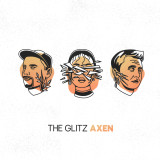
Heavy support by Radio Slave, Sam Divine, Acid Pauli, Green Velvet and Maceo Plex to name a few, while also being played on radio stations world wide. The album marks the beginning of a new chapter for The Glitz as they embark on a journey beyond the world of electronic music. After a wide range of beautiful, inspiring, provoking and uplifting The Glitz-singles, we are now approaching the full album in all its might. The singles have shown us the diverse soundscapes you can find in Andreas and Daniels musical multiverse, with the genres ranging from the classic House and Techno genres, to also introducing their take on Trip Hop, Neo RnB, Hip Hop, Ballad and Electronica. This journey into their musical realm has resonated with fans and colleagues alike the last months, putting the first single on position 1 in the German Club Charts for four weeks straight (it is still in the Beatport top100 after 7 months). Born out of a desire to create a space to explore and expand their unique sound, their new album is a bold extension of The Glitz vision and purpose. It has been a long time coming and is the result of four intense years in the studio together with the unique and talented singer and songwriter Mulay. And now it is time to present the full album to the world. is the mesmerising product of one of their many jam sessions in the studio. It carries the unique The Glitz fingerprints all over it while also letting them shine in a new context. The slow flowing Hip Hop beat paired with Mulays raw vocals and incredibly poetical and personal lyrics is a must hear for old and new The Glitz-fans alike.
Placed between some of the beautiful singles we have heard before, "Ergh" hits us with full force. The track takes us on a breaky, synth loaded trip. As an energetic and driving fresh breath of air, the track combines a frisky attitude with a tension building arrangement, showing that while Andreas and Daniel embrace new genres and styles, they still have good ears for club oriented, heavier hits as well. "Flummi" is put to work in a similar setting, but with a completely different world of sounds. Bright synths slowly build up, paralleled with the pulsating low end and guiding the listener towards an explosive breakdown. The track is followed by the wild and intoxicating "Rabbit Underground" that swoops you off your feet like a rocket launch. A skilfully crafted yet raw drum work with an exquisite snare creates a foundation for tantalising synths and captivating vocals that radiates with power. After this rollercoaster of a track, the wilderness is countered with the soft and playful "Mother". The Glitz bring together various layers of soft synths and smooth percussions, creating a beautiful sphere where the captivating vocals by Mulay shine in a new way. Ending this incredible journey of sound exploration is the stunning ballad "Seven Rivers". No noise, no distractions, just a beautifully stripped down ballad that carries an ocean of emotions. A perfect completion of "Axen". In their own way, each song carries the unique sound characteristics that Andreas and Daniel are so known and loved for, while giving them space to experiment and show themselves in new ways. The mix of emotionally charged, dance floor oriented and vibrant songs are bound to give the listeners an entrancing, unforgettable experience.
"Everybody Funk is the first album from Japigia Records, which launches into 2024 with great ardor. This is the first splendid house music album by Pasquale Fanelli, an industrialist from Bari with boundless passion for music and for the show in general, whose greatest merit is of having created a working group full of ideas and talent: the IAPIGI team. The DJ-arranger Paky Fanelli - so called by his friends - with the help of the multifaceted artist-DJ Fabio Ricciuti has dug extensively into the hinterland of the Puglia region in search of his own roots to find the right synergies and give meaning and value to the context, to the habits, to the organization of a city generous in history and culture like Bari, which crossed the ocean via the Adriatic Sea and the Mediterranean. Thanks to IAPIGI we have therefore arrived in New York where Danilo Braca captures Paky's work and shapes it with excellent Italian taste, which is exactly that of a DJ resident for several decades in the Big Apple where he generates surprising and always current sounds. Although radically different, "Daytona" and "Everybody Funk" represent some of the most exciting Italian house songs of this season. In addition to the skilful remix of these two songs, it is worth mentioning "The Edge", whose main melody develops slowly. Once again Danilo Braca has raised the bar and changed the rules of the game. Good boy! The experts Qubiko & Fabio Ricciuti bring a worthy close to this first work by Paky Fanelli with a short piece, originally entitled "Disaccord" and then merged into "Accord", with the aim of putting everyone on the same wavelength. on the same level or musical chord. Comes with an amazing embossed cover too."