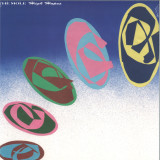
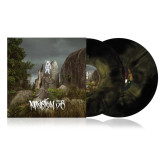
Efficient Space honours the memory of producer and MC Ali Omar with Hashish Hits, a posthumous selection from the dub rebel’s self-released discography.
One of ten children in working-class Liverpool, Omar drew deep influence from his father's Arabic heritage—a thread central to his identity and sample origins. After art school and a spell clubbing during Manchester's halcyon days, he relocated to Sydney, where he cofounded the blunted downbeat duo Atone with fellow British expatriate Andy Fitzgerald. As an MC, he infiltrated the city’s house, dub, jungle, and bass circuits, becoming a regular fixture at the Bentley Bar, where he commanded the mic with his versatile, rumbling baritone and charisma.
Freakishly talented in the studio, Omar was a pioneer of the Akai sampler and Atari, deftly recording live sessions straight to DAT. Drawing on industry insights from his sister, Merseybeat firebrand Beryl Marsden—who supported The Beatles on their final UK tour and was signed to Decca and Columbia—the non-conformist sought to build a self-sufficient business model. Between 1998 and 2004, he independently issued four albums on CD through his Hashish Studios imprint, hustling copies directly to local record stores and live shows for instant returns, even hand-sewing screen-printed hessian sleeves for his final release.
Uncompromising in his principles and refusing to suffer fools or charlatans, Omar relished the opportunity to collaborate with those who embodied the same spirit. Hashish Hits offers a snapshot of his inner sanctum—Fitzgerald on the opening track's billowing smoke stacks, the serpentine vocals of Gina Mitchell and the magic hands of mixer Louis Mitchell on 'On Release,' and Wicked Beat Sound System’s Kye on 'Poor Man Beggar Man Thief'. Meanwhile, 'Suicide Bomber' smoulders with the tension of a lost Muslimgauze relic, as the instructional 'Roll Up' and 'The Last Straw' spiral deeper into Omar’s signature production vortex— where space stretches in slow motion and walls reverberate with ricocheting delay.
A true icon of Sydney’s underground scene, the larger-than-life Omar passed away on 23 June 2009 after a valiant battle with cancer. He is remembered for his assertive spirit, larrikin humour, wild anarchic personality, and enduring mantra: “Love and live your life”.1
Search:slow magic
Uomo Meccanico also known as Nicola Altieri is a producer from Naples.He dropped this ep on IIB and we were blown away. Odyssey is a heads down smoke machine trip. Arpy baseline and a proper old style sample . Can't wait to hear on a big system. Strange Interferences is a straight up acid sleazebomb, squelching like a wet flip flop and again perfect sample technique. HOUSE! It's All Magic No Tricks drops the tempo and a syrupy sample.over Basement style bass and melodies, Strangely familiar but alien. La Guardia De La Luz (who we are big fans of here at IIB) take us on a slow drive through the desert, San Pedro dream style, slo mo brooding and massively balearic. A real gem to finish off one of our favourite ever releases
Robot 84 has fired up his machines and kicked out four superb new jams for this latest Magic Wand release. Opener 'AGAL' is a slow, percolating jam with shimmery synths and squelchy bass then 'Galaxies' brings some dusty broken beats and sugar chords for a nice laidback vibe. 'Feels Good' is another loose-limbed rhythm with wispy pads, DIY percussive sounds and bass that is rich in reverb. Last of all is 'Where Is The Dub' which slows things right to a crawl with plucked guitars and loads more echo to sink into.
Producers S. Fidelity, Bluestaeb, and Melodiesinfonie form a powerhouse trio known for their innovative blend of RnB, House, and 2-Step sounds. Their collaborative magic often unfolds in unique settings, such as a picturesque studio in the South of France, where they crafted their long awaited EP "365 P". The trio's ability to capture the essence of live sessions and translate it into vibrant, downtempo grooves has earned them a reputation already. As a result the group created these most vibey tracks between RnB, House & 2-Step to their catalogue ever - catching the vibe of this beautiful sessions together with douniah.
“Being Stuck in a loop with someone. repeating the same conversations over n over while nothing changes.” - douniah
"We started working on a joint project in Paris at Bluestaeb’s flat in 2017 already. Over the course of the years following, we tried to continue working on the project remotely from Berlin, Paris and Zurich. With only one conclusion: we need to be in the room together to make this a record that feels exciting to us. This May we finally closed ourselves in for a week and created what has become this beautiful EP with tons of live recordings." - S. Fidelity
Maybe this warning is not really relevant. It doesn’t scare anyone anymore. We all know that what is actually hiding behind this green fence is a sweet doggy only waiting to happily greet you.
First there's Gabriel, who you probably already saw playing crazy drums (with Terrenoire, Cola Boyy…). And then there's Facundo, the magician on the synth and on his choice of shirts.
Together they are Chien Méchant: a duo made of two friends who met at the hairdresser (and in high school), and that makes you wonder if groove, rock, funk and synths could maybe coexist one more time.
The release of their first self titled EP Chien Méchant gave prominence to their first inspirations - as first releases usually do - and showed off their influences. They were at the same time trying to prove themselves but also preparing us for what is to come: the real journey.
A journey that will start next January with Métamorphose. A first album that will display a cast smelling like leather, like a John Carpenter movie with GrandMarnier (Yelle) directing, Ouai Stéphane on the mix and of course Gabriel & Facundo taking a twisted pleasure in deconstructing our common preconception on pop music.
Métamorphose has many shapes - don’t forget a dog can have 3 heads. The track “Nuit Blanche” reminds us of our dancefloor trances. “Sens Contraire” is a drum/synth ballad that takes us by the hand and slowly whispers in our ear that it is ok to be anxious. “Point Final” is pretty self explanatory and makes us feel like we are back on the dancefloor saying “ok this is the last one”. There are ten tracks on this album that will be released alongside their label - Nowadays Records.
You will quickly understand that Chien Méchant is a live band. You will dream about these drums, these blinking synths, these psychedelic carpets, and about dancing without thinking about what’s next. But beware, Métamorphose also reminds us that they are way more than that.
- Look Back In Anger (John Peel Session 20.08.80)
- Picture Of Dorian Gray (John Peel Session 20.08.80)
- Le Grande Illusion (John Peel Session 20.08.80)
- Silly Girl (John Peel Session 20.08.80)
- Paradise Is For The Blessed (Andy Kershaw Bbc Session 27.02.86)
- My Conscience Tells Me No (Andy Kershaw Bbc Session 27.02.86)
- Salvador Dali's Garden Party (Andy Kershaw Bbc Session 27.02.86)
- I Still Believe In Magic (Andy Kershaw Bbc Session 27.02.86)
- Goodnight Mister Spaceman (Wmbr Session 02.04.92)
- How Does It Feel To Be Loved (Wmbr Session 02.04.92)
- I Get Frightened Too (Wmbr Session 02.04.92)
- Time Goes Slowly When You're Drowning (Wmbr Session 02.04.92)
- Gypsy Woman (Wmbr Session 02.04.92)
- She's A Virgin And A Whore (Wmbr Session 02.04.92)
- Why Can't I Touch It (Wmbr Session 02.04.92)
- All My Dreams Are Dead (Wmbr Session 02.04.92)
- Wandering Minds (Wmbr Session 02.04.92)
- Three Wishes (Wmbr Session 02.04.92)
Diese neue (!) Compilation vereint klassische Radiosessions der TVPs, den Meistern des DIY-Post-Punk und Indie-Pop. Die Doppel-LP enthält zwei BBC-Sessions aus den 80er Jahren, die bei John Peel und Andy Kershaw aufgenommen und ausgestrahlt wurden, sowie ein sehr rares WMBR-Set von 1992 mit Coversongs von Buzzcocks, Raincoats und Daniel Johnston sowie bisher unveröffentlichten Songs (und als digitaler Bonus die WFMU-Session von 1993). "Catchy hooks and schoolboy wit are in abundant supply." Pitchfork Die großartigen DIY-Fähigkeiten der Television Personalities und ihr liebenswertes, klappriges Auftreten haben sie auf so manchen subversiven Trip geführt, sowohl auf Platte als auch bei Live-Auftritten. Aber es war das Radio, das sie zum ersten Mal der Welt vorstellte, in einem Wirbelsturm wiederholter Airplays. John Peel ließ Außenstehende überall in TVPs alternative Welt eintauchen. Und auf dem Höhepunkt des Punk parodierten sie bereits die neue Revolution, ihre Single ,Part Time Punks" wurde zu einem Peel-Hit, und die Nachfrage nach weiteren Songs führte schließlich zu einer Session im Jahr 1980. In den 80er Jahren war Daniel Treacy so zu einem begnadeten Geschichtenerzähler gereift, der die moderne Welt aus seinen eigenen, verschwommenen Blickwinkel beschrieb. Seine Songs waren liebenswert, sofort identifizierbar und witzig, klare, scharfe Beobachtungen von oft magischer Tiefe. Treacy wurde zu einer Inspiration und unverzichtbaren Alternative des üblichen (auf der Insel nicht soo schlechten) Radioprogrammes, eines Mediums, das die TVPs zum Ende der 80er Jahre so gut wie aufgegeben hatte. "Tune In, Turn On, Drop Out" fängt den Weg dieses Pilgers ins Pop-Nirvana ein, ein psychedelisches Wunderland, das von dunklen und grüblerischen Momenten gezeichnet ist. Gehört wie durch ein knisterndes, Vintage-Transistorradio, welches vielleicht sogar unter dem Kopfkissen versteckt ist, so dass diese Skizzierungen der Gesellschaft ganz nah und intim Daniel Treacy's Psyche zeigen. Limitierte Doppel-LP, klassisch schwarzes Vinyl, Linernotes, gratis DLC mit Bonustracks!
"Langt Fra Jorden" ("Lejos De La Tierra", in Spanish, for the book) is the result of the dialogue between the Spanish photographer and artist Irene Zottola and the Danish musician and artist øjeRum initiated by IIKKI, between June 2024 and November 2024.
øjeRum is Copenhagen based musician and collage artist Paw Grabowski. In his øjeRum guise, he plucks and strums his treated acoustic instruments, sounding at times like church bells, at times like angelic harp, at time like drones, and suspends the listener in the magic of his melodies.
With a deep back-catalogue of releases since 2014 - spanning labels such as eilean rec., Room40, Line, Opal Tapes and many more - he continues exploring his minimal, textural and deeply personal style of ambient music.
Irene Zottola is a Spanish photographer and artist who explores the limits of analog photography to generate a world of dreamlike and poetic character, often accompanying her images with text.
She has been self-taught in Madrid in the laboratory of the Slow Photo collective since 2016. In 2017 she is a finalist in the Rfotofolio Grant.
Her work has been exhibited in Spain, Italy and Morocco. She has published with editorials such as La Bella Varsovia and Lumen (Spain) and magazines such as She shoots film (Australia), Fisheyemagazine (France) and Vostmagazine (Korea).
In 2021 she received one of the Grants to Creation granted by VEGAP with which she began a new project in Paris and was part of the artistic residence ART(e)gileak of the BBK with a participatory photography project. She is one of the 33 authors of the Mission Region project organized by the Community of Madrid and is part of the platform of the National Image Centre in Spain. Winner in 2020 of the V Edition of the Photochannel Contest, she has published with Ediciones Anómalas her first photobook, "Icarus", which has been a finalist in PhotoEspaña and in Les Photobook Awards of Les Rencontres d'Arles 2022.
"Lejos De La Tierra’’ is her second book.
Fine Art Book, Ltd. to 500 copies:
Hardcover book printed on Munken Print Cream 115g/m2 // 80 pages, 17cm x 23cm, 42 photos // Logo and slot embossed // Hot gold stamping // Visible seam and cutting cover pages // Hand-numbered, hand-stamped.
Writing music, for singer-songwriter and producer Fine, “feels like being entrusted with a secret.” On Rocky Top Ballads, the Copenhagen-based musician’s debut album, these secrets take the form of minimalist compositions that search for glimpses of beauty in the everyday. Recorded, produced, and mixed by Fine, the album is a mystical soundtrack to a captivating songwriter’s explorations of process and intuition.
“The whole album is about the moments when you see a crack in something,” Fine explains, “where you briefly see another side of yourself or of someone you've known forever.”
Fine grew up in Denmark’s rural Northern Jutland; there, her father’s guitar and banjo playing formed the sonic backdrop of her childhood. In the years since, her musical curiosity has led her to work across a range of styles and sounds. In her early twenties, she became part of Danish electronic trio Chinah, which released three albums. You might also have caught her sampled vocals on the joyfully rollicking Two Shell song “Home,” from 2021. Then, last year, she — along with Erika de Casier and Smerz — co-wrote three songs for the massive, critically lauded K-pop group New Jeans. Fine is also a part of Clarissa Connelly Canons group back home in Denmark, and writes music under the moniker Coined with composer and songwriter Astrid Sonne.
But Rocky Top Ballads is a turn back towards a more personal, stream-of-consciousness songwriting style. Fine wrote and recorded these songs sporadically over the course of the last few years. In light of Chinah’s collaborative, piecemeal production style, Fine craved a more organic, intuitive process for these songs. Her work on the record combines sample-based production with the sounds of instruments she and her collaborators could hold in their hands, ones that inspired free-flowing improvisation: electric and acoustic guitar, even the Ensoniq keyboard that was in her childhood home. The resulting songs are equally inspired by the country and folk of her childhood, the hazy beauty of Mazzy Star, the avant-garde pop of Dean Blunt, and the songwriting of ’90s singer-songwriters like Suzanne Vega.
Fine describes her songwriting process as a “magical thinking method”: being in contact with the present moment and pretending as if she already knows the song she’s about to write. Many of the songs on Rocky Top Ballads use the original takes of Fine’s vocals, an attempt to capture a song’s initial essence and avoid disturbing the song’s generative idea as much as possible. You can hear that well-preserved spark on songs like “Losing Tennessee,” a minimalist and wistful reflection on the inherent loss and change of growing older. She wrote other tracks, like the piano-led “Whys” and the woozy “Coasting,” through a process of cutting and layering her improvisations, carefully merging multiple musical snippets into newly seamless compositions. And the stunning closing track “A Star” is the product of a slow process of evolution: beginning as an understated expression of sincerity before dissolving into a rich, distorted guitar-driven exploration.
As a songwriter and producer, Fine’s work often peers into the universes of experience that can be hidden inside a fragmentary moment. Sometimes she explores this literally — as in “Days Incomplete,” which she built off a short sample from “A Star.” This impulse — to zoom in, to recontextualize, to excavate — threads throughout her lyrics, too. What happens, her songs ask, when we pay close attention to those everyday images and physical realities we might otherwise ignore: the sky, the rain, the sun, the sea? On the spacious and swoony “Big Muzzy,” with its gentle sway and Cocteau Twins-inflected vocals, Fine sings about watching the “summer turn blue”; the grooving, propulsive “Remember The Heart” is a love letter to the sea where she grew up. In her airy voice, Fine traces meandering melodies that continually unspool with fresh insights.
A particular mantra guided Fine’s songwriting throughout the creation of Rocky Top Ballads: “Everything has potential.” In these songs, small moments are worthy of deep contemplation, and gentleness can evoke worlds of emotion. The resulting songs offer a gift of momentary pleasure, flowing and unhurried as a gentle breeze.
Marissa Lorusso
- I See Through You
- Waiting For Blood
- Deaths Door
- Shockwave City
- 13: Candles
- Dead Eyes Of London
- Pusher Man
- Ritual Knife
- Slow Death
- Crystal Spiders
- Blood Runner
- Desert Ceremony
- I'll Cut You Down
- No Return
14 songs deep and proudly devoid of gimmicks or distractions, Slaughter On First Avenue is a riveting and raw account of Uncle Acid in full flight. From early classics like I'll Cut You Down and Death's Door (both from Blood Lust), to more recent works of lysergic aggro like Shockwave City (from Wasteland) and sinister epic Slow Death (from The Night Creeper), this amalgamation of two fiery and unforgettable live shows has a mesmerising momentum all of its own. A throwback to the days when live albums were magical things, rather than cynical stopgaps, Slaughter On First Avenue is a jolting dose of dark electricity and psychedelic terror. Swollen with the greatest of riffs and performed with grit, power and haughty disdain, it loudly confirms that Uncle Acid & The Deadbeats have the raw, fuzzed-out power to drag everybody into their bewildering, bewitched vortex of doom. A dazzling, devilish squall to mark the beginning of a new chapter, Slaughter On First Avenue also clears the decks for this band's next malevolent move. Don't say we didn't warn you. "Yes, There will be another record which will hopefully appear at some point without warning or explanation," Kevin Starrs avows. "It will be completely different to anything else we've done. You can think of it as a late-night detour. Its appeal will be extremely limited but that's OK... 'When you're slapped, you'll take it and like it!'".
Sound Migration proudly brings forth one of the contributions of UVX (Ultra Violet Explorer) to Magick Eye Records that was initially released in 1993. This release serves a touchstone for the quality that emerges when the gap between Ambient and early Trance is thoughtfully bridged.
The 15 minute aural odyssey that is the 13 Floor Spectrum version of the A-side begins mired in a beatless fog of atmosphere that slowly crystallises into a grid of percussive elements before evaporating entirely, leaving only voices leaking through the primordial aether as a precursor to the grand finale of vibration raising rhythmic frequencies.
The appropriately titled Dancefloor Sub Bassment and Trancefloor Transporter versions on the B-side transmute these sonic strands into musical talismans that can be unitised to intensify ecstatic dance practices & extend the boundaries of astral excursions.
Nummer Music are proud to present the first reissue of Paul Mahoux’s seminal BùLù project.
The Parisian (now Okinawa-based) producer released “Silicon-Shepherd / Senegalese-Sharpshooter” 30 years ago today on the french label Virtual.
Both cuts give a unique insight into the sound of the early Trance scene and travel beyond the boundaries of Techno & House. Whether you’re revisiting the past or experiencing them for the first time, they still stand as a testament to the free spirit of the early ‘90s.
On side A, the bouncy Silicon-Shepherd shows off BùLù’s singular sampling techniques: chopped up vocals, tripped out synths and a touch of M1 slap bass take you into unexpected peak-time territories, where euphoria meets deep mind-travelling (i.e. DMT).
On the flip, Senegalese-Sharpshooter unveils another facet of BùLù’s buoyant universe. The french producer slows down the pace and invites the listener on a magical meditative journey, the lullaby-like theme tune shacks up with ancient traditional instruments and mystical choirs, again freed from any sort of constraint of style or genre.
On remix duties, Nummer’s very own E-Talking gives Silicon-Shepherd a club lift while our beloved Caldera injects Senegalese-Sharpshooter with a heavy dose of his signature swampiness.
Naoki Zushi. Perhaps best known for his stellar guitar contributions to psych folk group, Nagisa Ni Te, Zushi has had a parallel career, for several decades, slowly releasing solo albums that spotlight his exultant guitar playing. Originally released to CD only by Shinji Shibayama of Nagisa Ni Te’s Org imprint in 2018, IV has Zushi playing and writing at a peak, its six songs slowly unfurling with a kind of paradoxical understated grandeur. This is psychedelic guitar music at its most paced and considered, yet given to flights of inspiration, and in this respect, Zushi sits within a lineage of guitarists who’ve used their instrument both as textural anchor and improvisatory tool – think of figures like Phil Manzanera and Robert Fripp, but also Roy Montgomery, Liz Harris of Grouper, even Tom Verlaine on his instrumental solo albums. Like those artists, Zushi locates moments of deep emotional resonance amidst luxuriant textural and melodic exploration. Zushi’s history stretches back to the mid 1970s. While for many, he first appeared on the scene as a founding member of noise legends Hijokaidan, alongside Jojo Hiroshige, his musical contributions predate that encounter. He started out playing progressive rock and improvised music, making home recordings of when he was in high school. He was a member of Rasenkaidan (Spiral Staircase) alongside Hiroshige and Idiot (Kenichi Takayama), the group that soon mutated into Hijokaidan (Emergency Staircase). Zushi and Takayama would soon form Idiot O’Clock, in 1982; Zushi also led his own Naoki Zushi Unit, starting in 1983. But for many, Zushi’s first significant appearance on record was as a member of Shinji Shibayama’s mid-eighties psych-pop group, Hallelujahs, whose sole album was recently reissued on vinyl. That group mutated into Nagisa Ni Te, and Zushi has played a significant role as their lead guitarist for several decades. His own solo music has appeared sporadically – Paradise (1987), Phenomenal Luciferin (1998), III (2005) and IV, with a few recent, meditative offerings, For My Friends’ Sleep (2021) and Nocturnes (2022). With IV, though, Zushi achieved something remarkable, a kind of extended exploration of the time-altering properties of echoplexed, hypnotically spiralling guitar interplay. The opening ‘Mirror’, “a song about the mirror inside me,” Zushi explains, starts out as a lush psych-folk song, slow and gentle, but soon takes to the skies with a cat’s cradle of Fripp-esque guitars, before thick, droning chords sweep the song to a drowsy coda. ‘Nocturne’ weaves silver skeins of guitar melody around a cyclical chord pattern; it gathers energy and quiet intensity through insistent repetition. The rest of the album explores the nuance Zushi can draw out of simple elements, building on what ‘Mirror’ and ‘Nocturne’ offer – the profundity of a chord change; the melancholy of a few quietly sighed words; the exhilaration of a guitar solo bursting out of the speakers; the subtle shifts in emotional register offered by tone and touch. Throughout, there’s something quiet, yet ineffable, shading the contours of the songs, such that it makes perfect sense when Zushi says, “What I want to express through music may be ‘sense of mystery’.” A few of the songs had their basic parts recorded at LM Studio and Studio Nemu with Shibayama and Masako Takeda joining on bass and drums, respectively; much of the album, however, was tracked at Zushi’s home studio. That seems appropriate for a collection of songs that are expansive in their intimacy. Asked what drove the sessions, Zushi answers, “I thought I’d make IV an album that particularly focuses on the guitar play.” And focus it does, as Zushi’s sky-scraping, soaring, elemental tone is front and centre throughout. But these are no guitar heroics; rather, Zushi uses the guitar as conduit and diviner, a tool for spirit location, and IV is his most eloquent expression yet of such singular magic.
- A1: As Long As I’ve Got You
- A2: Soldier Man
- A3: Byrds Turn To Stone
- A4: The Girl With The Long Brown Hair
- A5: On The Terrace 6 Miles Apart
- B1: Meant To Be
- B2: Carousel
- B3: On The Streets Tonight
- B4: Chinatown
- B5: Kilburn High Road
- B6: Happy Ever After
Oxblood colour vinyl[21,81 €]
A hugely in demand repress (the original vinyl pressing on North Country changes hands for hundreds of pounds..) now released on Shack’s newly created own label Shack Songs.
The Shack story is one of music’s greatest legends. It incorporates hardship, bereavement and chaotic misadventure, but above all it tells the tale of beautiful music triumphing over trouble and tragedy.
‘Here’s Tom with The Weather’ boasts a majestic and fresh form. These are magical songs, psychedelic folk songs of the finest Head vintage. Sleepy-eyed, wistful and mystical, yet crafted with a cunning and acute dexterity beyond just about anybody you can think of.
The two profoundly Liverpudlian brothers Mick and John Head have made several brilliant albums together , but none as quickly as ‘Here’s Tom…’ which was completed in seven weeks at Brynderwen Studios in North Wales along with drummer Iain Templeton (RIP) , bassist Guy Rigby and producer Jay Reynolds in 2003.
In the 80’s , the two brothers from the notorious Kensington estate in north Liverpool were singer and guitarist with The Pale Fountains , an effervescent pop group which imploded under the weight of two albums in 1986. The Heads returned in ‘88 as Shack and a debut album Zilch. In 1991 , Shack made ‘Waterpistol’ , an inspirational guitar jewel that would have proved just as influential as any British album in that era had the studio not burned down, taking the master tapes with it. Four more years passed , but by the time it was finally released on Marina it had developed ‘lost classic’ status.
The Heads battled on. They toured as their hero Arthur Lee (RIP) of Love’s backing band. In ‘97 , they created a new group called The Strands and recorded the delicate, dreamy masterpiece ‘The Magical World Of The Strands’ . They spent a long time making another classic ‘HMS Fable’ , and then decided that next time they wouldn’t take quite as long recording. Enter ‘Here’s Tom With The Weather’.
Showcasing John’s slow , shy emergence as a songwriter to challenge his brother (on the sparkling, heartbreaking ‘Miles Apart’ and ‘Carousel’ , and the spun-out ‘Kilburn High Road’ ) , toasting Mick’s newest confirmation as the most unrecognised genius of his or any other generation (the ode to his bro, ‘Byrds Turn To Stone’ , the mariachi horns that break open the slow folk fog of ‘Meant To Be’ , the two lullaby bookends ..and on , and on) .
“The journey we’ve had together has been beautifully turbulent”, laughs John. “But there’s times when we glide and we’re gliding forward now”
Mick agrees. “Making this album has been frantic, chaos, carnage, intense : the normal way with us. But it doesn’t sound like that. That’s all that matters. The story is what it is. But so are the songs and so are the records. Because we’re good.”
Nobody could disagree with that.
A hugely in demand repress (the original vinyl pressing on North Country changes hands for hundreds of pounds..) now released on Shack’s newly created own label Shack Songs.
The Shack story is one of music’s greatest legends. It incorporates hardship, bereavement and chaotic misadventure, but above all it tells the tale of beautiful music triumphing over trouble and tragedy.
‘Here’s Tom with The Weather’ boasts a majestic and fresh form. These are magical songs, psychedelic folk songs of the finest Head vintage. Sleepy-eyed, wistful and mystical, yet crafted with a cunning and acute dexterity beyond just about anybody you can think of.
The two profoundly Liverpudlian brothers Mick and John Head have made several brilliant albums together , but none as quickly as ‘Here’s Tom…’ which was completed in seven weeks at Brynderwen Studios in North Wales along with drummer Iain Templeton (RIP) , bassist Guy Rigby and producer Jay Reynolds in 2003.
In the 80’s , the two brothers from the notorious Kensington estate in north Liverpool were singer and guitarist with The Pale Fountains , an effervescent pop group which imploded under the weight of two albums in 1986. The Heads returned in ‘88 as Shack and a debut album Zilch. In 1991 , Shack made ‘Waterpistol’ , an inspirational guitar jewel that would have proved just as influential as any British album in that era had the studio not burned down, taking the master tapes with it. Four more years passed , but by the time it was finally released on Marina it had developed ‘lost classic’ status.
The Heads battled on. They toured as their hero Arthur Lee (RIP) of Love’s backing band. In ‘97 , they created a new group called The Strands and recorded the delicate, dreamy masterpiece ‘The Magical World Of The Strands’ . They spent a long time making another classic ‘HMS Fable’ , and then decided that next time they wouldn’t take quite as long recording. Enter ‘Here’s Tom With The Weather’.
Showcasing John’s slow , shy emergence as a songwriter to challenge his brother (on the sparkling, heartbreaking ‘Miles Apart’ and ‘Carousel’ , and the spun-out ‘Kilburn High Road’ ) , toasting Mick’s newest confirmation as the most unrecognised genius of his or any other generation (the ode to his bro, ‘Byrds Turn To Stone’ , the mariachi horns that break open the slow folk fog of ‘Meant To Be’ , the two lullaby bookends ..and on , and on) .
“The journey we’ve had together has been beautifully turbulent”, laughs John. “But there’s times when we glide and we’re gliding forward now”
Mick agrees. “Making this album has been frantic, chaos, carnage, intense : the normal way with us. But it doesn’t sound like that. That’s all that matters. The story is what it is. But so are the songs and so are the records. Because we’re good.”
Nobody could disagree with that.
- Intro
- Krabeka Saludi
- The Generator
- Hope
- Abflug 3
- Brasilia
- B-3 Fantastico
- Rocky Beach Boulevard
- When You Ask Me
- Orgami
- Disko 20.37
- B's Cafe
- Outro
- Slow Motion
A journey - that"s how musicians like to describe working on a new album. In the case of of krajenski"s new LP "B-3 Vol. 2" it really was a journey.
Many ideas were born and discarded, several sessions were played for inspiration, plenty of songs were produced in advance - the journey is the journey. Then the decisive missing link: krajenski. was able to find the two musicians and producers Dirk Berger (Peter Fox, Seed, Marteria) and Samon Kawamura (Joy Denalane, Max Herre, Till Brönner) for this project. And suddenly the production took a completely different magical turn - away from a "band album" towards a musical experiment.
High Hopes - New album from the Mole.
High Hopes is 17 songs across 40 minutes on one slice of wax that, as advertised, sounds nothing like last month’s Ep, High Dreams. Here, rather than the long form dance form, is a continuation of the beat tape pacing from the last album, a collection of moments posing as ideas posing as a narrative stuffed with oddities and surprises that reward the close listen.
What’s heard on High Hopes is the Mole’s exploration of a love letter, from one person to a family, from the northern Pacific to the southern Atlantic, from a boy to a painted bird. Vancouver Island to Manantiales. The songs range from ambient sound bath and hip hop sludge, up to micro boogie and almost House before tumbling back down and forth again. Bubbling synths, MPCs swung out, samples chopped and chewed, bass and violins from Rick and Sophie, field recordings of birds and frogs and beaches, friends and family and fiestas. Did we mention the love ?! This album has got it all! Original collages from Antonio Carrau envelope this wax: jacket, sleeve and cookie. Antonio’s work is typified by playful combinations and bold statements about living in a embrace of analog and digital health. His co lages marry the corporeal world with an updated, digitalized age of reproduction, inducing feelings of gratitude for the simple everyday scenes we sometimes lose touch with when we forget to slow down. Good living, like breathing, requires inhaling as well as exhaling.
We can’t always produce content, make art, we must also pause, and listen. And enjoy. The Mole is joined by friends and colleagues on several songs included on High Hopes. Rick May plays bass on both Que Rico and album stand out GoinF4er. Sophie Trudeau (Godspeed You Black Emperor) plays and arranges violins on GoinF4er and Danuel Tate (Cobblestone Jazz) and Julz Chaz (Wagon Repair) both play Vibes and Emaxx throughout the album. Working with these incredible talents not only enriched this album, but fulfilled a long standing goal of the Mole’s; to work again with the musicians from whom he learned so much. People who helped inform the shape of Mole to come.
The Mole who was As High As The Sky. The Mole has been ‘recognized’ by the ‘global underground’ since his critically celebrated premiere album, As High As The Sky, but his earlier Eps (Wagon Repair, Philpot, Musique Risquee) got the attention of Top DJs, clubs, and festivals around the world first. His sound remains unique, fresh and deep: enjoying plays in a wide variety of spaces and places.
High Hopes is the Mole’s 5th solo album and his 2nd album for Circus Company (The River Widens) who have also proudly released two eps of Mole magic (Little Sunshine, High Dreams).
*Isn’t that too much time for one record? Short answer - No. Long answer - depends on the material. Due to the many quiet passages in the album, the groove spacing can be modulated and the needle can slow it’s progress towards the center/end resulting in longer sides with continued high gain and low distortion.
High Hopes - New album from the Mole.
High Hopes is 17 songs across 40 minutes on one slice of wax that, as advertised, sounds nothing like last month’s Ep, High Dreams. Here, rather than the long form dance form, is a continuation of the beat tape pacing from the last album, a collection of moments posing as ideas posing as a narrative stuffed with oddities and surprises that reward the close listen.
What’s heard on High Hopes is the Mole’s exploration of a love letter, from one person to a family, from the northern Pacific to the southern Atlantic, from a boy to a painted bird. Vancouver Island to Manantiales. The songs range from ambient sound bath and hip hop sludge, up to micro boogie and almost House before tumbling back down and forth again. Bubbling synths, MPCs swung out, samples chopped and chewed, bass and violins from Rick and Sophie, field recordings of birds and frogs and beaches, friends and family and fiestas. Did we mention the love ?! This album has got it all! Original collages from Antonio Carrau envelope this wax: jacket, sleeve and cookie. Antonio’s work is typified by playful combinations and bold statements about living in a embrace of analog and digital health. His co lages marry the corporeal world with an updated, digitalized age of reproduction, inducing feelings of gratitude for the simple everyday scenes we sometimes lose touch with when we forget to slow down. Good living, like breathing, requires inhaling as well as exhaling.
We can’t always produce content, make art, we must also pause, and listen. And enjoy. The Mole is joined by friends and colleagues on several songs included on High Hopes. Rick May plays bass on both Que Rico and album stand out GoinF4er. Sophie Trudeau (Godspeed You Black Emperor) plays and arranges violins on GoinF4er and Danuel Tate (Cobblestone Jazz) and Julz Chaz (Wagon Repair) both play Vibes and Emaxx throughout the album. Working with these incredible talents not only enriched this album, but fulfilled a long standing goal of the Mole’s; to work again with the musicians from whom he learned so much. People who helped inform the shape of Mole to come.
The Mole who was As High As The Sky. The Mole has been ‘recognized’ by the ‘global underground’ since his critically celebrated premiere album, As High As The Sky, but his earlier Eps (Wagon Repair, Philpot, Musique Risquee) got the attention of Top DJs, clubs, and festivals around the world first. His sound remains unique, fresh and deep: enjoying plays in a wide variety of spaces and places.
High Hopes is the Mole’s 5th solo album and his 2nd album for Circus Company (The River Widens) who have also proudly released two eps of Mole magic (Little Sunshine, High Dreams).
*Isn’t that too much time for one record? Short answer - No. Long answer - depends on the material. Due to the many quiet passages in the album, the groove spacing can be modulated and the needle can slow it’s progress towards the center/end resulting in longer sides with continued high gain and low distortion.
The making of a maiden album can be a capricious process. One moment of outright musical flow paired with another period of sustained creative struggle are feats experienced by seasoned producers the world over. So when Miraclis was forced to hole away in his makeshift studio - in the midst of a global pandemic - the stage was set for something magical. Now it will see the light of day for the very first time.
Having released two singles on Secret Teachings to critical acclaim already this year, Chilean talent Miraclis will accomplish a milestone achievement in July with the release of his debut album: Origin Of Truth.
Difficult experiences were fundamental to the creation of such work, as were Miraclis’ inherent musical interests. He explains: “Origin Of Truth had its birth during the pandemic. I created it as a way of communicating to myself the sensations and feelings that were spinning around my head at the time. I've always been inspired by Bristol trip hop, as well as classical rock, and these genres definitely contributed to the making of these melancholic tracks. In a way I wanted to fuse all the musical influences that were part of my childhood, up until this point now, so this album really means a lot to me. It was my way of communicating, when there was a lack of social contact and communication itself was hard to come by.”
It's this meditative quality that initially drew Damian Lazarus to the project. “It’s a record that has its roots in electronic music, but it’s a very alternative, very deep, melancholic album. I find it both soothing and stirring at the same time, and that’s a quite interesting juxtaposition in that it feels edgy but delicious at the same time,” says Lazarus. “The fact that this was written in this place surrounded by the most incredible desert landscapes makes this a very important piece of work to me. It doesn’t sit in any particular genre, which is why it feels right for a Secret Teachings release. It hints at so many genres that I as a DJ am quite into, and it feels like a first as it’s unique and unclassifiable. That mystical, esoteric, edgy feel makes this a perfect release for the label.”
Sonnet opens proceedings, with ghostly vocals residing next to raw instrumental elements throughout. Miraclis’ signature guitar riffs soon converge on saddened keys, paving the way for Scienter. It takes the form of an instrument-based, electronic-inspired cut, building slowly before reaching a crescendo midway through via an enrapturing acoustic solo.
Floating Child comes next, brimming with a darker intensity courtesy of broody synth pulses and rhythmic hi-hats, as Shiver arrives next. There’s a rock-leaning sensibility to the piece that gives way to earnest lyrical offerings, opening swiftly into the breakbeat-esque world of Perceptions. Hard-hitting drums act as the focal point, with electric chords adding depth and intrigue, whilst Bright continues in a similarly heartfelt vein.
Introspective pads leave us feeling pensive, ahead of Interstellar taking us on a celestial journey through warped bass tones. Acting as the LP’s penultimate number, it’s a four-and-a-half minute showcase of guitar-based musical goodness and one that perfectly sets the stage for Trapped, a closing saga of suitably emotive proportions.
Miraclis earned his stripes as a DJ under the name Max Clementi in his native Chile, as well as Spain after a stint at the Barcelona SAE Institute. Playing and writing music since his parents gave him his first guitar at age twelve, he found himself inspired by synth wave, electronic pop, trip hop, and psychedelic rock of the ‘80s and ‘90s, drenching himself in music by the likes of Massive Attack, Tricky, Depeche Mode, and Nine Inch Nails. However, it wasn’t until he had to move back to Pucón to take care of his father during the pandemic that he began working on what would become Origin Of Truth.
Serendipity seems to play a large part in Crosstown Rebels’ new label Secret Teachings. Just look at the story of how Damian met Miraclis in the first place. It involved a chance midnight encounter in Pucón, Chile at a woodland campfire after the DJ was locked out of his hotel room. This meeting of minds was the start of a remarkable friendship, where Miraclis invited Lazarus to stay at his house and break bread with his family. The two kept in touch, exchanging music and ideas as a result.
Where would a painter paint if it were not on a white canvas? Where would a composer compose if it were not on the stave and the spaces in between the lines? How would a musician play his instrument if there were no melodies composed, written down, painted for him to follow?
The magic of art needs a frame, a somewhat solid container to hold the freedom that can only be found once we integrate some form of structure. And that also holds in every other area of life. We all need a frame, a structure, a rhythm, or else, we fall apart. This human form needs the body, and yet it transcends the limitations of the body - through art.
Consistency being one of them seems oftentimes less tangible, for it resides more in the act of doing, and showing up for the practice, for devoting energy and presence. Strangely, if we consistently show up for our practice, regardless of its form, the solid frame of the hour we devote to playing the instrument, learning a language, doing the sport, sitting silently for that meditation: It feels different every single time. It feels new every single time.
The repetitive consistency in being present again and again allows for nothing short of magic to happen. Magic feeds consistency. Consistency feeds magic. Consistency sets a foundation that strengthens over time. It allows us to slowly but surely develop any kind of skill, to find and hence to embody expertise. On the fertile grounds of such a solid foundation, creativity fosters, and innovation blossoms.
Establishing consistent rituals and routines can bring a sense of comfort and safety into every-day-life. For routine beholds repetition and its frame enables our experience within to change. In the familiar, we dare to explore, maybe even experiment, merely because a part of us remembers we depart from, and always return to, a safe space. We do not get lost. We do not fall apart. As we practice, again and again, we build resilience in overcoming obstacles or literally persevering through challenging situations and stretches of time.
While consistency gifts steadiness and stability, its overdose risks to result in what may appear as uniformity. It feels like constantly - consistently - dancing on the fine line of freedom within a structure. Life is filled with unexpected twists and turns, adjustments need to be made to accommodate change and avoid rigidity. By striking a balance between consistency and flexibility, we can create harmony in our lives, just like a beautiful melody that flows smoothly from one note to the next.
Within the magical waves of music, skills are needed, too. Consistency is key to show up and do the work. It frames the freedom of magic that resides beyond and only beyond effort. Learning to play an instrument, learning to sing, does never happen within the blink of the eye. It takes time. Time to show up for the practice, to do precisely that: practice. Again and again, every single time, again and again. Precision feeds perfection that falls apart inside the structure of a song, a line, a rhythm, dissolving into magic.
Consistency in practicing, in composing and sharing music with the world regardless of the form allows any musician to refine his style, to carve out his uniqueness. For any artistic expression is, after all: Unique. And this uniqueness is born inside the vessel of any structure, over and over again. Sharing music in the form of new releases and public performances nourishes the bond between artist and audience. And for that to unfold, both parties need to show up - while the underlying beat of this never-ending practice is presence fuelled by consistency.
With his 9th album, Housemeister invites you on a fascinating journey through electronic music. This work combines influences from techno, electro, synthesizer music, melodic house and synthpop, and shows the artists diversity and creativity. Driving rhythms, optimistic sounds, life-affirming vibes and less nervousness than in previous releases make this album more mature and an incomparable listening experience. The album captivates with its varied mix of different styles that magically come together in harmony. Beautiful melodies that stay in the ear and a successful balance of slow and fast tracks make it a work that constantly reveals new facets. A particular highlight of the album is the track Love is a Killer, in which Joy Tyson provides goosebump moments with her incredible voice. This alternative synthpop song is an emotional highlight and shows Housemeisters ability to create deep and moving music. This album is a must-have for all electronic music lovers and a versatile companion for any playlist. Whether in the club, on the radio or in a personal playlist, Housemeisters new album will set dance floors ablaze and hearts melting. And like always, the artwork is made by Housemeister himself.
Orange Vinyl[29,37 €]
HOO - master builders of woozy dynamics, songs unfurl with a mysterious, hooky logic all their own to create deeply emotive, chaotic, cinematic and - surprisingly, with this album ‘III’ - indie pop tunes! Songs clocking in just over 2 or 3 minutes, driven by heavy grunge guitars & potty Moog magic, opening out at times during the breathtaking prog Ov Violence/ Evil Weeks and the epic gothy final track Method Papers. ‘III’ has been 10 years in the making and features friends Simon Rowe (Chapterhouse, Mojave 3), Ian McCutcheon (Mojave 3, Slowdive), Paul Blewett (Moon Attendant), Lee Lavender & long-time collaborator & award-winning folk artist Jackie Oates. The themes and feel of the songs meant they had to lay in wait in HOO’s church-like studio, patiently growing & spawning like a 70's Dr WHO monster. Newer songs like the almost indie disco Snake & Myself When I Am Real finally gave the album foundation. HOO songwriter Nick Holton explains “All my music, including stuff in the past with Coley Park & Neil Halstead (Slowdive), is made at home in my own studio ‘Oaki Room’, so they blend into one another and my broader life. This is why musicians like Paul Blewett, Ian McCutcheon and Simon Rowe are always in the band or on my records - because they are part of my life. I have always made music this way and intended to. Jackie’s beautiful lead on England Theme, a high for me, was a simple idea. A mirror, as is so much of what I write about, here pride and disappointment in your world. Politics, religion, conflict, human frailty & alien tentacles, the collapsing environment all feature heavily and inspire. Despite this, we aim to make these dark songs engaging & endearing, skipping about you at volume in a psychedelic fug.” “I cannot and will not explain what is going on, but ‘III’ definitely closes a door and feels the most complete work of my life” Holton concludes. ’III’ is playful, eccentric, explosive and shamelessly takes itself seriously. Finished and mastered by Heba Kadry (Beach House, Bjork, Slowdive). We hope you now enjoy HOO’s third album. “Highly recommended to those who dig cinematic dream pop & Krautrock.” Echoes & Dust “50s sci-fi meets peak Reading shoegaze. It’s an ideal soundtrack for the new normal” Mojo “Shoegaze guitars, space-folk synths, otherworldly drones & krautrock drums into soundscapes immersive, possibly hallucinogenic.” Uncut “Textural & cinematic guitar driven epic” Shindig “A place where you see shadows of ghosts and echoes of your imagination” HiFi World Highlights “50s sci-fi meets peak Reading shoegaze. It’s an ideal soundtrack for the new normal” Mojo feat ex-Slowdive & Coley Park
Black[29,37 €]
HOO - master builders of woozy dynamics, songs unfurl with a mysterious, hooky logic all their own to create deeply emotive, chaotic, cinematic and - surprisingly, with this album ‘III’ - indie pop tunes! Songs clocking in just over 2 or 3 minutes, driven by heavy grunge guitars & potty Moog magic, opening out at times during the breathtaking prog Ov Violence/ Evil Weeks and the epic gothy final track Method Papers. ‘III’ has been 10 years in the making and features friends Simon Rowe (Chapterhouse, Mojave 3), Ian McCutcheon (Mojave 3, Slowdive), Paul Blewett (Moon Attendant), Lee Lavender & long-time collaborator & award-winning folk artist Jackie Oates. The themes and feel of the songs meant they had to lay in wait in HOO’s church-like studio, patiently growing & spawning like a 70's Dr WHO monster. Newer songs like the almost indie disco Snake & Myself When I Am Real finally gave the album foundation. HOO songwriter Nick Holton explains “All my music, including stuff in the past with Coley Park & Neil Halstead (Slowdive), is made at home in my own studio ‘Oaki Room’, so they blend into one another and my broader life. This is why musicians like Paul Blewett, Ian McCutcheon and Simon Rowe are always in the band or on my records - because they are part of my life. I have always made music this way and intended to. Jackie’s beautiful lead on England Theme, a high for me, was a simple idea. A mirror, as is so much of what I write about, here pride and disappointment in your world. Politics, religion, conflict, human frailty & alien tentacles, the collapsing environment all feature heavily and inspire. Despite this, we aim to make these dark songs engaging & endearing, skipping about you at volume in a psychedelic fug.” “I cannot and will not explain what is going on, but ‘III’ definitely closes a door and feels the most complete work of my life” Holton concludes. ’III’ is playful, eccentric, explosive and shamelessly takes itself seriously. Finished and mastered by Heba Kadry (Beach House, Bjork, Slowdive). We hope you now enjoy HOO’s third album. “Highly recommended to those who dig cinematic dream pop & Krautrock.” Echoes & Dust “50s sci-fi meets peak Reading shoegaze. It’s an ideal soundtrack for the new normal” Mojo “Shoegaze guitars, space-folk synths, otherworldly drones & krautrock drums into soundscapes immersive, possibly hallucinogenic.” Uncut “Textural & cinematic guitar driven epic” Shindig “A place where you see shadows of ghosts and echoes of your imagination” HiFi World Highlights “50s sci-fi meets peak Reading shoegaze. It’s an ideal soundtrack for the new normal” Mojo feat ex-Slowdive & Coley Park
Flame is Slow collects together three acclaimed seven-inch EPs (originally released on the Noisebox label in 1996 and 1997) by the mysterious, mercurial Navigator. The post-Loveless UK underground of the early 1990s was a vibrant place, despite what music biographies may tell you. What might now be lumped together as “post-rock” was in fact a varied and forward-thinking group of artists creating inquisitive music in the wake of the grunge goldrush. Contemporaries such as Hood, Flying Saucer Attack, Movietone and – of course – Mogwai and Arab Strap are rightfully seen as timeless nearly thirty years on but they’re really just the tip of the iceberg. Navigator might get mentioned less but their story is every bit as intriguing as any of their peers. Navigator formed in Norwich in 1994. Their music was consistently introspective and melancholic, but their brief existence of five years saw them move rapidly from traditional song structures towards noise, found sound, free improvisation, electronics, primitive instrument building and – ultimately - silence. They were an enigma back then and they remain so now. They released four seven inches before a solitary album Nostalgie (1997, Swarf Finger Records). Each release felt different to the last but always intimate and peculiar. Their use of sound and space is nothing short of magical. Rough and unsettling textures rub against each other, selected and mixed instinctively. Another band’s discarded mistake becomes a key element in their hands. The band received much acclaim and some genuine commercial success when single When the Wires Fall ended up in the indie charts. They shared stages with Low, David Thomas, Aerial M, Stars Of The Lid and Labradford and toured with Mogwai and Arab Strap culminating in the now-notorious, equipment-levelling performance at The Garage in London. The original version of the group played live for the last time in 1999 before quietly disappearing. It was perhaps inevitable that a band so committed to exploring and refining their sound should end by removing themselves from it entirely. Aside from a brief (and excellent) reformation in 2006 and a CDR compilation of those early seven inches, Navigator have been quiet for over 20 years until now. Flame is Slow assembles the blue, red and green Noisebox EPs into one cohesive album-length collection, remastered with care and reassembled by the band. It rightfully places Navigator where they belong – as one of the most curious, adventurous, and beautiful groups this island has ever produced. “Whenever I think of bands that more people should’ve heard than did, I always think about Navigator. It’s great that the music they made is going to be available again as it is truly special and deserves to be heard by more people” – Stuart Braithwaite
50 frequency and amplitude modulated sine waves describing a landscape / Trigram for Earth. Trigram for Earth, by Flora Yin Wong, is inspired by traditional eight-sided Pakua mirrors and the trigrams inscribed on each of their edges. The function of the mirrors is to show the nature of reality as being composed of mutually opposing forces and modulate them. Here, energies seem to be manipulated to guide and direct our listening, lost in a maze of sound, diffracted to the point of merging with the artist's own listening, through her memories, her obsessions, the fragments she carries within her. Flora Yin Wong invites us to embark on a multi-faceted investigation of sound, a journey through the meanders of liberated sonic forces, an auscultation of her own listening and a portal, at last, ajar to a fragmented and forever mysterious inner world.In his work '50 frequency and amplitude modulated sine waves describing a landscape,' Sébastien Roux applies his approach to algorithmic composition to the observation of the natural world, bringing the sound of the sea and the song of birds into the electronic domain, transmuting them into each other through a slow process of gradual modulation. Exploring the abstract space of pure sounds between two naturalistic tableaux, Sébastien Roux offers us a fascinating meditation on the world of synthesis, revealing, with an economy of means and great formal elegance, the magic of sonic simulacrum (deepl propose simulacra, mais là je suis pas assez calé_) and the strange beauty of the artificial, in a gesture that is ultimately as poetic as it is musical.
- A1: John Martyn - Small Hours
- A2: Stephen Whynott – A Better Way
- A3: April Fulladosa - Sunlit Horizon
- B1: Sylvain Kassap - Plancoët
- B2: Manu Dibango - Night In Zeralda
- B3: Henri Texier - Hocoka Time
- B4: Nivaldo Orneleas - O Que Ha
- B5: 808 State – Pacific State (Massey’s Conga Mix)
- C1: Magma - Eliphas Levi
- C2: Homelife - Stranger
- C3: Michael Gregory Jackson - Unspoken Magic
- D1: Dora Morelenboum - Avermelhar
- D2: Simone - Tudo Que Você Podia Ser
- D3: Experience Unlimited – People
- D4: Otis G. Johnson - I Got It
- D5: Mel & Tim - Keep The Faith
Oxblood Coloured Vinyl[36,09 €]
Exploring late-night, after-hours meditations on sound; ‘Everything Above The Sky (Astral Travelling with Luke Una)’ is a new compilation by the titular DJ, promoter and enigmatic cultural curator. Off the back of the E Soul Cultura phenomena, this compilation comes at a timely point in Luke’s rich career as he soars the heights of playing all over the world. Avoiding any chance of his sound being pigeonholed, Luke has put together a tracklist of songs and music that have a transcendental feel, after coming off the grid, going back to source, outside the city walls .
Music has long been believed to aid out of body experiences and many of us have searched long and hard for a combination of those elusive ingredients that might alleviate some of the monotony of everyday life, our daily routines and obligations, and those things that seem to block us from the spirit of the universe. In this collection, Luke selects music with all the right ingredients in just the right quantities, allowing the listener to engage in an esoteric journey of enlightenment through sound. Being a prolific collector of music, Luke initially delivered enough tracks to compile several compilations, making the licensing process the biggest effort to date for the label. The music moves softly and slowly, never becoming too intrusive, exemplifying the wonderful elevating properties of simple songs played from the heart.
Luke’s Everything Above The Sky manifesto reads, “Astral Travelling in the meadowlands with acid folk, spiritual jazz, around midnight hocus pocus, cosmic psychedelic soul, magical spellbound whirling swirling love songs, Brazilian ballads of light into machine soul gospel utopia dreaming, Balearic bossa, Outer Space ancient African drum, the breath of trees, escaping the big bad modern world, gathering round winter fires, walking amongst the bracken in Padley Gorge in late summer twilight, overlooking the Hope Valley, escaping ego, detaching and finally letting go amongst the stars with the slowly floating people. It’s beautiful beyond. Everything above the Sky”.
Beginning his career as an original Sheffield house young blood in the mid 1980s, Luke’s move to Manchester and partnership with Justin Crawford saw the birth of Electric Chair, a cornerstone cult night in the UK underground club scene. Then came Electric Elephant, a Croatian festival paying homage to their wild eclecticism from Balearic to Brazilian to É Soul, house, disco and techno. Luke’s much loved, long-running Homoelectric night and more recently Homobloc sell out festival for 10,000 souls has been at the forefront of Manchester’s LGBTQ+ cultural landscape. Luke’s Friday evening show on Worldwide FM captured imaginations and became a cult four-hour must-listen monthly journey for fans all over the world. Today, Luke remains, as ever, at the forefront of a changing milieu, pairing the momentous legacy of Manchester’s 80s and 90s scene with the delivery of what today’s club communities need to get down.
- Heart Of Tin
- Aberfan
- Movement
- Richard E Grant
- Salvation Xl
- Taking Stones To Joe’s House
- Double Island
- At The Lake Ft. The Golden Dregs
- Flight
- Bluff
In Cornish slang it is said that things get done ‘dreckly’; that is, not now, not necessarily tomorrow, but, at some indefinite point...in the future...soon...
Fitting then that when Bristol’s Langkamer decamped to their de facto home-from-home in the picturesque south-west seaside town of Falmouth to record their third album in as many years (with an EP thrown in there too) - there was no particular need to rush things: “The process was much slower and more considered for Langzamer.”, drummer/vocalist Josh Jarman explains: “The first two albums felt pretty urgent, and each was finished in about 6 months, but this one feels a lot more deliberate. It’s taken us two years to get this done.”
Equally fitting too that Langzamer kicks off proceedings with ‘Heart of Tin’: the first bars are languidly lugubrious, so deliciously plucked-out and scuzzed-up that they linger in the air like passing smoke, magically, slowing time down to their own assured and steady will. And in so much time, that also feels like no time at all, comes an opening line of such stark, disarming confessionalism as might be found in the David Berman/Silver Jews songbook: “Do you want the good news or the bad news first? // They’re both bad news, but the bad is worse” It’s Langkamer in a nutshell: embattled, heart-on-sleeve Slacker Rock slaked with twinges of fret-sliding Americana, yet deeply embedded in the folk mythologies, colloquialisms and experiences of the band’s West Country roots.
Throughout Langzamer, confronting the listener again and again is this conflict between the band’s breezy, melodic charm, and the threat of something more sinister lurking in the undergrowth. While those more familiar with Langkamer’s oeuvre to date will have already come to know and love their often self-deprecating yet witty lyricism, the songs on Langzamer take this trademark ebullient gloominess to more challenging plains: “Principally this is an album about grief, and everything that entails...” explains Jarman. “in a sense death brought these songs to life.”
This thread is felt no more so than on ‘Salvation XL’. Inspired by a “particularly bad batch of food poisoning I had in Morocco”, Jarman explains, and beginning with the memorable opening line, “Jesus came to me a Burger King in Marrakech”, the band wind their way through the ‘big topics’: death and God.
“This trip was shortly after a few of my friends had passed away, and I think a lot of my thoughts and actions at that time were being influenced by my grief without me realising it.”, he explains, “Whenever I dwell on grief, and how death has given my life a new context, I come back to that. The ongoing battle between agnosticism and atheism. I wasn’t raised in a very strict religious home, but I come from a long line of methodists, and it’s interesting to think about the way theism and religion have shaped my life without me knowing it. I think that’s being channelled on this album a lot. The uncertainty that comes with disbelief.”
Our collective mortal frailties are also felt on lead single ‘Richard E Grant’. With a trademark bittersweetness, a track that begins as an appreciation of the actor’s humorous social media presence unfolds as a study on “finding healthy coping strategies to deal with loss.”. Elsewhere, ‘At The Lake’ - to the tune of mournful, folk-like balladry - explores binge-drinking culture and the troubled association between unhealthy behaviour and creativity. The listener is left in no mind as to the meaning behind the references to James Joyce and Janis Jopin as “souvenirs stolen from the dark”.
With themes as weighty as these strewn across the album’s 10 tracks, It seemed like a particularly astute move then for the band to personally approach Ben Woods, founder of the Golden Dregs, to assist on production duties. Not only would the delicate intimacies of Woods’ main project - see 2023’s On Grace & Dignity for reference - add an appropriate moodiness, but Woods was also born and raised in Cornwall, where the album was recorded; amidst “eating pasties” and breaks by the sea, Woods and the band transformed the vaults underneath iconic Falmouth venue The Cornish Bank into a makeshift studio for a weeks’ worth of recording. Occasionally friends would drop by to lighten the load; Zander Sharp tracking violin on ’Double Island’ and ‘Flight’; Josh Law and Ben Sadler of Breakfast Records labelmates Getdown Services, both of whom contribute to the soul-stirring ‘mountain’ chorus on ‘Aberfan’.
When compared to the brightness of 2023’s The Noon and Midnight Manual, Woods’ influence on the record seems indisputable. On the aforementioned ‘At The Lake’, for instance, which features backing vocals from Woods. Or, most acutely, on the piano strains of harrowing closer ‘Bluff’, a track with such chilling, spectral severity as to effect the band’s most heartbreaking effort to date. While it’s particularly sombre note on which end proceedings, it's also an appropriate one: Langzamer bravely stands tall as their most restrained, matured, and sincere collection to date. And almost by virtue of its impeccable honesty, those moments of sunshine-joy that creep through the cracks feel that much more golden.
Forgetting You Is Like Breathing Water, the self-titled debut from the duo of trumpeter Will Evans and guitarist, synthesist, producer and multi-instrumentalist Theo Trump, arrives like a vault revelation. It feels like a decades-old yet newly unearthed masterwork of gorgeous ambient improvisation, the sort of thing scholars live to research and shepherd into deluxe reissue.
The patient, crystalline chords that swell and resonate like a series of confessions; the textured brass murmurs that suggest a ’60s or ’70s Fire Music master at their most poignant. Provocative found-sound experiments threading arcane religious recordings through dystopian soundscapes. Ear-shattering free-noise tumult. Where and when did this music come from? Who are these voices?
As it turns out, Forgetting You Is Like Breathing Water springs from an engrossing human story, though it isn’t necessarily the one you’d expect. This work of stunning maturity is in fact an entrance by two little-known explorers in their early 20s, who grew up together in Virginia, in the shadow of the Blue Ridge Mountains. It documents one of those perfect, sparkling moments in post-adolescence when big decisions and responsibilities are right around the corner, but for a spell, two young artists are able to create among the comforts and nostalgia of their shared past.
It also represents a reunion of sorts, as Evans and Trump connected as toddlers, became inseparable as boys, then pursued independent lives and creative paths as young adults. “Theo is my oldest friend,” Evans says, “and I feel like that’s what this band is — us meeting right in the middle of our interests.”
Now, having conjured this magic, they’ve detached once again: Evans, whose other works include the indie/avant-jazz unit Angelica X, is currently based in New York City. Trump recently moved to England, where he’d participated in his family’s theatre company, to go to school and further his solo ambient project. “This album didn’t start out as something super ambitious,” Evans explains. “It was more just an excuse to spend time together again and make music.”
***
In conversation, Evans and Trump are a delight, especially for cynics who might think that Gen-Z is only capable of doomscrolling. They come across as kindly young intellectuals who grew up using the internet as it was intended, for exposure to ideas and art across genres and generations. Trump points to indie-folk and the oracular post-rock of late Talk Talk, Bark Psychosis and Gastr del Sol. Pressed for his guitar heroes, he cites Bill Orcutt, Mary Halvorson and Marc Ribot, and mentions his devotion to alt-country. Heyday electro-industrial stuff like Skinny Puppy and Nine Inch Nails also meant a lot to him.
Evans is equally intrepid, though his background has a greater jazz focus. Ambrose Akinmusire, among today’s most thoughtfully commanding trumpeters, is a favorite. As for the soulful murmur he offers throughout Forgetting You, Pharoah Sanders’ wistful and lyrical contributions to Floating Points’ work is a touchstone.
The two grew up down the street from each other in the northern Piedmont town of Batesville, Virginia. Their families were friends, holidays were celebrated together and they became the most loyal of pals. As children they had a pretend band.
Then life unfolded, they attended different schools and their paths diverged. Evans discovered John Coltrane and became a jazz obsessive, as Trump found punk and hardcore and later began making ambient music. As a dedicated jazz trumpeter, Evans studied formally and widely; Trump was an autodidact, teaching himself guitar and absorbing synthesis and production techniques. The late teens and very early 20s brought moves away from home and back to home, as well as plenty of listening and learning. The Covid pandemic meant an opportunity to reconnect on long walks. Through it all, together and apart, they remained reverent of each other.
By early 2023, they found themselves living again among the Blue Ridge Mountains. In the evening, after giving trumpet lessons in Charlottesville, Evans would make the eerily beautiful trek “over the mountain” to Trump’s home in Staunton, Virginia. They’d talk and eat and begin to improvise, deep into the night. Evans played trumpet and sometimes drums. (Given the wee-hours recording schedule, the neighbors didn’t appreciate the latter.) Trump plugged a rickety, junk-store Telecaster-style guitar into a cheap solid-state amp and explored open tunings; he also layered on lap steel, electric bass, synths and electronics.
They locked in and relished each other’s gifts. In Trump, those include patience and intentionality and sonic decision-making; for Evans, a distinctive trumpet sound that both musicians think of as a singer’s voice. “Will’s playing is so thoughtful and well placed,” Trump says. “My goal from a producer’s mindset is that the trumpet will occupy the space that vocals would take.”
Often, they got lost in the best way. “The thing I look for most when I’m playing is that feeling of disappearing into what you’re doing,” Evans says. “Usually when that happens, the music is good.”
By the same token, they didn’t pursue free improvisation as an ethic, or as a pure process. Their goal was something closer to spontaneous composition. “We were trying to make good songs,” Evans says simply. Later, Trump did brilliant post-production work, expanding a modest setup into an enthralling soundworld. Under his judicious editorship, music that was wholly improvised sounds at times like a carefully composed new-music commission.
The results speak for themselves. “A Happy Death” summons up a swath of American desolation through the viewfinder of Wim Wenders. “Flesh of Lost Summers” and “Partings” are highlights from an essential ECM LP that never was. “A Collapse of Horses” infuses those seminal post-rock influences with the plod of doom metal or slowcore. The album’s final track, “The Mountains Are a Dream That Calls to Me,” was in fact the first thing the duo recorded, as an evocation of those twilit drives across the Blue Ridge Mountains. “Looking back at what we chose to name the songs,” Evans says, “and some of the sounds and how they make me feel, there is an air of impermanence and loss to this album.”
“I’m excited for everything that’s to come,” he adds, “but I recently thought, ‘Damn — that’s not going to happen again.’ It was a privilege for us to have that time together.”
Amputechture Beneath the technical flash, the fury, the fearless creative brinkmanship of the first two Mars Volta albums lay a potent seam of the blues, an existential vexation that powered every twist and turn of Omar and Cedric’s imaginations. That mournful vibe would come to the surface of the group’s third full-length Amputechture, a simmering/blistering set that was unquestionably the group’s darkest yet. There was no overarching theme here, no interlinking concept binding the songs together, though Cedric concedes that, lyrically, the album was influenced “by a lot of stuff I was going through, a really bad break-up and a lot of other crazy stuff, and trying to put that feeling into the record.” But Amputechture – its name another of the late Jeremy Michael Ward’s invented words – was no downbeat bummer. Opener Vicarious Atonement might’ve been a deliciously gloomy, slow-burning thing, capturing Cedric in delirious duet with Omar’s swooning guitar lines, accompanied by squalling saxophone by Adrian Terrazas-Gonzales and dream-frequency fuckery by the group’s new sonic manipulator, former At The Drive- In member Paul Hinojos. But second track Tetragrammaton swiftly set pulses racing, an epic-in-miniature and containing more ideas within its 16 minutes than most bands manage over an entire career, its proggy, complex guitar figures tessellating in infinite configurations and converging as if conforming to mathematical formulae from another reality. The raw material Amputechture was hewn from started life on the road. Omar now travelled with his own mobile recording studio – a little Neve ten-channel tape recorder and an array of microphones – and was able to work on new ideas on tourbuses, in hotel rooms and during soundcheck (and, occasionally, after the show was done). After touring for Frances The Mute was complete, Omar relocated to Amsterdam, staying with his photographer friend Danielle Van Ark and her partner, Nils Post. It’s here that he demoed Amputechture, flying in engineer Jon DeBaun, drummer Jon Theodore and his brother, Chino, to work on these raw sketches. He later returned to Los Angeles, where the album was finally recorded. Omar ceded guitar duties to his dear friend and kindred spirit John Frusciante, instead assuming the role of musical director. “I wanted to hear the sound of the band,” he says. “I thought, I’ll be able to sit at the console, feel the air of the speakers moving, the unified sound of everything, and not feel distant from it. It was fun, but it was also challenging.” Part of Omar’s new method was to teach the musicians their parts only moments before the tapes rolled. “To keep things fresh, and to keep everyone on edge,” he says, before chuckling. “No, not on edge – on their toes. Amputechture would prove The Mars Volta’s most diverse set yet, drawing into the group’s tornado of influences moments of fiery jazz spirituality and esoteric folk introspection, finding space for passages of devastating subtlety and also their most fierce and full-on moments to date. The aforementioned Vicarious Atonement found its meditative mood echoed by Asilos Magdalena, an intimate, acoustic piece that invoked traditional Latin folk music, as Cedric sang in Spanish a sorrowful tale of a lost soul’s quest for sanctuary within a Magdalen Asylum, a refuge set up by the Catholic church for “fallen women”. The shadowy, sinister closer El Ciervo Vulnerado, meanwhile, tapped into the darker side of spiritual jazz to further explore the album’s themes of redemption and religious myth and magick. Elsewhere, the interplay between guitar and clarinet on Viscera Eyes created complex, unsettling counter-melodies, while the coiling, ornate Meccamputechture – Cedric’s wild fusion of sacred texts, occultism and dystopian science fiction – proved a great showcase for Ikey Owens’ swarming, infernal organ runs, in concert with Frusciante’s arcane guitar-play. But it was Day Of The Baphomets that would prove Amputechture’s most ambitious and most defining epic. Cedric’s lyrics tore into the hypocrisy of religious cant and myths of sin and punishment. “I wanted to make a song that was like the movie The Believers, where this cabal stole kids and did some occult shit with them,” he explains. “But I wanted it to be like, ‘What if the people you hire to do jobs you don’t wanna do rise up one day and then pull some shit like that?’ Like it was the guerrilla warfare, them taking over – wouldn’t that be some fucked up shit? And the music just lent itself to that – the big intro, the bass solo, and all of the ruckus that occurs.” That ruckus was some of the most thrilling Mars Volta music yet, as Omar directed his musicians to rumble through fiery modes of wild tribal groove, ransack-the-palaces riot- rock and supreme progressive experimentalism. Amputechture, then, is the sound of The Mars Volta in imperial mode: fearless, insatiable, unstoppable.
Two seminal 12" mixes of a pair of enormous tracks from Surface. Housed in the super-rare and - until now - French-only picture sleeve of the eternal "Falling In Love", we've backed that classic with Be With's favourite deconstructed mix of the swirling electronic soul / synth-driven slow jam "Happy". These sought-after versions have never been paired on the same record before. This fresh Be With edition ensures these legendary tracks now sound, looks and feel as sensational as they deserve to. You know what to do...
American post-disco/R&B trio Surface were a New Jersey vocal group made up of Bernard Jackson, David Townsend and David Conley. The majesty of boogie ballad "Falling In Love" was their first single, released in 1983 on Salsoul Records. The mellow magic of this track is loved the world over; it's a feel-good smooth boogie jam that's forever coveted. The slick, crystal clear beat, the legendary minimoog bassline, the melody, Karen Copeland's superb vocal, the great flute solo (referenced on the cover) all of it is literally perfect and beautifully encapsulates that mid 80s international club vibe. This here is the original Shep Pettibone mix in its entirety - it's the only one you really need.
Flip for the legendary "Love Mix" of 1987 hit single “Happy". You all know the original. At least, you *should* all know it. But the "Love Mix" is a deconstructed, boldly produced mix which is the one the heads have turned to for so long. Yet, in our opinion, its hypnotic groove has flown under the radar for too many years. This killer remix begins with Jackson's spine-tingling isolated vocal, cleverly subverting expectations by actually delivering the first words of the original's second verse "You must be Heaven sent...Sent into my life...And I compliment you baby...Baby" before a heavy 808 drum kicks hard with echoey handclaps. It's super sparse and a dubbed out slow-mo boogie banger like no other. The synth bass, atmospheric synth pads and synthesized flute glide in and out with effortless style and the whole thing is a wonder to behold.
It's a slow jam, for sure, but crafted in the straight up funk tradition, using the digital tools of the day and this sparser than sparse version almost sounds like a precursor to UK Street Soul. A unique combination of undeniable funk, electro beats and an earnest, youthful tenor; it should be slamming out of every jeep forevermore.
Simon Francis remastered the original audio for both tracks and Cicely Balston's precise cut for Alchemy at AIR Studios ensures this 12" well and truly slaps. The immaculate Record Industry pressing will ensure this incredibly sought-after treasure finds a home in many more collections, this and every year. Simply flawless.
Within the quiet, cascading corners of Pittsburgh lies a community - essentially one large family - that spans neighborhoods and generations. Upon this foundation, Merce Lemon built her latest album: Watch Me Drive Them Dogs Wild. These are earnest songs, of belonging and longing, in which romantic and familial love rip into and out of themselves in a flurry of reckoning. There is a fierceness, a persistence in this vulnerability, that is matched by the wildness of her band. Merce took a step back from music in 2020, after releasing her debut album Moonth, to reassess. "Music was just something I'd always done, and I didn't want to lose the magic of that - but I was just having less fun." In this time of restless confusion, she got back to her roots. "I got dirty and slept outside most of the summer. I learned a lot about plants and farming, just writing for myself, and in that time I slowly accumulated songs." A creative hunger, supported by her community, had been newly fertilized. From this rediscovery, imbued with the vitality of earth's green magic, Watch Me Drive Them Dogs Wild sprouted forth.
Limited Bubblegum Pink Vinyl. Within the quiet, cascading corners of Pittsburgh lies a community - essentially one large family - that spans neighborhoods and generations. Upon this foundation, Merce Lemon built her latest album: Watch Me Drive Them Dogs Wild. These are earnest songs, of belonging and longing, in which romantic and familial love rip into and out of themselves in a flurry of reckoning. There is a fierceness, a persistence in this vulnerability, that is matched by the wildness of her band. Merce took a step back from music in 2020, after releasing her debut album Moonth, to reassess. "Music was just something I'd always done, and I didn't want to lose the magic of that - but I was just having less fun." In this time of restless confusion, she got back to her roots. "I got dirty and slept outside most of the summer. I learned a lot about plants and farming, just writing for myself, and in that time I slowly accumulated songs." A creative hunger, supported by her community, had been newly fertilized. From this rediscovery, imbued with the vitality of earth's green magic, Watch Me Drive Them Dogs Wild sprouted forth.
On October 4, 2024, Vel will make a splash with the release of her debut LP, MTY-011 «There is Always a Solution», through Anetha’s label, Mama Told Ya. After 3 exciting EPs and the recent rise of her Live performance, Vel made waves last year with the track «Velds1» on MTY-AIR «Mille Attaques, Les Vents Contrèrent» in collaboration with LDS. She is now ready to unveil her first full-length album.
«There is Always a Solution» flows with two slippery vinyl records and 10 immersive tracks. Nine tracks are produced solely by Vel, while one is co-produced by Vel and Anetha. Once again, Mama Told Ya returns with a valuable lesson: no matter the challenge, you will flow a way.
Vel is back with a mesmerizing new album featuring 10 tracks that draw you in with her captivating energy. Are you ready to heed the call? The High Priestess of Drums plunges us into a world of vibrant Techno and brisk Tribal rhythms, while her Ambient passages offer a calming retreat and her Mental influences are bound to stir your emotions. Rest assured, “there is always a solution.” Renowned for her expertise in rhythmic innovation and spatial soundscapes, Vel presents a revitalizing and dynamic release. MTY-011 promises to cleanse and rejuvenate—let yourself be immersed.
With a hint of irony, The Babe (A1) playfully teases, “Do you love me? Do you love my music?” But Vel’s real question is more reflective: you’re in deep water. Dive into the sound bath of Humans in Cafe (A2), close your eyes, and let the drums, the kicks, the bangs, and the buzz wash over you. One Xanax Introspection (A3) later, Vel is inviting us to explore the full spectrum of frequencies—a galloping race of deep bass and high treble in this ambient choreography.
« Don’t let the relentless BPM Anxiety (B1) drown you. Its tortured synth may try to hold you back, but you’re free. You’re in your Pop Tribe (B2), and nothing can stop you—DRUM BIG. »
Darling it's better down where it's wetter: joining Vel for a jam session « under the sea », it’s Anetha! Driving percussions are combining with a pulsating psytrance bassline, pure magic: « Ain’t We Mermaids (C1), dear? » Vel, ever the master of the salty beats, slows it down just enough to say, «I Don’t Care (C2),» as she deconstructs. A few moments later… She’s at it again—just when the BPMs are peaking, she draws us into a state of floating lethargy. That’s the absorbing power of Ambient Core (C3).
The current is strong with this one—prepare for a challenge. Deep Tracks Don’t Sell (D1) will drift you away in a swirl of intertwining undulations and dripping drums. It’s time to return to the surface: with a bubbly twist of whimsy, Oh La La (D2) pops in, full of new-wave energy. Vel gently swims us back to shore.
For this new LP, the artwork was crafted in-house under Vel’s artistic direction. The design was skillfully executed by Diplomatie Studio, while mastering was entrusted to In Aeternam Vale, Vel’s close friend and mentor.
What an unbelievable record. From the wild cover to the iconic breakbeats, Roots from Ian Carr’s Nucleus is one of the dopest albums we know. This is seriously thick, funky-prog jazz-rock heaven. Originally released on Vertigo in 1973, other than a couple of versions at the time for other territories, Roots was never re-pressed since so it’s gone on to become another one of those impossible to find records.
Maybe it was a little too out there for the time, but it’s aged very, very well indeed and this Be With re-issue, re-mastered from the original analogue tapes, shows off just why this deserves to be back in press.
Genius trumpeter and visionary composer Ian Carr was one of the most respected British musicians of his era. He was a true pioneer and saw the potential in fusing the worlds of jazz with rock, just as Miles Davis and The Tony Williams Lifetime did in the US. In late 1969, following the demise of the Rendell-Carr quintet, and tiring of British jazz, Carr assembled the legendary Nucleus. Regarding music as a continuous process, Nucleus refused to “recognise rigid boundaries” and worked on delivering what they saw as a “total musical experience”. We can get behind that.
Under bandleader Carr, Nucleus existed as a fluid line-up of inventive, skilled musicians. This constant evolution and revolution was all part of the continuous musical exploration and discovery that took jazz to new levels.
Working together with producer Fritz Fryer and engineer Roger Wake, the seven compositions by Carr, Brian Smith and Dave MacRae that make up Roots flirt with perfection, and Nucleus at that time made up of the cream of 1970s UK jazz with Brian Smith on tenor saxophones and flutes, Dave MacRae on piano and electric piano, Jocelyn Pitchen on guitar, Roger Sutton on bass, both Clive Thacker and Aureo De Souza on drums and percussion, Joy Yates delivering the vocals and of course Carr on trumpet.
The spellbinding title track immediately renders the album indispensable. Riding the illest of loping breakbeats, “Roots” is low-slung, doped-out heist-funk. An absolute monster. If it sounds familiar then that’s likely down to it being sampled by Madlib for Lootpack and Quasimoto’s “Loop Digga”, as well as by a whole host of beat manipulators. “Roots” conjures prime instrumental hip-hop / beat music, only 20 years ahead of its time. Truly, these are the roots. Through sinuous bass, twinkling keys and a hypnotic guitar riff, a smoky brass motif weaves its way into a gloriously deep haze around Carr’s solos. “Roots” is over 9 minutes long, but there’s not a single wasted second, not surprising given that this is a condensed version of an originally 40 minute long commissioned composition.
The soothing vocal fusion delight of “Images” follows. Meticulously constructed, with gorgeous flute work from Brian Smith, with Joy Yates’ silky vocals and Dave MacRae’s Rhodes never sounding better. The cool, driving “Caliban” closes out the first side. Originally the third movement in a four part commission to celebrate Shakespeare’s birthday it stands up on its own, all robust rhythms and blended brass. Keyboard colour and Carr’s trumpet are splashed across the funk drums and basslines (and there’s even some bamboo flute). This really is fusion: the elements of jazz and rock coming together in beautifully synthesis.
Side two opens in riotous fashion with the short, thrilling samba of “Wapatiti”. Next up, “Capricorn” forms a smoothed-out, jazzy constellation. Mellow and dreamy, its twinkling percussion and languid horns slowly build the vibe before head-nod drums and a killer bassline enter the fray. With a distinct heaviness that Black Sabbath would’ve envied, “Odokamona” is a venomous slice of riff-soaked jazz metal (yes, you read that right), elevated by Carr’s wah-wah horns.
The album closes with MacRae’s exceptionally cosmic “Southern Roots and Celebration”. Very much in conversation with Weather Report, it opens as a languorous, spiritual jazz of chiming keys and serene guitar that turns slowly, gorgeously into a mid-paced, brass-laced banger. It’s another sure-fire party starter and the sound of the band having a righteous blast, building an ecstatic chaos that ends with Yates screaming.
And of course we need to talk about Keith Davis’ cover for Roots. Perhaps the coolest record cover of all time? Certainly one of the most bonkers. Just your run-of-the-mill high-gloss, acid-tinged airbrush dystopian/utopian living-room party scene. Consider this your chemical flashback trigger warning.
Front-and-centre the hip-to-death green robot holds court with their giant ball of yellow barbwire wool, hooked up to… something(?) being teased out from under the stairs (probably best not to ask). A thoroughly zoned-out, long-legged Pop Art party-goer lounges half-plugged in to the painting behind her as a pair of legs flail into shot from the the top of the stairs opposite. We won’t even begin to guess what the chap’s up to in the middle, but the view out of the windows is rather nice, and someone’s already got the hoover out ready to tidy up. All of the Nucleus sleeves are something special, but this particular one? Crikey.
This Be With edition of Roots has been re-mastered from the original Vertigo master tapes, Simon Francis’ mastering working together with Pete Norman’s cut to weave their usual magic with these wonderful recordings. The crazy cover has been restored at Be With HQ as the finishing touch to this long overdue re-issue.
After over a year spent in a slight creative slump in a crumbling terraced house in Tottenham, Jam Baxter rang his label boss while heavily intoxicated to request they fly him to Bangkok forthwith, to rejoin forces with '...so we ate them whole' producer and engineer, Chemo. After an initial period of understandable hesitancy, the flights were booked and Baxter found himself suddenly regurgitated from the belly of a Jet Airliner into the magical and surreal surroundings of Mansion 38.
Mansion 38 is the name of the apartment block in Bangkok in which Baxter wrote the entire album, all the while going slowly insane on a heady mix of local liquor and multicoloured pharmaceuticals. The album is very much a product of the month he spent there in a dream-like state, becoming a delusional half-man half- goat figure to be admired and feared in equal measure.
Despite not being the wholesome and creative Zen retreat he anticipated and most probably needed, the backdrop of seedy late nights and impulsive tropical hedonism has resulted in some of his most intriguing and honest work to date. Chemo once again provides the haunting and evocative canvas that is all too perfect for Baxter's colourful imagery and dark psychedelic storytelling, blending a huge array of influences into an album that flows seamlessly from start to finish.
With comrades Lee Scott and Trellion flying to Bangkok on a whim to record their contributions and with videos shot in Bangkok, Hanoi and London this is truly an international project born of grand ambition and abject madness.
Mansion 38 is clear proof that after several years and multiple solo and group projects, Jam Baxter is still angrily shoving the boundaries of hip hop and lyricism further outward.
Two of Slow Life's stronghold producers and family members team up for the first time. The legendary Alex Neri, and the young magician Paolo Mosca, a powerful combo delivering a timeless piece of danceable art. They are past, present and future: eterno.
Coming out on September 6th on Sharptone Records, Sundiver is Boston Manor’s fifth album and one that represents a glimmering dawn for the Blackpool five-piece. Grown from a seedbed of optimism and sobriety, the LP celebrates new beginnings, second chances and rebirth. With two members recently stepping into fatherhood, hope is baked into every note. “Datura came out of these really dark few years over the hangover of the pandemic,” Henry reflects. “I'd been struggling a lot with drinking and not taking care of myself and bad mental health and stuff. We wanted Sundiver to be the next morning of the following day.” He explains that it feels good this time round to write through the lens of positivity. “The themes began to emerge, of rebirth, spring, dawn, sunshine and then other elements just started to fit into that.” It was during the making of Sundiver that Henry found out he was going to be a dad. This album is a significant one for the band. Originally coming out of the emo and pop punk scene, they’ve explored sonics and genres throughout their career, taken risks and achieved more than they could ever had dreamed of. They’ve grown up as Boston Manor – their lives and the world changing around them. They’re now taking stock, at a crossroads of the band they were and the band they could be.
While writing the album, they revisited the bands that shaped them in the late 90s and early 00s. “I was listening to the music I loved when I was a teenager and I just thought, why don't we make music like our favourite bands?”, guitarist Mike Cuniff remembers with a smile. “So we brought our interests to the table that way. Y2K kind of vibe. There are elements of Deftones, there are elements of Portishead in there, some Garbage, The Cardigans.” He laughs and adds NSYNC to the list of inspirations. From this cocktail of classics comes a dynamic and ambitious record, rich with depth, groove and more hooks than Peter Pan’s nightmares. Lyrics that foxtrot from parallel universes to personal growth, vivid dreamscapes to raw grief. Individually they’re single strokes full of meaning and magic. Together they’re a landscape.
Container (out Feb 15th) is the first single and it’s them at their best – impassioned and infectious. “This song is about the stagnancy of life creeping up on you & how that can bring about change.,” Henry explains, citing Ocean Song by US band Daughters as an inspiration.
The concept of the butterfly effect is present on Sundiver – how small actions can lead to big changes. This is no clearer than on their second single, Sliding Doors (out April 5th). It has the golden sound of late 90s Lollapalooza rock – think Smashing Pumpkins - rebooted with crisp 2024 production and a potent heaviness. In the lyrics Henry wonders, what if?, pondering on what could be. The idea that there are infinite versions of you whose lives splinter off in different directions at every decision you make. That there’s another you out there somewhere right now reading this sentence, and another me writing it. “So much is down to chance and circumstance,” Henry says. “You might catch that train and your life totally changes. Or you might miss it and things stay the way they are.”
Heat Me Up (out May 30th) is defiant and victorious, the audio equivalent of quitting your shit job and driving into the hot summer sun with a head full of dreams. “The lyrics are about love and gratitude,” Henry shares. “Another theme on the record is just appreciating what you have. It’s about not taking for granted the things that you've been afforded.”
There was some natural magic in the creation of Sundiver. They worked with their usual producer, Larry Hibbitt, and engineer, Alex O’Donovan, but instead of recording in London again they ended up in the green pastures of Welwyn Garden City. “Because Larry lives out in the countryside now, it was a way different environment and way different experience recording this time,” Mike remembers. “That contributed a lot to the brighter sound of the record.” The daily barbecues they had during their recording sessions imbued the process with harmony – five old friends spending quality time together and making quality music.
However, the album is by no means one-note. Birthing this new world they’ve created wasn’t without it’s pain, and that can be heard in the heavier moments on Sundiver. What Is Taken Will Never Be Lost is the most-stripped back on the album, a slow rock number seasoned with the downtempo Portishead influence. The heartfelt lyrics are Henry’s way of processing the loss of his grandfather, who died in a hospice last year(?). “It was just fucking horrible. It was always cold when I went there and they were always trying to get rid of me. The song title, What Was Taken Can Ever Be Lost, is the idea of his memory fading at the time because of dementia.” Henry goes onto explain that shoeboxes of photographs, diaries and a legacy is what he’s left behind. “He lived a really rich life and it has really impacted me and my father. His legacy is etched into the fabric of history in a very small way.” This song continues the connection between his grandfather and the band, as his painted face is emblazoned on the cover of the very first Boston Manor EP, Driftwood. As well as emotionally heavy themes, there’s heaviness in the music of Sundiver too. The closing song, Oil In My Blood, descends into an intense shoegaze outro with Debbie Gough from Heriot screaming hellfire. It’s in moments like this that the band show us aggression and fury can be as much a part of positive change as quiet introspection. The last lyrics of the song, “It resets and starts again,” leaves us in contemplation as the final chord rings out.
Touring the US, Europe and Japan over the years makes for an impressive CV, but if you know anything about Boston Manor you’ll know that they’re all about their hometown. Their choice to work with Blackpool-based photographer Nick Barkworth is testament to that. They’ve been working with him since the pandemic. “He captures Blackpool in a light that really reflects the weirdness and quirkiness of the town,” Henry says.” He's got a really good way of presenting that.” For the Sundiver cover, Nick photographed a 30ft tall abstract glass sculpture made by the local artist John Ditchfield. A striking and bewitching monolith that’s familiar to them but unusual to most people. “It has such kind of a gravity and power to it,” Henry describes the sculpture which stands in a field just outside of the seaside town. “It reminds me of either an explosion or a star or a supernova. To me it represents new life, power and radiance.” Boston Manor have got a knack for that - connecting the otherworldly and the everyday, the stars and the streets.
They’re a band known for using their music to make bigger statements about society. This time round they’re harnessing the uplifting power of music, and the communion it creates, as an antidote to the daily doom and isolation. “It seems like absolute chaos out there at the moment,” Henry says. “You’ve got Gaza and Israel, you've got Russia, you've got the fact that 40% of the world is going to have an election this year and increasingly most governments are leaning very far to the Right. The internet is dividing everybody, people are getting poorer and more desperate. It's really, really scary.” They considered trying to tackle the weight of it all in their music. “We could’ve written Welcome to the Neighbourhood on steroids, where it's just absolute darkness and misery”. He’s referring to their 2018 concept album that deals with class, inequality and the bleaker side of Blackpool. “But I think it's really important to write something that people can be immersed in and find some sort of solace in. Somewhere they can escape to from the modern day pressures and everything that’s going on. We’re all in this together.”
Isik Kural returns with Moon in Gemini, a luminous scrapbook of slow-flowing narratives couched in intuitive and symbolic storytelling. Bending a playful take on environmental music to the folk song form, Isik's vocals coo atop pastoral field notes, airy chamber instrumentation and archival recordings culled from a curious musical life. A tender pastiche coalesces across the suite of Moon in Gemini's fourteen pieces, and Isik invites the listener to daydream as-deep-as-possible. "The songs on Moon in Gemini don't mind being slower or taking their time to reach the listener," says Isik, who wanted the title to speak to the album's dreamy, liminal nature. "I enjoyed how the phrase could be used to describe an object, a time or a place simultaneously," he explains. Similarly and subsequently, these songs contain a multiplicity of sonic artifacts, moments and spaces that span Isik's rich musical career to date. With the bulk of the album realized between Amasya, Turkey and Isik's current home in Glasgow, in both domestic and studio recording environments, additional tracks unearthed from his personal recording archive lend their lush patina. The record emerged as a fertile space to reimagine a handful of previously unreleased songs and unfinished ideas spanning the past fifteen years of his life and work, including streetside sounds documented while growing up in Turkey and recordings made while studying music engineering in Miami, Helsinki and Glasgow. Looking to the more recent past, Isik found himself wanting to build upon some of the methodologies and textures explored on his 2022 album in february, seeking a newly intimate, vocal-forward sound. He points to the track "film festival" from that album as a door through which to enter Moon in Gemini, where sample-based arrangements are presented in the context of asymmetrical "build ups and progressions" and ambience and vocals intertwine. Inspired in part by listening to iconic, if not sometimes misunderstood, singers such as Nina Simone, Aldous Harding and Ed Droste of Grizzly Bear, Isik aimed to carve out a new space for his voice on Moon in Gemini, experimenting with novel recording and mixing techniques. Captured at his aunt's farmhouse in Amasya during an extended three week recording session, we find Isik's vocal high in the mix, front-and-center and on newly expressive terms. As a songwriter, Isik is an intuitive and playful lyricist who allows his deep love of literature to flow through his off-kilter texts. Here, echoes of Silvina Ocampo's poem "Dialogues of the Silence" reverberate from the margins of "Most Beautiful Imaginary Dialogues". Likewise, Elliott Smith and Virgina Astley shapeshift through "Behind the Flowerpots," some lines of which were based on misheard lyrics from Smith's "Stickman" and Astley's "Some Small Hope." Attuned to the magic of happy coincidences, other unexpected "themes and connections between tracks flourished" during the recording process, resulting in some songs being more "thematically and lyrically connected to each other compared to previous records." The duos "Prelude" and "Interlude" as well as "Grown One Iota" and "After a Rain" explore connected stories, while "Almost a Ghost" and "Behind the Flowerpots" serendipitously emerged out of a conversation with Stephanie "Spefy" Roxanne Ward, whose balmy vocals heard highlighting in february return and call out to Isik's in sweet dialogue. Plumbing these new potentials of structure and songwriting, Isik also developed a taste for an expanded sonic palette, one enriched by the lulling undertones of live woodwinds and strings. The resulting collaborations with flutist Tenzin Stephen, harpist Kirstin McCarlie and clarinet player Giulia Tamborino envelop the record in an altogether "dreamier sound," swaying pastel and awash in lunar light. Moon in Gemini, brimming with natural imagery and lullaby-inflected tones, tunes into states of being where the wonder filled sound of everyday is heard and felt, perfectly imperfect in its poetry; where the invisible steps forward; where dauntless ghosts wait around every corner and play enriches the soul; where bird song fills sun-soaked afternoons and carries us on its wings into each enchanted evening. Isik Kural's Moon in Gemini will be released on vinyl, Japanese import CD, and digital editions on September 6, 2024. On behalf of Isik and RVNG, a portion of the proceeds from this release will benefit Mor Çaty Women's Shelter Foundation, whose social work at their solidarity centers and shelters supports women building lives unhindered by gender-based discrimination and male violence under free and equal conditions.
Two classic cuts from Jorge Ben and Miriam Makeba take either side of this Mr Bongo Brazil 45 reissue.
’Xica Da Silva’ is one of Jorge Ben’s most well-known and well-loved cuts, housed on the legendary Africa Brazil LP that deserves a place in every collection. A magical MPB cut, it instantly transports you to the shores of Rio de Janeiro. With a low-slung funky samba flavour, Ben’s absorbing vocal recounts the legend of one of Brazil's oldest black icons.
On the flip side, Miriam Makeba serves up an entrancing, slowed-down, grooved-out version of ‘Xica da Silva’. A highly influential singer, songwriter, and civil rights activist from South Africa, this low and slow interpretation is doused in strutting guitar, off-beat piano stabs and hypnotic drums providing the perfect platform to let Miriam’s vocal shine through.
Remastered with refreshed artwork.
The vibrant label "Bunte Kuh" from Basel, Switzerland, releases brand new remixes of the track "JeBoDa" which was originally released on the label a year ago by the trio Dan Bay, Chill Sander & Between Machines, as well as "More Rooms" - a new original track from the artist trio.
A total of seven artists closely associated with the label reinterpret the catchy and intoxicating original, delivering inspiring remixes for the dancefloor. These new works span various genres, rooted in Down Tempo and Organic House, as well as Melodic House, Minimal, and Indie Dance.
Iorie enriches his remix, paving a vibrantly painted path to another dimension, full of love for detail. Kon Faber significantly increases the tempo, distilling the original down to its essence and adding splendid and powerful synths.
Focusing on the organic spirit of the original, Olivan carefully dresses his remix in a stylish framework of diverse layers and emotional depth. With minimal influences and gentle dub techno elements, Mira Vána crafts an immersive remix that captivates step by step, pleasantly dissolving the mind.
Hypnotically, Niju takes us on a special and completely ecstatic journey through his cosmos, enchanting body and mind with a magically rich remix. Niki Sadeki fuses the darker parts of the original with a unique spirit, creating an extraordinary piece through heartfelt arrangement and powerful instrumentation. Bīsu writes a psychedelic-tinged and completely new story with his remix, plunging the track into deep club waters that seem to separate the mind from the body.
With "More Rooms," Dan Bay, Chill Sander & Between Machines add a captivating and charismatic new track to the release. Organic elements merge with facets of the electronic, inviting an excursion into the night full of fluorescent elements and fairy-tale breaks whose aftereffects slowly but surely transform into unforeseen climaxes.
The remixes and the original will be released splitted on two digital EPs and then all together on vinyl.
After the first casual meeting at Lessinia Psych Fest 2014 (Maxigross festival in the Lessini Mountains) Miles managed to come back in Italy during spring 2015 to work with the band. In march 2015 they went together in the studio house of the band in the small mountain village of Vaggimal (Verona) to improvise and record one month straight, interrupting the sessions only for a few shows between Verona and Roma. They put few microphones around a big room in the house to catch the general sound in a Daniel Lanois’s style, and they played in the dark of the night without any light to forget the individual sound of each member, focusing only on the main sound of the Music. Miles brought from LA some recordings he made with drummer Joe Westerlund (Megafaun, Califone…) and, starting from that material, they begin to play on that. After these magical musical encounter they became close friends, sharing an house in Verona (Casa Tega), many albums, shows and life experiences, forgetting about these Vaggimal Sessions, that bring inside of itself the magic and the purity of any first meeting. These naked recordings are the only witness of this session.