Search:small

Styles
All
MELINA PAXINOS QUARTET - TIME

180g, blue marbled vinyl. Melina Paxinos is a composer and saxophonist (soprano and alto) and dedicates her album "Time", to the now state of time, because time is the most precious thing we have. Here, modern Jazz meets Mediterranean flair, creating a small journey through time with the help of her expressive melodies. The band Melina Paxinos Quartet plays together since 2018 and consists of Melina Paxinos (bandleader, sax, comp.), Yiannis Papadopoulos (piano), Ntinos Manos (bass) and Dimitris Klonis (drums). As a guest musician this time she invited Andreas Polyzogopoulos, who with his lyrical playing, accompanies the band with his trumpet and flugelhorn. The last song on her album "Ta Matoklada sou Lampoun" is a composition by one of the most famous Greek rebetiko musicians Markos Vamvakaris (1905-1972), which Melina rearranged for her album, thus bringing the past, that is the cultural heritage, into the present.

pre-order now21.02.2025

expected to be published on 21.02.2025

36,35
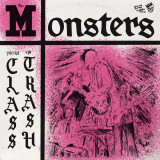
THE MONSTERS - YOU'RE CLASS, I'M TRASH

Dies ist die zweite Auflage von The Monsters "You're Class, I'm Trash", dem noch aktuellem Monsters-Album aus dem Jahre 2021 (erste Auflage war gelb und mit einer 7" Bonus-Single). Diese zweite Auflage hat ein neues pinkfarbendes Sleeve-Design, kommt als 180g Vinyl und mit einem zweiseitig bedrucktem Insert. HI-SPEED-BOOGIE-FUZZ-GARAGE-TRASH-ROCK-N-ROLL FROM LEGENDARY BERNESE GARAGE PUNKS PLAYED WITH A CHAINSAW-ON-STEEL 13 SPLATTER HITS INCLUDING SMALL HORROR OPERA BY SWISS FILM COMPOSER MARIO BATKOVIC The Monsters wurden 1986 in Bern der Schweiz gegründet, als Alternative zur damaligen populären Musik (z. B. Disco, Pop, Top 40 Rock). Sie nannten dies "Teenage Primitive Rock n' Roll Chainsaw Massacre Garage Trash Mix up Rockabilly mit Punkrock und Garage" und haben sich zu einer gefragten Garagen-Punkrockband gemausert, die auf Festivals, in Klubs und großen Hallen so weit gen Osten wie Japan, gen Süden wie Brasilien und gen Norden zu den Skandinavier resit und dort audspielt. Sogar im so Wilden Westen wie New York City in Amerika. Und dann öffnet 2020 die Türen, YAHOO!!! Die Welt wurde komplett abgeschottet und die Pläne aller änderten sich! Da es in naher Zukunft keine Tourneen gäbe, war es jetzt an der Zeit, ein neues Album zu machen. So widmete sich die Band zwei Wochen, um ihren Proberaum aufzuräumen und neue Musik zu schreiben, und 3 Tage im Berner Shirt Off Studio um diese aufzunehmen. Voila! Hier hast du Rosemary's Baby den Knüppel aus dem Sack: 13 raue, laute und spritzig klingende Tracks, die live ohne Overdubs (nur der Gesang/das Geschrei') aufgenommen wurden. Textlich ist das Album eine komplette Katastrophe mit nicht viel mehr als 120 Wörtern, welche aneinandergereiht meistenfalls keinen Sinn ergeben! Es ist eigentlich völliger Quatsch, aber THE MONSTERS lieben es! Das Cover stammt übrigens vom Berner Surrealisten Jerry Haenggli.

pre-order now21.02.2025

expected to be published on 21.02.2025

18,70
Arve Henriksen & Robert Jürjendal - Haihara

Prolific Norwegian trumpeter and ECM veteran Arve Henriksen returns with Estonian guitarist/composer Robert Jürjendal in tow, matching his idiosyncratic shakuhachi-style melodic condensations with Jürjendal's glassy electro-acoustic soundscapes and sonorous percussion.

Henriksen releases a lot but is remarkably reliable; his playing is so versatile that hearing it dematerialise into different ensembles and individual methodologies is always a treat. Jürjendal is a veteran guitarist, but doesn't approach his instrument from a purely classical standpoint, taking a Fripp-inspired path towards texture, processing and looping his sounds until they're barely recognisable. The duo share a similar love for Hassell's Fourth World ambience, and here inject new life into that mood.

Jürjendal's percussion is impressive: he offsets cascades of oddly-tuned electronics on 'Tuonela' with booming, ritualistic tom hits that punctuate Henriksen's melancholy phrases; and on the brilliant 'Ancient Bells', plays a set of gongs and gamelan-style instruments, creating swirling hammered tonal clusters that quiver beneath Henriksen's echoed-out, spirited improvisations. It's not always that corporeal, either; on 'A Remarkable Flow', he loops guitar phrases, creating gentle vibrations that rumble in the background while he mirrors Henriksen's pitchy zig-zags with high-pitched oscillator vamps.

Even on the peaceable 'Miraculous Lake', discreet kalimba loops set a celestial tempo that anchors the duo's gaseous soundscapes. And although they veer towards end-credits loveliness on the Göttsching-influenced 'Reunion Hymn', it’s balanced by the album's darker passages, like 'Rebirth' and 'Another Me'. On the latter, Henriksen's trumpet is transformed into a voice-like warble, while Jürjendal replies with glacial E-bowed drones that resonate creepily alongside his lysergic FM pads.

pre-order now21.02.2025

expected to be published on 21.02.2025

31,89
CLIFFORD THORNTON - Ketchaoua

Clifford Thornton

Ketchaoua

12inchBYG529323
CHARLY
21.02.2025
  • 1: Ketchaoua
  • 2: Pan African Festival
  • 3: Brotherhood
  • 4: Speak With Your Echo (And Call This Dialogue)

After appearing with Archie Shepp at the landmark Pan-African Cultural festival in Algiers in 1969, African-American trumpeter-cornetist Clifford Thornton recorded a set of his own compositions in Paris later that year. The result was Ketchaoua, an important political and spiritual as well as musical statement that reflected the inspiration that he took from Islam. Indeed, the title of the album refers to the awe-inspiring mosque in Algiers.
Clifford Thornton’s superb band comprised his compatriots, saxophonists Archie Shepp and Arthur Jones, drummer Sunny Murray, trombonist Grachan Moncur III, pianist Dave Burrell, and bassist Earl Freeman, as well as French bassist Beb Guérin. Together they brought energy and ingenuity to the leader’s compositions, which were characterized by vivid atmospheres, exploratory, mysterious sounds and haunting themes. And the song titles conveyed an important social and cultural message. Pieces such as ‘Brotherhood’ pointed to the sense of unity and kinship that African-American artists felt with the citizens they encountered on their journey to North Africa and Europe.
This newly remastered deluxe edition of Ketchaoua provides an opportunity to hear one of the major entries in Clifford Thornton’s relatively small yet nonetheless highly impressive discography. It is an album that marks him out as a figure in the avant- garde movement of the late 60s and early 70s who deserves far wider recognition.

pre-order now21.02.2025

expected to be published on 21.02.2025

30,04
Claude Fontaine - La Mer

"With their dulcet fusion of ‘60s French ye-ye pop, slinky Studio One reggae, and liminal Brazilian tropicalia, Claude Fontaine’s songs embody the best kept dreams of a globally connected world. The second album from the Los Angeles artist reflects the dream of creating the soundtrack for this utopia by the sea.

Released on Innovative Leisure, La Mer is a mesmerizing portal. It’s impossible for it to exist outside of the modern moment, but it floats on the gilded dust of the past. At times, Fontaine channels Jane Birkin as backed by Jorge Ben. Francois Hardy locked into sonic reverie with Mulatu Astatke, or Margo Guryan making lovers rock.

None of this is a happy accident. For her second opus, Fontaine assembled some of the most gifted musicians of the last five decades. First and foremost is her co-writer and producer, the multi-platinum Grammy-Award winning Lester Mendez, whose resume includes everyone from Grace Jones and Baaba Maal to Shakira and Nelly Furtado.

As with Fontaine’s self-titled first album, the legendary Tony Chin appears on guitar, bringing the orphic tones expected from someone who has played with some of the greatest reggae musicians of all-time (King Tubby, Dennis Brown, Lee Perry, Jackie Mittoo, Max Romeo, Sly & Robbie). On bass, there’s Ronnie McQueen, one of the co-founders of Steel Pulse. Sergio Mendes’ percussionist, Gibi Dos Santos, supplies propulsive locomotion. So does Ziggy Marley’s drummer, Rock Deadrick. And that’s just the abridged list of storied instrumentalists who appear on La Mer."

out of Stock

Order now and we will order the item for you at our supplier.

33,82

Last In: 15 months ago
DOVS - Psychic Geography LP

Dovs

Psychic Geography LP

12inchBALMAT14
Balmat
19.02.2025

DOVS are the duo of Vienna’s Johannes Auvinen, aka Tin Man, and Mexico City’s Gabo Barranco, aka AAAA. Psychic Geography is their second album together, but it differs considerably from both their respective solo work and their 2019 debut LP together, Silent Cities: Where that album’s hardware-based acid kept its gaze focused squarely on the dancefloor, Psychic Geography is a strictly ambient affair.

The album has its roots in a trio of beatless tracks that peppered Silent Cities; this time, the duo decided to try making an entire album with no drums. “It opened up the chance to make a different, more narrative style of music with more complex structures,” Auvinen says. Ambiguity and uncertainty are key watchwords for their music, which moves with eerie, liquid grace. Untethered from 4/4 kicks, their music drifts and morphs; familiar acid sequences give way to surprising shifts in tone and mood. And with no drums to distract the ear, the seeming simplicity of their silvery synth lines opens up to reveal remarkable depth and dynamism.

Barranco and Auvinen recorded the album together in the studio utilizing machines like the Roland TB-303, Juno G, Prophet 5, Elektron Octatrack MKII, Make Noise DPO and René, Mutable Clouds, Roland SH-101, Behringer TD3, and Sherman Filterbank. Listen on good speakers or headphones, and you can tell: Their gear yields a tonal richness that recalls the ambient and cosmic music of decades earlier. You can practically feel the heat from their circuits warming the air.

The meaning behind the name DOVS is as ambiguous as the duo’s music. (Dig, if you will, the picture of Picasso’s dove of peace—or, perhaps, the outline of a bird pressed into a small white pill.) But Psychic Geography needs little explanation. DOVS’ album is a collection of mental maps of imaginary places. Set your coordinates for the mirage on the horizon and prepare to dissolve.

out of Stock

Order now and we will order the item for you at our supplier.

22,06

Last In: 3 months ago
Loyle Carner - Not Waving, But Drowning LP

Loyle Carner will release his highly anticipated sophomore record, 'Not Waving, But Drowning' on 19 April via AMF Records.

'Not Waving, But Drowning' follows Loyle's BRIT (Best Male, Best Newcomer) and Mercury Prize nominated, top 20 debut 'Yesterday's Gone'. The bedrock of honest and raw sentimentality that you heard on 'Yesterday's Gone' left an inextinguishable mark on music in general and UK Hip Hop in particular, standing out as an ageless, bulletproof debut.

'Not Waving, But Drowning', Loyle's new album, gives yet more evidence - as if it were needed - of his razor-sharp flow and his unique storytelling ability. Yes, he can rap, but he allies that with the sensitivity of a poet, the observational skills of a novelist, and warmth of your best friend. The album opens with 'Dear Jean', a letter to his mother in which he's telling her that he has found the love of his life, 'a woman from the skies', and he's moving out.

It goes without saying that Loyle's music is hard to categorise, but what is even more impressive is that for someone who grew up listening to Mos Def, Biggie Smalls, Roots Manuva, and Wu Tang Clan, he doesn't sound like any of them. Although he might from time to time give lyrical nods to them, he's no imitator.

Loyle loves cooking. There are two tracks on this album named after chefs. The British-Israeli chef Yotam Ottolenghi, and the now deceased Italian chef Antonio Carluccio. 'Ottolenghi' the first single from the album was featured on the BBC Radio 1 B-list, BBC 6 Music A-list and has already been streamed over 5 million times.

Loyle refers to real life for everything, the title of 'Yesterday's Gone' came from a song of his step father, the title of his new album 'Not Waving, But Drowning' comes from a poem by his grandfather, which in turn came from a Stevie Smith poem. What you hear on the track 'Krispy' is real. He is pouring his heart out to his best friend Rebel Kleff after their relationship went downhill, he invites him on the track to say his piece but he doesn't turn up, so we get a flugel solo instead.

Loyle also has his own personal black consciousness movement. When he refers to his 'fathers' in the track 'Looking Back' he really is referring to two fathers. His biological father, a black man who he knows, but knows very little of, and his step father, a poet and musician who happens to be a white man but died a sudden unexpected death from epilepsy (SUDEP). With no real emotional ties to his biological father, but a deep connection with a deceased step-father, where does a young child turn He succinctly captures many of the great, unspoken, cultural and historical paradoxes of multicultural Britain on 'Looking Back'.

An album like this is hard to find. It is for those who like their Hip Hop to have soul, and their soul to have spirit. This is because it works on so many levels, but it is reflecting the personality of its creator. There are a host of collaborators here, Jorja Smith, Rebel Kleff, Kiko Bun, Kwes, Jordan Rakei, Sampha, Tom Misch and more, but none are overpowering. They blend righteously into place.
Loyle is not bitter with people who have let him down, or a society that lets so many down, but the combination of anger and love he has gives his voice the perfect blend of strength and vulnerability. This might be a coming of age album, but it's also a coming of ageless album. Loyle's 2019 Spring tour - which includes London's Roundhouse - sold out within 20 minutes of being on sale.

Not Waving, But Drowning


A rapper that raps about family is hard to find. The boys in the 'hood' tend not to be that interested in how much a 'brother' loves his mother, or how much he misses his dad, or even how much he misses his best friend. The boys in the 'hood' tend to be obsessed with the size of their cars, girls, bank accounts, and other personal 'possessions'. Loyle Carner's Mercury and BRIT Prize nominated debut 'Yesterday's Gone' (Released 2017), made it clear that he wasn't that kind of rapper. In fact, every time I talk to him about his work we talk about the world, and we tended to confuse ourselves by calling his work rap, poems, or songs, sometimes in the same sentence. They are in truth all of these things.


Here's some poetry.


Honestly I need them.

I hate them but I grieve them

I think I've finally found the reason

Trust

Like the fire needs the air.

I won't burn unless you're there.


'Not Waving, But Drowning', Loyle's forthcoming new album, gives us yet more evidence, (if it were needed), that he still has what rappers call, flow, but he hasn't lost any of his story telling qualities. Yes, the boy can rap, but a rapper with the sensitivity of a true poet, the observational skills of a novelist, and warmth of your best friend. The album opens with 'Dear Jean', a letter to his mother in which he's telling her that he has found the love of his life, (a woman from the skies), and he's moving out. He really loves the woman from the skies, but he still loves his mum, and so he reassures her that there is no competition, and tells her that 'She's not behind me or behind you, but beside we and beside two', his words. Or to put it another way, moving out without moving out. My words.


It goes without saying that Loyle's music is hard to categorise, but what is even more impressive is that for someone who grew up listening to Mos Def, Biggie Smalls, Roots Manuva, and Wu Tang Clan, he doesn't sound like any of them. Although he might from time to time give lyrical nods to them, he's no imitator. He says finding his own voice was something he always found easy. Although young, (in terms of a musical career), he has confidence in his own words and his own voice, and has never been tempted to sound like he's been hanging out in the USA, or rolling in 'Grime' on the mean streets of East London. And so when it comes to the creative process he doesn't simply find a beat to jump on and ride. Beats are important, but they are tenderly layered with samples, keyboards, or live drums, all imaginatively assembled for the laying on of words. Some tracks start with the idea, some with poetry, and some with a verse from a singer or some other melodic inspiration, but there is no formula.


Here's some poetry.


Don't hold any memories of us

Rather hold you everyday until the memories are dust

Yo we only caught the train

Cos you know I hate the bus


A prolific reader, who has dyslexia is hard to find. Add ADHD (Attention deficit hyperactivity disorder) to that and life should become even more difficult. To deal with your difficulties you devise coping strategies, which can differ from person to person. Loyle loves cooking. There are two tracks on this album named after chefs. The British-Israeli chef Ottolenghi, and the now deceased Italian chef Antonio Carluccio. Loyle describes himself as 'weird' because he is happy to read a cookbook as if he was reading a novel or a book of poetry. He has opened a cookery school for young adults not just because he loves food and wants to make more of it, but because it is one of the few things that can focus the ADHD mind. And when it comes to his other love, football, his approach is the same. Focus. He wanted to be a striker he says, up front scoring goals, but found his best position was in midfield because he was able to focus, check options, and see passes ahead of time, providing passes for other players just when they needed them. He says, 'You don't grow out of ADHD, you grow into it.' Loyle is also working with Levi's® on their music project where he is mentoring young musicians over a six month period, culminating at Liverpool Sound City festival.


More poetry.


When the going is tough

I wait till it falls on deaf ears

Hearsay

Without the boundaries of love


He also said, 'Ask most people and they will say that they love their mothers, but most are not going to rap about her'. On his first album Loyle's mum Jean wrote about the 'scribble of a boy' that growing up would take things apart to see how they worked. On this album she speaks with pride about a man who has found his place in the world.


Yes, poetry.


I'm still looking for the answers

Trying to find the right questions

Still waiting for my fathers

But can't break them in to sections


This poetry is serious. Loyle has his own personal black consciousness movement. He told me that he always felt safe at home, and being the darkest one in the family never meant a thing, but then when he had to face the outside world he felt hostility. It shook him up. Now he had to start asking questions, but what were the questions. This is serious. When he refers to his 'fathers' in the verse above taken from the track 'Looking Back' he really is referring to two fathers. His biological father, a black man who he knows, but knows very little of, and his step father, a poet and musician who happens to be a white man but died a sudden unexpected death from epilepsy (SUDEP). So to whom would a young black (or mixed race) kid turn He succinctly captures many of the great, unspoken, cultural and historical paradoxes of multicultural Britain when he says, 'My great grandfather could of owned my other one.' We are a people descended from enslaved people on one hand, and enslavers on the other, something we are still struggling to come to terms with, and this can be apparent in one family. A big book could have told you that, but here we get it in one line on the track, Looking Back.


Loyle refers to real life for everything. The album is peppered with captured moments that he records on his phone. These moments can range from conversations with taxi drivers, to capturing the moment when England scores a goal in the world cup. The title of 'Yesterday's Gone' came from a song of his step father, the title of his new album 'Not Waving but Drowning' comes from a poem by his grandfather, which in turn came from a Stevie Smith poem. What you hear on the track 'Krispy' is real. He is pouring his heart out to his best friend after their relationship went downhill, he invites him on the track to say his piece but he doesn't turn up, so we get a flugel solo instead. Yes people, this is real.


An album like this is hard to find. It is for those who like their Hip Hop to have soul, and their soul to have spirit, this is an album for those who have, (I'm sorry, I'm going to say it), emotional intelligence. This is because it works on so many levels, but it is reflecting the personality of its creator. There are a host of collaborators here, Jorja Smith, Rebel Kleff, Kiko Bun, Jordan Rakei, Sampha, Tom Misch and more, but none are overpowering. They blend righteously into place. Loyle is not bitter with people who have let him down, or the society that has let him down, but the combination of anger and love he has gives his voice the perfect blend of strength and vulnerability. This might be a coming of age album, but it's also a coming of ageless album. His first album worked, and this second album is a continuation of that work. Not creating a form, but being formless, as someone like Bruce Lee once said.

And here's some poetry from mum.


We talked long in to the darkest hours

Until we saw the burnished sky

And our eyes stung

As our words blurred and became thoughts

As we were silenced by the dawn

We clung to each other like sailors in a storm

out of Stock

Order now and we will order the item for you at our supplier.

35,25

Last In: 15 months ago
Allgood (Halgurd) - Adventure Awaits

Allgood (Halgurd) is a Dutch (Almere) based Producer. He started in 2007 and came to know the world of DAWs and there he started making bubbling remixes to songs, later on he fell in love with making Hip-Hop Beats, he made beats for his Rapper friends. In 2012 till 2017 he was a volunteer at a small studio, where he learned much more about music.

His teacher was Legendary NeverTheLess who produced for big names like Extince and Brainpower. He is inspired by various artists and different genres, in Hip-Hop, LoFi and Jazz.

He has done collabs with names like: JazzyHan ilaywho CaliCronk Bad Scientist Jokujekku SYNC.EXE Kanimayo Soulful. Dr Kaleidoscope Annawak muun and more.

pre-order now15.02.2025

expected to be published on 15.02.2025

42,82
JON HOPKINS - INSIDES

Jon Hopkins

INSIDES

12inchTAOLP064
Just Music
14.02.2025

‘Insides is a cracking album of shifting ambient moods, riding on the cusp of technology without forgetting emotive credence’ 9/10 FUTURE MUSIC
Originally released in 2009 Insides is Jon’s third solo album and will be made available from the 18th December 2020 on the Just Music label, following on from his first two Just Music albums, Opalescent and Contact Note. It paved the way for both Immunity (his hypnotic breakthrough solo album) and Diamond Mine (his collaboration with King Creosote) which attracted Mercury nominations and for his recently released fifth solo artist album, Singularity.
The epic Light Through The Veins from Insides, which bookends Coldplay’s Viva La Vida album, is always a crowd favourite and is played by Jon as one of the closing tracks at almost all of his venue and festival shows. Small Memory, also from Insides has been streamed almost 57 million times on Spotify alone where Jon has 355, 462 followers and nearly 2 million monthly listeners.
Cited by The New Yorker as “One of the most celebrated electronic musicians of his generation”, electronic artist, producer and composer Jon Hopkins has forged a reputation for music that marries the dance floor to the devotional, and for live performances that are visceral, generous and charged with a rapt, sensuous beauty.
Jon has remixed artists as diverse as Flume, David Lynch, Moderat, Disclosure, Four Tet, Wild Beasts and Purity Ring. Other projects include collaborations with Natasha Khan of Bat For Lashes and Bonobo, as well as productions for London Grammar and Coldplay. His film credits include his Ivor Novello nominated score for the indie sci-fi classic Monsters, The Lovely Bones (scored with Brian Eno and Leo Abrahams), How I Live Now, Uwantme2killhim? and Rob and Vanentyna in Scotland. He also scored the National Theatre Live production of Hamlet and his work has appeared in many films and adverts.
‘Lilting piano and strings give way to industrial glitch with a calculated force, shifting the mood from tranquillity to terror’ 7/10 CLASH
‘Hopkins is a conjurer, an illusionist, symbolically combining imagery and sounds that shouldn’t work together, creating new dimensions of listening’ KRUGER

out of Stock

Order now and we will order the item for you at our supplier.

28,15

Last In: 15 months ago
Tordenskjolds Soldater - Peace

Black Vinyl / 350 mcn double white coated paper / Poster sleeve / PVC outers / Original artwork / Exclusive 30x30 cm insert with Q&A by Tony Higgins with Ole Matthiessen printed on on 250 gram Gardamat coated paper. Archive picture from original recording session printed on 350 gram Gardamat paper. Archive pictures printed on 375 gram Vintage Bindakote Monolucido. All papers are acid free an printed with food based inks.

Personnel: 

Jesper Nehammer - tenor saxophone
Ole Mathiessen – piano
Jon Finsen – drums
Henrik Hove - bass

Notes:
Danish jazz band founded in 1969. Band line up: Henrik Hove on bass, Ole Mathiessen on piano, Jesper Nehammer (later Thors Hammer, Alrune Rod and Entrance) on tenorsax, and Jon Finsen on drums. Played for a while every Monday in the famous Jazzhouse Montmatre in Copenhagen.
Tordenskjolds Soldater only made this record (1970).
The small record label Spectator Records was founded in 1969 by Jørgen Bornefeldt a former journalist from Danmarks Radio in coorporation with the jazz musician Carsten Meinert. Meinert recorded two albums on the label. He only joined the company in the beginning. Cindarellaistudiet The studio was destroyed august 6th 1972 by a major fire. And that was the end of Spectator Records. From 1969 to the end, the label recorded at least 23 lp albums and 9-11 singles/EP's. The picture shows Henning Kragh Pedersen from Cinderella in Spectators studio. The great Danish rock band Gasolin recorded their first single – Silky Sally - on Spectator Records. It was no success and sold only 155 copies. Silky Sally is now one of the most sought after Gasolin singles among collectors and is of course very expensive.
The music from Spectator Records is mostly jazz, progressive rock and hippie free style. But they also made strange records for children, education etc. Most records were issued in very small numbers (300-500). Some of the best progressive rock in Northern Europe was recorded here.
Quality of vinyl was often poor - even new looking records can have audible problems. Covers and labels are primitive and cheap. On the other hand the creativity could be outstanding - check the Furekaaben cover gallery or the artwork of William Skotte Olsen from Green Grass. Several record from the labels are cult today. A perfect copy of certain records costs a fortune.
Master tapes was never found after the fire in 1972. Unofficial reissues and bootlegs are therefore made on the base of the original records. Recordings that never made it to the vinyl got lost in the fire. Both Cinderella and The Copenhagen based band, Lines lyst, had material readdy for lp's which was never recorded. (Tony Higgins)

pre-order now14.02.2025

expected to be published on 14.02.2025

33,82
Joe McPhee - I’m Just Say’n

Free jazz poetry by a spry, 85 year old Joe McPhee, adapting his renowned improvised practice to words - juxtaposed with Mats Gustafson’s sparing brass and electric gestures. It’s an utterly timeless and transfixing salvo, another shiny notch for Smalltown Supersound’s Le Jazz Non Series.

As a common ligature to the OG free jazz scene of ‘60s NYC, with formative binds to its European offshoots and the experimental avant garde, Joe McPhee is a true force of nature who has represented jazz at its freest over a remarkable lifetime. In duo with Swedish free jazz and noise standard bearer Mats Gustafson, he upends expectations with an astonishingly vivid and upfront example of his enduring contribution to freely improvised music. In 11 parts he variously reflects on everything from the neon sleaze and scuzz of NYC to contemporary US politicians and laugh out loud imitations of his previous sparring partners such as Peter Brötzmann, with a head-slapping immediacy that leaves you reeling, spellbound.

McPhee’s flow of rare, organic cadence, ranging from urgent to contemplative and dreamlike, is blessed with a unique turn-of-phrase that surely mirrors his decades of instrumental work. Gustafsson, meanwhile, dextrously takes up the mantle with a multi-instrumental spectrum of sounds, leaving McPhee unbound and able to float and sting on the mic. There’s obvious wisdom in his perceptively penetrative observations, as derived from a rich cultural life well spent, but also a playful naivety and levity in his ability to veer from almost melodic speech to explosive aggression and a knowing, bathetic wit. It’s perhaps hard to believe that McPhee only started incorporating and performing spoken word in his work in the past ten years, a half century since his declaration of “What Time Is It‽” announced his arrival on a legendary debut ‘Nation Time’ (1971), ushering in one of free jazz’s most singular characters in the process.

Oscillating between discordant reflections on life as a touring musician, set to Gustafsson’s skronk and culminating in a snort-worthy imitation of Peter Brötzmann’s gruff German accent, on ‘Short Pieces’ or the glowering growl and noise exhortations of ‘Guitar’, he evokes a more sweetly consonant calm in ‘When I Grow Up’ and eerie threat of ‘The Dreams Book’, and viscerality of ‘Disco Death’, where Gustafson’s tonal versatility comes into hugely mutable play, whilst McPhee’s extraordinary, unaffected voice is a constant. It’s perhaps McPhee’s balance of cool measuredness and wellspring of barbed energies that allows us, at least, to get the most out of this one; not stifling with mannered or manicured enunciation that can trigger certain icks; keeping close to the nature of spoken word in a way that avoids cliche and becomes inherently critical of it within his purposeful, non-hesitant clarity and unflinching approach.

pre-order now14.02.2025

expected to be published on 14.02.2025

31,89
Various - Do Your Own Dance! - Scorpgemi Records Story Vol. 1

Do Your Own Dance! VARIOUS ARTISTS
Chic’s Nile Rogers is lauded as an international star and the recently departed Patrick Adams is acknowledged as one of the most important pioneers of disco music, but behind them were an army of lesser-known musicians, producers, and arrangers including one of the founding-fathers of New York Dance, the enigma Lonnie Johnson.
Scorpgemi Records and Lonnie Johnson, the man behind the label, will be unknown to most, but he was an important figure at the birth of dance music. His label featured work by several leading voices of the New York scene and provided one of New York’s most instantly recognisable dance music records— “Keep In Touch (Body To Body)”—one of the greatest club cuts ever.. But Johnson himself leaves hardly a trace, a behind-the-scenes person, and a friend of Patrick Adams who is only known to those who study the small print on record labels.
So, Lonnie Joel Johnson proves to be both highly influential, and almost completely elusive. A backroom person, who created an anthem across the Atlantic from his home base in New York. A man who was instrumental in the development of Patrick Adams’ career from producer of vocal groups to the go-to producer for dancefloor gold. Yet, for all this there are no biographical details, no interviews and almost nothing left behind except for a small but fantastic catalogue of music.
The first ever curated works of the Broadway based Scorpgemi label Produced by Lonnie Johnson, one of the founding-fathers of New York Dance Dancefloor Gold from the enigma that is Lonnie Joel Johnson, the man behind the career of the legendary Patrick Adams.

pre-order now14.02.2025

expected to be published on 14.02.2025

29,20
Mulatu Astatke - New York - Addis - London LP

REPRESSED !!

Vibraphone and keyboard player, master arranger and bandleader, Mulatu Astatke is one of the all-time greats of Ethiopian music and the creator of his own original music form, Ethio jazz. Through the acclaimed Ethiopiques album series and through featuring on the soundtrack to the Jim Jarmusch film Broken Flowers, his music has belatedly reached a global audience and a new, younger generation of fans. In November of last year, he recorded an inspired new album with London psych jazz band The Heliocentrics for Strut's 'Inspiration Information' studio collaboration series. Now, Strut are proud to present, for the first time anywhere, the definitive Mulatu career retrospective covering his landmark 60's and 70's recordings.
Mulatu is a true pioneer of African music. He was the first Ethiopian musician of his generation to travel extensively and to record abroad - he studied in the UK in Wales and at Trinity College Of Music in London, cutting his teeth on the buoyant London jazz scene of the early 60's. He became the first African student to attend Harvard and he lived and recorded in New York, developing a unique sound that fused Western jazz with traditional Ethiopian melodies.
Tracing the progression of his Ethio jazz experiments with full access to all of the labels for whom he recorded, Mulatu Astatke: New York-AddisLondon is the essential Mulatu. Covering his first recordings in the UK during 1965, his groundbreaking fusions for the small Worthy label in New York and his key '70s recordings back in Addis on Amha, Phillips and Axum, the album features comprehensive sleeve notes by Miles Cleret, boss of the excellent Soundway Records imprint, and rare, previously unseen photos from Mulatu's personal archive.

out of Stock

Order now and we will order the item for you at our supplier.

34,66

Last In: 16 years ago
Jean-Claude Vannier - Jean-Claude Vannier Et Son Orchestre De Mandolines (LP)
  • Moi, Ma Mandoline (Me, My Mandolin)
  • Comme Les Enfants Savent Aimer (How Children Know To Love)
  • LA 2: Cv Disparaît Au Coin De La Rue (The 2Cv Disappears Around The Corner)
  • Perdue Dans La Cité (Lost In The City)
  • Il Y Avait Des Éléphants (There Were Elephants)
  • À Cause De Mes Problèmes (Because Of My Troubles)
  • Une Séance Photo Sous Les Arcades (A Photoshoot Under The Arcades)
  • Belle À Pleurer (Beautiful Enough To Cry Over)
  • Danse Des Maillots De Bain (Swimsuit Dance)
  • Nos Regards Se Sont Croisés (Our Eyes Crossed)
  • LA 2: Cv Rouillée (The Rusty 2Cv)
  • Un Petit Bout De Verre Cassé (A Small Piece Of Broken Glass)
  • Les Feux Arrière De L'ambulance (Ambulance T

Ein verspieltes Album mit klangschönen Träumereien, komponiert für Mandoline und Akkordeon, poetisch und unbändig zugleich. Es ist das erste Mal, dass der stets kreative Komponist speziell für die Mandoline geschrieben hat. Auf dem Album ist auch Vincent Beer-Demander zu hören, dessen Mandoline zu einem Orchester multipliziert wird, um eine einzigartige Klangpalette zu schaffen, die sorgfältig mit dem Akkordeon von Grégory Daltin kombiniert wird.

Mike Patton, der mit Vannier an dem 2019 erschienenen Album 'Corpse Flower' gearbeitet hat, sagt über die Veröffentlichung seines neuen Albums auf Ipecac: „Jean Claude ist ein guter Freund, Mentor und ein wunderbar talentierter und exzellenter Komponist. Eine Legende. Es ist eine große Ehre, mit ihm gearbeitet zu haben. Seine Texte und Arrangements haben eine Vielzahl von Künstlern beeinflusst, und ich kann mich zu den Glücklichen zählen, die seinen Weg gekreuzt haben. Er hat schon bahnbrechende Sachen geschrieben, bevor ich überhaupt geboren wurde. Er hat mich tief beeinflusst und ich bin ihm für immer dankbar und voller Ehrfurcht“.

Jean Claude Vannier, der von der Presse als „the rare bird“ bezeichnet wird, hat in den letzten 60 Jahren unter anderem mit Serge Gainsbourg und Jane Birkin sowie mit Künstlern wie Beck und Sean Lennon zusammengearbeitet. Er hat an unzähligen Soundtracks mitgewirkt, sechs Soloalben veröffentlicht und ist eine Ikone der französischen Popkultur, die für den Eurovision Song Contest komponiert, Videos gedreht, Gemälde ausgestellt, Radiosendungen moderiert und Kurzgeschichten veröffentlicht hat.

pre-order now14.02.2025

expected to be published on 14.02.2025

24,33
Joeyfat - The House Of The Fat LP

The 2003 debut album and a collection of early rarities from the genuine treasure of the UK underground. Remastered and available on vinyl for the first time in over two decades. “Legendary angular rock…Edgar Allen Poe meets The Fall” (The Guardian 2003) “Jarvis Cocker fronting Fugazi” (Melody Maker 1994) Joeyfat, from Tunbridge Wells in Kent, are the daddy of all the Sprechgesang bands out there. We searched on Wikipedia; they're not even mentioned. Maybe not such a bad thing. There are young scamps climbing up festival line-ups all over the world with more than a passing sonic and aesthetic resemblance. Influence can be picked up in diluted ways, maybe the true source of the river has been forgotten. Foals heard the source, they were there. So were Everything Everything. Ask them. Black Midi heard it third hand. Life Without Buildings heard it. So did Yard Act. You can see the pattern. From the early '90s Joeyfat, led by Matt Cole and Jason Dormon, have been perfecting and re-perfecting the sound. They toured with Green Day in 1994. They released music on the Fierce Panda label. They recorded BBC Sessions for John Peel and Marc Riley and released four albums and countless singles. They flirted with being known and they didn't like what they saw so they kept it local, building a community by setting up the Tunbridge Wells Forum, one of the great UK small venues. Debut album The House Of The Fat is a masterpiece, the musical precision recalls The Sound or B52s. The spot-on attack of the vocal and lyrics makes us think of Fugazi or Zounds. The Unwilling Astronaut compiles early singles and compilation tracks. Going all the way back to 1993 it shows how close to a DC-inspired hardcore band they were, it's a thrilling listen. Joeyfat shouldn’t need a re-introduction but they’re going to get one. The source of the river. The top of the family tree. This is where the resemblance comes from

pre-order now14.02.2025

expected to be published on 14.02.2025

26,01
Bruce - The Price / Mimicry

Bruce

The Price / Mimicry

7"-VinylPORK001
Poorly Knit
13.02.2025

Bruce is back!! Unveiling his new label Poorly Knit with two warped club creations on 7" vinyl... In Bruce we trust.

Hessle Audio and Timedance alumni Bruce, is cast out of the heavens following his dream-pop-heartbreak excursions, coiling back to the mortal and old faithful dance floor once more.

Fallen in fury, he treads alone on his new imprint, Poorly Knit, lashing out with two twisted and tangling tracks, The Price & Mimicry. Obscure sound design and unhinged samples are stitched into bass-bin-devastating rhythm and melody, cementing and serenading the burial of all DJs brave enough to step up.

Cut to small but deadly hand-stamped 7”, each side taunts a different flavour of his snickering, singular, soundsystem homecoming.

A true and ever-evolving artist, Bruce welcomes us back into his brave new world once again, a wholly refreshing release to start the year, and the new chapter has only just begun…

out of Stock

Order now and we will order the item for you at our supplier.

14,08

Last In: 15 months ago
Various - Praise Poems, Vol. 10 LP 2x12"

Watch out! You are holding the 125th (one-hundred-and-twenty fifth!) album on Tramp Records in your hands! We are honored to celebrate this impressive anniversary with the tenth volume in the Praise Poems series. This time, too, we go on a journey to discover previously unheard regions of jazz, folk and AOR from the 1970s and 80s.

Praise Poems Vol.10 presents sixteen (almost) forgotten rare groove gems, all released between the years 1970 and 1984. One of the many highlights is the opening track: "Fields of Laughter" by Color Me Blu - originally released on an acetate only of which two copies exist worldwide. But there is much, much more to discover. This brandnew volume features a wide range of genres, from AOR (Whiz Kids, Ross Miller, and another previously unreleased track by Harve & Charee) to Latin-Rock a'la Santana (Color Me Blue, Tribal Sinfonia, and Apple) to Soul-Jazz (Ernie Lewis Trio, Joe Bozzi Quintet or Dutch saxophonist Frits Kaatee). Right at the end, one track in particular stands out: the wonderful "It's Good Not To Forget" by George Melvin and his quintet - a fabulously dreamy, thoughtful instrumental piece in the style of Ramsey Lewis with catchy tune potential.

Not many compilation series make it to a tenth edition. And if they do, then you often notice that the quality of the songs goes in the opposite direction to the increasing number of series: namely decreasing. Not so with Praise Poems Vol. 10, which the creators prove in an impressive new way. They have found tracks that were originally either a) pressed by the musicians themselves in very small editions or b) released by small, regional labels. It is understandable that neither the musicians nor these small labels had the necessary knowledge or budget to market their albums or singles professionally. The majority of the bands therefore did not manage to reach a large audience - although they certainly had the potential for the big stage.

"Praise Poems 10 - A journey into soulful jazz and funk from the 1970s" makes these almost 50-year-old treasures accessible to a new audience. We hope that you enjoy discovering your personal favorite song(s) and we are already looking forward to many more releases!

out of Stock

Order now and we will order the item for you at our supplier.

24,16

Last In: 12 months ago
Various - ECHOES OF ITALY - ARTISTS IN WONDERLAND – EARLY 90S HOUSE VIBES VOL.1 LP 2x12"

Volume 1 of this expertly curated project of 90s Italian House - put together by Don Carlos.

If Paradise was half as nice… by Fabio De Luca.

Googling “paradise house”, the first results to pop up are an endless list of European b&b’s with whitewashed lime façades, all of them promising “…an unmatched travel experience a few steps from the sea”. Next, a little further down, are the institutional websites of a few select semi-luxury retirement homes (no photos shown, but lots of stock images of smiling nurses with reassuring looks). To find the “paradise house” we’re after, we have to scroll even further down. Much further down.

It feels like yesterday, and at the same time it seems like a million years ago. The Eighties had just ended, and it was still unclear what to expect from the Nineties. Mobile phones that were not the size of a briefcase and did not cost as much as a car? A frightening economic crisis? The guitar-rock revival?! Certainly, the best place to observe that moment of transition was the dancefloor. Truly epochal transformations were happening there. From America, within a short distance one from the other, two revolutionary new musical styles had arrived: the first one sounded a bit like an “on a budget” version of the best Seventies disco-music – Philly sound made with a set of piano-bar keyboards! – the other was even more sparse, futuristic and extraterrestrial. It was a music with a quite distinct “physical” component, which at the same time, to be fully grasped, seemed to call for the knotty theories of certain French post-modern philosophers: Gilles Deleuze, Félix Guattari, Paul Virilio... Both those genres – we would learn shortly after – were born in the black communities of Chicago and Detroit, although listening to those vinyl 12” (often wrapped in generic white covers, and with little indication in the label) you could not easily guess whether behind them there was a black boy from somewhere in the Usa, or a girl from Berlin, or a pale kid from a Cornish coastal town.

Quickly, similar sounds began to show up from all corners of Europe. A thousand variations of the same intuition: leaner, less lean, happier, slightly less intoxicated, more broken, slower, faster, much faster... Boom! From the dancefloors – the London ones at least, whose chronicles we eagerly read every month in the pages of The Face and i-D – came tales of a new generation of clubbers who had completely stopped “dressing up” to go dancing; of hot tempered hooligans bursting into tears and hugging everyone under the strobe lights as the notes of Strings of Life rose up through the fumes of dry ice (certain “smiling” pills were also involved, sure). At this point, however, we must move on to Switzerland.

In Switzerland, in the quiet and diligent town of Lugano, between the 1980s and 1990s there was a club called “Morandi”. Its hot night was on Wednesdays, when the audience also came from Milan, Como, Varese and Zurich. Legend goes that, one night, none less than Prince and Sheila E were spotted hiding among the sofas, on a day-off of the Italian dates of the Nude Tour… The Wednesday resident and superstar was an Italian dj with an exotic name: Don Carlos. The soundtrack he devised was a mixture of Chicago, Detroit, the most progressive R&B and certain forgotten classics of old disco music: practically, what the Paradise Garage in New York might have sounded like had it not closed in 1987. In between, Don Carlos also managed to squeeze in some tracks he had worked on in his studio on Lago Maggiore. One in particular: a track that was rather slow compared to the BPM in fashion at the time, but which was a perfect bridge between house and R&B. The title was Alone: Don Carlos would explain years later that it had to be intended both in the English meaning of “by itself” and like the Italian word meaning “halo”. That wasn’t the only double entendre about the song, anyway. Its own very deep nature was, indeed, double. On the one hand, Alone was built around an angelic keyboard pattern and a romantic piano riff that took you straight to heaven; on the other, it showcased enough electronic squelches (plus a sax part that sounded like it had been dissolved by acid rain) to pigeonhole the tune into the “junk modernity” section, aka the hallmark of all the most innovative sounds of the time: music that sounded like it was hand-crafted from the scraps of glittering overground pop.

No one knows who was the first to call it “paradise house”, nor when it happened. Alternative definitions on the same topic one happened to hear included “ambient house”, “dream house”, “Mediterranean progressive”… but of course none were as good (and alluring) as “paradise house”. What is certain is that such inclination for sounds that were in equal measure angelic and neurotic, romantic and unaffective, quickly became the trademark of the second generation of Italian house. Music that seemed shyly equidistant from all the rhythmic and electronic revolutions that had happened up to that moment (“Music perfectly adept at going nowhere slowly” as noted by English journalist Craig McLean in a legendary field report for Blah Blah Blah magazine). Music that to a inattentive ear might have sounded as anonymous as a snapshot of a random group of passers-by at 10AM in the centre of any major city, but perfectly described the (slow) awakening in the real world after the universal love binge of the so-called Second Summer of Love.

For a brief but unforgettable season, in Italy “paradise house” was the official soundtrack of interminable weekends spent inside the car, darting from one club to another, cutting the peninsula from North to centre, from East to West coast in pursuit of the latest after-hours disco, trading kilometres per hour with beats per minute: practically, a new New Year’s Eve every Friday and Saturday night. This too was no small transformation, as well as a shock for an adult Italy that was encountering for the first time – thanks to its sons and daughters – the wild side of industrial modernity. The clubbers of the so-called “fuoriorario” scene were the balls gone mad in the pinball machine most feared by newspapers, magazines and TV pundits. What they did each and every weekend, apart from going crazy to the sound of the current white labels, was linking distant geographical points and non-places (thank you Marc Augé!) – old dance halls, farmhouses and business centres – transformed for one night into house music heaven. As Marco D’Eramo wrote in his 1995 essay on Chicago, Il maiale e il grattacielo: “Four-wheeled capitalism distorts our age-old image of the city, it allows the suburbs to be connected to each other, whereas before they were connected only by the centre (…) It makes possible a metropolitan area without a metropolis, without a city centre, without downtown. The periphery is no longer a periphery of any centre, but is self-centred”.

“Paradise house” perfectly understood all of this and turned it into a sort of cyber-blues that didn’t even need words, and unexpectedly brought back a drop of melancholic (post?)-humanity within a world that by then – as we would wholly realise in the decades to come – was fully inhuman and heartless. A world where we were all alone, and surrounded by a sinister yellowish halo, like a neon at the end of its life cycle. But, for one night at least, happy.

out of Stock

Order now and we will order the item for you at our supplier.

28,99

Last In: 16 days ago
Gyasi - Here Comes the Good Part

Gyasi

Here Comes the Good Part

12inchLPALIVE0237
Alive Records
07.02.2025

Described by Rolling Stone magazine as “a glam rock triumph,” the multi-faceted rocker Gyasi (Jah-See) delivers his second studio album, “Here Comes The Good Part,” a glittery and fun universe filled with infectious hooks and searing guitar riffs, alongside songs of self-transformation. Teaming up with co-producer Bobby Holland, Gyasi expands his sound, exploring a wider palette of musical ideas. Mostly recorded with his touring band, it also features guest appearances by drummer Daru Jones. “Here Comes The Good Part” is a bold exploration of theatrical rock n’ roll, through the lens of a small-town West Virginia kid seeking self-discovery.

pre-order now07.02.2025

expected to be published on 07.02.2025

29,37
THE MOLES - COMPOSITION BOOK
  • 1: Feel Like A Dollar
  • 2: Chimes
  • 3: Alvin Hollis
  • 4: Lost Generation
  • 5: Since I Don't Know When
  • 6: Rattlesnakes, Vampires, Horse Tribes And Rocket Science
  • 7: One Day
  • 8: Tragedy
  • 9: Had To Be You
  • 10: Blow Yer Mind
  • 11: Promised Land

“Richard Davies is one of the last great songwriters on planet Earth. Every song on Composition Book is up there with his finest and so it's no small feat that after 35 years of making beautiful records, this one is his best.” – Robert Pollard / Guided By Voices Australian mad scientist Richard Davies has long flown under the popular radar with his groups The Moles and Cardinal, but his 10 albums are loved and championed by indie rock royalty. The Flaming Lips, for example, have recorded a Davies song and backed him up on a Moles tour in 1995. A scholar of the songwriting of The Beatles, The Beach Boys, Dylan et al., Davies spins off subtle, catchy indie rock melodies, sometimes reassembled in bizarre Frankenstein arrangements and deconstructed sonic derangements. On Composition Book, The Moles have evolved with emphasis on acoustic guitar and divine female voices. Davies’ lyrical non sequiturs and caustic wit sting, surprise and delight. “The Australian-bred, New England-based Richard Davies has long been a secret-handshake artist for indie diehards; his songs suggest self-contained pop hits from a crooked dimension.” – The New Yorker “The greatest differentiator between the work of the Moles and that of their contemporaries, though, is Davies himself. As a presence, there is something deeply and beguilingly inscrutable about him, a purposeful blankness that betrays an enormous amount of weight and depth behind it, and oozes both vulnerability and vitriol when it breaks and cracks.” – Pitchfork

pre-order now07.02.2025

expected to be published on 07.02.2025

25,20
Items per Page:
N/ABPM
Vinyl