There’s something new under the sun. If you look at it closely,
something new is only (and always) created at crossroads –
when different and signi¦cant traditions are connected and
combined. On their own, these traditions have often existed
for a while. However, in this new form they have never
appeared together. The latest manifestation of something
new can now be found on the album “No Future Dubs”, the
interpretations of “No Future Days” – the most recent album
by German band Messer – by Finnish producer and old
friend of the group Kimmo Saastamoinen aka Toto Belmont.
The intentional traditions that merge on this grand and
digni¦ed album are post-punk, dub and techno. A new
chapter in the culturally constant narrative of dub is written
here. Through their past and parallel activities in hardcore
and post-punk bands, Messer drummer Philipp Wulf met and
befriended Kimmo, originally a drummer too. In their
continuous dialogue discussing their musical journey, Philipp
and Kimmo over the years more and more immersed
themselves in the aesthetic possibilities of dub and reggae.
Indeed, lots of musicians do not listen to the type of music at
home that they write and play in their respective projects
(Take me as an example: House is the music that I produce
and put on as a DJ. On my own, I listen to various stuff,
music by Monk and Messer for example). The same applies
to the protagonists involved here. By discussing dub und
through Toto Belmont’s steadily increasing producingexpertise, the idea of creating dub versions of selected
Messer tracks was born. The Messer album “No Future
Days”, released in 2020, proved to contain the perfect raw
material as the songs on this album are already produced in
a much more transparent way than on previous LPs – and
are hence more suitable for dub. Still, it’s a giant leap from
the originals to the dubs. These add a third dimension to the
described character of the post-punk/dub amalgam: techno.
The result is a sound that hasn’t existed before, especially
not with German lyrics (which scarcely, however, carry
meaning or messages here. Hendrik Otremba’s voice is used
more like an instrument, as if he was the ghostly ¦gure which
he often sings about and which now §oats and screams
through the sound space). The history of mutual contact and
in§uence of (post-)punk and dub (reggae), which Messer
have kept on writing, is glorious and reaches back far in
musical history. Still, it has always been a rather marginal
chapter not only in punk but also in dub history. But already
in the beginnings of punk (the British version, less the
American one), the presence and in§uence of reggae was
obvious in many places as both are united in their resolute
attitude as rebel music. This is how the two genres
recognized each other – especially the punks regarded
reggae as rebellious. As is known, already Johnny Rotten
mainly listened to dub in private. By using the name John
Lydon, he then – together with bass player Jah Wobble –
established the group PiL as one of the most exemplary
bands at the crossroads of dub and punk. The Slits, Pop
Group, Killing Joke, The Ruts and last but not least The Clash
along with the Mick Jones offshoot Big Audio Dynamite –
the thriving British music scene in the early 80s was full of
dub-in§uenced acts. The echoes meandered everywhere. In
the USA, it took longer until the in§uence of dub became
noticeable and it has never been as distinctive as in the UK.
The history of US hardcore, however, cannot be told without
bands like Bad Brains from Washington D.C. who on their
albums occasionally inserted conscious reggae and dub
tracks between breakneck hardcore tracks. Another
important group is Blind Idiot God who similarly included
dub tracks on their LPs – the contrast between densely
droning rock tunes and widely breathing dub versions can be
experienced very vividly here. In the 90s, dub’s in§uence on
post-punk decreased while turning up even more distinctively
somewhere else: Techno was in many respects susceptible
to dub, to say nothing of the music from the so-called British
hardcore continuum (jungle, drum & bass etc.), which directlydeveloped from dub and reggae. But also “pure” techno –
meaning techno without breakbeats – discovered its a¨nity
for the possibilities of dub at an early stage, in England for
instance in projects like Left¦eld or The Orb. In addition, the
project Rhythm & Sound was established in Berlin with close
ties to the Hardwax record store. With regard to this project,
you can’t really say where dub ends and where techno begins
(or vice versa) because of the interconnection of the two
genres here – everything is based on the steppers pulse
which links the two styles like a common DNA. With dub
techno a new genre was created. Until the present day, there
are producers who don’t produce anything else and DJs who
don’t put on any other music. The Messer dubs are
characterized by a grand majestic manner and force that
presumably someone like Mad Professor is able to produce
and that is also inherent in many Scandinavian productions
of the last 15 years; a crystal-clear aesthetic which locates
itself far away from Kingston or Brixton, but features a pulse
referring clearly to Berlin and Helsinki. The songs appear in a
completely new and deconstructed form, the instruments are
exclusively used as particles and raw material, not as riffs;
merely glaring guitar textures ¦ll the wide dub space. There
are many new elements that were added by Toto Belmont,
especially synthesizer sounds and drums. The ¦nal result
creates an enormous aesthetic power and dignity, and an
atmosphere you don’t want to leave anymore. “No Future” is
a well-chosen title as a reference to the protagonists’ punk
association; as a main thrust of the album, however, a
comma between these two words is imaginable as well.
Suche:som sam
Die GRAMMY-nominierte Band CHA WA veröffentlicht mit ,My People" eine neue Song-Kollektion, die aus der reichen und lebendigen Straßenkultur von New Orleans schöpft. ,My People" vereint zeitgenössische Klänge mit der Musik von Straßenparaden und der Mardi Gras Indianer-Gemeinschaft - einer Gruppe schwarzer New Orleaner, die mit ihrer Kleidung, ihrer Musik und ihrem Dialekt den indianischen Stämmen Respekt zollen. Vollgepackt mit einer lebendigen Ansammlung von New Orleans-Klängen und -Geschichten, schöpft diese Sammlung neuer Originalsongs aus den Grooves von New Orleans-Funkbands der 70er Jahre wie The Meters (besonders bei Stücken wie ,Wildman" und ,Bow Down") und nimmt deutliche Einflüsse aus der Geschichte der Stadt mit Brass-Band-Musik, Jazz, R&B, Hip-Hop, Rock, Soul und afrikanisch inspirierten Arrangements (einschließlich einer relaxten Coverversion von Bob Dylans ,Masters Of War" in diesem Stil). Cha Wa wurde von Bandleader Joe Gelini kurz vor der Veröffentlichung des 2018 erschienenen Debütalbums ,Spyboy" gegründet, das 2020 bei den GRAMMYs mit einer Nominierung für das beste regionale Roots-Album ausgezeichnet wurde. ENG The next generation of New Orleans music shares a bold vision for the future with a reverence for the past. It builds upon tradition to bring something unique to the world. The future of New Orleans music is Cha Wa, a Mardi Gras Indian funk band that takes the music of the streets into the 21st century, with guests like Alvin Youngblood Hart and Anjelika Jelly Joseph. On "My People", the band tries to "take the influence of Monk and Bo and Willie Tee [from the original Wild Magnolias] back in the day, when they were interpreting the music of their time - the deep funk, disco, Afrobeat and tinges of reggae," says drummer & bandleader Joe Gelini. "And we're also trying to interpret and write new music that we're inspired to play that's relevant to our generation, and our current social environment." "My People" feels like pure joy, a distillation of generations of New Orleans expression, but it also never fails to remind us how hard-won that joy was and still is: not least in the tense, funky and explosive title track, with its declaration "My people, we're still here." "Mardi Gras Indian songs are inherently songs about freedom," Gelini says. "And that struggle is as relevant today as it's ever been."
Debut album, duo from Detroit which includes Chris Samuels of Ritual Howls 350 Units of limited cloudy clear/Bronze splatter colored vinyl Electronic, Industrial, Experimental music for Fans of Ritual Howls, Throbbing Gristle, Coil, The Legendary Pink Dots, Drew McDowall, Suicide, Cabaret Voltaire // Mission to the Sun synthesizes ambient, post-industrial landscapes with expansive arrangements and haunting vocals. Comprised of Christopher Samuels (synths, samples, programming) of Ritual Howls and Kirill Slavin (vocals), the Detroit-based duo creates an atmosphere of lamentation for a world left behind. Fragments of industrial noise and hypnotic synths fill Samuels' foreboding, alien terrain, and it's in this vastness that Slavin's voice mourns the drudgery of everyday life and the loss of universal consciousness. The duo's debut album, Cleansed by Fire, takes the listener on a journey home to the inferno of the sun, navigating memories of a life lived, dissolved into time. A wind of desolation opens "Take Me Back," with Slavin mourning for a return home to a distant reality. The song uses repetition to build a somber ambience while maintaining a spaciousness sparsely accented by noise with care and precision. Slavin's lyrics examine the conflict and paradoxes that riddle the human condition with Samuel's instrumentation providing a fitting backdrop. "The Unbroken Sea" illustrates this symbiotic reflection with a propulsive bass line contradicted by ethereal synths that swell and contract, only to be finally engulfed by a pulsating crescendo of rhythmic noise at the end. The dystopian title track "Cleansed by Fire" marches steadily along to a creeping darkwave rhythm. The basic elements of dance music are there, yet the song remains devoid of danceability. Punctuated by lyrics inspired by J.G. Ballard and technological isolation, a glimmer of pop sensibility can be found beneath the haze of the track's potent mood. Mission to the Sun beautifully captures an alien feeling: one ripe with despair and longing, one that doesn't quite belong to this world or time. A slow, satisfying burn, Cleansed by Fire traverses the dystopian past and present, while moving toward the future.
The sensation was perfect – Helloween, who have sold more than 10 million records worldwide, being one of the most respected German metal bands since 1984, announced their PUMPKINS UNITED WORLD TOUR in 2016. The media was raving about the TOUR OF THE YEAR, playing 69 shows in 32 countries all over the world. More than one million fans on three continents were ecstatic because it was not only a reunion of the original band, it was the summit of seven ultimate HELLOWEEN heroes: Andi Deris, Michael Kiske, Michael Weikath, Kai Hansen, Markus Grosskopf, Sascha Gerstner & Dani Löble. Or to put it simple: it was a dream come true for fans around the world, the band received five times more spectators and all of them had only one wish: »Please stay together!«
Following the excitement, one of the biggest magazines in this genre ‘BURRN!’ (Japan) honored the band with four unbelievable cover stories, this was followed by the thunderstorm of the century within the social media universe, a celebrated PUMPKINS UNITED single and the quenchless hunger for more – much more! And yes, the musicians tasted blood and it was clear: there is no way back – the future of HELLOWEEN will be written in unity. It marked the beginning of a new era and the re-birth of a metal legend with exceptional artists.
Their first new album will be released in summer 2021. Flatten the runway with a loud drumbeat: in April 2021 the spectacular single SKYFALL will be released. The 12 minute epic, written by Kai Hansen has the long yearned ‘Keeper-Vibe’ but it isn’t telling the story of the whole album. SKYFALL has a musical arch which will be loved by fans of every era: from unforgettable times to glorious adventures all the way to the upcoming first album of the HELLOWEEN new age. The epic track tells about an alien landing on earth and a dramatic chase while Hansen, Kiske and Deris duel with each other in a breathtaking manner and create a broadband adventure - with a lyric sheet with colored blocks identifying the singers as well as a video that is formidable. Produced by Martin Häusler, it will be the most elaborate clip in the history of the band, the story to be shown with 3-D animation and looking cinematic – in these times almost a dinosaur in implementation.
The base of the upcoming milestone album was already erected in the studio: using the original Ingo Schwichtenberg drum kit, the recording was done with the same modulators at the Hamburg HOME studios where back then ‘Master of The Rings’, ‘Time of the Oath’ and ‘Better than Raw’ was recorded. Back to the roots and completely analog is the UNITED impact - another great work by well-known producer Charlie Bauerfeind and Co-producer Dennis Ward before the album traveled to New York and got the final mastering polish in the Valhalla Studios of Ronald Prent (Iron Maiden, Depeche Mode, Rammstein).
With all this brand new material an album has been created, an album that is set apart from the digital mainstream and showing that the essence of the band was never more solid.
The artwork of Eliran Kantor (Berlin) is clear: SKYFALL is the beginning of something big – here comes HELLOWEEN.
Superb Gatefold delux editioon of a magic ambient to ambient-core sound... Ritch and conceptual music... Out from the fields and upper than any montaign... this is This tale is written inside the gatefold : The Bandiagara Escarpement unravels for more than 400.000 hectares, multitude of sandstone cliffs and plateaus, ravines and caverns. A West African area of unique and exceptional beauty also known as the Land of Dogon.
Summer night is fading away when the Hogon Kalapodis stands up abruptly after days completely motionless staring at the stars through the openings of the Kukulu Kommo Cave. Time has come. The heliacal rising of Sirius is getting nearer. Aware of the power of the word to bring everything into existence by naming, the Hogon reaches with a resolute pace the Polio Kommo Plain where his ancestors wrote in stone the past and future of mankind. There he finds the Awa fully deployed in two lines, the oldest standing and the others sitting before them. Dressed with braids of dyed fibers and embroidered with cowry shells, figures of mythological beings, humans, animals hold the painted wooden masks tightly between their teeth. Behind them, the whole tribe stood around the rock ark in the kanaga position : legs well planted in the sandstone, arms waving to the lightening sky.
Just a nod and Nogod, the most skilled percussionist, starts a solo on his Gom Boy. First he keeps on repeating over and over the same obsessive pattern and then, squeezing the leather chords of the talking drum with arm and body, he modulates the frequency produced with the beats originating from the rest of the tribe. The last Dama has just begun.
The end of the mourning ritual is now looming over the cliff. Hundreds of Boy Na and Boy Tolo and Gom Boys jam together with bells and bullroarers and all the singers. The masked crews jump and dance quickly in sonic belligerence and the faster they cross one another, the more the rhythm accelerates.
Drumming gets supersonic. No longer possible to detect a percussive sound, only a single powerful Black Drone. Super fast music becomes super slow.
In the light of dawn, looking at the horizon, Sigui Sirius A Tolo is now rising. Also its dark companion Po Sirius B Tolo is over there and far away a new New form is taking shape. Nogod standing right at the middle of the vibing tribe, whispers sweetly something but somehow in all that rumble everybody hears clearly the name : S………I………R………I………U………S………C
Sam Gendel’s new album, DRM, is the follow-up to his Nonesuch debut, Satin Doll, released earlier this year. DRM features Gendel’s solo musical experiments with vintage instruments such as a forty-year-old Electro Harmonix DRM32 drum machine, antique synthesizers, and a sixty-year-old nylon-string guitar — accompanied by his voice. While Satin Doll was a futuristic homage to classic jazz, DRM includes just one cover song: Lil Nas X’s ‘Old Town Road’, which Gendel interprets as an instrumental, playing the melody on an old German analogue synthesizer. The album’s accompanying short films were directed by Marcella Cytrynowicz and filmed at various locations around Gendel’s home state of California during COVID lockdown.
“I’m imagining people listening to DRM and thinking, ‘What the hell is this?’, like they’d just encountered some sailing ship in the sky,” Gendel says of the new work. “I imagine it as if someone many years into the future listened to the popular music of today and then tried to recreate it, without any of the tools or the understanding. Stylistically, it’s not too far from so much contemporary pop-rap music that you hear on the radio. A lot of those electronic backgrounds and instrumentals you hear today are tending towards something really out-there and experimental. It’s rhythmic and pointillistic, collaging different, seemingly unfitting elements together in cool ways. The visuals aren’t necessarily dictated by the music, but they both share the same slightly surreal feel, like I’m a video game character, inhabiting all these different backgrounds,” says Gendel.
Gendel is best known as a world-class saxophonist — it’s the instrument with which he’s led most of his bands, as well as the instrument on which he’s guested with the likes of Vampire Weekend, Ry Cooder, Moses Sumney, Sam Amidon, and Louis Cole’s Knower — but DRM is saxophone-free. “There was no active effort on my part not to include it; it just wasn’t part of the equation when I started recording it,” he says. “I just found a formula, working around this DRM32 drum machine, and rolled with it. I don’t consider myself just a saxophonist, I’m just someone who works in music.”
DRM was recorded in one sixteen-hour session, and then manipulated by Gendel with electronic percussionist Philippe Melanson. It was mixed by Blake Mills, and mastered by Grammy-nominated engineer Mike Bozzi. Gendel’s previous discography includes 2018’s Music for Saxofone & Bass Guitar with bassist Sam Wilkes, 4444, and Satin Doll, which the Los Angeles Times called “a woozy, blissfully twisted album.” He also performs on two other Nonesuch releases this month: Joachim Cooder’s Over That Road I’m Bound and Sam Amidon’s new self-titled album.
Former member of Rodolfo Alchourrón and Gato Barbieri's bands, Cevasco's first solo effort is a combination of fusion jazz with a pinch of unexpected Brazilian flavours and electronic sounds that now, more than 30 years after the original release of the album, still evoke a refreshing feel of modernity in the same vein as many other experimental Argentine and Uruguayan artists from the same era. Includes guest appearances from artists such as Litto Nebbia or Ruben Rada. Reissued on vinyl for the first time, including insert with liner notes and previously unseen photos. Details: Few musicians can boast of having played with "the greatest" without some eyebrows to be raised. The bass of Adalberto Cevasco has been heard in multiple concerts and recording sessions of artists as diverse as the Spanish divas Rocío Jurado and Isabel Pantoja, tango genius Astor Piazzolla or the cream of the Argentine jazz scene -from Pocho Lapouble, Gustavo Kerestezachi, Rubén López Furst or Andrés Boiarsky to the great Gato Barbieri- With the latter, as part of a dream band that included artists like Nana Vasconcelos as well as other Argentines such as Lapouble or Domingo Cura, he recorded two fundamental pieces in the Impulse! label catalogue in sessions held in Argentina and Los Angeles and also toured across various countries. The daily sold-out shows at the Regina Theater in Buenos Aires and their overwhelming performance at Montreux Festival are still well remembered. It is therefore out of question that Adalberto Cevasco belongs to that top-level league of musicians whose talent has also contributed to enhance those who accompany them. The history of this album begins with an encounter. Adalberto Cevasco joins Rodolfo Alchurrón's jazz-funk project Sanata y Clarificación as bassist and meets Litto Nebbia, who is invited to sing along. Some years on, when Nebbia's Melopea record company was developing, he would receive a cassette with a collection of demos recorded by Cevasco over the years. Some of the songs dated back to 1981 while others were made well into the decade and included such outstanding collaborations as that of the Uruguayan Rubén Rada, whom Adalberto Cevasco had met playing in a group of fusion candombe called Candonga. In addition to producing the complete album, Nebbia would also collaborate in a special way in one of the most outstanding tracks (Reencuentros Nº2) by adding to Cevasco's fusion jazz some unexpected Brazilian flavours and electronic sounds that now, more than 30 years after the original release of the album, they still evoke a refreshing feel of modernity. As the Argentine press of the moment highlighted, it'd seem as if the influences received and developed by the bassist during his career as a freelance musician - from post-Piazzolla tango to proyección folclórica (a movement of revision and modernization of the Argentinian musical roots) - had been added to their superb rhythmic work in this album. "Pájaros Eléctricos" was never presented live and has remained as the only published work by Cevasco as a soloist since the date of its release.
Bad Colours is the moniker of London-born, Maryland-raised, Brooklyn-based DJ and producer Ibe Soliman. With influences of garage from both sides of the Atlantic as well as funk, post-disco, proto-house and rap samples; his debut album 'PINK' is set for release by Bastard Jazz on 26th February 2021.
The drive to record an album came about while isolating at home in Flatbush during the COVID-19 pandemic. Inspired by some rough ideas and samples that friends sent him, Ibe focussed his attention on making music. From time well spent soaking up and storing sounds from clubs around the world, Ibe found, now with the time to dedicate towards it, the tracks flooding out. Taking cues from early Trax records and Larry Heard, the UKG musicality of MJ Cole, Todd Edwards' vocal sampling techniques, the brashness of Bmore, and an encyclopedia of disco, funk and soul knowledge; Ibe got to work and quickly compiled more than enough tracks for a full-length release.
Flowing from the album intro 'PINK!', first single 'Cookin' vibes over a Chris Faust sample and saxophone from south California virtuoso Carras Paton. 'Feelin' Like' was originally built around a short vocal sample by Jarv Dee, but grew to include additional lyrics on black power from the Seattle rapper after he heard it: "Dancey stuff with a message" says Ibe.
Slow jam 'Heyyy', with its preemptive lyrical synths, bridges to the album's next single 'Get You Off'. Ibe had been listening to a lot of Marvin Gaye - particularly 'I Want You' - during lockdown, getting into the production and vocals. After writing the "I just wanna get you off" hooks, he handed the track over to talented singer, actor and playwright Marcus Harmon who wrote the verses and provided the stunning vocal performance.
Keeping the sensual vibe, 'Skin To Skin' samples vocals from 'Private Play' by Wash 'N' Set, also produced by Ibe, with the Chris Isaak-esque guitar lines by Lex from Foreign Tapes. Made late at night, CMYK reminded Ibe of driving at night in the rain in NYC, where the colors bleed together on the wet road while 'Boss', the first track made for the album, is based around a Sunny Jones sample. The closing track 'Feel' was made at the peak of Black Lives Matter protests. "I just wanted something hard sounding," says Ibe.
Known for his residencies at some of New York's top venues, Ibe has been rocking crowds as a DJ for over a decade, and has shared the decks with the likes of James Murphy, Mark Ronson, and Q-Tip. He's performed alongside Wiz Khalifa, Snoop Dogg, Pusha T, and Young Thug, to name a few. In high demand as a private party curator, he's helped set the tone for Jeff Koons, FKA Twigs, Justin Timberlake, Travis Scott, and Usher. When Ibe's not behind the decks, he's in the lab, where he's produced for Kendrick Lamar, Faith Evans, Keyshia Cole, and Rick Ross, among others.
This highly collectible LP from 1974 is a nonstop salsa dura party album from start to finish, comparable with any of New York's finest like Ray Barretto and Willie Colón from the same era, but with its own unique sound and joyful vibe. Includes the anthems 'Mi Nuevo Ritmo' and 'Alma y Sentimiento/ Soul and Feeling' recorded at different sessions in Colombia and Peru. Presented in its original artwork and pressed on 180g vinyl. The highly collectible LP Alfredo Linares Y Su Salsa Star "Mi Nuevo Ritmo" (1974) is a nonstop salsa dura party album from start to finish, comparable with any of New York's finest like Ray Barretto and Willie Colón from the same era, but with its own unique swinging sound and bright, crisp, joyful vibe. There are plenty of straight up Cuban-roots based salsa tunes, plus some Latin jazz and Latin soul and a bolero. Trumpets, hand claps, loud cowbell, and vigorous vocals all make for a great listen and an even better dance experience. As the track 'La Música Brava' proclaims, "Yo no quiero que pare la música brava!" (I don't want the badass music to stop!). The record is actually a patchwork of different recording sessions made in Peru and Colombia, featuring differing studio sound and musician lineups. Linares had just returned to his adopted home of Medellín from a period spent in Peru and was looking for a record deal. He had brought master tapes with four songs recorded in Lima and was shopping them around in the hopes of securing an album contract. Linares also cut some Colombian sessions which feature Roy "Tayrona" Betancourt as well as Henry Castro and Enrique Fabián. Unfortunately, neither Discos Fuentes nor Sonolux or Codiscos were interested. At that time, vinyl for making records was scarce and over-priced due to the petroleum crisis and hence the labels were reluctant to try out a new artist. "There was nothing to be done. The only company that had vinyl stock was INS. So I did the business with them even though they didn't have a known name in Colombia. The strength of that album made them rather famous." The song 'Mambo Rock' (with 'Estricto Guaguancó' on the B side) came out on a 45rpm record in 1974, and, as Linares recounts it, "two months later the sale was at a very high level. So, partly out of gratitude, I started producing for them. It is from there that my other records and the AfroINS albums came." Unfortunately the master tapes to the LP were lost or destroyed, as with all INS releases, so the best possible vinyl sources and audio restoration has been used for this deluxe reissue.
Over the course of four albums, Manchester based trumpeter, composer, arranger and band-leader Matthew Halsall has carved out a niche for himself on the UK music scene as one of it's brightest talents. His languid, soulful music has won friends from Jamie Cullum and Gilles Peterson to Jazz FM and Mojo as well as an ever-growing international following. His label Gondwana Records is home to GoGo Penguin and his own albums have found Halsall exploring the modal jazz of John and Alice Coltrane, paying tribute to the hard bop of the late '50s and early '60s or most recently on Fletcher Moss Park drawing on Eastern influences in his most personal statement yet. His latest album When The World Was One is something of a companion piece to Fletcher Moss Park (much of the music was written at the same time) but draws more explicitly on Halsall's love of spiritual jazz and Eastern music as well as his own studies in meditation and travels in Japan. Beautifully recorded at Hasall's favourite studio, 80 Hertz in Manchester, and engineered by Brendan Williams and George Atkins it features the recording debut of Halsall's large ensemble, The Gondwana Orchestra, which utilises the exotic flavours of harp, koto and bansuri flute and Eastern scales to create a global palate for Halsall's life-affirming sounds.
The Gondwana Orchestra features long time collaborators Nat Birchall, saxophone, Gavin Barras, bass and Rachael Gladwin, harp as well as Taz Modi on piano. Modi who also plays with Halsall in their more electronic trio shares his passion for spiritual jazz and plays the music with real feeling while the role of the harp here is to bring a touch of 'magical reality' a floating dreaminess that is a vital part of Halsall's elegiac and beautiful music. The drummer Luke Flowers is perhaps best known as part of Cinematic Orchestra, and Halsall describes him as 'one of the best drummers in the world' and hails him for 'playing the music exactly as I heard it in my head', Keiko Kitamura is a Japanese Koto player who is becoming an increasingly important part of the Gondwana Orchestra, her role is similar to Gladwin's in that the koto helps free up the music while also bringing a real sound of the East. Finally, flautist Lisa Mallett brings a love of Indian music to the orchestra, much travelled on the continent she brings all of her knowledge and experience to play offering a unique texture to Halsall's dreamy melodies.
The album opens with the title track, When The World Was One, an expansive ascending tune that nods to Art Blakey and McCoy Tyner and draws the listener in before giving way to the dreamy, meditative A Far Away Place which features great work from Gladwin on harp and draws on Eastern influences alongside the music of Alice Coltrane and Yusef Lateef. Falling Water which features the beautiful soprano of Nat Birchall nods to classic spiritual jazz as well, but mixes in the more contemporary influences of Nostalgia 77 and Cinematic Orchestra, while the hard-driving Patterns conjures an up-lifting celebratory vibe with fine work from pianist Modi to set the mood. The beautiful Kiyomizu-Dera is inspired by Halsall's travels in Japan and in particular his visit to the Buddhist temple of the same name. Likewise Sagano Bamboo Forest is named for another place that left a deep imprint on Halsall and aims to capture his feelings as he worked through the vast maze of bamboo trees. Finally the album closes with the self-explanatory Tribute To Alice Coltrane a grooving tribute to one of Halsall's key influences. Driven by a powerful bass line and featuring wonderful work from Mallet on bansuri flute and harpist Gladwin, the band all really find their way into Halsall's groove before the leader plays a beautiful wistful solo of his own and it is the oneness of the Gondwana Orchestra that makes it such a powerful vehicle for Halsall's music as the leader takes you on his very own journey through his musical and spiritual world.
Hailing from Los Angeles, Jimmy Tamborello has been a key figure in refining what today is considered electronica for over 20 years. "The Seas Trees See" is the first of two Dntel albums to be released in 2021 by Morr Music in collaboration with Les Albums Claus: a free-floating and rather loose stroke of musical genius, giving ambience a whole new meaningful context. It combines crackles and hiss with deep, yet modest, synths and poignant, yet elegant, vocals and lyrics. "Away", its counterpart album, will follow later in 2021. It will showcase Dntel’s unapologetic love for pop music from a long-gone era, presenting yet another aspect of his multi-faceted personality. Dntel has always covered many musical grounds – from the pop-infused hits on "Life Is Full Of Possibilities" (Plug Research, 2001) to his much more abstract works on "Aimlessness" (Pampa Records, 2012), "Human Voice” (Leaving Records, 2014), and his electronics for The Postal Service (Sub Pop). Whatever his style – Tamborello has retained his very own musical voice.
When it comes to producing music, it can be a good idea to get away from the studio and find a more relaxed environment. Inspiration does not necessarily require huge bass bins. Fewer pieces of gear make it easier to really focus on ideas first and let them be. After recording "Hate In My Heart" – his most recent album, released in 2018 – this way, Tamborello continued working in that fashion, mainly jamming and getting ideas together for upcoming live shows. One of the first results of this creative process was the opening track of "The Seas Trees See" – a cover version of "The Lilac and the Apple", originally recorded by Californian folk singer Kate Wolf in 1977. Tamborello turns the acapella song into a vocoder-like extravaganza. Working with the original recording, the track perfectly sets the tone for what "The Seas Trees See" turns out to be – a quiet yet mesmerizing journey through sound and emotion, bringing together his very own sound design, disguised samples and an incredible feel for moods and atmospheres.
"I thought a lot about making an album that you would find in a thrift store", Tamborello remembers. Something "like a mysterious collection of sketches that leaves a lot unanswered. It doesn’t beg for attention or have any big moments." Despite its perfect and gentle flow, it is worth digging deeper, to surrender oneself to all the painstakingly placed details. Whether the beautiful and haunting piano work on "Movie Tears" or the almost sidechained-sounding "Yoga App" – every aspect of this album has been beautifully crafted, often bringing one of life’s biggest questions to the table: What if? What would have happened if Tamborello would have done this on that track or that on this track? It is good that he did not. Small things add up to something great, diverse and riveting.
The subtlety of his latest endeavor is fascinating. It opens up a new world, in which small musical sketches mean at least as much as perfectly produced pop anthems – if not more.
- We Are Sex Bob-Omb – Sex Bob-Omb
- Scott Pilgrim – Plumtree
- I Heard Ramona Sing – Frank Black
- By Your Side – Beachwood Sparks
- O Katrina! – The Black Lips
- I’m So Sad, So Very, Very Sad – Crash And The Boys
- We Hate You Please Die – Crash And The Boys
- Garbage Truck – Sex Bob-Omb
- Teenage Dream – T. Rex
- Sleazy Bed Track – The Bluetones
- It’s Getting Boring By The Sea – Blood Red Shoes
- Black Sheep – Metric
- Anthems For A Seventeen Year Old Girl – Broken Social Scene
- Under My Thumb – The Rolling Stones
- Ramona (Acoustic Version) – Beck
- Ramona – Beck
- Summbertime – Sex Bob-Omb
- Threshold (8 Bit) – Brian Lebarton
- Soundtrack: Disc Two: Side 4 (Bonus Tracks)
- Black Sheep (Brie Larson Vocal Version) – Metric
- No Fun – Sex Bob-Omb
- Garbage Truck – Beck
- Threshold – Beck
- Indefatigable – Sex Bob-Omb
- Ramona (Acoustic Demo Idea 2) – Beck
- Ramona (Acoustic Demo Idea 3) – Beck
- Ramona (Mellotron Version) – Beck
- Summertime – Beck
- Enter Goddess – Nigel Godrich
- Universal Theme
- Hillcrest Park
- Fight!
- Slick (Patel’s Song) – Dan The Automator
- Love Me Some Walking
- Talk To The Fist
- Rumble
- Feel The Wrath
- The Grind
- Hello Envy
- Mystery Attacker
- Second Cup
- The Vegan
- Bass Battle – Nigel Godrich/Jason Falkner/Justin Meldal-Johnsen
- Sorry I Guess
- Roxy
- The Ninth Circle
- Katanayagi Twins Vs Sex Bob-Omb – Beck & Cornelius
- This Fight Is Over
- Giedon Calling
- Level 7
- Go! – Plumtree
- Welcome To Chaos Theatre
- We Are Sex Bob-Omb (Fast) – Beck/Nigel Godrich
- Fast Entrance Into Hell
- Chau Down
- Game Over
- So Alone
- Round 2
- Death To All Hipsters – Nigel Godrich & Beck
- A Different Guy
- Boss Battle
- Blowing Up Right Now
- Aftermath
- Bye And Stuff
- Love – Osymyso
- Ramona – Osymyso
- Prepare – Osymyso
- Ninja Ninja Revolution – Dan The Automator
- Ramona (Acoustic Demo Idea 1) – Beck
This year marks the tenth anniversary of the theatrical release of Universal Pictures’ Scott Pilgrim vs. the World. The film adaptation by director Edgar Wright (Hot Fuzz, Baby Driver) of Bryan Lee O’Malley’s graphic novel series stars Michael Cera, Mary Elizabeth Winstead and Kieran Culkin and has since become a cult classic due in no small part to the use of music in its storytelling. The soundtrack album and score were originally released in 2010 by ABKCO Records.
Each side of each LP is graced with an image of one of the “Seven Evil Exes” characters from the film, with an image of Scott Pilgrim with Ramona Flowers on the eighth side. This marks the first time ever that Godrich’s score will get a vinyl release, which will also be available separately on a blue vinyl 2-LP set, also on March 26. On the same day, the original single LP version of the soundtrack will be reissued as the Ramona Flowers Edition on blue, green and magenta vinyl, representing the colors of the character’s hair throughout the film.
Now ABKCO, with Edgar Wright and Nigel Godrich’s oversight, has curated an expanded, four LP picture disc Seven Evil Exes Edition offering of the soundtrack/score, including more performances by Sex Bob-Omb and demos from Beck, as well as fan favourite “Black Sheep” by Metric and sung by actress Brie Larson.
Since its release, Scott Pilgrim vs. the World (Original Motion Picture Soundtrack) has received many accolades. UK’s The Independent ranked it at number 4 out of “the 40 greatest film soundtracks of all time,” declaring that Wright “found a way to seamlessly integrate his soundtrack into Scott Pilgrim vs. the World’s narrative.” It was also included on Alternative Press’ list of “16 Fantastic Movie Soundtracks You Need To Hear.” “We Are Sex Bob-Omb” won the 2010 Houston Film Critics Society Award for Best Original Song.
Scott Pilgrim Vs. The World (Seven Evil Exes Limited Edition)
• 4x LP picture discs
• Limited Edition Set
• Exclusive bonus tracks not included on original soundtrack by Sex Bob-omb, Beck, plus highly sought- after Brie Larson w/ Metric
• Social support from Edgar Wright + Beck
Bonus ephemera:
• Full colour film poster
• Exclusive Colouring Page by Bryan O’Malley
• Printed note from Edgar Wright, Director
- Universal Theme
- Hillcrest Park
- Fight!
- Slick (Patel’s Song) – Dan The Automator
- Love Me Some Walking
- Talk To The Fist
- Rumble
- Feel The Wrath
- The Grind
- Hello Envy
- Mystery Attacker
- Second Cup
- The Vegan
- Bass Battle – Nigel Godrich/Jason Falkner/Justin Meldal-Johnsen
- Sorry I Guess
- Roxy
- The Ninth Circle
- Katanayagi Twins Vs Sex Bob-Omb – Beck & Cornelius
- This Fight Is Over
- Giedon Calling
- Level 7
- Welcome To Chaos Theatre
- We Are Sex Bob-Omb (Fast) – Beck/Nigel Godrich
- Fast Entrance Into Hell
- Chau Down
- Game Over
- So Alone
- Round 2
- Death To All Hipsters – Nigel Godrich & Beck
- A Different Guy
- Boss Battle
- Blowing Up Right Now
- Aftermath
- Bye And Stuff
- Love – Osymyso
- Ramona – Osymyso
- Prepare – Osymyso
- Ninja Ninja Revolution – Dan The Automator
This year marks the tenth anniversary of the theatrical release of Universal Pictures’ Scott Pilgrim vs. the World. The film adaptation by director Edgar Wright (Hot Fuzz, Baby Driver) of Bryan Lee O’Malley’s graphic novel series stars Michael Cera, Mary Elizabeth Winstead and Kieran Culkin and has since become a cult classic due in no small part to the use of music in its storytelling. The soundtrack album and score were originally released in 2010 by ABKCO Records.
Each side of each LP is graced with an image of one of the “Seven Evil Exes” characters from the film, with an image of Scott Pilgrim with Ramona Flowers on the eighth side. This marks the first time ever that Godrich’s score will get a vinyl release, which will also be available separately on a blue vinyl 2-LP set, also on March 26. On the same day, the original single LP version of the soundtrack will be reissued as the Ramona Flowers Edition on blue, green and magenta vinyl, representing the colors of the character’s hair throughout the film.
Now ABKCO, with Edgar Wright and Nigel Godrich’s oversight, has curated an expanded, four LP picture disc Seven Evil Exes Edition offering of the soundtrack/score, including more performances by Sex Bob-Omb and demos from Beck, as well as fan favourite “Black Sheep” by Metric and sung by actress Brie Larson.
Since its release, Scott Pilgrim vs. the World (Original Motion Picture Soundtrack) has received many accolades. UK’s The Independent ranked it at number 4 out of “the 40 greatest film soundtracks of all time,” declaring that Wright “found a way to seamlessly integrate his soundtrack into Scott Pilgrim vs. the World’s narrative.” It was also included on Alternative Press’ list of “16 Fantastic Movie Soundtracks You Need To Hear.” “We Are Sex Bob-Omb” won the 2010 Houston Film Critics Society Award for Best Original Song.
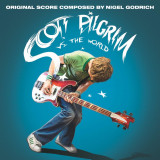
Scott Pilgrim Vs. The World (Original Score Composed By Nigel Godrich)
• 2xLP
• First time released on vinyl
• Blue colour vinyl
• Social Support from Edgar Wright (Director) & Beck
LA-based producer, composer, songwriter and multi-instrumentalist James McAlister is a rare creator, and highly sought after collaborator. Perhaps best known for his work with Sufjan Stevens , McAlister has also appeared on record with Lorde amongst many others, and is a regular contributor to Aaron Dessner 's projects, including the latest albums from Taylor Swift, folklore and evermore . His regular work with film music includes The Two Popes, The Big Sick, and Ron Simonsen 's recent films. In 2018 he joined Stevens, Casey Foubert , St. Vincent and Moses Sumney for the Oscar performance for music from Call Me By Your Name, where he played piano and a bottle of cupcake sprinkles. With nearly countless projects to his name, it was in 2017 that his collaboration with Stevens, Nico Muhly, and Bryce Dessner entitled Planetarium was released by 4AD. Around the same time McAlister started a deep dive into a personal sonic realm that has manifested as an ambient project under his own name. 2018 saw the release of Three Breaths , the first offering from this exploration. 2021 will see the second installment, an album called Scissortail which vividly puts McAlister's evolving master craft on display. It is a collection of moving, meditative, immediately satisfying and quietly stunning work. It is the sound of an artist letting go entirely of pre-conceptions or expectations, instead mining the depths of that very real and abstract place of sound, texture, color and feeling. Some songs arrive almost intuitively, while others feel mechanically made, fed through the framework of synthesizers and the patchwork of recording gear. And with that comes a compelling duality to the work; a machine grace informing the on-going but subconscious dialogue between energy and material, sensitivity and asceticism.
The Peacers are back with their third album. The time has
been kind. Three years since they went about their
sophomore release, ‘Introducing the Crimsmen’. That
second Peacers record was made by the second Peacers
line up, after two thirds of the first gang made for the door
after the first album. In came Bo Moore, Shayde Sartin
and Mike Shoun but, after they’d finished making
‘Introducing the Crimsmen’, singer Mike Donovan moved
out of his old San Francisco digs to the east coast and
made two solo albums.
The Peacers were consistently great no matter who they
were, delivering Mike D’s irrepressible subterranean pop in
a full colour spectrum of moods from purple to blue-black
to sometimes white. ‘Blexxed Rec’ is a different time in the
band’s life - a second album from the same line up, plus
with a country in between them. Also Bo, who had one
song on the last one, brought three in for this one and
Shayde’s got the closing number. Suddenly, three singersongwriters under The Peacers’ flag.
The Peacers send out a mad variety of the thrills and chills
of modern rock, whether glam-tinged (‘The Thunder Is an
Electrical Love God’), psyched-out (‘Colors for You’,
‘Dandelion’), folky (‘Irish Suit’), riding the knife blade of
post-garage fusion (‘Blackberry Est’, ‘Ms. Ela Stanyon’s
School of Acting’) or pumping the winning strains of their
own pure pop sound (‘Ghost of a Motherfucker,’ ‘Bic Sitar,’
‘Make It Right’) and melting it all together.
Recorded in SF and Hudson NY with The Peacers’
production ear for small and curious detail in full spectrum,
‘Blexxed Rec’ is a blessed event for all you rock and roll
people.
The first ever vinyl LP compilation of songs by the great Eddie and Ernie! The duo produced tons of great singles throughout the 60's and early 70's. This LP features a couple dance numbers, but mostly slow dramatic soul ballads reminiscent of the best moments of more well known acts like Sam and Dave and Otis Redding. Some pretty eerie soaring vocals and existential lyrics of the highest order. Under appreciated in their time, Eddie and Ernie are two of soul musics greatest talents! Old school "tip on" record cover and classy black inner sleeve. One time limited pressing.
- A1: Have A Nice Weekend Baby
- A2: The Love We Share Is The Greatest Of Them All
- A3: There’s Nothing In This World That Can Stop Me From Loving You
- A4: I Love You More & More
- B1: Naked As The Day I Was Born
- B2: That’s The Reason Why (I'll Love You Until The Day I Die) (I'll Love You Until The Day I Die)
- B3: Shame Me, Wake Me
- B4: If We Don’t Make It Nobody Can
Re-issue of a soul masterpiece from 1974, 'I Love You More and More' by Tom Brock was Tom's only solo album release, but what a beautiful classic it is. For some, it is up there in the pantheon alongside their all-time treasured soul favourites such as Marvin Gaye's 'What's Going On'.
Produced by the legend Barry White and released on 20th Century Records in 1974, it features the lush hallmark orchestration, heartfelt songs, and funky yet slick playing you’d expect from a White production. Like a dusting of sugar onto the top of the cake, the record also features the stunning arrangements of the great pianist, arranger, composer, and producer Gene Page, whose musical career left an impressive and prolific legacy.
'I Love You More and More' received another lease of life when it was resurrected for a new audience after having been sampled by Jay-Z, Mos Def, C.L. Smooth, and others. The record is solid throughout, but the song 'There's Nothing in This World That Can Stop Me From Loving You’ proved to be an extra-bright star in the sky and it formed the base to Jay-Z's 2001 hit 'Girls, Girls, Girls'. The sampling of Tom’s work triggered the collectors, diggers and DJs to explore his record and to transfer their passion for it onto their followers too.
Tom Brock passed away in 2002, but left behind his sensational soulful voice on a handful of amazing dusty 7" singles, several assorted productions recorded by other artists, and this absolute winner of an album, which will be cherished for years to come.
• Half-speed vinyl cut at Abbey Road Studios
• Sampled by Jay-Z, Mos Def, C.L. Smooth…
• Produced by Barry White, arranged by Gene Page.
Producer extraordinaire John Morales returns to BBE Music, celebrating the life and work of R&B / soul legend Teena Marie with a double album full of brand new remixes, lovingly crafted from the original studio tapes, entitled ‘Love Songs & Funky Beats’. “Teena is somewhat underrated, and people don't really know much about her.” Says Morales. “I set out to immerse people in her music and represent what she really did. That meant for me a dive into more than her R&B hits, to dig into her ballads and dance cuts. People know she was talented. I don't really think they really knew the depth of her abilities, her complete confidence to take it upon herself to do everything – singing, producing, arranging, songwriting. Teena Marie was the total package.” John Morales had the pleasure of mixing many of Teena Marie’s original records over the years, so it felt natural to dig into the archives and select his favourite cuts to rework, extend and subtly update in his own distinctive style. While by no means a definitive collection of Lady Tee’s expansive musical catalogue, ‘Love Songs & Funky Beats’ represents a fitting tribute to a multifaceted and important voice in popular music, by one of the most storied mix engineers and remixers of our age. Jumping into the music industry deep end in 1979 with a three-year mentorship from Berry Gordy & Rick James at Motown, Teena Marie then spent seven fertile years with Epic, which yielded her greatest commercial successes (including the classic album 'Starchild'). After founding an independent label ‘Sarai’, Marie took a ten-year hiatus which ended in 2004 in a deal with hip hop label Cash Money Records; a less unlikely partnership than some might assume, given that Teena was one of the first ‘mainstream’ artists to perform a rap verse, on 1981’s ‘Square Biz’. Teena Marie Brockert forged a unique path through the industry, an artist in-charge of her own destiny, influencing (and heavily sampled by) both the hip hop and R&B sounds of the 90’s and early 2000’s. Her 1982 lawsuit against Motown records resulted in "The Brockert Initiative", which has benefitted literally thousands of other artists by making it illegal for record companies to ‘shelve’ artists by keeping them under contract without releasing their material. She continued to tour regularly and deliver commercially successful, expertly sculpted music, right up until her untimely passing in 2010.
With his new album Rhapsodic, Nicolas Repac gives life to the archives of the hunter-gatherer of sounds: Charles Duvelle Nicolas Repac is pursuing the dreamlike magic of his art of sampling with his new album "Rhapsodic". The musician plunged into musicologist Charles Duvelle's pioneering field recordings, in order to deconstruct and revisit rare music archives gleaned from all over the world. Repac ventures into the craziest sonic and stylistic pileups - adding voices, rhythms and traditional music from "every world". He offers some "Rhapsodies" of multicoloured sounds and instrumentals, revisited through the prism of electronic music. He liberates himself from all ethnomusicological coherence to speak directly to the soul and imagination of his listeners - beyond the frontiers of time and space. Grafting heady grooves of traditional percussion from Benin onto sub-Saharan violin refrains, interweaving them with Mongolian morin khuur on a bed of pygmy mouth-bow, Nicolas Repac leads us on the most captivating of immobile journeys, to the heart of the most intimate impulses, the most human pulse.
- A1: Charles Aznavour - Parce Que Tu Crois
- A2: Joe Simon - Before The Night Is Over
- A3: Ray Charles - I Got A Woman
- A4: Timmy Thomas - Why Can't We Live Together
- A5: Vera Hall - Trouble So Hard
- B1: Bob & Earl - Harlem Shuffle
- B2: Syl Johnson - I Hate I Walked Away
- B3: Dusty Springfield - Son Of A Preacher Man
- B4: The Persuasions - Good Times
- B5: Johnny Mathis - Come To Me
- B6: Millie Jackson - All The Way Lover
- C1: Etta James - Something's Got A Hold Of Me
- C2: Cb & The Ten Others With Axes - Rosie
- C3: Bobby "Blue" Bland - (If Loving You Is Wrong) I Don't Want To Be Right (If Loving You Is Wrong)
- C4: Bobby Caldwell - Open Your Eyes
- C5: Boom Clap Bachelors - Tiden Flyver
- C6: Galt Macdermot - Coffee Cold
- D1: Gene Chandler - Duke Of Earl
- D2: Marva Whitney - It's My Thing (You Can't Tell Me Who To Sock It To) (You Can't Tell Me Who To Sock It To)
- D3: Joe Simon - Walking Down Lonely Street
- D4: Lowrell - Mellow Mellow (Right On) (Right On)