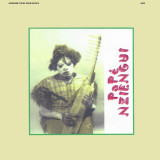
Kadi Yombo, published in 1989, is the most successful album in the quest for a fusion between tradition and modernity in Bwiti harp music of the Tsogho people of Gabon. Combining beating rattles with a layer of synthesizers, Papé Nziengui blends in a contrapuntal dialogue characteristic of harp playing: male song in appeal and female choir in response, male voice of the musical arc and rhythms of female worship. But above all it’s Tsogho ritual music and modern studio orchestration. The result is an initiatory itinerary of 10 musical pieces which are all milestones likely to be simultaneously listened to, danced, meditated on, and soon acclaimed. In the years since, Nziengui has traveled he world from Lagos to Paris, from Tokyo to Cordoba, from Brussels to Mexico City to become a true icon, the emblem of Gabonese music.
Like Bob Dylan, "electrifying" folk and Bob Marley mixing rock with reggae, some purists have criticized Nziengui for having distorted the music of harp by imposing a cross with modern instruments. They even went so far as to claim that Nziengui was just an average harpist covering his shortcomings with stunts that were only good for impressing neophytes; like playing a harp placed upside down behind his back or playing two or three harps simultaneously. Sincere convictions or venomous defamations, in any case, Nziengui never gave in to such attacks, imposing himself on the contrary to pay homage to the elders (Yves Mouenga, Jean Honoré Miabé, Vickoss Ekondo) while instructing the maximum of young people. He is thus the promoter of many young talents, the most prominent of which is certainly his nephew Jean Pierre Mingongué. In a conservative society where the sacred is confused with secrecy, exposing the mysteries of Bwiti in broad daylight can be punished by exclusion or even execution.
Papé Nziengui has always claimed that he faces such risks because he never felt enslaved to a community that governs his life, that regulates his conduct, that has a right of censorship over his activities. Like Ravi Shankar, the famous sitarist, Papé Nziengui is a man of rupture but also of openness, a transmitter of culture. As proof, he has established himself in Libreville, Gabo’s capital, as the main harpist for sessions and concerts, accompanying the greatest national artists (Akendengué, Rompavè, Annie-Flore Batchiellilys, Les Champs sur la Lowé, etc.) as well as foreign artists (Papa Wemba, Manu Dibango, Kassav', Toups Bebey, etc.). In 1988, he was the first harpist to release an album in the form of a cassette produced by the French Cultural Center (Papé Nziengui, Chants et Musiques Tsogho). At the same time, he created his own group (Bovenga), combining traditional music instruments (musical bow, drums, various percussion instruments, etc.) in the framework of a true national orchestra, which gave the first concert and the first tours of a traditional music that was both modern and dynamic, thus "democratizing" the harp, to the dismay of certain purists.
On the other hand, in modern music, dominated by the logic of profit or even commercialism, artistic creation must often be adjusted for a specific audience based on reason rather than heart. But instead of allowing himself to be distorted, Papé Nziengui has always tried to produce music that is not a caricature, worthy in its expression as in its content, of the sacredness and transcendence of the music of the Origins. This is what makes Nziengui not only the musician, but the man someone whose age hasn’t altered any of his freshness or authenticity

Search:soon
New pressing in soon!
Orgone is one of the most exciting bands in the new generation of funk bands; led by the powerhouse vocals of Adryon de Leon, Orgone recalls such legendary groups as Rufus and Sly & The Family Stone at their best! The band has backed Alicia Keys on her As I Am album and Cee Lo Green on his Grammy-winning track Fool for You. Beyond The Sun is the most complete fulfillment of Orgone s full spectrum of sound, ranging from the in the pocket funk of Don’t Push Your Luck to the evocative balladry of No Pain to the clubby-jam of the title track and the scorching instrumental workouts on Meat Machine and Sabi. A highlight is a hot version of Rufus - I'm A Woman (I'm A Backbone).
- A1: Tie Me Up
- A2: The Craft
- A3: Sirène
- A4: All Nerve
- A5: Plastic Drama
- B1: Marinela2017
- B2: Aklr
- B3: Profile Anxiety
- B4: Truth
- B5: Truce
- C1: Sirène (Cut_ Remix)
- C2: The Craft (Old Joel Dilla (Wolf Alice) Remix)
- C3: Profile Anxiety (Crystal Fighters Remix) – Watch Here
- C4: Marinela2017 (Delaporte Remix)
- C5: Tie Me Up (Hinds Remix)
- C6: All Nerve (Las Tea Party Djs Remix)
- D1: Aklr (Bonnz Remix)
- D2: Plastic Drama (Yoann Intonti (The Vaccines) Remix)
- D3: Marinela2017 (Asier Bilbao Remix)
- D4: Profile Anxiety (Dream Wife Remix)
- D5: Sirène (Guarda Remix)
- D6: Aklr (Josu Ximun Remix)
Spain’s fastest-rising band, Belako are announcing a very specialedition of their 2020 album ‘Plastic Drama’. The new, deluxe double LP will be released on 8th April via BMG and includes exclusive remixes by the likes of Wolf Alice, The Vaccines, Hinds and Crystal Fighters.
Hailing from the small town of Mungia near Bilbao, Belako have been playing non-stop in Spain and beyond these past few years, building a dedicated fanbase in their native country, which has quickly been spilling out into other parts of Europe and the US.
2020’s ‘Plastic Drama’ was the band’s fourth record, but the first since signing a major international record deal, and certainly their most ambitious to date. Self-produced by the band, ‘Plastic Drama' searches for “the real meaning of things in a world that translates everything into assembly lines, manufacturing and the exploitation of living beings,” say the band. “It’s about the harsh reality our generation is facing and the only good use of new technology, which is the ability to spread the word and call for action. The title of the album has another message, as it also reminds us the first world issues we’ve come so keen to complain about. We can only hope for a more responsible human legacy”.
They were named best new band by Rolling Stone Magazine (ES) and ‘Plastic Drama’ picked up top UK support from the likes of 6 Music, Clash, DIY, Dork, The Line Of Best and NME who hailed the record as ‘a bold next step from a band who have never been afraid of the weird or the wonderful. Belako step up and earn their place among the major players of the scene’.
Relentless in their craft and a ferocious live act at their core, Belako were the first band to tour Europe in the summer of 2020, breathing new life into old forgotten Spanish cinema drive-ins across the country for their live shows. The ‘Belako Pandemic Tour’ documentary was premiered at the San Sebastian International Film Festival and will soon arrive on digital platforms.
Having supported the likes of DMA’s, QOTSA and Liam Gallagher at Finsbury Park, and played major international festivals such as Primavera, SXSW, Rock En Seine & Benicassim, Belako’s explosive live performances have excited crowds from small dive bars in their early days to huge international festivals. Their anything-can-happen stage attitude showcases the power, electricity and punk ethos of this exciting young band, which also lead to them being the first ever Spanish act to be booked for the main stage at Reading & Leeds Festival.
Fast forward to 2022, Belako reinvigorate ‘Plastic Drama’ with a 50-date world tour to be announced shortly, kickstarted with the release of their new deluxe edition album in April, featuring remixes by some of alternative music’s biggest names. The band will also celebrate the release with an album launch party on the rooftop of Madrid’s prestigious Riu Plaza on April 6th. Details for all UK dates this summer will be revealed in the coming weeks.
Kadi Yombo, published in 1989, is the most successful album in the quest for a fusion between tradition and modernity in Bwiti harp music of the Tsogho people of Gabon. Combining beating rattles with a layer of synthesizers, Papé Nziengui blends in a contrapuntal dialogue characteristic of harp playing: male song in appeal and female choir in response, male voice of the musical arc and rhythms of female worship. But above all it’s Tsogho ritual music and modern studio orchestration. The result is an initiatory itinerary of 10 musical pieces which are all milestones likely to be simultaneously listened to, danced, meditated on, and soon acclaimed. In the years since, Nziengui has traveled he world from Lagos to Paris, from Tokyo to Cordoba, from Brussels to Mexico City to become a true icon, the emblem of Gabonese music.
Like Bob Dylan, "electrifying" folk and Bob Marley mixing rock with reggae, some purists have criticized Nziengui for having distorted the music of harp by imposing a cross with modern instruments. They even went so far as to claim that Nziengui was just an average harpist covering his shortcomings with stunts that were only good for impressing neophytes; like playing a harp placed upside down behind his back or playing two or three harps simultaneously. Sincere convictions or venomous defamations, in any case, Nziengui never gave in to such attacks, imposing himself on the contrary to pay homage to the elders (Yves Mouenga, Jean Honoré Miabé, Vickoss Ekondo) while instructing the maximum of young people. He is thus the promoter of many young talents, the most prominent of which is certainly his nephew Jean Pierre Mingongué. In a conservative society where the sacred is confused with secrecy, exposing the mysteries of Bwiti in broad daylight can be punished by exclusion or even execution.
Papé Nziengui has always claimed that he faces such risks because he never felt enslaved to a community that governs his life, that regulates his conduct, that has a right of censorship over his activities. Like Ravi Shankar, the famous sitarist, Papé Nziengui is a man of rupture but also of openness, a transmitter of culture. As proof, he has established himself in Libreville, Gabo’s capital, as the main harpist for sessions and concerts, accompanying the greatest national artists (Akendengué, Rompavè, Annie-Flore Batchiellilys, Les Champs sur la Lowé, etc.) as well as foreign artists (Papa Wemba, Manu Dibango, Kassav', Toups Bebey, etc.). In 1988, he was the first harpist to release an album in the form of a cassette produced by the French Cultural Center (Papé Nziengui, Chants et Musiques Tsogho). At the same time, he created his own group (Bovenga), combining traditional music instruments (musical bow, drums, various percussion instruments, etc.) in the framework of a true national orchestra, which gave the first concert and the first tours of a traditional music that was both modern and dynamic, thus "democratizing" the harp, to the dismay of certain purists.
On the other hand, in modern music, dominated by the logic of profit or even commercialism, artistic creation must often be adjusted for a specific audience based on reason rather than heart. But instead of allowing himself to be distorted, Papé Nziengui has always tried to produce music that is not a caricature, worthy in its expression as in its content, of the sacredness and transcendence of the music of the Origins. This is what makes Nziengui not only the musician, but the man someone whose age hasn’t altered any of his freshness or authenticity
Keith Tucker and Marty Bonds (Reel By Real) collaborating.
K1 / MARTY BONDS ......A soon to be electro/bass classic, the track gets body’s jumping with a killer bubbly bass line in true 'K1' fashion. Hard drums, infectious bass, alien-like signature vocals to show off Keith Tuckers writing skills...the full package of Detroit funk and originally. Thoughtfully completed with an "instrumental" and a "Bassapella" version for those who like to manipulate their mix.
* "TO FLY"
An electro masterpiece brought to you by the legendary producer Mr. Marty Bonds. Deep street bass dances amongst the spectral electronic percussions and commanding vocal in an intense mission for those who like to get their groove on. Also a head-nod to the"Hellraiser 2" sample that inspired this composition. Heavy stuff as Marty Bonds goes into a whole new bag from his Detroit techno origins... A must hear & have
Following up This Time, Al Jarreau released his eighth studio album Breakin’Away in 1981. It soon became the standard bearer of the LA pop and R&B sound and remains his best and most popular effort to date. It spent two full years on the Billboard 200 and was certified Platinum by the RIAA. Breakin’Away was nominated for Album of the Year at the
1982 Grammy’s and won him Best Male Pop Vocal Performance.
The album was produced by Jay Graydon and features top-level musicians including Steve Lukather (Toto), David Foster and George Duke. Breakin’ Away contains four tracks that became individual hits, “We’re In This Love Together”, “Breakin’ Away”, “Teach Me Tonight” and “Roof Garden”.
Breakin’ Away is available as a limited edition of 1500 individually numbered copies on crystal clear & pink mixed coloured vinyl and includes an insert.
Back in stock !
There is geological time and deep-space time. The natural world's time, and quantum time. Humans started measuring time with the stars and seasons. Then came hourglasses and sundials. The first mechanical clocks weren't in Europe until the late 13th century. Then came industrial time, a wristwatch for all and then everything had a time. A time for everything. All feeding into our recently digitised time and its marching nanoseconds. Let us not forget however another way to measure time: That would be K&D time.
Yes, you can rush, but isn't it so much nicer to amble? This onception of time may well have its roots in those smoke mists, softly blowing through the pre-history of 1995, and if that was time - then we need space. In particular, one Viennese front room that has turned its bass bins out to the cosmos. That sweet smoke, shrouding the desk and sampler. A few old keyboards (as a friend skins up at the back) unnoticed on the couch - just passing through...
Those days of K&D time had been thought to have gone. But one of times tricks is to hide itself in music. Not long ago (after a box of DATs had been found, and a DAT player prised back into service) back through the music wormhole our heroes fell into that smoke laden room of 1995. The remix time hadn't arrived nor the intense touring schedule. It was before the K&D sessions release and all that came with it, before the solo projects of the Peace Orchestra and Tosca. This was a time before all of that. A time for literally living in the studio and experiencing the joy of creating tune after tune. Just the sound and the smoke and no boundaries.
It was before people started asking about when the album was coming out. Which developed its own time specific answers. The 90s answer was soon, 00s answer was not sure and then: never! from 2010 onwards. The truth was, an album had been finished by the spring of '95 and all recorded onto DAT and placed in a box. K&D pressed up 10 copies and gave 4 away to some suitably eccentric individuals. Then the room's doors opened and in a tremendously big cloud of smoke time rushed in, K&D rushed out, and the years went rolling by. The days got filled with remixes, touring and life.
Then in early 2020 that chance moving of a box at the back of a room exposed the DATs and their time transporting properties. As K&D went through them they ended up comfortable and back in the room and that wonderful haze of 1995. The music was transferred from the DATs and K&D painstakingly rebuilt every molecule that made up the original 10 copies. From the very first takes of the mixes printed onto tape, to the solid slab of black virgin vinyl, to the abused by many plays, white cover. Even down to the labels that says "'Unverkäufliche Musterplatte" (Testpressing - Not For Sale) in rather rude German.
It now looks, feels and sounds pretty much exactly the same as those original 10 copies did in 1995. The only thing that couldn't be don is the original clouds of smoke those 10 copies were bathed in. That will be left to the listener to wrap it in the fresh harvest of 2020. In one way it's a musical time warp space travel. In another, if the music becomes classic and timeless, then it's of its time, whatever the time. So as the rooms bass bins are once again turned out towards the cosmos, K&D are happy and proud to release what they thought were lost moments. Drop through the worm hole, take your place on the couch. The friend who is skinning up, always just passing through, listening to an album for the future called 1995. It all makes sense if you measure in K&D time.
Black Vinyl[27,10 €]
Birthed in the bohemian enclave and epicentre of strange vibrations that is Calderdale in West Yorkshire, Hexen Valley’s story began in summer 2021 when a new formation of Gnod came together in a co-op house at the 200-year-old Nutclough Tavern. As always, the line-up of the collective shifted and morphed to fit circumstances, and soon they embarked on intensive jamming that was eventually captured by Sam Greenwood in Hebden Bridge Underground studios. Inspiration struck not only from the chemistry of the four musicians in this confined room but all around - the band’s Paddy Shine cites the likes of shop noticeboard messages and pub conversations in Hebden as lyrical sparks; channeling by his reckoning the ‘valley fever’ that exists somewhere in the chasms and contrasts between the amazing light and vivacity of the valley summit and the comparative darkness of the towns below. Meanwhile, musical shapes were making themselves known seemingly of their own volition, from ‘Still Running’, which takes shape across a sonic hinterland between Daydream Nation-style kineticism and sludged-out aggression to ‘Bad Apple’ - an entirely spontaneous piece of potent and angular post-punk intensity. Perhaps most surprisingly of all, Lou Reed’s tour-bus favourite ‘Waves Of Fear’ is hammered out with fearsome gusto into a salvo of first-take catharsis and alchemy, fit to transcend all or any oppressive atmospheres that surround.Hexen Valley is the sound of a band whose fearsome intensity is only matched by their evolutionary drive. It’s Gnod at full power, and it’s a haunted place you might struggle to leave
Red Vinyl[27,10 €]
Birthed in the bohemian enclave and epicentre of strange vibrations that is Calderdale in West Yorkshire, Hexen Valley’s story began in summer 2021 when a new formation of Gnod came together in a co-op house at the 200-year-old Nutclough Tavern. As always, the line-up of the collective shifted and morphed to fit circumstances, and soon they embarked on intensive jamming that was eventually captured by Sam Greenwood in Hebden Bridge Underground studios. Inspiration struck not only from the chemistry of the four musicians in this confined room but all around - the band’s Paddy Shine cites the likes of shop noticeboard messages and pub conversations in Hebden as lyrical sparks; channeling by his reckoning the ‘valley fever’ that exists somewhere in the chasms and contrasts between the amazing light and vivacity of the valley summit and the comparative darkness of the towns below. Meanwhile, musical shapes were making themselves known seemingly of their own volition, from ‘Still Running’, which takes shape across a sonic hinterland between Daydream Nation-style kineticism and sludged-out aggression to ‘Bad Apple’ - an entirely spontaneous piece of potent and angular post-punk intensity. Perhaps most surprisingly of all, Lou Reed’s tour-bus favourite ‘Waves Of Fear’ is hammered out with fearsome gusto into a salvo of first-take catharsis and alchemy, fit to transcend all or any oppressive atmospheres that surround.Hexen Valley is the sound of a band whose fearsome intensity is only matched by their evolutionary drive. It’s Gnod at full power, and it’s a haunted place you might struggle to leave
- 1: Super-Fire
- 2: Click Click
- 3: Crash 17 (X-Rated Car)
- 4: Disco Six Six Six
- 5: Life In Pink
- 6: Thekindamzkyoulike
- 7: Vera Cruz
- 8: Anotherdroneinmyhead
- 9: Cash Machine
- 10: Wilmington, Zodiac Love Team
- 11: Sharkmeat, My Funny Valentine
- 12: Sexy Sam
- 13: I’m From France
- 14: Man Ray Of Love
- 15: Magattraction, Red Bar
- 16: If Glamour Is Dead
- 17: Viva Roma Star
- 18: Your Life To Slide (Previously Unreleased)
- 19: Distracted Rvs #7
- 20: Do It Like Diamonds
- 21: Black Leather
- 22: Keep Yr Pants On
Very limited double black vinyl, Download Card Included. No returns. This is for Indies Only. Seminal post–hardcore band Girls Against Boys are celebrating the 25th anniversary of the 1996 release of their critically acclaimed album House of GVSB with a double vinyl reissue of the album. Packaged in a full-color gatefold jacket, side A and B are the original album remastered by Bob Weston (Shellac). Side C and D feature odds and ends from the band’s 90s era work including sought-after b-sides, singles, compilation tracks, and one previously unreleased recording. Beginning February 4, 2022, GvsB will embark on their first tour since 2013. The band will be playing songs from across their entire catalog with stops in Chicago, Los Angeles, Washington, DC, and Seattle, among other cities. European dates to be announced soon. “the great ’90s post-hardcore thud-masters” Stereogum // “A pathbreaking hard-rock opus that plays like one long money shot” SPIN #5 Top Album of the Year
Back in May 2019, Vancouver trio Corner Boys released their sole album… and promptly split a few months later. In retrospect, they couldn’t have known that the album’s title (‘Waiting For 2020’) would soon seem grimly ironic - and we all know why, right? No reason to go over all that shit again. But while the past two years have at least seen drummer/songwriter Patrick McEachnie staying active across two essential records with hardcore heroes Chain Whip, lockdown saw him switching roles. Basically, he bought a guitar and made an excellent record all on his lonesome, and as followers of his other projects will have come to expect, it’s fucking excellent. ‘Glad To Be Forgotten’ is the debut album by Pack Rat - in some ways you can see some level of crossover with Corner Boys in its manic energy and dedication to hooks (cuts like ‘Next Time Hit Me’ and ‘My Own Reality’ are so damn catchy, you could be forgiven for thinking you’ve already been listening to ‘em on repeat for the past 20 years). Familiar reference points show up (the melodies of the Pointed Sticks; the garage-slanted rifferama of Rudi or The Undertones) while a tinny budget synth keeps things ticking along nicely, just to remind you that this is a homespun DIY project. But honestly, this has the feel of a fully fleshed-out project and leaves you desperate for another fix of its sweet’n’sour tang. For anyone who loves the collision point between ‘New Rose’, powerpop sunshine and sheer rock’n’roll exuberance, this is essential. For everyone else, this is surely the gateway to all of that good stuff. You want to hear the tunes that’ll star on future generations’ equivalents to the Killed By Death comps? That’ll set your pulse soaring and your pogo muscles into overdrive? That’ll remind you of why this punk rock business still feels worth dedicating your life to, even after all this time? Hey, Pack Rat’s got ‘em. Now do your part
It begins with a rustle of noise, equally reminiscent of distorted factory noise and a cassette recording of cathedral bells unspooling, before a near-robotic beat and stuttering bassline enter the fray. Initially, you could be forgiven for thinking you’ve stumbled across the lost tapes of Joy Division’s early Warsaw incarnation, but the atonal blast of strafing guitars fading in and out soon make you realise this is a very different proposition. This is The Drin, and ‘Engines Sing for the Pale Moon’ is their debut album. It’s also one of the best things you’ll hear all year. Helmed by Dylan McCartney, drummer of the rock band Vacation, The Drin originally released this album as a hyper-limited cassette via Future Shock. It’s as much of a departure from McCartney’s usual output as it is for Drunken Sailor Records; songs don’t so much explode out of the gate as drift towards you like a creeping fog that turns your skin inside-out and leaves you sloshing organs all across the carpet. Second track ‘Guillotine Blade’ shows the pieces all coming together, a dubbed-out riot of claustrophobic noise that feels like Pere Ubu trapped in a cupboard one minute, and ‘Warm Jets’-era Eno trying on Bauhaus’ trenchcoats the next. Meanwhile, ‘Down Her Cheek A Party Tear’ unfolds across jittering, skittering rustles of drums and an undulating bassline, making you wonder why post-millennial post-punk so often settles for dickheads shouting non-sequiturs over landfill indie, when it could be entering these dark, unsettling territories instead. The Drin like to get weird. The Drin like to get wild. The Drin rarely cut loose, but that’s because the trip is already intense and haunting enough without things getting raucous in here as well. Hey kids, turn off those shite band name redacted records and get into this; you deserve so much better, and better’s right here. Fall into it, immerse yourself and step forward into a brave new world. I love this record
His first single Come On, Let’s Go was recorded in July 1958 at Studio B of the Gold Star Recording Studios. Phil Spector was also recording To Know Him Is To Love Him with the Teddy Bears, and dropped by Studio B to say hello to Ritchie. Released a couple of weeks later, Ritchie’s debut quickly became a number one in Los Angeles. The record went on to be named ‘Pick Of The Week’ in September’s issue of Billboard, soon reaching #42 on the national charts. Valens’ follow-up was Donna, which went to #2 on the charts in January 1959. Not only was the record a hit, it was almost eclipsed when radio DJs discovered the Bside, La Bamba, which Valens described as “an old Mexican folk song they play at weddings”.
This also became a hit, though it only reached #22 – although when La Bamba, the 1987 biopic of Valens was released, the title song went to Number One. From this point on Valens spent most of his time touring the West Coast and beyond, and also managed time for several TV shows and a movie appearance in Go, Johnny Go! So put this record on right now. Let’s go!
Turbo Recordings presents its grandest achievement yet, a reimagining of Plastikman's 1998 magnum opus "Consumed", Transformed as a new collaborative composition between original artist Richie Hawtin and musical genius Chilly Gonzales. This is an album three decades in the making, brought into the world by Executive Producer Tiga. A masterpiece of restraint, depth, and music as architectural vision, "Consumed" was profoundly influential, defining the soon-to-emerge minimal movement. Shortly after its 20th anniversary, Chilly Gonzales was inspired to compose accompanying piano pieces (counterparts) for each of the tracks and shared them with Tiga, who became the conduit between both artists and led the project to fruition on his label. Hawtin mixed the new combined work, allowing each artist their own space within the project,more of a sonic conversation between them than a conventional collaboration. Consumed in Key will be available as a deluxe triple vinyl LP. The artwork is a reinterpretation of the original album's, flipped to black and white and with the cutout size transposed to the dimensions of a piano key, the die-cut in the white outersleeve revealing a shiny black foil stamp on the black innersleeves.
- A1: Triston Palma - Bad Boys
- A2: Tony Tuff - Never Trouble Trouble
- A3: Robert Ffrench - Single Life
- A4: Michael Palmer - String Up The Sound System
- A5: Puddy Roots - Champion Bubbler
- A6: Ashanti Waugh - Police Police
- A7: Triston Palma - Fancyness
- B1: Phillip Frazer - A Little Bit Of Love
- B2: Bill Blast - Barrel Mentality
- B3: Cutty Ranks & Triston Palma - Inner City Blues
- B4: Michael Forbes - Reggae Fever
- B5: Tony Carver - Ethiopia
- B6: Eddie Constantine - Strawberry
- B7: Rod Taylor - The Lord Is My Light
At the beginning of the eighties reggae music became increasingly in tune with what was happening in Kingston’s dance halls… probably more so than at any time since the sound system operators had started to make their own shuffle and boogie recordings in the late fifties. The international audience and the critics were too busy looking for a new Bob Marley to appreciate what was happening downtown and failed to acknowledge that this was a return to the real, raw roots of the music. Brash, confident, young record producers who were totally in tune with the youth audience stepped forward and seized the moment…
Oswald ‘Ossie’ Thomas began his apprenticeship in the music business at the age of fourteen and served his time as a record salesman for Bunny ‘Striker’ Lee and Winston ‘Niney The Observer’ Holness before moving on to Miss Sonia Pottinger’s Tip Top Records.
“I ended up working in three record stores on Orange Street from 1976 to 1981… Yeah man! Me deh ‘pon me bicycle till I buy my motorcycle! Them days records were coming out left, right and centre… every day!” Ossie Thomas
It was during his time with Miss Pottinger that Ossie began to produce records for himself and in 1979 Ossie and Phillip Morgan began the Black Solidarity label based deep in the Kingston ghetto on Delamere Avenue. Phillip initially inspired Ossie to start the label and soon Triston Palma, Phillip Frazer and “a youth named Gary Robertson” joined in although Gary later left for Canada.
The Soul Syndicate rehearsed in the Delamere Avenue area and Tony Chin gave Ossie a cut of a rhythm that he used for Triston Palma’s ‘A Class Girl’… the label’s inaugural release. The record was a sizeable success and paved the way for hit after hit after hit on Black Solidarity. Ossie worked with just about everybody who was anybody during this critical period of the music’s development including vocalists Robert Ffrench, Little John, Sugar Minott, Frankie Paul and most notably Triston Palma.
“But Delamere must be considered as a music street sheltering as it does such artists as Junior Byles, Don Angelo, Triston Palma, Phillip Frazer and producer Ossie of the Black Solidarity label…” Beth Lesser
And the man who had made his name in the business selling other people’s records now became one of the most important and influential record producers of the era.
With grateful thanks to: Paul Coote, Nick Hodgson & Hasse Huss
Thomas Köner is one of the most influential modernist minimal composers. His music is often defined as dark ambient or drone, because of the use of low frequencies, material from gongs,shadowy resonances and boreal ambience, but at the same time its sound with constant fluctuation and vulnerability of sonic events, what makes it organic, human and almost comforting.
Köners soundscapes are no longer simply dark, the question now is that of a profound blackness. Such is the generic darkness of the abyss, the void and vacuum, the darkness of more than silence, of catastrophe and cataclysm, but also the soundscapes have utopian moments. It is a cosmological blackness, the black of nonbeing.
The more subtractive, the blacker the sound synthesis, Köner writes. Such blackness is non-music. Music will never be music until it ceases to represent and begins to sound like non-music or monochrome.
"Whoever hears the distortion of all sounds, will soon become Ultrablack. Whoever listens to this world, but has no affection for any of its sites, even to the place of Black Noise, may soon reach Ultrablack. Whoever understands the spirit of impartiality through ten thousand million partial tones, hears Ultrablack and can no longer be measured. No measures, no enclosures, no properties are the sign of ultrablack scores." Thomas Köner
Aubrite was first released 1995 on the label Barooni. Roland Speckle helped with production of the album. Aubrite is the name of a group of meteorites named for Aubres, a small achondrite meteorite that fell near Nyons in 1836.
Equal parts Sheffield bleep, fractal IDM and interstellar ambience, Hyper Nu Age Tekno sees Taro Nohara (aka Yakenohara) plotting a star map on a faded rave flyer. Let the billionaires blast into orbit while you explore your inner space with Growing Bin.
From the LP's earliest moments, the whomping subs and crystalline chimes of "Space Debris", it's clear that we're a long way from Hamburg. Taro pilots this craft on a deep space exploration way beyond the run out groove, to a place where heartening chords herald a twin sunrise and any broadcasts are lost in translation. The polyrhythmic pulse of "Ill Ell" follows, its concentric chimes and rapid fire kicks summoning the teknoguild to a watery altar in the engineering department. Sticking with interstellar mysticism but taking a turn for the transcendent, "Baker Baker Paradox" spins Reich-ian repetition into a graphene gossamer embellished with chrome, crystal and shoegaze shimmer.
The B-side begins on the observation deck, bathing in the beauty of "Celestial Harmonia"'s sci-fi exotica, before the entheogenic "Use Your Head" prompts a delirious dash to the holodeck. Laying serene pads over a techy 4/4, Taro turns out the most danceable and dreamy track on the LP. As ambient chords ring out into the aether and rhythmic pulses shift out of phase, "Airplane Without People" is the loading screen for your virtual fantasy, soon rendered through the woody percussion and spheric bass of "Music For Psychic Liberation". Leave your body behind as you pick mushrooms in a CGI forest.
Clear Vinyl Repress!!!
The landmark hundredth single on Phantasy, Erol Alkan’s ‘Automatic’ accompanied with two remixes that further take the London DJ and producer’s psychedelic club vision in distinct directions. The original 12" pressing, limited to 100 and hand-numbered, sold out in less than an hour.
Palms Trax builds on the sensual reverie of Alkan’s production with an electrifying rework full of touches both French and personal. Throwing out a gloriously chic bassline, the Berlin-based producer sprinkles carefully considered sweeps, stabs and filters on a trip to timeless house euphoria.
Mirroring the first ever artist to release on Phantasy in 2007 where Alkan remixed 'Engine', LA Priest proves a perfect candidate to reconstruct the label’s centenary single, a task he approaches with typically esoteric nous. Coaxing a heavenly aura from the original’s glorious loops, Sam Eastgate’s collection of reengineered and self-made analogue equipment soon progresses to melt Automatic’s rhythm into sticky cosmic bliss.
- A1: Be-Bop-A-Lula
- A2: Race With The Devil
- A3: Cat Man
- A4: Lotta Lovin
- A5: Ain't She Sweet
- A6: Pink Thunderbird
- A7: I Flipped
- A8: Jump Back, Honey, Jump Back
- B1: Bluejean Bop
- B2: Crazy Legs
- B3: Jezebel
- B4: Gonna Back Up Baby
- B5: Woman Love
- B6: Jumps, Giggles And Shouts
- B7: Wedding Bells (Are Breaking Up That Old Gang Of Mine)
- B8: Dance To The Bop
Born in Norfolk, Virginia on 11 February 1935. At the age of 12 Vincent
was given his first guitar by a schoolfriend. There was no generosity
involved in the gift because it wasn’t his friend’s guitar. It belonged to his sister, who was learning how to play. He couldn’t stand the racket she was making so he gave her guitar away. But unwittingly, this cruel act was a crucial moment in Gene’s life as he soon began to entertain with the blues, gospel and country from his porch. ‘Be-Bop-A-Lula’ was to be the first single by Gene Vincent & the Blue Caps. Selling 3 million copies, it opened the door to national fame and untold riches. Followed by the release of the album ‘Bluejean Bop‘ on Capitol Records. He was the ultimate greaser, the genuine article and the authentic voice of his generation.
Repress in soon!!
Morning Trip & Yoga Records are proud to finally reveal one of the ultimate lost masterworks of new age music: Alice Damon’s Windsong. Gently propelled by Damon's haunting breath-of-life vocal winds reminiscent of Joan La Barbara underscored by field recordings and Damon's fretless bass sound calling to mind mid-70 Joni Mitchell, Windsong is traveling music, for the roads or for the skies. Instantly moving, it conjures vistas both romantically familiar and cosmically mysterious — waterfalls and wind, the voice of the earth, as heard through heavenly prisms.
Damon attended college in Massachusetts, where she formed and fronted the all-female garage band called The Moppets in the late 60s. The band began to garner national attention, but Damon moved instead to the wilds of northern Vermont to homestead and raise a family. In 1981 or thereabouts she was able to gain use of an early Sony digital home recorder, and created her masterwork, Windsong.
But Damon waited until 1990 to release a packaged version of this album, now titled "Windsong II", and sent samples to regional distributors like Vermont’s fabled Silo-Alcazar, where a copy of the album was first discovered, but little evidence exists of a proper commercial release. Alice Damon passed on in 2011 and remained essentially unknown until the landmark I Am The Center: Private Issue New Age In America 1950-1990 first revealed her genius to a wider audience two years later. Now, just in time for the recording's 40th anniversary, Alice Damon's Windsong may at last be heard as one of the most singular, moving and profound examples of new age music's psychedelic essence. Morning Trip & Yoga
Records proudly present Windsong.