Manchester producer Hidden Spheres blends the interesting elements he finds within recordings into soulful dance music suited for clubs and the living room. Those influences combine Jazz artists like Sun Ra, John Coltrane, The Art Ensemble of Chicago, and Miles Davis along with the modern sounds of Detroit and German producers.
Having released individual tracks on Dirt Crew his first solo EP appropriately finds its way to Moods & Grooves, a label known its eclectic output. The Bloos connects the musical dots of his influences while expressing a love for house music. We believe you will enjoy it as much as we do.
Search:soul express
Saxophonist Sean Khan is a multi-instrumentalist distinguished for his ability to fuse traditional jazz with contemporary styles. His involvement in the West London broken beat scene as band leader of the cult soul/ jazz outfit SK Radicals and as a collaborator with the likes of the Bugz in the Attic collective, have seen his unique breed of jazz put to full effect in London's clubs, at nights like the legendary bruk orientated 'CoOp'.
In anticipation of Sean Khan's second album on Far Out Recordings: 'Muriel', this four track 12' release features remixes from 4hero and Nicola Conte with father of British Neo-Soul, Omar on vocal duties. 'Don't Let The Sun Go Down' is uplifting and sophisticated dance-floor jazz. Dego and Marc Mac (4hero), two pioneers of broken beat, jungle and UK dance music as a whole, re-work the single from 'Muriel' into a delicately crafted downtempo number, which tames the original somewhat with club focused intentions, yet retains all of its fluidity and groove. Along with the eminence of rhythmic elements, Omar's instantly recognizable, thick and soulful vocals are sparsely and subtly layered to create beguiling, unconventional harmonies. Elevating the track to its peak, Sean Khan's exquisite alto sax solo demonstrates both his technical prowess and keen understanding of jazz's history, whilst working to carve out its future. The B side hosts Nicola Conte's remix of 'Things to Say'. Renowned for his input and influence in the lineage of acid jazz and fusion, as a producer, Dj and musician, Nicola Conte provides a deeper, darker take on Sean Khan's unique blend of jazz. A bouncy 4/4 house beat skips along beneath contemplative, whirring Rhodes, while the ghostly soulful vocals of Diana Martinez and samples of Sean Khan's expressive sax playing see the track taken to more introspective yet still clearly club focused territory. The final track is the intro to 'Sister Soul', previewing more material from Muriel, Sean Khan's forthcoming studio album on Far Out Recordings.
William Kouam Djoko returns to Voyage Direct with Deflourished. After a year with a lot of high highs and some deep lows, William found himself on the dance floor listening to a set by Chicago Footwork specialists DJ Rashaad & DJ Spinn.
William experienced what religious people might call a divine moment. All the experiences, emotions and soul searching from the previous year came together in one emotional, energetic moment. William tried to recapture all of this in his studio the next day and within hours Deflourished was created. A pure form of energy shared by William for everyone to enjoy, hopefully as much as he enjoyed creating it.
B-side Behind Closed Doors completes the package; a lot more subtle and refined than it's A-side brother. A synth-heavy, down-pitched and outstretched song that builds heavily on space, both physical and mentally. On his Sophomore Voyage Direct release William Kouam Djoko truly sets out on a voyage to discover his inner-self. The result, whether it's the expressive energy of Deflourished, or the more mesmerising gloominess of Behind Closed Doors, is beautiful to say the least.
The package is completed by a stunning video of Deflourished made by graphic designer Saša Ostaja and animator Niko Lanzuisi. The video will be launched at a special party
Back in stock!
Some friends think that Shihab the man owes the balance of his soul to his beautiful Danish wife. They may be right; for Eros is the very essence of what Shihab plays.Yet Eros is a god with many a face. A tale of tender mournings Shihab's flute is telling in MAUVE - a piece that translates its title into delicately changing colors of sound. In UMA FITA DE TRES CORES he has his instrument wooing with the proud self-reliance of Latin grandezza. Calmly, softly, almost blandishly Shihab blows the solo flute in the Jimmy Woode composition MY KINDA WORLD. Serene and somewhat playful his own title ANOTHER SAMBA comes along - a most uncommon composition by the way: lasting for sixty bars as if growing independent out of itself, with solos that appear to be additional spinnings rather than improvised choruses; and yet; a perfect, self sustaining melody no element of which is superfluous. In the last of the pieces for flute, in Klook Clarke's THE WILD MAN, which is based on a flourish of trumpets, Shihab for the first time reminds of the sombre, the demon-like face of God Eros. He contrasts flawlessly intoned passages with challenging phrases, phrases raucously sung into the flute - really, he is a 'wild man' who is playing like that. This raucous challenging sound prevails throughout the four baritone-titles ('Shihab never withholds long to caress', Campi says). Shihab blows the instrument the same way he speaks: without any delay, directly coming to the point. And he treats it like a voice, not aiming at an artificially homogeneous sound in all the registers, but at their different modes of expression. In the high pitches the horn gains a brilliant tenor-like quality - for instance in PETER'S WALTZ, dedicated to Shihab's son Peter, and in Kenny Clarke's simple drum fills comprising theme JAY-JAY. In the deep register Shihab produces snotty sounds filling lady's ears with horrors like Pan - thus in JAY-JAY and in the boppy blues SET UP . Shihab's sense of a scurrilous humor breaks through in SEEDS (which reminds of the West-African heritage of jazz with its multiple rhythms and its renunciation of harmonious development - only the eight bars of the bridge base on a progression of chords): not only does he omit the notorious bombastic chord by the ensemble after his own final cadenza, he even ends with a minor second above the keynote. Seems as if Shihab now unrestrictedly conveys to his music all the experiences and emotions he formerly did not deal with in a musical way. Shihab the man need not be disturbed so that Shihab the musician may improvise passionate choruses. It would be unjust, however, to forget the choruses of the four other musicians for those by the 'born leader'. Francy Boland, taciturn and always introverted: he plays an extrovert, a masculine piano. Even with spare single note lines he produces a piercing and ringing sound that hitherto nobody except him has discovered, a bluesy sound bespeaking the very element of frustration that lies within the title of the trio number WHO'LL BUY MY DREAM. The unfailing feeling for rhythm the musicians of the CBBB praise with the arranger Boland, becomes manifest in the piano solo on SET UP. Francy's improvisation is rhythmically styled in a Monk-like manner, and yet no accent could be set differently. Maybe this is the secret of the Shihab-Combo. 'Rhythm is our business', this credo of Jimmy Lunceford could be the one of the five musicians as well. Sadi hits his vibes as dryly as if wanting to bring its ancestors to memory, the wooden chimes of West Africa's coastal tribes. To reach the fullest poignancy possible, he intentionally calms down even the resonance in MY KINDA WORLD. In UMA FITA DE TRES CORES Jimmy Woode bears out the crispy jazz beat against Sadi's Bongos and Klook's Latin-American percussion all by himself. Moreover - and that, too, is connected with the school of the Duke who was the first in the history of jazz to discover the instrument's potential as a melody instrument - Woode rips a marvelous counterpoint to the inventions of the other melody instruments, take for example PETER'S WALTZ. And then there is Kenny Clarke. Klook. On the entire record he only uses his brushes. Means by which different drummers only know to bring forward impressionistically blending noises: He drums a vigorous beat with them, fanciful fills, a solo, melodious and at once skillfully playing with cross rhythms in JAY-JAY. The 'born leader', the 'outstanding baritone saxophonist of modern jazz' (Joachim-Ernst Berendt), he could not wish himself different sidemen for this record overdue since some years.
Up and away / To your journey to the sun / Drink your rocket juice / Fly away (Hey, Shooter).
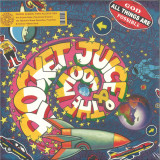
High up in the skies, amongst the clouds, Rocket Juice & The Moon was born. Literally. It happened back in 2008, when Damon Albarn, Flea and Tony Allen convened on the same Lagos flight, to play and exchange musical ideas in that city as part of the Africa Express collective. Relishing a shared enthusiasm for one another's work, and bonding immediately, there and then the triumvirate laid down the blueprint for Rocket Juice.
Still, more than a year passed before conditions were set for three weeks together at Albarn's West London studio, recording and refining two-dozen startlingly out and deeply funky instrumental grooves. The next stage was to invite onboard some extremely talented friends, with further sessions in Dallas, New York, Chicago and Paris... Erykah Badu, no less, queen of contemporary soul. Three companions from Africa Express: Malian singer Fatoumata Diawara, whose debut album has topped World Music charts since its release last Autumn; her multi-talented compatriot Cheick Tidiane Seck, whose prodigious keyboardism has lit up releases by artists ranging from Youssou N'Dour to Hank Jones; the young, Ghanaian rapper M.anifest, quizzically existential, switching seamlessly between Twi and English. And the Hypnotic Brass Ensemble, long-time stalwarts in the Honest Jon's set-up — since one of the team discovered them busking near the shop in Portobello Road, on his lunchbreak — with a second album for the label due in May... Finally, the tracks were dispatched for mixing to Berlin, to be meticulously honed, polished and envenomed by Mark Ernestus, one half of the legendary Basic Channel and Rhythm & Sound partnerships.
The result is Rocket Juice & The Moon — out March 26, 2012, on Honest Jon's Records — a triumphant exploration and proliferation of kinetic Afro-funk rhythms: organic, exuberant, communal music-making, evidenced by the project's live debut on stage as part of the Honest Jon's Chop Up in late 2011, which hit London, Marseille, Dublin, and Cork to such great acclaim (witness the flurry of smart-phone film-clips uploaded in the days thereafter).
From the inaugural bars — that absurdly funky slice of instructional timekeeping, 1-2-3-4-5-6 — the liquid pulse of Fela Kuti's classic recordings drives the action through a suite of 18 shape-shifting compositions. The greatest drummer in the world has never sounded so good as he does here. His intricate cross-patterns jostle and lock with Flea's nimble, rumbling bass riffs. Joined by Seck on There and Extinguished — 'when you dispose of something burning, be sure it's out' — Albarn's keyboards spray synth fusillades up top, over, and under... splicing into the mess of wires running between the freaked Afro-disco of William Onyeabor and the space-jazz-moog of Sun Ra. The HBE brings extra intensity and drama to Leave-Taking — likewise Flea's trumpet to Rotary Connection — teasing out the haunting melody coiled in the mix.
Where the best of vintage Afrobeat sides sustained their concentrated energies over the course of sprawling, marathon jams, RJ & TM manages something altogether different: the group bottles the idiom into capsules of funk... and real songs. Beautifully buoyed by Erykah Badu's unmistakable vocals, Hey, Shooter brilliantly traverses metaphysical spaceways sans any semblance of noodling. Lolo and Follow-Fashion — featuring the open-hearted sensuality of Diawara's singing, M.anifest's quick, brawny science, and more brass blasts — play like its musical cousins or codas. Indeed, the album's shrewd sequencing creates the composite effect of tracks working both individually or within the context of an extended song-cycle.
The lovely ballad, Poison, is bittersweet and ruminative: 'If you're looking for love, beware the signs / They will paralyze you one by one / Poison, it will only break your heart.' Down-tempo and dubby, Check Out and Worries amplify the range of styles and moods. And by the time of Fatherless — a chugging Afro blues that evokes John Lee Hooker lost in Lagos, one gets the sneaking suspicion there's very little outside the reach of this collective's inventive musical grasp.
There is, in fact, a palpable openness pervading Rocket Juice & The Moon — the sense of a limber willingness to follow creative impulse — right down to how the group acquired its name. When Ogunajo Ademola — the Lagotian commissioned to do the album's cover artwork — dubbed his submission 'Rocket Juice & The Moon', it quickly morphed into the formal name of the project, like trying to hold onto mercury.
Surely, the stars above also approved.
first copies in red vinyl
Repressed !!
Jay Dee needs no introduction. Widely regarded as one of the most important figures in hip–hop alongside Pete Rock, Kanye West, Pharell, and Dr. Dre, his influence has reached far beyond the genre. Known widely as your favourite producer’s favourite producer, and having produced and remixed for legends like Janet Jackson, Daft Punk, A Tribe Called Quest, Brand New Heavies, Busta Rhymes, Common, Erykah Badu, Guru, The Pharcyde, The Roots, De La Soul, and Royce Da 5’9"—the list is endless—there is no questioning Jay Dee’s genius. Many have tried, but none have been able to duplicate his sound. Originally released in 2001, Welcome 2 Detroit marked Jay Dee’s first solo project and the groundbreaking debut of BBE’s Beat Generation series, where producers stepped into the spotlight with complete creative freedom. A paradigm-shifting record, it was short-listed for Artistic Achievement in Music in October 2001 (the U.S. equivalent of the Mercury Prize) and instantly set the bar for everything that followed. Now, 25 years later, Welcome 2 Detroit returns in a long-awaited repress, celebrating a quarter-century of influence and innovation. This anniversary edition brings the instrumental version of the album back into circulation after years out of print, allowing listeners to experience the full depth and complexity of Jay Dee’s production in its purest form. Stripped of vocals, the intricacy, texture, and brilliance of his work shine brighter than ever—revealing details you may have missed the first time around. Make sure you grab a piece of history.