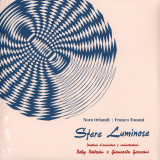
Sfere Luminose is a rare and breathtaking masterpiece that stands as a pinnacle of Italian Library music. Featuring the mesmerizing vocals of Nora Orlandi and the legendary jazz drumming of Franco Tonani, this album is an essential gem from the cult label Record TV - Firmamento, a name revered for iconic releases from the late 1960s to early 1970s. The album is produced by maestros Giancarlo Gazzani and Roby Poitevin, with contributions from the acclaimed studio group I Marc 4 and Alessandro Alessandroni.
This stunning work encapsulates the very essence of Italian Lounge music, offering a rich and diverse musical landscape. From cinematic soundscapes and Hammond organ-driven grooves to soft psychedelic arrangements, the album flows with impeccable soul-jazz and bossa nova influences, reminiscent of Piero Umiliani’s finest creations. The signature style of I Marc 4 shines through captivating drum work, while the enchanting interplay of scat vocals and choral harmonies adds a touch of ethereal beauty.
With its refined blend of jazz, lounge, and Morricone-esque beats, Sfere Luminose is an unmissable listening experience for aficionados of the genre. It's a collector's grail and a timeless treasure that captures the magic of Italy’s golden age of music, and we're proud to bring this back on vinyl, remastered from the original mono sessions, including 4 bonus tracks and artwork restoration by Luca Barcellona.
Buscar:soul magic
- A1: Silent Night (3:39)
- A2: All I Want For Christmas Is You (4:01)
- A3: O Holy Night (4:27)
- A4: Christmas (Baby Please Come Home) (2:33)
- A5: Miss You Most (At Christmas Time) (4:32)
- B1: Joy To The World (4:18)
- B2: Jesus Born On This Day (3:41)
- B3: Santa Claus Is Comin' To Town (3:24)
- B4: Hark! The Herald Angels Sing/Gloria (In Excelsis Deo) (2:59)
- B5: Jesus Oh What A Wonderful Child (4:26)
- B6: God Rest Ye Merry Gentlemen (1:18)
LP 2x12"[46,18 €]
LP[26,68 €]
LP[26,68 €]
7" single[15,92 €]
12" single[15,92 €]
12" single[17,61 €]
LP[19,75 €]
2LP[90,34 €]
The Holiday Album That Turned Mariah Carey into the Queen of Christmas: Featuring the Standard “All I Want for Christmas Is You,” the Singer’s Blockbuster Merry Christmas Exudes Joy, Spirituality, and Conviction
Sourced from the Original Master Tapes, Presented in Audiophile Sound for the First Time, and Strictly Limited to 3,000 Numbered Copies:
Mobile Fidelity’s UltraDisc One-Step 180g 33RPM LP Set Plays with Superb Detail, Openness, and Definition
1/2" / 30 IPS / Dolby SR analogue master to DSD 256 to analogue console to lathe
Mariah Carey didn’t become the Queen of Christmas just because of her fervent love of the holiday. Or as the result of a brilliant marketing plan. The iconic singer earned her title by way of her blockbuster Merry Christmas, a 1994 album that quickly joined the likes of Bing Crosby’s White Christmas, A Jolly Christmas from Frank Sinatra, and Nat King Cole’s The Christmas Song as an all-time holiday vocal classic. Featuring a balanced mix of inspired originals and well-chosen covers, Carey’s fourth studio record has only grown in stature as new generations discover its magic. Mobile Fidelity’s 30th anniversary edition reissue of Merry Christmas makes her spellbinding performances and upper-tier register come alive like never before.
Sourced from the original master tapes, pressed at Fidelity Record Pressing, and strictly limited to 3,000 numbered copies, the pioneering label’s UltraDisc One-Step 180g 33RPM LP set of Merry Christmas plays with superb detail, depth, and dimensionality. Available in audiophile quality for the first time since its original release three decades ago, and featuring the bonus track “God Rest Ye Merry, Gentlemen,” the nine-times-platinum set breathes with a newfound openness and transparency that enhance the spirituality, passion, and festive tenor of Carey’s singing.
Benefitting from superb groove definition, a nearly inaudible noise floor, and dead-quiet vinyl surfaces, the music takes on a heightened energy and anticipatory emotion synonymous with the holiday season. Carey’s signature vocals explode with liveliness and dynamics, the full scope of her acrobatic range presented in clear, transparent sound that practically places her on a small stage in your listening room. This collectible version also breathes with the kind of warmth, intimacy, and coziness you want from a landmark vocal album.
Recorded when Carey helped put “diva” back into everyone’s vocabulary, Merry Christmas gave the New York native another smash right out of the box. What nobody knew at the time was the degree of the album’s staying power — and how, many years removed from its initial promotion cycle, its legend would still grow and even spark a 2010 sequel. Having re-entered the Top 200 charts every year since 2019, Merry Christmas ranks as one of the three most commercially successful holiday LPs ever made and, in due time, will likely earn the top distinction in that class. A global blockbuster, it seamlessly ties together Christian, gospel, and secular threads and speaks to a boundless audience, independent of denomination.
Most obviously, the record remains inescapably connected to “All I Want for Christmas Is You,” an uptempo anthem that towers as a holiday standard and one of the biggest-selling singles in history. Punctuated with celesta chimes, sleigh bells, springy keyboards, and joyous beats, the song echoes the simple albeit engaging melodies and doo-wop style of beloved holiday classics of yore — and blends such elements with contagious dance-pop rhythms to create an atmosphere rich in joy, wonder, and excitement. Radiant with golden soulfulness and sincere conviction, Carey’s exuberant singing and on-point phrasing put it all over the top. And how.
The song stands as the only effort in Billboard history to top the Hot 100 chart during at least three separate runs. Carey’s blockbuster has already hit No. 1 during five runs, spanning every year between 2019 and 2024. That’s just one of the many records the singer holds — and only one of the multiple highlights from Merry Christmas, which includes two other Carey-penned originals, “Miss You Most (At Christmas Time)” and “Jesus Born on This Day.”
Though slightly lesser known, Carey’s remarkable rendition of Darlene Love’s “Christmas (Baby Please Come Home)” further links her album with the big, lush, Wall of Sound heritage that helped inspire its production. Carey’s heartfelt take and transformation of the traditional “Santa Claus Is Coming to Town” into an animated tune that even adults can believe, as well as her clairon reading of “Joy to the World” — cleverly augmented with bits of Three Dog Night’s 1971 hit of the same name — further reinforce her status as Queen of Christmas.
At the peak of her powers, Carey finds equivalent success when tapping more spiritual veins. Witness the reverence she brings to the timeless carol “Silent Night,” the piousness she invests in “Jesus Oh What a Wonderful Child,” and the sacred feeling she conveys throughout “O Holy Night.” You’ll also never think of “Hark! The Herald Angels Sing” and “Gloria (In Excelsis Deo)” the same way again after hearing Mimi pour her heart and soul into them, and pair the songs together.
Indeed, it’s Carey’s pliable voice, melismatic technique, and five-octave range — on display here in definitive fashion — coupled with her undeniable love for Christmas and understanding of the religious significance of the season that make Merry Christmas a must-have holiday staple. And on Mobile Fidelity’s LP, something you better add to your wish list.
- A1: Out To Get Me
- B1: Two Souls - Hell Is Revealed
The second of four 12" vinyls will be released on December 6th, anticipating the release of the new Death SS concept album: "The Entity
produced by Steve Sylvester with the magic touch of Tom Dalgety, a Grammy-winning english producer, already at work with Rammstein,
Ghost , Cult and others.
The second single “Out To Get Me” is a dark and orchestral ballad that underlines the moment of the concept of the work in which the main
character Jekyll becomes aware of the evil that his alter-ego has caused. After that he feel the reaction of people surronding him. Tormented
by doubts and remorse, his mental health degenerates and he become to feel himself persecuted by infernal creatures, that are actually the real
monsters of his conscience coming to life.
“Limited Deluxe” edition on transparent blue vinyl with a special shaped cover. The product contains the second part of the booklet with the
entire story behind the concept album together with two other songs taken from the album: “TWO SOULS and HELL IS REVEALED”,
available only in physical format.
Riccardo Teri, Also Known as Quasar, Is Set to Make a Triumphant Return to Skylax Records With an Exciting New Ep That Pays Homage to the Golden Era of 90s Uk Garage. This Forthcoming 12-Inch Release Comprises Four Mesmerizing Tracks, Each of Which Carries the Distinct Imprint of Quasar's Signature style.
The Ep Kicks Off With "Told You Once," a Track That Immediately Transports You to the Halcyon Days of Uk Garage, With Its Infectious Beats and Soulful Vocal Samples. "For Your Love" Follows, Seamlessly Blending Classic Garage Elements With a Modern Twist, Demonstrating Quasar's Mastery of the Genre's Evolution. as You Move Further Into the Ep, "Morning Bells" Beckons With Its Entrancing Melodies and Rhythmic Grooves, Drawing You Deeper Into Quasar's Sonic World. Finally, "Inside My Love" Completes the Quartet of Tracks, Delivering an Exceptional Experience With Its Lush Harmonies and Finely Crafted beats.
What Sets This Ep Apart Is the Remarkable Cohesion Between Its Tracks. Each Piece Contributes to an Exceptional Whole, With No Single Track Standing Out as a Weak Link. Every One of Them Stands Alone as a Dancefloor Banger, but When United, They Form a Remarkable Sonic Journey That Will Undoubtedly Leave a Lasting Impression. in an Era Where House Music Often Leans Towards Various Sub-Genres and Experimental Directions, Quasar's Work on This Ep Serves as a Refreshing Reminder of the Classic Uk Garage Sound. It Harkens Back to the Days When the Genre Was at Its Peak, and Yet, It Feels Contemporary and Relevant. This Perfect Fusion of Nostalgia and Innovation Is a Testament to Italy's Enduring Love and Respect for the Pioneers of the genre.
In "Told You Once," Quasar Brings Us a Release That Exudes Absolute Class and Authenticity, Showcasing His Profound Dedication to the Essence of Uk Garage. With This Ep, He Not Only Pays Homage to the Masters of the Genre but Also Cements His Own Place Among Its Contemporary Torchbearers. It's a Must-Listen for Anyone Looking to Relive the Magic of 90s Uk Garage While Embracing the Evolution of the Genre. Skylax Records Welcomes Back Quasar With Open Arms, and Fans of Quality House Music Have Reason to Celebrate....
DJ Koze, Arnim Teutoburg-Weiß aka arnim, and the Düsseldorf Düsterboys enchant with a touching homage to Holger Biege - one of the legendary architects of East German soul. DJ Koze once again proves his unparalleled sense for the extraordinary. Around the line "Du hast erzählt, gelacht / Mir gezeigt, wie schön du bist" from Holger Biege's 1978 song "Bleib doch", Koze weaves a small masterpiece, infused equally with nostalgic depth and futuristic elements.
Arnim Teutoburg-Weiß aka arnim (frontman of the iconic Beatsteaks) opens our hearts with his heavenly radiant voice. With full sincerity - pure and straightforward - he sings the love declaration of a lifetime.
Floating on a cloud, the Düsseldorf Düsterboys sprinkle lyrical stardust with their brilliant harmonies - fluffy and bizarre at the same time. It feels as if this cosmic quartet boarded a time machine and returned to the present to plant the essence of days gone by into today's matrix.
"Wie schön du bist" is not just a tribute to Holger Biege's work, but a loving bow to his entire musical legacy. It is an anthem to the timeless magic of music and the enduring power of love that connects us all.
Koze, arnim and the Düsterboys have created something truly unique here: a gem-a homage, a time travel, and a love letter all in one. Music can indeed be something magical.
AA
"Amor," a dandelion of a song, was created in collaboration with Brazilian singer César Lacerda. It is an acoustic love letter in its purest form-warm, crackling, and everlasting.
"This is the time that we, who have benefitted from the Last Poets shouldbe able to say, 'it's the Last Poets. It's them we should be honouring, because we did not honour them for so many years_"
KRS One wasn't just addressing the hip hop fraternity when he uttered
those words by way of introducing the video for Invocation - a poem
written thirty years ago, around the time of the Last Poets' last significant comeback. He was speaking to everyone who's been affected by the word, sound and power issuing from the most revolutionary poetry ever witnessed, and that the Last Poets had introduced to the world outside of Harlem at the dawn of the seventies.
In 2018 the two remaining Last Poets, Abiodun Oyewole and Umar Bin
Hassan, embarked on another memorable return with an album -
Understand What Black Is - that earned favourable comparison with theirseminal works of the past, whilst showcasing their undimmed passion andlyrical brilliance in an entirely new setting - that of reggae music. Trackslike Rain Of Terror ("America is a terrorist") and How Many Bullets demonstrated that they'd lost none of their fire or anger, and their essential raison d'etre remained the same.
"The Last Poets' mission was to pull the people out of the rubble o f their lives," wrote their biographer Kim Green. "They knew, deep down that poetry could save the people - that if black people could see and hear themselves and their struggles through the spoken word, they would be moved to change."
Several years later and the follow-up is now with us. The project started when Tony Allen, the Nigerian master drummer whose unique polyrhythms had driven much of Fela Kuti's best work, dropped by Prince Fatty's Brighton studio and laid down a selection of drum patterns to die for. That was back in 2019, but then the pandemic struck. Once it had passed, the label booked a studio in Brooklyn, where the two Poets voiced four tracks apiece and breathed fresh energy, fire and outrage into some of the most enduring landmarks of their career. Abiodun, who was one of the original Last Poets who'd gathered in East Harlem's Mount Morris Park to celebrate Malcolm X's birthday in May 1968, chose four poems that first appeared on the group's 1970 debut album, called simply The Last Poets. He'd written When The Revolution Comes aged twenty, whilst living in Jamaica, Queens. "We were getting ready for a revolution," he told Green. "There wasn't any question about whether there was going to be one or not. The truth was many of us still saw ourselves as "niggers" and slaves. This was a mindset that had to change if there was ever to be Black Power." He and writer Amiri Baraka were deep in conversation one day when Baraka became distracted by a pretty girl walking by. "You're a gash man," Abiodun told him. The poem inspired by that incident, Gash Man, is revisited on the new album, and exposes the heartless nature of sexual acts shorn of intimacy or affection. "Instead of the vagina being the entrance to heaven," he says, "it too often becomes a gash, an injury, a wound_" Two Little Boys meanwhile, was inspired after seeing two young boys aged around 11 or 12 "stuffing chicken and cornbread down their tasteless mouths, trying to revive shrinking lungs and a wasted mind." They'd walked into Sylvia's soul food restaurant in Harlem, ordered big meals, then bolted them down and run out the door. No one chased after them, knowing that they probably hadn't eaten in days. Fifty years later and children are still going hungry in major cities across America and elsewhere. Abiodun's poem hasn't lost any relevance at all, and neither has New York, New York, The Big Apple. "Although this was written in 1968, New York hasn't changed a bit," he admits, except "today, people just mistake her sickness for fashion." Umar is originally from Akron, Ohio, but had arrived in Harlem in early 1969 after seeing Abiodun and the other Last Poets at a Black Arts Festival in Cleveland. That's where he first witnessed what Amiri Baraka once called "the rhythmic animation of word, poem, image as word- music" - a creative force that redefined the concept of performance poetry and stripped it bare until it became a howl of rage, hurt and anger, saved from destruction by mockery and love for humanity. When Umar's father, who was a musician, was jailed for armed robbery he took to the streets from an early age where he shined shoes and raised whatever money he could to help feed his eight brothers and sisters. By the time he saw the Last Poets he'd joined the Black United Front and was ready to join the struggle. Once in Harlem, Abiodun asked him what he'd learnt in the few weeks since he'd got there. "Niggers are scared of revolution," Umar replied. "Write it down" urged Abiodun. That poem still gives off searing heat more than fifty years later. In Umar's own words, "it became a prayer, a call to arms, a spiritual pond to bathe and cleanse in because niggers are not just vile and disgusting and shiftless. Niggers are human beings lost in someone else's system of values and morals." And there you have it. It's not just race or religion that hold us back, but an economic system that keeps millions in poverty and living in fear - a system born from political choice and that's now become so entrenched, so bloated on its own success that it's put mankind in mortal danger. It was many black people's acceptance of the status quo that inspired Just Because, which like Niggers Are Scared Of Revolution, was included on that seminal first album. Along with their revolutionary rhetoric, it was the Last Poets' use of the "n word" that proved so shocking, but it would be wrong to suggest that they reclaimed it, since it never belonged to black people in the first place. There's never any hiding place when it comes to the Last Poets. They use words like weapons, and that force all who listen to decide who they are and where they stand. Umar's two remaining tracks find him revisiting poems first unleashed on the Poets' second album This Is Madness! Abiodun had left for North Carolina by then where he became more deeply enmeshed in revolutionary activities and spent almost four years in jail for armed robbery after attempting to seize funds related to the Klu Klux Klan. Meanwhile, the 21 year old Umar was squatting in Brooklyn and had developed close ties with the Dar-ul Islam Movement. A longing for purity and time-honoured spiritual values underpins Related to What, whilst This Is Madness is a call for freedom "by any means necessary," and that paints a feverish landscape peopled by prominent black leaders but that quickly descends into chaos. "All my dreams have been turned into psychedelic nightmares," he wails, over a groove now powered by Tony Allen's ferocious drumming. Those sessions lasted just two days, and we can only imagine the atmosphere in that room as the hip hop godfathers exchanged the conga drums of Harlem for the explosive sounds of authentic Afrobeat. Once they'd finished, the recordings and momentum returned to Prince Fatty's studio, since relocated from Brighton to SE London. This was stage three of the project, and who better to fill out the rhythm tracks than two key musicians from Seun Anikulapo Kuti's band Egypt 80? Enter guitarist Akinola Adio Oyebola and bassist Kunle Justice, who upon hearing Allen's trademark grooves exclaimed, "oh, the Father_ we are home!" Such joy and enthusiasm resulted in the perfect fusion of Nigerian Afrobeat and revolutionary poetry, but the vision for the album wasn't yet complete. He wanted to create a new kind of soundscape - one that reunited the Poets with the progressive jazz movement they'd once shared with musicians like Sun Ra and Pharoah Sanders. It was at that point they recruited exciting jazz talents based in the UK like Joe Armon Jones from Mercury Prize winners Ezra Collective, also widely acclaimed producer/remixer and keyboard player Kaidi Tatham, who's been likened to Herbie Hancock, and British jazz legend Courtney Pine, whose genius on the saxophone and influence on the UK's now vibrant jazz scene is beyond question. The instrumental tracks on Africanism are in many ways as revelatory and exciting as the Last Poets' own. It's important to remember that the kaleidoscope of styles and influences we're presented with here aren't the result of sampling but were played "live" by musicians responding to sounds made by other musicians. That's where the magic comes from, aided by Prince Fatty's peerless mixing which allows us to hear everything with such clarity. Music fans today have grown accustomed to listening to all kinds of different genres. Their tastes have never been so broad or all- encompassing, and so the music on this new Last Poets' album is as groundbreaking as their lyrics, and perfectly suited to the era that we're now living in. John Masouri
Pat Kelly possesses one of the great soul voices to come out of Jamaica. Influenced by the fantastic American singer Sam Cook, Pat Kelly could ride over any tune that came his way and with his outstanding falsetto voice always added a little magic to each recording.
Pat Kelly (born 1949,Kingston, Jamaica) began his singing career in 1967 when he replaced Slim Smith as lead singer of the Techniques, his voice working so well with the impeccable harmonies of Winston Riley and Bruce Ruffin. Their first hit for the mighty Duke Reid stable was a version of Curtis Mayfield's tune 'You'll Want Me Back' retitled 'You Don't Care' which held the Number 1 position in Jamaica for six weeks. Their next hit was another Curtis Mayfield cover of the Impressions 'Minstrel and Queen' again retitled for the Jamaican market as 'Queen Minstrel'. Further hits followed with such cuts as 'My Girl' and 'Love is Not a Gamble' before in 1968 Kelly decided to become a solo artist and hooked up with producer Bunny Lee. Bunny decided not to break the tried and tested formula and put Kelly on another Curtis Mayfield track 'Little Boy Blue' a style that
suited his voice so well. This paid dividends and was followed with 'How Long' (will I love you)' which gave them the biggest selling Jamaican hit of 1969. A track which broke the mould in that often used tradition where Jamaican tracks are sweetened
for the foreign markets by adding string arrangements. This was reversed on this occasion as the tune had already been released in the UK and dubbed over with strings so came back to the Jamaican shores and released there.
Another string to Pat Kelly's bow was his engineering skills. Having already spent a year in America studying electronics he put this to good use and became little known to many
one of the chief engineers at Channel 1 studios in the late 1970's and early 1980's.
For this release we have focused on the fabulous singing skills of Mr Kelly and have compiled some of his finest recording moments for your listening pleasure. The aforementioned timeless cuts to 'How Long ( Will I Love You )', 'Little Boy Blue'
alongside some other killer lost classics, as our set opener 'It's a Good Day', 'Somebodys Baby', 'Give Love a Try' and 'I'm In the Mood for Love'. His version of 'Twelfth Of Never' in a Rocksteady Style sounds as good now as it did then. We have
also included his interpretation of the James Carr soul hit 'Dark End of the Street' which has Pat Kelly working over the same rhythm as 'How Long' but giving it a different slant
with these fresh lyrics. A fine set from one of the Islands finest, Jamaican Soul indeed... hope you enjoy the set.
- Bloodstains On The Horns 5:36
- Capture Of A World's Demise 6:06
- Passion For Suicide 8:51
- Towards Eternity 6:21
"Hevn III emerges from the shadows of Norway’s underground with a debut album that is nothing short of a sonic assault. This relentless black metal offering is a testament to the trio's pitch-black sovereign hatred, channeled through raw, primal aggression. Drawing on themes of hatred, magick, misanthropy, and the philosophical musings of Blake, Nietzsche, and Crowley, Hevn III crafts a soundscape that is both chaotic and deeply unsettling. For those who have encountered Hevn III live, the sheer intensity of their performance is unforgettable. Their sound harks back to an era when black metal was raw, dissonant, and unfiltered, characterized by a tight, sulphurous noise that gnaws at the soul. This debut album plunges listeners into a world where dissonance is king, and every riff resonates with venomous intent. Hevn III isn’t just an album; it’s a ritual of misanthropic fury, destined to leave a lasting scar on the black metal landscape."
Leon Dinero returns with "One Way Love", another magical rendition from the James Hunter catalogue. Dinero, along with the Inversions and produced by Victor Axelrod, transforms the uptempo R&B classic into a rocksteady mover whose relaxed groove and soulful vocal give the track an authenticity that may have folks scratching their head as to which version came first. A testament to the incomparable songwriting savvy of Mr Hunter, "One Way Love" is a track that defies the constraints of genre labelling with unfettered elegance and lyrical prowess.
Real people music recorded at a Quaker Boarding school in the mid- '70s. Mixing soft psych, vocal jazz, and sunshine soul, Shira Small and her high school music teacher Lars Clutterham created a peerless artifact of outsider magic. Imagination, wonder, the existential dread of Vietnam and math class and getting caught smoking weed in Nixon's America_ it's all here. Is your life alright?
Dean Bryce, one of London's best-kept secrets on the DJ circuit, brings his magic touch to this latest release for Extra Soul Perception.
As the founder of Technicolour Records, the label behind early releases from Peggy Gou, Actress, and the recent standout Barry Can't Swim, Dean's reputation is undeniable.
On this record, he dives deep into his re-edit arsenal to deliver three timeless gems. The highly sought-after "H.E.R." makes a triumphant return after becoming a Discogs favourite (£$£), while the flip side unveils "TEAZE" and "Winner"—two stunning cuts that capture Dean's signature sound.
File next to the likes of Moodymann and Theo Parrish. Dean Bryce is truly certified!
Available on limited aquamarine vinyl only, from November 8th 2024.
- A1: Nobuo Yagi - Mi Mi Africa
- A2: Nobuyuki Shimizu - Silver Spot
- A3: Piper - Samba Night
- B1: Haruko Kuwana - Akogareno Sundown
- B2: Aru Takamura - Koi Wa Saikou
- B3: Hitomi Tohyama - Love Is The Competition
- B4: Homma Express -What The Magic Is To Try
- C1: Colored Music - Colored Music
- C2: Shohjo-Tai & Red Bus St Project - Electric City
- C3: Yumi Murata - Krishna
- D1: Eri Ohno - Live Hard, ,Live Free
- D2: Minnie - Rocket 88
- D3: Shoody - Tokyo Melody
2024 Repress
at mule musiq, we've focused on shining light on the many aspects of what electronic music can be, putting out house, techno and ambient releases on our main label, while releasing alternative-leaning dance music through our endless flight imprint. but with the launch of our new label, studio mule, we are stepping away from electronic club music for a bit. the label will not be tied to a specific genre, as we will instead focus on releasing any kind of music that we feel is a little bit different and interesting, but somehow make sense in this day and age. for our first batch of releases, we will be focusing on japanese music.
to be honest, i have been watching the recent rise of global interest in japanese music with a skeptical eye, not sure of how to feel about all these labels overseas licensing great albums that were birthed in our country. but then, i was told by somebody i greatly respect that i should do something similar with mule, and put our own spin on it, which sounded like a good idea to me. after a period of procrastination, i finally got around to doing it. we are starting things off with a compilation of japanese disco, boogie and soul music that we selected from a modern dance music perspective — the kind of songs that we feel would intrigue music fans across the world.
at first, i started seeking authentic-sounding disco that sound like it could have been recorded in the states, but after struggling to get licensing rights for many of those tracks, i started to wonder if that was really the direction we should be going in. when we start new labels or projects, we often come up with the title or artwork first, before deciding on the actual music. we came up with the title midnight in tokyo first, which dictated that we needed to find music that would be a perfect soundtrack to listen to at night in tokyo. we ended up compiling a selection of tracks that you could both listen to at home, and play in clubs at certain time slots. the compilation also ended up sounding a lot more pop than we initially imagined...
during the selection process, we did not care whether the tracks have been reissued already or not, and how rare the original copies of the records were. our sole purpose was to gather a handful of songs from across labels, major or otherwise, that we felt could be listened to for many years to come — even after this whole japanese music trend dies down. although we put together this release mainly for listeners outside of japan, the compilation can also be a chance for japanese music lovers to rediscover the greatness of domestic music, as we did during the process.
the compilation starts off with the afro disco classic 'mi mi africa' by harmonica player nobuo yagi, which was also included in the compilation mastercuts.
'silver top' is a jazzy fusion disco taken from composer, arranger and multi-instrumentalist nobuyuki shimizu's first album, which he released when he was 19. the track features singer epo, whom he worked with many times over the years as an arranger.
'samba night' is by vocalist keisuke yamamoto and his band piper, from their masterpiece second album summer breeze. a delightful city pop number that should appeal to tatsuro yamashita fans.
'akogareno sundown' is a japanese soul classic, sang by singer haruko kuwana (the sister of well-known musi-cian masahiro kuwana). recorded in hawaii and produced by mackey feary band, known for the soulful classic 'a million stars.'
'koiwa saiko (i'm in love)' is a mellow and groovy track by singer aru takamura, the great-grandchild of sculptor kouun takamura, whose son kotaro takamura is a famed poet and sculptor. can be thought of as japan's answer to cheryl lynn's 'got to be real.'
'what the magic is to try' is a cult electropop track by honma express, a project helmed by producer kanji honma. hailed as japan's trevor horn, he is also known as the producer of legendary techno pop band tpo.
'colored music' is a song by colored music, a duo of pianist ichiko hashimoto and her partner atsuo fujimoto, who have gone on tour with ymo. taken from colored music's sole album, the japanese rare groove treasure is a mesh of new wave, synth pop and jazz influences.
the dubby electronic new wave disco 'electric city' is a b side of pop idol group shohjo-tai's debut 12' single, but the girls aren't actually singing on it, making the instrumental one of japan's greatest '80s dance tracks.
'love is the competition' is a breezy disco jam by okinawa-born bilingual artist hitomi tohyama. featured on her album next door, the song's melody seems like an interpolation of the whispers' 'it's a love thing.'
taken from mariah project's diva yumi murata's first album, 'krishna' is a funky and soulful rockin' disco cut.reminiscent of chaka khan's 'i know you, i live you,' 'live hard, live free' is a song by jazz vocalist eri ohno who is known for her work with dj krush and singing on the soundtrack to anime rupin the third.
'rocket 88' is a melancholic disco number by singer minnie. though the track was released through sapporo's independent label paradise records, the superb production quality suggests otherwise.
closing out the 13-track compilation is japanese disco staple 'tokyo melody,' sang by half african and half swedish american singer shoody and backed by tetsuji hayashi's disco band the eastern gang.
- Meditation
- Going Home
- A-1 Funk
- Every Step Of The Way
- Black Magic Woman
- Gypsy Queen
- Oye Como Va
- Yours Is The Light
- Batukada Xibaba (She-Ba-Ba)
- Stone Flower (Introduction)
- Waiting
- Castillos De Arena, Part I
- (Sand Castle)
- Free Angela
- Samba De Sausalito
- Matra
- Kyoto
- Castillos De Arena, Part Ii
- (Sand Castle)
- Se A Cabo
- Samba Pa Ti
- Mr. Udo
- Toussaint L’overture
- Incident At Neshabur
One of the Most Exhilarating Live Albums Ever Released: Santana’s Lotus Documents 1973 Performances Distinguished by Passionate Soulfulness, Chemistry, and Inventiveness
Mobile Fidelity’s 180g 33RPM 3LP Set Features Reference Sound and Deluxe Trifold Packaging Faithful to That of the Original Japanese Import: Strictly Limited to 5,000 Numbered Copies, Includes Four Photo Inserts and Two Fold-Out Posters
The bizarre legacy of Lotus transcends its status as both the definitive onstage document of Santana’s career and one of the most spectacular live albums ever released. Originally issued in 1974, the triple LP contains exhilarating performances of the band recorded at two shows in early July 1973 at the 2400-seat Osaka Kosei Nenkin Kaikan concert hall. It bears witness to the eight-piece collective playing with a chemistry, inventiveness, cohesiveness, and soulfulness no other Santana lineup would ever surpass. Featuring seven previously unreleased tracks as well as remarkable renditions of material from Santana’s first four albums and the Carlos SantanaJohn McLaughlin collaboration Love Devotion Surrender, Lotus simultaneously suggests and inspires, dreams and delivers.
Transferred by original engineer Tomoo Suzuki, strictly limited to 3,000 numbered copies, and housed in deluxe trifold packaging faithful to that of the original pressing, Lotus benefits from reference audiophile treatment on Mobile Fidelity’s 180g 3LP set. Featuring rich tones, smooth dynamics, excellent separation, deep soundstages, and involving presence, this reissue pays tribute to both the virtuosic lineup and the magnetic fusion of Latin- and Afro-Cuban-influenced jazz, rock, psychedelia, R&B, and blues. The complexity of the spiritual passages, demands of the crescendos, delicacy of the calm transitions, electricity of the solos: everything is rendered with superb balance and free of the harshness, compression, and fatiguing peaks that would otherwise distract from the presentations at hand. Black magic, indeed.
- Intro
- Won1
- Postal
- Tour Stories
- Skit
- Proper Aim
- You Got It
- Hiero Hq
- Poets Skit
- Poets
- Mr. Freeman Skit
- Fourmation
- Dead Man Walkin
- For Real Y'all
- Lickity Split
- Home Game
- Outro
- La La La
Souls Of Mischief, the Oakland, CA quartet and members of the mighty Hieroglyphics Crew, are proud to announce the first-ever vinyl release of their fifth album "Montezuma's Revenge." Notably, the album’s striking cover featured a fifth member of the group: the legendarily innovative producer Prince Paul, who executive produced the LP, handling most of the beats and overseeing the musical direction of the album from start to finish.
Emcees A-Plus, Opio, Phesto, and Tajai take turns showing off the multisyllabic flows, witty similes, and smooth lyrics that have made the crew a household name in rap for over 30 years. Souls' trademark juxtaposition of complex, multi-syllabic lyricism against laid-back Cali flow remained as strong as it was in 1993 on “Montezuma’s Revenge,” and Paul’s magic touch on production took the Souls’ sound to a new level.
While the aforementioned and unmistakable SOM sound remains very much intact, Paul's vision and risk-taking come through on the finished product. Tajai was comfortable from the start in working with the visionary producer: ”Paul is a perfectionist and so are we so we took time with the beats and subject matter. This album to me is a great insight into who we are as people and how important it is to progress stylistically, yet it retains a classic, timeless feel."
For number 83 in the Brazil 45 series we have a real treat. Di Melo's self-titled debut album has long been collectible for its irresistible Brazilian-funk sound, pleasing the Brazilian, B-Boy breaks, funk collectors, and sample hunters alike. With original copies for the album now fetching crazy sums, we felt these tracks needed another moment in the sun for all to enjoy.
For this release we have selected two of our favorite cuts from this cult album, ‘Kilariô ' & ‘Pernalonga'. Coincidentally these two gems were released on Odeon Records in 1975 as a rare promo campacto (a Brazilian 7", which plays at 33rpm). 'Kilariô' is a pure Brazilian-soul classic. All the right elements gel together, whilst Di Melo works his relaxed vocal magic over the top. ‘Pernalonga', with its catchy guitar and horns intro, loose break-beat drum, has the feel-good factor which some may recognize as one of the samples behind N.A.S.A featuring David Byrne, & Chali 2na's 'The People Tree' from 2009.
Di Melo is still recording to this day, releasing an album with Cotonete on Favorite Recordings in 2019 - a true don!!!
NEA Jazz Master Big Chief Donald Harrison Jr. is one of finest saxophonists of his generation. His resume includes long associations with Terrance Blanchard and Art Blakey throughout the 1980s. But the foundation of Harrison's music, and it’s the soul of his music, comes from his lifelong participation in the culture of New Orleans, his home town.
Here he pays tribute to that rich culture, and accompanied by non other than the legendary Dr. John.
Both artists, the embodiment of New Orleans’ music in their own right.
The album features a mix of original compositions and jazz standards, all infused with the spirit and energy of New Orleans. Featuring the Mardi Gras Indian chants of The Guardians Of The Flame, this recording captures the magic of heritage New Orleans Mardi Gras music and wraps it all up in one package.
Originally recorded at BMG Studios in New York City, May of 1991. Remastered by Bernie Grumman.
- A1: Never Give My Love
- A2: Glory Hallelujah
- A3: Mustang Sally
- A4: Land Of 1000 Dances
- A5: Soft Soul Boogie Woogie
- B1: Mr. Magic Man
- B2: Proud Mary
- B3: In The Midnight Hour
- B4: Goodnight Sweetheart


