Two gypsies with pedigree backgrounds in Flamenco got together with a drum machine in a studio during the early 80's and the result was Chipen, a somewhat poppy chart oriented project featuring Peret Reyes the grandson of legendary Catalan Gitano musician Peret (aka "El Rey de la Rumba") and Johnny Tarradellas. "Volao" is a mid tempo effort to bridge Pop and Rumba, mixing catchy funk guitar riffs with elements of Flamenco in unprecedented ways. "Chiribiri" sounds like it could be the theme song to a Catalan morning show or even a Japanese 80's Toyota Camry ad, reeks of stereotype and cliche, except that Chipen is the real deal, as real as the darkness of the hair dye on the cover photo. Extended version of Volao on the B side. Remastered at Manmade Mastering in Berlin.
Поиск:sound man
Все
Third studio album by the Munich-based band Dune Pilot. Fuzzy stoner/desert rock at its finest! Founding members Andris Friedrich on vocals and Christian Schmidt on guitar are focusing again on earthy stoner roots rock with a ‘fat fuzz’. Munich scene veterans Veit Schlembach on drums (ex-Password Monkey) and Konst Fischer on bass (ex-Smoke The Sky) brought freshness into the team, enriching the sound and songwriting of the band in a multi-layered and positive way. The gods of desert rock - read Kyuss - are duly honoured here. The new album "Magnetic" has been completely recorded live in the studio by the well-rehearsed musicians. The four-piece ensemble has already done many live-shows, mainly in Germany, and has shared stages with scene greats such as Karma To Burn, Orange Goblin, Greenleaf, Colour Haze and Rotor.
Antibody presents this new opus by Berlin based Japanese artist Tot Onyx (Tommi Tokyo, formerly of group A).» Satire Of Desire« is her second solo album to date. Here, performance and sound art meet post-industrial deconstructivism. It’s radical, ferocious, wonderfully free and powerful.
Written under the covid-19 pandemic, "Satire Of Desire" is her radical criticism on the man-made catastrophe and sonic response to the cacotopic world that seemed less realistic than the surreal dreams of flying turtles. »My dreams started to become more realistic than the empty streets of Berlin. That's when I began wondering the difference between dream and reality, conscious and subconscious, how we distinguish them and what that even means. That was the beginning of creating this album. The beginning of the future i was unwillingly stepping into.«
"Nonesuch Records releases Rectangles and Circumstance, an album of ten songs co-written and performed by Caroline Shaw and Sō Percussion. The album follows their 2021 Grammy Award–winning Nonesuch debut, Narrow Sea, and their first record as a band, 2021’s Let the Soil Play Its Simple Part, with Shaw on vocals backed by Sō – Eric Cha-Beach, Josh Quillen, Adam Sliwinski, and Jason Treuting. Grammy-winning engineer Jonathan Low (The National, Taylor Swift) co-produced with them on both Let the Soil… and Rectangles and Circumstance. Sō and Shaw’s upcoming performances will be announced soon.
Sliwinski says in the new album’s liner notes, “After a few years of touring Let the Soil Play Its Simple Part together, with a pandemic in between, we came to record our second album, Rectangles and Circumstance, as a road-tested band who knew each other’s strengths, weaknesses, and tendencies intimately.” He continues, “Most of the songs started with instrumental pieces or fragments of pieces from Jason or Eric.
“As both a songwriter and a classical composer, Caroline is accustomed to writing lyrics as well as setting them. Going over texts with her is like working on music: I collect a handful of poems and send them over to her, waiting to see if anything catches her interest, then I modify my search based on her feedback,” Sliwinski says. “For this album, Caroline, Eric, and I sourced a group of nineteenth-century poems that shaped its expressive mode and ended up using verses by Christina Rosetti, Emily Brontë, Emily Dickinson, Gertrude Stein, and William Blake … The lyrics on this album by members of the band contain wordplay that explores the same profound feelings explored by Blake and Dickinson.”
Caroline Shaw is a musician who moves among roles, genres, and mediums, trying to imagine a world of sound that has never been heard before but has always existed. She is the recipient of the 2013 Pulitzer Prize in Music, several Grammy awards, an honorary doctorate from Yale, and a Thomas J. Watson Fellowship. She has worked with a range of artists including Rosalía, Renée Fleming, and Yo-Yo Ma, and she has contributed music to films and TV series including Fleishman Is in Trouble, Bombshell, Yellowjackets, Maid, Dark, and Beyoncé’s Homecoming. In addition to her albums with Sō, Nonesuch has released her two Grammy-winning albums Orange (2019) and Evergreen (2022), both of which feature Attacca Quartet. ‘Two-Step’, the first of Shaw’s songs with Ringdown, her duo with Danni Lee, to be released on Nonesuch is available now.
For twenty years and counting, Sō Percussion has redefined chamber music for the twenty-first century through an “exhilarating blend of precision and anarchy, rigor and bedlam” (New Yorker). Their commitment to the creation and amplification of new work, and their extraordinary powers of perception and communication, have made them trusted partners for composers including David Lang, Julia Wolfe, Nathalie Joachim, Bryce Dessner, Dan Trueman, Kendall K. Williams, Angélica Negrón, Shodekeh Talifero, claire rousay, Leilehua Lanzilotti, Bora Yoon, Olivier Tarpaga, and many others. Sō has recorded more than twenty-five albums, including a performance of Steve Reich’s Mallet Quartet on the Nonesuch record WTC 9/11. Its members are the Edward T. Cone performers-in-residence at Princeton University. Sō Percussion’s educational and community work includes the Sō Laboratories concert series and the Sō Percussion Summer Institute, an intensive two-week chamber music seminar for percussionists and composers.
"
Rbia Harsha Cinta is a dark and experimental reworking of Gilles Aubry's recent film on seaweed and pollution in Morocco (Atlantic Ragagar 2022). The film's dreadful atmosphere of environmental devastation is transposed into a haunting soundscape of analog textures and naked rhythms. With its title referring to endangered seaweed species, Rbia Harsha Cinta comprises eight tracks that pulse and breathe with a post-natural intensity.
YRLNG is a new project by Gilles Aubry dedicated to ambient and deconstructed club music. Aubry's distinctive presence in the field of noise and experimental music is marked by his numerous contributions using field recordings, electronic manipulations and feedback processing. He is also known as a member of the Berlin based noise collective MONNO who released five albums between 2003 and 2015. As a sound artist, his practice spans a broad range of media including film, installation, radio and performance works.
- A1: Wonka's Welcome Song
- A2: Augustus Gloop
- A3: Violet Beauregarde
- A4: Veruca Salt
- A5: Mike Teavee
- A6: Main Titles
- B1: Wonka's First Shop
- B2: The Indian Palace
- B3: Wheels In Motion
- B4: Charlie's Birthday Bar
- B5: The Golden Ticket / Factory
- C1: Chocolate Explorers
- C2: Loompa Land
- C3: The Boat Arrives
- C4: The River Cruise
- C5: First Candy
- C6: Up And Out
- C7: The River Cruise - Part 2
- D1: Charlie Declines
- D2: Finale
- D3: End Credit Suite
Tim Burton’s 2005 adaptation of Roald Dahl’s classic children’s book was conceived as long ago as 1991 and was in development for several years before Burton was involved in the production. He immediately brought regular collaborators Johnny Depp and Danny Elfman aboard.
Charlie and the Chocolate Factory represents the first time since The Nightmare Before Christmas that Elfman contributed to a film score using written songs and his vocals. The film was released to critical praise and was a box office success, grossing $475 million worldwide.
The wonderfully quirky melodic score and songs from one of Hollywood’s great composers harks back to Edward Scissorhands, Burtons’ and Elfman’s most personal work, and is a return to the composer’s “vintage” sound from the late 1980s and early 1990s.
First released on vinyl in 2015, this latest edition brings the popular soundtrack back to vinyl on Marshmallow Pink and Chocolate Brown Vinyl.
“It was more fun than I ever had working on a movie. It was so crazy and doing all the vocals was so much fun. I found myself falling into voices, singing vocal mannerisms. I was having such a gas.”
- Danny Elfman
New sounds from the gaullic underground on Violent Cases’ latest release, the first one since many moons. Two long tracks born out of myths and mist to take you on a mental journey.
Side A’s „Chaos Theory“ sets off at 145 bpm. Synth layers and strings over deep bass create the atmosphere. Drama. Then a brilliant incorporation of a classic guitar solo in mid track. Unique.
Side B „Pagan Blade“ is a joint venture with Ciklo and ups the tempo to 160 bpm. Rolling and riding it’s pushing the dance floor while the pagan assassin whispers the rhythm.
You can tell the artists have honed their skills playing live, these tracks will unfold their full potential and deepness on a proper system.
Stunning full sleeve artwork by Darkam. Graphically edited and arranged by TDSIGNZ. Mastered by Stefan ZMK in the low countries.
Each copy includes an artwork poster, artwork sticker and digital download link.
The inspiration to record this Album came from a difficult period in Zito's life when he was dealing with the death of his late wife Laura. A outpouring of emotion expressing the vulnerability and longing associated with the love and heartbreak surrounding the passing of Mike's wife Laura. Recorded at the legendary Sunset Sound Studios in Hollywood, California, under the watchful eyes of producers Joe Bonamassa and Josh Smith, "Life Is Hard is a complete work of
art for me. I believe this is the best album I've ever made in my life. My wife Laura and I planned this idea of pouring my heart out in music after her death from cancer." - Mike Zito
Mike is a chart topping Contemporary Blues artist racking up numerous independent, international and Billboard No.1 Albums. 'Life Is Hard' was officially released 23rd of February 2024 and achieved six weeks in the top 5 on the US Billboard Blues Chart!
Alongside this Mike has consistently received accolades from the likes of the Blues Federation and The Blues Music Awards, this year Mike is nominated for "Best Blues Rock Artist" and "Best Blues Rock Album". Gulf Coast Records will be rolling out adverts in Blues Matters, Classic Rock, Living Blues and Mojo.
We're old and familiar friends. These compositions represent the thing that happens when we get together. They aren't representative of one individual, one moment in time, or one chain of decisions. Some are ancient refrains, beginning life as habits and warm-ups, in-jokes; others are distilled jams; more still are refined from MIDI sketches and ideas whistled into voice notes. On whatever terms these elements become something we're happy to stand in front of you and play, to put on record, so be it.” So ANTA describe the process behind 2024's Organesson. Characteristic of the Bristolian Sci-Prog quartet, the record weaves together mesmerising, muscular riffs in insanely loud compositions that extend well into excess. Less typical is the polarisation at play, where granular polymeters will yield in an instant to passages of one or two-note simplicity. The record strides from one raging refrain to the next, lurching between devastation, joy, chaos, and stirring the themes accumulated along the way in exposition. “It comes down to those precious sweaty hours” the group suggest, “in which we get to vibrate these sounds into your face and chest, and you can dance and laugh with us. This is the stuff we remember and plan for, the moments we talk about the most when writing these songs.” ANTA's live shows, ceaseless onslaughts of deafening riffs, have been notable for maintaining the same intense energy among festival crowds or to three people in a basement. Walls of amps going full-pelt. Pounding, ornate drums and metals, wherein drummer James King is relentless in discovering strange and mighty rhythms. Full-drawbar organs, electric pianos, piercing synths from keys-man Alex Bertram-Powell. Joe Garcia's growling bass that strides rather than walks. Ben Harris' all-encompassing, dizzying guitars. Hypnotic, communal, compelling, indefinite energy. Organesson is the latest effort to put this feeling on record.
A band with many chapters and an everchanging sound, Shudder To Think’s story began in 1986 in Glover Park, Washington DC. Bass player Stuart Hill and drummer Mike Russell had just recruited Chris Matthews to play guitar in their fledgling hardcore band Stüge (1984-86) when they suddenly found themselves in need of a new singer as well. Matthews suggested his friend Craig Wedren for the role. At the audition, Wedren’s style clashed with the style of the band’s previous singer, but the group all sensed that they might have stumbled into a “chocolate-inmy-peanut-butter” situation with intriguing potential. The group changed their name and headed into new territory. Side A of this LP is comprised of five songs from one of their first recording sessions together. The tracks chosen are songs that were only released on demo tapes, never to be re-recorded for future proper releases (this version of “Too Little, Too Late” did appear on the local punk compilation FR-5 in 1987). Side B consists of four tracks that were originally released as their first 7-inch release, the It Was Arson EP, a split release by Sammich/Dischord Records. Included at the end of side B is a version of “Take The Child” from this session (later re-recorded for their first album in 1988).
As the winds of music blow, a wise heart navigates the spiral, finding wisdom in each of its twists and turns.
As the releases of DUBBLACK’s catalogue pile up, the novelty and exploration for new music keeps on thriving.
A brand-new record is approaching, as always available both on a 12” vinyl – limited to 300 copies – and in digital format, featuring the presence of two Masters from the Electronic Music scene: A2 Abd El Monim and Tocchitek.
The two-track EP baptised “Dark Side” includes the gems “Euriale” and “Steno”; two expansive compositions that, also due to their length, masterly observe the task of narrating two complementary stories, each with its distinct moments, yet marked by a strong rhythmic temper. Both tracks are planned to share similar sonic elements: a pulsating 160 bpm kick drum, ghostly pads serving as an inevitable backdrop, and indispensable rhythmic details enriching the whole structure and arrangement.
A2 Abd El Monim, born Alan Abd El Monim, is an Italian-Egyptian artist/composer. He expresses himself through the creation of music ranging from electronic to purely instrumental, and through the interaction between the arts. His poetics opens in a “dark” dimension that considers and interprets the facts through the notion of shadows and darkness but also through penombre. His “dark” vision stands as a filter through which he reads the world and its interactions, therefore using also the notion of light. His music has been performed in Festivals including Musica d’arte (Riccione – Italy), Luci d’Artista (Salerno – Italy), GAMO (Firenze – Italy), Spazio Musica (Cagliari – Italy), On Air – On site (Den Haag -Netherlands), Sound Spaces (Malmö – Sweden), etc.
He composed songs for the solo exhibition “La pelle degli oggetti” and for works Lui&Lei by the artist Giovanni Oberti. In 2020 he undertook a collaboration with the poet Milo De Angelis , putting to music the lyric “A volte , sull’orlo della notte, si rimane sospesi”. He wrote music for several theatre performances by director Emily Tartamelli and has written music for several directors films including Reto Gelshorn, Enea Francia, Paola Piscitelli and Fabio Corbellini. He collaborated with the London based fashion brand B DODI and was invited as an artist to participate in the collective exhibition “Instructions to Light-Keepers” (Milano – Italy). In March 2023, “Periodo Nero”, its interactive and generative installation music and video, was selected for the tribute to Picasso in the city of Florence, will be presented at the Certosa of Florence in September of the same year. In 2017 he won the International Competition of Composizione Silenzio Musica, in 2020 the diploma from President and Artistic Director of Winterreise International Composition Competition Moscow, in 2021 the Call For Scores banned by the Cultural Association Esecutori di Metallo su Carta. A2 Abd El Monim is signed to international label F.M.T Records and Dubblack Records, with which he regularly publishes his electronic music.
Tocchitek is an underground Tekno producer and performer born in Milan, Italy. He started playing live in 2007 as part of the “Approdo Caronte” sound system based in Milan. His first significant appearance as a live performer was at a “Mayday Parade” in 2008 in Milan. In 2009, he joined the “R909 Records” chapters crew based in Milan, bringing his live set to many local club dance floors. Meanwhile, he collaborated and played with many crews around Europe, spreading his music in the free Underground Tekno movement. In 2021, in Milan, he launched “F.M.T Records”.
Simplicity is often the hardest thing to achieve when producing this type of music, primarily designed for uncompromising dance-floors, but the duo successfully channels their message with purity and truthfulness.
The visual aspects of layout and design are once again entrusted to Vittorio Valigi, who puts a greyscale spiral at the center of the cover. A spiral within which one an eye can be glimpsed – the eye of the musical soul of DUBBLACK harmoniously fused with that of A2 Abd El Monim and Tocchitek, who become worthy ambassadors of the Dubblack’s sonic mission.
Seit langer Zeit kursierten die Can LPs nur als Bootlegs, jetzt gibt es endlich die offiziellen Vinyl Reissues via Spoon Records! Die limitierte Erstveröffentlichung des Albums erschien im August 1969 auf dem Label Music Factory noch unter dem Namen THE CAN. Die zweite Veröffentlichung, mit neuem Artwork wie man es heute kennt, erfolgte auf Liberty Records im darauf folgenden Jahr. Aufgenommen wurde das Album im Schloss Nörvenich mit Cans erstem Sänger Malcolm Mooney. Das Albumdebüt der Band verband Elemente unterschiedlichster Stilrichtungen aus Psychedelic Rock, Blues, Fee Jazz und World Music. Die Nutzung der Improvisation, des Editings und des Layerings der unterschiedlichen Sounds setzte den Standard für alle folgenden Can Alben!
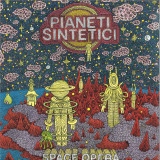
Pianeti Sintetici presents AI-37, entitled ‘Space Opera’. Conceived by Italian artist Davide Perrone, the Pianeti Sintetici (“Synthetic Planets”) project hypothesises the creation of future synthetic worlds as told through sound. Although split across two parts, the album is a singular organism that narrates a journey of boundless cosmic exploration. A sonic tapestry woven of intergalactic atmospheres, Space Opera’s imaginative sound design contributes to a richly spatial and haptic experience.
Taking place in the dimly lit crevices of deepest space, a swirling pool of chemical abstractions and extraterrestrial transmissions spumes out from the darkness. Elements weave through broad washes of drones and scintillating textures, contrasting a sparse backdrop with dense and multilayered passages. Composed with the use of modular synthesisers and intense audio manipulations, ‘Space Opera’ comes to life as an entity that transports the listener on an immersive journey into the mysteries of alien worlds.
Ryo Fukui is a renowned pianist born in Hokkaido, Japan. His fresh and delicate playing has attracted many listeners, and his first album, "Scenery," has been highly acclaimed worldwide. Fukui, who began playing the piano at the age of 22, recorded this album at the age of 28. The earnest performance of his youthful days shakes the listener's emotions in a pleasant way. It Could Happen To You" swings as if strutting, "Early Summer" is exhilarating and joyful, and "Scenery" seems to contain the night air of late autumn. The "Hokkaido-like emotion" that blends with Fukui's qualities and combines a large scale and subtlety is pleasant to listen to. The green leaves sprouting, the dazzling clear stream, the clear sky, the snow falling without a sound.... Here, the beautiful scenery spun by Ryo Fukui lives on forever.
Folly Group become the first band on Ninja Tune imprint Technicolour
(Elkka, Sofia Kourtesis, VTSS) with their new EP ‘Human and Kind’.
The four-piece of Sean Harper, Louis Milburn, Kai Akinde-Hummel and Tom Doherty formed in the tumultuous melting-pot of the London musical circuit. They released their debut EP ‘Awake and Hungry’ last year, receiving wide acclaim for their electronic infused post-punk sound and furiously brilliant live shows, landing coveted slots at Pitchfork Music Festival, in NME’s 100 Artists On The Rise and a co-sign from IDLES’ singer Joe Talbot.
Speaking about the EP, Folly Group said: “Where ‘Awake and Hungry’
doubled as a diary of the band’s formative months and encapsulation of our live show, ‘Human and Kind’ is a projection of our ambition, and our desire to push ourselves through what we might previously have
perceived as the ceiling of possibility for four players.”
For fans of Black Country, New Road, Squid, Yard Act, Black Midi, Dry Cleaning, Shame, Do Nothing.
140g crystal clear vinyl in 12” sleeve with spine and printed inner, plus
digital download code. Pressed sustainably within a 99% circular
environment at Deepgrooves.
“Every track is so good. They haven’t released anything that isn’t
amazing.” - Joe Talbot (IDLES, speaking on BBC 6 Music)
“thriving in well-crafted chaos.” - NME
“brilliant, experimental jungle rock” - i
“Give me that post-punk syncopation any day of the week” - Lauren
Laverne, who has made the band’s last three singles (including ‘I Raise You…’) her While You Were Sleeping Track Of The Day.
Headline UK Tour starting 31 March, taking in London, Bristol,
Manchester, Leeds, Birmingham, Nottingham, Margate, Newcastle,
Southampton, Milton Keynes and more.
'Quintela', the debut album by Carme López, a performer, teacher and researcher of traditional oral music from Galicia, is a new experimental work for Galician bagpipe. Influenced by the approach of composers like Éliane Radigue or Pauline Oliveros, the Spanish composer creates slowly modulating sound environments, and stretches the sonic the possibilities of the bagpipe to its absolute limit. 'Quintela' is structured in four movements, plus a prologue and an epilogue, which serve as a link to the contemporary language of the instrument.
The bagpipe is strongly tied to traditional musics; its use in different genres and musical contexts is extremely limited and unimaginative. 'Quintela' brings it to a wholly unknown field, decontextualising the bagpipe in order to elevate a personal approach, and leaving behind its male-dominated past (in which it relates to ideas of prestige, dominance or carries even sexual connotations). López expertly demonstrates its grandeur and breadth; the music on 'Quintela' ranges from barely audible sounds of air passing through the hide bag through rhythmical use of its reeds to all-encompassing drones with complex harmonic structures and vibrant overtones.
The narrative arc focuses on the composer's past, its people and places, and could be conceived as a journey in and of itself. A homage to those in our memories, but also a step into the unknown, 'Quintela' is an ambitious, graceful and captivating debut.
When Man Man released its last album, "Dream Hunting in the Valley of the In Between," frontman Honus Honus (née Ryan Kattner) was in a state of unrest, oscillating between hope and cynicism. Perhaps fittingly, the album dropped during the pandemic, a time at which we could all relate. But, much like that bizarre turn of events, the ennui now seems so distant to Man Man. A revived sense of purpose washes through Man Man's new album, Carrot on Strings, radiating a mix of calm and confidence. Kattner always embodied a wild-man pied-piper vibe: his melodic, unhinged art-rock was at once intriguing and angsty. He was so alluringly creative that you went along with it, even if you were never sure where Man Man would take you. Carrot on Strings is no less inventive, but its ethos is radical in context of the band's two-decade career. "When I was younger, I would feed off of chaos. I would, you know, be upset and get drunk and smash chairs," Kattner explains. "Now those chairs are in my head: It's less of an outward projection, more of an interior monologue." The name "Carrot on Strings" came to Kattner while experimenting with the sound of someone munching on the vegetable, which you can hear in the cacophonous, similarly named song. It alludes to how success always seemed to dangle uncertainly before him, often just out of reach. But listen intently and you'll hear a more content Kattner finding an uneasy peace: "Life, as far as I've known it, has always been side hustles. Would it be great if I could go into a studio and record for a year without figuring out how to finance it? Yeah, it would be," he says. "But ultimately, I need to keep making music because art is an extension of my psyche. It's how I have learned to translate the palpitations of my heart. Simply put, I'd go insane without it." Growing up as a multiracial Hapa kid (half Filipino, half white) with a father in the U.S. Air Force, Kattner lived an itinerant childhood that included a few pivotal years in Germany, where he honed in on an appreciation for out there German cinema and art. His film obsessions and screenwriting background were crucial to Carrot on Strings. The album nods to the films of Werner Herzog and Rainer Werner Fassbinder as much as Italo-disco, Randy Newman, goth rock, and avant pop. (Kattner continues to work in the film industry with an acting role in the upcoming horror-comedy movie Destroy All Neighbors, for which he also served as composer; music supervising season 1 & 2 of the Interview With The Vampire AMC TV series; and shopping around, with director Matthew Goodhue, a script he wrote that he describes as a Wim Wenders road movie on acid.) In a bid to not overthink anything - his last album took seven years to make - he recorded the bulk of Carrot On Strings in five days in Mant Sounds studio in Glassell Park, Los Angeles with "very chill" producer Matt Schuessler, who had worked on Man Man's cover of Neu!'s "Super" for the seminal Krautrock band's box set. The resulting album represents a newfound sense of self for Kattner, who finds himself inspired and at peace both personally and artistically in ways that eluded him for most of his first 15 years playing music. When, on Carrot On Strings, you hear Kattner croon humbly, or sing of the tension between his outsize stage persona and the thoughtful, soulful guy he actually is, you're hearing Kattner liberate himself. "I first got into music to escape from myself," he says. "And now, it sounds so corny, but I have zero doubt that music ended up saving my life."
A home, a house, has countless frequencies. Each room, each corner feels different. Swings differently. And as you grow older, you realize which corner is yours. But yeah, it takes time…
It certainly marks the end of an era when the house one called home as a kid no longer exists. This home, it was the starting point of so many journeys. Of one big, ongoing journey. And so it feels good, soothing, reassuring to at least return to a spot nearby – to that (proverbial) hill from where you can see it. Feel the vibe that made you.
Andi Haberl’s debut solo album as Sun is sort of dedicated to that house. It’s a journey leading to that hill overlooking everything that made him. It’s not about nostalgia, not about actually returning to a specific place. Instead, it’s about finding a personal frequency, an overlapping of sounds and samples, an open space that mirrors and extends whatever frequencies felt right at different points in time.
“To me, the results feel like Gold Panda/Four Tet meets Steve Reich meets Krautrock meets film scores. I just really wanted to create moods that touch me – and ideally others, too.”
Talking about his first solo album, Haberl recalls many stages: early compositions that ended up on Alien Ensemble’s albums, early DIY/home studio/multi-instrumentalist inspirations (Le Millipede), new technologies that came and went, even a set of wildly convincing arrangements (done with Cico Beck’s crucial input) that ultimately became stepping stones for yet another round of DIY takes. “It was a long, recurring process, and the songs went through so many different versions,” he says, talking about phases of growth (“I added more and more equipment over time”) and pruning, “cleaning up my music a bit.” Tending towards instruments that open up space, and slowly falling in love with sampling, he certainly didn’t rush things once it was time for interior design decisions ;)
“During this whole process I got to learn so much about my own taste, how I prefer to listen to the pieces, which musical elements really matter to me… and what my own voice is. For example, that acoustic elements are most important to me: the banjo, piano, drums, my voice, glockenspiel, trumpet, melodica. Anything that opens up some space.”
Every journey begins with a search: “Missing” with its plucked chords opens like a sunrise over pastoral plains, gently leading the way towards the intricate, playful explosion that occurs once a certain amount of energy (“Sun”) hits dirt and other surfaces: things grow, clot and curdle into new shapes, like new buds; layers of sound move forward, drenched in Spring’s new light. Relying on samples to ask for precipitation (“Rain On Me”), robotic “Low” goes from barren to bass-heavy after its midway shift in pace, full of loops plucked from the shade.
Towards the album’s midpoint, things are suddenly reversed: “Cluster” has that backwards pull, you can’t tell what’s what, yet everything is perfectly locked in, as the pace increases once again. And before the title song shimmers with densified cheering (to eventually stand tall like early Lymbyc Systym), “Beside Me” swipes you off your feet with its booming bass drum. The beat returns once again (“Daydream”), full of searching voices underneath, and at “Dawnday,” we can finally catch a melancholy view of the house. Voices hum. It’s the score moment of the album. Everything makes sense now. A happy end of sorts?
“I want to take people on a journey. A personal journey, too, because when my parents split up and sold the house I grew up in, I felt a bit like the ground had fallen out from under my feet. But I have dedicated the album title and the accompanying piece to this house… so I can keep it in good memory.”
“I Can See Our House From Here” has been a long time coming. It’s been a long journey. Homeward-bound. Leading to a place that’s really Haberl’s – his sound. His frequencies.
Known as a long-time member of The Notwist and various other bands/projects (Alien Ensemble, AMEO, jersey, Ditty etc.), Berlin-based drummer/composer Andi Haberl has also worked with My Brightest Diamond, Till Brönner, Owen Pallet, and Kurt Rosenwinkel, to name a few. “I Can See Our House From Here” is his first solo offering.
‘Empires into Sand’ is the first album of new material from Normil Hawaiians in 40 years. The group first refined their sound during the early 80s, hitting on a pastoral experimentalism that drew on ambient drone, motorik impulse and post-punk pep.
‘Empires into Sand’ came together in the familiar manner of their original three albums, with improvisation and nuance informing the blueprint of the tracks. It was with the official release of this last record ‘Return of the Ranters’ (originally recorded in 1984/85, but then unconsciously shelved) in 2015 by Upset The Rhythm that led to the group reconnecting with the intention of playing music together again. Normil Hawaiians played a launch show for that ‘lost album’ and followed that up with more concerts, including an appearance at Supernormal, a residency at the Edinburgh Festival, gigs at Cafe OTO. They were even chosen by Richard Dawson to perform with him in London.
Throughout this time, Normil Hawaiians revisited their original songs for live performance. However for a group always so interested in evolving their sound, it came as no surprise that they shirked at the idea of a faithful retread. The band pushed their songs into new inventive dimensions, still progressive at core, but now imbued with a cosmic uncanny. A cinematic approach that was always quietly present has come to the fore. The quaint weirdness of folk song, the humanity of communal practice and the group’s ecological mindedness have all found a place in Normil Hawaiians’ current sound world.
When Normil Hawaiians write and record music they prefer to gather in a remote location and live together for a while, such is their communal ethos. Being far-flung across the UK, the Family Hawaii (numbering seven key members) decided to encamp to Tayinloan, a small village on the west coast of the Kintyre peninsula in Scotland. They set up their own studio in an isolated, windswept house overlooking the sea and started the tape rolling. Noel Blanden from the band explains the process neatly: “we set up and began playing, slowly and patiently, allowing the music to take its own shape based on where we were staying and our ongoing friendship. We recorded for days, capturing everything. A lot of new and rich ideas began to emerge”.
Normil Hawaiians took their time to develop these threads at their own pace, allowing songs to mutate and settle over months. Simon Marchant deftly produced and recorded the album whilst also performing in the band, this marked the first time the band had total control of their own sound. The last few years has seen the band reconvene in Herne Bay, Faversham, London and Leith to record new parts, constantly responding to the changing form of these quietly spectral songs of defiance.
‘Empires into Sand’ incorporates samples from old rehearsals and live music into the new finished pieces, this is in continuum with their previous records. Snippets of sound from the static of short wave radio and satellite transmissions also embellish the work. In fact the whole album is stitched together with interludes, creating an acutely immersive 45 minutes. ‘Exiles’ opens the album amid swirling atmospheres, synth flights and recordings of Vilnis Egle (father of Zinta Egle from the band) retelling his experience of fleeing his home in Latvia during Soviet occupation in 1942. George Bikandy also features on this track talking about his flight from Syria in 2014. ‘Ghosts of Ballochroy’ is a winding river of a song featuring a lively discourse in Scots courtesy of Rodney Relax. There’s a commitment to truth telling present across this hopeful album populated with angels, incoming tides, long shadows and the rose-washed sun. “From our broken windscreen, we feel the breeze” soars Guy Smith triumphantly over the driving beat of ‘Waterfalls : Bedford 330’. ‘Big City Sky’ flutters and sparkles with rapid synth runs, tape-looped drums and Jimmy Miller’s commanding vocal. With ‘In The Stone’ Zinta’s melody is deliberately jagged and blunt, exaggerated by octave-layered vocals and interjections from Guy.
This is thought-provoking, boundary-bothering music. Honest in intent, a solidarity of vision. The album’s title is derived from a poem by band member Mark Tyler, who sadly passed away during the recording process and the transience of life is felt heavily throughout. Noel best coins the group’s wish for the album: “we wanted to create an album that acknowledges our history and also reflects who we are today. We remained true to ourselves and we wanted to make something beautiful without removing the edges.” ‘Empires into Sand’ certainly does that, it’s an echo from the past, an echo from the future.
About 10 years ago I tried to contact Dutch artist and scientist Felix Hess, when he was still alive, but never got a reply. Years later, in 2022, I was talking to Frans de Waard, who told me he was administering the sound archive of the late Hess together with Mark Poysden. Together we started working on an album to celebrate his life and many accomplishments. It includes selections from all the highly collectible Frogs releases from the 80's and 90's, while the artwork is sourced from his Zenga collection, unifying his two greatest passions.
While in Australia conducting research for his PhD thesis on the aerodynamics and motion of returning boomerangs in 1975, Felix Hess heard frog choruses for the first time. The hills, close to Adelaide, generating amazing natural rhythms and waves of spatial sounds. He started traveling to the outback to record similar frog choruses, camping in quit places to enjoy these wonderful nightly concerts.
Mystified by how the waves and rhythms of frog choruses could emerge without a conductor or a score and by the physics of this method of communication, he started to research the phenomenon in 1982 by designing and building small electronic sound creatures that could respond to each other in a similar way. These creatures and his various other installations earned him international acclaim.
During the 1990s, Hess was invited to Japan many times to present his work and he became interested in Zen Buddhism. One summer evening in 2001 he visited a museum in Berlin and saw actual Zen art for the first time. Overwhelmed by the extraordinary power radiating from this and similar artworks he became addicted to Zenga and gradually built up one of the world's most representative collections of hanging Zen scrolls. A collection he named Kaeru-An (Frog Hut) to honor his original teachers, the frogs