London producer Scott Ferguson is the man behind the Robot84 alias. He has a love for 80s gear that very much defines the sounds he makes, from proto-house to darker disco. His self-titled label is back with more of that good stuff here as he faces off with The Raff for 'Get It Right Next Time'.
This one has a creeping groove and warm chord sequences that tease and please beneath sweeping Balearic synths and celebratory melodic sequences that build to a crescendo.
The drums get the hips swinging and the sprinkling of cosmic magic finishes it off in style making it a perfect cut for open-air dancing by the beach.
Suche:sound man
Saint Abdullah & Eomac is a long distance, ongoing collaboration between New York based Iranian-Canadian brothers Mohammad and Mehdi Mehrabani (Saint Abdullah) and Ian McDonnell a.k.a. Eomac, based in Wicklow in Ireland. They tested the waters with their first album on Nicolas Jaar's Other People label last year, but 'Chasing Stateless' is their fullest expression so far.
The creative mindset behind the album starts with bravery and eschews escapism. Says Saint Abdullah's Mohammad, "As a collective, we exist to test the revolutionary possibilities within sound and sonic storytelling. As a means to finding a vision of the future and for building cultural dialogue today. Our belief is that the expressiveness of this vision should be pushed to its utmost limits to reveal anew. I always felt that the intensity of the middle eastern soul needs to be revealed more potently. Ian and the Irish have it too. I suspect most historically oppressed cultures do."
The music on 'Chasing Stateless' avoids easy middle eastern tropes — "I think what we're proposing here is that you don't need to water down our culture, you don't need to take only the bits that fit your idea of who we are, what we are. You ought to take it in its entirety."
Musically, the album approaches established genres and re-orientates them towards middle eastern rhythm and melody with an iron soul. Songs are rough and intense. Rusty polyrhythms, daf drums wrapped in a thick coating of distortion or punchy kicks with micro-edited samples of middle eastern life spiralling across them. Mournful melodies are squeezed out until the music teeters on the edge of rhythmic collapse. 'Chasing Stateless' is rough and energetic but also tender and reflective too. It's a human sound, utilising technology but not about technology. Sample heavy with expressions of anger, sadness and hope present and deeply felt.
The album's title speaks to a loss of collective societal imagination; of 'chasing status'. As Moh says "This generation, man, we're really good at putting up walls, despite all our openness. But where does this all lead to? What exactly are we chasing? This is where I especially love the name 'Chasing Stateless,' because if all this continues, we indeed will end up stateless, society-less, community-less, neighbor-less. Just a bunch of same-sies, living in an imaginary bubble, where we all look / think / say / CHASE the same things."
In 1994 the South London collective Archive was formed by Darius Keeler and Danny Griffiths together with female singer Roya Arab and young rapper Rosko John. Unfortunately, a few months later, they broke up, however Darius and Danny regrouped and continued releasing more Archive albums. Their 1996 debut album Londinium features a very strong mix of trip-hop, electronica, string arrangements, and female vocals from Roya Arab. Rosko John’s tough-spoken words are very similar to Tricky, Future Sound Of London and Massive Attack. The original 1996 issue only came out as a limited edition advance release, and has steadily built in reputation as a rare and expensive record to get a hold of. Fun fact: the song “Londinium” was featured on the Playstation
1 demo-disc and the music video was directed by Matt Cook.
This 25th Anniversary Edition of Londinium by Archive features the singles “So Few Words”, “Londinium” and more. It is packed in a gatefold sleeve, and includes a 4-page booklet with song lyrics and credits.
Why is it that thousands of clubbing tourists land at Berlin Schönefeld airport every weekend? Why have clubs like Berghain become the stuff of legend the world over? Why have some of the best-known producers and techno DJs like Richie Hawtin and DJ Hell moved with their labels to this city? These are the kind of questions explored in Lost and Sound by Tobias Rapp, a German music journalist who has been living, working and partying in Berlin since the beginning of the nineties. He has spoken with DJs, clubbers, label bosses, hostel managers and urban planners; he has looked and listened carefully; and most important of all, he has been part of the dance floor himself. Every day of the week – from Wednesday night (in Watergate) right through to Wednesday night (back in Watergate).
Lost and Sound is not one of those books that try to grasp techno from a desk-bound position. Rapp zooms in to relate intimate moments in front of the DJ booth and at the bar, and then cuts to historical tangents and theoretical reflections. Detailed research is interspersed with accounts from a first-person perspective. An excellent portrait of Ricardo Villalobos, the biggest star of the Berlin minimal techno and after-party scene, stands alongside a precise sociological portrayal of the queue for Berghain. Through this interplay of music, architecture, infrastructure and drug-induced explorations of personal limits, Rapp is able to capture what makes Berlin such a unique place for electronic music and how this music is experienced.
Following its publication in Germany in February 2009, Lost and Sound made an impact not
seen from a book about popular music for a long time. This was undoubtedly due in part to the
term coined for its subtitle: the ‘Easyjet set’ is a new group of music fans who – thanks to the
deregulation of the European air travel market – now regard the aeroplane as a taxi service for
parties, effectively making Barcelona, London and Paris suburbs of Berlin.
Repress!
Following his debut on the label with last year’s ‘The Pob Routine’, Jerome Hill returns to AccidentalJnr with another absolute stonker of a release which we’ll let him describe in his own words...
“After my last EP for Jnr I spoke with label boss Matthew Herbert and he challenged me to write a track for the next EP, containing only sounds I'd recorded 'in the wild'. I was about to spend a little time on an organic Vegetable farming co-op just outside Munich, 'Kartoffel Kombinat' which I'd previously nicknamed Potato Land, so I brought my recorder and during my stay made lots of recordings, carrots being bitten and snapped, various gardening tools clattering around, voices and even the big tombola-like machine that cleans the freshly picked vegetables. The resulting track was Potatoland and the only non-organic noise in it is the kick. Various 'Potatoland’ elements also make guest appearances in the other tracks, although they are less easy to spot.
'Quibble’, was also written specifically for the label and was influenced by Herbert who I've been a huge fan of for decades... I wanted to make something suitably wobbly and humorous that shuffles along but then really slams when the kick comes in. Add in the Dance Mania influenced ‘Chicken’ and the final track ‘Bleeper’ and that's the EP... Very happy to be back!!”
Trailblazing instrumental synth pop experiments created to soundtrack Japan’s booming 1980s cartoon and comic industries. The brightly futuristic instrumentals on this collection reflect the mindset of composers and musicians who believed in a technological future where everything was possible.
In the late 1980s Japan experienced a brief but heady period where societal changes combined with new-found wealth to open up a world of possibilities. A huge influx of cash - artificially created by slashed interest rates after an agreement with the US to weaken the dollar relative to the yen - resulted in the inflation of real estate and stock market at a rapid pace. While the economic bubble it created was unprecedented and impossible to sustain, for a while money was in plentiful supply.
The musical genre City Pop reflected the aspirations of the country’s booming leisure class. Video games flourished with Nintendo's 1983 launch of their Family Computer (or FamiCom). Studio Ghibli was founded 1985 to later became one of the most famous and respected animation studios in the world, and Anime and Manga were established as major forms of entertainment for all generations of the Japanese public.
Music was no mere footnote to the anime and manga boom: the two forms of media often went hand in hand, and not simply through the presence of background melodies. With generous budgets available, even two-dimensional static manga comics could be released with an accompanying soundtrack of original music known as an ‘Image Album’.
Composer and arranger Kazuhiko Izu was one such beneficiary of this open budget approach. Written to accompany artist Katsuhiro Otomo’s manga comic Domu, the composer and arranger took advantage of the world-leading (and wallet-busting) Japanese synthesiser technology available at King Records’ fully equipped studio. Featured on this compilation, A3: Act 2 Scene 26 reflected the story’s sci fi themes with a blazingly futuristic yet warmly funky slice of synth pop that presents a joyful celebration of synthesisers and their seemingly endless possibilities.
Kan Ogasawara was another composer who made early mastery of the litany of synthesisers, drum machines and sequencers that had become available. Two tracks written to accompany the 1985 period manga Yume No Ishibumi are featured here; Honowo’s experimental electronic textures add spice to a jaunty electro pop melody that recalls the Rah band’s 1983 hit Messages From Stars; the jazz-tinged Utage rounds out Ogasawara’s shimmering synth textures with beautifully crafted backing from legendary musicians Yuji Toriyama (guitar), Pecker (percussion) and Jun Fukamachi (piano).
Before becoming one of the pioneers of Japanese Kankyo Ongaku (Ambient Music), Takashi Kokubo worked on the proto techno track Kiki (Jungle At Night). It was put together for the 1984 anime film Shonen Keniya (Kenya Boy) using some of the most expensive music technologies available at the time. This Africa-Inspired dance track offers a contemporary parallel to the early techno music that young Detroit based producers were then creating using cheap Japanese Roland drum machines and synthesisers.
This is the first compilation of Japanese anime and manga soundtracks curated by Kay Suzuki and Rintaro Sekizuka from Vinyl Delivery Service (a Tokyo based online record shop which also operates in East London's renowned wine and hifi shop Idle Moments). With a cover by artist Kazuki Takakura and two pages of liner notes, this vinyl only compilation of music never before released outside of Japan, captures a vital aural snapshot of an era whose forward-thinking sounds went hand in hand with cutting edge technology.
Analogue Productions (Atlantic 75 Series)
Celebrating the 75th Anniversary of Atlantic Records!
Bad Company's eponymous 1974 debut featuring "Ready for Love"
180-gram 45 RPM double LP
Mastered directly from the original master tape by Ryan K. Smith at Sterling Sound
Pressed at Quality Record Pressings and RTI
Tip-on old style gatefold double pocket jackets with film lamination by Stoughton Printing
From the wreckage of Free came Bad Company, the English hard rock supergroup fronted by singer Paul Rodgers and featuring his drummer bandmate Simon Kirke, Mott the Hoople guitarist Mick Ralphs, and King Crimson bassist Boz Burrell. Peter Grant, who managed the rock band Led Zeppelin, also managed Bad Company until 1982.
The group's eponymous 1974 album debut decidedly proves the band is proudly not progressive — the details make a difference, as do the pastoral acoustics of the closing "Seagull" — reducing their rock 'n' roll to a strong, heavy crunch; compare "Ready for Love," a tune Ralphs brought over from Mott the Hoople, to the original to see how these quartet members keep their heads down as they do their business. Appropriately enough given their name, there's a sense of slow, churning menace to Bad Company, writes AllMusic reviewer Stephen Thomas Erlewine.
Their first three albums, Bad Company (1974), Straight Shooter (1975), and Run with the Pack (1976), reached the Top Five in the album charts in both the U.K. and the U.S.. Many of their singles and songs, such as "Bad Company," "Can't Get Enough," "Good Lovin' Gone Bad," "Feel Like Makin' Love," "Ready for Love," "Shooting Star," and "Rock 'n' Roll Fantasy," remain staples of classic rock radio. They have sold 20 million RIAA-certified albums in the U.S. and 40 millon worldwide.
The self-titled debut album was recorded at Headley Grange, Hampshire, in Ronnie Lane's Mobile Studio. The album reached No. 1 on the Billboard 200 in the U.S, and No. 3 on the U.K. Albums Chart, spending 25 weeks on the U.K. charts. The album has been certified five times platinum in the U.S., and became the 46th-best-selling album of the 1970s. The singles "Can't Get Enough" and "Movin' On" reached No. 5 and No. 19 on the Billboard Hot 10.
All the hallmarks of a top-notch Analogue Productions reissue are here for your pleasure: Mastered directly from the original master tape by Ryan K. Smith at Sterling Sound and cut at 45 RPM. Pressed on 180-gram vinyl at Quality Record Pressings and RTI, and housed in tip-on old style gatefold double pocket jackets with film lamination by Stoughton Printing.
- A1: Roscoe Robinson - You Don't Move Me No More
- A2: Lamp Sisters - No Cure For The Blues
- A3: Lh & The Memphis Sounds - Out Of Control
- A4: Marvin Preyer - Climbing Up To Love
- A5: Oscar Toney Jr - A Love That Never Grows Cold
- A6: Lee Rogers - The Same Things That Make You Laugh (Make You Cry) (Make You Cry)
- A7: Shortkuts - Your Eyes May Shine (Feat Eddie Harrison)
- A8: Bobby Womack - Take Me
- B1: James Fry - Tumblin' Down
- B2: Joe Simon - Looking Back
- B3: Lc Cooke - Half A Man
- B4: Masqueraders - Sweet Lovin' Woman
- B5: Bart Jackson - Dancing Man
- B6: Homer Banks - Foolish Hearts Break Fast
- B7: Double Soul - I Can't Use You
- B8: Terry Felton - I Don't Want To Have To Wait
- B9: Ted Ford - You're Gonna Need Me
Most southern soul fans will tell you that that the music produced in Memphis in 1967 and 1968 was the pinnacle of quality. So following on from our look at the River City’s soul output in 1967, we now turn our attention to an album covering the next year. As before, the singers here are a heady mixture of local Tennessee talent and welcome soulful guests who journeyed down south hoping that a little of the famous Memphis magic would rub off on their songs. There are soul genres to suit all tastes here – from the deepest ballads to upbeat tracks that will rock your socks off. Soul doesn’t get much better than the artists and their tunes on this LP!
- A1: Josephine Taylor - Good Lovin
- A2: Jackie Beavers - Sling Shot
- A3: Five Stairsteps - Come Back
- A4: Betty Everett - Bye Bye Baby
- A5: Tim - My Side Of The Track
- A6: Tyrone - You Made Me Suffer
- A7: Cash Mccall - You Mean Everything To Me
- A8: Andrea Davis - You Gave Me Soul
- B1: Jamo Thomas - Stop The Baby
- B2: Jean Dushon - All Of A Sudden My Heart Sings
- B3: Jimmy Dobbins - What Is Love (I Found Love) (I Found Love)
- B4: Chuck Bernard - Let's Go Get Stoned
- B5: Sonny Warner - Been So Long
- B6: The Cod's - It Must Be Love
- B7: Joyce Davis - Along Came You
- B8: Johnny Sayles - Deep Down In My Heart
In the 1950s Chicago was the blues capital of the world. But by 1966 musical tastes had changed. R & B had morphed into hard soul and newer soft soul musical stylings had coalesced from earlier doo wop motifs, with bigger and more sophisticated productions. This was the era of the small independent owners / producers, all vying for airplay and sales in a hugely competitive marketplace. This landmark LP showcases many of the best of this output – the sounds that hit music listeners and buyers straight from the street. The mix here is a perfect blend of the tough hard soul style and the softer soul sounds. Just right for the feet and the heart. Enjoy!
Seven suites of deep and sprawling sonic meditations built around ‘call and response’ improv sessions between Randy Raine-Reusch and Michael Red.
Slow and tempered recordings of Asian flutes, African harps, temple gongs and a myriad of obscure instruments from Randy Raine-Reusch's deep collection mutate and ebb into swirling gossamers of tone. Sonic incantations stretched and magnified further by Red's Sends. An otherworldly play between light and shadow worlds; at times idyllic and light-filled, at times dark and eerie– all engrossing. Dream-reality reconciliations weave between the spectral world of Michael Red's sound processes and the direct physicality of Raine-Reusch's playing. The tension across the pieces builds between the live playing and processing techniques, dutifully revealing a growing familiarity with collective transcendence through sound (bigger than the sum of its parts). Real-time interactive dream music.
Initially realized over the course of a few days in Randy’s instrument museum in Vancouver BC December, 2014 'ERAS' is made up of processed, and sometimes multi tracked, improvisations between Randy and Michael. Through these sessions Randy would choose instruments he sensed possibilities within, and Michael then revealed and sculpted these possibilities. Both resonating, sensing sonic structures, environmental nuances, and further worlds in each other’s art, all within the moment. Being present for each other, they acted on instinct, trusting a first thought, trusting each other; committing, responding to that commitment, then mutating and letting go. Always moving forward, synthesizing and letting the living moment lead the way.
The recordings were left to distill and mature for many years before the composers felt it was ready. With minimal judicious edits and a very light dusting of FXs, both careful to preserve the direct and intuitive process that permeates the recording, ERAS now emerges.
Repress!
For those who know, Bambooman is one of the most sought-after, probing, and distinctive voices in UK electronic music right now.
The Yorkshire-born producer's catalogue builds into an aural mosaic, comprising everything from scrunched up hip-hop to techno deviance, all delivered with an impish sense of individuality.
'Whispers' certainly resonates. It's a lengthy, bucolic work, an album of great breadth but also one of sustained mood – think those hazy summer evenings when shadows stretch out across the road, and autumn lingers around the corner.
This new album has a dusty, organic, and decidedly personal feel, much more at home with Jon Hassel's 'fourth world' aesthetic than the club.
The results are also imbued with an incredible sense of mystery, with Bambooman's productions frequently being shot through with a hallucinatory sense of the uncanny. Entirely self-composed, 'Whispers' utilises "lots of field recordings that I've collected over the last few years, while within the tracks you can find lots of the instruments, percussion, bells and whistles that have been gathered throughout my life."
In certain ways 'Whispers' is entirely autobiographical: Bambooman reaches back to his varied alter egos, to the ambient releases, art commissions, and soundtrack projects that litter his discography. The cover art was even pieced together by Oliver Pitt – of Glasgow group Golden Teacher – who was an early ally in the producer's sonic quest.
Stylistically 'Whispers' veers from avant hip-hop of Flying Lotus to the theoried composition of Terry Riley, from the future-forward percussive energy of Battles to the ever-evolving electronics of Mark Pritchard. It's a record marks by a fiercely independent spirit, but also by a close-knit cast of collaborators.
King Kashmere takes a starring turn, following the pair's collision on the recent 'SUPERGOD' EP.
Each vocal is recorded, chopped up and then spliced across the album, with Elsa Hewitt also making a number of appearances and re-appearances.
credits
The official new edition from this rare and great Afrobeat & Soukous masterpiece from Nigeria !
"Vibro Success Intercontinental Orchestra was an extraordinary group from the Central African Republic, founded by the sax player Rodolphe 'Beckers' Bekpa, also known as Master Békers, in the late 60's. The band achieved surprising domestic success after Beckers introduced the first drums to the Congolese Rumba rhythm. His innovation proved to be wildly popular so they were hired as the resident band of “ciel d’Afrique au Km5”, a night club in Bangui. The club was renowned as the temple of the Olympic Réal football team's fans and that visibility propelled them into becoming the official national orchestra.
1970 marked beginning of the band's international fame . Their fame spread beyond national borders until they became so popular that invitations began to arrive from nearby countries like Cameroon and Chad, the former of which the band would then tour that same year. The success of their performances prompted a further tour in 1972. According to Rodolphe Bépka, the audience enthusiasm Vibro encountered was bewildering. "We filled the old military stadium in Yaoundé in 1970, in 1972 the new Amadou Haïdjo stadium ... We are running with great success in the cities.” Their popularity was also growing in Chad, where they would tour several times through the early and mid 70's.
Towards the end of 1976, Vibro Success decided to take their music global and introduce Central African music to listeners worldwide. It worked. The turning point came in Nigeria. There the group achieved extraordinary success, with live performances followed by contracts with local labels like Scottie and Ben/Clover resulting in hit releases. Most of their LP's were originally released on this later label, Ben Limited, owned by Ben Okonkwo.
Ben, also known as Clover Sounds, brought a great number of the biggest bands from the country to market, bands like The Apostles, Akwassa,The Doves, Aktion, The Visitors, Mansion, Folk 77 and many others. Nearly all those groups started their recording careers in the label's studios based in the commercial heart of Aba, Abia State, one of Southeastern Nigeria’s largest cities. Aba at that time was a flourishing city, an important crossroads of people and culture with an intensive and active and cutting edge live music and nightlife.
But after that golden era the group began to lose its popularity. In the 1980's they returned to Bangui and resumed their old-time gigs in dance halls there - only to realize that their music didn't have the appeal it used to. Making matters worse, the domestic economic downturn accelerated, forcing the orchestra to slowly end its activities . Vibro Succès Intercontinental Orchestra disappeared at the end of the 80s and most of its members died in the 90s.
We discovered this LP during our first trip to Nigeria in 2016. While traveling in the east to meet up with a musician, we stopped for a night in a village. As often happens in Nigeria, information has a way of traveling fast. The news that a couple of white guys looking for records had arrived in the village the day before spread like light. When we awoke, we found a couple of elderly music lovers in the hall of our hotel with a little pile of records for sale. The nice cover of the “Drunkard” album was right on top!
At first we thought it was just another really good soukous album made by Vibro Success but after we heard “Drunkard” - we knew we had stumbled onto something very special. That was the “easy” part. Soon after, we had the idea of reissuing this LP and that was a bit harder. There were no credits on the cover and not much information about Vibro Succès. We started to ask to our friends to ask around, see if somebody knew them or the producer. That's when sadly we discovered that Ben Okonkwo had passed. So with no leads to follow and seemingly without any possibility of making progress on the matter, we "gave up" and returned to Italy.
A couple years later, in the summer of 2019, we found ourselves again in Aba. This time we had the chance to meet Nnamdi Okonkwo, the eldest son of the late Ben Okonkwo. After Nnamdi's mother and family agreed, he was glad to cooperate with us for the re-release of this special album."
Repetitive actions, looping in your head forever. Forever? Never. Zero is endless. All flowers and fades. No permanence is ours. We are a wave, that flows to fit. And yet, “Music for a film”, a cassette tape by Swedish artists Sofie Herner aka Leda, inheres the power for perpetuity. A circulating dreamland, built on loop pedals, guitar, and tape manipulation.
The Malmö based artist, who is already famed in the global experimental, improvisational, lo-fi noise underworld for her own musical creations as well as being part of bands and projects like Enhet För Fri Musik, Källarbarnen, or Neutral, brings music made for the film “Dödfött“ - an interactive flick by director Niklas Hansson about failed online karate and caducity, screened with a stage art performance at Hypnos Theatre, Malmö, in early autumn 2022. Cinematic sounds for all the Velvets, that never awaken from their first DIY Super 8 dream.
Colorful, yet monochrome electrified and acoustic guitar melodies, monotonous, working like drones, getting all stranded in the zones. Six minimal compositions. Full of plenty, always friendly. Heavy, calm, dreamy, shredding, scratching, created for the woman of the world. And all other creatures, that seek features in unbroken repetition. As nobody keeps any of what he has, one day the eternal veil of forgetfulness will warp us all. Until that hour we dance in circles. Making karate moves, sidestepping caducity, reenacting ourselves, endless at the edges, through night and day, craving form that binds. As form is emptiness, emptiness is form itself. Welcome to the world of Leda, riff, 7/4, loop, the young, the middle aged, the old…
Tape is hand-stamped along the top, in printed card housing, with
Colbie Caillat is a master storyteller whose breezy SoCal folk-pop songs laced with a country shimmer speak truth to both the pain of endings and hopefulness of what’s to come when you’re brave enough to follow your wild, wild heart. Along The Way, Caillat’s solo country debut, embodies the positivity in heartbreak’s wake. Though her move to Nashville was done as one-half of a romantic partnership - a personal and professional adventure to the southern city for this west coast girl - she thrived in all of life’s changes. In her musical journey and experimentation with new sounds, Caillat vividly captured a moment in her life through song. The California-raised, Nashville-based girl delivered songs with gratitude for having known this love, learned so many lessons and the joys shared along the way. “The love that you shared shouldn’t be wasted: you help each other grow and become a wiser and more evolved person. We needed to be together to become who we are today, even if we didn’t end up together.” If Joni Mitchell’s quintessential Blue is the deep dive into the caverns of grief following a break-up, Along The Way is a bright, shiny compass Caillat offers to guide people through the tough times and raw feelings that accompany any dissolution. Lover, leaver, left, the woman who’s sung at the Nobel Peace Prize Concert wants to sow compassion for all parties involved.
Minneapolis' Chris Bartels aka Blurstem, and Philadelphia's Andrew Tasselmyer of the likes of Hotel Neon and Gray Acres have hooked up once more for a second collaborative album Midnight Letters. This album's starting point was original concepts played out on guitar which were then processed and experimented with through an ages-old analog tape machine. Add in an array of iPad audio processing apps, samplers, and Ableton software and you have a perfect mix of tools to serve up a sonic journey that perfectly merges the old with the new. The resulting ambient soundscapes are immersive and sparse but packed with subtle details that convey all manner of emotions.
Analogue Productions (Atlantic 75 Series)
Celebrating the 75th Anniversary of Atlantic Records!
Hello, I Must Be Going! — Phil Collins' second solo studio album
Featuring "You Can't Hurry Love" and "I Cannot Believe It's True"
180-gram 45 RPM double LP release
Mastered by Chris Bellman at Bernie Grundman Mastering and cut to lacquer from a 1/4" EQ'd Dolby tape copy of the original master tape
Pressed at Quality Record Pressings and RTI
Tip-on old style gatefold double pocket jackets with film lamination by Stoughton Printing
On his first solo album, 1981's Face Value, Genesis drummer-singer Phil Collins showed that he wasn't about to be left behind in the mire of classical-rock sludge. That LP boasted shorter songs and demonstrated that Collins had a true pop sensibility. Hello, I Must Be Going! continues that trend, with some familiar patterns emerging, wrote Rolling Stone's John Milward.
"First, there are the dramatic rock dirges that use drums as a lead instrument; 'I Don't Care Anymore,' with Collins' one-man band playing alongside Daryl Stuermer's atmospheric guitars, wins in this category. Then there are the buttery ballads, of which "Don't Let Him Steal Your Heart Away" is the best by virtue of a Beatles-like melody that buoys Collins' anonymously sweet voice. Both of these styles were already Genesis staples; it was Collins' uptempo soul tunes on Face Value and Genesis' Abacab that surprised old fans and found new ones. 'I Cannot Believe It's True,' with Earth, Wind and Fire's Phoenix Horns casting out clean lines, clobbers the other soul contenders on Hello, I Must Be Going!, especially his remake of the Supremes' 'You Can't Hurry Love.' Collins took the golden-oldie route on that song and the result isn't soulful, it's superfluous. Despite its trend-bucking boast of an 8-track recording, the album's rich luster is of the old classical-rock school. In fact, the LP sounds like stripped-down Genesis, ornamental but not too ostentatious. — John Milward, Rolling Stone (3 Stars)."
This Analogue Productions (Atlantic Series) reissue of Hello, I Must Be Going! has the essential elements that make it a standout for your collection. First, we turned to Chris Bellman at Bernie Grundman Mastering to cut lacquers from a 1/4" EQ'd Dolby tape copy of the original master. Pressing on 180-gram vinyl is by Quality Record Pressings and RTI, and the album is housed in tip-on old style gatefold double pocket jackets with film lamination by Stoughton Printing.
Hello, I Must Be Going! was a triple-platinum-selling hit in the U.S. for Collins in the 1980s and it stayed on the U.K. album charts for more than a year, peaking at No. 2. For the fans it is a drummer's album, a record that expresses rage and desperation as well as loneliness and longing. Not an album for every day, but one that really speaks to you when you need it, wrote Martin Klinkhardt, in a review for genesis
This is the soundtrack to flipping through the filing cabinet at the mortuary in Return of the Living Dead. You are running out of time before ending up on the slab yourself at the end of a bad day at work. Wash away the blues with a pint and 12 tracks clocking in at just under 14 minutes whilst Stiff Meds take you on a journey to see the many faces of death. Starting in 2019, Stiff Meds arose from the grand tradition of fast as fuck music that has always been at the centre of UKHC from Napalm Death to Voorhees. Taking that history, along with some more US influences such as No Comment and Infest, vocalist Seth marries that with tales of the macabre as metaphors for daily life. Each song contains more riffs than most brains can compute in real time and is a testament to the skill level of the band. Not surprisingly they have grown a reputation as a ferocious live machine that blasts through 20+ songs with ease and without stops with wild crowd reactions to match. If you don’t believe us, then check out the Live at the Mersey Shore Set as an exclusive special feature of the physical vinyl release of Tales from the Slab. Don’t delay, it’s time to pick up your prescription. Check them out on tour in Europe, November-December 2023.
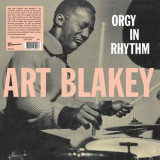
When Billy Eckstine’s band dissolved in the mid-1940s, adventurous drummer Art Blakey spent two years in Africa, where he briefly converted to Islam; back in New York, he gigged with Miles and Monk, before fronting his own Jazz Messengers. 1957’s Orgy In Rhythm drew on the sounds of North Africa and the Middle East, Blakey’s unfettered drumming accompanied by Latin percussionists such as Potato Valdez and Evilio Quintero, with Herbie Mann on flute. The musical arrangement is stunning, at times melodic or primordially rhythmic, but never short of pure brilliance. Overall, an excellent and astounding release!
- A1: A Love Before Time (Mandarin)
- A2: Crouching Tiger, Hidden Dragon
- A3: The Eternal Vow
- A4: A Wedding Interrupted
- A5: Night Fight
- A6: Silk Road
- A7: To The South
- A8: Through The Bamboo Forest
- B1: The Encounter
- B2: Desert Capriccio
- B3: In The Old Temple
- B4: Yearning Of The Sword
- B5: Sorrow
- B6: Farewell
- B7: A Love Before Time (English)
Crouching Tiger, Hidden Dragon is a 2000 wuxia film directed by Ang Lee. Taking place in 18th-century Qing dynasty China, the story revolves around a warrior who gives his sword, Green Destiny, to his lover to deliver to safe keeping, but it is stolen, and the chase is on to retrieve it. The film was praised for its story, direction, and cinematography, and for its martial arts sequences. It won the Academy Award and Golden Globe Award for Best Foreign Language Film. The score was composed by Tan Dun, containing many solo passages for cello by Yo-Yo Ma. The track “A Love Before Time” features Coco Lee. This album is released as a limited edition of 750 copies on translucent red vinyl.
Foreigner's debut spawned massive FM hits "Feels Like the First Time," and "Cold as Ice"
180-gram 45 RPM double LP
Mastered directly from the original master tape by Ryan K. Smith at Sterling Sound
Pressed at Quality Record Pressings and RTI
Tip-on old style gatefold double pocket jackets with film lamination by Stoughton Printing
Arena rock heroes Foreigner crushed with their 1977 self-titled album debut, spawning some of the biggest FM hits of that year, including the anthemic "Feels Like the First Time" and "Cold as Ice," both of which were anchored — like most of Foreigner's songs — by the muscular but traditional riffing of guitarist Mick Jones, the soaring vocals of Lou Gramm, and the state-of-the-art rock production values of the day, which AllMusic reviewer Andy Hinds says allowed the band to sound hard but polished.
The architect behind Foreigner's extraordinary catalog, Mick Jones has crafted some of rock music's most enduring songs. Grammy and Golden Globe-nominated songwriter, performer and producer and winner of the prestigious Ivor Novello songwriter award in 1998, Jones first began playing guitar in his early teens.
After starting his own rock band and opening for the Rolling Stones in pubs across South London, Mick's first big break came in 1964 when he moved to Paris and was hired to play with French singer Sylvie Vartan.
After a brief stint in England to reform the band Spooky Tooth, Jones moved to New York City and formed Foreigner with Ian McDonald and Dennis Elliott and Americans Lou Gram, Alan Greenwood and Ed Gagliardi.
Foreigner defined a generation of rock music to people across the globe. From its iconic debut album, the band moved on to record-breaking hits including "I Want To Know What Love Is," "Waiting for a Girl Like You," "Double Vision," "Hot Blooded," "Juke Box Hero" and many more.
Now on 180-gram 45 RPM double LP you'll hear Foreigner in all its phenomenal glory. Mastered from the original tape by Ryan K. Smith at Sterling Sound, this reissue rocks. Double LP cut at 45 RPM, pressed at Quality Record Pressings and RTI, and housed in a Stoughton Printing tip-on old style gatefold jacket. That's how you upgrade a classic.