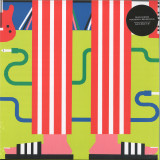
Gaucho — Steely Dan's Grammy-winning seventh studio album now on UHQR!
Definitive reissue Ultra High Quality Record, the pinnacle of high-quality vinyl!
45 RPM LP release limited to 20,000 numbered copies
Mastered by Bernie Grundman from a 1980 analogue tape copy originally EQ'd by Bob Ludwig
Pressed at Quality Record Pressings using 200-gram Clarity Vinyl®
Purest possible pressing and most visually stunning presentation and packaging!
Tip-on old style gatefold double pocket jackets with film lamination by Stoughton Printing
Gaucho — the iconic seventh studio album by Steely Dan, released in November 1980 — and Grammy-winner for Best Engineered Non-Classical Recording, was also Grammy-nominated for Album of the Year and Best Pop Performance by a Duo or Group with Vocals. The album represents the band's musical evolution towards a more polished and sleek sound, featuring a collection of meticulously crafted songs that blend jazz, rock, and pop music, while exploring themes of decadence, longing, and disillusionment.
Gaucho opens with the title track, a jazzy instrumental piece that sets the tone for the rest of the album. The standout tracks on the album include "Hey Nineteen," a catchy and upbeat tune that features a memorable saxophone riff and lyrics about an older man's attraction to a young woman, and "Babylon Sisters," a funky and groovy track that showcases the band's impeccable sense of rhythm and melody.
The sessions for Gaucho represented the band's typical penchant for studio perfectionism and obsessive recording technique. To record the album, the band used at least 42 different musicians, spent more than a year in the studio, and far exceeded the original monetary advance given by the record label. Still, the album features multiple layers of instrumentation, carefully crafted arrangements, and the use of top-notch session musicians to create a lush and sophisticated sound that is uniquely Steely Dan.
Despite its critical and commercial success, Gaucho was a challenging album to make. During the two-year span in which the album was recorded, the band was plagued by a number of creative, personal and professional problems. MCA, Warner Bros. and Steely Dan had a three-way legal battle over the rights to release the album. After it was released, jazz musician Keith Jarrett was given a co-writing credit on the title track after threatening legal action over plagiarism of Jarrett's song "'Long As You Know You're Living Yours."
Gaucho marked a significant stylistic change for the band, introducing a more minimal, groove- and atmosphere-based format. The harmonically complex chord changes that were a distinctive mark of earlier Steely Dan songs are less prominent on Gaucho, with the record's songs tending to revolve around a single rhythm or mood, although complex chord progressions were still present particularly in "Babylon Sisters" and "Glamour Profession." Gaucho proved to be Steely Dan's final studio album that Donald Fagen and Walter Becker would make together until the year 2000.
Gaucho reached No. 9 on the U.S. album chart and was certified platinum-selling. "Hey Nineteen" reached No. 10 on the U.S. Singles Chart and went to No. 1 in Canada. Pitchfork, in its review, describes the almost "pathologically overdetermined production" as elegant, arid and a little forbidding. "Every last tinkling chime sounds like it took 12 days to mix, because chances are, it did." The New York Times deemed Gaucho the best album of 1980, beating out Talking Heads' Remain in Light and Joy Division's Closer.
Founded by core members Walter Becker (bass) and Donald Fagen (vocals, keyboards), Steely Dan's popularity rose throughout the late 1970s on, and their seven albums throughout that period of time blended elements of jazz, rock, funk, R&B, and pop. Steely Dan created a sophisticated, distinctive sound with accessible melodic hooks, complex harmonies and time signatures, and a devotion to the recording studio. Becker and Fagen, with producer Gary Katz, gradually changed Steely Dan from a performing band to a studio project, hiring session musicians to record their compositions. The duo didn't perform live between 1974 and 1993. But their popularity nevertheless grew throughout the '70s as their albums became critical favorites and their singles became staples of Adult Oriented Radio and pop radio stations.
After a brief battle with esophageal cancer, Walter Becker died on September 3, 2017 at the age of 67. Steely Dan has sold more than 40 million albums worldwide and were inducted into the Rock and Roll Hall of Fame in March 2001. VH1 ranked Steely Dan at No. 82 on their list of the 100 Greatest Musical Artists of All Time. Rolling Stone ranked them No. 15 on its list of the 20 Greatest Duos of All Time.
This stereo UHQR reissue will be limited to 20,000 copies, with gold foil individually numbered jackets, housed in a premium slipcase with a wooden dowel spine.
Gaucho remains a testament to Steely Dan's enduring musical legacy and their ability to create timeless music that transcends genre and style.
Search:sound man
FAT JON returns with the 2nd installation of "tephlon Funk". This 12 track LP serves as a soundtrack to the eponymous manga published by Dark Horse Comics and comes with a 12"x12" manga poster, with a full print jacket. A must have for fans of FAT JON's work as Five Deez and on the Samurai Champloo soundtrack.
Big Crown Records is proud to present the debut full length offering from Les Imprimés, Rêverie. The stirring and ethereal sounds of Les Imprimés have been making fans of anyone who hears them since their first 7” single hit the speakers. Morten Martens is the man behind the band. Born, raised, and working in Kristiansand, Norway, he keeps a low profile while making his heartfelt, highly infectious, and unique music. This album is a long time coming for Martens and it is sure to make him a name to be reckoned with.
The first thing you notice listening to Les Imprimés is the high level of musicianship. Martens plays nearly every instrument on the recordings and handles the production and arranging. He has been making records for decades, winning a Spellemann Award (aka, the Norwegian Grammy) in 2006 for producing a Hip Hop album as well as getting nominations across three other genres. While awards and accolades speak to the level of his talent, this new album really shows who he is as an artist on his own terms.
Moving away from being a hired gun on the touring scene naturally led him to start doing more studio work. Slowly collecting gear and getting more experience behind the boards he built his own studio on the island of Odderøya and was making a living playing with and recording other people's music. As the story goes, after those sessions would end he would work on his own project into the wee hours of the night. From these late night sessions, Les Imprimés was born and Rêverie began to take shape.
However, "it wasn't until COVID, when things locked down, that I was really able to find the time to focus on Les Imprimés" Morten says about creating and leading his own solo project. "It was a scary time. But I knew I had to do something with it." He took the sum of his influences, combined them with his own vibe and got busy writing the music, playing the instruments, and singing the songs. "It's soul music, but I don't exactly have the soul voice," Morten explains humbly. "But I do it my own way, in a way that's mine."
It is his sound, his fingerprint, his sensibility, that makes his music hard to categorize. He has crafted an album of songs with different energies that all fit together to make one gorgeous record. The lead single “Falling Away” starts with a raw drum break and turns into a lushly arranged tune that paints the picture of love when it slips away. On “Still Here” he professes his resilience through life’s twists and turns over a thundering track that puts a new spin on the B side ballad genre. Songs like “You” and “Our Love” mix tones from 60s and 70s Soul with arrangement nods to Doo Wop records while Martens’ lyrics and delivery leave you singing the melodies long after they finish. “Love & Flowers” finds Martens in a moment of clarity with a song that fits the niche sub genre of happy break up tunes, the four on the floor track will move the dancefloor while the message will resonate with anyone who put too much effort into the wrong situation in their lives. However, it is songs like “Muse” and “Chess” that really encapsulate the uniqueness of Les Imprimés as they push the boundaries of genre, one a profession of love for music and the other a cover of an electronic record respectively. Martens’ lyrics, emotion, and delivery truly make the whole thing come together and stand out from any of his peers. There’s an infectiousness and a pop sensibility in the writing that is done with the utmost class and taste giving Les Imprimés the rare quality of immediate attraction that only deepens the more you listen.
Element, co-founder of Riddim Chango imprint, introduces his latest creation, a 4 track EP, under the freshly forged subsidiary label, Parallel Line.
The EP opens with the abstract dancehall mic-man in Kingston I Jahbar, reprising his collaboration with Element from their 2021” Andromeda EP on Bokeh Versions, narrating rhythmic tales of style and ambitious hustle. The records transitions to the intense dubwise cut to the A1,“Chicken Gravy Dub”, and the B-side unfolds“Nine Mall”and“Martian Gravity,”instrumentals resonating with obscure yet atmospheric dancehall/dembow echoes.
The EP embodies a fusion of eclectic influences, resonating with reflecting the innovative and unique soundscapes of Element and his Parallel Line imprint.
Repress!
Listeners familiar with Kaitlyn Aurelia Smith's previous album Euclid (an album that prompted Dazed to call her "...one of the most pioneering musicians in the world.") will no doubt notice her heavier use of vocals on her new album EARS. On all but one song, her gently ecstatic swells of vocals emerge to soar over a dense jungle of synths and woodwinds. After initially composing on a Buchla analog synth, she wrote arrangements for a woodwind quintet, added vocals, and further refined the pieces with granular synthesis techniques she developed in her sound design work (she contributed sound design to Panda Bear's "Boys Latin" video, and handled sound design and original compositions for Brasilia co-written by and starring Reggie Watts).
Kinetic arpeggios of synths pulse, often buoying her graceful vocal mantras, while woodwinds breathe and flutter, emulating the wildlife Smith observed while growing up on the West Coast (she even studied recordings of slowed down bird calls prior to composing these pieces). Though some of her gestures echo the musical tropes used by early minimalist composers, the world she creates on EARS is uniquely hypnotic and full of life, not unlike Miyzaki's film Nausicaä, which she cites as an inspiration.
EARS is a masterful articulation of Smith's vision, which she achieved in part by spending time preparing her mind prior to composing the album.
With its tenth record from Fortunato Durutti Marinetti, Quindi continues to celebrate songwriting and storytelling framed by curious musicality. In keeping with the label's trajectory to date, this is an album which draws on a universal human sentimentality and presents it with an uncommon flair. In the case of Toronto-based Daniel Colussi, the man behind Eight Waves In Search Of An Ocean, his melancholic poetry cuts through with a clarity which calls to mind all-time greats from Anette Peacock through to Lou Reed and Leonard Cohen.
Turin-born Colussi has drifted through various bands, guises and styles over the past 20 years, but since settling into Fortunato Durutti Marinetti as a vehicle for his songs, he's found a strong expressive impetus which transcends genre to become entirely hinged on the power of his words and melodies. The first album under this alias was a 2020 cassette album, Desire, later pressed on vinyl due to demand in tandem with the release of 2022's Memory's Fool. On each record, Colussi has found distinct arrangements of players to set the mood, ranging from gently lilting art and folk rock through to orchestrated balladry, but Eight Waves In Search Of An Ocean widens the palette of Fortunato Durutti Marinetti to create an album in which each song feels like a tale unto itself.
Colussi's renewed approach is instantly apparent as album opener 'Lightning On A Sunny Day' unfurls, informed greatly by producer Sandro Perri's input pursuing a hybrid electro-organic sound. The addition of drum machines and synths to the musical palette bring with them the strong connotations of pop while the sax and violin sounds similarly smooth and silky, and one can't help but think of John Martyn's slide into the digital sound of Sapphire or Kraftwerk's bittersweet synthetic tenderness.
Within this sound, there's still space for the energy to fluctuate according to the whims of songs. 'The Flowers' turns inward with a soft-touch composition as delicate as the petals Colussi describes falling to the floor. 'Misfit Streams' and first single 'Clerk Of Oblivion' savour the fluid, luxuriant tone of fretless bass with all the 80s connotations intact. Colussi remains the central focus whatever happens around him, in possession of the kind of unforced charisma which drives a song deep into the listener's heart. It's at once entirely his own style and yet comforting and familiar. The lyrics might sweep you into the singer's inner world, similarly to the experience listening to late 60s Tim Buckley, or you might well inhale the mellow jazziness of the harmonic movement like you would Joni Mitchell on Hejira.
The emotional direction of each track is never linear - 'Smash Your Head Against The Wall' snarls its rhythm section before the strings sow their aching beauty to cool the song's temper, winding up as a track of distinct halves jabbing at each other. "I Need You More' leaves space for spiralling flute solos and strangely stiff, militaristic drum rolls in the midst of a sweet, slightly sad synth ballad, the final wave receding back into the tidal undulations of Colussi's unique exploration of his muse.
The artist himself dubs his musical expression as "poetic jazz rock" with a sideways glance - it's not exactly poetry, far from trad jazz and it doesn't really rock, yet the tag feels uncannily like it fits, just like the curious music it's used to describe.
The fragility and balancing act of creativity is an immeasurable factor in the life of any artist, serving as a commanding force in the choices they make over their careers. If the connection and meaning in creativity becomes devoid, there's a transformation process that either channels an ascension or departure. An internal and external battle that can chase and haunt individuals in every part of their life if one falls into the latter position. In the case of Los Angeles based electronic producer Huxley Anne, ascension was achieved during one of these tests of creative endurance and preservation, entering a phase of her life where the process of feeling art on meaningful levels had subsided for a lengthy period and the eventual reprisal of these natural gifts returned. This led to the creation of her debut album and an expansion in creativity that marks an important beginning for her path as an artist. This work is known as Ilium, representing a moment in Huxley Anne's life that's been one of her most testing yet rewarding mountains to climb. Ilium is Huxley Anne's debut album with Los Angeles indie imprint and Alpha Pup Records affiliate, Dome of Doom. Sonically, Ilium is an orchestrated field of unique beauty, drawing together eight tracks of exotic electronic music that calls upon the darkest and most light-driven of emotions. Exploratory textures take on vortexes of shape through cinematic sound designs, fluidly traversing between amorphous undertones, intricate composition mapping and pulsing rhythms. From the submersion of euphoria to the illumination of power, Ilium draws upon as many influences in the realm of mystical antiquity as it does the landscape of experimental music leading us into the future. A sonic portrait of her ascension through creative turmoil, the struggle of sustained determination and a rebirth into timeless artistry. Huxley Anne has created a boldness in sound that was made with the most vulnerable and giving of sides and simply put, Ilium is the continuation of meaningful life
After releasing his seventh - arguably best and most popular album - The Odd Shower, The Bitter Springs' singer / songwriter Simon Rivers reinvented himself as Poor Performer, whose own debut, Like Yer Wounds Too, followed the same winning formula, widened somewhat by the inclusion of songs with a greater fragile beauty and introspection . . . though rarely without a degree of self-effacing humour and a rather stylish wit. Decades of self-releasing compact disc-only albums from the far southwestern suburbs of London, with scant regard for promotion or the normal machinations of showbiz - touring, for instance - did little to spread the word about Rivers' unique and prestigious talents. A conversational singer with a delightfully warm and convivial stone, Rivers' sense of the absurd and willingness to portray aspects of life generally unrecognised by pop music, one supposes it's not entirely unfair to have expect Top of The Pops to come calling. Yet the relative absence of cult of Simon Rivers fans is somewhat perplexing, for his lyrics, ideas and tunes all do merit it. There's little affectation in the sense of stage persona, but heaps of personality and intriguing, occasional perverse idea. It's hard to listen to anything he's down without a degree of sheer enjoyment. It's real, without affectation. The very real bumps heads with the slightly mental, just like in life! So what does this new guise - Oldfield Youth Club - have to offer? It's partially a revival of Rivers' first 'real' band, Last Party, and it displays hallmarks of that band's youthful energy. There's a bit of teen glam in Good News I'm Afraid and (Theme From Oldfield Youth Club, even while lead track We're The OYC and When Bob Grant Ruled The World add a dollop of an energetic ruefulness to the mix. A Kind Of Loving In A Loveless Town is an immediate classic, a song one could hear dozens of times before really reaching the core of its magic and majesty. Lest this sound like the work of a solo artist, it does feel like a band - a rather clever one, in fact. Including members Kim Rivers and Neil Palmer (both from Last Party), as well as trumpeter / vocalist Alison Targett, Oldfield Youth Club is a band with an obvious musical kinship. There's a connection to the literal style of Vic Godard's Subway Sect (and members have been shared between both acts) or early Go-Betweens . . . there's an alchemical sensibility shared by all three acts wherein their words and tunes inform each other in a deceptively casual but arresting manner. It's hard not to love, a rare work that earns immediate affection and just grows better from there.
- A1: Dopamine & Hennessy
- A2: Ms Sweet Tea
- A3: Summer In The Rain
- A4: Adam & Eve (Feat. Cory Henry)
- B1: Honeysuckle Neckbone (Feat. Bootsy Collins)
- B2: You Gotta Man (Feat. Kirby)
- B3: Odee
- B4: Diamonds & Freaks
- C1: Judas & The Holy Mother Of Stank
- C2: Pink Marmalade
- C3: Broke Folk
- D1: Ephesians
- D2: Let Me Go
- D3: Orange Wine
- D4: Let It Grow
Diamonds & Freaks is the second studio album from producer/artist/visionary, BLK ODYSSY. Following up the critically acclaimed debut album, BLK VINTAGE, Diamonds & Freaks is a concept album that tells the story of a man enslaved by his lustful addictions. The record is presented as an erotic novel by Keisha Plum with narration by Bootsy Collins, both of whom offer a stark contradiction to the vivid and edgy content of the songs. The record contains elements of soul, hip-hop, and pop—seamlessly blended to create a fresh and distinct sound true to BLK ODYSSY. Diamonds & Freaks showcases BLK ODYSSY’S talent for crafting colorful characters and vivid scenes to tell stories through music. The 15 track masterpiece features appearances by Cory Henry, Bootsy Collins, KIRBY, Rapsody, Eimaral Sol, Grace Sorensen, STOUT, & The Alchemist. Pressed on Amber vinyl, housed in a Diecut Gatefold Jacket and includes a 32pg Booklet, 2 Double-sided 12x12 Inserts, Postcard, Marketing Sticker & Black Polylined Sleeves.
- Keiner Kann Uns Ab
- Bundeswehr
- Gen Italien
- Das Loch In Seinem Leben
- Liebe, Glück, Zufriedenheit
- Frei Von All Dem Hier
- Immer Der Gleiche Scheiß
- Irgendwie Muss Ich Was Tun
- Ordnung Muss Sein
- Nwe Hieß Mal So 'Ne Band
- 400: Mark
- Habt Ihr Angst, Dass Man Euch Versteht?
- Auf'm Bauernhof
- Leer Und Blöde Und Ohne Sinn
- Liebe, Glück, Zufriedenheit (Live, Scala Herford 1980)
- Immer Der Gleiche Scheiß (Live, Scala Herford 1980)
Brausepöter (Martin Lück: Gesang, Gitarre, Synthi und Bernd Hanhardt: Bass, Kemper: Drums, bestehen bis heute in dieser Besetzung!) gründeten sich 1978 in Ostwestfalen und hießen ursprünglich Nordwestdeutsches Eiterlager, kurz NWE. Genialer Name, aber Brausepöter ist auch nicht schlecht! Sie sind somit eine der ersten deutschen Punkbands und zwar Punk im eigentlichen Sinne oder wie es im US-Amerikanischen Fanzine Maximum Rocknroll hieß: "It"s indie punk in the purest John Peel sense" bzw. wie es Martin Lück ausdrückte "Wir wollten immer den ganzen Rock aus unserer Musik rausnehmen". 2019 veröffentlichten Brausepöter ihr letztes reguläres Album "Nerven geschädigt". Das Punk- Zine FAZ überschrieb ihre Rezension mit "Die neue Brausepöter-Platte zeigt, was Punk heute heißt". Für sie ist Brausepöter "eine deutsche Band, die leider zu gut war, um so berühmt zu werden wie Trio oder Die Toten Hosen. Auch Spiegel Online fand "Nerven geschädigt" gut: "In ihrem radikalen Desinteresse an allem, was gerade so geht und erfolgversprechend wäre, wirkt die Musik von Brausepöter heute sogar um einiges konsequenter als damals." Nun erscheint das verlorene 1979er Album "Keiner kann uns ab" Ursprünglich sollte die Platte, "79 mit einem Kassettenrecorder aufgenommen, bei ZickZack erscheinen, aber daraus wurde nichts. Ging das Tape auf dem Postweg verloren? Waren die Aufnahmen zu gut? Oder selbst für ZickZack zu radikal? Wir wissen es nicht. Wäre "Keiner kann uns ab" damals tatsächlich erschienen, wer weiß, vielleicht würde man das Album heute in einem Atemzug mit "Monarchie und Alltag", "Amok Koma" oder dem Debüt von Slime nennen. Vielleicht aber auch nicht, denn der Brausepöter-Sound ist zu eigen, zu baufällig, zu DIY - näher an den TVPs, näher an The Fall oder näher an den frühen Mekons als an den ganzen Punk Rock-Bands. Brausepöter sind eben "indie punk in the purest John Peel sense".
Señor Sapo is a character created based on the Mesoamerican deity Quetzalcoatl:
while capturing Sr. Sapo atop The Pyramid of the Sun at Teotihuacan
in The Valley of Mexico; dawn…
Augie Robles (the photographer) spotted an elementary school class of around 25 children with two teachers suddenly appear scaling the momentous stair case behind our subject!
They shouted;
“Sr. Sapo! Sr. Sapo!”
the name has stuck! they wanted to have their pictures taken with Sr. Sapo? however; they did not want to touch him as they thought his skin might be “viscoso” or “slimy”?
“Q’uq’umatz” (as it is known amongst the K’iche’ Maya) goes back to the Olmec culture and represents the duality of flight to reach the skies; whereas the reptilian (in most cases a snake) represents the ability to mingle amongst other creatures of the Earth;
Among the Aztecs he was related to the gods of wind; of the dawn; of merchants and arts; crafts; knowledge and the planet Venus: as well as their patron god of the priesthood…
THE FUTURE S0UND 0f YESTERDAY is as well a construct of the imagination; a fictitious “orchestra” with many imaginary characters; KENT CHESTERFiElD; LEE NAilZ; PHATTITUDE; EPiPHANY TALEUR; ThE ClARKETTES (they actually exist in the “real” world)…
The titles:
“0de to A Tree”;
is the culmination of a night out in Berlin; “…met a young man in a bar close to the “atelier”; he said he wanted to play something on a piano; we go to the place and he plays this melody over a rhythm though not in rhythm?
…basically edited none of it; then used a series of tone generators and filters to change the sound into all the soundscapes you hear in the final piece; the title was simply a tribute to the trees…” Eric D. Clark
“is it good for Ya’?”;
is a slow pumping House song with a message in the form of a question; “is it good for you?” as in “I could do it; however; should I? you know; look in a mirror and ask the question”…
the Music came about as an experiment at NADEL EiNS Studio in Berlin; Heavy bass at around 116bpm plus Erix’s cheeky vocal stylings weaving in & out of frame (as well key) deliver a unique aural experience!
the final track:
“Elsewhere playback”
is literally the playback of a track Eric did under the guise of KENT CHESTERFIELD for a party series he did in Sacramento CA with AJ Sachs…
it’s really just a tool; the good thing is you can drop -8 (or -16 assuming your tables are tuned) to bring it to a tempo one could easily rap over OR push it up to +8 and have a dry Tech number? Either way it BANGS! Dub Plates & Mastering did a swell job!!
overall a must for any Dance Music aficionado’s collection out on October 10th on SHADDOCK RECORDS !
After his participation in a masterpiece such as Popol Vuh’s Hosianna Mantra, in the early 1980s Klaus Wiese produced a series of seminal works in the field of ambient-drone and healing music. The first of these, Baraka, was released on tape by Acquamarin in 1981, and already contained all the aspects of his future research into the mysticism of sound. Wiese shares the path with other German explorers such as Hamel, Fricke, Micus or Deuter, but he focuses his attention on the most essential nature of sounds, on their acoustic purity, which is always infinite spiral, vortex of frequencies and cosmic bath. It takes only a few means (zither, tampoura, cybals, singing bowls) to reach the absolute through vibration. Like the archaic mood of a great universal harmony, the sound suggests a complete state of otherworldly meditation, an enveloping cloud of peace in the eternity of the present. The musician is only the one who distributes and directs the thickenings of ethereal matter, microtonal agglomerates, cascades of celestial harmonics and emotional floods, petals and stems of devotion.
- A1: I (Intro)
- A2: Me At The Zoo (Feat Abase)
- A3: Mixed Signals (Feat Ndo)
- A4: Love International Inc (Feat Bluestaeb & Melodiesinfonie)
- A5: Backseats Cheat
- A6: Ii - James' Joint
- A7: Something Good
- A8: Iii - Yagi Uda
- B1: Presumably Broccoli (Feat Suff Dadd)
- B2: Temptations
- B3: Iv - Trippin' (Feat K & Le Maestro)
- B4: Higher (Feat Abase & Saint Ezekiel)
- B5: Members Only
- B6: V - Extra Dobro (Feat Noa Erni)
- B7: Tiara St (Feat Aspene, K, Le Maestro & Zae)
2023 Reissue
Berlin based HipHop producer S. Fidelity presents his sophomore and full packaged concept album “Fidelity Radio Club” via Jakarta Records.
Four years after his Jakarta Records debut “A Safe Place to Be Naked” S. Fidelity has matured as a producer and as an artist: working and recording in London, Los Angeles, Paris and Johannesburg while building up his Manolo Purple Studios in Berlin with longtime collaborator, labelmate and soul brother Bluestaeb.
In 2021 S. Fidelity finally returns to the main program with his brand new solo album “Fidelity Radio Club” shaped in form of a genre crossing radio show exploring HipHop, R&B, Jazz, House and Funk in all their depths, creating the multi-layered album he always dreamt to do as he orchestrates a stoking line-up of equally talented friends and fellows like Bluestaeb, Melodiesinfonie, Suff Daddy, K, Le Maestro, Àbáse and many more while still delivering that very personal note every classic producer album needs and comes with. Or as the artist himself would put it: “17 different artists, producers and instrumentalists from all over the world helped me to bring this vision to life.”
According to that the albums 1st single features Singer NDO from Florida, giving life to the hard hitting R&B gem “Mixed Signals” where warm neo soul harmonies meet with classic R&B vibes of early 2000. The song made it to Spotify’s Butter Playlist right away and was picked for Deezer’s “Date Night” Playlist and Apple Music’s New Music Daily as well and received shout outs and further Playlist-placements by music blogs like Stereofox or MOW Mag.
The 2nd single comes as a double single featuring pianist, producer and main protagonist of Berlin’s prog-jazz scene Àbáse on “Me At The Zoo” (reminding its listeners of London’s new wave of jazz around Kamaal Williams or Yussef Dayes) on one side and the energetic, funk influenced disco tune “Something Good” on the other side.
The 3rd and final single “Love International Inc.” then comes with a bumpy up tempo drum beat, which develops into an energetic and jazzy lo-fi house/deep house loop, featuring none other than Zürich’s finest Melodiesinfonie as well as Paris-based Bluestaeb, marking this supergroup’s 2nd appearance and giving a glimpse of what’s yet to come.
Each of the album’s single cuts comes with a visual treatment by HipHop’s favorite photographer Robert Winter and his team (The Ottos), matching sound and artwork accordingly while the record’s amazing and unique artwork comes from the Swiss based creative studio HOMI. The record itself contains a sticker sheet with customized S. Fidelity and “Fidelity Radio Club” stickers as well.
The whole album campaign is further accompanied by the Fidelity Radio Show hosted by S. Fidelity himself, sitting down with his featured guests talking about the music they love and they draw inspiration from – broadcasted via S. Fidelity’s own youtube channel releasing its episodes in between the album’s single drops.
Trop-pop duo Summer Salt — singer/guitarist Matthew Terry and drummer Eugene Chung — spent many years building towards their latest album, Sequoia Moon (2021), ever since jettisoning their Dallas, Texas, hometown for the arts-and-culture oasis of Austin. The band quickly rose through the ranks of the local Austin scene with their 2014 debut Driving To Hawaii, teeming with both the escapism and recklessness of youth and the composure and charm of '60s-era pop, doo wop and bossa nova.
2018's Happy Camper, 2019's Honeyweed and 2020's Avenue G further cemented the band's place as one of the indie brightest stars. Summer Salt soared past 1 million monthly Spotify listeners and toured the world, all as Live Nation's Ones To Watch and American Songwriter hailed them for their breezy, synesthetic soundscapes.
Felipe Gordon is a Colombian producer based in Bogota. He’s one of the most famous faces of latin american underground house music. He built a track record of pure house productions from the mid-2010s up until now, being Laurent Garnier-supported and releasing records with the most notorious house labels around the globe (Royal Oak, Razor-N-Tape, Toy Tonics, Local Talk, Shall Not Fade, etc.) His unique sonic touch, intertwining elements of raw analogue sounds from his synth collection and a strong hip-hop sampling background are allowing him to explore and revisit his influences to craft a solid musical signature.
- A1: Godzilla-1.0 Fear
- A2: Godzilla-1.0 Portent
- A3: Godzilla-1.0 Confusion
- A4: Godzilla-1.0 Godzilla Suite
- B1: Godzilla-1.0 Divine
- B2: Godzilla-1.0 Elegy
- B3: Godzilla-1.0 Mission
- B4: Godzilla-1.0 Hope
- B5: Godzilla-1.0 Honor
- B6: Godzilla-1.0 Pride
- C1: Godzilla-1.0 Pain
- C2: Godzilla-1.0 Resolution
- C3: Godzilla-1.0 Godzilla Suite
- D1: Godzilla-1.0 Unscathed
- D2: Godzilla-1.0 Last
- D3: Godzilla-1.0 Pray
- D4: Godzilla-1.0 Godzilla Suite
Seven years after Shin Godzilla, the worst "despair" in history strikes.
Director Takashi Yamazaki's 70th anniversary film.
Since its first appearance in 1954, the monster "Godzilla" has fascinated and shocked not only Japan but the world. Godzilla-1.0" (Godzilla minus one)
marks the 70th anniversary of Godzilla, the 30th live-action Godzilla produced in Japan, and the first Godzilla produced in "2025". The film is directed, written,
and VFX directed by Takashi Yamazaki, who professes to be a Godzilla fan himself. Ryunosuke Kamiki plays the lead role. The heroine is played by Minami Hamabe.
The film also features a cast of talented actors, including Hiroki Yamada, Takataka Aoki, Hidetaka Yoshioka, Sakura Ando, and Kuranosuke Sasaki,
all of whom are ready to take on Godzilla. The music is composed by Naoki Sato, who has composed music for many of Yamazaki's films, including "Always: Sunset on Third Street,"
"Destiny: The Kamakura Story," and "Archimedes' War. The overwhelmingly powerful visuals and music will send viewers into a whirlpool of excitement.
Nerve Collect goes global with its new and futuristic Machine Learning EP - a thrilling blend of worldly rhythms and twisted electronics from New York based Brazilian-American producer Doctor Jeep aka Andre Lira.
Lira is a producer who is able to weave together threads from many different genres into his own new forms. His forward-thinking sounds draw on everything from drum & bass to techno, dancehall to electro, always with an unwavering focus on the dance floor. So far they have come on the eclectic likes of Medellin's TraTraTrax, Berlin’s SPE:C, and his own label DRX (amongst others).
The 6 tracks on this EP showcase Jeep's variety, from the distorted kicks and zippy synths of 'Machine Learning' and 'Mad T', to more straight forward 4x4 techno/tech-house crossovers of 'Shake The Club' and 'Largatixa, to futuristic grime mutations in 'Phase Morph' and ravey dancehall of 'Oil Drum' featuring Montreal-based SIM.
This is another fresh and unpredictable EP from Nerve Collect, although its impact on the club is very predictable: pure carnage.
In the summer of 2015, Mac DeMarco released Some Other Ones— a collection of original instrumental recordings DeMarco deemed his “BBQ soundtrack” — as a free digital download exclusively on Bandcamp. It was recorded in just 5 days at his home in Far Rockaway, Queens, about a year after the massive success of his third album, Salad Days, and just weeks before the release of mini-LP Another One. Originally released in conjunction with a barbecue DeMarco hosted to promote Another One and collect food bank donations, Some Other Ones soon gained cult status, now regarded amongst his fans as a key entry in his beloved catalog. Now, almost 10 years later, and following the success of his recent full-length instrumental album Five Easy Hot Dogs, Some Other Ones is finally getting the full release treatment. The album will be available digitally across all streaming platforms for the first time starting November 8th, and on limited edition yellow vinyl starting December 15th. The real heads get down to Some Other Ones!
Seven Steps to Heaven arrived at a crucial junction in Miles Davis' career. Recorded at two separate locations in spring 1963, it served as Davis' first release in more than a year – a layoff that was then unprecedented for the jazz visionary who had issued at least one LP a year since debuting in the early '50s. Equally notable, Seven Steps to Heaven marks the point at which the core of Davis' Second Great Quintet started to assemble. The twice Grammy-nominated effort is also Davis' final studio record to blend standards with originals. And it happens to be one of the expressive, well-played albums in the jazz canon.
Sourced from the original master tapes, pressed at RTI, and housed in a Stoughton gatefold jacket, Mobile Fidelity's 180g SuperVinyl LP of Seven Steps to Heaven adds yet another step (or more) towards the bliss suggested by the album title. Playing with standout clarity, detail, tone, and balance, this audiophile reissue pulls back the curtain on the instrumentalists. Afforded the tremendous advantages of SuperVinyl – including a nearly inaudible noise floor, dead-quiet surfaces, and superb groove definition – this numbered-edition version presents Davis and Co. amid a wide, deep soundstage whose dimensions and solidity help bring the record's historical importance and musical merit into focus. Warm, organic, and present, the SuperVinyl LP of Seven Steps to Heaven is what great-sounding hi-fi is all about.
And there's nary a passage on this 1963 landmark that isn't great. That Davis manages to make it feel so cohesive and seamless is a testament to the inspired performances and engaging compositions. Davis didn't draw it up the way it unfolded. No matter. He held trump cards that stayed up his sleeve for the next three decades: A drive to be nothing less than superb, a refusal to settle for mediocrity, and standards to which nearly no other composer or player could match. "The toughest critic I got, and the only one I worry about, is myself," Davis wrote in the liner notes. "The music has to get past me."
Davis' demanding approach partly explains why he switched up his band between the first and second sessions – and underscores how fast his mind was racing with new ideas. Seven Steps to Heaven acts as the stable bridge between the transitional period that followed the dissolution of his First Great Quintet and formation of the Second; without it, Davis perhaps doesn't invite then-23-year-old Herbie Hancock and a still-teenage Tony Williams into the fold. The trumpeter not only got his men – he preserved in amber for the only time (well, magnetic tape anyway) the chemistry and vibe he achieved with pianist Victor Feldman, drummer Frank Butler, tenor saxophonist George Coleman, and bassist Ron Carter.
That line-up gels for half of the six songs on Seven Steps to Heaven. Captured in Los Angeles April '63, the quintet stretches out on a luxurious reading of the late '20s New Orleans staple "Basin Street Blues"; lays on the romance for a candlelit stroll through the '40s standard "I Fall in Love Too Easily"; and explores the rounded contours and melodic crevices of the early blues "Baby Won't You Please Come Home." The performances are refined, elegant, emotional; the band lets the feelings linger and gives the listener time to absorb the colours and textures.
A month later, Davis returned to New York City with Coleman and Carter, and partnered them with Hancock and Williams. Tellingly, the quintet tried its collective hand at the title track and "Joshua" – Feldman-penned songs already recorded in Los Angeles – as well as the yearning "So Near, So Far." Those are the tunes that comprise the other piece of Seven Steps to Heaven, with the revised quintet's liquid pulse, articulate dynamics, and timing shifts a harbinger of things to come.
It's also worth mentioning that the interpretations of the bounding "Seven Steps to Heaven" – a showcase for Davis' trumpet – and interlocking "Joshua" netted considerable radio airplay and attracted the attention of other contemporaries who covered the songs. Keeping Carter and Williams as the rhythmic engine, and Hancock as the anchor between solo flights and structural motifs, Davis would soon soon welcome Wayne Shorter into the family and transform jazz. Again. The aptly – and, in hindsight, perhaps prophetically titled Seven Steps to Heaven – is how he got there.
- Kaizoku Banpaku No Theme 02:52
- Kaizoku Banpaku Kaimaku! 01:43
- We Are! ~Stampede Ver.~ 01:34
- Saiaku No Sedai ~Rookie Toujou~ 01:59
- A Thousand Dreamers 〜Stampede Ver.〜 01:17
- Luffy Ketsudan! 02:11
- Yurusenai Yatsu To Wa, Tatakae! 〜Stampede Ver. 〜 00:55
- Bullet Toujou _Shizuka Na Kyoufu 02:43
- Futashika Na Fuon 01:31
- Zoro Vs Fujitora 00:26
- Honki No Usopp 00:47
- Memories 〜Stampede Ver.〜 01:40
- Saishuu Sensou No Jokyoku 〜 Kaigun No Kakugo 〜 02:14
- Tachiagaru Luffy 02:38
- Kyoutou Kaishi 01:05
- Sentou Kaishi ~Kyoutou 1~ 05:59
- Tayoreru Otoko Luffy ~Kyoutou 2~ 03:51
- We Go! ~Stampede Ver.~ 03:16
Kohei Tanaka worked on the composition and arrangement of this album.
One Piece is a Japanese manga written and illustrated by Eiichiro Oda. The story follows Monkey D. Luffy, a young boy whose body became elastic after eating a Devil Fruit. Luffy decides to become the Pirate King and find the One Piece, a legendary treasure hidden on Raftel Island.