In between the folds of ceremony and commonality lies a perennial spring of musical expression.
A statement along the time continuum, or a testament to the resilient resourcefulness embedded in that truth, forms the philosophical approach of this album – the first outing of Dídac.
Studying an extensive archive of instruments, artifacts, and field recordings at the Musée d’ethnographie de Genève—a space steeped in folkloric gesture – Dídac encountered a cosmos of liturgical music and folk song. Anchored in reverance for tradition and transformation alike, this album navigates the old-world Mediterranean lore through a post-modern ambient lens, threading drone, gentle rhythm, electroacoustic textures and the crude tactility of archival material into one woven tapestry.
Under the guidance of Dr. Madeleine Leclair, Dídac was invited to work within one of the world’s most extensive ethno- musicological archives—L’AIMP. In the saturated basements and tape-lined backrooms of the museum, he submerged himself in the sounds of ritual and rural life: wax cylinders from the Eastern Mediterranean, tapes of liturgical hymn, the worn edges of communal song.
In a makeshift studio on the fourth floor of the museum, he sifted through the hours of material he collected, gradually discovering that the archive was no static source – It did not dictate; rather, it served as a companion—offering not answers, but questions. Not a beaten track, but a cluster of sonic clues and riddles. Samples do appear occasionally, tenderly interwoven into the dialogue of the songs. In Dídac’s self-titled debut, the past is not worn as ornament or kitsch; it is listened to and responded to. The museum, its archives, and the visit to Geneva became a foundational culisse of sorts, igniting a myriad of rough cuts and improvisational outtakes.
Dídac, or Diego Ocejo Muñoz, was born in Madrid in 1994 to a family of both Catalan and Castilian origin.
Brought up in a religious household, the influence of the Catholic Church innately shaped the social fabric, schooling and daily life. This lingering dominance led the adolescent Diego into a path of rejection of everything sacramental, promptly resorting to subversion in the shape of grafitti, skateboarding and underground music. Only later in life, after a rigorous venture as an acid and electro producer, the Church re-emerged before him in new light, invoking a deep fascination for its mysticism, iconography and choral tradition.
Spain in general and Catalonia in particular, has long served as a crossroads of the eastern–western Mediterranean continuum, with many of its cultures sharing aspects of way of life and ceremony. At the MEG, Diego found himself puzzled with this realization, resulting in a sonic amalgamation that reaches farther away from the rugged mountains of Catalonia than you might perceive at first encounter.
The deeply embedded memory of rite and public ceremony, religious hymn and landscape—sieved through the undercurrent of personal re-emergence, forms the emotional topography of this album. The record does not trace this landscape; it inhabits it. Its repetitive mysticism and ambient, wide-eyed gaze could possibly evoke (perhaps redundant) comparisons to artists such as Dimitris Petsetakis, or Popol Vuh’s late 70’s cinema scores.
The delicate lines between the sacred and the secular – between memory and re-invention – serve as a cipher to understanding this album in its entirety. Titles like Malpàs Mines or Pantocrator’s Portal Outro nudge toward a folkloric and devotional bedrock—places where labor and spirituality coexist, where names preserve both dust and veneration.
Nevertheless, this is far from mere nostalgia. It is a reclamation — singing alongside the spirits of the past, nurturing what still hums beneath the soil. It is an intimate reflection on tradition, rebellion, adolescence, ceremony and fantasy – a pastoral contemplation on what once was and what is to be.
Cerca:sound source
Originally released in 1996, this record featured two 10 minute tracks which were recorded from what the artist calls a Live Set Dub (LSD), this one in particular recorded from a session at Gibus Club in Paris.
The A-side explores the influences that the artist had from the Germany foundations of Basic Channel, while the B side is the artist’s homage to Chicago and Detroit pioneers as an attempt to build a bridge between them using this work as a response which could potentially be used in a greater dialogue with the American source of inspiration.
"It may surprise some that, after two decades of silent films, when Alam Ara broke the silence in 1931, it and every South Asian talkie that followed was what we in the West think of as a "musical." Music had been integral to the culture's staged drama going back to the Gupta Dynasty — sometime between the 4 th and 6 th Century CE. Since its inception, South Asian cinema drew heavily from Marathi, Parsi, and Bengali musical theatre and silent film screenings were often accompanied by live music to mimic a live staged experience.
When sound films arrived, actors with serious singing skills became the next wave of stars. Songs were performed live while shooting, with musicians hidden off-camera, to the side or sometimes even in trees. Playback singing — the practice of dubbing a real singer's voice over a lip-syncing actor — didn't become standard until the 1940s.
Thus, the biggest stars of the 1930s were also the greatest singers, with some, like Govindrao Tembe and Pankaj Mullick, excelling as both composers and vocalists. None, however, were more beloved than K.L. Saigal, whose emotional, untrained crooning captivated audiences across the subcontinent. Saigal's voice inspired a young Lata Mangeshkar, who vowed to become India's greatest filmi singer to win his heart. Sadly, Saigal grew increasingly addicted to alcohol, unable to perform without it, and passed away at age 42, seven months before the Partition. Lata never married.
This collection features some of the earliest songs from South Asian cinema, sourced from CDs and LPs found in Jackson Heights, Queens, Coney Island Avenue in Brooklyn, Lexington Avenue in Manhattan, and Oak Tree Road in Iselin, New Jersey — areas home to vibrant immigrant communities. South Asian immigration to New York and New Jersey surged after the 1965 Immigration and Nationality Act, which lifted non-European quotas. By the 1990s and 2000s, the region's Indian, Pakistani, and Bangladeshi media outlets flourished, especially in Jackson Heights, where such stores outnumbered the total number of regular record shops throughout the five boroughs.
The nascent period of sound film featured a limited palette of musical styles, predominantly Marathi Bhagveet, like the Ghazal, but with greater flexibility of subject matter and rhythm, and Rabindra Sangeet, the approximately 2,000 songs and poems composed by Bengali Nobel laureate Rabindranath Tagore. But there was some evolution as well, with the success of South Asian cinema's first woman composer, the classically trained Saraswati Devi, and the introduction of Western instruments including the piano and Hawaiian guitar.
While much of the music was dark and brooding, perhaps exemplified best by Devika Rani's interpretation of Saraswati Devi's "Udi Hawa Mein" from 1936's Achhut Kannya (Untouchable Maiden), there were moments of brightness, such as R.C. Boral's "Lachhmi Murat Daras Dikhaye" sung by Kanan Devi in Street Singer, an otherwise thoroughly depressing film from 1938 that cemented Devi's and co-star K.L. Saigal's superstardom.
This selection was chosen to emphasise a range of expressivity, instrumentation and style achieved even within the decade's relatively limited scope, setting the listener up for the relative explosion of possibility in the 1940s, to be covered in the next installment of this series."
- A1: Natty Dub Source: Natty Dread In A Greenwich Farm / Cornell Campbell
- A2: Lee's Dub Source: Lee's Dream / Derrick Morgan
- A3: Wonder Why Dub Source: Wonder Why / Cornell Campbell
- A4: I'm Gone Dub Source: I'm Gone / Derrick Morgan
- A5: Country Boy Dub Source: Country Boy / Cornell Campbell
- A6: True Believer Dub Source: True Believer / Johnny Clarke
- A7: Care Free Dub Source: Care Free / Mighty Diamonds
- A8: Rasta Train Dub Source: Mule Train / Johnny Clarke
- B1: Move Out Of Babylon Dub Source: Move Out Of Babylon / Johnny Clark
- B2: Give A Little Man A Great Big Hand Dub Source: Give A Little Man A Great Big Hand / Cornell Campbell
- B3: Feel So Good Dub Source: Feel So Good / Derrick Morgan & Paulette
- B4: For The Rest Of My Life Dub Source: Wonder Why / Cornell Campbell
- B5: When Will I Find My Way Dub Source: When Will I Find My Way / Owen Grey
- B6: I'm Leaving Dub Source: I'm Leaving / Derrick Morgan & Hortense Ellis
- B7: Feel Lost Dub Source: Feel Lost / Bb Seaton
- B8: Dawn Dub Source: Dear Dawn / Barrington Spence
2024 Reissue
“Tubby did three original dub albums, ‘Dub From The Roots’. ‘The Roots of Dub’ and the third is ‘Brass Rockers’ with Tommy McCook ‘pon the flying cymbals. Where he mixed it with the horn going in and out in a dub way and one named ‘Shalom Dub’ you can call Tubby’s too because he mixed the versions as they were off forty fives’’
Bunny ‘Striker‘ Lee
King Tubby and Producer Bunny ‘Striker’ Lee are intertwined in the birth of Dub Music. After discovering a mistake that made a ‘serious joke’ ( more of which later...) they went on to release the first pressings of this new musical genre namely ‘Dub Music’. Tubby’s vast knowledge of electronics and Bunny’s vast catalogue of rhythms would lay the foundations of what today is taken as a standard... the Remix / Version cuts to an existing vocal tune.
Osbourne ‘King Tubby’ Ruddock was born in Kingston, Jamaica on 28th January 1941 and grew up in the High Holborn Street area of downtown Kingston. He studied electronics at Kingston’s National Technical College and also on two correspondence courses from the U.S.A... When he had qualified Tubby began repairing radios and other electrical appliances in a shack in the back yard of his mother’s home. His work in the early days included winding transformers and building amplifiers for Kingston’s Sound Systems. Tubby built his first Sound System in 1957 playing jazz and Rhythm & Blues at local weddings and birthday parties. His reputation as a man who knew and understood both electronics and music grew steadily and as the sixties drew to a close. Tubby purchased his own basic two track equipment. He installed this alongside his dub cutting machine, a home made mixing console and his impressive collection of Jazz albums in the back bedroom of his home at 18 Dromilly Avenue which he christened his music room.
Tubby and Striker were at Treasure Isle Studio’s one day while Ruddy from Spanish Town was working with the engineer Byron Smith....
“Tubby and myself was talking when Ruddy was cutting some dub but Smithy (engineer) made a mistake through we were talking and forgot to put in the voice. It was two track recording in those days. Ruddy said ‘No Man! Make it stay! and so they cut the rhythm. When I went over to Ruddy’s that Saturday night a dance was in progress and when they played the vocal to the tune... then he said we’re going to play ‘Part Two’. They never called it ‘Version’..and then he played the rhythm track. The song was a catchy song and everybody started to sing along and the deejay started to toast so everything went down well. On Monday morning I went up and I said ‘Tubbs the mistake we made was a serious joke.It mash up Spanish Town! The people went wild. So you have to start to do that now ‘cause when the man put on the ‘Part Two’ everyone start singing this song. It played about twenty times. I said you try Tubbs!’...Well the next Saturday night now when Tubby strung up down the farm U Roy said he’s going to play ‘Part Two’ but Tubby did it different now. He started with the voice then dropped it out and let the rhythm run and then he brought in the voice in the middle and from there Tubby started to get really popular.’’
Bunny ‘Striker’ Lee
Dynamic Sounds upgraded to sixteen track recording in 1972 and Tubby purchased, again with the help of a deal brokered by Bunny Lee. The old four track equipment and the MCI console from their Studio B. The four tracks now gave him far wider scope to work with and he began to create a new musical form where the bass and drum parts were brought up while the faders allowed Tubby to ease the vocal and rhythm in and out of the mix. It was only a matter of time before Tubby’s dub plate experiments began to make it on to vinyl and the first ever long playing King Tubby releases would feature a collection of his mixes to a selection of Strikers rhythms. So please sit back and enjoy this historic set of sounds. Lovingly restored and with a few extra gems added to the CD Editions. These releases were the first to carry the name of King Tubby and the first to credit the great musicians that contributed so much to the rhythms that made these albums possible.
- A1: Whodat's Confidence Mix
- A2: Rely On The Key Of A Flat
- A3: Kassem Mosse's Snooze Mix
- B1: Snooze Seashore Korg X5D Mix
- B2: Snooze Oiseaux De La Nuit Mix
- B3: Nidia's Love In Life Mix
- B4: Sabar Ensemble Diop & 808 - We Another Part Mix 1
- B5: Picci Bis Bi Ci Dakar
- B6: Sabar Ensemble Diop & 808 - We Another Part Mix 2
On the record New Chapter, sound from all directions of the sky is transformed as it flows through the bodies of the musicians. The source material is Viola Klein’s solo record Confidant and the collaboration with the Sabar Ensemble Diop from Saint Louis, titled We. Whodat in Detroit, Kassem Mosse in Leipzig, Nídia in Lisbon, and Viola Klein in Cologne and Dakar reshape the places where Deep House, Leftfield, Kuduro, and Mbalax originated and/or continue to thrive: the USA, Germany, Portugal, and Senegal.
Skin/Glove is the second LP by Belgian musician Mathieu Serruys, following the release of his B.A.A.D.M. debut On Germaine Dulac back in 2014. Compiled over the course of a fortnight, the record features material recorded over the past five years: creaks of ice buckling under heat, thick hums like nauseating headaches, plumes of evaporated organ hymns, frostbitten crackles of dying tape loops. These disparate sources are unified by the pervasive corrosion of pain and time, which presses into the surface of every sonic object. Melodies splinter under the strain of being pulled apart; drones tremble under the gathering gravity of fatigue; dissonances flicker like candles on the brink of extinguishment. Yet despite the emotional density of the material itself, the process of composition provides a route toward comprehending how these sounds and experiences are connected. Skin/Glove reads as a constellatory map of adversity and grief, beautifully coalesced through the cathartic distance of retrospect, haunted by the sibilant whispers of distinct memories in dialogue, latticed by lesions that fatefully and poignantly intersect.
Developed over three years across residencies, tours, and periods of deep listening, “Your Whistle Tells of Landscape” finds Australian sound artist Alexandra Spence continuing her investigations into the perceptual entanglements of sound, place, memory, and imagination. Like much of the artist’s work, it unfolds at the liminal edge between the real and the imagined — between what is heard and what is remembered.
Composed from a constellation of materials gathered across sites and seasons — snowscapes recorded in Vancouver, insect choruses from a Sydney backyard, ceramic fragments unearthed while mudlarking with tinysound — it renders an intimate cartography of experience: one shaped equally by ecological resonance and internal drift. Each piece traces a kind of imaginary geography, where sonic ephemera become proxies for topography, weather, or myth.
The album is informed by time spent at EMS (Stockholm) and MESS (Melbourne), where Spence deepened her engagement with microtonality and tuned feedback systems, and by dialogues with sympathetic artists such as Tashi Wada and Patrick Farmer. Sound materials were sourced from Serge Modular systems, a custom lyre built by Tim Wall, amplified objects, handmade electronics, and Spence’s own field recordings captured within rockpools, beneath sand, and among a flock of sheep in the French Pyrenees. On “Magenta,” a collaboration with Delphine Dora, the domestic and mythic intertwine, as layers of voice, environmental recordings, and Halldorophone feedback drift in and out of one another like overlapping weather systems.
Despite its diverse material palette, the album resists spectacle or accumulation. Instead, it moves with a quiet sense of continuity and a rich interiority — less a sequence of compositions than a set of situated attunements. Across its duration, sounds seem to murmur, glint, or hover right at the edge of presence, invoking a listening practice that is as much about orientation as it is about reception. These are pieces not simply about place, but of place — etched with the grains of time, vibration, and breath.
- Disc 1 "Single Man" 2025 Remaster
- A1: Gift From A Fan
- A2: Big Haruko
- A3: Kindness
- A4: I'm For Myself
- A5: Recording Man (Relaxing Or Rushing To A Decision)
- A6: Wanna Take A Night Walk?
- A7: Dedicated To The Hippies
- A8: Absentminded
- A9: Why I Was Cold
- A10: It's Already Autumn On The Koshu Kaido
- A11: Slow Ballad
- Disc 2: Single & Rare Tracks
- B1: Slow Ballad (Single Version) 1976/1/21 Single
- B2: Kindness (Single Version) 1976/1/21 Single
- B3: You'll Understand Me 1976/10/11 Single
- B4: Hello With A Dirty Face 1976/10/11 Single
- B5: The Terrible Generation Difference (Oh, Ya!) *First Recording Version
- B6: It's Already Autumn On Koshu Kaido ~Another Mix~ *First Recorded Version
- B7: The Terrible Generational Difference (Oh, Ya!) (Tvk "Young Impulse" Studio Live 1976/4/25)
- B8: Slow Ballad (Tvk "Young Impulse" Studio Live 1976/4/25)
- B9: Wanna Take A Night Walk? (Tvk "Young Impulse" Studio Live 1976/4/25)
- B10: Good Morning Darling (Tvk "Young Impulse" Studio Live 1976/4/25)
- B11: Where I Sleep (Tvk "Young Impulse" Studio Live 1976/4/25) *Unreleased Song
- B12: I'm For Myself (Tvk "Young Impulse" Studio Live 1976/4/25)
Congratulations! 55th anniversary of debut
The third album "Single Man", released on April 21, 1976, was an album with many controversies from the production stage.
It was discontinued less than a year after its release, and then a movement to re-release "Single Man" arose, and it finally re-released in 1980, so it has
a twisted story.
The album features a variety of performances due to the transition period from the folk period to the electric arrangement period, and above all, many
masterpieces that can be said to be representative of the entire RC period, such as "Slow Ballad". The driving force just before the rapid climb to
"KING OF ROCK" after 1980 is already boiling in this album.
In addition to the latest remastered sound source from the original master tape of the album, this deluxe edition includes single songs from that time,
versions not included on the album, and a studio live sound source from tvk's "Young Impulse" at the time of the album's release.
It is a deluxe edition packed with the overflowing talent of RC Succession at that time.
The booklet includes for the first time all 17 images from the original jacket illustration, "Pictures for the Test of Painting Apperception of Infants and Children."
・Remastered by zAk
・Disc 1: Half-speed cutting / Disc 2: Normal cutting by Miles Showell at ABBEY ROAD
・180g heavyweight clear vinyl
・Booklet (17 images of "Pictures for the Test of Painting Apperception of Infants and Children" (illustrations by Minamioji Hajime), commentary, lyrics)
・Liner notes: Imai Tomoko, Sakai Hiroki
- A1: Nook & Cranny
- A2: Le Grand Dôme
- A3: Grandiflora
- A4: Black Lamb & Grey Falcon
- B1: Miniature Rock Dwellers
- B2: When I Leave
- B3: Iberia Eterea
- B4: Moistened & Dried
- C1: Algae & Fungi (Part 1)
- C2: Algae & Fungi (Part 2)
- C3: Too Fragile To Walk On
- D1: When I Leave (Finely Tuned Version)
- D2: Algae & Fungi (Candelaria Version)
- E1: Minuarta
- E2: Hoodoo
- F1: Slowly Etching
- F2: B9
Repress!
Biosphere is the main recording name of Geir Jenssen (born 30 May 1962), a Norwegian musician who has released a notable catalogue of ambient electronic music. He is well known for his works on ambient techno and arctic themed pieces, his use of music loops, and peculiar samples from sci-fi sources. His 1997 album Substrata was voted by the users of the Hyperreal website in 2001 as the best all-time classic ambient album.
Cirque - originally released in 2000 - was Biosphere's first album for the UK label Touch. This new re-issue comes with a 6-track bonus album and new artwork.
Mojo (UK): Fourth full album from ambient pioneer. Coming to prominence with 1992's Microgravity - which along with the first couple of Aphex/Polygon Window CDs, defined the genre ambient - Geir Jenssen as Biosphere has made three of the '90s' best albums, culminating with last year's near beatless Substrata. The idea - as it always was thanks to Eno's On Land - is music as environment (reflecting, creating): working from his base in Tromso, Arctic Norway, Jenssen offers a polar, Apollonian exploration of the human psyche. Cirque is a perfectly constructed 47-minute sequence: cold clarity up against real depth of field, synth cycles dissolving into sudden moments of sonic revelation that sound like a waking dream - try the first 20 seconds of Black Lamb and Grey Falcon. (And if you think that's pretentious - your loss). Inspired by the story of a young American, Chris McCandless, who walked alone into the Alaskan wilderness and perished, Cirque balances the tightrope between warmth and unease, resolving into a moon melody that leaves you a peace. What a good record! Jon Savage.
Returning with its final instalments, Die Schachtel's Decay Music series extends its explorations of inspired contemporary experimental efforts of the ambient, ethereal, and emotively abstract with Luigi Turra and Elio Martusciello’s “Liminale” and Sergio Armaroli and David Toop’s “And I Entered Into Sleep”, two astounding electroacoustic gestures of blurred space and time, plumbing complexity of meaning bound to sonority. Creatively groundbreaking and inspired, radically rethinking the terms of what ambient music can be perceived to be, they stand among the most striking efforts to appear within the series to date.
Reconfiguring the notion of bridge building on a multitude of terms, it feels fitting that the tenth and final installment of Die Schachtel’s Decay Music series, Sergio Armaroli and David Toop’s “And I Entered Into Sleep”, was co-created by an artist whose work featured in the first suite of LPs issued by Brian Eno’s Obscure Records in 1975, the groundwork toward which Decay Music’s own efforts nod. Since that auspicious debut, “New and Rediscovered Musical Instruments” — his split with Max Eastley — David Toop has been regarded as a pioneer in British experimental and improvised music: a sonic voyager who has continuously challenged the sources and materiality of sound through rigorously thoughtful performances, a vast catalog of recordings, and a steady flow of highly influential texts. Be it as a member of Alterations, his group breaking group with Peter Cusack, Terry Day, and Steve Beresford that ran between 1977 to 1986, or through is noteworthy work with artists like Rie Nakajima, Thurston Moore, Paul Burwell, Rhodri Davies, Lee Patterson, Ryuichi Sakamoto, Akio Suzuki, Elaine Mitchener, and numerous others, collaboration has always played a central role within Toop’s singular practice, but few can claim the sprawling sense of beauty and intimacy that’s achieved by “And I Entered Into Sleep”, his first recorded outing with Sergio Armaroli.
A composer, percussionist, vibraphonist, and multidisciplinary artist, Armaroli has been issuing radical and forward-thinking musical gestures for decades, working as one of Italy’s most noteworthy interpreters of composer’s like Giacinto Scelsi, John Cage, Franco Evangelisti, Giancarlo Schiaffini, and Walter Branchi, as both a solo performer and member of the highly regarded Rib Trio, as well as forging a singular practice as a composer, intertwining his efforts as a painter, concrete percussionist, fragmentary poet and sound artist, within a total art, rooted “within the language of jazz and improvisation” as an “extension of the concept of art”. Like Toop, Armaroli’s career has been populated by many collaborators, notably with Riccardo Sinigaglia, Alvin Curran, and Walter Prati, among others, setting the stage for a remarkable meeting between the pair.
Featuring Armaroli on vibraphone and prepared vibraphone and Toop on electronics, “And I Entered Into Sleep” is “a sonic journey, a Proustian suggestion à la Recherche, into the unconscious between electronic and acoustic sounds”. Using a bell that sounds at the beginning of Proust’s “À la Recherché du Temps Perdu”, which reappears more than 3,000 pages later — signaling a transition of phases, as well an auditory trigger of memory — as a departure point, as an association to the percussive vibraphone pulses that thread the album’s two sides, the pair weave a striking interior world of immersive psychological depth. Feeling almost subaquatic at times, like captured glimpses of rumbling, shadowy ecosystems lost within murky ambiences, before washing ashore in a series of pointillistic, highly detailed alien landscapes of the mind, each artist’s markedly different sound-sources, and treatment of the subsequent material elements, dance in abstract grace, incorporating subtle nods to minimalism, free jazz, and musique concrète within its seamless total form of sparse texture and tone.
Easily one of the most striking and memorable releases by either artist to appear in recent years, Sergio Armaroli and David Toop’s “And I Entered Into Sleep” traverses uncharted realms at the borders of literary reference, sound art, ambience and abstraction through delicately musical sounds, revealing new depths at every turn. Issued as the tenth and final album in Die Schachtel’s Decay Music series, highlighting inspired contemporary experimental efforts of the ambient, ethereal, and emotively abstract.
Returning with its final instalments, Die Schachtel's Decay Music series extends its explorations of inspired contemporary experimental efforts of the ambient, ethereal, and emotively abstract with Luigi Turra and Elio Martusciello’s “Liminale” and Sergio Armaroli and David Toop’s “And I Entered Into Sleep”, two astounding electroacoustic gestures of blurred space and time, plumbing complexity of meaning bound to sonority. Creatively groundbreaking and inspired, radically rethinking the terms of what ambient music can be perceived to be, they stand among the most striking efforts to appear within the series to date.
An aural bridge between two distinct generations of Italian experimental musicians, “Liminale” is the debut collaborative outing from the creative partnership of Luigi Turra and Elio Martusciello. Active within the context for roughly two decades, Turra (b. 1975) is a reductionist/electroacoustic composer, noted from his tense deployment of concrete and acoustic sources — particularly small sounds and noises — whose work threads the balance between silence, tactile auditory perception, and aleatoric music. Martusciello (b. 1959), on the other hand, is a musician and composer working across the fields of acousmatic and electroacoustic composition, sound installation, multi-media and audiovisual art, and computer music improvisation, who is widely celebrated for both his solo efforts and his collaborations with Eugene Chadbourne, Mike Cooper, Alvin Curran, Chris Cutler, Rhodri Davies, Iancu Dumitrescu, Michel Godard, Tim Hodgkinson, Lawrence D. "Butch" Morris, Jérôme Noetinger, Tony Oxley, Evan Parker, Z'EV, and others.
A single, nearly 40 minute work, extending across the two sides of the LP, “Liminale” — as its title eludes — is an exploration of the liminal through sonic means: “places that exist on the threshold, transitional spaces suspended between a before and an after, between the real and the evanescent” conceiving the soundscape as “a liminal place, a space to be inhabited without the certainty of where it leads.” Unfurling like a labyrinth navigated in darkness, the piece’s first half is marked by sparseness and restraint, as slow-paced guitar tones and harmonics thread silences and resonant ambience within a sprawling sense of space, delicately populated by tiny sounds, fleeting punctuations drawn from undeterminable sources, vocal utterances, and the unexpected appearance of intoxicating piano tones.
As “Liminale” progresses into its second half, Turra and Martusciello enter a more densely populated notion of the in between. No less defined by the presence of space and mystery, discreet textures rustle and writhe within passages of pure concrete abstraction and a fragmented, stretched sense of musicality: long-tones, metallic pulses, minimal vibrations, processed vocalizations, guitar harmonics, and deconstructed piano melodies, buried in spectral, gauzy hazes drifting from beyond arm’s reach within an imagistic and immersive landscape of profoundly meditative scope, where each sonic element flirts the line between emergence and disappearance.
Intimate, fragile, and achingly beautiful, “Liminale”, Luigi Turra and Elio Martusciello’s debut collaboration, is a masterstroke in sound-craft and composition, revealing the potency of meaning locked within transitional spaces and the undefined, and imbuing silence with monumental gravity and weight. Mastered for vinyl by Giuseppe Ielasi, and taking electroacoustic minimalism to an etherial extreme, “Liminale” is issued as the ninth entry in Die Schachtel’s Decay Music series, highlighting inspired contemporary experimental efforts of the ambient, ethereal, and emotively abstract.
- A1: From Darkness 01 18
- A2: Disappearance 04 34
- A3: Past Into Presence 02 32
- A4: Search Party 02 58
- A5: Forest Manipulations 03 22
- A6: Miscarriage 01 17
- A7: Who’s There? 00 59
- A8: The Pond 02 02
- A9: Mindfuck 01 20
- A10: I'll Take Noah 00 55
- A11: Wall Paintings 02 45
- B1: Death And Confusion 04 23
- B2: Visions 01 20
- B3: The House 03 55
- B4: What Have You Become? 01 41
- B5: Alone In The Dark 01 50
- B6: Ritual 02 07
- B7: Theo 02 29
- B8: Reunification 03 58
- B9: Open Eyes 02 25
- B10: Past Darkness 04 11
Erik K Skodvin summons his alter ego Svarte Greiner for a dive into the dark, wintery Swedish forest with the score to the psychological thriller/horror film “From Darkness” (orig: Ur Mörkret).
The film is director Philip W. Da Silva's debut and is set largely at night, deep in a Swedish nature reserve where mining used to take place. Loss, mental health and Nordic mythology come together in a story that revolves around the search for a missing woman. The score follows an eclectic and atmospherical path throughout the narrative with an uneasy underlaying vibe; although one with occasional points of refuge in the otherwise vast darkness. There is a gloomy, barely tangible sound of Nordic folk tradition buried in the music, even if it comes across in a different, more abstract way, where the various instruments are often used more as sound sources that are improvised (and abused) into becoming their own element. Skodvin performed and recorded the majority himself. In addition, he commissioned free improviser Axel Dörner to participate with his unique, custom-built electro-acoustic interface, which, along with Claudio Puntin's processed reeds and additional electronics, has been built into the elaborate backdrops to create an entire world that balances on the border between the approachable and the elusive - not unlike the journey of the protagonists. Skodvin's partner in Deaf Center, Otto A Totland, appears on piano in the stand out piece “What have you become?”.
The result is a harrowing yet deeply melancholic journey through the human psyche. One that echoes through the dark forests, cabins and lost mines of the desolate Swedish woodlands.
“It is presumed that as humans mined ore in the 1800s, they had many mishaps and dug too deep, leading them to assume they had unleashed some evil spirit that was guarding the ore. She was referred to as "Cave Wraith". It was said that she employed darkness to lure miners to their deaths. They prohibited villagers from visiting during the darkest months of the year. Some used sacrifices to subdue the evil entity.”
The vinyl is released in an edition of 150 numbered copies, with screenprinted artwork on black cardboard inside a screenprinted PVC sleeve, incl. Riso-printed insert with liner notes by Mike Lazarev, 180g vinyl.
10 year anniversary edition of Kreng's massive »Works for Abattoir Férme 2007 - 2011”« 4 LPs worth of slow, skin crawling cinematic ambience made for the Belgian theatre group Abattoir Fermé.
It could hardly be a better time to again dive deep into Kreng and Abattoir Fermé's disturbingly beautiful underground worlds. Through 8 full- length vinyl sides we are transported through the most terrifying, shadow- filled, down-right bizarre moments of the subconscious. What could be the sound of your darkest dreams or most surreal fantasies gradually unfolds throughout the three and a half hour duration. Exactly this is what Abattoir Fermé specialises in, and Pepijn Caudron's scores perfectly reflect and accompanies both this theatricality as well as our own fears and desires in a masterful way.
Each extended side is crafted from an arsenal of samples, disintegrating vinyl and corroded tape, and Pepijn Caudron manipulates these sounds in a way that belies the sources. Rather than allow the sounds to emerge, they stay trapped beneath swathes of noise, tape delay and oppressive bass giving us a compositions that emerge like a cross between William Basinski, Jerry Goldsmith (circa Alien) and Henryk Górecki.’ »Works for Abattoir Fermé« is not for the faint of heart, but for the rest of us it might be just what the Doctor ordered...
Jackie Mittoo’s ‘Reggae Magic’ is a new collection from the great Jackie Mittoo. The album features a mixture of classic tunes and rarities from the period 1967-74, when Mittoo was at the height of his musical powers. Mittoo’s solo career began after the end of The Skatalites in 1965. He began pushing new musical boundaries, creating a uniquely identifiable organ-led funky reggae sound that owed as much to Booker T and The MGs, Jimmy Smith, Stax and Motown as to the post-ska and emergent rocksteady island rhythms of Kingston, Jamaica. His solo work at the legendary Studio One spanned seven albums and hundreds of singles.
Aside from producer and founder Clement ‘Sir Coxsone’ Dodd, it’s hard to think of anyone more central to the sound and success of Studio One than Mittoo; keyboard player extraordinaire, songwriter, arranger, musician, truly the Keyboard King at Studio One. Jackie Mittoo had been the youngest founding member of The Skatalites (at age 16), probably the most important group in Jamaican music. After they split, he became leader of the three pivotal groups at Studio One – The Soul Brothers, The Soul Vendors and Sound Dimension. He also became musical director for Studio One, helping create countless hits for singers Ken Boothe, Bob Andy, The Wailers, John Holt, Delroy Wilson and more – unforgettable tunes like Alton Ellis’ ‘I’m Still in Love with You’, Marcia Griffiths’ ‘Feel Like Jumping’, The Heptones’ ‘Baby Why’ and others. Between 1965 and 1968, many of the tunes created at Studio One can be attributed to Mittoo – timeless instrumental tracks, recorded either under his own name or those of The Soul Brothers, Soul Vendors and Sound Dimension, that have become the basis for literally 1000s and 1000s of Jamaican songs over many decades, giving the music an unsurpassed longevity.
The endurance of his music was as a direct result of significant developments in Jamaican music in the 1970s, namely the creation of three important new styles: Dub, Deejay and Dancehall. In the early 1970s Mittoo’s instrumental tracks were used as the musical source for a series of classic Studio One dub albums. At the same time Deejays at Studio One, including Dillinger, Prince Jazzbo and Dennis Alcapone, began toasting over these same popular rhythms to create their own new songs. In the mid-70s, a new generation of Studio One singers and deejays, including Sugar Minott, Freddie McGregor, Johnny Osbourne, Michigan & Smiley and others, began once again creating new melodies over these original instrumentals, signalling the birth of a new Jamaican style that became known as ‘dancehall’.
As dancehall swept across the island, rival producers copied these now classic rhythms. These original Jackie Mittoo-driven tunes spread like a virus throughout Jamaican music; be they the instrumental cuts to tunes such as Alton Ellis’ ‘Mad Mad’ , ‘I’m Just A Guy’, Larry Marshall’s ‘Mean Girl’, Slim Smith’s ‘Rougher Yet’, and instrumentals such as Mittoo’s classic ‘Hot Milk’ or ‘One Step Beyond’, The Sound Dimension’s ‘Real Rock’, ‘Heavy Rock’, ‘Full Up’, ‘Drum Song’, ‘Rockfort Rock’ … and the list goes on. These tracks became a constant soundtrack to the island, emitting from the ever-present sound of speaker boxes strung up around dancehalls. This recycling travelled even farther afield; The Sound Dimension’s instrumental ‘Real Rock’, updated by Willie Williams on his classic ‘Armageddon Time’ was in turn covered by The Clash. Lily Allen sampled Mittoo’s debut solo single ‘Free Soul’ for number one hit ‘Smile’; Dawn Penn’s ‘You Don’t Love Me (No, No, No)’, accompanied by The Soul Vendors, was revived by Penn and producers Steely & Cleevie in 1994, since covered by Rihanna, Ghostface Killah, Stephen Marley, Damian Marley and Beyonce. And so it goes; an endless time-leaping, continent-hopping diasporic musical map of the world with all roads essentially leading back to one man – Jackie Mittoo.
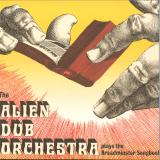
The Alien Dub Orchestra is ragtag collective of Bavarian musicians, featuring members of The Notwist and G.Rag y los hermanos Patchekos. The cohort formed around the idea of performing the standards of the fabled Breadminster Songbook, aka the back-catalogue of lone dubman Elijah Minnelli. Minnelli is known for constructing wheezy, forlorn odes to his hometown, both as highly sought-after self-released 7" singles, and a critically-acclaimed debut album, ‘Perpetual Musket’ for FatCat Records, lauded by the likes of The Guardian, The Wire, and The Quietus. ‘The Alien Dub Orchestra: Plays the Breadminster Songbook’ finds group covering Minnelli’s cumbia-infused dub reggae with full band, playing an eclectic array of instruments including: guiro, accordion, melodica, sousaphone, trumpet and assorted percussion.
The tale begins in 2022, when Minnelli was invited to lend his unique dubbing style to a pair of remixes for The Notwist, and what followed was an ever-flourishing relationship between the Breadminster native and the wider Munich scene. The seeds of the Alien Dub Orchestra were sown during a support gig for The Notwist, where assorted musicians joined Minnelli for a encore, reinterpreting one of his dub remixes across woodwind, brass and assorted percussion.
“The idea of real, competent professionals playing something you’ve muddled together on a computer in a damp basement is quite overwhelming,” reflects Minnelli on the process, “hearing them interpret and improve these melodies is a real joy and privilege.”
Despite the non-traditional origins of the source material, the inherent musicality of Minnelli’s songwriting shines through across his releases, and this creative kinship is what attracted the Orchestra to reimagining his work. The first live collaboration led to recording sessions and further gigs, with the Orchestra building a full set of Minnelli’s music.
The resulting album puts forward the strongest case yet of the shared musical throughline between the acts, where cumbia, dub and folk sensibilities coalesce to something all together unique. The tracks are wrought new, with melodies fleshed out and broader instrumentation expanding the sonic possibilities of the compositions. The tactility of the tracks is perhaps best demonstrated on the gorgeous ‘Vine and Fig Tree’, with it’s layed vocals and expressive bassline returning as a cavorting sousaphone line. Elsewhere, fan favourite ‘SLATS’ sounds as if it was simply written to be performed this way.
To further instill the cylindrical nature of these collaborations, the entire second half of the album is made up of dub versions of the Orchestra’s renditions. For these dubs, Minnelli is joined by Raimund Wong, who had caught his ear with his ambitious live sets, a daisy chain of tape machines and FX pedals. Again, despite their differing creative processes, the two bonded over a shared love of dub music. Each dub was a one-take, with Minnelli riding the faders and Wong’s filters and FX supplying a sound that doesn’t seek to imitate dub, so much as it tries to be it’s own chaotic self. The droning, psychedelic hypnosis of ‘Pundit Dub’ stretches the material to a whole new realm that feels outside of anything else Minnelli has produced before, an ode to the benefits of recycling sound if ever there was one. The whole second half is a perfect closing note to an album that is undoubtedly a love letter to folk tradition, dub ideology and, most importantly, the joy of uninhibited collaboration.
Elijah Minnelli - voc, guiro, percussion
Philip Gross - accordion, melodica
Theresa Loibl - clarinet, melodica
Cico Beck - electronics, keyboards
Sascha Schwegeler - congas, steel drum, percussion
Micha Acher - sousaphone, trumpet
Markus Acher - drums, voc
Dub mixes performed live by Elijah Minnelli & Raimund Wong at Breadminster County Council Studios
Fabio Nobile is a drummer and multi-instrumentalist who has been active on the music scene for over 25 years. Today, his musical
exploration draws from the deep roots of Afro traditions and the expressive freedom of jazz—two musical cultures that are an integral
part of his identity.
Sankofa Soul is a musical project born from the encounter between jazz, African traditions, and the search for a profound connection
between past and present. The term “Sankofa” comes from the Akan language (spoken in Ghana) and means “to go back and fetch what
is good” —an invitation to look to the past to better understand the future.
In an era where music is evolving at a rapid pace, Sankofa Soul looks to a rich and multifaceted cultural heritage, while also embracing a
modern voice—a universal call to reconnect with our European origins through the lens of African legacy.
Each track on Sankofa Soul reflects Fabio Nobile’s experiences, studies, and roots, forming a dialogue between past and present, the
sacred and the profane, individuality and community.
Sankofa Soul is a heartfelt tribute to West Africa, with a special focus on Nigeria.
Zuma Rock leads us into the rich and ever-changing soundscape of West Africa—a space where tradition meets innovation, and rhythm
tells stories older than words. Here, the legacy of Fela Kuti’s Afrobeat pulses through every beat, anchoring the music in political fire and
deep ancestral roots. At the same time, the unmistakable horn section weaves a vibrant fusion of Afro-Funk and Jazz. In Zuma Rock, we
enter a dialogue between past and present—a musical return to the source.
And then appears Kalakuta Republic, a heartfelt homage to the self-declared commune that was home to the legendary Fela Kuti—a
reminder not to forget the rebellious spirit of the Kalakuta Republic. This track gives voice to the very essence of Afro-jazz, wrapped in a
hypnotic 12/8 rhythm that echoes ancient African traditions. Its immersive pulse blends seamlessly with jazz’s boundless expressive
freedom, creating a vibrant, compelling dialogue suspended between ancestral roots and modernity.
Landed in Lagos and I Read the Stars naturally embrace the distinctive sound of Manu Dibango, while Say Your Prayer Now reminds us
how the evolution of Jamaican reggae—and its cultural and musical foundations—remains deeply linked to Mother Africa.
This is Sankofa: the soul’s journey back to the past to move forward.
GAISTER (Olivia Salvadori, Akihide Monna and Coby Sey) release their self-titled LP.
The record captures the embodiment of an encounter, one moment of the trio’s ongoing relationship as artists who communicate with each other through sound, voice and music.
After orbiting in the same circles at each other's shows around 2016 in London, Sey and Salvadori eventually crossed paths. In 2017 Sey joined Salvadori’s artistic collective Tutto Questo Sentire on a residency in Capalbio, the southernmost part of Tuscany, Italy, and started working together. Down the line the pair ended up joining with Akihide Monna (of Bo Ningen), performing together in 2019 at Camden Art Centre on Cork Street in London.
When the trio come together something new is created, brought out after laying dormant, like an Icelandic Geysir. The setting of this particular encounter amongst the trio is essential in the album’s sonic palette, process and emotion. The album was recorded in Iceland at
Greenhouse Studios, where the trio formalised a set of intuitions; how nature can provide a guideline in the choices of the instruments, their materials and related rhythms; reflections on the voice as a sculptural element, pure sound and words.
As Akihide has said of the experience during their short and intense recording period: “The sound spontaneously spun out as if we were pulling at each other's hearts and minds with a strange internal connection and sensation. Something pure was brought out.”
‘Gaister’ itself is a made up word, sprung from the German ‘Geist’ to mean ‘spirit’, and made into a sound of its own. A purity, spirit and essence is pulled from the trio, in spite of their varying mother tongues (Italian, Japanese and English), musical genres and identities to create something new. Olivia Salvadori’s operatic vocals run free, flowing and moving in
synergy with Monna’s rhythmic drumming. Sey sings freely with Salvadori, their voices braided together like a waterfall.
This flowing nature is reflected in the album itself, its timestamps and scores are marked by encounters rather than tracks themselves. This album can be considered as one constant piece and a journey of its own that is not foreclosed, in keeping with the band’s ethos of
constant conversation and collaboration.
As Sey speaks of the trio’s relationship: “Olivia, Monchan and I had performed live together once before, several years before this song and this album came to be… and yet, we fully trust each other’s intuition when performing and creating music together because of our unified belief in the ability of sound and music to communicate and connect.”
credits
releases November 1, 2024
Olivia Salvadori: voice
Akihide Monna: voice, drums, percussions
Coby Sey: voice, percussions, synths, wurlitzer
Recorded at Greenhouse Studios in Reykjavik, Iceland
Recorded and producer: Sandro Mussida
Sound engineer: Francesco Fabris
Studio assistant: Domiziano Maselli and Jakob Vasak
Mixing engineer: Kristian Craig Robinson at Total Refreshment Centre, London, UK
WRWTFWW Records is extremely happy to present the official reissue of Safari's self-titled album from 1984. The Japanese jazz-fusion super gem is available now as a limited-edition transparent vinyl LP housed in a heavyweight sleeve with obi.
Originally released on fabled label VAP, Safari is a one-of-a-kind city pop-adjacent summer blend of AOR, smooth jazz, and sun-drenched boogie. The sole album from the all-star outfit was the brainchild of keyboardist Toshiyuki Daitoku and Japan-based Californian jazz-funk-latin-fusion bassist Gregg Lee. Together with a large team of experienced musicians, they created a lush, immaculately-arranged 8-track cruise filled with poolside grooves, breezy rhythms, and feel-good vocal harmonies.
Safari features the well-known title track which acted as the theme song for an 80s sports program on Fuji Television, the night-swim chill music tune "All Right in The Night", and the fan-favorite buoyant vacation hit "The Morning After".
The official reissue is fully licensed and sourced from the original masters, with an audiophile cut by Sidney Meyer at Emil Berliner Studios, ensuring the warm, pristine sound this lost treasure deserves.
Safari is the second release from WRWTFWW's City Pop Series, following Momoko Kikuchi's beach classic Ocean Side, also available on transparent vinyl LP. The series, complete with a visual identity designed by Lopetz/Büro Destruct, also comes with a limited merch capsule, and more sun-soaked gems lined up for the future.
- Open Close
- Font
- Para
- Light Shadow
- A Book
- Opera
COKE BOTTLE CLEAR Vinyl[29,20 €]
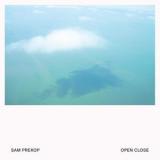
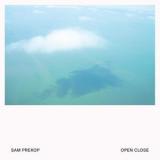
Sam Prekop"s work over the last 30 years, whether created primarily on his guitar or on his modular synth, is consistent in its powerful melodicism, delicate arrangements and subtle evolution. Prekop"s singular blend of melody, impressionistic lyricism and quietly intricate rhythms are the core of the singular sound of The Sea and Cake. Since 2010"s Old Punch Card, Prekop"s exploration of modular synthesis and electronic atmospheres, has come into its own. Highly skilled at manipulating the sonic interplay, Prekop has established a sytle all his own, his pieces are complex expressing real movement. Harmonies bloom with granular detail and contrary to their machine sources are able to convey emotion. Open Close is an album that captures the flow and energy of a live performance through the lens of a deft craftsman, an equilibrium of intuitive composition and the excitement of possibility.