‘I Want You To Be Mine’ has all the hallmarks of classic 1960’s Rocksteady, an era which many refer too as the Golden Age of Jamaican music. Over the top of a live one-drop beat, cool & deadly sax and warm analog guitar & bass Deemas J rides the riddim in a ‘old time style & fashion’ whilst Rachel Wallace provides the perfect accompaniment with her gorgeous vocal. On the B-Side we have the deeper cut ‘Questions’, where Deemas delivers a poignant poem over Adam Prescott’s moody instrumental in the style of Linton Kwesi Johnson. Featuring live instrumentation from Harry ‘Papa B’ Bradford (Sax), Clifford Junior (Guitar) & Guillaume Metenier (Hammond Organ). As an integral part of the Reggae Roast Soundsystem team Adam has established himself as one of the finest selectors in the world. Initially with some early support and guidance from Mark Iration (from the Leeds based Iration Steppas), Adam was quickly recognised as one of the key players in the re-emergence of British Reggae, producing first class original songs featuring the likes of Cornel Campbell, Macka B, Sugar Minott, Ranking Joe, Rod Taylor, Johnny Osbourne & Earl 16 to name but a few. Add to that consistent play on BBC Radio One & Rinse FM plus huge support from Sir David Rodigan, featuring Adam on his ‘Best Of British’ show on 1Xtra, Adam has become one of the hottest prospects in the revival of soundsystem music. Deemas J has built a formidable reputation as a go-to MC & vocalist with equally genre-busting credentials; His background in Reggae & Jungle means that his lyrical skills and style holds no bounds. He currently works with 3 of the top London Reggae Soundsystems, Unit 137, Reggae Roast & Solution Soundsystem as well as running his own Sound Limey Banton Bass in Guernsey. He has released music on some very well known labels such as Irie Ites, Irish Moss & Tru Thoughts, which released the cult LP ‘Wrongtom Meets Deemas J in East London’. More recently his latest release ‘Muhammed Ali’ received fantastic support from Don Letts, Sir David Rodigan & Ras Kwame. His virtually endless CV boasts collaborations with everyone across the worlds of Drum & Bass, Old School, Garage, Reggae and Hip hop, including High Contrast, Andy C, DJ EZ and Nick Manasseh to name just a few as well as touring the world with Manudigital
Поиск:sound 00
Все
Here is another amazing old skool reissue from Underground Music. This time from a label setup in 1993 called “Faceless Productions”. This EP has 3 classic 90’s old skool tracks that have been recovered from the original DAT master! Sounds better than the original pressing due to the amazing work from Finyl Tweek with the mastering. With prices upwards of £100 to grab a copy of the original it was well worth a reissue to make it available at a reasonable price for all the Djs & collectors!
- A1: Zan Lyons – The Mirror Ii
- A2: Audeka – Mondus
- A3: War – Nadir
- B1: Balatron – Machina Puta
- B2: Culprate – Beat Down
- B3: Subp Yao – Blah
- C1: Exept – Collision Detect
- C2: Current Value – Isotropy
- D1: Disphonia – Careful
- D2: Barbarix & Volatile Cycle – Bottle Opener
- D3: Grey Code & Submarine – Flamingo Club
- E1: Disprove – Override
- E2: Missin – Split
- E3: Ihr & Merikan – Dead End
- F1: Woulg – In Camera
3x12"
The SENTINEL LP represents the manifesto of one part of the spectrum of MethLab's club-oriented sound. Featuring a cross section of our forward-thinking artists and special guests and illustrating a dynamic set of sonic aesthetics to usher in a new era of diverse music and an open-minded approach to the dancefloor. Expect searing audio that resides on the very cutting edge of bass music.
This is an artist who comes straight from Normandy who signs the 6th EP of the Norman label. Already seen on the various artists EP (NRMND003), Sichuan delivers us here a record with his own sound, his own style.
Walking through a forest of hyper-technologic buildings inhabited by a dehumanised civilisation, he opened the gate of a damp and dark place from which he could hear thudding sounds. Behind the heavy door, he entered a room, slighty illuminated by neon lights shining through clouds of smoke. The place was filled with bodies moving to what sounded like the future. Here, making her way through the electrified tribe, like a flower cracking through a block of raw concrete, she came to him "you're too late but it's ok"Paradygme is a brand new label by VERTV dedicated to dreamy and abstract electronic club music.E00 is the new moniker of VERTV’s cofounder Eva 00 (releases on Neon Violence, The Other Planet, Special Species, Dream Raw…)
The Planet X invasion continues ... The third release is the most-awaited EP this year featuring the Matrixxman himself. According to the Alien Council, it is his best EP so far. It contains four tracks of serious icebreaking soundscapes, running trough the listener's veins by freezing the complete solar system with a coolness.
Starting the process is A1 with the fall-out Syren track called ‘Hong Kong Day’ played exclusively in the Matrixxman Dekmantel Boiler Room set last year, now finally being released for the hungry trainspotters who have been waiting for quite some time.
Next up A2, the second installment of the Hong Kong- the Night version- the most spooky-sounding spirit-catching meltdown of a track. It is reminiscent of a lethal death scene in a brutal manga cartoon, where the Iron eagle flies over the lands looking for prey.
On the other side- B1 starts with the track ‘Power Drain’ featuring his label mate-Exos- definitely the festival track of the release which then takes the listener to the breakbeat part of town in the final track called ‘Tango Down’ on B2.
This is where the real Matrixxman signature strikes with raw, dirty rave bass turning it back and forth, finishing the EP with some analog screams. The Planet X continues tearing through the galaxy.
“Lugar Alto presents their very first release: the incredibly rare and absolutely stunning “Homenagem”, by Leonardo V. Boccia. This is a forgotten gem from the eighties that examines traditional Brazilian themes such as choro, northeastern folk, and capoeira with touches of eighties electronics and new age.
Leonardo Boccia is a musician, multi-instrumentalist, composer, researcher and university professor of Culture and Society at the Federal University of Bahia, whose interests include sound studies, manipulation of sound media, audiosphere and aesthetics, musical theatre, audio culture and neuromusic.
Born in Italy, this respected academic studied music in Berlin, moved to Rio de Janeiro and established himself in Salvador where he was invited to research the northeastern music of Bahia. There he created the experimental group Macchina Naturale, an eclectic combo that performed regularly during his stay. In November 1980, Boccia participated in the first Instrumental Music Festival of Bahia as a soloist where he performed works of his own.
But it was in 1983 that Professor Boccia composed, directed and produced the LP Homenagem. With photos by renowned photographer and artist Mario Cravo Neto for the front and back cover of the booklet, the album presents new and original compositions for instrumental ensembles, such as: Choro Fantasia – for guitar and berimbau -, Canção para Iracema, Homenagem and Lenda do Sertão. The LP was originally released on January 3rd, 1984, with a live performance in the main hall of the Castro Alves Theatre under the title Tribute to Brazilian Music, with the participation of vocalist Sueli Sodré, who contributes to the album, instrumentalists Zeno Millet and Onias Camardelli, accompanied by choreography and visuals.
Much of Homenagem examines the genre of Brazilian music known as Choro, or Chorinho, a genre which appeared in Rio de Janeiro in the 19th century. Choro is regarded as the first typically Brazilian urban music and, over the years, it has come to be considered one of the most prestigious genres of national popular music. Stylistically, it originates from Lundu, a percussion-based rhythm of African inspiration but also influenced by European genres. The instrumental composition of choro was based on the trinca flute, guitar and cavaquinho. Over time, other wind and string instruments were incorporated.
Here, in Homenagem, Professor Boccia deliberately mixes the old and the new, the traditional and the innovative; the album is the environment of Chorinho reconsidered and recontextualized, and its melodies and harmonies still capable of surprises. Just listen to “Terra e Povo” – it has an almost proto-acid-house quality to it, while the synth washes on “Mãe Natureza” with the ethereal vocal stylings of Sueli Sodré ushering in the progressive quality of the album.
Too long out of print, new label Lugar Alto now offers you the chance to reappraise this fascinating reissue of yet another forgotten chapter in Brazilian music.”
- A1: Theme For A Hunter (2:12)
- A2: The Hunter (Link 1) (0:11)
- A3: The Hunter (Link 2) (0:09)
- A4: The Hunter (Link 3) (0:09)
- A5: Heavy Lead (1:43)
- A6: Uneasy Silence (2:05)
- A7: Hideout (1:56)
- A8: Hideout (Shock) (0:08)
- A9: Hideout (Let Down) (0:16)
- A10: Approach (2:00)
- A11: Approach (Shock) (0:08)
- A12: Approach (Sting) (0:08)
- A13: Approach (Exclamation) (0:07)
- A14: Flashing Knives (1:18)
- A15: Solid Pursuit (1:04)
- A16: Flying Squad (1:08)
- A17: Nightwatch (2:44)
- B1: Adventure Story (1:23)
- B2: Adventure Story (Link 1) (0:11)
- B3: Adventure Story (Link 2) (0:10)
- B4: The Investigator (2:48)
- B5: Passing Hours Suite (4:21)
- B6: The Set Up (2:01)
- B7: Stake Out (2:17)
- B10: Speed Trap (Link) (0:13)
- B11: Battle (1:00)
- B12: Battle (Link 1) (0:06)
- B13: Battle (Link 2) (0:17)
- B14: Attack (0:51)
- B15: Casing The Joint (1:33)
- B16: The Foil (1:31)
- B17: Scream (0:11)
- B18: Meanwhile (0:12)
- B8: Knife Edge (1:33)
- B9: Speed Trap (0:55)
They Say: “Composite themes and incidental cues for dramatic application”.
We say: Well, it’s definitely dramatic. No wonder this LP was mined by a multitude of 70s and 80s crime shows. Much like Beat Incidental, this true gem includes a raft of enjoyable sub-ten second incidental cues alongside satisfyingly stretched out, hard-knocking sleuth-funk.
The Hunter (Drama Suite) / Adventure Story is a real library-head’s library album. We’re treated to some of the best works of no less than five different heavyweights of the genre: drummer Brian Bennett, guitarist Clive Hicks (of The Gentle Rain), saxophonist Duncan Lamont, rock bassist Dave Richmond and keyboard session giant Steve Gary! Something of a dream line-up, they each contributed stellar efforts to create one of the most sought-after of the legendary KPM albums.
Both sides of this LP are dripping with insidious grooves and dramatic spy-score themes, bursting with heavy guitars, swirling flutes, creeping piano-funk and drum breaks galore. Originally released in 1975, it’s clear that these library heroes were heavily influenced by the tough funk and street soul sonics emerging from the cutting edge Blaxploitation soundtracks.
Dave Richmond’s taut swagger and wah-wah guitar licks of “Nightwatch”, Steve Gray’s sleazy horn and clav-funk on the A-side opener “Theme For A Hunter” and Brian Bennett’s rolling strut of “The Investigator” are just three of the highlights here. That last one being sampled by Jeff Jank under his Captain Funkaho guise on “My 2600” for Stones Throw back in 1999.
As with all of our KPM re-issues, the audio for The Hunter (Drama Suite) / Adventure Story comes from the original analogue tapes and has been remastered for vinyl by Be With regular Simon Francis. We’ve taken the same care with the sleeves, handing the reproduction duties over to Richard Robinson, the current custodian of KPM’s brand identity.
And don’t worry! Those KPM stickers aren’t stuck directly on the sleeves!
Voluptuous and catchy, Bronswick creates hauntingly electro songs and realistic sound fiction, with hints of both pastel and charcoal. Together, immersed in a creative connection revealed by their first EP Errances (Lisbon Lux Records), Catherine Coutu and Bertrand Pouyet are creating timeless pop sounds, between new-wave urban electro and synth-pop.
- A1: Cold Sweat (1 50)
- A2: Unease (2 41)
- A3: Aftermath (1 45)
- A4: Isolation (2 34)
- A5: The Unknown (2 42)
- A6: The Manipulator (3 12)
- A7: Space Probe (2 50)
- B1: Psychosis (2 54)
- B2: At Risk (2 53)
- B3: At Risk (Link) (0 26)
- B4: Manhunt (3 00)
- B5: Flying Squad (2 40)
- B6: Dead End (1 11)
- B7: Collision Course (1 47)
- B8: Voodoo (1 13)
They Say: “A selection of suspense underscores and drama blackcloths which vary in intensity and cover a wide range of suspense and drama situations”.
We say: A breaky, funky library great masquerading as a horror score. Oh, and the cover art is amazing.
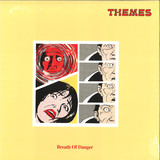
Breath Of Danger was originally released in 1974, and rounded up a killer ensemble cast of library legends including Alan Hawkshaw, Brian Bennett, Alan Parker, David Lindup, Kenny Salmon, Barry Morgan and Ray Cooper.
Lindup’s opener “Cold Sweat” sounds like hip-hop-friendly mode Axelrod and, indeed, was brilliantly sampled by Kool Keith for his Dr. Dooom project. Alan Hawkshaw and Brian Bennett’s “The Manipulator” sounds like it arrived straight out of the same sessions as their legendary Synthesizer & Percussion LP from the same year.
Over on the B-side Alan Parker’s “Psychosis” is a moving and beautifully restrained funk-guitar/cello/harp workout. Stunning. Kenny Salmon’s “Flying Squad” is a sleazy, flute-enhanced gem and the album closes with “Voodoo”, a seventy second riot of sound and colour from the dynamic drumming-percussion duo of Barry Morgan and Ray Cooper.
Sonically, there’s a widescreen vitality in all these tracks thanks to the driving rhythms, vibrant horn sections and blazing guitar work. It renders Breath Of Danger - 45 years old - truly ageless. The Themes series is known for having particularly striking sleeves, which was unusual for library records at the time, and Breath Of Danger’s scraps of comic-book crazy make for one of the most eye-catching.
As with all of our other Themes re-issues, the audio for Breath Of Danger comes from the original analogue tapes and has been remastered for vinyl by Be With regular Simon Francis. We’ve taken the same care with the sleeves, handing the reproduction duties over to Richard Robinson, the current custodian of KPM’s brand identity.
As one journey nears its end, another one is just starting. After the final release of her Propaganda label Nastia is back with a new imprint - NECHTO. After putting out a modest, but powerful catalogue of vinyl collector's exclusives, Nastia decided to focus more on dancefloor techno music.
The first installment in NECHTO catalogue is a perfect example of the concept - four track juicy techno EP from an undisclosed artist. From dreamy pads of N_1 that start the trip, through hypnotized and trance-like states of N_2 and N_3 to tense groove of N_4 the author takes no prisoners and delivers crisp, rich sounding collection of tracks that will light up every party.
A solid piece of work from the artist who's name will purposely remain a mystery. This is about music. So go order a copy now and dance to the sounds of NECHTO!
“Osondi owendi. What is cherished by some is despised by others. One man’s meat is another man’s poison. Different strokes for different folks. To each their own. Osondi owendi.
It’s a conventional aphorism in the Igbo language but if you utter the word “osondi owendi” in Nigeria today, the first thing that comes to anybody’s mind is the cucumber-cool highlife music maestro Chief Stephen Osita Osadebe and his legendary album that takes its name from the adage. Released in 1984, Osondi Owendi was instantly received as Osadebe’s magnum opus, the crowning event of an exalted career stretching back to the early years of highlife’s emergence as Nigeria’s predominant popular music.
Stephen Osadebe first appeared on the music scene in 1958 as a spry, twenty-two year-old vocalist in the Empire Rhythm Skies Orchestra, directed by bandleader Steven Amechi. With his dapper suits, urbane Nat King Cole-influenced vocal stylings and jaunty, uptempo, calypso-scented dance tunes, he personified the frisky spirit and anxious aspirations of a young, educated generation that had come of age in the wake of the Second World War, in a Nigeria that was rapidly shaking off British colonization and marching towards an independent future. 1959 would be the year that he truly made his mark in the business with his debut solo single “Lagos Life Na So So Enjoyment.” A giddy exhortation of the music, sex, fun and freedom availed by life in the big city, the song became a sensation and an anthem, and Stephen Osadebe became the leader of his own popular dance band, the Nigerian Sound Makers.
Osadebe would ride this wave of acclaim through most of the nineteen sixties, but a change in direction would be called for at the dawn of the seventies. As Nigeria emerged from a devastating civil war, so did a new generation of youth inspired by rock and funk, confrontational sounds reflective of a more violent, less idealistic era. All of the sudden, the idioms of the post-WWII dance orchestras that nurtured Osadebe’s cohort seemed quaint, the stuff of nostalgia. Osadebe needed to evolve to respond to the new tumultuous, turned-up times.
His response? He cooled it down.
Abetted by a new crop of fire-blooded young players, Osadebe slowed his music to a mellow, meditative tempo, brought forward the lumbering, Afro Cuban-accented bass and percussion, from the rockers he borrowed searing lead lines on the electric guitar. Over this musical bedrock, doesn’t so much as sing as he dreamily muses, coos, sighs aphorisms, words of wisdom and inspiration. “When one listens to my music, all I say appears meaningful,” Osadebe explained his lyrical approach, “at times they are in the form of proverbs which provoke much thought afterwards.” The result is a blend that is both rollicking and soothingly languid. Osadebe christened the style Oyolima—a tranquil, otherworldly state of total relaxation and pleasure. Osondi Owendi represents oyolima at its finest, and possibly Nigerian highlife in epitome.
Osondi owendi. What is cherished by some is despised by others. In some way, the album’s title constitutes a paradox. Because Osondi Owendi is a record that it’s almost impossible to imagine being despised by anybody."
“We seem to be caught! Trapped, somehow…”
Published for the first time on audio, Demon Records presents a narrated full-cast TV soundtrack, starring William Hartnell as the Doctor in one of his most weird and wonderful adventures!
In this vintage 6-part adventure, first shown on BBC TV in February and March 1965, a strange magnetic force pulls the TARDIS down to the craterous surface of Vortis. The Doctor and his friends learn that the planet has been invaded, and the parasitic Animus is slowly enveloping it in a web-like domain. The giant ant-like Zarbi are under its control, whilst the butterfly-like Menoptra are battling to reclaim their planet.
Presented across 3 x heavyweight 180g pieces of pink vinyl, this narrated TV soundtrack evokes a classic Doctor Who adventure in all its aural magnificence. The alien ambience of Vortis, the insistent chirruping of the Zarbi, and the supernatural voice of the Animus are all accompanied by the eerie sonics of Ron Grainer & Delia Derbyshire’s theme tune.
Written by Bill Strutton, this was the Doctor’s most exotic and lavish adventure yet. Linking narration is provided by Maureen O’Brien (Vicki) and the cast includes William Russell as Ian, Jacqueline Hill as Barbara, Martin Jarvis as Hilio and Roslyn de Winter as Vrestin. Accompanying the pink vinyl LPs are full episode billings, cast and credits, and eight illustrated
panels form a superb artwork montage. This is a first-time audio release for this very special
adventure. Dummedy-dum, Dummedy-dum, Dummedy-dum, Dum-dum…
Coming into orbit late November PS001.2 continues the dancefloor focussed explorations of one of Australia’s most loved new labels, Pure Space. Just in time for the Aussie summer the release highlights the sound of the new generation of electro and broken-beat producers emerging from the countries east coast.
On the A-side Point Guard returns to the label with his razor-sharp electro outing ‘Odyssey’. An emotional expedition that harnesses dancefloor euphoria with a powerfully burning bassline. Joining forces to complete the A side is Melbourne producer Disrute and label head Andy Garvey. Here an ever-evolving synthline propels you forward throughout the track that builds infinitely but pauses just to release Garvey’s mesmerising vocal, ‘NRG’.
Flip the axis and you will find swirling synths and scattered percussion that creates the murky club weapon that is emerging Sydney producer PMA’s ‘Hek’. Completing the release, Roy Mills brings you to a full rotation with ‘Aquatic Pressure’. His jittery breakbeat cut that slows to a half step mid way and returns with odd-ball synth mayhem.
Spaziale Recordings is born. Setting their sights on reissuing highly sought-after, obscure records, alongside providing fresh new interpretations of these classic gems, they kick things off with a bang.
Presenting an official remastered limited edition reissue of a classic cosmic disco 12”, featuring extended disco versions of three superb Afro and Latin-flavoured tracks taken from John Ozila’s 1979 killer funk album ‘Boogie Salsa’.
- Released on French label Disques Vogue, the A side offers the highly
infectious afro groove of ‘Funky Boogie’, treasured by the likes of
Horse Meat Disco, Dekmantel Soundsystem and Jack J.
- Previously a fiercely-guarded record collectors’ secret, the flip
houses two great afro-cosmic, obsure disco versions of “Let’s Go
Boogie” and “L’Orange Bleue” previously only available as album
versions on the “Boogie Salsa” LP.
- Now fully remastered and cut loud and proud to 12 inch for
maximum audio pleasure.
"The first series comprises six related movements, usually organised in pairs, electronic sounds with instrumental and more rarely, concrete sounds: Incidences/resonances brings into play controlled resonances akin to sounds of concrete origin in a process that helps to expand the variable electronic sound sources.
Here, 'incidents' are opposed to one-off 'accidents' in the second movement: Accidents/Harmoniques (Accidents/Harmonics). In the second movement, very short events of instrumental origin change the harmonic tone of the continuum they interrupt or overlap.
Moreover, the high notes are underplayed, which stimulates the attention given to other phenomena generally hidden by the melodic form applied to the instrumental play. Géologie sonore (Sound Geology) is similar to a flight over an area where different 'sound' layers come to the surface one after the other.
When seen from high above, instrumental and electronic sounds seem to fuse ... Dynamique de la resonance (Dynamics of Resonance) is a microphonic exploration of a single sound resonating through different forms of percussion. L'Etude élastique (Elastic Study) places together various sounds produced by 'touching' elastic or instrumental skins (baloons, doumbeks) or vibrating strings and a number of instrumental gestures close to this 'touch', using electronic processes to generate white noise.
Conjugaison du timbre (Conjugated Tone), the last movement in the series, uses the same substance to apply rhythmic forms onto a perpetually varying tone continuum. "The second series of movements draws its inspiration from concrete and electronic sources rather than instrumental ones. Incidences/battements (Incidences/Beatings) is a reminder of the first movement in the first series which then quickly moves into Natures éphémères (Ephemeral Natures): ephemeral play on instrumental and electronic sounds, singled out by their internal trajectory rather than by the material itself. Matières induites (Induced Matters): just as molecular effervescence triggers a changes of state, it seems that the different states of these sound materials can be generated by each other or through induction processes.
In Ondes croisées (Crossed Waves), the pizz vibrations interfere with somehow 'visible' water drops on the surface of a similar material. Pleins et déliés (Downstrokes and Upstrokes) can be listened to as the energies absorbed in the motion of bouncing bodies, while hollow 'bubbles' and points bring together some people's gravity and others' downwards movements. The work finishes with Points contre champs (Reverse Angle Points).
Here, the notion of perspective of the different sound threads weaving a kind of network, or field, traps the occasional iterative elements in the foreground and progressively absorbs them, giving more space for the angle - and the chanted sound - to grow." (B.P.).
ALTA’s debut release, 'Reasons' is the product of many long nights making music together in a back room at Hannah and Julius’ Brunswick home. It was self-recorded over 10 months, from January 2018 to November 2018, using midnight sessions, tape delay effects and a literal room full of wall to wall synths to carve out a world all their very own. "It's a collection of songs written together in our home studio - No cowriters or anything, just us two experimenting making the music,” says the band.
The album was later mixed by Seekae’s George Nicholas in Sydney and mastered by Grammy-winning engineer Chris Gehringer at Sterling Sound (Rihanna, Janelle Monae, Chvrches).
Thematically, the album’s title alludes to the sense of complacency that often sets in when people start making excuses for themselves.
“It’s this internal thing,” Julius explains, ‘always coming up with reasons why things did or didn’t happen, or reasons why someone else did something. Often it’s self-preservation but it’s also bullshit.”
‘Push’ follows on from previous singles ‘Figured Out’, ‘Back On It’ and ‘Twisted’, which have just under 2 million streams on Spotify since their release and are receiving global attention, with spins on BBC Radio 1 and praise from the likes of The Line of Best Fit and CLASH.
At streaming, ALTA have seen huge support locally and internationally, with their 2019 releases featuring in Spotify’s New Music Fridays, Indie Arrivals, The Local List, Just Chill, Front Left, New Dance Beats and The Office Stereo, plus Best Of The Week on Apple Music.
Melbourne fans will witness ALTA performing tracks from Reasons for the first time ever at Northcote Social Club on Saturday 5 October. Tickets are on sale now via Northcote Social Club’s website.
Reasons is an intricate and emotional body of work that will see ALTA step out from Melbourne’s underground scene, and into the international limelight. Pre-order your copy today.
- A1: Laurent Garnier - Water Planet
- A2: Mono Junk - Beyond The Darkness
- B1: Psychick Warriors Ov Gaia - The Valley
- B2: Melody Boy 2000 - Plenty Of Love
- C1: Drax Ltd Ii - Amphetamine
- C2: Dan Curtin - 3Rd From The Sun
- C3: Front 242 - U-Men
- D1: The Prince Of Dance Music - E3 E6 Roll On
- D2: Pan Sonic - Lahetys/Transmission
- D3: Burial - Archangel
Beyond Space And Time is the new record label from Japanese music festival, Rainbow Disco Club (RDC). RDC has been welcoming music loving people to Japan for over a decade. Throughout the festival's history, RDC have been fortunate to constantly encounter performers and DJs who've collaborated with them in establishing a beautiful dance floor year in, year out. These relationships have lead RDC to start their own label, and now gives them the opportunity to reveal one of the best-kept secrets: What is in a DJ's record bag?
This time around, festival regular DJ Nobu kindly opens up his collection and shares the music he loves with us all. On visual duty we welcome Senekt - his representational yet contemporary drawing illustrates the emotion we feel from DJ Nobu.
We have much more music to come in future from artists that we trust and respect.
▼ DJ Nobu describes 10 tracks this way ▼
A1. Laurent Garnier - Water Planet
Highly respected French DJ/Producer Laurent Garnier has been releasing tracks for decades capturing the very essence of Detroit Techno and Breakbeat. He always manages to create something truly emotional. This is not his biggest hit, but it's my favorite.
A2. Mono Junk - Beyond The Darkness
This track represents the very early days of Techno with it's ravey atmosphere. It has a primitive feel, and the obscure mixdown sounds almost unbalanced. That said, this one really stands out when DJing. Very cool.
B1. Psychick Warriors Ov Gaia - The Valley
It was always my intention to include this track in a compilation if were I ever to do one. It has a fat underlying groove, with some indigenous spices thrown in. The whole thing is put together beautifully. No complaints!
B2. Melody Boy 2000 - Plenty Of Love
I wanted to include a track that had Jacking feel to it - that is my definition of dance music. This track mixes well in both Techno and House DJ sets.
C1. Drax Ltd. II - Amphetamine
This is my all time favorite track by Thomas P Heckman. It asks questions and strikes down all the boring 'wanna be cool' techno tracks. It is obviously a well known tune already, but I include it here because I'm often asked for it's track ID from new kids in the game. This is a classic that should be passed down.
C2. Dan Curtin - 3rd From The Sun
Curtin's refined synth grooves and bass lines make this a true timeless classic. It do not get tired of listening to his rhythms and melodies - he always gets it just right.
C3. Front 242 - U-Men.
The originator of Electric Body Music. Their husky vocals, hard rhythms and strong synth basslines made the group very popular at the time, and they are still to this present day. To me, this track represents what the Belgian New Beat scene is all about.
D1. The Prince Of Dance Music - E3 E6 Roll On
This is the track I played the most up until around 2006. It is a genuine house track that cuts through trends in music. A hidden floor killer.
D2. Pan Sonic - Lähetys / Transmission
Electronic music has existed for decades, and if you are to choose some of the best from all scattered & hidden places, Pan Sonic's 'Lähetys / Transmission' must be considered. The track emerges beautifully - breaking structures and transcending the past. Every layer of the piece is produced with such delicacy and care, that as a whole it magically drags you into the world of the unknown.
D3. Burial - Archangel
This track merges melancholic emotions with technological prowess at the highest level, and deeply impacted the dance music scene on it's release. I recently played this track at the end of my set at the forward thinking Terraforma Festival in Milan. It faded out to huge applause from the open minded crowd. A moment to be remembered.
Sound has the ability to heal. This is the primary tenet that has been driving Karma Moffett for over 35 years. Pure tones, resonant harmonics, the sounds of the earth. At the dawn of the 80’s, as the burgeoning movement of privately-issued New Age was taking hold, Karma Moffett was a pioneer. Eschewing the use of synthesizers and other increasingly-available electronic technology, Karma crafted his meditative, introspective music using ancient instruments. Primarily utilizing Tibetan Bells, and Singing Bowls, Karma Moffett crafted sounds that led the listener on an inward journey.
1982’s Sitting Still Within/Sitting Still Without s Karma Moffett’s earliest triumph. Combining the aforementioned Tibetan Bowls & Bells along with naturalistic field recordings, Karma’s first album is a testament to the power of minimalism and repetition. An ambient voyage that truly draws the listener inwardst, and outwards, Sitting Still Within/ Sitting Still Without is music for healing.