Following up on Ohm Hourani’s infectious single “Barbara” which included a remix from Ricardo Villalobos and Amir Javasoul, We R The Aliens is happy to present its fifth release this June with another V/A from all-star cast: Boronas & Snad, Bärtaub, Mountain People and Nesta. Tap in and make some space in your record bag
mid short >>>
Following up on Ohm Hourani’s infectious single “Barbara” which included a remix from Ricardo Villalobos and Amir Javasoul, We R The Aliens is happy to present its fifth release this June with another all-star cast: Boronas & Snad, Bärtaub, Mountain People and Nesta.
Boronas & Snad set the tone with ‘Affliction,’ laden with haunting synth work, rolling MPC percussion, meticulous backspins and mind bending delays. Fresh off an outing for Yoyaku’s main label, Istanbul duo Bärtaub give a strong nod to the 90s and the cult E- MU rompler with ‘Orbit The Dance Planet.’ Their track fuses bumpy breaks and robotic voices with ghastly chords, a snaking bass groove and of course, one-shots from the Orbit.
Mountain People kicks off the flip side with ‘I Am The Void,’ characterized by shuffled drum grooves and soft chord sequences intertwined with murky, dubbed out stabs. Beirut’s Nesta rounds out the release with ‘Tarte Citron,’ a late 90's tech house reminiscent track with crisp percussion, airy synth flutters, swelling sub bass tones and a catchy vocal hook.
quête:spac
Rising Sheffield five-piece Dearthworms are set to release their debut album Sapsucker; a ferocious yet considered blend of jagged noise, wonk-rock, and a touch of experimental post-punk, in the vein of the Pixies, The Fall, Shame, Gilla Band, Protomartyr, Uranium Club.
Infused with eerie, surreal lyrics, stepping into Sapsucker is to dive head first into a parallel universe populated by snivelling, pathetic men, tales of eroticism, ruminations on death, and even a giant worm rooted in North-East folklore.
The band, who all have a longstanding history of being in various other bands in Sheffield inc. Blood Sport, Amorous Dialogues, Knorke and Stray Bullet, are a by-product of the local DIY space Hatch; a place that has existed as a creative incubator and experimental breeding ground.
Lyndon Hobson’s production captures the tone of the album itself, which is one equally rooted in anxious introspection as much as it is noisy and cathartic outpourings. This is a debut album that is genuinely distinct and singular, filled with varying twists and turns and off-kilter movements.
Cassette[14,71 €]
Sliding between the bodies in the street, cutting across the contrails that bisect our sky, Wand find melody and the anxiety beats as they hum the soundtrack for a new gravitational center. Seeking connections against the plan of niche interest and anonymity, Vertigo is the sound of slippage, rocks of contradiction (in soft focus); feet lost, regained, lost again, a multi-chromatic swaying, more automatic, associative, directed, in time. Determining to work backwards (or at least insideout) this time, Wand recorded everything in their own studio; pieces cut from improvisations and reshaped, writing from within the performance, without the woodshed. Unconsciously, in the shadow of themselves, and turning round and round (and round), they kept finding that empty space and playing what it implied. Everybody took on a new position in addition to the old one. It was intuitive, strangely ego-less . . . going somewhere they"d never been and not knowing what they were doing, but committing and recommitting, unafraid to eject in a constant positive forward momentum.
"Are Possible" is a spark-throwing, undulating fusion of styles played (mainly) on banjo, upright bass and drums, made possible by the individual perspectives of Nathan, double-bassist Casey Toll (Jake Xerxes Fussell, Mt. Moriah) and drummer Rex McMurray (CAVE) work together in an easy-rolling manner, but one that contains an expansive, ass-shaking confabulation of ideas. Music is time in redux: Are Possible"s many moments in time carry details from all over the place. Rex brought a rhythm to the table after drumming on buckets at work, Casey provided a bassline that redirected a previous jam, Nathan brought in a song he"d been fucking with forever and they figured it out together. Their diversity of sources moves easily within the arrangements, rendering a far-ranging set of feels, from transcendental to new country funk to good ol" jazz and the folk-rock, even - all of it drawn out exquisitely when they mixed at Electrical Audio in Chicago with the delicate hands of Cooper Crain upon the faders. The Nathan Bowles Trio have done their due diligence, passing their music through time and space on their way to now.
Vinyl[30,46 €]
Sliding between the bodies in the street, cutting across the contrails that bisect our sky, Wand find melody and the anxiety beats as they hum the soundtrack for a new gravitational center. Seeking connections against the plan of niche interest and anonymity, Vertigo is the sound of slippage, rocks of contradiction (in soft focus); feet lost, regained, lost again, a multi-chromatic swaying, more automatic, associative, directed, in time. Determining to work backwards (or at least insideout) this time, Wand recorded everything in their own studio; pieces cut from improvisations and reshaped, writing from within the performance, without the woodshed. Unconsciously, in the shadow of themselves, and turning round and round (and round), they kept finding that empty space and playing what it implied. Everybody took on a new position in addition to the old one. It was intuitive, strangely ego-less . . . going somewhere they"d never been and not knowing what they were doing, but committing and recommitting, unafraid to eject in a constant positive forward momentum.
Beginning in the 60"s, the small chamber group ensemble became increasingly important in the advancement of jazz, enabling horn players including Sonny Rollins, Joe Henderson, and Ornette Coleman to seek uncharted sonic territories and achieve new levels of freedom without the support of chordal instruments. With a mature, cohesive ensemble sound, the young trio juxtaposes tranquility and space with energy and tenacity across nine original compositions showcasing their stylistic breadth. From the swinging waltz "December" with a melodic contour reminiscent of a jazz standard, the soothing folk-influenced simplicity of "Vent", the intimate lyrical interplay between bass and clarinet in "Duo", to the heavy, propulsive power of the title track, the trio demonstrates fearlessness, listening, and spontaneity in a raw and personal recording that puts each of their distinctive voices in the spotlight. Christian Holm-Svendsen, currently resides in New York, studying for a master of music at Manhattan School of Music. In Denmark he played with, among others, The Danish Radio Big Band, Copenhagen Jazz Orchestra, Odense Jazz Orchestra, Jesper Zeuthen, and Regnfang. Daniel Sommer is an award-winning artist and sought-after drummer on the international jazz scene. Known for crossing the borders of different musical landscapes with a distinctive musical approach, Sommer currently performs with Karmen Roivassepp Quartet, Foyn/Hess/AC/Sommer and recently released the trio album "From Within" with Arild Andersen and Rob Luft on April Records. Mariusz Prasniewski is a Polish double bass player, residing in Copenhagen. A part of the Danish and European jazz scene for more than a decade, the bassist has worked with musicians like Tomasz Dabrowski, Anders Mogensen, and Gilad Hekselman.
Omega, die erfolgreichste ungarische ProgRock Band, veröffentlichte sein bestes Material in den 70er Jahren, und "Time Robber" gilt als der musikalische Höhepunkt in der Omega-Diskographie. Kernstück der LP ist der Titelsong, flankiert von "House Of Cards Part I & II". Das fast 13-minütige Werk bündelte exakt, was Omega 1976 ausmachte: Progressiver Space Rock versetzt mit Hard-Rock-Elementen. Nach vier Studio-Alben und einer Compilation waren die ungarischen Top-Stars Omega im Westen immer noch nur ein Geheimtipp. Eine steigende Tendenz bei den Absatzzahlen war aber zu erkennen, selbst wenn die Verkäufe längst nicht durch die Decke gingen. Darüber hinaus hatte sich die Band entwickelt, war live und in ihrem Erscheinungsbild professioneller geworden. Die Bacillus/Bellaphon-Verantwortlichen wollten Omega demnach auf jeden Fall behalten und verlängerten 1976 den Vertrag mit dem Quintett bis 1980. Und dieses zog mit Peter Hauke in die Offenbacher Europasound-Studios und spielte dort "Time Robber" ein. Die LP wurde im Westen Omegas Durchbruch. Bis heute soll sich das Album an die zwei Millionen Mal verkauft haben. Und dieser Erfolg kam nicht von ungefähr, lieferten die Ungarn doch erstmals ein komplexes, in sich geschlossenes Werk ab.
Formed in San Diego in 2012, Sacri Monti has transcended genres and sonic expectations to create a sound so unique, their name has become synonymous with invention. Signed to Tee Pee Records, this
July will see the official release of their third studio album, Retrieval. New single and album opener ‘Maelstrom’ hits like a whirling 70s prog rock opus, recalling the chugging riff/organ fuelled majesty of
Machine Head-era Deep Purple, alongside the Space Ritual vibes of Hawkwind.
Warehouse Find!
As I-Robots launches a new compilation series that celebrates the roots and influences of Italo disco in Turin and the Piedmont region, the Opilec Music boss also offers up various singles from it with some special remixes and edits. After an EP from Johnson Righeira last summer comes the latest one featuring the legendary Captain Torkive and two of his tracks as well as some special versions by I-Robots. Captain Torkive is Daniele Torchio, an Italian artist active in the late seventies & early eighties who got his nickname from a love of UFOs and space, in fact the titles here are inspired by the Superman DC Comics classic.
He has worked with the likes of Valero Liboni and all the material here is officially licensed from Ponzo Records master tapes. His tracks here are some of the most rare 7" Italo space disco tunes from Turin's rich history and feature synthesizers and electronic effects that he made himself, as well as guitars and keys he also played. Up first comes the I-Robots 1979 Reconstruction of Flying Saucers To Krypton which marries both tunes into a lush retro space odyssey that shimmers and rockets through the cosmos with live drums and jangling bass. Rounding off the A side is 1979 original version of Krypton' which is just as dazzling and spaced out with layers of synths and arps all sounding squelchy beneath some robot vocals. Kicking off the B side is the I-Robots 1979 Space Reconstruction of Flying Saucers To Krypton that strips some of the layers and keeps one lead synth line and some ascending spaceship sounds, as well as a lovably loose groove that really stomps along with real character. Last but not least is the original 1979 version of Flying Saucers, a cosmic tune with sci-fi sounds and melodies shooting about above big disco grooves with the keys and synths that carries you away to another galaxy. This is another essential package from Opliec Music that shines a light on an artist and era that deserves all the attention it can get.
Outsider ambient soundscape by two musicians from the Paris alternative : Désiré Bonaventure & Zach.
An enchanted yet psychedelic dream-like ballad recorded in one take in an ephemeral delirium; borrowing from dub, drone, IDM & techno, reflecting singular inter-worlds and inviting us to join them.
--
Rue des Garderies is a distillate produced by the spontaneous collaboration of Désiré Bonaventure and Zach, two musicians evolving in the Parisian alternative scenes and so named in homage to a former local hotspot of other-music Rue des Gardes - now bygone - where this improvisation took place. Accustomed to exorcising time and space with the multidisciplinary collective †een▲ge g:-)d, Zach has also been evolving in various frequencies - beatmaking, mastering - for over 15 years. Désiré Bonaventure, on the other hand, is a member of the duo Euphonic Alliances Ltd. and R.A.F. Soundsystem.
Rue des Garderies was recorded in one take, using samplers and effects, amidst a tangle of cables, with eyes closed, as dawn approached, in anticipation for another moment of the present. Here, Désiré and Zach delve into the in-between worlds (musical, but not limited to), immersing themselves in their cracks, folds and emanations, attempting to narrate them to us.
From this material they shape a new alchemy lasting over 1h30, akin to a prolonged journey into psychedelia, drawing from various currents (such as ambient, drone, IDM, dub techno, and the English electronic scene of the 1990s), rich in organic and analogue textures that overlap, stretch, fold and expand.
The result is a grand and ethereal fresco, with shifting colours and textures, evoking astral projections and sporadic rhythms; a whole other world, populated by shapes, hues and new lives, forming a complex but enchanting sound essay.
Born of a fragile chaos, Rue des Garderies is an ephemeral harmony that accompanies moments of existence; a dance without tangible movement.
Beige Vinyl[27,10 €]
Black Vinyl[25,00 €]
Animals on Psychedelics welcomes Swiss/Tunisian producer Ish for its 9th release, with another suitably lysergic 3 track EP.
A1 kicks off with vintage Sci-fi mind exploration samples and quickly evolves into a pulsating and accelerated acid trance rumpus, with the sample weaving its way around the tracks main goan filtered synths and throbbing bass, for a perfect, reflective end of night closer.
Still keeping things pacey and sci-fi, B1 guides us into more traditional trance territory, with lighter 808 kick drums and a progressive arpeggiated synth line that links up with his paranoid friend half way through for some machine talk , before metallic bass and electric guitar mates comes barging in to abruptly end all chat.
B2 continues the trip and lands us on an unexplored planet deep in the outer universe. Pensive, melancholic and breaksy IDM frequencies transmit through our vessels radio, whilst a woman reminds us that we still have our 'Body's' as we float in space.
I was sent an unfinished version of Dose Your Dreams so that I might contribute string parts. I couldn’t stop listening to the rough mixes I received. A friend asked me how the record was. I replied, “My God, Fucked Up have made their Screamadelica.” And psych-rock-groove it is. The drums mixed wide, propensity for drones, for delay pedal, for repetition, groove. The politics and aesthetics of hardcore married to an “open format” approach to genre. Elements of doo-wop, krautrock, groove, digital hardcore. “None of Your Business Man” opens the album in familiar enough territory, a sax assisted exit from an office space. But things get psychedelic very quickly. By the time the title track arrives, Mike Haliechuk is whispering, wah pedals are in full effect, and we’re wearing oversized t-shirts and pinwheeling. “Accelerate,” the lyrical centrepiece of the album, storms in like Boredoms on a bullet train and dissolves into a digital nightmare. The album closer, “Joy Stops Time,” finds Fucked Up at their most Düsseldorfian, nearly eight minutes of blissful motorik. At the center of it all is Damian Abraham’s scream a man chained, a man tortured, a true protagonist. The effect is one of an epic, every chapter attempting its own narrative devices, its own genre hybridization and it works, it works so insanely well. The drama unfolds like a miniature world of many parts being explored, a map being illuminated, location by location. As with David Comes to Life, there is a story here. David who once came to life is now indentured to a desk job. David meets the elderly Joyce who closes his eyes, opens his mind, and sends him on a spiritual journey. David embarks on his own metaphysical odyssey. He sees a stage adaptation of his own life. He speaks to an angel in a lightbulb. He sees an infinite series of universes as simulations within simulations. Meanwhile, Lloyd Joyce’s lover was sent, decades ago, by Joyce on the same odyssey, but was lost in the void. Lloyd seeks to be found and reunited with his lover. Where will David end up? Will Joyce and Lloyd be reunited? Dose Your Dreams meaning: treat your dreams as you would a dream, allow yourself to be lost within them, allow them to open your heart and your mind, enjoy them as you would a drug. Reach out for my hand and pull me close. Owen Pallett.
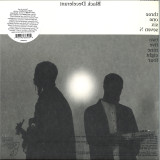
Black Decelerant is the second installment of Reflections, a series showcasing contemporary collaborations orchestrated by RVNG Intl., recently inaugurated by Steve Gunn and David Moore. Black Decelerant, the duo of Khari Lucas, aka Contour, and Omari Jazz, explores jazz traditions, improvising with synthesizers, guitars, and electronics as a practice laid forth by their musical ancestors. This experience allows for sonic meditations on themes such as Black being/nonbeing, mourning/life, expansion/limitation, and the individual/the collective. The two strive to create a sonic surface which can simultaneously allow Black listeners a place to be still, and to serve as a basis for a movement beyond "the moment." The album's ten compositions configure vast, resonant landscapes with signals, weathers and spirits, suspended in memory and distilled in time. The Black Decelerant machine recalibrates archival relics and acoustic impulses into collages of amalgamated timbres, where harmony exists not without discordance. Across the expansive space of the record, cadent storms of modulated sound ascend beside serene melodic spells. Piano keys and bass lines tumble in free fall throughout the release, accompanied on tracks "two" and "eight" by the spectral trumpet improvisations of Jawwaad Taylor. The duo arrived at their name upon reading Aria Dean's Notes on Blacceleration, an article which explores Accelerationism within the context of Black being or non-being as a foundational tenet of capitalism. Coupled with the record's intended effect, "Black Decelerant" references the music being an invitation to slow down, while hinting at the shared politics between themselves and the artists and thinkers who inspire them.
Italian producer Toto Chiavetta returns to Mind Against's HABITAT with a spellbinding new single titled "My Eyes Are Failing". Off his new EP of the same name, the song is a haunting journey where crunchy textures and hypnotic melodies come together with the refrain, "I think my eyes are failing, but I feel my lungs inhaling," to envelop listeners in a dark, atmospheric soundscape. Featuring the mesmerizing Thom Yorke-esque vocals of Trenton, the new track showcases Chiavetta's mastery over immersive, emotionally-charged electronic music.
Bolstered by b-side single “The Sacred Space” and a club-ready alternative version from Toto himself, plus remix from Echonomist, the new EP rounds out to create a defining statement from Chiavetta. With a growing list of supporters that include industry heavyweights like Âme, Sasha, John Digweed, and Camelphat, to name a few, and previous releases on Innervisions and Diynamic, Toto Chiavetta is poised to make a big impact with this landmark release on HABITAT.
Archeo Recordings' rewarding relationship with Tony Esposito continues on AR027, as the label provide a remastered reissue of his transcendent fusion-pop masterpiece "Pagaia" alongside a trio of brand new reworks from Perugia's mighty Feel Fly. Whether you're looking for cosmic house, mellow acid, trancey techno or dubby downbeat, these remixes have you covered, and the original remains a true work of art. Available in all good record stores on 12th July as a 50 copy super limited edition on Solid Blue Vinyl (including gadget scarf) and limited black vinyl edition.
50 copy Solid Blue Vinyl Edition (including gadget scarf), and also limited black vinyl run "Pagaia" hails from the Neapolitan percussionist's 1982 LP Tamburo, his first release for the brilliant Bubble imprint. Though the album delights and excites from start to finish, dancing through jazz-funk, Mediterranean pop, slow disco and smooth fusion, it's "Pagaia" which is first among equals. Esposito's nuanced hand drums lay the foundation for Claudio Pizzale, Sara Borsarini and Simona Pirone's wordless vocals, a life affirming chorus which carries us onto the swell of bass, piano and horns which drive the track through four and a half minutes of emotional release. Emphatic and expressive, the track transports the listener into a state of body moving rapture, all driven by Tony's rhythmic fluency. The song found its way into Italian living rooms over the credits of TV show Domenica In, and found its way into club culture thanks to fanatical support from the likes of Daniele Baldelli, who even included it on his first official Cosmic compilation.
Following a string of essential releases for the likes of Internasjonal, International Feel and New Interplanetary Melodies, Daniele Tomassini, better known as Feel Fly, now joins the Archeo family with a trio of contemporary club translations of the killer "Pagaia". The Perugian's "Cosmical Remix" extends that familiar introduction into a deep and DJ-friendly blend of drum and voice, awash with airy reverb and augmented by additional percussion, building through the original piano and bass into the churn of a dance floor wormhole. Driven by an unstoppable sequencer throb, the interpretation skirts the dark side of space before landing in the light of the miracle, those heavenly vocals and lush keys leading the way. The "Instrumental Cosmical Remix", not entirely instrumental, but utterly cosmical nonetheless, sees Daniele serve a tense and tracky arrangement of his first rework, perfect for deep space exploration. Stripped of the joyful exuberance of the original, this variation is a complex blend of shadowy trance idents and the mature techno we'd expect from the likes of François K. Not content with soundtracking either side of the peaktime, Feel Fly serves up a third version, following the Compass Point through a musical map of club-dub to turn out an immersive interpolation of deep bass, spring reverb and stabbing keys that sits perfectly beside the Rhythm & Sound catalogue. Each interpretation is an emphatic demonstration of Tomassini's musical talent, production prowess, and stylistic range, and furthermore a fitting tribute to the lasting genius of Esposito's original.
Air is the central element in Antonina Nowacka's third solo album Sylphine Soporifera. The title names an imaginary species and the land they inhabit, inspired by the unreal desert landscape of Paracas and the undulating tree-less hills of the Outer Hebrides, and comes from the writings of Rudolf Steiner, who describes creatures called Sylphs as the spirits of the air, and the Latin word sopor which means deep sleep.
As with all her releases, Nowacka's other-worldly vocals coming as if from beyond the veil, at once haunting, alien and utterly entrancing. "The voice is the most beautiful and resonating instrument,” she says. “When I sing I feel I create a field in between myself and the air in front of me," she explains. "It is not just that I'm singing – something in the space in front of me is happening, and I merge with this sphere.”
She conjures and is inspired by open environments and infinite landscapes: places full of light and air, manifested here in the sound of ocarinas from Budrio in Italy, whistles from Mexico, simple bamboo flutes from Nepal, alongside tremulous zithers, synthetic Hawaiian sounds from a vintage organ and the uncanny wind instrument presets from a 90s synth.
Nowacka’s first album was informed by vocal sketches made in caves in Indonesia, later recorded at a fortress in Poland; she studied Hindustani music in India with vocalist Shashwati Mandal, fell in love with early Cumbia in Mexico and Peru, and has more recently found inspiration in the landscapes of Italy. Hers is a new New Age soundworld that finds its origins everywhere and nowhere. Sylphine Soporifera gathers these sounds, visions and experiences into an album permeated with a sense of hope and fulfilment, that feels like sitting in an enlivening white beam of afternoon sunlight, as dustmotes swirl in the stillness.
UK Bass titan and Swamp 81 label boss Loefah makes his Teklife debut with Jump Start, three new tracks full of raw house energy. Taking cues from the Chicago tradition of feral 909 jams, these pummelling rhythms are met with eerie atmospheres and haunting speech. The late ghetto house godfather DJ Deeon adds his touches to the title track, stretching its acid squelches out and taking them even farther into space. It’s pure warehouse music, trippy yet ominous, perfect for getting lost in a dark corner at a rave.
There are certain occasions when you can truly feel the stars align. One of these is when the interstellar voyager of cosmic soul Jimi Tenor finally lands his spaceship at full force on a Timmion recording. In 2024, he will be serving us two spaced out album sessions recorded together with Cold Diamond & Mink. Jimi is no stranger in these space ways as he has operated behind the Timmion scenes for years, furnishing several of the label's artists with his flute and reeds artistry. The first album out is titled "Is There Love In Outer Space?", which begs the question with the force of five extended tracks that are guaranteed to blow your mind to the stratosphere. The pieces are loaded with whooshing and glistening synth noises and span from lofi space funk to cinematic soundscapes. The sweetly floating title track is like some of those galactic ballads that rare soul collectors are spending their pensions on. At the other side of the spectrum, album closer `What Are You Doing?' sounds like Sun Ra sat down at a JBs session, and is straight up meant to get that booty moving. Combined with the raw soul prowess of CD&M, Jimi is able to refine new shades from his already impressive repertoire of talent. Even if you are a friend of his previous work you might not have heard him get down quite like this.