The space between every love is filled with vigilance in preparation for future threat. This threat is not so much pain as failure and, above all, fatigue. Even the beginnings, when love seems at its most accessible, are disturbing. In spite of this we advance into the turmoil because we are inebriated with love.
Dominik Suchy's third album admits all this as a quality of love. Disembodied and denied to be gloom or bliss, love is revealed to be a raw process at full length. This makes for emotionally hypercharged music that is more inevitable than tense. The record unfolds, for all its ruptures and weight, as familiar. It is a music of pathos, because it benefits from the emotional knowledge that already resides in you.
The universality of this angle allows for compositions that are less than opulent. A focus on the mass of sound // verticality leads to a bareness that sets "Every Love..." apart from Suchy's previous works. At times sonically overwhelming and rhythmically ambiguous, it should be approached as free jazz rather than post-club.
Every Love Is an Exercise in Depersonalisation on a Body Without Organs Yet to Be Formed does not submit to the weariness of love // Weltschmerzen does not submit to the weariness of the world.
“In places harrowing and emotionally charged, in other places quite inconspicuous, you feel that you are standing in front of something big, transcending everything, which you observe with sacred reverence. Maybe it's the eye of the storm or that love which is the origin of everything.”
Peter Dolnik, 34.sk —
“One of the most distinct electronic artists in our geographical area.'”
Roberta Tothova, Pravda.sk —
“Everything happens with deep apprehension, the atmosphere and its variations are executed on a masterly level””
Richard Kutej, Fullmoon Zine —
“An album full of incessant soundscapes, undulations and sound-design based portrayals of magnificence.”
Mikulas Hamerla, Alterecho.cz —
Поиск:spac
Все
The latest in a prolific string of solo and collaborative releases by James Rushford, Turzets collects a pair of new works primarily created and recorded last year while the Australian composer-performer was in residence at La Becque, an art center on Lake Geneva in Switzerland. The side-length piece "Fallaway Whisk" explores hesitation in its many forms_reticence of speech, sonic restraint_using live, abstracted translations of text from English to German against a lush and swelling soundscape. On the flip side, "Quire" is a work in ten movements influenced by the composer's study of late medieval repertoire on portative organ, weaving the instrument's woodsy interlocking melodies with angelic Yamaha CS-80 synth sweeps and stuttering glitches. The combined effort is somewhat a departure for Rushford, working in traces of Klaus Schulze, concrete poetry, and ars subtilior into a precise and ever-unfolding tapestry. Rushford's work draws from a wide range of collagist and improvisatory musical languages, staking out an idiosyncratic stylistic space that has been variously described as "electro-acoustic experimentation with a beating heart" (Boomkat) and "haunted Jacobean ASMR" (The Wire). Investigating the creases, cracks, and folds in traditions ranging from early music to New Age, Rushford's work subtly exaggerates seemingly liminal aspects such as atmosphere and the bodily presence of the performer until these take on a weight equal to musical elements such as pitch, rhythm, and timbre. In recent years, Rushford's solo work has been guided by his theorization of sonic images, particularly the shadow, which has inspired pieces as diverse as an hour-long companion to Federico Mompou's 1959-67 piano cycle Música Callada (2016) and a sumptuous translation of the play of light across flat surfaces into synthetic sound (The Lake from the Louvers, Shelter Press, 2021). His long-standing performance practice for piano, portative organ, synthesizers, and electroacoustic devices, is constantly infused with a delicacy of touch and a harmonic sensibility in which unorthodox tunings coexist with influences from fin de siècle Impressionism, the twentieth century avant-garde, and popular musical structures. He has worked with a vast range artists including Klaus Lang, Annea Lockwood, David Behrman, Tashi Wada, Haroon Mirza, Dennis Cooper, Ora Clementi, crys cole, Oren Ambarchi, Kassel Jaeger, Will Guthrie, and Graham Lambkin. He has performed as Golden Fur (with Sam Dunscombe and Judith Hamann) and Food Court (with Joe Talia and Francis Plagne).
Transparent Yellow w/ Black Splatter Vinyl. Since founding Swedish synthpop duo KITE in 2008, singer Nicklas Stenemo and keyboardist Christian Hutchinson Berg's brooding fusion of cinematic electronics and anthemic pop has steadily elevated into a spectacle of passion, atmosphere, and communion. Their debut double-A vinyl single for Dais Records, Don't take the light away / Remember me captures KITE at their most urgent, thrilling and apocalyptic."Don't take the light away" is a song about "the war between energies," with singer Stenemo's wounded croon leading a rising tide of stabbing strings, pulsing percussion, and looming bass orchestrated by keyboardist Hutchinson Berg, surging to a mass-chanted chorus both desperate and triumphant ("dance, let them dance into me / people versus people can't see / hands should be holding hands"). "Remember me" was written following the band's 2017 US tour, capturing the intense feelings of burnout and exhaustion. "Remember me, Won't you remember me, Promise you'll remember me."Words only tell half of the story; smoke spills across the stage, and the melodies become a battle cry. Our worst fears eventually boil over, turning into hope and resilience. Like the best of KITE's music, "Don't take the light away" and "Remember me" fuse theater and catharsis into anthems of universal yearning, born of "the struggle to keep a flickering candle lit in a very dark space."
An accomplished songwriter, Kimbrell's sound has been described as "cosmic American music," that ranges from the swinging front-porch blues to the spaced out Americana/alt-country, painting a diverse and deep musical landscape.
"Easy Truths" by Kyle Kimbrell includes the following tracks: "Holy Bombs", "Poor Donny", "In The Shit (Phil's Song)", "Singin' A Tune" and more.
The Sun-kissed songwriting, deft guitar work, and lush vocal harmonies that have been at the core of The HawtThorns' sound are exponentially magnified through the lens of their new record, 'Zero Gravity'
KP and Johnny Hawthorn, have had celebrated careers that started in LA's singer- songwriter and Alt- Country scenes. Between the two, they have hundreds of recordings heard on network and cable TV, and film. KP co-founded LA's CALICO the band while Johnny fronted his own band and played in legacy acts, Toad the Wet Sprocket and Everclear. Their common ground has been the starting point for a sum greater than it's parts, an inspired combination of top- notchsongwriting, vocals and guitar work.
"Dynamite duo who aim to pull up their roots, stick by their guns and bring back the sounds of the Laurel Canyon in the 1960's, the British invaders of the '70's and the cosmic cowboys still twirling through time and space" - Pop Matters
"A perfect blend of melody and magic, one that incorporates the sunny sounds of classic California Rock blended with the rich resonant sounds of today's Americana musical environs" -The Alternate Root
"Already a leading light in L.A.'s independent country scene, the HawtThorns swing for the heartland country-rock fences with "Shaking," whose brightly- strummed guitars and sunny harmonies channel the warmth of the band's west coast home." -Rolling Stone
Zero Gravity by Hawtthorns, released 5 April 2024, includes the following tracks: "Hands On A Clock", "Faking It", "Don't Plan To Lose", "Don't Wait By The Phone" and more.
Rethink human's dominion in "The Invincible": a story-driven adventure set in a hard sci-fi world by Stanis?aw Lem. Discover planet Regis III as scientist Yasna, use atompunk tools looking for a missing crew and face unforeseen threats. Make choices in a philosophical story that's driven by science. A major part of the brand-new video game hit "The Invincible" is the unique atmosphere. Apart from the outstanding visual effort, created by Starward Industries, there's also the capturing soundtrack by Brunon Lubas that draws the player into the game. Lubas describes his contribution to this journey into space the following: "Inspired equally by the early pioneers of electronic music, minimalism, lo-fi and modern experimental music, the soundtrack for 'The Invincible' consists of 13 diverse tracks. Digging deep into the emotional part of the game's narrative, it accommodates the feelings of melancholy, mystery, loss and hope all glued together with a distinct and consistent take on aural aesthetic and harmony."
Limited edition tri-color splatter vinyl. The vinyl edition of Daedelus' new LP "Xenopocene" features a die cut cover title album text which allows the viewer to see the multi color swirling vinyl beneath. Xenopocene means Alien Age. Some have theorized our current is the Anthropocene; however in an era where artificially generated and deep faked, what is terrestrial in origin vs u.f.o.? Daedelus’ latest LP ‘Xenopocene’, inspired by their artist-in-residency with S.E.T.I. follows a timeline from an extraterrestrial first contact thru to 10k days hence and spiraling towards the nearest exoplanet 6,000+ years away. Attempting to parse out science informed fiction from the fact that in an unfathomable universe life exists outside our confines. Actually there are guidelines in place for receiving such a communication. In S.E.T.I.'s Protocols for an ETI Signal Detection (which first line reads "Declaration of Principles Concerning the Conduct of the Search for Extraterrestrial Intelligence...") well measured steps from such an awesome event could almost be read as unexceptional. Hyperbole has little place in the sciences whereas music makes the most from. Daedelus across 11 tracks deftly deals with space inspired sounds pulling equally from Gustav Holst and Sun Ra as Alice Deejay and Amon Tobin. No techno-optimism here, ultimately this is Earth music made to dream upwards. Asking us to reckon with our humanity while daring us to envision a new epoch. Interlaced throughout are quavering violins by Vivek Menon. Featuring words from the singular R.A.P. Ferreira on "Starfire" and extra instrumentation from Eli Henry Goss of the Breathing Effect in "Float
- Ein Moment Sind Zwei Sekunden
- Der Regen Tropft
- Tanzende Kakteen
- Fleissige Ameisen
- Sechs Fingen An
- Das Insekt
- Denn Alles War Nur Ein Trick
- Schwarzwald
- Schauet Her
- Buback
- Gummitwist
- Space Bob
- Sirius Und Alpha Zentauri
- Rapwalz
- Alte Pizza
- Hey Baby Hop
- Glitzergleiter
- Junger Mann
- Gummitwist (Instrumental)
- Gorck Fock
- Elektro Platinum Saturn Gott
wieder auf Lager Der Plan gelten als zentrale Wegbereiter der Neuen Deutschen Welle: Mit minimalen Mitteln produzierten Moritz Rî, Frank Fenstermacher und Pyrolator experimentelle elektronische Musik, verspielt und mitunter dilettantisch anmutend, aber immer mit Humor. 1984 wurde Der Plan von der japanischen Kaufhauskette Seibu für sechs Konzerte nach Tokio eingeladen. Anlass war die von Seibu ausgerichtete deutsche Woche. Ausgerechnet Der Plan? Warum nicht eine Oktoberfestkapelle oder die Scorpions? "Damals war in Japan die NDW sehr beliebt", so Moritz Reichelt. "Man kannte sich dort besser damit aus als hierzulande. Außerdem war an diese Kaufhauskette der Plattenladen und Vertrieb Wave angeschlossen, und die kannten sich richtig aus." "Japlan" dokumentiert die Setlist dieser Tokio-Auftritte. Neben Songs von den Vorgängeralben "Normalette Surprise" und dem Soundtrack "Die letzte Rache" und von der Doppelsingle "Golden Cheapos" enthält "Japlan" auch seltsame Instrumentalstücke, die extra für diese Konzerte produziert wurden. Und einen der bekanntesten Songs des Plans: "Gummitwist". Das Album erscheint mit Bonus-Tracks.
Mr. G and Duncan now return to 49North with a brand new 4 track EP.
The first cut, Cosmic One is a peak time futuristic roller that lures you in gently and leads you through its infectious sonic journey.
Cosmic Two comes straight in with its solid electro-funk 808 rhythm, a nod to early Detroit electro but with its feet firmly set in the 21st Century, it builds and builds and builds.
Cosmic Three revisits the synth work of Cosmic One and switches things up a few gears. From the get-go it’s heads down, a driving funk fuelled groove.
Cosmic Four rewinds us to a beat-less reprise of Cosmic One but very much its own unique space. Like sliding into a warm bath of dubbed out beat-less analogue bliss
Enjoy the ride ......
Ein wahrer Dub-Klassiker von 1980: Rückwärtstapes voller interplanetarer Soundeffekte, gespenstischer Stimmen und klingelnder Percussion, 'Starship Africa' hört sich wie ein schräger 'Alien' Film-Soundtrack an, der die Dub-Reggae-Horizonte ins Unermessliche erweitert. Mit Mitgliedern der Roots Radics, Misty In Roots und Prince Far I’s Arabs war es der einzige Release auf dem Pre-On-U-Sound-Label 4D Rhythms. Reissue mit ausführlichen Linernotes, Archivfotos und DL-Card. Kürzlich in der MOJO-Rubrik 'How To Buy… On-U Sound' zur am meisten empfohlenen Platte des gesamten Katalogs gewählt.
Erstmals seit 1982 auf Vinyl erhältlich: 'Psychotic Jonkanoo' war das sechste Creation Rebel-Album in drei Jahren, ursprünglich lizenziert an das Glasgower Post-Punk-Label Statik. Ein weiterer solider Killer-Dub, weniger instrumental, mehr ausgereichtet auf bewusste Vocals im militanten Stil samt unterstützenden Harmonien im Black Uhuru-Stil. Mit Backing-Vocals der Punk-Legende John Lydon (The Sex Pistols, Public Image Limited) und einer ausgesprochen experimentell-britischen Herangehensweise an traditionell-jamaikanischen Roots-Reggae, was zu einem unverwechselbaren Hybrid-Sound führt, der immer noch frisch klingt.
'Anybody searching Adrian Sherwood's catalogue for an easy point of entry would do well to start here, and everyone else can simply applaud Psychotic Jonkanoo as the last truly great roots reggae album of the 1980s.' - All Music
Icelandic musician and visual artist Sunna Margrét is set to release her debut full-length album, Finger on Tongue, via No Salad Records. Citing influences from krautrock legends CAN and Neu!, outsider synth pop artist The Space Lady and electronic music pioneers Suzanne Ciani and Eliane Radigue, Finger on Tongue is a masterclass in experimental pop, capturing an authentic Icelandic essence through its electronic and spellbinding sounds. Some tracks offer softness and peace while others invite you to dance, and the album homogeneity is precisely ensured by the rigorous approach to writing.
Gatefold Sleeve / 180g Vinyl
Returning to the well of Roger Doyle once again, his “Babel” project spans a decade of composition work before its’ initial release in 1999 as a 5CD set. Over 100 pieces and almost 50 collaborators it marks a journey through a virtual tower of Babel with each piece corresponding to a room within an imagined giant tower city. For the 25th Anniversary vinyl edition Doyle has revisited it- remastering it and providing its first vinyl edit - 80 minutes spread across two 180gm LP’s - rounding out the package with extended liner notes and a download code to the full 6 hours.
We’ve previously explored Roger’s Operating Theatre days and the idea for this project came in the early nineteen eighties while Doyle was heavily involved with the experimental theatre group. Working with emerging technologies and across a variety of genres he realised that he would be unlikely to achieve an overarching compositional style. Instead deciding to make a virtue out of the fact that he composed so schizophrenically, he wished to create a musical alphabet out of short abstract sounds with these sounds being analogous to phonemes in speech. With Blade Runner and sci-fi embedded in the zeitgeist of the times he came to the idea of the Tower of Babel as both a futuristic skyscraper and also an embodiment of language.
In the spring of 1990 Babel was finally begun and kept growing until it reached over 6 hours of music and was released in 1999.A large-scale musical structure making use of many technologies and music languages, with each piece of music being thought of as a 'room' or place within an enormous tower city. Each track in the main section corresponds to a virtual sonic architecture. The pieces are divided into two kinds: aural representations of actual spaces like The Dressing Room, The Stairwell and Mr. Brady's Room alongside internalised dream spaces like the Room Of Rhetoric, the Spirit Levels and the Mansard childhood memory room. Listeners can navigate their way differently through this virtual building at each hearing. As a supplement to the Babel Tower KBBL - the fictitious radio station – broadcasts a number of shows. Each has its own style and atmosphere. Collaborating with DJs, actors, writers and singers, KBBL is made to sound like a real radio station with ads, traffic reports and phone-ins.
Examples of the connections within the project can be found via the architecture were the saxophonist in the off-stage dressing room is rehearsing for her solo in the concert-hall (heard in Pagoda Charm) or the room off the stairwell, where the sounds of piano lessons and apartment life can be heard and the apartment where a muffled KBBL can be overheard At a molecular level The Iron Language Alphabet is a sound alphabet containing tiny fragments of sound representing letters or characters of an alien alphabet. This sound alphabet can be heard scattered through other pieces like The Room of Rhetoric, Pagoda Charm and in KBBL in Johnny’s Body at 002. Other molecular scatterings can be found in Cantilena where two songs sung by Operating Theatre’s Elena Lopez in KBBL are exploded and re-arranged to form new entities.
Doyle’s Babel celebrates language - a slight variation on the Biblical morality tale - and musical expression in all its variety.
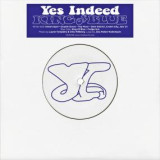
King Of Blue by Yes Indeed sees Laurie Tompkins and Otto Wilberg take their eclectic stance on cosmic jazz and electronics to further uncharted and dreamlike territory, encompassing a unique logic of what is harmoniously absurdist.
King of Blue by Yes Indeed sees members Laurie Tompkins and Otto Willberg further dive into their melismatic take on cosmic jazz and new electronics, by way of their highly eclectic and at times nonsensically sensical modus operandi. Their work is defined by an eloquent flurry of ideas, spheres, and signifiers, creating a musical universe of surprising longevity and depth. Treating musical convention with gentle disdain, Yes Indeed take on a variety of genres and moods and switch them around into a beautifully melismatic and dreamlike state of being. King Of Blue is a mini- album of fragmented beauty and warmth. It puts the illogical center stage and gives space to abruptly miniaturist musical ideas, allowing them to take on a meaning bigger than one would expect. It is cosmic music for modern times. A brazen descent into the execution of a fundamentally diversified musical stance.
'Yes Indeed' are Laurie Tompkins & Otto Willberg. Live, they play keys, bouncy bass and sing over tactile, emotive samples. Their music is epic and also somehow wrong, with space for delicacy, straight-up joy and soaring licks. Since 2022’s ‘Rotten Luck’ - their first proper album, on Bison - YI have played across the UK and Europe. Solo, Laurie co-ran the Slip label and has put out CDs on Entr’acte, 33-33 and Hyperdelia. Otto is a roaming bassist in groups like Historically Fucked and Abstract Concrete and his LP of “wildly singular, wickedly trippy and sensual set of fusion jams” (Boomkat) was recently out on Black Truffle.
Organ of Corti, the trio of Joachim Nordwall (IDEAL Records, The Gagmen), Mattias Gustafsson (Altar of Flies) and Dan Johansson (Sewer Election, Enhet för Fri Musik) returns with another exercise in the slow-motion decay of analog sound. Usher, a minimal hypnotic track on side A reveals its subtle details after multiple listens while the claustrophobic Trauma on the flipside will grab your immediate attention. Machines that hum, sputter, and crackle while slowly moving forward. Vaguely familiar tape loops, spacious synths and crumbling electronics. A journey into the unknown.
The Swedish underground scene continues to deliver some of the best experimental acts and Organ of Corti firmly establish themselves as part of the foundation with a recent self-released cassette, another cd on New Forces and this new single. While their sound has clearly evolved, these alchemists are staying true to their original intention of forging fragments of surreal nightmares.
Recorded by award-winning mastering engineer Kevin Gray's record label, Anthony Wilson's Hackensack West is Cohearent Records' follow-up to Kirsten Edkins' Shapes & Sound album. Produced by Joe Harley and recorded all-analogue/all-tube at Gray's studio, Cohearent Recording, the AAA vinyl release is pressed on 180-gram vinyl at RTI and housed in a deluxe tip-on gatefold jacket.
From the liner notes:
The week before these sessions in the summer of 2023, I sat down each morning with the goal of composing one new song by day's end. I knew I'd soon be in the room with my dear friends Gerald Clayton, John Clayton, and Jeff Hamilton, three musicians whom I trust the most, and with whom I've played the most over the last couple of decades. I tried to imagine themes that would feel natural to us, the kinds of songs we could simply dive into without much thinking. When we headed to Kevin Gray's studio to record, I brought seven new songs along with me. Five are included on this album.
"Daido" is dedicated to Japanese photographer Daido Moriyama, who became known in the late 1960s for his grainy, sometimes blurry, high-contrast black and white images made throughout Japan. I love his pictures taken on the streets of various Tokyo neighbourhoods such as Shinjuku. His portrait of a menacing stray dong, from his series "A Hunter," is the kind of picture that, seen just once, is unforgettable. These days Daido is still out on the street making pictures, at the ripe young age of 85.
"Verdesse" has a sinuous, chorinho-like melody and rhythmic feel. The tune seems to weave and bob playfully in a space of brightness the way a grapevine seems to curl towards the sunlight. So I named it after a wine grape native to the pre-Alpine region of Isère, near Grenoble in eastern France, that makes a particularly delicious and drinkable white wine.
I wrote "Sunday," well...on Sunday. It unfolds slowly, like a good Sunday does when there's nothing to do, you can sleep in, you've got your person beside you, and you just relax into the day.
"The Lands" is dedicated to a family very dear to my heart: that of tenor saxophonist Harold Land. My mother met Harold when they were both teenagers growing up in San Diego, California. The two of them became lifelong friends, and a little later, Harold enjoyed a fruitful musical association and close friendship with my father, Gerald Wilson. Harold, his lovely wife Lydia, and their son Harold Jr. were extended family for us; they looked after me with love and care. Some of my first gigs ever as a young guitarist were with Harold's incredible band that included Oscar Brashear, Billy Higgins, Richard Reid, and Harold Land Jr.
I've loved Todd Rundgren's "Marlene" since I first heard it on his epic double-album Something/Anything. With its tender, well-contoured melody buoyed by a few special harmonic surprises, it almost seems like something from the pen of Burt Bacharach. It tells such a complete musical story. Rundgren's recorded version has a beautiful endlessly repeating tag. So we played the melody simply, and used the tag as a small staging area for a bit of improvising.
Hackensack West is our alias for engineer Kevin Gray's studio Cohearent Recording, a place inspired by Rudy Van Gelder's first studio in Hackensack, New Jersey. Located inside Van Gelder's parents' home, the musicians played in the living room! It was there, in 1954, that Thelonious Monk recorded his classic tune "Hackensack," a "contrafact" melody over the chord changes to the Gershwins' "Oh, Lady Be Good!" In contrafact-like fashion, my own bebop-spirited melody "Hackensack West" seems to nod toward the changes of a few recognizable standards, without corresponding to any particular one.
Janis Joplin wouldn't be denied on Pearl. The powerhouse vocalist had kicked her addictions, teamed with a stupendous band, and partnered with a producer that knew how to best showcase her voice on record. She came to the sessions with an armload of astonishing songs, and a burst of creative energy that mirrored her rejuvenated emotional state and undeniable spirit. You can hear it on every note of the 1971 record. Ranked #135 on Rolling Stone's 500 Greatest Albums of All Time list, Pearl sold more than four million copies and stands as the first female rock superstar's definitive studio work.
Mastered from the original master tapes, cut at 45RPM, and pressed on dead-quiet vinyl at RTI, the iconic audiophile label's reissue takes Joplin and Co.'s stupendous performances to newly transcendent levels. Boasting a fidelity that further magnifies the singer's passion and producer Paul A. Rothchild's clear production, this pressing benefits from increased spaciousness, dynamics, and openness afforded by the wider grooves. Joplin's husky, strong, and penetrating singing has never sounded so vibrant or made deeper connections. Warm, organic, and free of any artificial ceilings, this version lets you step into Sunset Sound Recorders with the performers, such is the degree of realism and authenticity. Indeed, few, if any words, describe Joplin better than "authentic," and her spirit comes to life on this 2LP set in positively transcendent fashion. Like its headliner, this pressing leaves it all on the floor.
While Joplin's electrifying vocal prowess is universally lauded – she's recognized as the greatest white female blues singer the world has ever seen – her mix of compassion, confidence, and charm play as large a role in attracting listeners and keeping them ensnared more than four decades after her tragic death. And on Pearl, she burrows into deeper stylistic veins, teasing out sides of her persona and craft she'd never previously displayed. Her signature desperation, sadness, and vulnerability remain – the harrowing, lonely wail that begins her soul-ravishing take on Jerry Ragovoy's "Cry Baby," underlined with a Wall of Sound-like piano accompaniment, could only come from a person severely scarred by loss and disappointment – yet Joplin also reveals a sense of humour and beatnik innocence that helped propel the album to the top of the charts for nine straight weeks.
Playfully introduced as "a song of great social and political import," the acapella "Mercedes Benz" reflects Joplin's throaty timbre as well as her enhanced, sunnier mood. Similarly, her definitive read of Kris Kristofferson's "Me and Bobby McGee" signals a laidback demeanour and a move into country strains, with the delivery as natural, carefree, and loving as any in the rock canon. As she does throughout the record, Joplin invests her all in the narrative so that there's no line between the performer and the song. She makes everything on Pearl feel autobiographical, and by extension, gut-wrenchingly honest, and devastatingly intimate. Joplin achieved these feats often during her brief career, yet there are differences on Pearl, chiefly among them her balance of impeccable timing and raw emotion. Heart-aching anthems such as "A Woman Left Lonely" offer both grit and control, subtlety and attack, resulting in cathartic releases distinguished with originality, personality, and instinctual passion.
Pearl remains Joplin's finest hour, with credit also owed to the Full Tilt Boogie Band – the only group she ever considered to be her own – as well as the Doors alum that sat behind the boards. Joplin and Rothchild both admitted to sharing a common bond and understanding, with the latter inheriting the role of teacher and Joplin, a willing student ready to discover how she could use her voice in new, more expressive ways. The fruits of the pair's labours fill Pearl, be it the guardedly optimistic "Get It While You Can" or assertive, fleet-footed "Move Over."
Experienced in the new light brought to fore by this definitive Mobile Fidelity edition, Joplin's swan song is no longer about a masterpiece that its creator never lived to see finished. Rather, it's about a once-in-a-lifetime vocalist realizing mammoth potential and wringing passion out of every note. It's not a tragedy, but a triumph. Get it while you can.