Ground Groove, the third full-length release from the LA-based, Iranian-American producer and DJ, Maral, begins with an invocation: the sprawling, achingly heavy Feedback Jam opens the floodgates of history. Conventional (linear) spacetime collapses, crushed beneath the track’s lumbering 4/4 heartbeat and successive waves of distortion. As each wave recedes, samples trickle forward in the mix — seeking, perhaps, to fill the void. Voices and instruments rise and fall in uncanny reverse. Overlapping, implied melodies flicker into focus, then flit away. Feedback Jam is at once an initiation ritual, and a thesis statement for the record that follows.
Drawing upon a vast personal archive of Iranian folk, classical, and pop recordings (some sourced from mixtapes made by her parents in the eighties/nineties), Maral presents, on Ground Groove, a further refinement of the signature “folk club” sound she developed as a live DJ— a sound she would later codify on Mahur Club (2019) and Push (2020). By collecting, dissecting, and re/presenting sonic fragments from Iran, Maral practices a kind of dance-floor ethnomusicology. The subject of her inquiry: Iranian
culture and contexts, throughout history and in the present. But, crucially, this inquiry is instantiated within and throughout the body of the listener, whether this listener is dancing in the club, or riding the train, nodding along with headphones on.
Maral speaks of being in collaboration with her samples, treating each as a distinct bandmate, often consulting with an artist’s catalog (or even a single recording) as one would a trusted creative partner. In so-doing, Maral claims to seek to transcend the self. In this regard, her output neatly triangulates contemporary dance and heavy music with much of the traditional religious music that she samples. Broadly speaking, each of these idioms addresses a desire —shared by audience and performer alike—to transcend the self through volume, repetition, and movement.
Having, in her youth, studied the Setar under Nader Majd (the founder of Virginia’s Center for Persian Classical Music), Maral cycled through various genres (ex: punk, emo, dub) in her adolescence and early twenties, all the while expanding her knowledge of, and appreciation for, Iran’s diverse musical traditions during regular summer trips to Tehran. In college, Maral taught herself to make beats with a ripped copy of Ableton (which remains her DAW of choice), eventually transitioning to playing and hosting various club nights. Forever abiding by an autodidactic, DIY impulse to create art and foster community, Maral relocated to Los Angeles in 2013, where she quickly immersed herself in the city’s numerous overlapping music scenes.
Collaboration (beyond sampling) has proven an important component of her process, with notable spoken word contributions from the likes of Lee Scratch Perry and Penny Rimbaud, as well as a 2021 Panda Bear collab track (On Your Way), which the Animal Collective founder co-produced. Maral is equally attentive to the visual components of her records (album art, music videos, etc.), drawing upon the work of peers and friends for inspiration.
Indeed, the genesis of Ground Groove can be traced back to an audio-visual collaboration between Maral and the artist Brenna Murphy, originally commissioned for the 2021 Rewire Festival — a project that would eventually serve as the album’s foundation. Tracks eight through eleven on Ground Groove comprise Maral’s half of this installation, with tracks one through seven composed afterwards, inspired by the fruits of Maral and Murphy’s collaboration. Murphy’s visuals will be released alongside Ground Groove as a visual accompaniment. Additionally, Murphy designed the album’s art, directed the video for the lead single (the aforementioned Feedback Jam), and is featured on track six, Shy Night.
Composed largely on Ableton, Ground Groove features more frequent and more prominent live recordings from Maral (guitar, bass, and vocals) than either Push or Mahar Club. The cult favorite Roland MC-909 groovebox rears its head on Mari’s Groove. Mixed by Trayer Tryon (Hundred Waters) and mastered by Daddy Kev, the attention to sonic quality on Ground Groove constitutes another significant step in Maral’s development as a studio artist.
Ground Groove’s eleven tracks are “grooves” in the obvious sense, in that they are each driven by a persistent, propulsive rhythm, but the album’s title may just as well suggest the glacial passage of time—the scope of human history, in which individual voices, like streams, carve paths (impossibly) through earth and stone, winding their way to the vast sea of the present.
Buscar:spac
The Legendary album ‘From Mars to Sirius’ put GOJIRA on the path to Worldwide stardom. Almost 18 years , 72 seasons later, this classic album is still a massively Heavy Monster !. It is a concept album addressing environmental issues and the rebirth of a dead planet through a space travel storyline, with the underlying theme of a transition from war to peace. From Mars to Sirius was released in 2005 to critical acclaim. It has since been ranked amongst the Rolling Stone's 100 Greatest Metal Albums of All Time. (wikipedia) A first run of 2000 copies of this double pic disc are being made .
Recorded in Florence in October 1979, »Asia« represents Egisto Macchi’s musical journey across the East. In this work, Macchi describes the many faces of Asia through his unmistakable, electric style. In Macchi’s music, Asia acquires mystical, religious, naturalist, sacred, and adventurous connotations. Acoustic instruments dominate this album; among percussion, zithers, celestas, flutes, marimbas, sansas, and violins, the listener embarks on a musical journey outside the limits of space and time
Part 01[11,39 €]
Dropping as the second standalone EP ahead of Len Faki’s highly anticipated debut album Fusion (due out later this year), this release provides a new outlook on the producer’s sounds, going far beyond the confines of techno that he previously has been known and lauded for.
Opening the record in bold yet sensible style, Gamma subtly transcends the dancefloor functionality by anchoring its driving momentum in a wistful and enigmatic melody; a regular of Berghain, Faki also occasionally plays the upstairs room - where the bumping house of his own It's Time (to Move Your Body) could well go down as the highlight of a long night, whizzing with of colourful synths and anthemic vocals. Yantra then is a reminder of the powerful, loopy and trippy techno, which Faki (amongst all the newfound sonic explorations) has still not lost his appetite and knack for. A genuine counterpart, Shri Yantra then picks up elements of its predecessor, reframed in an enveloping breakbeat journey through time and space.
Going past the constraints of his previous work, Faki’s signature style is still very much audible on this EP, while also showing how there are still endless possibilities to develop. Stay tuned for one more special EP (x35) before the final release of the Fusion double album!
Run by Gabriele and Paolo, Italy based newborn label Sunny Crypt's first output is a reissue of the sought-after "Random Rooms" album by Danish poets and multidisciplinary artists Niels Lyngsø and Morten Søndergaard. Both attending the Literature university in Copenhagen, they were linked at first by a mutual passion and fascination towards music - or rather "sound" - even before unveiling each other that they were writing poems. Niels and Morten started bringing their solo homemade DIY sound experiments together, giving birth to a wide genre-spanning album that ranges from slow tempo mutant disco to folk inspired synth-pop to sound collages and more musical compositions that is fairly complex to put in a precise musical genre box.
First released in 1992 on the same day as their debut poetry collections, Random Rooms should be a house or a flat or an exhibition space that you could walk through and in each room you would come across something new. A fusion of genre and bits and pieces of culture and play.
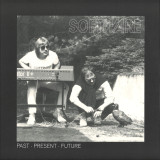
A kaleidoscope of past, present, and future.
German project founded in 1984 by Peter Mergener and Michael Weisser. This release features two cheery picked exemplary moments in downtempo contemplative cosmic travels. A side sends the listener well out of orbit with a 10 min long gradient of Krauty arpeggiated showers that grows elegantly, a concerto to the astros of the mind. Flip it and it gets better as your space capsule gets sucked into some distant planet's gravitational pull, feelings of other-worldly sounds, slowed down beautifully almost eerie nuances one won't forget so easily. Sunrise on a Balearic island from another solar system. Berlin-School by trade but also heard on mixes by Jose Padilla. Heftily remastered.
As a self-described “sponge for club music”, London-based Bristol transplant Ian DPM has cut a singular figure in both the West Country and the capital in just a handful of years. Already situated as the tastemaker behind music curation platform Definite Party Material, co-owner of Scuffed Recordings, and Noods Radio and Rinse FM resident, Ian DPM’s emergence as a producer has marked him as an expansively curious, bass-forward figure at the bleeding edge of genre boundaries.
After retreating to his hometown of Portsmouth during lockdown to absorb the blueprints of ‘90s techno, Ian emerged with a new phase of experimentation: techno-inspired and indebted, yet eschewing loops and grids for a loose-limbed, open minded engagement of the form.
Taking inspiration from the iconic carnival rides that are inseparable from their high-octane happy hardcore soundtrack, “One For The Waltzers” begins with a distant rumble of muffled breakbeats that inch ever closer. But rather than dizzying lights and in-the-red maximalism, “One For The Waltzers” gradually reveals its knowingly deep shimmy and groove. It is a drum-heavy and rhythmic production, masterfully using negative space to showcase every contour of its slowed-down rave horns and acid house synth lines.
“KE01” inhabits the flipside of the same sonic world “One For The Waltzers”. Here, feverish percussive energy contrasts against pensive melodic synth chords. It’s a heady warehouse affair, familiar and complex, referential yet contemporary, and only adds to the momentum that Ian DPM is gathering.
Connections by Satya is a February exclusive edition and a token of love for the year ahead. Gathering to spark an electrifying synergy, Connections is all about finding that blissful meeting point that can be achieved once we mindfully align on values, sentiments and musical sensitivities. These pillars hold up Connections’ core foundations and shape a new philosophy construction for the label. By merging four finessed tracks mastered by four invested musical minds, Satya takes a new turn for collaborative musical alchemy in the sense that Connections’ production is balanced, tasteful and touching. Each artist’s culture subtly seeps into each track and speaks volumes of their character in and out of the studio. Space Invaders, Aurora, Mentat and Spaces hold many keys to unlocking doors to full transparency and connectivity through our senses in the simplest of ways.
“These are cosmic sounds that you can get lost in and go anywhere you feel safe and adventurous.” - Zone+
- A1: Global Tracks - Hither Green
- B1: Globaltracks - Shelley
- C1: Kanot - Bottenmannen
- D1: Kanot - La Danse Des Corneilles
- E1: Tecwaa - Cï
- F1: Tecwaa - Xentæh
- G1: Dame Bonnet - Portamento
- H1: Dame Bonett - Dark, Slow
- I1: Birds - Transcendental Phases
- J1: Birds - Tunnel Visio
- K1: Purple Desert Rain God - Invisible Matter
- L1: Purple Desert Rain God - Bridge To Nowhere
- M1: Jesse - Possibilities
- N1: Jesse - Shazzy
- O1: The Exorcist Gbg - Stonerdisco
- P1: The Exorcist Gbg - Superstandard
- Q1: Timothy J. Fairplay - Pathfinder Theme
- R1: Timothy J. Fairplay - Ufos Over China
- S1: Pink Skull - Taki Chrome
- T1: Pink Skull - Strummer Maxx
The Mothership has come! It has arrived in the form of the strictly limited collection box “Music Is The Healing Force Of The Universe”, containing all singles released on the label between 2019 and 2021. The Höga Nord – galaxy resounds of all good between strict electro and loose jams, fluffy krautrock and moist world music to underwater techno and space funk. Although, what it is that defines the Höga Nord sound is not genres, instead it is, to cite Mathias Nilsson, founder of and boss for the label, music “strongly connected to fantasy, to the creative world.” Creativity over profit!
The collection is an overview on Gothenburg’s underground music and on an international scene that breathes similar air as the local Swedish acts that Höga Nord Rekords has chosen to highlight. The kinship between Jesse’s 80’s varnish sports car-electro and Purple Desert Rain God’s more traditional mountain sound can appear distant but the artists come together in their free spirited approach to their own productions – what all acts on this collection has in common is that they move toward something new, something beyond the genre they are in.
“Music Is The Healing Force Of The Universe ” mark the closer for Höga Nords first run. The 2010s are over and the 2020s lies open for further investigation of the cream of the Swedish and international of underground scenes!
- A1: My Mind Was A Fog, My Heart Became A Bomb
- A2: Then The Quiet Explosion
- A3: Turning Into Tiny Particles, Floating Through Empty Space
- B1: Like A Valley With No Echo
- B2: Holding Your Absence
- C1: Shored Against The Ruins, Drowning In Ten Directions
- C2: I Could Hear The Water At The Edge Of All Things
- C3: In The Middle Of This Nowhere
- D1: Hope Becomes A Loss
- D2: Tres Domine
Bonus LP with Etching. Oblivion Hymns is the sixth studio album by American ambient/post-rock band Hammock. It was released on November 26, 2013 by the band's own label, Hammock Music. Oblivion Hymns was met with positive critical reception and hit No. 17 on the Billboard Top Heatseekers Album Chart in 2013. Mike Diver at Clash magazine loved the album, stating that Oblivion Hymns is "…some of the most blissful music Clash has ever had the luxury of bathing in. Hammock has gone on to become one of the foremost purveyors of affecting ambient post-rock on the scene." John Diliberto, the host of Echoes, listed Oblivion Hymns as No. 8 in the "25 Essential Echoes CDs for 2013" as an album that represented the best, most innovative aspects of the ambient music soundscape in the past year, stating that "Hammock goes deeper into their ambient chamber music with children’s choirs emerging out of swirling deeply processed guitars."
Electronic duo Pale Blue return to Crosstown Rebels with ‘No Words’, the second single from their forthcoming album ‘Maria’, with remixes from DJ Tennis and Perel.
Italians Do It Better founder Mike Simonetti and Silver Hands’ Elizabeth Wight’s rich and storied careers within the electronic realm and beyond only elevated further with the launch of their Pale Blue project in 2015, unveiling a series of critically acclaimed releases via Simonetti’s 2MR imprint with plaudits including Pitchfork, FACT and Resident Advisor, to name just a few. Having provided the first look into their forthcoming album on Crosstown Rebels entitled ‘Maria’, scheduled for release on the label later this year, the pair return to open March with the second single from the project, ‘No Words’ - accompanied by remixes from DJ Tennis and Perel.
Detailing the backstory to the record, Simonetti notes both upcoming single ‘No Words’ and the majority of the tracks on the duo’s forthcoming album project were made on the exact synths used to create Jaydee’s iconic 1993 hit, ‘Plastic Dreams’.
Guided by a captivating bassline accented by Wight’s charming vocals, which flutter amongst the mix, ‘No Words’ is a hooky and compelling production that ebbs and flows across its near five-minute duration with effortless ease, capturing the playful nature alluded to by Simonetti. Life and Death head honcho DJ Tennis’ remix arrives next, veering down a hazy yet absorbing path as crisp organic drums and engrossing melodies form around the vocals and journey through light and dark textures.
The B-side of the record belongs to DJ/producer, vocalist and DFA Records favourite Perel, offering a cosmic dive through spacey synths, skittering bleeps and pops, and tough kicks across her take on the production - before distorting and warping the vocals and shifting the emphasis on the ever-evolving electronics across her ‘Dub Version’.
- A1: Toasty - The Knowledge
- A2: Dense & Pika - Colt
- B1: Mount Kimbie - Maybes (James Blake Remix)
- B2: Sepalcure - Pencil Pimp
- B3: Or La - Uk Lonely
- C1: Search & Destroy - Candyfloss (Loefah Remix)
- C2: Scuba - Ruptured (Surgeon Remix)
- D1: Paul Woolford - Mdma
- D2: Closet Yi - Heavy
- D3: George Fitzgerald - Thinking Of You
- E1: Scuba - Three Sided Shape
- E2: Recondite - Caldera
- F1: Jimmy Edgar - Sex Drive (Scuba's Dub Of Doom)
- F2: Lawrence Hart & Casually Here - Wanderlust
- F3: Kiimi - Breaking My Mind (Jacques Greene Remix)
Hotflush Recordings celebrates 20 years in the game this year, with a triple pack vinyl compilation featuring some of the key musical events in the label’s catalogue.
Born in 2003, Hotflush stands as one of electronic music’s most influential labels. A multi-dimensional imprint that helped define the development of bass music throughout the mid-2000s, in the last decade it would evolve towards the liminal spaces between house, techno, and beyond - a journey which has given the dancefloor some of its true underground classics.
This celebratory release covers every era and stylistic area of the Hotflush output. 2005’s proto-dubstep face melter ‘The Knowledge’ by Toasty kicks off Side A, with the key sides of bass music development all covered with tracks from James Blake, Loefah, Sepalcure, and Scuba.
UK techno legend Surgeon appears with his seminal remix of Scuba’s ‘Ruptured’ (2008), while the early Paul Woolford classic ‘MDMA’ reminds us of how ended up working with Diplo.
George FitzGerald and Recondite reprise some of their key formative material, while newer names Lawrence Hart, OR:LA and breakout Seoul artist Closet Yi also make appearances.
Canadian mastermind Jacques Greene rounds off the release with his slamming remix of Kiimi’s Breaking My Mind.
This is a compilation 20 years in the making, containing some of the key tracks from the electronic underground - curated and compiled by label boss Scuba.
Dismantling the acoustic to feed the electronic, Editions Mego presents Telepath, the new album by Material Object. Born out of a single improvised recording session with a lone Violinist, Telepath is a startling album of future electronic music, resulting in an LP of unique and timeless tracks that reimagine a classic sound for an endless future.
Boldly departing from his previous canon of largely 'ambient' work, Material Object's Telepath renders itself out as something much stranger, something more spacious, more subtle and gradual. Moments of bouncing minimalism meet moirés of delayed pure tones phasing in and out of resolution, giving way to a series of strobing foreground gestures arranged and offset in disorienting landscapes which scatter themselves asymmetrically amongst crystal pools of reverb.
Revelling in the creative dismemberment of the original source material, Material Object slowly and patiently induces the violin to undergo every category of torsion, pressure and rupture. Its vivid acoustic qualities pass over and across the event horizon of the digital domain. Shattering then crystallising into points and coordinates, intersections, disjunctions, planes and reverberant figures. An uncanny geometry perceived only between the ears, at once dissolving and reconstructing itself.
Not to be missed here is the essential, but bonus only, add-on (available with all Bandcamp purchases) "Auxiliary Apparition", a hallucinatory expanse that traverses the same liminal geography as the LP proper but as some refracted, ghostly counterpoint. More nocturnal, overpowering phantasms looming out of a droning noise floor before fading away. A hypnotic and time-dilated recapitulation of what's gone before as if looking back from beyond a mirror. When it finally resolves in the closing moments and returns you home, you realise you haven't really moved at all.
Equally abstract, haunting and daring, Material Object’s Telepath is a singular work that abandons all notions of genre. Erupting with a tension of opposites that unfolds as a truly unique story, told in four dimensions and draped in deafening colour.
Ben Glas (b. 1992) is an experiential composer based in Berlin. Through ephemeral compositions Glas' work questions preconceived notions between the acts of passive hearing and active listening. In seeking to discover open ended forms of music and pragmatic listening perspectives, Glas' compositions focus on the realms of subjective perception and cognition, via the use of acoustics, psychoacoustics and space as tools for sonic composition. His work has been exhibited and performed internationally, including the Portland Institute for Contemporary Art (PICA), Glasgow's Radiophrenia Festival, the Soundwave Biennial (SF) and the Czong Institute for Contemporary Art (CICA). He is currently receiving his M.A. in Sonic Studies at the UdK.
Ben Glas writes… "Anonymous Sextet for Perverted Piano is a conceptual performance piece that combines a traditional grand piano, six long-distance remote controlled vaginal/anal vibrators and the prolonged use of the piano's sustainer pedal.
The six vibrators were strategically (and preparedly) placed atop of the strings of a various grand pianos (and one harpsichord), while random strangers around the globe connected to and operated the sex toys remotely. After the random and unwitting performers had befriended and synced-up with a catfishing account linked to the six individual vibrators and controlled by three different smartphones, they then sent vibrational patterns and pulses to stimulate their assumed target. The then-kinetic vibrators bounced, slid and bopped aleatorically through the tonal possibilities that the piano and piano's soundboard itself permits. The piano's sustain pedal was held down throughout the performance, elongating the triggered notes and the good vibrations.
All tracks on side A are performed by those unwitting performers, while side B's single track was performed with (more than) a little help from my friends (Anonymous (1), Genesis Victoria, Harry Hudson-Taylor and Hayden Dean)." – Ben Glas, Berlin, 16 February 2023.
Close to five years on from their last transmission, Ulrika Spacek resurface from self-imposed exile with their third album, Compact Trauma, a collection of songs that function as a chance treatise of sorts for our current collective condition. With a title like that arriving at this point in time, it's tempting to interpret the record solely in the context of the global events of the past few years, but the roots of these ten songs arc back much further in time, charged with their own personalised internal damage. Trauma, in its myriad forms, is often hard to qualify, even harder to rationalise. When something begins to go wrong, how do you gain perspective? What is a temporary roadblock, and what is unmitigated disaster? In its first phase of life, Compact Trauma was a document of a band striving to perfect an idea while the universe around them seemed to want to shut down. And then, at an impasse of sorts and with a record halfway complete, it suddenly did. If Ulrika Spacek were a band in need of the breaks applying, it was the force of a global pandemic that made it happen. As the world stood still, Compact Trauma was filed away, unfinished and unheard by the wider world, possibly to remain that way forever. And yet, there was to be a second act. If mutability is our tragedy, it's also our hope, clearer days slowly began to emerge as the bad slipped away. The wound, as the saying goes, is the place where the light enters you. The prolonged break enforced by myriad lockdowns may have separated the group but it also afforded the five time to reflect on what had already been committed to tape.. As the lights came back on and the shutters up, they found themselves drawn back towards Compact Trauma. What they rediscovered was a record that seemed to preempt the shared grief of a global pandemic. Even if the specifics were different, the themes were uncannily similar. Addressing existential freak out, displacement, substance reliance and encroaching self-doubt, these highly personalised songs suddenly took on a wider significance, speaking in part to a bigger narrative. They could have left it alone, but in coming back to what they knew, Ulrika Spacek found their best work yet. RIYL: Mercury Rev, Sonic Youth, My Bloody Valentine, Radiohead, Deerhunter, Atlas Sound, Stereolab.
Experience the upbeat, feel good music from village to town, and town to village. A beautiful excursion through a landscape of memories lived and futures imagined with electronic rhythms, soulful vocals and Ndebele chants from the heart of Zimbabwe.
Traditional chiming guitars and gorgeous male harmony voices meet the toughest of drum machine kick drums and juddering synths to create something that is both reminiscent of 1980s ‘Jit’ music and a classic electro sound with heavily compressed 808 drums gut-punching through the speakers
Following the tumultuous riots of the late 60's, youths in Washington, DC were looking for two things: positivity and an outlet to relieve tension. MUGO, aka "Music, Unity, Guidance, & Organization", offered just that. Formed by 8 high school friends during the summer of 71', this high-octane machine was driven by Manager and retired Marine Sgt. Reuben McNair Sr. His son, Reuben McNair Jr., was a leader within the group, and consequently wrote the B-side of their only public release. This cut, entitled "Space Travel", boasts a driving rhythm section as well as synthesizer overdubs likely to captivate even musically ambitious extraterrestrials. The flip, "Organize", became the group's unofficial theme song; submitting to the public a deft vocal response to rampant inner city blues.