Italian composer and saxophonist Laura Agnusdei returns with “Flowers Are Blooming In Antarctica” a career defining record that sees the artist diving into uncharted waters, a profound timeless meditation on our relationship with planet Earth, the eco-conflicts arising and the fascination with non human forms of life, backdropped to a vivid soundtrack of coral exotica, spiritual Jazz, fourth-world minimalism, tropical electronics, tribal futurism and contemporary elegance.
Every step of Laura Agnusdei’s path, from electroacoustic experimentation to her constant research based upon the acoustic dimension of wind instruments and their interaction with polymorphic electronic sounds, seems to have pivoted into a new sense of awareness, as if the mind and intellectual practice has finally caught up with the body, the heart and the soul, resulting in her most organic and transcendent work yet. “Flowers Are Blooming In Antarctica” is loosely inspired around a trifecta of pioneering ideas that explore unconventional reality: James Bridle’s ‘Ways Of Being’ with his radical story that mixes ecology, tech and intelligence; Luigi Serafini’s late-70s fantastical ‘Codex Seraphinianus’, an unparalleled collection of flora, fauna, anatomies metamorphosed into new fragile beings; J.G. Ballard’s climate-fiction foreshadowing sci-fi ruminations. These influences shift Agnusdei’s musical trajectory injecting doses of terrestrial malaise, the earthy sub-saharan ‘Ittiolalia’ with its wah-wah filtered sax and trance inducing groove; the rubbery playfulness of ‘Oasi Bar’; the gentle eco-system of ‘P.P.R.N’ reminiscent of Herbie Hancock’s innovative synthesis of funk, space and synthesizers; the kaleidoscopic northern lights of ‘Emperor Penguin Lullaby’, where south-east Asian echoes reach icy shores; the Jon Hassell hyper-ambience of ‘Cuttlefish REM Phase’; the post-apocalyptic march of ‘The Drowned World, a jazz standard for an artificial civilization on the brink of self-destruction. Nothing feels out of place and it’s no coincidence that one of the most powerful messages on the record is delivered on centerpiece ‘Are We Dinos?’ via an interview conducted with two preschoolers. Radical optimism or sonic liberation?
Laura Agnusdei’s tenor sax cuts deep all across “Flowers Are Blooming In Antarctica”, a laser baton raised up to the clouds, a conductor orchestrating devotional soundscapes for a three-eyed dolphin, guiding us through prismatic pastures and acidic oceans. Her tropicalized realm is pin-pointed with Miles-like sheer clarity, a bristling nakedness on the verge of exploding at any time, creating an album where ascension becomes the unifying code.
Buscar:space around the world
- My Darling, My Angel
- Pavement
- Something For Somebody
- Virtue
- Defibrillator
- The Light Streams In And Hits My Face
- Hocus Pocus
- Hideaway
- Love Songs/ Heart Strings
- Ray Of Light
- The Worst Thing I Would Ever Do
- Horses
In Mallrat’s (aka Grace Shaw’s) vision of the world, light is more than photons and electromagnetic radiation hitting the eye — it’s a moment of divine intervention. A bold swerve into the metaphysical, this is the premise of the prized Brisbane-born, LA-based pop songwriter and producer’s 2025 sophomore album: Light hit my face like a straight right. Set against a newly informed backdrop of expressive breakbeats and dance music, its 12 songs explore the intangible and mysterious allure of human connection, held together by curious investigations into light — “the closest thing to a concept this album has,” Mallrat says. She reunited with Butterfly Blue producers Styalz Fuego (Troye Sivan, Tate McRae) and Alice Ivy, while bringing into the mix indie electronic producers Chrome Sparks and Casey MQ. Mallrat serves up highs like “Hideaway,” a song where heart-racing garage clashes with her trademark candor: “I’ll be your lucky charm just let me hang around your neck,” she sings. Sleek and early standout “Pavement” gets a gritty underlayer with chopped up vocals from DJ Zirk’s “Born 2 Lose” and mid-album standout “Hocus Pocus” finds Mallrat singing about being pulled “under the spell” of someone new, borrowing a different part of the same DJ Zirk sample to build its shimmering, dancefloor-ready facade. It’s an endeavor that perhaps reaches a peak on “Horses,” the record’s gentle and organic closer which Shaw herself calls “objectively the best song.” Written after returning home to Brisbane and “feeling like an alien,” it gained new meaning in the wake of her late sister’s passing. For Shaw, it’s the convergence of the song’s minimalism, lyrics, space, and the way her voice cracks on the recording as she sings, “Hey, I’m right here, I look different now.” After years of solidifying herself as a master of well-crafted, timeless pop — fielding recognition from New York Times, NYLON, Teen Vogue, Billboard, The FADER, NPR, and more — Light hit my face like a straight right is a step into the art of world-building, bolstered by her intuitive songwriting and clever, studied production.
- A1: Progetto Tribale - The Sweep
- A2: Onirico - Echo Giomini
- A3: Open Spaces - Artist In Wonderland
- B1: Alex Neri – The Wizard (Hot Funky Version)
- B2: M C.j. Feat. Sima - To Yourself Be Free - Instrumental Mix Energy Prod
- B3: Mato Grosso - Titanic Expande
- C1: Dreamatic - I Can Feel It (Part 1)
- C2: Carol Bailey - Understand Me Free Your Mind (Dream Piano Remix)
- C3: The True Underground Sound Of Rome - Secret Doctrine
- D1: Don Carlos - Boy
- D2: Lazy Bird – Jazzy Doll (Odyssey Dub)
Vol 2[28,99 €]
Volume 1 of this expertly curated project of 90s Italian House - put together by Don Carlos.
If Paradise was half as nice… by Fabio De Luca.
Googling “paradise house”, the first results to pop up are an endless list of European b&b’s with whitewashed lime façades, all of them promising “…an unmatched travel experience a few steps from the sea”. Next, a little further down, are the institutional websites of a few select semi-luxury retirement homes (no photos shown, but lots of stock images of smiling nurses with reassuring looks). To find the “paradise house” we’re after, we have to scroll even further down. Much further down.
It feels like yesterday, and at the same time it seems like a million years ago. The Eighties had just ended, and it was still unclear what to expect from the Nineties. Mobile phones that were not the size of a briefcase and did not cost as much as a car? A frightening economic crisis? The guitar-rock revival?! Certainly, the best place to observe that moment of transition was the dancefloor. Truly epochal transformations were happening there. From America, within a short distance one from the other, two revolutionary new musical styles had arrived: the first one sounded a bit like an “on a budget” version of the best Seventies disco-music – Philly sound made with a set of piano-bar keyboards! – the other was even more sparse, futuristic and extraterrestrial. It was a music with a quite distinct “physical” component, which at the same time, to be fully grasped, seemed to call for the knotty theories of certain French post-modern philosophers: Gilles Deleuze, Félix Guattari, Paul Virilio... Both those genres – we would learn shortly after – were born in the black communities of Chicago and Detroit, although listening to those vinyl 12” (often wrapped in generic white covers, and with little indication in the label) you could not easily guess whether behind them there was a black boy from somewhere in the Usa, or a girl from Berlin, or a pale kid from a Cornish coastal town.
Quickly, similar sounds began to show up from all corners of Europe. A thousand variations of the same intuition: leaner, less lean, happier, slightly less intoxicated, more broken, slower, faster, much faster... Boom! From the dancefloors – the London ones at least, whose chronicles we eagerly read every month in the pages of The Face and i-D – came tales of a new generation of clubbers who had completely stopped “dressing up” to go dancing; of hot tempered hooligans bursting into tears and hugging everyone under the strobe lights as the notes of Strings of Life rose up through the fumes of dry ice (certain “smiling” pills were also involved, sure). At this point, however, we must move on to Switzerland.
In Switzerland, in the quiet and diligent town of Lugano, between the 1980s and 1990s there was a club called “Morandi”. Its hot night was on Wednesdays, when the audience also came from Milan, Como, Varese and Zurich. Legend goes that, one night, none less than Prince and Sheila E were spotted hiding among the sofas, on a day-off of the Italian dates of the Nude Tour… The Wednesday resident and superstar was an Italian dj with an exotic name: Don Carlos. The soundtrack he devised was a mixture of Chicago, Detroit, the most progressive R&B and certain forgotten classics of old disco music: practically, what the Paradise Garage in New York might have sounded like had it not closed in 1987. In between, Don Carlos also managed to squeeze in some tracks he had worked on in his studio on Lago Maggiore. One in particular: a track that was rather slow compared to the BPM in fashion at the time, but which was a perfect bridge between house and R&B. The title was Alone: Don Carlos would explain years later that it had to be intended both in the English meaning of “by itself” and like the Italian word meaning “halo”. That wasn’t the only double entendre about the song, anyway. Its own very deep nature was, indeed, double. On the one hand, Alone was built around an angelic keyboard pattern and a romantic piano riff that took you straight to heaven; on the other, it showcased enough electronic squelches (plus a sax part that sounded like it had been dissolved by acid rain) to pigeonhole the tune into the “junk modernity” section, aka the hallmark of all the most innovative sounds of the time: music that sounded like it was hand-crafted from the scraps of glittering overground pop.
No one knows who was the first to call it “paradise house”, nor when it happened. Alternative definitions on the same topic one happened to hear included “ambient house”, “dream house”, “Mediterranean progressive”… but of course none were as good (and alluring) as “paradise house”. What is certain is that such inclination for sounds that were in equal measure angelic and neurotic, romantic and unaffective, quickly became the trademark of the second generation of Italian house. Music that seemed shyly equidistant from all the rhythmic and electronic revolutions that had happened up to that moment (“Music perfectly adept at going nowhere slowly” as noted by English journalist Craig McLean in a legendary field report for Blah Blah Blah magazine). Music that to a inattentive ear might have sounded as anonymous as a snapshot of a random group of passers-by at 10AM in the centre of any major city, but perfectly described the (slow) awakening in the real world after the universal love binge of the so-called Second Summer of Love.
For a brief but unforgettable season, in Italy “paradise house” was the official soundtrack of interminable weekends spent inside the car, darting from one club to another, cutting the peninsula from North to centre, from East to West coast in pursuit of the latest after-hours disco, trading kilometres per hour with beats per minute: practically, a new New Year’s Eve every Friday and Saturday night. This too was no small transformation, as well as a shock for an adult Italy that was encountering for the first time – thanks to its sons and daughters – the wild side of industrial modernity. The clubbers of the so-called “fuoriorario” scene were the balls gone mad in the pinball machine most feared by newspapers, magazines and TV pundits. What they did each and every weekend, apart from going crazy to the sound of the current white labels, was linking distant geographical points and non-places (thank you Marc Augé!) – old dance halls, farmhouses and business centres – transformed for one night into house music heaven. As Marco D’Eramo wrote in his 1995 essay on Chicago, Il maiale e il grattacielo: “Four-wheeled capitalism distorts our age-old image of the city, it allows the suburbs to be connected to each other, whereas before they were connected only by the centre (…) It makes possible a metropolitan area without a metropolis, without a city centre, without downtown. The periphery is no longer a periphery of any centre, but is self-centred”.
“Paradise house” perfectly understood all of this and turned it into a sort of cyber-blues that didn’t even need words, and unexpectedly brought back a drop of melancholic (post?)-humanity within a world that by then – as we would wholly realise in the decades to come – was fully inhuman and heartless. A world where we were all alone, and surrounded by a sinister yellowish halo, like a neon at the end of its life cycle. But, for one night at least, happy.
Since the late 90"s, Jakob "Dino" Dinesen has become a stalwart of the Danish jazz scene, performing with nearly everyone of note in the country as well as internationally celebrated names such as Kurt Rosenwinkel, Jeff "Tain" Watts, Jakob Bro and Paul Motian. Finding joy and inspiration in the building of bridges between genre boundaries, his career in music has seen him travel and perform all over the world, enriching his sound and soul with every new experience. His new record seeks to convey his dream of a future world at peace with itself. "Slow Flow" is set to release on January 25th on April Records. "I envision a world where people from every corner of the globe come together, dancing, sharing meals, and finding joy through my music. My children are a blend of Africa and Denmark, and I hope they"ll carry the traditions and wisdom of both their mother and father as they navigate their path. I would love for music like this to be the soundtrack to their journey through life." Rooted in the playful live sound of an atypical quintet featuring cello and djembe, Slow Flow sits in a unique space somewhere between earthy, simplistic, and acoustic and contemporary, electronic, and unexpected. The record"s sound is soft spoken and full of compassion-a dark-timbred music where the intimate, warm breath of his tenor saxophone intertwines with the crisp, organic tones of the cello. Together, they float over smooth, analog synths and electronic loops, while the carefully crafted lines of the bass and the gentle rhythm of hands on drum skins carry the music forward. Occasional erratic, quirky bursts from an affected keyboard and weaving improvisations offer moments of energy and contrast. Each of the album"s nine original compositions paint musical pictures of contentment that are dear to Dino, as well as offering musical tributes to four of his heroes in Yusef Lateef, Wayne Shorter, Coleman Hawkins and Eddie "Lockjaw" Davis". Drawing on modern European jazz, African rhythms, Italian circus music, and reggae, Slow Flow plays as a deeply personal exploration of Dino"s identity, whilst providing a dream-like message of global peace that promises to resonate with like-minded people all around the world..
Ten years on, Joana Gama and Luís Fernandes show no signs of slowing down. Over the past decade, the duo has released five albums, composed soundtracks for film and television, and created pieces for performing arts. With “Strata”, they embark on a bold exploration of their musical identity, breaking new ground by seeking the primordial, the raw, and forging a deeper creative synergy. This evolution makes their music feel less like a conversation and more like a unified, introspective monologue.
Until now, their work has largely been defined by dialogue - a dynamic exchange of ideas evident in their earlier records. However, in their relentless drive to push boundaries, they now turn inward, embracing a monologue as a pathway for growth, innovation, and celebration of their journey so far. Two key elements shape this transition: Joana’s growing affinity for synthesizers over piano, a direction initiated in “There’s no knowing”, and her integration of field recordings gathered from diverse locations around the world. Rather than stepping into each other’s domain, the duo finds common ground, creating music that thrives on harmony and introspection.
“Strata” stands as Joana and Luís's quieter and most cohesive record to date. It reflects their desire to craft music that resonates with the natural world, unfolding as a seamless stream of sound that enhances their connection and invites the listener into their creative process. While their previous works were compelling, they often felt distant, as if the listener was observing from the sidelines. “Strata”, by contrast, draws the listener in, encouraging them to fill the spaces and find their own place within the duo’s monologue.
This process climaxes in the closing track, "Geode," where the subtle sounds of debris underscore the tightly woven structure of “Strata”. It’s a testament to the duo's commitment to evolution and their ability to surprise both themselves and their audience. A decade into their collaboration, “Strata” reaffirms Joana and Luís's creative vitality, offering a record that feels both fresh and deeply rooted in their artistic vision.
- A1: Pink Lady
- A2: Pray Like A Fool
- A3: Wise Guy
- B1: Racist Man - Remix
- B2: Isolation
- B3: Pennywise (Hologram Cowboy Remix)
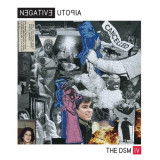
After releasing their accomplished debut album “NEW AGE PARANOIA” in 2023, THE DSM IV are following up with this limited edition, vinyl only EP “NEGATIVE UTOPIA”. Formed by Guy McKnight of the critically acclaimed and cult favourite The Eighties Matchbox B-Line Disaster, THE DSM IV has a dark sound that blends hypnotic noise-rock with synth-pop industrial aesthetics. “NEGATIVE UTOPIA” features six more synth-pop-acid-house-goth-rock-new-wave bangers. The A-Side consists of three new songs by the band. Meanwhile on the B-Side there are remixes of two tracks from “NEW AGE PARANOIA” (‘Racist Man’ and ‘Pennywise’) plus a cover of Joy Division’s iconic ‘Isolation’. Shimmering synth lines meet heavy guitar riffs in a kaleidoscopic sonic sound space where McKnight’s shamanic vocal acts as a guiding force. This EP, like their debut album, demonstrates that THE DSM IV are a band with a social conscience and are unafraid to speak truth to power on matters of injustice. Their music is a reflection of the what is around them, it grapples with the consequences of a cruel and unjust planet with an optimism and belief that a better world is possible.
Securing his place in the scene as a mainstay after consecutively acclaimed releases on his own record label and beyond as well as lengthy touring around the globe's best venues, Altinbas returns to Token the only way he knows how. The Fuse resident's ethereal mark on driven techno comes this time with an aquatic touch, diving further into his bubbly architecture and melodic intrigue.
'Voyage' can mean many things; the past few years have been an incessant trip across the world's greatest sound systems and most dedicated audiences for the Belgian producer, or then perhaps it's a reference to the climactic and emotional nature of his productions. In any case, it's also the title track for his third EP on Token Records. Balancing warmth and anticipation, Altinbas is able pack in all the elements of a timeless record while still providing the space to breathe. Smooth and introspective, 'Voyage' kicks off the EP on a cloud of a club roller. 'Stygious Night' shares the first side with a more minimal but nonetheless effective approach. The tonal synth work on this record begs for a powerfully round system worthy of only the best dancefloors, and the space that washes around in the background gives it true dimension. Maintaining minimalism with structure through drum arrangement, 'Stygious Night' is reminiscent of a not so distant past in Berlin crafted with a clearly modern approach. As the record flips, 'Venus Ballroom' takes us by surprise with an uncommonly resonant sound at the forefront. This stylistic switch blends perfectly with historic tracks on the label that have come to define its sound since 2007. Hypnotic, psychotic, quirky, and mental - 'Venus Ballroom' proves a deep understanding of the music and appreciation of versatility. 'Psychosphere' closes down the EP with a classic sound of dissonant stabs to resonate through a foggy room. Altinbas highlights his sound with frantic clap sequences and short rides to keep his percussion rolling but dry while his synths create the acoustic he's been known to craft for the past few years. To have everyone agree on level of taste and technical capability is tough, which is why this certainly won't be the last time Altinbas will team up with Token to roll out his cutting-edge work.
- A1: Pupper
- A2: The Beautiful World
- A3: Stray
- A4: Piano Tree
- A5: Introverts As Leaders
- A6: Our Secret
- B1: Good Afternoon
- B2: Oh Lauren
- B3: The Door
- B4: Look
- B5: Elevation
David Allred is a prolific composer and producer based in Portland, Oregon. His new album The Beautiful World captures an enriched, realised understanding of why he composes in the first place. Dedicated to the expression of existential themes such as death, grief, longing and loss, the album’s core theme centres around the suicide of a young girl Lauren, who was a family friend to Allred. For as long as he could remember, Allred always created music out of a kind of dissociative state which he finds alluringly easy to lapse into. A repetition of a motif is usually where he begins composing. But unlike his previous works, The Beautiful World firmly has one foot in reality and is deeply intertwined with Allred’s relationships, past and present. Through his correspondence with Erased Tapes label head and the album’s producer, Robert Raths, over the past year, he came to realise that everyone has a Lauren in a way – someone they’d lost. Through writing to Raths, Allred was able to draw out this thread from the work and position it more clearly as the central concept to this work. The music doesn’t reflect the chaos of trauma, instead it has a therapeutic quality. It was through this dialogue that Allred was able to create what may be his most cohesive body of work to date. The 11 track album unfolds around Oh Lauren, providing the core of the album’s sentiment – how grief returns to us throughout life over and over. Embedded more than halfway through the album, Allred allows listeners to cohabit a meditative space through ambient textures, drones and ballads echoing the vocal sincerity of Arthur Russell, Daniel Johnston and the hypnotic storytelling of Robert Ashley. To truly reckon with The Beautiful World’s emotional position, listeners must understand the importance of the figure of Lauren, and the significance she has had throughout Allred’s life. Lauren’s suicide as a child provided the catalyst for Allred’s lifelong grief. But it was death anxiety and grief itself which provided Allred a link to a universal relationship that people have with each other and the world they live in. Impermanence and loss are the driving force behind all of our connections. The trance-like nature of the album perhaps comes from David Allred’s time sense – particularly when it comes to memory and trauma. Time becomes non-linear rather than a straight line – where one can repeat or return to the same themes but older and in a different frame of mind. Grief continues to manifest itself in life and despite personal growth, there will always be moments where the same feeling will manifest itself again. The album encourages listeners to sit with the concept of grief, and Allred is hopeful they can find comfort and learn to process it in a healing way. The Beautiful World is therefore heavily influenced by Allred’s work in therapy, particularly his relationship to writing music. In the past, Allred would be composing music as a means to dissociate from his life, but the album sees him engaging and connecting more authentically than ever with others and himself. Despite his prolific previous works being made in the company of others, Allred needed to step back from the scenes that he’s worked in to discover what he really wanted to create. Allred concludes: “In the power of love, curiosity, humour, and reconciliation, we give you The Beautiful World.”
- My Body
- Black Hole
- Laced And Lost
- Dope Magic
- Waitin' Around
- Searching For Seams
- Break The World In Two
- Neon Orange Leash
- Speculum Aenigmate
- Cold Grey Eyes
- Smile
LP + 7". Portland indie rock band charts novel sonic territory, exploring resilience of the human spirit in the aftermath of tragedy and trauma, over 5 years in the making. Conceived in the wake of a worldwide quarantine, the entire West Coast being on fire, and the horrific murder of one of the band's own - then recorded, finished, and now released in defiance of it all. Harnessing all that of chaotic change and catastrophe, the band took it all as an opportunity to boldly blaze some new trails for themselves, carving out new sonic territory by exploring everything from spacey Fusion-Funk bass Moogs and Hip-Hop drum machines, to New Wave-ish synths and flourishes of Samba, Blues, Soul, and Sunshine Pop - all while still delivering the goods that Aan fans have come to know them for: to-die-for melodies, inebriating primal belt-along therapy, and face-melting guitar solos. For Fans of Unknown Mortal Orchestra, STRFKR, Pixies, Dungen, Grizzly Bear, TV On The Radio, Stereolab and Modest Mouse.
- It Didn't Mean Nothing
- In Your Head
- Bruised
- If I Had To Go I Would Leave The Door Closed Half Way
- Wish You Would Notice (Know This)
- Ghosts
- Pressure Makes A Diamond
- Head In A Wheel
- Bluebird
- Ny Ny
LP[28,15 €]
"I decided to just let myself go," Zzzahara says of their new record, 'Spiral Your Way Out' "I think I finally came to this acceptance that I don't have to be perfect. I want to be a good role model to my fans and stuff like that, but I also don't want to hide who I am." Zzzahara's music wades into the deep waters of love, lust, and self-discovery in a part of the world where artifice and authenticity co-exist. Emerging from the heart of LA's alternative music scene, their sound is raw in feeling and rebellious by nature.
Their 2022 debut album, Liminal Spaces, chronicles a coming- of- age in Highland Park, following painful childhood memories through to late- night, live- fast coping mechanisms, and the changes the neighbourhood has endured over the same period of time. Their 2023 follow- up, Tender, marked a period of slowing down, looking inward, and embracing a softer side of being. 'Spiral Your Way Out' sees Zzzahara evolve again. Emotionally, its foundations are built on scorched earth.
The album finds Zzzahara in the aftermath of a relationship spent trying to fit someone else's mould, being jerked around by indecision, and then hitting "emotional rock bottom." Made in a three-month burst that let all their pent-up frustrations loose, 'Spiral Your Way Out' is in part a work of self-reclamation, swapping there 2nd album Tender's meditative state for something fiery and more assertive. The new album marks another sonic evolution as much as an emotional one. Zzzahara's songs have always come wrapped in a warm glow that reflects how they were written -namely at home in their bedroom.
That glow remains on 'Spiral Your Way Out', but it also packs an ambitious streak and a gutsy punch. Taking a more collaborative approach than usual, Zzzahara worked with a range of producers including Jorge Elbrecht (Japanese Breakfast, No Joy, Sky Ferreira), Sarah Tudzin (boygenius / Cloud Nothings / The Armed), former Ducktails guitarist Alex Craig (Jelani Aryeh / re6ce) and Halsey tour drummer Franco Reid, who helped harness their intimate style of writing and blow it up into something more panoptic. After a year of upheaval, Zzzahara finally feels "calm." The musical equivalent to going several rounds on a punching bag, 'Spiral Your Way Out' finds solace between extremes. It licks its wounds in a place where pain and love, healing and abandon, sit side-by-side. If it has a message, it's one of standing tall in your own shoes - scuffs and all.
"I decided to just let myself go," Zzzahara says of their new record, 'Spiral Your Way Out' "I think I finally came to this acceptance that I don't have to be perfect. I want to be a good role model to my fans and stuff like that, but I also don't want to hide who I am." Zzzahara's music wades into the deep waters of love, lust, and self-discovery in a part of the world where artifice and authenticity co-exist. Emerging from the heart of LA's alternative music scene, their sound is raw in feeling and rebellious by nature.
Their 2022 debut album, Liminal Spaces, chronicles a coming- of- age in Highland Park, following painful childhood memories through to late- night, live- fast coping mechanisms, and the changes the neighbourhood has endured over the same period of time. Their 2023 follow- up, Tender, marked a period of slowing down, looking inward, and embracing a softer side of being. 'Spiral Your Way Out' sees Zzzahara evolve again. Emotionally, its foundations are built on scorched earth.
The album finds Zzzahara in the aftermath of a relationship spent trying to fit someone else's mould, being jerked around by indecision, and then hitting "emotional rock bottom." Made in a three-month burst that let all their pent-up frustrations loose, 'Spiral Your Way Out' is in part a work of self-reclamation, swapping there 2nd album Tender's meditative state for something fiery and more assertive. The new album marks another sonic evolution as much as an emotional one. Zzzahara's songs have always come wrapped in a warm glow that reflects how they were written -namely at home in their bedroom.
That glow remains on 'Spiral Your Way Out', but it also packs an ambitious streak and a gutsy punch. Taking a more collaborative approach than usual, Zzzahara worked with a range of producers including Jorge Elbrecht (Japanese Breakfast, No Joy, Sky Ferreira), Sarah Tudzin (boygenius / Cloud Nothings / The Armed), former Ducktails guitarist Alex Craig (Jelani Aryeh / re6ce) and Halsey tour drummer Franco Reid, who helped harness their intimate style of writing and blow it up into something more panoptic. After a year of upheaval, Zzzahara finally feels "calm." The musical equivalent to going several rounds on a punching bag, 'Spiral Your Way Out' finds solace between extremes. It licks its wounds in a place where pain and love, healing and abandon, sit side-by-side. If it has a message, it's one of standing tall in your own shoes - scuffs and all.
Following his recent EP, The Circle of Life, on Pushmaster Discs, Milan's rising techno star Maike Depas returns with a brand-new release on his renowned The Innovation Studio Records. Titled “Sexy Devil Horse”, it is a powerful 10-track collection, featuring many iconic international artists from the Hard Techno space such as Etruria Beat’s headmaster Luca Agnelli, Dutch-based sensation OGUZ and the “Demon of hard techno” also known as Michael Katana, as well as Southern Italian talents CHRS and Gianni Di Bernardo.
This release marks a pivotal moment in Maike Depas’ journey to become one of the highest rated talents in the Hard Techno scene. It will also be followed by a key paradigm shift his label’s business model in 2025. For this occasion, Maike has lined up an amazing group of artists to celebrate those who have shared his musical vision along the way.
The title is meant to be provocative and captivating, just like its content: catchy and fresh enough to attract ravers and clubbers from around the world. Its artwork was created by the master Luden Works. It features a plastic female figure with an undefined appearance, yet with sensual curves and a powerful surge of energy, like a wave enclosed in a sphere, representing Maike’s and The Innovation Studio Records’ logos.
From the galloping rhythm of “Sexy Devil Horse” and “Hear The Sound” to the groovy and elegant “Ce Soir” there is an immediate feel about the artist’s singular touch and eclecticism. Same goes for the tangible contrasts which make a key element of this release, where the minimalistic mood of “StarKiller” and its maximalist counterpart “Dark Serenade” carry the listener through a full-spectrum emotional rollercoaster.
Hard Techno and Psy Trance vibes go hand in hand with ‘90s Trance and Rave echoes, creating a blend of recognisable and innovative samples that can resonate with many different types of audience and like-minded artists. This aspect is fundamental in the direction Maike and his team have decided to take.
It all comes from afar: starting with a classical musical background – playing the piano at Conservatory level for many years, including Berlin’s own Funkhaus. This theoretical and practical knowledge, mixed with a long-time passion for electronic music, made it easier for Maike to shape and cultivate his authentic sound since a very young age.
As part of its evolution, The Innovation Studio Records will officially open its doors to new talent and renowned artists starting in 2025. The team’s vision is to create an international reference point for quality and innovation, shaping a brand-new artistic movement based on combining the modern vision of our generation with our cultural heritage from the past, thanks to the team that we put together, both in terms of approach and technique.
It'll be a structure built from the ground up, combining the best of analogue technology in a modern workflow with the highest level of music hardware, audio monitoring and studio design. In their view, there are two types of productions: those that stay ‘inside the box’ and those that get into your heart.
The desire to unite instead of dividing, to join forces instead of competing, is the key to Maike’s success and a real drive to turn the studio lights on every single day. Despite playing a lot with dystopic, cyberpunk-like atmospheres throughout his artistic journey, music doesn’t feel like a means to escape reality for Maike. In fact, it’s quite the opposite.
The definition Maike uses the most to describe what The Innovation Studio Records wants to become is “a mysterious display cabinet”: a place where an artists will never know what emotion will arise or what direction will be taken next. Although hard work, professionalism and common inspiration will ultimately still be its main fuel, a true sense of community and empathy will be crucial to shape the future Maike and his team have in mind for it.
In a very romantic way, the idea is to re-create the same atmosphere from the Italian Renaissance masters’ workshops. Places where different artists - with opposite backgrounds and styles - could all mingle and inspire each other, in order to foster the creation of something unique. A collective effort for a greater good.
About MAIKE DEPAS
Young hard techno DJ-producer Maike Depas (born Michelangelo De Pasquale) has seen the future of music and it’s called metaverse: “In the future it will blow up,” he predicts. “And it’s going to revolutionize the way we experience music.” Bowled over by Skrillex and Martin Garrix by the age of eight, and DJing at smaller Milan clubs by the time he was eleven, Depas went on to study composition and piano at the prestigious
Milan Conservatory before learning ‘life- changing” lessons from the best in the business at Catalyst’s 4-week Advanced Sound Design course in Berlin’s Funkhaus . His production gets inspired by huge 90s trance synths as much as pounding hard techno from artists such as Kobosil, In Verruf and Amelie Lens.
2024 marked the launch of MAIKE DEPAS 2.0, a tectonic audio-visual shift that entails a wide array of content from DJ sets livestreamed from Berlin’s Teufelsberg and other dystopic locations around Europe to cyberpunk-inspired outfits designed by Demobaza, a cyberpunk-inspired casual couture brand best known for their sustainable Dune X Demobaza collection. Over the course of a developing metamorphosis from a flesh-and-bone individual to a mysterious CGI character, Depas is another step closer to revolutionize the dance music scene through the metaverse.
- A1: Sinus Wave 35 555 Hz
- A2: Sinus Wave 71 111 Hz
- A3: Sinus Wave 142 222 Hz
- A4: Sinus Wave 284 444 Hz
- A5: Sinus Wave 568 888 Hz
- A6: Sinus Wave 137 777 Hz
- A7: Sinus Wave 275 555 Hz
- A8: Sinus Wave 4551 111 Hz
- A9: Sinus Wave 9102 222 Hz
- B1: Sinus Wave 53 333 Hz
- B2: Sinus Wave 106 666 Hz
- B3: Sinus Wave 213 333 Hz
- B4: Sinus Wave 426 666 Hz
- B5: Sinus Wave 853 333 Hz
- B6: Sinus Wave 1706 666 Hz
- B7: Sinus Wave 3413 333 Hz
- B8: Sinus Wave 6826 666 Hz
- B9: Sinus Wave 13653 333 Hz
- C1: Bass Sweep Sinus Wave 142 222 Hz - 17.777 Hz Log
- C2: Bass Sweep Triangle Wave 142 222 Hz - 17.777 Hz Log
- C3: Bass Sweep Saw Wave 142 222 Hz - 17.777 Hz Log
- C4: Bass Sweep Square Wave 142 222 Hz - 17.777 Hz Log
- C5: Bass Sweep Pulse 142 222 Hz - 17.777 Hz Log
- C6: Bass Sweep Smooth Saw Wave 142 222 Hz - 17.777 Hz Log
- C7: Bass Sweep Smooth Square Wave 142 222 Hz - 17.777 Hz Log
- C8: Bass Sweep Smooth Pulse Wave 142 222 Hz - 17.777 Hz Log
- D1: Sweep Grid 1/2
- D2: Sweep Grid 1/3
- D3: Sweep Grid 1/4
- D4: Sweep Grid 1/5
- D5: Sweep Grid 1/6
- D6: Sweep Grid 1/7
- D7: Sweep Grid 1/8
- D8: Sweep Grid 1/16
- E1: Eisler - Run In Groove
- E2: Eisler - Run In Groove
- E3: Eisler - Run In Groove
- E4: Eisler - Run In Groove
- E5: Eisler - Run In Groove
- E6: Eisler - Run In Groove
- E7: Eisler - Run In Groove
- E8: Eisler - Run In Groove
- F1: Eisler Tonal Loop
- F2: Eisler Tonal Loop
- F3: Eisler Tonal Loop
- F4: Eisler Tonal Loop
- F5: Eisler Tonal Loop
- F6: Eisler Tonal Loop
- F7: Eisler Tonal Loop
- F8: Eisler Tonal Loop
- G1: Drum Pattern
- G2: Drum Pattern
- G3: Drum Pattern
- G4: Drum Pattern
- G5: Drum Pattern
- G6: Drum Pattern
- G7: Drum Pattern
- G8: Drum Pattern
- H1: Drum Pattern
- H2: Drum Pattern
- H3: Drum Pattern
- H4: Drum Pattern
- H5: Drum Pattern
- H6: Drum Pattern
- H7: Drum Pattern
- H8: Drum Pattern
- I1: Sonar
- I2: Sonar
- I3: Sonar
- I4: Sonar
- I5: Sonar
- I6: Sonar
- I7: Sonar
- I8: Sonar
- J1: Ping
- J2: Ping
- J3: Ping
- J4: Ping
- J5: Ping
- J6: Ping
- J7: Ping
- J8: Ping
- K1: Hi Surface
- K2: Hi Surface
- K3: Hi Surface
- K4: Hi Surface
- K5: Hi Surface
- K6: Hi Surface
- K7: Hi Surface
- K8: Hi Surface
- L1: Surface Tonal
- L2: Surface Tonal
- L3: Surface Tonal
- L4: Surface Tonal
- L5: Surface Tonal
- L6: Surface Tonal
- L7: Surface Tonal
- L8: Surface Tonal
- M1: Shepard
- M2: Shepard
- M3: Shepard
- M4: Shepard
- M5: Shepard
- M6: Shepard
NOTON and The Vinyl Factory are pleased to announce the release of the new edition of Carsten Nicolai’s ∞ (Endless Loop Color Edition), under his alias Noto.
This new limited edition box set celebrates Carsten Nicolai’s beloved interactive installation, bausatz noto, currently featured at The Vinyl Factory: Reverb exhibition at 180 Studios.
The exhibition features an expanded version of Nicolai’s artwork bausatz noto (1998) – an interactive piece centered around four Technics SL-1210 turntables and a selection of colored vinyl records. Visitors are invited to select and play the records, each of which has been cut with 9 or 8 unique locked grooves on each side. As Nicolai explains, “the different colors indicate different sound material, from the very abstract to the graphic” that users can loop and layer to create infinite permutations and combinations.
Previously released as a sold-out signed edition with a hardback book, this 2024 box set edition brings the installation into your own space. Comprised of twelve 10” colored vinyl records, each featuring 18 or 16 unique locked grooves (9 or 8 per side), the concept remains the same: Nicolai provides the tools to build your own soundscapes.
The records are sleeved in twelve custom-made archive folders, housed in a handmade box with artwork. Limited to 1000 copies worldwide.
Lacquers created by Lupo / Calyx Mastering
- 1: We're So Starving
- 2: Nine In The Afternoon
- 3: She's A Handsome Woman
- 4: Do You Know What I'm Seeing?
- 5: That Green Gentleman
- 6: I Have Friends In Holy Spaces
- 7: Northern Downpour
- 8: When The Day Met The Night
- 9: Pas De Cheval
- 10: The Piano Knows Something I Don't Know
- 11: Behind The Sea
- 12: Folkin' Around
- 13: She Had The World
- 14: From A Mountain In The Middle Of The Cabins
- 15: Mad As Rabbits
- 1: Peach Blossom Paradise
- 2: Demon Cicadas In The Night
- 3: The Cold Curve
- 4: Saying Yes To Everything
- 5: Lighthouse
- 6: Revisionist Mystery
- 7: The Meander
- 8: The Wheel Of Persuasion
- 9: Another Tomorrow
- 10: Common Exotic
Prairiewolf make easy listening music for an age of fracture. They almost do it in spite of themselves. No one can seriously question the head music bona fides of the members of this Colorado-based trio.
Guitarist Stefan Beck has already assembled a formidable discography of jewel-toned guitar zone-outs under his Golden Brown moniker. And keyboardist and guitarist Jeremy Erwin and bassist Tyler Wilcox have both made their reputations as chroniclers of the vast world of out-music. Erwin helms the indispensable Heat Warps blog, a performance-by-performance archive of Miles Davis’s labyrinthine electric period. And Wilcox has been covering the ragged edges of psychedelia and experimental rock at Aquarium Drunkard and other publications, not to mention his own virtual basement for heads, the great bootleg blog Doom and Gloom from the Tomb.
These guys come by it honestly. And yet, given their backgrounds, Prairiewolf’s self-titled debut last spring was remarkably free of face-melters, brown acid blowouts, and ascendant spiritual jazz odysseys. Instead, they dropped a record of beautiful, elegant, low-key cosmic groovers that sounded like the piped-in background music to a resort hotel on Jupiter. It was an unlikely psychedelia, brocaded with mid-twentieth century sonic threading from the hi-fi era: vintage synthesizers, smears of spaghetti western, luxe tropical details, the faint schmaltz of space age pop. Imagine something like a Harmonia residency in the airport lounge. And yet somehow it all worked brilliantly. Prairiewolf became last summer’s cool-down standard. After a year woodshedding around Colorado’s Front Range region, the Prairiewolf boys have fired up their trusty Korg SR-120 drum machine for another outstanding collection of suborbital exotica. The appropriately titled Deep Time operates in its own chronology, unspooling at its unhurried pace. All its incongruous period and stylistic references—the new age pulses, Hawaiian steel, shaggy hippie rambles, lysergic guitar spirals, and orchestral synthesizer flourishes—float atop the album’s own singular temporality. Deep Time makes its own time.
From the moment Beck folds his slide guitar, origami-like, into a sound resembling the call of gulls on the tranquil album opener, “Peach Blossom Paradise,” there is a sense of departure from everyday life. The shimmering “Lighthouse” has a similar sunbaked nonchalance, like an afternoon passed day-drinking in a seaside bar. That they named their lush, kaleidoscopic downtempo track “The Meander” pretty much says it all. The ranging, propulsive “Saying Yes to Everything” seems like a nod in the direction of Rose City Band’s brand of wookie krautrock. And the motorik noir of “Demon Cicadas in the Night” also goes hard. Beck and Erwin’s intertwined guitar jam on the eerie album standout “The Cold Curve” evolves into something that sounds like primitive computer music. A genteel bassline from Wilcox on another album highlight, “Revisionist Mystery,” sets the stage for a loopy space jazz turn from guest clarinettist Matt Loewen of Rayonism. The title of post-rock cowboy tune “Another Tomorrow” might refer to the alternative future that so many critics heard in the music of Prairiewolf’s first album. Or it might simply refer to the persistence of time, however deep. Either way,
I’m thankful for the way Prairiewolf make each of their tunes a little oasis or sanctuary, each subsisting according to its own crystalline little logic for a few minutes. It is no simple task to filter out the omnipresent anger and anxiety of everyday life these days. But Prairiewolf are out here making it seem easy.
Brent S. Sirota
- A1: The Universe Explodes Into A Billion Photons Of Pure White Light
- A2: Do The Supernova
- A3 21: St Century Man
- A4: Money Is Dust
- B1: The Multiverse Suite
- B2: Space Junk
- B3: Dark Matter
- B4: If You Enter The Arena You’ve Got To Be Prepared To Deal With The Lion
- C1: In The Graveyard
- C2: Hail To The Lovers
- C3: Magic Eye (To See The Sky)
- D1 57: 76 (The Breathing Song)
- D2: Dark Energy
- D3: The Hum Of The Universe
Pink Vinyl[30,21 €]
In 2015, Membranes released their first album for 25 years.
It was a critically acclaimed double album about life, death, and the universe. An ambitious work, it became the band's best-selling album in a long and unconventional career. “Dark Matter / Dark Energy” was both the band’s critically acclaimed return and best-selling release and, due to public demand, it is now reissued as a double vinyl album in stunning and experimental, ground-breaking new artwork and packaging.
The album which will be launched in December with gigs at the Albert Hall in Manchester and Shepherds Bush Empire in London was inspired by Membranes’ John Robb, meeting John Incandela the head scientist from the CERN project at a TEDx talk they were both giving.
Incandela had just completed his work on the Higgs Boson particle project, and Robb became friends with him and other scientists from the project. Their conversations about the universe were mind-blowing, and the album attempted to capture these in musical form.
The band toured the album around the world, supporting The Stranglers, The Sisters Of Mercy, and Mark Lanegan, who called the Membranes one of his favourite all-time post-punk bands and said that ‘John Robb is a legend - I’m truly honored to know him’.
The Membranes were formed in Blackpool in the late seventies and were big John Peel and music press favourites with their innovative bass driven discordant Death To Trad Rock sound providing a template and influence for many bands over the years including Big Black, Mercury Rev, The Wedding Present and even the likes of the Lambchop who covered them.
John Robb is also a well-known face on TV and radio as well as running the Louder Than War music and culture website and writing best-selling books like ‘Punk Rock - An Oral History’ and ‘The Art Of Darkness - The History Of Goth. He is currently working on his mémoires and a new Membranes album.
The new edition of the album comes in revolutionary and stunning new artwork gatefold sleeve, complete with lyric sheet, and a poster of the original album cover, all of which captures its interstellar themes.
- A1: The Universe Explodes Into A Billion Photons Of Pure White Light
- A2: Do The Supernova
- A3 21: St Century Man
- A4: Money Is Dust
- B1: The Multiverse Suite
- B2: Space Junk
- B3: Dark Matter
- B4: If You Enter The Arena You’ve Got To Be Prepared To Deal With The Lion
- C1: In The Graveyard
- C2: Hail To The Lovers
- C3: Magic Eye (To See The Sky)
- D1 57: 76 (The Breathing Song)
- D2: Dark Energy
- D3: The Hum Of The Universe
Clear Vinyl[30,21 €]
In 2015, Membranes released their first album for 25 years.
It was a critically acclaimed double album about life, death, and the universe. An ambitious work, it became the band's best-selling album in a long and unconventional career. “Dark Matter / Dark Energy” was both the band’s critically acclaimed return and best-selling release and, due to public demand, it is now reissued as a double vinyl album in stunning and experimental, ground-breaking new artwork and packaging.
The album which will be launched in December with gigs at the Albert Hall in Manchester and Shepherds Bush Empire in London was inspired by Membranes’ John Robb, meeting John Incandela the head scientist from the CERN project at a TEDx talk they were both giving.
Incandela had just completed his work on the Higgs Boson particle project, and Robb became friends with him and other scientists from the project. Their conversations about the universe were mind-blowing, and the album attempted to capture these in musical form.
The band toured the album around the world, supporting The Stranglers, The Sisters Of Mercy, and Mark Lanegan, who called the Membranes one of his favourite all-time post-punk bands and said that ‘John Robb is a legend - I’m truly honored to know him’.
The Membranes were formed in Blackpool in the late seventies and were big John Peel and music press favourites with their innovative bass driven discordant Death To Trad Rock sound providing a template and influence for many bands over the years including Big Black, Mercury Rev, The Wedding Present and even the likes of the Lambchop who covered them.
John Robb is also a well-known face on TV and radio as well as running the Louder Than War music and culture website and writing best-selling books like ‘Punk Rock - An Oral History’ and ‘The Art Of Darkness - The History Of Goth. He is currently working on his mémoires and a new Membranes album.
The new edition of the album comes in revolutionary and stunning new artwork gatefold sleeve, complete with lyric sheet, and a poster of the original album cover, all of which captures its interstellar themes.
Producer, designer, publisher, filmmaker, all-round scene phenom - Lasse Marhaug returns with his first album since relocating from Oslo to the Arctic Circle, surveying his 35-year career for a set of grizzled, doom-pocked rhythms and foghorn drones pulled from the aether. Expansive and hard to categorise, it's a precision-tooled set of ice-cold tonal productions that heavily lean into Mika Vainio’s rhythm experiments, with extra levels of growling bass and curious noises to send us deep into the uncanny.
Lasse Marhaug has put his mark on literally hundreds of albums - working with artists like Jenny Hval, Merzbow, Jim O'Rourke, Kevin Drumm, Hilary Woods - so many others - yet he still regards himself as a primarily visual artist who got diverted into an occasionally different path. If his last album 'Context' was a kiss goodbye to decades of life in Oslo, 'Provoke' turns a new page, but one that draws heavily from memories of the distant past, reflecting on the way the topographies of Norway's frozen north helped shape his creative worldview. Weaving electronics into environmental recordings captured in the bleak Arctic winter, the album was mixed during the Polar night season, when, for two straight months, the sun never rose past the horizon. Somehow, even at its bleakest, Marhaug avoids the usual aesthetic signifiers for this kinda thing, finding elements of queered beauty in all the severity, juxtaposing elements that shine a bright light on all the odd spaces in-between.
A consideration of noise music's place in 2024, and whether it can still be a tool for subversion when its aesthetics have been so commodified, ‘Provoke’ also refernces an experimental '70s Japanese art magazine that attempted to define a new language for photography. Operating somewhere between these two guiding poles, Lasse feels his way through a subtly altered mode of expression, a new approach to familiar concepts. Album opener ‘Plates’, for example, gives it the full Ø treatment, like some exceptional ‘Oleva’-outtake, but , eventually, shards of interference start to exhale like horses blowing, creating uncanny sensations that hit through ambiguous feeling rather than sheer noise terror. Ritualistic, corporeal - hard to know what you’re listening to and why it makes you feel that certain way - so much more than just machine cycles optimised for their ultimately hollow brutalist aesthetic.
Marhaug paints vivid pictures from a carefully chosen palette, drawing us into a soundworld that's rich with contradictions and contrasts. Even the relatively deafening 'New Topographics' offsets its wall of distortion with a muffled, perforating kick drum, cutting into the noise like a knife through butter. And all of this preparation makes the album's lengthy centrepiece 'Monochrome Head' even more impactful; hinging on a Pan Sonic-like alloy of bass and drums, the track snowballs through tempered feedback and improv scrapes and whistles that pick up into an orchestral din. Marhaug accents the bluster with rhythmic hums that gather in momentum until they're almost oppressively heavy, as if everything's about to collapse.
A masterclass in quietly subversive world-building, 'Provoke' invites us to peer at an expansive sonic landscape and marvel at its intricacies, but this time around there's a Lovecraftian behemoth lurking somewhere beneath its icy surface.
- A1: It's Always October On Sunday 10 12
- A2: Sleeping In Church - Tape 1 On A Warm Day I Turned To Tell You Something But There Was Nothing There 7 31
- A3: Fish Can't Tie Their Shoelaces, Silly 3 28
- B1: We Put Her In A Box And Never Spoke Of It Again 7 22
- B2: There Is A Science To Days Like These (But I Am A Slow Learner) 7 20
- B3: 4 Is An Okay Number 6 14
- B4: Thanks For Coming 1 14
- C1: To Die In The Country 2 05
- C2: Objects Lost In Drawers (Found Again At The Most Inconvenient Times) 3 10
- C3: From Gardens In The City We Keep Alive 4 57
- C4: Everything Is Wrapped In Cling Film 3 36
- C5: Are These Your Hands, Would You Like Them Back? 5 15
- C6: It Is 5Pm And Nothing Bad Has Happened To Us (Yet) 2 15
- D1: Three Clementines On The Counter Of A Blue-Tiled Sun-Soaked Kitchen 8 21
- D2: I Liked It Better When We Lived On See-Saw Hill 2 37
- D3: Jumana 5 42
- D4: Come Back Later 3 54
'We are thrilled to be able to bring you Yara Asmar's first two cassette releases in a deluxe remastered double vinyl gatefold package featuring all new art and design from Yara herself.
Both albums were originally released on Hive Mind Records in 2022 and 2023 and received critical acclaim around the world':
“Melancholic drifts sound through the overcast skies of synth waltzes and accordion laments, infusing ageless melodies with a sense of falling backward through time. History is stitched through gilded aural silhouettes and elegiac drones. Asmar’s music is visceral. While electronics beckon beyond the sunrise stretched through a metallic shimmer, synth waltzes and accordion laments sticks with us while we remain lost in the hazy doldrums, always crawling forward tethered to our past lives. Highest recommendation.”
Brad Rose, Foxy Digitalis
"...these tracks are a cushion against reality. Asmar creates music that unfurls in evanescent bliss, an invitation to a safe space both isolated and welcoming."
Daryl Worthington, The Quietus
"...a set that transmutes the instrument’s droning tones into a sweep of introspective, breath-catching moments of beauty"
Eric Torres, Pitchfork Best Jazz & Experimental Albums of 2023
"The combination and contrast of highly familiar and highly alien elements give Asmar's music a quality not quite like anything else I can name. The way she channels found voices into her surreal mix of sounds is particularly striking."
Byron Coley, The Wire
Gavin Vanaelst runs the space Aboli Bibelot in Antwerp where exhibitions and musical performances can happen side to side with dealings in centuries-old furniture and unique pieces of folk art or volkskunst. Gavin makes music under the aliases DJ Charme, Kassett and So Sorry. This is the first album under his birth name. Takeaway Loops cycles back to the days when Gavin was working as a courier for .
is a food delivery company. Their couriers - ehm, brand ambassadors, as the company prefers to call them - dressed in bright orange, they race their bikes around the city. They deliver meals and groceries for all sorts. Thanks to them, the privileged can stay tucked in their private spaces. Interaction between the two groups - the privileged and the brand ambassadors - is mostly kept to the bare minimum. And sparse communications are often driven by annoyances - “my Coke is warm because you kept it too close to the French Fries.” And on the streets the general public dis-approaches the brand ambassadors with pity. We tell our peers: “That’s not a good job,” and “stay away from the Sharing Economy.” Because, you know, in our capitalistic dollhouse we all stand our grounds and play our parts wholeheartedly.
During his shifts for , Gavin recorded location sounds on his phone at fast food restaurants while waiting on the orders he had to pick up and deliver. Later in his home studio Gavin added piano and electronics to this source material. The result: a gloomy soundtrack for a shadow world. Seven songs in evening blue with a bright orange glare.
A few years ago, our favorite Belgian publishing house Het Balanseer released Seizoenarbeid by Heike Geissler (available in English trough Semiotext(e)). Geissler writes about her job at Amazon in Leipzig. Because her writing and freelance work did not pay the bills any longer, she was forced towards this underprivileged shadow-world of unwanted jobs. Seizoenarbeid shed a light on freedom in an unfree world. A monument of ‘we are all in this, but not together’. Takeaway Loops gives us a similar peak in a world that is at the same time so visible, but then also very veiled for many. A world that we prefer to use, yet that most of us prefer not to see - a world that we don’t like to enter.
Last year at Harbourland subway station in Kobe i was mesmerized by its sound design, created by Hiroshi Yoshimura. For each part of the subway station he composed a short phrase. While walking trough the station, a full composition grows in your head. The looping melodies guide you trough a microworld. Trough a blue world of commuters, of the homeless, of the lonely, of the fast paced, of the tourist. Gavin creates a similar effect with Takeaway Loops. The tonality somehow corresponds to Yoshimura’s work. Yet instead of being guided trough a building, we are now taken to the after dark. You feel the concrete evening heat of the city. You hear the rain. Stiff fingers during cold winters’ nights. You are alone on the bike, cruising. Your maps app telling you where to go. You just left the fake leather bench of the well-lit pastiche interior of a fast food restaurant.
Next order, number ECN44! Please wait outside, sir?