Announcing Perseverance Flow, the latest album from acclaimed Chicago-based ensemble Natural Information Society (NIS), release date 2024-10-24. After a trilogy of double LPs by expanded manifestations of the band that began in 2018 with Mandatory Reality & continued through Since Time Is Gravity (a Pitchfork Best Jazz & Experimental Album of the Year selection & Mojo’s #1 Underground Album of 2023), NIS returns to its core formation of Lisa Alvarado on harmonium, Mikel Patrick Avery on drums, Jason Stein on bass clarinet, & composer/multi-instrumentalist Joshua Abrams on guimbri for one continuous 37 minute composition across a single LP. As the rocket boosters on spaceship earth sputter closer to burnout, lower your stylus into a soundfield that grows stronger the deeper you travel into it; a dose of the medicine many of us look to music to deliver awaits you inside.
One of the deep contemplations of this natural information (thanks Bill Callahan) is the wide range of source materials Abrams draws from over the band’s more than 15 year history: Ideas from minimalism, modal jazz & traditional musics are regularly reimagined in these compositions. The 2021 double LP descension (Out of Our Constrictions), with guest soloist Evan Parker, reflected aspects of Abrams’ love of party music, Chicago house, & John Coltrane. *But even veteran travelers with the NIS best brace themselves for the Perseverance Flow.
Speaking to the history & the inspirations behind the album, Abrams offers: “We played the piece for a year in concert before the recording. At Electrical (Audio Studios, Chicago) we went in at 11 & were done in time to pick our kids up from school.” Abrams continues: "In a reference world, I imagine Perseverance Flow like a live extended realization of a Jaylib lost instrumental as remixed by Kevin Shields. Or vice versa. I also think it has sympathies to some of the more rhythmically intricate dance musics out of Chicago & Lisbon.”
The core NIS ensemble heard on Perseverance Flow always address Abrams’ writing with the discipline of orchestra musicians & the creativity of improvisers. But this time around, instead of inviting living legend status musicians Evan or William Parker or Ari Brown as honored guests to solo freely over the composed materials, Abrams’ invited guest collaborator was the medium of the recording studio itself. Situated at the board with engineer Greg Norman, Abrams pushed post production techniques found only sporadically on earlier NIS records deep into the heart of the music, distorting & reshaping instruments to subtly &, at times, aggressively mutate timbre & texture, color & time.
Refracting the band’s signature mesmerizing chains of overlapping rhythmic patterns through the sonic funhouse of dub makes Perseverance Flow the most formally experimental NIS album to date. Now a soundworld fully unique to itself is listening to itself, consoling & humoring itself, & consoling & humoring you. A destruction myth & a creation myth of a soundworld together at once —”energetically nutritious” (October 2025 Issue 500 The Wire) supernatural information society.
“Perseverance Flow is skipping rope in slo-mo. A dance of co-operation to rally guts & humors & keep marching through pouring tears” (Abrams).
Cerca:spaces
For over six decades, Charlemagne Palestine (b. 1947, New York) has been a pioneering composer, performer, and multimedia artist, celebrated for his ecstatic sonic explorations and ritualistic, metaphysical performances. Emerging from the cross-disciplinary New York art scene of the 1960s and ’70s, he helped shape a heretical edge of minimalism alongside figures like Conrad, Riley, Niblock, and Glass. Trained as a Jewish cantor and later as the carillonneur at St. Thomas Church, Palestine cultivated a deep fascination with resonance and overtone—an obsession that evolved through his use of percussion, early synthesizers, and monumental piano works, influencing artists from John Cale to Nick Cave.
Animated by a spirit of ecstatic play and what he calls his »meschugge« (Yiddish for »crazy«) sensibility, Palestine’s universe blends the sacred and the absurd, filled with soft toys, ritual gestures, and immersive sound environments. Rejecting the »minimalist« label in favor of a maximalist, »spontanimalist« approach, he creates long-form, resonant performances that transform spaces into vibrating, living organisms—opening portals into the nature of time, sound, and devotion.
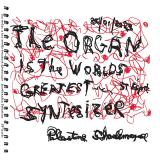
In the same vein, the aptly titled live record »The Organ is the World’s Greatest Synthesizer« – performed during the Sonic Acts Festival at Amsterdam’s Oude Kerk in 2025, and taking its title and cover art from a drawing realized by Palestine himself during the concert – adds to his opaque yet vibrant personal mythology and intimate transcendence, marking a return to the Staalplaat catalog after »Fffroggssichorddd« (2020) and »Music for Big Ears« (2001).
Beginning with a resonating bell and his falsetto overtone singing, then surrendering to the endless, wild soundscapes of tone-feeling and beat frequencies generated by the church’s organ, across 40+ minutes, single sound sources evolve into clusters, entangle fully with one another, and establish their own spatial existence and aural architectures. We witness the traces of something that can be described as a perpetual performance, a test for the ever-changing interaction between artist, instrument, space and, ultimately, us.
Since Palestine has always defined his execution as a form of anti-composition - of simply »being in the music« as if inhabiting a space - the true power of »The Organ is the World’s Greatest Synthesizer« lies in encapsulating a moment of Palestine’s practice in its most authentic, live dimension. Sound becomes at once subtle substance and strange telluric force, animating physical forms from some unknown channel beyond and within, accessible only through our sensorium. The point in this liminal temple of tone, timbre and frequency is not to learn anything but to simply enter. Palestine earns once again his self-given title of contemporary shaman by keeping this sonic portal open, allowing us to witness and make it last.
»I have always felt and heard and mixed the sounds in my world as liquids not as solids. Sonic liquids are material that is endlessly transformable. But I’m not crazy about people who go around defining stuff.«
- A1: Bienvenue Au Speakeasy
- A2: Draskapha
- A3: Mellow Mood
- B1: Minute Papillon
- B2: Quadro
- B3: Sans Faire
Already fifteen years that Cléa Vincent has been stepping on stage with that childlike fervor, that passion for pop and its elasticity, from her early days in Parisian bars to last year’s show at the Bataclan for the release of her third album Advitam Æternamour. You could say she needs no introduction, her name being inseparable from some of the most exciting work to emerge in contemporary French independent music. From the very beginning, she asserted her taste for spontaneous, candid, sunlit music, turning her songs not only into spaces of introspection but also into small capsules for dialogue. She collaborates constantly, with Kim Giani, Jeanne Balibar, Alison Wheeler, Jacques, NUSKY & VAATI, João Selva, Les Clopes…driven by a desire for sharing, for visions that meet and collide across genres. Alongside her work as a composer, she dedicates herself to giving a voice to the artists around her, notably through her show Sooo Pop, broadcast on YouTube in 2018 and 2019, where she welcomed guests as varied as Christophe, Moodoïd, Mathilde Fernandez, Katerine, and The Pirouettes. Like others of her generation, she claims the influence of francophone pop from the 1980s, but rather than being a successor to Jacno, Cléa draws from everything that shapes her era, fully plugged into the present, its faces, its energies, its collisions. She travels too, a way of reshuffling the cards of her inspiration, and her discovery of South America, of bossa nova and samba during her tour dates, became the catalyst for her series of EPs Tropi-Cléa.
- 1: Rust
- 2: Moving On
- 3: Say Something Mean
- 4: This Is The Place
- 5: Things
- 6: Medicine
- 7: California Rain
- 8: Passing Through
- 9: Leaving Song
- 10: Days Like This
Co-produced with Blaine Harrison of Mystery Jets, the album is a bold and moving leap forward, shaped by the wide-open spaces of Grace's adopted California and the intimate venues of his hometown of London. Moving to California at 21, Grace played his first shows in small coffee houses and clubs in Los Angeles and San Francisco. There he was introduced to the music of artists like Bon Iver and Ray Lamontagne who helped shape his early writing and the songs that would later appear on his 2022 debut album 'Alive In America' . Since returning home to London, his music has been championed by the likes of Clash, Under The Radar, Wonderland, Songwriting Magazine, Americana UK, Absolute Radio, BBC Introducing and Mahogany.
Limited to 250 copies !
The Deadheads had never had much luck with spaceships. Their first mission had ended in a catastrophic engine failure, leaving them adrift in deep space for weeks. This time, their craft was hardly more reassuring. A hodgepodge of outdated technology and shoddy repairs made it more of a floating death trap than a reliable cruiser. As they began their descent toward the strange planet, the hull creaked and rattled, sending a wave of dread through the crew.
"Hold on," Matt's voice crackled over the intercom, without much conviction, as if he himself doubted they would make it out alive. Outside, a thick, grayish atmosphere swirled ominously, while the planet's gravity became far stronger than anticipated.
“Fuck, we’re gonna burn at the entrance!” M yelled, his hands flailing on the console as sparks flew from the control panel. The ship’s sensors were completely jammed, and the navigation system flickered intermittently, like a dying light. Below, the planet’s surface was a tangle of lava rivers and jagged rock formations, the kind of place no sane person would ever land. But the Deadheads had never pretended to be. They lived in a state of constant emergency.
As the descent intensified, the alarms blared. On the bridge, the screens lit up with red warnings and flashing messages: "SYSTEM ERROR," "UNSTABLE TRAJECTORY," "SUIVITY SYSTEM COMPROMISED." The lines of code scrolled by too quickly to be read, while a mechanical voice repeated relentlessly: "Imminent impact. Structural integrity at twenty percent."
The once pristine shell of the vessel began to disintegrate, with shards of metal breaking away and disappearing into the atmosphere.
With a final, piercing screech, the ship crashed onto the planet's surface, sending up a cloud of dust and debris. The crew was violently thrown from their seats, stunned but barely alive. They struggled to their feet amidst the wreckage, the ship reduced to a charred shell around them.
"Well," M said, wiping the dirt off his suit with a grimace, "at least the air is breathable." Matt scanned the hostile expanse stretching before them and smiled slightly. "Perfect. Let's hope we have better luck with the planet than with our ships."
With that, the Deadheads gathered their equipment and headed into the unknown, while the remains of their ship slowly sank into the unstable soil of the planet.
- A1: Skyscraper
- A2: Subways Of Your Mind
- A3: Goldrush
- A4: Heart In Danger
- A5: Dirty Slapstick
- B1: I Got My Eyes On You
- B2: Talking Hands
- B3: Strange Feeling
- B4: Jenny
- B5: Subways Of Your Mind (Tmms Darius Version)
Yellow Vinyl[25,17 €]
The incredible story that began with The Most Mysterious Song on the Internet (TMMS) now enters an exciting new chapter: Skyscraper, the debut album by FEX.
Skyscraper features ten original tracks recorded in the early to mid-1980s-carefully re-transferred, remastered, and brought back to life. The album cover, designed by Darius S., brings the story full circle. Darius is the very person who preserved the now-iconic track Subways of Your Mind by recording it from NDR radio in the mid-80s. Without him, FEX may never have been discovered.
FEX's debut opens with its namesake, Skyscraper-a brooding, previously unreleased track the band once described as part of their "psychedelic phase." With haunting synth-helicopter textures and deep guitar riffs, it immediately sets the tone and raises tension.
The release flows naturally into the energetic and fully remastered studio version of Subways of Your Mind. This version of the TMMS - re-discovered on the "yellow label tape" by Reddit user Marijn-was long believed to be from a smaller home studio, but was actually recorded in November 1984 at Hawkeye Studios in Ganderkesee, near Hamburg.
Goldrush, first teased in raw form on FEX's YouTube channel, bends toward mechanical rhythm and shimmering synths, a snapshot of the band's experiments with programmed drum machine sound. Rückwardt's lyrics point to greed and criticizes materialism, and while the music leans toward pop sensibilities, it carries a raw, fractured edge.
Heart in Danger and I've Got My Eyes On You offer contrasting experiences-one rooted in classic post-punk tension, the other floating in melodic synth layers. The latter in particular feels like a fragment from a parallel radio history: a precise and one of a kind synth pop love song with a progressive touch.
From a rehearsal tape comes Dirty Slapstick, its urgency intact. Missing keyboard parts were later reconstructed by Michael Hädrich using his original DX7 synthesizer-recovering lost elements without rewriting the past. The lyrics take a wry look at forced optimism. Also included are the songs Talking Hands, Jenny and Strange Feeling, the latter being a slower blues-tinged cut, revealing yet another facet of the band's reach and Rückwardt's songwriting diversity.
The album closes where the legend began-with the original radio recording of Subways of Your Mind from Darius' cassette. This version of The Most Mysterious Song features alternate vocal effects, contributing to the track's enigmatic aura. Digitally transferred using a high-end Revox machine and carefully remastered, it now has its long-deserved official release.
The cover features a photo of the Eichenberg Bunker in Kiel-one of FEX's original rehearsal spaces and a symbolic monument to their sonic legacy.
With the 7th Grade of the Riddim Dub School series, Prince Istari enters Junior High School. Prince Istari returns with his Riddim Dub School series now on 12inch, pushing deeper into the intersection of dub, drum and bass, and sound system culture. This 6-track EP, titled "lessons into drum and bass wise", explores raw rhythms, analog feedbacks, and heavy low-end pressure.
The EP starts with a Drum and Bass cut with a One Drop of the DUB ME LOOPY tune from Riddim Dub School 5th Grade. INTIMACY COORDINATOR follows with a heavy Disco Dub. The last track on Side A is LABOUR’S DUB, with deep bass polished through spring reverb. The shakers come in late and push the whole thing forward. Side B begins with GONE TOO SOON from Riddim Dub School 4th Grade, in an alternative version. It’s followed by the most upfront track on the release CONQUERING DUB – brass fanfares and a deep disco rocker beat with minimalistic arrangement. NO DUB INNA DI WRONG ends the 7th Grade with a roots way style. It suggests
that dub music doesn't belong to or support negative, corrupt, or unjust actions or spaces. Dub music stays righteous, true, or positive, and doesn’t associate with bad vibes or wrongdoing.
- Somewhere, Nowhere
- Angles Mortz
- False Prophet
- Fluoride Stare
- The Void
- Ascension
- Just A Kid
- Host
- Landslide
- Renaissance
- 7: Am
- Blue In Grey
2026 Repress
Flickering in ultraviolet, there is an elusive place where blue pill meets red, ups become downs, and day merges with night. Those liminal spaces where anything is possible is where you’ll find Nightbus and their hypnotic debut album Passenger. Doom, uncertainty, and opportunity lurk in the shadowy corners of their murky existence with stops at disassociation, co-dependency, and addiction before reaching its final destination - a glimmer of hope.
The in-between of Nightbus’ own Gotham lies where Manchester’s city pulse meets Stockport’s outer realm. An audio-visual entity formed among a musical family of friends, freaks, and foes in messy mills and after hours on dancefloors alike, their sound bleeds from tension where collective creative forces are bound together and collide with the fallout of being torn apart. Before even playing a show, their So Young released single ‘Mirrors’ – a knowing nod of respect to some well-known gloomy Northerners - may have made old school indie heads shimmy at shows in Salford’s The White Hotel but also signalled the duo’s knack for offering listeners a Bandersnatch approach to hitchhiking their own personal Nightbus in whatever direction they choose to take. “Everyone can have their moment with our songs; the music is our response to who we are as young people, living in the city full of this energy right now,” they say.
Whilst reverb hefty melodies and dread-filled loops embody isolation from writing at each of their home studio set-ups, magic happens in the ether across 90s trip-hop, indie sleaze and electronica; Jake’s production layers Olive’s pop sentimentality with drums and samples whilst tales of a cast of faceless characters place Olive as puppet master; her severed self’s perspective manipulating their stringed limbs at arm’s length to see how their stories play out when scenes reflecting her own lie close to the bone. “It’s a bit fucked; like having this out of body experience with a made-up movie running through my head,” she says. “As I write I can see they’re all from a similar world, but they allow me to explore different feelings without giving away part of myself.”
Recorded at The Nave in Leeds with producer-engineer Alex Greaves (Heavy Lungs, Working Men’s Club), surprise and danger lies in every crevice. Brooding whispers turn to chants on 6-minute opus ‘Host.’ Improvised when performed live, its immersive shift in tempo leads to hefty dub courtesy of Jake’s pedals. Even then, you won’t know shit’s hit the fan until its mid-point reveal when ominous bass blasts a thunderous soundtrack as its protagonist defiantly walks away after committing the perfect crime. “It makes you wait, and more songs should have sirens,” Olive grins.
Leaning deeper into alter-egos via the video game-psychological horror of a Silent Hill dystopia, the band’s Fight Club moment ‘Angles Mortz’ turns its literal translation of death angles on its head as it reflects upon kink and internalised shame reincarnated as pride. Elsewhere the ice cool ‘Landslide’ is a Requiem for a Dream about the addiction of being in a band; ‘The Void’ explores co-dependency and estranged relationships; and carefully selected samples revive house track ‘Just A Kid’ from the band’s early incarnation. Passenger’s every direction is to face challenges head on. “That is what’s so great about horror; you can see through predictable patterns so when the unexpected occurs it's more realistic and uncomfortable… I want to own the dark stuff!”
As for Passenger’s first single, the pulsating ‘Ascension’ is a spiralling deep dive into death, suicide, and legacy around who or what we leave behind. A noughties club banger by way of NYC beats - ergonomically designed for those who like to stay out a little too often and too late - it throbs like a house party’s partition wall as the literal levelling up undergoes a neon transformation; blue glitching to pink, diffusing the white construct of the Nightbus Matrix. “It really does feel like the end of something and was purposely written that way,” they say, “the ascension is like a firework going off!”
With wheels in motion, Nightbus has become a movement surpassing sonic realms. Between shows from Porto to Brighton taking in The Great Escape, Rotterdam’s Left Of The Dial and Paris’ Supersonic; DJing; remixing; guesting (BDRMM’s Microtonic album); and even enlisting talented like-minds to craft a 3-part queer coming-of-age music video series which ties in with a new ‘hyperpop’ phase in the evolution of their popular Nightbus Soundsystem club night, heads are now being turned from sports brands to high-end fashion designers. “There are things we can’t reveal just yet,” tells Olive, “but we’re excited about the direction this beast we’ve created is heading.” As the album philosophises and asks one ultimate question; what does it truly mean to be ‘Passenger’? Nightbus may not claim to offer a definitive answer, but it might make you feel a bit better about those demons.
An’archives presents 'sensitive', a new album, and the first solo vinyl release, by Japanese keyboardist and synth player, Mitsuhisa Sakaguchi. A deftly assembled suite of glistening electronic tonalities, 'sensitive' is the latest in a lengthy run of excellent, idiosyncratic albums by Sakaguchi. A low-key yet productive artist, Sakaguchi has released banks of solo titles via his own Bandcamp page, and is also an in-demand improvisor for electronics: see, for example, recent collaborations with Yoshiki Ichihara ('TO(R)RI INFRANTA', 'Ftarri', 2025), Tatsuhisa Yamamoto ('non equal mad', self-released, 2020), and the - trio with Yamamoto and Uchihashi Kazuhisa ('self-titled', Modern Obscure, 2023).
'sensitive' is a startling album for many reasons, not least its rich attention to detail. Sakaguchi’s ear is sensitized to the complexity of electronic sonority, something he’s developed through decades of performance and improvisation, though he’s not limited to that language. “I mainly use multiple synthesizers and process the sounds with effects,” he clarifies, detailing his approach to his music. “I also use a lot of acoustic sounds such as field recordings and percussion; sometimes I also use sounds such as prepared piano.”
Indeed, you can hear this see-sawing balance between the electronic and acoustic written across 'sensitive' – see the activated cymbals that twist and stutter through the first half of “metatoxic”, which are soon replaced by a similar stream of burbling synth-flow. The opening “sensitive rot” folds field recordings into Sakaguchi’s electronic kit to such a degree that the differing forms dissolve into each other; on “green shrine”, the field recordings are more present, yet still poetically framed, taken as they are “from the mountains of my hometown, Yawata City, Kyoto,” Sakaguchi explains.
The tender balance achieved by Sakaguchi as he moves between practices, tonalities and temporalities helps manifest the guiding conceptual force behind 'sensitive', where Sakaguchi explores a cleansing reverie. “What I wanted to portray with this album was to create an album of sounds that shattered and reassembled my current ‘sense’ and ‘toxins’,” he nods, “along with the ‘nature’ around me. Electronic sounds, our bodies, the environment around us, and nature all blend.”
From there, Sakaguchi attempts a transformation, or transmutation – an alchemical process of exchange. “I am attempting to explore whether it might be possible for the sounds to come closer to each other,” he concludes, “or perhaps even to interchange places.” On the five pieces that comprise 'sensitive', you can hear this fusing and exchange. Inhabiting similar spaces as the music of Nuno Canavarro, Asmus Tietchens, Omit, and other like-minded visionaries, 'sensitive' traverses curious, quixotic terrain between electronic composition, electro-acoustics, and improvisation.
- A1: Les Arbres Grincent Pour Se Parler
- A2: Temple Bouddhiste Amidain, Ogimachi, Île De Sado
- A3: Les Démons S'absentent
- A4: Bulbul À Oreillons Bruns Et Autres Oiseaux De L'île De Sado
- B1: Kigi Ga Kotoba O Kawasu Tame Karada O Yusuri Kishima Seru
- B2: Fête Du Daimyō Gyoretsu, Hakone
- B3: Herbes Argentées
- B4: Criquets De Kurashiki
blickwinkel warmly welcomes Brussels-based composer Roxane Métayer to the label with her new album »Vies Sylvestres«, out on November 21 on vinyl and digital formats. The album was conceived and developed during performances and travels in Japan in 2023, where its sounds and ideas gradually came together.
»Vies Sylvestres« continues the direction of her previous release on Kraak, where Métayer built imagined narratives unfolding in forests or urban spaces inhabited by animal and plant characters. On this new album, however, the presence of these elements becomes more explicit and central. Field recordings are not solely used as backdrops but become compositions, complementing the instrumental works and expanding the album’s narrative into the realm of lived sound and place.
The listener encounters recordings of crickets and birds but we're also witnessing a scenery at a Buddhist temple. As such, combined with violin, electronics, and voice, Métayer explores the relationship between the natural environment and human culture. Her work bridges both worlds, showing how sound can connect different spaces and contexts.
Four original deep, trippy and trancy tracks from Dj Gus. Vinyl Only
Queer communities have long transformed parties into something powerful: spaces where care flourishes, injustice gets challenged, and new worlds are danced into being. But today, DJs command huge fees while behind-the-scenes workers earn below minimum wage. Corporations profit from our culture while communities that created these spaces are displaced. As venues shut and workers burn out, it’s clear that something has gone deeply wrong.
Club Commons: Moving Bodies to Grow Movements in Queer Nightlife & Beyond by Anjali Prashar-Savoie takes you inside hidden stories of resistance and reinvention. We meet the people reshaping nightlife from below: abolitionist security teams creating safety without police, sober raves doubling as mental health support, radical childcare at parties, venues becoming worker cooperatives, and free party crews reclaiming public space. Through their work, we see how party-throwing skills build movements, how refusing to play changes everything, and why protecting queer nightlife means transforming who owns it.
Quotes
“When Anjali shines her perceptive light on dancefloor culture, everything is better illuminated. I can’t wait to read this book. It’s one we need.” Emma Warren (author of Dance Your Way Home/Up the Youth Club)
“Anjali’s one of the most exciting and insightful voices writing about dance music today, bringing fresh perspectives, intellectual rigour and emotive power to a conversation that’s too often homogenous, superficial or cynically commercial. Club Commons promises to be an essential and overdue book: a chance to reexamine the queer history of club culture, celebrate and critique its present, and map out radical possibilities for its future.” Ed Gillett (author of Party Lines)
“Beautifully written and unique, Anjali Prashar-Savoie’s behind-the-scenes journey through queer nightlife is as thorough as it is fascinating. Documenting a world that commercial interests are rapidly destroying, Club Commons is proof that queer culture holds the key to a better future for the dancefloor and beyond.” Professor Sam Parsley (author of Minor Keys, coach, DJ and founder of In the Key, a directory and platform championing the careers of women, trans and non-binary electronic music producers)
“Club Commons: Moving Bodies to Grow Movements in Queer Nightlife & Beyond is a vital reminder of how important the dance floor is to connect, unfurl and envision new futures. The text highlights the historic and existing care work entangled with the club space, particularly in providing temporary sites of refuge and embodied joy for Black and LGBTQIA+ communities. This is juxtaposed with research on the corporate and carceral commodification of nightlife in recent years, which exposes the false premise that club spaces are always radical. This book affirms my belief that the non-commercial nightlife ecosystem is an essential part of our social change infrastructure, rather than a luxury. Club Commons is a call to action to reclaim this space on our own terms and revive the underground.” Camille Sapara Barton, (author of Tending Grief: An Embodied Guide to Being with Grief Individually and in Community)
- A1: Hypnosis - Astrodance (Computer Remix)
- A2: Wish Key - Easy Way (Instrumental)
- A3: Laserdance - Technoid (Space Version)
- A4: Panish Symphonic Orchestra - Computer Game
- B1: Koto - Dragon‘s Legend (Maxi Version)
- B2: Cyber People - Digital Signal Processor
- B3: Lexx - Flexxy Ball Theme (Instrumental Version)
- B4: Plash Band - Unheimliche Schattenlichter
Mit “ZYX Italo Disco Spacesynth Part 4” setzen wir die Vinyl – Compilation-Serie mit den größten Spacesynth Klassikern der 80er Jahre fort.
Alle Spacesynth- und Schallplatten Fans können sich auf die legendären und unvergessenen Hits von Koto, Laserdance, Hypnosis, Wish Key uva. freuen.
- Warriors
- Dead Star
- New Adventure
- Sky Orbit
- Technological Mind
- Tunnel Of Mind
- The Landing
- Technoid (Vocoder Version)
Das legendäre Album „Technological Mind“ von Laserdance aus dem Jahr 1992 ist endlich wieder erhältlich – jetzt als farbige Vinyl-Neuauflage!
Die Spacesynth-Pioniere liefern auf diesem Album ihren typischen, futuristischen Sound: treibende Synthesizer, galaktische Melodien und pulsierende Beats, die den Geist der frühen 90er perfekt einfangen. Mit Tracks voller Energie und kosmischer Atmosphäre ist Technological Mind ein absolutes Highlight für alle Fans von Spacesynth, Italo Disco und RetroElectronic Sounds.
Ein zeitloses Meisterwerk elektronischer Musik – Laserdance – Technological Mind, jetzt endlich wieder auf Vinyl!
Laserdance‘s legendary 1992 album „Technological Mind“ is finally available again – now as a coloured vinyl reissue!
On this album, the space synth pioneers deliver their signature futuristic sound: driving synthesizers, galactic melodies and pulsating beats that perfectly capture the spirit of the early 90s. With tracks full of energy and cosmic atmosphere, Technological Mind is an absolute highlight for all fans of space synth, Italo disco and retro electronic sounds.
A timeless masterpiece of electronic music – Laserdance – Technological Mind, now finally back on vinyl!
Nine years forward Sublee returns to Metereze with an album that echoes a
life lived in sound.
Crafted like a sonic memoir, “Youmanity” traces the emotional arc from the
energy of packed dancefloors to the introspective solitude on the road and the run
back home.
His signature hypnotic strips of the genres, acid flashbacks and immersive ambient
landscapes are stitched together with raw field recordings from airports, sleepless
backstage corridors and the stillness of nature as the world drifts by.
Intimate yet expansive, Youmanity is a journey through the rhythm and
connection of nightlife and the quiet reflective spaces in between.
Ten years after her first release, electronic musician Mor Elian presents her debut album Solid Space. Showing her full artistic range, the LP drifts between dream-like listening states and experimental club spaces. Written in a transitional time, these compositions arrived in emotional, unfiltered bursts. Solid Space brings together ambient textures, early IDM structures, and experimental electronics, with distant, hazy vocals converging into a single, subconscious flow. It is released by adventurous electronic music label topo2 on November 28, 2025. The record is pressed on 180 grams of ICCS-certified bio-vinyl, housed in a heavy full-colour sleeve, and comes with a download-code to the full release. Mastering is done by Ike Zwanikken, mixing by Gramrcy, artwork courtesy of Kees de Klein, and poetry written by Eelco Couvreur. Additional production and mixing on track 7 by Carrier.
—
in the half-sleep: a voice
not anyone’s, just sound.
what it touches, it mirrors
learning to name itself.
a throat opens —
to hum through bone
to say nothing correctly.
we coexist as opposites
in our mother tongue, dreaming
the things we were never meant to touch.
there is a channel
between pulse and sentence —
a being moving through
the being that once answered to me.
to feel and not own the feeling,
each of us made visible
by the other.
Shogun Audio is extremely proud to present GLXY's second album, 'Form, Focus'. Unequivocally the most refined body of work to date from the ever-evolving drum & bass duo, this LP showcases GLXY at their irresistible best.
A decade on from the release of their debut single 'Small Talk/Trinity', GLXY have cemented themselves as one of liquid drum and bass’ most respected and prolific acts. With twelve EPs, a debut album in 2020, and collaborations with the likes of Alix Perez, Halogenix, Lenzman, Unglued, and Catching Cairo under their belt, 'Form, Focus' represents the next definitive milestone in an already heavyweight catalogue.
From beginning to end, the record distils everything that makes GLXY so special. Abundant with luscious sound design, soulful vocal features, and an unmistakable sense of groove and musicality. Featuring Charli Brix, DRS, Duskee, Eljé, Jords, Salo, and Verbz, the tracks flow seamlessly between deep, introspective liquid cuts and vibrant, club-ready rollers, painting a full picture of their artistry while pushing their sound into fresh, exciting spaces.
More than just a continuation, 'Form, Focus' feels like a statement: a decade of honing their craft distilled into a singular vision. It’s an album that reaffirms GLXY’s position at the cutting edge of the genre, while at the same time carving out their own unmistakable lane within it.
Final LP of a productive year for Feral Child is an absolute cracker. The latest of a long line of superb full lengths from Stephen James Buckley's incendiary Polypores project. This one is arguably his most adventurous outing to date, the undeniably psychedelic “Hungry Vortex”. Four extended pieces exploring polyrhythmic fixations and cosmic jazz-prog freak-outs. Percussion-heavy opener ‘The Body Is The Spaceship’ is a fine example of the sort of seamless organic growth we tend to see in Polypores’ music, with slewed synth blips and rolling polyrhythms gradually twisting into unrecognisable strands of melody and unconventional groove before your very ears.
The prog-heavy ‘Wizards!’ sees Buckley’s trademarked playful use of time-signature changes, providing such a wealth of emotional and stylistic variance and immeasurable enjoyment without changing key once (honestly, who needs keys). It’s brilliantly evocative too and could indeed perfectly soundtrack a mushroom-trip wizard march. As we flip the record over, the flutey flourishes and minimalist clicks of the title track draw the listener into a trancelike state, repeated movements spiralling like myriad creatures crawling over a candy-coloured horizon, echoing forth into an inviting sonic oblivion. It’s ostensibly electronic, yet somehow more natural organism than machine, with little concern for the grid, or indeed, the rules. Finally, we end on something a little more subdued - the reassuring classicism of the beautiful ‘Void High’, with washes of warm noise and wobbly delay lines whirring and twinkling away, closing the record with an experience that is undeniably emotional, spiritual and as always, uniquely Polypores. This is a wonderful record with which to close the year out, it comes in a magnificent, spot varnished Jake Blanchard sleeve. A superb record released as a one time only vinyl pressing.
Two years after releasing the Frontier's Edge EP, the Budos Band are returning with their first full-length since 2020's Long in the Tooth. Titled simply VII, the new album sees them doing what they do best: laying down hypnotic, horn-spiked grooves that menace and mesmerize in equal measure. Produced by Budos guitarist Tom Brenneck with Simon Guzmán engineering, VII features 11 tightly constructed new tracks that draw on the group's wide range of influences, sounding like only the Budos can. It's music for getting down, for nighttime drives, and for alternate headspaces _ a beguiling mix of mystery and rhythm that stands with the formidable work they've released in their two decades of recording. VII was recorded in California and serves as the Budos Band's first full-length album on Diamond West, the independent label founded in 2023 by Tankel and Brenneck. It's also the group's first album to include instrumental contributions from percussionist Rich Tarrana, who previously played in the Frightnrs. All told, it succeeds in opening up some new sonic spaces while staying tethered to the intuitive, unique musicality that made them such a sensation from the jump.
The inimitable Richard Youngs returns to Black Truffle with this third full-length for the label, Hidden. Like CXXI and Modern Sorrow, Hidden unfolds across two side-long pieces at once eminently listenable and possessed of the ‘bloody-minded’ dedication to ‘having an idea and sticking with it’ that Youngs himself has identified as one of the key qualities of his work.
At the core of both pieces are rapid, randomised arpeggios generated with a Moog Grandmother, hypnotic patterns that wouldn’t be out of place on a Berlin School classic. Alongside these arpeggios, across the seventeen minutes of the first side-long piece Youngs builds an airy structure of shakers, synthetic handclaps and a brief, repeated sample, impossible to identify but sounding like a glitched foghorn. Over the top we hear his unmistakable voice, repeating single syllables—Ha, Ho—with a slow delay, something like a lonely one-man-band take on Anthony Moore’s Pieces from the Cloudland Ballroom or a more musical elaboration of the hypnotically overlapping delayed phonemes of Anton Bruhin’s Rotomotor. Like much of Youngs' work, the arrangement of sounds is sparse, each layer punctuated by spaces that allow others to shine through, in a way that seems to have more to do with dub or early hip-hop than high-brow models of musical reductionism.
On the flipside, the arpeggios return, now accompanied by ringing, filtered guitar chords and long flute tones. The use of a similar ground layer across the two pieces with strikingly different overdubs calls up Youngs' first solo record, the classic Advent, reminding us of how consistent ‘theme and variations’ is as an approach in his enormous body of work. Joined by handclaps and a chiming sound, the piece almost feels like it is about to achieve dance-floor lift-off at times, only for the percussion to disappear and leave the listener once again floating among the guitar and flute, now joined by occasional cut-off vocal snippets, like a radio turned quickly on and off. The suspension of these disparate elements over the steady foundation of the Moog arpeggios might remind some listeners of the free-form studio explorations of Moebius & Plank and Holger Czukay or even give a nod to Youngs’ formative encounter with Cabaret Voltaire.
Like some of Youngs’ much-loved work with Simon Wickham-Smith, Hidden approaches relatively familiar sounds and instruments from skewed angles, delighting in loose structures of interaction that border on gleeful incoherence while remaining outwardly beautiful. Coming up to almost four decades of persistent activity, like little else in contemporary music Youngs’ work beams with the simple joys of exploration and experiment.