East London record shop World of Echo debuts on the other side of the counter with a reissue of Two Wishes, the solitary 12" by Anglo-German collective, Mutabor!. Seemingly lost to time, Mutabor! were first brought to World of Echo's attention when drummer/singer, Gary Asquith, played at the shop's first birthday celebrations while promoting one of his other bands, Rema Rema. And so the story goes...
Mutabor! emerged wraith-like from the monochromatic grit of Berlin's art punk underground late in 1981 when Asquith left London to set up temporary residence in the city following a chance meeting with Malaria's Bettina Koster backstage at a Birthday Party gig at the Lyceum earlier that year. Beguiled by the possibilities of collaboration, musical and otherwise, he was soon to make his own contributions to what was an already fecund scene. Partnering with Koster, and Gudrun Gut and Manon Duursma also of Malaria!, Mutabor! were publicly birthed via an impromptu performance at punk rock polestar the Risiko. Asquith found himself playing percussion in what would be a first, while the rest of the band ossified in front of him in typically idealistic post-punk democracy. Little documentation of the performance survives beyond that which exists in the memories of those playing - that itself shaky enough - though there was clearly sufficient encouragement for them to commit to a recording session.
Later that winter, the four booked time at Music Lab, the studio operated by Harris Johns, for what would ultimately be their only studio visit. Two songs were laid to tape, and soon after a photoshoot was to take place at Koster's flat, resulting in a handful of images that, along with the music, comprise the sum total evidence of the band's existence. 1001 Nights and Treats both found their way to Peter Kent, a co-founder of 4AD who had recently left the label with the ambition of starting his own imprint. Entitled Two Wishes, the two track 12" was to be the first and only release on Loaded. It seems that Mutabor! were to represent a series of firsts and lasts, a trend that continues now as they open the World of Echo imprint.
It's fitting to think of Mutabor! in these prescient terms given how they sounded. Berlin at that time shared a spiritual axis with New York, the conceptual & aesthetic discordance of no wave and a nascent off-beat dance culture underpinning much of the respective creative activity. There are shared signifiers, but even in that context, Two Wishes sounds oddly out of step, moving to its own unusual rhythm. 1001 Nights stutters along on a tribal beat that seems to run independent of skronking sax, spidery guitar lines and deadpan vocal incantations, the ghosts of two songs meeting in some kind of incompatible voodoo union. On the reverse, Treats slows down and dims the lights further, as Asquith sardonically recites desirous threats as an increasingly malevolent sax and guitar grinds behind him. No surprise the darkness within the music given the parent bands and the backdrop of a crepuscular early 80s Berlin, though there remains a complex compositional element to these songs that suggests a broader spectrum of emotion - desire, romance, and ultimately, infinite possibility.
Recut and mastered, Two Wishes is now presented with the original front cover artwork alongside additional imagery, including a 16 page booklet, all culled from Asquith's own archive. A brief bolt of energy at a crucial juncture in music history, Mutabor!'s story is emblematic of the mutli-verse of post-punk and the creativity its ideology necessitated.
Buscar:spider man 3
Recumbent Speech, Ezra Feinberg’s second album, opens with a lament. Named for the Robert Frost poem, “Acquainted with the Night” was written during one of the many devastating spectacles of injustice under our current regime. Repeating flutes and synths beam out of a low-end darkness, reflecting a collective sense of loss and alienation. Rising slowly, thickening with guitars and strings, “Acquainted with the Night” lifts off, and so too does the album from there. The second track, “Letter to my Mind,'' features the dynamic interplay of Feinberg's guitar with the loose and playful drumming of Tortoise's John McEntire, both pushing and pulling atop a looping bass figure. "Palms Up" begins with a lockstep pulse recalling early Terry Riley before jumping into an Ashra-like jam with Afrobeat accents. Side B opens with "Ovation," a tryptic with McEntire on drums which sets a wide lens onto a sweeping landscape, with soaring flutes, wordless vocals, and a hypnotic bassline played on a humming fretless that recalls classic ECM jazz-fusion. The piece plunges into an ambient, interior space before reemerging with a guitar solo fried through an old Space Echo effects processor, conjuring lidded Pompeii-era Pink Floyd. The album's title-track finale, "Recumbent Speech," features the magical pedal steel of Chuck Johnson. Unwinding atop a Balearic analog synth pattern, Feinberg stretches textures of Fender Rhodes and acoustic guitar around Johnson’s lyrical steel, with nods to Japanese ambient legend Hiroshi Yoshimura, as well as Cluster & Eno. Recumbent Speech refers to the possibilities, pleasures, fears, and fantasies that occur the moment the noise dies down, when we are recumbent, in repose but still awake, still speaking, and still aware of ourselves as part of the maddening world. Ezra Feinberg is a guitarist, composer, and psychoanalyst living in Jackson Heights, NY. Feinberg was the founding member of the San Francisco psychedelic rock collective Citay, releasing albums on Important Records and Dead Oceans throughout the 2000s. After relocating to NYC, he issued his first solo record, Pentimento and Others, on his imprint Related States and on cassette on Stimulus Progression in 2018. The release, his first since Citay folded in 2012, earned praise from numerous music outlets including Paste Magazine, The Wire, Stereogum, Vice, and Aquarium Drunkard. In recent years, Feinberg has performed and toured near and far with Jefre Cantu-Ledesma, Steve Gunn, Alexander Turnquist, Cruel Diagonals, Daniel Carter, Jonas Reinhardt, Christopher Tignor, Kath Bloom, Robbie Lee, High Aura’d, Glasser, Ava Mendoza, Buck Curran, Real Estate, and many others, and has ongoing studio collaborations with Jefre Cantu-Ledesma and Arp, contributing both guitar and songwriting to the last Arp album Zebra.
- A1: Reeves Gabrels - You've Been Around
- A2: Ian Hunter & Mick Ronson - All The Young Dudes
- A3: Dana Gillespie & By Mick Ronson & David Bowie - Andy Warhol
- A4: Mick Ronson - Growing Up & I'm Fine
- A5: Iggy Pop & David Bowie - Funtime
- B1: The Spiders From Mars - Ziggy Stardust
- B2: Mick Ronson - Pleasure Man/Hey Ma Get Papa
- B3: Ava Cherry & The Astronettes - I Am Divine
- B4: Angie Bowie - I Just Want To Have Something To Do
- B5: Ian Hunter & Mick Ronson - All The Way From Memphis
- C1: Reeves Gabrels - The King Of Stamford Hill
- C2: The Spiders From Mars - Moonage Daydream
- C3: Carmen - Lonely House
- C4: Iggy Pop & David Bowie - Sister Midnight
- C5: Ava Cherry & The Astronettes - I Am A Laser
- D1: The Yardbirds - I'm A Man
- D2: The Velvet Underground - Waiting For The Man
- D3: The Mccoys - Sorrow
- D4: Chuck Berry - Around & Around
- D5: Jacques Brel - La Mort (My Death) (My Death)
- A1: Diego Carpitella & Alan Lomax - E Ballamu Tutti Ddhoi Ti Paru
- A2: Diego Carpitella & Ernesto De Martino - Pizzica Tarantata N 014
- A3: Diego Carpitella & Ernesto De Martino - Pizzica Tarantata N 015
- A4: Diego Carpitella & Ernesto De Martino - Pizzica Tarantata N 026
- A5: Diego Carpitella & Ernesto De Martino - Pizzica Tarantata N 030
- A6: Diego Carpitella - Santu Paolu Meu De Galatina
- B1: Bjorn Torske & Trym Søvdsnes - Pizzica Tarantata N 026 (Rework)
- B2: Uffe - Pizzica Tarantata N 015 (Rework)
- C1: Lns - Pizzica Tarantata N 014 (Rework)
- C2: Bottin - Santu Paolu Meu De Galatina (Rework)
- D1: Don't Dj - Pizzica Tarantata N 014 (Rework)
- D2: Kmru - Pizzica Tarantata N 030 (Rework)
After their first issue focus on Benga, a Kenyan musical movement, FLEE is proud to present its new project: «Tarantismo: Odyssey of an Italian Ritual», available on 2LP Gatefold and as a bundle with 2LP Gatefold and a 168 pages Book.
Please note that the book only is not available
Dedicated to Tarentism, this project tells the story of a centuries-old choreo-musical ritual from Southern Italy, mobilizing frenetic rhythms and maniac dances, to exorcise women of a mysterious evil caused by the bite of a spider. Trans-disciplinary, this effort of documentation and artistic re-interpretation of one Europe’s most mysterious trance phenomenon is comprised of a double LP vinyl compilation including original recordings from Italian Maestro's Carpitella, Lomax and De Martino with reinterpretations from Don't DJ, Bottin, LNS, Bjorn Torske & Trym Søvdsnes, KMRU, Uffe and a hardcover Italian/English book.
- A1: Phoner To Arizona
- A2: Revolving Doors
- A3: Hillbilly Man
- A4: Detroit
- A5: Shy-Town
- A6: Little Plastic Bags
- A7: The Joplin Spider
- B1: The Parish Of Space Dust
- B2: The Snake In Dallas
- B3: Amarillo
- B4: The Speak It Mountains
- B5: Aspen Forest
- B6: Bobby In Phoenix
- B7: California & The Slipping Of The Sun
- B8: Seattle Yodel
The Fall is the fourth studio album by British virtual band Gorillaz. The album was officially announced on 20 December 2010 as a holiday gift to fans. The Fall was first released on 25 December 2010 to stream for free on the Gorillaz website, only available as a download for paying members of the band's Sub-Division club, a premium access campaign the band ran throughout 2010. The album features fewer guest artists than previous Gorillaz albums; collaborators include Mick Jones and Paul Simonon of The Clash and Bobby Womack.
Spiderland by Slint is post-rock ground zero. It was the band's second and final album, but it's THE ONE when it comes to defining a sub-genre. The band featured Brian McMahan who went on to play with Will Oldham and then form The For Carnation, and David Pajo who has done many good things since such as Ariel M, Papa M as well as being in Tortoise for a bit. He was also a member of Billy Corgan's Zwan.
Here's one for all the hardcore Disco and Soul lovers out there, one of the finest and rarest manifestations of the legendary writing, arranging and production team of Randy Muller and Jeff Lane (Skyy, BT Express, Brass Construction, Aquarian Dream, Spiders Webb and many more!). First appearing as a 'Columbia Records Disco Series' promo 12" in 1976 this is a wondrous example of that mid to late 70's uptempo Soul sound morphing into Disco, and boy are we glad it did! Drenched in pure Philly vibes 'I'm Ready To Give Up My Life' is a real beauty, clocking in at over 9 mins of pure dance-floor joy with soaring strings and a driving rhythm. Pure class all the way and one for the aficionados for sure. Beautiful Soul music that will certainly deliver the goods in the club indeed. As per the original 1976 promo release this 12" features the same program on both sides.
This underground Disco classic has been legally reissued by Above Board distribution in conjunction with the legal rights holders - Sony Music Entertainment. This high quality repress features original Columbia white label Disco 12" artwork and has been remastered from Sony's original sources by Optimum Mastering, Bristol UK.
Washington DC's Rush Plus drop four superb techno cuts entitled 'The Sweat EP' on P.Leone and Caiazzo's E-Missions imprint.
Having dropped three quality releases on their own eponymous label, Rush Plus continue to turn heads with their imaginative productions, gaining support from the upper echelons of techno with names like Rodhad, Ben Klock, DJ Spider, Ben Sims, Slam, Answer Code Request, DJ Deep and many more getting behind them. Following up a release on Ambivalent's Valence Records, they now join P.Leone and Caiazzo's rapidly rising E-Missions imprint.
'Megabust' initiates the package with twisted sci-fi synths and syncopated drums whilst rattling metallic elements operate throughout. Intricate hits of percussion are soon followed by rumbling bass in 'Rebirth' as the track gradually becomes more and more twisted using filtered effects and soaring pads, making way for the shuffling 'Sweat' with its menacing stabs and echoing voices. Finally, the package concludes with 'Slow Release' - a high-octane and ominous roller.
- A1: The Hell Raisers - Syd Dale
- A2: The Eyelash - Johnny Hawksworth
- A3: Walk In A Nightmare - Syd Dale
- A4: Beat Street - Johnny Hawksworth
- A5: Walk And Talk - Syd Dale
- A6: Big Bass Guitar - Bill Martin / Phil Coulter
- A7: Mr. Chestertons Dog - Bill Martin / Phil Coulter
- A8: Mods & Rockers - Bill Martin / Phil Coulter
- A9: L.s.d. - Bill Martin / Phil Coulter
- B1: Stand By - David Lindup
- B2: Take A Goosie Gander - Syd Dale
- B3: Juggernaut - David Lindup
- B4: Grand Prix - Johnny Pearson
- B5: Veiled Threat - David Lindup
- B6: Sixth Sense - David Lindup
- B7: Funky Flight - Keith Mansfield
- B8: Raver - Alan Hawkshaw
- B9: The Washington Affair - Syd Dale
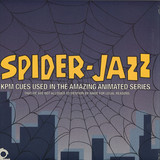
Way back in 1967, an animated superhero cartoon was released into the world. It was created by Grantray-Lawrence Animation and was based on a web-spinning, crime fighting blue and red dressed character that had originated in1962, in Marvel Comics by Stan Lee and Steve Ditko. This amazing series (that we're not allowed to mention the name of for legal reasons) ran on ABC TV in the USA, then Canada, then a few years later started to spread its web further, running here in the UK throughout summer holidays, after school and possibly early mornings at weekends in the late 1970s. The series then got released on VHS video (and probably Betamax too) in the mid 1980s and still continues to spin its animated magic around the world through further broadcasts, YouTube and DVDs.
The series was notoriously low budget, with animated errors everywhere and numerous scenes, sequences and backgrounds being re-used all the time, often across the same episode. Even a certain spider logo on a costume would appear with six legs, then eight legs later on, then back to six again in the same show.
Series One opened with a newly written spider theme, a classic, hooky song all about doing whatever spiders can, and had, as Big George (RIP) once pointed out to me, a set of session singers falling slightly out of time with the backing track after the first verse. Series One also featured background music by jobbing composers Bob Harris and Ray Ellis but these cues and master tapes are now believed to be lost.
After Series One the company Grantray-Lawrence went bankrupt, so the amazing spider series (that we're not allowed to mention for legal reasons) was taken on by producer Steve Krantz. He brought in new talent, including animation director Ralph Bakshi who later went on to turn a Robert Crumb strip cartoon into the feature Fritz The Cat. Krantz also slashed the already cripplingly small spider budget, and brought in the idea of using economic library music. Here, thanks possibly to an independent sync agent (it has been suggested that a company called Music Sound Track Services may have been the one) production turned to the KPM catalogue. This was one of the few really established library catalogues around at the time with a modern edge, it was full of fabulous, modern dramatic music tracks - often all on the same LP. But more importantly all the tracks were far longer than the one minute musical cuts that many of the fledgling USA library companies were issuing at the time. Not only would this KPM music be efficient, affordable and very easy to use, it would also mean syndication worldwide would not be held up by any future musical issues. Krantz produced two amazing spider series (that we're not allowed to mention for legal reasons), and both were smothered with KPM music. In fact barely a spider second goes by without music playing in either the background or foreground.
For many years I - and many nostalgic others - have been thinking about putting this vinyl album together. For many enthusiasts this really is formative music - a junior foray into hip swinging crime jazz and esoteric musical grooviness. I've also read on line accounts by DJs from WFMU on the trail of original spider master tapes, and there's even a whole forum dedicated to Spidey-Jazz'. Then recently I was looking at an old spider tracklist and realized that several of my favourite KPM cues were there including Syd Dale's Hell Raisers' and Walk And Talk', both from one of the most elusive and desirable KPM albums of all time (yes, you just try and find yourself a copy of KPM 1002 right now), so I decided to push on and get the album made.
So, what features on this Spider-Jazz Lp Well it's music from the amazing TV series we are not allowed to mention for legal reasons, BUT, not music from Series One. No, but it is all from Series Two and Series Three. From looking at archival cue sheets, over 50 tracks from various early KPM 1000 series albums were used across episodes. I've distilled this down into one exciting and enthralling LP, and if this works a further Spider Jazz album may well swing in to production. If you're interested (and I'm sure you may well be) cues here came from KPM1001, KPM1002, KPM1015, KPM1017, KPM1018 and KPM1043 and were composed by master library composers of the era - Dale, Hawkshaw, Hawksworth, Mansfield etc.
And if you are listening over there in the USA, you may well recognize many of the cues here not just from the amazing TV series (that we're not allowed to mention for legal reasons) but also from classic 1960s and 1970s NFL highlight shows that we are allowed to mention.
Air Lows is the debut solo album by Silvia Kastel. The Italian artist has been a fixture of the underground since her precocious teens, clocking up many miles in Control Unit with Ninni Morgia ('It's like Catherine Deneuve dumped two cases of post-Repulsion psychiatric notes over Pere Ubu's Dub Housing, lit the fuse and, ahem, stood well back" - Julian Cope), including collaborations with the likes of Smegma, Factrix, Gary Smith, Aki Onda and Gate (Michael Morley of The Dead C). Both solo and in her work with others, Kastel has explored the outer limits and inner workings of no wave, industrial, dub, extreme electronics, free rock and improvisation. Air Lows is both her fullest and most refined offering to date, a work of vivid, isolationist electronics which draws deeply on her past experience but assuredly breaks new ground. Prompted by a late-flowering interest in techno and club music, Kastel sought to create something which combines a steady rhythmic pulse with the otherworldly sonorities of musique concrete, and avant-garde synth sounds inspired by Japanese minimalism and techno-pop (Haruomi Hosono's Philharmony being a particular favourite). The formal artifice of muzak / elevator music, the intros and outros of generic popular songs, the extreme light-heavy contrasts of jungle, the creative sampling of hardcore, and the very 'human' synths in the jazz of Herbie Hancock's Sextant and Sun Ra: all were touchstones for Air Lows' conception and composition, and all strains of music addressing - or complicating - the relationship between the human and the technological. By extension, visual inspirations also proved important: anime, and the avant-garde fashion of Rei Kawakubo. What does that shirt or dress sound like Though used sparingly, Kastel's voice remains her key instrument, whether subject to dissociative digital manipulations as on 'Bruell', delivering matter-of-fact spoken monologues, or providing splashes of pure tonal colour. Recorded between her expansive Italy studio and a more compact, ersatz set-up in Berlin, Air Lows gradually takes on some of the character of the German capital: you can hear the wide streets and uninhabited spaces, the seepage of never-ending nightlife, the loneliness. Air Lows is The Wizard of Oz in reverse: the glorious technicolour J-pop deconstructions of its first half leading inexorably to the icy noir of 'Spiderwebs' and 'Concrete Void'. These later tracks are reminiscent of 2015's magnificent 39 12', Kastel in the role of numbed, nihilistic chanteuse stalking dank, murky tunnels of reverb and sub-bass. But in fact there is contradiction and emotional ambiguity to Air Lows from the outset, and throughout - a sense of both infinite space and acute claustrophobia; energy and inertia; fluency and restraint.
The sub label of Sonic Groove, 'Sonic Groove Experiments', returns after a 4 year hiatus with a stellar re-release of the Electrowave classic 'Eruption' by Beta Evers. Originally released as a Limited Edition 12' back in 2005 on Beta's own Kommando 6 label. Now in 2017 the original pressing goes for quite a fortune on the record collecting market. Often exceeding €60 for a mint copy. For the first time in a dozen years this release is available on vinyl in its original running order but with very sleak new artwork for the normal asking price of a new store bought 12'.
Beta Evers is Brigitte Enzler from Augsburg, Germany. An artist with a substantial amount of accomplished work to her credit including an early release on the storied Hague label, Cre`me and her side project Black Spider Clan. After ceasing Kommando 6 operations, Beta Evers continues on independently releasing music on her other labels Bodyvolt and Venus Noir. Her most recent release is the 2016 awesome 'Delusion' album on legendary Industrial/EBM pioneer Dirk Ivens prestigious Daft imprint.
The opening track's title serves as a warning, titled 'Don't Be Afraid', a cold introduction led by sinister synth lines soliciting our attention to expertly crafted true analog electronic percussion in the EBM/Dark Electro disciplines. Surreal, deep and seductive vocals lie in the wake at the center of the composition giving us a melancholic piece worthy of deep contemplation during listening on or off the dance floor.
The following track 'Move In My Body Rhythm' continues in the same sinister and dark aesthetic in a more driving manner, this track continues to bring forth energy with a precise beat and rhythm accompanied by acidic synth modulations.
Side B continues to hold the heavy weight of this extended player with the track 'Eruptive' This reference track to the title of the EP. is an electronic/vocal robotic analog circuit breaker suitable for dawn light on the floor. Traditional arsenal of classic analog sounds are arranged and rearranged with sonic manipulation at the test. Mutant dance music for cosmic venues.
The closing track, 'Destination Lost' is comprised of lyrics of urban angst and disturbance whispered out through sultry vocals. Dark minimalist and cinematic cyberpunk breaks reinforced by low drone synth waves and crystals of lysergic analog bleeps drifting along the perimeter. Dead serious wave infected electronics.
This sonic document also serves as a good example of a roots approach to creating music whilst at the same time giving us something entirely innovative. This is as futuristic as it is timeless and that reflects the elements of a masterpiece.
I feel unstoppable, I feel unstoppable, I feel unstoppable, singen Superfood auf ihrem zweiten Album.
Und diesen Anflug von Unaufhaltsamkeit kann man tatsächlich spüren. Schließlich kann man seine
gesamte musikalische DNA nicht einfach neuschreiben und den fanatischen Indie-Bombast des
Debüts für eine neue Morgendämmerung hinter sich lassen - so wie es das Duo auf Bambino tut -
ohne dass einem eine übermenschliche Dosis Selbstvertrauen durch die Venen schießt.
This next release on Konstruktiv is the super special vinyl version of the 'Vremya Versions' EP and it contains two Rolando and two Unbalance remixes.
This record was played and supported by: Laurent Garnier, Truncate, Dj Deep, Ben Sims, Jonas Kopp, Matrixxman, Marcel Dettmann, Slam, DJ Rolando, DVS1, Ed Davenport, Mr G, Boddika, Setaoc Mass, Oliver Deutschmann, Lo Shea, DJ Spider, Baikal, Brendon Moeller, Groove, DJ Mag, Thump, XLR8R, Wicked Style, Ibiza Voice and many others.
Dan Deacon, der vollbärtige Wunderwuzzi des Popgeschäfts, meldet sich mit seinem neuen Album "Gliss Riffer" zurück. Das selbstsproduzierte Werk ist ein 'back to the roots' für Dan Deacon. Nach seinen letzten Ensemble-lastigen Alben "Bromst" (2009) und "America" (2012) findet er wieder zu einem einfacheren Schreib- und Aufnahmeprozess zurück. Und obwohl "Gliss Riffer" größtenteils elektronisch produziert ist, ähnelt die Klangpalette doch auch wieder den letzten beiden Alben. "Gliss Riffer" umfasst alle gewohnten instrumentellen Spielereien und hyperventilierenden Nuancen, die wir von Deacon erwarten, aber er legt ein größeres Selbstvertrauen an den Tag, was den Gesang betrifft, wie man auf "Feel The Lightening" hört. Und ja, auch die "weibliche" Stimme ist Dan Deacon. Wie schon sein 2007er Werk "Spiderman Of The Rings" ist "Gliss Riffer" ein musikalisches Erlebnis, das vor Ekstase und Energie wahrhaftig sprührt. Der klangliche Übermut wird nur von den Lyrics gedämpft, die den quälenden Ängsten der menschlichen Existenz trotzig die Stirn bieten.
New York City, USA, 2014. A community filled with amazing shit and amazingly fucked up shit. This Yin Yang is an ever-present part of life, and it is this contradiction that Isaac Basker seeks to take on with Swishin' & Dishin,' his sophomore release on Play It Say What Records.
On A1, 'Swishin' & Dishin',' Isaac references NYC basketball legend, Walt 'Clyde' Frazier to define the city's Yin. Starting off like a certified banger; a simple 'bleep' blasts the track over a thumping kick and rhythmic percussion, as if attacked by a penetrating crossover dribble. Yet Isaac then drops his trademark melodic chords to turn the track into an authentic deep house groove.
With A2 Plan B Recordings boss DJ Spider provides his latest remix for Isaac, helming 'Swishin' & Dishin' (DJ Spider Mix).' The original is then obliterated into his classic raw, deep sound. Hard kicks, obscure female vocals, hats and snares form the basis of the track as we then get slowed chords to tease us until deeper sounds and syncopated percussion elevate the listeners mood before bringing the track back to the remix's original rawness.
B1, 'Slumlord Billionaires (5Pointz Of Light Mix),' Swishin' & Dishin's most dance floor friendly track, takes on the Yang of the city, using the to be demolished graffiti mecca 5Pointz as a point of reference. Yet, this is an uplifting build up banger of a track emphasizing human resilience in the face of doom. Booming drums start the song off until a single fluttering melodic chord drops. Then syncopated claps, and vocal hits arrive challenging 'the powers that be' to further enhance the song's call for dance floor resistance.
Then there is 'American't.' With B2 Isaac, takes dark analog keys and syncopated techno sensibilities over a simple eerie baseline to further emphasize the Yang. A manipulated vocal later emphasizes this further and another layer of angry, reflective keys drive the operatic finale of this definite New York release.