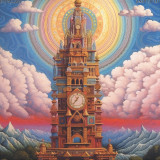
WE ARE WINTER'S BLUE AND RADIANT CHILDREN (WAWBARC) is the new quartet of Mat Ball (BIG|BRAVE), Efrim Manuel Menuck (Godspeed You! Black Emperor, Thee Silver Mt. Zion), and Jonathan Downs and Patch (both Ada). On "NO MORE APOCALYPSE FATHER" they present six modal lullabies drenched in seared distortion, slathered across striding electronic pulses. Ball and Menuck began creating music in and for the bleakest moments of Montréal winters: "We're honoring that idea of winter, when you come inside and your house is warm, a place that only exists because of how cold it is outside," says Menuck. They later recruited Downs and Patch to flesh out their initial ideas. Menuck met them in 2015 when recording Ada's final album at Montréal's Hotel2Tango _ where they reconvened to make this record. "NO MORE APOCALYPSE FATHER" is an album about witnessing bleakness from a place of safety. Carrying newfound descriptive depth, thanks to the quartet's open-ended songs freeing him from writing in meter, Menuck likens his lyrics to photorealism. On opener `Rats and Roses' he sings of an unnamed city struck by an unknown cataclysm, but the details are local: specifically, his neighbors inadvertently poisoning birds when tackling a rat infestation. It's backed by blown out synths and guitars reaching a soaring crescendo. "Seeing things from a distance and not being able to intervene happens a lot on the record," Menuck explains. "If you're a feeling and thinking person, that's just part of the human condition. We watch horror unfolding from afar, unable to do anything concrete to change it." A powerless witness, able to describe but not intervene. `Dangling Blanket From A Balcony (White Phosphorous)' references Michael Jackson holding his child over a hotel balcony in 2002_the bizarre media spectacle still lodged in Menuck's psyche. This and the album's closing track also elegize white phosphorous, a technology of war designed to light up battlefields but capable of inflicting horrific burns on those it touches. Illumination and horror in one, here underpinning scenes picturesque and terrifying. "The last song `(Goodnight) White Phosphorous' is deliberately like a lullaby," says Menuck. "Written from the viewpoint of watching white phosphorous falling outside your window." Scorched and tarnished and laden with harrowing imagery, "NO MORE APOCALYPSE FATHER" is also a record bathed in light: the bewilderment of hopeful spirits witnessing despair, watching a blizzard of distress unfold outside from a place of relative shelter and comfort. You could call that emotional ambivalence, maybe numbness. But those words are too passive for the weight of conflicted feeling resonating through the album. "I never know how I feel on an overcast day when the sun is still bright despite the grayness and the light is very flat. The colours become more saturated, and you see a single flower, say a morning glory, whose colour is so vibrant beneath the gray, I don't know if that's a lovely sensation or a terrible sensation. It's both," says Menuck.
Cerca:spirit id
Get Nuff Nuff Data is a series of books exploring positive forces in contemporary music in relation to place and culture.
This book opens the series with the stories of musician I Jahbar and his surrounding community, set in the outskirts of Spanish Town, Jamaica. In 2011 I Jahbar collaborated with a duo of California based experimental musicians, and his acrobatic performance on their track ‘Spy’, inspired the founding of a record label named ‘Duppy Gun’. Their music captivated me like nothing had before. It was difficult to frame, drawn towards an innovation in sound, while embodying some ancient energy. 'Duppy Gun’ has paved its own unique path in dancehall music ever since, showcasing the power of international creative collaborations, by linking Jamaican lyricists with producers from different parts of the world.
There’s a little family formed around those musical projects, of goodhearted, talented individuals.
Led by a growing curiosity, I came to Jamaica, offering to create a visual aspect to the ongoing dancehall movement. During 3 weeks of collaborating with I Jahbar, we worked on a shared vision of promoting the voices of emerging vocalists and documenting their creative spirit.
The feeling of being welcomed to step into an unfamiliar narrative inspired the creation of this series, examining the perceptions of ones belonging and idea of home. Through segments of monologues and conversations, nature and portrait photographs, the book portrays a bond between people and their surrounding land, what they seek to change or wish to cherish and preserve. Get Nuff Nuff Data is dedicated to the simple lines that connect us all, each individual story exists as a universal one.
* Part of the book takes place online, including access to ‘unprintable data’. Exclusive video, audio, and downloads.
Details:
Self published
Designed by Matúš Hnáts
Printed by Tiskárna Helbich
500 copies, Swiss binding, 120 pages, 16x24cm
Printed on Fedrigoni 135gsm Symbol Tatami White
ISBN 978-965-598-736-2
(Barcode on the Last page of the book)
Es gibt Bands, die machen nach drei Akkorden und einer popeligen Orgelmelodie Feierabend. Es gibt aber auch Bands, die schleifen am Sound, schrauben am Text, polieren die Solos auf Hochglanz und überschreiten das Tempolimit nur an den dafür geeigneten Stellen. Bands, die den Popsong an allen Ecken und Enden abklopfen, bis sie perfekte Schmuckstücke mit dem Gütesiegel "Zeitlos!" herausbekommen haben. Eine amerikanische Band aus dem fernen Wien: Pretty Pleas (Daniel Smith - vocals/guitars, George Clavicle - bass, B.B. Kong - drums) zeigen, dass es neben exzellentem Handwerk und Spaß am Experiment auch die richtigen Einflüsse braucht, um einen authentischen, individuellen Sound zu schaffen, der gleichzeitig großer Pop und tougher Alternative Rock ist. Die Quadratur des Kreises? Vielleicht. Aber war gute Musik war nicht schon immer Alles und noch etwas mehr? Unterstützung beim Modellieren des idealen Sounds fanden Pretty Pleas im Multiinstrumentalisten Paolo Tornitore, der vor allem für die großartigen Arrangements verantwortlich zeichnet, sowie in der fabelhaften Keyboarderin Jasmin Nagl, die einigen Songs das perfekte Sahnehäubchen aus herrlich dahingroovendem Orgelsound aufsetzte. Daniel Smith: "The record is an intriguing blend of power pop, glam rock, new wave, and psychedelia influences." Diesen gelungenen und sehr tanzbaren Mix aus Atmosphäre, Beat und Klang bezeichnet die Band passenderweise als Moody Art Pop. Das Debutalbum "In Circles And Lines" ist das beste Beispiel für diese elegante Soundbeschreibung. Der Opener "Moving Forward" liefert den ZuhörerInnen die atemberaubende Frische, die wir von den frühen Roxy Music kennen. Mit "Broke" wird sofort auf dem gleichen Niveau nachgelegt. Und obwohl die markante Stimme von Daniel Smith eine andere Liga bespielt - das flamboyante Wesen eines Brian Ferry liegt da gar nicht weit entfernt. Aber auch die mitreißende Melancholie eines Stuart A. Staples (Tindersticks) ist Smith keineswegs unbekannt. "The band delves into universal themes such as loss, heartbreak, alienation, as well as the throes of new found love.", erklärt Daniel Smith die Themenwelt der Songs. Damit der Sound von "In Circles And Lines" kompakt und groovy bleibt wie ein Hit von The Sweet, setzt der glasklare Klang der Gitarre die Markierungen in Richtung Power Pop. Aber auch der Orgelsound, der den Garagenpunk der 60s und die britischen Ravebands der 1990er in Erinnerung ruft ("Ghosts"), feiert den Enthusiasmus für funkelnde Melodien - Moody Art Pop it definitely is. "In Circles and Lines" offers a deep dive into the ways we interact with each other in romance, life, and every facet of human relationships - a contemplative exploration of love's many forms and the inevitable heartbreak that often follows." (Daniel Smith)
Following last year’s Cyber Sunshine single and Vantage Point EP, plus the former’s expansion into a Deluxe Remix Pack EP just this Spring, trusty Dutch trance traders Match Box are miraculously back with their fourth consecutive glistening Goddezz release. This time, it’s a double offering whose boundless celestial charm again centres around the star we owe it all to: think of High En3rgy as the sunset daydream and Clint’s remix the sunrise epiphany.
Spanning 8 minutes and 7 seconds that slip by all too soon, High En3rgy is a lucent, dreamlike journey not easily forgotten. Layering a faintly melancholic and hauntingly simple melody over a nonetheless pulsating bassline, it accomplishes something rare: an emotive marrying of the wistful and the rousing. The effect is a plucky, heartening sound that walks a tightrope between nostalgic reflection and enduring anticipation. It’s delicate yet driving - the gorgeous sonic expression of a sunset daydream that could leave you leaning either way.
Whether you emerge from that musing trance with a lump in your throat or a fire in your belly, Clint’s remix is the impossibly ideal next step. Faithfully refracting its originator’s sound whilst instantly supercharging the mood from spirited to high-spirited, its giddy rhythm and buoyant-turned-bouncy beat inject pure, immediate, perhaps emergency enlivenment. It’s more than fun, playful or invigorating: it’s irresistibly, heroically stirring - and once its sunrise synths come scorching over the horizon, you’re passing through gleeful exhilaration into sublime elation, with no hope of holding back any tears.
Lukas de Clerck brings us the ancient greek instrument, the aulos, of which his new interpretation of long form expression is coaxed forth on this tremendous recording. Lukas de Clerck explores a niche of archaeological research in music; the aulos is a historical Greek instrument that Lukas analyzed and reinterpreted by a luthier in modern times_navigating this impression as an artwork or living sculptural object, as there is an absence of historical partitions or written information about how to recreate technique on the instrument. Lukas de Clerck has interpreted information from the rare archaeological resources and visual art of the classical Greek period to recreate both playing technique and possible sound timbres with the instrument. With his contemporary approach to drone, post-minimalist music, and contemporary folk, we find a deeply satisfying and compelling, even playful set of songs, timbral exercises and compositions. An important document of new music meets contemporary archaemusicological research via Stephen O'Malley of SUNN O)))'s label Ideologic Organ. _ The telescopic aulos is speculative: might it have existed? It takes on features from the historical aulos, a double-reed instrument of which we know how it looked but little about what music was played on it or how it would have really sounded. It's an instrument without the limitations of canon or manual, providing creative freedom and awakening curiosity. The new instrument featured on this album is ancient and futuristic at once. The aulos has no tone holes; instead, each of the two tubes consists of three parts that can slide into each other. In this sense, the metal pipes bear a certain resemblance to the principle of a trombone. However, since both hands are already in use to hold both tubes, the sliding has to be done by way of gravity and the help of a «phorbeia», a leather mask which helps keep the reeds in place. The aulos's material is metal (instead of wood), which gives it a certain electronic allure and intensity, as well as a variety of sonic possibilities and textures. It produces overtones efficiently and allows them to play with their microtonality. The aulos Lukas plays on this recording was developed at Brasserie Atlas, a temporary occupation of a former brewery in the heart of Brussels where Lukas lives. It is quite a poetic coincidence that the birthplace of the instrument is named after the Greek titan condemned to carry the sky, while this instrument needs to be turned skywards to lower its pitch with the help of gravity. At Brasserie Atlas, Lukas has found collaborators who have shared in the process of building this new instrument: the collective Noir Métal has constructed the tubes, in this way becoming instrument builders; the phorbeia has been manufactured by Jot Fau; a former water reservoir in the vast cellar of the building carried the instruments' resonance for its first sounds. The place has left an imprint on this new instrument. With all of the telescopic aulos' layers, its sonic, musical and extra-musical components are still unfolding their potential as a medium for discovery and research, next to being an instrument of great musical potential. The music on The Telescopic Aulos of Atlas reflects this spirit. In several miniature pieces, it presents an encyclopaedia of musical possibilities that the instrument offers while keeping an intense and corporeal sonic specificity. The short pieces are studies that reflect on the sonic possibilities of this instrument that are yet to be explored. It meanders, searches and interacts with itself and the space. It needs to answer common expectations of old instruments being harmonious or pleasing. It transports a kind of experimental archaeology that, by formulating hypotheses in the present, allows us to reflect on what might have been in the past and simultaneously questions concepts of beauty, harmony or virtuosity. However, in the end, this instrument might have never existed before. -Julia Eckhardt
Dawson’s latest offering, The Tinnitus Chorus, is an album of wide-eyed collaborations. He is joined by an inspired cast of revered friends and kindred strangers including Suso Saiz, M. Sage (Fuubutsushi), Eli Winter, K. Freund, (Trouble Books / Lemon Quartet), Dasom Baek, Lina Langendorf (Langendorf United), Vumbi Dekula, Jairus Sharif, Yutaka Hirasaka, and his bandmates in Peace Flag Ensemble. The collection is bookended by two pieces with Michael Grigoni. From birdsong and decaying tape to Western sprawl, each of Dawson’s previous solo records have moved in a singular direction but here he approaches things through a kaleidoscopic lens. While his weathered ambient sketches serve as a through line, they are woven with all manner of instrumentation from clarinet and modular synth to steel guitars and flugelhorn. Improvised Congolese guitar nuzzles next to American experimental folk. Handmade electronics give way to spiritual sax. M. Sage contributes something referred to as a “mystic music box”. The result is a strange and beautiful journey that feels lost between genres and yet wholly unified. Dawson reflects on the genesis of album with a smirk and a shrug. He has been marred by ear troubles in recent years and had been struggling to complete an album of solo material. The clicks, ringing tones, and hiss in his ears had been drowning out the ringing tones, clicks, and hiss in his studio. When he reached out to We Are Busy Bodies to provide an update on the record he was met with an unsuspecting proposal that perhaps he shift focus to an album of collaborations. The truth is he had been ruminating on the idea for years and the nudge from WABB proved to be the motivation he needed to shelve his insecurities and invite artists he admires to join him for The Tinnitus Chorus.
The impact, influence, and importance of Run-D.M.C.'s self-titled debut – the album that invented hardcore hip-hop and bridged rap, rock, and funk in then-unparalleled ways – cannot be measured. The first full-length record released by Profile Records, the 1984 set permanently changed the sound of music, broadcast streetwise wisdom to every corner of the country, and made the notion of a one-man band a distinct reality. Bolstered by an incendiary blend of staccato deliveries, stark beats, aggressive exchanges, evocative hooks, and socially conscious messages, Run-D.M.C. still hits listeners in the jaw with the same intensity it did nearly 40 years ago when it could be heard booming from ghetto blasters carried around city blocks nationwide.
Sourced from the original master tapes, pressed on MoFi SuperVinyl, and strictly limited to 3,000 numbered copies, Mobile Fidelity's 180g SuperVinyl 33RPM LP is the definitive-sounding version of the groundbreaking work cited by Rolling Stone as the 378th Greatest Album of All Time. This reissue also represents the first time this gold-certified effort has been presented in audiophile quality. Benefitting from the ultra-low noise floor, superb groove definition, and dead-quiet surfaces of SuperVinyl, Run-D.M.C. now plays with a clarity, immediacy, punchiness, and directness worthy of the artistry, urgency, and intellect of the trio's material.
The brilliance of Russell Simmons and Larry Smith's production comes into view as if the music is being broadcast on a giant system in a small club — only more focused, lively, and unlimited. Free of dynamic constraints and fatiguing harshness, this LP invites you to turn up the volume and experience the raw, rough, invigorating songs that changed the look, sound, and feel of hip-hop overnight. Think the trio’s sparse framework of drum machines, tag-team rhymes, keyboard accents, and turntable scratches is stuck in the mid-80s? Spin MoFi’s SuperVinyl LP and gain new appreciation for the music, messages, and production on display on Run-D.M.C.
Recorded in the wake of two successful and pioneering singles, both included on the album, Run-D.M.C. effectively took a sheet of coarse-grit sandpaper to the polish, sheen, and linear presentation of all the hip-hop that preceded it. Stripped to bare-bones foundations, the songs grab your attention and shake you by the collar with a combination of industrial-leaning rhythms, staggered deliveries, dance drama, and hard, minimalist percussion. Then there are the lyrics.
The LP broadcasts a smart mix of boots-on-the-ground reports, uplifting advice, and then-nascent b-boy culture. In one fell swoop, its narratives and music rendered the scene’s proclivity toward glamor and softness passé. Run-D.M.C.’s tough, cool-minded fashion sense showed the trio walked its talk and gave fans — particularly those living in long-ignored urban areas — heroes which with they could identify. Kangol hats, black jeans, leather jackets, Adidas sneaks, and gold chains were the new currency.
In every regard, Run-D.M.C. signifies the birth of modern hip-hop. Never more obviously than on the groundbreaking “Rock Box,” where rap and rock were first fused. As the first hip-hop video to receive regular rotation on MTV, the track eviscerated racial and social boundaries, awakened musicians and listeners to new possibilities, and redefined both popular music and, ultimately, popular culture. As the Roots’ Questlove has stated, it “ knocked down many obstacles, enabling hip-hop to become the new gospel."
Such teaching includes the real-world scripture of “Hard Times,” utopian hopefulness of “Wake Up,” and observational truths of “It’s Like That.” Released as the group’s debut single well before its eponymous album, the latter tune established themes and outlooks Run-D.M.C. would embrace during its career. Namely, the keen awareness of various prejudices, economic ills, and disruptive violence as well as the knowledge that education, self-motivation, and hard work were the ways to escape disadvantages and disillusionment.
Inspired and inspirational, the song reflects the spirit and shrewdness that courses throughout Run-D.M.C. That includes a detailed account of the trio’s not-so secret weapon (“Jam-Master Jay”), purpose statement (“Hollis Crew (Krush-Groove 2)”), and a revolutionary hybrid autobiographical narrative-dis track (“Sucker M.C.’s (Krush-Groove 1)”) widely regarded as one of the best hip-hop songs ever created. The same can be said for every moment on Run-D.M.C.
MoFi SuperVinyl
Developed by NEOTECH and RTI, MoFi SuperVinyl is the most exacting-to-specification vinyl compound ever devised. Analog lovers have never seen (or heard) anything like it. Extraordinarily expensive and extremely painstaking to produce, the special proprietary compound addresses two specific areas of improvement: noise floor reduction and enhanced groove definition. The vinyl composition features a new carbonless dye (hold the disc up to the light and see) and produces the world's quietest surfaces. This high-definition formula also allows for the creation of cleaner grooves that are virtually indistinguishable from the original lacquer. MoFi SuperVinyl provides the closest approximation of what the label's engineers hear in the mastering lab.
Hot off the heels of an active summer tour across the festival circuit, South London Samba present their debut EP "Tempo!". Across 5 tracks, band leader Adam Ouissellat drives a tight rhythmically focused sound, with influence from Brazil and across the African diaspora.
"We have been performing these tunes for a long time and it felt right to archive them when we came up to our 10 year anniversary (the band started in April 2013).
We recorded them at Midi Music Company which is where we have rehearsed and ran classes since the beginning! These tunes have stood the test of time and are loved by audiences wherever we play."
Recorded in Deptford in single takes without overdubs, and expertly engineered by Ahmad Dayes (brother to Yussef).Tempo!is a vignette of their live performances. It encapsulates the raw power of a drumming orchestra carefully disposed to drive a unique interpretation of samba rhythms.
Adam says"The idea was to capture the spirit of carnival whilst adding to the rhythmic culture of drumming ensembles. Each piece has melodies and motifs running throughout which makes it a listening experience as well as something anyone can groove to."
Tempo!collects global inspiration from the Caribbean, Dutch Brass bands and Latin America and represents a desire to grow their community, and to "push the genre into new territory".Having already supported the likes of the Black Eyes Peas, Disclosure and performed at the O2 arena and regulars at Notting Hill Carnival, SLS are cementing their prowess with a technical dexterity that is immediately profound.
Dazed’ is the new single by recent FatCat signings and Netherlands power trio, Abdomen.
Sometimes described in the Dutch press as ‘postgrunge garage’, Abdomen themselves are keen to avoid any pigeon-holes or genre labels: “We’ve been influenced by so many things. Right now punk, post-punk, and noise are important inspirations, but there are a lot, lot more. Rap, hip hop, electronic music, IDM, electro, and techno, for instance.”
‘Dazed’ is heavy, heavy hypnotic groove, with a chanted vocal and wall of phased, psychedelic shredding. There are echoes of outfits such as Loop and Spacemen 3 - their stoned / stoner aesthetics, albeit turned up to 11.
It began as a demo set at a frantic pace before producer Rasmus Bredvig suggested slowing it down - “Something like 5 times” - morphing, mutating, the track into an epic, melodic, psyche mantra.
A head-banging, trance-inducing, transcendental raga, with its sights set on spiritual lift-off, the piece aims to create a path away from the negative toward a more positive way of life.
Two classically trained musicians from vastly different traditions, MD Pallavi and Andi Otto came together to create a jewel of a record in ’Songs for Broken Ships’ and Multi Culti have whipped up a stunning remix package for it featuring Simone de Kunovich, Auntie Flo, Peter Power, Kaleema and more.
Hailing from Bangalore, trained in Hindustani music and poetry since childhood, MD Pallavi’s beautiful voice makes an elegant companion to cellist / composer / producer Andi Otto’s idiosyncratic and unconventional style. Andi’s music has featured on labels such as Shika Shika and Pingipung (which he co-runs and curates) and, of course, Multi Culti, who released his previous album ‘Bow Wave’ which featured his first collaboration with Pallavi.
While the heart of "Songs for Broken Ships" showcased the duo's unique meld of cross-cultural folktronica and acoustic ballads with MD Pallavi's poetic Kannada verses at the core, "Remixes from the Clouds” reframes these elements for a vast spectrum of electronic listeners and club go-ers.
An ethereal hypnotic techno re-interpretation of ‘Prayer to the Cloud’ from Italian producer Simone de Kunovich. Scottish ambient maestro and mushroom aficionado Auntie Flo's ecstatic reinterpretation of "Clockshop". Multi Culti veteran downtempo wizard Peter Power's organic and earthy rendition of "Prayer to the Cloud." The mystic sounds of Kaleema breathing new percussive life into "Clockshop". The package concludes with a 'prayer-a-pella' version of "Prayer to the Clouds", spotlighting MD Pallavi's vocals in their purest form, for DJs and producers seeking to slather their rhythms with spiritual voice.
The Multi Culti imaginarium also present an expanded digital package that includes mixes from Hannah Lee, Bliz Nochi & Emil Jourjou, Migramara, and Poligra. In the words of Shawn Christopher: "people from all nations, dancing together." Celestial harmony, one 12” at a time.
- Satellite
- Dayton, Ohio-19 Something And 5
- Is She Ever?
- My Thoughts Are A Gas (Fucked Up Version)
- Knock ?Em Flyin?
- The Top Chick?S Silver Chord
- Key Losers
- Ha Ha Man
- Wingtip Repair
- At The Farms
- Unbaited Vicar Of Scorched Earth
- Optional Bases Opposed
- Look, It?S Baseball!
- Maxwell Jump
- The Stir-Crazy Pornographer
- 158: Years Of Beautiful Sex
- Universal Nurse Finger
- Sadness Is To End
- Reptilian Beauty Secrets
Color Vinyl[27,52 €]
Originally released in 1996 as a limited fan-club pressing for Rockathon, Guided By Voices’ Tonics And Twisted Chasers has always existed as an anomaly in Robert Pollard’s vast discography. In many ways, the album serves as the tail of a creative comet that in just two years included the “classic line-up” trilogy of Bee Thousand, Alien Lanes, Under the Bushes, Under the Stars and countless singles that crammed endless hooks in their grooves. In the intervening space, Tonics And Twisted Chasers has taken on a mythic status. It’s arguably Pollard’s strangest, gnarliest, most enlightened record and also the fans first chance to see the stitches that bind his galaxy of songs. It’s like peering at the caliber inside a watch, responsible for making the whole enterprise tick. This nineteen-song collaboration with guitarist Tobin Sprout could be interpreted as spontaneous sketches, late-night improvisations, ideas that blossomed later in the timeline (“Knock ’Em Flyin’” and “Key Losers”), but as with anything in Pollard’s orbit, its intention is clear when heard as a cohesive whole. The Pollard tenet that “less is more” is on full display here. The songs rarely creep past ninety seconds and coalesce much like Pollard’s collage-styled visual art. Arena anthems in miniature (“158 Years Of Beautiful Sex”) bash up against eerie piano laments (“Universal Nurse Finger”) without any time to breathe, acoustic lullabies that sound like a Midwestern summer’s twilight (“Look It’s Baseball”) segue into monochromatic post-rock (“Maxwell Jump”). The euphoric joy and obtuse melancholy in Pollard’s voice is so palpable on the album’s standout, “Dayton, Ohio 19 Something & 5” (which has since become a live staple), that it’s impossible to find a more autobiographical yarn in his catalog. The album’s closest analog is 1993’s Vampire On Titus, as it contains that album’s prickly, dark and shimmering obfuscation that only reveals its beauty after repeated listens. Tonics And Twisted Chasers maintains the lore because the melodies are so strong. Using a primitive drum machine, Radio Shack effects, minimal instrumentation and the DIY spirit that guided them in the first place, Pollard and Sprout constructed a masterpiece of pop that could only come from a basement in north Dayton, Ohio. Anyone in that hallowed era who happened upon it, kept it as a secret.
- Satellite
- Dayton, Ohio-19 Something And 5
- Is She Ever?
- My Thoughts Are A Gas (Fucked Up Version)
- Knock ?Em Flyin?
- The Top Chick?S Silver Chord
- Key Losers
- Ha Ha Man
- Wingtip Repair
- At The Farms
- Unbaited Vicar Of Scorched Earth
- Optional Bases Opposed
- Look, It?S Baseball!
- Maxwell Jump
- The Stir-Crazy Pornographer
- 158: Years Of Beautiful Sex
- Universal Nurse Finger
- Sadness Is To End
- Reptilian Beauty Secrets
Black Vinyl[27,69 €]
Originally released in 1996 as a limited fan-club pressing for Rockathon, Guided By Voices’ Tonics And Twisted Chasers has always existed as an anomaly in Robert Pollard’s vast discography. In many ways, the album serves as the tail of a creative comet that in just two years included the “classic line-up” trilogy of Bee Thousand, Alien Lanes, Under the Bushes, Under the Stars and countless singles that crammed endless hooks in their grooves. In the intervening space, Tonics And Twisted Chasers has taken on a mythic status. It’s arguably Pollard’s strangest, gnarliest, most enlightened record and also the fans first chance to see the stitches that bind his galaxy of songs. It’s like peering at the caliber inside a watch, responsible for making the whole enterprise tick. This nineteen-song collaboration with guitarist Tobin Sprout could be interpreted as spontaneous sketches, late-night improvisations, ideas that blossomed later in the timeline (“Knock ’Em Flyin’” and “Key Losers”), but as with anything in Pollard’s orbit, its intention is clear when heard as a cohesive whole. The Pollard tenet that “less is more” is on full display here. The songs rarely creep past ninety seconds and coalesce much like Pollard’s collage-styled visual art. Arena anthems in miniature (“158 Years Of Beautiful Sex”) bash up against eerie piano laments (“Universal Nurse Finger”) without any time to breathe, acoustic lullabies that sound like a Midwestern summer’s twilight (“Look It’s Baseball”) segue into monochromatic post-rock (“Maxwell Jump”). The euphoric joy and obtuse melancholy in Pollard’s voice is so palpable on the album’s standout, “Dayton, Ohio 19 Something & 5” (which has since become a live staple), that it’s impossible to find a more autobiographical yarn in his catalog. The album’s closest analog is 1993’s Vampire On Titus, as it contains that album’s prickly, dark and shimmering obfuscation that only reveals its beauty after repeated listens. Tonics And Twisted Chasers maintains the lore because the melodies are so strong. Using a primitive drum machine, Radio Shack effects, minimal instrumentation and the DIY spirit that guided them in the first place, Pollard and Sprout constructed a masterpiece of pop that could only come from a basement in north Dayton, Ohio. Anyone in that hallowed era who happened upon it, kept it as a secret.
WRWTFWW Records is wonderfully proud to announce the long anticipated official reissue of Chrysalide (1978), the sole album from French multi-instrumentalist and enigmatic genius Michel Moulinié. The krautrock/ambient/minimalism paragon is available as a limited edition LP with one never-heard bonus track. It is sourced from the original reels and housed in a heavy 350gsm sleeve.
Originally released in 1978 on Ange and Jean-Claude Pognant's mythical prog rock label Crypto,
Chrysalide is a fusion of minimalist meditations, cosmic soundscapes, and ambient with a human warmth, carried by a profoundly beautiful and unique use of twelve-string guitar, bass, and violin.
Ideal for an introspective listening experience, the hypnotic Kosmische Musik of Michel Moulinié belongs to the same psychedelic family as Manuel Göttsching’s Inventions For Electric Guitar, Mike Oldfield’s Tubular Bells, early Tangerine Dream, and Steve Hillage’s innovative guitar mastery. WRWTFWW listeners might also be reminded of the label’s seminal French release, Dominique Guiot's L'Univers de la Mer, which makes a great spiritual pairing with Chrysalide.
Escape into the vast universe inside yourself :
Gregory T.S. Walker’s Minstrels & Minimoogs was self-published by a young, nomadic composer and virtuoso in 1988 to accompany an immersive multimedia performance at the University of Colorado Boulder’s Fiske Planetarium. Created with this outer, and other, world setting in mind, the four tracks find Walker stretching toward an ancient-to-future vision where Egyptian myths and Hieronymus Bosch-ian tableaus are rendered in a screaming three dimensional circuitry of electronic drums, synth guitars, and, of course, Minimoog. Given the musical terrains and outmoded topics traversed, and that this entirely DIY effort was originally released as a micro one-sided 12” edition, Minstrels & Minimoogs is as perplexing and euphoric a document lost-to-time as it is now found.
Born in 1961 into an intensely musical family spanning four generations, Gregory’s mother Helen Walker-Hill was a noted musicologist specializing in the rediscovery and work of historical Black female composers, while his father, George Walker, was the first African American composer to win the Pulitzer Prize for music. Both parents studied with the famed (and famously strict) Nadia Boulanger in Paris in the 1950s, and held to lofty aesthetic standards in their home life. Walker began studying the violin as a child, but when a burgeoning interest in the electric guitar and rock music as a teen manifested, it was largely verboten in the household. The rule was that the music played in the home was to be acoustic and classical. Although the elder Walkers eventually relented and allowed Gregory’s guitar to be plugged in for a brief interval on the weekends, the remaining days he settled for strumming it sans amplification.
Gregory, conditioned and eager for a life in music but looking to get out from under the influence and yoke of his famous composer father, ultimately chose to study computer music at the University of California at San Diego, where he earned a Master of Arts. This was followed by another MA in electronic music composition at that hotbed of West Coast experimental music, Mills College. Intermedia and multimedia in the arts was the rage in the 1980s, and Mills was one of the centers for it; audacious spectacle meeting visionary performance, such as one of the realizations for Anthony Braxton’s music for multiple orchestras a young Gregory performed in with his violin.
After a series of solo synthesizer concerts around California, Gregory followed a girlfriend on a mid-country move to Boulder, Colorado. After picking up yet another composition degree at University of Colorado Boulder, his life as a composer really started, writing a piece for extended technique for guitar, a passacaglia for vocoder and orchestra, as well as Minstrels & Minimoogs.
Envisioned as a multimedia performance such as the kind he’d experienced at Mills (which was all but unknown in Boulder at the time), Gregory roped in a number of college going or aged friends of varying skill levels and musical sympathies to accompany him with distorted sax or oblique spoken interludes. Confronted with a lack of finances, but driven to get his ideas captured in a complete musical package, the album was recorded in his brother’s apartment. If not every player assembled was on Gregory’s virtuosic level, so be it; it was more about capturing the spirit of his intentions and embracing the serendipity of mistakes.
An inspired attempt at world building, Minstrels & Minimoogs draws on the deep well of musical knowledge Gregory gathered from his parents and teachers, but all the while subverting that historical basis by incorporating mutant strains of prog and pop music. The work accumulated is not unlike the playful 1980s work of Gregorio Paniagua, where medieval estampies and rondeaus are wrenched into an anachronistic present where Hildegard Von Bingen and Kate Bush are contemporaries. Ars nova, new art, a 20th century minimalist jester and troubadour.
A one sided LP was the cheapest option Gregory found to have Minstrels & Minimoogs memorialized on vinyl, so somewhere between 50 to 100 copies were pressed. There was no distribution, outside of copies that were handed out to friends or sold at the performances at the planetarium. Gregory T.S. Walker’s cosmic-futuristic forays into oblique pop and baroque subversion could forever reside perfectly in both the domed simulacrum of our universe for which it was composed, in the formats it is being reintoduced now, and our own biblical firmament. For in the words of Gregory, straight from the original liner notes: “God Is A Minimoog”
Gregory T.S. Walker’s Minstrels & Minimoogs arrives again August 23, 2024 on vinyl and digitally as part of uncommon¢ (“uncommon sense”), an open-ended, serialized endeavor from Freedom to Spend that provides new meaning for rarefied recordings from music's outermost fringe.
- Hollow Inside
- Light The Beacon
- Not Like I Was Doing Anything
- Note On The Table
- You Know It's True
- What Time Is It There?
- I Can't Sleep Thinking You Hate Me
- Smitten
- Portland, Oregon
- Let Me Brush The Hair From Your Face
- Stay
- Shoot The Moon
- Barney & Me
- Firefly
- La International Airport
- Crying
- If Things Had Been Different
- I Take It That We're Through
Repress
Songs ’94-’98 is a smart selection of material from The Cat’s Miaow, an Australian indie-pop group that gifted their decade with some of its finest songs. Released on World Of Echo, the album draws from the group’s string of excellent seven-inch singles, a small clutch of compilation contributions, and features one previously unreleased song, “I Take It That We’re Through”, recorded in 1998. Part of the burgeoning international pop underground of the nineties, The Cat’s Miaow’s legend has only built over subsequent decades, as more people discover this most quixotic and curious of groups: a recent appearance on A Colourful Storm’s compilation of Australian indie-pop, I Won’t Have To Think About You, is testament to their enduring influence. In part emulating the selection of tracks on the 1997 CD-only compilation, Songs For Girls To Sing, Songs ’94-’98 is also the group’s first ever full-length 12” vinyl collection. The Cat’s Miaow started out in 1992 as a home-recording duo, Bart Cummings (guitar, bass, vocals) and Andrew Withycombe (bass, guitar) taking time out from duties with Girl Of The World and The Ampersands (respectively), knocking out songs on Withycombe’s four-track. Soon joined by Kerrie Bolton (vocals) and Cam Smith (drums), the quartet spent the next five years quietly, slowly working away in the suburbs of Melbourne, recording gem after gem of independent pop. Like many of their Australian precursors or peers – The Particles, Even As We Speak, The Cannanes – The Cat’s Miaow were more successful overseas, a sadly typical phenomenon within the Australian musical landscape. The Cat’s Miaow were always worldly and stylish, anyway, each seven-inch single a refined artifact, each song a peaceable jewel. You could hear some relationships with other music – someone (if not everyone) in The Cat’s Miaow was a Galaxie 500 fan; there’s a minimalism to the playing and melodies that recalls Young Marble Giants, Marine Girls, Beat Happening – but the spirit in these songs is endearingly individualised, the result of a hermetic vision, an ideal of what a simple, unadorned pop song could be. They had a winning way with simplicity, songs like “Autumn”, “Crying” and “I Can’t Sleep Thinking You Hate Me” passing by in the blink of a moistened eye, and when they stretched out, as on “Firefly”, you can hear hints of the drifting ambience they’d perfect in their other band, Hydroplane. It’s not much of a surprise that The Cat’s Miaow found a receptive audience, and no small amount of support, from the networked communities of indie-pop labels and fanatics that developed in the nineties – they released records on imprints like Drive-In, Darla, Bus Stop and Quiddity, shared a flexi-disc with Stereolab, and appeared on countless compilations over the years. But they also understood the importance of the local: their first few cassettes reached the world’s mail routes via Wayne Davidson’s legendary Melbourne tape label, Toytown; they turned up on a split single with Davidson’s group, Stinky Fire Engine; they appeared on a tribute cassette for one of Australia’s finest, The Sugargliders, and indeed that’s Josh Meadows of said group playing wah guitar on “Stay”. The Cat’s Miaow also rarely played live – one launch gig, for the Munch video compilation, and a few parties – which is a great way to maintain mystique. Cosmopolitan yet homely, dedicated to their craft, The Cat’s Miaow always felt a little like a group moving in slow motion, using that pace and focus fully to embrace the art of the perfectly stated pop song – every element in place, no flash and no fuss, no excess, just the core of the thing. Few managed to tease such fierce poetry from such understated, elegant means. From Australia or anywhere.
- A1: Professor Clark Arrives 3 39
- A2: The Box - Theme 0 44
- A3: Ken And Reilly At C A.c.a. 0 53
- A4: Patty 0 35
- A5: Drug Cart Ride 1 06
- A6: Pent Tv - Ident 1 0 14
- A7: Introducing Mentor 0 30
- A8: Concludiato 1 53
- A9: Approaching Niagara 0 48
- A10: Initiato 2 03
- A11: Donet Makes Your Brown Eyes Blue 0 36
- A12: The Musk 1 33
- A13: The Maester 0 47
- A14: Pool Table Stand Off 0 14
- A15: Ken Enters The Pentaverate 1 01
- A16: Let’s Make Some Waves 0 54
- B1: The Demetrius Protocols 0 29
- B2: I’m A Free Man! 0 50
- B3: Skip Arrives 0 38
- B4: Pent Tv - News Bed 2 22
- B5: Accusations 1 15
- B6: The Spare Key 0 47
- B7: The Red Robes 1 27
- B8: Pent Tv - Ident 2 0 08
- B9: Ken’s Turning Point 1 57
- B10: The Box - Sting Horn 0 02
- B11: Hall Of Mirrors 4 33
- C1: The Box 3 3 04
- C2: Ken On Trial 1 16
- C3: Bruce Takes Control 1 36
- C4: Patty To The Rescue! 0 36
- C5: War Council 2 30
- C6: I'm Sorry 1 00
- C7: Bruce’s Plan 1 43
- C8: Enter Mentor 1 28
- C9: Mentor Reboot 0 05
- C10: Murder Montage 0 56
- D1: Pent Tv - Ident 3 0 08
- D2: I’m Just A Local News Guy 0 54
- D3: Reilly All Along 3 00
- D4: Lakeside Conversation 1 28
- D5: Get The Canadian! 0 22
- D6: The People Are Too Stupid 1 57
- D7: Charge Of The Liechtenstein Guard 2 54
- D8: Don’t Move Or The Sheila Gets It! 1 44
- D9: The World Has Changed 1 15
- D10: Pent Tv - Orange Alert 0 12
- D11: The Box - Ken Into Kentor 2 44
- D12: Kentor Start Up 0 09
- D13: The Box - The Septaverate 0 32
Die Musik zur Netflix Serie von Mike Myers. Aus der Feder von Paul & Phil Hartnoll, den legendären, kultigen, britischen Elektronik-Pionieren ORBITAL.
ORBITAL hat Musik beigesteuert zu: The Saint, Event Horizon, xXx, Spawn, Test Drive 4, Mortal Kombat, Mean Girls, Peaky Blinders, The Beach, Wipeout, Hackers, Teen Spirit, American Ultra und vielen mehr.
Doppel-LP gepresst auf Metallic Gold & Schwarzem Vinyl.
Vinyl Packaging: Full color jacket featuring original artwork by Callum Rooney. Can I Communicate With the Unknown? is the new album from Go By Ocean, moniker of Northern California based singer / songwriter / producer Ryan McCaffrey. Co-produced alongside Tim Bluhm (The Mother Hips) and David Glasebrook, the album features contributions from a wide cast of characters, ranging from the tight knit community of Phil Lesh’s much loved Terrapin Crossroads to the wider West Coast indie-rock scene, including members of The Mother Hips, Sugar Candy Mountain, ALO, Tea Leaf Green, and more. Building upon McCaffrey’s catalog of songs, the new album finds inspiration in the down-to-earth music of 1970’s Marin County, when songwriters like Michael Hurley and Jesse Colin Young lived out in Olema and Point Reyes, the kind of places where songs blow in on the breeze from the Pacific Ocean. Lyrically, the album traces a hero’s journey as the narrator struggles with addiction, eventually finding peace and freedom in a tumultuous world, wrestling with metaphysical and spiritual ideas along the way. Highly anticipated new album from Go By Ocean, co-produced by Tim Bluhm of The Mother Hips. Press coverage includes reviews and features in Austin Town Hall, Glide Magazine, Psychedelic Baby Magazine, and more. UK/EU Publicity handled by Chris Carr & Mal Smith. “...washed with breezy beachy vibes…” - Glide Magazine // “...marries the bright guitar arrangement of The Byrds with an updated indie appeal.” - The Wild Is Calling // “...you can almost feel the hope over the hills waiting for you with open arms.” - Austin Town Hall // “‘...satisfyingly artful and I would venture to guess you’ve never heard anything quite like it.” - Ear To the Ground Music // “We will be spinning the hell out of this record for the rest of the summer.” - Up To Hear Music // “...it’s not hard to imagine some of these songs floating in on the coastal fog, ascending ghosts indeed.” - Psychedelic Baby Magazine
Marking sixty years of Bossa Nova, and twenty years since Marcos Valle’s first release for Far Out Recordings, what better time to bring back this era-defining classic from the Brazilian master composer?
Throughout his astounding six-decade career, infiltrating pop, bossa nova, samba, delicate psychedelia, jazz and funk, Marcos Valle has consistently shown a dogged determination to transcend the traditions and structures of bossa nova, whilst never veering away from the movement’s inherent, fundamental spirit. To some extent, his epithet ‘the original Rio beach boy’ is a handy one: it reflects the origin and character of his often sun-soaked sound, but expounding his importance in the lineage of Brazilian music, he is more discerningly known as ‘the renaissance man of Brazilian pop’. He is indeed one the very greatest and most important composers, arrangers, writers and performers in Brazil.
Up until Nova Bossa Nova, Marcos Valle hadn’t released an album for well over a decade. After 1983, he resented the way the music industry had changed with commercialisation and new demands curtailing his creative freedom. This was until 1994 when Marcos met Far Out boss Joe Davis and they recorded a track for Far Out’s first Friends From Rio album. This new collaborative partnership resulted in a new solo album, which commenced recording in 1996.
Nova Bossa Nova brought Marcos bouncing back into the 90s, slotting nicely in place alongside the acid jazz movement as well as a voracious new demand for Brazilian music on dancefloors from London to Tokyo. It was witnessing the London club scene’s growing appetite for Brazilian music, as well as a lack of new sounds coming out of Brazil at the time, that a young Joe Davis put in a proposal to record a new album with one of his musical idols. Joe wanted to facilitate an album which would combine the latest technologies and production techniques, with live to analogue tape recording: a Marcos Valle album tailor-made for London’s clubs. Always open to modern influences and possibilities, Marcos agreed to the project, and Joe and his production partner Roc Hunter flew to Rio in ‘96. The record wasn’t released until ’98, as the original ½ inch tapes were stolen from Far Out’s London studio, meaning parts of the album had to be re-recorded.
Nova Bossa Nova was unveiled at the peak of the of the Brazilian movement, the record would also prove to be something of a revolution, inspiring a new generation of artists like Bebel Gilberto, Sabrina Malheiros, Da Lata and Bossacucanova, who continued to fuse Brazilian influences with modern electronic sounds.
LTD. COKE BOTTLE CLEAR VINYL[23,49 €]
Written with no big plan in mind, Reverend Baron's "Overpass Boy" becomes a Los Angeles meditation, an eight song prayer of poetic topography. The album gives the city its own sound, and its own songs to hum. Recorded in several different locations of LA, and loosely sketching the story of a young wanderer, the album is an easy current of observations and longings. Slices of soul and doo-wop emerge in stacked harmonies, while the percussion and grooves are the blooms that could only come from East LA. Garcia's investment to vocal tenderness and instrumental high style strikes our universal center. His soft serenade reconnects us to something misplaced. Playing almost every instrument on the album, Garcia's spirit is tailored into the sound, designing an amalgam of tones and frequencies as idiosyncratic as the singer himself. Traversing the alleys, passing the sous-chef's cigarette smoke, under the shaking bridges, behind a velvet curtain in a good suit, with a slide guitar in the rain, the titles quilt together for us: Every promise out here walks and waits in the little hours. Jackie and Jimmy drive away and we're left in that little valley, suspended. Recorded and digitally released in 2019, "Overpass Boy" will be re-released by Karma Chief Records on 8/2/2024
Black Vinyl[23,49 €]
Written with no big plan in mind, Reverend Baron's "Overpass Boy" becomes a Los Angeles meditation, an eight song prayer of poetic topography. The album gives the city its own sound, and its own songs to hum. Recorded in several different locations of LA, and loosely sketching the story of a young wanderer, the album is an easy current of observations and longings. Slices of soul and doo-wop emerge in stacked harmonies, while the percussion and grooves are the blooms that could only come from East LA. Garcia's investment to vocal tenderness and instrumental high style strikes our universal center. His soft serenade reconnects us to something misplaced. Playing almost every instrument on the album, Garcia's spirit is tailored into the sound, designing an amalgam of tones and frequencies as idiosyncratic as the singer himself. Traversing the alleys, passing the sous-chef's cigarette smoke, under the shaking bridges, behind a velvet curtain in a good suit, with a slide guitar in the rain, the titles quilt together for us: Every promise out here walks and waits in the little hours. Jackie and Jimmy drive away and we're left in that little valley, suspended. Recorded and digitally released in 2019, "Overpass Boy" will be re-released by Karma Chief Records on 8/2/2024