Swing Family's Music Force is dramatic mid-80s synth-funk. From the maverick mind of Sauveur Mallia, it's a thrilling and uniquely brilliant album from start to finish. It's undoubtedly known and revered for its unbelievable standout track, "Mission Africa". Those that know, know. And if you don't know, get to know. It's the reason this record has been hugely sought-after for the best part of two decades. Originally released on Tele Music in France in 1985 but now tear-inducingly rare, this is the definition of "a welcome reissue."
Swing Family is basically a supergroup of French Funk royalty. Led by French disco lord and Arpadys maestro Sauveur Mallia, they were augmented by trombonist Alex Perdigon from legendary French funk rock collective Godchild, trumpeter Kako Bessot from funky fusion group Synthesis and saxophonist Pierre Holassian, a member of Giant, Janko Nilovic's French jazz orchestra. So, about as heavyweight as it gets for funky French goodness. Mallia handles, of course, bass duties throughout, as well as utilising his arsenal of synths including his E-mu, Yamaha Dx7, Roland MSQ 700, Mini Moog and Oberheimm.
The maximalist disco fusion of "Exorcistor" is perhaps a bit too 80s French cheese for most tastes, so either linger on its singular style or head straight to the soundtracky typo-funk of "Greewich Boulevard". A deep, swaggering powerhouse, it comes on like mid-80s Chic jamming on the set of Beverly Hills Cop with Kashif. Yes, *that* good. It's followed by the vital "Music Force", a synthy, sleazy instrumental full of sax and flute and those 80s drum fills. Just the right side of acceptable.
OR! You can even choose to forget all the rest and just stick "Mission Africa" straight on. A rumbling, strutting, afro-cosmic low-profile banger. The slick drums hit hard, the synth strings warm things up, overlapping horns add swagger whilst electric guitar flourishes and a chanted refrain sit in the mix quite perfectly. A track that's almost impossible to describe and do justice to. You just need to hear it. Preferably as you saunter into your favourite after-hours club, after spotting all your friends at once, as you cut a swathe to the bubbling dance floor. A track quite like no other, it makes you sit up within its first bars and, to us at least, sound like something you'd have heard on a Print Thomas mix from the mid 00s. Basically, it's cosmo-galactic.
The B Side opens with "Musical Stars", an oh-so-80s funk-lite track which, at times, sounds like something Daft Punk may have left on the cutting room floor during their Discovery sessions. Another unimpeachable favourite of ours is the druggy brilliance of "Gentleman & Musician". You can almost hear the white powder through the speakers, as soaring, acidy synths, slick, heavy beats and the irresistible interplay of the primo horn players create a real sleazy wonder. "Film Action" follows, a galloping horn-heavy synth romp with moments of extreme bass breakdown brilliance before the drama-synths of "Episode Double" take things up another notch as it oscillates between gorgeous funky horns and urgent bleepy magic. Super tense, super funky and super stylish. Just ace. The elctro-tinged horn workout "Fatal Lady" closes things out majestically.
The audio for Music Force has been remastered by Be With regular Simon Francis, ensuring the punch of Sauveur's bass and those sick drums come through to the fullest. Pete Norman’s expert skills has made sure nothing is lost in the cut whilst the original and iconic sleeve - complete with perky Liberty Belle - has been restored here at Be With HQ as the finishing touch to this long overdue re-issue.
Поиск:stars n bars
Все
All music improvised by Michael Wollny, Emile Parisien, Tim Lefebvre
and Christian Lillinger (except ‘Nostalgia for the Light’, written and
arranged by Michael Wollny).
The music we hear doesn’t fit into any category. We’re in uncharted
territory, so a good way to capture its essence might be to break it
down into its four component parts. First there’s Michael Wollny, here
for the very first time playing only on electronic keyboard instruments.
He creates a characterful world of retro-futuristic sounds that is very
much his own. We find the occasional nod to early Jean-Michel Jarre,
references to science fiction and horror movies and also vivid
memories of the sounds of avant-garde Krautrock: Can and Irmin
Schmidt and Klaus Schulze.
As for Tim Lefebvre, here is a musician who has plied his very great
craft with stars such as David Bowie, the Tedeschi Trucks Band, John
Mayer, Knower, Steely Dan, Elvis Costello and Wayne Krantz. Here
he is like a rock in a tempestuous sea. He propels the music forward
with a combination of bass and effects. He builds structures and
tames unruly elements. The way he lays down a groove is
overwhelming.
As a counterbalance we find the explosive yet highly sensitive playing
of drummer Christian Lillin-ger. He stacks layer upon layer of rhythms
and textures.
And the melodic lines of Emile Parisien on soprano saxophone
always have an astonishing springy inventiveness. Such is Parisien’s
latent energy, it seems as if at any moment he could suddenly
become airborne.
The players’ eager curiosity as to what the next turn, the next
impulse, the next push will be is palpable to the listener. One can
sense the tension between the urge to construct forms, lines,
grooves, harmonies, textures, versus the illicit joy of tearing such
fragile structures apart before they have even been heard. There are
beats and patterns from the 90s, 80s and 70s, all coalescing into
cinematic bacchanalia of sound. These four master improvisers and
composers all have the urge to rewrite the rules of their musical world
- and to do so in real time.
LP pressed on 180g vinyl with digital download code.
Following four long years of sonic hibernation, the shadowy sneaker fiends behind the Shoebox series have decided to deliver a fourth EP of intoxicating musical fusions rich in dusty deepness, hazy grooves, kaleidoscopic electronics and glassy-eyed musical mysticism. Some tracks feed the dancefloor while others reward horizontal listening; all are suitably wide-eyed and tantalizingly tactile.
Only those who read all the credits on record liner notes will know the full details: Areski is of course Brigitte Fontaine's partner in life, but also her creative alter ego, and the composer of the music of most of her songs. Even though it was his wife Brigitte and not him who wrote the lyrics, Areski is a poet in his own right. Furthermore, he is polyvalent: composing, arranging, singing, improvising, playing every possible instrument and even acting! Areski, to sum up, is the perfect mix of the tradition of Munir Bashir with the European sophistication' of someone like Jean-Claude Vannier, one foot permanently in Versailles (where he was born) and the maghreb. Areski, is left bank French songs without the stylistic effects, revised and updated through contact with arab-andalusian music. He is a Living Theatre style happening with a dose of cosmic free jazz, surrealist poetry viewed through the prism of Kabyle culture... All that and a lot more!
Areski honed his talent observing the stars of traditional chaâbi, testing it out in bars and dives before meeting, during military service, the singer Jacques Higelin with whom he would record his first cult album, and who would present him to his wife-to-be, Brigitte Fontaine. Between 1969 and 1980, with her, Areski would contribute an essential chapter to French underground music including classics such as Comme à la radio (with the Art Ensemble of Chicago), Je ne connais pas cet homme, L'Incendie, Le Bonheur and Vous et nous. For all that, Areski has never really tried to have a career under his own name, in spite of the wonderful Un Beau matin first published in 1970, and which it is high time to de (re)discover (better late than never). Those already in the know will not be surprised to see, especially, Jean-Charles Capon, author of the inspired L'Univers-solitude, Brigitte Fontaine of course, or Daniel Vallancien, author of a no-less inspired duo with saxophonist Philippe Maté. All contributing to an acerbic poetic universe, concerned but never militant, and open to worldwide influences long before they became a fashion.
Inspired, poetic, in a word essential: Un Beau Matin is one of the best albums of the French underground produced by Pierre Barouh on his label Saravah, alongside those by Maurice Lemaître, Catharsis, Claude Yvans, Mahjun, Barney Wilen, Cohelmec Ensemble et Michel Roques.
"Between Stars" is the debut album from Barcelona based Venezuelan producer and DJ Maurice Aymard. More than two years in the making, 'Between Stars' has been a labour of love for Aymard as he travelled the globe to collaborate with musicians and singers in Barcelona, Berlin, London and Venezuela who could help to bring his vision to life. Released on Aymard's own Galaktika Records (Garnica, James Teej & more), 'Between Stars' was recorded entirely live and features contributions from the likes of Brazilian star Gui Boratto, Columbian singers Andrea and Paulo Olarte, Argentian guitarist Mariano Godoy and many more, the resulting album takes the house music template and expands it to a grandiose level. In an age when anything that isn't packed full of buzzsaw bass and 'sick' drops gets labelled as Deep House, "Between Stars" is the real deal, and from the first bars of the albums opening (and title) track, 'Between Stars' quickly establishes itself as something truly special, a 'house' album that not only works as a coherent whole but sounds as good at home, by the poolside or in a club at 4am. If 'live' house albums have in the past had a tendency to verge on the polite, Aymard's skill as a producer and experience as a DJ keeps things rooted in club culture and nearly every track off 'Between Stars' deserves to find its way into DJ sets over the coming months. Rather than smooth things out the live instrumentation instead adds an energy to the tracks and the subtle touches, that the likes of guitarist David Rondon brings to 'El Final', lift the album up to another level altogether. Since moving from Venezuela to Spain and launching Galaktika Records, Aymard has become an integral part of the European house music scene. With releases on the likes of Berlin's Moodmusic, Hamburg's Einmusika and Denmark's Tic Tac Toe Records, and remix credits for artists such as Mario Basanov, Compuphonic and Combo, Aymard has built a reputation for delivering quality underground house music and with his debut album Aymard looks set to secure his position as one of the scene's most innovative artists.
Up and away / To your journey to the sun / Drink your rocket juice / Fly away (Hey, Shooter).
High up in the skies, amongst the clouds, Rocket Juice & The Moon was born. Literally. It happened back in 2008, when Damon Albarn, Flea and Tony Allen convened on the same Lagos flight, to play and exchange musical ideas in that city as part of the Africa Express collective. Relishing a shared enthusiasm for one another's work, and bonding immediately, there and then the triumvirate laid down the blueprint for Rocket Juice.
Still, more than a year passed before conditions were set for three weeks together at Albarn's West London studio, recording and refining two-dozen startlingly out and deeply funky instrumental grooves. The next stage was to invite onboard some extremely talented friends, with further sessions in Dallas, New York, Chicago and Paris... Erykah Badu, no less, queen of contemporary soul. Three companions from Africa Express: Malian singer Fatoumata Diawara, whose debut album has topped World Music charts since its release last Autumn; her multi-talented compatriot Cheick Tidiane Seck, whose prodigious keyboardism has lit up releases by artists ranging from Youssou N'Dour to Hank Jones; the young, Ghanaian rapper M.anifest, quizzically existential, switching seamlessly between Twi and English. And the Hypnotic Brass Ensemble, long-time stalwarts in the Honest Jon's set-up — since one of the team discovered them busking near the shop in Portobello Road, on his lunchbreak — with a second album for the label due in May... Finally, the tracks were dispatched for mixing to Berlin, to be meticulously honed, polished and envenomed by Mark Ernestus, one half of the legendary Basic Channel and Rhythm & Sound partnerships.
The result is Rocket Juice & The Moon — out March 26, 2012, on Honest Jon's Records — a triumphant exploration and proliferation of kinetic Afro-funk rhythms: organic, exuberant, communal music-making, evidenced by the project's live debut on stage as part of the Honest Jon's Chop Up in late 2011, which hit London, Marseille, Dublin, and Cork to such great acclaim (witness the flurry of smart-phone film-clips uploaded in the days thereafter).
From the inaugural bars — that absurdly funky slice of instructional timekeeping, 1-2-3-4-5-6 — the liquid pulse of Fela Kuti's classic recordings drives the action through a suite of 18 shape-shifting compositions. The greatest drummer in the world has never sounded so good as he does here. His intricate cross-patterns jostle and lock with Flea's nimble, rumbling bass riffs. Joined by Seck on There and Extinguished — 'when you dispose of something burning, be sure it's out' — Albarn's keyboards spray synth fusillades up top, over, and under... splicing into the mess of wires running between the freaked Afro-disco of William Onyeabor and the space-jazz-moog of Sun Ra. The HBE brings extra intensity and drama to Leave-Taking — likewise Flea's trumpet to Rotary Connection — teasing out the haunting melody coiled in the mix.
Where the best of vintage Afrobeat sides sustained their concentrated energies over the course of sprawling, marathon jams, RJ & TM manages something altogether different: the group bottles the idiom into capsules of funk... and real songs. Beautifully buoyed by Erykah Badu's unmistakable vocals, Hey, Shooter brilliantly traverses metaphysical spaceways sans any semblance of noodling. Lolo and Follow-Fashion — featuring the open-hearted sensuality of Diawara's singing, M.anifest's quick, brawny science, and more brass blasts — play like its musical cousins or codas. Indeed, the album's shrewd sequencing creates the composite effect of tracks working both individually or within the context of an extended song-cycle.
The lovely ballad, Poison, is bittersweet and ruminative: 'If you're looking for love, beware the signs / They will paralyze you one by one / Poison, it will only break your heart.' Down-tempo and dubby, Check Out and Worries amplify the range of styles and moods. And by the time of Fatherless — a chugging Afro blues that evokes John Lee Hooker lost in Lagos, one gets the sneaking suspicion there's very little outside the reach of this collective's inventive musical grasp.
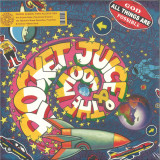
There is, in fact, a palpable openness pervading Rocket Juice & The Moon — the sense of a limber willingness to follow creative impulse — right down to how the group acquired its name. When Ogunajo Ademola — the Lagotian commissioned to do the album's cover artwork — dubbed his submission 'Rocket Juice & The Moon', it quickly morphed into the formal name of the project, like trying to hold onto mercury.
Surely, the stars above also approved.