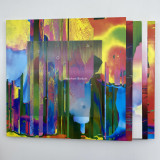
‘Reich’s music expands from minimalist austerity to more full-bodied passages and back again. Reminiscent of his earliest work, it is very beautiful.’ – Financial Times
‘The music has tender energy, and an undercurrent of melancholy. Its droning tones sometimes seem to be pulling apart – like taffy, or like Richter’s stretching spaghetti stripes of color.’ – New York Times
Nonesuch Records releases the first recording of Steve Reich’s Reich/Richter, performed by Ensemble intercontemporain and conducted by George Jackson. The composition was originally written to be performed with German visual artist Gerhard Richter and Corinna Belz’s film Moving Picture (946-3).
Reich describes Richter’s book Patterns, which served as source material for the film: “It starts with one of his abstract paintings from the ’90s. He scanned a photo of the painting into a computer and then cut the scan in half and took each half, cut that in half and two of the four quarters he reversed into mirror images. He then repeated this process of ‘divide, mirror, repeat’ from half to quarter, eighth, sixteenth, thirty-second, all the way up to 4096th. The net effect is to go from an abstract painting to a series of gradually smaller anthropomorphic ‘creatures’ (since the mirroring produces bilateral symmetry) to still smaller very fine stripes.
“Belz described the film in terms of ‘pixels’. It begins with two-‘pixel’ stripes and the music begins with a two-sixteenth note oscillating pattern. When the film moves to four ‘pixels’, the music moves to a four-sixteenth note pattern, then to eight, and sixteen,” the composer continues. “After that, I began introducing longer note values – initially eighth notes, and later to quarter notes. By the middle of the film, when the images move from 512 to 1064 pixels, the music really slows to dotted half notes. Finally, as the ‘pixel’ count begins to diminish, the music moves back into more rapid eighths and then ending with the most intense rapid sixteenth movement.”
After more than one hundred performances of Reich/Richter at The Shed in New York in 2019, it was performed in London at the Barbican by the Britten Sinfonia conducted by Colin Currie and then in Paris at the Philharmonie, where this recording was made. The Austrian ensemble Windkraft Tirol, led by Kasper de Roo, will perform Reich/Richter on September 8 at Szentrum, Silbersaal in Schwaz, and the LA Phil New Music Group, led by Brad Lubman, performs the piece, accompanied by Richter and Belz’s film, at Walt Disney Concert Hall in Los Angeles on April 1, 2023.
Nonesuch has recorded every new piece of music by Steve Reich since 1985, beginning with The Desert Music and continuing through 2018’s Pulse/Quartet, resulting in twenty-two albums and the two box sets Phases in 2006 and Works: 1965-1995 in 1997. The label will put out a collection of his complete works in 2023.
Reich released a book last month, Conversations, that includes dialogues with past collaborators, fellow composers, musicians, and visual artists who have been influenced by his work, including: David Lang, Brian Eno, Richard Serra, Michael Gordon, Michael Tilson Thomas, Russell Hartenberger, Robert Hurwitz, Stephen Sondheim, Jonny Greenwood, David Harrington, Elizabeth Lim-Dutton, David Robertson, Micaela Haslam, Anne Teresa de Keersmaeker, Julia Wolfe, Nico Muhly, Beryl Korot, Colin Currie, and Brad Lubman. Booklist said in its review, ‘Iconoclastic American composer Steve Reich is singular in his own right, and when he is in conversation with other equally iconoclastic composers, conductors, sculptors, musicians, percussionists, and video artists, sparks not only fly, they sparkle. Reich and his colleagues conduct lovely give-and-takes during which they share stories, creative approaches, and viewpoints. Reich's Conversations is the best kind of eavesdropping.’
Steve Reich has been called ‘America’s greatest living composer’ (Village Voice), ‘the most original musical thinker of our time’ (New Yorker), and ‘among the great composers of the century’ (New York Times). His music has influenced composers and mainstream musicians all over the world. Music for 18 Musicians and Different Trains have earned him two Grammy Awards, and in 2009, his Double Sextet won the Pulitzer Prize. Reich’s documentary video opera works – The Cave and Three Tales, done in collaboration with video artist Beryl Korot – have been performed on four continents. His recent work Quartet, for percussionist Colin Currie, sold out two consecutive concerts at Queen Elizabeth Hall in London shortly after tens of thousands at the Glastonbury Festival heard Jonny Greenwood (of Radiohead) perform Electric Counterpoint followed by the London Sinfonietta performing his Music for 18 Musicians.
In 2012, Reich was awarded the Gold Medal in Music by the American Academy of Arts and Letters. He has additionally received the Praemium Imperiale in Tokyo, the Polar Music Prize in Stockholm, the BBVA Award in Madrid, and the Golden Lion at the Venice Biennale. He has been named Commandeur de l’Ordre des Arts et des Lettres and has been awarded honorary doctorates by the Royal College of Music in London, The Juilliard School, and the Liszt Academy in Budapest, among others. ‘There’s just a handful of living composers who can legitimately claim to have altered the direction of musical history and Steve Reich is one of them’, states the Guardian.
Pierre Boulez founded the Ensemble intercontemporain in 1976 with the support of Michel Guy (who was France’s Minister of Culture at the time) and the collaboration of Nicholas Snowman. The Ensemble’s thirty-one soloists share a passion for twentieth and twenty-first century music. Under the artistic direction of Matthias Pintscher, the musicians work in close collaboration with composers, exploring instrumental techniques and developing projects that interweave music, dance, theater, film, video and visual arts. In collaboration with IRCAM (Institut de Recherche et Coordination Acoustique/Musique), the Ensemble intercontemporain is also active in the field of synthetic sound generation. New pieces are commissioned and performed on a regular basis. Resident of the Cité de la musique – Philharmonie de Paris, the Ensemble performs and records in France and abroad, taking part in major festivals worldwide.
George Jackson, winner of the 2015 Aspen Conducting Prize, came to attention after stepping in at short notice with Orchestre de Paris, where he stepped in for Daniel Harding. Recent highlights include leading Ensemble intercontemporain at Festival Romaeuropa, the Rainy Days Festival in Luxembourg, and Festival D’Automne in Paris, as well as conducting the RTÉ National Symphony Orchestra, the orchestra of Opéra de Rouen and the world premiere of Tscho Theissing’s Genia with Theater an der Wien. His varied operatic experience includes performances at Opera North, Hamburg State Opera and Opera Holland Park, as well as conducting a new production of Hänsel und Gretel at Grange Park Opera.
Поиск:steph highl
Все
Caamp formed when Taylor Meier and Evan Westfall met and bonded
over a shared love of music and a shared love of home, specifically the
inspiration they culled from the Midwest lives they grew up in
The two began writing and performing and quickly grew a rabid fan base. A selftitled 2016 debut album took flight, Evan and Taylor brought a third member and
longtime friend, Matt Vinson, to join on bass just before recording By and By. In
week one of the release of their full- length, By and By on Mom + Pop, Caamp
made multiple chart debuts. By and By entered the Billboard Top 200, was the #1
Heatseeker, #1 on the New Artist Alternative Albums, top 5 vinyl album sales for
the week and entered the Alternative and Emerging Artist charts. Caamp then
scored their first #1 at radio with their single 'Peach Fuzz,' made their late-night
television debut on Jimmy Kimmel Live!, and followed that up with a killer
performance on CBS This Morning Saturday. After a victorious 2019 festival
season playing Firefly, Shaky Knees, Forecastle, Outside Lands, Austin City Limits,
Great Escape and many more, Caamp kicked off a major US headlining tour in
September of 2019 and sold out show after show. In early 2020, Caamp
performed on the Late Show with Stephen Colbert. The performance was filmed
in Caamp's hometown of Columbus, OH during quarantine. The trio later released
their first live EP Live From Newport Music Hall. The five- track recording was
taken from one of their seminal hometown shows in Columbus, OH. The
recording contains live versions of songs off their most recent album, By and By.
Not long after the release of Live From Newport Music Hall, Caamp kept
themselves busy by releasing the singles and companion videos for 'Officer Of
Love' and 'Fall Fall Fall' via their label home, Mom + Pop. The band then
celebrated another victory in 2020 with their single 'By and By' resting snugly in
the Top 5 Most Spun on Sirius XM's Alt Nation. They kicked off 2021 with 'Officer
of Love' hitting #1 at AAA radio for 2 consecutive weeks. In 2022, the band will
release their highly-anticipated album 'Lavender Days' featuring 'Believe
In the summer of 1981, The Fall embarked on their second American tour, criss-crossing the States over a two-month period. Featuring the dual guitar of Marc Riley and Craig Scanlon and rhythm section of Stephen Hanley and Karl Burns, A Part Of America Therein, 1981 would document this fabled journey with crucial performances that show the band evolve from noisemaking lout cultists into true post-punk legends.
"From the riot-torn streets of Manchester, England to the scenic sewers of Chicago ..." as the album opens unforgettably with a nameless promoter introducing The Fall, who proceed to tear into a hypnotic take on "The N.W.R.A." stretched into a near stare-down that is wholly different than the studio version on Grotesque. The LP highlights Mark E. Smith's incomparable bite, heard most notably on the adlibbed vitriol of "Totally Wired," where not even the costumed punks were safe from a proper dressing down.
A Part Of America Therein, 1981 proves once again that The Fall's constant rally against complacency was a top-down directive and intrinsic to their wonderful and frightening sound.
Liner notes by Brian Turner.
- A1: St. Estes Reform School (Vinyl Version)
- A2: Eddie Draws
- A3: Lucky Slaughterhouse
- A4: Postcard From The Edge
- A5: No Touching!
- A6: Lethal Rejection
- A7: Carnage Unleashed
- A8: The Great Escape
- A9: He Did Not Taste Good
- B1: Turn On The Charm
- B2: Unholy Matrimony Pt. 1
- B3: Unholy Matrimony Pt. 2
- B4: Venom And Blues
- B5: Venom’s Suite Tooth
- B6: Brock And Roll
Limited Edition
Venom: Let There Be Carnage is highly anticipated 2021 superhero film featuring the Marvel Comics character Venom. It is intended to be the second film in Sony’s Spider-Man Universe and the sequel to Venom (2018). The film is directed by Andy Serkis from a screenplay by Kelly Marcel, based on a story she wrote with Tom Hardy who stars as Eddie Brock / Venom alongside Michelle Williams, Naomie Harris, Reid Scott, Stephen Graham, and Woody Harrelson.
Stephan Bodzin proves once again why he is one of the most innovative techno artists in the world with new album Boavista. The expressive 17 track full length lands on Herzblut Recordings on October 8th 2021 and is proceeded by lead single 'Boavista' on the Afterlife label.
German icon Stephan Bodzin is globally recognised on a number of fronts - his live show is one of techno's most celebrated, his productions constantly push the genre forward with his own trademark sound. He has put out well-received solo long players Liebe Ist and Powers of Ten as well as worked on many other iconic projects under a range of aliases.
In the last year, Stephan had the chance to look back on the vast archives of music he has recorded but never finished. While spending time in Brazil, he picked his 25 favourites and finished them properly, with the best 17 making up Boavista. His simple aim was to tell stories with each track, to paint musical pictures that conjure up very real emotions in the listener. As always, playing the album live was in the back of Bodzin's mind throughout the creative process. This means each track is a powerful piece that is both emotional and honest, physical and straightforward, but also true to the authentic Bodzin sound. The lack of DJ gigs and club experienceshad no impact on the music: Stephan has long since done his own thing and has never tried to conform to expectations.
And so it proves. The album kicks off with the lush 'Earth' which pays homage to all the elements of life - water, fire, wind, as well as time, light and the rotation of the planet. 'LLL' is an electronic lullaby track defined by a sense of love for the people in Stephan's life and 'Astronautin' has a lead synth that came about after Stephan's daughter said she would like to be an astronaut when she grows up. It truly takes you to the stars before the simple but effective melodic patterns of the title track light up a night sky with real hope.
Elsewhere there 'Infinite Monkey' which was a freeform jam that was led by the music itself, the epic pads of 'Dune' and interstellar explorations of the more thoughtful and melancholic 'Cooper Station’. 'Nothing Like You' was written in a hotel room before Stephan's last pre-lockdown gig, then 'Isaac' is another powerful journey through space and time, different worlds and alternative realities.
Further hypnotising highlights come from the soft melodies but powerful basslines of 'Collider', the expansive synths of 'Trancoso' and the delicate beauty of 'Ataraxia', which references German composer Klaus Doldinger who was a huge influence on Stephan's understanding of melodies and harmonics. 'Breathe' is a second spindling vocal track featuring Luna Semara next to 'Nothing Like You' and closer 'Rose' isa heartbreaking piano piece.
Boavista is another exquisitely crafted album of rich, synth-heavy electronic music that takes you into new worlds of emotion and leaves you in awe
Longpigs were the alternative rock band who came to prominence in the 1990s Britpop scene
with their breakout debut album ‘The Sun Is Often Out’. Fronted by Crispin Hunt, the group also
featured guitarist Richard Hawley, Simon Stafford on bass and drummer Andy Cook.
• Originally released in 1999 on U2’s Mother label, ‘Mobile Home’ was the band’s second and final
release. Highlights include the singles ‘Blue Skies’ and ‘The Frank Sonata’ and the Stephen Street
produced track ‘Gangsters’.
• The album is now issued on vinyl for the very first time, pressed on 180g heavyweight clear vinyl,
housed in a UV gloss sleeve.
Composed as a disco soundtrack for condemned night clubs and empty venues, "I Can See You Outside" is the latest single from Dubstar, a further collaboration with Stephen Hague, who produced their earliest hits.
Recorded at the end of the UK's first COVID-19 lockdown, it forms a companion piece with their previous single Hygiene Strip. While the previous song, “Hygiene Strip”, revealed an ordinary human predicament set within the extraordinary context of the pandemic, I Can See You Outside is a defiant expression of optimism, and the resolution to transcend an existential threat. The EP features brand new Extended and Dub remixes, and will be promoted heavily to the band's highly active fanbase via social networks
Les Disques du Crepuscule presents Subway, a collection of singles by cult NYC duo Thick Pigeon, originally released on Crepuscule, Factory and Factory Benelux between 1981 and 1991.
Comprised of vocalist Stanton Miranda and instrumentalist Carter Burwell, Thick Pigeon emerged from the downtown New York artrock scene which also spawned Glenn Branca, Bush Tetras, DNA, Arthur Russell and Sonic Youth. Like their chosen name, the duo were typically atypical: Miranda was previously a dancer with the Marthe Graham ballet company, and Carter a film animator and Harvard fine arts/architecture graduate. Very much a studio project, the ‘group’ hardly ever performed live.
Poised and subtle debut single Subway appeared on Crepuscule in January 1981, a connection forged by Miranda’s partner Michael Shamberg. Dog followed a year later, along with wry Christmas single Jingle Bell Rock, before the duo switched to Factory Records, recording debut album Too Crazy Cowboys in Manchester with Stephen Morris and Gillian Gilbert of New Order producing. Released simultaneously on Factory and Factory US in 1984, the album was billed as “a walk through the civilisation of you soul”.
Having now embarked on a career scoring movies (becoming the Coen brothers’ composer of choice), Carter was absent from the next TP project, 1986 dance single Wheels Over Indian Trails, although Morris and Gilbert remained on board as guest musicians. However Miranda and Carter would reunite for a second (and final) leftfield pop album, Miranda Dali, issued by Crepuscule in 1991.
As well as singles Subway, Dog, Jingle Bell Rock, Jess + Bart and Wheels Over Indian Trails, TWI 351 also includes b-sides (Sudan, Tracy + Pansy), album highlights (Crime, Riding) and a second festive track, Blue Christmas, previously issued only on cassette as part of a Factory Christmas card in 1986.
Alongside Stephen Morris and Gillian Gilbert, the stellar cast of guests include Fred Szymanski (of Ike Yard), Ikue Mori (DNA), remixer John Robie, and even artist and event designer Jean-Paul Goude on backing vocals.
Limited to just 500 copies, Subway (Singles) is newly remastered and pressed on transparent violet vinyl, reflecting the original 1981 sleeve artwork by legendary Crepuscule designer Benoit Hennebert. The album includes a free digital copy (MP3).
Stephanie Lottermoser’s brilliant and highly anticipated album ‘Hamburg’, is her follow-up project to ‘This Time’, which was number two in the German jazz charts in 2018 and which was characterised by Jazzthing, as “containing feather-light songs with a surprising level of thoughtfulness”.
There are some decisive differences that set ‘Hamburg’ apart from the abovementioned recording: the autobiographical elements in the storyline and the musician’s thoughts on important social topics of our time, which had a determining influence on the structure of the songs. the album - does not only focus on the city itself but lets the eye wander further away.
The result is an exceptionally entertaining album, agreeably close to the live sound of the band, intertwining elements of funk, jazz, pop and soul splendidly and of a quality rarely to be found.
Hygiene Strip is Dubstar’s first release in collaboration with legendary producer Stephen Hague (Pet Shop Boys / New Order / Erasure) since their initial sequence of hit records in the mid-1990s.Written and recorded remotely during the apex of the 2020 (first) UK lockdown. The EP featuresbrand new Extended and Dub remixes, and will be promoted heavily to the band's highlyactivefanbase via social networks, database email, and online marketing.
Between Christmas 2000 and New Year 2001 producers Ekkehard Ehlers and Stephan Mathieu recorded an album of warm, soft, delicately crackling electronic music in the space of that week. It was christened with the ambivalent title "Heroin" and was released on CD via the label Brombron in 2001 and later in 2003 re-issued on Kit Clayton's Orthlorng Musork on double-LP with remixes the pair had commissioned as expansions.
17 years later Heroin sees its first vinyl release to include all 13 tracks from the original CD track-list on this LP + 12“ set. The centerpiece "Herz" finally receives its long deserved vinyl treatment (side C, at 45rpm) and on the flip side Thomas Brinkmann contributes a mirror in a magnificent remix of that very piece on side D.
Ehlers and Mathieu were both highly prolific solo artists during the period 2000-2004, and in just two years after the initial release of "Heroin" each had produced over half a dozen new solo recordings: among them the serial masterpiece Ehlers' "Plays" (Cornelius Cardew, Hurbert Fichte, John Cassavetes, Albert Ayler, Robert Johnson) released as 5 stunning LPs in a series on Staubgold, while Mathieu's 'Full Swing Edits' spread over five 10" records plus his album 'FrequencyLib' on Mille Plateaux, 'Die Entdeckung des Wetters' on Lucky Kitchen and ‘The Sad Mac’ on Atsushi Sasaki’s Headz label were greeted to critical acclaim.
Both artists were expanding their conceptual sonic approaches in the glow of developing laptop technologies which would to these times in 2020 seem quite primitive, but these two in that period used the state-of-the-art to aid and abet their conceptual visions, while at times the duo used unorthodox experimentation - yet always had a distinctively melodic and musical form at its heart and soul.
Ehlers can be seen as a conceptualist, as a meta-musician who interrogates the mediums and methods of sound production - reflecting on the conditions and possibilities of improvisation (e.g. "Plays Albert Ayler") and exploits ideas of mutation and distortion of popular aesthetics played out within a ghostly form of divine pop beauty in his project März.
Mathieu, originally a drummer and co-founder of what has come to be known as the Berlin 'Echtzeitmusik' scene. His approach could be similarly described as working a critical analyst and researcher: Subtly and precisely working in the realm of processing as a method of intervening in melodious/harmonic analog sound sources.
Ehlers and Mathieu may not think too much about their singular productions and publications outcomes, but instead concentrate on the process and musical personality that characterizes their gesture- style itself stays in the background - and they usher a music from small minimal sound sources coaching a patient music of slow intervention - much like a refraction of light than a concrete painting or a blurred photograph - beatus accident.
And indeed, "Heroin" is an album that embraces the happy accident being made up of reduced, often very catchy and very direct micro hooks which seem laser-guided into a space accepting obvious melodic beauty in what feels like an observation of musics unfolding and revealing it's DNA, embed with for a kind of yearning for innocence and naiveté - as if Satie were on the jukebox in "The Crying of Lot 49". Not to say the music is "reduced", but rather: 'restricted' and born from acceptance of limitations, and the artists allowing the sounds to just "be.." with some incremental degrees of coercion.
The album not only sounds like that of 2 producers who are both dreamers and scientists, but that Ehlers and Mathieu chose to work with these means in a dialogue together to reduce pop music to its musical/tonal core, it is not Pop music anymore, rather a ghostly pointilistic itteration of song. "Heroin" is located at this transition, around that point at which tracks, that were or could have become pop compositions, irrevocably slip into a static harmonic nirvana. We are invited to follow the arch of Heroin in a slow-motion morphine musical haze.
Heroin sounded timeless when originally released and proof is that it remains so, one wishes that Ehlers and Mathieu would convene again for a week, a month or an entire year to continue this process of slow rumination, picking affectionately over the sounds they both love - and then maybe when everything is condensed, evaporated they would write more songs with those sonic refractive elements that remain.
The latest record from Delinquent Delivery sees label-head Stephen Mahoney round up five of Dublin’s most prolific producers. Stuey Lyons, Jon Hussey, Jack Jennings, Stephen Mahoney & Rustal have contributed to Stretching Ohms, the fifth release on Delinquent Delivery. Dancefloor directed techno at its finest.
Stuey Lyøns & Jon Hussey have teamed up for A1, a straight-shooting dancefloor oriented techno work. With over forty years of experience between them,Lyøns & Hussey’s expertise is put to work on A1. Dark, pensive and groove-oriented, A1 never deviates too far from its source, making it a useful techno tool for any DJ’s arsenal.
Jack Jennings contribution on A2 is another dancefloor directed number, featuring a dissonant lead married with a swinging percussive section which creates an infectious groove. Jennings’ production style would be synonymous with dark, late night sets, such as those by Marcel Dettmann or Chris Liebling.
Mahoney’s input to Stretching Ohms is B1, a commanding techno banger. Mahoney’s production style is similar to his DJ sets, delicately blending subtle elements throughout B1 while never losing focus of the main driving components. B1’s direct approach makes it perfect for late night sets.
Rustal rounds the record off with B2, a groovy roller which echoes Detroit through and through. Chiming in as the fastest track on the record, Rustal effortlessly balances a funky bassline with a compelling lead, reminiscent of the Belleville Three’s earlier work. B2 marks the end of Stretching Ohms, continuing on the energetic path set out before.
Stretching Ohms delivers high-octane dancefloor driven bangers of the highest quality. Each track differs in style, but combined they all have similar DNA – they’re all made in Dublin. This release highlights the talent that Ireland has to offer to techno globally.
A new sub-label of the longstanding Canadian electro imprint Suction Records, Ice Machine — focusing on old-school wave/post-punk sounds — is thrilled to present a new, deluxe reissue of “Pow Wow”, the debut 1982 solo LP from Cabaret Voltaire’s Stephen Mallinder. Now expanded to a double-LP, and also released on CD/digital, it’s a definitive reissue which now includes Mallinder’s early solo discography in its entirety. This collection of mutant dub/funk/postpunk sounds just as fresh and contemporary in 2020 as it did in 1982 (note Autechre’s inclusion of standout cut “Del Sol” in a mix earlier this year), and highlights Mallinder’s crucial contributions to Cabaret Voltaire.
Some words from Mr.Mallinder on the scene and era from which “Pow Wow” was born: “It was an interesting, and inspiring, time. The primal caterwaul of punk was dying and lots of really significant things were emerging from the fires. Much looser vibes were in the air and there was a much more exploratory feel. Punk had championed a visceral, anti-intellectual approach but in truth the real characters brought so much more to the table, and what began to happen - from people like The Pop Group to Throbbing Gristle, and emerging scenes from No New York to Factory Records - is we began to embrace the art of it all. There was acknowledgement of the importance of books, films, graphic art, and experimentation with all those mediums. We were just as interested in turning over rocks to see what lay beneath, as throwing them. There was a sense of new magik emerging.”
“Pow Wow” was commissioned by the Fetish Records label, and recorded at the Cabs’ Western Works studio, where Mallinder would spend his days recording with Cabaret Voltaire, and continue on alone into night recording his debut solo material. “I slept very little in those days,” he adds, continuing: “It was done on 8 track and very multi-tracked, so lots of recording, then bouncing, and overdubbing, to get the integrated feel of the tracks. I became very adept at pressing record then jumping onto equipment to play it - it was actually a very 'live' record in that sense. I've always seen rhythm at the core of what I do so I loved the layering of counter rhythms. The sequence/arpeggiator parts were all drum machine triggers that were played live. It was about creating a distinct groove so arrangements came from weaving in and out of those linear grooves. It was fun to play everything from drums, guitars, keys, trumpet, percussion, tapes… and record and produce it all. Prince got it from me!”
Surprisingly, Mallinder’s first solo LP would also prove to be his last - that is, until last year’s critically-acclaimed solo return “Um Dada”, on Dais.
This new edition of “Pow Wow” contains 14 songs, and is housed in a recreation of the original, iconic Neville Brody jacket, painstakingly recreated using scans of Brody’s original artwork elements. The 2LP vinyl edition is in a reverse board, thick-spine jacket, and adds a 12”x24” folded poster/insert, featuring unused elements from Brody’s original designs, sketches, and instructions for the LP. The CD edition comes in a reverse board, 6-panel digipack.
2-11 from the Pow-Wow LP on Fetish Records, 1982.
13-14 from the Temperature Drop / Cool Down 12” on Fetish Records, 1981.
12 from the Fetish Records compilation The Last Testament, 1983.
1 edit from the Pow-Wow Plus LP on Fetish Records (Japanese pressing), 1984.
German veteran Marc Romboy is back on André Hommen’s These Eyes imprint with a stellar two track release entitled Elka, showcasing Marc’s effortless ability to portray alluring and emotive characteristics through music. This offering follows up from Trapped In An Orbit, which he released on the label in 2017 and remains a label highlight to this day.
The title track Elka provides a stirring and suspenseful journey that plays out as it’s melodies unfold over a bassline that pulses gently and impels the listener. Unreal Sun ups the energy with a groove thats ready to fall into and chords that lead the way, dictating the pace as their intensity undulates.
Marc Romboy has dedicated 30 years to the scene, with an impressive history of releases on labels like Innervisions and his own Systematic Recordings, collaborating with artists such as Stephan Bodzin. It is a point to be made that the A side to this release is one of Marc’s personal favourites to date and it is clear to see why.
Bram De Looze is a Belgian pianist and composer whose distinct musical vision has found its way through both solo projects and collaborations. His unique technical skill and musical maturity have earned him considerable critical acclaim back home as his work spotlights his far-ranging interests - from traditional classical piano music, to solo improvisations that have often been compared to Keith Jarrett and Jason Moran. On the 21st February 2020, Sdban Ultra will release his highly anticipated new solo album, 'Colour Talk'.
De Looze made his entrance onto the national jazz scene with LABtrio, formed in 2007 with Anneleen Boehme and Lander Gyselinck, and he immediately impressed, flirting with urban jazz, electronics and hip hop.
After a period of studying abroad at the New School for Jazz and Contemporary Music in New York, where he studied with Uri Caine and Marc Copland, in 2014, De Looze launched the international septet, Septych, that once again stressed his affinity for jazz, classical music and improvisation. With diverse and astounding improvisors like Daniel Levin, Lester St-Louis, Robin Verheyen, Gebhard Ullman, Bo Van Der Werf and Flin Van Hemmen, it was the start of an explorative musical journey.
Over the past few years, De Looze could frequently be heard with kindred spirits like Stephane Galland, Dre Hocevar and Antoine Pierre but it was a visit to the historical collection of pianofortes of Chris Maene that inspired De Looze to release his first solo album 'Piano e Forte' (2017), and it received critical acclaim for its creativity, spontaneity and passion. He would later garner further acclaim working alongside fellow Belgian Robin Verheyen and American rhythm painter Joey Baron with whom he recorded 'MixMonk' (2019), a tribute to the legendary jazz pianist Thelonius Monk.
Bram De Looze's solo career took off in an unexpected way with 'Piano e Forte', a project for which he approached historical instruments from a contemporary perspective. The switch to the Chris Maene Straight Strung Grand Piano for 'Switch The Stream' (2018) indicated a renewed search for movement, evolution and introspection. His latest solo project 'Colour Talk', continues this trajectory with another revolutionary piano model, designed by lauded architect Rafael Vinoly, and a continued attempt to renew from within.
On 'Colour Talk', what you hear is a musician who has freed himself from stylistic constraints and limitations. While still rooted in jazz, classical music and free improvisation have found a new balance, a coexistence that enables the pianist to express himself with a new vigour. Switching between shorter pieces that feel like curious, unresolved puzzles and more extended explorations, 'Colour Talk' is once again an ode to (re)invention in the grey zone were the classical idiom and improvisatory urges meet, with the 13-minute tour-de-force of 'Hypnosis' as one of several undisputed highlights.
If you asked De Looze about his current position as an artist, he would probably tell you that it's all about forward movement and the need to keep evolving, about a trajectory as work-in-progress. However, if you consider 'Colour Talk' as a freeze frame of where De Looze is at, it is hard not to consider it a highlight in a career that should have some more surprises in store.
“Osondi owendi. What is cherished by some is despised by others. One man’s meat is another man’s poison. Different strokes for different folks. To each their own. Osondi owendi.
It’s a conventional aphorism in the Igbo language but if you utter the word “osondi owendi” in Nigeria today, the first thing that comes to anybody’s mind is the cucumber-cool highlife music maestro Chief Stephen Osita Osadebe and his legendary album that takes its name from the adage. Released in 1984, Osondi Owendi was instantly received as Osadebe’s magnum opus, the crowning event of an exalted career stretching back to the early years of highlife’s emergence as Nigeria’s predominant popular music.
Stephen Osadebe first appeared on the music scene in 1958 as a spry, twenty-two year-old vocalist in the Empire Rhythm Skies Orchestra, directed by bandleader Steven Amechi. With his dapper suits, urbane Nat King Cole-influenced vocal stylings and jaunty, uptempo, calypso-scented dance tunes, he personified the frisky spirit and anxious aspirations of a young, educated generation that had come of age in the wake of the Second World War, in a Nigeria that was rapidly shaking off British colonization and marching towards an independent future. 1959 would be the year that he truly made his mark in the business with his debut solo single “Lagos Life Na So So Enjoyment.” A giddy exhortation of the music, sex, fun and freedom availed by life in the big city, the song became a sensation and an anthem, and Stephen Osadebe became the leader of his own popular dance band, the Nigerian Sound Makers.
Osadebe would ride this wave of acclaim through most of the nineteen sixties, but a change in direction would be called for at the dawn of the seventies. As Nigeria emerged from a devastating civil war, so did a new generation of youth inspired by rock and funk, confrontational sounds reflective of a more violent, less idealistic era. All of the sudden, the idioms of the post-WWII dance orchestras that nurtured Osadebe’s cohort seemed quaint, the stuff of nostalgia. Osadebe needed to evolve to respond to the new tumultuous, turned-up times.
His response? He cooled it down.
Abetted by a new crop of fire-blooded young players, Osadebe slowed his music to a mellow, meditative tempo, brought forward the lumbering, Afro Cuban-accented bass and percussion, from the rockers he borrowed searing lead lines on the electric guitar. Over this musical bedrock, doesn’t so much as sing as he dreamily muses, coos, sighs aphorisms, words of wisdom and inspiration. “When one listens to my music, all I say appears meaningful,” Osadebe explained his lyrical approach, “at times they are in the form of proverbs which provoke much thought afterwards.” The result is a blend that is both rollicking and soothingly languid. Osadebe christened the style Oyolima—a tranquil, otherworldly state of total relaxation and pleasure. Osondi Owendi represents oyolima at its finest, and possibly Nigerian highlife in epitome.
Osondi owendi. What is cherished by some is despised by others. In some way, the album’s title constitutes a paradox. Because Osondi Owendi is a record that it’s almost impossible to imagine being despised by anybody."
"3x12" - Vinly Only.
The second instalment of minimood's multidisciplinary fusion series features Die Wilde Jagd with an extensive rework of the neo-romantic ’Morgenrot’ as well as a vast array of diverse remixes by Ancient Methods, CV313, Luigi Tozzi, Roman Flügel, Rude 66, Steve Bug, The KVB, Vactrol Park, and Variant. This gatefold 3x12" vinyl only release is visually enhanced with intricate hand-drawn artwork including inlay by Dusseldorf based artist Susanne Giring. Written and recorded by Sebastian Lee Philipp with his Uhrwald Orange studio collaborator Ralf Beck, ’Morgenrot’ originally appeared on Die Wilde Jagd's debut album in 2015.
For this release, Philipp and Beck re-visited the song: the ensuing ‘Fangschuss Version' enjoys an augmented arrangement, additional instrumentation and a haunting guest vocal by New- Zealand based singer Nina Siegler. In Philipp’s words, the 'Fangschuss Version' constitutes “a venture to capture the spirit that has been guiding this fusion release - a desire to explore the concepts of friendship, time, distance and memory. An attempt to unveil fragments of the unseen and to reveal the surge of a distant remembrance in an embracive listening experience." 'Morgenrot' subsequently gets a highly varied remix treatment by a range of carefully selected artists.
While Vactrol Park navigate the original audio material into beautiful ambient territory, Ancient Methods showcase an epic masterpiece of enchanting medieval-vibed techno. The KVB turn the track into a dreamy cold-wave trip and Rude 66 dives into a dark, primetime, anthemic dimension. For Roman Flügel, it’s a slow, organic, starry-eyed approach and Luigi Tozzi transforms 'Morgenrot' into hypnotic & loopy, minimal, deep techno. The rework by Steve Bug plays with the original's melody and a danceable kosmische-infused house cut emerges.
The final two remixes are both crafted by legendary Echospace Detroit mastermind Stephen Hitchell: absorbing deep trips into mesmerizing dubtechno by CV313 and into foggy lo-fi ambient by Variant.
- A1: Rainbow Deux (6 57)
- A2: Let Love In (6 14)
- A3: Sigh (4 08)
- B1: The Darkest Night (7 32)
- B2: Surrender Now (6 08)
- B3: Summer Is Her Name (4 37)
- C1: Are You Ready (3 18)
- C2: Streets (Keep Me Runnin’) (7 00)
- C3: Samba Dreams (3 20)
- D1: Let’s Go Deep (5 27)
- D2: We Should Be Laughin’ (3 45)
- D3: Wishful Thinking (4 00)
TThe melodically adventurous soul of Leon Ware continues its expression in his final opus Rainbow Deux, released on double vinyl on September 13th. The album features new songs recorded and performed by Leon before his health turned, leading to his transition on February 23rd 2017. Co-produced by Taylor Graves, it has stellar musical contributions from the likes of Kamasi Washington, Thundercat, Ronald Bruner Jr, Rob Bacon and Wayne Linsey.
Taylor Graves came into Leon’s musical family in 2002 when he, his brother Cameron and the Bruner brothers Ronald Jr and Stephen (Thundercat) were playing along with their schoolmate Kamasi at an L.A. jazz club. Taylor, Cameron, Ronald and Stephen became Leon’s band for his debut shows in Japan in 2002 and Taylor continued to work with Leon as his mentor and collaborator over the next 15 years.
“Leon was ALWAYS writing something or developing his musical palette” his wife Carol Ware tells us, so it’s impossible to pinpoint any single moment of Rainbow Deux’s genesis. Six of the songs go back to 2012/2013 and were released in 2014 as part of Sigh, a Japan-only CD collection heavy with Rob Bacon’s tasteful licks and Wayne Linsey’s piano vibes. The rest of the material comes from Leon’s sessions with Taylor.
Describing Leon’s and his process, here’s Taylor: “We’d start by having some great homemade food! Then a glass of wine ‘to slow down time’. After we’d have our fill and smoked our joints we’d go into his studio room to listen and create.”
The album was finished-up around August of 2016 in a back-and-forth between Leon and his go-to mastering engineer Toni Economides in the UK.
Leon worked on Rainbow Deux with life’s greatest challenge looming over him, yet it is one of his most focused and cohesive solo offerings since the 1980s. The entire record is a vibe: mellow, deep and smooth as silk. The lyrical themes are eternal, and the music is elegant, soulful and sensual.
The album opens with the hypnotic throb of “For The Rainbow”, coming on like a percussive, slow-mo house shuffle. Gilles Peterson is a fan. The exotic “Let Love In” follows, with its gradual-build Island Funk, intricate guitar picks and sassy female vocals. It explodes when it hits its stride. “Sigh” is the stylish slow jam close-out to side A. Serene guitars and polished drums create neck snapping funk, with a swaggering finger-snap strut.
Side B opens with the easy-burning broken-beaty “The Darkest Night”, the centrepiece of the album. Kamasi Washington’s lurking sax, restrained and beautiful, unfurls into the dank, sticky atmosphere of Thundercat’s signature creeping bass laid over his brother’s in-the-pocket drums. Leon’s vocals are perfect, a masterclass in seductive sax-soul.
“Surrender Now” conjures waves of vocals to swell and wash over the glossy piano, subtly bumping hip-hop drums and bubbling synth-bass stabs. It’s got the trademark Leon layers. “Summer Is Her Name” has Kamasi’s effortless, melancholic sunshine sax give way to rising tempos and propulsive rhythms.
“Are You Ready” is a total highlight (and we’ve been playing it out for ages). It’s a nimble groove of piano and synth rolling around Theo Croker’s sensual trumpet playing. Digi-soul at its finest. With lush G-Funk sensibilities “Streets (Keep Me Runnin’)” sounds like a lost Dam-Funk produced gem. All tough kicks and snares and street sounds. Leon’s hood pass will be forever intact.
“Samba Dreams” is the first of two tracks that bring a little Rio magic to Rainbow Deux. Leon created a whole body of work in partnership with Brazilian legend Marcos Valle that includes “Rockin’ You Eternally” - a hit for Leon - and “Estrelar” – a hit for Marcos. Leon channels his obvious love of Brazilian music here through more of Croker’s sumptuous trumpet, played over loose percussion. “Let’s Go Deep” is next up. A dreamy between-the-sheets quiet storm anthem and a real showcase for Leon’s vocals.
The dripping, honeyed harp-funk of “We Should Be Laughin’” marks the star turn of the brilliant Kimbra. Leon first met her on-stage to do an impromptu duet of “Inside My Love” during an open-air celebration of Minnie Riperton in July of 2014. Kimbra was working with Taylor on her music and he brought her to Leon’s house to do some writing. This was the result.
Warm synths radiate shuffling samba soul on “Wishful Thinking” as those Brazilian rhythms return to bring Rainbow Deux to a close.
During an apartment move Leon and Carol rediscovered some watercolours Leon had done years ago. One of these paintings had been dubbed “Deux Hearts” and Leon decided it should be on the cover of Rainbow Deux, getting as far as approving a draft concept for the artwork.
Carol has overseen developing that draft into the final gatefold sleeve. It brings together quotes, photographs and tributes in what is a reflection on the music, relationships and philosophy of the sensual minister.
Gerry “the gov” Brown, Leon’s long-time sound engineer, was by his side throughout the project, recording and mixing. The album was mastered by Toni Economides and Simon Francis’ additional sensitive work makes sure this double LP sounds like it should on vinyl.
Be With’s first ever release was Leon’s eponymous LP. Re-issuing that album planted the seed of a relationship that has grown to grant us the privilege of presenting his crowning achievement. We know that Leon’s fans all over the Earth will love Rainbow Deux. But we also hope that this album, the final entry in a phenomenal body of work, will reach new fans and find fresh conduits for the spirit of this oft-unsung hero of Soul.
Leon always said “they will get it when I'm gone.”
He also said that “the spirit never dies”…
- A1: J B. De Carvalho E Seu Terreiro - Fui À Umbanda
- A2: Trio Ternura - A Gira
- A3: Alcione - Figa De Guiné
- A4: Impacto 5 - Longe Daqui Aqui Mesmo
- A5: Abaeté - Pisa No Taboado
- A6: Tobias - Coisa Sentimental
- A7: Os Flippers - Estrelar
- B1: Spaceark - Don’t Stop (Unreleased Long Version)
- B2: Pure Release - I'll Know It's Love For Sure
- B3: Luther Davis Group - You Can Be A Star
- B4: Marumo - Khomo Tsaka Deile Kae?
- B5: Splash - Peacock
- C1: Gyedu Blay Ambolley - Highlife
- C2: Harari - Senyamo
- C3: Kaleidoscope - Let Me Try
- C4: Elias Rahbani - I Want To Be
- C5: Tokyo Academy Philharmonic Chorus Group – Taharazaka
- C6: Cesar Roldão Vieira – Zé Do Trem
- C7: Elias Rahbani - Dance Of Maria
- C8: Galt Macdermot – Coffee Cold
Volume Three in the Mr Bongo Record club series. Another showcase of recent vinyl finds and favourites from our DJ sets and radio shows. This is an extra special one however, as it lands in 2019, the year that we celebrate 30 years since it all began way back in 1989.
Compiled by David Buttle and Gareth Stephens, assisted by Graham Luckhurst and Gary Johnson.
A Quest Called Tribe begins with a series of portraits drawn by Stéphane Carricondo in
2017 dedicated to Hip-Hop legends. As close partner in art Medline proposed to create a
soundtrack for them, and first interpreting ATCQ's classics with elements of the past,
present and future. The best way to materialize this multidimensional tribute was obviously
a vinyl. And it's the one we unveil today.
On the visual side, ATCQ's portraits are composing the front cover and, assembled into a
great scene, are printed on a colorful A2 poster. Stéphane Carricondo's natural lines are
highlighting each member's soul map. The alchemy of the dark ink on emptiness gives to
them an impressive sparkle of life.
On the musical side, the classic themes are transformed into a polymorphic fusion, were
jazz, funk and soul from the original sample sources converse with Tribe's characteristic
beats. Medline added a hint of his magic, unique rhythms, improvisations, arrangements,
original orchestration and inspired melodies.
The album is an ode to the band that marked both artist's life and mind. A cultural print and
school of sound that designed Hip-Hop foundations. With a blooming expression Medline
and Stéphane Carricondo are going to the roots of ATCQ in a quest for the tribe.