Tracked in 1977, this bundle of never-before-released basement demos throw Harris’ beloved Philadelphia Sound into an unfinished root cellar, pelting it with Clavinet attacks, disco skats, and infectious hooks. Named for the street address of its underground uptown genesis, 1514 Oliver Avenue (Basement) is James “Jimmy Jam” Harris’ first foray into songcraft and an organic Minneapolis-vintage alternative to a late ’70s Prince songbook gone increasingly synthetic.
Suche:street sound inc
Tracked in 1977, this bundle of never-before-released basement demos throw Harris’ beloved Philadelphia Sound into an unfinished root cellar, pelting it with Clavinet attacks, disco skats, and infectious hooks. Named for the street address of its underground uptown genesis, 1514 Oliver Avenue (Basement) is James “Jimmy Jam” Harris’ first foray into songcraft and an organic Minneapolis-vintage alternative to a late ’70s Prince songbook gone increasingly synthetic.
- 1: Street Dance – Bonnie Jean
- 2: That's No Way To Spend My Time - The Pen Etts
- 3: Boy Trouble - The Rev-Lons
- 4: I Can Tell (I'm Losing Your Love) – Lena Calhoun & The Emotions
- 5: You Really Never Know Till It's Over – The Vel-Vetts
- 6: Heart For Sale - The Fran-Cettes
- 7: One Way Street - The Swans
- 1: No More Tears - The Sweethearts
- 2: To Know Him Is To Love Him - The Darlings
- 3: Boy You Move Me - Joan Moody
- 4: Lonely Girl - The Lovettes
- 5: My Heart Tells Me So (Aka I Know It's You) – The Del-Phis
- 6: Surfers Memories - The Fashions
- 7: He's Groovy - The Front Page & Her
• “Hearts For Sale” is the fifth and latest in our series of 12-inch vinyl albums spotlighting the US girl group sound of the 1960s. The collection opens with ‘Street Dance’ by Bonnie Jean, a little-known must-have for collectors of the genre, with Darlene Love and the Blossoms clearly audible on background vocals. Issued on Lew Bedell’s Doré label, this exciting faux-live deck in the style of Shirley Ellis’ ‘The Nitty Gritty’ was written by Guy Hemric and Jerry Styner, a hip team known for supplying songs for the soundtracks of B movies such as Muscle Beach Party and Thunder Alley.
• The Hollywood-based Doré imprint is also the source of ‘You Really Never Know Till It’s Over’ by the Vel-Vetts (which shares a backing track with the Superbs’ ‘I Was Born When You Kissed Me’), ‘One Way Street’ by the Swans, a soulful update of the Teddy Bears’ ‘To Know Him Is To Love Him’ by the Darlings and – featuring lead vocals by Sheilah Page, a former member of groups such as the Bermudas, Becky & the Lollipops, the Majorettes, Joanne & the Triangles and Beverly & the Motor Scooters – ‘He’s Groovy’ by the Front Page & Her.
• Other highlights include the Sweethearts’ Supremes-influenced ‘No More Tears’, the sophisticated slowie ‘Lonely Girl’ by the Lovettes (that’s them on the front sleeve), ‘My Heart Tells Me So’ by the Del-Phis (an early incarnation of Martha & the Vandellas) and the Fran-Cettes’ terrific recording of ‘Heart For Sale’. As with the earlier volumes in the series, the album comes with a fully-illustrated inner bag featuring a 2,500-word track commentary by compiler Mick Patrick.
If you dig deep enough into the underground you will find the most precious jewels and it ain't that much of an effort these days to turn on the computer and trip through the colorful World Wide Web. But beware for not all the glitter is gold. I stepped by some dark and dusty back street club in Atlanta / Georgia, USA and some enchanting music tempted me to enter. A powerful raspy voice screaming out the pain of the world no matter if it were big or small affairs. "California dreaming on such a winter's day", wow, when the MAMAS AND PAPAS sang this in a sweet folk manner it was a light and joyful anthem for all hippies and hipsters back in 1966, like a call to love. Lee Moses' version is more of a desperate cry for sunshine and freedom. And it goes on this way. His voice has this special phrase showing determination, pain but also sheer joy of life. His 1971 album is a steady groover with a steaming hot band performing , which includes a brass section of divine greatness. These devoted players build up a massive wall of groove and melody on which Lee Moses can unleash his voice like a volcanic eruption. The groove itself stays quite relaxed but definitely hypnotizing throughout the whole album and clears up your mind for the message of love Lee Moses raves about. The high skills of Lee's backing band gets showcased in a steaming instrumental version of THE FOUR TOPS' "Reach out (I'll be there)", which appeared on an early 7" first and got added here as a bonus track. They don't stop for THE BEATLES' "Day tripper" either and next to "California dreamin'" you can find another heart warming version of "Hey Joe" on the regular album. Not as extraordinary outraging as Hendrix' turn on this classic Lee and his mates make it a slightly more epic effort. All in all this is a soul album with very few covers and even more classic anthems of this genre that should actually be worshipped by lovers of the late 1960s Motown sound. Especially the bonus tracks will drive you wild. Go for it, brothers and sisters.
The free folk/jazz sound of modern Los Angeles. Featuring a heavy bunch of musicians and vocalists including Moor Mother.
"Fearlessly Accessing the Divine Spirit From Here on Out" is the vinyl debut from pianist, composer, and producer Diego Gaeta. He has previously released projects as Club Diego and with the trio Human Error Club (whose members Mekala Session and Jesse Justice helped produce this record). He has quickly become a fixture in a number of Los Angeles musical environments, working with Lionmilk, The Pan Afrikan Peoples Arkestra, Carlos Niño, Black Nile among others. This album is a synthesis of these many LA environments, and carries chamber, jazz, ambient, and folk influences, ultimately giving it an uncategorizable feel similar to works by Arthur Verocai or David Axelrod.
Gaeta recorded the initial ideas for the album by himself after experiencing a burst of creativity during the lockdown of 2020, in the aftermath of a season of protests in Los Angeles, on a piano at his home in El Sereno. "I was constantly not in tune with myself, always awaiting outrage and tragedy in a very unstable world. However, hitting the streets in support of various ongoing pandemic community actions felt necessary and it marked a point in time that ushered in large societal changes. The weight of that era made me feel allergic to making art at the time. All of these ideas came after that period, expressing my reflections subconsciously. I remember that the ideas came in a short amount of time, and then they developed."
Once he had created the tracks as Ableton sessions, he realized the gravity and context of how he was processing his ideas so he, as he puts it, "felt like taking them outside the hands of midi and into the hands of friends." Gaeta was able to assemble his dream band, which ended up being a 9-piece ensemble, or a nonet. "I felt that at some point I was channeling the geometrical balance of that nonet...it's almost as if I had a sextet and then the three of the sextet that's not the rhythm section were doubled. It's a really dense sextet, that's how I see it."
The recording process began the following summer in June 2021 as the musicians were all adjusting to the newfound dynamic of getting tested for COVID, waiting a few days, and then meeting up to record. "We were eating Indian food, some of us were smoking, it was a nice memory, but I felt a little stressed, because I was the bandleader, and I felt the emotional weight of my music."
The title track and single, featuring vocals by Jimetta Rose, begins with a speech by Gaeta delivered when playing with Black Nile in 2019 at the Levitt Amphitheatre in MacArthur park. Gaeta provides the following account: "Even though it was in 2019, socio-political tensions and issues were at the forefront for me at that time. I wrote a speech that was intended to be critical of the US but it ended up becoming a collage inspired by different women that had messages of freedom that spoke to me the most. I quoted Nina Simone and Georgia Anne Muldrow, it wasn't something that I read but something that she said "kicking it with consciousness and style" that phrase stuck with me, so I used it in that speech. Although critical, the speech had a positive feeling to it, and it was hopeful. I gave that speech while fireworks were going off."
Moor Mother & Zeroh are found on their respective tracks, Memory Screen & Eccolo - both delivering a distinct, commanding vocal performance. Low Leaf colors the track Soft Spot with harp, a beautiful ballad nestled in the center of the album. Other players include Gregory Uhlmann on guitar, Jon Kaye on violin, Devin Daniels on alto saxophone, Caleb Buchanan on bass, Dante Luna on vibraphone, Patrick Behnke on viola, Bryan Baker on tenor saxophone/flute, and Mekala Session on drums.
"I’d like for us tonight to embody a freedom oriented life. Freedom isn’t just a dream, it’s a place we must all arrive at together, as one by one the people of the Earth help each other to be Free of power, hate, and insecurities. Let’s kick it with consciousness and style. Can y’all dig that? YEAH. I can too. So now we’d like to present to you a spiritual transmission I like to call: 'Fearlessly Accessing the Divine Spirit of Freedom From Here On Out.' YEAH" - Diego Gaeta
Recorded over the course of a 4,000-mile cross-country roadtrip,
Canadian Taylor Ashton's new album is a sonic odyssey through the heart
of America, one that works its way geographically from coast to coast as
it meditates on the meaning of closeness and connection
The performances are warm and inviting, anchored by Ashton's deft guitar and
banjo work and rich, easygoing melodicism, and the recordings-- helmed by
producer Jacob Blumberg and captured with a broad range of collaborators
including Courtney Hartman, Big Thief's Buck Meek, Lake Street Dive's Rachael
Price, Vulfpeck's Theo Katzman, and Late Show bandleader Louis Cato-- are
alternately sparse and lush. From a blanket in Brooklyn's Prospect Park to a
spiritual vortex in Sedona, AZ, the settings are inextricable from the songs, and
the result is a moving collection that evokes both the gentle virtuosity of Nick
Drake and the buoyant wit of Paul Simon.
Attarazat Addahabia & Faradjallah's album came to us as quite a mystery. Our friends from Radio Martiko got access to the studio archive of the Boussiphone label and a reel labeled “Faradjallah” was among the items they had found there. After listening to the selection of reels they borrowed, Radio Martiko felt it was not a fit for their label and helped us licensing it from Mr. Boussiphone instead. We knew nothing about the band. We just had the reel with the music but very little information. What we knew was that the music was incredible and very unique. Gnawa sounds were combined with funky electronic guitars, very dense layers of percussions and female backing vocals more reminiscent of musical styles further south than Morocco. We started asking around whether anyone knew the band with no immediate success until we asked Tony Day, a musician from Morocco who helped us during our search for Fadoul’s family. His sharp memory came through once again, remembering all the names of the Attarazat Addahabia band members and even how to contact the bands singer and leader Abdelakabir Faradjallah. After visiting him at his home in Casablanca with our Moroccan colleague Sabrina multiple times, he shared his personal story. His father arrived in Casablanca from Aqqa at the age of six and his mother came from Essaouira. Abdelakabir was born in the neighbourhood of Benjdia in 1942. Abdelakabir Faradjallah studied fine arts in Casablanca, graduating in 1962. He also played soccer in the second team of "Jeunesse Societe One". His brother-in-law Ibrahim Sadr worked for one of the biggest football teams of the time in Morocco called "Moroco Sportive Union", which allowed him to travel to France occasionally. While Ibrahim was never part of the band he brought along a few instruments from trips.
Yet the majority of the instruments they could not afford to buy were build by Faradjallah and Abderrazak, Faradjallah's brother who passed away early. For instance they had built a Spanish guitar and a drum made of wood barrel and sheepskin by themselves.During the 1950s Faradjallah was booked as a singer for surprise parties with friends. He started to write his first songs including "L’gnawi" in 1967 and wanted to make people discover Gnawa culture, or maybe rather his take on the culture to be more exact. Faradjallah recalls his first interaction with the genre in the streets of the Dern neighbourhood, where he used to go to elementary school. Gnawa is one of the essential musical genres of Morocco. It combines ritual poetry with traditional dances and music linked with a spiritual foundation. Musically a lot of influences originated from West Africa as well as Sudan. Gnawa is usually played by a selection of specific instruments such as the qaraqab (large iron castanets centrally associated with the music), the hajhouj (a three string lute), guembri loudaâ (a three stringed bass instrument) and the tbel (large drums). People would put shells on their clothes and instruments and use incense at their parties. "Sidi darbo lalla - lala derbo khadem..." came from Gnawa verses Faradjallah used to sing when he was 14. The lyrics tackle a global (im)balance of power and the question of social status in this course. The band Attarazat Addahabia was formed in 1968. The original line-up included 14 members, all from the same family. They played their first small concerts here and there starting in 1969. Later in 1973 they performed bigger shows for instance at the Municipal Theatre followed by the "Al Massira Show" at Velodrome Stadium in downtown Casablanca. Their first album "Al Hadaoui" (the one you are listening to) was recorded at Boussiphone studios in 1972 and was never released before. Nobody seems to remember the exact reason why Boussiphone ended up deciding not to put the album out. The album's title track also served as the basis for Fadoul's "Maktoub Lah", who frequented the same circles as the band for some time.
Their shows sometimes could go as long as 12 hours, starting at 5pm in the afternoon, with an occasional break here and there. In the 1980s the band took a brief break. Faradjallah recalled the reason for that break like this: "Zaki, the bands drummer, had fallen in love with a young girl from Mohammedia. Soon after, he fell very ill. The group members were convinced that the girl had given him ‘s'hor’ (a kind of local Moroccan version of "black magic"). For four years, the whole group stopped playing. It was unthinkable to find another drummer to replace Zaki, even temporarily." So they waited four years for Zaki to "get back on his feet" before going back on stage. Apart from very few gigs here and there Faradjallah stopped playing music in the mid 1990s. Some members from the younger generations formed a new band and still play frequently to this day. Faradjallah runs a television repair shop coupled offerings beverages and snacks in the Belevedere /Ains Sbaa district of Casablanca. While Faradjallah was primarily a musician, he would work for the local cinema and paint their posters for new movies by hand and he designed all artworks and cover posters of the band.
And this eventually led to him participating actively in our first exhibition dealing with Habibi Funk’s work in Dubai 2018. He helped us by creating calligraphic complementations on large photo prints for that show.
Trombone Shorty is back with his first album in 5 years and the eagerly awaited follow-up to his 2017 Blue Note debut Parking Lot Symphony, which the esteemed New Orleans music magazine OffBeat said continued his tradition of “stunningly good musicianship, crowd-pleasing good material, and just plain good fun.” The new album captures the explosive energy of his legendary live shows, and combines classic New Orleans sounds (funk, gospel, street rhythms, Mardi Gras Indian chants, and second lines) with modern lyrics, melody, and beats to create something fresh and unique. The album features special guests including vocalist Lauren Daigle & guitarist Gary Clark Jr.
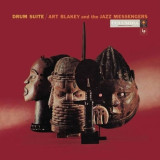
One of the inventors of the modern bebop style of drumming, Blakey is known as a powerful musician and a vital groover; his brand of bluesy, funky hard bop was and continues to be profoundly influential on mainstream jazz.
For more than 30 years his band, Art Blakey & The Jazz Messengers included many young musicians who went on to become prominent names in jazz. Recorded in 1956, Art Blakey's Drum Suite is a wonderful hybrid of African, Latin, and hard bop rhythms that prefigures the concept of Afro-beat by at least a decade. The sheer energy, not to mention its very special and fresh-sounding intimacy, make it especially astounding.
Even more amazing is that the three parts of the suite -- Blakey's "The Sacrifice," Ray Bryant's "Cubano Chant," and Oscar Pettiford's "Oscalypso" -- were recorded straight through live, and were only intended to be a pre-take run-through. As is obvious here, Blakey and company nailed the whole thing right out of the box.
Groundbreaking for its time, and still sounding vital, powerful, and visionary, the Drum Suite album is somewhat of a lost masterpiece that deserves a fresh audience.
"Art Blakey's first release for Columbia Records is essentially two records. Side one is a percussion ensemble playing what would, ten years later, be called Afro-Cuban drumming. Side two is the mid-fifties version of the Jazz Messengers featuring Jackie McLean on saxophone. Side one features Blakey, Jo Jones and Charles Wright on drums, Candido and Sabu on bongos, and Oscar Pettiford and bass and cello. The group plays three compositions, one by Blakey, one by Pettiford and one by Ray Bryant, fusing African, Cuban, and calypso percussion into a well-integrated suite.
"The group recorded a run through and it was so perfectly executed that they used the practice run for the release, unedited except to add some Swahili chants by the percussionists during a few passages. One cannot help but think of Olantunji's Drums of Passion, another Afro drumming landmark, here. Blakey's drum suite was recorded at Columbia's 30th Street studios in New York in 1957 and is in mono. The almost stereoscopic image is truly remarkable. Mastered by Kevin Gray and pressed at RTI, Drum Suite is a valuable record of one of the most important figures in jazz history. Recording: 9/10. Music 9/10." - Dennis Davis, Hifi+
"...The three-part suite was laid down in one take with no arrangements, and begins with a few tympani thwacks followed by an African chant. Soon the ensemble kicks in and the group takes off an a sweaty Afro-Cuban-bop journey that will leave you breathless, as the thing crackles with terrific energy. Side Two is more conventional hard bop, but given this group's mastery of if not invention of the style, these tracks are extremely satisfying. Kevin Gray's remastering is detailed and immediate, with plenty of bit and air, if not the widest dynamic range. For anyone interested in percussion of this genre, this is not to be missed." - Wayne Garcia, The Absolute Sound
- A1: Maroon Commandos - Bi Sophia N°1 (El Sofia)
- A2: Issa Juma & Waanyka - Ateka (El Corín Tellado)
- B1: Orchestre Shika-Shika - Diabanza (La Gallina Java)
- B2: Viva Makale - Safari (La Mecedora)
- B3: Les Mangelepa - El Trouble Pt 1 (El Trouble)
- C1: Nairobi Matata Jazz - Dada Mwajuma (La Pistola)
- C2: Les Volcano - Hakuna Dawa Ya Mapenzi (La Guitarra Sónica)
- D1: Lawi Somona - Safi (El Mapache)
- D2: Les Kilimambogo - Wakumbuke Wazazi (El Coyote)
- D3: Les Mangelepa - El Trouble Pt 2
This compilation takes us on a journey to the Colombian coast where the passion for African music burns bright.It's impossible to understand this love affair without first looking to San Basilio de Palenque - the first free town in colonial Latin America, established in 1691 as a place of refuge and autonomy for black slaves. It's a place where pride in African heritage and culture could be kept alive, just 50 km away from Cartagena de Indias.
The Afro Caribbeans' connection to their roots gave rise to the "picós" - artisanal, high-powered sound systems akin to those found in Jamaica. These music aficionados have a keen ear for African melodies, leading to a vibrant collector's scene that brought Afro sounds to the streets of Barranquilla, Cartagena, and Santa Marta. This compilation showcases the best of Kenyan Benga music - a unique style with a distinct guitar-picking method that draws from traditional instruments like the nyatiti and orutu. Learn everything about the history and stories behind these African tracks, from the carefully guarded "exclusives" to the piconema - the practice of renaming songs in Spanish based on their lyrics or the reaction of the dancefloor.
The project has been led by Spanish vinyl collector Joan Pujol aka Golfo De Guinea surrounded by a team of passionate music lovers including Don Alirio, a musicologist from Barranquilla who offered a coastal perspective, and George Ouma, a Kenyan DJ, collector, and Benga advocate who helped with track selection and securing rights. The result is a compilation that captures the joy and energy of sub-Saharan polyrhythm, bringing together a vibrant mix of genres that are sure to move your feet. So sit back, turn up the volume, and let yourself be transported to the vibrant streets of the Colombian coast and the shores of Lake Victoria.
- A1: The Battle Dub Feat Emilie Chick (Straight Dub Mix)
- A2: Galactic Beats Dub (Straight Mix)
- A3: Lava Dub Feat Ua (Straight Dub Vocal Mix)
- A4: Mirror Dub Feat Josué Thomas (Straight Mix)
- A5: Outer Space Dub Feat Dj Krush (Straight Dub Mix)
- B1: I'm Thinking, I'm Spacing Dub Feat Afrika Bambaataa (Straight Dub Mix)
- B2: Sumimasen Suite Dub Feat Emily Capell, Rebel Dread (Straight Dub Mix)
- B3: We Need Power Dub Feat Josh Milan (Straight Dub Mix)
- B4: Hear?There? Beyond Dub Feat Kan Takagi, Reck (Straight Dub Mix)
Yasushi Ide, the Japanese Street Music Icon Unleashed "Cosmic Suite 2" in a Revolutionary Blend of Genres.
Yasushi Ide, the revered figure in Japanese street music, has recently unveiled his latest musical opus titled "Cosmic Suite 2," a rebel music masterpiece that pushes the boundaries of musical genres.
This groundbreaking album features collaborations with esteemed pioneers including Afrika Bambaataa, Don Letts, Josh Millan, Jeff Mills, DJ Krush, Tony Allen, and more. By transcending the limitations of time, genre, and even mortality, Ide has crafted a truly unique and eclectic street music experience unlike anything seen before.
Notably, Ide enlisted the expertise of Grammy-winning sound engineer Steven Stanley to embark on the reconstruction of "Cosmic Suite 2" using his renowned dub mix techniques. The outcome of this collaboration is the birth of "Dr. Steven Stanley Meets Yasushi Ide - Cosmic Disco Dub," a mesmerizing rendition that showcases the genius of both artists.
Hailing from Jamaica, Steven Stanley is a highly regarded sound engineer and producer whose illustrious career spans several decades, primarily in the realms of reggae, dub, and rock music. Having worked with acclaimed acts such as Talking Heads, Black Uhuru, and Tom Tom Club, Stanley has solidified his status as a living legend within the industry. His contributions to Tom Tom Club's "Genius of Love" and his Grammy-winning work on Black Uhuru's "Anthem" further exemplify his unparalleled expertise. Additionally, Stanley has collaborated with notable artists including Grace Jones and B-52's.
In "Dr. Steven Stanley Meets Yasushi Ide - Cosmic Disco Dub," Stanley expertly integrates elements from the original "Cosmic Suite 2" tracks, employing his unique dubbing techniques to enhance the sonic experience. Through the addition of his signature dubby reverb and other distinctive sound manipulations, Stanley elevates the album to an entirely new dimension.
"The Battle" Transformed into an Enchanting Disco Dub Experience, Infused with Stanley's Horn Section Effects for a smoky ambience.
In the mesmerizing track "Galactic Beats," the legendary Afrobeat pioneer Tony Allen's powerful drums take center stage. Skillfully applying his dub effects, Stanley adds vibrant layers and new dimensions to the composition, further enhancing its sonic palette.
Another standout is the dub version of "LAVA," featuring acclaimed Japanese singer UA. The track, which was already a fan favorite in its original form, undergoes a remarkable transformation in this dub rendition, further accentuating its appeal.
"Outer Space" Transcends Time and Genre with a Dream Collaboration Between the Late Legendary Reggae Drummer Style Scott and Japan's Turntablist Extraordinaire, DJ Krush. While the original track exudes a stoic and deep cosmic dub essence, Stanley ingeniously reimagines it as a nostalgic old-school dancehall masterpiece.
"Sumimasen" is a track that exemplifies Stanley's mastery, where the unique Japanese word "Sumimasen" (meaning "I'm sorry") is transformed into a psychedelic and deeply immersive dub journey. The track features captivating echoes on the vocals and twisted synth elements, transporting listeners to a cosmic realm of sonic exploration.
Furthermore, it is crucial to highlight "Hear, There, and Beyond," a collaboration between Yasushi Ide, Kan Takagi, the pioneering figure of Japanese hip-hop, and RECK, the bassist from the legendary punk rock band FRICTION. This reconstructed version takes the original track to unprecedented heights. With a remarkable shift to tribal drums in the midst of the song, the energy intensifies, resulting in a wild and exhilarating musical experience.
The reconstruction of this album evokes memories of Mad Professor's "No Protection," a renowned dub reconstruction of Massive Attack's work that remains an enduring masterpiece in the genre. With its exceptional craftsmanship and artistic vision, "Dr. Steven Stanley Meets Yasushi Ide - Cosmic Disco Dub" has the potential to be regarded as another timeless dub reconstruction masterpiece, solidifying its place in music history.
Founded in 1971, Matumbi was among the earliest and best British reggae bands. They did, however, also record under different guises, including 4th Street Orchestra. In their acclaimed Rough Guide to Reggae, Steve Barrow and Peter Dalton rate this album (and its counterpart Ah Who She? Go Deh!) as 'the best showcases for Matumbi's talents'. This release marks the first LP reissue of this genuine UK roots monument since 1976.
Original member Dennis “Blackbeard” Bovell (of LKJ and Dub Band fame) knew the local sound system scene like the back of his hand, and most tracks on Leggo! Ah-Fi-We-Dis were initially cut as exclusive 'specials' for his own Jah Sufferer sound system and for fellow soundmen. Hardly anyone hearing these tunes at reggae parties would have guessed they didn't originate in Kingston but were recorded in London. And neither did many who bought the records when they were released a few years later. That's hardly surprising, as the material Bovell & Co churned out could easily compete with the toughest output of their Jamaican counterparts. The solid interpretation of Junior Delgado's "Tichion" and a scorching, melodica-led version of Ras Michael's "None-Ah-Jah-Children" are the most familiar tunes here. And a militant update of Max Steiner's "Theme From A Summer Place" displays good fun as well as guts. But the band's outstanding originals will give many '70s Jamaican classics a good run for their money.
Delicious new school, street soul from Freya Roy, self-released and limited to 100 pressings. Hailed as “Street Soul is back” by Gilles Peterson, British-German artist/producer Freya Roy is steadily making her mark on the nu-jazz and alternative soul scene. With the release of her 8 track LP ‘For Who I Have Become’, her engrossing vocals and production takes you through the dark and moody new school, and into a blissful, soulful soundscape, with glistening guitar lines and haunting backing vocals. Along with a handwritten insert, and bonus tracks including Roy’s 2020 release ‘Fantasies’ featuring a fiery vocal from Maya Law, this limited pressing is not one to sleep on.
[g] B3. Fantasies ft. Maya Law (Original) [Vinyl Bonus]
[h] B4. Day Is Done (Instrumental) [Vinyl Bonus]
The best R&B songwriter and soul singer that most people have never heard of, Sam Dees has written songs for countless artists, including Gladys Knight, Aretha Franklin, Whitney Houston, George Benson, the Temptations, Teddy Pendergrass, Millie Jackson, Jackie Wilson, the Manhattans, Regina Belle, KC & the Sunshine Band, Willie Clayton, and many others. He's also a pretty fine singer, having recorded for the Chess, Atlantic, Polydor, and SSS labels, and he had a nice string of his own hits in the 1970s. His 1975 Atlantic album The Show Must Go On has long been regarded by Southern soul aficionados as one of the best of the genre. Sounding a bit like a deeper-voiced Curtis Mayfield (in both style and theme), Dees sings with assurance, wisdom, passion, and a whole lot of soul here. Songs like "Child of the Streets", "Troubled Child," & "What's It Gonna Be," share Mayfield's commitment to social commentary, and Dees knows his way around a love song, too. It's absolutely essential.
New York, NY (May 09, 2023) - Techno powerhouse, Charlotte de Witte releases her highly anticipated EP, Overdrive as the anchor to her larger Overdrive Campaign within the KNTXT Label. Following de Witte’s breakthrough to the top of the electronic music scene in 2019 with her signature sonic approach that refuses to be boxed in, Overdrive is a reflection of this ethos. The EP aims to showcase street style that is both rough and energizing, while delivering high-energy tracks meant to pull listeners into the fast-paced thrill that unlocks one's turbocharged version of themselves. Listen HERE.
“While making Overdrive, I didn’t fully realize how applicable the lyrics are to my philosophy of life,” said de Witte. “The fast-paced tempo, which goes full force without looking back, is all about the feeling of being on the edge and living life to the fullest.”
Best known for her “dark and stripped-back” brand of techno and underground music, DJ, record producer, and label head de Witte pushes the boundaries of the electronic genre with music that has a distinct and unforgettable sound that is uniquely her own. De Witte’s innovative ability allows her to seamlessly blend genres and styles that have won her a dedicated fan base and critical acclaim.
“Overdrive is a love story between hip hop and techno, it’s inspired by both genres, but coated in a techno jacket,” said de Witte. “It’s meant to be played loud while driving at night and watching the city lights pass by, and where better to experience that than in New York City?”
Overdrive marks de Witte’s first release since her single “High Street,” and first EP on her KNTXT label since her last EP, “Apollo” which was released in October 2022 as well as her collaboration with fellow techno artist Enrico Sangiuliano on the “Reflection” EP in March 2023. De Witte had previously worked with Sangiuliano on their remix of “The Age Of Love”, which amassed over 40 million streams on Spotify and achieved certified gold status in Belgium. De Witte’s other recent releases include her “Universal Consciousness” EP in 2022 and her “Formula” EP in 2021, which featured the chart-topping lead track “Doppler”.
- Moanin’ (Bobby Timmons)
- Superstition (Stevie Wonder)
- Iko Iko (James Crawford)
- Señor Blues (Horace Silver)
- When A Man Loves A Woman
- (C. Lewis & A. Wright)
- Freedom Jazz Dance (Eddie
- Harris)
- Sidewinder (Lee Morgan)
- Brother Where Are You?
- (Oscar Brown)
- Wade In The Water (Traditional)
- Work Song (Nat Adderley)
- Land Of 1.000 Dancers (Chris
- Kenner)
- Gimme Some Lovin’ (S
- Winwood & S. Davis)
- Motherless Child (Traditional)
- New Orleans Strutt (Jack
- Dejohnette)
- La Place Street (Stanley
- Turrentine)
- Amen (Traditional, Arr. By Bob
- Belden)
- Jubilation (Junior Mance)
- Joshua (Traditional)
- Mr. Magic (Ralph Macdonald &
- William Salter)
- Theme From Shaft (Isaac
- Hayes)
- Nobody Knows The Trouble
- I’ve Seen (Traditional)
Who did Aretha Franklin not want to miss out on when she recorded
her most inspiring albums in the early Seventies? Who gave Steely
Dan the beat? Who did Isaac Hayes, Donny Hathaway, BB King,
‘Sweet’ Lou Donaldson and Joe Cocker give the chair behind the
drums? No drummer has seen the inside of a studio as often as
Bernard ‘Pretty’ Purdie.
Not for nothing do colleagues attribute the ‘funkiest soul beat on the
scene’ to the drummer, and consequently, Purdie has never relied on
the genre of jazz alone, but rather curiously looked beyond the
borders. Sessions with The Rolling Stones, James Brown, Jimi
Hendrix or Tom Jones are no problem for him, whose precise and
sensitive playing is synonymous with drive and groove. This is
probably one of the reasons why his rhythms are still sampled by
many DJs today.
Released on CD back in 1996 and 1997 (and now out of print), the
two ‘Soul to Jazz’ recordings have a cult factor today and sound as
fresh as they did back then. Now both albums are released together
for the first time as a 3LP set.
These recordings are peppered with lots of prominent star guests
from jazz and soul, from Eddie Harris, Michael Brecker and Nils
Landgren to Hank Crawford, Stanley Turrentine and Cornell Dupree.
Purdie’s ‘Soul to Jazz’ project takes two different approaches: The
first part focuses on the renowned WDR Big Band led by Gil
Goldstein. Soul classics such as Stevie Wonder’s ‘Superstition’,
‘When a Man Loves a Woman’, Eddie Harris’s ‘Freedom Jazz Dance’
and Lee Morgan’s famous groove tune, ‘Sidewinder’, are interpreted
in large scale sound. One discovery of these recordings amidst all the
renowned guest soloists is the New York-born singer, Martin Moss.
The great success of this first album, released under ‘Soul to Jazz’,
led to ‘Soul to Jazz II’, a more intimate record, but one that picks up
where the first recording left off, by exploring similar themes. Again,
Purdie has called together a notable band of kindred spirits, including
saxophonists Hank Crawford (BB King, Ike and Tina Turner, Ray
Charles), Stanley Turrentine (Jimmy Smith, Shirley Scott) and Vincent
Herring, as well as guitarist Cornell Dupree (King Curtis) to pianists
Benny Green and Junior Mance.
Bernard Purdie’s ‘Soul to Jazz’ is a timeless classic and a blueprint of
the soul jazz genre in all its facets. Above all, it is a portrait of one of
the most influential and best drummers in the world, who made jazz
groove with his inimitable funky soul beat
- A1: The Carver Area High School Seniors - Get Live '83 (The Senior Rap)
- A2: Mike T - Do It Any Way You Wanna
- B1: Chapter Iii - Real Rocking Groove (Rap & Breaks)
- B2: Sinister Two - Rock It, Don't Stop It
- C1: Sangria - To The Beat Y'all
- C2: Funky Four Plus One More - Rappin' And Rocking The House
- C3: The Just Four - Girls Of The World (Genius Rap & Breaks)
- D1: Eye Beta Rock - Super Rock Body Shock
- D2: Funky Constellation - Street Talk (Madam Rapper)
- E1: Kool Kyle The Starchild - Do You Like That Funky Beat (Ahh Beat, Beat)
- E2: The Just Four - Jam To Remember
- F1: Grandmaster Flash And The Furious Five - Super Rappin' No 2
- F2: Silver Star - Eei Eei O
- A1: Magic's Trick - Magic's Rap - Mono (7")
- B1: Magic's Trick - Magic's Rap - Stereo (7")
Yo! Boombox is the new instalment of Soul Jazz Records’ Boombox series on the early days of hip-hop on vinyl and features some of the many innovative underground first-wave of early rap and disco rap records made in the USA in the period 1979-83.
The album includes the first releases of seminal groups such as Grandmaster Flash & The Furious Five and The Funky Four Plus One More through to a host of rarities and little-known obscurities such as the Carver Area High School band’s ‘Get Live 83’, an awesome record made at a Chicago high school.
The album is released as a deluxe triple LP complete with 3x full inner sleeves of extensive sleeve notes, exclusive photography and original label artwork. There is also a very-limited one-pressing only special deluxe version that comes with an extra bonus super-rare 7” single of ‘Magic’s Rap’ by Magic’s Trick, aka ex-marine Magic Fraga, a record that was only ever available on US military bases!
Yo! Boombox also features the stunning photography of Sophie Bramly, one of a very select group of photographers (alongside Henry Chalfant, Martha Cooper, and Joe Conzo) who were allowed full access to document the exciting early days of hip-hop in New York.
These first exuberant wave of innocent, upbeat, party-on-the-block rap records were the first to try and create the sounds heard in community centres, block parties and street jams that first took place in the Bronx in the mid-1970s. Where the first DJs – Flash, Kool Herc and Bambaataa – were back-spinning, mixing and scratching together now classic breakbeat records like The Incredible Bongo Band’s Apache or Babe Ruth’s The Mexican, these first pre-sampling rap records were all made using live bands, often replaying then current disco tunes.
As Chic’s ‘Good Times’ was to ‘Rappers’ Delight’, the songs here feature then-current dancefloor hits such as the Tom Tom Club’s ‘Genius of Love’, Cheryl Lynn’s ‘To Be Real’, MFSB’s ‘Love Is the Message’ while MCs rapped over the top, creating a unique new sound. In fact, the links between disco and rap date back earlier to the ‘party style’ MCing of figures such as the legendary DJ Hollywood or radio DJs like Frankie Crocker.
This new Soul Jazz Records collection
celebrates these first old-school rap
records, bringing together rare, classic
and obscure tracks released in the
early days of rap.
When Belgian Adolphe Sax invented the saxophone in the mid-19th century, he could not have imagined what he had set in motion with his invention. Neither in classical music nor in military music did his new woodwind instrument find much appreciation. It was only long after his death that it became the most important instrument in jazz music via swinging big bands. It would probably have amazed Mr. Sax if he had been able to witness a young trio from Germany playing loudly against climate change and the lack of political consequences with two noisy saxophones and a drum set on a stage in front of the Reichstag in Berlin in front of more than 50,000 people jumping up and down during the climate strike in September 2021: BRASS RIOT.
The trio around Constantin von Estorff (Sax), Simon Sasse (Drums) and Carl Weiß (Sax) have been a band since their school days in Lüneburg. What started there as street music became a permanent and sought-after formation through the proximity to political initiatives, above all the Fridays-For-Future movement, and appearances at countless demonstrations. The band's name is slightly misleading, as "brass" in music refers to brass instruments such as the trumpet or tuba, even though most brass bands always include a saxophone. Moreover, the word "brass" means something in the German language, which in turn fits perfectly with this young, energetic trio: Fury.
On the heels of their debut album "Matschsafari" (2018), their second studio album "The Never Acting Story" is now released on Fun In The Church. The album title, in critical allusion to the world-famous fantasy book by Michael Ende, sums up well what the music of BRASS RIOT is about at its core: the possibility to get a noisy outlet for all the fury about the failed politics of the last decades and the frustrations and fears that go with it, and to free oneself from it for a moment. That this path has produced the wildest live music on this crisis-ridden planet is an irony of history - and certainly not the first time it has happened. It's no different in the jazz of Charlie Parker than in the songs of Patti Smith, the raps of Little Simz or the Afro-beat of Fela Kuti.
Musically, BRASS RIOT move more in the area of the melodic ska-pop of Madness, the fake jazz of the Lounge Lizards and contemporary rave brass ensembles like MEUTE between house music and electro beats. The fact that they have managed to politicize their sound so strongly over the years, despite all the party that goes with it, and without any song lyrics at all, is truly phenomenal.
Repress!
**NEW 2018 ALBUM FROM KIKAGAKU MOYO**The shifting dimensions of Masana Temples, fourth album from psychedelic explorers Kikagaku Moyo,are informed by various experiences the band had with traveling through life together, ranging from the months spent on tour to making a pilgrimage to Lisbon to record the album with jazz musician Bruno Pernadas. The band sought out Pernadas both out of admiration for his music and in an intentional move to work with a producer who came from a wildly different background.
With Masana Temples, the band wanted to challenge their own concepts of what psychedelic music could be. Elements of both the attentive folk and wild-¬-eyed rocking sides of the band are still intact throughout, but they're sharper and more defined.
Kikagaku Moyo started in the summer of 2012 busking on the streets of Tokyo. Though the band started as a free music collective, it quickly evolved into a tight group of multi-¬-instrumentalists. Kikagaku Moyo call their sound psychedelic because it encompasses a broad spectrum of influence. Their music incorporates elements of classical Indian music, Krautrock, Traditional Folk, and 70s Rock. Most importantly their music is about freedom of the mind and body and building a bridge between the supernatural and the present. Improvisation is a key element to their sound.
More than the literal interpretation of being on a journey, the album's always changing sonic panorama reflects the spiritual connection of the band moving through this all together. Life for a traveling band is a series of constant metamorphoses, with languages, cultures, climates and vibes changing with each new town. The only constant for Kikagaku Moyo throughout their travels were the five band members always together moving through it all, but each of them taking everything in from very different perspectives. Inspecting the harmonies and disparities between these perspectives, the group reflects the emotional impact of their nomadic paths. The music is the product of time spent in motion and all of the bending mindsets that come with it.
The first ever release of electronic Jaglara, an obscure dance music being innovated in an area near the Sudan, Ethiopia, and Eritrea border called Fashaga.
Among the most raucous, hypnotic, addictive, and celestial dance styles being made anywhere in Africa, this heavy, mysterious sound is being led by one man: Jantra, which translates as "craziness," a moniker bestowed to celebrate both his personality and sound. Jantra is a rather unknown quantity even in Sudan, outside of the circles which have granted him cult status to perform at their humble gatherings or at street parties far from the gaze of the cities.
Jaglara, which roughly translates as improvisation, has no songs. Jantra simply freestyles a combination of his melodies incessantly for hours on end, acting as a live producer and DJ for emphatic crowds, where the energy of his 155 - 168 BPM music is known to inspire the odd gunslinger to raise and fire his pistol in the middle of the dance floor. His music is hopeful in a hopeless world, uplifting in spirit, ancient and new, childish and mature, familiar yet refreshingly obscure, fueled by the hypnotic Sera rhythm. His Yamaha keyboard is specially tweaked to achieve what you're hearing — the perfect, sweet key tone, literally universal in its appeal.
A hybrid reissue-contemporary album, Ostinato combined extracted individual melodic patterns, rhythms, and MIDI data from Jantra's Yamaha keyboard with his older cassette and digital recordings to recreate his lengthy sessions into individual dance tracks for a worldwide audience to reach the enviable frenzy of Sudanese crowds. This promising new dance music emerging from the deepest reaches of Sudan has never made its way outside of Jantra's parties, let alone outside of the country.
This record is confirmation that the many electronic styles being exported from Africa have a worthy sibling and rival—Jantra's signature electronic Jaglara from the Fashaga underground. It is a privilege of the highest order to be exposed to this unheralded, incredibly well kept rural Sudanese secret.