Aphasy, a dive into a fascinating sonic universe. A two-sided journey. Designed with a strong artistic vision, the artwork showcases a striking duality between Side A and Side B, offering a contrasting auditory experience. Side A, adorned with a delicate shade of pink, embodies the essence of deep, lyrical, and ethereal tracks. The melodies unfold with mesmerizing lightness, enveloping the listener in an atmosphere of softness and contemplation. Vibrant basslines and subtle rhythms intertwine with evocative sound textures, creating a musical landscape that invites reverie and escape. Flipping the record reveals Side B in all its dark and nostalgic splendor. The back of the sleeve immerses the listener in a more introspective and captivating world. The tracks on this side unveil emotional depth and hypnotic intensity. Darker tones, dissonant harmonies, and entrancing rhythms transport us into an enchanting atmosphere, evoking feelings of melancholy and introspection. This record embodies the very essence of electronic music, with its intricate sound textures, signed by Romain Mégroz.
Поиск:subtle by design
Все
Acclaimed Scottish composer Craig Armstrong releases his new work Pacific via his own label CMA Records. Written for piano, cello, and electronics, the three-movement piece was originally commissioned in December 2024 by Christian Kellersman, a pioneering figure in contemporary classical and jazz music, for his new live event series Berlin Confidential, co-curated with Alexander Szlovák. The series aims to promote innovative new music projects, with a particular focus on emerging musicians and composers.
Armstrong was among the first artists invited to perform as part of Berlin Confidential, premiering Pacific at Berlin’s historic Meistersaal concert hall in March 2025. The concert featured Armstrong on piano alongside cellist Lena Angelina von Almen and producer and musician Guy Sternberg, combining acoustic instruments with live electro-acoustic treatments to create a rich and atmospheric sound world.
Recorded in May 2025 at Lowswing Studios in Kreuzberg, Pacific continues Armstrong’s ongoing exploration of blending acoustic and electronic sound in a natural, seamless way. Over several days in the studio, Armstrong, von Almen and Sternberg developed the work’s intricate textures and dynamic interplay, resulting in a recording that captures both the intimacy and expansiveness of the original live performance.
Speaking about the inspiration behind the piece, Armstrong says: “I wrote this work during a time of great instability in the world, I wrote “Pacific” as an Elegy dedicated to the many suffering in today’s conflicts and in the hope that peace will prevail.”
Across its three movements, Pacific 1 is elegiac in nature, with the main themes stated and developed throughout the piece, punctuated by recurring piano motifs. The movement is reflective and atmospheric, with subtle electronic interventions. The second movement is arrhythmic in nature, following shifting time signatures that reflect a sense of uncertainty - the music is searching and static, ending without resolution but leaving hope for one to come. Pacific 3 moves towards peace and resolution, bringing the work to a close with quiet strength and emotional release.
When speaking about the creative process and his collaborators, Armstrong said: “Lena’s beautiful playing , tone and expression worked so beautifully on Pacific, Lena was also a great collaborator and was always willing to experiment and try new musical approaches. Lena is such a natural musician and she brought so much emotion and beauty to the piece. I wish her all the best in her future musical journey.”
He continues: Guy is a unique combination of being a brilliant engineer and mixer and a prolific very talented musician/composer. I was very fortunate to spend time with Guy in his studio in Berlin. His sensitivity to the project and his electronic programming made a wonderful contribution to the composition. His collaboration and friendship made the days working in Berlin such a great experience I would like to thank Emma Ford for her dedication, enthusiasm and guidance on Pacific”
For both von Almen and Sternberg, the collaboration was equally meaningful. Von Almen reflects on the experience of recording the piece, saying: “As a musician, it is always a great privilege to work on a piece together with the composer, and of course I felt even luckier to go through the process of creating something new with an artist like Craig Armstrong. Figuratively speaking, it felt like knitting a silk scarf: using the finest materials and taking the utmost care during the recording, we have realised another beautiful and touching work by Craig, which will bring us and certainly many others great joy. I feel very honoured to have been part of this and to have experienced this warm encounter.”
Sternberg adds: “Diving into Armstrong’s music while working on this record felt like examining a diamond under a microscope, discovering endless beauty within simplicity. Perfection and complexity emerging from simplicity, where every note, tone, noise, and gesture has meaning. I’m deeply grateful to have been part of this process, and for the freedom Craig gave me to express myself through his music, to let our sonic visions merge into one. It’s been both a lesson in music-making and in setting the ego aside, if only for a moment.”
Reflecting Armstrong’s belief in the role of music as a force for empathy and reflection, proceeds from Pacific will be donated to charities working towards peace: Médecins Sans Frontières and the Red Cross.
The limited-edition vinyl release has been pressed on Eco Vinyl at SeaBass Vinyl, a sustainable plant near Edinburgh. The record features striking cover art by Dirk Rudolph, who has designed several of Armstrong’s previous releases.
Four years on from their landmark Grassroots, visionary half-time heavyweights The Untouchables return with their third album, Lost Knowledge. The duo of Kate McGill and Ajit 'Nitrox' Steyns have carved out a space in modern D&B all their own, building on a legacy that reaches back to the late 00s to keep pushing into unexplored terrain with an assured and deadly line in rhythmic intrigue and atmospheric immersion.
Lost Knowledge launches into action instantly with the high-pressure drum science and dubby splashes of 'Drunken Bells', capturing the loopy techno propulsion and rolling intensity that drives so much of the output on Samurai Music. Where The Untouchables excel is in finding variety and nuance in their relatively forbidding, pared down sound. The heads-down groove of 'Mafia Town' owes as much to dembow and dancehall as D&B, while 'Lost Knowledge' spirals out into psychoactive flurries of synth strafes and organic percussion slathered in tight-locked delay trails. There's no light relief from strident hooks or riffs, just a pure, unshakeable commitment to the power of the beat and deeply designed layers of sound shaping out the space around.
'Busy Bones' makes space for carefully deployed hints of pad tone while the snares snap out of the mix with a sharp set of teeth. 'Four Eared Demon' baits the gabber crowd with its rapid-fire 4/4 hats atop seasick creaks across the midrange, keeping subtlety and patience in the lower frequencies to maintain the signature elegance readily associated with The Untouchables. 'Phase Correlation' teases an artfully unhinged ripple of synth that stands out amongst the murky murmurs filling out the middle distance, but it's still exercised with brutal precision.
Nothing happens by accident or feels out of place - McGill and Steyns are in total control, and they demonstrate incredible range and inventive approaches within their focused style. The accent of the grooves shifts, and individual sounds carry all kinds of artefacts, yet everything gets folded into the exacting Untouchables sound with a liberal dubwise sensibility. Brimming with inspiration and immaculately produced, on Lost Knowledge their one-of-a-kind sound is stronger than ever.
Identified Patient returns to Dekmantel for a third time with his Reset EP. The future-facing four tracker is another mutant fusion of bass and techno with low-end power with cerebral sound designs.
Job Veerman debuted on the Dekmantel UFO Series in 2019, returned in 2020 and has lit up the festival several times with transportative sets that balance power with precision. Like his productions on the Nerve Collect label, he co-runs with Gamma Intel, they are leftfield explorations of genre and tempo that find strange sensuality in often abstract ideas. Once again here, the Dutchman draws on eclectic influences to craft music that sounds like no one else but remains anchored by magnetic rhythms.
Opener 'Light' kicks off with a fuzzy synth line that slithers between syncopated drums. Whispered vocals drift through the mix as lurching basslines swell and collapse beneath them. The groove disassembles and reassembles in waves, propelled forward by bursts of glitchy, off-kilter percussion that's unsteady yet seductive. 'Scales' is a slow, menacing descent into rhythmic darkness. It sounds both ancient and futuristic with ghoulish vocalisations and filtered synths flickering like a badly wired circuit. There's a rave tension lurking throughout, but always in the shadows.
'Internal Pace' drives on but rides fluid, wobbly bass while tightly looped hits build the pressure. Layers of static and subtle distortion add grit to this unrelenting heads-down roller. Finally, 'Return' is a kinetic, razor-edged ride where jungle breaks collide serpentine melodies. Ethereal female coos drift in and out, brushing against spat-out vocal fragments so that tension crackles throughout this hallucinogenic trip.
With Reset, Identified Patient reaffirms his status as a singular voice who twists sound into evocative new worlds.
Proud to present you our third RETROFUTUR compilation, including 6 tracks by our most regular artists.
Endrik Schroeder opens the ball with the pure warehouse banger “Automated” ! The track’s sonic intensity never falters, driven by a relentless rhythmic structure and saturated synthetic textures. The modulated layers and the syncopated break recreate the visceral urgency worthy of the underground raves of the 90s.
With “Happy End,” Brandski distils a contagious euphoria, designed to set the dancefloor ablaze with collective joy. A leading figure of the Italian-French new wave, he creates a track as jubilant as it is unstoppable, where rhythmic mastery flirts with festive instinct. An invitation to luminous abandon: arms raised, shared smiles, communion guaranteed.
With “Eldorado” John Lord Fonda reaffirms his status as a key ambassador of French techno on the international scene. The track unfolds a relentless, extremely tense groove, where darkness becomes driving tension. A rigorous, almost martial sound signature, serving an uncompromising vision.
“White Light” by Panthera is a polished track that transports us on a euphoric journey. The heavy, incisive kick blends with atmospheric layers and heady arpeggios, creating a constant tension that culminates in thunderous drops. The whole thing is supported by a deep, vibrant bassline, typical of the 90s rave scene.
Once again, Berlin’s My Secret Playground stands out as the architect of a muscular German nu-disco, flirting with the boundaries of techno. “Don’t Panic” combines percussive pulses and dark tension, while distilling subtle reminiscences of the disco aesthetic. A masterful sonic hybrid, between retro hedonism and contemporary intensity.
Club Mayz delivers a masterful closing performance with “Tonight I Have To Hide”, an electro track fueled by the raw heritage of Detroit techno and the dark textures of EBM. The track combines dramatic tension and synthetic precision in a nocturnal and introspective aesthetic.
- A1: Time Was
- B1: Sometime World
- B2: Blowin' Free
- C1: The King Will Come
- C2: Leaf And Stream
- D1: Warrior
- D2: Throw Down The Sword
Wishbone Ash reigned supreme through the 1970s — centered on inspired musicianship, joyful spirit and inventive songs. Their concerts were uplifting and their recorded work sublime. Argus remains a stunning high point in the band's startling repertoire. Argus was a 1972 tour de force, a hard-rocking masterpiece that has gone on to have a huge impact on rock bands moving forward. If you've never heard Argus, you've surely heard music that it inspired.
The British quartet's trademark harmony guitars became a touchstone for many: Thin Lizzy, Iron Maiden, Opeth, and Lynyrd Skynyrd have all acknowledged an Ash influence, and tracks such as Lizzy's "The Boys Are Back in Town," Maiden's "The Trooper," and even Steely Dan's "Reeling in the Years" all have twin-guitar moments that hark back to Argus. But Wishbone Ash were different from the start. They were never strictly a hard rock band; their soaring vocal harmonies and musical grandeur placed them close to progressive rock.
But they weren't strictly prog either: They had no keyboards, no real classical influence and weren't into side-long suites. Their roots were in the blues, and their calling card was twin lead guitars in harmony (played in the original lineup by Ted Turner and Andy Powell). Even the hardest Ash rockers — like "Blowin' Free," the most famous track from Argus — had an ethereal touch. They could rock the big stages, but they did it with subtlety and grace. This is reflected perfectly in the classic album sleeve by prog-associated designers Hipgnosis: The front cover shows a Greek sentry — the "argus" of the title — staring off into the distance. It's a mythic, old-world kind of image until you look closely at the back cover, and see that he's heralding the arrival (or perhaps watching the departure) of a spaceship.
Two worlds colliding. Exactly what the band and album were all about. By the time of Argus, Wishbone Ash were stars in England and cult heroes among Anglophiles in the US. What made Argus a step forward was its flow of moods. The songs don't run together, but there's an emotional connecting thread from the album's somber beginning to its heroic end. The band insisted at the time that lyrics were something of an afterthought: Shortly after its release, main lyricist Martin Turner told NME that he wrote them mainly to fit the mood of the music: "The music that was coming out was very English, very medieval, and the lyrics had to reflect that." Added Powell at the time, "The expression comes out in the guitars. We wouldn't play it if it didn't express something." Now, Analogue Productions has applied all of its vaunted craft and technical expertise to make this epic album shine! Two 45 RPM LPs pressed on virtually silent 180-gram vinyl at Quality Record Pressings make the remastered audio sparkle. Quieter lyrical sentiments and softer musical passages are rendered precisely, while majestic riffs and fist-waving anthems fully reveal the energy of the music! Argus isn't just another rock record — it's a journey through a sonic landscape rich with depth, emotion and technical prowess. It's the album that solidified Wishbone Ash as masters of twin guitar harmony. Discerning audiophiles will find Argus an essential addition to their record collection. It's a masterclass in sound engineering that fully captures the intricate interplay of dual guitars with pristine clarity and a warmth that only analog recordings can provide.
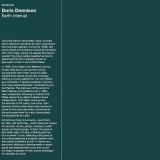
The discovery of Doris Dennison's score represents a genuine musicological breakthrough—what once would have been "a tree falling in the woods" thirty years ago now holds the potential to render "a thunderous clap in our minds." While researching Anna Halprin's lesser-known collaborators, scholar Tom Welsh uncovered the archives of AA Leath, one of Halprin's principal dancers. Buried within these materials was Dennison's handwritten score for Earth Interval, dated May 1956. Born in Saskatchewan, Canada, in 1908, and raised near Seattle, Dennison (1908-2009) encountered John Cage while teaching Dalcroze eurythmics at the Cornish College of the Arts. She joined Cage's earliest percussion quartet—alongside Margaret Jansen, the composer and his wife Xenia—in the group widely regarded as having performed the first complete concert of percussion music in the United States. This historic December 1938 concert was followed by tours and the landmark May 1941 performance at the California Club, comprising Cage and Lou Harrison's Double Music, the premiere of Cage's Third Construction, and Harrison's 13th Simfony.
As Bradford Bailey observes in his extensive liner notes, Earth Interval demonstrates "an extraordinary balance of elements that imbues the piece with a sense of clarity, directness, and constraint that is both distinct and ahead of its time." The work's most remarkable innovation lies in its approach to extended techniques, particularly Dennison's notation for the central movement: "In 2nd movement, 1st player lowers + raises a gong into a tub of water while beating." This technique, absorbed from Cage's experimental vocabulary, generates what Bailey describes as "fields of acoustic abstraction that bend and warp time through sustained resonances, beat, and space." The temporal sophistication of these manipulations anticipated Karlheinz Stockhausen's Mikrophonie I (1964) and Annea Lockwood's water-based sound investigations by over a decade. After joining Mills College as dance accompanist, Dennison maintained crucial connections to the Bay Area's experimental scene, collaborating with figures like Merce Cunningham and programming Cage's music throughout the 1950s.
Comprising three movements—Land Form, Air Tide, and Earth Play—Earth Interval is scored for recorder, drums, gongs, maracas, muted gongs, and bowl gongs. In total, the piece is just under eight minutes: "a fleeting glimmer of moment in time, a life spent at the cutting edge, and a singular creative vision that packs a powerful punch." When viewed in historical context, placed in contrast to roughly contemporaneous avant-garde percussion works by Cage, Harrison, Louis Thomas Hardin (Moondog), and Harry Partch, or important precursors like Edgard Varèse's Ionisation (1931) and Henry Cowell's Ostinato Pianissimo (1934), it's clear that Dennison was following her own path. Earth Interval is not derivative. It is a precursor to what was yet to come, alluding to developments of avant-garde and experimental music that wouldn't begin to appear on the cultural landscape until the 1970s and '80s, with the emergence of Post-Minimalism and more idiosyncratic artists and ensembles like Midori Takada, Ros Bandt, Peter Giger, Frank Perry, Christopher Tree, Michael Ranta, Gamelan Son of Lion, and Niagara.
This recording by Chicago's Third Coast Percussion, captured in March 2022, represents the first complete documentation of this pioneering work. The ensemble's interpretation reveals the piece's remarkable contemporaneity while maintaining its historical specificity. Where Cage, Harrison, and Partch employed "self-consciously off-kilter polyrhythms," Dennison's rhythmic sensibility anticipates minimalist developments by nearly a decade, yet integrates "forceful rests, as well as sharp shifts in sonic character, tempo, and meter, that break the momentum and breathe a sense of life into the piece's structure." This positions her work closer to Post-Minimalism decades before its emergence. The architectural approach demonstrates Dennison's understanding that "the composer almost entirely disappears" in favor of phenomenological listening experience, creating what might be called an egoless music that places its realities and meaning entirely in the ear of the beholder. The present recording, realized by Chicago's distinguished Third Coast Percussion ensemble, represents a significant achievement in experimental music scholarship and performance practice. As specialists in the Cage tradition and contemporary percussion repertoire, Third Coast Percussion approached Earth Interval with the historical sensitivity and technical precision required to illuminate Dennison's subtle compositional innovations. The March 2022 recording sessions, engineered by Colin Campbell, capture both the work's intimate chamber music qualities and its bold exploration of extended techniques. The ensemble's interpretation reveals the piece's remarkable contemporaneity—its ability to speak directly to current musical concerns while maintaining its historical specificity.
This recording serves multiple scholarly functions: it provides the first complete documentation of Dennison's compositional voice, offers insight into the broader network of experimental music practitioners surrounding Cage and Harrison, and demonstrates the sophisticated level of compositional thinking that was occurring within the Bay Area's dance-music collaborations of the 1950s. The work's emphasis on phenomenological listening—what might be called an "egoless" approach to musical experience—places it within a lineage of American experimental music that prioritizes perceptual process over compositional personality. The work's original obscurity—limited to AA Leath's performances at venues like the 1957 Pacific Coast Arts Festival at Reed College—paradoxically allowed it to remain "entirely on its own terms," free from the constraints of historical categorization. Drawing on Jacques Derrida's Archive Fever, the argument emerges that "the archive can acknowledge, celebrate, and resurrect" overlooked voices, transforming our understanding of experimental music history. The present Blume edition, featuring Third Coast Percussion's authoritative interpretation, includes a lavishly illustrated 16-page booklet designed by Bruno Stucchi / dinamomilano, containing complete scholarly apparatus, historical photographs, and detailed production notes. This recording enables "cross-temporal intersectionality," allowing Dennison to "belong to a newly formed and more dynamic understanding of the present and past," demonstrating how forgotten voices can reshape entire historical narratives when given proper scholarly attention and performance advocacy.
- A1: Dear Psilocybin
- A2: World Blew
- A3: In The Wind (Feat. The Alchemist)
- A4: Sweet Celine
- A5: Explains It Scientifically
- A6: Lost All Control
- B1: Accidental Killer
- B2: Hansel & Gretel" (Feat. Boldy James)
- B3: Trenchblade
- B4: Past Life (Feat. Mavi)
- B5: Buggin
- B6: Kingdom Come (Hyping Me Up)
- B7: Arîba! Arîba!
LA-based producer Real Bad Man and Detroit artist ZelooperZ release their joint album Dear Psilocybin via the pro-ducer’s own Real Bad Man Records. The album marks the duo’s first collaboration, culminating in a full-length project that also features guest appearances from Boldy James, MAVI and a verse from The Alchemist. On Dear Psilocybin, ZelooperZ invokes unconventional production out of Real Bad Man to match his own unpredictable and outlandish delivery, working outside of traditional song structures and existing in a lane of his own. The Detroit multihyphenate, who is an integral part of Danny Brown’s Bruiser Brigadecollective and also an accomplished visual artist, painted the album’s corresponding cover artwork as well.
“I definitely haven’t made anything like this before, it’s a very subtle version of my music as far as tone, ” ZelooperZ explained in a conversation with Real Bad Man for his RBM Radio show. He elaborates on the off-kilter approach to the way he recorded to say, “the album feels like a movie soundtrack for a film about a man losing his mind and getting spurts of memories along the way. ”
Speaking about how the project differs from the rest of his collaborative catalog, RBM says, “It’s trippy and it’s a little different – but the main goal was for it to be authentic to Z and his process. ” That dedication to authenticity rings true across his catalog, drawing back to the foundations of his beginnings as a producer, learning the fundamentals of sampling, experimenting with chords and learning to piece songs together by ear. RBM builds a cohesive production arc around each artist he works with, catered to their strengths as artists, working with a variety of lyrical stylists includ-ing Memphis rapper Lukah, Pink Siifu, Blu, Kool Keith, Elcamino & more.

Real Bad Man is the production moniker of visual artist and designer Adam Jay Weissman. A designer and visual artist first, he made his foray into music through his On High Alert series of imaginative, multi-generational compilations, which have featured the likes of Roc Marciano, ROME STREETZ, Pink Siifu, Maxo and more. In the years since, he’s partnered with some of hip-hop’s most talented and adventurous artists on full-length projects, refining and shaping the trajectory of some of rap’s most exciting independent artists.
ASR030 marks a proud moment for Arsenik Records, celebrating the 30th release together with ANNÉ. Built for the floor and rich in character, the EP flows through four distinct cuts, shifting naturally in textures and moods.
Opening with Frescoes, the EP sets a confident tone. Inspired by the ancient art of mural painting, the track weaves crisp percussion and rolling basslines into a flowing, groove- driven atmosphere — vivid and full of motion.
Lythra follows with a more introspective touch. Blending precise sound design and warm textures, it builds a subtle but powerful emotional pull beneath its steady pulse, loosely echoing ancient forms and symbolism.
On the B-side, Nyctis lifts the energy skyward. Carried by luminous synths and rolling momentum, it captures the fleeting euphoria of summer nights, offering a bright and open feeling without losing its grounding.
Closing the EP, Polynoe shifts into a breaky, more playful direction. Nodding to mythological imagery, it layers fractured rhythms and melodic rawness, bringing a fresh and unexpected twist to the final moments of the record.
- A1: My Lowville (2025 Remaster) 10 54
- A2: Auto Show Day Of The Dead (2025 Remaster) 07 11
- A3: Fucking Milwaukee's Been Hesher Forever (Part 1) (2025 Remaster) 03 50
- B1: Fucking Milwaukee's Been Hesher Forever (Part2) (2025 Remaster) 05 34
- B2: Re We're Again Buried Under (2025 Remaster) 07:026
- B3: The Surge Is Working (2025 Remaster) 08 14
'the fun years', comprised of multi-instrumentalists Ben Recht and Isaac Sparks, have been making music together since the turn of the century, producing intriguing interrogations of ambient, drone, post-rock, and turntablism. Originally released in 2008 on the now-defunct Barge Recordings, 'baby it’s cold inside' is perhaps the high watermark of their discography. Equally concerned with microtonal nuance and harmonic intensity, it is both a product of its time and something well past it. The chief protagonist is surely the turntable, deployed to create woolly, evocative loops from unidentifiable source material that recall, at times, the work of Philip Jeck or Jan Jelinek—churning, roiling, hissing, atrophied textures further articulated with nuanced processing and buoyed by baritone guitar drones and anti-riffing.
The title of opener "my lowville" feels like a wink to the famed slowcore duo, with spare post-rock motifs hovering in a dusty ether, slowly consumed by distorted washes of rich, harmonic sound. One of the most satisfying aspects of the album is that despite the recumbent nature of most of their sound design choices and compositional proclivities, Recht and Sparks are loath to sit still. "auto show of the dead" is a serpentine piano/guitar exploration full of subtle detail, preceding the immaculately titled "fucking milwaukee’s been hesher forever," in which the tactile delights of clicks+cuts are liberated from the laboratory and allowed to slum it in the world of tape gunk and '90s plate reverb. Later, "re: we’re again buried under" presents an inky black ambience that feels truly expansive and almost overwhelming, and closer “The Surge is Working” tears apart an anthemic shoegaze dirge at the seams, leaving only billowing filtered noise and negative space in its wake.
Presented here with a brilliant remaster by LUPO, 'baby it’s cold Inside should be considered alongside records like Belong’s October Language and Polmo Polpo’s Like Hearts Swelling—an arresting early aughts ambient marvel that warrants ongoing investigation.
- A1: French Lesson
- A2: Nothing (Feat. Fleur De Mur & Georges)
- A3: Every Second (Feat. Mangabey)
- A4: My Bad (Feat. 4Tunat)
- A5: Play My Song (Feat. Oden & Fatzo)
- A6: Got To See The World (Feat. Lucile)
- A7: For Your Love
- B1: Ebelebe (Feat. Lauretta Yemoja)
- B2: Faubourg Saint-Denis (Feat. Contrecoeur)
- B3: Bad Girl (Feat. Fleur De Mur)
- B4: Zut De Flûte
- B5: Cool Uncle (Feat. Phat Kat)
- B6: Big Ben
- B7: Partir Tous Les Deux (Feat. Solitaires)
With French Lessons, Jeff The Fool delivers a dazzling display of musical diversity, exploring a myriad of styles and influences. From the melancholic rain of Paris to the warm rays of the Californian sun, each track showcases remarkable technical precision and infectious energy.
Set for release in 2025, this album stands out with its array of international guest artists such as Fleur de Mur, Oden & Fatzo, Mangabey, and Phat Kat. It brings together singers and rappers from Lagos, Detroit, and Atlanta, infusing the work with a unique cosmopolitan dimension. On compositions imbued with French accents, these artists lend their voices to traverse house, hip-hop, jungle, trap, and afro-soul. French Lessons is a true ode to innovation, illustrating Jeff The Fool’s determination to push genre boundaries and reinvent himself alongside talented collaborators. This album pays tribute to the electronic music scene while asserting his unique artistic identity.
Here, Jeff The Fool continues his creative journey, marked by a subtle blend of underground house sounds and more accessible grooves. Since his notable debut with the Pay Your House EP in 2018, he has consistently expanded the horizons of house music, skillfully combining soulful samples and deep rhythms, crafting tracks designed for the dance floor.
Building on the success of his 2022 album Russian Dolls, released under Nowadays Records and amassing millions of streams, Jeff The Fool continues to captivate house music purists while drawing in a broader audience. His live performances, intense and eclectic, blending house, techno, disco, and electro, have taken him to international stages, showcasing the breadth and richness of his talent.
- Orchid Mantis
- Breach
Orchid Mantis, by Michelle Helene Mackenzie and Stefan Maier, is a work that draws its inspiration from the history of the Sanzhi Pod City, in northern Taiwan. Sanzhi Pod City was built from 1978 onwards, made up of buildings constructed from assemblages of `pods' inspired by the futuro houses of Finnish architect Matti Suuronen. The project was abandoned in 1980, following a number of accidents during construction and persistent rumours that the site was haunted. However, this wasteland of a city has allowed insects to proliferate, in particular five species of orchid mantis. It is this strange environment, made up of utopian buildings, proliferating insects and vegetation reclaiming the site, that serves as the imaginary space for Michelle Helene Mackenzie and Stefan Maier's music, a music of carefully designed pace and progression, drawing, through resonance and stridulation, subtle sonic materials that guide and accompany us into multiple worlds with admirable ease and grace. Breach, by American composer Olivia Block, engages in a dialogue between field recordings and synthesised sounds, creating a vibrant plea for wild spaces that face an ever-growing threat to their survival from human activities. The work is based on recordings collected in the San Ignacio lagoon in the Mexican part of Southern California. This lagoon is known as a breeding ground for eastern Pacific grey whales. With the help of precise electronics, the music unfolds like a drift, depicting the subjective soundscape of whales caught up in the noise of the Anthropocene. The composer uses otoacoustic emissions in particular, representing the sound saturation caused by humans in the habitat of these large marine mammals. Going beyond a merely descriptive dimension, Olivia Block manages to transcend her subject to offer a fascinating musical form that engages the listener in a constantly renewed way.
- Pharaoh's Dance
- Bitches Brew
- Spanish Key
- John Mclaughlin
- Miles Runs The Voodoo Down
- Sanctuary
Listen to This.” As the original working title for Bitches Brew, the instruction and invitation remains to this day as the best way to approach a record that shattered conventions, altered music history, and, 55 years later, still sounds far ahead of its time. The template for jazz fusion, Bitches Brew is rightly ranked by virtually every significant outlet among the 100 greatest albums ever made. Sewn together with vibrant colors, voodoo textures, and ethereal moods, the 1970 landmark emerges with supreme detail and nonpareil feeling on Mobile Fidelity’s UltraDisc One-Step 180g 33RPM 2LP vinyl set.
Sourced from the original master tapes, strictly limited to 5,000 numbered copies, and pressed at Fidelity Record Pressing in California, this definitive-sounding 55th anniversary reissue enhances every element of a double album that established new possibilities for studio recording techniques. You’ll hear wide and deep soundstages, separation between instruments, and an extremely broad dynamic range. If ever a jazz album can be said to have gone to outer space and back, this is it.
Davis conceived Bitches Brew by having the musicians stand in a semi-circle. There, he pointed at them with vague directions for tempo, solos, and cues. The collective improvisation and interplay spawned a galaxy of melodies and grooves that were later spliced together by producer Ted Macero. Benefitting from the ultra-low noise floor and superb groove definition of this pressing, these distinct creations take shape with utmost realism. Compositions stretch across jet-black backgrounds and paint canvases laden with millions of colors and shades. Juxtaposed percussion, loose jams, and melodic segues explode with impressionistic verve.
Bitches Brew also boasts visionary artwork. By design, the lavish packaging and gorgeous presentation of the UD1S Bitches Brew set call attention to such matters. Housed in a deluxe slipcase, it features special foil-stamped jackets and faithful-to-the-original graphics that illuminate the splendor of the recording. It is made for discerning listeners who desire to fully immerse themselves in everything surrounding the album, from the images to the tones. And this is one effort where every last detail matters.
Gathering a Hall of Fame-worthy lineup of musicians and tweaking it according to his desires, Davis follows through on his idea to “put together the greatest rock and roll band you ever heard.” Central to his proposition is the presence of two (and sometimes three) drummers and two bassists, a tactical move that makes rhythms a central focus. Akin to the futuristic album cover art, the drum-driven suites head toward distant universes and uncharted territories. At once hypnotizing and grooving, they chart maverick adventures via quixotic rock, funk, and R&B elements.
A without-a-net experiment involving interchangeable double-quintet lineups, Bitches Brew explores the previously unimaginable with electrified instruments — Fender Rhodes piano, processed trumpet, dissonant guitars, and bass among them — and an emphasis on feeling over composition. Mesmerizing and soothing, jarring and smooth, overt and subtle: The music seemingly covers an entire map of emotions and sensations, and like no record before, ties together the groundbreaking creativity of the multiple disciplines that were changing popular culture at the end of the 1960s and dawn of a new decade.
Conceptually, Davis described Bitches Brew as “a novel without words” and “an incredible journey of pain, joy, sorrow, hate, passion, and love.” The vast psychedelic expanses of warped echoes, liquid reverb, and tape loops confirm such ambitious contrasts of light and dark, fear and hope. Yet the most absolute characteristic of the watershed effort lies in how it resists definitive interpretation and encourages free thought — the very principles Davis used to conceive Bitches Brew.
More About Mobile Fidelity UltraDisc One-Step and Why It Is Superior
Mobile Fidelity Sound Lab’s UltraDisc One-Step (UD1S) technique bypasses generational losses inherent to the traditional three-step plating process by removing two steps: the production of father and mother plates, which are created to yield numerous stampers from each lacquer that is cut. For UD1S plating, stampers (also called “converts”) are made directly from the lacquers. Since each lacquer yields only one stamper, multiple lacquers need to be cut. Mobile Fidelity's UD1S process produces a final LP with the lowest-possible noise floor. The removal of two steps of the plating process also reveals musical details and dynamics that would otherwise be lost due to the standard multi-step process. With UD1S, every aspect of vinyl production is optimized to produce the best-sounding vinyl album available today.
- Ishi
- Many
- Tonbo
- Horo Horo
- Mushi Dance
- Spells
- Nami
- Wakaranai
- Dottsu
- Kodama
- Tent
- Metallic Gold
- Omajinai
- Ghost
Taba voices a subtle yet surprising shift for the Japanese musician and producer Satomimagae. Observing and absorbing the fleeting scenes and sounds of life flowing outside of her home studio, Taba unfolds as a series of vignettes that document the personal and the universal. Satomi sings beyond herself in an orbit of souls and systems known and unknown, seen and unseen, in the present and in the strange flux of memory, leaving linear songwriting to rest for circuitous stories expanded and expansive in tone and texture. Following the logic of taba, a Japanese term for a bunch, bundle or grouping together of different things, the album is assembled as a loose collection of short stories. Shapeshifting into something like a poet-narrator, Satomi casts her writer's eye to the often perplexing shapes that form from quotidian events and exchanges defining our increasingly alienated age. Where Satomi's last full-length, 2021's Hanazono, bloomed from the lush soil of a private inner sphere, the bird's eye of Taba searches to place the artist_somewhere, somehow_within a wider, wilder world. Collaborations with other artists and musicians close to Satomi's universe further elevate the album's sweeping sonics. Synthesizer lines from Norio, who also helps define the album's visual identity through photo and video, enliven the tender ballad "Kodama." The bell-like Rhodes piano ringing in and around Satomi's guitar on "Dottsu" is played by Akhira Sano, who created the cover art for her 2021 Colloid EP. Yuya Shito's clarinet was the missing puzzle piece that completed "Spells," and it was also Yuya who mixed Taba with an ear for its organic textures and elegantly frayed edges, giving utterance to a distinctly different energy than Satomi's earlier expressions. The tonal and rhythmic play that lay the foundation of these songs also animates a colorful palette of melodic gestures, noisy resonances and pointed moments captured by Satomi's close-at-hand recorder. While Taba is still carried by the innate intimacy that has defined Satomi's music to date, these songs channel her newly spacious and inquisitive songwriting approach, unlocking unusual layers in the process. Some are subsumed in the speculative poetics of sound design, while others peer through the window of bedroom pop. Gathering imagistic reflections, tracing vast ideations and quietly lingering in humble moments, Taba connects vivid lines between the individual and the collective, the constructed and the cosmic, the articulated and the felt. Satomi's sonic tales gain an eloquent coherence by the simple fact of existing in conversation, humming a harmony of parts that buzzes with the tangled circuitry of a life in motion. Taba is the fifth album from Japanese musician, songwriter and dream traveler Satomimagae, following her 2021 album Hanazono and the 2023 reissue of her debut album Awa, both for RVNG Intl. On Taba, Satomimagae leaves linear songwriting to rest for circuitous stories expanded and expansive in tone and texture, unfolding as a series of vignettes that document both the personal and the universal. Some of the songs on Taba feature intimate moments captured on Satomi's hand recorder, poetic moments of sound design animated by tonal and rhythmic bedroom pop foundations. As with Hanazono, Taba's album artwork features a wooden block print by Satomi's sister, the artist Natsumi Magae.
Variophon is Philophon's newly established sub-label. As the name suggests, Variophon is designed to release variations, or more commonly expressed, remixes of songs taken from the Philophon catalog. The beginning on Variophon makes the all around the world beloved Jimi Tenor by remixing himself.
Jimi has chosen one title each from his two albums released on Philohon. From his first, "Order of Nothingness", it is the gently dancing "Myteria" and from his recently released "Aulos" the driving "Vocalize My Luv" (featuring Florence Adooni and Lizzy Amaliyenga). He electrified both pieces in his own very personal, subtle way in order to achieve what he does best: make people happily dancing!
b B1: Vocalize My Luv (Electric Remix) feat. Florence Adooni & Lizzy Amaliyenga
- Save Me
- The Mind Of Love
- Miss Chatelaine
- Wash Me Clean
- So It Shall Be
- Still Thrives This Love
- Season Of Hollow Soul
- Outside Myself
- Tears Of Love's Recall
- Constant Craving
Because Sound Matters' meticulous One-Step process creates the definitive sounding audiophile version of k.d. lang Ingénue. This all-analog release comes from the original first-generation master tapes for the first time. Vinyl guru and editor Michael Fremer says, "This k.d. One-Step is insane – It's otherworldly great!"
This One-Step version is strictly limited to 3,000 copies. The album is housed inside a top-quality, foil-stamped, uniquely designed numbered slipcase. The enclosed gatefold jacket will feature an "old style" tip-on jacket with the original artwork.
Special care has been taken to faithfully preserve the original sound with exceptional clarity and depth, capturing the recording's nuances and subtleties at every step to create the best sounding record possible.
The One-Step process is highly regarded among audiophiles and collectors for its unparalleled sound fidelity and represents the pinnacle of vinyl manufacturing craftsmanship.
Ingénue was originally released March 17, 1992 and is k.d. lang's second solo album.
Upon release, the album charted at #18 in the US, #13 in Canada, #3 in the UK and Australia and #1 in New Zealand. Nominated for six Grammy® Awards with the breakout single "Constant Craving" winning a Grammy® Award for Best Female Pop Vocal Performance. "Miss Chatelaine" and "The Mind of Love" were follow-up singles.
k.d. received universal critical acclaim for the album from publications like Mojo, Pitchfork, Rolling Stone, Uncut and dozens more! Today, Ingénue is a true classic album and considered one of the great audiophile recordings of the modern era. This One-Step version certainly proves that!
Notes for This Release:
Ingénue was originally recorded and mixed on analogue tape and produced by Greg Penny, Ben Mink and k.d. lang. The original analogue master tapes were directly used as the audio source for this One-Step pressing! This is the first time the analogue tapes have been used as a vinyl source for this brilliant recording. The results are stunning.
Because Sound Matters used the Neotech VR900-D2 180g High-Performance vinyl compound, which is the same as what is known as Super Vinyl – the best in the world.
Chris Bellman at Bernie Grundman Mastering cut the lacquers with meticulous care! He also did the original mastering of the CD release in 1992.
Dorin Sauerbier at Record Technology, Inc (R.T.I.) has been plating records for decades and is considered the best in the world – he also has done more One-Step processing than anybody. This is a vital step in the process to ultimately delivering the absolute best sounding version of Ingénue ever.
Record Technology, Inc did the pressing – using the exact pressing machine used for so many other One-Step releases. The QC team is constantly monitoring each copy as it comes off the press.
Because Sound Matters' slipcases and gatefold "old style" tip on original art jackets were printed by world-renowned Stoughton Printing Company.
This new all-analogue edition will draw you into the music as never before—at least it did me. The sonic picture is rich, well-textured, harmonically saturated, spatially deep and all the rest of the audiophile buzzwords that no doubt the producers (who include lang) intended to give listeners but until now couldn't fully deliver. The musical flow will have you swooning in your seat. Before the opener 'Save Me' concludes you may already feel overwhelmed and in need of lifting the stylus to catch your emotional breath...What a treat!
-Michael Fremer, Tracking Angle, Music 11/10, Sound 11/10
BLACK/RED VINYL
A match made in heaven and hell, since forming in the cradle of Europe Athens, back in 2012, dark synth duo Selofan have paved their own perditious way, reinventing the modern Darkwave scene throughout the continent and worldwide with their prolific creativity and work ethic over the past decade. Through varied experimental synth-scapes conjured with keen ears for sound design, production, and theatrical aesthetics, Selofan rest not on the laurels of just creating highly danceable coldwave infused music, but with together with Joanna Pavlidou's haunting vocals, and Dimitris Pavlidis' throbbing bass guitar, and modular synth compositions, the pair conjure whole other worlds and narratives throughout each album and music video they create. Thus far the Selofan have released 5 studio albums, issued through their own legendary label they curate themselves: Fabrika Records. Through their Fabrika family, Selofan have championed such acts as Lebanon Hanover, and She Past Away, aiding these bands in becoming two of the most popular Darkwave acts worldwide. Drab Majesty even cameoed in a She Past Away video while being hosted by Selofan during one of the band's frequent stays in Athens, and Kaelan Mikla, a handpicked favorite of The Cure, were first championed by Selofan, through the release of the Icelandic Trio's self-titled debut in 2016. In the Spring of 2020, Selofan released the video for the hopelessly plaintive "There Must Be Somebody", the first single from their forthcoming sixth studio album Partners In Hell, the follow-up to 2018's widely popular Vitrioli LP. "There Must be Somebody" is a discordant composition, mimicking the startled song of birds after a disturbance in a wooded enclave on a mountainside, while a magick ritual unfolds. The album itself opens with "Grey Gardens", a menagerie of morose melodies setting a sombre tone for the rest of a bleak record whose sound design and dreamscapes evoke the best sounds of British and German post-punk of the 80s. "Almost Nothing" is a brooding bell-driven track with a dark and pirouetting melody that is the perfect soundtrack to a figurine twirling in a music box. The German language "Nichts" means No, and this song is both sinister and cinematic with sighing keys, shuddering drum machines, and German lyrics sung with sorrowful conviction. "Zusamen", is a word often asked if you are together, or separate, is a dark ballad whose shadowy keys weave a nightmarish delirium, evoking the soundscapes of a lullaby sung in a haunted dollhouse. "4am" is a restless rhythm, whose soft percussive melody tosses and turns alongside subtle bass and string accents overlaid with despondent vocals. "Happy Consumers" sounds like the swirling of a finger drawn upon the edge of crystalline glass, with vocals and drum machines coming emanating from an adjacent room with echoing acoustics, collectively evoking the sound like lingers when the somnambulist wakes from his dream. "Absolutely Absent" hums onward like a phantom train ride that is a one-way ticket to madness, and with the next track "Metalic Isolation" the locomotive beats gather more steam, propelled forward with anachronistic melody. The album closes with "Auf Dein Haut", which translates as on your skin, and the song is both tactile and tenebrous with sensuously dark synth textures amidst howling German vocals that take flight like witches during a sabbat. Partner's In Hell was mixed and produced by Serafim Tsotsonis, and mastered by Doruk Ozturkcan. Genre: Alternative / Post-Punk / Cold Wave
Blue Vinyl[17,61 €]
We are thrilled to announce another underground gem on our label. This time, it's Collage's incredible 4-track EP "Mit den Puppen tanzen" (Dancing With The Puppets). Originally released in 1984 on the small FMusic label, the 12" EP is a true highlight in German Electro and NDW history, becoming a sought-after item among collectors. It features intense lyrics by singer Katrin A. Kunze, with music composed by Markus Kammann and Jürgen Grah.
Kammann and Grah, both originally from Solingen - a small city near Wuppertal - had previously collaborated on the new wave project Schwarze Bewegung with a different singer. Their self-titled LP was released in 1982 on Bacillus/Bellaphon. During this period, the electro sound pioneered by Kraftwerk evolved into electro-funk, sparked by the release of Afrika Bambaataa's groundbreaking track "Planet Rock", which achieved global acclaim. The iconic Roland TR-808 drum machine, masterfully employed by Arthur Baker's production team, revolutionized dance music with further hits like "Looking for the Perfect Beat" and collaborations with Planet Patrol. Markus Kammann cites these tracks, along with black music as a whole, as key influences on his work. In contrast, much of the electronic music emerging from Germany at the time rather leaned towards the styles of artists like Klaus Schulze and Tangerine Dream. Kammann's influences are evident in Collage's EP, which incorporates elements of early electronic hip-hop, such as the scratching sounds in the title track (created with tape rather than turntables) and short rap segments in "Niemals zurück".
By this time, Kammann and Grah had acquired their own Roland 808 as well as a JUNO-60 keyboard. Grah, originally a drummer, played keyboards and vibraphone, while Kammann, primarily a guitarist, also played bass. All the lyrics on the EP were written and performed by Kathrin A. Kunze, who hailed from Cuxhaven, a northern German city. She moved to Wuppertal around 1983 to study literature, and the group Collage was born.
Through Uwe Bauer, drummer of Fehlfarben, and their manager Horst Lüdge (of Profil), Collage connected with Werner Lambertz, a legendary sound technician from Düsseldorf. Lambertz's state-of-the-art studio featured custom-built sequencers capable of triggering the JUNO-60, as well as expensive equipment like a vocoder. Over the course of a week, the group completed all four tracks.
The EP's hard yet playful electro beats were complemented by Kunze's distinctive performance and introspective lyrics, which lent the songs a uniquely German and wavy touch. Her subtle songwriting conveyed a sense of paranoia and sorrow, as seen in lines like "Ich glaub mir selber nicht. Wer hält denn schon, was er verspricht?" ("I don't believe myself. Who stays true to their word, anyway?").
Unfortunately, the EP was never properly promoted and was distributed solely through the independent market via EFA. Despite this, Collage continued working on new material and pre-recorded an album that garnered label's attention. Polydor expressed interest but proposed using the compositions for a solo project with singer Inga Humpe (of Neonbabies), who was already signed to their roster. This would have required replacing Kunze as the vocalist, an idea the group firmly rejected. As a result, the album was never released. In 1987, Kammann, Grah, and Kunze launched another project called Cold End, which released another brilliant and highly sought-after 12" single, Metropolitan Jungle, originally issued on Tam Tam and recently re-released.
The first-ever reissue of "Mit den Puppen tanzen" is limited to only 400 copies - 200 on classic black vinyl and 200 on blue transparent vinyl. The cover art remains true to the original 12" release, designed by the aforementioned Uwe Bauer (aka Bimbo Art). This reissue is a must-have for DJs and collectors alike
Black Vinyl[16,77 €]
We are thrilled to announce another underground gem on our label. This time, it's Collage's incredible 4-track EP "Mit den Puppen tanzen" (Dancing With The Puppets). Originally released in 1984 on the small FMusic label, the 12" EP is a true highlight in German Electro and NDW history, becoming a sought-after item among collectors. It features intense lyrics by singer Katrin A. Kunze, with music composed by Markus Kammann and Jürgen Grah.
Kammann and Grah, both originally from Solingen - a small city near Wuppertal - had previously collaborated on the new wave project Schwarze Bewegung with a different singer. Their self-titled LP was released in 1982 on Bacillus/Bellaphon. During this period, the electro sound pioneered by Kraftwerk evolved into electro-funk, sparked by the release of Afrika Bambaataa's groundbreaking track "Planet Rock", which achieved global acclaim. The iconic Roland TR-808 drum machine, masterfully employed by Arthur Baker's production team, revolutionized dance music with further hits like "Looking for the Perfect Beat" and collaborations with Planet Patrol. Markus Kammann cites these tracks, along with black music as a whole, as key influences on his work. In contrast, much of the electronic music emerging from Germany at the time rather leaned towards the styles of artists like Klaus Schulze and Tangerine Dream. Kammann's influences are evident in Collage's EP, which incorporates elements of early electronic hip-hop, such as the scratching sounds in the title track (created with tape rather than turntables) and short rap segments in "Niemals zurück".
By this time, Kammann and Grah had acquired their own Roland 808 as well as a JUNO-60 keyboard. Grah, originally a drummer, played keyboards and vibraphone, while Kammann, primarily a guitarist, also played bass. All the lyrics on the EP were written and performed by Kathrin A. Kunze, who hailed from Cuxhaven, a northern German city. She moved to Wuppertal around 1983 to study literature, and the group Collage was born.
Through Uwe Bauer, drummer of Fehlfarben, and their manager Horst Lüdge (of Profil), Collage connected with Werner Lambertz, a legendary sound technician from Düsseldorf. Lambertz's state-of-the-art studio featured custom-built sequencers capable of triggering the JUNO-60, as well as expensive equipment like a vocoder. Over the course of a week, the group completed all four tracks.
The EP's hard yet playful electro beats were complemented by Kunze's distinctive performance and introspective lyrics, which lent the songs a uniquely German and wavy touch. Her subtle songwriting conveyed a sense of paranoia and sorrow, as seen in lines like "Ich glaub mir selber nicht. Wer hält denn schon, was er verspricht?" ("I don't believe myself. Who stays true to their word, anyway?").
Unfortunately, the EP was never properly promoted and was distributed solely through the independent market via EFA. Despite this, Collage continued working on new material and pre-recorded an album that garnered label's attention. Polydor expressed interest but proposed using the compositions for a solo project with singer Inga Humpe (of Neonbabies), who was already signed to their roster. This would have required replacing Kunze as the vocalist, an idea the group firmly rejected. As a result, the album was never released. In 1987, Kammann, Grah, and Kunze launched another project called Cold End, which released another brilliant and highly sought-after 12" single, Metropolitan Jungle, originally issued on Tam Tam and recently re-released.
The first-ever reissue of "Mit den Puppen tanzen" is limited to only 400 copies - 200 on classic black vinyl and 200 on blue transparent vinyl. The cover art remains true to the original 12" release, designed by the aforementioned Uwe Bauer (aka Bimbo Art). This reissue is a must-have for DJs and collectors alike
Music to Watch Seeds Grow By continues its series of plant-inspired soundscapes with new work from Pittsburgh-based sound artist Davis Galvin. This composition focuses on the Delphinium Elatum, capturing the quiet drama of this striking perennial through carefully constructed ambient textures.
Where their previous work explored the complex electronic territories of the outer technoid reaches, here Galvin turns their attention to the subtle processes of plant growth. The piece unfolds gradually, much like the Delphinium's own journey from seed to flowering plant. Gentle drones and atmospheric elements mirror the plant's various growth stages, from its initial emergence to its ascent to heights of up to two metres. You heard it here first.
The music creates an environment for contemplation, designed specifically for the moments of sowing and tending to these magnificent plants. Galvin's approach, as with all things they turn their ear to, emphasises patience and attention to detail, qualities essential to both gardening and deep listening.
Finnish-born producer and pianist Idealism (800K Spotify Monthly Listeners) and French transplant Lucid Green (175k SML) are no strangers to each other’s subtle, yet potent productions. Having worked together on „Untold“ their Sophomore, fully collaborative LP “Unsaid” is a natural journey into the beautiful ambient, downtempo, lo-fi worlds they’ve each created. Through visits to Lucid’s flat in Paris and ideas being exchanged remotely, the duo experimented with different sounds, instruments and aural environments, in the process crafting a natural partnership that sits in a comfortable, melancholic pocket.
With lulling guitar and poignant piano progressions that provide a pillow to rest your ears, and downtempo percussions that keeps you ebbing and flowing along on a subtle current, unsure where one wave ends and the next begins, only the albums progressions dictate the head-nod. The album soars, reminiscent of life’s simple, yet wholly memorable moments.
As with all 823 releases, the project is a visual one as much as it is a musical project. The first singles visualizers are a fusion of Hopes & Dreams Club & 823’s design aesthetics with personal super8 footage captured by Idealism & Lucid Green, beautifully expressed from Hopes & Dreams Club membersi. Each visualizer and single art will easily stand on its own, transporting you to worlds familiar, yet undeniably groovy and sonically comfortable.
823 is a multifaceted Perth-based record label, fashion brand, and artistic community, founded by Australian producer and all-around creative, Ta-ku (630 SML). With an astute attention to detail and an ethos that appreciates the everyday things in life, 823 doesn’t stick to any particular genre. Past 823 releases include “So Far To Go” EP via Cabu (500k SML), Ta-ku and matt mcwaters’s duo project “Black and White,” featuring Masego collaboration “Flight 99” (38mil streams on Spotify), the “All Things Considered” compilations, a curated, collaborative series featuring both budding and well-established artists around the world and have included Idealism, Wun Two, pastels, L.Dre, Flobama, SwuM, Jinsang, Tenderlonious, among a host of others, as well as multiple sold out clothing capsules.
Apple Cores is the latest full-length album from New York tenor saxophonist James Brandon Lewis, "one of the fiercest sounds in jazz today" (The Guardian) with a "penchant for unbound exploration" (Pitchfork). Informed by the rhythms and textures of hip-hop and funk while remaining rooted in jazz, Apple Cores was recorded with Chad Taylor (drums/mbira) and Josh Werner (bass/guitar) over the course of two intense, entirely improvised sessions. The album takes its name and intention from the column that poet and jazz theorist Amiri Baraka wrote for DownBeat in the 1960s. In addition to Baraka, the influence of another jazz giant looms mightily over Apple Cores: trumpeter and multi-instrumentalist, Don Cherry. In a testament to Cherry"s influence over the music that the trio is playing, Lewis designed each song title as a cryptogram of sorts, making subtle references to Cherry"s life and music. Apple Cores further cements Lewis as one of the provocative and prolific musical voices of his generation. It follows his breakthrough with JazzTimes" Album of the Year Jesup Wagon (2021), a dreamlike mosaic of gospel, folk-blues, and catcalling brass bands inspired by inventor George Washington Carver, and Eye Of I (2023), his joyous and exploratory debut for ANTI-.
We are glad to introduce you to our new full length album, sound designed and arranged by Spanish duo Crime as Service. Their musical output has always been solid and consistent, always offering diverse visions on techno sound.
For this particular work they have explored the deepest side of their sound palette, starting with the beatless intro Unlocked, made of subtle drones and field recordings.
Next track is Altered Circuits, a bass heavy groove on the first bars soon followed by mechanical components colliding with atmospheres and micro drone. A combination of pressure and deepness.
Shadow Crew follows with a continuous sequence over a shuffled beat, the usual textures appear on top of the main synth line spicing the mood, until bleeps and asymmetrical components complete the equation.
Zombie Botnet changes the mood drastically, adrenaline goes up and new sonic components add hypnosis to the overall feel as the track goes by.
Second slice of plastic opens with Lazarus Group, intense and dark with super effected synth lines running through the stereo field wisely.
Darknet Operation, as the title suggests, is opaque and gray but also liquid with water samples appearing randomly along the arrangement. The groove behind is relentless and effective, one more time mixing intensity with mindfulness.
Unknown Exploits shares similar feelings as the previous one, a combination of tension and sonic details.
Closing the release, Deconstructed Blockchain, aimed directly for the dancefloor with a psychedelic approach on the main sound, constantly mutating and evolving as the minutes go.
A solid collection of well-crafted techno tunes, aside from tendencies and hype, made to last.
The Tonarium is an idiosyncratic instrument comprising of two sets of modular synthesizers: Serge by Random Source, and another one by Bugbrand, both of which operate alongside a mixer constructed by Piotr Ceglarek and Jan Dybała. This intertwinement facilitates precise control over audio and CV signals and integrates technology with analog sound, offering the artists a distinctive sonic palette to delve into.
The present record unfolds in two parts, each exploring the fluctuating nature of sound. Both equally contribute to the work’s immersive imaging characterized by sound intensity, continuity and endless flow. Within its sonic tapestry lies a space for listeners to uncover subtle nuances, pulsations, and moments of harmony flickering through each chord’s firm surface.
In Part I, a formidable force consisting of chord progressions pierced by abrupt shifts and transitions unfolds. This deliberate disruption of harmonic continuity invites listeners to immerse themselves fully in each musical entity, uncovering the intricate details of the chords’ overtonal structure, drifting and steadily glimmering inside their glowing cores.
Part II, on the other hand, presents a more closed form—a recurring four-chord motif that evolves and transforms with each iteration until it finally fades out into whisper-like serenity. Here, the bass pulsates with greater intensity, like a wave enveloping the listener in a froth of feelings, which prevails and swells throughout the composition. In contrast to Part I, it exudes a sense of warmth and intimacy, inviting listeners to reflect over the dimensions of their own inner landscapes.
The Tonarium is to serve as a conduit for expression—a vessel through which the artist Aleksandra Slyz is enabled to channel her creativity and emotion into the music. Both Part I and II of the work have the capacity to drag listeners into a sonic odyssey that transcends time and space, therefore leaving an indelible impression on one’s trembling soul.
Performed & recorded on December 18-19th 2023 while in residence at The New Media Laboratory in Katowice, Poland.
Organized by The Soundscape Foundation
Composed & produced by Aleksandra Słyż
Mastered by Rashad Becker
Photographies by Kacper Krzętowski
Design by Maks Posio
Executive production by Christian Di Vito
Ocean Moon - alias of producer Jon Tye (MLO).
In addition to running the long-standing label Lo Recordings, Tye has recorded under various names and been involved in numerous projects over the past three decades. Keen fans of the label may also notice that this isn't Tye's first collaboration with MFM; his work during the 1990's as part of UK ambient group MLO captured our attention years ago, leading to the release of their retrospective album 'Oumuamua' in 2021.
Releasing archival work alongside new material from an artist has been a fundamental aspect of Music From Memory's identity since we began the label, and is something that continues to bring us immense joy. With Jon continuing to produce work under a wide range of names to this day, the short step to releasing this new work was organic and natural. Working under the name Ocean Moon Jon carries echoes of his work with MLO into the modern day, weaving an ambient electronic music that radiates gentle positivity.
The title 'Ways To The Deep Meadow' is inspired by the poem 'Universal Solar Calendar' written by poet, mystic, shaman, and visionary Angus Maclise. Maclise began as the percussionist in an early iteration of La Monte Young's Theatre Of Eternal Music and later played with the Velvet Underground before moving to Nepal, where he wrote and published an impressive collection of poetry and music.
Side one of the album was created at a time when Tye had been exploring ideas around artificial intelligence, delving into books such as 'The Physics Of Immortality' by Frank J. Tippler, 'Novacene' by James Lovelock, and '12 Bytes' by Jeanette Winterson, seeking an alternative to the prevalent, negative views of AI. He was also inspired by the Buddhist perspective of AI as an integral part of consciousness evolution, as evidenced by the creation of a Buddhist robot that preaches in the Kodaiji Temple in Kyoto.
Side two consists of two long-form pieces, one composed for Janine Rook's 'Made In Dreams' exhibition and the other for Vix Hill Ryder's 'Wild Edges' film. For 'Made In Dreams', text from the exhibition catalogue was processed via the Holly Herndon Holly + app to create an environment that is simultaneously otherworldly and warm.
As with much of Jon's work, this music seeks to nurture an optimistic outlook in the listener, something he achieves here with subtlety and a truly delicate touch. The immersive ambient music of 'Ways To The Deep Meadow' reaches out to the listener like gentle trails of light, offering it's spells,invocations and enchantments to all who choose to listen.
'Ways To The Deep Meadow' will be released on 31st January 2025 on LP as well as digitally. Sleeve art and design by Michael Willis.
- A1: Distorted Clamor 21 52
- B1: Sweet Elephant 08 43
- B2: The Horizon Did It 05 45
- B3: Electromagnetic Ride 09 58
- C1: Your Hand In My Peace 05 27
- C2: And The Volcano 07 18
- C3: Hat Lives In Me 04 54
- D1: Quiet Races 06 59
- D2: Reen Stones 04 09
- D3: Look For What Is In Me From The Earth 05 04
- D4: Memory Crusher 06 45
'Distorted Clamor', the latest full-length album from legendary Spanish ambient composer Suso Saiz. Marking his eighth release with our label, the album showcases Saiz at his spellbinding best, continuing a prolific creative phase in a career that spans over 40 years.
Building upon 'Resonant Bodies' and 'Nothing Is Objective', his most recent full length releases for Music From Memory, Saiz's dedication to experimentation and conceptual approach to sound lie at the centre of 'Distorted Clamor'.
Discussing his process and the concept behind the album, Saiz says: “Thousands of beings cry out for their lives, for the sustainability of their habitats, for their future. Their
clamouring together generates a distorted, deafening and incomprehensible noise. Trying to go deeper into that distortion and understand all the voices and discover the strength and beauty in all of them. This was the first image I had when I started composing Distorted Clamor. Can distortion and all those sounds (clicks, clips, ticks, tocs, pluks, crashes) that we normally discard, generate beauty? This question has also accompanied the entire whole project.”
The transit of sound through various materials is also central to the work, with Saiz using water, wood, and metals as filters and sound-transforming pedals. The album was created without the use of synthesizers, relying entirely on acoustic sounds that were transformed in an unnatural way to achieve something completely new.
Spanning eleven compositions, Saiz's mastery of timbre and ability to paint layers of sound with the subtlest of touches stand out unmistakably to the listener. As always, his radiant drones are a nest of hidden feelings; they glisten with complex emotions and textures, teasing out moods of vulnerability and hope.
Sleeve art and design by Michael Willis.
- Ermione
- Elena
- Menelao
- Tindaro
- Nuovo Sposo
- Uccidere Elena
- Amata Luce Addio
- Pilade
- Niente Di Sacro
- Pugnali
Die Schachtel Records is proud to present Ifigenia/Oreste, a new vinyl LP by celebrated Italian composer Paolo Spaccamonti. This album marks the seventh installment in the label's renowned Decay Music series, which has become synonymous with deeply emotive, abstract, and electronic/ambient music, which has so fare featured works of such names as Stefano Pilia, Giovanni di Domenico, Sandro Mussida, Vértice, Damavand and Claudio Rocchetti. Aim of the series is composing a fascinating scenario of the most interesting names of experimental musicians – mainly of Italian origins - working at the intersection of sound and music, abstract and visual, storytelling and abstract composition.
Paolo Spaccamonti has long been a significant figure in the contemporary music scene, known for his ability to bridge the worlds of instrumental, electronic, and experimental music. His most recent release, Nel Torbido (2023), is a testament to his ever-evolving artistry. With Nel Torbido, Spaccamonti delivered a haunting and immersive sonic experience that oscillates between tension and release, bringing together moody soundscapes, unsettling textures, and his signature understated guitar work. His exploration of silence, noise, and melodic tension has earned him recognition as one of the most unique voices in modern composition.
Composed by Spaccamonti, Ifigenia/Oreste is the original score for the theatrical production IFIGENIA / ORESTE, directed by Valerio Binasco and produced by Teatro Stabile di Torino. The music, both haunting and subtle, mirrors the play's minimalist and intense staging, immersing listeners in an evocative soundscape that blends ambient textures with guitar-driven melodies. The music was recorded and processed by Filippo Conti, with additional production and mixing by Stefano Pilia. The vinyl’s design has been crafted by Bruno Stucchi of Dinamomilano, making this release a fusion of sound, visual, staging and cultural reference.
In reflecting on his collaboration with director Valerio Binasco, Spaccamonti said: "From the first meeting with Valerio, it was clear that we aimed to create a production stripped of any unnecessary stylistic embellishments. Ifigenia and Oreste had to be severe, devoid of visual distractions, simple yet extreme in its own way. I sought to follow the same path with the music. The foundation is always the guitar, but I wanted to avoid overloading it, either harmonically or sonically. Sometimes, I treated it like a fragmented background noise; other times, I ventured into more aggressive, melancholic, or even melodic terrains, but always in a very human way. The text demanded an atmosphere that lived in the alternation of silence and rarefaction, like in the films of Bresson and Lanthimos. Short scenes interrupted by moments of darkness. In a marked rhythm, a suspense constantly suggesting the advance toward death, announced from the very first scene. Hence, the emphasis I wanted to place on silence through the music, even within individual tracks. Long, granular tails, like the (few) lights on stage."
SWIMS returns with their third release since last summer’s romance with London’s Kit Records which spawned two beautiful albums by Romeo Poirier and Electric Capablanca.
Leaving behind the soothing natural landscapes of the previous releases, Finomehanika is an intricate 42-minute machinist journey combining the frayed melancholia of Vladislav Delay’s recently reissued Multila, with the strangely real-sounding yet otherworldly mechanics of Autechre in their Confield era. However, Finomehanika sounds thoroughly unique. It makes heavy use of the piano and field recordings for depth and ambience. The line between synthesized sound and manipulated recordings blur to a point where one becomes the other. The often subtle use of field recordings prevents us from drifting too far into the abstract, keeping us grounded in a fragmented, confusing but familiar environment.
Finomehanika is Robert’s first solo release in 20 years since 2000’s Albumski on Phthalo. The sleeve was designed by Michael Tan known for his previous work with artists such as Blanck Mass and Dopplereffekt. The album features on piano Robert’s brother Miro, better known for his releases as Qwerty. The brothers also recently collaborated on 2019 album Na Vrućem Krovu by Robert’s art-pop band Marinada.
Following up on last years debut release, Chontane returns with Manx, the second EP on his label, TANE. This five-track collection continues his exploration of sound design, moving into fresh territory while retaining the distinctive energy that marked TANE001.
With TANE002, Chontane invites listeners into a diverse sonic landscape, emphasizing mood, texture, and the subtle intricacies of rhythm.
Manx marks a significant progression in Chontanes artistry, expanding on the
foundation set by TANE001, which echoed the nostalgia of 90s and early 2000s rave culture. While his first EP blended old-school, rave-inspired techno, atmospheric tracks, and a touch of jungle, TANE002 boldly ventures into new, uncharted territories. It challenges traditional genre boundaries, delving deep into the potential of sound design, and offering a forward-thinking perspective that feels attuned to the future.
The EP highlights Chontanes dedication to capturing a wide spectrum of moods and textures within a single record. The title track, Manx sets the stage with a dark, hypnotic presence. Rich in layered textures and atmospheric undertones, the track fuses a powerful kick with resonant toms, deep subs, and eerie pads. Haunting, glitchy vocal snippets add an extra dimension, making Manx a compelling, immersive experience.
On Gazebo, the EPs A2 track, Chontane shifts the energy, delivering a composition that balances driving rhythms with a melodic core. The combination of dynamic drums with an epic, mystical theme creates a piece thats both uplifting and introspective, standing out for its ability to evoke grandeur while maintaining a sense of optimism.
The B-side leans into a more shadowy atmosphere, with Oolean blending metallic
percussion and a throbbing bassline. The tracks ominous pads and powerful kick drum propel it forward, creating a narrative thats intense and captivating.
B2 offers a fitting conclusion to the vinyl release, presenting a track that blends dreamy, atmospheric melodies with a robust kick and driving sub-line. The mystical qualities of this composition make it an evocative and memorable closer.
The digital-only track, Thumb Print, rounds out the EP with a relentless, peak-time experience. Its hypnotic rhythm and expansive sense of scale make it a standout track, perfect for igniting dance floors and capturing listeners attention.
Yellow[27,52 €]
Crypt of the Wizard is proud to present Necro Soft - Don't Test the Unmaker's Patience on vinyl and digital formats. What if the devil recorded a record? Would it scream for attention as loud as it could, with all knobs turned to 10? Would it be just another relentless wall of noise vying for your shortened attention, only to be forgotten while the next hot thing is being released, but this time, once again, promising a more raw and extreme experience than previously imagined? Seems unlikely. Satan is a subtle seducer. Luring and waiting are his tactics. His is the insidious rhythm that runs down your leg, causing your foot to tap while your lying lips are still saying, "This isn’t really my kind of thing." All sequins and satin, laughter and fun, while whispering in your ear about his plans for the final destruction of the infinite universe so quietly, you forget to stop enjoying yourself. Necro Soft’s debut LP Don't Test the Unmaker's Patience is crafted from this very notion. Rising from Copenhagen’s unrelentingly creative Mayhem scene with connections to bands such as Ryg Din Sidste Bøn and Gabestok, you already know you’re in for something special. With the devil at the helm and influenced as much by contemporary black metal as by the UK big beat scene of the 1990s, bands such as The Prodigy are seldom listed as having an impact on underground metal records, but here we are! A shimmering wash of drum machine rhythms and perpetual pop production designed to ensnare listeners with its irresistible beats while subtly corrupting their souls. Listening to Necro Soft is akin to entering some kind of damned Heavy Metal disco, high as a kite, and fixating on the glittering mirror ball in the ceiling before noticing that the floor is sticky with blood.
Purple[27,52 €]
Crypt of the Wizard is proud to present Necro Soft - Don't Test the Unmaker's Patience on vinyl and digital formats. What if the devil recorded a record? Would it scream for attention as loud as it could, with all knobs turned to 10? Would it be just another relentless wall of noise vying for your shortened attention, only to be forgotten while the next hot thing is being released, but this time, once again, promising a more raw and extreme experience than previously imagined? Seems unlikely. Satan is a subtle seducer. Luring and waiting are his tactics. His is the insidious rhythm that runs down your leg, causing your foot to tap while your lying lips are still saying, "This isn’t really my kind of thing." All sequins and satin, laughter and fun, while whispering in your ear about his plans for the final destruction of the infinite universe so quietly, you forget to stop enjoying yourself. Necro Soft’s debut LP Don't Test the Unmaker's Patience is crafted from this very notion. Rising from Copenhagen’s unrelentingly creative Mayhem scene with connections to bands such as Ryg Din Sidste Bøn and Gabestok, you already know you’re in for something special. With the devil at the helm and influenced as much by contemporary black metal as by the UK big beat scene of the 1990s, bands such as The Prodigy are seldom listed as having an impact on underground metal records, but here we are! A shimmering wash of drum machine rhythms and perpetual pop production designed to ensnare listeners with its irresistible beats while subtly corrupting their souls. Listening to Necro Soft is akin to entering some kind of damned Heavy Metal disco, high as a kite, and fixating on the glittering mirror ball in the ceiling before noticing that the floor is sticky with blood.
WRWTFWW Records is happy to further its collaboration with Japanese electronic/ambient group Interior by releasing their never-heard-before soundtrack for environmental artist NILS-UDO’s 1987 Laserdisc Sculpture of Time (Apocalypse). The intriguing sound design/kankyo ongaku/new age album is available as a limited edition LP housed in a heavyweight 350gsm sleeve and comes with a obi strip. It is also available in digital format.
In 1987, Intermission published a Japan-only Laserdisc showcasing one hour of works created by renowned German environmental artist NILS-UDO. To accompany the visuals, they commissioned electronic music group Interior, fresh off their Haroumi Hosono-produced self-titled debut (also available on WRWTFWW Records) and their Windham Hill Records-released sophomore album Design. For the first time ever, the soundtrack is now available in full HD glory, demonstrating Daisuke Hinata, Eiki Nonaka, Mitsuru Sawamura, and Tsukasa Betto’s precise, subtle, and spellbinding approach to ambient sound design.
Calming nature sounds, ritualistic synths, meditative atmospheres, and eruptive forays into darker territories mesh superbly in a 4-part soundscape that flirts with oeuvres such Midori Takada’s Through The Looking Glass and Hiroshi Yoshimura’s Green, making Sculpture of Time one of one of the best kept secrets of kankyo ongaku – a must have for mystery hunters and levitating music lovers.
Sculpture of Time (Apocalypse) follows WRWTWW’s reissue of Interior’s debut album and precedes the upcoming release of Tarzanland, band member Daisuke Hinata’s pitch perfect solo from 1989.
We present UT006, a compilation featuring six dynamic tracks, each with its own unique flavor. This
collection showcases the diverse sounds found within the electro universe.
Dark Vektor and The Bandit, united by the bass, unleash a high-energy blast brimming with
intricate sound details, power, vocoders, and versatility—all in one.
Cyberdom offers a captivating track with arpeggiated bass lines and a nostalgic 2000s vibe. His
signature style and well-crafted arrangements create a journey through sweet and subtle darkness.
Amor 307 joins the lineup with an aggressive track featuring thick, looped sounds and strident acid
elements, revealing his techno influences.
Spectrums Data Forces delivers a high-end track that defies conventional electro norms. If not for
its broken rhythm, it could be described as a storm of quality techno with intense melodies.
The Belgian Dark Prophet contributes a 4x4 hit designed to ignite any dance floor, blending a
touch of classic electro that resonates with our audience.
Promising/Youngster has once again proven his mastery. This track exudes pure quality,
demonstrating that simplicity can be the ultimate form of beauty, and a sample can evoke powerful
memorie
Labels Theory Therapy and co:clear come together to release the debut album by Italy-based artist CHANTSSSS (with a special feature from k2dj, aka Ben Bondy).
‘Shyness’ suggests something subtle, intricate and ethereal – but it also demands your attention. Over 10 tracks of spacious, sub-aquatic ambience, CHANTSSSS pulls you deep into his vaporous sound world. The songs themselves, a blend of ambient pop, chamber music and pulsing low end rhythms, feel cloaked in mystery. Layers of reverb and zonked vocals float in the atmosphere, moving between and through one another, mist on mist. It’s not necessarily a quiet record, the low end can shake a room if you turn the volume up, but it does feel extremely intimate – proof that some art speaks loudest in its quietest moments.
Credits:
Written & Produced by CHANTSSSS
Mastered by Ike Zwanikken
Lacquer cut by Henry Rudkins
Artwork & Design by Lucas Dupuy
Rising UK label Human Worth proudly present TORPOR's third full length album Abscission. A fine tapestry of sludge metal, lumbering doom riffs, forward thinking post-rock dynamics, cerebral drone passages, ambient textures and stark spoken poetry. Recorded by producer Wayne Adams (whose credits include Wallowing, Green Lung, Possessor and more), 'Abscission' is a paean to earth shattering tones, subtle detailed textures, immersive sound design and most importantly... ABSOLUTELY CRUSHING HEAVINESS. For their third album, TORPOR were compelled to withdraw into the bleak and elemental vistas of rural Wales, embracing isolation and solitude in order to craft this autumnal sonic landscape. The trio brought producer and frequent collaborator Wayne Adams (Petbrick, Big Lad) out of his London city studio to work at Giant Wafer Studios.
TORPOR's excursions into the wilderness can really be felt across these lengthy songs. Bludgeoning riffs show a new found density and weight reminiscent of gallant trees standing tall amongst battering wind and rain. All of this sonic magnitude has been finely captured by Adams, with the final master by James Plotkin (Khanate) completing this all-encompassing experience – quite fittingly the trio were also invited to showcase the album in full at the 2023 Roadburn Festival, on the day that Khanate headlined! Abscission is the sound of Torpor fully realising their visceral and cinematic vision, turning an unflinching gaze towards the unrealised lives we all carry with us. Human Worth have pressed a limited edition of environmentally conscious Eco-Mix Vinyl in a stunning packaged designed by Jack Burley, featuring a 12" foldout insert, with 10% of all proceeds donated to charity Second Step – a leading mental health charity in Bristol and the South West.
Introducing ‘Total Blue’, the Los Angeles-based trio of Nicky Benedek, Alex Talan, and Anthony Calonico. Despite collaborating for over a decade, ‘Total Blue’ represents a new chapter in their artistic journey together as a trio.
Embracing chance, inviting the unknown, and guided by a spirit of sheer play and exploration, ‘Total Blue’ was driven by a desire to ‘touch the beyond’ in pursuit of an elusive vibe the three had been chasing for years.
Alex, Nick, and Anthony envision ‘Total Blue’ as the all-encompassing full picture, a place where the real and the imaginary begin to blur; a destination reached not through escapism but by expanding one's perspective; a widened scope of vision where personality both shines and disintegrates.
Across the album, their mission statement is expertly achieved with subtlety and delicate human touch; painting with a lush palette of digital synths, Akai EVI wind synthesizer, fretless bass, and guitar, the trio masterfully balance texture and color, evoking wide expansive vistas that stretch from Los Angeles right out to the furthest reaches of sky and sea. This is ‘Total Blue’ - a place of time and timelessness where echoes of history and tradition merge with rootless inhuman sonics.
Art and design by Michael Willis.
Introducing the inaugural vinyl release, envisioned by Ekaterina Arshanitsa, designer and founder of the progressive streetwear label, DESU Clothing titled "Fashion Show".
This exclusive LP marks the genesis of our limited vinyl collection, comprising of only 10 meticulously curated records, each edition being limited to 300 copies.
Articulating a fusion of progressive clothing design and intelligent music, "Fashion Show" will grace the shelves of our flagship fashion house in Bali, as well as select partner stores in global fashion capitals such as Paris, New York City, Los Angeles, Dubai, Tokyo, Moscow.
Renowned artists, who share a passion for DESU's innovative style, have composed exclusive tracks that embody our vision. Aquarius Heaven, eclectic singer, and stylish performer Monoplay, remarkable duo Kurt & DJ Nils, and Silas Hoppe, side project of techno producer Roman Shultz, all contribute to the first of ten collectible EPs. Each composition reflects a seamless blend of intellectual music and cutting-edge fashion, showcasing the subtle and profound synergy between sound and style.
We now present our first DESU "Fashion Show" - avant-garde electronic music with modern street fashion. Ready-to-Play!
Three years in the making, Livity Sound alumni Azu Tiwaline and Forest Drive West combine their distinct but compatible styles into an EP of advanced, reduced soundsystem immersion.
The idea for the collaboration took shape not long after Tiwaline’s first Livity release, the Magnetic Service EP, and the pair took time to settle on a sound set which now shapes out Fluids In Motion. Drawing on a cohesive palette, the tracks they pieced together in a remote exchange between Tunisia and the UK explored a variety of tempos and rhythms ranging from pure ambience through to spring-loaded 4/4, with a focus on minimalism and dub-spirited spatial sound design.
The end result naturally evolves from each artist’s existing work, matching subtlety and space with intricate detail to present a complete, considered release that runs as deep as an album over the course of four tracks.
Livity Sound is a label set up by Peverelist in 2011 as a vehicle for a raw and exploratory strain of UK techno, rooted in the heritage of UK dance music and sound system culture. It has since become one of the UK's foremost protagonists for cutting edge underground electronic music.
With his new instrumental album Ventas Rumba, the French composer (and singer) returns to his signature instrument, the piano, blending it with warm synth tones. This album represents a "return to his roots ", allowing Ezéchiel Pailhès to reinvent himself in a seamless way while still exploring ballads and ritornellos, halfway between light-heartedness and melancholy. Ezéchiel Pailhès has been meaning to write a solo piano album for as long as he can remember. Hardly surprising, of course, for this academically-trained pianist, brought up on classical music and then studied jazz. Yet, since his 2001 debut with the electro-pop duo Nôze, and his subsequent four albums, the artist had constantly postponed this project that was so close to his heart. Then in 2022, just as he was getting ready to start producing an album of new songs, this long-standing aim finally materialized.
The melodies he wrote seemed to stand on their own naturally, spurring him on to compose this series of fourteen tracks, recorded in sessions split between France and Latvia.
A new piano: the Una Corda
Ezéchiel wanted this project dedicated to the piano to begin a new narrative, to explore new instrumental terrain and new tones, something far removed from the familiar piano he has been playing all his life. He opted for the Una Corda piano, designed by David Klavins, a groundbreaking instrument builder renowned for his distinctive pianos with vertical shapes and frames.
The Una Corda, created in 2014, is an upright piano with a single string per note (unlike three strings on traditional pianos). Enticed by the "crystalline and unique" tones of this instrument, which is hard to find in France, Ezéchiel travelled to Kuldiga, Latvia (where David Klavins set up his workshops and studios), to record the first part of the album. Although the title of the album may initially conjure up images of a distant, sensual dance, the reality is quite different. Ventas Rumba indeed refers to the waterfall and rapids (in Latvian: rumba) of the river Ventas, which runs near this small village in the western part of the country. Ezéchiel chose to blur the lines, as the sound and musicality of the title likely evoke both his short stay in the Baltic country, and also a form of distant exotic imagery perfectly in tune with his own mischievous wit. Tracks as short stories
Back in France, Ezéchiel enhanced the first tracks recorded in Kuldiga with subtle synth tone layers, and added other tracks composed and recorded at his Montreuil studio. The album reflects a deliberate and sensitive orchestration of piano, synth keyboards and digital effects, as he puts it: "playing to erase the differences between the tones of the various instruments", as if each instrument's texture echoed the others. According to Ezéchiel, you can listen to Ventas Rumba as you would leaf through "a collection of short stories", through compositions that rarely exceed three minutes and evoke figures of movement, lightness, curves or modulation, such as "La ligne", "La valse des singes" or "Fly Finger". Others more seriously relate to a kind of spirituality, which quietly infuses such different tracks as "Ferveur", "Éclair" and "Louanges". Ezéchiel adds: “I’m by no means religious, but I like what God has managed to get musicians to achieve (laughs)". "Louanges", for instance, despite its electronic edge, "refers to Olivier Messiaen, a very devout composer who I greatly admire". Other tracks are directly inspired by the classical music he listens to on a daily basis. For example, Chopin's “8th Nocturne” formed the backdrop of “Pianovado”. Likewise, the harmonic structure of Beethoven's “Waldstein Sonata No. 21” inspired “Opus 53”. Aside from these multiple references and inspirations, which quickly recede behind a style that is uniquely his, Ezéchiel Pailhès keeps exploring ideas already found on his first solo albums, this time in an instrumental format, undoubtedly purer, fostering an imaginary world that evokes the shapes and themes of ballads, ritornellos, light-heartedness, passing time, reverie or a universal subdued melancholy.
Cate Brooks is back with her seventh release for Clay Pipe Music. Never one to stand still, ‘Easel Studies’ finds her pushing the boundaries of sound synthesis and experimentation on the Buchla Music Easel while still sounding beautifully beguiling and hypnotically melodic.
"On this day in 2015, at exactly Midday, I took delivery of a wildly exotic musical instrument. To call it a synthesizer would be a misrepresentation; it’s really more of a tactile, living, breathing entity than anything else. It had originally supposed to have been delivered on the day before, but had somehow been mislaid in the labyrinths of the Royal Mail sorting office at Elephant and Castle.
I sat patiently and quietly all morning, waiting for its imminent arrival. I had already read through the ‘manual’, which is more of a concept / design for living, written by synthesis legend Allen Strange.
With Noon approaching, I became a little anxious- my local postie, Barrie, was usually here by about 10:30am and there was no sign of him.
At 11:58, Barrie walked past, completely ignoring my house. Obviously concerned, I stood at the door and waited for him to walk back toward his van. As he came back, he smiled and I called out, quizzically “Barrie?”. His reply was “Yes I have!” and walked back to his van, collecting a large box and bringing it to my door. I remember the weather was muggy and my neighbour was attending to her rose bushes, as the cheery and helpful postie deftly navigated around her busy secateurs.
I took the box inside, opened the top and just looked at the inner box for a while. I took a photo of it, which I still have. It felt like quite a momentous occasion, because I felt that this instrument would take me to different sonic spaces than I was used to. It wasn’t my first experience with Don Buchla’s instruments by any means, as I’d learned to use his 200e system. But this was quite a different beast.
My cat Brillo came to inspect the box and I set the Music Easel up on the floor and plugged it in. The result of that very first experiment became “Pendula”.
In the following days and weeks of that summer, I created many more experiments on the Easel, quite often with Brillo either sat on me as I played, or trying to climb up on the instrument itself, attempting to move the faders and switches himself.
By the end of August, I had amassed some thirty-something pieces, which I put aside for future reference. I had learned a lot about this instrument, its idiosyncrasies, subtleties and ways of working.
Sadly, Brillo died in September of 2015. I like to think that his last summer with me was a comforting experience, curling up and listening to the sonic experiments taking place, as he regularly did for the sixteen years he was with me. The first track on the album, “Con Brillo” is my little tribute to him.
Fast forward to 2021 and I rediscovered all of these experiments. Some were almost unlistenable, but some had a beguiling charm about them- perhaps the sound of someone not really knowing what they’re getting into. They needed mixing and balancing, so I set to work. I also wrote a new piece, with exactly the same recording chain, in the same way, in the same room. This became the suitably titled final track “Hindsight”.
The Music Easel has remained a constant source of sonic worlds for me to explore. It because the main instrument on the album Agri Montana, for example and has cropped up on many other records I’ve made since.
I would especially like to thank David at Postmodular for selling the Music Easel to me, after phoning him and disturbing his Sunday afternoon outing to Hyde Park (sorry about that David). I always promised I would send him a copy of something I had produced on it, so hopefully he will enjoy Easel Studies."
As I finish writing this, I notice that it is, once more, exactly Midday.
I hope you enjoy Easel Studies too.
Cate Brooks (21st of May, 2023).